Int. J. Electrochem. Sci., 12 (2017) 10230 – 10238, doi: 10.20964/2017.11.18
International Journal of
ELECTROCHEMICAL
SCIENCE
www.electrochemsci.org
Short Communication
Determination of γ-Terpinenes in
Bunium Persicum
by
Voltammetric Method and GC/Mass Analysis
Amir Hossein Jamshidi1, Omid sadeghpour2, Maryam Khayatkashani3, 4*, Esmaeel Nazem4, Mohsen Khayatkashani5
1
Food and Drug Organization, Food and Drug Laboratories Research Center, Tehran, Iran
2
Research Institute for Islamic and Complementary Medicine, School of Iranian Traditional Medicine, Iran University of Medical Sciences, Tehran, Iran
3
Talae Sabz Tuba Pharmaceutical, Tehran, Iran
4
School of Traditional Medicine, Tehran University of Medical Sciences, Tehran, Iran
5
Department of Pharmacognosy, Isfahan University of Medical Sciences, Isfahan, Iran
*
E-mail: [email protected]
Received: 14 July 2017 / Accepted: 29 August 2017 / Published: 12 October 2017
A new method using a glassy carbon electrode modified with gold nanoparticles (GNPS/GCE) was
developed and validated for determination of γ-terpinene in Bunium Persicum (B. Persicum) oil. Voltammetric methods including cyclic voltammetry and differential pulse voltammetry were used. Cyclic voltammetry was used to investigate the redox properties of the GNPS/GCE. The peak current
increased linearly with the concentration of γ-terpinene. The GNPS/GCE was then successfully used to
determine the concentration of γ-terpinene in B. Persicum oil. Also B. Persicum oil constituent are identified by gas chromatography coupled with the mass detector (GC/Mass).
Keywords: γ-Terpinene; Gold Nanoparticles; Bunium Persicum; Voltammetry Methods; GC/Mass
1. INTRODUCTION
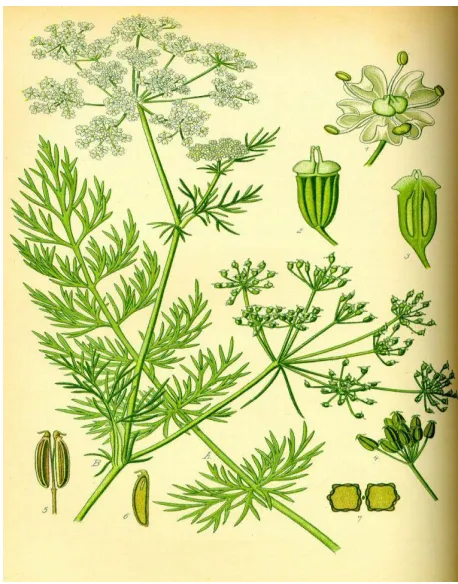
B. Persicum (Boiss.) B. Fedtsch. (Carum Persicum, Zire Kuhi) (Fig. 1) is an herbaceous and perennial plant belonging to the Apiaceae family [1]. The flowers are hermaphrodite and are pollinated by insects. It is also one of the most valuable indigenous medicinal plants in Iran, which is found locally in many parts of the country. Also B. Persicum is one of the most important indigenous spices of Iran, India, Tajikistan, Afghanistan, Pakistan, Kashmir and Central Asia [2].
oxidant activity of volatile compounds [5- 8], histamine effect of aqueous extract [9], anti-inflammatory activities of hydroalcoholic and polyphenolic extract [10] and antimicrobial activity of the oil and extracts of B. Persicum [11- 13] have been demonstrated in previous studies. The essential oil was used against the larvae of two vector species of mosquitoes [14].
Chemical composition of the essential oil of seeds of B. Persicum was analyzed using gas chromatography-mass spectrometry (GC/Mass). The main constituents of the oil were γ-terpinene, p-cuminaldehyde, α-methyl-benzenemethanol and β-cymene [14, 15].
[image:2.596.167.396.259.551.2]The essential oil of B. Persicum seed is rich in monoterpene hydrocarbons that show an efficient free radical scavenging and antioxidant activity. This activity is attributed to the presence γ-terpinene as the major component in this oil which is strongly active [8].
Figure 1. structures of of B. persicum seed
γ-terpinene was analyzed by GC and GC/Mass method [16-23]. The behavior and electrochemical mechanism of terpinenes at a platinum working electrode was studied by cyclic voltammetry [24]. Also Square-wave voltammetry at boron-doped diamond electrode was used for evaluating p-cymene and c-terpinene in essential oil of Carum copticum seeds [25].
For quantitative determination of γ-terpinene in essential oils of B. Persicum seed, voltametric methods was used.
The objective of this study is to use a novel sensor for the determination of γ-terpinene in essential oil of B. Persicum seed by an electrochemical method based on GNPS/GCE. This method is
sample preparation. Gold nanoparticles (GNPs) modified glassy carbon electrode (GCE) have been successfully applied for the determination of γ-terpinene.
2. EXPERIMENTAL SECTION
2.1. Reagents
Acetonitrile (HPLC, 99%), lithium perchlorate (98%), γ-terpinene and Chloroauric acid (HAuCl4) were obtained from Merck and used without any further purification. The glassy carbon
electrode (0.0314 cm2, Azar Electrode Co.,Urmia, I. R. Iran) was used for assembly process. B. Persicum seeds were purchased from pakan bazr co. in Isfahan (Iran) which was harvested from Jandagh Mountains in July 2012. The electrochemical study was carried out in acetonitrile (0.1 M LiClO4). The measurements were conducted in solutions made free from oxygen by the use of
bubbling nitrogen.
2.2. Isolation Procedure
The oils were obtained from 25.0 g of freshly ground seeds of B. Persicum by hydrodistillation for 4 h in 250 ml water, according to the determination of oil content in vegetable drugs, using the apparatus described in the Iranian herbal pharmacopeia [26]. The oils were separated and stored below 8°C in a refrigerator until voltammetry and GC/mass analysis was performed.
2.3. Electrochemical experiments
All electrochemical experiments were carried out using an Autolab potentiostat-galvanostat PGSTAT 35 (Eco chemie Utrecht, Netherlands) equipped with GPES 4.9 software. The electrochemical cell was equipped with a GNPS/GCE as the working electrode, a platinum electrode as
the counter electrode, and a silver/silver chloride (Ag/AgCl) electrode as the reference electrode. A personal computer (pentium IV) was used for data storage and processing.
The bare GCE was polished into a mirror-like 100 surface with 0.5 and 0.05 μm alpha Al2O3,
then rinsed ultrasonically with water / chloroform / water baths, each for 5 minutes, so that any physically adsorbed species be removed. The bare GCE electrode was immersed in gold nanoparticle (GNPs) solution for 10 h at room temperature (25 °C). An ultrasound bath (Bandelin Sonorex, Germany) was used at a constant frequency of 35 kHz during experimentation.
2.4. Preparation of colloidal gold
The GNPs were prepared according the following procedure, by adding 0.5 ml of 1 % sodium citrate solution to 50 ml boiling solution of 0.01 % HAuCl4. The mixture was maintained at boiling
diameter colloidal gold nanoparticles. Color of external solution for GNPs (24 nm) was pinkish red. The λmax of the GNPs by UV-vis spectra was observed to be 528 nm. The solution was stored in a
refrigerator in a dark-colored glass bottle.
2.5. GC/mass analysis
The components of the B. persicum were identified by GC–MS analyses. The GC–MS apparatus was a Hewlett Packarrd 5972A spectrometer consisting equipped with a fused-silica column HP-5MS (30 m - 0.25 mm i.d., film thickness 0.25 lm) The operating conditions were as follows: oven temperature 60-240 ºC with a rate of 4 ºC/min, injector temperature 250 ºC, injector mode: split injection, with carrier gas, He, flow rate 2 ml/min, mass spectra: electronic impact, ionisation potential 70 eV, ion source temperature 200 ºC.
2.6. Identification of components
The oil components were identified from their retention indices obtained with reference to the n-alkane series on the DB-5 column, mass spectra with those of authentic samples, composition of their mass spectra and fragmentation patterns reported in the literature, and computer matching with MS-data bank. Quantification of the relative amount of the individual components was performed according to the area percentage method.
3. RESULTS AND DISCUSSION
3.1. Voltammetric behavior of γ-terpinene
-200 -100 0 100 200 300 400 500 600 700 800
-1.0 -0.5 0.0 0.5 1.0 1.5 2.0 2.5 3.0
I /
µA
E / V vs Ag/AgCl
A
[image:4.596.160.420.518.694.2]C B
Figure 2. Cyclic voltammetry of (A) 9×10⁻³M γ-terpinene on the surface of GNPs/GCE in acetonitrile (0.1 M LiClO4 (B) 9×10⁻³M γ-terpinene on the surface of bare CPE in acetonitrile (0.1 M
The voltammograms of γ-terpinene solution with bare CPE and GNPs/CPE electrodes were investigated. Fig. 2 shows the cyclic voltammogram responses from 9×10⁻³M γ-terpinene on the surface of bare GCE and GNPs/GCE in acetonitrile (0.1 M LiClO4). At the bare electrode, γ-terpinene
shows a relatively broad and two weak oxidation peaks at 1800 and 2200 mV. Nevertheless, with the GNPs/GCE, the oxidation peak becomes well-defined and sharp, with a magnification current of 1500 and 2200 mV. The lower over potential and the increase in current response are clear evidence of the catalytic effect of the modified electrode on the oxidation of γ-terpinene. From these voltammograms, it can be seen that the peak potential of γ-terpinene shifts to less positive potentials and the peak currents increase.
3.2. Effect of scan rate
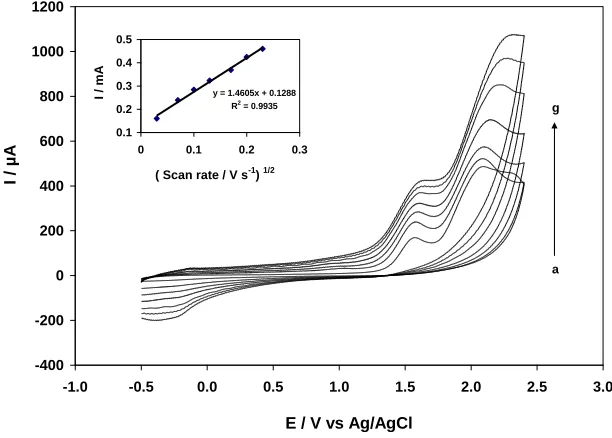
The effect of potential scan rate on the electrocatalytic oxidation of γ-terpinene at the GNPs/GCE was investigated using cyclic voltammetry. By increasing the scan rate, the oxidation peak potential shifted towards a more positive potential, confirming the kinetic limitation of the electrochemical reaction. This result suggests that, at sufficiently positive potentials, the reaction is controlled by γ-terpinene diffusion. The linear regression equation is shown in Equation [27].
Ip = 2.69×10⁵ n 3/2 A D 1/2 C υ 1/2
Where C is the bulk concentration, D is the diffusion coefficient, A is the electrode surface area (0.029 cm2), α is the transfer coefficient, n is the number of electrons transferred in the reaction and υ is the scan rate.
The effect of scan rate (υ) on the electrochemical behavior of γ-terpinene in the GNPs/GCE in acetonitrile (0.1 M LiClO4) containing 1 mM γ-terpinene is shown in Fig. 3A.
-400 -200 0 200 400 600 800 1000 1200
-1.0 -0.5 0.0 0.5 1.0 1.5 2.0 2.5 3.0
I /
µA
E / V vs Ag/AgCl
a g
y = 1.4605x + 0.1288 R2
= 0.9935
0.1 0.2 0.3 0.4 0.5
0 0.1 0.2 0.3
I /
m
A
[image:5.596.128.434.489.708.2]( Scan rate / V s-1) 1/2
For scan rates between 30 and 230 m V s-1, the γ-terpinene oxidation peak current also increases linearly with the square root of the scan rate suggesting that the reaction is diffusion-limited (Fig. 3B). The linear regression equation for γ-terpinene was found to be:
I Pa, γ-terpinene = 1.46 V 1/2 + 0.128, R2 = 0.993
3.3. Differential pulse voltammetry investigations for the measurement of γ-terpinene
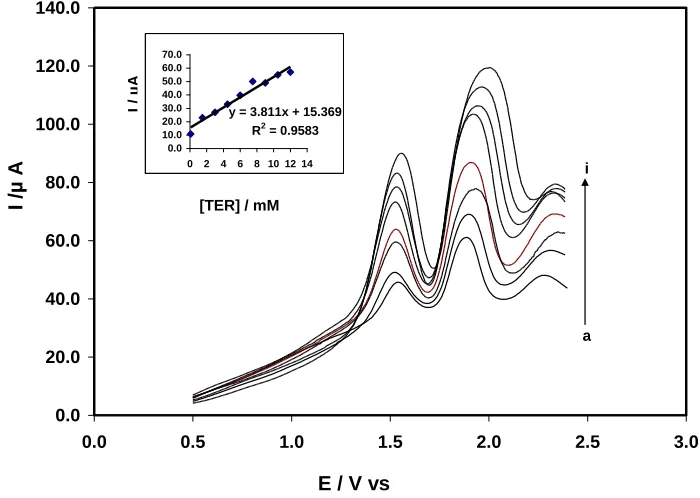
Given that differential pulse voltammetry (DPV) has a much higher current sensitivity and better resolution than cyclic voltammetry (CV), it was used to estimate the detection limits for γ-terpinene. Moreover, the charging current contribution to the background current, which is a limiting factor in the analytical measurements, is negligible in DPV. Fig. 4 shows the DPV data obtained for the oxidation of different concentrations of γ-terpinene on the GNPs/CPE in acetonitrile (0.1 M LiClO4) at a scan rate of 25 mV s−1.
0.0 20.0 40.0 60.0 80.0 100.0 120.0 140.0
0.0 0.5 1.0 1.5 2.0 2.5 3.0
I /
µ
A
E / V vs
a i
[TER] / mM
I /
µ
A
y = 3.811x + 15.369 R2 = 0.9583 0.0
10.0 20.0 30.0 40.0 50.0 60.0 70.0
0 2 4 6 8 10 12 14
Figure 4. Differential pulse voltammograms of of γ-terpinene on the GNPs/GCE in acetonitrile (0.1 M LiClO4) at a scan rate of 25 mV s−1 (A) Plots of peak current as a function of γ-terpinene
concentration in the range of 1.2×10⁻²M 1×10- -4M.
[image:6.596.106.456.331.580.2]
We report the oxidation of γ-terpinene by a GNPS/GCE in DPV method and compare a
voltammetric and GC/Mass method and validated it for determination of γ-terpinene in essential oil of B. Persicum seed. Determination of γ-terpinene in essential oil was achieved by the standard addition method, yielding a plot of peak height versus γ-terpinene concentration. A linear equation (ip = 0.011C
+ 0.0296) was obtained with a correlation coefficient of 0.999. Under these conditions, quantity of γ-terpinene in B. Persicum oil was obtained as 36.7g. The amount of γ-terpinene obtained by voltammetry method has good agreement with the value obtained by GC/Mass method. The results are in good agreement with each other and acceptable and the proposed method for determination of γ-terpinene can be used.
3.4. GC/mass results
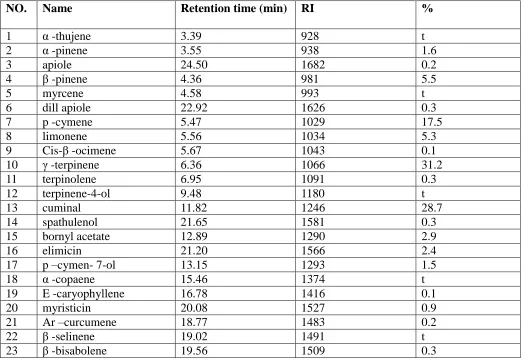
Table 1. GC/mass results for B. persicum oil
NO. Name Retention time (min) RI %
1 α -thujene 3.39 928 t
2 α -pinene 3.55 938 1.6
3 apiole 24.50 1682 0.2
4 β -pinene 4.36 981 5.5
5 myrcene 4.58 993 t
6 dill apiole 22.92 1626 0.3
7 p -cymene 5.47 1029 17.5
8 limonene 5.56 1034 5.3
9 Cis-β -ocimene 5.67 1043 0.1
10 γ -terpinene 6.36 1066 31.2
11 terpinolene 6.95 1091 0.3
12 terpinene-4-ol 9.48 1180 t
13 cuminal 11.82 1246 28.7
14 spathulenol 21.65 1581 0.3
15 bornyl acetate 12.89 1290 2.9
16 elimicin 21.20 1566 2.4
17 p –cymen- 7-ol 13.15 1293 1.5
18 α -copaene 15.46 1374 t
19 E -caryophyllene 16.78 1416 0.1
20 myristicin 20.08 1527 0.9
21 Ar –curcumene 18.77 1483 0.2
22 β -selinene 19.02 1491 t
23 β -bisabolene 19.56 1509 0.3
[image:7.596.38.562.306.666.2]
shown in Table 1, γ-terpinene in the B. persicum oil was the main monoterpene hydrocarbon with 31.2% and shows that the GC/mass results are similar to the DPV results. In order to address the qualitative determination of composition of B. persicum oil by GC-MS, it is necessary to utilize retention indices identities [28]. The retention time (RT) and retention index (RI) for each compound are also presented in Table 1.
4. CONCLUSION
The GC/mass analysis of B. Persicum oil was performed and results showed that γ-terpinene is the main component of B. Persicum oil. A new method using a glassy carbon electrode modified with gold nanoparticles (GNPS/GCE) was developed and validated for determination of γ-terpinene. The
GNPS/GCE was then successfully used to determine the concentration of γ-terpinene in B. Persicum
oil. The concentration of γ-terpinene obtained by this electrode was on the same order of value as the concentration obtained by GC/mass analysis. In addition, high selectivity, good sensitivity, low detection limits and simple, fast and low cost make this method suitable for accurate analysis in pharmaceutical and herbal medicine.
ACKNOWLEDGMENTS
The authors wish to express their gratitude to the Talae Sabz Pharmaceutical for supporting this work. References
1 K. H. C. Baser, T. Oezek, B. E. Abduganiev, U. A. Abdullaev and K. N. Aripov, J. Essent. Oil Res., 9, (1997) 597-598.
2 M. Azizi, G. Davareenejad, R. Bos, H. J. Woerdenbag and O. Kayser, J. Essent. Oil Res., 21 (2009) 78.
3 Anonymous, Nederlandse Farmacopee. 6th Edn., 2nd printing, Staatsuitgeverij, ‘s-Gravenhage, The Netherlands, 1966, 72.
4 C. P. Kala, Medicinal plants of Indian trans-Himalaya. Bishan Singh Mahendra Pal Singh, (2003) Dehradun.
5 T. Sekine, M. Sugano, M. Azizi and F. Yoshiharu, J. Chem. Ecol., 33 (2007) 2123.
6 N. Shahsavari, M. Barzegar, M. A. Sahari and H. Naghdibadi, Plant Foods Hum Nutr., 63 (2008) 183.
7 M. Keramat and M. T. Golmakan, Grasas y Aceites, 67 (2016)1.
8 M. Keramat, M. T. Golmakani, M. Aminlari and S. Shekarforoush, Int. J. Food Prop., 19 (2016) 2666.
9 G. Ruberto and M. T. Baratta. Food Chem., 69 (2000)167.
10 M. H. Boskabady, and A. Moghadas, int. J. Phytoth. Phytopharm., 11 (2004) 411. 11 V. Hajhashemi, S. E. Sajjadi, M. Zomorodkia, Pharm. Biology, 49 (2011) 146.
12 A. Rustaie, R. Keshvari, N. Samadi, F. Khalighi-Sigaroodi, M. R. S. Ardekani, M. Khanavi, Pharm. Sciences, 22 (2016) 296-301.
13 P. Ghaderi, R. Ahmadi, F. Balkanyian, A. Moridikyia, E. Mahdavi and P. Tavakoli, In vitro Antibacterial Activity of Bunium Persicum and Mentha Longifolia against Bacillus Subtilis and Staphylococcus Aureus. International Conference on Chemical, Agricultural and Medical Sciences (CAMS), Turkey, Antalya, 2014).
15 A. S. Dehkordi, H. Vatandoost, M. R. Abaei, B. Davari, M. M. Sedaghat, J Essent. Oil Bear Plants, 19 (2016) 349.
16 K. H. C. Baser, T. Oezek, B. E. Abduganiev, U. A. Abdullaev and K. N. Aripov, J. Essent. Oil Res., 9 (1997) 597.
17 S. M. Pourmortazavi, M. Ghadiri and S. S. Hajimirsadeghi, J. Food Composition And Analysis, 18 (2005) 439.
18 B. E. Abduganiew, U. A. Abdullaev, K. N. Aripov, K. H. C. Baser and T. Oezek, J. Essent. Oil Res., 9 (1997) 597.
19 R. K. Thappa, S. Ghosh, S. G. Agarwal, Food Chem., 41 (1991) 129.
20 A. Rustaie, R. Keshvari, N. Samadi, F. K. Sigaroodi, M. R. S. Ardekani and M. Khanavi, Pharm. Sci., 22 (2016) 296.
21 B. E. Abduganiev, V. Rashkes and V. N. Plugar, Chem. Nat. Comp., 30 (1994) 269-275.
22 R. K. Chahota, V. Sharma, M. Ghani, T. R. Sharma, J. C. Rana and S. K. Sharma, Physiol Mol Biol Plants, 23(2017) 429.
23 F .Sharififar, N. Yassa and V. Mozaffarian, Pak. J. Pharm. Sci., 23 (2010) 300. 24 D. M. Stankovic, Anal. Biochem., 486 (2015) 1.
25 N. B. Salah, F. Matoussi, J. Electroanal. Chem., 583 (2005) 1.
26 A. Zarghari, Pharmacopeia of Iran herbs (2011) Compiled by the Pharmacopeia Commission of Food and Drug administration of Iran, Iran.
27 A. J. Bard and L. R. Faulkner, Electrochemical Methods, Fundamentals And Applications (2001) Wiely, New York.
28 R. P. Adams, Identification of Essential Oils Components by Gas Chromatography/Quadrupole Mass Spectroscopy (2001) Allured: Carol Stream, IL, USA.