White Rose Research Online URL for this paper: http://eprints.whiterose.ac.uk/82655/
Version: Published Version
Monograph:
Meager, N, Newton, B, Sainsbury, Roy Derek orcid.org/0000-0002-1217-6818 et al. (2 more authors) (2014) Work Programme Evaluation : the participant experience report. Research Report. Department for Work and Pensions Research Report . Department for Work and Pensions , London.
Reuse
Items deposited in White Rose Research Online are protected by copyright, with all rights reserved unless indicated otherwise. They may be downloaded and/or printed for private study, or other acts as permitted by national copyright laws. The publisher or other rights holders may allow further reproduction and re-use of the full text version. This is indicated by the licence information on the White Rose Research Online record for the item.
Takedown
If you consider content in White Rose Research Online to be in breach of UK law, please notify us by
Work Programme
Evaluation: the
participant experience
report
December 2014
Research report No 892
A report of research carried out by the Institute for Employment Studies, the Social Policy Research Unit at the University of York, the National Institute of Economic and Social Research, the Centre for Economic and Social Inclusion and GfK NOP on behalf of the Department for Work and Pensions.
© Crown copyright 2014.
You may re-use this information (not including logos) free of charge in any format or medium, under the terms of the Open Government Licence. To view this licence, visit http://www.nationalarchives.gov.uk/doc/open-government-licence/or write to the Information Policy Team, The National Archives, Kew, London TW9 4DU,or email: [email protected].
This document/publication is also available on our website at: https://www.gov.uk/government/collections/research-reports If you would like to know more about DWP research, please email: [email protected]
First published 2014. ISBN 978-1-910219-65-2
Contents
Acknowledgements ... 12
Authors’ Credits ... 13
Glossary ... 14
DWP Preface Notes ... 16
Executive Summary ... 18
Characteristics of Work Programme participants... 18
Programme entry ... 18
Pre-employment support ... 19
In-work support ... 20
Getting work ... 20
Staying in work ... 21
Those who completed the programme without finding sustained work ... 22
Some key themes emerging from the evaluation... 23
Specific and multiple barriers to work ... 26
Part 1: Introduction ... 29
Coverage of this report and methods ... 29
Report structure ... 30
1 The Work Programme ... 32
1.1 A new model for welfare-to-work ... 32
1.2 The commissioning model ... 33
1.3 Programme delivery and service design ... 35
2.3.1 Provider research ... 41
2.3.2 Participant research ... 41
2.3.3 Measuring outcomes and impact ... 42
2.3.4 Locating the evaluation within existing evidence ... 43
3 Work programme participants: their labour market background and personal characteristics ... 44
3.1 Personal characteristics ... 44
3.2 Qualifications ... 47
3.3 Family, caring, household and housing circumstances ... 48
3.4 Participants’ labour market background and circumstances ... 51
3.5 Summary ... 53
Part 2: Programme delivery ... 55
4 Referral and entry to the Work Programme ... 56
4.1 Pre-programme information sessions ... 56
4.1.1 Most participants attend an information session ... 56
4.1.2 Understanding still relatively high among those who do not attend a session ... 58
4.2 Waiting time before starting on the programme ... 58
4.3 Why participants join the programme ... 59
4.4 Perceptions of voluntary or mandatory participation... 61
4.5 Summary ... 62
5 Pre-employment support ... 64
5.1 Initial contact with participants, role of advisers, assessment and action planning ... 64
5.1.1 Assessment and initial contact with providers ... 64
5.1.2 Action planning ... 66
5.1.3 Nature and frequency of ongoing contact with Work Programme advisers ... 67
5.2 Nature of provision: work-first, human capital and other approaches ... 75
5.3 Support for participants with a health condition or disability ... 79
5.4 Homeless participants ... 80
5.5 Participants’ views on support offered and received from providers... 81
6.1 The purpose of, and early feedback from participants on, in-work support 91
6.2 Being contacted about in-work support ... 92
6.2.1 Frequency of in-work support contact ... 93
6.2.2 Perceived impact of in-work support ... 96
6.2.3 Experience of pressure from advisers to stay in work ... 98
6.2.4 What more in-work support is wanted ... 99
6.2.5 Opportunities to progress in work ... 104
6.3 Summary ... 106
Part 3: Outcomes ... 108
7 Employment entries ... 109
7.1 Evidence from participant survey ... 109
7.1.1 Employment status of Work Programme participants ... 110
7.1.2 Characteristics of jobs taken by Work Programme participants ... 112
7.1.3 Participants’ views on jobs taken and the role of the Work Programme in supporting them into work ... 113
7.1.4 Key factors associated with employment entries among Work Programme participants ... 117
7.2 Self-employment and the Work Programme ... 119
7.2.1 Discussions about self-employment ... 119
7.2.2 Experience of self-employment ... 121
7.2.3 Sustainability of self-employed work ... 122
7.3 Summary ... 123
8 Sustained employment ... 125
8.1 Evidence from the participant survey ... 125
8.1.1 Multivariate analysis ... 130
8.2 Evidence from the qualitative research ... 132
8.2.1 Sustaining employment rather than holding down one job ... 133
8.2.2 Reasons to stick with an unsatisfactory job ... 134
8.2.3 Expectations for the future ... 134
9.3.1 What was missing from the experience? ... 144
9.4 Summary ... 145
10 Mandation, conditionality and sanctions ... 147
10.1 Who is mandated to do what? ... 147
10.2 Awareness of conditionality and sanctions ... 149
10.3 Sanctions in practice ... 152
10.4 Effects of the threat and use of sanctions ... 154
10.4.1 Effects on engagement ... 154
10.4.2 Effects on keeping appointments and undertaking activities ... 155
10.4.3 Effects on job entry ... 157
10.4.4 Impact of sanctions ... 158
10.5 Summary ... 159
11 Personalisation ... 161
11.1 Background: concept of personalisation in the Work Programme context 161 11.2 Procedural personalisation ... 162
11.3 Substantive personalisation ... 164
11.4 Work-first and human capital approaches to provision ... 171
11.5 Summary ... 172
12 Variations in provision across different participant groups ... 174
12.1 Some evidence of differences in the support participants receive ... 174
12.1.1 Differences in the pre-employment support experience ... 174
12.2 Summary ... 179
13 Aspirations and motivation ... 181
13.1 Wanting to work... 181
13.2 Factors affecting motivation before engagement with the Work Programme 182 13.3 Impact of the programme on motivation ... 183
13.4 The fit between people’s aspirations, the labour market and the support received ... 186
13.5 Motivations for sustaining work ... 188
14.2 Many are relatively job-ready ... 191
14.3 A different experience of the programme? ... 192
14.4 Not ready for work? ... 192
14.5 Moving towards and into work, or not ... 193
14.6 A fit between health and work? ... 194
14.7 Motivated to stay in work ... 195
14.8 Sustaining employment with ill-health ... 196
14.9 Health/disabilities and completing the programme without finding work ... 196
14.10Summary ... 198
15 Housing ... 199
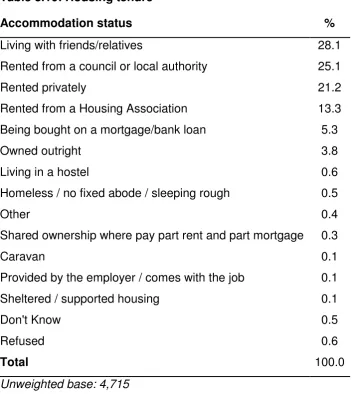
15.1 Participants’ housing tenure ... 199
15.2 The experience of homeless participants ... 201
15.2.1 Financial impact of housing ... 201
15.2.2 Lack of documentation acts as a barrier ... 202
15.2.3 Experience of pre-employment support ... 203
15.3 Little help to find stable housing ... 205
15.4 Summary ... 205
16 Participants’ finances... 207
16.1 About a fifth receive financial advice ... 207
16.2 Feelings of being better off or not ... 208
16.3 Financial implications of taking up a job ... 209
16.4 The role of in-work benefits ... 210
16.5 Summary ... 211
17 Family and caring responsibilities ... 212
17.1 Family and caring provision pre-employment ... 212
Appendix 1: detailed tables from participant survey and multivariate analysis ... 226
Survey tables ... 226
List of Tables
Table 1.1: Work Programme Payment Groups 33
Table 2.1: Qualitative participant samples 39
Table 3.1: Age distribution of WP participants in survey 42
Table 3.2: Ethnic origin of WP participants in survey 42
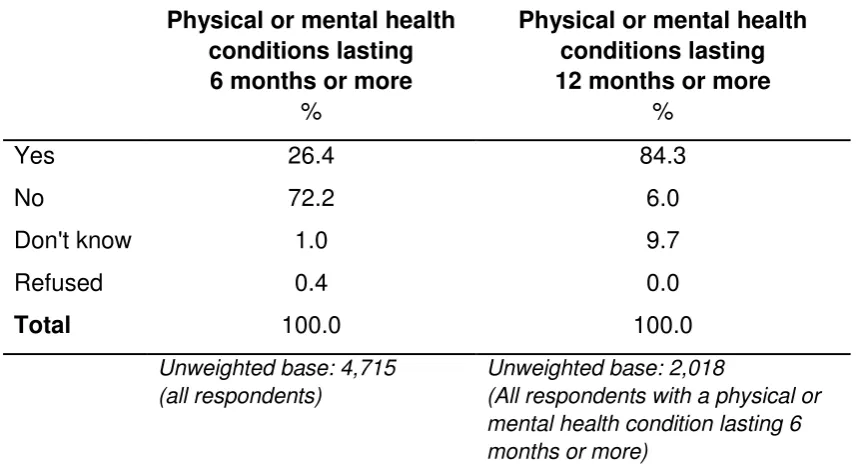
Table 3.3: Health conditions among WP participants in survey 43
Table 3.4: Type of health condition/disability 44
Table 3.5: Qualification levels of WP participants 45
Table 3.6: Family/household status of WP participants 46
Table 3.7: Children under 16 46
Table 3.8: Caring responsibilities 47
Table 3.9: Employment impact of caring responsibilities 47
Table 3.10: Housing tenure 48
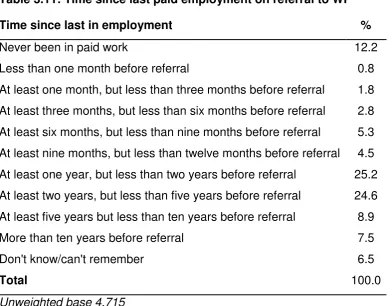
Table 3.11: Time since last paid employment on referral to WP 49
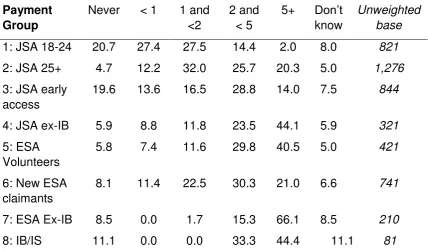
Table 3.12: Work Programme Payment Groups by time since last paid
employment on referral to WP 50
Table 4.1: Information sessions for new participants 54
Table 4.2: Value of information sessions to WP participants 54
Table 4.3: Information provided to WP participants who did not attend
information sessions 55
Table 4.4: Waiting times for attachment to the Programme 56
Table 4.5: Prior understanding of Work Programme 58
Table 5.6: Frequency of meetings with personal adviser 70
Table 5.7: Participants’ satisfaction with frequency of advisory contact 72
Table 5.8: Nature of support received by participants 74
Table 5.9: Participants not offered support, by whether health condition makes it
difficult to find work 76
Table 5.10: Views on utility of different support types provided: Wave 1 78
Table 5.11: Views on utility of different support types provided: Wave 2 79
Table 5.12: Participants’ views on effectiveness of WP support in helping them
find work 80
Table 5.13: Overall effectiveness of WP support in helping find a job or move
closer to work 81
Table 5.14: Perceived adequacy of support received under WP 82
Table 5.15: Role played by WP support in increasing the probability of finding
work 84
Table 6.1: In-work support offered under WP 88
Table 6.2: Frequency of in-work contact with WP advisers 90
Table 6.3:Appropriateness of frequency of in-work contact 91
Table 6.4: Impact of in-work support on employment retention 92
Table 6.5: Nature of positive impacts of in-work support 93
Table 6.6: Pressure from advisers for employment retention 95
Table 6.7: Additional in-work support desired among recipients of in-work
support 97
Table 6.8: Additional in-work support desired among those not receiving in-work
support 98
Table 6.9: Participant views on prospects for in-work advancement 99
Table 6.10: In-work training 100
Table 7.1: Employment status of WP participants at time of survey 105
Table 7.4: Contractual basis of (employee-status) jobs among WP participants
in work 107
Table 7.5: Suitability of work found by WP participants in employment 109
Table 7.6: Reasons for accepting less well-matched employment 110
Table 7.7: Role played by WP support in securing work 111
Table 8.1: Duration of current employment (Wave 1: approx. 6 months after
Work Programme attachment) 122
Table 8.2: Duration of current employment (Wave 2: approx. 24 months after
Work Programme attachment) 122
Table 8.3: Duration of current and total cumulative employment (Wave 2) 123
Table 9.1: Employment status after 24 months on programme 133
Table 10.1: Mandation requirements on Work Programme participants 145
Table 10.2: Awareness of mandation and sanctions 146
Table 10.3: Whether participants thought activities were compulsory 147
Table 10.4: Incidence of sanctioning among WP participants 148
Table 10.5: Reasons for sanctioning 149
Table 10.6: Whether threat of sanctions made a difference to participants’ co
-operation with provider 152
Table 11.1: Overall perception of how well support matched participants’ needs 160
Table 11.2: How well support matched participants’ needs, by age group 160 Table 11.3: How well support matched participants’ needs, by health status 161
Table 11.4: How well support matched participants’ needs, by qualification level 162
Table 18.1: The number of difficulties to finding work among participants 214
Table 18.2: Frequency of meetings by number of barriers 214
Table 18.3: Interventions received by number of barriers 215
Acknowledgements
Our sincere thanks go to DWP staff including Janet Allaker (current project manager), Katie Fawkner-Corbett and Matthew Garlick (previous project manager).
The research could not have progressed without the support offered by Work Programme participants who contributed to the surveys and qualitative research.
Authors’ Credits
Nigel Meager (IES), Director of IES, is an international expert on labour market and employment policy. A major strand of recent work has centred on the evaluation of public training and employment programmes, with a particular focus on participation of disabled people and other disadvantaged groups. His work has an international emphasis on the comparison of labour market policies, and the identification and transfer of good practice in policy development
Becci Newton (IES) is a Principal Research Fellow at IES. She leads the institute’s work on young people’s transitions into the labour market and also focuses on adult unemployment. For example, she recently headed up the Evaluation of the Youth Contract 16-17 year olds (DfE) and an evaluation of a pilot to deliver work-focused services to lone parents in children’s centres in Wales (Welsh Government).
Roy Sainsbury (SPRU) is a Research Director and Professor of Social Policy in the Social Policy Research Unit at the University of York where he leads the research team on welfare and employment. His research focuses on social security,
employment, sickness and disability, welfare to work and the administration and delivery of benefits.
Anne Corden (SPRU) is a Senior Research Fellow in the Social Policy Research Unit. She has worked on numerous projects on health, disability and employment including the official evaluations of employment programmes (Pathways to Work and the New Deal for Disabled People) and health and well-being pilots.
Annie Irvine (SPRU) is a Research Fellow in the Social Policy Research Unit. She has extensive experience of research projects covering health, disability and
Glossary
Black box A term for minimum service prescription, which allows providers to decide which interventions to offer to programme participants into sustainable employment.
Claimant A term describing someone of working age in receipt of state benefits
Differential pricing A system of funding where providers are paid at different rates for outcomes achieved by different claimant groups with outcomes for the harder-to-help groups being paid at higher rates than those for groups closer to the labour market.
Jobcentre Plus Jobcentre Plus is the UK public employment service which is part of the Department for Work and Pensions. It provides services that support people of working age from welfare into work, and helps employers to fill their vacancies.
Minimum Service Standards When bidding Work Programme prime providers had to specify their own individual set of minimum service standards. These set out, for example, the frequency of contact and nature of support a participant can expect from the provider. The minimum service standards vary considerably between providers and are often not quantifiable or measurable.
Supply chain The organisations providing services to Work Programme participants under contract to a Work Programme prime providers.
Sustained job outcome This refers to a spell of employment entered by a programme participant that lasts for at least 13 or 26 weeks (depending on the claimant group).
DWP Preface Notes
Having now helped 444,000 people into jobs and 208,000 into lasting work, the Work Programme is succeeding — transforming the lives of those furthest from the labour market, who are the hardest to help into employment. The Department welcomes this report as an independent view of the current delivery of Work Programme as
experienced by participants.
The report contains a lot of positive feedback from participants including a general satisfaction with support provided. DWP is committed to utilising the results from this report in the continuous improvement of the Work Programme and the design of any future contracts. As such, DWP would like the reader to note a number of updates summarised below:
Building Best Practice
In March 2013, the Department commissioned an externally led Building Best Practice group which made recommendations including the following:
to maximise transparency both in the current Work Programme and in future contracts to allow providers and subcontractors to benchmark their
performance against the best in their field.
to ensure Minimum Service Levels should be incorporated into a Customer Service Standard Framework, which follows the customer journey through the Work Programme.
to explore capacity building for the sector, to improve engagement with specialist Voluntary and Community Sector organisations.
The Department is committed to implementing these recommendations.
We have an increasing focus on sharing best practice and building the capability of the market to deliver. We have started this with the Work Programme Accelerated Performance Regime workshops, and we will continue to build this approach.
Service delivery to ESA participants
2015. These are exploring a variety of different approaches including supporting people while still in employment and supporting those with mental health conditions. From early 2015 we are introducing a number of pilots, these include: those awaiting a Work Capability Assessment will be offered voluntary employment-related Work coach interventions; for the first six months following the completion of the Work Programme, pilots will offer increased frequency and intensity of Work Coach
support; more personalised Remploy support; enhanced Jobcentre Plus support and support from local health care professionals; and a local authority led pilot in
Manchester.
In-work Support
The Work Programme is designed to support people into lasting employment and this remains DWP’s goal for the long-term unemployed. The Department is building an evidence base on in-work support through our comprehensive trialling strategy. The Department will be considering the findings in this report alongside the evaluation of current and planned trials to test and learn about effective approaches that can drive employment retention and progression.
Work Programme sanctions policy
Since the conclusion of the research reported here, DWP commissioned an independent review of the operation of JSA sanctions that are validated by the Jobseeker’s Act of 2003, which includes the Work Programme.The Oakley review made 17 recommendations about how to improve the system, in particular around improving claimant understanding and communication; in the Department’s response it accepted all these recommendation and work is already underway on delivering against these; please see full details below1.
Universal Credit
The research identifies a financial challenge for some Work Programme participants in managing the transition from benefits to paid work.
Executive Summary
This report brings together and summarises the key evidence available from the different strands of the Work Programme evaluation relating to the experience of participants (a parallel report, Foster et al., 2014, sets out the findings relating to Work Programme providers).
In particular, it presents analyses from two waves of a large scale longitudinal survey of participants and a multi-wave (partly cross-section, partly longitudinal) programme of in-depth qualitative fieldwork with participants.
Previous reports from the evaluation (Newton et al., 2012, and Lane et al., 2013) presented early findings on programme delivery and programme commissioning respectively. A final synthesis report, summarising the overall evaluation is planned for publication in 2015.
The evaluation tracks the Work Programme over several years from its launch in 2011. The present report notes changes in participants’ experiences and perceptions of the programme during this period, which reflect changes in delivery of the
programme as it beds down over time as well as changes in the economic climate in which it is operating. However, the later data reported here are more likely to
represent a picture of the programme as it settles down into a steady state. As the findings from the evaluation build up, DWP is able to use the evidence to improve programme performance and influence the design and management of future programmes.
Characteristics of Work Programme
participants
The representative national survey of Work Programme participants found (Chapter 3) that:
two thirds were male;
three quarters were under 45;
The evidence on referral and entry to the programme (Chapter 4), showed that:
over half of participants attended some kind of information session about the programme prior to referral, and most of them found this useful.
the time between being referred to the programme by Jobcentre Plus and starting with a provider was less than three weeks for most participants.
nearly half of participants felt a ‘push’ from Jobcentre Plus to join the programme, although a third cited intrinsic ‘pull’ reasons and a desire to find work. Most
participants correctly understood that their participation in the programme was mandatory.
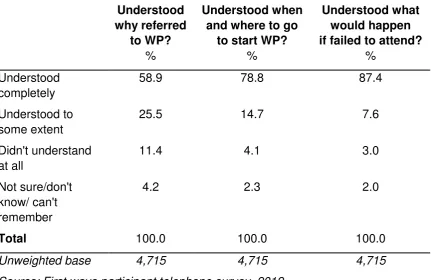
overall, participants seemed well-informed about the programme’s rationale, and the procedures for joining it.
Pre-employment support
Evidence from previous welfare-to-work interventions emphasises the importance of flexible tailored support from personal advisers, but notes that this can be
undermined by large caseloads and staff turnover, and that interventions need to be preceded by effective needs assessments.
Evidence from the Work Programme (Chapter 5) shows that early assessments were common, usually but not always conducted face-to-face, and that most participants started the programme with a good understanding of the support available, although some were not completely comfortable to discuss their difficulties in finding work with their advisers.
The existing evidence suggests a growing use of written action plans in welfare-to-work programmes. This term typically refers to written documents listing the steps a participant/claimant should be taking to move towards employment which are often developed collaboratively between the adviser and the participant. In the Work Programme, the provider data (reported separately: Foster et al., 2014) suggested near universal use of personalised action plans, but participants reported them much less commonly (this finding may, in part, reflect a failure to recognise the terminology ‘action plan’).
Providers report (Foster et al., 2014) that they normally deliver support through personal advisers, usually face-to-face, and aim to offer continuity of adviser support. Evidence from participants, however, suggests that such continuity is less commonly experienced by some groups (e.g. older participants) than others. Fortnightly
meetings were most common and most participants were happy with the frequency of contact. In the early months of participation there was significant variation in the frequency of advisory contact between different groups but by the two year point only there was only one group recording a significant difference in frequency of
work), with less emphasis on human-capital based approaches (e.g. training programmes). Most participants received help with CVs, job search and interview techniques. Few were referred to training provision or to support designed to address specific barriers to employment (e.g. health conditions, accommodation problems or caring responsibilities). Evidence from Work Programme providers (Foster et al., 2014) confirms this, with limited use of subcontractors (especially specialist
providers) in supply chains to deliver support interventions, and most support being delivered through generalist, in-house staff.
Nonetheless, most participants who cited difficulties finding work reported that the interventions received were helpful in overcoming their barriers and moving closer to work. However, some groups (older, disabled and better-qualified participants in particular) were less likely to report the interventions as helpful.
Looking overall at their experience of the programme, most participants thought the support they received was adequate, although disabled people and people with health conditions, and highly qualified participants were significantly more likely to feel that they had not received enough support. Participants with health conditions and disabilities often did not feel ready to progress towards work - they were much more likely to be looking for support related specifically to medical or disability matters and they were also rather less likely than participants as a whole to wish for more meetings or contact with advisers.
In-work support
The Work Programme emphasises participants being retained in employment rather than simply starting a job. Previous research suggests that continued support from providers/personal advisers in the early months of employment in particular can help employment retention, especially if a flexible approach is offered and/or if
supplementary financial support is also available (Chapter 6).
at some point during the six months and 18% were currently in work. After two years on the programme the corresponding employment rates were 44% and 33%
respectively3.
Additional insights (from Chapter 7) include:
part-time and temporary jobs were much more common among Work Programme participants (accounting for 44% and 43% respectively) than among the overall UK workforce, but the proportion of participants in work who were self-employed (13% after six months, 15% after two years) was similar to the national average;
participants in work were generally satisfied with the job they entered; nearly 80% (after six months and after two years) said their job was well-matched to their skills. There was little evidence of participants being pushed into unsuitable employment;
however they were more ambivalent about the role the Work Programme had played in helping them find a job (around half of participants in work (after six months and after two years) believed that the programme had played a role in helping them find that work.
additionally, personal characteristics made a difference to the likelihood of participants finding work while on the programme. In particular, in both waves:
- women were more likely to enter work than men;
- younger participants were more likely to enter work than older participants;
- people without health conditions or disabilities more likely to enter work than people with such conditions;
- those with recent work experience were more likely to enter work than those with limited prior work experience.
Staying in work
The first wave survey (which took place 6-9 months after programme entry) found that a quarter of those who had entered work (4% of all participants) had remained in work for six months or more (Chapter 8). By the time of the second survey (when participants had been on the programme for two years), over two thirds of those in work (33% of all participants) had worked for six months or more, and nearly a quarter (24% of participants) had been in work for at least 18 months.
me_Statistical_Release_Sep14_Final.pdf). For example, 27% of the early cohorts of JSA 24+
claimants completing the programme achieved job outcomes. This increased to 32% for the cohort which started in March 2012. The rates of job outcomes being achieved compares favourably with the original National Audit Office (2012) projection of 26% (which took account of the challenging
economic conditions in the early months of the programme).
Looking at all participants at the second survey, and their cumulative spells in work, just over 30% had experienced a total of six months or longer (in one or several jobs) during their two year period on the programme.
Multivariate statistical analysis4 (i.e. controlling for other factors) showed that, after two years, participants’ total duration of employment while on the programme was higher if they:
were female;
were young;
did not have a disability or health condition;
had recent work experience prior to joining the programme;
lived in a less deprived local labour market.
There was also some statistical evidence that those who had received more frequent contact from personal advisers were likely to achieve longer durations in
employment. This may not be conclusive evidence of a positive effect of frequent adviser contact, however, as it could equally reflect a tendency for providers to offer more frequent contact to participants they judge more likely to achieve sustained work (and therefore trigger ‘outcome payments’).
Qualitative evidence suggested that financial pressures and the belief that ‘any work is better than no work’ both acted as motivators for participants to hang on to the jobs they secured; some also reported intrinsic motivation, job satisfaction, dignity and self-esteem as important factors in work retention.
Those who completed the programme without
finding sustained work
After two years on the programme, two thirds (67%) of participants were not in work, and would return to Jobcentre Plus job-search support provision, although 21% of this group had managed to find work at some point during their participation on the
4
Work Programme. This is broadly in line with the official statistics for the Work Programme5.
Evaluation evidence showed that statistically, these ‘completers’ were more likely to be men, to be older than 55, to have a health condition or disability, to have low or no qualifications, and to have no recent work experience prior to joining the programme.
Qualitative research provided some insight to the process by which this group
transitioned back to Jobcentre Plus support, and what they thought they had got from their time on the programme:
Some reported a well-structured transition with a review of achievements and progress, while others noted a less well co-ordinated process and less clarity about what would happen next.
Some, who had a good relationship with providers, wanted to remain on the Work Programme, looking for work. Others, less satisfied with their contact with the provider, were keen to leave the programme.
Some (especially older participants, and with health conditions) believed they were too ill to work, and reported having little support from providers (often because their conditions inhibited regular contact). Others completing their time on the programme, mainly JSA claimants, remained optimistic about their employment prospects, and a further group were planning entry to further education or training on leaving the programme (believing that access to such education/training had been prevented by being on the programme)
As with other participants, this group had mixed views on whether the programme had made a difference to them. Some appreciated positive and supportive adviser contact, but this did not always lead them to feel that the programme had made a difference. Others highlighted benefits such as an improved CV or greater
confidence as a result of the programme. Some of those completing the
programme criticised it for not delivering the promised personalised support, and some highlighted a need for more contact time with advisers, and more access to training linked to labour market opportunities.
Some key themes emerging from the
evaluation
In addition to the detailed findings about how different stages of the programme were functioning, the research identified several cross-cutting themes, relating to factors which affect the success of the programme in getting and keeping participants in work, and influenced the kind of provision delivered under the programme.
Conditionality
there was widespread awareness among participants of the mandatory nature of the programme and the implications of not engaging with it, and a general
acceptance that such an approach was ‘reasonable’ in principle;
participants believed the system should be fair, transparent, and operate correctly and consistently. Those who believed that these criteria had not been applied to their own situations said that the sanctions regime could be subject to
administrative inconsistencies
the most common view among participants interviewed shortly after joining the programme was that the conditionality and sanctions regime was largely unnecessary or irrelevant to them. This was because they saw themselves as naturally compliant because of their overwhelming desire to find work
after six months 10% of participants reported that they had been sanctioned and said they had their benefits stopped or reduced, and of these a third said they had applied for a hardship payment as a result. After two years the proportion who reported a sanction increased to 14% (of whom half had applied for hardship payments);
qualitative findings suggested that some people who reported experience of a sanction also felt they had been largely compliant, and faced sanctions because of isolated lapses or missed appointments.
40% of participants responding to the survey said that awareness of the threat of sanctions made them more likely to comply with provider requests, but slightly more than half felt the sanctions regime had made no difference to compliance;
from participants’ accounts there was little to indicate that they believed that the threat and operation of sanctions had changed their job search behaviour or had increased their likelihood of entering work.
Personalisation
A key aim of the Work Programme is to provide individually-tailored support to help participants find and retain work. Several waves of findings from participants on this aspect (Chapter 10) reinforce those reported in the first evaluation report (Newton et al, 2012). It is apparent that personalisation is a subjective notion that means
different things to different people. The key themes emerging included the following:
Providers were seen by participants as delivering a high level of ‘procedural’ personalisation, creating friendly, mutually respectful relationships with
matched their needs either very or fairly well. For these participants, a standardised service was deemed sufficient and appropriate because the interaction with the adviser provided the individualised support that many
appreciated. Some participants benefited from frequent meetings while for others (for example those waiting for external interventions such as health services), meetings spaced months apart were welcome and appropriate.
A minority (particularly older and more highly-qualified participants) felt their needs weren’t met because of insufficient personalisation.
Variations in provision across different groups
The design of the Work Programme funding model (in particular, differential pricing which offers higher payments for ‘harder-to-help’ participants) aimed to discourage providers from skewing support provision towards those closest to the labour market7. Early qualitative findings reported in Newton et al., (2012) suggested that such behaviour occurred to some extent among providers. The more recent
quantitative and qualitative data from participants (Chapter 12) suggested that:
Participants’ readiness to work and other characteristics are used by providers to vary the frequency and intensity of support they receive. The participant data did not suggest that payment group was influencing these decisions about support.
Participants in the survey confirmed that continuity of adviser contact was the norm: at the two year point 70% reported seeing the same adviser always or almost always, indicating a high level of adviser continuity (although older participants reported less continuity).
Other examples of variations in support experienced by different groups included: - One in ten participants did not receive any additional support beyond
adviser meetings. Women, the youngest and oldest participants and those with health conditions/disabilities were more likely to report this. There was little evidence that providers had offered specialised and targeted support to help participants address particular barriers to work8;
- Participants with health conditions and disabilities often reported a different experience from those in other groups, although many felt this was
appropriate to their circumstances.
The quantitative data show that some of the variation in support apparent in the early stages of the programme had diminished 18 months on. This might reflect changes in provider behaviour overall, or might result from the staging of provider support (e.g. that some groups who received less support early on, got more intensive input later in their Work Programme experience). It is important to stress that variations in support between groups may equally represent the implementation
7
A practice commonly observed in contracted out public services that adopt ‘payment-by-results’ funding regimes
of established good practice in frequent and concerted job searching for those nearest the labour market; and/or a sequencing of support for those whose barriers were greatest. However, for DWP, a notable finding from the quantitative9 and qualitative data is that the payment groups have not significantly influenced the support being received by participants.
Specific and multiple barriers to work
The evaluation evidence confirmed that participants face many barriers to work. Some related to personal characteristics (e.g. health status, or their attitudes or motivation to work), others related to their personal situation (e.g. housing or financial circumstances), and both could have a role in the delivery and impact of the
programme.
Participant motivation
Evidence from participants provides considerable insight into their aspirations and motivation (Chapter 13):
overwhelmingly, participants wanted to work; there was little or no evidence of preference for a life on benefits, although repeated lack of success in job search had a negative impact on motivation;
how providers engaged with participants (particularly early on), the style of engagement adopted by personal advisers and the extent to which interventions were seen by participants as ‘appropriate’, were important influences both on participant job search motivation and on their commitment and willingness to engage with the programme.
Health and disability
Participants with health conditions and disabled people reported different experiences of the Work Programme from other participants, though most were content with the level of support received. Sometimes these participants were offered less frequent, but longer appointments, and/or a frequency of appointments that they saw as appropriate for their needs or their ability to work. It also seemed that some of these differences may have moderated over time as the programme developed.
Housing
documentation to prove identity), constitute an additional barrier, but there was no evidence of homeless participants receiving a different experience under the programme than other participants, and their level of satisfaction with programme provision was broadly similar to other participants. However, some reported that their housing needs were not discussed, and that they were not offered specialist support to resolve housing problems and others noted that their criminal records and/or substance misuse problems were also not discussed. Nonetheless, the evidence suggested that few participants raised their need for these types of support with their advisers.
It was notable that where specialist support was offered to homeless participants it was typically from organisations outside the Work Programme and, although the research with providers (Foster et al., 2014) indicated that this specialist support existed with Work Programme supply chains, as with other forms of specialist
support, it did not appear to be widely used. For some of those homeless participants who moved into work, the relatively high cost of hostel accommodation could
constitute a major barrier to being retained in work. However, not all participants in hostel accommodation reported that this acted as a financial barrier and some were offered financial help from the Work Programme provider or the hostel to ease the transition to work. Others had not thought about whether living in a hostel was a barrier to work, or had thought that they would be able to find private rented accommodation quickly if they moved into work.
Finances
Participants’ financial circumstances, their benefit status, and their understanding of whether and to what extent they would be better off in work, played an important role in their engagement with the programme (Chapter 16).
Financial advice and guidance (including ‘better off calculations’) were not commonly offered to participants (less than a fifth reported such support), despite the current policy emphasis on ensuring that ‘work pays’ and on communicating this. However, there were indications that many participants did not consider a better-off calculation to be necessary, as in their view it was obvious that they would be better off in work. In parallel to this, some participants thought that coming off benefits to take up work of any kind was the most important priority, regardless of any financial difference made.
It was nevertheless common for participants seeking work to believe that they would be better off in work, although those who had found work were more mixed in their views on whether they were actually better off.
While there was little evidence on whether and how participants who had entered work received financial advice and support, there was a positive statistical
association between having received pre-work financial advice from a Work
Caring responsibilities
Around a third of participants had caring responsibilities for a child or adult. Those caring for adults were more likely to see this as a constraint to finding work than were those caring for children (Chapter 17). There was some evidence that participants’ view that caring responsibilities posed a barrier to their availability for work or the type of work they could do, had increased during their time on the programme.
It did not appear that Work Programme providers made widespread use of specialist support for parents and carers; however those participants who did receive this support (such as help in finding childcare, or in managing the fit between work and care) were generally satisfied with it. Providers were often reported to be flexible in making adjustments to take account of participants’ caring commitments.
Participants with caring responsibilities had a higher than average rate of
employment entry after six months on the programme (although this effect was no longer statistically significant after two years on the programme). They were also more likely than non-carers to have received in-work support from providers (although there remained some questions about the nature of that support).
Multiple barriers to work
The participant survey showed that individuals reporting multiple barriers to finding work (around a quarter of all participants) typically reported a combination of ‘asset -based’ barriers which inhibited their progress. The combination included a lack of work experience, a lack of jobs and suitable jobs in the local area as well as out-of-date CVs and barriers related to age.
Part 1: Introduction
Coverage of this report and methods
This, the third published report from the official Work Programme evaluation, draws together the evidence on the participant perspective from the various strands of research undertaken in the evaluation, namely:
Four waves of qualitative research with Work Programme participants. The fieldwork focused on 12 local authority areas across 6 contract package areas. The findings from the first wave (published in in Newton et al, 2012) included interviews with participants (using a mixed cross-sectional/longitudinal design), as well as observations of provider-participant meetings. The findings from the
second, third and fourth waves of the cross-sectional and longitudinal participant interviews, which took place in autumn 2012, spring 2013, and autumn 2013 are incorporated in the current report.
A large scale, statistically representative telephone survey of around 4,700 Work Programme participants (approximately 6-9 months since their referral to the programme), conducted in July to October 2012, and a follow-up survey of around 1,800 of the same participants in early 2014 (aiming to coincide with each participant’s two year anniversary of entering the programme).
Throughout the report, the survey data are used to provide a broad quantitative picture of participants’ characteristics and their experiences on the programme. The qualitative research provides further in-depth insights on participants’ experiences and views to supplement and flesh-out the quantitative findings, and should be interpreted alongside the quantitative data. In this light, the qualitative findings are not intended to be used in isolation to indicate the scale or incidence of particular aspects of programme delivery. For this, the quantitative data should be used.
Work Programme evaluation structure and reporting schedule
Report title Content Publication
date
Newton et al (2012). Work Programme evaluation: Findings from the first phase of qualitative research on programme
delivery. DWP Research Report 821
Findings from:
- observational research - wave 1 of qualitative
participant study
- wave 1 of Jobcentre Plus & provider visits/interviews (programme evaluation)
November 2012
Lane et al (2013), Work Programme Evaluation:
Procurement, supply chains and implementation of the
commissioning model, DWP Research Report 831
Findings from:
- wave 1 of qualitative study of unsuccessful bidders, non-bidders and market leavers - wave 1 of qualitative
commissioning study - online provider survey
(commissioning)
March 2013
- Work Programme Evaluation:
the participant experience
Findings from:
- longitudinal survey of participants (both waves) - all waves of qualitative
participant research.
December 2014
Work Programme Evaluation: operation of the commissioning model, finance and programme delivery
Findings from:
- wave 2 of the programme delivery strand
- waves 2 and 3 of the commissioning study - waves 2 and 3 of online
provider surveys (commissioning and programme delivery)
December 2014
Work Programme Evaluation: A synthesis of the evidence (provisional title)
Final synthesis of all the qualitative and quantitative evidence exploring the commissioning approach,
Part 1 (Chapters 1 to 3), ‘Introduction’, introduces the Work Programme and its objectives, outlines the scope of the evaluation, and describes the characteristics of the Work Programme’s target eligible population(s).
Part 2 (Chapters 4 to 6), ‘Programme delivery’, looks at the operation of the programme, following participants through different stages of their engagement with the programme (referral and entry to the programme, pre-employment support, and in-work support and progression).
Part 3 (Chapters 7 to 9), ‘Outcomes’, looks at programme outcomes and the programme’s perceived impact, focusing on programme participants’ entry into work, the extent to which they are achieving sustained employment, the
characteristics and experiences of ‘completers’ (those who leave the programme after two years without finding work and return to Jobcentre Plus support) and their views on the ‘difference made’ by the programme.
1
The Work Programme
The Work Programme (WP) is an integrated welfare
-
to
-
work programme,
implemented across Great Britain
10in June 2011. It replaces a range of
predecessor back
-
to
-
work programmes for unemployed and
economically inactive people including Pathways to Work
11and the
Flexible New Deal
12. This chapter outlines the genesis and design of this
new programme.
1.1 A new model for welfare-to-work
The programme is designed to address concerns raised about the performance and cost-effectiveness of existing employment programmes targeted at unemployed and inactive people. For example, the National Audit Office examined Pathways to Work and noted:
“Pathways has turned out to provide poor value for money and the Department needs to learn from this experience.”
(National Audit Office)
The Work Programme builds on previous approaches to commissioning welfare-to-work programmes delivered through private and voluntary sector contractors. A distinguishing feature of the Work Programme, compared with previous programmes such as the Flexible New Deal, is that it combines a minimum specification or ‘black box’ approach with payment by results (PbR)13. Thus contracted providers are paid for getting people into work and are free to design their own support provision, with minimal intervention from the Department.
The invitation to tender for potential Work Programme providers stated that the programme’s core objectives are to:
“increase off-flow rates for WP customer14 groups (more people into work);
decrease average time on benefit for WP customer groups (people into work sooner);
increase average time in employment for WP customer groups (longer sustained jobs);
narrow the gap between off-flow rates/time in employment for disadvantaged groups and everyone else; and
contribute to a decrease in numbers of workless households’” (DWP: Work Programme invitation to tender, pp. 3-4)
While some of these objectives are similar to previous UK welfare-to-work schemes, the focus on sustainable employment is an important new emphasis. This confirms the intention to address a key deficiency of previous active labour market measures in the UK and elsewhere,15 namely their susceptibility to ‘revolving door syndrome’, where the emphasis on getting participants quickly into work results in short-term, unstable employment spells, with many participants quickly returning to benefit.
The programme therefore combines: a) a new commissioning approach, with payment-by-results and flexibility for providers to innovate; and b) an emphasis on sustainable outcomes, with much of the payment to providers occurring only after participants have spent a significant period in work. This combination makes the programme’s performance of considerable interest not only as a welfare-to-work scheme, but more broadly as the largest example to date of PbR in the delivery of UK public services.
1.2 The commissioning model
The Work Programme commissioning model develops the approach set out by the previous administration (DWP, 2008), and continues the direction of travel implicit in this approach. Its key elements are:
A prime-provider approach. The Department contracts with a single provider (the prime provider, or ‘prime’). The prime, in turn, commissions and manages a supply chain of sub-contracted providers to deliver the contract.
Outcome-based funding. This goes further than previous models, incorporating several new elements:
weeks (13 to 26 weeks, depending on the target group). This aims to reduce ‘deadweight’ (the extent to which providers are rewarded for outcomes that would have happened anyway). Further ‘sustainment’
payments are payable (on a regular four-weekly basis, subject to a variable cap on the number of payments) after a trigger point when the participant has been in work for a longer period (17-30 weeks, dependent on the target group).
- Differential payments16. Providers are paid at different rates for outcomes achieved by different target groups (outcomes for harder-to-help groups paid at higher rates than those for groups closer to the labour market). This incentive structure aims to discourage providers from concentrating effort and resources on those participants for whom they can achieve an
employment outcome most quickly or cheaply.
Ongoing performance competition. DWP manages the provider ‘market’ so that providers can compete for market share to reap rewards from good performance and suffer the consequences of poor performance. This happens through a process of ‘market share shifting’, under which better-performing providers are rewarded by being allocated more claimants, while poorer-performing providers (who remain above the minimum quality threshold) receive fewer claimants.
Minimum service prescription17by the Department. This ‘black box’ approach allows providers flexibility to decide what interventions will best help participants into sustainable employment. This is intended to encourage providers to develop a personalised approach customised to the needs of individual participants, and stimulate wider innovation in service delivery.
Larger, longer contracts (typically five to seven years in length). The greater market stability this offers aims to facilitate the development of provider capacity and expertise and encourage investment to support service delivery innovation18.
1.3 Programme delivery and service design
1.3.1 Who participates in the Work Programme?
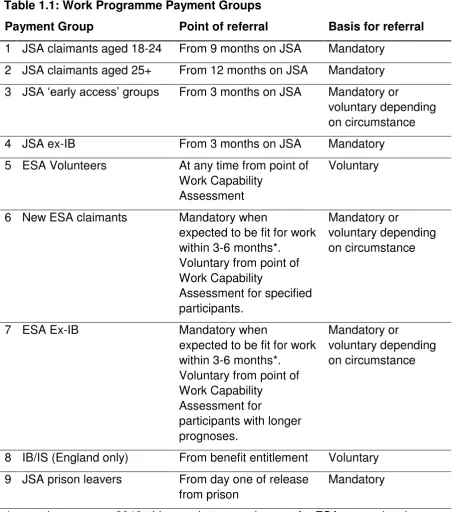
The Work Programme applies to benefit claimants in various categories19(‘payment groups’) summarised20 in Table 1.1 below. This also shows the time during their benefit claim at which claimants will be referred to the programme, and whether their participation will be compulsory or voluntary.
19
Table 1.1: Work Programme Payment Groups
Payment Group Point of referral Basis for referral
1 JSA claimants aged 18-24 From 9 months on JSA Mandatory
2 JSA claimants aged 25+ From 12 months on JSA Mandatory
3 JSA ‘early access’ groups From 3 months on JSA Mandatory or
voluntary depending on circumstance
4 JSA ex-IB From 3 months on JSA Mandatory
5 ESA Volunteers At any time from point of Work Capability
Assessment
Voluntary
6 New ESA claimants Mandatory when
expected to be fit for work within 3-6 months*.
Voluntary from point of Work Capability
Assessment for specified participants.
Mandatory or
voluntary depending on circumstance
7 ESA Ex-IB Mandatory when
expected to be fit for work within 3-6 months*.
Voluntary from point of Work Capability
Assessment for
participants with longer prognoses.
Mandatory or
voluntary depending on circumstance
8 IB/IS (England only) From benefit entitlement Voluntary
9 JSA prison leavers From day one of release from prison
Mandatory
contracts and any revisions are made publicly available through the DWP website. Jobcentre Plus advisers also explain the Minimum Service Standards to participants on referral to the programme. The rationale is that both DWP and participants will be able to hold the providers to these standards.
1.3.3 How do claimants enter the Work Programme?
Jobcentre Plus refers claimants to Work Programme providers through the ‘Provider Referral and Payments System’ (PRaP), giving the provider basic details of the claimant with each referral. At this point the provider makes initial contact with the participant, and agrees the action(s) that the provider and participant will undertake through the programme. This agreement should be recorded in an ‘action plan’, which also incorporates any mandatory activity which the provider requires the participant to undertake. If a participant fails to comply with any mandatory activities, the provider notifies Jobcentre Plus in order that sanctions can be considered.
1.3.4 How long do participants stay on the programme?
Once Jobcentre Plus refers a participant to the Work Programme, the provider is expected to deliver two years (104 weeks) of continuous support regardless of whether the participant changes benefits or moves into employment. Early completion of the Work Programme occurs only when:
the final outcome payment has been claimed by the provider;
the participant is referred to Work Choice or a Residential Training College; or
the participant dies.
Participants who leave benefit and return within the two-year period are referred back to the relevant provider. If, however, they return to claim benefit after two years, or when the provider has claimed a final outcome payment for them, they remain with Jobcentre Plus.
1.3.5 Who are the Work Programme providers?
England, Wales and Scotland are divided into 18 ‘contract package areas’ (CPAs). Following a competitive tendering process, two or three Work Programme providers (drawn from the private, voluntary and public sectors) were contracted to operate as prime providers in each of the CPAs21. Prime providers may deliver services directly to Work Programme participants, or through a network of subcontractors, or both.
2
The evaluation of the Work
Programme
The Department for Work and Pensions commissioned a consortium led
by the Institute for Employment Studies (IES) to undertake an
independent evaluation of the Work Programme. Research started in
autumn 2011 and concludes in early 2015. The consortium includes the
following organisations working alongside IES on various strands of the
evaluation: Centre for Economic and Social Inclusion; GfK NOP; National
Institute of Economic and Social Research; Social Policy Research Unit
at the University of York. This chapter provides details of the evaluation
approach and research methodologies.
2.1 About the evaluation
The evaluation is exploring the delivery and effectiveness of the Work Programme by assessing participants’ experiences and outcomes. Given the innovative manner in which the programme is commissioned, the evaluation also focuses on how the commissioning approach impacts on the provider market and influences service delivery and participant outcomes. Thus the evaluation is spilt into commissioning and programme evaluation strands with considerable overlap between the two.
Key research questions for the evaluation as a whole include the following:
Commissioning: How does the commissioning model impact on the provider
market? How do DWP and prime providers influence service delivery and outcomes? Why do providers design their services the way they do?
Delivery: What services do providers deliver to participants and how do they deliver them? What is the participant experience? What are the key operational lessons learnt from delivery?
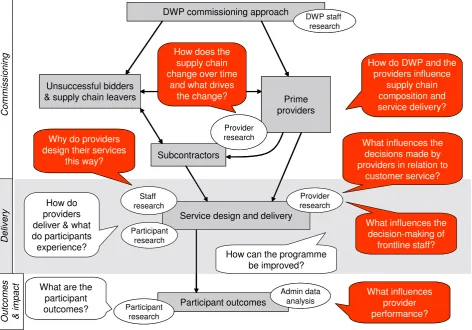
Figure 2.1 Structure of the Work Programme Evaluation
2.2 The commissioning model evaluation
This strand examines how the commissioning approach impacts on the provider market and the decision-making processes of Work Programme providers, and thereby influences service delivery and participant outcomes. Findings from the commissioning research undertaken in 2012, which comprised a provider survey and interviews with DWP and Jobcentre Plus staff, unsuccessful bidders, non-bidders and providers leaving supply chains as well as prime providers and sub-contractors, were reported in Lane et al, (2013).
DWP commissioning approach
Prime providers
Subcontractors
Service design and delivery
Participant research Provider research C om m is s ioni ng D eliv e ry Ou tc om e s & im p ac t Participant outcomes Admin data analysis Participant research How do providers deliver & what do participants experience?
What are the participant outcomes?
Unsuccessful bidders & supply chain leavers
What influences the decision-making of
frontline staff?
DWP staff research
Why do providers design their services
this way?
Provider research
How do DWP and the providers influence supply chain composition and service delivery? Staff research
How can the programme be improved?
What influences the decisions made by providers in relation to
customer service?
What influences provider performance? How does the
supply chain change over time
and what drives the change?
DWP commissioning approach
Prime providers
Subcontractors
Service design and delivery
Participant research Provider research C om m is s ioni ng D eliv e ry Ou tc om e s & im p ac t Participant outcomes Admin data analysis Participant research How do providers deliver & what do participants experience?
What are the participant outcomes?
Unsuccessful bidders & supply chain leavers
What influences the decision-making of
frontline staff?
DWP staff research
Why do providers design their services
this way?
Provider research
How do DWP and the providers influence supply chain composition and service delivery? Staff research
How can the programme be improved?
What influences the decisions made by providers in relation to
customer service?
What influences provider performance? How does the
supply chain change over time
the services that providers deliver to participants, so exploring the type and nature of the services delivered is a key aspect of this element of the evaluation.
2.3.1 Provider research
The provider research aims to identify the services provided and the factors shaping their nature, which may vary between providers according to local conditions,
participant types served and provider preference. The research includes:
observational research (Jan/Feb 2012) examining key interventions and interactions between participants and advisory staff from four prime providers;
qualitative research with Jobcentre Plus staff and provider managers and advisers covering 11 prime providers across six contract package areas (spring/summer 2012);
further qualitative research with Jobcentre Plus staff and provider managers and advisers in six contract package areas in summer 2013;
three national online surveys of Work Programme providers (summer 2012, 2013 and 2014).
Findings from the first two of these elements (observational research, first wave of qualitative research with providers) were reported in Newton et al, 2012, and the remaining provider research (qualitative and quantitative) is reported with the commissioning research in the provider-focused report published alongside the present report (Foster et al., 2014).
2.3.2 Participant research
Research with participants explored their end-to-end experience of the programme and their views on services received, the relevance and helpfulness of services, and outcomes from the programme as a whole. This element looked beyond immediate job outcomes, to examine whether and how providers support participants to stay in employment, and work with employers to facilitate this.
In summer/autumn 2012 a national telephone survey that was representative of those joining the programme at that time was conducted with over 4,700 participants between six and nine months into their Work Programme journey; a follow-up survey of over 1,800 of the same participants was conducted in early 2014 when
respondents had completed the two-year programme period. Findings from both surveys are included in this report. Methodological details, including the survey tools, are provided in an accompanying technical report.
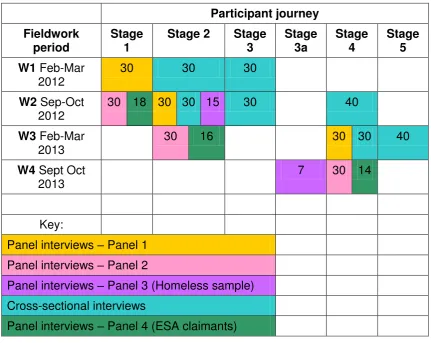
Key: description of stages
Stage 1 – initial engagement with a Work Programme prime provider
Stage 2 – during pre-employment engagement with a prime provider or subcontractor
Stage 3 – job entry
Stage 3a – ongoing support from the programme
Stage 4 – sustained employment
[image:44.595.64.496.114.457.2] Stage 5 – end of engagement with the Work Programme.
Table 2.1: Qualitative participant samples
Participant journey
Fieldwork period
Stage 1
Stage 2 Stage 3
Stage 3a
Stage 4
Stage 5
W1 Feb-Mar 2012
30 30 30
W2 Sep-Oct 2012
30 18 30 30 15 30 40
W3 Feb-Mar 2013
30 16 30 30 40
W4 Sept Oct 2013
7 30 14
Key:
Panel interviews – Panel 1
Panel interviews – Panel 2
Panel interviews – Panel 3 (Homeless sample)
Cross-sectional interviews
methodological challenges due to the absence of a clear control group or ‘counterfactual’ against which to compare participants’ outcomes.
In addition, the consortium is undertaking a separate piece of econometric analysis, exploiting the opportunities offered by the random allocation of participants to the prime providers operating in each contract package area, drawing on administrative data and data generated by other strands of the evaluation to identify the factors associated with variations in provider effectiveness, asking:
which prime provider characteristics (e.g. supply chain composition, whether for profit or not-for-profit) tend to lead to better performance;
which participant groups appear to benefit most; and
how strongly area characteristics (e.g. labour market conditions) influence delivery and performance.
2.3.4 Locating the evaluation within existing evidence
The DWP and evaluation consortium agreed that the evaluation findings should be located within the international evidence base on active labour market programmes (ALMPs), both within the UK and, where relevant, overseas. To do this systematically an ‘evidence review group’ (ERG) was established. This group involved participants from all organisations in the evaluation consortium, supplemented with additional key experts including from DWP itself. The group facilitated a peer-based discussion and review process for UK and international evidence, to situate the Work Programme evaluation findings in the context of wider evidence and highlight differences and similarities between what is coming out of the Work Programme evaluation, and that corpus of earlier knowledge and experience.
The activities of the ERG included:
Ongoing review of findings emerging from the evaluation, in particular, contributing to the development of the evaluation synthesis report.
3
Work programme participants: their
labour market background and
personal characteristics
Later sections of this report describe what happens to participants in the
Work Programme. Before this, the current chapter draws on the first
wave of the representative telephone survey of Work Programme
participants
22to outline their key personal and other characteristics, as
well as what is known of their (work) history prior to their period of
worklessness and engagement with the programme.
3.1 Personal characteristics
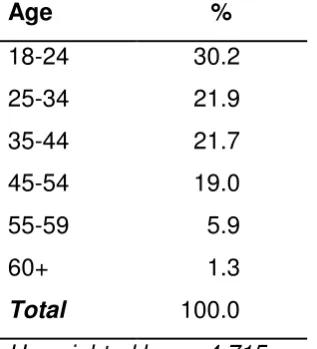
Nearly two thirds (65%) of the Work Programme participant survey sample were male. Nearly a third (30%) were under 25 years old (Table 3.1), and just over half the sample were under 35. Only 7% were 55 or older23. Just over a quarter of