Theses Thesis/Dissertation Collections
12-12-2016
Beyond the Surface: An Analysis on the Journalistic
Reporting of Native American Issues
Nicole Dorothy Irene Scott
Follow this and additional works at:http://scholarworks.rit.edu/theses
This Thesis is brought to you for free and open access by the Thesis/Dissertation Collections at RIT Scholar Works. It has been accepted for inclusion in Theses by an authorized administrator of RIT Scholar Works. For more information, please [email protected].
Recommended Citation
Rochester Institute of Technology
School of Communication
College of Liberal Arts
Beyond the Surface: An Analysis on the Journalistic Reporting of Native American Issues
by
Nicole Dorothy Irene Scott
A Thesis presented
in partial fulfilment of the Master of Science degree
in Communication & Media Technology
Degree Awarded:
The members of the Committee approve the thesis of Nicole D. Scott presented on October 17, 2016.
____________________________________ Andrea Hickerson, Ph.D.
Associate Professor and Director School of Communication
____________________________________ Andrea Hickerson, Ph.D.
Associate Professor and Director School of Communication Thesis Advisor
____________________________________ James Myers, Ph.D.
Associate Provost
International Education and Global Programs
Thesis Advisor
____________________________________ Grant Cos, Ph.D.
Associate Professor of Communication Director of Graduate Programs
Acknowledgment
Yá’át’ééh shik’éí dóó shidine’é. Shi éí Nicole Scott yinishyé. Táchii’nii nishłį. Tótsohnii
báshishchíín. Kinyaa’áanii dashicheii. Kiis’áanii dashináli. Tóhahadleehí déé’ naashá. Shimá éí Denise Manygoats wolyé dóó shizhé’é éí Nathaniel Manygoats wolyé (Áshįįhí).
My parents pressed two important teachings upon me: The importance of introducing myself in the Diné (Navajo) language and the power of prayer. I start this paper with that introduction, in order to establish kinship with the readers. I also start by thanking God, the Creator, for being my source of comfort and strength throughout my lifetime, but most importantly through these last three years.
This paper is dedicated to my elders, those alive and those who have passed. You have been through so much and it is due to your strength and adversity that I stand here today. I have admired you throughout my lifetime. I saw how you rose with the sun and began with a morning prayer. I have long admired your laugh lines, and emulated my own laugh from yours. I
witnessed how you cared for everyone and were generous even when you had little to give. As a young girl, there were many times when I fell asleep listening to you speak in our Native tongue. I took each moment and each teaching for granted. Today, as I am falling asleep, there are times when I can hear your voices and it brings me peace.
I thank my parents - Denise & Nathaniel, my sisters - Bryana, Ashley, and Natasha, and my brother - Denim. Thank you for allowing me to move across the country and have this journey. Through it all, your love and support was constant. To my nephews- Josiah, Eli, & Ryan: I do this work for you. I believe that I can help make your future a better one. I love you all very much. I thank my friends, students, and colleagues. Thank you for your words of encouragement, for the laughs, and the hugs. To my advisors, Andrea and Jim, thank you for helping me organize these thoughts and words so that I may find my voice and share this story.
Table of Contents
Abstract 5
Introduction 6
Purpose of Study 8
Chapter 1: Adversity, Perseverance, & Transformation 10
Chapter 2: Context of Study 28
Chapter 3: Method & Results 32
Chapter 4: Discussion 40
Chapter 5: Moving Forward 44
BEYOND THE SURFACE: AN ANALYSIS OF THE
JOURNALISTIC REPORTING ON NATIVE AMERICAN ISSUES
Nicole Dorothy Irene Scott
School of Communication
College of Liberal Arts
Master of Science in Communication & Media Technologies
Term Degree Awarded: Fall Semester 2016 (2161)
Abstract
This study analyzes the reporting of four issues that have impacted the Native American
community. The research begins by addressing historical events that transformed Native
American identity and have shaped the media’s representation of Native identity. Framing
theory, muted group theory, and tribal critical race theory support this study, with framing theory
focusing on examining the news discourse. This study seeks to identify how Native American
issues are framed differently in Indian Country Today Media Network and the New York Times,
and seeks to identify if the Native voice can be heard in articles written by Native journalists.
The results of this study suggest that the sources were the most significant difference between
the articles by ICTMN and the NYT. Sources also were the key element in hearing the Native
voice.
Keywords: Native American, Indigenous, identity, storytelling, voice, Indian Country
Beyond the Surface: An Analysis of the Reporting of Native American Issues
In an op-ed for the Huffington Post, Navajo postdoctoral scholar and a personal mentor
of mine, Dr. Amanda Tachine, wrote an open letter to Native American college students, stating:
We as Native peoples have gone through much adversity, and yet we have persevered. I
think it’s because we have the ability to transform the negative into positive. We all have
‘monsters’ that surround us, but transformation is in our blood. It’s the belief that we
have to move forward, for our people and future generations. (2015, para 13)
Today, Native American communities are experiencing high levels of unemployment,
low college enrollment/completion rates, high levels of suicide, domestic violence, drug and
alcohol usage. There are as many stories about Native Americans that seek to uplift the
community, as there are stories that tell of the critical state of Indian Country and are reminders
of the long term effects of colonialism. Together, both types of stories weave a much larger story
demonstrating the adversity and perseverance that Dr. Tachine refers to. A story of people who
are moving forward and working to move away from the negative images and stereotypes that
continue to plague their identity. Native Americans are working to reclaim their identity and
preserve their cultures for future generations.
Native American identity is one that the dominant society has long sought to control and
eliminate. The control began when European settlers arrived and colonization began. During the
boarding school era, the mission was to “Kill the Indian, Save the Man.” Today, the lack of
accurate media representation and the perpetuation of the stereotypical Indian has only kept
Native American identity in the past. In 2013, Native scholars asked higher education institutions
to look Beyond the Asterisk, a book by the same name. A purpose of the book was “to move
quo” (Shotton, Lowe, & Waterman, 2013, p. 2). Similarly, this study has found that when it
comes to reporting on Native American issues, journalists and the media must look beyond the
surface of the facts, and seek to understand the underlying factors in their reporting on Native
issues.
Native American identity is complex, because it is diverse. There is not one overall story
that can explain the history of each Native American nation and not one overall identity for
Native people. Each Native nation holds its own cultural values, its own religion, its own
language. While mass media organizations seek to report the stories of Native people, it is a
perspective that cannot be understood if the journalist does not fully comprehend the complexity
and the diversity of Native cultures and history. This comprehension is one that is embedded in
the experiences of Native people, in their families, and is in their blood. Native American
journalism allows for this perspective to be told, and is one that should be incorporated into
mainstream media reporting.
A 1995 study, focusing on the pipeline into journalism for Native American journalists,
found that Native journalists consider journalism as a new form of storytelling, “especially for
journalists working in the Native media system” (Reaves, p. 68). Native American journalists
utilize journalism to provide an understanding of the underlying factors and educate the larger
global community. They utilize the very medium that historically sought to erase their history
and identity, in order to further assimilate Native people, to share their stories and experiences.
This is an example of Dr. Tachine’s words that illustrates how Native people took the negative
and transformed it into a positive, using this medium to document and to preserve their history,
Purpose of the Study
Through comparative analysis of traditional media and Native media, this study seeks to
identify the elements of an article that differ for Native media, compared to mainstream media,
and how elements of traditional Native American storytelling may be woven into the European
model of journalism when written and distributed through Native American media outlets. This
study seeks to convey the importance of the Native voice in modern journalism by analyzing and
comparing the reporting of Native American issues between Indian Country Today Media
Network (ICTMN) and The New York Times (NYT). Supporting this study are three theoretical
frameworks: Framing theory, muted group theory, and tribal critical race theory.
The first chapter is split into three sections: adversity, perseverance, and transformation.
The adversity section describes the painful and traumatic history of Native Americans. It aims to
provide the reader with an understanding of Native history and its relevance in the issues
impacting Native communities today. It is the history of Native people that has shaped the
media’s representation and the world’s perception of Native identity. In the second section, the
perseverance of Native Americans is showcased. Using the printing press as an example, this
chapter relays how the press evolved into becoming a tool for Native American journalists to
counter the misconceptions, in an effort to reclaim their identity. This section provides a brief
history of Native journalism, describing the development of Native American media, and its
importance in Native American communities. Lastly, before going into the context and findings
of this study, the transformation section discusses the misrepresentation of Native identity and
how it has impacted the media representation of Native people. In addition, the section discusses
Together each element illustrates the transformations that have occurred within Native
communities. Today, the use of media by Native people to reclaim their identity, and share their
perspective is allowing for another transformation of their identity, one that is accurate and a true
representation.
The importance for this study centers on Native Youth and the Haudenosaunee’s
philosophy of thinking of the next seven generations. Native Americans have long lived in a
world ignoring the truth behind the founding of the United States. The effects of the traumatic
experiences of an entire generation continues to plague the population, and in addition the
misrepresentation and invisibility of Native Americans in the media also has consequences. The
idea that all Native people are the same, has harmful effects. Leavitt, Covarrubias, Perez, and
Fryberg (2015) found that “exposure to prominent media portrayals led Native American high
school and college students to have more negative feelings about their self … and community
…and depressed academic future possibilities …” (p. 44). This study seeks to emphasize the
importance of the Native American voice in modern day Native journalism and its importance in
media, in hopes that future generations will understand the importance of their voice and that
Chapter 1: Adversity, Perseverance, & Transformation
Adversity
To understand the importance of Native American journalism, one must first have
knowledge of Native American history, or America’s history. While each Native nation has its
own history of events, there are moments in time where their stories intertwine. These events are
accounted for through stories that have been passed down and retold from generation to
generation, as well as having been documented and researched by scholars.
The cultural assimilation attempts, made by newly arrived settlers and the United States
government, of Native Americans, had dire consequences for how Native Americans are
portrayed and for their ability to express their Native voice. The three focused on in this paper
are: colonialism, Indian removal, and Indian boarding schools. These events were not only
painful, but so traumatic that the effects are still present in today’s Native communities. Each
event played a role in shaping Native identity and the transformation of Native culture. They also
influenced how Native Americans are represented in mainstream media.
Colonialism. Archeologists and anthropologists have tried to piece together the life and
culture of Native American people prior to contact with European settlers who colonized the
already inhabited land. It is through the analyzing of writings, written hundreds of years ago by
Europeans, that the history of Native people is told. Early writings inform historians about
Indigenous society and the role Indigenous women played in their society. These writings relate
a story that shows the shift from a matrilineal society to a patriarchal one; interrupting the way of
life, and disrupting harmony within the Indigenous community. Historians’ early descriptions of
Indigenous women were of them “[acting] independently of both Indigenous and newcomer
do so” (Barman, 2010, p. 93). As time went on, the historians noticed a change in the
descriptions of Indigenous women, as society moved toward a patriarchal society and the
assimilation of Indigenous people began (Huhndorf & Suzack, 2010). Barman (2010) writes of
how the sexualization of Indigenous women “freed men to act toward them as they would rather
than as Indigenous women’s behavior suggested they should” (p. 105). As for Indigenous men,
the “barbarous Indians” (Carstarphen & Sanchez, 2010), “ruthless, faithless savage” (Merskin,
1998) have been the common narrative. As one scholar wrote, “the intent of whites was better
served by creating a more fearsome myth” (Merskin, 1998, p. 334). By reducing Native people
to a stereotype and dehumanizing them, it justified the treatment of Native people and only
furthered the misrepresentation of Native people. Colonialism initiated the misrepresentation of
Native people and transformed the culture of Native people.
The media plays a significant role in the representation of Native Americans and the
shaping of their identity. The misrepresentation of Native people has communicated many of the
“false identities” to the world that Murphy referred to. The false identities show up on movie
sets, in the text of popular books, in the field of sports, and even the 2016 United States
Presidential Election; which are explained further in this study.
Removal. On May 28, 1830, the United States Congress passed the Indian Removal Act,
“[giving] the president authority to assign districts west of the Mississippi, not included in any
state or territory, to tribes who chose to exchange their present lands and move there” (Littlefield
& Parins, 2011, p. 105). The Act and process of removal was initiated by President Andrew
Jackson. His supporters sought or “coveted Indian lands, whether it was for the gold or
transportation routes or the fruit and cotton lands of the Cherokees, the cotton lands of the
the Midwest…” (Littlefield & Parins, 2011, p. xiv). Although the Act was deemed a “voluntary
removal,” Jackson used it to force tribes who resisted to move west of the Mississippi (Littlefield
& Parins, 2011).
The relocation of Native people took them from their ancestral land, displacing
thousands. The Trail of Tears saw “the removal of the Cherokee, Muscogee, Seminole,
Chickasaw, and Choctaw people from their homelands (Littlefield & Parins, 2011). The 1860s
Long Walk displaced “more than 10,000 Navajos and Mescalero Apaches... to a desolate
reservation in eastern New Mexico…” (Burnett, 2005, para 1). Merskin (1998) wrote, “as a
result of reducing native people to types it was possible to generate a level of hatred and disgust
sufficient to make genocide a seemingly reasonable solution to the ‘Indian problem’” (p. 334).
The narrative of Native people being a problem to take care of was echoed in the Long Walk
when “Gen. James Henry Carleton, commander of New Mexico Territory, decided to solve, once
and for all, the ‘Navajo problem’” (Burnett, 2005, para 2). This “solution” saw “the Native
American population [fall] from several million to roughly 250,000 people by 1900 (Merskin,
1998, p. 334) and the death of nearly 2,380 in the Long Walk (Burnett, 2005).
Boarding schools. In 1819, the United States government passed the Indian Civilization
Fund Act, “which established a federal contribution of $10,000 annually to be given to various
denominational groups for the purpose of educating and civilizing the Indians” (Stout, 2012, p.
15). It was this act that funded the removal of Native American children from their homes and
forced them to live in boarding schools. In 1879, the United States government opened the
Carlisle Indian School, “an experimental off-reservation boarding school for Native Americans
started by Colonel Richard Pratt” (Stout, 2012, p. xii). For decades, thousands of Native
children were placed in schools in order to assimilate them into “the larger European American
society in the United States by means of a forced replacement of language and culture through
immersion” (Stout, 2012, p. xii). Colonel Pratt’s mission, “Kill the Indian, Save the Man”
forbade Native students from speaking their language, as well as the taking of their Native
American name, “in an obvious effort to strip them of their culture and identity” (Stout, 2012, p.
36). In addition to the boarding school assimilation practices, Native American children suffered
“physical, psychological and emotional trauma… [giving] rise to dysfunctional family
relationships and patterns such as substance abuse, domestic violence, and sexual abuse, which
are still present in many Native families and communities” (Tsosie, 2011, p. 36).
While the Carlisle Indian School closed in 1918, the assimilation experiment carried
negative consequences and impacted Native American communities. For many students who
eventually returned to their communities, they returned to a community in which they no longer
felt accepted. For one student, Thomas Alford, it was a difficult transition as “He was not
welcomed home with open arms, but rather with suspicion and coldness. He looked different,
acted differently, and scorned many of the aspects of his new daily life, comparing them
unfavorably with boarding school” (Stout, 2012, p. 122). The impact of the removal of Native
American children from their homes are present today, as “many tribes continue to struggle to
combat rampant unemployment and high rates of substance abuse […], alcohol- and drug-related
fatalities, domestic violence, and suicide” (Tsosie, 2010, p. 36).
Colonialism shaped the identity of Native people, both dehumanizing and sexualizing
them, initiating the transformation of their culture and misrepresentation of their identity. The
Indian removal forced Native people away from their homelands, transforming their culture as
previously held with their homeland. The Indian boarding schools sought to save Native children
from their Indian-ness. Boarding schools transformed the cultural identity of Native
communities, as it resulted in the loss of Native languages and customs, and impacted future
generations. These events have led Native nations struggling to preserve their culture and thus
their identity is once again at stake.
Perseverance
Reaves (1995) writes, that while Native Americans have gone through several social
changes, that have drastically changed their ways of living, storytelling “remains an active, oral
transmission of Native culture” (p. 59). Storytelling is not only a method used to transfer
information but it also “empowers and constructs group identity” (Reaves, 1995, p. 60). For
Native American cultures like the Haudenosaunee, the use of storytelling “preserves their rich
teachings and culture” (Koblun, 2016, para 1). They use storytelling to keep their traditions and
beliefs alive, and in the process preserving pieces of their culture that have been challenged by
several attempts to assimilate Native people such as colonialism, restriction on Native languages,
and removal.
Tribal critical race theory. In his introduction of tribal critical race theory (TribalCrit),
Brayboy recognizes the importance of storytelling among Indigenous people. He describes
storytelling as the “transmission of culture and knowledge” (2005, p. 439) where “Oral stories
remind us of our origins and serve as lessons… serve as guideposts for our elders and other
policy-makers… for researchers in institutions of higher education, there is a saliency in stories”
(2005, p. 439).
TribalCrit emerges from the frameworks of critical race theory (CRT). It was developed
that reflect on Indigenous experiences, Indigenous history, and Indigenous knowledge. Both
theories, TribalCrit and CRT, “values narrative and stories as important sources of data”
(Brayboy, 2005, p. 428). The difference is that “TribalCrit honors stories and oral knowledge as
real and legitimate forms of data and way of being. Stories are not separate from theory; they
make up theory” (Brayboy, 2005, p. 439). Brayboy (2005) argues that while academics value
theory and statistics, among Indigenous communities it is the stories that build the foundation
and are as valuable as measurable data.
Turning a negative into a positive. The goal of assimilation was to strip Native people
of their culture, identity, traditions, and beliefs, which was passed down through oral teachings.
The printing press was used to challenge oral storytelling and was a tool used to rewrite Native
history and restructure Native identity. Printing and the written word became tools used to
further colonize and assimilate Native Americans (Murphy, 2010)
Johannes Gutenberg’s printing press brought about a cultural change in Europe. For one,
prior to the printing press “The ability to read and write was confined to the great merchants and
to the first two estates—the nobility and clergy” (Fellow, 2010, p. 2). The ability to print allowed
for communication to travel and voices once silenced to be heard. Printing allowed for historical
information to be copied and preserved. It also encouraged the creation of new literature and the
sharing of information. From the printing press emerged news pamphlets and sheets, such as the
corrantos in Amsterdam or The Continuation of Our Weekly News in England (Fellow, 2010). It
was in the year 1704 that the first continuous newspaper in the American colonies, The Boston
News Letter, was distributed (Fellow, 2010). When the United States Constitution was
established, the writers placed an importance on including protection for the right to the freedom
Congress shall make no law respecting an establishment of religion, or prohibiting the
free exercise thereof; or abridging the freedom of speech, or of the press; or the right of
the people peaceably to assemble, and to petition the Government for a redress of
grievances. (U.S. Const. amend. I.)
In addition to solidifying these rights, the writers of the United States Constitution sought
to “form a more perfect Union, establish Justice, insure domestic Tranquility, provide for the
common defense, promote the general Welfare, and secure the Blessings of Liberty to ourselves
and our Posterity…” (U.S. Const. pmbl.), but early U.S. history shows that not all individuals
were afforded those rights. For Native Americans, not only were they not considered equal, the
freedoms granted by the Constitution also did not apply to them. The early experiences of Native
Americans are not included in American textbooks, nor are their current experiences included in
today’s mass media. The history of Native people has largely been told for them, with their
perspectives and truth being left out, and their identity shaped for them. It was in 1828 when the
printing press became a tool for Native people to tell their stories.
Development of Native American media. In the 1800s, Sequoyah developed the
Cherokee syllabary system (Murphy, 2010), leading to several important developments for the
Cherokee people, including the creation of the first bilingual tribal newspaper: The Cherokee
Phoenix, and Indians’ Advocate (Coward, 2008, p. 322). The Cherokee Phoenix was created in
February of 1828, a product of Elias Boudinot, in the midst of the Indian Removal Act (Coward,
2008). During the assimilation era, this publication was important in that it allowed tribal nations
to communicate with each other during a time when “forces [were] impinging upon life and
survival” (Murphy, 2010, p. 330). During this challenging time, Native people began to feel that
Phoenix’s editor, Boudinot, was one individual who felt that “the Cherokees and other tribes, had
two alternatives; they must either become civilized and happy, or sharing the fate of many
kindred nations, become extinct” (Murphy, 2010, p. 330).
While Boudinot ultimately decided that “relocation was the only way to save the Nation”
(Murphy, 2010, p. 330), and that choosing to be “civilized” was mandatory in order for Native
existence to survive, his paper was first a tool that documented and preserved Cherokee laws and
customs; and served as a model for other Native American publications to follow including: The
Cherokee Advocate in 1844, the Choctaw Intelligencer in 1850, the Cheyenne Transporter in
1879, and the Wassaja: Freedom’s Signal for Indians in 1916 (Coward, 2008). These
publications used Native voices to “[investigate] threats to Indian self-determination, education,
and land and water rights…” (Murphy, 2010, p. 332). Today, there are an estimated “280
reservation newspapers and bulletins, 320 urban Indian publications, a small but growing number
of independent newspapers and 100 magazines and journals” (Murphy, 2010, p. 332). Native
media today includes community papers like the Navajo Times which “[covers] the nation’s
largest tribe from Window Rock, Arizona” (Coward, 2008, p. 324) to Indian Country Today
which “flourished, becoming the largest weekly in the South Dakota and eventually expanded its
coverage” (Coward, 2008, p. 324). Native American journalists have been able to use the press,
which had once been used to eradicate their history and identity, to share issues affecting Indian
Country, to share accomplishments within the community, to maintain their tradition and culture
of storytelling. Also importantly, Native American journalists “offer opportunities for
self-awareness that challenge the often negative images available in mainstream media” (Murphy,
2010, p. 338) … and “help tell stories and provide news and information not available
The continued growth of Native American journalism led to the creation of a Native
American Press Association. In an effort to “reinvigorate the Native media, address the
widespread barriers and challenges facing Native journalists, and build on the strengths of Native
communications” (“NAJA History,” 2016, para 5), in 1984 the Native American Press
Association (NAPA) was established. Later, in 1990, the organization was renamed the Native
American Journalists Association (NAJA), (“NAJA History,” 2016). Murphy (2010) writes of
the importance of Native journalists in the media: “reservation and urban journalists have used
the press in building and reflecting on community, championing Native American rights,
correcting mistakes and misinterpretations by mainstream media and preserving important
traditions in Indian Country” (p. 328).
Community media impact on Native communities. Over the years, Native American
media has continued to grow and develop, connecting and informing millions of rural and urban
Native communities. Today, it reflects a model known as community media. This model
maintains similar attributes of traditional mass media, but it differs in several aspects. The goal
of most mass media today–television stations, newspapers, and radio station–is to have the
highest ratings because that translates into more money from advertisers (Gordon, 2012). In
contrast, community media is community driven and focused, and its larger goal is to serve the
needs of the community they are in. Jankowski (2003) refers to community media as “a diverse
range of mediated forms of communication: electronic media such as radio and television, print
media such as newspapers and magazines, and electronic network initiatives which embrace
characteristics of both traditional print and electronic media” (p. 7). In his assessment, Jankowski
looks at the ownership and control, the content, production, distribution, audience, and financing
ownership are community controlled. The production includes members from the community
who may not have had professional training, but more importantly gives the audience someone
they can relate to and identify with. The focus is community. Unlike commercially driven media,
community media are meant to reflect, represent, and include members of the community
(Jankowski, 2003).
However, it is important to note that community media found in Native American
communities stands alone and is its own model. It is unique as its purpose is to connect rural and
urban Native communities, transfer information to other tribal communities, and preserve
Indigenous culture. For Native people, the continued dependence on community newspapers and
radio stems from the large distances separating many Native communities, as they are located in
“more rural and isolated locations of the United States” (Guskin & Mitchell, 2012, para 1). At a
time when Native Americans have very limited access to broadband Internet, newspapers and
radio stations still play a large role in many Native communities.
Native American communities are unique and diverse, and the community media reflects
the unique cultures of each tribal nation. There are 566 federally recognized American Indian
tribes, about 5.4 million American Indians and Alaska Natives (AIANs), and 326 federally
recognized American Indian reservations in the United States (“Facts for Features,” 2015).
Altogether, Native Americans make up about 2% of the United States population. These 566
tribal nations span across the United States. Native Americans may live in urban areas, but a
majority live in rural areas, known as reservations. These reservations vary by size and are
separated from their sister communities by large distances. The U.S. Census defines American
… areas with boundaries established by treaty, statute, and /or executive or court order.
The reservation and their boundaries are identified for the Census Bureau by the Bureau
of Indian Affairs (BIA), an agency in the U.S. Department of the Interior, or by State
governments. (“AIAN Areas,” n.d., p. 1)
An example is the Navajo Nation. This Nation covers 27,000 square miles and four
states, and “population centers are clusters of housing around schools, hospitals, trading posts,
and chapters houses” (University of Arizona, 2008, p. 1). The Nation as a whole relies on
community media, like Native radio and newspapers, to keep them connected to the happenings
within the many communities that are spread across those 27,000 square miles. The Navajo
Nation is served by the largest weekly Native newspaper, The Navajo Times, which also has an
on-line presence, and the AM commercial station KTNN, “Voice of the Navajo Nation,” which
broadcasts news and entertainment, not only across the large Nation but across the country
through its online format (Murphy, 2010).
Native American community media is an accurate representation of its community.Due
to low visibility, Native Americans have been plagued with false stereotypes about them that are
spread through mainstream media, “based mostly on lingering romantic, primitive, and negative
stereotypes” (Fuller, 2007, p. 56). Native Americans are “fed up with the lack of service
provided by the mass media and the stereotyping such access and misrepresentation that is
prevalent in the media” (Smith & Cornette, 1998, para 5). Community media provide Native
people with the opportunity to use their voice and the chance to “define who they are, or who
they feel they are, as compared to what other groups say about what they are (culture) and what
they think about different issues” (Fuller, 2007, p. 58). Native communities are also surrounded
mainstream media, the media of non-native communities often leave Native people out of their
conversations.
It is likely that due to the small size of the American Indians and Alaska Natives (AIANs)
population, this leaves AIANs out of mainstream conversations, leaving many to feel neglected
and invisible (Fuller, 2007). The importance of community media in Native American
communities stems from the fact that they are often left out of conversations within mainstream
media coverage. Small populations are usually left voiceless, and it is difficult to share their side
of the story when the larger media is not interested, because it is usually not what will create
interest among their audience and therefore will affect their revenue. This further illustrates the
importance of community media.
For Native communities, community media provides a connection between Native
American communities who are spread far apart and would not otherwise have the means to
share information to a large group quickly. It is also an outlet allowing these communities to
have a voice and the ability to express their culture. At a time when Native communities are still
reeling from the traumatic and painful events of their history, community media has given Native
people a voice to share their historical perspective, the opportunity to preserve their culture, and
the ability to reclaim their identity.
Transformation
The beginning of this paper touched on three events that transformed Native American
culture and impacted their identity.Native American identity continues to be an issue impacting
Native communities. The issue is complex, as it encompasses a diverse population. Yet, since the
first settlers arrived, Native Americans have been grouped as one population and not separate
misrepresentation of a population in which cultural appropriation and stereotypes continue to
project a negative identity on Native people.
Murphy (2010) writes that “media neglect or misinterpretation of peoples cultures,
whether benign or malevolent, imposes on those peoples and cultures false identities and
communicates those false identities to the rest of the world” (p. 329). Today, false identities still
plague Native Americans, where they are seen as historical 19th century figures (Leavitt et al.,
2015), and not portrayed as modern beings who contribute to society.
Muted group theory. Muted group theory (MGT) argues that there is an “asymmetrical
power relationships” that exists in society. The theory, initially applied to anthropology, has been
applied to study the non-dominant group experiences of women and of African American men
(Orbe, 1998). This theory posits that “marginalized groups [are] largely muted because their
lived experiences are not represented in the dominate structures” (Orbe, 1998, p. 4).
In her evaluation of MGT, Kramarae notes that MGT not only focuses on the differences
in gender, but is also concerned with “other marginalizing differences as well (including race,
sexuality, age, and class,” Kramarae, 2005, p. 55). Kramarae’s research of muted group theory
supports the basis of this study: that the story and history of Native Americans have long been
told for them by the dominant group because of the oppression they have faced and the dominant
society silencing their voice throughout history. Kramer 2005 writes that the power of speech
lies with the dominant society and the power is kept from them:
Their speech is disrespected by those in the dominant positions; their knowledge is not
considered sufficient for public decision-making or policy making processes of that
culture; their experiences are interpreted for them by others; and they are encouraged to
The voice of Native Americans has mostly been muted, with their voices and stories
being heard within their own communities and through organizations like Indian Country Today
Media Network. While women are more than the kitchen they’ve been placed in, and African
American men more than the stereotypes they’ve been given, Native American and Indigenous
people are more than the false identities given to them. They have different cultures, different
customs and languages but have longed been grouped together, “[presented as] one homogenous
Indian image” (Merskin, 1998, p. 335) and one that is “frozen in time” (Leavitt et al., 2015.)
Native people are wanting their stories to be shared, wanting to be humanized, and
wanting to be seen as more than a stereotype or a mascot. Leavitt et. al (2015) writes:
Many groups experience relative invisibility… but what differentiates Native Americans
is that they uniquely experience absolute invisibility… they are rarely (if ever) seen as
contemporary figures in the media, which means they are absent from depictions of
mainstream public spaces, such as schools and hospitals, and from many professional
positions, such as teachers, professors, doctors, and lawyers. (p. 41)
In a society where Native Americans make up 1.6% of the United States population
(Leavitt et al., 2015, p. 14), their story has been told for them and their representation created or
framed for them. The foundation of this study is framing theory. The concept of this theory
centers on the idea that individuals process information differently and a part of the reason is due
to the way information is presented, or framed. Scheufele and Tewksbury (2007) write that
framing “is based on the assumption that how an issue is characterized in news reports can have
an influence on how it is understood by audiences” (p. 11). Chong and Druckman (2007) write
that “the major premise of framing theory is that an issue can be viewed from a variety of
104). Taking these definitions into consideration, this study seeks to use framing theory as its
foundation and apply it to the study of the media representation of Native American and their
identity.
Framing theory. Framing theory seeks to identify the communication process between
the communicator and the receiver, while taking into consideration the cultural environment (de
Vreese, 2005). The understanding is done by looking at the frame-building and the frame-setting.
De Vreese (2005) describes frame-building as “factors that influence the structural qualities of
news frames” (p. 52), and frame-setting as “the interaction between media frames and
individuals’ prior knowledge and predispositions” (p. 52). These processes include looking at
internal and external factors and the effects the framing has on the audience and society as a
whole (de Vreese, 2005).
Scheufele and Tewksbury (2007) describe framing as a way to make complex issues
more understandable to an audience who may not know the specifics of an issue. The issue with
using frames to understand a perspective is that “there is little consensus as how to identify
frames in the news” (de Vreese, 2005, p. 53). In his research, de Vreese (2005) identifies two
approaches for identifying frames: inductive, where news stories are analyzed and “frames
emerge from the material during the course of analysis” (p. 53), and deductive, where frames are
investigated, defined, and focusing on causality. In their article on framing analysis, Pan and
Kosicki (1993) look at the concepts of framing and its process. In this article they write that
framing can be a sociological concept and a psychological concept, where frames are used to
organize then distribute ideas/information to an audience, or frames are used to place influence
and psychological concepts, where it is “a strategy of constructing and processing news
discourse or as a characteristic of the discourse itself” (p. 57).
Pan and Kosicki (1993) wrote of the framing structures of news discourse in which they
centered on the idea that every story has a theme, in which the themes give meaning to the story.
These themes, also identified as frames, can be classified into four categories: syntactical
structures, script structure, thematic structures, and rhetorical structures (p. 59)
§ Syntactical structures: “refer to the stable patterns of the arrangement of words or
phrases into sentences” (p. 59).
§ Script structures: “refers to an established and stable sequence of activities and
components of an event that have been internalized as a structured mental
representation of the event” (p. 60).
§ Thematic structures: “is a multilayer hierarchy with a theme being the central core
connecting various subthemes as the major nodes that, in turn, are connected to
supporting elements” (p. 61).
§ Rhetorical structures: “describe the stylistic choices made by journalists in relation to
their intended effects” such as “metaphors, exemplars, catchphrases, depictions, and
visual images” (p. 61).
This research uses the inductive in nature approach(de Vreese) to analyze the frames
used in the media representation of Native Americans on the issues concerning identity. In
addition, the four framing structures are used to identify the themes of each article and to
interpret the signifying elements of the theme. With the support of framing theory and muted
group theory this research seeks to communicate the importance of the Native voice/perspective
The three sections of this study focus on providing the reader with a brief history of
Native people and the impact that history continues to have on Native communities today. It is
important to note that colonization, forced removal, and boarding schools are only mere glimpses
into the history of Native Americans. The history of the press and Native people goes back to
early colonization, when settlers wrote their perspective of Native people down to the press
being used as a tool to further oppress and colonize Native people.
The second section, perseverance, describes the development of Native American
community journalism. It began with Boudinot’s Cherokee Phoenix, and today there are over
200 Native American community newspapers. These newspapers provide Native people with the
ability to share their stories, to inform readers of issues impacting Native communities, and to
connect the millions of Native people who reside in rural and urban communities. Native
American community journalism is both reflective and a representative of the Nation it reports
on and seeks to tell the stories that are left out of mainstream media.
Lastly, the transformation section centers on the fact that over the last few hundred years,
the representation of Native people has not changed because it is being told by individuals who
are not able to understand the full story. However, the small Native community publications and
the work of individuals are working to reclaim their identity and bring an accurate representation
of each 566 federally recognized Native American nations.
Research question. Since 1828, Native American journalism and media has continued to
grow. What was one bilingual newspaper has resulted in numerous native publications, radio
stations, and blogs that give Native Americans a voice. A 1995 study by Shiela Reaves, found
that members of the Native American Journalist Association (NAJA) considered journalism to be
The literature finds that there are differences between community media and mainstream
media, mostly that community media is meant to reflect and represent the community. From the
1995 study, there is evidence that Native journalists use journalism to share their stories, their
voice. The research question posed is: How does the framing of Native American issues differ
between Native community media and mainstream media, and in those difference how is the
Native voice heard?
For the purpose of this research, “Native voice” is defined as the historical and/or
personal (present) voice used by the writer. This definition is based off of N. Scott Momaday’s
explanation of the “three distinct narrative voices:” the immediate, the historical, and the mythic
(Morel, 2005). Morel (2005) writes that together they work, “the same way as the past, present,
Chapter 2: Context of Study
This study will take articles, focused on the topic of identity, from Indian Country Today
Media Network (ICTMN) and the New York Times to analyze the reporting done by these two
news organizations. While there are several Native American community papers, ICTMN covers
issues from across Indian Country and not solely on a particular nation. The New York Times was
chosen because of the reputation it has and its commitment to reporting quality news. The earlier
sections of this paper sought to bring understanding of Native American history, of the Native
American community, and the importance of Native American media, such as journalism.
Indian Country Today Media Network
In 1981, Tim Giago (Lakota) founded the weekly newspaper Indian Country Today in
South Dakota (Coward, 2008). The success of this paper allowed for it to expand its coverage
and was eventually purchased by the Oneida Nation of New York in 1998 (Coward, 2008). After
the purchase, the weekly continued to see success with Indian Country Today expanding to
“include quarterly magazines and a web site, indiancountry.com, one of many popular sources of
Native American information on the Internet” (Coward, 2008, p. 324). In 2011, the newspaper
was renamed Indian Country Today Media Network (ICTMN) and promoted as “the first ever
all-inclusive media network for Native Americans” (PRNewswire, 2011, para 1). Today, ICTMN
has become a global type of community media for the Native American community and is
considered to be “the world’s largest and most trusted news source for contemporary Native
American and indigenous news…” (PRWeb, 2014, para 1). ICTMN’s transition from a print
magazine to the online website allowed the national newspaper to “[provide] Native people
across North American with an easily accessible news source over a variety of topics affecting
(Bosco, 2015, para 2). ICTMN continues to see success after the 2011 website launch. In June
2014, ICTMN reached an online traffic milestone with 1,009,761 unique monthly visitors
(PRWeb, 2014). For this study, Indian Country Today Media Network will be used because of its
reputation as a trusted news source for Native Americans news and reporting of issues that
impact Indian Country.
The New York Times
As one of the largest American news organizations, the New York Times is considered to
be one of the leading newspapers in the world. Founded in 1835, as the New York Herald (“Our
History,” 2016), the New York Times has seen a transition from print to learning to embrace
technology and the Internet. In 1996, the Times introduced the New York Times website, making
articles accessible online and to the world (“Our History,” 2016). Over the years, the NYT has
covered U.S. Presidential elections, terrorism attacks, global economics, wars, and various
scandals, to name a few.
A reason the NYT is highly regarded may be due to the high standards it places on its
journalists. On its Standards and Ethics website, The New York Times (2016, para 1) states that
its core purpose “is to enhance society by creating, collecting and distributing high-quality news
and information. Producing content of the highest quality and integrity is the basis for our
reputation and the means by which we fulfill the public trust and our customers’ expectations.” It
lists fairness, integrity, and truth as the foundation helping carry out their purpose. For this
study, the New York Times will be used because of its reputation as “the newspaper of record in
the United States and one of the world’s greatest newspapers” (Britanica, 2016). It is because of
American issues in comparison to what is considered the Native American media equivalent to
the NYT: Indian Country Media Network Today.
Theories
To analyze the structure of these stories, tribal critical race theory, muted group theory,
and framing theory are applied to this study. Tribal critical race theory was applied to this
research as it aims to “address the issues of Indigenous Peoples in the United States (Brayboy,
2005, p. 427) by taking into account the experiences of Indigenous people and addresses the
issues, but “emphasizes that colonization is endemic in society while also acknowledging the
role played by racism” (Brayboy, 2005, p. 430). Muted group theory, briefly introduced earlier,
helps to support the importance of Native American journalists and community media, as this
theory asserts that “in every society a social hierarchy exists that privileges some groups over
others” and “groups that function at the top of the social hierarchy determine to a great extent the
communication system of the entire society” (Orbe, 1998, p. 4). For the analyzing of the articles,
from the New York Times and Indian Country Today Media Network (ICTMN), framing theory
is being applied to help understand what perspectives, or frames, are emphasized more in each
article, by each organization.
The analyzation of the articles aims to identify if the Native voice is present in today’s
Native journalism by comparing the reporting of recent stories that focus on Native identity.
Articles from these two news organizations will center on the following issues: Adam Sandler’s
2016 movie controversy, the National Football League’s (NFL) Washington DC football team
name, and the rhetoric of Presidential candidate Donald Trump. These three issues were selected
due to the amount of coverage in the year between 2015-2016. During the research process, it
reported on in the mainstream media. The fourth issue, the new J.K. Rowling series, is included
because it demonstrates an example of how reporting on Native issues differs between
Chapter 3: Method & Results
Method
Data collection. For this study, news articles that focused on issues regarding Native
American identity were collected from the New York Times and Indian Country Media Network
Today websites. Specifically, this study will analyze articles that report on the following events:
• articles in reference to Adam Sandler’s The Ridiculous Six film
• articles in reference to the Washington Post’s poll on offensiveness of the name of the
National Football League (NFL)’s Washington Redskins
• articles that report on the new J.K. Rowling book, History of Magic in North America
• articles pertaining to Donald Trump’s reference of Pocahontas in an attempt to call
out Senator Elizabeth Warren’s claim of Native heritage.
A search was used, from each site’s database, to locate articles, with similar/close publication
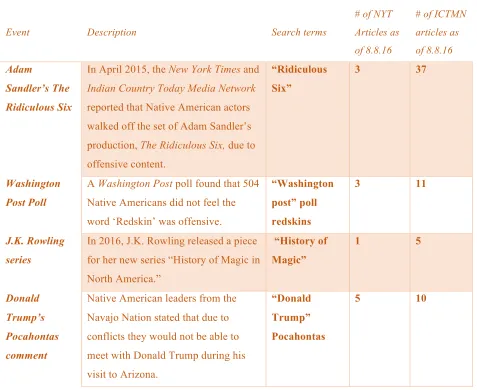
dates, for each recent issue being analyzed. The table below shows the event chosen and a
description of the event. The statements are meant to be objective and based on facts included in
both articles. Also shown are the search terms used to identify articles pertaining to each of the
four events and includes the number of articles written by the two media organizations. In total,
two articles for every issue were analyzed and their themes analyzed based on the four framing
structures of news discourse: syntactical structures, script structure, thematic structures, and
rhetorical structures. The eight articles, photocopied, were read in entirety and analyzed to
identify themes related to identity. In the analyzing of each article, the following were examined:
the article title, the lead paragraph, sources, and the number of articles on those subjects from
Table 1
Events Being Analyzed
Results
Research question. How are Native American issues framed differently in Indian
Country Today Media Network (ICTMN) and the New York Times (NYT)?
Sources. The most significant difference between the articles, by the two media
organizations, are the sources used to provide information on each event. While both
organization’s articles shared similar sources, a common practice was the use of experts and
scholarly sources by the NYT which included: individuals from the National Congress of
Event Description Search terms
# of NYT Articles as of 8.8.16
# of ICTMN articles as of 8.8.16
Adam
Sandler’s The Ridiculous Six
In April 2015, the New York Times and Indian Country Today Media Network reported that Native American actors walked off the set of Adam Sandler’s production, The Ridiculous Six, due to offensive content.
“Ridiculous Six”
3 37
Washington Post Poll
A Washington Post poll found that 504 Native Americans did not feel the word ‘Redskin’ was offensive.
“Washington post” poll redskins
3 11
J.K. Rowling series
In 2016, J.K. Rowling released a piece for her new series “History of Magic in North America.”
“History of Magic”
1 5
Donald Trump’s Pocahontas comment
Native American leaders from the Navajo Nation stated that due to conflicts they would not be able to meet with Donald Trump during his visit to Arizona.
“Donald Trump” Pocahontas
American Indians, linguist experts, politicians, and outside journalists. Whereas, ICTMN sought
the opinions of activists and Native American leaders, academics, and members. The difference
in sources used, resulted in a difference in the tone of each article. In the articles by ICTMN,
which used more “community” sources, the tone addressed the issues differently and framed the
issues in a different manner.
Take for example the article regarding Native Americans walking off the set of the film
Ridiculous Six. The two articles, by the NYT and ICTMN, were published on the same day, but
the NYT article is only four paragraphs long and consisted of three sources: Netflix, Allison
Young, and ICTMN. On the other hand, ICTMN article is 18 paragraphs long and its sources
included: Allison Young, Loren Anthony, Goldie Tom, and David Hill, whom provided the
Native American perspective of the situation.
Young, a Navajo actress, was quoted in both articles, saying: “Nothing has changed. We
are still just Hollywood Indians.” However, in addition to the quote,ICTMN provided
information on her experience before the incident occurred.
When I began doing this film, I had an uneasy feeling inside of me and I felt so
conflicted,” she said. “I talked to a former instructor at Dartmouth and he told me to take
this as finally experiencing stereotyping first hand. We talked to our producers about our
concerns. They told us, ‘If you guys are so sensitive, you should leave’… “A film like
this should not make someone feel this way. (Schilling, 2015, para 11)
ICTMN’s inclusion of Young’s experience went beyond just reporting the facts, but went beyond
the surface and provided an understanding of what she and other Native actors had felt prior to
walking off the set. ICTMN provided a different perspective to the situation than the NYT’s
In the attempt to hear the Native voice, this research focused on listening for the
historical and/or personal voice of Indian Country Today Media Network (ICTMN) writers. This
research’s definition of Native voice stems from N. Scott Momaday’s explanation of the three
narrative voices: the immediate, the historical, and the mythic (Morel, 2005). This research
analyzed the four articles and were able to identify the writer’s use of historical and personal
voices in their articles. The historical voice was heard when the article included information
about historical inaccuracies that caused the Native actors to be offended: “Our costumes did not
portray Apache people. The consultant, Bruce spoke to the crew and told them we should not
have braids and chokers and he was very disappointed” (Schilling, 2015, para 13). Or stressing
the importance of understanding tribal history and sovereignty.
The personal voice was heard when the tribal identity of the sources and subjects were
identified. The sources also brought the personal voice, because of the word choices: “In
Trump’s eyes, we’re just stereotypes” (Landry, 2016, para 8). The personal voice was also heard
when the writers did not dismiss “the lifelong experience and sound judgement of actual Native
peoples who are in positions of trust and who reflect the will of Native people they represent”
(Moya-Smith, 2016, para 9) because they included the Native voices, who were the main
sources.
The distinct use of community sources in ICTMN articles allowed for the Native voice to
be heard. It was the most distinct difference between the two news organizations. The
community sources provided information that was both reflective and a representation of the
Table 2
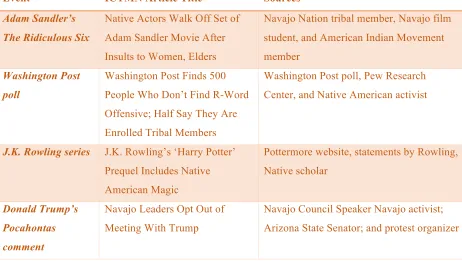
Analysis of Indian Country Today Media Network Articles
Headlines. The differences, between the two articles, were also noticed in the headlines
and lead paragraphs. The titles for the NYT article were shorter, less descriptive, and contained
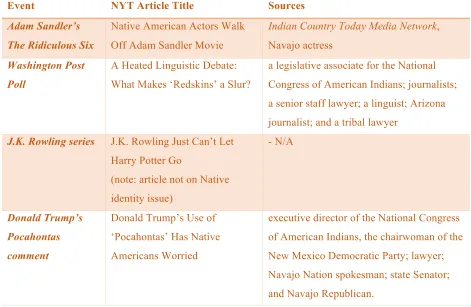
one fact (see Tables 2 and 3 for titles). When compared, Indian Country Today Media Network
(ICTMN)’s titles were longer and included, at times, more than one fact in the article title.
Take for example the articles about Adam Sandler’s movie: “Native Actors Walk Off Set
of Adam Sandler Movie After Insults to Women, Elders” (ICTMN) and “Native American
Actors Walk Off Adam Sandler Movie” (NYT). Both titles are similar, but the NYT article is
more concise, while the ICTMN article is longer and more descriptive.
Lead paragraph.The lead paragraphs for the articles by both organizations provided a
summary of the purpose for the articles. However, they differed in that ICTMN provided more
information on the controversy surrounding the issues being reported on, and jumped into the
Event ICTMN Article Title Sources
Adam Sandler’s The Ridiculous Six
Native Actors Walk Off Set of Adam Sandler Movie After Insults to Women, Elders
Navajo Nation tribal member, Navajo film student, and American Indian Movement member
Washington Post poll
Washington Post Finds 500 People Who Don’t Find R-Word Offensive; Half Say They Are Enrolled Tribal Members
Washington Post poll, Pew Research Center, and Native American activist
J.K. Rowling series J.K. Rowling’s ‘Harry Potter’
Prequel Includes Native American Magic
Pottermore website, statements by Rowling, Native scholar
Donald Trump’s Pocahontas comment
Navajo Leaders Opt Out of Meeting With Trump
issue, rather than lead into the issues. For example, below are the two lead paragraphs for the
articles that reported the findings of the Washington Post poll.
The New York Times article (Barry, 2016) began with:
Growing up as a member of the Gila River Indian Community in Arizona, Brian Howard
attended an elementary school that was within the boundaries of Phoenix and beyond
those of his reservation. There, in the third grade, he was first called “redskin.”
The Indian Country Today Media Network article (Moya-Smith, 2016) began with:
It didn’t take long after The Washington Post published a report claiming 9 out of 10
Native Americans do not find the name of the Washington NFL team offensive before
prominent Native American leaders and activists began calling it “flawed” and
“irresponsible.”
In addition, the word choices of the writer added to the differences. For one, the writers
of the ICTMN articles rarely used the term “redskin” when writing on the subject. As there are
Native Americans that find the term “redskins” to be offensive, ICTMN instead replaced it by
using the “R-Word” or “the Washington NFL team” in its place.
Hypothesis testing. The most significant thematic difference among the articles written
by New York Times (NYT) and Indian Country Today Media Network (ICTMN) was the use of
hypothesis-testing. Stories with a thematic structure “contains certain hypothesis-testing features:
events are cited, sources are quoted, and propositions are pronounced” (Pan & Kosicki, 1993, p.
60). In most of the articles, the titles served as the hypothesis with evidence supporting the
hypothesis in the body of the text, for example:
1. Headline of article (hypothesis):Donald Trump’s Use of ‘Pocahontas’ Has Native
Supporting evidence: “For many, his mention of the historical figure is offensive and a
sign that Mr. Trump, who has been accused of being anti-immigrant, also has problems
with the people who first inhabited the country” (Rappeport, 2016, para 4).
2. Headline of article (hypothesis): Native Actors Walk off set of Adam Sandler movie
after insults to women, elders
Supporting evidence:the supporting events, actions, or statements include: the names of
characters, the misrepresentation of the Apache culture, and the script which insulted
native women and the elderly (Schilling, 2015).
In other cases, the hypothesis is found in the body of the text, or in the following example in
the lead paragraph.
3. Headline of article:Washington Post Finds 500 people who don’t find r-word offensive;
half say they are enrolled tribal members
Body of article: It didn’t take long after The Washington Post published a report claiming
9 out of 10 Native Americans do not find the name of the Washington NFL team
offensive before prominent Native American leaders and activists began calling it
“flawed” and “irresponsible.”
Hypothesis: the poll is “flawed” and “irresponsible.”
Supporting evidence:“…it does not take into account the empirical research that found
words like ‘redskin’ and ‘savage’ harm the mental health of Native American youths; and
secondly, that more than half – 56 percent – of the respondent’s self-identity as Native
Americans” (Moya-Smith, 2016, para 3).
Amount of articles. For each event, ICTMN wrote more articles than the NYT. The
community” (Rowling, 2016), had five articles written by ICTMN, but the NYT did not report
on the controversial issue. The sole result from a search using the NYT’s website came up with
an article regarding the J.K. Rowling’s inability to “…Let Harry Potter Go,” and did not mention
the controversy. However, it is important to note that a quick Google search resulted in articles
on the controversy by other mainstream media outlets. The event of the Adam Sandler movie
[image:40.612.70.541.287.594.2]produced the most articles with 37 written by ICTMN and 3 by the NYT.
Table 3
Analysis of New York Times Articles
Event NYT Article Title Sources
Adam Sandler’s The Ridiculous Six
Native American Actors Walk Off Adam Sandler Movie
Indian Country Today Media Network, Navajo actress
Washington Post Poll
A Heated Linguistic Debate: What Makes ‘Redskins’ a Slur?
a legislative associate for the National Congress of American Indians; journalists; a senior staff lawyer; a linguist; Arizona journalist; and a tribal lawyer
J.K. Rowling series J.K. Rowling Just Can’t Let
Harry Potter Go
(note: article not on Native identity issue)
- N/A
Donald Trump’s Pocahontas comment
Donald Trump’s Use of ‘Pocahontas’ Has Native Americans Worried
Chapter 4: Discussion
The framing differences among the articles indicate that there is a difference between the
reporting by the two news organizations. These differences were seen in the sources, headlines,
and lead paragraphs of each article. For one, when compared to the New York Times (NYT),
articles by Indian Country Today Media Network (ICTMN) differed in that the headlines were
usually longer, and more descriptive. However, an explanation for this could be that the NYT is
also a printed publication, and with that there are space constraints for headlines.
The results suggest that sources played a significant role in the differences between the
two reports. As ICTMN’s sources were more community based, it allowed for the Native voice
to be heard. In one example, ICTMN gave Native actors the opportunity to provide their
accounts and reasons for walking off the set of Sandler’s film. In another example, it allowed
scholars to present their research findings of the harmful effects that offensive and derogatory
language can have on Native youth. Native journalism allowed tribal officials to speak out and
talk about issues that are impacting Native communities. In these instances, the reporting went
beyond just the facts. It included information that recognizes the experiences of Native people,
told by Native people. It is through those experiences that brought an alternative perspective on
each event.
The structures of the news discourse varied in the reporting by both organizations.
However, the results suggest that the “thematic structure” was used frequently. The articles with
a thematic structure also utilized a hypothesis-testing element. The hypotheses were either found
in the headline of the article or the body of the article. The articles then proceeded to support the