UNIVERSITI TEKNIKAL MALAYSIA MELAKA
A STUDY ON ENERGY EFFICIENCY FOR LIGHTING IN SMALL
SCALE ROOM USING LUMEN METHOD
This report submitted in accordance with requirement of the Universiti Teknikal Malaysia Melaka (UTeM) for the Bachelor’s Degree in Mechanical Engineering Technology
(Maintenance) (Hons.) by
MUHAMMAD FAEEZ BIN MOHAMED HARIRI B071210450
900327035699
UNIVERSITI TEKNIKAL MALAYSIA MELAKA
BORANG PENGESAHAN STATUS LAPORAN PROJEK SARJANA MUDA
TAJUK: A Study on Energy Efficiency for Lighting in Small Scale Room Using
Lumen Method
SESI PENGAJIAN: 2014/15 Semester 2
Saya Muhammad Faeez Bin Mohamed Hariri mengaku membenarkan Laporan PSM ini disimpan di Perpustakaan Universiti Teknikal Malaysia Melaka (UTeM) dengan syarat-syarat kegunaan seperti berikut:
1. Laporan PSM adalah hak milik Universiti Teknikal Malaysia Melaka dan penulis. 2. Perpustakaan Universiti Teknikal Malaysia Melaka dibenarkan membuat salinan
untuk tujuan pengajian sahaja dengan izin penulis.
3. Perpustakaan dibenarkan membuat salinan laporan PSM ini sebagai bahan pertukaran antara institusi pengajian tinggi.
4. **Sila tandakan ( )
SULIT
TERHAD
̷̷ TIDAK TERHAD
(Mengandungi maklumat yang berdarjah keselamatan atau kepentingan Malaysia sebagaimana yang termaktub dalam AKTA RAHSIA RASMI 1972)
(Mengandungi maklumat TERHAD yang telah ditentukan oleh organisasi/badan di mana penyelidikan dijalankan)
(---)
Alamat Tetap:
PT-167, Jalan Masjid Pulau,
16150 Kota Bharu,
Kelantan.
Disahkan oleh:
(---)
Cop Rasmi:
i
DECLARATION
I hereby, declared this report entitled “A Study on Energy Efficiency for Lighting in Small Scale Room using Lumen Method” is the result of my own research except as
cited in references.
ii
APPROVAL
This report is submitted to the Faculty of Engineering Technology of University Teknikal Malaysia Melaka (UTeM) as a partial fulfillment of the requirements for the degree of Bachelor of Engineering Technology (Bachelor’s Degree of Mechanical Engineering Technology (Maintenance Technology)) (Hons.). The number of the supervisory is as follow:
iii
ABSTRAK
iv
ABSTRACT
v
DEDICATION
To my beloved family,
My supervisor,
My Panel,
and to all my friends,
vi
ACKNOWLEDGEMENT
First I would like to express my grateful to ALLAH S.W.T. as for the blessing given that I can complete my final year project. In preparing this paper, I have been involved with many people in helping me to complete this project.
I am grateful and would like to express my sincere gratitude to my supervisor, Mr. Mohamed Saiful Firdaus Bin Hussin for the preliminary ideas, invaluable guidance, continuous encouragement and continuous support in making this research possible. I appreciate his consistent support from the beginning till the end of this project. Thanks to all my supervisor mates and staff of the Mechanical Engineering Technology Department of Universiti Teknikal Malaysia Melaka and development department who helped me in many ways during the project.
I acknowledge my sincere gratitude to my family for their love, dream and sacrifice throughout my life. I cannot find the appropriate words that could properly describe my appreciation for their devotion, support and faith in my ability to attain my goals. Special thanks should be given to my friends. I would like to acknowledge their comments and suggestions, which was crucial for the successful completion of this final year project.
vii
TABLE OF CONTENT
Declaration i
Approval ii
Abstrak iii
Abstract iv
Dedication v
Acknowledgement vi
Table of Content vii
List of Tables x
List of Figures xi
List Abbreviations, Symbols and Nomenclatures xii
CHAPTER 1: INTRODUCTION 1
1.1 Overview Energy Consumption 1
1.2 Problem Statement 4
1.3 Objectives 6
1.4 Scope 6
CHAPTER 2: LITERATURE REVIEW 7
2.1 Energy consumption by global perspective 7
2.2 Importance of energy efficiency in industry 9
2.3 Energy management 10
2.3.1 Objectives of energy management 10
2.3.2 Organizational structure and energy management program 11
2.4 Energy audit 12
2.4.1 Energy audit process and resources 12
2.5 Types of energy audit 13
2.5.1 Preliminary audit 14
2.5.2 General audit 15
viii
2.6 Energy efficiency courses and training program 16
2.6.1 Energy saving by housekeeping 17
2.6.2 Elements of a good housekeeping campaign 18
2.7 Application of energy consumption 19
2.7.1 Refrigerators 19
2.7.2 Lighting 20
2.7.3 Fan 21
2.7.4 Air Conditioner 21
2.7.5 Other-End-Uses 22
2.8 Energy Use and Energy Efficiency Performance in Buildings 22
2.8.1 Buildings and Energy Use 23
2.9 Lumen Method 23
2.9.1 Light Loss factor 24
2.9.2 Method 25
2.9.3 Usage 25
2.9.4 Variables 26
2.10 The watt-Per-Square-Foot 26
CHAPTER 3: METHODOLOGY 28
3.1 Methodology of the project 28
3.2 Survey 29
3.3 Observation and Measurement 29
CHAPTER 4: RESULT AND DISCUSSION 31
4.1 Walk-Through Lighting Audit 31
4.1.1 User Behaviors 32
4.2 Average Daily Electrical Consumption 34
4.2.1 Hourly Analysis 37
4.3 Energy Management and Saving Proposal 40
4.3.1 Finding Opportunities to Save Energy 42
4.3.2 Targeting the Opportunities to Save Energy 41
4.3.3 The Occupant Needs To Control the System 41
4.3.4 The Occupant Needs To Understand the System 41
ix
4.3.6 Auxiliary Equipment 43
CHAPTER 5 : CONCLUSION AND RECOMMENDATION 46
5.1 Conclusion 46
5.2 Recommendation 47
REFERENCES 49
APPENDICES 55
A Questionnaire 55
B Sample Calculation 56
x
LIST OF TABLES
Table Title Page
1.1 Annual electric bill UTeM 3
2.1 Level Requirement for lecture room 27
2.2 Level Requirement for Laboratories 27
4.1 Number of Lighting by lecture room 9 at (FKM) 32
4.2 Energy Consumption of Lighting by lecture room 9 at (FKM) 35
4.3 Energy Consumption of Lighting by Oils Analysis Laboratory at (FTK) 36
4.4 Energy Consumption of Lighting at Lecture Room 9 FKM (standard) 38
xi
LIST OF FIGURES
Figure Title Page
1.1 Bar chart annual electric bill (UTeM) 4
2.1 World marketed energy consumption 8
2.2 Energy Consumption OECD and non-OECD industrial sector 8
2.3 Organizational structure and energy management program 11
2.4 Typical energy audit program 13
2.5 Resources required for an energy audit 15
2.6 Energy efficiency courses and its dimensions 17
2.7 Breakdown of energy consumption in the building sector (%) 23
3.1 Flow chart of studies 28
4.1 The classroom with lighting fluorescent type 31
4.2 Percentage behaviors of electricity users in UTeM 33
4.3 Energy consumption for lecture room 9 FKM 39
4.4 Occupancy control scheme 45
xii
LIST
OF ABBREVIATIONS, SYMBOLS AND
NOMENCLATURE
UTeM – University Technical Malaysia Melaka FTK - Faculty of Technology Engineering (FTK) FKM - Faculty of Mechanical Engineering (FKM) FHE - Further and higher education
MOHE - Ministry of Higher Education
FPTT - Faculty of Technology Management and Technopreneurship ZW – Zettawatt (10^21 watt)
OECD - Organization for Economic Cooperation and Development CFL - Compact fluorescent lamps
GDP - Gross Domestic Product
1
CHAPTER 1
INTRODUCTION
1.1 Energy Consumption Overview
Energy consumption is the consumption of energy or power used by all of human civilization. The pattern of energy consumption actually differs for an industry, buildings and sites where it also depends on the duration and nature of the period of occupation. Usually, a building that demands high usage has high energy consumption. Eventually, energy efficiency measures should be carried out in order to improve overall building performance (Bassi et al., 2009). Energy saving can increase competitiveness for industry, through the cost reduction, economic growth and environmental issues (Ozolina & Rosˇa, 2012).
2
building is determined by the load or equipment that been use. So that, when more demands by the load, the grade will be higher.
Presently, further and higher education (FHE) around the world is a growing sector, with student numbers increasing by 44% over the past ten years (Ozolina & Rosˇa, 2012). This means that the energy consumption of colleges and universities is also growing (Ozolina & Rosˇa, 2012). Establishments are under constant pressure to provide optimum learning facilities on a limited budget so it makes sense to look at the way energy is used in order to release much needed additional funds for curricular resources. Implementing a few simple techniques can reduce energy consumption. It will also boost the environmental credentials of a college or university, which could influence the number and caliber of students attracted and retained.
The energy consumption increases with population growth, increasing demand for building services and comfort levels, and time spent inside buildings (Ozolina & Rosˇa, 2012). Lighting has the potential to improve energy saving in buildings (Boyano et al., 2013). In fact, the energy use in buildings is reflected by the energy consumption in residential and commercial sectors (Ozolina & Rosˇa, 2012), and energy efficiency in buildings has become a primary objective for energy policy at regional, national and international levels. The increase in the number of commercial buildings and residential area development projects has a great impact to the national development but it also increases the energy demand.
3
sector with its share 34.1% in 2012 (Choong et al., 2009). In Malaysia, the Ministry of Higher Education (MOHE) spends more than ten million ringgit annually on the expensive electricity bills (Choong et al., 2009).
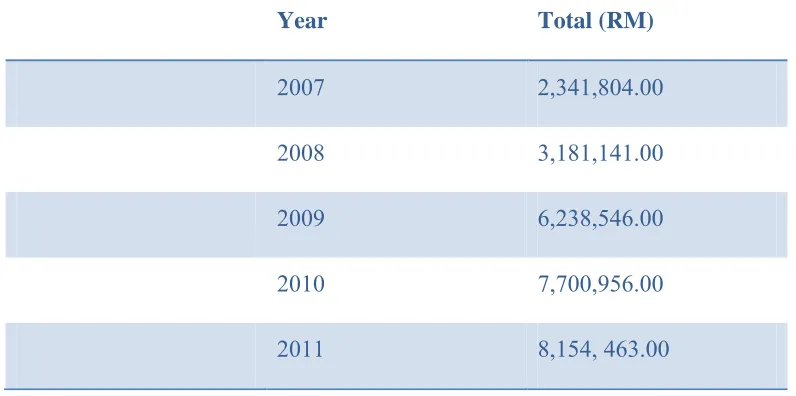
[image:17.612.129.527.344.542.2]MOHE has urged all education centers to save energy for expensive monthly electricity bill which had become the concerns for many parties (Choong et al., 2012). A survey done has shown the energy consumption in Universiti Teknologi Malaysia and International Islamic University Malaysia has led to more than ten million ringgit annually due to increment of students’ population almost every year (Choong et al., 2012).
Table 1.1: Annual electric bill UTeM (Hassan, 2012)
Year Total (RM)
2007 2,341,804.00
2008 3,181,141.00
2009 6,238,546.00
2010 7,700,956.00
2011 8,154, 463.00
4
[image:18.612.147.542.170.381.2]about 20% which is around RM 1.6 million by an implementation of good energy management, the annual electric bill of course will be reduce. Below is the Table 1.1 shown the annual electric bill for University Technical Malaysia Melaka (UTeM) (Hassan, 2012).
Figure 1.1: Bar chart annual electric bill UTeM (Hassan, 2012)
1.2 Problem Statement
Energy consumption at colleges and universities is always growing through the time together with increases of student numbers (Piper, 1999). Especially at University Technical Malaysia Melaka (UTeM) an academic precinct is widespread and consists of a large number of buildings of different functions and consumption patterns. The rapid growth of UTeM leads increase of electrical energy usage. It is expected that UTeM soon will expand six greater in just several years ahead.
air-5
conditioners and electrical appliances in use, temperature, occupancy rate, occupant behavior, and size of buildings (Piper, 1999). Energy consumption increases when more air conditioners are turned on and more electrical devices are in use (Piper, 1999).
According to the research by Hassan (2012) from Faculty of Technology Management and Technopreneurship (FPTT) & Faculty of Mechanical Engineering (FKM), state that trend of annual bill UTeM always increase. The overall cost for electric bill UTeM in the 2011 is about RM 8,154, 463.00. So that, if this annual bill can be reduce, the funds can be saved for research and other areas that are more in need.
Energy audits are carried out to understand the energy performance of buildings and facilities so that areas with potential for energy savings can be identified (Jayamaha, 2007). Energy audits are commonly classified as preliminary or walk-through audits and comprehensive or detailed audits, each differentiated by the level of detail involved and the depth of analysis undertaken (Beggs, 2009.). Preliminary energy audits focus mainly on the gathering and analysis of historical data such as utility bills and invoices, a walk-through of the facility under consideration to familiarize with the facility operation and identify evident areas with energy inefficiency, taking meter readings as well as simple interviews with site operating personnel (Gard, 2007.). Detailed energy audits normally involve conducting of in-depth measurements and data inventory, possibly with the aid of energy simulation computer software, thus consuming more time.
6
electrical appliances which is lighting will be investigated to determine their effects on energy consumption.
1.3 Objective
Based on the problem statement stated above, the objectives of this study are stated below:
i. To identify the excessive uses of lamp and lighting level in the small scale room.
ii. To propose energy management that could result in savings in utilization and associated expenditure.
1.4 Scope
In order to reach the objectives, a few scopes have been stated below:
i. Identifying the excessive uses of lamp and lighting level in the FTK and FKM building by using lumen method.
7
CHAPTER 2
LITERATURE REVIEW
2.1 Energy Consumption by Global Perspective
Energy is usually a simple desire for distinct purposes in industrial facilities around the globe including in college or university building. Huge amount of energy required for countries together with more rapidly financial progress. Energy can be as a result a crucial element with regard to financial competition along with work. On the other hand, world-wide people along with power desires are generally improved hand-in-hand. This particular matter has to be tackled by the global local community in order to get over almost any shortage of energy sources sometime soon.
Entire world marketed power usage is actually estimated to improve simply by 33% by 2010 to 2030. Total world power consumption utilize rose by 82, 919 ZW within 1980 to 116, 614 ZW within 2000 after which is actually required to reach 198, 654 ZW within 2030 as shown in Figure 2.1 (U.S Energy Information, 2009). The most rapid growth in energy demand from 2006 to 2030 is projected for nations outside the Organization especially for Economic Cooperation and Development (non-OECD nations).
8
[image:22.612.174.472.523.674.2]73% contrasted with a 15% expansion in power use among the OECD nations (U.S Energy Information, 2009). The states devours 25% of the world's energy consumption. On the other hand, the hugest development of power utilization is at present occurring in China, which has been developing at 5.5% every year (U.S Energy Information, 2009).
Figure 2.1: World marketed energy consumption (U.S Energy Information, 2009)
9
Figure 2.2: Energy consumption OECD and non-OECD industrial sector (U.S Energy
Information, 2009)
2.2 Importance of Energy Efficiency in Industry
Industrial development throughout the world will result with more energy use and definitely will lead to additional concentration of greenhouse gases for instance carbon dioxide (CO2) and also other emissions such because sulfur dioxide (SO2),
nitrogen oxide (NOx) as well as carbon monoxide (CO) which in turn all have disastrous
consequences for earth’s climate including rising temperature, drought, surges, famine and monetary chaos. (Mahlia, 2002). The actual Intergovernmental Panel about Climate Change (IPCC) described that continued emissions will bring about a temperature improves of between 1.4˚c to 5.8˚c in the period from 1990 to help 2100.
Moreover, The Department of energy (The United States of America) highlighted that, global carbon emissions are rising greater than 2% per season and by 2015 could possibly be more than 50% earlier mentioned 1997 level, all of which because of improving energy demand and inefficient way of energy use. (Mahmoud et al., 2009). Energy efficiency inside the industrial sector begun to be considered one of the primary functions in this 1970s. After that, the world possesses trimmed its energy budget by utilizing higher efficiencies, while still growing monetarily, and has realized the importance of protecting surroundings.
In the industry sector, large plants together with high energy consumption tackled the issue by retrofitting method plants and features. Other industrial sectors resorted to investments with the shortest possible payback including heat recovery as well as reduction of loss (Petrecca, 1992). Furthermore, energy efficiency can be improved by three different approaches as follow:
Energy savings by management.
10 Energy saving by policies/regulations.
2.3 Energy Management
Energy management could be the strategy of getting together with energy demand when and where it really is needed. This can be carried out by adjusting along with optimizing energy utilizing systems and procedures so that you can reduce energy demands per unit involving output while holding constant or decreasing total costs involving producing the productivity from these techniques (US Bureau of Energy Efficiency, 2010). Energy management started to be considered one of the many functions of industrial management from the 1970s as the effect of the rising price of electricity and reports in regards to the approaching exhaustion connected with world energy resources (Petrecca, 1992).
These days, the role of energy management has greatly expanded in market sectors. Top management on the company participates throughout planning various power management projects regularly. The annual reports of the numerous companies should mention information of energy resource efficiency activities and various achievements because of the company regarding power conservation projects. To be effective, energy management programs will include four main pieces (Kannan et al., 2003). To begin with, analysis of previous data, then power audit and accounting, follow by executive analysis and investments proposals based on feasibility studies not only that personnel training in addition to information.
2.3.1 Objectives of Energy Management