133
The Quarterly Review of Biology, June 2016, Vol. 91, No. 2 Copyright © 2016 by The University of Chicago Press. All rights reserved.
0033-5770/2016/9102-0002$15.00
Resilience to dRoughts in mammals:
a conceptual fRamewoRk foR estimating
vulneRability of a single species
Tasmin L. Rymer
College of Marine & Environmental Sciences and Centre for Tropical Environmental & Sustainability Sciences, James Cook University
Cairns, Queensland 4870 Australia
School of Animal, Plant & Environmental Sciences, University of the Witwatersrand Johannesburg 2050 South Africa
e-mail: [email protected]
Neville Pillay
School of Animal, Plant & Environmental Sciences, University of the Witwatersrand Johannesburg 2050 South Africa
e-mail: [email protected]
Carsten Schradin
School of Animal, Plant & Environmental Sciences, University of the Witwatersrand Johannesburg 2050 South Africa
Institut Pluridisciplinaire Hubert Curien—Département Ecologie, Physiologie et Ethologie, Université de Strasbourg
Strasbourg 67087 France CNRS, UMR7178 Strasbourg 67087 France
e-mail: [email protected]
keywords
allostasis, homeostasis, metabolism, osmoregulation, preadaptation, thermoregulation
manually chage ligatures
fi and fl to
abstract
The frequency and severity of droughts in certain areas is increasing as a consequence of climate change. The associated environmental challenges, including high temperatures, low food, and water availability, have affected, and will affect, many populations. Our aims are to review the behavioral, physiological, and morphological adaptations of mammals to arid environments, and to aid research-ers and nature conservationists about which traits they should study to assess whether or not their study species will be able to cope with droughts. We provide a suite of traits that should be considered when making predictions about species resilience to drought. We define and differentiate between general adaptations, specialized adaptations, and exaptations, and argue that specialized adaptations are of little interest in establishing how nondesert specialists will cope with droughts. Attention should be placed on general adaptations of semidesert species and assess whether these exist as exaptations in nondesert species. We conclude that phenotypic flexibility is the most important general adaptation that may promote species resilience. Thus, to assess whether a species will be able to cope with increasing aridity, it is important to establish the degree of flexibility of traits identified in semidesert species that confer a fitness advantage under drying conditions.
Introduction
nthRopogenic-induced
environ-mental change, including habitat
loss (galbraith et al. 2002), fragmentation
(fahrig 2003), and climate change
(et-terson and shaw 2001; alley et al. 2003),
is accelerating at a rate unprecedented in
earth’s history (etterson and shaw 2001;
alley et al. 2003). in fact, the rate of
ver-tebrate species climatic niche evolution is
considerably slower than the current
pre-dicted rates of anthropogenic
environmen-tal change (Quintero and wiens 2013). the
accelerated rates of human-induced
envi-ronmental change could thus be driving a
sixth mass extinction event, requiring
con-servation efforts to be focused on reducing
the rate of extinctions (pimm 2009; black
et al. 2011; harley 2011). however, we are
currently unable to predict which species
will be threatened by extinction under
in-creased environmental change and which
species will survive (moritz and agudo
2013).
many studies have assessed the
proba-bility and potential of species to adapt to
rapid environmental change via
evolution-ary adaptation (e.g., evolutionevolution-ary rescue;
gonzalez et al. 2013; box 1). however,
evo-lutionary adaptation is generally a slow
pro cess, occurring over generations
(hoff-mann and sgrò 2011), and may occur too
slowly for species to respond to rapid
envi-ronmental and climate change. under
such circumstances, species may become
extinct, change their distribution range, or
show an active response to change through
adaptive (breed et al. 2011; box 1) or
exap-tive (ghalambor et al. 2007; box 1)
phe-notypic plasticity. interestingly, a number
of local declines and extinctions due to
en-vironmental change have been associated
with changes in species interactions (cahill
et al. 2013; ockendon et al. 2014).
how-ever, an individual’s ability to cope with its
prevailing environment is also dependent
on its behavior, physiology, and
morphol-ogy. these responses to abiotic factors then
likely also influence species interactions,
for example, through changes in activity
patterns, ultimately further impacting
ex-tinction risk.
one of the main consequences of global
climate change is an increase in the frequency
and intensity of droughts (ipcc 2007; dai
2011). Regions where droughts have
be-come, and are projected to bebe-come, longer
and more frequent include the
mediterra-nean, central europe, central north america,
and southern africa (ipcc 2007). although
the latest ipcc report (2013) mentions a
lower confidence for the increased incidence
of droughts since the 1950s, it is still
pre-dicted that droughts are likely to increase
in some areas in the future. droughts are
a normal part of climate variation, which
means that, independent of global climate
change, natural populations have and
will continue to face this problem
repeat-edly. for example, in the last 500 years,
box 1
Definition of terms
Term Definition
Adaptive phenotypic plasticity
alteration of some aspect of the phenotype in
re-sponse to prevailing environmental conditions, which
increases an individual’s chance of survival and
repro-duction (maximizes fitness; charmantier et al. 2008;
ozgul et al. 2009, 2010; piersma and van gils 2010)
and that may facilitate population persistence and
potentially evolutionary adaptation (hoffmann and
sgrò 2011). traits that specifically evolved in response
to historical selection pressures and have current
util-ity in the same context (phenotypic adaptation).
Aridity index
Im =
(100
S
− 60
D
)
pet
; where
I
m= index of moisture
availability;
S
= total moisture surplus (mm) from
all months with a water surplus;
D
= total of all
monthly deficiencies (mm); and pe = annual
po-tential evapotranspiration (mm; meigs 1953). both
S
and
D
are represented by the difference between
monthly precipitation and monthly potential
evapo-transpiration (nash and engineering group
work-ing party 2012). deserts have an aridity index below
0.2, semideserts between 0.2 and 0.5.
Behavioral evader
animals able to escape environmental extremes
us-ing primarily behavioral and physiological
adapta-tions (willmer et al. 2000).
Developmental plasticity
nonreversible phenotypic plasticity occurring during
ontogeny (piersma and lindström 1997).
Drought
current precipitation falls significantly below the
long-term mean of a defined area (dai 2011). is
defined on a temporal scale and can occur in any
environment.
Drought-affected areas
areas that are neither deserts nor semideserts, but
ex-perience unpredicted droughts, which might occur
more often and become more intense in the future
due to climate change (li et al. 2009). in the
fu-ture, increasingly more areas might become drought
prone due to climate change.
Environmental stressor
any stimulus that could affect an individual
nega-tively if it cannot respond to it via a specific stress
response, which itself is costly (e.g., charmandari et
al. 2005). typically uncontrollable for the
individ-ual, but can be predictable (e.g., seasonal changes
in food) or unpredictable (e.g., a storm; wingfield
2013).
box 1
Continued
Term Definition
Evolutionary adaptation
change in the relative gene frequencies of alleles
(and associated phenotypic changes) within a
popu-lation over multiple generations, with a
correspond-ing increase in species fitness over time (pianka
2011; Rezende and diniz-filho 2012).
Exaptation
formerly called preexisting adaptations or
preadap-tations. traits that evolved in response to historical
selection pressures, which have current utility but in
a different context (i.e., different environment or
selection pressures; gould and lewontin 1979).
Exaptive phenotypic plasticity
alteration of traits in response to prevailing
envi-ronmental conditions, which specifically evolved in
response to historical selection pressures and have
current utility in a different context (exaptation),
increasing an individual’s chance of survival and
reproduction (increasing fitness) in novel
environ-ments (ghalambor et al. 2007).
Interannual rainfall variability
expressed as a percentage of the mean deviation of
precipitation from the average over the average
pre-cipitation (nash and engineering group working
party 2012).
Phenotypic flexibility
Reversible phenotypic plasticity (piersma and
lind-ström 1997).
Physiological endurer
animals that tolerate environmental extremes
us-ing physiological and morphological adaptations
(willmer et al. 2000).
Predictable environment
Resources spatially and/or temporally
heteroge-neous; selection pressures imposed on populations
over multiple generations are seasonal/cyclical (e.g.,
negus et al. 1986; ylönen and Ronkainen 1994);
species show evolutionary adaptation and
pheno-typic plasticity in response to change (ledón-Rettig
et al. 2008; Rymer et al. 2013).
Resilience
the ability of a species (populations or individuals)
to persist following a disturbance or disturbances
(hughes et al. 2007; tanentzap et al. 2013;
hodg-son et al. 2015).
Unpredictable environment
Resources spatially and/or temporally
heteroge-neous with random, rare, or sporadic environmental
changes (valladares et al. 2002); rapid
environ-ment pressure imposed on individuals; and species
show phenotypic flexibility in response to change
(piersma and drent 2003; Rymer et al. 2013).
Vulnerability
the predisposition or susceptibility of a species
megadroughts (extreme drought events
persisting for several years) have occurred
in north america, china, and west africa
(dai 2011).
droughts are characterized by periods of
unusually low water availability due to
re-duced precipitation and/or increased
evap-oration due to increased temperatures (dai
2011). droughts create water shortages,
leading to reduced plant primary
produc-tivity (mcnaughton et al. 1983) and thus
an associated food reduction for animals,
ultimately leading to an increased risk of
individual death and population extinction
(miller et al. 2005; seager et al. 2007).
an-imals exposed to such environmental
con-ditions may respond through changes in
behavior, physiology, and/or morphology
that facilitate survival and/or
reproduc-tion. if individual differences in
survival/re-productive probabilities are due to genetic
differences, genetic selection within the
population will result in evolutionary
ad-aptation (Rezende and diniz-filho 2012).
under drought conditions, reproduction
is often terminated or forfeited, and dry
seasons are typically the nonbreeding
sea-son (pinter 1994; schradin and pillay 2005;
sperry and weatherhead 2008). droughts
represent periods of low resource
availabil-ity that individuals must survive in order to
reach a season when reproduction again
becomes possible. for this reason, our
fo-cus rests with survival and not on
reproduc-tive success.
individuals can cope with droughts
us-ing a variety of morphological,
physiolog-ical, and behavioral traits, and to predict
the extent to which species are resilient to
droughts requires some measure of these
traits. here, we review these traits to
pro-vide researchers and nature
conservation-ists with a guide to which phenotypic traits
should be studied in order to assess whether
or not a species of interest may be able to
cope with droughts. we describe three
dif-ferent ways species can cope with droughts,
namely through evolutionary adaptation
(future change), adaptive phenotypic
plas-ticity (current change), and exaptations
(including exaptive phenotypic plasticity,
current change). we focus specifically on
stressors are typically uncontrollable for
the individual. for example, the individual
cannot control rainfall during a given
pe-riod. stressors can occur predictably (e.g.,
seasonal changes in food) or unpredictably
(e.g., a storm; wingfield 2013).
we then highlight some approaches to
categorize behavioral, physiological, and
morphological traits of mammals for
ex-istence in deserts and semideserts and
in-troduce our own categorization system, the
adaptive triquetra, which categorizes traits
facilitating coping with aridity instead of
cat-egorizing the species themselves. the
adap-tive triquetra system considers the primary
driving stressor, the body system mounting
the adaptive response (behavior,
physiol-ogy, and/or morphology), and the extent
to which this trait is flexible. we suggest
that the selection pressures operating in
deserts (defined below) drive the
evolu-tion of specialized, nonplastic adaptaevolu-tions,
whereas those in semideserts (defined
be-low) promote phenotypic flexibility. we also
stress that traits that could potentially
facili-tate future coping (which would be classified
as exaptations) must not be ignored. we
focus our explanation of the adaptive
tri-quetra on mammals, which are one of the
best studied taxa for desert adaptations.
al-though adaptations in other taxa, such as
insects and birds, might be quite different,
we believe that our general conclusions
would apply to them as well. finally, we
conclude that the degree of flexibility of
traits that exist as exaptations in nondesert
species will determine how well they can
cope with droughts, and comparing their
degree of flexibility with those of species
from semideserts will enable us to predict
their resilience.
Evolutionary Adaptation,
Adaptive Phenotypic Plasticity,
and Exaptations
evolutionary adaptation involves genetic
changes over generations (Rezende and
diniz-filho 2012). over time, species may
show genetic changes, leading to changes in
morphology (e.g., peppered moths
Biston
betularia
; saccheri et al. 2008), physiology
(e.g., red abalone
Haliotis rufescens
; de wit
and palumbi 2013), and behavior (e.g.,
bird song; podos et al. 2004). the degree
of adaptive phenotypic plasticity also
rep-resents an evolutionary adaptation. these
adaptations confer a fitness advantage and
evolved in response to particular past
se-lection pressures (baum and larson 1991;
coddington 1994). evolutionary adaptation
represents how species responded to
previ-ous environmental change, and raises the
question of whether, and the degree to
which, species can respond to prevailing
environmental change via genetic change.
although it is becoming increasingly
rec-ognized that evolutionary adaptation can
be quite rapid (hoffmann and sgrò 2011),
the evolutionary response to a changing
environment can be constrained by a lack
of genetic variation or genetic correlations
(i.e., genetic constraints; chevin 2013),
the rate at which individuals within a
pop-ulation reproduce (lewontin 1970), and
the rate and predictability at which the
strength and direction of selection changes
(due to environmental change) over time
(lande and shannon 1996; gomulkiewicz
and houle 2009; chevin 2013; michel et al.
2014).
suggesting that euryhalinity is an exaptation
important for drought resistance (hoffman
2014). euryhalinity in these toads did not
evolve in response to direct selection
pres-sure from an arid or semienvironment (i.e.,
evolved in response to past selection
pres-sure), but it does have current utility (i.e.,
provides a use in the existing context). the
usefulness of the term exaptation has
fre-quently been criticized because exemplary
traits are often not clearly distinguishable
from adaptations (larson et al. 2013). the
distinction between adaptation and
exap-tation is particularly important to consider
when assessing whether an individual could
survive in a future environment not
expe-rienced previously, as is predicted under
accelerated environmental change (sih et
al. 2011). existing phenotypic plasticity is
likely to be of importance in the prevailing
environment, even if it has evolved under
different selection pressures in a different
environment (i.e., exaptive phenotypic
plas-ticity; box 1). therefore, a population might
be able to respond to increased severity of
droughts, not because it previously
experi-enced droughts and is adapted to droughts,
but because it experienced different
envi-ronmental conditions that imposed similar
selection pressures (e.g., food shortage).
this population could thus possess
benefi-cial exaptations in response to droughts.
adaptive phenotypic plasticity is an evolved
trait, enabling a comparatively rapid response
by individuals to cope with environmental
change. phenotypic traits are altered
adap-tively in response to prevailing
environmen-tal conditions, which increases individual
fitness (charmantier et al. 2008; ozgul et
al. 2009, 2010; piersma and van gils 2010).
adaptive phenotypic plasticity may
deter-mine an individual’s survival and
reproduc-tion in the short term, which may facilitate
population persistence and evolutionary
adaptation in the long term (west-eberhard
1989; hoffmann and sgrò 2011). this could
be especially important for juveniles and
subadults that might be more vulnerable to
stressful conditions than adults (e.g., Rivers
et al. 2012). importantly, adaptive
pheno-typic plasticity itself is the product of
evolu-tion (baldwin 1896). phenotypic plasticity
can be divided into developmental plasticity
and phenotypic flexibility (piersma and van
gils 2010; box 1). for developmental
plas-ticity (nettle and bateson 2015), the
envi-ronment during early ontogeny determines
which one of two or more developmental
pathways is adopted, leading to alternative
adult phenotypes that cannot change to any
of the other phenotypes (ledón-Rettig et al.
2008). the resulting phenotype is often
ro-bust, being able to cope with environmental
changes. for developmental plasticity to be
adaptive, the population must have
experi-enced particular environments in the past
and, as a result, the developmental input to
produce particular phenotypes under
par-ticular sets of conditions experiences
posi-tive selection (nettle and bateson 2015). in
other words, individuals experience a
partic-ular environment during early development
that is predictive of the environmental
con-ditions they are likely to experience in later
life. in the case of phenotypic flexibility, the
trait can change back and forth (i.e., it is
re-versible), such as changes of the
osmoregu-latory hormone arginine vasopressin (avp),
whose levels increase when the organism
has to save water, but later decrease again.
importantly, individuals may have both
de-velopmentally plastic traits and also
pheno-typically flexible traits.
the majority of studies on phenotypic
plas-ticity provide little or no information on the
underlying genetic and epigenetic
mecha-nisms. therefore, in the context of this
re-view, we consider plasticity in general, rather
than in relation to the absolute underlying
mechanisms, by determining how variable
the trait can be under varying
environmen-tal conditions.
phenotypic plasticity has been
hypothe-sized to be costly because of the need for
the development and continued
mainte-nance of neural structures (dukas 1999),
and sensory and/or response pathways
in-volved in facilitating the flexible response
(dewitt et al. 1998; mery and burns 2010).
however, estimating the actual costs of
plasticity is difficult, and these costs might
be more easily detected under certain
con-ditions. for example, costs of plasticity are
said to be greater in stressful conditions,
and if plasticity utilizes resources that
be-come scarce in response to the stress, these
costs would be easier to detect (steiner and
van buskirk 2008). van buskirk and steiner
(2009) argue that the costs of plasticity are
actually relatively weak and there might
be a compromise or tradeoff between the
fitness benefits and costs of greater
phe-notypic plasticity. one of the main costs
of plasticity might be the time needed to
mount an appropriate plastic response.
be-cause plasticity seems to have surprisingly
low costs, it has been argued recently that
relaxed and variable selection intensities
are more important constraints for the
evo-lution of plasticity than are its costs
(mur-ren et al. 2015).
phenotypic plasticity, enabling a coping
response to droughts, can either be
evolu-tionary adaptations (adaptive phenotypic
plasticity) or exaptations (exaptive
pheno-typic plasticity). for example, all mammals
have the hormone avp, which is important
in osmoregulation, but not all mammals
have experienced droughts as a selection
pressure modifying the avp system.
there-fore, an increase of avp plasma levels to
reduce water loss during droughts might
be higher in desert species, representing an
ad-aptation to previous droughts, but would also
occur—although maybe at a lower level—in
species from nondesert environments when
exposed to droughts, as an exaptation that
evolved to save water under different
envi-ronmental conditions, such as during
win-ter or during periods when food has a lower
water content due to seasonal changes. in
sum, phenotypic plasticity can have very low
flexibility (being fixed) or high flexibility,
and represent adaptations or exaptations to
droughts.
Three Primary Stressors
of Arid Environments
identifying the limits of phenotypic
plas-ticity is foundational for assessing the degree
to which individuals can respond to rapid
environmental change. to evaluate which
adaptations and exaptations could promote
species persistence to increased pe riodicity
and/or intensity of droughts, we will
fo-cus on species that currently inhabit areas
characterized by periods of dryness (i.e.,
semideserts and deserts) with low annual
precipitation and high aridity index (box 1).
below 0.2 (nash and engineering group
working party 2012). in our review, we group
both arid categories into “deserts,” as the
se-lection pressures in both habitat types will
drive the establishment of specialized
adap-tations (see below). semideserts, such as the
hardeveld of the succulent karoo in south
africa (acocks 1988) and the victoria River
district in australia (webb et al. 2014),
gen-erally receive between 100 and 200mm of
rainfall per year on average, have a moderate
aridity index of between 0.2 and 0.5, and a
25–50% interannual rainfall variability (for
definition see box 1; nash and
engineer-ing group workengineer-ing party 2012). we define
“drought-affected areas” as those that are
nei-ther deserts nor semideserts, but experience
unpredictable droughts, which might occur
more often and become more intense in the
future due to climate change (box 1).
deserts and semideserts are characterized
by low food availability. under these
condi-tions, vegetation is typically sparse and
patch-ily distributed across the landscape (Zhang
et al. 2005). consequently, food availability
and quality is spatially and temporally
vari-able and the availability of food resources
might be unpredictable. for example, some
areas might experience seasonal periods
of dryness, which are relatively predictable
(predictable environment; box 1), while
other areas might experience unpredictable,
extreme climatic events leading to droughts
(unpredictable environment; box 1).
ani-mals inhabiting these environments have to
cope both with periods of low water
availabil-ity and simultaneously low food availabilavailabil-ity
(willmer et al. 2000). one important
con-sideration is that plants in deserts are also
adapted to low water availability (chaves et
al. 2003), whereas plants in areas
experienc-ing increased frequencies of droughts due to
climate change may not be adapted to cope
with dry conditions over long periods
(vi-cente-serrano et al. 2013). as a result, food
and water availability in drought-affected
ar-eas may have an even greater influence on
animal populations than those in naturally
dry areas.
ambient temperature (t
a) is the third
fac-tor influencing species in naturally dry and
in drought-affected areas. these habitats
are often characterized by extreme daily
fluctuations in t
athat can range from very
cold at night to very hot during the day, a
consequence of reduced absorption of heat
by vegetation (sarma et al. 2001), leading
to greater reflection of solar radiation by
the ground during the day (i.e., increased
albedo; charney et al. 1977), and rapid loss
of heat at night (sarma et al. 2001). animals
living in naturally dry environments have
evolved under selective pressures of
fluctu-ating temperature and tend to show specific
behavioral, physiological, and/or
morpho-logical adaptations to these environmental
extremes. for example, several large
des-ert artiodactyls (table 1), such as camels
Camelus dromedarius
(elkhawad 1992; ouajd
and kamel 2009) and arabian oryx
Oryx
leu-coryx
(hetem et al. 2012), utilize the carotid
rete, a network of interlacing arterioles in
the venous sinus, for selective brain cooling
(hetem et al. 2012). venous blood cooled
through the nasal countercurrent exchange
mechanism (ouajd and kamel 2009) drains
into the venous sinus, cooling the arterial
blood moving to the brain (mitchell et al.
1987).
to identify flexible traits that could
con-fer a fitness advantage under conditions
of increasing aridity, it is useful to study
species that inhabit deserts or semideserts.
categorizing species living in these dry
environments can help us to: identify key
adaptations that have arisen in response
to aridity; establish a comparative database
of traits that can be used to compare with
other species for which we lack information;
and recognize traits in nondesert-adapted
species that could promote responses to
in-creasing aridity and droughts.
Categorizing Species From
Deserts and Semideserts as
Endurers or Evaders
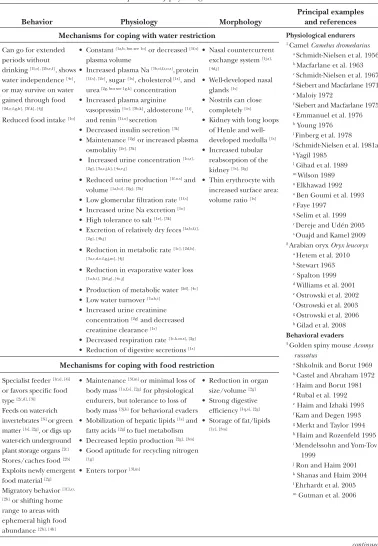
table 1
Characteristic desert adaptations of physiological endurers and behavioral evaders
Behavior Physiology Morphology
Principal examples and references Mechanisms for coping with water restriction Physiological endurers
1 camel Camelus dromedarius a schmidt-nielsen et al. 1956 b macfarlane et al. 1963 c schmidt-nielsen et al. 1967 d siebert and macfarlane 1971 e maloiy 1972
f siebert and macfarlane 1975 g emmanuel et al. 1976 h young 1976 i finberg et al. 1978 j schmidt-nielsen et al. 1981a k yagil 1985
l gihad et al. 1989 m wilson 1989 n elkhawad 1992 o ben goumi et al. 1993 p faye 1997
q selim et al. 1999 r dereje and udén 2005 s ouajd and kamel 2009 2 arabian oryx Oryx leucoryx
a hetem et al. 2010 b stewart 1963 c spalton 1999 d williams et al. 2001 e ostrowski et al. 2002 f ostrowski et al. 2003 g ostrowski et al. 2006 h gilad et al. 2008 Behavioral evaders 3 golden spiny mouse Acomys
russatus
a shkolnik and borut 1969 b castel and abraham 1972 c haim and borut 1981 d Rubal et al. 1992 e haim and izhaki 1993 f kam and degen 1993 g merkt and taylor 1994 h haim and Rozenfeld 1995 i mendelssohn and yom-tov
1999
j Ron and haim 2001 k shanas and haim 2004 l ehrhardt et al. 2005 m gutman et al. 2006 • can go for extended
periods without drinking [1l,o], [2b,e,f ], shows water independence [4c], or may survive on water gained through food [2d,e,f,g,h], [3f,k], [4j] • Reduced food intake [1o]
• constant [1a,b, but see 1o] or decreased [1f,s] plasma volume
• increased plasma na [1b,d,f,i,o,s],protein [1f,s], [2e], sugar [1s], cholesterol [1s], and urea [2g, but see 1g,k] concentration • increased plasma arginine
vasopressin [1o], [3b,k], aldosterone [1i], and renin [1i,o] secretion
• decreased insulin secretion [3k] • maintenance [2g] or increased plasma
osmolality [2e], [3k]
• increased urine concentration [1o,s], [2g], [3a,c,j,k], [4a,e,j]
• Reduced urine production [1f,o,s] and volume [1a,b,i], [2g], [3k]
• low glomerular filtration rate [1f,s] • increased urine na excretion [1o] • high tolerance to salt [1e], [3k] • excretion of relatively dry feces [1a,b,f,i],
[2g], [4b,j]
• Reduction in metabolic rate [1c], [2d,h], [3a,c,d,e,f,g,j,m], [4j]
• Reduction in evaporative water loss [1a,b,i], [2d,g], [4c,j]
• production of metabolic water [2d], [4c] • low water turnover [1a,b,i]
• increased urine creatinine concentration [2g] and decreased creatinine clearance [1s]
• decreased respiration rate [1c,k,m,s], [2g] • Reduction of digestive secretions [1s]
• nasal countercurrent exchange system [1j,s], [4d,j]
• well-developed nasal glands [1s]
• nostrils can close completely [1s] • kidney with long loops
of henle and well-developed medulla [1s] • increased tubular
reabsorption of the kidney [1s], [2g] • thin erythrocyte with
increased surface area: volume ratio [1s]
Mechanisms for coping with food restriction
• specialist feeder [1r,s], [4i] or favors specific food type [2c,d], [3i]
• feeds on water-rich invertebrates [3i] or green matter [1s], [2g], or digs up water-rich underground plant storage organs [2c] • stores/caches food [2b] • exploits newly emergent
food material [2g] • migratory behavior [1f,l,s),
[2b] or shifting home range to areas with ephemeral high food abundance [2h], [4h]
• maintenance [3f,m] or minimal loss of body mass [1a,f,s], [2g] for physiological endurers, but tolerance to loss of body mass [3j,k] for behavioral evaders • mobilization of hepatic lipids [1s] and
fatty acids [2g] to fuel metabolism • decreased leptin production [2g], [3m] • good aptitude for recycling nitrogen
[1g]
• enters torpor [3l,m]
• Reduction in organ size/volume [2g] • strong digestive
efficiency [1q,s], [2g] • storage of fat/lipids
[1r], [3m]
Dipodomys merriami
, which are able to
es-cape environmental extremes behaviorally
(table 1). later, ward (2009) recognized
that endurers are typically large-bodied
animals while evaders are typically small-
bodied animals.
the endurer-evader concept is useful for
categorizing desert specialists primarily in
relation to one characteristic of arid
envi-ronments, namely extremes in
environmen-tal temperature (t
a). however, this concept
is a simplistic approach, based on the
as-sumption that it is easier for small animals
to find refuge in the shade than it is for
large animals, while in fact we know that
large animals will use any little shade they
can find in their environment to avoid high
t
a(williams et al. 2001; ostrowski et al.
2006; ouajd and kamel 2009). although
this concept, to a degree, considers the
ability of animals to be behaviorally
flexi-ble (e.g., seeking shade), it generally
as-sumes that animals have limited flexibility
in their behavioral and morphological
re-sponses and neglects the important aspect
of exaptive phenotypic plasticity, which we
consider to be a key mechanism to cope
with change, including droughts. as such,
the endurer-evader categorization provides
an initial framework from which to further
identify important traits to be studied in
nondesert-adapted species for coping with
heat, food, and water restriction as a
conse-quence of droughts.
A Novel Classification: The
Adaptive Triquetra
[image:11.534.76.460.101.326.2]given the simplicity of the endurer-evader
concept, we developed a three-tier system,
the adaptive triquetra, that categorizes
ad-aptations to aridity instead of categorizing
species (box 2). having a species
catego-rization is not helpful for generalizing
ad-aptations across species, and importantly
overlooks the underlying general adaptive
responses to drought. we stress that
provid-ing this framework is only the first step. the
framework we develop here must be
vali-dated in the future by data from a variety
table 1
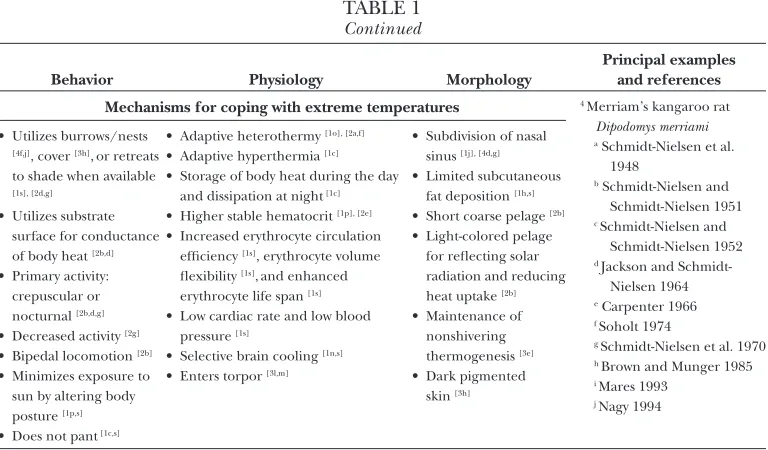
Continued
Behavior Physiology Morphology
Principal examples and references Mechanisms for coping with extreme temperatures 4 merriam’s kangaroo rat
Dipodomys merriami a schmidt-nielsen et al.
1948
b schmidt-nielsen and schmidt-nielsen 1951 c schmidt-nielsen and
schmidt-nielsen 1952 d Jackson and
schmidt-nielsen 1964 e carpenter 1966 f soholt 1974
g schmidt-nielsen et al. 1970 h brown and munger 1985 i mares 1993
j nagy 1994 • utilizes burrows/nests
[4f,j], cover [3h],or retreats to shade when available [1s], [2d,g]
• utilizes substrate surface for conductance of body heat [2b,d] • primary activity: crepuscular or nocturnal [2b,d,g] • decreased activity [2g] • bipedal locomotion [2b] • minimizes exposure to sun by altering body posture [1p,s] • does not pant [1c,s]
• adaptive heterothermy [1o], [2a,f] • adaptive hyperthermia [1c] • storage of body heat during the day
and dissipation at night [1c] • higher stable hematocrit [1p], [2e] • increased erythrocyte circulation
efficiency [1s], erythrocyte volume flexibility [1s],and enhanced erythrocyte life span [1s] • low cardiac rate and low blood
pressure [1s]
• selective brain cooling [1n,s] • enters torpor [3l,m]
• subdivision of nasal sinus [1j], [4d,g] • limited subcutaneous
fat deposition [1h,s] • short coarse pelage [2b] • light-colored pelage
for reflecting solar radiation and reducing heat uptake [2b] • maintenance of
nonshivering thermogenesis [3e] • dark pigmented
skin [3h]
superscript numbers designate species (endurers: 1Camelus dromedarius, 2Oryx leucoryx; evaders: 3Acomys russatus, 4Dipodomys
box 2
Using the adaptive triquetra system
the adaptive triquetra considers a three-step approach that can be used for either:
directly assessing resilience in species for which good biological information
al-ready exists; and/or for identifying areas where more research may be required.
for example, if someone is interested in a particular species, they might have good
knowledge of its life history, but little knowledge about its environment, and could
therefore focus on establishing which environmental stressor is more important
before understanding how the species could respond. similarly, someone might
have good knowledge about the physiology of a species, but little about its behavior.
focus could be placed on how that species responds behaviorally to particular
envi-ronmental stressors.
Step 1 Step 2 Step 3
What is the primary environmental stressor?
What traits correspond to each body system?
What is the relative flexibility of each trait?
Step 1: What is the Primary Environmental Stressor? ( Water, Food, Temperature)
consider the environment in which the species of interest occurs, and what the
primary stressor would be, taking microhabitat use into account (tables 2a, b, and
c). this is important because not all habitats will experience the same intensity of
change and some environments will buffer some stressors better than others. for
example, temperature extremes might be more critical in subtropical areas
experi-encing droughts than in temperate or polar climate zones. for a diurnal burrowing
rodent, such as brants’s whistling rat
Parotomys brantsii
( Jackson et al. 2004), extreme
temperatures may not represent a problem due to the buffering effects of burrows.
Step 2: What Traits Correspond to Each Body System? (Behavioral, Physiological,
Morphological)
this step considers the presence of, and number of traits, corresponding to each
system (tables 2a, b, and c). the greater the number of traits allowing for coping
with the stressors, the more likely it is that the species might be able to cope with
rapid environmental changes. however, this will also heavily depend on the
flexibil-ity of the traits (step 3).
Step 3: What is the Relative Flexibility of Each Trait? (Fixed, Developmentally
Plastic, Flexible)
of different species and different research
programs to determine its accuracy, and
then modified as appropriate. our
compre-hensive review of adaptations to droughts
of specialist and nonspecialist species
pro-vides the foundational information needed
for such future research programs on the
effects of droughts on individual survival
and population and species persistence.
the term “triquetra” is derived from the
latin
tri-
“three” and
quetrus
“cornered,”
emphasizing the three-tiered nature of this
classification system, as well as the
intercon-nectedness of its parts. our adaptive triquetra
considers: which stressor is addressed (water
restriction, food restriction, or extremes in
t
a); which body system mounts an
appropri-ate adaptive response (behavior, physiology,
or morphology); and the nature of the trait
(fixed versus flexible). although these
stress-ors are often interlinked (e.g., plants are
dependent on water and, therefore, food is
likely to be restricted if water is restricted),
we argue that each stressor should first be
examined independently, because some
spe-cies might have adaptations or exaptations
that facilitate better coping with one stressor
compared to another. this is especially
im-portant for designing effective management
strategies to support populations at risk. for
example, during a severe drought period
(1981–1984) in southern africa, mortality of
herbivores was quite high, but in some areas,
such as the northeastern tuli region of
bo-tswana, mixed grazers-browsers (e.g., impala
Aepyceros melampus
) were little affected
com-pared to grazers (e.g., blue wildebeest
Con-nochaetes taurinus
and zebra
Equus burchelli
),
whereas in other areas, such as the central
kruger national park in south africa, the
same grazers (blue wildebeest and zebra)
were unaffected (walker et al. 1987). walker
et al. (1987) suggest that mortality in
kla-serie Reserve in south africa (adjacent to
the kruger national park) was heightened
by close spacing of permanent water sources.
heavy grazing occurred around these areas,
eliminating reserve stands. instead,
drop-ping fences and widely spacing water sources
would have allowed animals to move
be-tween areas, accessing forage and promoting
survival. therefore, supplemental feeding in
klaserie could have been highly beneficial to
promote species survival.
which stressor is addressed?
the first step of the adaptive triquetra
model is to identify which of the three
pri-mary stressors has driven the evolution of
the particular adaptation in question (box 2).
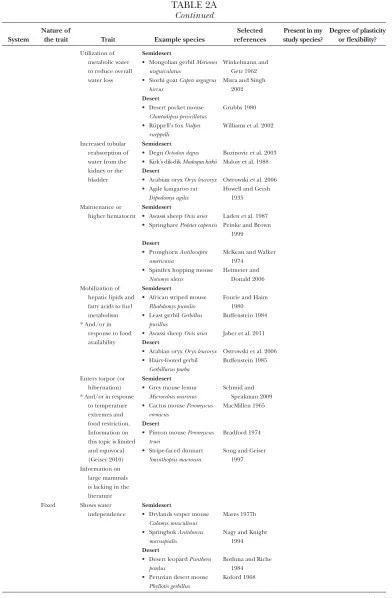
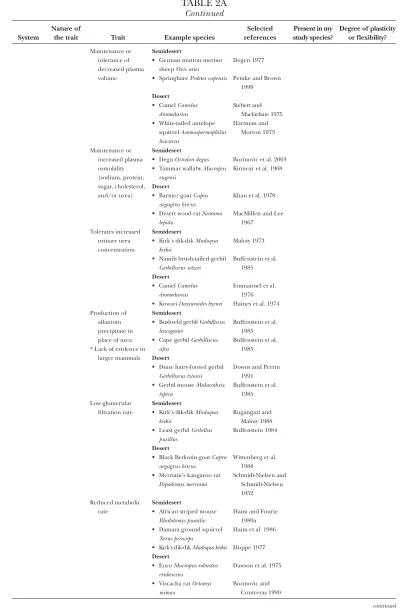
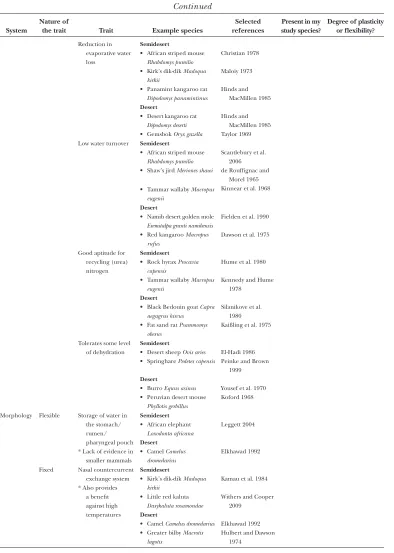
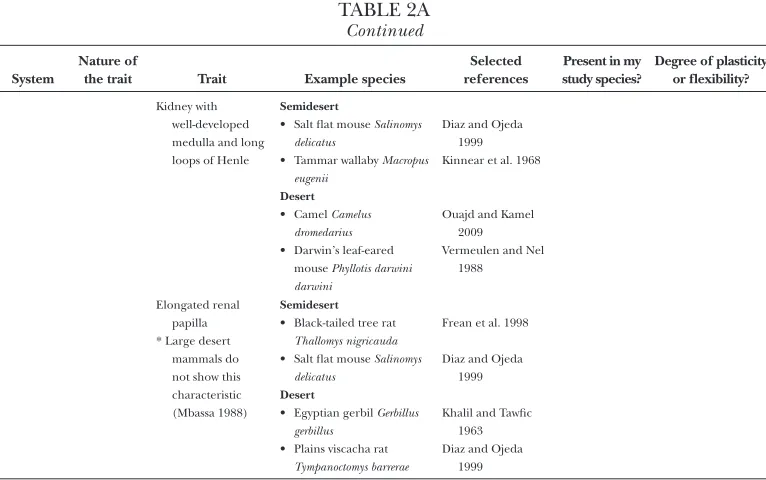
first, low water availability leads to the need
for improved osmoregulation, resulting in
adaptations that reduce water loss or
in-crease water intake (table 2a). second, since
food availability is a direct consequence of
water restriction, there is a need for
im-proved energy storage mechanisms,
result-ing in adaptations that minimize energy
loss or maximize energy gain (table 2b).
these include both intrinsic adaptations,
such as storage of body fat (e.g., mongolian
gerbils
Meriones unguiculatus
;
Zhang and
wang 2007), and extrinsic adaptations, such
as food caching (e.g., kangaroo rats
Dipo-domys
spp.; Randall 1993). third, high t
aleads to the need for improved
thermoreg-ulatory ability, resulting in adaptations that
decrease the risk of overheating or increase
the ability to tolerate heat (table 2c).
these three stressors are not fully
inde-pendent of each other. for example, in
mammals, the need for improved
thermo-regulation is directly related to the need
to save water because the ability to reduce
water loss in mammals is constrained by
the need for evaporative cooling to reduce
overheating (taylor 1970). furthermore,
water can be obtained from food directly
(e.g., consumption of succulents by
visca-cha rats
Octomys mimax
; bozinovic and
con-treras 1990) and/or indirectly (e.g., use of
metabolic water by the desert pocket mouse
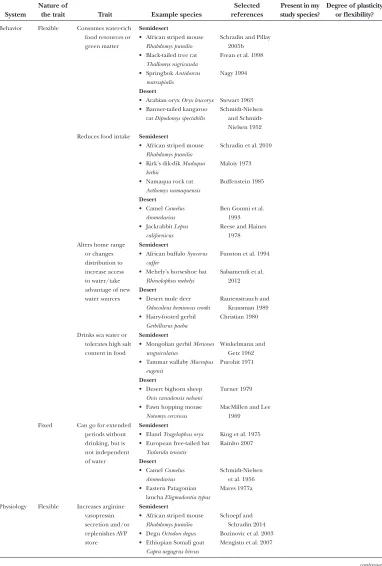
table 2a
The adaptive triquetra system for the environmental stressor water restriction
System
Nature of
the trait Trait Example species
Selected references
Present in my study species?
Degree of plasticity or flexibility?
behavior flexible consumes water-rich food resources or green matter
Semidesert
• african striped mouse
Rhabdomys pumilio
• black-tailed tree rat
Thallomys nigricauda
• springbok Antidorcas marsupialis
Desert
• arabian oryx Oryx leucoryx
• banner-tailed kangaroo
rat Dipodomys spectabilis
schradin and pillay 2005b frean et al. 1998
nagy 1994
stewart 1963 schmidt-nielsen
and schmidt-nielsen 1952 Reduces food intake Semidesert
• african striped mouse
Rhabdomys pumilio
• kirk’s dik-dik Madoqua kirkii
• namaqua rock rat
Aethomys namaquensis
Desert
• camel Camelus dromedarius
• Jackrabbit Lepus californicus
schradin et al. 2010
maloiy 1973
buffenstein 1985
ben goumi et al. 1993 Reese and haines
1978 alters home range
or changes distribution to increase access to water/take advantage of new water sources
Semidesert
• african buffalo Syncerus caffer
• mehely’s horseshoe bat
Rhinolophus mehelyi
Desert
• desert mule deer
Odocoileus hemionus crooki
• hairy-footed gerbil
Gerbillurus paeba
funston et al. 1994
salsamendi et al. 2012
Rautenstrauch and krausman 1989 christian 1980
drinks sea water or tolerates high salt content in food
Semidesert
• mongolian gerbil Meriones unguiculatus
• tammar wallaby Macropus eugenii
Desert
• desert bighorn sheep
Ovis canadensis nelsoni
• fawn hopping mouse
Notomys cervinus
winkelmann and getz 1962 purohit 1971
turner 1979
macmillen and lee 1969 fixed can go for extended
periods without drinking, but is not independent of water
Semidesert
• eland Tragelaphus oryx
• european free-tailed bat
Tadarida teniotis
Desert
• camel Camelus dromedarius
• eastern patagonian laucha Eligmodontia typus
king et al. 1975 Rainho 2007
schmidt-nielsen et al. 1956 mares 1977a
physiology flexible increases arginine vasopressin secretion and/or replenishes avp store
Semidesert
• african striped mouse
Rhabdomys pumilio
• degu Octodon degus
• ethiopian somali goat
Capra aegagrus hircus
schoepf and schradin 2014 bozinovic et al. 2003 mengistu et al. 2007
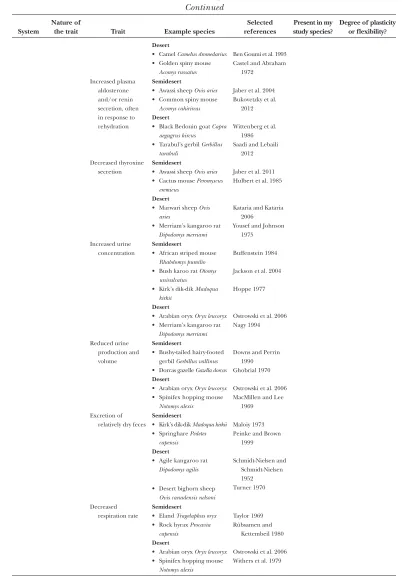
table 2a
ContinuedSystem
Nature of
the trait Trait Example species
Selected references
Present in my study species?
Degree of plasticity or flexibility?
Desert
• camel Camelus dromedarius
• golden spiny mouse
Acomys russatus
ben goumi et al. 1993 castel and abraham
1972 increased plasma
aldosterone and/or renin secretion, often in response to rehydration
Semidesert
• awassi sheep Ovis aries
• common spiny mouse
Acomys cahirinus
Desert
• black bedouin goat Capra aegagrus hircus
• tarabul’s gerbil Gerbillus tarabuli
Jaber et al. 2004 bukovetzky et al.
2012
wittenberg et al. 1986 saadi and lebaili
2012 decreased thyroxine
secretion
Semidesert
• awassi sheep Ovis aries
• cactus mouse Peromyscus eremicus
Desert
• marwari sheep Ovis aries
• merriam’s kangaroo rat
Dipodomys merriami
Jaber et al. 2011 hulbert et al. 1985
kataria and kataria 2006 yousef and Johnson
1975 increased urine
concentration
Semidesert
• african striped mouse
Rhabdomys pumilio
• bush karoo rat Otomys unisulcatus
• kirk’s dik-dik Madoqua kirkii
Desert
• arabian oryx Oryx leucoryx
• merriam’s kangaroo rat
Dipodomys merriami
buffenstein 1984
Jackson et al. 2004
hoppe 1977
ostrowski et al. 2006 nagy 1994
Reduced urine production and volume
Semidesert
• bushy-tailed hairy-footed gerbil Gerbillus vallinus
• dorcas gazelle Gazella dorcas
Desert
• arabian oryx Oryx leucoryx
• spinifex hopping mouse
Notomys alexis
downs and perrin 1990 ghobrial 1970
ostrowski et al. 2006 macmillen and lee
1969 excretion of
relatively dry feces
Semidesert
• kirk’s dik-dik Madoqua kirkii
• springhare Pedetes capensis
Desert
• agile kangaroo rat
Dipodomys agilis
• desert bighorn sheep
Ovis canadensis nelsoni
maloiy 1973 peinke and brown
1999
schmidt-nielsen and schmidt-nielsen 1952 turner 1970
decreased respiration rate
Semidesert
• eland Tragelaphus oryx
• Rock hyrax Procavia capensis
Desert
• arabian oryx Oryx leucoryx
• spinifex hopping mouse
Notomys alexis
taylor 1969 Rübsamen and
kettembeil 1980
ostrowski et al. 2006 withers et al. 1979
table 2a
ContinuedSystem
Nature of
the trait Trait Example species
Selected references
Present in my study species?
Degree of plasticity or flexibility?
utilization of metabolic water to reduce overall water loss
Semidesert
• mongolian gerbil Meriones unguiculatus
• siorhi goat Capra aegagrus hircus
winkelmann and getz 1962 misra and singh
2002
Desert
• desert pocket mouse
Chaetodipus penicillatus
• Rüppell’s fox Vulpes rueppelli
grubbs 1980
williams et al. 2002
increased tubular reabsorption of water from the kidney or the bladder
Semidesert
• degu Octodon degus
• kirk’s dik-dik Madoqua kirkii
Desert
• arabian oryx Oryx leucoryx
• agile kangaroo rat
Dipodomys agilis
bozinovic et al. 2003 maloiy et al. 1988
ostrowski et al. 2006 howell and gersh
1935 maintenance or
higher hematocrit
Semidesert
• awassi sheep Ovis aries
• springhare Pedetes capensis
Desert
• pronghorn Antilocapra americana
• spinifex hopping mouse
Notomys alexis
laden et al. 1987 peinke and brown
1999
mckean and walker 1974
heimeier and donald 2006 mobilization of
hepatic lipids and fatty acids to fuel metabolism * and/or in
response to food availability
Semidesert
• african striped mouse
Rhabdomys pumilio
• least gerbil Gerbillus pusillus
• awassi sheep Ovis aries
Desert
• arabian oryx Oryx leucoryx
• hairy-footed gerbil
Gerbillurus paeba
fourie and haim 1980 buffenstein 1984
Jaber et al. 2011
ostrowski et al. 2006 buffenstein 1985
enters torpor (or hibernation) * and/or in response
to temperature extremes and food restriction. information on this topic is limited and equivocal (geiser 2010)
Semidesert
• grey mouse lemur
Microcebus murinus
• cactus mouse Peromyscus eremicus
Desert
• pinyon mouse Peromyscus truei
• stripe-faced dunnart
Sminthopsis macroura
schmid and speakman 2009 macmillen 1965
bradford 1974
song and geiser 1997 information on
large mammals is lacking in the literature fixed shows water
independence
Semidesert
• drylands vesper mouse
Calomys musculinus
• springbok Antidorcas marsupialis
Desert
• desert leopard Panthera pardus
• peruvian desert mouse
Phyllotis gerbillus
mares 1977b
nagy and knight 1994
bothma and Riche 1984 koford 1968
table 2a
ContinuedSystem
Nature of
the trait Trait Example species
Selected references
Present in my study species?
Degree of plasticity or flexibility?
maintenance or tolerance of decreased plasma volume
Semidesert
• german mutton merino sheep Ovis aries
• springhare Pedetes capensis
Desert
• camel Camelus dromedarius
• white-tailed antelope squirrel Ammospermophilus leucurus
degen 1977
peinke and brown 1999
siebert and macfarlane 1975 hartman and
morton 1973
maintenance or increased plasma osmolality (sodium, protein, sugar, cholesterol, and/or urea)
Semidesert
• degu Octodon degus
• tammar wallaby Macropus eugenii
Desert
• barmer goat Capra aegagrus hircus
• desert wood rat Neotoma lepida
bozinovic et al. 2003 kinnear et al. 1968
khan et al. 1978
macmillen and lee 1967 tolerates increased
urinary urea concentration
Semidesert
• kirk’s dik-dik Madoqua kirkii
• namib brush-tailed gerbil
Gerbillurus setzeri
Desert
• camel Camelus dromedarius
• kowari Dasyuroides byrnei
maloiy 1973
buffenstein et al. 1985
emmanuel et al. 1976 haines et al. 1974 production of
allantoin precipitate in place of urea * lack of evidence in
larger mammals
Semidesert
• bushveld gerbil Gerbilliscus leucogaster
• cape gerbil Gerbilliscus afra
Desert
• dune hairy-footed gerbil
Gerbillurus tytonis
• gerbil mouse Malacothrix typica
buffenstein et al. 1985 buffenstein et al.
1985
downs and perrin 1991 buffenstein et al.
1985 low glomerular
filtration rate
Semidesert
• kirk’s dik-dik Madoqua kirkii
• least gerbil Gerbillus pusillus
Desert
• black bedouin goat Capra aegagrus hircus
• merriam’s kangaroo rat
Dipodomys merriami
Rugangazi and maloiy 1988 buffenstein 1984
wittenberg et al. 1986
schmidt-nielsen and schmidt-nielsen 1952 Reduced metabolic
rate
Semidesert
• african striped mouse
Rhabdomys pumilio
• damara ground squirrel
Xerus princeps
• kirk’s dik-dik Madoqua kirkii
Desert
• euro Macropus robustus erubescens
• viscacha rat Octomys mimax
haim and fourie 1980a haim et al. 1986
hoppe 1977
dawson et al. 1975
bozinovic and contreras 1990
table 2a
ContinuedSystem
Nature of
the trait Trait Example species
Selected references
Present in my study species?
Degree of plasticity or flexibility?
Reduction in evaporative water loss
Semidesert
• african striped mouse
Rhabdomys pumilio
• kirk’s dik-dik Madoqua kirkii
• panamint kangaroo rat
Dipodomys panamintinus
Desert
• desert kangaroo rat
Dipodomys deserti
• gemsbok Oryx gazella
christian 1978
maloiy 1973
hinds and macmillen 1985
hinds and macmillen 1985 taylor 1969 low water turnover Semidesert
• african striped mouse
Rhabdomys pumilio
• shaw’s jird Meriones shawi
• tammar wallaby Macropus eugenii
scantlebury et al. 2006 de Rouffignac and
morel 1965 kinnear et al. 1968
Desert
• namib desert golden mole
Eremitalpa granti namibensis
• Red kangaroo Macropus rufus
fielden et al. 1990
dawson et al. 1975
good aptitude for recycling (urea) nitrogen
Semidesert
• Rock hyrax Procavia capensis
• tammar wallaby Macropus eugenii
Desert
• black bedouin goat Capra aegagrus hircus
• fat sand rat Psammomys obesus
hume et al. 1980
kennedy and hume 1978
silanikove et al. 1980 kaißling et al. 1975
tolerates some level of dehydration
Semidesert
• desert sheep Ovis aries
• springhare Pedetes capensis
Desert
• burro Equus asinus
• peruvian desert mouse
Phyllotis gerbillus
el-hadi 1986 peinke and brown
1999
yousef et al. 1970 koford 1968
morphology flexible storage of water in the stomach/ rumen/ pharyngeal pouch * lack of evidence in
smaller mammals
Semidesert
• african elephant
Loxodonta africana
Desert
• camel Camelus dromedarius
leggett 2004
elkhawad 1992
fixed nasal countercurrent exchange system * also provides
a benefit against high temperatures
Semidesert
• kirk’s dik-dik Madoqua kirkii
• little red kaluta
Dasykaluta rosamondae
Desert
• camel Camelus dromedarius
• greater bilby Macrotis lagotis
kamau et al. 1984
withers and cooper 2009
elkhawad 1992 hulbert and dawson
1974
table 2b
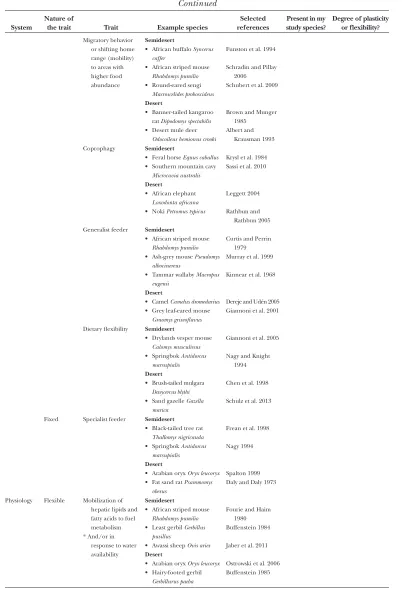
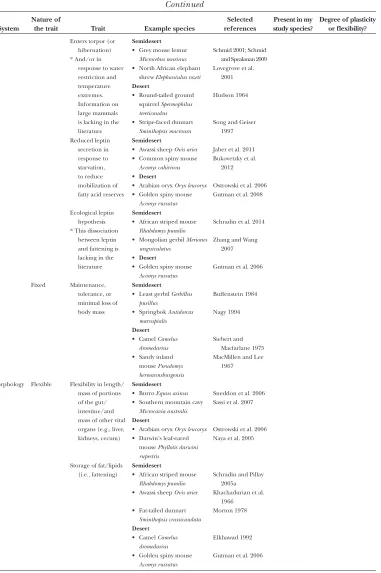
The adaptive triquetra system for the environmental stressor food restriction.
System
Nature of
the trait Trait Example species
Selected references
Present in my study species?
Degree of plasticity or flexibility?
behavior flexible stores/caches food/ scatter hoards
Semidesert
• black-backed jackal Canis mesomelas
• giant kangaroo rat
Dipodomys ingens
Desert
• desert kit fox Vulpes macrotis arsipus
• wagner’s gerbil gerbillus dasyurus dasyurus
nel 1984
shaw 1934
cypher 2003
hatough-bouran 1990 exploits newly
emergent food material
Semidesert
• african striped mouse
Rhabdomys pumilio
• vicuña Vicugna vicugna
Desert
• arabian oryx Oryx leucoryx
• piute ground squirrel
Spermophilus mollis
schradin and pillay 2006 donadio et al. 2012
ostrowski et al. 2006 Rickart 1986
[image:19.534.73.461.442.631.2]continued
table 2a
ContinuedSystem
Nature of
the trait Trait Example species
Selected references
Present in my study species?
Degree of plasticity or flexibility?
kidney with well-developed medulla and long loops of henle
Semidesert
• salt flat mouse Salinomys delicatus
• tammar wallaby Macropus eugenii
Desert
• camel Camelus dromedarius
• darwin’s leaf-eared mouse Phyllotis darwini darwini
diaz and ojeda 1999 kinnear et al. 1968
ouajd and kamel 2009 vermeulen and nel
1988
elongated renal papilla * large desert
mammals do not show this characteristic (mbassa 1988)
Semidesert
• black-tailed tree rat
Thallomys nigricauda
• salt flat mouse Salinomys delicatus
Desert
• egyptian gerbil Gerbillus gerbillus
• plains viscacha rat
Tympanoctomys barrerae
frean et al. 1998
diaz and ojeda 1999
khalil and tawfic 1963 diaz and ojeda
1999
table 2b
ContinuedSystem
Nature of
the trait Trait Example species
Selected references
Present in my study species?
Degree of plasticity or flexibility?
migratory behavior or shifting home range (mobility) to areas with higher food abundance
Semidesert
• african buffalo Syncerus caffer
• african striped mouse
Rhabdomys pumilio
• Round-eared sengi
Macroscelides proboscideus
Desert
• banner-tailed kangaroo
rat Dipodomys spectabilis
• desert mule deer
Odocoileus hemionus crooki
funston et al. 1994
schradin and pillay 2006 schubert et al. 2009
brown and munger 1985 albert and
krausman 1993 coprophagy Semidesert
• feral horse Equus caballus
• southern mountain cavy
Microcavia australis
Desert
• african elephant
Loxodonta africana
• noki Petromus typicus
krysl et al. 1984 sassi et al. 2010
leggett 2004
Rathbun and Rathbun 2005 generalist feeder Semidesert
• african striped mouse
Rhabdomys pumilio
• ash-grey mouse Pseudomys albocinereus
• tammar wallaby Macropus eugenii
Desert
• camel Camelus dromedarius
• grey leaf-eared mouse
Graomys griseoflavus
curtis and perrin 1979 murray et al. 1999
kinnear et al. 1968
dereje and udén 2005 giannoni et al. 2001
dietary flexibility Semidesert
• drylands vesper mouse
Calomys musculinus
• springbok Antidorcas marsupialis
Desert
• brush-tailed mulgara
Dasycercus blythi
• sand gazelle Gazella marica
giannoni et al. 2005
nagy and knight 1994
chen et al. 1998
schulz et al. 2013
fixed specialist feeder Semidesert
• black-tailed tree rat
Thallomys nigricauda
• springbok Antidorcas marsupialis
Desert
• arabian oryx Oryx leucoryx
• fat sand rat Psammomys obesus
frean et al. 1998
nagy 1994
spalton 1999 daly and daly 1973
physiology flexible mobilization of hepatic lipids and fatty acids to fuel metabolism * and/or in
response to water availability
Semidesert
• african striped mouse
Rhabdomys pumilio
• least gerbil Gerbillus pusillus
• awassi sheep Ovis aries
Desert
• arabian oryx Oryx leucoryx
• hairy-footed gerbil
Gerbillurus paeba
fourie and haim 1980 buffenstein 1984
Jaber et al. 2011
ostrowski et al. 2006 buffenstein 1985
table 2b
ContinuedSystem
Nature of
the trait Trait Example species
Selected references
Present in my study species?
Degree of plasticity or flexibility?
enters torpor (or hibernation) * and/or in
response to water restriction and temperature extremes. information on large mammals is lacking in the literature
Semidesert
• grey mouse lemur
Microcebus murinus
• north african elephant shrew Elephantulus rozeti
Desert
• Round-tailed ground squirrel Spermophilus tereticaudus
• stripe-faced dunnart
Sminthopsis macroura
schmid 2001; schmid and speakman 2009 lovegrove et al.
2001
hudson 1964
song and geiser 1997 Reduced leptin
secretion in response to starvation, to reduce mobilization of fatty acid reserves
Semidesert
• awassi sheep Ovis aries
• common spiny mouse
Acomys cahirinus
• Desert
• arabian oryx Oryx leucoryx
• golden spiny mouse
Acomys russatus
Jaber et al. 2011 bukovetzky et al.
2012
ostrowski et al. 2006 gutman et al. 2008
ecological leptin hypothesis * this dissociation
between leptin and fattening is lacking in the literature
Semidesert
• african striped mouse
Rhabdomys pumilio
• mongolian gerbil Meriones unguiculatus
• Desert
• golden spiny mouse
Acomys russatus
schradin et al. 2014
Zhang and wang 2007
gutman et al. 2006
fixed maintenance, tolerance, or minimal loss of body mass
Semidesert
• least gerbil Gerbillus pusillus
• springbok Antidorcas marsupialis
Desert
• camel Camelus
dromedarius,
• sandy inland mouse Pseudomys hermannsburgensis
buffenstein 1984
nagy 1994
siebert and macfarlane 1975 macmillen and lee
1967
morphology flexible flexibility in length/ mass of portions of the gut/ intestine/and mass of other vital organs (e.g., liver, kidneys, cecum)
Semidesert
• burro Equus asinus
• southern mountain cavy
Microcavia australis
Desert
• arabian oryx Oryx leucoryx
• darwin’s leaf-eared mouse Phyllotis darwini rupestris
sneddon et al. 2006 sassi et al. 2007
ostrowski et al. 2006 naya et al. 2005
storage of fat/lipids (i.e., fattening)
Semidesert
• african striped mouse
Rhabdomys pumilio
• awassi sheep Ovis aries,
• fat-tailed dunnart
Sminthopsis crassicaudata
Desert
• camel Camelus dromedarius
• golden spiny mouse
Acomys russatus
schradin and pillay 2005a khachadurian et al.
1966 morton 1978
elkhawad 1992
gutman et al. 2006
which body system mounts an
appropriate adaptive response?
the second step of the adaptive triquetra
model is to identify which body systems
have changed in response to the
environ-mental challenges associated with increasing
droughts (box 2). we expect that all species
may use multiple adaptive strategies at the
behavioral, physiological, and
morphologi-cal levels to adapt to, and cope with, the
pre-vailing environment. first, animals may use
specific behaviors to avoid harsh
environ-mental conditions. animals can reduce
wa-ter stress by choosing to consume wawa-ter-rich
food, by reducing their food intake (thereby
minimizing water required for digestion),
and/or by reducing respiration to
mini-mize evaporative water loss (table 2a).
an-imals can reduce food stress by consuming
newly emergent food (e.g., plant/insect),
by altering the diet to include a wider
vari-ety of food types (opportunistic feeders), or
by storing or caching food (table 2b). to
avoid temperature extremes, animals can
employ a range of behavioral strategies to
minimize overheating, such as utilizing
bur-rows/cover/shade that buffer temperature
extremes and also minimize water loss, or
altering body posture to minimize exposure
to the sun (tables 2a, b, and c). altering
ac-tivity levels by shifting to nocturnal acac-tivity
is another strategy minimizing exposure to
lethal diurnal temperatures, as well as
mini-mizing water loss (tables 2a and c).
second, physiological traits of
osmoregu-lation, metabolism, and thermoregulation
enable individuals to offset the limited
re-sources of water and food, and to respond
to thermal stress (tables 2a, b, and c). we
need to differentiate between
physiologi-cal mechanisms of the three processes and
the physiological markers indicating
devi-ation from the optimal physiological state,
which could suggest that the individual is
struggling to maintain homeostasis. for
example, decreased thyroxine levels could
indicate a mechanism to save metabolic
energy (yousef and Johnson 1975), while
reduced blood glucose levels might not be
an adaptation, but rather a physiological
marker of deviation (stress) from the
opti-mal physiological state (mccue 2010).
[image:22.534.75.461.87.221.2]Recently, the term allostasis has been used
to describe the physiological mechanisms
that maintain stability (homeostasis of blood
glucose, ph, and o
2levels) through change
of the osmoregulatory, metabolic, and/or
thermoregulatory system (mcewen and wing
-field 2003). importantly, allostasis depends
on the energy availability in the environment,
which decreases during droughts, leading to
allostasis overload type 1 (energy
expendi-ture to cope with environmental stressors
is greater than energy intake; mcewen and
table 2b
Continued
System
Nature of
the trait Trait Example species
Selected references
Present in my study species?
Degree of plasticity or flexibility?
fixed strong digestive efficiency
Semidesert
• degu Octodon degus
• kirk’s dik-dik Madoqua kirkii
Desert
• arabian oryx Oryx leucoryx
• great basin pocket mouse Perognathus parvus
veloso and bozinovic 1993 hoppe 1977
ostrowski et al. 2006 schreiber 1979