(D @
--i
la
UJ IIJ
o
i\"1
'"{j
Adapting
the
EU
Regulatory
Framework
to the
Developing
Multimedia
Environment
ANNEX I
COMPARATIVE OVERVIEW OF CURRENT
REGULATORY ENVIRONMENT IN ..
TELECOMMUNICATIONS AND
BROADCASTING SECTORS
·~tudy
on Adapting the EU Telecommunications
Regulatory Framework to the Developing Multimedia Environment
A Study
for the European Commission
(Directorate-General XIII) ·
Analy__sys
Contract No. 48415
The opinions expressed in this Study are those of the authors and do not necessarily reflect the views of the European Commission.
ANNEX I to the Study on Adapting the EU Telecommunications Regulatory
Framework to the Developing Multimedia Environment
COMPARATIVE OVERVIEW OF CURRENT
REGULATORY ENVIRONMENT IN
TELECOMMUNICATIONS AND
BROADCASTING SECTORS
The comparative overview of current regulatory environment in telecommunications and broadcasting sectors which follows reflects the law of the Member States as they stood at 1 October 1997.
This comparative overview should be read in conjunction with the individual national reports set forth in Annex II to this Study.
All information contained in this Annex has been assembled in good faith and to the best of the ability of the Study Team.
The information and views expressed do not constitute a legal opinion, and they should not be acted upon without independent confirmation and professional advice. The national correspondents cannot accept any responsibility for loss arising from decisions based upon the national reports.
Comparative Overview of Current Regulatory Environment in Telecommunications and Broadcasting Sectors/Table of Contents Page i
TABLE OF CONTENTS
INTRODUCTION ... 1
1. CONDITIONS OF MARKET ENTRY: THE LICENSING OF INFRASTRUCTURE AND SERVICES ... 2
1.1 Licensing Policy Goals ... 4
1.2 Community Regulatory Framework for the Licensing of Telecoms Infrastructure and services ... 6
1.2.1 Types of Licences ... 7
1.2.2 Licence Conditions ... 8
1.2.3 Reporting Timetables ... 9
1.3 The Licensing of "Telecoms" Services ... 9
1.3.1 Voice Services ... 10
1.3.2 Value-Added Network Services ("VANS") ... 19
1.3.3 Mobile Communications Services ... 30
1.3.4 Satellite Communications Services ... 50
1.4 The Licensing of "Telecoms" Infrastructure ... 65
1.4.1 Community Regulatory Framework ... 66
1. 4. 2 Member State Licensing Policy ... 69
1. 4. 3 Internet "Infrastructure" ... 71
1.4.4 Infrastructure vs. Services Competition Models ... 72
1.5 The Licensing of "Broadcast" Networks and Services ... 79
1. 5.1 The Public/Private Broadcasting Dichtomy ... 81
1.5.2 Comparative Licensing Requirements ... 86
1.6 Ownership and Operational Restrictions ... 95
1.6.1 Line-of-Business Restrictions ... 96
1. 6. 2 Cross-media Ownership ... 1 05 1. 6. 3 Foreign Ownership Restrictions ... 112
1. 7 Market Entry Requirements: A Comparative Overview ... 114
1. 7. 1 Duration of Licences ... 115
1.7.2 Value of Licences ... 122
2. THE DEFINITIONAL BOUNDARIES BETWEEN "TELECOMMUNICATIONS" AND "BROADCASTING" SERVICES ... 131
2.1 Existing Definitional Boundaries Under Community Law ... 132
2.2 Definitional Weaknesses Under Existing Member State Laws ... 138
2. 3 Options for Adapting Current Approaches to Multimedia ... 145
3. CONDITIONS OF MARKET OPERATION: INTERCONNECTION AND ACCESS IN THE TELECOMS AND BROADCASTING SECTORS ... 151
---Comparative Overview of Current Regulatory Environment in Telecommunications and Broadcasting Sectors/Table of Contents Page ii
3.1 Community Legal Framework For Interconnection And Access In Telecoms Sector ... 153
3.2 Telecoms Interconnection and Access Rules at Member State Level ... 159
3.3 The Concept of "Access" in Broadcasting ... 173
3.4 Differentiating Between "Interconnection" and "Access" ... 178
4. ACCESS TO SCARCE RESOURCES ... 185
4.1 Public Resources ... 186
4.1.1 Spectrum Allocation ... 187
4.1.2 Numbering and Addressing ... 210
4.1.3 Rights-of-Way ... 216
4.2 Private Resources ... 225
4.2.1 Conditional Access Systems ... 226
4.2.2 Directory Services and Navigation Systems ... 233
4.2.3 Inside Wire ... 241
4.2.4. Access to Content ... 243
5. REGULATORY AUTHORITIES FOR MULTIMEDIA ... 256
5.1 Existing Regulatory Structures ... 257
5.1.1 Telecoms ... 257
5.1.2 Broadcasting ... 260
5.1.3 Publishing ... 268
5.2 Overlapping Competences ... 272
5.2.1 Licensing ... 272
5.2.2 Frequency Allocation ... 273
5.2.3 Interconnection & Access ... 274
5.2.4 Price Controls ... 275
5.2.5 Regulation of Content ... 275
5.2.6 Appeals from NRA Decisions ... 276
5.2.7 Numbering Issues ... 277
5.3 Role of Competition Authorities ... 278
f~u.--n·, d~m.dem ff
{)j~qnp~:.y-LLP. ·
Comparative Overview of Current Regulatory Environment in Teleconmmnicatwns and Broadcasting Sectors/Introduction Page I
Introduction
The transformation of today' s telecoms regulatory framework into one which reflects tomorrow's multimedia environment will require a cross- sectoral evaluation of the common and key policy issues which underpin existing regulation in those sectors most immediately affected by convergence, namely, the telecoms, broadcasting and publishing sectors. This cross-sectoral analysis should also extend, wherever appropriate parallels can be found, to the information technology sector.
To this end, Annex I compares and contrasts the various approaches taken at the Community and Member State levels to those regulatory issues which are likely to be key drivers in the development of a multimedia regulatory framework:
( 1) Conditions of market entry, particularly the licensing of services and infrastructure.
(2) Definitional issues ans1ng out of the obsolescence of platform-based and
technology-based categories for services.
(3) Conditions of market behaviour, particularly the interconnection of, and
access to, networks.
(4) Access to scarce public and private resources in a multi-operator multimedia
market environment.
(5) The convergence of regulatory functions and authorities.
Of course, the breadth and depth of technological and market convergence (see Chapters I and II of the Study) need not necessarily result in an identical degree of regulatory convergence. The same policy questions, however, will have to be addressed by each of today' s discrete regulatory frameworks, which are organised along traditional vertical, sectoral lines. The lessons learned in one sector may find application in other sectors. Indeed, certain issues may require a full cross- sectoral response, or at least one which entails parallel approaches across multiple sectors.
Analy_sys
---Comparative Overview of Current Regulatory Environment in Teleconununications and Broadcastmg Sectors/Licensing Page 2
1.
Conditions of Market Entry:
Infrastructure and Services
The
Licensing of
The Regulatory Issues
The development of a flexible and transparent licensing regime for infrastructure and services will be a key regulatory driver for the future provision of multimedia services. The formulation of such a forward-looking licensing regime will need to take place at a time when the traditional licensing frameworks in the telecoms and broadcasting sectors are in a state of flux.
For example, the telecoms sector is witnessing a radical shift from monopoly in the provision of voice services to open competition across a full range of telecoms services. Moreover, telecoms services and user needs are becoming increasingly global in scope. Satellite technology in particular is making national borders irrelevant in the design and delivery of services, yet licensing remains highly fragmented along national lines. The radical change from monopoly to open competition is being driven by regulatory developments at the level of the European Union. The adoption of a harmonised Community licensing regime and the market entry it will facilitate are key elements in that process of liberalisation. The increasing harmonisation of licensing principles in the telecoms sector should facilitate the development of global services and should act as a counterweight to alliances among dominant operators.
By way of contrast, licensing in the broadcasting sector is regulated primarily at the Member State level, except insofar as Community competition rules may apply or the
content-related issues harmonised under the Television Without Frontiers Directive' are at
issue. In broadcasting, the momentum for the introduction of greater competition has grown because of the opportunities made possible by digitalisation, rather than by
harmonised regulatory intervention ( e.g. , digitalisation is undermining the validity of
"scarcity", the traditional rationale for limiting the number of broadcasting licences).
By way of further contrast, the publishing sector has never been restricted in terms of market entry through formal licensing conditions, and has opted instead for a system of self-regulation which is largely administered through national Press Councils or similar self-regulatory bodies.
Directive 97 /36/EC of the European Parliament and of the Council of 30 June 1997 amending
Directive 89/552/EEC on the coordination of certain provisions laid down by law, regulation or
administrative action in Member States concerning the pursuit of television broadcasting activities, OJ 1997 L202/ 60.
~-U<!~, rk~u4J'a f1 Qb-n_r..u:y
Comparative Overview of Current Regulatory Environment in Telecommunications and Broadcasting Sectors/Licensing Page 3
The working principles upon which the discussion in this Section is based are as follows:
• Regulatory and economic elements which are common to the licensing of infrastructure and services across industry sectors need to be identified with a view to determining the extent, if any, to which similar regulatory principles should be applied to the licensing of "multimedia" services and networks.
• Burdensome and fragmented licensing conditions can deter market entry and limit effective competition, particularly competition in international and high value services. The Study Team believes that market entry restrictions can only be justified for such fundamental policy reasons as ensuring that certain public interest goals are attained, that public services are provided, that scarce resources are fairly allocated and that market power is controlled. The Community's goal should be to reach a consensus regarding the fundamental licensing conditions which cut across traditional vertical sectoral lines.
• The separate licensing of technology-based services and services identified with a single delivery platform should in principle be avoided in the future. Such licensing is inconsistent with technological convergence and would undermine the important
regulatory goal of platform independence. It would also undermine the important
progress being made towards the integration of fixed and mobile services and networks.
• There will exist a number of "public interest" and content-related issues with respect to which there is no broad consensus among Member States. In such cases, and consistent with the principle of subsidiarity, it will be important for any future regulatory model to identify clearly those aspects of regulation which fall primarily within the competence of the Member States.
Analy_sys
---Comparative Overview of Current Regulatory Environment m Telecommunications and Broadcasting Sectors/Licensing Page 4
1.1 LICENSING POLICY GOALS
Licences perform a number of policy functions. To the extent that some of those functions are no longer justified by specific public interest goals and discourage market entry and the provision of multimedia services, they should not become part of the emerging regulatory framework for multimedia services.
Historically, licensing has served a number of purposes:
• A licence represents government permission for a private business to operate. Licences
often involve the payment of a one-off licence fee or a stream of continuing royalties to the government. To this extent, licences are a mechanism for taxation which, if excessive, can deter market entry. In view of the temptation to use licence fees as a source of general revenue, such fees should be no greater than necessary to cover the actual administrative costs associated with the granting of a licence. Otherwise, short-term revenue generation may lead to the creation of long-short-term inefficiencies and the lack of innovation usually associated with limited competition. Possible exceptions to this principle would include: (i) licences for facilities-based public operators, where licence conditions are complex and administrative and supervisory costs are correspondingly high; (ii) licences allocating scarce resources, where fees equal to the commercial value of the resource allocated may be justified and may ensure optimal use.
• A licence is often used to correct a market failure that would otherwise lead to the
misallocation or misuse of resources. For example, the right to use a certain portion of the electromagnetic spectrum needs to be controlled to prevent the negative effects of radio interference that would occur in an unregulated environment. Another example is the case of public rights-of-way, or wayleaves. To prevent excessive tearing up of public thorough fares and the associated inconvenience, limits may be justified on the right to install underground or overhead facilities. Licences are also used to set conditions on the environmental impact of certain activities, such as the construction and operation of telecoms networks, the siting of radio towers, and so on.
• Licensing can also be used to create a legal barrier to entry for new competitors. The
consequence of using licensing in such a manner is the creation of inefficiencies associated with a lack of competition (see above). Licensing restrictions raise barriers to entry, reduce the level of competition and hamper the ability of new entrants to
challenge the market power of dominant operators. Licensing may also introduce
technological distortions, by imposing conditions going beyond "essential technical requirements" .
• A key function of licensing is to grant permission to use a scarce public asset, and to
maintain public control over the use of the asset. The element of scarcity has been one of the policy bases for imposing restrictions on the content of broadcasting, which uses spectrum that is arguably a public asset in limited supply. In the telecoms arena, such policies have historically been predicated on the assumption of natural monopoly or the
Comparative Overview of Current Regulatmy Environment in Telecommunications and Broadcasting Sectors/Licensing PageS
scarcity of bandwidth, spectrum, or processing power. This approach has led to the imposition in many countries of common carrier and public interest obligations in the telecoms and broadcasting sectors.
• Another function of licensing is to promote the attainment of certain public interest goals and, in particular, to ensure that the operator has met certain standards. The goal is to protect consumers from fraud or unsatisfactory products or services in those cases where service quality is hard to evaluate prior to its purchase. Consumers can be protected by providing the regulator with the authority to issue cease-and-desist orders, impose fines, and use other appropriate enforcement tools, including the referral of fraud to criminal authorities.
• Licences can also be used as a means of supervising activities considered to be of public, cultural and democratic importance. These policy goals have been of particular relevance in the broadcasting sector.
The functions set forth in the first four bullet points above are fundamentally matters of economic regulation. As such, they raise such issues as how many operators should be allowed to provide infrastructure and services in a multimedia environment, and the terms and conditions pursuant to which they should be allowed to do so.
By way of contrast, the last two bullet points raise fundamental issues of public policy.
Licensing requirements in the telecoms and broadcasting sectors will be assessed below in light of these prevailing forms of economic and non-economic regulation. In keeping with the prevailing vertical models of regulation, the Study Team will review these issues on the basis of the current telecoms and broadcasting regulatory frameworks.
Comparative Overview of Current Regulatory Environment in TelecommunicatiOns and Broadcasting Sectors/Licensing Page 6
1.2 COMMUNITY REGULATORY FRAMEWORK FOR THE LICENSING OF TELECOMS
INFRASTRUCTURE AND SERVICES
The harmonisation of licensing conditions for telecoms services and infrastructure in the European Union is being achieved at present through the use of two legislative instruments, namely:
Article 3 of the Full Competition Directive;2 and
The Licensing Directive. 3
The Licensing Directive, which is due to be implemented by the Member States by 31
December 1997 (subject to certain derogations), defines a common framework for national licensing and authorisation regimes, based upon the following policy goals:
• a prohibition on the a priori limitation of the number of licences that may be
granted, other than to the extent required by the efficient allocation of frequencies or, for the time necessary, to make available sufficient numbers
in accordance with Community law; 4
• a preference for the lightest possible regulatory regime;
• a preference for general authorisations (as opposed to individual licences);
and
• authorisation of new services not covered by an existing authorisation on a
provisional basis within six weeks of the filing of an application (subject to the possibility of Member States extending this time limit for up to four months in objectively justified cases) .
• The harmonisation of:
national procedures (award procedures must be open, harmonised and non-discriminatory); and
the conditions which may be attached to licences (licence conditions must be justified, non-discriminatory and subject to proportionality).
Commission Directive 96119/EC of 13 March 1996 amending Commission Directive 90/388/EEC regarding the implementation of full competition in telecommunications markets, OJ 1996 L74/13. Directive 97/13/EC of the European Parliament and of the Council of 10 April 1997 on a common framework for general authorisations and individual licences in the field of telecommunications services, OJ 1997 L117 115.
The Commission acceded to demands of the Member States to limit the number of licences if there is a shortage of numbers (Article 10), but the effect of this is limited since most Member States are
obliged to ensure that adequate numbers are available by 1 July 1997 under the terms of the Full
Competition Directive.
e4'u.!~, c£;nde-m-f+ Ykmft46!f
LLP. •
Comparative Overview of Current Regulatory Environment in Telecommunications and Broadcasting Sectors/Licensing Page 7
• The facilitation of cross-border services (but without any obligation of
mutual recognition).
In adopting the Licensing Directive, there was general agreement among the Member States
that the Directive should not apply to the rules adopted by the Member States governing the "distribution of audiovisual programmes intended for the general public, and the content of
such programmes" . 5
1.2.1 Types of Licences
Individual licences may only be required to the extent that access is being provided to
"scarce resources" (namely, access to frequencies, numbers and/or rights of way) 6 or where
the licensee is subject to particular obligations/benefits (e.g., universal service obligations,
specific obligations arising from "significant" market power in conformity with Community law, or the provision of "public" infrastructure between the European Union and third countries).
Although Member States may require an individual licence for organisations providing universal service, the same is not true of organisations whose only obligation is to
contribute to its financing. It is widely understood that an individual licence may be
required by most Member States where a company wishes to provide basic voice telephony services and to establish and provide a public telecommunications network requiring the use of radio frequencies.
The Licensing Directive also allows Member States to require individual licences for
anyone offering a voice telephony service, operating public networks or using radio frequencies in addition to the situations listed above. A review clause can be found in Article 22, however, which requires the Commission to reconsider the scope of the activities which may be subject to individual licences as part of the 1999 telecoms review.
A fee may be imposed for the grant of an individual licence, but only insofar as it reflects the administrative costs incurred in the administration of the licence. The final text of the
Licensing Directive leaves open the potential for a licence fee to reflect the costs borne in
maintaining an independent regulator or administering a licensing regime in general, rather than the costs borne only with respect to the processing of a licence application. The fee structure must be published so as to be easily accessible. Fees imposed to recover administrative costs must be based on objective, transparent and non-discriminatory criteria.
The Licensing Directive confers a great degree of flexibility on National Regulatory
Authorities. For example, there is nothing to prevent a regulator from
Refer to Article 1(2) of the Licensing Directive. Refer to Article 3(3) of the Licensing Directive.
Analy_sys
---Comparative Overview of Current Regulatory Environment in Telecommunications and Broadcasting Sectors/Licensing Page 8
suspending/withdrawing a general authorisation or an individual licence for non-compliance with licence conditions. However, there is an obligation to give the undertaking concerned an opportunity to state its views and to remedy any breaches. Suspension decisions must be reasoned and made subject to appeal.
1.2.2 Licence Conditions
The Licensing Directive also identifies the conditions which may be attached to both general
and individual authorisations, when the imposition of a heavier regime is justified.
Conditions which may be attached to individual licences are:
• specific conditions set out in an Annex to the Licensing Directive;
• those which may be attached to general licences (but only where justified);
• compliance with "essential requirements"; and
• information requirements necessary to verify compliance with licence
conditions.
Conditions which may be attached to general authorisations are:
• compliance with "essential requirements";
• information requirements which are reasonable in order to verify compliance
with operating conditions; and
• specific conditions for example, the protection of consumers as defined in the
ONP Voice Telephony Directive, 7
universal service obligations, the provision of universal directory information, emergency services, and special
arrangements for the disabled, and general interconnection obligations (as
contained in the Interconnection Directive). 8
Directive 95/62/EC of the European Parliament and of the Council of 13 December 1995 on the application of open network provision to voice telephony, OJ 1995 L321/6.
Directive 97 /33/EC of the European Parliament and of the Council of 30 June 1997 on interconnection in telecommunications with regard to ensuring universal service and interoperability through application of the principles of the open network provision (ONP), OJ 1997 L199/32.
uf?~'~'. o£~u/e'7'3, ff fikny;..Yy'
L.LP. '
Comparative Overview of Current Regulatory Environment in Telecommunications and Broadcastmg Sectors/Licensing Page 9
1.2 .3 Reporting Timetables
The Full Competition Directive9 imposes a number of filing and information obligations on
the Member States regarding their telecoms licensing regimes. The following deadlines had to be satisfied unless derogations were obtained:
• notification by 1 January 1997 to the Commission of any licensing or
declaration procedures for the provision of voice telephony and/ or the deployment of public telecommunications infrastructure; and
• publication by 1 July 1997 of any such licensing or declaration procedures
for the provision of voice telephony and/ or the deployment of public telecoms infrastructure.
1.3 THE LICENSING OF "TELECOMS" SERVICES
Historically, the European Union has accorded priority to the liberalisation of telecoms services, rather than the infrastructure which can support such services.
Under the terms of the original Services Directive in 1990,10 the provision of telecoms
services was fully liberalised except insofar as:
• a monopoly over the provision of voice telephony and the provision of
network infrastructure was maintained for telecoms operators; 11 and
• certain types of services were expressly excluded from the scope of the
Services Directive because of their relative market immaturity at the time, but which have since been expressly liberalised through successive amendments to the Services Directive (principally, satellite and mobile communications, paging, and also telex).
The discussion of telecoms services below addresses the following categories :
10 II
• voice telephony services over fixed lines;
• liberalised or "value added" telecoms services (including line and
on-demand communications services);
Article 3 of Commission Directive 96119/EEC of 13 March 1996 amending Commission Directive 90/388/EEC regarding the implementation of full competition in telecommunications markets, OJ
1996 L74/13.
Commission Directive 90/388/EEC on competition in the markets for telecommunications services, OJ 1990 L192/10.
According to Recital 18 of the Services Directive, a monopoly over voice services could only be maintained in order to ensure a revenue base for universal service (i.e., the provision of a nationwide network).
Comparative Overview of Current Regulatory Environment in Telecommunications and Broadcasting Sectors/Licensmg Page 10
• mobile communications services; and
• satellite services.
1.3.1 Voice Services
The Regulatory Issues
Market interviews indicate that the ability to provide voice telephony services, particularly during the important transitional phase from monopoly to competition, is a critical consideration in the strategic investment decisions of potential new multimedia market entrants. Voice services are seen by many investors as the short-term regulatory driver for the future development of a portfolio of multimedia services, most of which are relatively untested in the marketplace. As a consequence, it is important that the licensing requirements imposed on providers of voice services should not be so cumbersome as to deter market entry.
Conversely, in a future multimedia market, the possible (and some say likely) commoditisation of voice services (see Chapters I and II of the Study) may diminish the relative importance of such services relative to the remainder of a multimedia service package (or at least be of relatively low economic value). The Study Team see this possible market development as exerting pressure on regulators to adopt the least
burdensome licensing regime for voice services (i.e., because the relative cost of market
entry in the short-term may not be proportional to the economic value of voice services in the longer term). In the transition from monopoly to free competition, it may therefore be important to subject licensing regimes to regular review so as to ensure that they reflect the economic and social values attached to various services in a multimedia world.
Insofar as the intrinsic economic "value" of voice services might diminish over time, the manner in which such services are licensed ought to reflect the manner in which
value-added services are regulated. Indeed, Member States such as Denmark, Finland and The
Netherlands no longer require an individual licence for the provision of voice telephony
services. The growth of voice communications over the Internet will also have the effect of blurring the distinction between "voice" services and other digitalised communications (at least from a technological viewpoint).
~.-tU~'. d}uuk~· ff fZbnp..#-;y
Comparative Overview of Current Regulatory Environment in Telecommunications and Broadcasting Sectors/Licensing Page 11
(i) Timetable for Liberalisation
In accordance with the terms of the Full Competition Directive, 12 the deadline for the
liberalisation of public switched voice telephony is 1 January 1998 unless a Member State has been granted a derogation from this obligation on the basis of its less-developed
network (or, in the case of Luxembourg, its smaller network). 13
Countries such as Sweden, Finland and the United Kingdom have liberalised voice services
for a number of years, with full liberalisation of voice services having occurred most
recently in Denmark (1 July 1996) and in The Netherlands (1 July 1997).
In addition, France made available in July 1996 (effective in practice by early 1997) a
series of experimental multi-purpose telecoms licences (so-called "Lex" licences) which run for a period of five years and are limited in terms of geographic scope and the number of
subscribers that may be served (i.e., not exceeding 20,000).
12 Article 3b of Commission Directive 96119/EEC of 13 March 1996 amending Commission Directive
90/388/EEC regarding the implementation of full competition in telecommunications markets, OJ 1996 L74/13.
Of the five countries which sought derogations-- Ireland, Greece, Portugal, Spain and Luxembourg--the periods requested and granted are shorter than Luxembourg--the maximum period available (namely, five years). The longest of these derogations was obtained by Greece, which has until 31 December 2000 to liberalise voice telephony. In the case of Spain, the derogation regarding voice telephony lasts only until 1 December 1998, and was in any event conditional upon Spain granting two national voice
telephony licences prior to that date (i.e., to Retevision and a third licensee), plus the right of cable
TV concessionaires to provide local voice telephony services. See: Commission Decision of 27 November 1996 concerning the additional implementation periods requested by Ireland for the implementation of Commission Directives 90/388/EEC and 96/2/EC as regards full competition in the telecommunications markets, OJ 1997 L4118; Commission Decision of 12 February 1997 concerning the granting of additional implementation periods to Portugal for the implementation of Commission Directives 90/388/EEC and 96/2/EC as regards full competition in the telecommunications markets, OJ 1997 L133/19; Commission Decision of 14 May 1997 concerning the granting of additional implementation periods to Luxembourg for the implementation of Commission Directives 90/388/EEC and 96/2/EC as regards full competition in the telecommunications markets, OJ 1997 L234/7; Commission Decision of 10 June 1997 concerning the granting of additional implementation periods to Spain for the implementation of Commission Directives 90/388/EEC and 96/2/EC as regards full competition in the telecommunications markets, OJ 1997 L243/48; and Commission Decision of 18 June 1997 concerning the granting of additional implementation periods to Greece for the implementation of Directive 90/388/EEC and 96/2/EC as regards full competition in the telecommunications markets, OJ 1997 L245/6.
Comparative Overview of Current Regulatory Environment in Telecommunications and Broadcasting Sectors/Licensing Page 12
(ii) Scope of "Voice Telephony" Services
For a telecoms service to be regarded as voice telephony, and hence a "reserved service" within the meaning of the Services Directive, it must comply with all the criteria used to define the concept of "public switched voice telephony" as:
"the commercial provision for the public of the direct transport and switching of speech in real-time between public switched network termination points, enabling any user to use equipment connected to such a network termination point in order to
communicate with another termination point." 14
The burden of proof that a new service actually constitutes "voice telephony" rests with
national regulators. 15
(iii) Regulatory Status of "Voice on the Internet "
For some time, there has existed a degree of regulatory uncertainty in many Member States as to the regulatory status of voice communications over the Internet. To date, however, "voice on the Internet" has been provided free of any licensing requirements at the Member State level, primarily because it has not as yet had a significant commercial impact.
The classification of voice over the Internet as "voice telephony" would have a significant impact on the future development of such services in the short term. In particular, such services might be subject to an individual licence (and all the attendant costs relating thereto) and subject to the payment of universal service obligations.
Given the regulatory uncertainty regarding the classification of these services, the European Commission issued in May 1997 a "Draft position on the status of voice on the Internet pursuant to the Services Directive" (the "Notice").16 According to the Notice, "voice on the
Internet" cannot at present be considered "voice telephony", as that concept is defined in the Services Directive. More specifically, voice on the Internet does not satisfy the individual elements of the legal definition of "voice telephony", for the following reasons:
• It is often the simple technical non-commercial provision of a telephone connection
between two Internet users.
• Internet telephony is usually effected via leased circuits, even if the call terminates on a
public switched network.
14
15
16
Article 1 ( 1) of Commission Directive 90/388/EEC on competition in the markets for telecommunications services, OJ 1990 L192/10.
Communication by the Commission to the European Parliament and the Council on the status and
implementation of Directive 90\388\EEC on competition in the market for the telecommunications services, OJ 1995 C275/2.
Commission Notice concerning the status of voice on the Internet pursuant to Directive 90/388/EEC, OJ 1997 Cl40/8.
e9-~· c£,~}40 f!-lli.-0-Mif·
LLP. •
Comparative Overview of Current Regulatory Environment in Telecommumcations and Broadcasting Secton,/Licensing Page 13
• Internet telephony can occur via cable television networks, which do not benefit from a monopoly over voice telephony.
• Internet telephony does not take place in real-time.
1. Legal Impact
Prior to the release of the Notice, the regulatory treatment of voice over the Internet was
uncertain in a number of Member States, with only Sweden, Italy, Germany, Finland,
Denmark and Austria having concluded that voice over the Internet was a liberalised
service. Seen in this light, the main consequences of the Notice are:
• Voice on the Internet is a liberalised service that cannot be claimed as a monopoly
II reserved service 11
by incumbent national telecoms operators.
• Member States cannot impose an individual licensing requirement on Internet
access/ service providers.
• Internet access/ service providers may not be required to contribute to the support of universal service. 17
The Commission indicates in the Notice the need for proportionality in applying any
elements of the current regulatory framework to Internet voice telephony services in the future, as and when it is considered to meet the current criteria.
2. Commercial Impact
The potential commercial challenge presented by voice on the Internet, regardless of its regulatory classification, has been recognised recently by a number of telecoms operators.
In Finland, for example, Telecom Finland became the first incumbent telecoms operator to
encourage the use of the Internet for voice communications. Rather than providing such
services itself, Telecom Finland commenced sales in December 1996 of Vocaltel software
(which allows PC users equipped with a microphone and sound card to talk to users with similar equipment).
More recently, in the summer of 1997, a number of events took place which escalated the
importance of voice on the Internet. In Germany, Deutsche Telekom launched customer
trials of a non-PC based telephone-to-telephone Internet telephony service ( "T-NetCall"),
with plans to commercialise the service by the end of 1997. In France, the telecoms
17 The text of the 1997 French Decree on Universal Service, however, arguably subjects Internet traffic
to the payment of universal service obligations, which would be contrary to the position taken by the European Commission in its Notice.
Analy...sy_s
Comparative Overview of Current Regulatory Environment in Telecommunications and Broadcasting Sectors/Licensing Page 14
regulator (the "ART") approved the requests of two major cable networks to provide Internet access. France Telecom announced that it was in the advanced stages of trials for telephone-to-telephone Internet telephony which bypasses the use of the personal computer.
Earlier in 1997, Telia of Sweden obtained a Section 214 (international facilities-based)
licence in the United States, citing the relative importance of Internet traffic between
Sweden and the United States as a prime reason for its decision to obtain the licence.
According to Telia, it now carries over three times as much "Internet" traffic (although the
voice component of this percentage is anticipated to be relatively small) as traditional "voice" traffic on this trans-Atlantic route.
In addition, a number of European telecoms operators are working closely on the ETSI project known as Project Tiphon, which is aimed at establishing common standards for Internet telephony by September 1998. Companies involved in this project include most major equipment and microelectronics manufacturers of both European and North American parentage.
~~u,;.e, c£~/7u47'3 If {j)~jM~-1/"'
Comparative Overview of Current Regulatory Environment in Telecommunications and Broadcasting Sectors/Licensing Page 15
, ... , ... ,
Implications for Multimedia
Defining the regulatory status of voice on the Internet solely in terms of the existing regulatory definition of i
"voice telephony" highlights the inherent weakness of licensing new digital services along traditional sectoral i
lines. Even if voice on the Internet communications were being made through a PSTN connection at either end, !
the reality of digitalisation means that any communication, whether voice, data, images or sound on, is simply a ! stream of "bits" to the provider of the Internet service. Consequently, an Internet Service Provider ("ISP") is i
not in a position to know the particular nature of any given communication, nor is the ISP able to differentiate i
voice communications from other streams of traffic in multimedia applications such as videoconferencing or !
telemedicine.
I
~ i
! In any event, it is the use of enabling software which allows an end user to transmit voice messages over the !
l
Internet, and such software may be supplied by a variety of vendors independent of the ISP. In these !i circumstances, it would be a disproportionate burden to subject the ISP to an individual licence for voice i
i telephony, both because of the high entry costs (licence fees) and because of the inherent difficulties of separating i
, voice from other traffic streams for purposes of determining the ISP' s universal service obligation contribution. .
! The growth in Internet communications may require, therefore, a radical overhaul of existing regulatory !
i definitions (see Section 2 of Annex I) to reflect the realities of digitalisation. In this regard, the increasing use of i
! voice over the Internet may require a re-evaluation of the need to distinguish voice telephony from other !
! communications services. Is ·
; ... ;
18 The Notice has been updated to reflect the fact that the dynamics of convergence are having an
immediate impact on the existing regulatory definition for "voice telephony". As is acknowledged by the Commission in its revised Notice: "The current position of voice communications on Internet under Community law may change in the light of further technical and market developments". Accordingly, the Commission has undertaken to review the scope of the Notice, and at least before 1 January 2000. Refer to Status of voice communications on Internet under Community Law and, in particular, pursuant to Directive 90/388/EEC, OJ (1998) C 6/4 of 10 January 1998.
_
Analy_sys _ _ _ _ _ _ _ _
_
t1?~n--, d;/~u:k~ ff g_fi.J«>y/Comparative Overview of Current Regulatory Environment in Telecommunications and Broadcasting Sectors/Licensing Page 16
(iv) Licence Requirements for Voice Services
The Licensing Directive has been interpreted by most Member States as permitting the
individual licensing of voice services.
Countries such as Denmark and Finland, however, do not require any licence whatsoever
(merely a simple pro forma registration). The Netherlands has subjected the provision of
voice services to a simple authorisation procedure. In the United Kingdom, the licensing
regime foresees the granting of individual licences for three categories of voice-based services (regional, national and international facilities-based).
In Sweden, individual licences were, until the enactment of the 1997 Telecoms Act on 1 July
1997, only required for three types of services provided over a public network:
• voice telephony services to a fixed termination point;
• mobile communications services;
• other telecoms services that require the assignment of capacity of a telephony
numbering plan.
An additional individual licence category has now been created in Sweden under its new
1997 Telecoms Act for the provision of infrastructure.
In the transition to full competition, countries such as Finland, the United Kingdom and
Portugal have formally separated national and international voice telephony as part of the
incremental liberalisation of voice services.
Even where a formal regulatory distinction between national and international telephony has not been established for licensing purposes, effective competition is consistently most pronounced in the provision of international, as opposed to national, telephony services.
For example, in Finland, the Finnet group achieved a market share of 56% of the
international voice market in the first year after Telecom Finland 's international telephony
monopoly came to an end. Similarly, in Sweden, new competitors for international voice
services have secured more than 20% of the market in a period of six years (and rising) but have had little competitive impact on Telia' s local telephony operations despite years of free
competition. As regards the United Kingdom, new entrants have succeeded in obtaining
approximately 40% of the international voice telephony market since the introduction of
full competition for international voice services. 19 In Denmark, Tele Danmark has stated
recently that its share of the outgoing international call market has declined from 90% -95% at the end of December 1996 to 80% by June 1997.
19 According to 0 FTEL' s document entitled "Market Information 1992/3 to 1996/7'' (December 1997),
as at March 1997, BT had 61% of all international calls, with Mercury Communications and Cable &
Wireless Communications having 14% and 6% respectively, and all other operators holding the
remaining 18%. By comparison, BT' s market share for local and national calls is resilient,
maintaining levels of 90% and 80% respectively.
~'«:<u, ok~v/.,?00 p,~ _Q;~y1..uy
Comparative Overview of Current Regulatory Environment in Telecommunications and Broadcasting Sectors/Licensing Page 17
These figures can be partly explained by the fact that international telephony has traditionally been the most lucrative segment of the telecoms sector. More fundamentally, there is a strong regulatory rationale for such developments. For example, the only country
in which serious competition at the level of local voice telephony has occurred is Finland,
where the members of the Finnet group, because of their widespread access to the customer directly through the ownership of local loop facilities (cable), were able to translate that infrastructure build-out and strong local telephony market share into a significant competitive presence in international voice services.
(v) Licence Conditions
In addition to the criteria set forth in the Licensing Directive, licences for voice telephony
display the following characteristics:
1. Licence Fees
Market interviews indicate that, with the exception of Germany, individual licences for
voice services are considered by most licensees to be reasonable, insofar as they do not impose serious barriers to entry.
Under the German Licensing Ordinance of 28 July 1997, for example, Class 4 voice
telephony service licences are valued at 3 million D M for the whole of the German territory, with a sliding scale of lower fees being payable where the coverage is less
(according to the number of inhabitants in the covered area). 20 The German licence fees are
applied on a one-off basis, and are not subject to an additional annual charge. Although these licence fees are significantly less than was originally proposed by the German
authorities (i.e., 40 million DM), most of the smaller new market entrants consider this
licence fee to be prohibitive and contrary to the terms of the Licensing Directive.
In France, operators need to spend an amount equal to 5% of their investments (tax free) on
research and development ("R&D"). This contribution is to be paid annually, and the operators need to submit a summary of the actions they have taken to promote R&D to the
national regulatory authority and the Ministry of Communications. 21
In Spain, neither Telefonica nor the second voice telephony operator, Retevision, has been
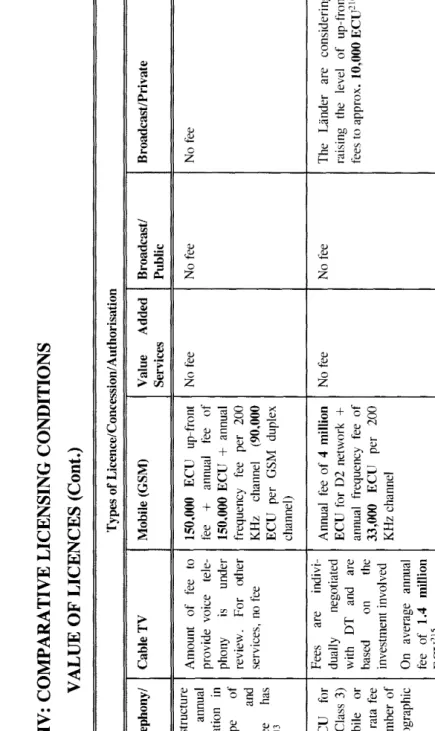
thus far charged a specific fee for the provision of voice services and, although no licence fees have formally been charged for the cable TV concessions which are now being tendered, bidders must agree to a specified "minimum investment" performance bond set at a percentage of the total investment (the performance bond for the Barcelona concession is set, for example, at four percent of the Pta 20 billion (179m ECU) investment.
20
21
A distinction is drawn between area licences and line licences. The latter type of licence is in turn divided between local and long distance connections.
Decree of 27 December 1996 (No. 1175), OJ 29 December, Chapter 2, Section 1, Article D.
98(1)(g).
Comparative Overview of Current Regulatory Environment in Telecommunications and Broadcasting Sectors/Licensing Page 18
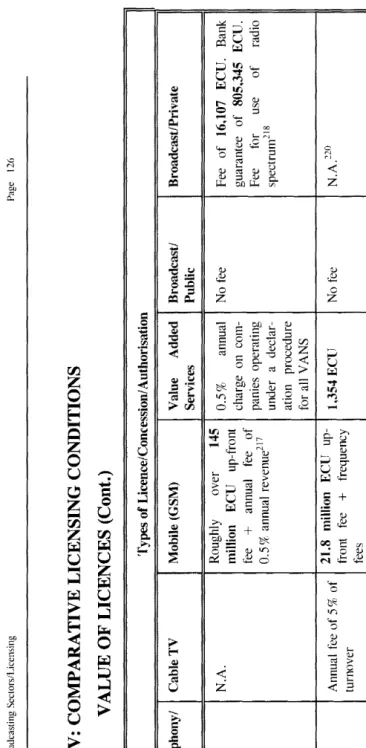
For a comparative list of licence fees, refer to Table IV of Annex I.
2. Duration
The duration of voice telephony licences varies from Member State to Member State. They
may be of indefinite duration (e.g., Spain and Sweden), or may range from 25 years in
countries such as the United Kingdom to 15 years in Italy and France (refer to Table III of
Annex I).
Commercial cable TV franchises or concessions which include the authority to provide
voice services range from 23-25 years in the United Kingdom, with 25 years also being
most recently prescribed in Spain (all terms are renewable).
As is usual with all licences of a "personal" nature, voice telephony licences are not assignable except in certain limited circumstances, which always require the prior approval of the appropriate regulatory authority.
3. Licence Review Procedure
With the exception of such countries as The Netherlands, United Kingdom, Sweden and
Finland, there has been little practical experience with respect to the manner in which voice
telephony licences are processed. In those countries, the usual period between the time an application is filed and a licence for voice telephony is granted currently ranges from four
to six months in the United Kingdom (a PTO licence), 22 to six weeks in Germany. Many of
the delays currently experienced are due to the relatively few resources enjoyed by the respective national regulators, as well as the relative immaturity of their respective licensing procedures.
The length of the licensing procedure also often reflects the detailed information required of
licence applicants. In Germany and France, for example, detailed business plans and
network rollout strategies must be provided to the regulator in the context of the licence
application. Even in the United Kingdom, the Department of Trade & Industry regularly
make enquires of existing licensees whether their operations are producing tangible public good. A number of potential licensees have commented that this degree of intrusiveness into private business planning is inconsistent with a regulatory framework in which the
number of licensees cannot be restricted ab initio. Moreover, they claim that many business
plans will per force be general in nature, given that most voice telephony markets have yet
to be fully opened to the forces of competition. Recent practice in the United States and
elsewhere suggests that the viability of an applicant's business case is best left to the market
to judge ex post rather than by the regulator ex ante.
22
In mid-1977, over 125 "PTO" licences were being processed by the Department of Trade & Industry in the United Kingdom. At the time of writing, this backlog is being overcome in light of the implementation into national law of the Licensing Directive.
Comparative Overview of Current Regulatory Environment in Telecommunications and Broadcasting Sectors/Licensing Page 19
1.3.2 Value-Added Network Services ("VANS")
The Regulatory Issues
The provision of value-added network services ("VANS") has been liberalised
throughout the European Union since the adoption of the Services Directive in 1990. The
regulatory treatment of the basket of services which are considered to be VANS should in principle cover most, if not all, forms of new digital services. Consequently, the manner in which such services are regulated in many Member States should serve as an appropriate model for the licensing of "multimedia" services in the immediate future (with the absence of licensing, which currently characterises the publishing industry, possibly being even more appropriate in the context of a competitive multimedia market).
Because there has not been full harmonisation of national " telecoms" licensing frameworks, the approach of the Member States to the licensing of VANS has been anything but consistent. Indeed, some Member States appear to have interpreted the
Licensing Directive as providing a legal basis for imposing licensing obligations on
VANS that were previously provided free from regulation. Insofar as this tendency
reflects a minimal level of regulatory involvement (e.g., class licences or simple
notifications), this should not create unnecessary market entry barriers for new competitors. Such barriers, however, have arisen in certain Member States whose fee structures bear no reasonable relation to the costs of administering VANS licences. The absence of a harmonised approach to the duration of VANS licences may also have a material effect on the ability of certain new market entrants to provide pan-European services.
Most important, the effects of digitalisation and compression have brought VANS to the forefront of the debate regarding the traditional regulatory lines of demarcation between the telecoms sector and the broadcasting sector. The discussion below explores the ways in which current Member State rules apply to certain new "digital services" whose characteristics contain elements of both regulatory frameworks. The discussion which follows in Section 2 of Annex I explores a number of longer term means of resolving the regulatory impasse which is likely to occur unless fundamental definitional issues are resolved.
_
Analy_51s _ _ _ _ _ _ _ _ _
_
~,u-&n·, ~~1'3 f1 {j)~.;6!l'Comparative Overview of Current Regulatory Environment in Telecommunications and Broadcasting Sectors/Licensing Page 20
The residual category of telecoms services liberalised by the Services Directive may conveniently be described as VANS. These liberalised services comprise essentially any transmission of data and/or voice signals (other than public voice telephony) to which a telecoms operator adds some commercial value. For example, VANS include a variety of network-based services, including E-mail, EDI, on-line remote database access, protocol conversion services and access to the Internet. VANS can be offerings to the general public, especially when the service is widely deployed geographically, and is offered to any user who wishes to subscribe.
Although VANS were initially introduced to serve the needs of corporate customers, today services such as on-line information services cater to a much larger set of customers, including residential subscribers. VANS, however, can be distinguished from public offerings insofar as regulators impose no obligations on providers of VANS to make their
services universally available 23 and do not regulate the terms and conditions pursuant to
which such services are provided. This relatively minimal regulatory interference, however, is not necessarily reflected in all Member States insofar as licensing is concerned. In the absence of full compliance with the harmonised terms of the Licensing Directive, VANS are subject to a variety of declaration and authorisation requirements. These licensing requirements, in order of least to most onerous, can be summarised as follows:
(i) Notifications
In many countries, the provision of VANS only requires notification to the national regulatory authority. The details of the notification vary from Member State to Member State. In most cases, services must be notified prior to the commencement of operations
(e.g. , France, The Netherlands and Sweden). In Germany, however, notification may be
delayed until one month after the commencement of operations. In Belgium, the system is a hybrid one, consisting of a non-opposition procedure, in which a service is deemed approved if the national regulator does not oppose the provision of the service within two months from the filing of the notification. In Luxembourg, the enactment of a new law in 1997 has meant that many VANS, which had been previously unregulated, are now required to satisfy a declaration procedure.
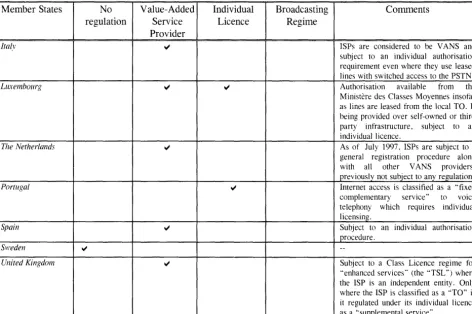
In some Member States, notification requirements coexist with individual authorisation requirements for the vast majority of services. In such instances, services subject to a simple notification requirement are often defmed very narrowly, which means that the
benefits of a notification are not available for most types of VANS. 24
Under a notification system, the period of authorised operation is by and large unlimited, provided that the operator complies with prescribed essential requirements of a technical
An exception is found in the provision of leased line capacity by incumbent telecoms operators.
For example: Italy, notification was until recently only appropriate for services not using leased line
capacity; in Greece -until March 1997 - notification was only appropriate for services using leased line capacity below 2 x 64 Kbp/s.
Comparative Overview of Current Regulatory Environment in Telecommunications and Broadca~ting Sectors/Licensing Page 21
nature. The transfer of assets and/or operations is usually not restricted, nor are changes in the corporate structure of the operator other than a simple notification of that change for the purposes of ensuring that the new operator complies with essential requirements.
Regulations adopted in Greece in 1997 have introduced a unique fee structure (at least for
the European Union) for VANS. The fees are based on a percentage of the operator's annual revenues (0.5%). Moreover, the fee is imposed retrospectively. Such a fee structure for VANS - especially those subject to a simple notification procedure - is difficult to
reconcile with the terms of the Licensing Directive.
(ii) General (Class) Authorisations
The United Kingdom is the only Member State in which a system of general (so-called "Class") authorisations applies to all VANS provided within the European Economic Area ("EEA"). This excludes international simple resale services which, if provided outside the EEA, require an individual authorisation.
Some systems which have historically required more restrictive individual authorisations for VANS are now in the process of embracing general authorisation regimes. This is the case, for example, in the latest series of legislative proposals tabled before the respective
Parliaments of Italy and Spain with the exception of a limited number of cases in which
individual authorisations will continue to be necessary, namely: ( i) where scarce resources
are needed; and (ii) in the case of Italy, when specific licensing conditions are imposed
which would determine the application of an individual authorisation requirement (e.g.,
obligations regarding: (a) the provision of universal service; (b) Open Network Provision; and (c) the regulation of dominant operators).
(iii) Individual Authorisations
Greece, Italy, Portugal and Spain still have regulatory frameworks which require new entrants to obtain individual authorisations to provide many types of VANS. Legislative
proposals currently being discussed by the Parliaments of Italy and Spain, would, if finally
approved, abolish these individual authorisation requirements for the vast majority of telecoms services.
The duration of individual authorisations currently varies among Member States ( e.g. , 9
years in Italy, 10 years in Greece, 15 years in Portugal) and all are subject to renewal. In
Spain, authorisations for the direct transmission of data to and from network termination points may be for 10 years (renewable for successive periods of equal duration up to a maximum of 30 years); other VANS are authorised for an indefinite period. This distinction is likely to be removed under proposed legislation.
Comparative Overview of Current Regulatory Environment in Telecommunications and Broadcasting Sectors/Licensing Page 22
The transfer of individual authorisations is generally prohibited or requires regulatory approval before it can be effected. Also, material changes in the corporate structure of service providers are subject to regulatory approval.
In some cases, the company seeking to provide VANS is required to establish a branch in
the country of operation (e.g., Greece) or have a registered address in a country of the
European Union (e.g., Italy, Portugal and Spain).
Licence application fees have been reported by operators to constitute a significant burden
in some of the countries listed above, especially: ( i) in Italy, where operators are required
to pay one million lire up-front for their licence application, plus one million lire on an
annual basis for each site where switching equipment is located; and (ii) Portugal, where
500,000 escudos are due at the time of submitting an application, plus an annual fee of two million escudos, plus 250,000 escudos for each renewal which is requested.
In France and Germany, although individual authorisation schemes were maintained after
their respective legislative overhauls in 1996, individual authorisations are for the most part (at least insofar as VANS concerned) linked to the use of radio spectrum or to the operation of public network infrastructure.
(iv) Licensing of "Multimedia" Services
When VANS were limited to data or combined voice and data transmissions, they posed little threat to the regulatory status quo; they certainly did not create any pressure on the traditional definitional boundaries between the telecoms and broadcasting sectors. The onset of digitalisation, the use of compression technology and the take-off of the Internet, however, now mean that telecoms networks are increasingly used to carry visual images (usually associated with the broadcasting sector).
As explained in Chapter II of the Study, ATM technologies and a range of xDSL technologies are facilitating the transport of such images over traditional telecoms networks. The introduction of multi-purpose cable systems and the spread of fixed wireless technologies such as Wireless Local Loop ( "WLL") are also making possible the combined transmission of data/voice/images, thereby enhancing the ability of operators to disseminate such multimedia communications.
The Internet has similarly expanded the possibilities for multimedia transmission, creating numerous transmission options over many different types of networks through the use of
the IP Protocol, whether for business purposes (e.g., on-line information systems) or
entertainment purposes (on-demand video services). We discuss below the different approaches to the regulatory treatment of these services at the Member State level.
~'~~. c£;_~1'3-if
q~..,..__,.-LLP. ·