UNIVERSITI TEKNIKAL MALAYSIA MELAKA
DEVELOPMENT OF ATTENDANCE SYSTEM FOR STUDENT USING
BLUETOOTH DEVICE CONNECTION
This report is submitted in accordance with the requirement of the Universiti Teknikal Malaysia Melaka (UTeM) for the Bachelor’s Degree of Electronics Engineering Technology (Telecommunication) with Honours
by
MUHAMMAD AINOL HAFIZ BIN MAT DEWI
B071410062
920305-05-5419
FACULTY OF ENGINEERING TECHNOLOGY
erut?1~1
!J>l,.µ~<F-v-~.,,
UNIVERSITI TEKNIKAL MALAYSIA MELAKA
UNIVERSITI TEKNIKAL MALAYSIA MEL.AKA
BORANG PENGESAHAN STATUS LAPORAN PROJEK SARJANA MUDA
TAJUK: Development of Attendance System For Students Using Bluetooth Device Connection
SESI PENGAJIAN: 2017/18 Semester 1
Saya MUHAMMAD AINOL HAFIZ BIN MAT DEWI
mengaku membenarkan Laporan PSM ini disimpan di Perpustakaan Universiti Teknikal Malaysia Melaka (UTeM) dengan syarat-syarat kegunaan seperti berikut:
1. Laporan PSM adalah hak milik Universiti Teknikal Malaysia Melaka dan penulis. 2. Perpustakaan Universiti Teknikal Malaysia Melaka dibenarkan membuat salinan
untuk tujuan pengajian sahaja dengan izin penulis.
3. Perpustakaan dibenarkan membuat salinan laporan PSM ini sebagai bahan pertukaran antara institusi pengajian tinggi.
4. **Sila tandakan ( ./)
D
D
D
SULIT
TERHAD
Tl OAK TERHAD
Alamat Tetap:
NO. 449 Peringkat 3
Felda Pasir Besar
(Mengandungi maklumat yang berdarjah keselamatan atau kepentingan Malaysia sebagaimana yang termaktub dalam AKTA RAHSIA RASMI 1972)
(Mengandungi maklumat TERHAD yang telah ditentukan oleh organisasi/badan di mana penyelidikan dijalankan)
Disahkan oleh:
Cop Rasmi:
73420 Gemas, Negeri Sembilan
Tarikh:
-Tarikh:
-** Jika Laporan PSM ini SULIT atau TERHAD, sila lampirkan surat daripada pihak berkuasa/organisasi
berkenaan dengan menyatakan sekali sebab dan tempoh laporan PSM ini perlu dikelaskan sebagai SULIT
iv
DECLARATION
I hereby, declared this report entitled “Development of Attendance System for Students Using Bluetooth Device Connection” is the results of my own research
except as cited in references.
Signature : ………
Author’s Name : ………
v
APPROVAL
This report is submitted to the Faculty of Engineering Technology of UTeM as a partial fulfilment of the requirements for the degree of Bachelor of Electronics Engineering Technology (Telecommunications) with Honours. The member of the supervisory is as follow:
………
vi
ABSTRAK
vii
ABSTRACT
viii
DEDICATION
ix ACKNOWLEDGEMENT
Alhamdulillah, thank you Allah because of his blessing, I finally complete and finish my PSM 2 successfully. With great pleasure, I want to take this opportunity to express my heartfelt gratitude to all people who helped in making this major project work a grand success.
I was grateful to Mr. Mohd Anuar Bin Adip, lecturer of Fakulti Teknologi Kejuruteraan (FTK) UTeM for his valuable suggestions and guidance during the execution of this project and also for giving me moral support throughout the period of our study in UTeM. I believe that, without his knowledge and assistance, I will be lost into my wrong turn.
x TABLE OF CONTENT
Abstrak vi
Abstract vii
Dedication viii
Acknowledgement ix
Table of Contents x-xii
List of Figures xiii-xv
List of Tables xv
CHAPTER 1: INTRODUCTION 1
1.1 Introduction 1
1.2 Background of Project 1
1.3 Problem statement 1
1.4 Objective 2
1.5 Scope of Work 2
1.6 Project Outline 2-3
CHAPTER 2: LITERATURER REVIEW 4
2.1 Introduction 4
2.2 Previous Related Work 4
2.2.1 Bluetooth Smart Based Attendance Management System 4-7
xi
and Android 7-11
2.2.3 Smartphone Application for Tracking Students Class Attendance 12-19
2.3 Project Comparison 20
2.3.1 Hardware and Software Comparison 20
2.3.2 Comparison on method for recording the attendance 21-23
CHAPTER 3: METHODOLOGY 24
3.1 Introduction 24
3.2 System Overview 24
3.2.1 Flowchart of overall progress 24-25
3.2.2 Flowchart of Students Attendance System using Bluetooth 26-27
3.3 Project Methodology 28
3.4 Software Development 28
3.4.1 Raspbian 28
3.4.2 Python 29
3.4.3 GPIO (General Purpose Input and Output) 30-31
3.5 Hardware Development 32
3.5.1 Raspberry Pi 3 32-37
3.5.2 Monitor 38
3.5.3 HDMI Cable 39
3.5.4 USB Keyboard 39
3.5.5 USB Mouse 40
3.5.6 Power Supply 40
xii
CHAPTER 4: RESULT & DISCUSSION 42
4.1 Introduction 42
4.2 Software Analysis 42
4.2.1 Bluetooth Software Update and Upgrade 43-44
4.2.2 Interface of Bluetooth Attendance System Coding 44-46
4.3 Hardware Analysis 46-48
4.4 Result 48-53
4.5 Data Analysis 53-55
CHAPTER 5: CONCLUSION & FUTURE WORK 56
5.1 Introduction 56
5.2 Conclusion 56
REFERENCES 57
APPENDICES
xiii LIST OF FIGURES
Figure Content Page
2.1 Flowchart for the student attendance management system 6
2.2 Bluetooth Smart System Operation 7
2.3 User interface for attendance system 9
2.4 Beacons scanning process 9
2.5 Attendance List 10
2.6 Flow chart of the system 11
2.7 List of available class 13
2.8 Log in screen 14
2.9 Success screen 14
2.10 Admin log in screen 15
2.11 Student options 15
2.12 Create or Modify student information 16
2.13 Lecturer options 16
2.14 Create or Modify lecturer information 17
2.15 Class options 17
2.16 Professor log in screen 18
2.17 Professor screen 18
2.18 Statistic page 19
3.1 Project progress flowchart 25
3.2 Project flowchart 27
3.3 Raspbian Operating System 28
3.4 Python Logo 29
3.5 Python IDLE (Integrated Development Environment) 29
3.6 Python Command Line 29
3.7 GPIO pins of Raspberry Pi 3 Model B 30
3.8 GPIO pins of Raspberry Pi 3 Model B 30
3.9 GPIO pins of Raspberry Pi 3 Model B 31
3.10 Raspberry Pi 3 Model B 32
3.11 Pop up window for win32 disk imager 34
xiv
3.13 “Choose boot option” window 36
3.14 Raspberry desktop 37
3.15 Update command 37
3.16 Example of monitor 38
3.17 Example of HDMI cable 39
3.18 Example of USB keyboard 39
3.19 Example of USB mouse 40
3.20 Example of Raspberry Pi 3 Model B power supply 40
3.21 Micro SD Card for Raspberry Pi 3 Model B 41
4.1 Raspbian Operating System 42
4.2 Python IDLE (Integrated Development Environment 43 4.3 Command line for update and upgrade a system 43
4.4 Failed updating process 44
4.5 Success updating process 44
4.6 (a) Coding line of bluetooth attendance system 45 4.6 (b) Coding line of bluetooth attendance system 46
4.7 (a) Raspberry and devices used 47
4.7 (b) Raspberry and devices source connection 47
4.7 (c) Raspberry and devices connected with monitor 47 4.8 Python IDLE (Integrated Development Environment)
Language
48
4.9 Create new file project (projectname.py) 49
4.10 Save as new file project 49
4.11 Choose file directory 49
4.12 Save as new file project (projectname.py) 50
4.13 Create bluetooth attendance system coding 50
4.14 Run bluetooth attendance system coding 50
4.15 Turn on bluetooth device 51
4.16 Output display detected device 51
4.17 Turn off Bluetooth device 51
4.18 Output display undetected device 52
4.19 Save output data (projectname.txt) 52
xv
4.21 Download attendance for record process 53
4.22 Comparison between phone model and effective range 54
4.23 Quantity vs. time analysis 55
LIST OF TABLES
Table Content Page
2.1 Hardware and software comparison between previous projects
20-21
3.1 Raspberry Pi 3 Model B Specifications 32-33
3.2 Example of monitor specifications 38
3.3 SD Card Class 41
1
CHAPTER 1
INTRODUCTION
1.1 Introduction
This chapter will present all the description of this research which is about the students attendance system using bluetooth by declaring the background and the objectives and also the scope of this project. The objectives of this project are to solve the problem statements declared in this chapter.
1.2 Background of Project
This project describes about the dishonesty of students on filling the attendance form during lecture session. The idea is intended to help lecturers to identify the students who truly represent the learning sessions or absent where the attendance form filled by classmates. By using signing method for attendance without monitored by lecturer of the subject, it will be easy for students to deceive the attendance. From that, by applying the use of bluetooth connected with students mobile phone, students should attend the lecture session to ensure the attendance recorded and it only will be record if students complete to register during the beginning of class session and the second register within 5 minutes to 10 minutes before the end of class session.
1.3 Problem Statement
2
on the form filled by classmates. Based from that to overcome this issues, the concept idea was created.
1.4 Objective
The objectives of this project is recommend to prevent students from dishonesty of filling the attendance form for lecture session. To achieved this project, the objectives should be successes by:
i. To solve problem of dishonesty of filling the attendance for lecture session
ii. To develop attendance system for students using bluetooth
1.5 Scope of Work
In order to achieve the objectives of the project, the scope have been decided:
i. This project will focus during lecture session only within two to three hours in classroom.
ii. The scope of project is using bluetooth connection that connected with student mobile phone in classroom.
iii. Raspberry Pi system used in this project where it operate by receive data transmitted from mobile phone and displaying the data on monitor.
1.6 Project Outline
This report includes 3 chapters that will show and describes the flow of this project. The first chapter consists of the background of this project, problem statement, objectives and the work scope of this project.
3
4
CHAPTER 2
LITERATURE REVIEW
2.1 Introduction
In this chapter will cover about the informations and comparisons related with this project based on research that has been gathered from previous journals, research’s, books or websites about bluetooth attendance system.
2.2 Previous Related Work
2.2.1 Bluetooth Smart Based Attendance Management System
Riya Lodha, Suruchi Gupta, Harshil Jain, and Harish Narula (2015) mentioned that the quality of lecture session is based on the time taken to fill the student attendance and sometimes it is inaccurate when use the manual process. Based on this criteria, they come out with a system known as Bluetooth Smart Attendance Management System which is more efficient and effective where the time of data entry will be more accurate. Furthermore, it only use low cost and compatible with large number of mobile phones, tablets and computers.
5
Mumbai University (MU) policy to ensure a 75% of course attendance by students before examination session for any course. It will lead the students database management system that cannot be manipulate by anyone, reduce the time taken for the students attendance during manual process.
The advantages of this system is the tags can be embedded into the student identification cards (student ID card) where it easy to be read during any motion and the tags does not need to be facing the reader each other. The tag still can be read even it submerged or covered with dirt and because it has a tiny physical, it only use low power consumption.
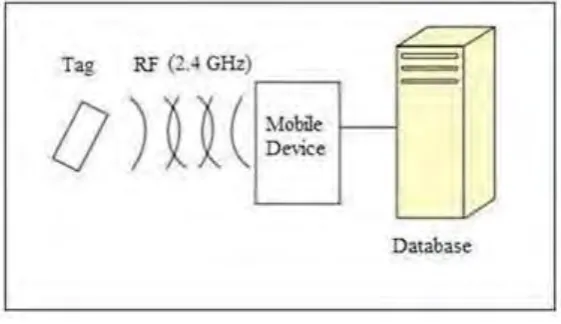
The bluetooth tags need to be programmed and configured to make it easy to communicate with the Android application via bluetooth. The attendance will be recorded into database entry when students attend the lecture session with accurate time stamp and the bluetooth tags only can be detect within the coverage area in order to avoid detection of tags that outside the classroom.
6
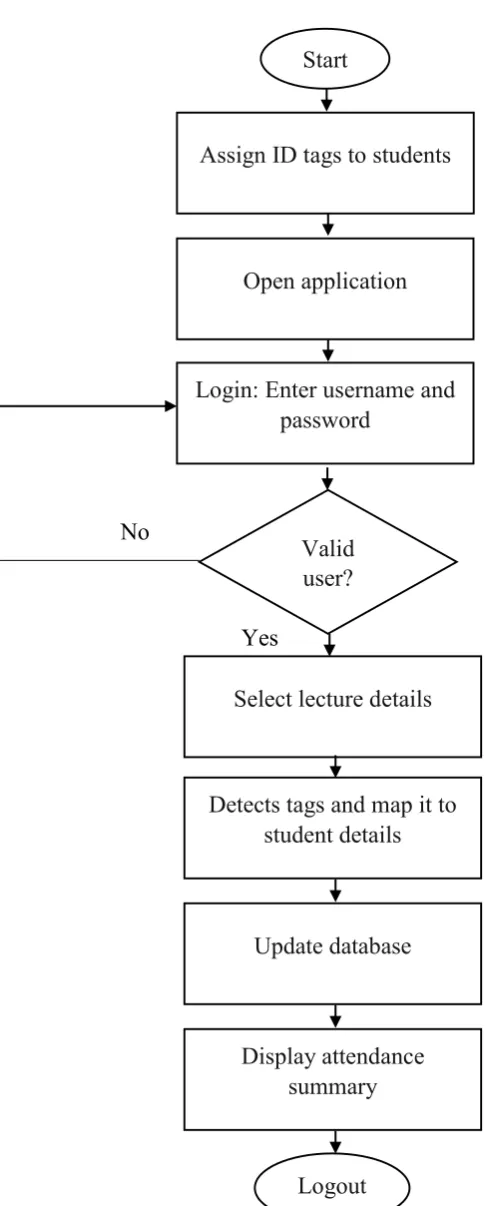
Figure 2.1: Flowchart for the student attendance management system Start
Assign ID tags to students
Open application
Login: Enter username and password
Valid user?
Select lecture details
Detects tags and map it to student details
Update database
Display attendance summary
Logout Yes
7
Figure 2.2: Bluetooth Smart System Operation
2.2.2 Smart Attendance Management using Bluetooth Low Energy and
Android
Raghav Apoorv and Puja Mathur (2016) mentioned that by collecting the students attendance manually on attendance form is a burdensome and take a long time. Based from that, the idea to create smart attendance monitoring using Bluetooth Low energy was created. The students attendance taken when the beacon stickers that attached to students card sensed by the bluetooth sensor that turned on by teacher within range around 200 meter when students enter the classroom.
The data can be visualize in different modes such as a list mode and a pie chart to make the data easy to analyze. The use of sensor is to avoid any kind of error or false attendance where the number of students in the classroom counted by the sensor. If there any mismatching data, it will notify the teacher. The data also can be manually change by teacher if there are some sensor stops working.
8
The estimote sticker beacons used for this application is in regular size beacons compared with the usual size [6]. The battery life is around a year and it can easily be replaced. It has low usage of power and cost which make it as suitable for this project. It only can be attach on one side to the identity cards of students. It can transmit Bluetooth signals up to 7 meters (20 ft) [7] and also as a waterproof device. There is no limit to the number of stickers that can be monitored in a region.
The application for taking attendance and storing records was develop on an open source mobile operating system Android since is used widely in smartphones where Android currently has 84% of the world's share in the mobile industry. It was designed mainly for touchscreen devices such as smartphones and tablets based on Linux Kernels.
The development of Android comes with its Software Development Kit (Android SDK) which provides the developers the API (Application Programming Interface), libraries and developer tools necessary to build, test and debug applications. The IDE used for the development of this Application is Android Studio developed by Google, it is the official integrated development environment (IDE) for Android Platform Development. Android applications are developed in JAVA hence, JDK (JAVA Development Kit) is another requirement for the compilation of the code for the application.
Android Bluetooth APIs allows device to wirelessly communicate, scan or connect with others Bluetooth devices through it [12]. The Bluetooth adapter is one of main component for bluetooth activity in an application where it needs to check whether the Bluetooth is enabled or not. If the Bluetooth is not enabled, it will request to enable the Bluetooth of the device. The callback method used to scan Bluetooth enabled devices.
9
[image:23.595.268.441.202.422.2]The application for the smart attendance management system contains class activity when students run the application. It provides the user interface of the application. The main activity of the application contains a switch button to toggle between the class attendance and bus attendance mode, reports button which is the attendance reports for class taught by the teacher and button to take the attendance which is clicking starts the beacon detection.
Figure 2.3: User interface for attendance system
[image:23.595.269.439.489.727.2]10
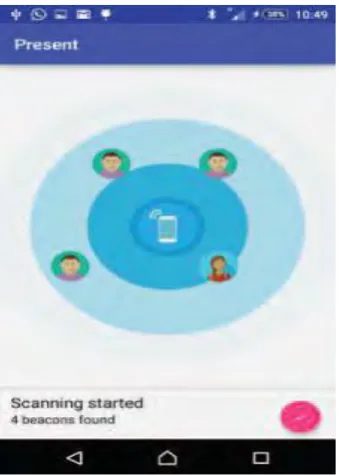
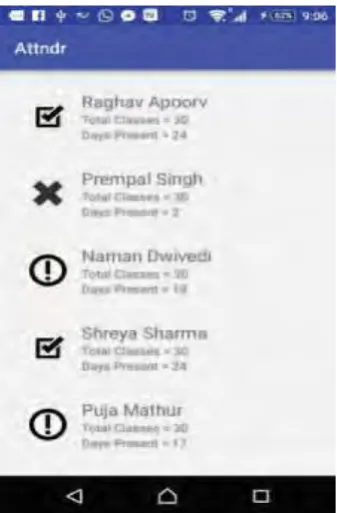
[image:24.595.269.438.312.569.2]The beacons within the classroom range will be detect by the sensor and added to a list. The detected beacons are displayed as Figure 2.4 and it will keeps updating the adapter as soon as the beacon is detected. All the detected beacons are then displayed in a list as a recycler view. The detected beacons provide the UUID, Major and Minor values where these value are checked in the SQLite Database and provides the Roll Number against which the particular beacon is mapped and attendance is marked for the beacon. The undetected beacons will be marked absent for the class. The data will be visualize using pie chart when the attendance process is complete where it shows the precentage of students that presence and absent for the class session.