This is a repository copy of
M2M meets D2D: Harnessing D2D Interfaces for the
Aggregation of M2M Data
.
White Rose Research Online URL for this paper:
http://eprints.whiterose.ac.uk/112748/
Version: Accepted Version
Proceedings Paper:
Afzal, A, Zaidi, SAR, McLernon, DC et al. (2 more authors) (2017) M2M meets D2D:
Harnessing D2D Interfaces for the Aggregation of M2M Data. In: 2017 IEEE International
Conference on Communications. IEEE ICC'17: Bridging People, Communities, and
Cultures, 21-25 May 2017, Paris, France. IEEE . ISBN 978-1-4673-8999-0
https://doi.org/10.1109/ICC.2017.7997135
(c) 2017, IEEE. Personal use of this material is permitted. Permission from IEEE must be
obtained for all other uses, in any current or future media, including reprinting/republishing
this material for advertising or promotional purposes, creating new collective works, for
resale or redistribution to servers or lists, or reuse of any copyrighted component of this
work in other works. Uploaded in accordance with the publisher's self-archiving policy.
[email protected] https://eprints.whiterose.ac.uk/
Reuse
Unless indicated otherwise, fulltext items are protected by copyright with all rights reserved. The copyright exception in section 29 of the Copyright, Designs and Patents Act 1988 allows the making of a single copy solely for the purpose of non-commercial research or private study within the limits of fair dealing. The publisher or other rights-holder may allow further reproduction and re-use of this version - refer to the White Rose Research Online record for this item. Where records identify the publisher as the copyright holder, users can verify any specific terms of use on the publisher’s website.
Takedown
If you consider content in White Rose Research Online to be in breach of UK law, please notify us by
M2M meets D2D: Harnessing D2D Interfaces for
the Aggregation of M2M Data
Asma Afzal
†⋄, Syed Ali Raza Zaidi
†, Des McLernon
†, Mounir Ghogho
†‡and Afef Feki
∗†
University of Leeds, United Kingdom ⋄CentraleSupélec, Gif-sur-Yvette, France ‡International University of Rabat, Morocco,
∗
Mathematical and Algorithmic Sciences Lab, France Research Center, Huawei Technologies France SASU Email: {elaaf, s.a.zaidi, d.c.mclernon, m.ghogho}@leeds.ac.uk, [email protected]
Abstract—Direct device-to-device (D2D) communication presents as an effective technique to reduce the load at the base station (BS) while ensuring reliable localized communication. In this paper, we propose a large-scale M2M data Aggregation and Trunking (MAT) scheme, whereby the user equipments (UEs) aggregate M2M data from the nearby MTDs and trunk this data along with their own data to the BS in the cellular uplink. We develop a comprehensive stochastic geometry framework by considering a Poisson hard sphere model for UE coverage. The main motivation of this model is to capture the fact that a UE can gather data from short range, low-power MTDs located only in its close proximity while ensuring that an MTD is associated to at most one UE. We explore the inherent trade-off between the time reserved for aggregation and successful trunking of data to the BS and compare our results with the baseline case where no aggregation mechanism is used. We show that while the baseline case of connecting a bulk of MTDs directly with the BS is prohibitive, MAT scheme can efficiently gather data from selected MTDs in a distributed manner.
I. INTRODUCTION
Machine-to-Machine (M2M) communication is the key en-abler of the Internet of Things (IoTs) as sensing and actuating devices are present virtually in every industry nowadays. To fully realize the potential of IoTs, there is a need to develop sophisticated techniques to inter-connect these short range machine-type-devices (MTDs) with each other and the cloud to analyze their data and extract meaningful information. Cellular networks present as a suitable candidate to unify the data generated from MTDs due to their extensive global cover-age. However, the existing cellular infrastructure is optimized for the Quality-of-Service (QoS) requirements of human-to-human (H2H) communication, which is based on fewer and longer sessions with the main focus on providing higher data rates. Conversely, MTDs are low power devices sending small amounts of data sporadically. Connecting a sheer bulk of MTDs with the cellular network will cause congestion at the core network. This poses a number of challenges on cellular networks and necessitates efficient resource management and clustering techniques with minimal signaling overhead [1].
A number of recent studies have proposed random access for MTDs over random access channel (RACH) in the
cel-This work has been supported by the UK Engineering and Physical Sciences Research Council (EPSRC) grant EP/P511341/1 for the University of Leeds Institutional Support under EPSRC Prosperities Outcome Framework. All data are provided in full in the results section of this paper.
lular long-term evolution (LTE) [2], [3]. These techniques however, are not scalable for ultra dense scenarios due to increased collisions on RACH. Techniques like aggregation and clustering of MTDs have also proved to significantly mitigate the congestion problems [4]. Only recently, Device-to-Device (D2D) communication was identified as a fitting solution to aggregate M2M data and reduce the burden on the base stations (BSs) of scheduling and signaling [5]. D2D communication proximity service (ProSe) is an integral part of 4G and 5G networks as it enables low power devices in close proximity to communicate with each other [6]. Thus, cellular UEs can serve as ideal candidates for D2D enabled aggregators due to their abundance and high computation capabilities. A single cell, single UE framework for the aggregation and trunking of M2M traffic via D2D links with the UEs is provided in [7]. However, the analysis is only limited to a single cell and is not scalable as it does not take into account the physical locations of the MTDs and the UEs and more importantly, it does not consider the impact of interference from MTDs and UEs transmitting in other cells in aggregation and trunking phases respectively. Motivated by the above literature, we develop a large scale analytical framework for the aggregation of M2M data with the help of user equipments (UEs). The UEs collect M2M data by establishing D2D links with the nearby MTDs and pass this information to the base station (BS) with their own data.
are coordinated by the UEs. The coordinated MTD transmis-sions do not interfere with each other, but cause extensive signaling and control overhead at the BS. For the trunking phase, we assume that the UEs employ constrained UL channel inversion power control. We obtain tight approximations of the rate coverage for both the aggregation and trunking phases. We explore the inherent trade-off between the time reserved for aggregation by the UEs and the successful data delivery in both the aggregation (MTD-UE) and trunking phases (UE-BS). In fact, larger aggregation periods results in better aggregation opportunities from multiple MTDs but at the cost of trunking performance degradation.
II. THEMAT SCHEME
We propose a novel M2M data Aggregation and Trunking (MAT) scheme, where the UEs relay the M2M data to the BS along with their own data. We consider that the BSs, UEs and the MTDs are distributed independently in R2 according to homogeneous Poisson point processes (HPPPs) Φb, Φu,
and Φm with intensities λb, λu and λm respectively. In our
proposed scheme we focus in the cellular UL. The UEs associate to the nearest BS, which implies that the macrocells form a Voronoi tessellation inR2. The transmissions from both the MTDs and UEs suffer form channel impairments including small scale Rayleigh fading and path loss. As a consequence, the channel power gainh∼exp (1)is a unit mean exponential random variable. Throughout this paper, we assume a simple power law path loss function r−α for a distance separation r
whereαis the path loss exponent. We consider the same value of αto account for MTD-UE and UE-BS links, however, the presented framework can be easily extended to account for various propagation environments. The key stages involved in our proposed MAT scheme are presented as follows.
A. Clustering MTDs using Poisson Hard Sphere (PHS) Model
The first step is to determine how a UE collects data from its nearby MTDs and how we can ensure that each MTD is associated to at most one UE. According to the PHS model in 2-d, the interiors of the disks centered at the points of the parent process do not overlap almost surely (a.s.). The nearest neighbor model (NNM) proposed by Stienen in [11] is a type of PHS extensively used in disk packing and percolation problems. In case of NNM, the diameter of the disk centered at a given particle is the distance to it’s nearest neighbor of the same process. To understand this better in the context of wireless networks, consider a UE zj, where zj ∈ Φu. The
radius of the Stienen disk ofzj is then given as
X = min
zl
ηkzj−zlk, zl, zj∈Φu, l6=j, (1)
where the Stienen cell (S-cell)Bzj =
y∈b(zj, X), y∈R2
is a disk of radius X andη= 1/2 for the NNM. We extend this model to a more general case where the scalar η may take any value from the range 0 < η ≤ 1/2. This gives us control on accurately modeling the coverage regions of UEs especially when the UEs are sparsely populated. Notice that for any value of η, the UE S-cells form disjoint sets such that
Aggregation Trunking
T
T
[image:3.612.370.503.49.89.2](1- )T
Figure 1. Division of the uplink time slot
Bzl∩ Bzj =∅,∀zj 6=zl. This implies that the MTDs inside a
UE’s S-cell are only associated to it.
The distribution fX(x) of the radius of the S-cell can be
quantified using the concept of void probability of Poisson processes. The probability that the radiusX exceeds a certain threshold x is the probability that there is no UE at a distance η−1x from the given UE. It can be expressed as P[X≥x] = exp −λuπη−2x2. The resulting process of
MTDs inside the S-cells constitute a modified Matern cluster process [9], where the radius of the disks is random and is distributed according to fX(x). Using the S-cell radius
distribution of the radius of the S-cell, the probability mass function of the number of MTDs inside an arbitrary S-cell can be easilty derived using the fact that the MTDs are Poisson distributed in a S-cell with mean measureλmπx2. It is given as
[12]P[Nm=n] =µ(1 +µ)
−n−1
, whereµ=λuη−2/λm. B. Communication Framework
We consider that the UL time slot is further divided into two slots as shown in Fig. 1. In the first slot, the UEs establish D2D links with the nearby MTDs to aggregate the M2M data. In the second slot, regular UL transmission takes place whereby UEs employ power control to transmit their own data as well as the collected M2M data to the BS. We now describe the transmission schemes for aggregation and trunking phases.
1) Aggregation: We consider that the MTDs transmit at a fixed powerPmand MTD transmissions are multiplexed (MX)
in frequency or time. The MTDs employ frequency division multiple access (FDMA) or time division multiple access (TDMA). Both TDMA and FDMA result in the same average data rate so we do not make further distinction between the two in the rest of the paper. To account for the extra signaling for multiplexed transmission, we consider that the available aggregation timeTef f =τ T−kTsig is effectively smaller by
kTsig, whereTsigis the time spent by the MTDs in contending
for a transmit opportunity and channel reservation by the UE.
2) Trunking: In this phase, the UEs transmit their own data along with the collected M2M to the BS. We consider that the cellular bandwidthWu is equally divided among the
UEs inside a macrocell and there in no intra-cell interference. For energy efficient operation, the UEs employ UL channel channel inversion power control. The transmit power under the truncated UL channel inversion power control is written as
Pu=min Pumax, ρ0l(y)−1. (2)
Notice that that the transmit power is constrained by the upper limit Pmax
u , which is the maximum transmit power
of a UE and l(y) = y−α is the path loss when the UE
of the distance between an arbitrary UE and its associated BS follows a well known Rayleigh distribution and is given as [8] fY(y) = 2πλbyexp −λbπy2
. The term ρ0 is the
normalizing factor depending on the receiver sensitivity of the BS. We can see from (2) that the UEs only at a certain distance
Rmax=
hPmax u
ρ0 i1/α
can successfully invert the path loss. The UEs outside a disk of radiusRmaxwill transmit at maximum
power. Unlike the truncated channel inversion power control presented in [13], where the UEs farther fromRmaxare forced
to go into outage, we present a more realistic power control scheme as the disadvantaged UEs still get a chance to transmit.
C. Probability of Successful Aggregation and Trunking (PSAT)
For cellular downlink scenarios, network operators are inter-ested in load balancing and maximizing the rate experienced by a UE and the overall area spectral efficiency of the network [14]. On the contrary, the performance metrics are quite different for cellular UL and M2M applications, where ensuring reliability and enhancing connectivity is the primary focus. Based on this criteria, we define a key performance determining metric for the analysis of the aggregation and trunking communication framework described above.
Definition 1. PSAT: The probability that a UE is able to successfully aggregate M2M data from k MTDs in time τ T
and can trunk it along with its own data in time(1−τ)T, can be expressed as the product of rate coverage in aggregation and trunking phases. It is given as PM X
k =RM Xa × Rt, where,
RM X
a is the rate coverage in aggregation phase andRtis the
rate coverage in trunking phase. The description and derivation of the rate coverage for each phase is given in the following subsections.
1) Aggregation Phase: In this phase, the MTDs within the UEs S-cell transmit to it. Assuming that the MTDs transmit a fixed payload of size Dm bits using the available bandwidth
Wm in time τ T, aggregation is successful only when the
the M2M data from k MTDs is successfully decoded. We consider Shannon’s capacity formulation to characterize the rate coverage for various transmission schemes. The rate coverage for multiplexed transmission can be represented as
RM Xa =
P
W
m
k log2(1 +SIR
M X a )≥
Dm
Tef f
k
= P
SIRM Xa ≥θM Xa
k
, (3) where θM X
a = 2
kDm
WmTeff −1 and T
ef f = τ T −kTsig is
the effective time available for MTD transmission after the signaling and channel reservation forkMTDs. The SIR of the received signal at the UE is given as SIRM X
a =h R
−α arb/Im,
where Im = Pwj∈Φintm hj||ωj||
−α is the aggregate
interfer-ence power experiinterfer-enced by the UE from MTDs in the other S-cells and Rarb is the distance between an arbitrary MTD
and its closest UE, given that the MTD is located inside the UE’s S-cell. The distribution of this distance is given by the following Lemma.
Lemma 1. If an arbitrarily selected MTD is present inside the coverage region of a UE, the distribution of the distance between the UE and the MTD is given as
fRarb(r) = 2πrλarbexp −πr
2λ
arb, (4)
whereλarb=λu 1 +η−2
.
Proof: The unconstrained distribution of the distance between an arbitrary MTD and the nearest UE is Rayleigh dis-tributed and is given as fRuncon(r) = 2πr λuexp −λuπr
2
.
However, in this case, the MTD must also lie in the S-cell of the nearest UE. We need to findP[Runcon=r|X ≥Runcon],
which is the PDF of distance with the condition that the S-cell encapsulates the arbitrary MTD. Therefore, we have
fRarb(r) =
P[X ≥r]P[Runcon=r]
P[X ≥Runcon]
, (5) where P[X ≥r] = exp λuπr2η−2
and P[X ≥Runcon] =
´∞
0 (1−FX(t))fRuncon(t)dt = 1 +η
−2−1
. Substituting these expressions in (5) gives (4).
Lemma 1 reveals that the distribution with S-cell restrictions differ with the unconstrained case HPPP case in density only. As λarb ≥ λu, the average distance between UE and
an arbitrary MTD is smaller. This implies that the current network with S-cell boundary restrictions can be translated into a denser unconstrained HPPP network. The following proposition gives the coverage probability for the aggregation phase with MX transmission.
Proposition 1. For a given SIR threshold θ, the probability that the UE successfully decodes the data from an arbitrary MTD within its S-cell is given as
SaM X(θ)≈
∞ ˆ
0
exp
−2πλintmEQ[C(α, sa, q)]
fRarb(r)dr,
(6)
where Q is distributed according to fQ(q) =
2πλint
m qexp −λintm πq2
, λint
m = λu(1 + µ)−1 and
C(α, β, d) = βd(2−α)
(α−2) F
α,dα
β
where Fα,dα
β
=
F
2 1 1,1−α2; 2−
2
α;−βd
−α
and 2F1(., .;.;.) is the
generalized hypergeometric function.
Proof:Please refer to Appendix A.
2) Trunking Phase: In this phase, the UEs transmit the data collected from k MTDs along with their own data to the BS. Assuming the UEs require a fixed data rate Ru =
Du/T, the rate coverage in trunking phase can be written
as ENu[P[SIRt≥θt]], where θt = 2
n(Du+kDm)
Wu(1−τ)T −1 and
Nu is the number of UEs inside a macrocell to which the
arbitrarily chosen UE belongs (Ref (3) in [15]). To simplify things, we adopt the mean-load approximation as in [14]. The average number of UEs inside a macrocell is given by
Navg
u = 1+1.28λu/λb. Therefore, the rate coverage simplifies
to
Rt=P
W
u
Nuavg
log2(1 +SIRt)≥
Du+kDm (1−τ)T
Parameter Value
Densities of BSλm, UEλu, and MTD,λm, Ratio of densitiesλm/λu
[2,20,200]/π5002
, 1
Max. transmit power of MTDPm, UE Pmax
u and BS receiver sensitivityρ0
[−18,23,−80]dBm
PHS coefficientη, Path loss exponentα, UL slot fractionτ
1/2, 4, 0.2
MTD and UE bandwidthWm, Wu 180 kHz, 10 MHz
M2M PayloadDm, Desired UE data rate for its own dataRu
100 bits, 10 Kbps
UL slot time periodT, Signaling time per MTDTsig
1 ms,0.1ms
Table I
LIST OF SIMULATION PARAMETERS
and θt = 2
Nuavg(Du+kDm)
Wu(1−τ)T −1. We will make use of this approximation throughout the course of this paper. The SIR at the BS in trunking phase can be represented as SIRt =
Puh Y−α
Iu ,wherePuis the variable transmit power given in (2)
depending on the distance Y between the UE and the BS it is associated with and Iu=Pzj∈Φint
u Pu,jhj||zj||
−α, where
||zj||is the distance of the interfering UEzj from the typical
BS andΦintu comprises of the interfering UEs from other cells
as we assume that there is no intra-cell interference. In the following Lemma, we obtain the average power transmitted by a UE which will help characterize the coverage in trunking phase.
Lemma 2. Under constrained UL channel inversion power
control, the average power transmitted by a UE is given as
Pavg
u =
ρ0Γ (δ)
(λbπ)α/2
γ λbπR2max, δ
+Pmax
u exp −λbπR2max
,
(8)
where δ = 1 +α/2, Rmax =
hPmax u
ρ0 i1/α
and γ(b, a) = 1/Γ(a)´b
0t
a−1exp(−t)dtis the normalized lower incomplete
gamma function.
Proof:The average transmit power is calculated by taking expectation of (2) with respect to Y.
The coverage probability for a generic UL with constrained channel inversion power control is given by the following proposition.
Proposition 2. When a generic user transmits to the nearest BS by employing constrained channel inversion power control, the probability that the BS can successfully decode this signal can be expressed as
St(θ) = Rmax
ˆ
0
exp
−2πλbEPu[C(α, s1Pu, y)]
fY(y)dy+
∞ ˆ
Rmax exp
−2πλbEPu[C(α, s2Pu, y)]
fY(y)dy(9)
where s1 =θ/ρ0, for 0 ≤y ≤Rmax and s2 =θyα/Pumax for y > Rmax.
Proof:The sketch of the proof is as follows. The condi-tional coverage probability of the UE can be expressed as
St(θ)|y =
Phρ0h Iu ≥θ
i
=LIu(s1) 0≤y≤Rmax,
PhPumaxh y−α
Iu ≥θ i
=LIu(s2) y > Rmax,
Here,LIu(.)is the Laplace transform of the interference
expe-rienced by the BS from the active UEs in other macrocells. We assume the interfering UEs comprise a HPPP1 Φint
u with the
intensity equal to the BS intensity λint
u =λb. After using
similar mathematical manipulations as the proof of Prop. 2, we obtain (9).
Corollary 1. The UL coverage probability can be simplified as
St(θ) ≈ Rmax
ˆ
0
exp
−2πλbC(α, s1Puavg, y)
fY(y)dy+
∞ ˆ
Rmax exp
−2πλbC(α, s2Puavg, y)
fY(y)dy(10)
Proof: The function inside the integral in
C(α, s1Pu, y) = ´
∞
y
ν
1+(stPu)−1ναdν is strictly concave
in Pu. We employ Jensen’s inequality in (9) to shift the
expectation with respect toPuinside to obtain a lower bound
for coverage.
III. RESULTS ANDDISCUSSION
In this section, we verify our analysis using Monte-Carlo simulations and provide some useful design insights for the aggregation and trunking framework. To compute the distri-bution of distance and coverage, we conduct 104 iterations.
In each iteration, the BSs, UEs and MTDs are distributed independently according to HPPPs with densities λb,λu and
λmrespectively in a circular area of radius 1.5 km. The list of
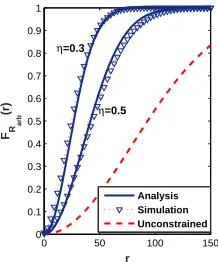
simulation parameters and their description is given in table I unless stated otherwise. We begin with the verification of Lemma 1. For the distance between the UE and an arbitrarily distributed MTD, we generate the S-cells and fix the location of the MTD at the origin. The distance between the UE and MTD is recorded if the MTD lies inside the nearest UE’s cell. The iterations where the MTD lies outside the S-cell are ignored. For clear comparison with the unconstrained HPPP case, we obtain the cumulative distribution function (CDF) of the distance Rarb, which is given as FRarb(r) = 1−exp −λarbπr2
, whereΓ (a, b) =´∞
b t
a−1exp(−t)dt is
the upper incomplete gamma function. As shown in Fig. 2, the simulation accurately matches our analytical results for various values ofη and i. As η decreases, the size of S-cell also decreases and therefore, the distance between the UE and MTDs inside the cell also decreases. As expected, the distance between the UE and an arbitrary MTD within its S-cell is statistically smaller compared to the unconstrained case.
0 50 100 150 0
0.1 0.2 0.3 0.4 0.5 0.6 0.7 0.8 0.9 1
r
FR
arb
(r)
Analysis Simulation Unconstrained
η=0.5
[image:6.612.117.226.57.188.2]η=0.3
Figure 2. CDF of the distance between the UE and an arbitrarily distributed MTD inside the S-cell:λm= 500/π5002
20 40 60 80
θ [dBm] 0
0.2 0.4 0.6 0.8 1
S a
MX
(
θ
)
Analysis Simualtion
λ
m/λu=1
λ
m/λu=100
10 20 30 40 50
θ [dBm] 0
0.2 0.4 0.6 0.8 1
St
(
θ
)
[image:6.612.344.516.58.213.2]Simulation Analysis Corollary 1
Figure 3. SIR coverage probability. Aggregation (left), trunking (right).
Moving on, we validate the expressions for SIR coverage probability for the aggregation and trunking phases derived in Propositions 1, and 2 in Fig. 3. The plots demonstrate a strong agreement between the simulations and the derived analytical results. Fig. 3 further shows that the coverage probability in aggregation phase SM X
a decreases when λm/λu increases.
The drop inSM X
a is attributed to the increase in the interferer
intensity λint
m = λu(1 +µ)−1 as λm/λu → ∞, λintm =λu.
This implies that each S-cell has at least one MTD transmitting to its UE. On the contrary, the trunking coverageSt does not
depend on λu or λmas evident from (9) and (10). In case of
trunking, Fig. 3 reveals that the equi-dense HPPP assumption in (10) for the interfering UEs is quite accurate. The simplified lower bound derived in Corollary 1 is also in good agreement with the analysis and simulations. Notice that the coverage for the aggregation phase is better compared to the trunking phase. This is because the smaller path loss between the UE-MTD link improves the received signal strength at the aggregation stage.
After validation of the preliminary results using network simulations, we investigate the factors affecting PSAT and the scenarios where aggregation and trunking is feasible. Fig. 4 explores the effect of k and τ (the fraction of UL time slot reserved for aggregation) on the rate coverage. The results are intuitive as the increase in k causes both Rt and RM Xa to
0 0.2 0.4 0.6 0.8 1
τ 0
0.2 0.4 0.6 0.8 1
R a
MX
, R
t
R a MX, k=1
R t, k=1
R a MX, k=3
R t, k=3
Tsig=
0.1T
0.3T 0.1T
0.2T
0.3T 0.2T
Figure 4. Rate Coverage in aggregation and trunking phases.
degrade. However, for a givenk, an interesting trade off inτ
is revealed. As we increaseτ, the trunking rate coverage Rt
drops, while the aggregation rate coverage RM X
a increases.
This is because a higherτ corresponds to a better aggregation opportunity forkMTDs asθM X
a decreases whereas, it results
in a degraded trunking performance as θt increases because
lesser time is available for trunking UE and M2M data from
k MTDs (Du+kDm). Hence, there must exist an optimal
τ=τ∗
M Xwhich maximizesPkM X. Another important factor to
take into consideration while deciding the transmission scheme in aggregation phase is the signaling overhead in MX case. Even though MX transmission is generally more robust, we see that even slightly increasing Tsig results in complete outage
for small values ofτ.This is because there is no time left for data transfer as τ T ≤kTsig.
In Fig. 5, we study the variation in PM X
k with respect
to τ and k. As expected, the maximum achievable PSAT decreases with the increase in k as both Rt and RM Xa
decrease. The increase ink also causes τ∗
M X to increase and
the optimal point shifts further right. This implies that the degradation inRM X
a is higher than in Rt. We also compare
PM X
a with the baseline case, where the MTDs transmit to the
BS directly with powerPm without hierarchical aggregation.
For fairness in comparison, we consider that the BS has to decode the data from kNavg
u MTDs, which is the average
number of of active MTDs inside the cell under the MAT scheme. Because of the centralized control, only one MTD transmits to the BS at a given snapshot of the network. Therefore, the rate coverage probability for the baseline case is
given by PBase =EY
exp
−2πλbC α, θM Xa,Byα, y
kNuavg
[8], where θM X a,B = 2
k NuavgDm
WmT −1. We observe that when
k = 1, and the average number of MTDs inside the cell is small, no hierarchical aggregation is required. However, ask
[image:6.612.66.277.242.379.2]0 0.2 0.4 τ 0.6 0.8 1 0
0.2 0.4 0.6 0.8 1
P k
MX
Baseline MAT
k=2
[image:7.612.78.230.69.210.2]k=3 k=1
Figure 5. Effect of MTD and UE densities onPM X
k .
degradation. For k = 3, the probability of successful data delivery is about 55% better than what can be achieved with the baseline case.
IV. CONCLUSION
In this paper, we propose the MAT scheme for aggregation and trunking of M2M data with the help of D2D links in the cellular uplink. A PHS model is formulated to characterize the coverage regions of UEs performing D2D communications with its MTDs. The performance evaluation also accounts for the scheduling and signaling overhead for coordinating MTD transmission at the UEs. For the proposed MAT scheme, the fraction of time slot reserved for data aggregation by the UEs plays a crucial role in determining the probability of successful data delivery at the BS. Simulation results show the efficiency of the proposed MAT scheme with huge performance gains compared to the baseline case, where the MTD transmit directly to the BS.
APPENDIXA
PROOF OFPROPOSITION1
The coverage probability for MX transmission of MTDs can be characterized asSM X
a (θ) =ERarb h
h r−α
Im ≥θ i
.Since the channel power his exponentially distributed, SM X
a (θ) =
ERarb[LIm(sa)], wheresa =θr
α andL
Im(.)is the Laplace
transform of Im, which is the interference experienced by
the UE from the MTDs outside its S-cell . For analytical tractability, we assume that the set of active MTDs in MX case constitute a HPPP Φint
m with density λintm . At a given
time, as only one MTD inside a S-cell (if there is any) will be transmitting, the effective density of Φint
m will be
λintm =λu×P[Nm≥1] =λu(1 +µ)−1. Hence, we have
LIm(sa) = E
Y
uj∈Φint m
exp
−sahj||uj||−α
(b)
= EQ
exp
−2πλintm
∞ ˆ
q
ν
1 +s−1
a να
dν
,
where (b) follows from the PGFL of PPPs and taking the expectation with respect to h as the channel power gain is independent ofΦint
m . The lower limit of integralq represents
the minimum distance separation between the UE and the interfering MTD. Because of the HPPP assumption, this distance is the distance to the nearest UE having at least one MTD in its S-cell. It is Rayleigh distributed according to
fQ(q) = 2πλintm qexp −λintm πq2
. For further simplification, we exploit the convexity of the exponential function and apply Jensen’s inequality to shift the expectation operator inside the exponential function to obtain (6).
REFERENCES
[1] A. Biral, M. Centenaro, A. Zanella, L. Vangelista, and M. Zorzi, “The challenges of M2M massive access in wireless cellular networks,” Digital Communications and Networks, vol. 1, no. 1, pp. 1–19, 2015. [2] H. S. Dhillon, H. C. Huang, H. Viswanathan, and R. A. Valenzuela,
“Power-efficient system design for cellular-based machine-to-machine communications,” IEEE Transactions on Wireless Communications, vol. 12, no. 11, pp. 5740–5753, 2013.
[3] M. Hasan, E. Hossain, and D. Niyato, “Random access for machine-to-machine communication in lte-advanced networks: issues and ap-proaches,”IEEE Communications Magazine, vol. 51, no. 6, pp. 86–93, 2013.
[4] F. Ghavimi and H.-H. Chen, “M2M communications in 3GPP LTE/LTE-a networks: LTE/LTE-architectures, service requirements, chLTE/LTE-allenges, LTE/LTE-and LTE/LTE- appli-cations,”IEEE Communications Surveys & Tutorials, vol. 17, no. 2, pp. 525–549, 2015.
[5] Z. Dawy, W. Saad, A. Ghosh, J. G. Andrews, and E. Yaacoub, “To-wards massive machine type cellular communications,”arXiv preprint arXiv:1512.03452, 2015.
[6] X. Lin, J. Andrews, A. Ghosh, and R. Ratasuk, “An Overview of 3GPP Device-to-Device Proximity Services,” IEEE Communications Magazine, vol. 52, no. 4, pp. 40–48, 2014.
[7] G. Rigazzi, N. K. Pratas, P. Popovski, and R. Fantacci, “Aggregation and trunking of M2M traffic via D2D connections,” in 2015 IEEE International Conference on Communications (ICC). IEEE, 2015, pp. 2973–2978.
[8] J. G. Andrews, F. Baccelli, and R. K. Ganti, “A tractable approach to coverage and rate in cellular networks,” IEEE Transactions on Communications, vol. 59, no. 11, pp. 3122–3134, 2011.
[9] R. K. Ganti and M. Haenggi, “Interference and outage in clustered wireless ad hoc networks,”IEEE Transactions on Information Theory, vol. 55, no. 9, pp. 4067–4086, 2009.
[10] M. Afshang, H. S. Dhillon, and P. H. J. Chong, “Modeling and Performance Analysis of Clustered Device-to-Device Networks,”arXiv preprint arXiv:1508.02668, 2015.
[11] J. Stienen,Die Vergroeberung von Karbiden in reinen Eisen-Kohlenstoff-Staehlen. na, 1982.
[12] R. H. Aquino, S. A. R. Zaidi, D. McLernon, and M. Ghogho, “Modelling and performance evaluation of non-uniform two-tier cellular networks through Stienen model,” in International Conference on Communica-tions (ICC). IEEE, 2016.
[13] H. ElSawy, E. Hossain, and M.-S. Alouini, “Analytical modeling of mode selection and power control for underlay D2D communication in cellular networks,”IEEE Transactions on Communications, vol. 62, no. 11, pp. 4147–4161, 2014.
[14] S. Singh, H. S. Dhillon, and J. G. Andrews, “Offloading in heterogeneous networks: Modeling, analysis, and design insights,”IEEE Transactions on Wireless Communications, vol. 12, no. 5, pp. 2484–2497, 2013. [15] S. M. Yu and S.-L. Kim, “Downlink capacity and base station density