This is a repository copy of Gender inequality in mobility and mode choice in Pakistan
.
White Rose Research Online URL for this paper:
http://eprints.whiterose.ac.uk/145995/
Version: Accepted Version
Article:
Adeel, M orcid.org/0000-0003-0369-9008, Yeh, AGO and Zhang, F (2017) Gender
inequality in mobility and mode choice in Pakistan. Transportation, 44 (6). pp. 1519-1534.
ISSN 0049-4488
https://doi.org/10.1007/s11116-016-9712-8
© Springer Science+Business Media New York 2016. This is a post-peer-review,
pre-copyedit version of an article published in Transportation. The final authenticated
version is available online at: https://doi.org/10.1007/s11116-016-9712-8.
[email protected] https://eprints.whiterose.ac.uk/
Reuse
Items deposited in White Rose Research Online are protected by copyright, with all rights reserved unless indicated otherwise. They may be downloaded and/or printed for private study, or other acts as permitted by national copyright laws. The publisher or other rights holders may allow further reproduction and re-use of the full text version. This is indicated by the licence information on the White Rose Research Online record for the item.
Takedown
If you consider content in White Rose Research Online to be in breach of UK law, please notify us by
1
Gender inequality in mobility and
mode choice in Pakistan
Abstract
Using the nationally representative dataset of the 2007 Pakistan Time-Use Survey, this paper examines gender differences in daily trip rate, mode choice, travel duration, and purpose of travel, which are previously unreported because of limited data availability. Wide gender mobility gaps are observed in the country, where women are less likely to travel, are half as mobile as men and may rely heavily on walking. The particular social and cultural context of the country, that renders women as private, secluded and family honor, seems influential in shaping their mobility and choice of activities. Demographic factors such as age, household income, and marital status significantly decrease female mobility levels. Hence, these findings call for a gender-based culturally responsive transportation policy in the country.
Keyword: Travel behavior, gender, Pakistan, social context
1. Introduction
Gender based differences in travel behavior have been extensively investigated in developed countries, particularly in the West (Transportation Research Board, 2004). The existing literature shows that women exhibit significantly different, albeit suppressed, mobility patterns than men (Rosenbloom, 2004, Babinard and Scott, 2009). However, these gendered patterns in developing countries remain underexplored. It is expected that the developing countries have more pronounced gender mobility gaps as their women exhibit lower level of access to mobility resources and face additional socio-cultural mobility constraints that significantly affect their travel decisions, mode choice, and purpose of travel (Gossen and Purvis, 2004).
Mobility is essential for accessing basic services, such as education, healthcare, and social networks. This ability is particularly important for developing countries where mobility remains limited and the majority of their population depends on walking or using public transport in their daily lives (Babinard and Scott, 2009). The ability to pay for personal and household transportation expenditures is also a concern for most of them, particularly for low-income groups. Moreover, the significant influence of socio-cultural contexts on individual mobility has been increasingly recognized over the past decades (Rajé, 2007; Bamberg et al., 2007; Carrasco and Farber, 2014). Women are particularly affected by these factors because of their limited access to economic resources and their dependence on family members for daily mobility (Law, 1999).
2 1. Do men and women exhibit similar mobility patterns in terms of trip rate, mode
choice, travel duration, and trip purpose?
2. How do socio-demographic factors, such as age, marital status, income, and area of residence, affect the mobility behavior of men and women?
With our findings, our work aims to complement existing knowledge and provide new evidence on gender mobility differences as well as the differential influence of various socio-cultural factors on female mobility. The rest of this paper is divided into six sections. Section 2 describes the gendered nature of mobility. Section 3 reviews how mobility is measured in travel surveys. Section 4 explains the effect of socio-cultural context on gendered mobility in Pakistan. Section 5 describes the dataset and measurement procedure. Section 6 presents the results and discussion. Finally, Section 7 presents the potential effects of gender differences on mobility and mode choice with specific reference to the local context of the study area.
2. Gender and mobility
Mobility is a broad term that represents the physical and virtual movement of people, objects, and energy in space and time (Urry, 2000). The current paper focuses on the everyday movement of people, which Zelinsky (1971) refers to as circulation. Mobility is essential to our social and economic lives as well as to our personal wellbeing (Reichman, 1976). Hence, mobility not merely refers to the mobile individual, but also to the connection among people, places, and services where each individual is embedded into the larger systems of household, family, community, and society (Bland, 1983; Levinson and Kumar, 1995; Handy, 1996; Harvey and Taylor, 2000). Therefore, the social, cultural, and geographical contexts of an individual must be taken into account for better understanding his/her mobility (Hanson, 2010).
Gender, on the other hand, is a complex genealogy term; that is linked to the differences between men and women and tied to the unequal power relationship that underlies such differences (Heward and Bunwaree, 1999). The concept has been explored from two distinctive standpoints: one that sees gender as a biologically determined and fixed process and another that sees it as a socially constructed and evolving phenomenon (Tannen, 1994). The meanings and practices of gender vary from one place to another, which leads to a post structuralist understanding of the dynamic differences among men and women in contemporary society (Bussey and Bandura, 1999).
3
3. Mobility in travel surveys
Travel surveys, the only source of information on day-to-day mobility, collect data on individual travel behavior through trip-based Household Travel Surveys (HTS) and activity-based Time-Use Surveys (TUS). HTS measure the purpose, time, and mode of each trip, while TUS measure all activities and their characteristics, such as location and start/end time. Travel is among the measured activities for which associated indicators, such as mode of travel, are also noted down (Pendyala, 2002). This results in significant variations in travel behavior estimates for the same area and over a similar period (Hubert et al., 2008).
HTS remain the popular source of travel behavior information even though they present a rather incomplete picture of the particular travel context and suffer from limitations, such as soft refusal (Gerike et al., 2015). In contrast, TUS are less popular in travel behavior studies even if they can provide a more complete contextual dimension of daily mobility (Noble, 2001).
Given that travel surveys are usually undertaken in developed countries, the other parts of the world lack such precise information on their daily travel behavior. Many of these countries have carried out TUS that can be used for mobility analysis. However, due to the lack of access to their datasets, TUS remain a scarcely used resource in travel behavior analysis in these areas.
4. Context of mobility in Pakistan
Social life in South Asia is characterized by the traditional patriarchal family system, in which men are breadwinners and authorities in the household, while females are homemakers and have lower degrees of power and autonomy (Sathar and Kazi, 1997). Women are considered family honor and sociocultural values restrict them from establishing any kind of relation sexual or nonsexual with unrelated men (Mumtaz, 2003). Age, marital status, and social role also affect the level of honor based social restrictions in multiple ways (Sathar and Kazi, 2000). Generally, the women in their adulthood age, married and those from certain tribes, castes and localities experience greater social restrictions than the others (Jejeebhoy and Sathar, 2001).
Female mobility within the abovementioned sociocultural context is closely linked with the social code of honor. Travel is considered a potentially risky activity for women as it may lead to unwanted interactions with men and loss of honor (Papanek, 1971). Therefore, the mobility of women is closely monitored by their families. Sathar and Kazi (1997) state that female mobility is a controlled through permission, veiling, and escort. Travel permission is usually granted for subsistence activities, such as fetching water, and is often denied for non-essential activities, such as leisure and socializing. Veiling of bodies becomes important for social acceptance, particularly for travelling through streets and public places dominated by ghair (unrelated) men. Similarly, having an escort is important for walking trips, particularly when the destination is outside of the local neighborhood. The level of adherence to these social practices varies considerably across geographies and is closely linked to individual, household, and broader societal preferences (Khan, 1999).
4 and women, of which a little is presently known. Gender difference in travel behavior is rarely measured in Pakistan and in other South Asian contexts because of unavailable data. This paper fills such gap by quantifying and comparing daily travel behaviors in Pakistani men and women. It also examines the effect of important individual- and household-related demographic characteristics on these mobility patterns in the country.
Figure 1: Area surveyed in the 2007 Pakistan Time Use Survey.
5. Data and methods
5.1 2007 Pakistan Time-Use Survey (PTUS)
This paper used the 2007 PTUS dataset, which is the only account of national time-use in the country. PTUS was carried out to estimate the contribution of women in economic activities for preparing gender-equitable budgetary allocations (Pakistan Bureau of Statistics, 2008). It collected data from a national sample of 19,600 households, selected systematically through a spatial, multi-stage, stratified sampling methodology. Time-use diaries were collected from two persons, who were more than 9 years of age, from each sample household. The diary respondents were selected using the Kish Grid probability-sampling methodology (Kish, 1949).
5 The survey was conducted during January 2008 to February 2009, with sample roughly equally distributed between months and days of the week. The downloaded data files contain data on 19,306 households and 37,830 time-use diaries. Low non-response rates of 1.5% and 3.5 % were recorded in the household and time-use diary interviews, respectively.
5.2 Measurement of travel activity
The diary section of PTUS recorded individual time-use information on the day before the survey in 123 detailed activity codes that were based on the UN-recommended International Classification of Activities for Time-Use Surveys (ICATUS) (Harvey and Niemi, 1993).
Twenty-four hours of the diary day were divided into episodes, with each episode lasting for 30 minutes. The survey enlisted a maximum of three activities in each episode and recorded their simultaneity, and context locations.
Using the diary data, we calculated the time for each activity. For those episodes with only one activity, the entire 30 minutes were allotted to that mentioned activity. For those episodes with more than one activity, 30 minutes were allotted to each activity if they occurred simultaneously, or if they were carried out one after the other, 30 minutes was divided equally between them. This time allocation method helped preserving travel time-use in simultaneous activities.
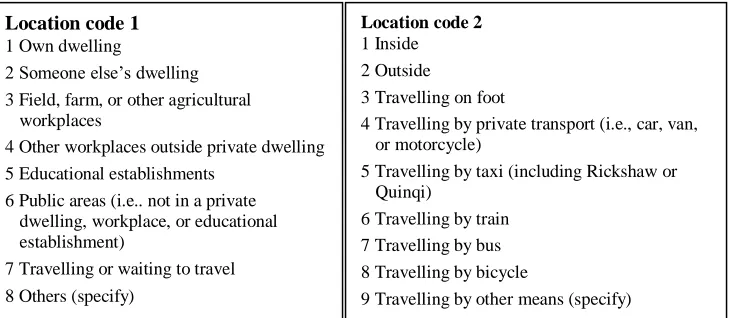
[image:6.595.119.484.456.615.2]PTUS noted the travel activity in 20 travel activity codes. The mode of transportation was noted with two context location variables (Figure 2). The first variable, Location Code 1, noted a respondent location in eight categories, including travel activity. The second context variable, Location Code 2, noted the mode of travel in case of travel activity or otherwise mentioned the location as inside or outside.
Figure 2: Context location variables of the time-use diary.
The travel behavior data were summarized by activity categories and by Location Code 2. The summary file was generated by following the analysis techniques in Pentland et al. (1999), Michelson (2005), and Singer and Willett (2003), particularly the reshape and collapse functions in Stata 12. This generated a detailed set of information on activity travel behavior and daily time-use in the country. In this paper, we present the findings on individual trip rate and mode choice estimates across both genders and other important demographic variables.
Location code 1 1 Own dwelling
2 Someone else’s dwelling
3 Field, farm, or other agricultural workplaces
4 Other workplaces outside private dwelling 5 Educational establishments
6 Public areas (i.e.. not in a private dwelling, workplace, or educational establishment) 7 Travelling or waiting to travel
8 Others (specify)
Location code 2 1 Inside 2 Outside
3 Travelling on foot
4 Travelling by private transport (i.e., car, van, or motorcycle)
5 Travelling by taxi (including Rickshaw or Quinqi)
6 Travelling by train 7 Travelling by bus 8 Travelling by bicycle
6
6. Results and discussion
6.1 Gender difference in mobility
Our analysis counts a total of 120,000 trips and 2.6 million minutes of travel with an average of 3.1 trips and 70 minutes of travel per person. Males account for approximately 80% of these trips and 79% of the travel duration, while females only account for 20% of these trips and 21% of the travel duration. Therefore, it can be said that, in general, Pakistani women are nearly four times less mobile than men1.
Approximately 30% of the respondents did not report any trip on the diary day. Such immobility rate is considerably higher than the previously reported levels in developed countries (Hubert et al., 2008). Work by Baker et al. (2005) and Elias and Shiftan (2014) also reported higher immobility rates in various Asian contexts. However, the gender differences in immobility have been rarely reported. Further analysis shows that Pakistani women are more likely to stay at home than travel on a random day since 55% of the surveyed women did not report travel as compared to less than 4% men reporting so. Similarly, urban residents are significantly more likely to report immobility than rural residents.
[image:7.595.105.492.445.701.2]Table 1 shows that, on average, a mobile respondent makes 4.5 daily trips and travels for 100 minutes per day. However, the gender mobility differences are significant and wide. Women make nearly half as many daily trips (2.7) as men (5.4). Their daily travel duration (63 minutes) is also 46% lower than that of men (117 minutes). One-way ANOVA results confirm significant gender differences in daily trip rate (F =5206) and travel duration (F=4517, p<0.0001).
Table 1 Per capita trip rate and daily travel duration of the mobile population.
Mode Trips Minutes traveled
Male Female All Male Female All
Non-motorized 4.9 (3.49) 2.4 (1.68) 4.1 (3.22) 97 (63.34) 52 (36.99) 82 (59.88) Walking 4.7 (3.51) 2.4 (1.68) 3.9 (3.21) 91 (62.68) 52 (36.93) 78 (58.47)
Bicycle and other
0.2 (0.75) 0.0 (0.18) 0.1 (0.63) 6 (24.03) 0 (5.75) 4 (20.09) Motorized 0.5 (1.17) 0.3 (0.76) 0.5 (1.06) 20 (49.82) 11 (34.96) 17 (45.61)
Private automobile1
0.3 (0.99) 0.2 (0.61) 0.3 (0.88) 11 (35.59) 6 (25.08) 8 (32.55)
Public transport2
0.2 (0.70) 0.1 (0.49) 0.2 (0.64) 9 (36.30) 5 (25.11) 9 (33.05) All 5.4 (3.36) 2.7 (1.49) 4.5 (3.15) 117 (68.88) 63 (41.73) 100 (66.23) Notes: 1Includes car, van, and motorcycle. 2Includes bus/minibus, taxi/ rickshaw/quinqi and train; Standard deviations are enclosed in parentheses. Source: Calculated from the 2007 TUS by the first author.
7 In terms of mode choice, as expected, nearly 9 out of 10 trips in Pakistan are performed by walking. Female share of walking trips is 2 percentage points higher than that of males (89% vs. 87%). Females do not use bicycles and other modes, which are used by males in 4% of their trips. Therefore, the share of females in non-motorized trips is 2 percentage points lower than that of males (89% vs. 91%). Among automobile-based trips, female share of trips by household car and motorcycle is 1 percentage point higher than that of males (7% vs. 6%), whereas both sexes have a similar share of public transport based trips (4%). T-test confirms significant gender differences in trip rate and travel duration for all modes, except for public transport.
6.2 Differences in purpose of travel
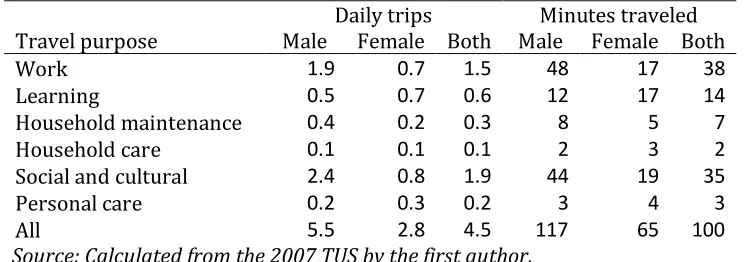
As shown in Table 2, women exhibit lower mobility levels than men for every purpose of travel. T-test results confirm significant gender differences for all ICATUS activities, except for household care related travel activities, such as grocery shopping, which account for the smallest portion of daily mobility.
[image:8.595.113.488.450.581.2]Work, learning, and socio-cultural activities are the top three travel purposes that account for 87% and 80% of the total daily mobility of men and women, respectively. Work and socio-cultural travel contribute nearly all of the gender differences in mobility as well. Compared with men, Pakistani women make 1.6 fewer socio-cultural trips (0.8 vs. 2.4) and 1.2 fewer work trips (0.7 vs. 1.9). The total daily travel duration of women is also 31 minutes shorter for socio-cultural travel (17 minutes vs. 48 minutes) and 25 minutes shorter for work travel (19 minutes vs. 44 minutes). However, both men and women exhibit a nearly identical average trip duration of approximately 25 minutes. The significantly lower female mobility for work is mainly attributed to the gender gap in workforce participation as women accounted for only 22% of active labor workforce in the country in year 2013 (GOP, 2015).
Table 2 Gender mobility differences among mobile respondents by travel purpose.
Travel purpose
Daily trips Minutes traveled Male Female Both Male Female Both
Work 1.9 0.7 1.5 48 17 38
Learning 0.5 0.7 0.6 12 17 14
Household maintenance 0.4 0.2 0.3 8 5 7
Household care 0.1 0.1 0.1 2 3 2
Social and cultural 2.4 0.8 1.9 44 19 35
Personal care 0.2 0.3 0.2 3 4 3
All 5.5 2.8 4.5 117 65 100
Source: Calculated from the 2007 TUS by the first author.
8 Low mobility levels are recorded for activities other than work, social and cultural purposes. Women make 0.2 more learning trips (0.7 vs. 0.5) and 0.1 more personal care trips than men (0.3 vs. 0.2), their travel time is also longer by 5 minutes and 1 minute for these activities, respectively.
Significant gender differences are observed in the mobility levels for activities other than household-care. However, the actual mobility levels for personal care and household care activities remain low. Therefore, the findings for these activities must be generalized with caution.
6.3 Effect of age, marital status, and income on mobility
[image:9.595.131.466.408.605.2]Table 3 shows significant effect of age on daily mobility behavior across gender. Specifically, the male mobility levels increase while female mobility levels decrease with ageing. Between 10 years and 14 years, men make 36% more trips and their travel duration is 39 percentage points higher than that of women. At 15 years and older, this gender gap increases to more than 50%. In addition, both men and women experience a decrease of their trip rates between 15 years and 30 years, but the rate of decrease is only marginal (2%) among men but quite noticeable (20%) among women. Additionally, this trend starts much earlier among women, at the age of 15, potentially due to rising safety concerns and up taking of homemaking roles. After the age of 30, trip rates increase more rapidly for men but very slowly for women. Similar age related trend can be observed across gender for daily travel duration as well.
Table 3 Effect of age on mobility levels.
Age (Years)
Trips Minutes traveled Male Female Both Male Female Both
10 to 14 5.3 3.2 4.4 108 69 92
15 to 19 5.4 2.6 4.5 118 65 101
20 to 24 5.3 2.6 4.5 117 62 100
25 to 29 5.2 2.6 4.4 115 57 97
30 to 34 5.4 2.7 4.5 117 60 99
35 to 39 5.5 2.7 4.7 121 61 104
40 to 44 5.5 2.8 4.8 119 63 104
45 to 64 6.0 2.8 5.0 125 63 105
65 to 69 6.8 2.7 5.6 129 61 109
70 years
and older 6.7 2.8 5.7 118 55 102
Overall effect + - + + +
P value *** *** *** *** *** ***
Notes: +increased significantly, decreased significantly, ~ insignificant change; Group differences by one way ANOVA: ~Insignificant, *p<0.05, **p<0 .01,***p<0.001. Source: Calculated from the 2007 TUS by the first author.
9 Marital status and presence of children also significantly influence the mobility levels of both men and women in Pakistan. Marriage significantly increases mobility among men, but decreases mobility among women. In particular, the trip rates and travel duration of men increase by 7% and 8% upon marriage, while those of women decrease by the same margin (Table 4). However, the presence of children decreases the mobility levels of both. The respondents with children below 7 years reported significantly lower mobility levels than those without children. However, compared with men, women showed a larger reduction in their daily travel duration (10% vs. 3%), whereas men experienced a greater reduction in their daily trip rates (12% vs. 4%). In other words, the presence of children shortens the trips length of women while it reduces the trip frequency of men. Divorce significantly reduces the mobility levels of the respondents. Divorced individuals make fewer daily trips (5.3 and 2.7 for men and women, respectively), that are further reduced by the presence of children below 7 years (3.3 and 1.8 for men and women, respectively).
Table 4 Effects of marital status and presence of children on mobility levels.
Marital status
Trips Minutes traveled Male Female Both Male Female Both
Bachelors 5.3 2.9 4.5 113 67 98
Currently married 5.7 2.7 4.8 121 61 102
Widow/widower 6.3 2.9 4.3 120 61 86
Divorced 5.3 2.7 4.2 106 64 88
Without children below 7 years
6.0 2.8 4.7 123 65 102
Currently married 6.0 2.8 4.7 123 65 102
Widow/widower 6.0 3.0 4.1 118 64 91
Divorced 3.0 2.4 2.4 90 62 67
With children below 7 years
5.5 2.7 4.8 120 59 101
Currently married 5.5 2.7 4.8 120 59 102
Widow/widower 5.2 2.9 4.1 116 62 83
Divorced 3.3 1.8 2.4 105 39 65
Source: Calculated from the 2007 TUS by the first author.
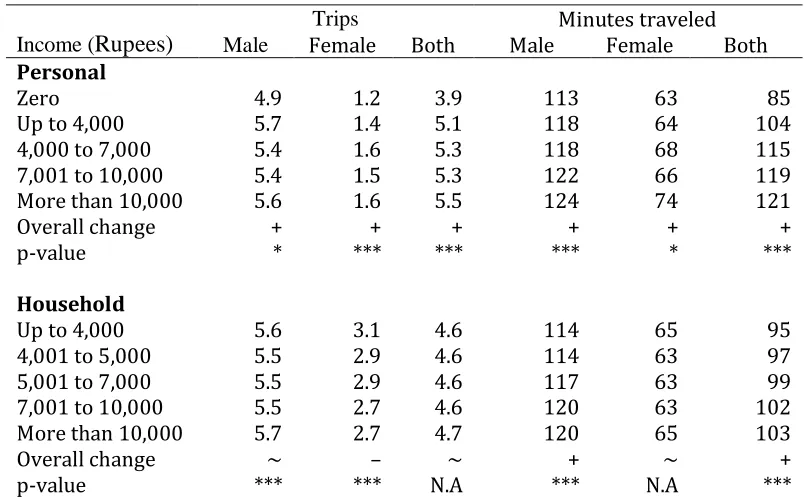
As shown in Table 5, personal income is positively associated with mobility levels and respondents without income reported least mobility levels. Among men, those with a personal monthly income of at least Rs. 10,0002 make 14% more trips and travel 10% longer than those without any personal income. Similarly, female travelers with a monthly income of Rs. 10,000 or above make 26% more trips and travel 18% longer than their counterparts without any income.
On the other hand, a higher household income has dissimilar effects between men and women. The trip rates of men do not change significantly with household income, while those of women decrease by 14% between the lowest and highest income quintiles. However, the mean daily travel duration among men increases by 6% between the lowest and highest income quintiles but remains unchanged among women. The significant effects of household income reflects the influence of social and cultural factors on female mobility. For example, rich families may discourage females from traveling or the females of these families may voluntarily stay at home. However, family income does not affect the male mobility.
10 Table 5 Effect of income on mobility levels.
Income (Rupees)
Trips Minutes traveled
Male Female Both Male Female Both
Personal
Zero 4.9 1.2 3.9 113 63 85
Up to 4,000 5.7 1.4 5.1 118 64 104
4,000 to 7,000 5.4 1.6 5.3 118 68 115
7,001 to 10,000 5.4 1.5 5.3 122 66 119
More than 10,000 5.6 1.6 5.5 124 74 121
Overall change + + + + + +
p-value * *** *** *** * ***
Household
Up to 4,000 5.6 3.1 4.6 114 65 95
4,001 to 5,000 5.5 2.9 4.6 114 63 97
5,001 to 7,000 5.5 2.9 4.6 117 63 99
7,001 to 10,000 5.5 2.7 4.6 120 63 102
More than 10,000 5.7 2.7 4.7 120 65 103
Overall change ~ ~ + ~ +
p-value *** *** N.A *** N.A ***
Notes: +Increased significantly, decreased significantly, ~ insignificant change; Group differences by one way ANOVA: ~Insignificant, *p<0.05, **p<0 .01,***p<0.001. Source: Calculated from the 2007 TUS by the first author.
6.4 Effect of age, income, and vehicle ownership on mode choice
As shown in Table 6, walking remains the most dominant mode of travel across all age groups. Specifically, the share of walking trips has a greater dispersion among men (82% to 94%) than women (87% to 91%). The gender gaps in mode choice are statistically significant for all age groups, except for public transport that is only significant for adults aged between 45 years and 64 years.
Table 6 Percent tips by mode of travel across age groups.
Mode 10 to 20 years (Young)
21 to 44 years (Adults)
45 to 64 years (Older adults)
65 and above (Elderly) Male Female Male Female Male Female Male Female Non-motorized 94 90 86 88 90 89 96 92
Walking 91 90 82 87 86 89 94 91 Bicycle and
others 3 0 5 1 4 0 2 1
Motorized 6 10 14 12 10 11 04 08
Personal
automobile 3 6 9 7 7 6 2 5
Public transport 3 4 5 5 3 5 2 2
All 100 100 100 100 100 100 100 100
[image:11.595.88.512.519.717.2]11 Non-motorized travel accounts for 94% and 90% of the daily mobility of men and women aged 10 to 20 years, respectively. Although motorized trips remain low at this age, the share of personal automobile based trips among women is significantly higher than that among men in this early adulthood period (6% vs. 3%).
Between 21 and 44 years of age, share of automobile trips peak among men and women, to 14% and 12%, respectively. At this age period, portion of walking trips among male decreases by 9% while their portion of motorized trips increases by roughly the same margin. However, during the same age period, portion of automobile trips among female increases by only 2 to 3 percent due to lack of access to income and mobility resources.
[image:12.595.86.523.311.519.2]The portion of automobile trips among men start decreasing from the age of 45 years and reaches an all-time low in later stages of life. Such a decrease may be attributed to the rejuvenated walking-based active lifestyle among elderly men. However, the portion of automobile trips among elderly women remains twice as high as men (8% vs. 4%) showing their sustained reliance on automobile and lesser walking-based mobility.
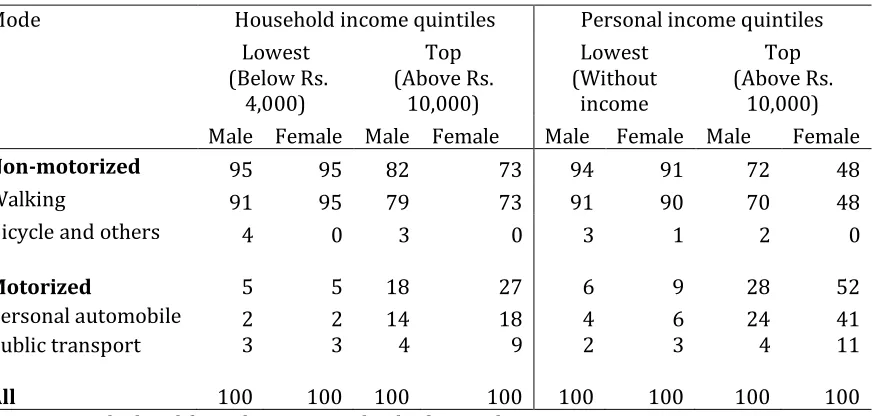
Table 7 Percent tips by mode of travel across income groups.
Mode Household income quintiles Personal income quintiles
Lowest (Below Rs.
4,000)
Top (Above Rs.
10,000)
Lowest (Without
income
Top (Above Rs.
10,000)
Male Female Male Female Male Female Male Female
Non-motorized 95 95 82 73 94 91 72 48
Walking 91 95 79 73 91 90 70 48
Bicycle and others 4 0 3 0 3 1 2 0
Motorized 5 5 18 27 6 9 28 52
Personal automobile 2 2 14 18 4 6 24 41
Public transport 3 3 4 9 2 3 4 11
All 100 100 100 100 100 100 100 100
Source: Calculated from the 2007 TUS by the first author.
Table 7 presents the effect of personal and household income on the mode choice. As expected, non-motorized travel remains the dominant mode of transportation across every income group. Non-motorized trips account for up to 95% of the daily mobility among men and women from the poorest households. The share of automobile trips significantly increases with income, particularly among women. Although the share of walking trips among women is 4 percentage points higher than that among men in the poorest households (95% vs. 91%), it decreases by 6 percentage points (73% vs. 79%, respectively) in the top income quintile households, that reflects an increased automobile reliance among women from the higher income households.
12 The public transport in Pakistan is largely unresponsive to the mobility needs of females (Imran, 2010). Still, the share of public transport trips among females is nearly twice as large as that among men. Given the significant gender gap in wages and labor market participation, the higher personal automobile reliance among women presents a significant financial challenge to their households who are somehow forced to buy, maintain and travel on private cars for a safer, convenient, and respectable daily mobility.
[image:13.595.116.478.276.405.2]Table 8 presents the statistics on household vehicle ownership. Nearly half of the sample did not report having any mode of transport, 28% reported having bicycles, 19% reported owning motorcycles, and 6% reported having a car. Among the respondents from the poorest households, approximately 70% did not own any vehicle and only 3% reported having a car or motorcycle. In contrast, among the respondents from the top income quintile, 30% reported not owning a vehicle, while 51% reported owning a car or motorcycle.
Table 8 Vehicle ownership by household income.
Monthly household income (Rs.)
No vehicle
Non-motorized Motorized Total
Up to 4,000 70 27 3 100
4,001 to 5,000 59 35 6 100
5,001 to 7,000 54 34 13 100
7,001 to 10,000 45 31 24 100
Above 10,000 30 19 51 100
Total 49 28 23 100
Source: Calculated from the 2007 TUS by the first author.
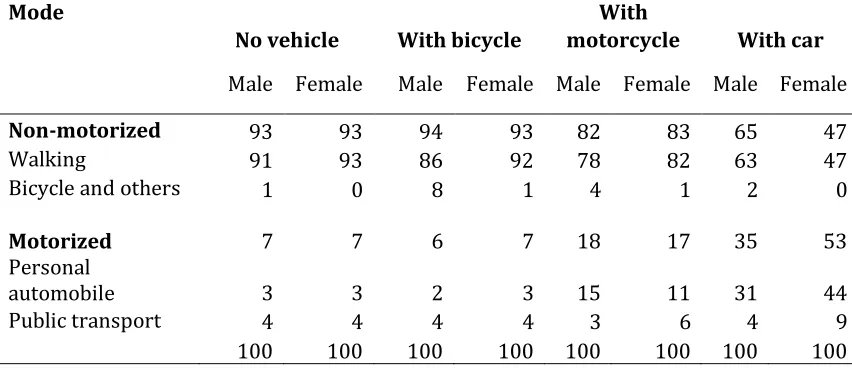
As presented in Table 9, the automobile trips of zero-vehicle households are as low as 6% and 7% among men and women, respectively. The share of bicycle trips among households with bicycles increases up to 8% among men, which is 2 percentage points higher than all motorized trips in these households showing the importance of bicycles for daily mobility in low-income households.
[image:13.595.84.510.584.768.2]With presence of motorcycles, the shares of automobile trips increases to 15% among men and 11% among women. Car ownership further increases the share of automobile trips to 31% among men and 44% among women. Although the majority of women travel as passengers in household cars, their share of motorized trips increases much more rapidly than that of their male counterparts.
Table 9 Percent tips by mode of travel by type of vehicle owned. Mode
No vehicle With bicycle
With
motorcycle With car
Male Female Male Female Male Female Male Female
Non-motorized 93 93 94 93 82 83 65 47
Walking 91 93 86 92 78 82 63 47
Bicycle and others 1 0 8 1 4 1 2 0
Motorized 7 7 6 7 18 17 35 53
Personal
automobile 3 3 2 3 15 11 31 44
Public transport 4 4 4 4 3 6 4 9
13 All
Source: Calculated from the 2007 TUS by the first author.
Significant gender differences are also observed between urban and rural areas. Adeel et al. (2014) state that the share of automobile-based trips is significantly higher in urban areas both for men and women because of the higher income levels and automobile ownership in cities. Urban Unit (2008) reported that motorized trips account for half of the total trips in metropolitan areas, such as Karachi and Lahore, but has a much lower share in smaller cities and towns. The continuous urban expansion in metropolitan areas, coupled with the increased concentration of a high-income population in suburban areas, indicate that automobile-based mobility will continue to increase. However, this paper does not delve into such an issue because the PTUS dataset does not specifically record samples from large cities of the country.
7. Conclusion
This paper estimates the gender mobility differences in Pakistan and examines the effects of important demographic variables on such differences. Our findings confirm the existence of significant differences, which have not been documented in the
literature. Women are also less mobile than men by every mode of travel and for almost every purpose of travel. On a random day, Pakistani women are more likely to stay at home than travel while only 3% of the male population has reported so. On average, women make 50% fewer trips and have 46% shorter travel time than men.
We have also found that certain demographic indicators can have opposite effects on mobility across gender. For example, male mobility levels keep increasing with age and marriage, while those of females decrease with these life events. Surprisingly, elderly men exhibit greater mobility levels than younger population as they undertake frequent walking trips to nearby social and religious places. Personal income increases mobility across gender, while household income decreases female mobility levels. Women in car-owning households make 53% of their total daily trips using personal automobiles, which is 33% higher than that of their male counterparts and more than 10 times higher than that of men and women from the lowest income quintiles.
These gender based differences in daily mobility behavior are linked with the particular socio-cultural context of the country which restricts female mobility due to their honor and safety concern. We identify the following aspects of social life in Pakistan that have influential roles in exacerbating gender-related mobility inequality in the country:
(i) A socio-cultural context that controls female mobility through permission, veiling, and having an escort;
(ii) Social constraints on the appropriateness of a mode of travel;
(iii) Higher burden of walking on women, because of limited income and increased involvement in unpaid family work, such as water and firewood collection;
(iv) Higher reliance on personal automobiles among adult women, despite their limited ability to pay for transportation costs; and
(v) Economic poverty and time constraints.
14 Women may be less mobile and still have an acceptable level of access to services. However, the existence of wide gender differences in access to necessities such as education, healthcare and employment, indicate that women may be more vulnerable to reduced accessibility because of these mobility constraints (Adeel et al., 2016).
To improve mobility of women in Pakistan and elsewhere, a comprehensive, female-friendly transport system and land use policy should be implemented. The society should also recognize the mobility needs of women. Programs such as Safe Route to School may facilitate female walking mobility and increase their access to educational, employment, and other activities. These programs can also decrease the undesired automobile reliance among low and middle-income households. A detailed examination of personal accessibility and its relationship with mobility levels can generate useful information regarding the mobility needs and the relationship between transport and land use services in a predominantly walking-based society with distinct socio-cultural characteristics.
References
Adeel, M., Yeh, A.G.O., Zhang, F.: Gender, mobility and travel behavior in Pakistan: Analysis of 2007 Time Use Survey. In: 5th International Conference on Women's Issues in Transportation - Bridging the Gap, 14-16 April. Paris, France Federation
I I A
Adeel, M., Yeh, A.G.O., Zhang, F. 2016. Transportation disadvantage and activity
participation in the cities of Rawalpindi and Islamabad, Pakistan. Transp. Policy. 47, 1-12 (2000)
Babinard, J., Scott, K.: What Do Existing Household Surveys Tell Us About Gender and Transportation in Developing Countries? In: Conference on Research on Women's Issues in Transportation, Chicago Illinois, United States 2009, pp. 213-224.
Transportation Research Board Conference
Baker, J., Basu, R., Cropper, M., Lall, S., Takeuchi, A. Urban Poverty and Transport The Case of Mumbai. World Bank Policy Research Working Paper 3693. (2005)
Bamberg, S., Hunecke, M., Blöbaum, A. Social context, personal norms and the use of public transportation: Two field studies. J Environ Psychol. 27(1), 190-203 (2007)
Bland, B.H.: Land-use patterns and travel. Land use patterns and travel. Special Research Branch, Safety and Transportation Department, Transport and Road Research Laboratory, Crowthorne, Berkshire : (1983)
Buliung, R.N., Kanaroglou, P.S.: Activity-Travel Behaviour Research: Conceptual Issues, State of the Art, and Emerging Perspectives on Behavioural Analysis and Simulation Modelling. Transport Rev 27(2), 151-187 (2007)
Bussey, K., Bandura, A.: Social cognitive theory of gender development and differentiation. Psychological review 106(4), 676 (1999)
Carrasco, J.A., Farber, S.: Selected papers on the study of the social context of travel behaviour. Transportation Research Part A: Policy and Practice 68(0), 1-2 (2014) Crane, R.: Is There a Quiet Revolution in Women's Travel? Revisiting the Gender Gap in
Commuting. J Am Plann Assoc 73(3), 298-316 (2007)
Dobbs, L.: Wedded to the car: women, employment and the importance of private transport. Transport Policy 12(3), 266-278 (2005)
Elias, W., Shiftan, Y.: Gender Differences in Travel Behavior in the Arab World: Comparison of Case Studies from Jordan and Israel. In: 5th International Conference on Women's Issues in Transportation - Bridging the Gap, , 14-16 April. Paris, France Feederation
15 Ettema, D., Timmermans, H.J.P. (eds.): Activity-based approaches to travel analysis, 1st ed.
ed. Pergamon, Oxford, UK: (1997)
Gerike, R., Gehlert, T., Leisch, F.: Time use in travel surveys and time use surveys Two sides of the same coin? Transportation Research Part A: Policy and Practice 76, 4-24 (2015)
G R P C L A R W I
Transportation, 21 (2004)
GOP: Pakistan Economic Survey 2012 13, Islamabad, Pakistan (2015)
Handy, S.: Methodologies for exploring the link between urban form and travel behavior. Transportation Research Part D: Transport and Environment 1(2), 151-165 (1996) Hanson, S.: Gender and mobility: new approaches for informing sustainability. Gender, Place
& Culture 17(1), 5-23 (2010)
Hanson, S., Hanson, P.: Gender and urban activity patterns in Uppsala, Sweden. Geographical Review, 291-299 (1980)
Harvey, A., Taylor, M.: Activity settings and travel behaviour: A social contact perspective. Transportation 27(1), 53-73 (2000)
Harvey, A.S., Niemi, I.: An International Standard Activity Classification: Toward a
framework, relevant issues. Paper presented at the International Association for Time Use Research Workshop, Amsterdam, (1993)
Heward, C., Bunwaree, S.: Gender, education and development: Beyond access to empowerment. Palgrave Macmillan, (1999)
Imran, M.: Sustainable Urban Transport in Pakistan: An Institutional Analysis. International Planning Studies 15(2) (2010)
Jejeebhoy, S.J., Sathar, Z.A.: Women's Autonomy in India and Pakistan: The Influence of Religion and Region. Population and Development Review 27(4), 687-712 (2001) Khan, A.: Mobility of women and access to health and family planning services in Pakistan.
Reprod Health Matter 7(14), 39-48 (1999)
Law, R.: Beyond 'women and transport': towards new geographies of gender and daily mobility. Prog Hum Geog 23(4), 567-588 (1999)
Levinson, D., Kumar, A.: Activity, travel, and the allocation of time. J Am Plann Assoc 61(4), 458 (1995)
Michelson, W.: Time use : expanding explanation in the social sciences. Paradigm Publishers, Boulder, CO: (2005)
Mumtaz, Z., Salway, S., Waseem, M., Umer, N.: Gender-based barriers to primary health care provision in Pakistan: the experience of female providers. Health policy and planning 18(3), 261-269 (2003)
NIPS 2008. Demographic and Health Survey 2006-07. National Institute of Population Studies. Islamabad, Pakistan (2008)
NIPS: Demographic and Health Survey 2012-13. National Institute of Population Studies. Islamabad, Pakistan (2013)
Noble, B.: Using simple time use surveys to investigate travel. In: International Conference on Transport Survey Quality and Innovation: How to Recognise It and How to Achieve It, South Africa 2001
PAKISTAN BUREAU OF STATISTICS: Time Use Survey 2007 - Final Report. Islamabad, Pakistan. (2008)
PAKISTAN BUREAU OF STATISTICS: Pakistan social and living standards measurement survey (2010-11): National / Provincial / District. Islamabad, Pakistan. (2010).
16 Papanek, H.: Purdah in Pakistan: seclusion and modern occupations for women. Journal of
Marriage and the Family, 517-530 (1971)
Pentland, W.E., Harvey, A.S., Lawton, M.P., McColl, M.A. (eds.): Time use research in the social sciences. Kluwer Academic Publishing Group, New York (1999)
Porter, G.: Living in a Walking World: Rural Mobility and Social Equity Issues in Sub-Saharan Africa. World Development 30(2), 285-300 (2002)
Rajé, F.: Negotiating the transport system: user contexts, experiences and needs. Ashgate, Aldershot, England; Burlington, VT. (2007)
REICHMAN, S. 1976. Travel Adjustments and Life Styles - A behavioral Approach. In: Behavioral travel-demand models. Edited by Stopher, P. R., Meyburg, A. H. Lexington Massachusetts: Lexington Books.
R S U W M T P the Research
C I R W I T N 20,
2004, Chicago, Illinois 2004. Transportation Research Board Conference Proceedings (2006)
Sathar, Z.A., Kazi, S.: Women's autonomy, livelihood and fertility: a study of rural Punjab. Women's autonomy, livelihood and fertility: a study of rural Punjab. (1997) Sathar, Z.A., Kazi, S.: Women's autonomy in the context of rural Pakistan. The Pakistan
Development Review, 89-110 (2000)
Singer, J.D., Willett, J.B.: Applied longitudinal data analysis: Modeling change and event occurrence. Oxford university press, (2003)
Tannen, D.: Gender and discourse. Oxford University Press New York, (1994)
THE URBAN UNIT: The Urban Dialogue - Talk on Urban Sustainable Development and Transport. Lahore, Pakistan. (2008)
T R B R W I T R
C I W I n Transportation, Chicago, Illinois, November 18
20, (2004)
Urry, J.: Sociology beyond societies: Mobilities for the twenty-first century. Psychology Press, (2000)