This is a repository copy of Examining adaptation using the Message-Actor-Channel (MAC) model of communicative water practices.
White Rose Research Online URL for this paper: http://eprints.whiterose.ac.uk/128016/
Version: Accepted Version
Article:
Ajia, F. orcid.org/0000-0003-3981-854X (2017) Examining adaptation using the
Message-Actor-Channel (MAC) model of communicative water practices. Water Science and Technology: Water Supply. ws2017200. ISSN 1606-9749
https://doi.org/10.2166/ws.2017.200
[email protected] https://eprints.whiterose.ac.uk/ Reuse
Items deposited in White Rose Research Online are protected by copyright, with all rights reserved unless indicated otherwise. They may be downloaded and/or printed for private study, or other acts as permitted by national copyright laws. The publisher or other rights holders may allow further reproduction and re-use of the full text version. This is indicated by the licence information on the White Rose Research Online record for the item.
Takedown
If you consider content in White Rose Research Online to be in breach of UK law, please notify us by
Examining adaptation using the Message-Actor-Channel (MAC) model of communicative water practices
F.O. Ajia*
* The University of Sheffield Winter St, Sheffield S10 2TN, United Kingdom. [email protected]
Keywords: Adaptation; Behavioural change; Household demand management; Public engagement; Water management; Water utilities
Abstract
Water utilities rely on technological interventions to achieve household water efficiency. This practice is critiqued as seeking to appeal to the financial interests implied by peopleÕs role as customers rather than to achieve behavioural change in householders. A policy analysis reveals that although not prominently evidenced by some water utilities, public engagement is key to long-term demand reduction.
This paper presents a systematic review of the demand management literature; specifically outlining key theoretical considerations for public engagement in relation to reducing water demand; and their translation into practice in utilities. The aim is to demonstrate the use of a framework for examining engagement in utilities. Findings show that demand management interventions need to exploit: (1) effective frames for messages, (2) the diversity of the public, and (3) communication mediums that facilitate feedback. These insights informed the development of the MAC (Message Actor Channel) model of communicative water practices further used in this study to review public engagement plans for household water efficiency in selected UK water utilities based on processes described in their 2014 water resources management plans. Findings will inform the next stages of a doctoral study which will assess utilitiesÕ field engagement of households to reduce water use.
Introduction
In line with social scientists increasingly calling for changes to traditional water management
(Browne et al. 2013), this paper starts from the normative position that traditional water
management would be enhanced through increasing public engagement to understand and influence peopleÕs water behaviours, and hence provide better value for money.
Increasing household water demand and its management is a recognised global issue. With the world population rising by 33% between 2011 and 2050 (UN 2016); and the
5th Intergovernmental Panel on Climate Change (IPCC) warning that for every degree of global
steadily increased by 1% since the 1930s (Staffell et al. 2015). These facts highlight the imperative to manage domestic water demand and is reflected by a rapid increase in the quantity of research and policy experiments using public engagement to influence water values and practices, and thus reduce water use.
The conventional role of public engagement in traditional water management regimes can be contrasted with arguments for public engagement in contemporary water management. Up until the early 1980s, the UK water supply was managed by state-owned enterprises using engineering expertise and infrastructures such as large dams (Bakker 2013) which provided quick solutions to urgent water issues. The traditional role of public engagement in the water utility typically focussed on minimising water supply disruptions and billing complaints.
Pahl-Wostl et al. (2007) ascribe such engineering focused approaches as ÔtraditionalÕ because of
their heavy reliance on inflexible technical systems for prediction and control.
On the other hand, there is a growing interest in governmentsÕ and public-proxy bodiesÕ commitment to people and the environment; and water regulatory frameworks and management strategies are positioning public engagement as crucial to linking water utilities with the public. The premise of contemporary demand management is therefore that people must be centred at the heart of water matters, but how this translates into practice varies between two positions that manifest through the collaboration of two key actors that manage and use water Ð the water utilities and people.
In 1992, the ÔDublin StatementÕ was produced with its major principle being that water should be managed as an economic good (Muller 2015) through market pricing. This led to the
controversial (Franco et al. 2013) but wide acceptance of the commodification of water (Bakker
2013). The Dublin Statement is critiqued as flawed due to its lack of consideration for the variations in management approaches across organizations (Muller 2015). Critics of the Dublin Statement present an alternative to the commodification of water by advocating for communal involvement in water management. Two dominant approaches are thus emerging Ð engaging the public on water issues by appealing to individual interests such as reducing water bills (Schleich and Hillenbrand 2009); and engaging the public on water issues by appealing to peopleÕs communal values such as the desire to protect water resources (Muller 2015). Termed in this study as the Ôindividual interestÕ and Ôcommunal interestÕ approaches, the former is indicated significantly by economic incentives for customers while the latter is indicated by intrinsic incentives for householders.
The water utilityÕs perception of its ÔpublicsÕ and its understanding of its responsibility towards water security is indicative of its adoption of any or both public engagement approaches in practice, albeit the primary goal of both approaches is to reduce per capita daily water consumption despite variations in the motivations and practices that constitute these
approaches. For example, in its ÔSave A Little, Save A LotÕ campaign to Òconsume water with
careÓ in June 2015, Yorkshire Water sought to achieve water efficiency by appealing to its
customersÕ individual interest in reducing water bills. Here Yorkshire Water intended to highlight the financial value of water by stating in its June 8 2015 website article titled ÔWater
Conservation Campaign Launched to Mark World Environmental DayÕ that Òan extensive
survey in 2014 revealed most customers recognize the importance of water efficiency, with financial savings the biggest driverÓ. In contrast, Anglian WaterÕs current ÔLove Every DropÕ campaign continues to significantly target its publicsÕ communal interests by encouraging people to come together to protect and use water wisely. Although both approaches in Yorkshire Water and Anglian Water involve engagement, two important differences lie in Ôthe people engagedÕ and Ôthe basis of the engagementÕ Ð with the former approach targeting customers interested in making financial savings on water bills and the latter approach targeting residents who desire to collectively protect water.
This study therefore seeks to investigate key policy and literature considerations for public engagement and how these manifest as planned household demand management approaches in UK water utilities. This work uses published documents on water management and represents the preliminary data collection phase of a doctoral study examining public engagement in relation to reducing water demand undertaken by water utilities in the UK.
The challenge: making a case for public engagement in demand management
UK Water utilities have a responsibility to plan and promote water efficiency, albeit in the long term, the uptake and continuity of water efficiency measures lie with their publics. The public
is recognized as capable of actively supporting water utilities to tackle water issues (Sharp et
al. 2015) and over the past price review periods, Ofwat has continued to increase expectations
for water utilities to play a more significant role in household demand management.
Significant challenges are emerging as public engagement becomes increasingly recognised as a pillar of water management. First, the policy governing UK water engagement is not prescriptive, creating a challenge with standardising engagement. Second, some utilities still underestimate the capability of the public to actively reduce water use without the influence of water saving devices. Third, although mostly discussed in isolation, the literature is lacking any holistic considerations for the interdependency of the elements that facilitate engagement. Most studies on water engagement focus on understanding singular elements of public engagement; for example, there are existing studies on expectations of good engagement
in relation to demand management (Kampragou et al. 2011) but a comprehensive
Methodology
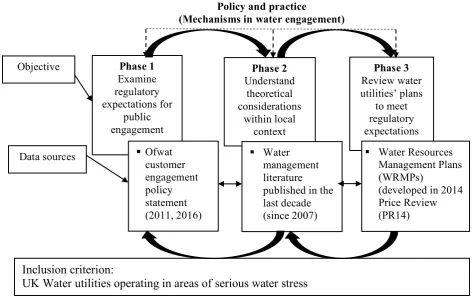
[image:5.595.53.527.146.443.2]A coordinated qualitative approach including a literature and systematic documentary review was utilised for this study (see Figure 1).
Figure 1 Framework for analysing considerations for public engagement policy and practice
Analyses were conducted in three phases due to the interest in pulling together elements of public engagement in relation to water efficiency discussed in policy documents, in the literature, and in Water Resources Management Plans (WRMPs) Ð a statutory document produced by UK utilities to demonstrate management of water resources to balance demand and supply.
In Phase 1, a documentary analysis of the customer engagement policy designed by the UK water sectorÕs economic regulator Ofwat in 2011 and 2016 was undertaken, with the aim to understand regulatory expectations for public engagement.
In Phase 2 a review of the literature on water management mostly published in the past decade was conducted, with an objective of drawing together recent theoretical and practice considerations for public engagement in relation to reducing water demand. In examining these understandings, I developed themes from literature discussions around the construct of demand management messages, stakeholder roles, and channels of communication. Drawing from Phases 1 and 2, this study took a novel approach to develop the Message Actor Channel (MAC) model of communicative water practices which synthesises key elements of public engagement and positions as the framework for examining WRMPs as questions emerged in Phase 3.
Objective Phase 1
Examine regulatory expectations for
public engagement
Phase 2
Understand theoretical considerations
within local context
§ Water management literature published in the last decade (since 2007) § Ofwat
customer engagement policy statement (2011, 2016)
Phase 3
Review water utilitiesÕ plans
to meet regulatory expectations
Policy and practice
(Mechanisms in water engagement)
Inclusion criterion:
UK Water utilities operating in areas of serious water stress
§ Water Resources Management Plans (WRMPs)
In Phase 3, using the MAC model as an analytical lens, I systematically and iteratively reviewed WRMPs with focus on public engagement plans in relation to household water efficiency developed by seven selected UK water utilities during PR14. Under the regulatory guidance of Ofwat, the Environment Agency, and the Department for Environment, Food & Rural Affairs (Defra), each UK water utility is required to produce and maintain a WRMP setting out how it will manage and develop water resources to balance demand and supply over the next 25 years; and revise this plan every five years as part of the price review process. Utilities were purposely selected from the pool of twenty-four UK water and sewerage utilities operating in England, Scotland and Wales to solely include those identified by the UK Environment Agency and Natural Resources as facing the issue of increasing water demand. These utilities are namely Affinity Water, Anglian Water, Essex and Suffolk Water, South East Water, Southern Water, Sutton and East Surrey Water, and Thames Water.
Results and Discussion
Public engagement policy: emerging expectations for UK water utilities
A central assumption underlying the regulation of any commodity is that markets are imperfect thus requiring control from a regulatory organisation. One theme of policy that has been gaining traction in the water sector since the 1990s is customer engagement (UKWIR 2015). In August 2011, Ofwat published its customer engagement policy statement for water companies introducing the concept of forming Customer Challenge Groups (CCG) to increase customer involvement in water governance and foster engagement through various pathways.
Regarding expectations for increasing customer engagement, Ofwat adopts a Ôtransfer-of-authorityÕ approach by giving water utilities considerable leeway to implement engagement. The regulator steers clear of providing hard rules for engagement as suggested in its statement:
ÒWe have designed a framework that is intended to be non-prescriptive, while holding the companies accountable for
managing and shaping customer engagement...Ó.
(Ofwat 2011). To shape engagement, Ofwat highlights key principles that emphasise customer involvement and recognise a variation in customer priorities, thus stating the following:
ÒDifferent customers in different areas have different concerns and prioritiesÉ while some groups may favour work to enhance the local environmentÉothers want help managing
water use... some people may need help communicating with their companyÓ.
(ibid.).
and the subsequent refresh of this policy every Price Review period after PR14 will create spaces for innovative utilities to refine public engagement on short and long-term priorities.
Theorising public engagement: The MAC model of communicative water practices
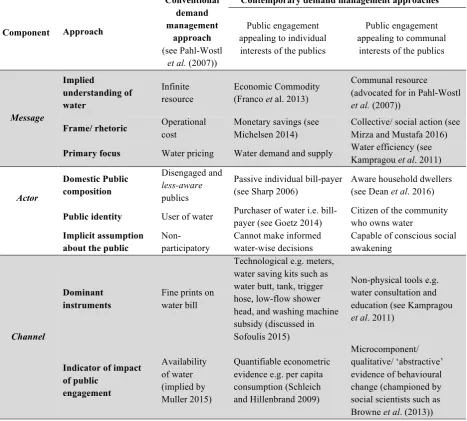
Interpreting theories which emphasise the understanding of elements underlying public engagement in the context of water demand management (see Table 1) is key to deducing the implications of dominant practices in water utilities.
Table 1 Conventional versus Contemporary Approaches to Public Engagement in relation to Reducing Water Demand
Component Approach
Conventional demand management
approach (see Pahl-Wostl
et al. (2007))
Contemporary demand management approaches
Public engagement appealing to individual
interests of the publics
Public engagement appealing to communal
interests of the publics
Message Implied understanding of water Infinite resource Economic Commodity (Franco et al. 2013)
Communal resource (advocated for in Pahl-Wostl et al. (2007))
Frame/ rhetoric Operational cost
Monetary savings (see Michelsen 2014)
Collective/ social action (see Mirza and Mustafa 2016)
Primary focus Water pricing Water demand and supply Water efficiency (see Kampragou et al. 2011)
Actor Domestic Public composition Disengaged and less-aware publics
Passive individual bill-payer (see Sharp 2006)
Aware household dwellers (see Dean et al. 2016)
Public identity User of water Purchaser of water i.e. bill-payer (see Goetz 2014)
Citizen of the community who owns water
Implicit assumption about the public
Non-participatory
Cannot make informed water-wise decisions
Capable of conscious social awakening
Channel
Dominant instruments
Fine prints on water bill
Technological e.g. meters, water saving kits such as water butt, tank, trigger hose, low-flow shower head, and washing machine subsidy (discussed in Sofoulis 2015)
Non-physical tools e.g. water consultation and education (see Kampragou et al. 2011)
Indicator of impact of public engagement Availability of water (implied by Muller 2015) Quantifiable econometric evidence e.g. per capita consumption (Schleich and Hillenbrand 2009)
Microcomponent/ qualitative/ ÔabstractiveÕ evidence of behavioural change (championed by social scientists such as Browne et al. (2013))
Whilst the identity of the public is contested in and across various research fields, the need to understand the specific and diverse identities of actors in public engagement is
emerging in response to the research community promoting people (Dean et al. 2016) and
[image:7.595.78.546.243.664.2]Ôbill-payersÕ and Ôthe general publicÕ. For example, in a field study conducted in an anonymous US water utility, Goetz (2014) emphasised the general public as bill-paying customers.
Selecting communication channels in public engagement is important; with its
relevance grounded in the ability of mediums to facilitate or impede engagement. Browne et
al. (2013) note that household demand is influenced by the interaction between people, nature
and technology; and communication channels serve to (re)shape these interactions. There is more specific literature which embodies how water efficiency programmes position the ÔcustomerÕ and how water acts in households (Sofoulis 2015). Of equal significance is the literature that expands on promoting water efficiency using multiple communication channels and how water systems such as rain water tanks and cistern displacement devices can cause people to change water habits sometimes unconsciously (Sharp 2006). Although devices such as meters are technological, they transmit implicit messages that consciously and sub-consciously (re)shape publics during use. I thus consider technological interventions as channels of communication in their own rights. It must however be highlighted that when a conscious behavioural change is not the focus of demand management interventions, a displaced water demand may unfold when there is a change in household dynamic such as economic status, water system, or physical space. For instance, whilst a water user may spend
less time in the shower due to using a low-flow shower head, this quick-fix outcome may not
be sustained when the water user uses a high-pressure shower head in an hotel. If peopleÕs values are consciously reshaped using behavioural change messages on the other hand, it is more likely that regardless of water system and physical space, users will be water efficient.
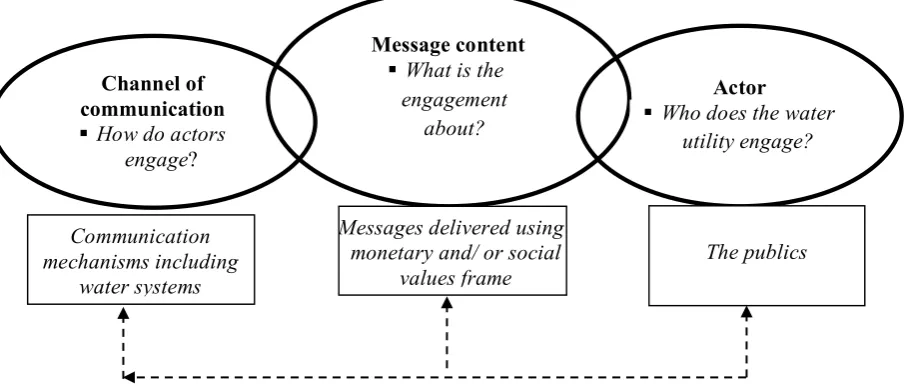
Having examined policy and literature discussions relating to public engagement in the context of water management, the insights are understood around three major elements Ð actor, message and channel of communication. I thus juxtapose insights that authors and Ofwat draw up to argue for the factors that re(shape) the outcomes of public engagement, forming the MAC (Message Actor Channel) model of communicative water practices (see figure 2).
[image:8.595.72.525.523.717.2]
Figure 2 The MAC (Message Actor Channel) model of communicative water practices
Message content
§ What is the engagement
about?
Channel of communication
§ How do actors engage?
Actor
§ Who does the water utility engage?
The publics Communication
mechanisms including water systems
Messages delivered using monetary and/ or social
A systematic review of demand management plans using the MAC model of communicative water practices
To illustrate the MAC modelÕs application, and as a starting point for understanding engagement approaches in water utilities, this study used the three elements of the MAC model as a tri-focal analytical lens in the review of public engagement plans and practices set out in WRMPs of UK water utilities operating in areas of serious water stress. Findings are discussed subsequently:
Message: There is a high degree of commonality in the way water utilities plan to construct and present water efficiency messages to their publics. Although some utilities indicated that some publics contest the validity of climate change, it is still a powerful frame for water efficiency messages especially when attempting to appeal to the peopleÕs communal interests. This is apparent in WRMP consultations conducted by Affinity Water, Anglian Water, Essex and Suffolk Water, South East Water, and Sutton and East Surrey Water who all highlighted the impact of climate change on level of rainfall in their regions of operation, thus attempting to awaken local interest and motivate collective action.
Actor: As can be inferred from the literature, the disparity between how stakeholders are identified theoretically and the role they assume in relation to water begs the question about who water utilities envision when they imagine the ÔcustomerÕ. Thus, understanding semantics in public engagement planning is key to identifying water utilitiesÕ target audience for water efficiency initiatives. The frequency of reference to publics in relation to demand management in WRMPs across all water utilities was examined (see Figure 3).
! !
Figure3 Dominance of reference of public actors in relation to domestic demand management
I found a high degree of reference to ÔcustomersÕ and Ôbill-payersÕ which implies that most water engagement initiatives such as metering were econometrically and significantly planned to appeal to the individual interests of publics. On the other hand, public-proxies such
as environmental and social groups and CCGs were more referenced than publics such as citizens, residents, and students; and this can be attributed to some water utilitiesÕ zeal to engage with intermediaries because this is an Ofwat statutory requirement for the WRMP consultation process. This pattern thus begs three questions: (1) are intermediaries a realistic representation of citizens? (2) can lessons from water efficiency programmes be efficiently transferred from intermediaries to various publics? (3) from a policy perspective, what more can Ofwat do more to mandate water utilities to engage publics other than bill-payers?
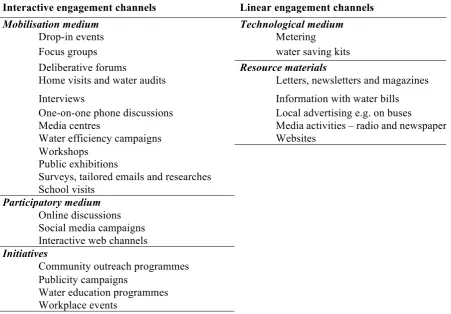
[image:10.595.75.527.306.620.2]Channel of communication: Across water utilities, different mediums were planned to be used to communicate water efficiency messages to publics, some of which were more direct than others. On this basis, this study groups the dominant mediums into interactive and linear channels (see Table 2) depending on whether the mediums have a pathway that facilitate feedback.
Table 2 Interactive and linear water engagement channels
Interactive engagement channels Linear engagement channels
Mobilisation medium Technological medium
Drop-in events Metering
Focus groups water saving kits
Deliberative forums Resource materials
Home visits and water audits Letters, newsletters and magazines
Interviews Information with water bills
One-on-one phone discussions Local advertising e.g. on buses
Media centres Media activities Ð radio and newspapers
Water efficiency campaigns Websites
Workshops Public exhibitions
Surveys, tailored emails and researches School visits
Participatory medium Online discussions Social media campaigns Interactive web channels Initiatives
Community outreach programmes Publicity campaigns
Water education programmes Workplace events
Metering and water saving kits were visibly championed in Southern Water, Thames Water, and Affinity Water as instruments for promoting domestic water efficiency. It is noteworthy that in all water utilities examined, increased metering, distribution of water saving devices to households, and the promotion of water efficiency programmes to achieve behavioural change were planned although there was a higher level of specificity around plans for metering than there was for behavioural change programmes.
exchanged within the same medium without either of the primary actors having to move out of that communication environment. In studied utilities, interactive engagement channels were planned for use by engagement-oriented utilities for water efficiency programmes which involved public mobilization and participation. For example, Affinity Water planned to engage the younger generation in schools about water by visiting 7,000 students annually, and teach about the importance of water and the environment. Similarly, Affinity Water planned a ÔLetÕs Talk WaterÕ survey to gather insight on water use and behaviours, metering and water efficiency devices. Anglian Water planned to maintain its ÔDiscover Discuss and DecideÕ online discussion on water issues and solutions; and Essex and Suffolk Water planned to continue its retrofit project which includes measuring of water savings, the sharing of feedback, and the drawing up of lessons with the publicsÕ input.
On the other hand, linear engagement channels by design and condition of implementation facilitate a one-way communication between the water utility and its publics wherein information and feedback cannot be easily exchanged without the actors moving out of the primary communication environment. Whilst linear channels can reach an extensive audience, publics cannot instantly communicate feedback to their water utilities through same channels. Exemplars of the use of linear engagement channels include the reliance on metering, water efficiency devices and resource materials to communicate implicit water efficiency messages to the customers in utilities such as Southern Water, Thames Water and Affinity Water; the advertisement of retrofit projects on bus shelters and van decals, on the radio, in magazines and newspapers, leaflet drops, and on posters in washrooms at shopping centres which Essex and Suffolk Water stated as having explored in previous years; plans to circulate messages on water bills to households by South East Water; and the distribution of automatically generated letters to customers with high usage by Sutton and East Surrey Water.
Ultimately, a water utility decides what channels to use considering many factors including aim, target audience and cost effectiveness. However, across water utilities studied, several channels were planned to be used for household demand management although it was unclear in most cases if channels were tailored to publics.
Developed typology based on public engagement approaches in water utilities
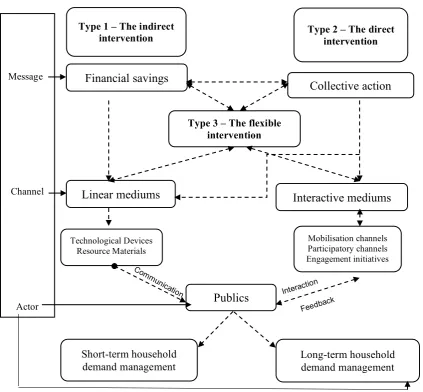
Figure 4 Typology of demand management approach in water utilities
Type 1 Ð Indirect interventions are technology (e.g. metering) oriented. They implicitly position publics as buyers of water, and significantly involve the use of linear channels and the money rhetoric to achieve household water efficiency e.g. including information on water bills, distributing water saving kits, and installing meters without the inclusion of public mobilisation and/or participation. Indirect interventions do not aid active
dialogue between actors but sets out to appeal to the individual interests of publics. The
conceptualisation of indirect intervention was shared in Southern WaterÕs 2010-2035 WRMP
published in October 2009: Òmeteringis the fairest way to pay for waterÉ; it enables customers
to influence their own billsÉ; it is consistent with sending out economic signals which will assist in the development of competitionÉÓ (pp. 3-7).
Type 2 Ð Direct interventions are engagement oriented, evident in practices which position publics as owners of water and significantly involve the use of interactive mediums and the ÔcollectiveÕ rhetoric to achieve household water efficiency. Direct interventions aid dialogue between actors although it is imperative to note that it is impossible for any water utility to rely solely on direct or indirect interventions for demand management because of the magnitude of the issue of water demand and the need to provide immediate solutions pending
Type 2 Ð The direct intervention Type 1 Ð The indirect
intervention
Financial savings
Collective action
Publics
Linear mediums Interactive mediums
Technological Devices Resource Materials
Mobilisation channels Participatory channels Engagement initiatives
Short-term household demand management
Long-term household demand management
Type 3 Ð The flexible intervention Message
Channel
when gradual behavioural change builds up. Still, through some practices, some examined water utilities were more engagement-oriented. Exemplars include the following:
(i) South East Water planned demand management via retrofitting devices but also
stated in its WRMP that its customers perceived water saving as a civic duty and it is the water utilityÕs social and environmental responsibility to manage demand through education and awareness activities designed to change water behaviours and reduce customersÕ water use.
(ii)Essex and Suffolk Water attributed its consistent reduction of water demand to
its water efficiency initiatives, leakage control and metering programme but noted that water efficiency is the key strand of its demand management strategy. The utility has a history of complementing social measures with technological solutions to water issues having conducted
behavioural change projects such as the H2eco and ecoFIT annually since 2006 (current phase
is branded as the ÔEvery Drop CountsÕ programme).
Type 3 Ð Flexible interventions are engagements driven by water utilities which set out to engage in ways different from the norm by complementarily using both direct and indirect water demand interventions such as mobilization programmes and metering, and propagating both the ÔcollectiveÕ and monetary rhetoric to promote water efficiency. Exemplars of practices indicative of flexible intervention include the following:
(i)Through the Love Every Drop campaign, Anglian Water continues to educate
its publics about local water issues and the value of water including how to modify household practices such as gardening and showering; and distributes with water saving kits to supplement this behavioural change campaign.
(ii)Adopting a different approach, Affinity Water used its metering trial run in the
Southeast region to understand its customersÕ water behaviours by incorporating smart communications on water use and social comparison into the programme.
(iii) South and East Surrey WaterÕs approach in its final WRMP published in June
2014 was to use water efficiency schemes to help customers reduce bills and reduce abstraction, but also recognised that there is an immeasurable social benefit of saving water, stating that its
focus was to make Òchanges to behaviours in water use the normÓ (p. 251).
Conclusions
Recognising the Ôindividual interestÕ and Ôcommunal interestÕ contemporary approaches to household demand management implied through theoretical and practical translations in the literature and practices adopted in the industry, this paper introduces a novel approach to examining public engagement in relation to reducing water demand by developing a conceptual framework called the MAC model of communicative water practices. This model synthesises the message, actor, and channel of communication components of engagement which this study uses as a tri-focal lens in the systematic review of water resources management plans developed by UK utilities.
References
Bakker, K. 2013 Privatizing Water: Governance Failure and the WorldÕs Urban Water Crisis,
Cornell University Press, New York, USA.
Browne, A., Med, W. & Anderson, B. 2013 Developing Novel Approaches to Tracking Domestic Water Demand under Uncertainty Ð A Reflection on the Top ÔUp ScalingÕ of Social
Science Approaches in the United Kingdom. Water Resource Management, 27(4), 1013Ð1035.
Dean, A. J., Lindsay, J., Fielding, K. S. & Smith, L. D. G. 2016 Fostering Water Sensitive
CitizenshipÐCommunity Profiles of Engagement in Water-related Issues. Environmental
Science and Policy, 55, 238-247.
Franco, J., Mehta, L. & Veldwisch 2013 The Global Politics of Water Grabbing. Third World
Quarterly 34(9), 1651-1675.
Goetz, M. K. 2014 Communicating WaterÕs Value: Talking Points, Tips and Strategies,
American Water Works Association Denver, USA.
Intergovernmental Panel on Climate Change 2013 Climate Change 2013: The Physical Science
Basis. http://www.climatechange2013.org/report/ (accessed 13 April 2016).
Kampragou, E., Lekkas, D. & Assimacopoulos, D. 2011 Water Demand Management:
Implementation Principles and Indicative Case Studies. Water and Environment Journal,
25(4), 466-476.
Michelsen, A. 2014 What Does Economics have to do with Water. In: The Future of Water
Resources in the United States, R.A. Engberg (ed.), American Water Resources Association, 38-39.
Mirza, M. & Mustafa, D. 2016 Access, Equity and Hazards: Highlighting a Socially Just and
Ecologically Resilient Perspective on Water Resources. In: Sustainable Development and
Disaster Risk Reduction, J. I. Uitto & R. Shaw (eds.), Springer Japan, pp. 143-159. doi: 10.1007/978-4-431-55078-5.
Muller, M. 2015 The Nexus as a Step Back Towards a More Coherent Water Resource
Management Paradigm. Water Alternatives 8, 675-694.
Ofwat 2011 Involving Customers in Price-setting Ð OfwatÕs Customer Engagement Policy Statement.
http://webarchive.nationalarchives.gov.uk/20150624091829/https://www.ofwat.gov.uk/future /monopolies/fpl/customer/pap_pos20110811custengage.pdf (accessed 06 March 2017).
Pahl-Wostl, C., Sendzimir, J., Jeffrey, P., Aerts, J., Berkamp, G. & Cross, K. 2007 Managing
Change Towards Adaptive Water Management through Social Learning. Ecology and Society
Schleich, J. & Hillenbrand, T. (2009) Determinants of Residential Water Demand in Germany.
Ecological Economics, 68(6), 1756-1769.
Sharp, L. 2006 Water Demand Management in the UK: Constructions of the Domestic Water
User. Journal of Environmental Management and Planning, 49, 869-889.
Sharp, L., Macrorie, R. & Turner, A. 2015 Resource Efficiency and the Imagined Public:
Insights from Cultural Theory. Global Environmental Change 34, 196-206.
Sofoulis, Z. 2015 The Trouble with Tanks: Unsettling Dominant Australian Urban Water
Management Paradigms. Local Environment 20(5), 529-547.
Staffell, I., Brett, D.J., Brandon, N.P., & Hawkes, A.D. (Eds.) 2015 Domestic Microgeneration:
Renewable and Distributed Energy Technologies, Policies and Economics, Routledge, London, UK and New York, USA.
UK Water Industry Research (UKWIR) 2015 The Future Role of Customer and Stakeholder
Engagement in the Water Industry, UKWIR, London, UK.