Int. J. Electrochem. Sci., 6 (2011) 5588 - 5596
International Journal of
ELECTROCHEMICAL
SCIENCE
www.electrochemsci.orgEffects of Amorphous Silicon Film on Elevated-Temperature
Cycle Performance of Li
4Ti
5O
12for Lithium Ion Battery
Yingbin Lin*, Yanmin Yang, Ying Lin, Guiying Zhao,Ting Zhou, Zhigao Huang
Department of Physics, Fujian Normal University, Fuzhou, 350007, PR China *
E-mail: [email protected]
Received: 24 August 2011 / Accepted: 20 October 2011 / Published: 1 November 2011
Amorphous silicon (α-Si) film was deposited on the surface of Li4Ti5O12 electrode by vacuum thermal evaporation technique and the effect of α-Si film on electrochemical performance at elevated temperature in different voltage range was investigated. Galvanostatic charge-discharge testing indicates that α-Si film/Li4Ti5O12 has better cycling performance than that of Li4Ti5O12 in the voltage range of 1.0–3.0V, especially at high C-rate. The enhancement might result from the injecting electron due to the chemical dissolution of oxide film at the silicon/electrolyte interface in HF. In the voltage range of 0–3.0V, α-Si film/Li4Ti5O12 has a higher discharge capacity at low C-rate as the Li-Si phase formation in lithiation/delithiation while degradate more distinctly with increasing the C-rate, which might be attributed to the electrolyte decomposition, affinity effect of dangling bonds inα-Si or silicon delamination at low voltage range.
Keywords: Lithium-ion battery; Spinel Li4Ti5O12; Amorphous silicon; Elevated temperature.
1. INTRODUCTION
electric behaviors [8,9]. However, to the best of our knowledge, there are scarce investigations on the deposition of silicon on anode electrode surface for lithium-ion batteries and its effects on the electrochemical performance of Li4Ti5O12. In present work, we report the effect of α-Si film deposition on the electrochemical performance at elevated temperature of Li4Ti5O12/Li cell in different voltage range to investigate the potential application of α-Si as surface modification in high-power Li-ion batteries. The results unequivocally demonstrated α-Si film does enhance the electrochemical performance at elevated temperature.
2.EXPERIMENTAL
The Li4Ti5O12 powder was synthesized via a sol-gel route using tetrabutyl titanate [Ti(OC4H9)4] and lithium nitrate [LiNO3·H2O] as the precursors. In a typical procedure, the desired amount of Ti(OC4H9)4 was dissolved in 50 mL anhydrous ethanol to obtain solution A. Stoichimetric amounts of LiNO3·H2O, deionized H2O, C2H4O2 and nitric acid were dissolved in 50 mL anhydrous ethanol to obtain solution B. With stirring, solution B was gradually dropped to solution A to get a clear solution. The mixed solution was kept stirring till the polymerized gel was formed as Ti(OCH3)4 hydrolyzing. After aging for 3 days, the obtained gelatin was dried at 85 C0 to extract out excess solvents and yield organic precursor. The gel precursor was subsequently calcined at 900 C0 over 12 h in air. The crystal structures of as-prepared powder was characterized by X-ray powder diffraction with a Cu Kαradiation source.
The anode electorde was prepared by mixing Li4Ti5O12 powder, super-P and polyvinylidene fluoride with a weight ratio of 7:2:1 in N-methylpyrolline. The slurry was pasted onto a copper foil and subsequently dried at 120C0 in vacuum. The Li4Ti5O12 coated withα-Si film was prepared by depositingα-Si film about 400 nm thick on the surface of Li4Ti5O12 electrode through vacuum thermal evaporation deposition. Coin type (CR 2025) test cells were assembled in an argon-filled glove box (Mikrouna, Super 1220/750) using a metal lithium foil as reference electrode, Celgard 2300 microporous polyethylene membrane as the separator and 1M LiPF6 in a mixture of ethyl carbonate (EC) and dimethyl carbonate (DMC) (1:1 in vol. ratio) as the electrolyte. The cells were galvanostatically cycled at elevated temperature in a voltage range of 1.0-3.0V or 0-3.0V. Cyclic voltammetry measurement was performed using an Arbin BT2000 battery testing system.
3. RESULTS AND DISCUSSION
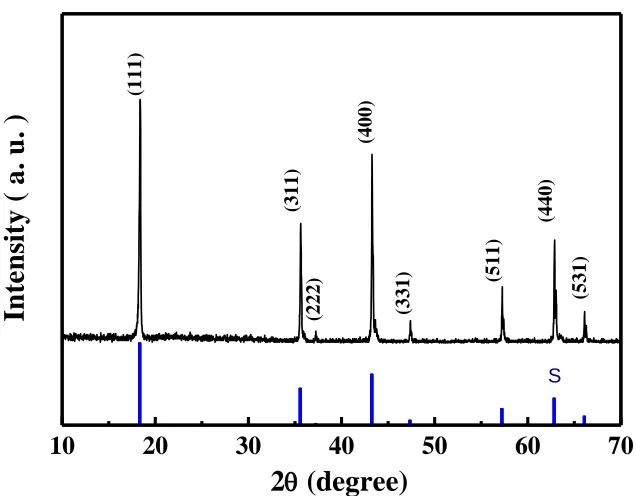
Fig. 1 shows XRD pattern of Li4Ti5O12 calcined at 900C0 for 12 h. All the observed diffraction peaks can be absolutely indexed on the basis of a cubic spinel lithium titanate phase (ICSD file no. 15787 10) and the presence of second phase such as TiO2 or Li2TiO3, is not detected within the sensitivity of measurement.
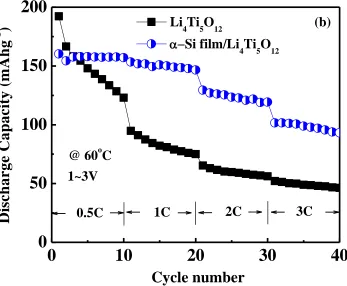
processes of the samples are taken for 10 cycles at 0.5 C, 1.0 C, 2.0 C and 3.0 C, respectively. It is found that the electrochemical performances are enhanced at low C-rate withα-Si film deposition, especially at 60 C0.
10 20 30 40 50 60 70
2
(degree)
[image:3.596.136.454.158.406.2]In
te
n
sit
y
(
a
.
u
.
)
S (2 2 2 ) (5 3 1 ) (4 4 0 ) (511 ) (3 3 1 ) (4 0 0 ) (3 1 1 ) (1 1 1 )Figure 1. XRD patterns of standard spinel Li4Ti5O12 (JCPDS Card No. 49-0207, denoted as S) and the samples calcined at 900C0 for 12 h.
0
10
20
30
40
100
120
140
160
180
200
Li4Ti5O12 Si film/Li
4Ti5O12
D
is
c
h
a
r
g
e
C
a
p
a
c
it
y
(
m
A
h
g
-1)
Cycle Number
1C0.5C 2C 3C
1~3V
@ 25oC
0
10
20
30
40
0
50
100
150
200
(b)
1~3V
D
is
c
h
a
r
g
e
C
a
p
a
c
it
y
(
m
A
h
g
-1
)
Cycle number
Li
4
Ti
5O
12
Si film/Li
4
Ti
5O
12@ 60
oC
1C
[image:4.596.111.458.83.369.2]0.5C
2C
3C
Figure 2. The discharge-capacity at (a) 25C0 and (b) 60 C0 versus cycle number in a potential range from 1.0 to 3.0V for pristine and α-Si film/Li4Ti5O12 at different current densities.
1.0
1.2
1.4
1.6
1.8
2.0
-3
-2
-1
0
1
2
C
u
r
r
e
n
t
(m
A
)
Potential (V vs. Li
+/Li)
Li
4
Ti
5O
12
Si film/Li
4
Ti
5O
120.1mV/S
1.0
1.5
2.0
2.5
3.0
3.5
-0.9
-0.6
-0.3
0.0
0.3
0.6
0.9
(b)
Potential (V vs. Li
+/Li)
C
u
r
r
e
n
t
(m
A
)
Li
4
Ti
5O
12
Si film/Li
4Ti
5O
12 [image:5.596.101.486.77.367.2]0.05mV/S
@ 60
oC
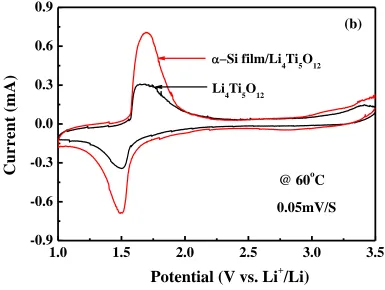
Figure 3. Cyclic voltammograms at (a) 25 C0 and (b) 60 C0 of cells using the Li4Ti5O12 andα-Si film /Li4Ti5O12 sample as electrode materials.
As seen in Fig. 2(b), α-Si film/Li4Ti5O12 exhibits much higher specific capacity (0.5C: 160 mAhg-1; 1C: 152 mAhg-1; 2C: 125 mAhg-1; 3C: 100 mAhg-1, respectively) than that of pristine one at the same current densities. The formation of an oxide film at the silicon/electrolyte interface is considered in accounting for the enhancement of electrochemical performance with α-Si film deposition. It has been assumed that an oxide film of several monolayers at the silicon/electrolyte interface will form due to the preparation or possible reaction with Si-F speies in non-aqueous electrolyte [11-13]. The partially oxidized silicon atoms have relatively high energy levels and are capable of injecting electrons into the conduction band and generating a current during the chemical dissolution in HF [14-16] which is generated as a product of the LiPF6 decomposing reaction at elevated temperature. As a result, the electrochemical performance at elevated temperature is correspondingly enhanced.
curves in 60 C0 of the Li4Ti5O12 andα-Si film/Li4Ti5O12 at a scanning rate of 0.05mV/s. Compared withα-Si film/Li4Ti5O12, the symmetrical redox peaks of Li4Ti5O12 look quite broad, suggesting that there is a notable polarization even if they have the same potential difference. With α-Si film deposition, theα-Si film/Li4Ti5O12 composite is endowed with quite narrow and sharp redox peaks, along with the increased peak current. The obtained results indicates that the deposition of film on anode electrode indeed be beneficial to the enhancement of electrochemical activity for the α-Si film/Li4Ti5O12 composite.
0
10
20
30
40
50
60
70
80
90
0
100
200
300
400
500
600
700
@ 60
oC
Cycle Number
D
is
c
h
a
r
g
e
C
a
p
a
c
it
y
(
m
A
h
g
-1
)
4C
2C
1C
0.5C
Li
4
Ti
5O
12
Si film/Li
4Ti
5O
120.2C
[image:6.596.95.470.224.516.2]0-3V
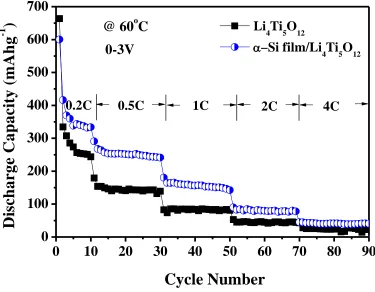
Figure 4. The discharge-capacity at 60C0 versus cycle number in a potential range from 0 to 3.0V for pristine and α-Si film/Li4Ti5O12 at different current densities
film/Li4Ti5O12. 2) an irreversible consumption of Li occurs because of dangling bonds inα-Si, which have a strong affinity to capture Li ions [23, 24].Hence, Li ions could not extract all from lithiated α -Si film into Li4Ti5O12 particles or electrolyte during charge and discharge. 3) Li atoms prefer to stay at the surface of Si film due to the high barrier energy and promote the formation of LixSi phase. The interfacial Si atoms are peeled off with the increasing of C-rate, leading to low rate capability [25]. Hence, the discharge capacity of α-Si film/Li4Ti5O12 decreases more dramatically than that of Li4Ti5O12 in a potential range from 0 to 3.0V.
0 50 100 150 200 250 300 350 400
0.0 0.5 1.0 1.5 2.0 2.5 3.0 3.5
Li4Ti5O12
P
o
te
n
tia
l
(V
v
s.
L
i
+ /L
i)
Special Capacity (mAhg-1)
(a)
4C 2C 1C 0.5C 0.2C
@ 60oC
0-3V
0 50 100 150 200 250 300 350 400
0.0 0.5 1.0 1.5 2.0 2.5 3.0 3.5
Si film/Li4Ti5O12
P
o
te
n
tia
l
(V
v
s.
L
i
+ /L
i)
(b)
4C 2C 1C 0.5C
Special Capacity (mAhg-1)
0.2C
@ 60oC
[image:7.596.147.436.218.670.2]0-3V
Fig. 5 shows the charge-discharge curve at 60 C0 for the electrodes of Li4Ti5O12 andα-Si film/Li4Ti5O12 recorded over the potential range between 0 and 3.0V at different current rates. As can be seen in Fig. 5(a) and (b), α-Si film/Li4Ti5O12 exhibits excellent electrochemical performance at low current rate while shows a rapid loss of the 1.55V plateau with increasing the current rate. More rapid loss of the plateau inα-Si film/Li4Ti5O12 at high C-rate further confirms Si peeling off at the interface is responsible for the degradation in electrochemical performance at low discharge voltage (discharged to 0 V).
4. CONCLUSIONS
α-Si film/ Li4Ti5O12 was prepared via depositingα-Si film on the surface of Li4Ti5O12 electrode using vacuum thermal evaporation technique and the effect of α-Si film on electrochemical performance at elevated temperature in different voltage range was investigated. The excellent rate capability and cycling performance in the voltage range of 1.0–3.0V ofα-Si film/ Li4Ti5O12 is mainly attributed to the injecting electron due to the chemical dissolution of oxide film at the silicon/electrolyte interface in HF. However, α-Si film/Li4Ti5O12 shows a more rapid loss of capacity with increasing the current rate, which may be due to the electrolyte decomposition, affinity effect of dangling bonds inα-Si or silicon delamination at low voltage range.
ACKNOWLEDGEMENT
This work was supported by a grant from National Science Foundation for Young Scholars (No. 11004032), Natural Science Foundation of China (No. 11004039) and Fujian Province Science Foundation for Young Scholars ( No.2008F3039)
References
1. J. B. Goodenough, Youngsik Kim, Chem. Mater. 22, 587 (2010). 2. C. L. Schmidt, P. M. Skarstad, J. Power. Sources 97-98, 742 (2001) .
3. K.-S. Park, A. Benayad, D. J. Kang, S. G. Doo, J. Am. Chem. Soc. 130, 14930 (2008) . 4. P. Martln, M. L. Lopez, C. Pico, M. L. Veiga, Solid State Sci. 9, 521 (2007).
5. T. F. Yi, J. Shu, Y. R. Zhu, X. D. Zhu, C. B. Yue, A. N. Zhou, R. S. Zhu, Electrochim. Acta 54, 7464 (2009).
6. S. H. Huang, Z. Y. Wen, B. Lin, J. D. Han, X. G. Xu. J. Alloys Compd. 457, 400 (2008). 7. J. J. Huang, Z. Y. Jiang, Electrochim. Acta 53, 7756 (2008).
8. V. Baranchugov, E. Markevich, E. Pollak, G. Salitra, D. Aurbach, Electrochem. Commun. 9, 796 (2007).
9. J. Li, J. R. Dahn, J. Electrochem. Soc. 154, A156 (2007).
10.A.Deschanvre, B. Raveau, Z. Sekkal, Mater. Res. Bull. 6, 699 (1971).
11.K. Kumai, H. Miyashiro, Y. Kobayashi, K. Takei, R. Ishikawa, J. Power Sources 81, 715 (1999). 12.V. P. Parkhutik, Electrochim. Acta 36, 1611 (1991).
13.J. C. Flake, M. M. Rieger, G. M. Schmid, P. A. Kohl, J. Electrochem. Soc. 146, 1960 (1999). 14.X. G. Gregory Zhang, Electrochemistry of silicon and its oxide, Kuwer Academic/Plenum
15.F. Ozanam, J. N. Chazalviel, A.Radi, M. Etman, Ber. Bunsenges. Phys.Chem., 95, 98 (1991). 16.V. V. Lehmann, Electrochemistry of silicon, Wiley-VCH Verlag GmbH, 2002.
17.F. Croce, G.B. Appetecchi, L. Persi, B. Scrosati, Nature 394, 456 (1998). 18.Y. H. Rho, K. Kanamura, J. Electrochem. Soc. 151, A106 (2004).
19.T. F. Yi, J. Shu, Y. R. Zhu, X. D. Zhu, R. S. Zhu, A. N. Zhou, J. Power Sources 195, 285 (2010). 20.J. Li, J.R. Dahn, J. Electrochem. Soc. 154, A156 (2007).
21.K. Xu, Chem. Rev. 104, 4303 (2004).
22.H. Guo, H. L. Zhao, C. L. Yin, W. H. Qiu, Mater. Sci. Eng. B 131, 821 (2006).
23.K. L. Lee, J. Y. Jung, S. W. Lee, H. S. Moona, J. W. Park, J. Power Sources 129, 270 (2004). 24.V. Baranchugov, E. Markevich, E. Pollak, G. Salitra, D. Aurbach. Electrochem. Commun. 9, 796
(2007).
25.B. Peng, F. Y. Cheng, Z. L. Tao, J. Chen. J. Chem. Phys. 133, 034701 (2010).