DOI: 10.1111/1467-8551.12103
Methodology Corner
Inductive Praxis and Management
Research: Towards a Reflexive Framework
Phil Johnson and Joanne Duberley
1Sheffield University Management School, Crookesmoor Building, Conduit Road, Sheffield S10 1FN, UK and
1Birmingham Business School, University of Birmingham, University House, Birmingham B15 2TT, UK
Corresponding author email: [email protected]
This paper examines how induction legitimately varies according to the impact of dif-ferent knowledge constituting philosophical assumptions. As a result of its prevalence in qualitative management research, the paper focuses on grounded theory and uses this as a vehicle to explore the key parameters of the philosophical diversity articulated in judge-ments around neutrality, description and theorization. A reflexive framework of inductive praxis is offered as a heuristic device for interrogating the choices evidently at play in the variable constitution of inductive management research. We indicate how there are multiple modes of engagement, each of which is legitimate within its own philosophical commitments. This implies the need for a more tolerant pluralistic stance in the evaluation of qualitative management research.
Introduction
Various forms of induction have long underpinned naturalistic, interpretive modes of engagement and the deployment of various qualitative method-ologies (see Cressey, 1950; Denzin, 1971; Lincoln and Guba, 1985; Lindesmith, 1947; Van Maanen, 1979). As several management researchers have re-cently observed (e.g. Gephart, 2004, p. 457; Sud-daby, 2006, p. 635), this association sharply con-trasts with Popper’s (1959) hypothetico-deductive methodology, which tends to predominate in many Anglophone cultural milieux (see Bengtsson, Elg and Lind, 1997; Denzin, 2010; Pratt, 2008). Here an a priori researcher-derived predictive concep-tual and theoretical structure is rigorously tested through the operationalization, measurement and statistical analysis of the causal relationships
be-We would like to thank Geoff Wood and the three anony-mous referees for their feedback and encouragement with regard to the development of this paper.
The copyright line for this article was changed on October 24, 2016 after original online publication.
tween variables (see Donaldson, Qui and Luo, 2013; Edwards, 2010). For some critics (e.g. Guba and Lincoln, 1994, p. 106), such deployment of what Outhwaite (1975) has defined as erklaren has on epistemological grounds served to determinis-tically exclude the focus of interpretive research through its analysis of the external antecedent con-ditions that are presumed to cause the behaviours under investigation. In contrast, any interpretive focus is necessarily inductive as it entails verstehen (Outhwaite, 1975) through aiming to access actors’ meaningful inter-subjective worlds, in their every-day ‘natural’ context, and render them ‘under-standable from the standpoint of a theory that is grounded in the behaviours, languages, definitions, attitudes, and feelings of those studied’ (Denzin, 1971, p.166).
The possible dangers of deductive method-ological parochialism discriminating against the publication of inductive management research in prestigious management journals have been reg-ularly articulated (Amis and Silk, 2008; Johnson
et al., 2006; Pratt, 2008). Moreover qualitative re-searchers are sometimes deemed to collude in their
© 2015 The Authors British Journal of Management published by John Wiley & Sons Ltd on behalf of British Academy of Management. Published by John Wiley & Sons Ltd, 9600 Garsington Road, Oxford OX4 2DQ, UK and 350 Main Street, Malden, MA, 02148, USA.
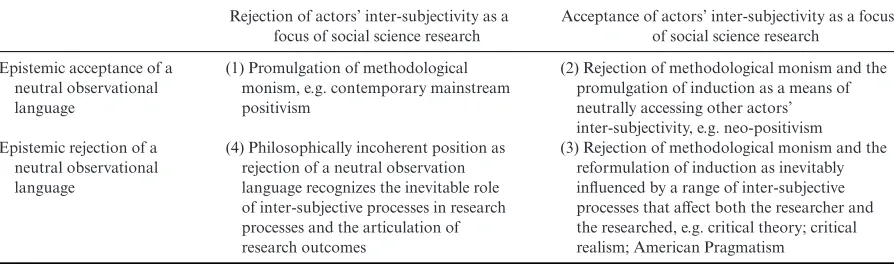
Table 1. Positions on inter-subjectivity and neutrality
Rejection of actors’ inter-subjectivity as a focus of social science research
Acceptance of actors’ inter-subjectivity as a focus of social science research
Epistemic acceptance of a neutral observational language
(1) Promulgation of methodological monism, e.g. contemporary mainstream positivism
(2) Rejection of methodological monism and the promulgation of induction as a means of neutrally accessing other actors’ inter-subjectivity, e.g. neo-positivism Epistemic rejection of a
neutral observational language
(4) Philosophically incoherent position as rejection of a neutral observation language recognizes the inevitable role of inter-subjective processes in research processes and the articulation of research outcomes
(3) Rejection of methodological monism and the reformulation of induction as inevitably influenced by a range of inter-subjective processes that affect both the researcher and the researched, e.g. critical theory; critical realism; American Pragmatism
own downfall by showing a perceived lack of in-ductive rigour. These possibilities have encouraged several criteriological commentaries (e.g. Bansal and Corley, 2011; Bluhm et al., 2011; Gephart, 2004; Pratt, 2009; Suddaby, 2006; Tracy, 2010, 2012) aimed at promoting and disciplining quali-tative management research. The result is the ar-ticulation of benchmarks, or ‘boiler plates’ (Pratt, 2009), that specify the ‘critical attributes of good qualitative research’ (Bansal and Corley, 2011, p. 233). For example, Suddaby (2006) draws pri-marily upon Glaser and Strauss (1967) to guide induction by defining what ‘grounded theory is not’. In doing so he ignores alternative renditions of grounded theory (GT) (see for example Burr, 1995; Charmaz, 2000, 2009; March, 2005; Welch
et al., 2013) that draw upon different philosoph-ical agendas to that tacitly articulated by Glaser and Strauss. In contrast, philosophical diversity in qualitative research is overtly noted by both Gephart (2004) and Bluhmet al. (2011). Neverthe-less, they purposefully restrict their generic crite-riological specifications for inductive processes to what, for instance, Bluhmet al. (2011) call ‘posi-tivist and interpre‘posi-tivist approaches’ which they see follow the principles of GT (2011, p. 1868) and purposefully exclude alternative philosophical tra-ditions. We shall argue in this paper that despite a tacit and sometimes explicit awareness of the philosophical heterogeneity evidently articulated by qualitative researchers and their laudable desire to endorse methodological pluralism, these speci-fications for qualitative research generally, and GT in particular, seem to be derived primarily from only one possible philosophical position. This par-ticular position has been variously labelled ‘soft’ positivism (Madill, Jordan and Shirley, 2000, p. 4), ‘qualitative’ positivism (Prasad and Prasad, 2002,
p. 6) or ‘neo’ positivism (Alvesson and Sandberg, 2013, p. 149; Lincoln and Guba, 1985, p. 46). A key characteristic of this position is that the no-tion of interpretano-tion is only considered in rela-tion to the inter-subjectivities of those actors be-ing researched and is not recursively applied by researchers to themselves. From here on we shall use the term ‘neo-positivism’ to refer to this philo-sophical position.
Represented by cell 1 in Table 1, many posi-tivists (e.g. Abel, 1958) emphasized the need to exclude inter-subjectivity from scientific explana-tions of behaviour because such inner causes were deemed to be unobservable in a neutral manner and approaches such as verstehen were dismissed as unscientific because they lacked objectivity (see Ross, 1991). For Laing (1967) this exclusion of hu-man subjectivity also served to bolster the monis-tic desire for one methodology (ostensibly derived from physics) to be used in both the social and natural sciences since it removed any ontological differentiation between the natural and the social domains.
Couched in an overt rejection of such method-ological monism, the neo-positivist dispute with mainstream positivism is largely limited to whether inter-subjectivity is open to neutral observation by researchers and the consequent appropriateness of verstehen and induction to social science research (see Alvesson and Skoldberg, 2000; Markus, 1994) (see cell 2 in Table 1). Hence a shared concern of recent criteriological commentaries has been to encourage qualitative management researchers to systematically demonstrate rigour and objectivity in their pursuit of isomorphic representations of actors’ inter-subjectivities as a basis for inductive theorizing usually in the form of GT (e.g. Bluhm
2006). Alternative epistemological stances that re-ject the possibility of such a neutral observation language and thereby reframe induction, since our engagements as researchers are seen to be always mediated by our culturally derived interpretations, may become marginalized by default. These al-ternative ways of undertaking induction, initially represented by cell 3 of Table 1, remain at best under-explored or at worst delegitimizedab initio, thereby possibly encouraging the very monologi-cal processes that these criteriologimonologi-cal commenta-tors seem to challenge in their initial espousal of a form of methodological pluralism. Meanwhile cell 4 of Table 1 represents a philosophically in-coherent position. Here the notion that actors’ inter-subjective processes should play no role in so-cial science research cannot sit conformably with the simultaneous rejection of a neutral observa-tional language. This is because the latter epistemic stance is usually justified by recognition of the role those same inter-subjective processes play in re-search processes themselves thereby justifying the rejection of a neutral observational language.
The inadvertent, yet contradictory, philosoph-ical and methodologphilosoph-ical parochialism articulated in the recent criteriological commentaries noted above has the potential for stimulating exclusion-ary processes of criteriological commensuration. Indeed it seems to be another example of the ‘ex-tended controversy’ (Guba and Lincoln, 2005, p. 205) that persists where static standards, that unre-flexively express particular philosophical assump-tions, gain indiscriminate epistemological jurisdic-tion (see also Easterby-Smith, Golden-Biddle and Locke, 2008; Grey, 2010; Johnsonet al., 2006).
However, as Burrell and Morgan (1979) demon-strated, there are always choices with regard to these matters that need to be considered. If we ac-cept their notion that any account is conditioned by an underlying philosophical sub-text, then re-flexivity, which holds ‘research structures and log-ics as themselves researchable and not immutable’ (Steier, 1991, p. 7), is crucial to our understand-ing of our own and others’ methodological praxis. Therefore, in the originally reflexive and permis-sively contingent spirit of methodological plural-ism (see McLennan, 1995), it would seem timely to consider and extend our understandings of induc-tion by examining how varyinga priori philosophi-cal commitments may lead to induction’s method-ological differentiation. Here, for several reasons, our primary focus will be GT: first, because of GT’s
ubiquity as a qualitative methodology generally in the social sciences (see Strauss and Corbin, 1997) and because of its significant profile in manage-ment research (see Locke, 2001; Welchet al., 2013); second, because GT’s longstanding influence upon the format of software programmes widely used in qualitative data analysis may be acting as a Tro-jan horse in the emergence of a ‘new orthodoxy’ for induction (Bryman and Bell, 2011, p. 595); third, because its recent specification by manage-ment researchers’ criteriological commanage-mentary (see Bluhm et al., 2011; Suddaby, 2006) raises ques-tions as to why one should try to epistemologically and criteriologically constrain GT despite its of-ten being regarded as an ‘umbrella covering several different variants’ (Charmaz, 2009, p. 128) deriv-ing from a range of philosophical stances; fourth, because there are alternative forms of induction which could be considered, such as analytical in-duction. However, despite a longer pedigree, ana-lytical induction is rarely deployed in the manage-ment field and, when it is, this is often as a helpful and commensurable elaboration that is combined with GT to improve causal analysis (e.g. Johnson, 2004). Finally, given GT’s popularity as a form of induction, its standardization to the confines of neo-positivism may serve as a conduit to fur-ther undermine the current philosophical diversity evident in qualitative management research (see Duberley, Johnson and Cassell, 2012; Grey, 2010) by influencing the implicit and explicit criteria de-ployed during research evaluation (see Amis and Silk, 2008; Savallet al., 2008).
To pursue these aims we shall structure this paper as follows. First we trace the empiricist origins of induction through to its present-day methodological justification. Second we explore how rival epistemological views (initially repre-sented by cells 2 and 3 in Table 1) about the vi-ability of a neutral observational language im-pact upon the conduct of induction. Here we give specific reference to neo-positivist prescrip-tions for GT and the ‘second generation’s’ (see Morseet al., 2009) challenge which has applied so-cial constructionism to those inductive processes via various epistemological stances. In doing so, we identify the key parameters of the philosoph-ical diversity articulated in choices around neu-trality, description and theorization. We conclude by offering a reflexive framework of such induc-tive praxis as a heuristic device for interrogat-ing the different philosophical choices at play in
the variable constitution of inductive management research.
Empiricism and induction
Induction’s philosophical pedigree precedes the deployment of hypothetico-deductivism (e.g. Ba-con, 1620; Comte, 1853; Hume, 1739, 1748; Locke, 1690; Mill, 1874). Nevertheless, it is the latter which has become the mainstream methodology, especially in US management research, under the aegis of Popper’s (1959) falsificationism. Popper rejected the possibility of the inductive verifica-tion of theories by revitalizing, and attempting to resolve, Hume’s (1739) ‘problem of induction’. The latter arose because of the intimate relation-ship between induction and empiricism in his sec-ular desire to ‘commit to the flames . . . [the] . . . sophistry and illusion’ (Hume, 1748, sec. vii, pt iii) of received metaphysical speculation. Hume’s ad-vocacy of Locke’s (1690) empiricism in this epis-temological purge led him to reject all ideas that could not be traced to corresponding sense impres-sions. But the empirical problem for Hume was that causation is in itself not directly observable and thereby could not be validated by experience. Rather the causal associations we anticipate lie in our customs or ‘force of habit’−ideas which have developed from our past observation of repeated resembling, chronologically ordered, spatially re-lated, ‘constant conjunctions’. For Hume, it was impossible to verify any proposed causal relation-ship through logical inference from past experi-ence to a suppositional future, regardless of the number of accumulated empirical confirmations, without engaging in the anathema of metaphysi-cal speculation through deploying ampliative as-sumptions. This epistemological contradiction led Hume to doubt the possibility of induction: a scep-ticism that was down-played in the subsequent velopment of positivism (Comte, 1853) and the de-ployment of induction by logical positivists (e.g. Ayer, 1971.
By the twentieth century certain philosophical commitments were established which guided the application of inductive analysis and were maintained by logical positivists to defend En-lightenment reason against the rise of Fascism (see Callinicos, 1989). The first is a commitment to empiricism and the verifiability principle of meaning where something is only meaningful if it
is empirically verifiable through sense experience and observation (Ayer, 1971, p. 48). The second commitment, traceable to Epicurean Hellenistic philosophy (see Long and Sedley, 1987), is to a neutral observational language where truth as cor-respondence with reality is to be found in the ob-server’s passive registration of Comte’s ‘positively given’ (i.e. data) located in a directly accessible mind-independent external reality (see Reichen-bach, 1963; Wittgenstein, 1922): a subject–object dualism. Third is a commitment to methodological monism: that only natural science methodology can provide certain knowledge in the social sci-ences (see Ross, 1991). However, at the heart of logical positivism’s commitment to empiricism and inductive-verificationism lay Hume’s epistemolog-ical contradiction. Popper rescued positivism by reconfiguring the scientific enterprise as deductive-falsificationism. He exploited the empirical asym-metry between the proof and disproof through his proposition of falsificationism aimed at producing
verisimilitudebased upon the ability of a theory’s postulates to survive predictive tests aimed at objectively identifying non-correspondence with an external reality (Popper, 1976, pp. 148−150).
Contemporary justifications for
induction
As Welch et al. (2013, pp. 252–253) found, an inductive approach has often been justified apolo-getically as a necessary precursor to deduction because of the exploratory or novel nature of the research undertaken. Rather than being presented as deduction’s poor relation others have justi-fied induction as superior through assertions of enhanced naturalism that makes findings more plausible, accessible and relevant (Glaser and Strauss, 1967; Locke, 2001; Van Maanen, 1979) especially to non-researchers (Watson, 2011) as it provides ‘a strong handle on what “real life” is like’ (Miles and Huberman, 1994, p. 10). Related to naturalism, another justification centres upon the view that deductive testing necessarily entailsa pri-orioperationalization of deterministic behavioural variables in which their inter-subjective basis is absent, or at best distorted (Denzin and Lincoln, 2000; Guba and Lincoln, 1994). By signifying the importance of inter-subjectivity qualitative re-searchers are concurrently drawing upon the long established idea that there exists an ontological
discontinuity (see Dilthey, 1976; Giddens, 1976; Laing, 1967; Mead, 1934; Merleau-Ponty, 1962) between the subject matters of the social and natu-ral sciences. Since human behaviour, unlike that of physical objects, is inherently meaningful to actors it cannot be explained as the necessary outcome of the action of discrete causal variables (see Dilthey, 1976, p. 89); methodological monism must be rejected (see Ross, 1991). Moreover, we cannot reduce lived experience to a number of separate factors operating as distinct influences regardless of the social context in which action arises (see Merleau-Ponty, 1962, p. ix). Therefore in order to access inter-subjectivity, explanations must be generated through verstehen (Outhwaite, 1975): the inductive description and analysis of actors’ cultures in ‘natural’ (Denzin, 1971), ‘real’, settings (Gephart, 2004, p. 457). This dismissal of method-ological monism as arising from a categorical error that conflates the social with the natural seems to put philosophical distance between positivism and the present-day deployment of induction. Nevertheless, how induction is used in qualitative management research sometimes retains key pos-itivistic elements (see cell 2 of Table 1) – especially the presupposition of a neutral observational lan-guage and the consequent necessity to rigorously demonstrate the plausible objectivity required by the criteriological commentaries discussed earlier.
A priori
theory and induction
Contemporary induction in management re-search, usually seen as synonymous with GT, is often presented as a flexible process where research questions, conceptualizations of phenomena, and theory concurrently emerge and are constantly refined through interaction with an evolving anal-ysis of the data being collected through various forms of iterative fieldwork (Glaser and Strauss, 1967; Suddaby, 2006). This immediately begs questions regarding the role of a priori theory during induction. It is of particular importance for qualitative researchers who may be criticized for lacking rigour in comparison to hypothetico-deductive researchers who systematically design research to refute theoretical predictions. Here two different positions are initially evident: first, that such pre-understandings need to be used as preliminary guides; second, that they must be kept at bay by being ‘bracketed’ from the outset.
The first position initially seems to be informed by Heidegger’s (1927, p. 24) hermeneutics where he points to how we are always caught in a com-munally informed pre-understanding of being: a hermeneutical circle with no access to an un-interpreted given. For some, this epistemological predicament means that that we must clarify the theoretical pre-understandings we have to hand from the start of research. This is illustrated by Blumer (1954, p. 7) when he argued that, at the outset, researchers should take from extant liter-ature ‘sensitizing concepts’ which ‘merely suggest directions in which to look’ and constitute flex-ible guides for uncovering empirical variation in phenomena rather than imposinga priori observa-tional benchmarks.
The second view of the relationship with prior theory parallels Husserl’s (1965) phenomenology. This aims to provide descriptions of actors’ con-sciousness located in sedimentations of past expe-rience of phenomena that are largely cultural and lead us to conceive the world as a common albeit experienced from different perspectives. To access the appearance of things in the external world to actors, Husserl argued that the researcher’s own preconceptions of those phenomena (the natural attitude) must be set aside through ‘bracketing’ (or ‘epoche’−the act of suspending judgement about the natural world to instead focus on analysis of mental experience) so as to enable ‘reduction’: the uncovering of the essential structure of phenom-ena as subjectively experienced by others. So al-though Husserl was a staunch critic of positivism (see Husserl, 1965, p. 189) this presumed ability to bracket suggests the promulgation of an epis-temic privilege akin to neo-positivism’s presump-tion of a neutral observapresump-tional language: the re-searcher’s ability to investigate the ‘essences’ of the phenomena constituted in the ‘lifeworld’ free from pre-conception and bias. In other words a subject−subject dualism is assumed.
Meanwhile, recognition of Heidegger’s
hermeneutic circle could lead to two stances within the first position noted above. The first entails dismissal of any positivist commitment to a neutral detached observer as a myth since no interpretation free from presuppositions is ever possible: a subject–subject duality that has significant implications for the accomplishment of induction and the epistemic status of the outcomes of research. The second follows Blumer (1954), for example, where recognition of the hermeneutic
circle might be limited to indicating the practical difficulties of starting any research without a preceding conceptual interaction with extant theory: a starting point that does not necessarily undermine the possibility of a subject–subject dualism during fieldwork and data analysis.
As we shall discuss below, there is debate over these alternative epistemological stances in the most influential contemporary approach to induc-tion within management research: GT.
Neo-positivism’s subject
−
subject
dualism in GT
Management researchers (e.g. Alvesson and Skoldberg, 2000; Gephart, 2004) have identified how GT was developed by Glaser and Strauss (1967) as a response by symbolic interactionists to the categorical error entrenched in method-ological monism (see also Cherutz and Swanson, 1986) and to the threats posed by the method-ological hegemony of structural functionalism. From the outset GT articulated a commitment to investigating how actors interpret reality and also abstracting those empirical descriptions into theoretical statements: ambitions that created epistemological ambiguities. What initially con-cerns us is the extent to which GT has necessarily severed ties to (neo) positivist epistemology.
Originally Glaser and Strauss (1967, pp. 161– 183) saw the library as a source of qualitative data for aiding the development of theory through elab-orating categories and as an aid to constant com-parison. What they are unclear about is the role of extant literature at the outset of research (see also Dey, 1999). For example they talk of generating ‘formal theory . . . directly from data . . . [but] . . . it is more desirable, and usually necessary, to start formal theory from a substantive one’ (Glaser and Strauss, 1967, p. 79) already articulated in research. This ambiguity seems to have evolved into an im-portant difference in subsequent approaches. For example Glaser (1978, p. 3; 1992, p. 31), as part of a strategy for maintaining a dispassionate objectiv-ity in fieldwork, requires that no extant theory or literature should be deployed until an initial the-oretical framework had been developed through ‘sensitive’ immersion in order to generate theory that ‘really exists in data’ (1992, p. 53). In contrast, Strauss (1987; Strauss and Corbin, 1990, 1998) seems to follow Blumer’s idea of overtly
develop-ing sensitizdevelop-ing concepts from the relevant litera-ture as necessary provisional points of deparlitera-ture but nonetheless requiring maintenance of objectiv-ity in relation to data and participants to produce ‘provisionally verified’ theory (Straus and Corbin, 1990, p. 25). Regardless of these differences, Glaser and Strauss (and Corbin), with their continuing emphasis upon discovery and emergence, have re-mained committed to a neutral observational lan-guage (see Charmaz, 2000, p. 513; Clarke, 2003) during data collection and analysis so as to ob-jectively develop theories embedded in the mean-ingful everyday inter-subjective realities of actors (see Glaser, 1992, p. 16; Strauss and Corbin, 1998, p. 99). According to Frendt and Sachs (2008, p. 447), this commitment to a subject−subject dual-ism requires demonstration of a separation of the researcher from his/her description and analysis of other actors’ inter-subjective cultural experiences: the hypostatization of a passive observer which en-ables them to avoid recursively applying the no-tion of interpretano-tion to themselves. The result is an epistemological privileging of any inductive ac-count by management researchers (see Knights, 1992; Van Maanen, 1995) as ‘part of another foundationalist enterprise’ (Thomas and James, 2006, p. 780): a dogged neo-positivist demonstra-tion of the qualitative researcher’s ‘more rigorous than thou’ methodological attributes (Thomas and James, 2006, p. 788).
For instance, Lincoln and Guba (1985) empha-sized the requirement for researchers to provide traceable, self-critical and sometimes confessional audit trails to allow the reader to judge the ob-jectivity and rigour of their research. Especially important here is an account of the researcher’s field role that reflexively analyses the steps taken to maintain naturalism whilst navigating a course that avoids both cultural co-option and ethnocen-tricity by demonstrating a precarious social, emo-tional and intellectual balance between insider and outsider (e.g. Cicourel, 1982; Hammersley, 1992; Pollner and Emerson, 1983). Audit trails also pro-vide details of how inductive analysis of data was accomplished to produce emergent descriptions and theory. So, in order to corroborate the objec-tivity of findings and demonstrate theoretical sen-sitivity, researchers are strongly advised to show how an unimpaired interplay of data with theory and description was achieved. This includes an ac-count of how concepts and categories were syn-thesized, memo-ed, coded, cross-referenced with
inter-rater checks to various data sources, applied and theorized along with how alternative analyti-cal outcomes have been considered and why they were discarded (see Adler and Adler, 1994; Locke, 1996; Morse, 1994). It is precisely the need to demonstrate how these processes have been un-dertaken in order to persuasively display a ‘hard won objectivity’ (see Seale, 1999, p. 161) that has been one of the key foci of recent criteriological specifications by various commentaries in presti-gious management journals (see Bansal and Cor-ley, 2011; Bluhm et al., 2011; Gephart, 2004; Pratt, 2009; Suddaby, 2006; Tracy, 2010, 2012).
Description and theorization of
inter-subjectivity
Inductive analysis usually begins with ‘thick’ descriptions (Geertz, 1973, p. 24) of shared interpretations (Gephart, 2004; Glaser, 1992). Phenomenologists would usually consider such description of actors’ lifeworlds sufficient and
analytical movement beyond the
world-as-experienced in order to theoretically explain it to be an epistemological violation (see Thomas and James, 2006, pp. 771–773). In contrast, others classify this phenomenological stricture as result-ing in analytical interruptus (Loftland, 1970): a failure to develop theory that explains why any observed variation in observed cultural categories happens (see Denzin, 1978; Schatzman, 1991) and to show how those subjective experiences may be abstracted into theoretical statements about causal relations between actors (Suddaby, 2006, p. 635). Here neo-positivist GT purportedly provides procedural guidelines for accomplishing
both a neutral description of actors’ interpretive processes and their subsequent theorization.
It is emphasized that data analysis and col-lection should simultaneous and recursively in-form each other to establish descriptive categories which, initially, are in constant flux as new data are collected and analysed (see Miles and Hu-berman, 1994; Morse, 1994). Through memo-ing and open-coding (Strauss and Corbin, 1990, p. 181) related observations are consolidated to for-mulate provisional conceptual properties (Glaser and Strauss, 1967, pp. 35–36). Eventually concep-tual categories are created, which combine con-ceptual properties and refer to specific variations in phenomena, having been adjusted and re-coded
as new data are collected and compared to em-brace all observations and achieve theoretical sat-uration (Glaser and Strauss, 1967, p. 61). Here a move from description to theoretical development is enabled through analysing relationships between the saturated, internally homogeneous, categories ‘which best explain the data . . . assembled’ (see Becker, 1970, p. 196). This abstraction of patterns of actors’ common subjective experiences into the-oretical statements is often seen as problematic. As we indicate above, for some it entails a move be-yond the knowing actor’s experience in order to ex-plain it: a philosophical impropriety as it relegates the actor’s ‘original voice’ (Thomas and James, 2006, p. 790). For others it entails a process that often lacks systematic means of identifying the re-lationships between categories so as to rigorously ground theoretical emergence (Wasserman, Clair and Wilson, 2009).
There have been attempts at systematizing in-ductive causal inference by deploying Mill’s (1874) inductive methods for causal analysis (e.g. Bloor, 1976, 1978; Johnson, 2004; Miller and Fredericks, 1999) or by adding deductive testing of emergent theory (e.g. Hammersley, 1989; Robinson, 1951). In contrast, Strauss and Corbin (1990, p. 96) en-courage ‘axial coding’ which puts ‘data back in new ways . . . by making connections between cat-egories’. This move from description to ‘higher lev-els of abstraction’ (Strauss, 1987, p. 55) through the use of conditions and consequences matri-ces to trace ‘paths of connectivity’ (Strauss and Corbin, 1998, p. 129, 199) may be extended to trace linkages in the data to micro and macro conditions (Corbin and Strauss, 1996) and, some-times aided by fractal concept analysis, to enable macro-level conceptualization grounded in micro-level data (Wasserman, Clair and Wilson, 2009). For Glaser (1998) the use of such analytical proce-dures is overly formulaic and forces theory rather than allowing theory to emerge whilst controlling the impact of any preconceptions. Nonetheless, re-gardless of the procedures used, the aim would still be the ‘discovery’ of causally homogeneous cate-gories with no exceptions to the proposed induc-tively generated theoretical inferences.
However, some remain unconvinced: as Thomas and James (2006, p. 777) observe, where are the ‘in-ference tickets coming from in the supposed pro-cess of induction . . . ?’ They describe this abstract shift to putative theorization as a ‘methodologi-cal alchemy’ which is philosophi‘methodologi-cally undesirable
for qualitative researchers and fails to adequately investigate and demonstrate the operation of in-ferred causal relations.
Whilst some inductive researchers have at-tempted to resolve this inference issue within the samples accessed in their fieldwork, Thomas and James (2006) also point to the problem of making ampliative inferences within an empiricist frame of reference, which was first articulated by Hume and raises the issue of inductive generalization. Of-ten the perceived outcome of fieldwork is theory grounded in empirical data from a relatively small number of cases which undermine representative-ness and generalization. This has created pressure to increase the size of samples in qualitative re-search (Cornelissen, 2009). For Eisenhardt (1989), whilst there is a possibility that theory generated inductively is likely to be novel and empirically valid it lacks the sweep of ‘grand theory’ and re-mains at a modest, idiosyncratic level applicable only to the social context(s) in which it was de-veloped and therefore requires deductive testing in defined populations to enable extrapolation (see also Seale, 1999, p. 108). Nevertheless, Eisenhardt (1989) also argues that generalizability can be en-hanced by comparing the emergent theory to ex-isting literature (p. 545) which for Morse (1994) is part of a process of recontextualization where theory can be abstracted to new settings. In con-trast, Mitchell (1983; see also Stake, 2000) argues that inductive inference can only be logical and de-rives its generalizability from the demonstrated all-inclusive power of the inductively generated and tested theory (1983, p. 190). Here the rigour and credibility of the procedures used on an initial site to comprehensively embrace any negative case through constant comparison until saturation oc-curs legitimizes extrapolation to other sites. But this still begs Hume’s question regarding how we might ever know for certain that such comprehen-sion and saturation is achieved and that the the-ory is applicable to new and un-researched con-texts without making ampliative assumptions that negate neo-positivist’s empiricist commitments. As Seale (1999, p. 112) cautions, ‘unwarranted as-sumptions are made about the characteristics of the population of cases not yet studied’. In sharp contrast to these concerns, Denzin (1983) argues that generalization is in any case impossible due to the indexical or context-bound nature of human behaviour and what Vince (2006, p. 351) calls the consequent particularity of knowledge in context.
Social constructionism and the
subject
−
subject duality in GT
mere speculation – no matter how reflexive the co-production process may appear to be? Alterna-tively, if she is promulgating an epistemological al-ternative to correspondence demonstrated by hard won objectivity – what is it? Charmaz may leave herself open to the accusation of epistemological vacillation between the claim that findings emerge from data about co-production and the claim that they are the result of an analysis that was inevitably the researcher’s own interpretation. This potential dilemma seems to be avoided by those who have also openly rejected a neutral observational lan-guage but then have more overtly considered how to develop coherent epistemological alternatives to positivism that simultaneously eschew relativism.
For example, critical theory (CT) has long rejected positivist epistemology (e.g. Horkheimer, 1937; Horkheimer and Adorno, 1947). In a Kantian (see Kant, 1781) fashion all human cognition is construed as deriving from a priori
inter-subjective processes which socially construct versions of an external reality that simultaneously exists independently of those sense-making pro-cesses (see Habermas, 1974a, 1974b). So whilst we may never know reality-as-it-is, that reality contin-gently imposes pragmatic limits (Habermas, 1972, p. 33) upon human activities: therefore anything does not go. For Habermas (1984, 1987), the epis-temological question becomes one of how to es-tablish these realities-for-us legitimately and avoid relativism. Here he develops consensus as an epis-temic standard via his notion of the ideal-speech situation wherein discursively produced demo-cratic agreement between participants derives from dialogue, argument and analysis without the resort to coercion, distortion or duplicity. By implication any discourse evolving outside these conditions must be forced and distorted, thereby raising the issue of ideological hegemony by the powerful. This epistemology has been highly in-fluential upon a group of writers who have tried to translate it into guidelines for inductive research.
For example, Habermasian epistemology was influential upon Guba and Lincoln’s later work (1989, 1994) where they developed authenticity as social constructionist criteriological commitment. Here inductive research, such as GT, becomes more of a processual scheme that emphasizes researchers’ and participants’ reflexive and dia-logical examination of their own inter-subjective understandings in the social context of the hegemonic discourses at play. So, not only must
researchers reflexively interrogate their own a priori stances (Kincheloe and McLaren, 1998), they also must attempt to sensitize themselves and participants to how hegemonic regimes of truth impact upon their subjectivities in the de-velopment of alternative understandings of reality (Marcus and Fisher, 1986; Putnam et al., 1993). For example, through inductively conducting ‘crit-ical’ ethnographies (Forester, 2002; Morrow and Brown, 1994; Thomas, 1993), and achieving ‘crit-ical interpretations’ (Denzin, 1998, p. 332) which go beyond a description of actors’ subjectivities to develop theoretical understandings regarding the manner in which those subjectivities become con-stituted, the prime aim of the research is to liberate those it studies so that they understand the world in new ways and use this knowledge to change it (Dryzek, 1995; Jermier, 1998; Schwandt, 1996). In order to approximate Habermas’s ideal-speech situation highly participative research designs are deployed (e.g. Broadbent and Laughlin, 1997) that aim to achieve dialogue (Schwandt, 1996, pp. 66– 67) where the credibility of the socially constructed realities to those who have democratically partic-ipated in their development is crucial (Kincheloe and McLaren, 1998). In addition to consensus as a key epistemic standard for these inductively developed self-understandings and alternative accounts of phenomena, there is a simultaneous requirement that they should be used to intervene and thereby change a status quo which previously was construed as normal, authoritative and there-fore immutable (see Alvesson, 1996; Gaventa and Cornwall, 2006; Jermier, 1998; Park, 2006). The result is sometimes a form of praxis aimed at trans-forming perceived inequalities where, based upon dialectical inductive theory building (Lather, 1991) and a dialogical relationship with researchers (Lynch, 1999, p. 57), participants become able to both understand and change their situation (see Brook and Darlington, 2013). Because of the con-textually specific and socially constructed nature of consensus, issues of generalizability are largely irrelevant; instead there may be an emphasis upon ‘accommodation’ (Kincheloe and McLaren, 1998) where researchers use their knowledge of a range of comparable contexts to assess the implications of similarities and differences for praxis.
A commensurable philosophical position to CT, but which often downplays consensus as an epis-temic standard, is articulated by critical realism
(CR) where ontological realism and epistemologi-cal subjectivism are also combined (Bhaskar, 1978, p. 249). Here, Bhaskar does this by differentiating between the intransitive ontological dimension of scientific inquiry (e.g. social reality), that exists in-dependently of human knowledge, and the tran-sitive socially constructed dimension (epistemol-ogy) that allows us to make sense of our worlds (see also Bhaskar, 1989). Nevertheless, unlike nat-ural or physical reality, social reality is transi-tively produced and reproduced through our inter-subjectively derived agency but is intransitive in the sense that it exists ‘at least in part independently of any knowledge claims’ (Lawson, 1998, pp. 222– 223) about it. Therefore, as in CT, critical realists have argued that we are always entrapped within ana prioriculturally derived subjectivity in our so-cial construction of our understandings of soso-cial reality. However, the latter, albeit it always medi-ated by fallible human cognition, is not determined by the former (see Fleetwood, 2004, p. 33; Sayer, 1992, p. 83; 2004, p. 8). Therefore critical realists reject both a correspondence theory of truth and the possibility of a neutral observational language – but in doing so they also reject what is called ‘judgemental relativism’ where there are no ratio-nal grounds for epistemologically judging between accounts (see Bhaskar, 1986, p. 72).
A key aim for CR is to retroductively excavate what Bhaskar (1986) claims are the structured lay-ers of social reality so as to, in an inevitably fallible manner, identify generative or causal powers which underlie conceptually mediated (i.e. transitive) ob-servable appearances in order to explain those em-pirically patterned phenomena. In other words during theorization CR seeks to link phenomena such as the observable inter-subjectivity of agents to the causal context of real but non-empirical structures which may produce those ‘actual’ events expressed in conceptually mediated empirical pat-terns (Bhaskar, 1989, p. 16). Here social struc-tures pre-exist, enable and constrain agency whilst dialectically emerging from and changing that agency (see Archer, 2003, pp. 5−6).
Although some critical realists have rejected GT as a methodology (see Danermarket al., 2002) this is usually because of its perceived neo-positivist origins. For others, as ‘hermeneutics is essential’ (Archer et al., 1998, p. xv), a constructionist ver-sion of GT that enables mediated access to agents’ inter-subjectivities but then moves to a situational analysis ‘beyond the knowing subject’ (see Clarke,
2009, p. 200; 2003) to examine generative mecha-nisms is deemed necessary and viable. Although her idiom is slightly different, such situational analysis of ‘unstated or unrecognised influences’ is also something which Charmaz (2009, p. 130) sees as necessary in her approach to GT.
However, this poses epistemological problems in that, given CR’s subjectivist epistemology, how can we establish whether the causal powers retroduc-tively excavated are more than a researcher’s the-orization and are real ‘non-empirical’ structures that condition, and are conditioned by, actors’ inter-subjectively derived activities (see Halfpenny, 1994, p. 65). Moreover, as Al-Amoudi and Will-mott (2011, p. 29) argue, epistemological subjec-tivism also applies to inductive analysis of those actors’ inter-subjectivities. Indeed critical realists may contradict their subjectivist epistemology by inadvertently privileging their analyses: a potential problem we have raised in relation to Charmaz’s social constructionist GT. To avoid the pitfall of positivist privileging, and in order to eschew the perceived dangers of judgemental relativism, Sayer (1992) proposes an alternative epistemic standard for CR which he calls practical adequacy (pp. 69– 70) which simultaneously appears to be commen-surable with CT’s emphasis upon consensus as a basis for transformative praxis. Here, despite our inability to escape inter-subjective processes, Sayer (1992) argues that practical adequacy allows us to rationally judge between our social construc-tions by assessing their ability to ‘generate expecta-tions about the world . . . that are actually realized’ (p. 70).
Sayer’s proposal of a critical realist epistemic standard commensurable with a subject−subject duality seems related to James’s and Dewey’s rendition of Pragmatist philosophy which also attempted to navigate an epistemological course between what they saw as the Scylla and Charyb-dis of positivism and relativism (Margolis, 1986). Here there is some potential for confusion be-cause Strauss (but not Glaser) is associated with Pragmatist philosophy (see Locke, 2001; Suddaby, 2006). However, this is based upon Peirce’s view of Pragmatism (see Strauss and Corbin, 1994). Peirce (1931−58) argued that inductive and abductive cooperative scientific inquiry, despite being fallible, would eventually converge upon a final agreement that that would correspond with reality (Vol. 8, chs 13 and 41). For Rescher (1978, p. 52) this accretional view of scientific
progress is proto Popperian in its epistemological Darwinism. Although Peirce was cautious about the possibility of objectivity, its epistemic rejection is manifest in James’s and Dewey’s Pragmatism. For example, James (1909) argued that ‘once we give up the doctrine of objective certitude, we do not thereby give the quest or hope of truth itself ’ (p. 17) because ‘experience . . . has ways of boiling over, and making us correct our present formulas’ (James, 1897, p. 106; see also Dewey, 1929a, p. 19). In doing so they articulated an epistemic standard similar to practical adequacy and commensurable with CT’s consensus standard as it focuses upon the extent to which inductively generated theory, grounded in dialogue and consensus, enables ‘workable’ interventions which can be assessed with reference to the extent to which they ‘settle problematic situations’ (Dewey, 1929b, p. iii). Through such praxis, it is thought contact with reality is enabled which allows evaluation and thus avoids judgemental relativism because it is ‘the circumpressure of reality itself, which gets us sick of concrete errors’ (James, 1909, p. 72; see also Gustavsen, 2006; Margolis, 1986).
Therefore Pragmatism has important implica-tions for evaluating GT in terms of its workabil-ity or practical adequacy. This is something which Charmaz (2006) implies when she points to how grounded theories are always potentially transfor-mative since they allow people to ‘see the world from a different vantage point and create new meanings’ which may be acted upon (p. 128). How-ever, Pragmatism also has implications for how qualitative researchers epistemically evaluate their inductively built hermeneutical understandings of others’ inter-subjectivity that goes beyond consen-sus. Here, for example, Davidson (1984, p. 200) has argued that such understandings must articulate what any cultural outsider must access and learn in order for them to be able to communicate and behave with pragmatic success and consistency in the cultural settings they are investigating.
Thus it would seem that the implications for the deployment of constructionist GT by CT and CR are similar and imply a significant degree of epistemological complementarity. Both emphasize the important role played by GT in describing ac-tors’ inter-subjectivity and in retroductive moves beyond the knowing subject to examine genera-tive mechanisms. The main variability here can be the emphasis put upon actors’ democratic and di-alogical participation in the formulation of these
descriptions and theorizations−something which has a relationship to the extent to which consen-sus is valued as a constructionist epistemic stan-dard. Simultaneously both CR and CT emphasize the need for intervention and change based upon the emergent, often dialogically grounded, theory. Such interventions enable the further evaluation of theory in terms of its practical adequacy or work-ability. The key implication here is that GT then becomes part of a highly participative form of criti-cal action research (see Cassell and Johnson, 2006) in the sense that it aids analysis and diagnosis and then becomes the basis of interventions whose ef-fects may be evaluated before triggering a further round of participatory analysis, diagnosis, inter-vention and so on, possibly in new social contexts to explore the extent of accommodation.
Conclusions
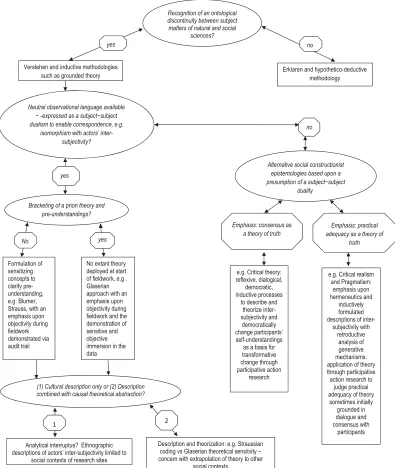
In this paper we have attempted to contribute towards a reflexive understanding of the variable constitution of GT as a key example of con-temporary inductive praxis. In this analysis we have mapped how varying philosophical commit-ments impact upon the deployment of induction in management research around the issues of neutral engagement, description, causal analysis and theorization of inter-subjectivity. Figure 1 summarizes the philosophical choices we have discussed and which inevitably face inductive researchers but may remain unnoticed. Figure 1 begins with choices, driven by varying ontolog-ical and epistemologontolog-ical commitments, between verstehen and erklaren and their rival inductive or deductive methodologies. Once verstehen and induction are chosen, researchers are implicitly faced by the choice between a subject−subject dualism and a subject−subject duality. We argue that neo-positivist approaches to GT are allied to a subject−subject dualism but with that selection re-searchers simultaneously have to deal with the rele-vance and impact of pre-existing theory upon their research: a choice that we have illustrated by the differences between bracketing and the use of sen-sitizing concepts. Simultaneously neo-positivists have to make choices around the aims of their re-search with regard to cultural description or then using those descriptions as a basis for subsequent theorization that moves beyond the actors’ voices whilst methodologically justifying the ‘inference
43 Refer
Recognition of an ontological discontinuity between subject matters of natural and social
sciences?
Verstehen and inductive methodologies
such as grounded theory Erklaren and hypothetico-deductive methodology
yes no
Neutral observational language available − -expressed as a subject−subject dualism to enable correspondence, e.g.
isomorphism with actors’ inter-subjectivity?
Bracketing of a priori theory and pre-understandings?
yes
no
Alternative social constructionist epistemologies based upon a presumption of a subject−subject
duality
Emphasis: practical adequacy as a theory of
truth Emphasis: consensus as
a theory of truth
e.g. Critical theory: reflexive, dialogical, democratic, inductive processes
to describe and theorize inter-subjectivity and
democratically change participants’ self-understandings as a basis for transformative change through participative action
research
e.g. Critical realism and Pragmatism:
emphasis upon hermeneutics and
inductively formulated descriptions of
inter-subjectivity with retroductive
analysis of generative mechanisms: application of theory through participative action research to
judge practical adequacy of theory sometimes initially
grounded in dialogue and consensus with
participants
yes No
Formulation of sensitizing concepts to clarify pre-understanding, e.g. Blumer, Strauss, with an emphasis upon objectivity during fieldwork demonstrated via audit trail
No extant theory deployed at start of fieldwork, e.g . Glaserian approach with an emphasis upon objectivity during fieldwork and the demonstration of sensitive and objective immersion in the data
(1) Cultural description only or (2) Description combined with causal theoretical abstraction?
2 1
Description and theorization: e.g. Straussian coding vs Glaserian theoretical sensitvity – concern with extrapolation of theory to other
social contexts Analytical interruptus? Ethnographic
[image:12.567.82.477.61.529.2]descriptions of actors’ inter-subjectivity limited to social contexts of research sites
Figure 1. Variations in grounded theory and philosophical choices: a reflexive framework
tickets’ that are used in this process. As can be seen in Figure 1, the choice of whether or not to bracket does not dictate the aims of the research, i.e. the ex-tent of theoretical abstraction produced, but it will influence the research process undertaken and the perceived role ofa prioritheory in data collection. In contrast, the earlier choice of a subject− subject duality leads to various social construc-tionist approaches where issues of epistemological
legitimization, whilst avoiding claims to neu-trality and eschewing judgemental relativism, loom large. Here we have considered how re-lated approaches, such as CT and CR, with their varying emphases upon consensus and practical adequacy as epistemological stan-dards, have reformulated the deployment of GT by in effect changing what ‘grounded’ means.
Therefore, as illustrated with specific reference to GT, induction may vary considerably under the impact of variable philosophical assumptions. We have attempted to illustrate key aspects of this diversity by showing the apparent variance in how qualitative researchers have attempted to ‘ground’ their descriptions and explanations of actors’ meaningful behaviour deriving from observation of social phenomena in their ‘natural’ context. Hence, as we have argued, there are multiple potentially legitimate approaches to induction generally, and GT in particular, depending on the philosophical commitments being deployed and the coherence between those philosophical com-mitments and the approach taken. This potential plurality starkly contrasts with the singularity deemed appropriate by much commentary in prestigious management journals.
Therefore we suggest that it would seem highly arbitrary and excessively limiting to attempt to discipline qualitative researchers to adopt specific procedures which articulate only neo-positivist knowledge constituting assumptions. Within neo-positivism’s epistemology, as Thomas and James wryly observe (2006, p. 779) ‘neutral analytical procedures replace neutral controls and treatments of the experiment . . . in the hope . . . [of] . . . an uncontaminated correspondence’. It is precisely these epistemic aims that have been one of the key foci of jurisdictional specification by commentary in prestigious management journals ostensibly in support of methodological pluralism (see Bansal and Corley, 2011; Bluhm et al., 2011; Gephart, 2004; Pratt, 2009; Suddaby, 2006; Tracy, 2010, 2012). Obviously such commentary can be helpful within a neo-positivist perspective. Indeed much discourse seems to focus upon strategies for cop-ing with the epistemic contradictions and prob-lems encountered by their empiricist forerunners especially around causal analysis and empirical ex-trapolation whilst trying to avoid the contradiction of metaphysical speculation. But surely this criteri-ological specification is limited to those underlying knowledge constituting assumptions. Moreover, as we have indicated, even within a subject−object dualism other philosophical disputes lead to vary-ing methodological commitments around the-orization and description. For others such is-sues are eschewed through epistemological shifts away from neo-positivism which result in con-siderable methodological reorientation that is
legitimate within those alternative social con-structionist knowledge constituting philosophical assumptions.
In the spirit of a permissive pluralism, Figure 1 attempts to summarize those choices invariably encountered in conducting inductive research and their relationship to varying philosophical sub-texts. Our key point is that such sub-texts need to be reflexively interrogated and articulated in both the design and reporting of research so that different choices are contextualized and justified with reference to ever-present knowledge constituting assumptions rather than being taken by default. Moreover, as a heuristic and reflexive device Figure 1 has criteriological consequences that require recognition so as to maintain the legitimacy of the philosophical diversity evident in qualitative management research. It implies a need to move beyond criteriological ‘diversification’ approaches which aim to develop evaluation cri-teria specific to particular methodologies like GT (see Sparkes, 2001) to a recognition that varying knowledge constituting assumptions can be put into practice in very different ways by what might ostensibly seem to be the same methodology. The implication of this for management research is that the deployment of different evaluation criteria needs to be overtly contingent upon such philosophical variance (see Johnsonet al., 2006). Clearly this requires that researchers, commenta-tors and evaluacommenta-tors give more consideration to the philosophical assumptions they are employing in their judgements of research ‘quality’ as the latter is a concept with many meanings. For researchers, this brings reflexivity to the forefront of inductive research. Such reflexivity can take many forms (see Cunliffe, 2003; Johnson and Duberley, 2003; Lynch, 2000). It is clear, however, that at a mini-mum researchers should engage with underlying philosophical assumptions from the very start of framing a research project, not only when consid-ering data analysis. Without careful consideration of these issues the field risks the unintended imposition of epistemological conformity and cri-teriological commensuration. We argue that this should be countered by a permissive recognition of philosophical differences and the consequent need to vary how research is evaluated in the light of reflexive interrogation and articulation of our, too often unnoticed, knowledge constituting assumptions.
References
Abel, T. (1958). ‘The operation called verstehen’,American Jour-nal of Sociology,54, pp. 211–218.
Adler, P. A. and P. Adler (1994). ‘Observational techniques in qualitative research’. In N. Denzin and Y. Lincoln (eds), Hand-book of Qualitative Research. London: Sage.
Al-Amoudi, I. and H. Willmott (2011). ‘Where constructionism and critical realism converge: interrogating the domain of epis-temological relativism’,Organization Studies,32, pp. 27–46. Alvesson, M. (1996).Communication, Power and Organization.
Berlin/New York, NY: Walter de Gruyter.
Alvesson, M. and J. Sandberg (2013). ‘Has management stud-ies lost its way? Ideas for more imaginative and innovative re-search’,Journal of Management Studies,50, pp. 128–152. Alvesson, M. and K. Skoldberg (2000).Reflexive Methodology:
New Vistas for Qualitative Research. London: Sage.
Amis, J. M. and M. L. Silk (2008). ‘The philosophy and politics of quality in qualitative organizational research’,Organizational Research Methods,11, pp. 456–480.
Archer, M. S. (2003).Structure, Agency and the Internal Conver-sation. Cambridge: Cambridge University Press.
Archer, M., R. Bhaskar, A. Collier, T. Lawson and A. Norrie (1998).Critical Realism: Essential Readings. London: Rout-ledge.
Ayer, A. J. (1971).Language, Truth and Logic. Harmondsworth: Penguin.
Bacon, F. (1620/1960). ‘Novum Organum’. In F. H. Anderson (ed.),The New Organum and Related Writings. New York, NY: Liberal Arts Press.
Bansal, P. and K. Corley (2011). ‘The coming of age for qualita-tive research: embracing the diversity of qualitaqualita-tive research’,
Academy of Management Journal,22, pp. 233–237. Becker, H. S. (1970).Sociological Work. Chicago, IL: Aldine. Bengtsson, L., U. Elg and J.-I. Lind (1997). ‘Bridging the
transat-lantic publishing gap: how North American reviewers evaluate European idiographic research’,Scandinavian Journal of Man-agement,13, pp. 473–492.
Bhaskar, R. (1978). A Realist Theory of Science, 2nd edn. Brighton: Harvester.
Bhaskar, R. (1986).Scientific Realism and Human Emancipation. London: Verso.
Bhaskar, R. (1989).Reclaiming Reality: A Critical Introduction to Contemporary Philosophy. London: Verso.
Bloor, M. (1976). ‘Bishop Berkeley and the adenotonsillectomy enigma: an explanation of variation in the social construction of medical disposals’,Sociology,10, pp. 43–61.
Bloor, M. (1978). ‘On the analysis of observational data: a dis-cussion of the worth and uses of inductive techniques and re-spondent validation’,Sociology,12, pp. 545–552.
Bluhm, D. J., W. Harman, T. W. Lee and T. R. Mitchell (2011). ‘Qualitative research in management: a decade of progress’,
Journal of Management Studies,48, pp. 1866–1891.
Blumer, H. (1954). ‘What is wrong with social theory?’,American Sociological Review,19, pp. 3–10.
Bochner, A. P. (2000). ‘Criteria against ourselves’,Qualitative In-quiry,6, pp. 266–272.
Broadbent, J. and R. Laughlin (1997). ‘Developing empiri-cal research: an example informed by a Habermasian ap-proach’,Accounting, Auditing and Accountability,10, pp. 622– 648.
Brook, P. and R. Darlington (2013). ‘Partisan, scholarly and ac-tive: for an organic public sociology of work’,Work, Employ-ment and Society,27, pp. 232–243.
Bryman, A. and E. Bell (2011).Business Research Methods, 3rd edn. Oxford: Oxford University Press.
Burr, V. (1995).Introduction to Social Constructionism. London: Routledge.
Burrell, G. and G. Morgan (1979).Sociological Paradigms and Organizational Analysis. London: Heinemann.
Callinicos, A. (1989)Against Postmodernism: A Marxist Cri-tique. Oxford: Oxford University Press.
Cassell, C. and P. Johnson (2006) ‘Action research: explaining the diversity’,Human Relations,59, pp. 783–814.
Charmaz, C. (1995). ‘Grounded theory’. In J. Smith, R. Harre and L. Langenhove (eds),Rethinking Methods in Psychology. London: Sage.
Charmaz, K. (2000). ‘Grounded theory: objectivist and construc-tivist methods’. In N. Denzin and Y. Lincoln (eds),Handbook of Qualitative Research, 2nd edn, pp. 509–535. London: Sage. Charmaz, K. (2006).Constructing Grounded Theory: A Practical
Guide Through Qualitative Analysis. London: Sage.
Charmaz, K. (2009). ‘Shifting grounds: constructivist grounded theory methods’. In J. M. Morse, P. N. Stern, J. Corbin, B. Bowers, K. Charmaz and A. E. Clarke (eds),Developing Grounded Theory: The Second Generation. Walnut Creek, CA: Left Coast Press.
Cherutz, W. and J. Swanson (1986). ‘Qualitative research us-ing grounded theory’. In W. Cherutz and J. Swanson (eds),
From Practice to Grounded Theory. Menlo Park, CA: Addison-Wesley.
Cicourel, A.V. (1982). ‘Interviews surveys and the problem of ecological validity’,American Sociologist,17, pp. 11–20. Clarke, A. E. (2003). ‘Situational analyses: grounded theory after
the postmodern turn’,Symbolic Interaction,26, pp. 533–576. Clarke, A. E. (2009). ‘From grounded theory to situational
anal-ysis: What’s new? Why? How?’ In J. M. Morse, P. N. Stern, J. Corbin, B. Bowers, K. Charmaz and A. E. Clarke (eds),
Developing Grounded Theory: The Second Generation. Walnut Creek, CA: Left Coast Press.
Comte, A. (1853).The Positive Philosophy of Auguste Comte. London: Chapman.
Cornelissen, J. (2009). ‘Writing up qualitative research: an overview of the challenges’. Paper given to the British Academy of Management Meeting on Writing Up Qualitative Research for Publication, London, November.
Cressey, D. (1950). ‘The criminal violation of financial trust’,
American Sociological Review,15, pp. 738–743.
Cunliffe, A. L. (2003). ‘Reflexive inquiry in organizational re-search: questions and possibilities’,Human Relations,56, pp. 983–1003.
Danermark, B., M. Ekstrom, L. Jakobsen and J. Karlsson (2002).
Explaining Society: Critical Realism in the Social Sciences. London: Routledge.
Davidson, D. (1984).Inquiries into Truth and Interpretation. Ox-ford: Oxford University Press.
Denzin, N. (1971). ‘The logic of naturalistic inquiry’, Social Forces,50, pp. 166–182.
Denzin, N. K. (1978).The Research Act: A Theoretical Introduc-tion to Sociological Methods, 2nd edn. London: McGraw-Hill. Denzin, N. K. (1983). ‘Interpretative interactionism’. In G.
Mor-gan (ed.),Beyond Method. London: Sage.
Denzin, N. K. (1998). ‘The art and politics of interpretation’. In N. Denzin and Y. Lincoln (eds),Collecting and Interpreting Qualitative Materials. London: Sage.
Denzin, N. K. (2010).The Qualitative Manifesto: A Call to Arms. Walnut Creek, CA: Left Coast Press.
Denzin, N. and Y. Lincoln (2000). ‘Introduction: entering the field of qualitative research’. In N. Denzin and Y. Lincoln (eds),
Handbook of Qualitative Research. London: Sage.
Dewey, J. (1929a).The Quest for Certainty. New York, NY: Mil-ton Bach.
Dewey, J. (1929b).Experience and Nature. New York, NY: Henry Holt.
Dey, I. (1999).Grounding Grounded Theory – Guidelines for Qual-itative Inquiry. London: Academic Press.
Dilthey, W. (1976). ‘The development of hermeneutics’. In H. P. Rickman (ed.), Dilthey: Selected Writings. Cambridge: Cambridge University Press.
Donaldson, L., J. Qui and B. N. Luo (2013). ‘For rigour in or-ganization and management theory research’,Journal of Man-agement Studies,50, pp. 153–172.
Dryzek, J. S. (1995). ‘Critical theory as a research programme’. In S. K. White (ed.),The Cambridge Companion to Habermas. Cambridge: Cambridge University Press.
Duberley, J., P. Johnson and C. Cassell (2012). ‘Philosophies un-derpinning qualitative research’. In G. Symon and C. M. Cas-sell (eds),Qualitative Organizational Research: Core Methods and Key Challenges. London: Sage.
Easterby-Smith, M., K. Golden-Biddle and K. Locke (2008). ‘Working with pluralism: determining quality in qualitative research’, Organizational Research Methods, 11, pp. 419– 429.
Edwards, J. R. (2010). ‘Reconsidering theoretical progress in or-ganizational and management research’,Organizational Re-search Methods,13, pp. 615–619.
Eisenhardt, K. M. (1989). ‘Building theories from case study research’, Academy of Management Review, 14, pp. 532– 550.
Frendt, J. and W. Sachs (2008). ‘Grounded theory method in management research: users’ perspectives’,Organizational Re-search Methods,11, pp. 430–455.
Fleetwood, S. (2004). ‘An ontology for organisation and manage-ment studies’. In S. Fleetwood and S. Ackroyd (eds),Critical Realist Applications in Organisation and Management Studies. London: Routledge.
Forester, J. (2002). ‘On fieldwork in a Habermasian way: critical ethnography and the extraordinary character of ordinary pro-fessional work’. In M. Alvesson and H. Willmott (eds), Study-ing Management Critically. London: Sage.
Gaventa, J. and A. Cornwall (2006). ‘Power and knowledge’. In P. Reason and H. Bradbury (eds),Handbook of Action Research: Participative Inquiry and Practice, concise paperback edition, pp. 70–80. London: Sage.
Geertz, C. (1973).The Interpretation of Cultures. New York, NY: Basic Books.
Gephart, R. P. (2004). ‘Qualitative research and theAcademy of Management Journal’,Academy of Management Journal,47, pp. 454–462.
Giddens, A. (1976).New Rules of Sociological Method: A Positive Critique of Interpretative Methodologies. London: Hutchin-son.
Glaser, B. (1978). Theoretical Sensitivity: Advances in the Methodology of Grounded Theory. Mill Valley, CA: Sociology Press.
Glaser, B. G. (1992) Emergence vs Forcing: The Basics of Grounded Theory Analysis. Mill Valley, CA: Sociology Press. Glaser, B. (1998).Doing Grounded Theory: Issues and
Discus-sions. Mill Valley, CA: Sociological Press.
Glaser, B. G. and A. L. Strauss (1967).The Discovery of Grounded Theory. New York, NY: Adine.
Grey, C. (2010). ‘Organizing studies: publication, politics and polemic’,Organization Studies,31, pp. 677–694.
Guba, E. and Y. S. Lincoln (1989).Fourth Generation Evaluation. Newbury Park, CA: Sage.
Guba, E. and Y. Lincoln (1994). ‘Competing paradigms in quali-tative research’. In N. K. Denzin and Y. S. Lincoln (eds), Hand-book of Qualitative Research. Newbury Park, CA: Sage. Guba, E. and Y. Lincoln (2005). ‘Paradigmatic controversies,
contradictions and emerging confluences’. In N. K. Denzin and Y. S. Lincoln (eds),Handbook of Qualitative Research, 3rd edn. London: Sage.
Gustavsen, B. (2006). ‘Theory and practice; the mediating dis-course’. In P. Reason and H. Bradbury (eds),Handbook of Ac-tion Research: Participative Inquiry and Practice, concise pa-perback edition, pp. 17–27. London: Sage.
Habermas, J. (1972).Knowledge and Human Interests. London: Heinemann.
Habermas, J. (1974a).Theory and Practice. London: Heinemann. Habermas, J. (1974b). ‘Rationalism divided in two: a reply to Al-bert’. In A. Giddens (ed.),Positivism and Sociology. London: Heinemann Educational Books.
Habermas, J. (1984).The Theory of Communicative Action.Vol. 1: Reason and the Rationalization of Society. Cambridge: Polity Press.
Habermas, J. (1987).The Theory of Communicative Action.Vol. 2: Lifeworlds and System: A Critique of Functionalist Reason. London: Heinemann.
Halfpenny, P. (1994). ‘Causality’. In W. Outhwaite and T. Bot-tomore (eds),The Blackwell Dictionary of Twentieth Century Thought. Oxford: Blackwell.
Hammersley, M. (1989).The Dilemma of Qualitative Method: Herbert Blumer and the Chicago Tradition. London: Rout-ledge.
Hammersley, M. (1992).What’s Wrong with Ethnography? Lon-don: Routledge.
Heidegger, M. (1927/1962).Being and Time. Oxford: Basil Black-well.
Horkheimer, M. (1937).Critical Theory. New York, NY: Herder and Herder.
Horkheimer, M. and T. Adorno (1947).Dialectic of Enlighten-ment. New York, NY: Herder and Herder.
Hume, D. (1739–40/1965).A Treatise on Human Nature. Oxford: Clarendon Press.
Hume, D. (1748/1975).An Enquiry Concerning Human Under-standing. Oxford: Clarendon Press.
Husserl, E. (1965).Phenomenology and the Crisis of Philosophy. London: Harper and Row.
James, W. (1897) (reprinted 1956).The Will to Believe. New York, NY: Dover.
James, W. (1909) (reprinted 1970). The Meaning of Truth. Chicago, IL: University of Michigan.