
This is a repository copy of
Understanding nursing practice in stroke units: a
Q-methodological study.
.
White Rose Research Online URL for this paper:
http://eprints.whiterose.ac.uk/86210/
Version: Accepted Version
Article:
Clarke, DJ orcid.org/0000-0001-6279-1192 and Holt, J orcid.org/0000-0003-2468-8148
(2015) Understanding nursing practice in stroke units: a Q-methodological study. Disability
and rehabilitation, 37 (20). pp. 1870-1880. ISSN 0963-8288
https://doi.org/10.3109/09638288.2014.986588
[email protected] https://eprints.whiterose.ac.uk/ Reuse
Items deposited in White Rose Research Online are protected by copyright, with all rights reserved unless indicated otherwise. They may be downloaded and/or printed for private study, or other acts as permitted by national copyright laws. The publisher or other rights holders may allow further reproduction and re-use of the full text version. This is indicated by the licence information on the White Rose Research Online record for the item.
Takedown
If you consider content in White Rose Research Online to be in breach of UK law, please notify us by
1
Title: Understanding nursing practice in stroke units: a Q-methodological study.
Authors: Clarke D,J1 , Holt, J2
1
Academic Unit of Elderly Care and Rehabilitation, Leeds Institute for Health Sciences, University of Leeds.
2
School of Healthcare, University of Leeds. Addresses:
1. Academic Unit of Elderly Care and Rehabilitation, Temple Bank House, Bradford Royal Infirmary, Bradford, United Kingdom, BD9 6RJ.
2. School of Healthcare, Baines Wing, University of Leeds, Leeds, United Kingdom, LS2 9JT. Address for correspondence:
Dr David J Clarke Lecturer in Stroke Care
Academic Unit of Elderly Care and Rehabilitation Bradford Institute for Health Research
Temple Bank House Bradford Royal Infirmary Duckworth Lane
Bradford, BD9 6RJ Tel: 01274 383441 Email: [email protected] Word count: 6758
2
Title: Understanding nursing practice in stroke units: a Q-methodological study.
Abstract:
Purpose: Nurses represent the largest professional group working with stroke-survivors but there is limited evidence regarding nurses' involvement in post-stroke rehabilitation. The purpose of this study wasto identify and explore the perspectives of nurses and other multidisciplinary stroke team
oke rehabilitation.
Method: Q-methodological study with 63 multidisciplinary stroke unit team members and semi-structured interviewswith 27 stroke unit team members.
Results: Irrespective of their professional backgrounds, participants shared the view that nurses can make an active contribution to stroke rehabilitation and integrate rehabilitation principles in routine practice. Training in stroke rehabilitation skills was viewed as fundamental to effective stroke care but nurses do not routinely receive such training. The view that integrating rehabilitation techniques can only occur when nursing staffing levels were high was rejected. There was also little support for the view that nurses are uniquely placed to co-ordinate care, or that nurses have an independent rehabilitation role.
3 Introduction:
Stroke is the third largest cause of death and largest cause of adult disability in the United Kingdom and United States. The World Health Organization (WHO)[1] estimates 15 million people worldwide will have a stroke annually; this represents a major health burden [1-2]. Overall, mortality rates are falling [2] but WHO [1] data indicate 5 million deaths from stroke annually and 5 million people living with permanent disability. Post-stroke rehabilitation aims enable an individual who has experienced a stroke to reach the highest possible level of independence and be as productive as
possible [3]. Inpatient rehabilitation is provided by multidisciplinary teams (MDTs) which include nurses. Nurses represent the largest professional group working with stroke survivors but there is currently limited evidence regarding nurses' involvement in post-stroke rehabilitation [4-5]. N rehabilitation role can be hidden and not fully understood by other MDT members [6-7]. The perspectives of other MDT members, on nurses' practice and contribution in stroke rehabilitation are largely unreported. This is an anomaly given the evidence that MDT working is a major factor in achieving the improved outcomes associated with stroke units [8]. Findings from studies exploring patients' and carers' perspectives on rehabilitation role post-stroke indicate mostly positive descriptions of nurses' caring activities. However, patients and carers were largely unable to identify instances where nurses contributed to rehabilitation [9-11].
4
reported nurses appreciated the importance of contributing to rehabilitation but cited time and workload pressures as reasons why they did not routinely employ stroke rehabilitation principles in their practice [5,17]. Stroke rehabilitation nursing has been described as using knowledge gained from teaching or working with therapists to routinely integrate therapy into activities of daily living and into nurse-patient communication[18]. Observational studies also identified nurses' limited involvement in post-stroke rehabilitation [17-20] . A recent meta-ethnography of 16 qualitative studies, published between 1990-2012, concluded n reported involvement in post-stroke rehabilitation remains limited [5]. Integration of rehabilitation principles in routine nursing activity was perceived to be contingent on adequate nurse staffing levels and . Direct care and monitoring were prioritised, often without appreciation that these activities provided opportunities to integrate rehabilitation principles. The review provided evidence of the need to re-examine nurses' involvement in inpatient post-stroke rehabilitation. This study aimed to explore the perspectives of nurses and other MDT members actice in stroke rehabilitation.
The objectives of the study were:
To establish nurses' and other MDT members' subjective views on statements drawn from a meta-ethnography of nursing practice in stroke rehabilitation.
To explore how nursing roles and nursing practice in stroke units were described and understood by other MDT members.
To compare and contrast explanations for nurses' practice in stroke rehabilitation from nurses and other MDT members.Methods:
5
Q methodology shares some features with qualitative methodology; however, statistical analysis is used to identify themes that emerge from the data. Baker et al [23] argue that combining features of quantitative and qualitative designs is a strength of Q methodology. The approach has been used previously in disability related research[24-25] but in only three studies of stroke services, all with patients[26-28].
Development of the Q-set:
The statements participants sort are referred to as the Q-set which should provide good coverage of
must be broadly representative of opinion, domain,
population or concourse at issue 29p58. We drew on nursing rehabilitation role descriptions identified in a meta-ethnography of nursing practice in stroke rehabilitation[5]. Initially 134 items related to
were identified. The size of the Q-set is
dependent on the subject matter but between 40 and 60 items are usually selected[21], although useful interpretations have been derived from Q-sets with lower numbers[24-28]. In an iterative process these items were reviewed and synthesised independently by 4 researchers and reduced to 38 statements, and then to 32 by author 1. These were reviewed for content and clarity by author 2 and by another stroke researcher for relevance and coverage. A number of theoretical frameworks have been developed to define nursing roles in rehabilitation [12-13,15-16]. These were reviewed for the degree of fit with the role descriptions identified in the meta-ethnography[5]. The empirically derived framework developed by Long et al[30] was adopted (Supplementary file 1) to group items under six thematic headings which appeared to most closely match contemporary nursing activity in stroke rehabilitation settings. The larger number of items in the herapy integration and carry on theme reflects the focus of this study.
6
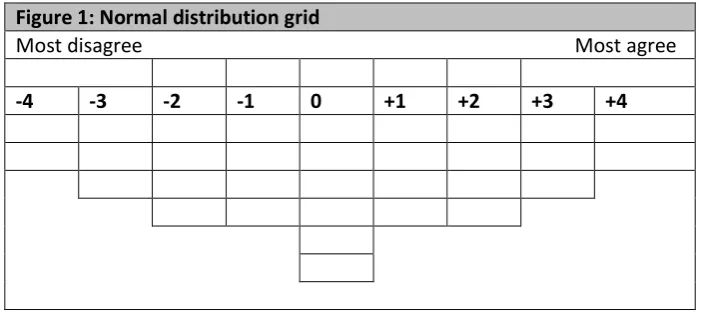
[image:7.595.117.468.215.372.2]Participants were presented with 32 statements on laminated cards. Firstly, they sorted statements in to three groups (agree, disagree and neutral), secondly they determined how strongly they agreed or disagreed (e.g. agree, strongly agree, very strongly agree) with each statement, before rank ordering statements on a grid with a quasi-normal distribution, ranging from -4 (most disagree) through 0 (neutral) to +4 (most agree) (Figure 1).
Figure 1: Normal distribution grid
Most disagree Most agree
-4 -3 -2 -1 0 +1 +2 +3 +4
Settings:
7
provide individual input following referral and are regarded as peripheral MDT members. Each unit was supported by an experienced nurse whose title varied from stroke co-ordinator and stroke specialist nurse to stroke thrombolysis co-ordinator and specialist nurse.
Inclusion criteria:
Staff were eligible to participate in the study provided they were: a RN, HCA, therapist, physician, dietician, social worker, clinical psychologist or orthoptist working on or visiting patients on the stroke unit for more than three days a week. Therapists completing post-registration training rotations were required to have been working on the stroke unit for > two months. The study received a favourable ethical opinion through the National Research Ethics Service (Reference 11/YH/0211) and research governance approval in each hospital; all participants provided written informed consent.
Recruitment and sampling
8
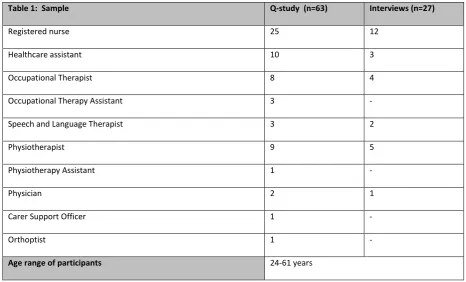
Table 1: Sample Q-study (n=63) Interviews (n=27)
Registered nurse 25 12
Healthcare assistant 10 3
Occupational Therapist 8 4
Occupational Therapy Assistant 3 -
Speech and Language Therapist 3 2
Physiotherapist 9 5
Physiotherapy Assistant 1 -
Physician 2 1
Carer Support Officer 1 -
Orthoptist 1 -
Age range of participants 24-61 years
Data collection:
Q-sorts were completed between October and December 2011; either one-to-one or in small group sessions on stroke units, at times participants chose. Researchers were present to explain the Q-sort exercise. Participants took 25-50 minutes to complete Q-sorts; no discussion took place between participants. Participants were encouraged to record comments on the statements or the reasons for placing them in a specific grid position in a booklet provided; approximately half of the participants added comments. The last section of the booklet, completed by all participants, sought biographical details.
9
times chosen by participants. Few had read this before interview, so findings were discussed during interviews.
Data analysis Q-sorts:
Q sort data were entered into PQ Method (version 2.11). The 63 completed Q sorts were analysed using principal components analysis. A correlation matrix for all Q sorts was produced and factor analysis performed to identify Q sorts that appeared to group together. PQ method computes eight factors, all had eigenvalues of >1 (range 32.68 to 1.55), therefore a scree plot was created to decide which factors to keep for rotation. The scree plot indicated 4 to 5 factors to the left of the point where the line flattened out [31]. Following Brown [32] the percentage of explained variance, the number of participants loading on the factors and the contextual significance of the factor arrays were considered for 3, 4 and 5 factor solutions. The 5 factor solution was disregarded as it did not provide additional understanding. The 3 factor solution was considered too limiting as it masked a fourth understanding. The 4 factor solution, accounting for 66% of the explained variance, was selected for Varimax rotation. There were twelve defining sorts for factor 1, seven for factor 2, eleven for factor 3 and six for factor 4. These defining sorts characterise the factor and while it does not mean that the sorts of all participants who load on one factor are identical, they are nevertheless significantly similar. A [29] was used to ensure all items in the factor arrays, were considered. Qualitative data drawn from the Q-sort statement booklets were used to help interpret the placing of statements.
Semi-structured interviews:
10
categories based on the four factors derived from the analysis. Some data could not be coded to these categories, two additional categories proved necessary. These categories were
in post-stroke rehabilitation.
Results:
Consensus statements:
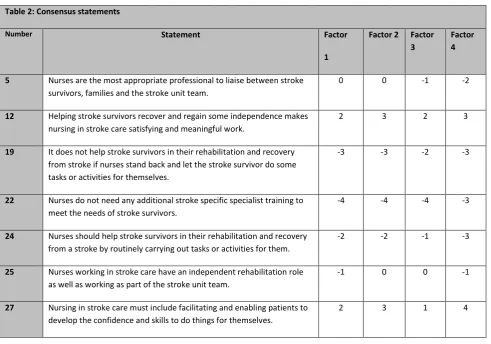
[image:11.595.67.559.266.610.2]There were seven consensus statements which did not discriminate between factors. Table 2: Consensus statements
Number Statement Factor
1
Factor 2 Factor 3
Factor 4
5 Nurses are the most appropriate professional to liaise between stroke survivors, families and the stroke unit team.
0 0 -1 -2
12 Helping stroke survivors recover and regain some independence makes nursing in stroke care satisfying and meaningful work.
2 3 2 3
19 It does not help stroke survivors in their rehabilitation and recovery from stroke if nurses stand back and let the stroke survivor do some tasks or activities for themselves.
-3 -3 -2 -3
22 Nurses do not need any additional stroke specific specialist training to meet the needs of stroke survivors.
-4 -4 -4 -3
24 Nurses should help stroke survivors in their rehabilitation and recovery from a stroke by routinely carrying out tasks or activities for them.
-2 -2 -1 -3
25 Nurses working in stroke care have an independent rehabilitation role as well as working as part of the stroke unit team.
-1 0 0 -1
27 Nursing in stroke care must include facilitating and enabling patients to develop the confidence and skills to do things for themselves.
2 3 1 4
11
rehabilitation. However, RNs and HCS in other studies have identified the conflict felt when they are faced with time pressures and staff shortages, but understand the importance of facilitating independence [13,17,19,34]. Such time and workload pressures were present in this study, but this kind of conflict was rarely identified by participants, with both RNs and HCAs in all clinical areas arguing facilitating independence was an essential element of their work.
Even something simple like, if a patient needs a bed-bath just getting them washing their
, F
beside them and help them if
need be a , simple things like that help
[facilitate independence]. (Interview, RN (ward sister) mixed unit C).
Neutral or moderate disagreement with statement 5 challenges researchers claims that the co-ordination role is core to stroke care nursing [16, 34-36]. P indicated the best person to co-ordinate depended on what issue was being considered, e.g. aids and adaptation to the home were best addressed by OTs, whereas continence issues were often addressed by nurses:
[It is] Often but not always [the nurse]. For example, a patient W S , the SALT may be most appropriate or the Dr, given severe dysphagia is the most prevalent feature.(Q-sort booklet response: Lead SALT, HASU B).
The whole team need to liaise with families and stroke survivors to ensure an appropriate flow of information (Q-sort booklet response: Lead PT, HASU B).
Consensus on statement 25, where there was neutral or moderate disagreement, challenges claims made previously for an independent rehabilitation role for RNs [12,16,34]. However, this may reflect the clearer role understanding held by those who routinely work in stroke units where an MDT approach is well established and underpinned by evidence of its value [8]. Statement 22 reflects strong agreement with the view that RNs and HCAs need additional stroke specific specialist training; this was endorsed in interviews:
They will assist the therapists;
procedure followed all the way through. (Interview, Clinical Specialist OT, HASU B).
W S T PTs
OT F and the
12
Informal unit based training such as that described above was often highlighted as a strategy being
used to develop RNs and HCAs
difficult to deliver:
The problem is getting the nurses [to attend], even something simple as education when everybody is so busy with their own or even me giving up the time to teach them, so working alongside nurses on the ward is probably the best way. (Interview Lead PT, HASU, A)
At the moment this is just such a busy ward that love to have training sessions every
. (Interview, RN,
Rehabilitation Unit D)
Review of training reported by participants (Supplementary file 2) indicates that, with the exception of online Stroke Training and Awareness Resources (STARS) [37] training, and in contrast to most therapists, few RNs had completed post-qualifying stroke specific education and training.
Factors
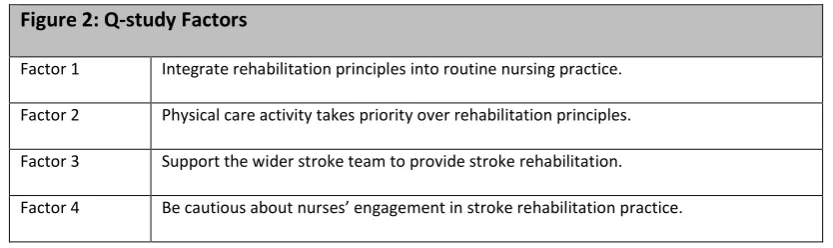
A four factor solution was found to represent -
[image:13.595.117.534.479.603.2]and understanding perspectives on RNs and HCAs practice in stroke rehabilitation (Figure 2).
Figure 2: Q-study Factors
Factor 1 Integrate rehabilitation principles into routine nursing practice.
Factor 2 Physical care activity takes priority over rehabilitation principles.
Factor 3 Support the wider stroke team to provide stroke rehabilitation.
Factor 4 B
13
T
interpretive phase of data analysis and represent holistic conceptual descriptors of the factor.
Factor 1: Integrate rehabilitation principles into routine nursing practice
[image:14.595.70.556.453.773.2]Factor 1 explained 23% of the variance. Twelve participants from three units loaded on this factor, they included an OT, PT and RN from a HASU, two RNs, a PT, OT and HCA from a mixed unit, and two RNs, a PT and a physician from a rehabilitation unit. All were experienced and senior staff. Two RNs were Sister grade and two were Stroke Specialist Nurses. Therapists were all senior grade and the physician had worked in stroke for ten years. With the exception of one Sister, all had undertaken stroke specific post-graduate education. Six statements (8,32,21,10,16,28) characterised this factor, these suggest that more experienced MDT members, irrespective of their professional backgrounds share the view that nurses have an active contribution to make in stroke rehabilitation and can integrate rehabilitation principles into routine nursing practice.
Table 3: Factor 1 [most strongly agree/disagree only]
Number Statement Rank
2 The stroke unit team, not individual nurses, should assess and plan for stroke survivors' care and rehabilitation.
+4
8 Nursing stroke survivors and carers is a specialised type of neurological nursing which requires stroke specific knowledge and skills.
+4
1 Being competent in assessment is the most important part of the nursing role in stroke care [include neurological assessment, swallowing assessment, moving and handling assessment].
+3
20 Nurses working in stroke care must incorporate stroke specific rehabilitation techniques in their care [for example: when helping stroke survivors with positioning, sitting and standing, walking, washing, eating and drinking].
+3
32 Stroke rehabilitation nursing is a distinct and specialist role that needs further development. +3
28 It is important when working with stroke survivors that nurses prevent stroke survivors taking risks in activities of daily living.
-3
14
the stroke survivor do some tasks or activities for themselves.
18 Nurses working in stroke care should concentrate on the physical and emotional care of the stroke survivor and leave rehabilitation to the therapists.
-3
9 Nurses working in acute stroke care must focus on physiological monitoring and supporting medical interventions, and so they cannot also incorporate rehabilitation techniques in caring for stroke survivors.
-4
22 Nurses do not need any additional stroke specific specialist training to meet the needs of stroke survivors. -4
Participants agreed stroke care was a specialist type of nursing (+4) requiring stroke specific training; with strong agreement that the role required further development (+3). There was agreement that RNs and HCAs need to use stroke specific assessment skills and must incorporate rehabilitation techniques in their work, e.g. when helping patients with positioning, washing and dressing, eating and drinking and walking as part of routine activities of daily living (ADLs). Support for facilitation, enabling and integrating rehabilitation in all activities was evident (+2). Joint working between therapists RNs and HCAs to develop skills and share knowledge was viewed positively (+2). In contrast, RNs and HCAs prioritising physiological monitoring, medical interventions and concentrating on physical and emotional care were quite strongly disagreed with (-3 and -2). This factor was the most positive in terms of RNs and HCAs supporting patients to take some risks in ADLs, where appropriate. Participants were neutral about RNs actively encouraging patients families to come into units to help with ADLs and held negative views about RNs and HCAs inviting in and teaching families skills to provide personal care (-2). Analysis suggested these are regarded as part of rehabilitation provision normally managed by therapists and there was caution about RNs and HCAs undertaking these activities.
It is not the responsibility of nursing PADL T ts
actise skills with stroke survivors and families/carers. (Q-sort booklet response: Senior OT, HASU A).
15
Interview data confirmed that therapists regarded teaching caregivers skills such as washing and dressing or transfers as a pre-discharge activity in which therapists had specialist knowledge and skills. RNs and HCAS largely did not contest this view, indicating they would support other MDT members in these areas but not take a lead role.
Participants did not agree that integrating rehabilitation techniques could only occur when staffing levels are high (-1). Experienced MDT members from different units acknowledged integration of rehabilitation principles in RNs and HCAs routine care practices was difficult when staffing levels were low. However, they argued integration could still be achieved provided RNs and HCAs understood the purpose and contribution of rehabilitation principles as these responses indicate:
Y
. A
to ask them to take their time. (Interview, HCA, HASU A)
[Statement 23] Is partially true, staffing levels affect care however, even when short staffed care provided should be rehab based. (Q-sort booklet response: Junior RN, mixed unit C).
A lot of it ca It can be part of, washing and dressing and
[Interview, PT HASU and
rehabilitation unit A and D].
This factor did not support the view that RNs are uniquely placed to co-ordinate care, or that RNs have an independent rehabilitation role. Instead, the role of the team in assessment and planning care is strongly supported (+4). RNs and HCAs were viewed as part of stroke teams as opposed to a unique group within stroke MDTs.
I ave to be nurses because sometimes as an OT
knowledge of the community and what happens for that person at home then it might be a (Interview, Clinical Specialist OT mixed unit C)
T
the evening, so they do t one member of
that team. (Interview, Senior OT HASU A).
16
activity were monitored or facilitated, e.g. ensuring scans, X-rays, medications, community care reports, were occurring as intended.
Factor 2: Physical care activity takes priority over rehabilitation principles
[image:17.595.66.557.360.786.2]This factor, which explained 11% of the variance, differed in a number of ways from the other three. Seven participants loaded on this factor, all were all RNs (x3) or HCAs (x4). The HCAs were from HASUs; two RNs were from a mixed unit (x2) and one a HASU. The RNs were basic grade, and whilst they had more than one year of stroke care experience they were less experienced than many of their colleagues. RNs at this grade and most HCAs spend most of their working day providing direct care, supporting completion of ADLs, monitoring vital signs and in medication administration. There were 14 distinguishing statements for this factor (10,12,7,3,9,26,21,29,2,18,11,17,6,31).
Table 4: Factor 2 [most strongly agree/disagree only]
Number Statement Rank
1 Being competent in assessment is the most important part of the nursing role in stroke care [include neurological assessment, swallowing assessment, moving and handling assessment].
+4
10 Physical care [including managing incontinence, bathing and preventing pressure ulcers] should be the
+4
27 Nursing in stroke care must include facilitating and enabling patients to develop the confidence and skills to do things for themselves.
+3
20 Nurses working in stroke care must incorporate stroke specific rehabilitation techniques in their care [for example: when helping stroke survivors with positioning, sitting and standing, walking, washing, eating and drinking].
+3
12 Helping stroke survivors recover and regain some independence makes nursing in stroke care satisfying and meaningful work.
+3
6 P
not a nursing responsibility.
-3
19 It does not help stroke survivors in their rehabilitation and recovery from stroke if nurses stand back and let the stroke survivor do some tasks or activities for themselves.
-3
30 The role of the nurse in rehabilitation of stroke survivors is not understood by all members of the stroke unit team.
-3
31 Specialist stroke nurses should focus on management of care including chairing MDT meetings and patient follow up after discharge.
17
22 Nurses do not need any additional stroke specific specialist training to meet the needs of stroke survivors. -4
This factor revealed the strongest agreement with more traditional views on what RNs and HCAS in stroke care need to prioritise and where their work should largely be focused. In direct contrast to factor 1, factor 2 emphasises the importance of physical care, placing statement 10 at +4. Nursing stroke patients is viewed as demanding physical work (+2), whereas it was placed at neutral in factors 1 and 3 and at +1, in factor 4. The shared views evident in this factor were more consistent with findings from the meta-ethnography[5] and overall literature, that RNs and HCAs prioritise direct care and physiological monitoring [12,19,34].
I -
I ‘N (Ward
Sister) mixed unit C]
I re
you can move on to the rehab. [Interview, Senior RN, HASU A]
Negative views in respect of RNs encouraging families to come into units to help patients with ADLs (-2) were evident, similarly and RNs and HCAs teaching and assessing families e.g. re personal care skills was ranked 0. More distinct nursing roles were supported, e.g. social and emotional support roles, the need for close relationships with patients and carers. Participants agreed RNs and HCAs need stroke specific training as in factors 1,3 and 4, but agreement with statement 32, that this is a specialist type of neurological nursing which needs further role development was less strong (+2). This is the lowest scoring factor on team as opposed to nursing assessment and planning of care and rehabilitation (-1).
18
respectively). Statement 23, which indicates support for the view that integrating rehabilitation techniques is not staffing dependent was ranked negatively (-2); there is a similar rejection of One interpretation of this seeming contradiction is that these RNs and HCAs understand the philosophy of stroke rehabilitation, and acknowledge that they have a role in promoting independence, even if they do not currently do this.
I I , so a
large part of our role and the physical side is. W I the patients than we should be doing, I see that a lot, we try not to but that does happen [Interview, RN (Ward Sister), rehabilitation unit D].
The views expressed in Factor 2 assert the importance of nursing but more narrowly define priorities, these differ from the wider team emphasis noted in factors 1 and 3. In interviews, most participants thought this factor would have been defined by RNs and HCAs working in HASUs. In reality participants loading on this factor were from a mixed unit and a HASU. Interview data suggest some of these RNs and HCAs may underestimate their use of rehabilitation techniques in routine care.
T [HCAs] more hands-on, T
they do the vast bulk of the care work. One of our HCAs is the moving and handling expert and we can go to her and say such and such about this, and they do incorporate a lot of the continuing rehab side of things. [Interview, Senior RN, HASU B]
Factor 3: Support the wider stroke team to provide stroke rehabilitation
19
Table 5: [most strongly agree/disagree only]
Number Statement Rank
14 A close relationship with stroke survivors and carers is necessary if nurses are to help stroke survivors regain some independence and cope with their stroke.
+4
15 Nurses must work in partnership with stroke survivors so that they can take an active part in own their care and rehabilitation.
+4
29 Stroke unit nurses should help stroke survivors by continuing with the rehabilitation programmes prescribed by therapists throughout the day, evening and night.
+3
21 Nurses and therapists ought to routinely work jointly with stroke survivors to develop their respective rehabilitation skills and stroke specific knowledge.
+3
13 It is important for nurses to help stroke survivors and their carers make sense of and cope with the emotional and psychological effects of stroke.
+3
23 Nurses working in stroke care can only incorporate stroke specific rehabilitation techniques in helping stroke survivors when nursing staffing levels are high.
-3
10 Physical care [including managing incontinence, bathing and preventing pressure ulcers] should be the
-3
9 Nurses working in acute stroke care must focus on physiological monitoring and supporting medical interventions, and so they cannot also incorporate rehabilitation techniques in caring for stroke survivors.
-3
22 Nurses do not need any additional stroke specific specialist training to meet the needs of stroke survivors. -4
18 Nurses working in stroke care should concentrate on the physical and emotional care of the stroke survivor and leave rehabilitation to the therapists.
-4
[image:20.595.67.557.69.505.2]20
Participants loading on this factor were neutral about nursing stroke survivors being a specialist type of neurological nursing and there being an independent rehabilitation role for RNs . However, in common with Factor 1&2 there was strong support for the need for stroke specialist education for RNs and HCAs , and (as Factor 1), for joint working between therapists and RNs and HCAs , and for specialist nurses to work alongside inexperienced RNs and HCAs . Factor 3 exhibits the most positive view in respect of RNs working with families and teaching e.g. personal care skills, statements 16 and 17 at +1. Statements 14 and 15, partnership with patients to take an active role in their own care and rehabilitation, and the need to develop close relationships as being necessary to help stroke survivors regain some independence are both rated +4 in this factor. One RN expressed this view:
I I
environment. If the patient has got swallowing problems we can show them how to feed
S I I
one of the best people to do the training.[Interview, RN (Ward Sister), mixed unit C].
This is consistent with the positive emphasis on incorporation of rehabilitation techniques in routine care (+2) and RNs and HCAs continuing rehabilitation prescribed by therapists across the day and night as appropriate (+3). The views evident in this factor suggest acknowledgement that RNs and HCAs, in addition to their expertise in physical care, co-ordination and psycho-social care, can also develop and integrate specialist stroke skills traditionally associated with therapists.
T
therapists are here [only] I
as a very close team on that. [Interview, Clinical Specialist OT, HASU B].
Often the people who have most contact with the patients are HCAs; in fact more often
HCA I I
Lead SALT, rehabilitation unit D].
21
primary goal for stroke teams but that this is a collaborative enterprise requiring a whole team approach.
F B
This factor explained 12% of the variance, six participants loaded on this factor, 2 RNs and two OTs working in HASUs and an OT and carer support officer (CSO) from a mixed unit. With the exception of the CSO, all these MDT members were basic grade and inexperienced staff. There were five distinguishing statements (10,28,20,31,1).
Table 6: [most strongly agree/disagree only]
Number Statement Rank
27 Nursing in stroke care must include facilitating and enabling patients to develop the confidence and skills to do things for themselves.
+4
2 The stroke unit team, not individual nurses, should assess and plan for stroke survivors' care and rehabilitation.
+4
26 Specialist stroke nurses ought to work alongside less experienced nurses to teach them stroke specific skills as part of providing care for stroke survivors.
+3
21 Nurses and therapists ought to routinely work jointly with stroke survivors to develop their respective rehabilitation skills and stroke specific knowledge.
+3
12 Helping stroke survivors recover and regain some independence makes nursing in stroke care satisfying and meaningful work.
+3
24 Nurses should help stroke survivors in their rehabilitation and recovery from a stroke by routinely carrying out tasks or activities for the patient.
-3
22 Nurses do not need any additional stroke specific specialist training to meet the needs of stroke survivors. -3
19 It does not help stroke survivors in their rehabilitation and recovery from stroke if nurses stand back and let the stroke survivor do some tasks or activities for themselves.
-3
9 Nurses working in acute stroke care must focus on physiological monitoring and supporting medical interventions, and so they cannot also incorporate rehabilitation techniques in caring for stroke survivors.
-4
1 Being competent in assessment is the most important part of the nursing role in stroke care [include neurological assessment, swallowing assessment, moving and handling assessment].
[image:22.595.64.557.280.710.2]22
Participants loading on factor 4, strongly disagreed with statement 9 that RNs and HCAs cannot incorporate rehabilitation due to the requirement to focus on physiological monitoring and supporting medical intervention (-4). At the same time, physical care as the main focus is placed at +2, as is the need to provide nursing care for patients for whom rehabilitation is not suitable. Given this broad support for the physical care role, it was surprising that statement 1, that competence in assessment as the most important part of the nursing role was strongly disagreed with (-4).
Factor 4 indicates strongly positive views in respect of RNs and HCAs facilitating and enabling but in common with factor 1 is also clear that assessing and planning care and rehabilitation are viewed as team rather than individual RN responsibilities (both +4). There was strong agreement that therapists ought to routinely work jointly with patients (+3) and for Stroke Specialists Nurses to work alongside less experienced staff (+3). Interviews highlighted concern for some MDT members that joint working, which had been common as stroke units were being established previously, was now very difficult to achieve because of the increasingly acute focus of units and the necessity for experienced therapists and RNs to be undertaking prescribed assessments to ensure nationally audited targets were being met.
The opportunity for work shadowing is just non- I
way of learning I 5s and my
assistant, they would work alongside me to pick up techniques.[Interview, Clinical Specialist OT mixed unit C].
[Its] Very different, we are much more involved in the very early days in meeting targets in the sentinel audit [Interview, Lead PT HASU B].
23
disagreed that nurses were best placed to make sure the team addresses patients' rehabilitation needs, or the most appropriate professional to liaise between patients families and the team, statements 3 and 5 were ranked -2. The statement that nurses have an independent rehabilitation role was also viewed negatively (-1). Participants expressed positive views about helping patients regain some independence (+3), working in partnership with stroke survivors (+2) and carryover and integration of rehabilitation programmes across the day/evening (+1). However, factor 4 was the only one to agree (+2) with statement 28, that nurses should prevent stroke survivors taking risks in ADLs, factors 1-3 disagreed (-1 to -3).
T not as aware of risk assessing. I think they play it on the safe side, which is good,
assess, what to look out for.[Interview, rotational junior PT HASU B]
Factor 4 also had the lowest level of agreement with statement 20 (+1), that nurses must incorporate specific rehabilitation techniques in their care; in other factors this was ranked at +2 or +3. Similarly, statement 16 (-1) and statement 17 (0) indicate little agreement with the view that nurses should teach or work with families on developing ADL support skills.
W
the patient is aspirating and things like that, but if a patient is going to be going home, families do need to be involved, but perhaps it would be better coming from the speech and language therapist who can give a little bit more specific advice, than the nursing staff. I think it should come from the whole team, not just the nurses. [Interview, Lead PT HASU B].
This factor suggests less experienced staff endorse the rehabilitation philosophy expressed in stroke units, but these inexperienced nurses and therapists may lack of confidence in RNs and HCA skills to independently support ADL practice. In interviews some staff noted that early in
24
I ntity and as you develop and you increase your level of professional
identity, [than inexperienced staff] who
probably think well this is my role and I should be doing that role . [Interview, Clinical Specialist OT mixed unit].
Factor 4 contrasts with Factor 1 and to a lesser extent Factor 3, where those loading on the factors were very experienced in stroke care and reported (in interview) being secure in their own professional roles.
Discussion
The four factors generated id
practice in stroke units. These provide insight into similarities and differences in viewpoints amongst MDT members working in stroke units which are set up similarly to those currently operating in many developed countries. Participant numbers were high for a Q study and included all disciplines regularly working on stroke units. However, purposive sampling is not intended to be statistically representative; different viewpoints may have been elicited had the study been conducted in additional stroke units. Follow up interviews (as opposed to interview immediately after Q-sorting) were used as staff have difficulty taking time from clinical work. At interview participants sometimes struggled to recall how they had sorted statements. A copy of the statements and a results summary facilitated discussion, but conducting brief interviews immediately after Q-sorting may have enabled more detailed understanding of why participants held particular views on specific statements.
25
The Q study found strong agreement with the view that RNs and HCAs, in addition to their acknowledged roles in physical care and monitoring, can develop and integrate stroke rehabilitation skills, traditionally associated with therapists, into routine care. Encouraging and facilitating independence is central to stroke rehabilitation; all disciplines considered this to be something RNs and HCAs should integrate in routine care. Q-sort booklet responses and interviews provided examples of these skills in regular use across stroke unit settings. These are important findings for two reasons; firstly RNs and HCAs have previously reported they do not have time to incorporate rehabilitation principles. Secondly, stroke units now treat more acutely ill people, length of stay has reduced significantly and pressure to provide high quality evidence based stroke care is intense [39]. Despite these very real time and workload pressures, most stroke unit staff indicated that RNs and HCAs understood and routinely integrated rehabilitation principles in care. There was some evidence to indicate this was influenced by the presence of a stable workforce with knowledge, skills and experience gained from previous work in rehabilitation stroke units, as reported in other studies
[42-44]
.
26
rehabilitation. These factors also suggest that inexperienced staff in all disciplines may lack confidence in RNs and HCAs ability to encourage and facilitat independence. Training is considered important in National Clinical Guidelines [39-41] but in England there is no mandatory requirement for development of specific competencies in rehabilitation. In contrast, for example, routine training to assess patients using the National Institutes of Health Stroke Scale[3], to manage post-thrombolysis care or to complete swallowing assessments was evident in all units. Few participants were aware of the UK nationally endorsed Stroke Specific Education Framework[45] and there was no evidence of structured competency based training such as that seen in Scotland 46]. Teasell et al[47] argue there is a need to refocus stroke care away from preoccupation with acute management to ensure rehabilitation services are also effective. RNs and HCAs may benefit from this kind of refocusing provided that challenges in developing their rehabilitation skills are recognised and addressed.
Conclusion
There was cross disciplinary agreement that RNs and HCAs can and should develop and integrate stroke specific rehabilitation knowledge and skills in their practice, regardless of the type of stroke unit in which they work. However, realising the potential of RNs and HCAs as full partners in stroke rehabilitation is unlikely to occur without introduction of structured competency based multidisciplinary training in rehabilitation skills.
Declarations of interest:
The authors report no conflicts of interest.
27
28 References:
1. World Health Organisation [Internet] Atlas of Heart Disease and Stroke. Global Burden of Stroke 2014. Cited 2014 Jan 03. Available at:
http://www.who.int/cardiovascular_diseases/en/cvd_atlas_15_burden_stroke.pdf
2. Lackland,D.T. Roccella,E.J. Deutsch,A.F. Fornage,M. George, M.G. Howard,G. Kissela,B.M. Kittner,S.J. Lichtman,J.H. Lisabeth,L.D. Schwamm, L.H. et al 2014 Factors Influencing the Decline in Stroke Mortality. A Statement from the American Heart Association/American Stroke Association. Stroke.45: 315-353 http://stroke.ahajournals.org/ 10.1161/
01.str.0000437068.30550.cf Accessed 2014 Jan 03.
3. National Institutes for Health Stroke Scale (NIHSS) Stroke Scales and related information 2014. [Internet ] Cited 2014 Feb 02. Available at:
http://www.ninds.nih.gov/disorders/stroke/strokescales.htm
4. Burton, C,R. Fisher, A. Green, T,K,L. The organisational context of nursing care in stroke units: a case study approach. International Journal of Nursing Studies. 2009; 46, 86 95. 5. Clarke, D.J. Nursing practice in stroke rehabilitation: systematic review and
meta-ethnography. Journal of Clinical Nursing 2013 23, 1201-1226.
6. Pryor J A Nursing perspective on the relationship between nursing and allied health in inpatient rehabilitation. Disability and Rehabilitation 2009; 30, 314 322.
7. Kearney PM & Lever S Rehabilitation nursing: invisible and underappreciated therapy. Editorial. International Journal of Therapy and Rehabilitation 2010; 17, 394 395.
8. S U T C O
Cochrane Database of Systematic Reviews, 2013; Issue 9. Art. No.: CD000197. DOI: 10.1002/14651858.CD000197.pub3.
9. M D CN S ursing care. Journal of Clinical Nursing.
1998; 7, 442 450.
10. Seacrest JS How stroke survivors and primary support persons experience nurses in rehabilitation. Rehabilitation Nursing 2002; 27, 176 181.
11. A Å H G E ence of nursing care after a stroke:
from a gender perspective. Journal of Advanced Nursing 2009; 65: 2038 2045. 12. Kirkevold M Caring for stroke patients: heavy or exciting? Image: Journal of Nursing
Scholarship 1990; 22, 79 83.
13. Kirkevold M Balance values and norms in the nursing care of stroke patients. Rehabilitation Nursing Research 1992; 1, 24 33.
14. Gibbon, B Implications for nurses in approaches to the management of stroke
rehabilitation: a review of the literature. International Journal of Nursing Studies1993; 30(2)133-141.
15. O C S E A
1997 [ PhD Thesis ]. University of Southampton Available from: University of Southampton, http://library.soton.ac.uk/home/contact
16. Burton C,R. A description of the nursing role in stroke rehabilitation. Journal of Advanced Nursing 2000; 32, 174 181.
17. Seneviratne CC, Mather CM & Then KL Understanding nursing on an acute stroke unit: perceptions of space, time and interprofessional practice. Journal of Advanced Nursing 2009; 65, 1872 1881.
18. Pound, P. Ebrahim, S. Rhetoric and reality in stroke care. Social Science and Medicine 2000; 51(10): 1437-1446.
19. Barreca S & Wilkins S Experiences of nurses working in a stroke rehabilitation unit. Journal of Advanced Nursing 2008; 63, 36 44.
20. Gordon, C., Ellis-Hill, C. and Ashburn, A., The use of conversational analysis: nurse patient interaction in communication disability after stroke. Journal of Advanced Nursing
29
21. Kitzinger, C. Researching subjectivity and diversity : Q-Methodology in Feminist Psychology. Psychology of Women 1999; 23(2):267 276).
22. Stainton Rogers, R., Stenner, P., Gleeson, K., Stainton Rogers, W. Social Psychology: A Critical Agenda. 1995 Cambridge, Polity Press.
23. Baker,R.M., Thompson,C., Mannion.R. Q methodology in health economics. Journal of Health Services Research & Policy 2006; 11(1): 38-45.
24. Mckenzie,J. Braswell,B. Jelsma,J. Naidoo,N. . A case for the use of Q-methodology in disability research: lessons learned from a training workshop. Disability and Rehabilitation 2011; 33 (21-22):2134-2141.
25. Westbrook,J.L. McIntosh,C.J. Sheldrick,R. Surr,C. Hare,D.J.. Validity of Dementia Care Mapping on a neuro-rehabilitation ward: Q-methodology with staff and patients. Disability and Rehabilitation 2013;35 (19):1652-1659.
26. Corr S, Phillips C, Capdevila R Perceived benefits of a day service for younger adults following a stroke. Operant Subjectivity 2003; 27(1), 1-23.
27. Corr, S. , Neill, G. , Turner, A. Comparing an Occupational Therapy Definition and
C E Q M S B J O T
2005; 68(8):338-346.
28. Spurgeon, L. Humphreys,G. James, G., Sackley, C. A q- subjective experiences of TIA. Stroke Research and Treatment. 2012 . .
http://www.hindawi.com/journals/srt/2012/486261/cta/ doi: 10.1155/2012/486261. Accessed 2014 Jan03.
29. Watts, S. Stenner, P. Doing Q-methodological research: Theory, method and interpretation. 2012 London, Sage.
30. Long,A. Kneafsey, R. Ryan, J. Berry,J. The role of the nurse in the multi-professional rehabilitation team. Journal of Advanced Nursing. 2002 37(1):70-78.
31. Tabachnick,B.G., Fidell,L.S. Using Multivariate Statistics.5th Edition. 2001 London, Pearson. 32. Brown, S. Political Subjectivity: Applications of Q methodology in political science. 1980
New Haven CT, Yale University Press.
33. Hsieh, H.F., Shannon, S. Three Approaches to Qualitative Content Analysis. Qualitative Health Research. 2005 15(9): 1277-1288.
34. O C S,E. N
their pattern of care in stroke units. Rehabilitation Nursing. 2000 25, 224 230.
35. Kirkevold.M. . The role of nursing and rehabilitation of acute stroke patients: towards a unified theoretical perspective. Advances in Nursing Science. 1997 19, 55-64.
36. Kirkevold.M. . The Role of Nursing in the Rehabilitation of Stroke Survivors: An Extended Theoretical Account. Advances in Nursing Science. 2010 33(1): E27 E40
http://journals.lww.com/advancesinnursingscience/Abstract/2010/01000/The_Role_of_Nu rsing_in_the_Rehabilitation_of.11.aspx 10.1097/ANS.0b013e3181cd837f Accessed 2010 Sept 30.
37. Stroke Training and Awareness Resources . The University of Edinburgh, Edinburgh. [Internet] 2014 http://www.strokecorecompetencies.org Accessed 2014 Jan 03. 38. Burton, C.R. Developing stroke services a key role for nursing and nurses. IN: Williams,
J.,L.Perry, C.Watkins. (Eds) Acute Stroke Nursing. 2010 Oxford, Wiley-Blackwell.
39. Intercollegiate Stroke Working Party National Clinical Guidelines for Stroke. 4th Edition. Royal College of Physicians, London. 2012 [Internet]
http://www.rcplondon.ac.uk/resources/stroke-guidelines. Accessed 2013 Nov 14. 40. National Stroke Foundation . Clinical guidelines for stroke management. Melbourne,
Australia 2010. [Internet]
30
41. Lindsay MP, Gubitz G, Bayley M, Hill MD, Davies-Schinkel C, Singh S, Phillips S, Canadian Stroke Strategy Best Practices and Standards Writing Group. Canadian best practice recommendations for stroke care. 2012-13 Ottawa (ON): Canadian Stroke Network. [Internet] http://strokenetworkseo.ca/education-resources/resources/guidelines-recommendations Accessed 2014 Feb 03.
42. Kilbride, C. Meyer, J., Flatley, M., Perry, L. Stroke Units: the implementation of a complex intervention. Educational Action Research. 2005 13(4):479-503.
43. Suddick, K. M., & De Souza, L. H. Therapists experiences and perceptions of teamwork in neurological rehabilitation: Critical happenings in effective and ineffective teamwork. Journal of Interprofessional Care2007 21(6), 669 686.
44. Clarke, D.J. Achieving teamwork in stroke units: The contribution of opportunistic dialogue. Journal of Interprofessional Care. 2010 24(3): 285 297.
45. Department of Health Stroke-Specific Education Framework. 2009 Department of Health, London.
46. Chest, Heart and Stroke Scotland An Evaluation of the Competency Framework for Stroke. 2008 Chest, Heart and Stroke Scotland, Edinburgh.
![Table 3: Factor 1 [most strongly agree/disagree only]](https://thumb-us.123doks.com/thumbv2/123dok_us/7875442.182918/14.595.70.556.453.773/table-factor-strongly-agree-disagree.webp)
![Table 4: Factor 2 [most strongly agree/disagree only]](https://thumb-us.123doks.com/thumbv2/123dok_us/7875442.182918/17.595.66.557.360.786/table-factor-strongly-agree-disagree.webp)
![Table 5: [most strongly agree/disagree only]](https://thumb-us.123doks.com/thumbv2/123dok_us/7875442.182918/20.595.67.557.69.505/table-most-strongly-agree-disagree-only.webp)
![Table 6: [most strongly agree/disagree only]](https://thumb-us.123doks.com/thumbv2/123dok_us/7875442.182918/22.595.64.557.280.710/table-most-strongly-agree-disagree-only.webp)
