This is a repository copy of
Muon studies of Li+ diffusion in LiFePO4 nanoparticles of
different polymorphs
.
White Rose Research Online URL for this paper:
http://eprints.whiterose.ac.uk/147793/
Version: Published Version
Article:
Ashton, T.E., Laveda, J.V., MacLaren, D.A. et al. (4 more authors) (2014) Muon studies of
Li+ diffusion in LiFePO4 nanoparticles of different polymorphs. Journal of Materials
Chemistry A, 2 (17). pp. 6238-6245. ISSN 2050-7488
https://doi.org/10.1039/c4ta00543k
[email protected]
https://eprints.whiterose.ac.uk/
Reuse
This article is distributed under the terms of the Creative Commons Attribution (CC BY) licence. This licence
allows you to distribute, remix, tweak, and build upon the work, even commercially, as long as you credit the
authors for the original work. More information and the full terms of the licence here:
https://creativecommons.org/licenses/
Takedown
If you consider content in White Rose Research Online to be in breach of UK law, please notify us by
Muon studies of Li
+
di
ff
usion in LiFePO
4
nanoparticles of di
ff
erent polymorphs
†
Thomas E. Ashton,aJosefa Vidal Laveda,aDonald A. MacLaren,bPeter J. Baker,c Adrian Porch,dMartin O. Jonescand Serena A. Corr*a
The lithium diffusion in nanostructured olivine LiFePO4has been investigated for thefirst time using muon spectroscopy (mSR). A microwave-assisted approach has been employed for nanoparticle preparation, where the choice of solvent is shown to play an important role in determining particle morphology and crystal chemistry. Two phases have been obtained:PnmaLiFePO4and the high pressureCmcmphase. The Li+ diffusion behaviour is strikingly different in both phases, with DLi of 6.25 10 10 cm2 s 1 obtained for PnmaLiFePO4in good agreement with measurements of bulk materials. In contrast, Li+ diffusion is impeded with the addition of the high pressureCmcmphase, with a lowerDLiof 3.96
10 10cm2s 1noted. We have demonstrated an efficient microwave route to nanoparticle synthesis of positive electrode materials and we have also shownmSR measurements to be a powerful probe of Li+ diffusion behaviour in nanoparticles.
A
Introduction
Olivine structuredPnmaLiFePO4has been the focus of much
attention for the development of efficient positive insertion electrodes, as it presents an economical and non-toxic option for a rechargeable Li-ion battery cathode material.1–4 LiFePO
4
exhibits a high charge density, good cyclability and is comple-mentary to most conventional polymer electrolytes. Recently, great efforts have been made in the development of nano-structured electrodes due to potential improvements in elec-trochemical performance, as their small size allows for shorter diffusion pathlengths while increased surface areas improve electrode–electrolyte interactions.5,6
Phase pure olivine materials can be obtained using conventional synthetic methods, such as solid-state ceramic routes, sol–gel routes and solvothermal methods.7–11While high temperature ceramic routes will oen yield bulk materials, the choice of solvent in solvothermal reactions can oen play a determining role in resulting particle morphology and size. One example of a class of materials nding increasing use as solvents for the preparation of electrode materials is the use of
ionic liquids, where elegant control over resulting particle size and shape has recently been demonstrated for the case of the solvothermal synthesis of LiFePO4and LiMnPO4.12–14In recent
years, microwave-assisted solvothermal methods have appeared as a faster, efficient approach to inorganic materials.15 For
example, LiMPO4(M¼Fe, Mn) has been prepared by using a
benzyl alcohol approach aer only 3 minutes at 180 C.16
Microwave routes to nanostructured Li2FeSiO4and Li2MnSiO4
using a tetraethylene glycol solvent have also been reported,17
while recently Nazar and co-workers have established a fast, microwave-assisted polyol route to the triplite LiFeSO4F phase
with tetraethylene glycol.18
Here, we report the synthesis of nanoparticulate LiFePO4
using a microwave-assisted solvothermal route. We show how the crystal chemistry and resulting morphology can be controlled by the solvent and iron starting materials employed. We employ two methods combined with microwave heating: a polyol synthesis and an ionothermal route. We also report, for therst time, on the diffusive nature of Li+ through LiFePO4
nanoparticles prepared in this manner using positive muon spin relaxation (mSR). The nature of Li+ di
ffusion in LiFePO4
continues to attract considerable attention. A number of methods already exist for the study of Li+di
ffusion, yet there is signicant variation between the results obtained for DLi in
LiFePO4(ranging from 10 7cm2 s 1from M¨ossbauer
spec-troscopy19 to
10 14 cm2 s 1 for galvanostatic intermittent titration techniques [GITT]20). Recently, electrochemical
methods employed for calculating Li+diffusion coefficients in thinlm electrodes have raised questions due to differences caused by the nature of the diffusion, the electrode surface area and the smoothness of the electrode surface.21–23Theoretical aSchool of Chemistry, University of Glasgow, Glasgow G12 8QQ, UK. E-mail: serena.
[email protected]; Tel: +44 (0)141 3302274
bSUPA, School of Physics and Astronomy, University of Glasgow G12 8QQ, UK cISIS Pulsed Neutron and Muon Source, STFC Rutherford Appleton Laboratory, Harwell Science and Innovation Campus, Didcot, Oxfordshire OX11 0QX, UK
dCentre for High Frequency Engineering, School of Engineering, CardiffUniversity, Cardiff, CF24 3AA, UK
†Electronic supplementary information (ESI) available: XRD patterns of LiFePO4
products obtained for increasing temperatures for (a) ethylene glycol and (b) ionic liquid. See DOI: 10.1039/c4ta00543k
Cite this:J. Mater. Chem. A, 2014,2, 6238
Received 30th January 2014 Accepted 5th March 2014
DOI: 10.1039/c4ta00543k
www.rsc.org/MaterialsA
Materials Chemistry A
PAPER
Open Access Article. Published on 05 March 2014. Downloaded on 6/25/2019 4:14:29 PM.
This article is licensed under a
Creative Commons Attribution 3.0 Unported Licence.
studies have found that, for LiFePO4, Li+diffusion is conned to
a curved 1-dimension in the [010] direction, withDLiestimates
of 10 8 cm2 s 1.24–26 This 1-dimensional diffusion has been
shown experimentally using a combination of neutron diff rac-tion and maximum entropy methods.27Activation barriers for
Li+ and electron mobility have also been investigated experi-mentally using NMR and impedance analysis.28,29
mSR has previously been employed as a sensitive probe for magnetic ordering and also in the investigation of dynamic sample effects.30 It has also been successfully applied to the
study of Li+ di
ffusion in a number of Li-ion battery materials including lithium metal oxides and ternary lithium nitridome-tallates, where the Li+ di
ffusion perturbs the muon environ-ment.31–34mSR has been shown to reliably determineD
Livalues
for LixCoO2, with values obtained close to theoretically
pre-dicted values.32,35Recently, the use ofmSR as a probe to study Li+
diffusion in olivines has also been demonstrated for bulk olivine materials, including bulk LiFePO4.36–38
Herein, we examine the Li+ diffusion in nanoparticulate
Pnma LiFePO4 and the high pressure Cmcm LiFePO4 phase
usingmSR for therst time. We observe a thermally activated Li+ hopping regime for nanostructuredPnma LiFePO4, similar to
measurements obtained for bulk samples, demonstrating the reliability of this technique for the study of Li+diffusion. We also examine muon diffusion of theCmcmLiFePO4polymorph
for therst time in a mixed phase sample ofPnma LiFePO4/
CmcmLiFePO4.
B
Synthesis
Powder samples of LiFePO4were prepared by grinding LiH2PO4
(0.263 g; 2.54 mmol) and FeC2O4$2H2O (0.456 g; 0.254 mmol) in
an agate mortar for 10 min and adding to 10 ml of either ethylene glycol (Sample LFP-EG1; Alfa Aesar, 99%) or 1-ethyl-3-methyl imidazolium triuoromethanesulfonate (EMI-TFMS) (Sample LFP-IL; Solvionic, 99.5%) in 35 ml glass reaction vessels. The mixtures were stirred for 20 minutes before irra-diation with microwaves in a CEM Discover SP microwave syn-thesiser (2.45 GHz) for 3 hours at 250C. The products were washed with water (220 ml), ethanol (220 ml) and acetone (20 ml), before drying in a vacuum oven at 80C overnight. The pale green powders were characterised by X-ray diffraction (XRD) (PANalytical X'Pert powder diffractometer) and scanning electron microscopy (SEM) (Carl Zeiss Sigma variable pressure analytical SEM). SEM samples were prepared on adhesive stubs and coated using a plasma sputter coater with a 99 : 1, Au : Pt target to avoid charging feedback. Transmission electron microscopy (TEM) was performed on a JEOL ARM instrument, operated at 200 keV. TEM samples were prepared by dispersing the sample in ethanol and dropping the suspension onto an amorphous holey carbon coated grid.
Muon spectroscopy
Spin polarised positive muons were implanted into LiFePO4
samples, where they stop at interstitial sites and decay with a mean lifetime of 2.2ms. Whilst implanted in the sample, the
muon spin direction is affected by the local magneticeld at the stopping site. When the muon decays into a positron and two neutrinos, the positron is preferentially emitted in the direction of the muon spin at the instant of decay. The muon spin polarisation can be followed as a function of time by measuring the asymmetry in the count rate of the decaying positrons,A(t), in two banks of detectors on opposite sides of the sample; (essentially, we monitor the muon's spin through its daughter positron).
mSR experiments were carried out at the ISIS pulsed muon and neutron source, using the EMU instrument and data were analysed using the WIMDA program. The samples were prepared by transferring the powders of LiFePO4(approximately
1 g) into titanium sample holders with a titanium foil window. Ti depolarises muons very weakly and so gives an easy-to-subtract background. In order to probe the lithium diffusion behaviour in two of our samples, we measured a temperature range of 100 K to 400 K at 10 K increments and at 0 G and applied longitudinal elds of 5 and 10 G. Multiple magnetic eld measurements give more reliable determinations of simultaneouslytted parameters since it allows greater inves-tigation of how theeld distribution experienced by the muon is decoupled by theeld applied parallel to the initial muon spin polarisation.
C
Results and discussion
Microwave synthesis of nanoparticulate LiFePO4
Ethylene glycol and EMI-TFMS were chosen as solvents for the preparation of LiFePO4nanoparticles for two reasons:
(a) Choice of solvent has been previously shown to heavily inuence the resulting nanoparticle shape.39
(b) Both solvents are high boiling point solvents (ethylene glycol boils at 196 C; EMI-TFMS has a decomposition temperature of 340C) with dipole moments which can interact with incoming microwaves to uniformly heat reactants.
Our synthetic approach takes advantage of a solvent's ability to efficiently absorb microwave energy and convert this into heat through the dielectric heating effect.40 A material's dielectric
properties can be described by its complex relative permittivity 3¼31 i32, which depends on both frequency and temperature. The real part31(more precisely, the quantity31 1) is a measure of the ability of the material to be polarized by an electriceld, and the imaginary part 32 is a measure of the efficiency with which the material converts electric eld energy into heat. Assuming a uniform internal electric eld of magnitude E
within a sample of volume V, the time-averaged power dissi-patedPat some frequencyfcan be written asP¼p3230f E2V.
In order to assess the behaviour of the solvents we have employed in greater detail, we measured the microwave dielectric properties of ethylene glycol and the ionic liquid EMI-TFMS. Measurements were taken in the range 0.01 GHz to 10 GHz using a broadband coaxial probe connected to a microwave network analyser (N5232A PNA-L, Agilent Technologies).41All
measurements were taken at a constant temperature of 27.5C and values of complex permittivity were veried using a TM010
microwave cavity operating at 2.45 GHz.42 Results for the
Paper Journal of Materials Chemistry A
Open Access Article. Published on 05 March 2014. Downloaded on 6/25/2019 4:14:29 PM.
This article is licensed under a
Creative Commons Attribution 3.0 Unported Licence.
frequency dependence of the complex permittivity of both liquids are shown in Fig. 1(a) and (b). Wend that ethylene glycol behaves close to that of a classical Debye liquid43of static
permittivity3s¼37.80.4 and relaxation frequency of 1.57 0.01 GHz. EMI-TFMS, on the other hand, behaves as a liquid withnite electrical conductivity, whose imaginary (i.e.lossy) permittivity32exhibits the expected frequency variation below about 1 GHz of32zs/2p30ff1/f. From this, we deduce a dc electrical conductivity ofs¼0.960.01 S m 1.
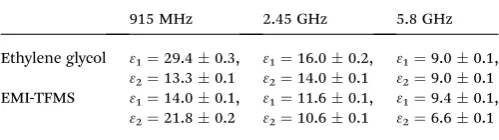
Some numerical values of complex permittivity of both liquids at spot frequencies of importance for microwave heating applications (namely 915 MHz, 2.45 GHz and 5.8 GHz) are shown in Table 1. The results obtained for ethylene glycol compare well with previously reported values.44Note that the
errors quoted in our data are systematic errors of around1% associated with the simple quasi-static model41used to model
the aperture admittance of the coaxial probe to convert micro-wave reectance data into complex permittivity values. Wend that both solvents have large measured values of32, conrming their effectiveness as microwave absorbers. In Fig. 2 we plot the rms power dissipated P (expressed in W cm 3 of solvent) calculated for axed internal electriceld of 10 kV m 1, as is typical in a microwave heating application, using our measured complex permittivities shown in Fig. 1. Wend that that the dissipated power densities are 72 and 95 W cm 3at 2.45 GHz for EMI-TFMS and ethylene glycol, respectively, which are sufficient to drive the high temperatures required for our reactions.
In a typical synthesis, stoichiometric amounts of iron precursor and LiH2PO4 were mixed with 10 ml solvent for 20
min at 30C before a heat treatment in the microwave chamber at 250C for 3 hours. The results from three experiments are presented here: (1) LFP_EG1 from iron oxalate dihydrate,
LiH2PO4 and ethylene glycol solvent, (2) LFP_EG2 from iron
acetylacetonate, LiH2PO4and ethylene glycol (note, temperature
is 220 C here) and (3) LFP_IL from iron oxalate dihydrate, LiH2PO4and ionic liquid EMI-TFMS solvent.
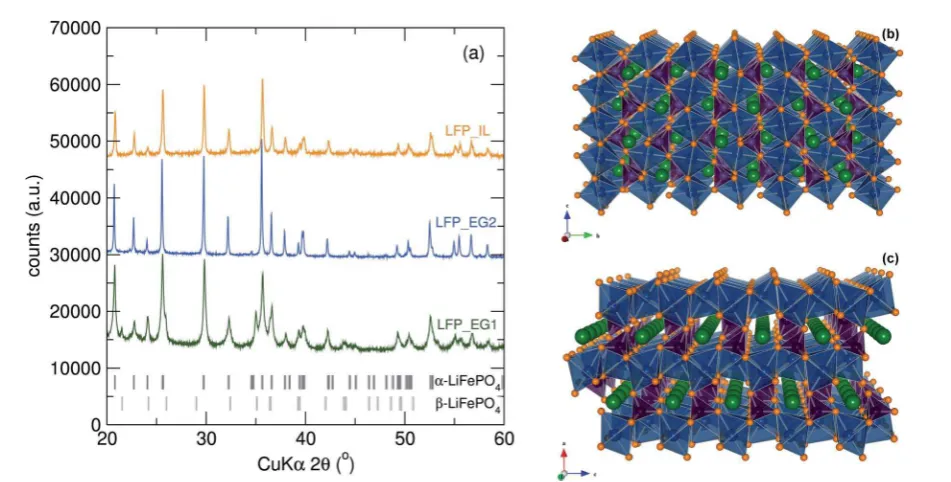
XRD patterns collected for each dried powder sample are shown in Fig. 3. For sample LFP1_EG with iron oxalate as a starting material and ethylene glycol as a solvent, a two-phase system is found with the pattern plotted in Fig. 3(a) matched to
PnmaLiFePO4and a high pressure LiFePO4phase which
crys-tallizes in theCmcmspace group. Heating this sample in a tube furnace under Ar at 600C for one hour completely transforms the high pressure phase toPnmaLiFePO4. This high pressure
Cmcmphase has been realised before by Garc´ıa-Moreno and co-workers at high pressures (tens of kbar) and temperatures (hundreds of degrees).45 Very recently Niederberger and
co-workers have observed this phase at much lower reaction temperatures and times (195 C, 3 min) for a nonaqueous microwave synthesis, whereby a change in the benzyl alcohol– 2-pyrrolidinone solvent ratio can be used to tailor the phase obtained.46 In our experiments, the solvent volume is held
Fig. 1 (a) Experimental data for the real part31of the complex permittivity3measured as a function of frequency for the polar liquid ethylene glycol (EG) and the ionic liquid EMI-TFMS. (b) The same plot, only this time for the imaginary part3
[image:4.595.303.553.93.163.2]2. No errors bars are shown but all data are subject to a systematic error of1% imposed by the aperture module of the coaxial probe used to extract the permittivity data.41
Table 1 Numerical values for the real part31and imaginary part32of the complex relative permittivity 3for the two solvents used in the microwave reactions, measured at 27.5 C and at the industrially
important heating frequencies of 915 MHz, 2.45 GHz and 5.8 GHz
915 MHz 2.45 GHz 5.8 GHz
Ethylene glycol 31¼29.40.3, 32¼13.30.1
31¼16.00.2, 32¼14.00.1
31¼9.00.1, 32¼9.00.1
EMI-TFMS 31¼14.00.1, 32¼21.80.2
31¼11.60.1, 32¼10.60.1
31¼9.40.1, 32¼6.60.1
Open Access Article. Published on 05 March 2014. Downloaded on 6/25/2019 4:14:29 PM.
This article is licensed under a
[image:4.595.48.551.451.692.2]constant while the solvent itself is changed. Using a controlled synthesis, we can monitor the vessel pressure during synthesis. For the LFP_EG1 reaction, the observed pressure is approxi-mately 5.86 bar once the reaction temperature of 250 C is reached. This build-up of pressure is due to the removal of the waters of crystallisation from the iron starting material, which occurs between 170C and 230C.47We believe it is this change
in pressure which drives the formation of the high pressure
phase in the ethylene glycol reaction. By employing Fe(acac)3
which has no water of crystallisation instead of Fe(C2O4)$2H2O,
we can obtain pure, single phasePnmaLiFePO4at 220C using
an ethylene glycol solvent. The X-ray pattern of this sample, LFP_EG2, was t by Rietveld prole analysis to the ortho-rhombicPnmaLiFePO4structure and is shown in Fig. 4(a). The
solubility of starting materials is also different, with Fe(acac)3
more soluble in ethylene glycol than the oxalate salt, as observed by the deep red colour of the solution prior to microwave treatment. The nature of the solvent is also of great importance in determining what phase is obtained, as demonstrated by the ionic liquid sample, LFP_IL. Using Fe(C2O4)$2H2O as a starting material and EMI-TFMS as solvent,
[image:5.595.50.287.47.272.2] [image:5.595.65.541.460.701.2]which has a greater dissipated power density than ethylene glycol, single phase Pnma LiFePO4 is obtained aer 3 hours
[Fig. 4(b)]. We have also studied the effect of reaction temper-ature on the phase obtained. For increasing reaction tempera-tures using ethylene glycol as a solvent and an iron oxalate starting material, we observe a two phase product made up ofa -andb-LiFePO4even up to reaction temperatures of 300C (see
XRD patterns in ESI, Fig. S1a†). In the case of EMI-TFMS as a solvent, we do not see the formation of theb-LiFePO4phase and
only obtaina-LiFePO4at temperatures above 250C (see XRD
patterns in ESI, Fig. S1b†). We are currently investigating the use of several commercial and tailored precursors to examine the effect of starting material and solvent on crystal chemistry in greater detail.
SEM images taken of dried powders of LFP_EG1 and LFP_IL reveal a dependence of particle morphology on the choice of solvent. In the case of LFP_EG1, large platelets are noted, with a typical platelet diameter of 6mm. The thickness of these plate-lets is of the order of 20 nm and they appear as clusters of stacked particles as shown in Fig. 5(a). A dramatic difference is
Fig. 3 (a) XRD data for LFP_EG1 reveals this is a two-phase system, comprising thePnmastructured LiFePO4(a-LiFePO4) and the high pressure
Cmcmphase (b-LiFePO4). These phases are depicted in (b)Cmcmhigh pressure LiFePO4and (c)PnmaLiFePO4.
Fig. 2 The rms dissipated power densityP(expressed in W cm 3), calculated from the permittivity data of Fig. 1 for a uniform internal electric field of magnitude 10 kV m 1, plotted as a function of frequency.
Paper Journal of Materials Chemistry A
Open Access Article. Published on 05 March 2014. Downloaded on 6/25/2019 4:14:29 PM.
This article is licensed under a
Creative Commons Attribution 3.0 Unported Licence.
noted for the LFP_IL sample, where more nanoparticulate material, which oen adopts geometric forms, is found to form
under the same reaction conditions. The typical particle size in this case is 200 nm and in some cases the particles appear faceted [Fig. 5(b)]. High resolution TEM images conrm the
highly crystalline nature of the LFP_IL sample [Fig. 5(d)], with lattice spacings consistent with Pnma LiFePO4. Larger,
[image:6.595.50.284.47.262.2] [image:6.595.49.284.412.650.2] [image:6.595.307.549.450.692.2]sheet-like particles are again observed for the LFP_EG1 sample [Fig. 5(c)].
mSR studies of Li+diffusion in nanoparticulate LiFePO4
In terms of structure, thePnmaLiFePO4phase is characterised
by open channels running in theb-direction through which Li+
ions can diffuse during electrochemical cycling, as shown in Fig. 3(c). The structure of theCmcmphase, shown in Fig. 3(b), is made up of rows of edge-sharing octahedral along thec axis, with PO4and LiO4tetrahedra running in theadirection.45As
demonstrated previously, the major structural difference between these polymorphs is in the Li–Li distances, with the high pressure phase increasing to a point at which the lithium hopping mechanism is no longer viable.46The electrochemical
properties of this phase have been investigated and it has been shown to be electrochemically inactive, with theoretical predictions in agreement with experiment.45,46
In order to probe the Li+ diffusion in the pure Pnmaand
Cmcm-containing nanosized LiFePO4 samples prepared here,
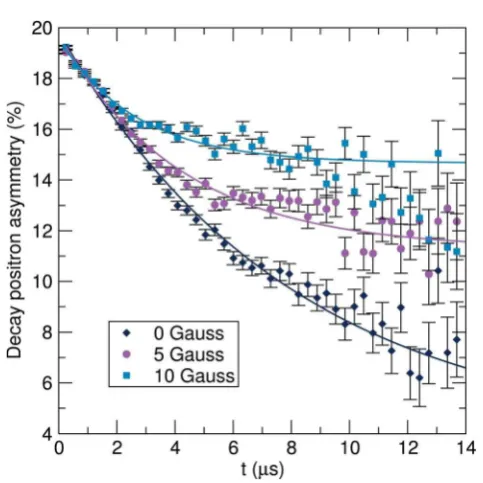
we recordedmSR data at zeroeld (ZF) and applied longitudinal elds (LF) of 5 G and 10 G. The typical raw data obtained for the LFP_IL sample, recorded at 300 K, are shown in Fig. 6. The initial positron asymmetry, regardless of applied eld, is approximately 17%. These measurements, which are taken above the antiferromagnetic ordering at TN (LFP_IL, 51 K;
LFP_EG, 49 K), contain a fast initial relaxation likely due to interactions with the paramagnetic iron moments and a slow relaxation from interactions with nuclear magneticelds from
7Li,6Li and31P. By applying a longitudinal
eld parallel to the
Fig. 4 Rietveld analysis was performed on single phase materials (a) LFP_EG2 [Rwp14.8%,Rexp4.15%,a¼10.327A,˚ b¼5.999˚A,c¼4.697A]˚ and (b) LFP_IL [Rwp14.3%,Rexp8.12%,a¼10.327A,˚ b¼6.003˚A andc¼
4.693A].˚
Fig. 5 SEM and TEM images of (a and c) LFP_EG1 and (b and d) LFP_IL, respectively. Large, stacked platelets and rods, with a typical thickness of 20 nm are noted for the EG1 sample, while more crystalline particles are seen for the IL sample. Long-range crystallinity throughout parti-cles of both samples was confirmed by HRTEM images, with (inset) Fourier transforms demonstrating long-range crystallographic ordering (c and d).
Fig. 6 RawmSR data for LFP_IL collected at 300 K at zerofield (ZF) [diamonds] and applied longitudinalfields of 5 G [circles] and 10 G [squares].
Open Access Article. Published on 05 March 2014. Downloaded on 6/25/2019 4:14:29 PM.
This article is licensed under a
direction of the beam, any interactions between the muon and the local nuclear magneticeld distribution that it probes can be eliminated. Fig. 6 demonstrates this decoupling, where it can be seen that the application of progressively larger LF (from 5 G to 10 G) reduces this slower relaxation rate. Similar observations have been reported for bulk LiFePO4.36–38
In order to probe the Li+diffusion dynamics in our samples, data were collected over a temperature range of 100 K to 400 K at ZF and LF of 5 G and 10 G. All data were t using three parameters: a combination of an exponentially relaxing signal to account for the initial fast relaxation from the iron magnetic moments, a baseline asymmetry and an exponentially relaxing dynamic Kubo–Toyabe function,30which has been modied to account foructuations due to muon or lithium diffusion and can be employed for an assumed Gaussian distribution of local elds.48 From these
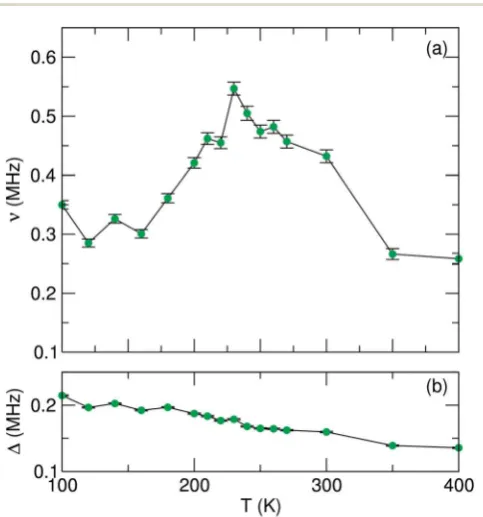
ts, we can extract parameters which provide us with insight into the Li+diffusion mechanism in our materials. In Fig. 7 and 8, we show the values ofn, the eld uctuation rate, andD, the localeld distribution at the muon stopping site, for data collected over the full temperature range. Data extracted for the single phase LiFePO4sample LFP_IL are
shown in Fig. 7. The values obtained forDare very similar to those observed for bulk LiFePO4samples reported previously,
i.e.a low temperature plateau followed by a smooth decrease to higher temperatures [Fig. 7(b)]. In the case of theuctuation rate, n, we again observe similar behaviour as seen for bulk LiFePO4. From 160 K, we see a steady increase until 230 K aer
which there is a sharp drop. The observed decrease innabove 240 K likely results from the Li+ di
ffusion being too fast for m+SR.38To evaluate the di
ffusion coefficient for Li+, we consider
only jumps of Li+ to interstitial sites and we take the primary
hopping axis to be in theb-direction. The distance travelled for each hop will be thereforeb/2, giving an estimation of the Li+
diffusion coefficient,DLi, fromb2n/4. For the LFP_IL sample, we
can extrapolatets of DLiversus1/Tto obtain a Li+diffusion
coefficient at 300 K of 6.25 10 10 cm2 s 1. This is in close agreement to bulk sample measurements.36,37
To determine the activation energy, we plot an Arrheniust tonover the thermally activated region to give an estimatedEa of 58 meV for the LFP_IL sample. This value is close to the bulk reported value from Bakeret al.who employed a Kerentting function to data and obtained anEavalue of 60 meV.36For bulk
LiFePO4prepared by ceramic methods and using similar Kubo– Toyabetting methods, Sugiyamaet al.have found Eavalues
close to 100 meV.37,38 The similarities in values obtained
demonstrate the robustness of this method for determining Li+
diffusion behaviour.
In the case of the LFP_EG1 sample (Fig. 8), we initially observe similar behaviour to the LFP_IL case, albeit with smallerDandnvalues. An increase innis noted with increasing temperature, but now a decrease aer 230 K is not seen. Instead, a steady increase is observed over the remaining temperature range. Given that this is a two phase system comprisingPnma
andCmcmLiFePO4, it is reasonable to assume that the initial
increase up to 230 K is due to Li+diffusion, similar to the case of the LFP_IL sample and previous observations for bulk samples. Previous reports on the high pressureCmcmphase have shown that this phase is inactive electrochemically, with DFT simula-tions establishing the poor Li+ mobility, with no hopping observed for the ions which rattle in voids.46 From Rietveld Fig. 7 Temperature dependence of (a)fluctuation rate (n) and (b)field
distribution width (D) parameters derived fromfittingmSR data to a dynamic Kubo–Toyabe function for the LFP_IL sample, measured
from 100 K to 400 K.
Fig. 8 Temperature dependence of (a)fluctuation rate (n) and (b)field distribution width (D) parameters derived fromfittingmSR data to a dynamic Kubo–Toyabe function for the LFP_EG1 sample, measured
from 100 K to 400 K.
Paper Journal of Materials Chemistry A
Open Access Article. Published on 05 March 2014. Downloaded on 6/25/2019 4:14:29 PM.
This article is licensed under a
Creative Commons Attribution 3.0 Unported Licence.
[image:7.595.311.544.46.289.2] [image:7.595.47.289.422.681.2]renement of our XRD pattern, the phase fraction of the sample isPnma:Cmcm80 : 20. Our experiments are in agreement with previous observations for the Cmcm phase, with a lower DLi
value of 3.9610 10cm2s 1obtained for the LFP_EG1 sample (Eact¼46 meV). We can therefore rationalise ournobservations
as follows for the LFP_EG1 sample. We continue to observe an increase in n due to diffusion in the Pnma phase, which is present in excess. However, the presence of theCmcm phase acts to limit the supply of Li+ ions which can diffuse. This impedes the lithium diffusion and results in a lowerDLivalue.
D
Conclusions
We have shown that a microwave-assisted synthetic approach for the preparation of LiFePO4 can allow for different particle
morphologies, including crystalline nanoparticles and platelets, and different phases (a- andb-LiFePO4) to be obtained in
gram-scale quantities and short reaction times. The microwave dielectric measurements of ethylene glycol and EMI-TFMS reveal these as excellent microwave absorbers to generate the temperatures required for our reactions to proceed.mSR has also proved a powerful tool to examine the Li+ diffusion in these nanomaterials, with nanocrystalline Pnma LiFePO4
exhibiting similar diffusion coefficients to bulk LiFePO4.
mSR has also revealed that the presence of the Cmcm phase impedes Li+mobility and leads to a decrease in Li+di
ffusion. In future, our investigations include varying the experimental conditions to allow for further tuning of the crystal chemistry and morphology, together with additionalmSR experiments on mixed metal phosphates.
Acknowledgements
This work was supported by funding from the EPSRC (EP/ K029290/1) and Royal Society (RG100301) and we thank the STFC for beamtime allocation. We also acknowledge and thank Prof. J. M. Tarascon for introducing us to the microwave synthesis of LiFePO4in ionic liquid media.
Notes and references
1 A. K. Padhi, K. S. Nanjundaswamy and J. B. Goodenough,
J. Electrochem. Soc., 1997,144, 1188.
2 A. K. Padhi, K. S. Nanjundaswamy, C. Masquelier, S. Okada and J. B. Goodenough,J. Electrochem. Soc., 1997,144, 1609. 3 J.-M. Tarascon and M. Armand,Nature, 2001,414, 359. 4 C. Masquelier and L. Croguennec, Chem. Rev., 2013, 113,
6552.
5 M. S. Whittingham,Dalton Trans., 2008, 5424.
6 A. Manthriam, A. Vadivel Murugan, A. Sarkar and T. Muraliganth,Energy Environ. Sci., 2008,1, 621.
7 S. S. Zhang, J. L. Allen, K. Xu and T. R. Jow,J. Power Sources, 2005,147, 234.
8 R. Dominko, M. Bele, M. Gaberscek, M. Remskar, D. Hanzel, S. Pejovnik and J. Jamnik, J. Electrochem. Soc., 2005, 152, A607.
9 Z. Lu, H. Chen, R. Robert, B. Y. X. Zhu, J. Deng, L. Wu, C. Y. Chung and C. P. Grey,Chem. Mater., 2011,23, 2848. 10 B. Ellis, W. H. Kan, W. R. M. Makahnouk and L. F. Nazar,
J. Mater. Chem., 2007,17, 3248.
11 J. Zhu, J. Fiore, D. Li, N. M. Kinsinger, Q. Wang, E. DiMasi, J. Guo and D. Kisailus,Cryst. Growth Des., 2013,13, 4659. 12 J.-M. Tarascon, N. Recham, M. Armand, J.-N. Chotard,
P. Barpanda, W. Walker and L. Dupont, Chem. Mater., 2010,22, 724.
13 N. Recham, L. Dupont, M. Courty, K. Djellab, D. Larcher, M. Armand and J.-M. Tarascon,Chem. Mater., 2009,21, 1096. 14 P. Barpanda, K. Djellab, N. Recham, M. Armand and
J.-M. Tarascon,J. Mater. Chem., 2011,21, 10143.
15 I. Bilecka and M. Niederberger, Nanoscale, 2010, 2, 1358– 1374.
16 I. Bilecka, A. Hintennach, I. Djerdj, P. Nov´ak and M. Niederberger,J. Mater. Chem., 2009,19, 5125.
17 T. Muraliganth, K. R. Stroukoffand A. Manthiram, Chem. Mater., 2010,22, 5754.
18 R. Tripathi, G. Popov, X. Sun, D. H. Ryan and L. F. Nazar,
J. Mater. Chem. A, 2013,1, 2990.
19 B. Ellis, L. K. Perry, D. H. Ryan and L. F. Nazar,J. Am. Chem. Soc., 2006,128, 11416.
20 P. P. Prosini, M. Lisi, D. Zane and M. Pasquali,Solid State Ionics, 2002,148, 45.
21 H. Xia, L. Lu and M. O. Lai,Electrochim. Acta, 2009,54, 5986. 22 A. Eekhari,Electrochim. Acta, 2010,55, 3434.
23 L. Lu,Electrochim. Acta, 2010,55, 3435.
24 D. Morgan, A. Van der Ven and G. Ceder,Electrochem. Solid-State Lett., 2004,7, A30.
25 M. S. Islam, D. J. Driscoll, C. A. J. Fisher and P. R. Slater,
Chem. Mater., 2005,17, 5085.
26 C. A. J. Fisher, V. H. Hart Prieto and M. S. Islam, Chem. Mater., 2008,20, 5907.
27 S.-I. Nishimura, G. Kobayashi, K. Ohoyama, R. Kanno, M. Yashima and A. Yamada,Nat. Mater., 2008,7, 707. 28 J. Cabana, J. Shirakawa, G. Chen, T. J. Richardson and
C. P. Grey,Chem. Mater., 2010,22, 1249.
29 C. Delacourt, L. Laffont, R. Bouchet, C. Wurm, J.-B. Leriche, M. Morcrette, J.-M. Tarascon and C. Masquelier,
J. Electrochem. Soc., 2005,152, A913. 30 S. J. Blundell,Contemp. Phys., 1999,40, 175.
31 J. Sugiyama, K. Mukai, Y. Ikedo, H. Nozaki, M. M˚ansson and I. Watanabe,Phys. Rev. Lett., 2009,103, 147601.
32 J. Sugiyama, Y. Ikedo, K. Mukai, H. Nozaki, M. M˚ansson, O. Ofer, M. Harada, K. Kamazawa, Y. Miyake, J. H. Brewer, E. J. Ansaldo, K. H. Chow, I. Watanabe and T. Ohzuku,
Phys. Rev. B: Condens. Matter Mater. Phys., 2010,82, 224412. 33 A. S. Powell, J. S. Lord, D. H. Gregory and J. J. Titman,J. Phys.
Chem. C, 2009,113, 20758.
34 A. S. Powell, Z. Stoeva, J. S. Lord, R. I. Smith, D. H. Gregory and J. J. Titman,Phys. Chem. Chem. Phys., 2013,15, 816. 35 A. Van der Ven and G. Ceder,Electrochem. Solid-State Lett.,
2000,3, 301.
36 P. J. Baker, I. Franke, F. L. Pratt, T. Lancaster, D. Prabhakaran, W. Hayes and S. J. Blundell, Phys. Rev. B: Condens. Matter Mater. Phys., 2011,84, 174403.
Open Access Article. Published on 05 March 2014. Downloaded on 6/25/2019 4:14:29 PM.
This article is licensed under a
37 J. Sugiyama, H. Nozaki, M. Harada, K. Kamazawa, O. Ofer, M. M˚ansson, J. H. Brewer, E. J. Ansaldo, K. H. Chow, Y. Ikedo, Y. Miyake, K. Oshishi, I. Watanabe, G. Kobayashi and R. Kanno, Phys. Rev. B: Condens. Matter Mater. Phys., 2011,84, 054430.
38 J. Sugiyama, H. Nozaki, M. Harada, K. Kamazawa, Y. Ikedo, Y. Miyake, O. Ofer, M. M˚ansson, E. J. Ansaldo, K. H. Chow, G. Kobayashi and R. Kanno, Phys. Rev. B: Condens. Matter Mater. Phys., 2012,85, 054111.
39 F. J. Douglas, D. A. MacLaren and M. Murrie,RSC Adv., 2012,
2, 8027.
40 D. M. P. Mingos and D. R. Baghurst,Chem. Soc. Rev., 1991,20, 1. 41 A. Sulaimalebbe, A. Porch, F. J. Vidal-Iglesias and G. Attard,
Microwave Symposium Digest, 2008 IEEE-MTT International, Atlanta, GA, 15–20 June 2008, pp. 1585–1588.
42 D. Slocombe, A. Porch, E. Bustarret and O. Williams,Appl. Phys. Lett., 2013,102, 244102.
43 H. Fr¨ohlich,Theory of Dielectrics, Clarendon, Oxford, 1958. 44 E. Hanke, K. von Roden and U. Kaatze,J. Chem. Phys., 2006,
125, 084507.
45 O. Garc´ıa-Moreno, M. Alvarez-Vega, F. Garc´ıa-Alvarado, J. Garc´ıa-Jaca, J. M. Gallardo-Amores, M. L. Sanju´an and U. Amador,Chem. Mater., 2001,13, 1570.
46 G. Zeng, R. Caputo, D. Carriazo, L. Luo and M. Niederberger,
Chem. Mater., 2013,25, 3399.
47 M. Hermanek, R. Zboril, M. Mashlan, L. Machala and O. Schneeweiss,J. Mater. Chem., 2006,16, 1273.
48 R. S. Hayano, Y. J. Uemura, J. Imazato, N. Nishida, T. Yamazaki and R. Kubo, Phys. Rev. B: Condens. Matter Mater. Phys., 1979,20, 850.
Paper Journal of Materials Chemistry A
Open Access Article. Published on 05 March 2014. Downloaded on 6/25/2019 4:14:29 PM.
This article is licensed under a
Creative Commons Attribution 3.0 Unported Licence.