Integrable boundary for quad-graph systems:
Three-dimensional boundary consistency
Vincent CAUDRELIER†, Nicolas CRAMP ´E ‡ and Qi Cheng ZHANG†
† Department of Mathematical Science, City University London,
Northampton Square, London EC1V 0HB, UK
E-mail: [email protected], [email protected] ‡ CNRS, Laboratoire Charles Coulomb, UMR 5221,
Place Eug`ene Bataillon - CC070, F-34095 Montpellier, France
E-mail: [email protected]
Received ???, in final form ????; Published online ???? doi:10.3842/SIGMA.201*.???
Abstract. We propose the notion of integrable boundary in the context of discrete in-tegrable systems on quad-graphs. The equation characterizing the boundary must satisfy a compatibility equation with the one characterizing the bulk that we called the three-dimensional (3D) boundary consistency. In comparison to the usual 3D consistency con-dition which is linked to a cube, our 3D boundary consistency condition lives on a half of a rhombic dodecahedron. The We provide a list of integrable boundaries associated to each quad-graph equation of the classification obtained by Adler, Bobenko and Suris. Then, the use of the term “integr2ab(able boundary” is justified by the facts that there are B¨acklund transformations and a zero curvature representation for systems with boundary satisfying our condition. We discuss the three-leg form of boundary equations, obtain asso-ciated discrete Toda-type models with boundary and recover previous results as particular cases. Finally, the connection between the 3D boundary consistency and the set-theoretical reflection equation is established.
Key words: Discrete integrable systems, Quad-graph equations, 3D-consistency, B¨acklund transformations, Zero curvature representation, Toda-type systems, Set-theoretical reflection equation
2010 Mathematics Subject Classification: ?????; ?????; ?????
Introduction
Discrete integrable systems arise from various motivations in applied or pure mathematics like the need to preserve integrability of certains continuous equations when performing numerical (and hence discrete) simulations or the theory of discrete differential geometry. In previous work concerning an important class of such systems known as integrable quad-graph equations [1], one of the original motivations was to study discrete differential geometry of surfaces. In this context, a general construction allows one to always obtain a discretization of the surface in terms of quadrilaterals [1], at least as long as one is only concerned with thebulk of the surface and does not worry about its boundary (if it has one). The vertices of the graph thus obtained can be seen as discrete space-time points where the field is attached. The dynamics of the field is then specified by an equation of motion involving the values of the field at the four vertices forming an elementary quadrilateral. Typically, this is of the form
Q(u00, u10, u01, u11;a, b) = 0, (1)
whereu00, u10, u01, u11are the values of the field at the vertices of the quadrilateral anda, bare
There exist several integrability criteria that different authors use to characterize the notion of discrete integrability. Let us mention for instance algebraic entropy [2], singularity confinement [3] or the 3D consistency/consistency around the cube condition [1, 4]. The latter is deeply related to the notion of discrete Lax pair, discrete B¨acklund transformations and other classical notions of integrability and, combined with a few other assumptions, led to the important ABS classification of quad-graph equations [5]. This fact and the similarity of the above structures with those existing in the case of continuous integrable systems make it a popular criterion.
In this paper, we want to propose a way of defining an integrable discrete system on a quad-graph with boundary as arising from the discretization of a surface while taking into account its boundary. From the geometric point of view, this is a natural generalization of the discrete differential geometry motivation to the case of a surface with boundary. From the point of view of discrete integrable quad-graph equations, this then allows us to tackle the problem of formulating the analog of the 3D consistency condition together with its consequences i.e.
B¨acklund transformations and zero curvature formulation. We also introduce Toda-type systems with boundary through the three-leg form of integrable equations on quad-graphs and we recover the previous approach to boundary conditions for discrete integrable systems presented in [6].
We give a precise definition of the discretization procedure and of a quad-graph with boundary in Sec. 1.1. Then we show how to define a discrete system on it. In addition to the elementary quadrilateral and the corresponding equation of motion (1), the new crucial ingredient is an elementary triangle together with the corresponding boundary equation of the form
q(x, y, z;a) = 0,
wherex, y, zare the values of the field at the vertices of the triangle, and a functionσdetermining the effect of the boundary on the labelling (see RHS of the Fig. 3). We provide our definition of integrability in this context by defining the 3D boundary consistency condition involving
Q, q and σ in Sec. 1.3 and then go on to present a method that allows us to find solutions for q and σ for a given Q in section 2. In section 3, we justify further our introduction of the 3D boundary consistency condition by discussing B¨acklund transformations and the zero curvature representation in the presence of a boundary. Section 4 introduces the three-leg form for boundary equations and we use this to define systems of Toda-type with boundary. As an example, we recover as particular case the approach to boundary conditions of [6] in (fully) discrete integrable systems. Finally, in section 5 we establish the connection between the 3D boundary consistency condition introduced in this paper and the set-theoretical reflection equation [7, 8] in the same spirit [9] as the 3D consistency condition is related to the set-theoretical Yang-Baxter equation [10]. Conclusions and outlooks are collected in the last section.
1
Integrable quad-graph systems with boundary
In this section, we first define the notion of quad-graph with boundary and then use it to define the elementary blocks needed to study integrable equations on quad-graphs with boundary.
1.1 Quad-graph with boundary
boundary and it is noted that Γ∗ is not a cellular decomposition of the surface. Nevertheless, in Section C.3 of [12], a notion of double is given for a surface with boundary (and not necessarily compact, like a half-plane) and we adapt it here for our purposes. In particular, we will see that the generic structure that arises is what we call a quad-graph with boundary with its faces being either quadrilaterals or “half quadrilaterals” i.e.triangles.
So let us consider a cellular decomposition G of our surface S with a boundary. We denote, respectively, by F,E and V the set of faces, edges and vertices of this cellular decomposition. Following [12] and adapting slightly, we defineG∗ as the following collection of cells withF∗,E∗
and V∗ respectively the sets of faces, edges and vertices.
• To each face inF, we associate a vertexv∗ inV∗ (called white), placed inside the face.
• To each edge e ∈ E not on the boundary, we associate the dual edge e∗ ∈ E∗ which cuts it tranversally and forms a path between the two white vertices contained in the two adjacents faces in F separated bye.
• To each vertexv∈V (called black) not on the boundary, we associate the face inF∗ that
contains it i.e.the face whose boundary is made of the edges in E∗ that cross the edges
inE having the vertex v under consideration as one of their ends.
Compared to Definition 6 of [12], in our definition of G∗, we include neither the dual edge
corresponding to an edge on the boundary nor the additional white vertex in the middle of an edge inE belonging to the boundary. A typical configuration of G and G∗ is shown in Fig. 1.
We now form the structure that we will call a quad-graph with boundary below. Let us denote
0 0 1 1 0 0 1 1 0 0 1 1 0 0 1 1 0 0 1 1 0 0 1
1 00
[image:3.595.97.503.460.615.2]1 1 0 0 1 1 0 0 1 1 0 0 1 1 0 0 1 1 0 0 1 1 0 0 1 1 0 0 1 1 0 0 0 1 1 1 0 0 0 1 1 1 0 0 1 1
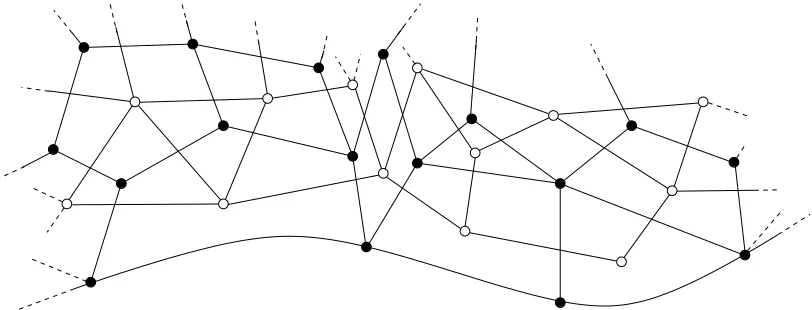
Figure 1: Example of a cellular decomposition G and of the associated G∗. The “horizontal” curved line is the boundary of the underlying surface S. The black dots and the straight lines connecting them are the vertices and edges of the initial cellular decomposition G. The white dots and the straight lines connecting them are the vertices and edges of G∗. Edges of G on the boundary and the boundary itself are identified in this picture.
it D. The vertices of D are all the black and white vertices i.e. VD =V ∪V∗. The edges of D
are all the edges in E that lie on the boundary of S together with those edges (w, b) obtained by connecting a white vertex to each of the black vertices sitting on the face that contains the white vertex1. The faces are then taken to be the interiors of the “polygons” thus obtained.
The result of this procedure forGand G∗ as in Fig. 1 is shown in Fig. 2. The faces are therefore
of two types:
1
• Quadrilaterals, with two black and two white vertices, in the bulk.
• Triangles, with two black vertices (on the boundary) and one white vertex (inside S), alongside the boundary.
0 0 1 1 0 0 1 1 0 0 1 1 0 0 1 1 0 0 1
1 0011
[image:4.595.102.503.206.361.2]0 0 1 1 0 0 1 1 0 0 1 1 0 0 1 1 0 0 1 1 0 0 1 1 0 0 1 1 0 0 0 1 1 1 0 0 0 1 1 1 0 0 1 1
Figure 2: Example of a quad-graph with boundary D. Black and white dots are the vertices of the double and the straight lines are edges. Edges of G on the boundary and the boundary itself are identified in this picture and form the rest of the edges ofD. Faces are therefore either quadrilaterals (with two black and two white alternating vertices) or triangles lying along the boundary (with two black vertices and one white vertex).
Definition 1. A quad-graph with boundary is the collection of vertices and edges ofDobtained as described above from a cellular decomposition of a surface with boundary.
As an important by-product, this procedure to get a quad-graph with boundary allows one to obtain a bipartite graph2. In addition, all the vertices on the boundary are of the same type. This property will be important in the construction of the Toda models in Sec. 4.
1.2 Discrete equations on quad-graph with boundary
We are now ready to define discrete equations on a quad-graph with boundary. As usual, we associate a field to this quad-graph (i.e. a function from V ∪V∗, the set of vertices, toC) and
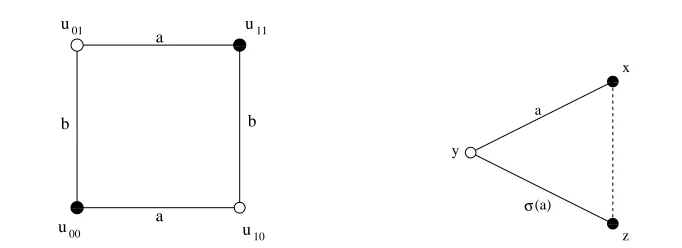
a constraint between the values of the field around a face. This constraint can be seen as the equation of motion for the field. For each quadrilateral face, the constraint is, as usual, defined by
Q(u00, u10, u01, u11;a, b) = 0, (2)
where u00, u10, u01, u11 ∈ C are the values of the field at each vertex around the face and
a, b∈Care parameters associated to opposite edges. One usually represents this equation as on the L.H.S. of Fig. 3. We will refer to equation (2) as describing the bulk dynamics. Sometimes, one demands additional properties [1] for the function Q(u00, u10, u01, u11;a, b) such as linearity
on each variable u00, u10, u01, u11 (affine-linearity), symmetry by exchange of these variables
(D4-symmetry), the tetrahedron property or the existence of the three-leg form (see section 4).
The new elementary building block needed to define a discrete system on a quad-graph with boundary is an equation of the following type defined on each triangular face
q(x, y, z;a) = 0, (3)
2
00 00 00 11 11 11
00 00 00 11 11 11
u00
a
a
b b
u u
u
01 11
10 00
00 00 11 11 11 00 00 00 11 11 11
a
y
z (a)
σ
[image:5.595.129.470.129.253.2]x
Figure 3: Elementary blocks to construct a discrete system with boundary.
wherex, zare values of the field on the boundary,ya value inside the surface andais a parameter associated to one edge (the other edge is associated to a function σ(a) of the parameter a). We represent this equation as on the R.H.S. of Fig. 3 where the dashed line represents the edge on the boundary of the surface. We will refer to this equation as describing the boundary dynamics. In general, there is no special requirement onqorσbut we will see that our methods to construct expressions forq result inq having certain properties:
• Linearity: the function q(x, y, z;a) is linear in the variables x and z. Let us emphasize that it may not be linear iny.
• Symmetry: one has σ(σ(a)) =a and
q(x, y, z;a) = 0 ⇔ q(z, y, x;σ(a)) = 0.
• In some cases, a three-leg form forqinherited from the three-leg form of the corresponding bulk equation Q= 0. We go back to this point in Sec. 4.
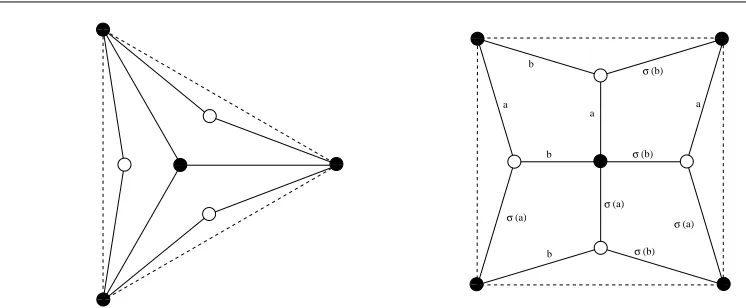
Let us remark that for a given quad-graph with boundary (and for σ being not the identity), it is not always possible to label the edges with parameters as prescribed above. We show on the L.H.S. of Fig. 4 a quad-graph with boundary for which we cannot find a suitable labelling. On the R.H.S., we show a case where this is possible. In the following, we consider only those quad-graph with boundary that can be labelled. It would be very interesting to study this combinatorial problem in general but this goes beyond the scope of this paper.
1.3 Integrability: the 3D boundary consistency condition
As explained in the introduction, we adopt the 3D consistency approach to integrable quad-graph equations. Let us first recall what it means in the bulk case [1, 4] before we introduce its boundary analog. The usual setup is depicted in L.H.S. of Fig. 5 where the bulk equation of motion Q = 0 is attached to each face of the cube. Given values of the field in the three independent directions of the cube, say u000, u100, u010, u001, there are three different ways of
computing u111 by repeated use of Q = 0. The 3D consistency condition requires that these
three possibilities give the same result foru111.
00 00 11 11
0 0 1 1
0 0 1 1
00 00 11 11
0 0 1 1
00 00 11 11 0
0 0 1 1 1 00
00 11 11
0 0 1 1
σ(a) σ(b)
σ(b)
σ(b) σ(a) σ(a)
b a a
b
a
[image:6.595.92.465.125.279.2]b
Figure 4: Two examples of quad-graphs with boundary (represented by a dashed line here). Only the one of the right-hand side can be labelled according to our rules for quadrilaterals and triangles.
Q= 0 andq = 0). Then, the 3D boundary consistency is the statement that, given the valuesx,
x1 andx2 of the field, the different schemes to compute w(see Fig. 5) lead to the same results.
More precisely, following the notations in Fig. 5, we get that, givenx,x1 andx2:
• the three equations
Q(y1, x2, x1, x;a, b) = 0, q(x, x1, y2;a) = 0, q(x, x2, y3;b) = 0, (4)
gives respectively the values of y1,y2 and y3.
• Then, both equations
Q(y1, z1, x2, y3;σ(b), a) = 0, Q(y1, z2, x1, y2;σ(a), b) = 0, (5)
gives respectively the values of z1 and z2.
• Finally, the three equations
q(y2, z2, w;b) = 0, q(y3, z1, w;a) = 0, Q(y1, z1, z2, w;σ(b), σ(a)) = 0, (6)
provides three ways to computew which must give the same answer.
Definition 2. We say that we solve the 3Dboundary consistency forqif, given a 3Dconsistent
Q, we find a function qof x, y, z, aand a function σ ofasuch that the scheme (4), (5), (6) gives a unique value for wgiven values for x,x1 and x2. In this case,q is called a solution of the 3D
boundary consistency condition (we omit explicit reference to σ which is taken as part of the solution). We also say thatq is compatible withQ.
Note that this should not be confused with the notion of a solution of the actual dynamics described by Q and q. Such a solution would consists in finding an expression for the field u
at each vertex of the quad-graph that satisfies the bulk and boundary dynamics. This is an exciting open question which deserves separate attention and is beyond the scope of the present paper.
0 0 1 1 0 0 1 1 0 0 1 1 0 0 1 1 u u u u u u u u000 b a c 100 010 1 001 101 111 011 110 00 00 00 11 11 11 00 00 00 11 11 11 0 0 0 1 1 1 0 0 0 1 1 1 00 00 00 11 11 11 σ(b) z2 (a) σ 2 y a y x x z 1 y1 x2 3 1 b w
Figure 5: 3D consistency and 3D boundary consistency. We recall that parallel edges carry the same parameter.
Definition 3. We call integrable equation on a graph with boundary the data of a quad-graph with boundary with compatible labelling as well as functions Q, q and σ which satisfy the 3D consistency and the 3D boundary consistency conditions.
We justify the adjective “integrable” in sections 3.1 and 3.2 by showing the presence of B¨acklund transformations and a zero curvature representation.
Let us emphasize that similar approaches have already appeared in the literature to introduce integrable boundaries in different contexts. Indeed similar figures to those in Fig. 5 appeared in [13, 14, 15] as the face representation of the reflection equation [16, 17]. The right-hand-side of Fig. 5 is also half of the figure representing the tetrahedron equation [18, 19]. There exists also a close connection between the set-theoretical equation introduced recently in [7, 8] and the 3D boundary consistency (see Sec. 5 for more details). Similar connections have been studied previously in the bulk case where the set-theoretical Yang-Baxter equation is linked to the 3D consistency condition [5, 9].
2
Solutions of the 3D boundary consistency
In this section, we provide a list of solutions of the 3D boundary consistency condition associated to the bulk equations Q classified in [5]. In other words, given Q, we want to find solutions q
and σ which satisfy the 3D boundary consistency conditions. The underlying idea is that this should provide integrable boundary conditions for integrable discrete equations characterized by
Q.
2.1 The ABS classification
For completeness, we list the solutions of the 3D consistency equations (2) obtained in [5].
(Q1) : a(u00−u01)(u10−u11)−b(u00−u10)(u01−u11) +δ2ab(a−b) = 0,
(Q2) : a(u00−u01)(u10−u11)−b(u00−u10)(u01−u11)
(Q3) : (b
2
−a2)(u00u11+u10u01) +b(a2−1)(u00u10+u01u11)
−a(b2−1)(u00u01+u10u11)−δ2(a2−b2)(a2−1)(b2−1)/(4ab) = 0,
(Q4) : sn(a)(u00u10+u01u11)−sn(b)(u00u01+u10u11)−sn(a−b)(u00u11+u10u01) +sn(a−b)sn(a)sn(b)(1 +K2u00u10u01u11) = 0,
(H1) : (u00−u11)(u10−u01) +b−a= 0,
(H2) : (u00−u11)(u10−u01) + (b−a)(u00+u10+u01+u11) +b2−a2 = 0,
(H3) : a(u00u10+u01u11)−b(u00u01+u10u11) +δ2(a2−b2) = 0,
(A1) : a(u00+u01)(u10+u11)−b(u00+u10)(u01+u11)−δ2ab(a−b) = 0,
(A2) : b(a
2−1)(u
00u01+u10u11)−a(b2−1)(u00u10+u01u11)
+(b2−a2)(u00u10u01u11+ 1) = 0.
We use the same labels (Q, H, A families) and forms that were used in [5], except for equation (Q4) which is in an equivalent form introduced in [20] where sn(a) = sn(a;K) is the Jacobi elliptic function with modulusK. It is worth noting that the 3D consistency condition as well as the affine-linearity, D4-symmetry and tetrahedron properties are preserved for each of the
equations up to common M¨obius transformations on the variables u00, u10, u01, u11 and point
transformations on the parameters a, b.
2.2 Method and solutions
Instead of performing brute force calculations where one could make assumption on the form of q (like multilinearity in the variables) and insert in the 3D boundary consistency condition for a given Q, below we describe a simple method that amounts to “fold”, in a certain sense,Q
to obtain compatible q’s. Although it may seem ad hoc and arbitrary, this method has several motivations. First, it gives a simple way to obtain three-leg forms for q knowing the ones for
Q and hence a way to introduce discrete Toda-type systems with boundary. This is explained in Sec. 4. Second, the method is a simple adaptation of the folding method that was used in [8] to obtain reflection maps i.e. solutions of the set-theoretical reflection equation. This last point is discussed in more detail in Sec. 5. There, we present an alternative method to find admissible q’s starting from reflection maps. This alternative method produces some of the solutions that are also obtained with the method that we explain here. But more importantly, this alternative method establishes a deep connection between solutions of the 3D boundary consistency condition and reflection maps. This is reminiscent of the deep connection between solutions Q of the 3D consistency condition (in particular the ones of the ABS classification) and quadrirational Yang-Baxter maps [28].
Now, given Q satisfying the 3D consistency condition, we look for q(u00, u10, u11;a) of the
form
q(u00, u10, u11;a) =Q(u00, u10, k(u00, u10;a), u11;a, σ(a)), (7)
satisfying the 3D boundary consistency condition, wherekand σ are the functions to be deter-mined. Equation (7) may be seen as the folding along the diagonal (u00, u11) of the quadrilateral
in Fig. 3 to get the triangle (u00, u10, u11). Obviously, one may fold along the other diagonal
but, due to the D4-symmetry of Q, we get the same results.
To find k and σ (and hence q), for each given Q, we insert our ansatz (7) in the scheme (4)-(6) and try to find functionskand σ that fulfill the resulting constraints. We note that the following “trivial” choice
is always a solution of the problem for anyQ. It yields q(u00, u10, u11;a) =au10(u00−u11). We
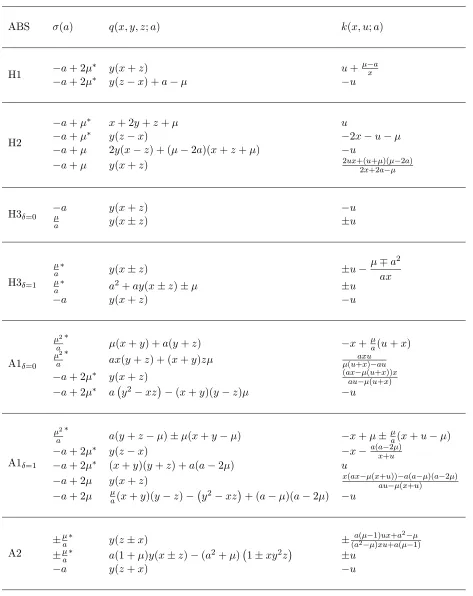
report in Tables 1 and 2 the nontrivial functionsk,σ and q we found for the differentQ’s of the Q, H and A families of the ABS classification. Note that we make no claim of completeness. A method for a systematic classification is in fact an interesting open problem.
3
Other aspects of integrable equations on quad-graphs with
boundary
In this section, we present results on important traditional aspects of integrability obtained from the 3D boundary consistency equation. They justify a posteriori our definition of integrability for quad-graphs with boundary.
3.1 B¨acklund transformations
In this subsection, we prove that the 3D boundary consistency condition proposed in the previous section leads naturally to B¨acklund transformations which are a basic tool in the context of classical integrability and soliton theory. This result is similar to the one without boundary [5] and is summarized in the following proposition:
Proposition 1. Let us suppose that we have an integrable equation on a quad-graph with bound-ary (with the set of all its vertices denoted as V) as well as a solution, g:V →C. There exist
a two-parameter solution g+ of the same integrable quad-graph equation and a function f from V to Csatisfying
Q(g(v), g(v1), f(v), f(v1);a, λ) = 0, Q(f(v), f(v1), g+(v), g+(v1);a, σ(λ)) = 0,
for all edges (v, v1) of the quad-graph not on the boundary of the surface (a is the parameter
associated to this edge), and
q(g(v2), f(v2), g+(v2);λ) = 0,
for all vertices v2 on the boundary of the quad-graph. We call the solution g+ the B¨acklund
transform of g.
Proof: The proof follows the same lines as in the case without boundary. We start with the quad-graph with boundary, called in this proof the ground floor. We consider also two other copies of the surface, called first and second floor, of the ground floor. Then, we construct a 3D
graph by the following procedure (see also Fig. 6):
• There is a one-to-one correspondence between the vertices of the ground floor and the ones of the first floor but one moved the vertices of the first floor such that no vertex of the first floor lies on the boundary of the surface (see L.H.S. of the Fig. 6). The vertices on the second floor is an exact copy of the ones on the ground floor.
• We copy the edges in the bulk of the ground floor on the first and second floor. The copies carry the same label. We copy the edges on the boundary of the ground floor only on the second floor.
ABS σ(a) q(x, y, z;a) k(x, u;a)
Q1δ=0 µ2
a
∗
a(y−z) +µ(x−y) x+ µa(x−u)
µ2
a
∗
ax(y−z) +µz(y−x) au+axuµ(x−u) −a+ 2µ∗ y(x+z) µxu+(a−µ)x2
(a−µ)u+µx
−a+ 2µ∗ a y2−xz
+ (x−y)(y+z)µ −u
Q1δ=1 µ2
a
∗
a(y−z−µ)±µ(y−x−µ) x+µ±µa(u−x−µ) −a+ 2µ∗ y(x−z) x+ a(a−2µ)
x−u
−a+ 2µ∗ (y−x)(y−z) +a(a−2µ) u
−a+ 2µ y(x+z) x(ax−µ(xau−u+))µ−(xa−(au−)µ)(a−2µ) −a+ 2µ (y2−xz) +µa(x−y)(y+z)−(a−µ)(a−2µ) −u
Q3δ=0
±µa
∗
y(x±z) ±(((aa22−−µµ))xu−−aa(1(1−−µµ))ux)x
±µa
∗
(a2+µ) y2±xz
−a(1 +µ)y(x±z) ±u
−a y(x+z) −u
Q3δ=1 µ
a y(x±z)
a(µ∓1)xu−(µ∓a2
)x2
+1 4(a
2−
1)(a2−µ2
)1
µ∓
1
a2
(a2∓µ
)u−a(1∓µ)x µ
a
a(µ±1)y(x±z)−(µ±a2)(y2±xz)
±u
+14(µ1 ±a12)(a2−1)(a2−µ2)
−a y(x+z) −u
Q4 −a y(x+z)
x2−sn2
(a) u(1−K2sn2(a)x2)
[image:10.595.73.585.189.688.2]−a sn2(a)(K2y2xz−1) +y2−xz −u
ABS σ(a) q(x, y, z;a) k(x, u;a)
H1 −a+ 2µ
∗ y(x+z) u+µ−a
x
−a+ 2µ∗ y(z−x) +a−µ −u
H2
−a+µ∗ x+ 2y+z+µ u
−a+µ∗ y(z−x) −2x−u−µ
−a+µ 2y(x−z) + (µ−2a)(x+z+µ) −u
−a+µ y(x+z) 2ux+(2xu+2+µa)(−µµ−2a)
H3δ=0 −µa y(x+z) −u
a y(x±z) ±u
H3δ=1 µ a
∗
y(x±z) ±u−µ∓a
2
ax
µ a
∗
a2+ay(x±z)±µ ±u
−a y(x+z) −u
A1δ=0 µ2
a
∗
µ(x+y) +a(y+z) −x+µa(u+x)
µ2
a
∗
ax(y+z) + (x+y)zµ µ(u+axux)−au
−a+ 2µ∗ y(x+z) (ax−µ(u+x))x au−µ(u+x)
−a+ 2µ∗ a y2−xz
−(x+y)(y−z)µ −u
A1δ=1 µ2
a
∗
a(y+z−µ)±µ(x+y−µ) −x+µ± µa(x+u−µ) −a+ 2µ∗ y(z−x) −x−a(a−2µ)
x+u
−a+ 2µ∗ (x+y)(y+z) +a(a−2µ) u
−a+ 2µ y(x+z) x(ax−µ(xau+u−))µ−(xa+(au−)µ)(a−2µ) −a+ 2µ µa(x+y)(y−z)− y2−xz
+ (a−µ)(a−2µ) −u
A2
±µa
∗
y(z±x) ±(aa(2µ−−µ1)ux+a2−µ
)xu+a(µ−1)
±µa
∗
a(1 +µ)y(x±z)−(a2+µ) 1±xy2z
±u
[image:11.595.70.543.154.750.2]−a y(z+x) −u
• the set of faces is the union of the following sets: (i) the triangular and quadrilateral faces of the ground and second floor; (ii) the quadrilateral faces of the first floor; (iii) the “vertical” quadrilateral faces made from the edges of the ground floor, the corresponding ones of the first floor and the vertical edges linking the vertices of these edges, and similarly between the first and second floors; (iv) the “vertical” triangular faces made of the edges linking the vertices on the boundary of the ground and second floors and the corresponding vertex of the first floor (which is not on the boundary).
0 0 1 1 0 0 1 1
0 0 1 1
0 0 1 1 00 00 11 11
0 0 1 1
1 f(v )
1 f(v )
1 + g (v ) +
σ(λ)
g(v ) f(v)
g(v)
1 f(v)
λ
[image:12.595.162.458.256.500.2]g(v)
Figure 6: The figure on the left shows the ground floor (white vertices and thick lines connecting them) and the first floor (gray vertices and thick lines connecting them) corresponding to a typical configuration near the boundary. The first floor and the second one (black vertices and thick lines connecting them) is shown on the figure on the right. The thin lines correspond to the edges linking the different floors: they carryλ on the left andσ(λ) on the right.
We impose now that the values of the field living on this 3Dgraph be constrained byQ= 0 on each quadrilateral face and byq = 0 on each triangular faces.
As in the case without boundary, due to the 3D consistency condition, given a function g
satisfying the constraints on the ground floor, one can get a functionf satisfying the constraint on the first floor depending on λ and on the value of f at one vertex of the first floor. This functionf satisfies, in particular, Q(g(v), g(v1), f(v), f(v1);a, λ) = 0.
Knowing the value of the field at one vertex on the boundary of the ground floor (say
g(v1) on the figure) and the corresponding value on the first floor (f(v1)), we get the value
g+(v1) of the field g+ at the corresponding vertex of the second floor using the equation
q(g(v1), f(v1), g+(v1), λ) = 0 which connects the white, grey and black copies of the vertex
v1.
We obtain a functiong+satisfying the constraints of the second floor usingQon the “vertical”
quadrilateral faces between the first and second floors. The important point is to remark that due to the 3D consistency and the 3D boundary consistency conditions, all the different ways to obtain the values of g+ give the same result. We may see this geometrically since the only
functions Q and q are chosen such that they satisfy the 3D consistency and the 3D boundary consistency conditions, the different ways to compute the values of the field g+ are consistent.
Finally, using the fact that the second floor is an exact copy of the ground floor,g+ satisfies the constraints of the original quad-graph equations.
Let us remark that the main difference between the cases with and without boundary lies in the necessity of an additional, intermediate floor in the case with boundary. This feature appeared previously in the context of asymmetric quad-graph equations [22]. Let us emphasize that the function f defined on the intermediate floor is not in general a solution of the same equations on a quad-graph with boundary since the values of the field on the vertices of the “would-be” boundary of the first floor do not necessarily satisfy an equation of the type (3).
3.2 Zero curvature representation
It is well established that a 3Dconsistent systemQ(u00, u10, u01, u11;a, b) admits a zero curvature
representation [1, 4, 23] i.e. there exists a matrixLdepending on values of the field on the same edge, the parameter associated to this edge and a spectral parameter λsuch that the following equation holds3
L(u11, u10, b;λ) L(u10, u00, a;λ) = L(u11, u01, a;λ) L(u01, u00, b;λ). (9)
There exists a constructive way to get L from Q [1, 4]: due to the linearity of the function
Q, we can rewrite equivalently equation (2) as follows
u11=L(u10, u00, a;b)[u01], (10)
whereL is a 2 by 2 matrix describing, with usual notations, a M¨obius transformation
L[z] = αz+β
γz+δ where L=
α β γ δ
.
Geometrically, using Fig. 5, it is easy to show that the matrix (10) satisfies the zero curvature equation (9) ifQ satisfies the 3D consistency [1, 4, 23].
Similarly, we want to show that the 3Dboundary consistent system admits a zero curvature representation. For the boundary equation q(x, y, z;a) = 0, we propose the following zero curvature representation
K(z;c) L(z, y, σ(a);c) L(y, x, a;c) = L(z, y, σ(a);σ(c)) L(y, x, a;σ(c))K(x;c), (11)
whereK is also a 2 by 2 matrix. We can now state the following results justifying the previous definition:
Proposition 2. All the examples of boundary equations q(x, y, z;a) = 0 displayed in Tables 1 and 2 as well as the trivial solution (8) can be represented by equation (11) where K(x;a)[u]
is the 2 by 2 matrix describing the function k(x, u;a), understood as a M¨obius transformation w.r.t. u with polynomial coefficients inx anda.
Proof: We give the details of the proof for the case given in the first row of the Table 1 i.e.
we deal with the bulk equation Q1δ=0 given by
Q(u00, u10, u01, u11;a, b) =a(u00−u01)(u10−u11)−b(u00−u10)(u01−u11),
3
and the boundary equation characterized by
q(x, y, z;a) =a(y−z) +µ(x−y) with σ(a) = µ
2
a , k(x, u;a) =
−µu+x(µ+a)
a , (12)
The matrix Lassociated to this Q is given by
L(y, x, a;b) = √ 1
b√b−a(x−y)
ay+b(x−y) −axy a −ax+b(x−y)
. (13)
It is a known result that equation (9) with this choice forLis satisfied ifQ(u00, u10, u01, u11;a, b) =
0 but it is easily verified. Let us mention that the parameters entering in the square roots of the normalisation ofLmay be negative. Therefore, one must choose a branch cut for the square root appearing in the normalisation: we choose the half-line {ix| x <0}.
The matrix K associated to the functionkgiven by (12) is
K(x;a) = −1 (
a µ+ 1)x
0 aµ
!
.
By algebraic computation, one gets
K(z;c) L(z, y, σ(a);c) L(y, x, a;c)−L(z, y, σ(a);σ(c)) L(y, x, a;σ(c))K(x;c)
∝q(x, y, z;a)
a(y−z) −ax(y−z) +cz(y−x)
0 c(y−x)
.
Therefore, if q(x, y, z;a) = 0, relation (11) holds. That proves the proposition for this case. All the other cases are treated similarly which finishes the proof of the proposition.
Note that equation (11) provides a rather general framework for the representation of an integrable boundary in quad-graph models. In the next section, we show how it contains as a particular case a previous approach to boundary conditions in fully discrete systems.
4
Toda-type models
4.1 Three-leg form
It is known that any quad-graph equation Q(x, u, v, y;a, b) = 0 of the ABS classification can be written equivalently in the so-called three-leg form [1], either in an additive form,
ψ(x, u;a)−ψ(x, v;b) =φ(x, y;a, b), (14)
or a multiplicative form,
ψ(x, u;a)/ψ(x, v;b) =φ(x, y;a, b). (15)
As demonstrated in [1, 23], the existence of a three-leg form leads to discrete systems of Toda-type [25]. Indeed, letx be a common vertex of thenfaces (x, yk, xk, yk+1) (with k= 1,2, . . . , n
and yn+1 =y1) with the parameters ak assigned to the edge (x, yk). On each face, there is the
equationQ(x, yk, yk+1, xk;ak, ak+1) = 0 written in the presentation (14) or (15). Then, summing
the correspondingn equations of type (14), one gets
n
X
k=1
wherean+1=a1. Similarly, multiplying nequations of the type (15) leads to
n
Y
k=1
φ(x, xk;ak, ak+1) = 1,
where an+1 = a1. When the graph is bi-partite (for example with black and white vertices),
we can reproduce this procedure by taking as common vertices all the black vertices to get a Toda-type model on the black subgraph.
Now assume that the boundary equation q(x, y, z;a) = 0 can be written as
ψ(y, x;a)−ψ(y, z;σ(a)) =ϕ(y;a) or ψ(y, x;a)/ψ(y, z;σ(a)) =ϕ(y;a), (16)
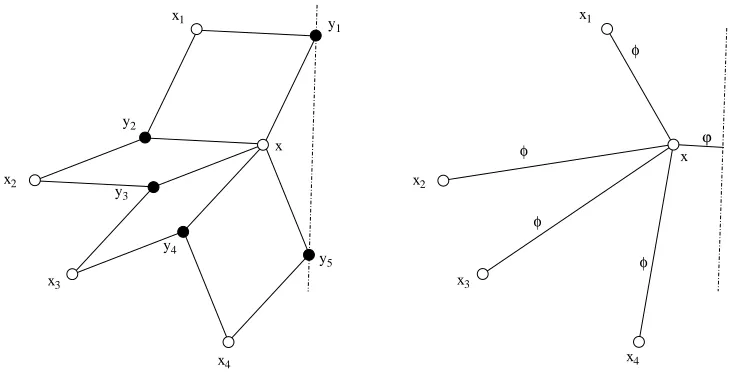
where the functionψis the same as in the bulk case and the new functionϕdepends only on the central vertex of the triangle representing the boundary and on the parametera. In this case, one can obtain systems of Toda-type with boundary. Indeed, letxbe a vertex close to the boundary (i.e. belonging to a triangle but not sitting on the boundary) and common ton−1 quadrilateral faces (x, yk, xk, yk+1) (withk= 1,2, . . . , n−1). As in the bulk case, on each quadrilateral face,
there is the equation Q(x, yk, yk+1, xk;ak, ak+1) = 0 written in the presentation (14) or (15).
On the triangular face, it holds thatq(yn, x, y1;an) = 0 (with a1 =σ(an)). Then, summing (or
multiplying) the correspondingnequations, we get in the additive case
ϕ(x;an) + n−1
X
k=1
φ(x, xk;ak, ak+1) = 0,
and in the multiplicative case
ϕ(x;an) n−1
Y
k=1
φ(x, xk;ak, ak+1) = 1.
We illustrate this procedure schematically in Fig. 7 forn= 4.
y1
x1 x1
x2
x3
x4
x2
x3
x4 x
y
y
y
y5 4
3 2
φ
φ
φ
[image:15.595.116.481.533.719.2]φ ϕ x
Figure 7: Faces adjacent to the vertex x near a boundary (Left). Star graph from the white subgraph where the edges carry the functions associated appearing in the Toda-type equation (Right).
to get a Toda-type model on a subgraph and with a boundary determined byϕ. The conditions on the graph seem, at first glance, very restricting. Nevertheless, the procedure explained in Sec. 1.1 provides, starting from any graph, examples satisfying such constraints.
4.2 Boundary conditions for Toda-type systems
In general, it seems that not all the solutions for q found previously can be written as in (16). However, it turns out that for each solution q(x, y, z;a) for which the corresponding function
k(x, y;a) depends only on y or the function q(x, y, z;a) factorizes asf(y, a)g(x, z, a), there is a way to obtain ϕ from φ. This is reminiscent, at the three-leg form level, of the simple folding procedure (7) used to obtain q from Q. In these cases, the function k(x, y;a) plays the role of the cut-off constraint (or boundary condition) for the Toda-type model in the sense of [6] (see Example 3 below for a precise connection).
For the first case where the functionk(x, u;a) =k(u;a) does not depend onx, using equation (7) in (14) or (15) together with the D4-symmetry property for Q, one can see that equation
(16) with the following functionϕ
ϕ(y;a) =φ(y, k(y;a);a, σ(a)), (17)
is equivalent to the corresponding boundary equation q(x, y, z;a) = 0. Therefore, by using the explicit forms of φgiven in [5] associated to eachQof the ABS classification and the results of Tables 1 and 2, we can deriveϕand hence three-leg forms of the boundary equation in the form (16). In turn, this allows us to define Toda-type systems with a boundary.
Example 1. The trivial solution (8) always corresponds toϕ(y;a) = 0 for the additive case or
ϕ(y;a) = 1 for the multiplicative case. This boundary condition may be interpreted as a free boundary for the corresponding Toda-type system.
Example 2. We recall thatψ(x, u;a) = x−au andφ(x, y;a, b) =ψ(x, y;a−b) forQ1δ=0. Looking
at the fourth solution for Q1δ=0 of Table 1,i.e. σ(a) =−a+ 2µ andk(x, y;a) =−y, we obtain
ϕusing (17) and the following discrete Toda-type system with a boundary term:
an−µ
x +
n−1
X
k=1
ak−ak+1
x−xk
= 0.
For the second case where the function q(x, y, z;a) factorises, the construction is a bit more involved. The equation q(x, y, z;a) = 0 constrains x and z independently of the values of y. Therefore, we get equations involving only the values of the field on the boundary. Let us suppose we solve these constraints on the boundary and denote by ¯x the corresponding solution for the fieldx. These values on the boundary play the role of parameters in the functionk(¯x, y;a) appearing in the boundary conditions. Also, one can see that equation (16) involves the following functionϕ¯x
ϕx¯(y;a) =φ(y, k(¯x, y;a);a, σ(a)),
and is equivalent to the corresponding boundary equation q(¯x, y,z¯;a) = 0. It also appears in the corresponding Toda-type system with boundary. We now illustrate this case.
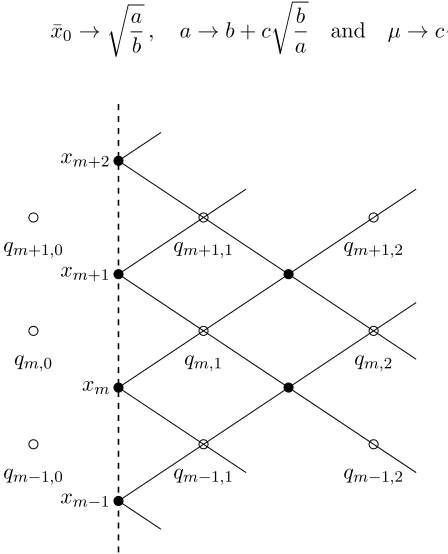
Example 3. Let us restrict our general framework to a Z2 lattice system: we consider the quad-graph with boundary represented on Fig. 8 with the bulk equations given by Q1δ=0 with
the label a on the lines m−n= const and the label b 6= a on the lines m+n =const. The corresponding Toda-type model reads, for n≥2,
1
qm,n+1−qm,n −
1
qm,n−qm,n−1
= 1
qm+1,n−qm,n −
1
qm,n−qm−1,n
We use the third solution for q forQ1δ=0 in Table 1 to generate the boundary condition on the
Toda-type system from the following boundary equation4
q(¯xm, qm,1,x¯m+1;a) = 0⇔x¯m+ ¯xm+1 = 0,
on the quad-graph with boundary. It is obvious that the general solution for the boundary values of the field is ¯xm = (−1)m x¯0 (for any ¯x0). Then, following the procedure of folding explained
in Sec. 2.2, we obtain
qm,0 =k(¯xm, qm,1;a). (19)
where
k(¯xm, qm,1;a) =
µ(−1)mx¯
0qm,1+ (a−µ)¯x20
(a−µ)qm,1+µ(−1)mx¯0
.
In particular, we recover exactly the results of [6] (equations (13) and (17)) for the model (18) (equation (3) of [6]) with the identifications
¯
x0 →
r
a
b, a→b+c
r
b
a and µ→c
r
b
a, (20)
qm,0 qm,1 qm,2
qm+1,0
qm−1,0
qm+1,1 qm+1,2
qm−1,1 qm−1,2
xm+2
xm+1
xm
[image:17.595.74.298.369.646.2]xm−1
Figure 8: A quad-graph with boundary with an underlying Z2 lattice structure. The additional white vertices will play the role of boundary ver-tices for the Toda-type system with boundary living on the white sublattice.
qm,0 qm,1 qm,2
qm−1,0
qm+1,0 qm+1,1
qm−1,1 qm−1,2
qm+1,2
xm+2
xm+1
xm
xm−1
Figure 9: The (white) Z2 (sub)lattice support-ing the Toda-type system with a boundary. Our boundary is inserted between the boundary for the Toda-type system at siten= 0 and the first site of the bulk system atn= 1.
4.3 Lax presentation of boundary conditions for a Toda-type model
In the previous example 3, we showed that we can recover the boundary conditions introduced in [6]. In this subsection, we show that the correspondence goes beyond this and is in fact also
4
[image:17.595.321.576.389.646.2]valid at the level of the zero curvature representation. Indeed, our zero curvature representation (11) allows us to recover as a particular case the main equation of [6], which we reproduced as (21) below, and which encodes the symmetry approach to integrable boundary conditions applied to integrable discrete chains. For clarity, we restrict our discussion of this connection to the case treated already in example 3 above. But we believe that the argument is easily generalizable to most Toda-type models.
Let us first recall that the boundary condition (19) was obtained in [6] by analysing the matrix equation
H(m+ 1, λ)A(m,0, λ) =A(m,0, h(λ))H(m, λ), (21)
whereA(m, n, λ) is the “discrete time” part of the discrete Lax pair (evaluated at the siten= 0 of the boundary),his some function acting on the parameterλandH(m, λ) is a matrix encoding an extra linear symmetry at the site of the boundary (see eqs (14) and (15) in [6]) and effectively producing allowed integrable boundary conditions.
The main result here is that our zero curvature representation boils down to (21) thanks to a remarkable “fusion” property of the two matrices L which then become A and the fact that our matrix K becomes the matrix H. This goes as follows. The zero curvature representation based on Fig. 8 reads
K(xm+1;c)L(xm+1, qm,1, σ(a);c)L(qm,1, xm, a;c)
=L(xm+1, qm,1, σ(a);σ(c))L(qm,1, xm, a;σ(c))K(xm;c),
where
L(y, x, a;b) = 1 (x−y)
ay+b(x−y) −axy a −ax+b(x−y)
,
and
K(x;c) =
µx (c−µ)x2
(c−µ) µx
.
Now, Using the three-leg form
ψ(qm,1, xm+1;σ(a))−ψ(qm,1, xm;a) =φ(qm,1, qm,0;σ(a), a),
and performing calculations similar to those in [1] (Proposition 11), one finds
L(xm+1, qm,1, σ(a);c)L(qm,1, xm, a;c) =c L(qm,0, qm,1, σ(a)−a;c−a).
It remains to perform the changes of parameters as in (20), together with
c→(2λ+ 1)b+c
r
b
a, (22)
to obtain
L(xm+1, qm,1, σ(a);c)L(qm,1, xm, a;c) = 2b (2λ+ 1)b+c
r
b a
!
σ3A(m, n, λ)σ3,
whereσ3 is the usual 2×2 Pauli matrix. This also yields
K(xm;c) =
(−1)mc (2λ+ 1)a
(2λ+ 1)b (−1)mc
= (−1)mH(m, λ).
This is completely equivalent to the results obtained in [6] up to an irrelevantc→1/c substitu-tion in H. Note that the map λ7→ h(λ) =−λ−1 is also correctly reproduced with our choice
5
Connection between
3
D
boundary consistency and the
set-theoretical reflection equation
5.1 General approach
In [9], a nice approach was described to obtain a relation between a 3D consistent quad-graph equation and a Yang-Baxter map thus yielding a connection between 3D consistency and the set-theoretical Yang-Baxter equation [10]. It is based on the use of symmetries of the equation
Q = 0 and the identification of invariants under these symmetries. Our idea is to extend this connection at the level of reflection maps and integrable boundary equations thus yielding a connection between the 3D boundary consistency introduced here and the set-theoretical reflection equation introduced in [7, 8]. First, let us recall the method of [9]. Given a quad-graph equation
Q(u00, u10, u01, u11;a, b) = 0, (23)
let Gbe a connected one-parameter group of transformations acting on the variablesuij
Gǫ: (u00, u10, u01, u11)7→(ˆu00,uˆ10,uˆ01,uˆ11).
This transformation is said to be a symmetry of (23), if
Q(ˆu00,uˆ10,uˆ01,uˆ11;a, b) = 0,
whenever (23) holds. The corresponding infinitesimal action reads
vQ= 0,
where
v=η00
∂ ∂u00
+η10
∂ ∂u10
+η01
∂ ∂u01
+η11
∂ ∂u11
,
withη being the characteristic of Gspecified by
ηij =
d
dǫGǫ(uij).
Methods to obtain the characteristic η can be seene.g. in [26, 27]. Knowingv, the idea is then to define alattice invariant I of the transformation group Gwhich satisfies
vI = 0,
and to use it to define the Yang-Baxter (or edge) variables (X, Y, U, V) from the vertex variables (u00, u10, u01, u11) by
X=I(u00, u10), Y =I(u10, u11), U =I(u01, u11), V =I(u00, u01),
and assign them to the edges of an elementary quadrilateral as shown in Fig. 10. Once the infinitesimal generator vis known, one can solve forI.
An important result of [9] is that the variables X, Y, U, V are related by a map (U, V) =
R(X, Y) which is a Yang-Baxter map, provided the quad-graph equation determined by Q
u00
p
(X, a) u10
q (Y, b) u11
p
(U, a)
u01
q
[image:20.595.227.371.140.262.2](V, b)
Figure 10: Link between quad-graph equation and Yang-Baxter map.
the invariant properly, the Yang-Baxter map R can be recognized as one canonical form be-longing to the classification of quadrirational Yang-Baxter maps [28, 29]. Then we can use the corresponding reflection mapsha and σ to construct q according to the following prescription
q(u10, u00, u01;a) =I(u00, u01)−ha(I(u00, u10)). (24)
The origin of this prescription comes from the folding method explained and used in [8] to con-struct reflection maps. When translated in terms of vertex variablesu00,u10,u01, it gives (24).
Indeed, the folding method produces reflection mapsBacting on the Yang-Baxter variables and the parameters, of the form (V, b) =B(X, a) = (ha(X), σ(a)). Hence, V =ha(X) and recalling
that V = I(u00, u01) and X = I(u00, u10), this becomes equivalent to q(u10, u00, u01;a) = 0
with q as defined in (24). In particular, our construction ensures that q and Q satisfy the 3D -boundary consistency property since the corresponding Yang-Baxter and reflection maps satisfy the set-theoretical reflection equation. We see that to carry out this programme, the knowledge of the invariants and hence v is crucial. We use the classification for v obtained in [30] of the so-called five-point symmetries, a subset of which is the set of one-point symmetries which are the ones involved in the above method. Note that although the results of [30] were obtained in the context of Z2 lattices, we can easily adapt them to the present more general context of quad-graphs. For eachvof each quad-graph equation, we provide a solutionI0 for the invariant
I which is of the simplest form, the latter meaning that other solutions are obtained from ourI0
in the form f(I0) withf being a differentiable bijection depending possibly on the parameters
aor b. To the best of our knowledge, only sparse examples of invariants and corresponding YB maps have been given in the literature so far. In Table 3 below, we give a list of invariants satisfying the above criteria and the corresponding family of YB maps. Then, one only has to use formula (24) to find q. In Tables 1 and 2, the solutions for q (and σ) that we have found using this method (on top of the folding method) are shown with an asterisk.
5.2 Example for A1δ=0
We now carry out the example of the quad-graph equation A1δ=0 explicitely to show how the
method works and illustrate some of the technical subtleties. Let
Q(u00, u10, u01, u11, a, b) =a(u00+u01)(u10+u11)−b(u00+u10)(u01+u11).
For this family, the classification in [30] gives three one-point symmetry generators5
η1 = (−1)k+l, η2=u00, η3= (−1)k+lu200.
5
We have kept the notations of [30] which involve the two integers k, l related to the underlying Z2
The corresponding simplest invariants I1,I2 and I3 read
I1(s, t) =s+t , I2(s, t) =
s
t , I3(s, t) =
1
s+
1
t.
So, for the first invariant, the Yang-Baxter variables read
X=u00+u10, Y =u10+u11, U =u01+u11, V =u00+u01,
which satisfy
X−Y =V −U , aV Y −bXU = 0. (25)
This yields the relations
U =aY X−Y
bX−aY , V =bX
X−Y bX−aY .
To recognize the family to which this map belongs, we perform the following transformation on the variables
X→aX , Y →bY , U →aU , V →bV . (26)
We then obtain the FIII quadrirational Yang-Baxter map
U = Y
a P , V = X
b P , P =
aX −bY X−Y .
For this family, we have the following reflections maps
σ(a) = µ
2
a and ha(X) = aX
µ or ha(X) =− aX
µ ,
where µ is a free parameter. Performing the inverse transformation of (26), we obtain the reflection maps that we can use in formula (24) to obtain q. They read
ha(X) =
µX
a or ha(X) =− µX
a ,
and we obtain
q(x, y, z;a) =µ(x+y)−a(y+z) or q(x, y, z;a) =µ(x+y) +a(y+z),
both valid with σ(a) = µa2. Note that in this case, the two possibilities for the boundary equations q(u10, u00, u01;a) = 0 are related by the transformation µ → −µ which leaves σ(a)
invariant so that, in fact, we only have one boundary equation here. Let us perform the same analysis forI2. The Yang-Baxter variables are
X=u00/u10, Y =u10/u11, U =u01/u11, V =u00/u01,
and they satisfy
XY =U V , a(XY +U)(Y + 1)−bY(X+ 1)(U+ 1) = 0,
which yields
U = bY −aXY +bXY −aXY
2
a+aY −bY −bXY , V =
aX+aXY −bXY −bX2Y b−aX+bX−aXY .
Performing the following transformation
we obtain theHII quadrirational Yang-Baxter map
U =Y (b+ (a−b)X−aXY)
(a+ (b−a)Y −bXY) , V =X
(a+ (b−a)Y −bXY) (b+ (a−b)X−aXY).
For this family, we have the following reflections maps
σ(a) = µ
2
a and ha(X) =
a+µ−Xµ
a or ha(X) =
aX aX+µ−Xµ,
or,
σ(a) =−a+ 2µ and ha(X) =−X or ha(X) =
a+ (X−1)µ aX+µ−Xµ.
where µ is a free parameter. Performing the inverse transformation of (27) and using (24) we find
q(x, y, z;a) =ax(y+z) + (x+y)zµ or q(x, y, z;a) =y(a(y+z)−(x+y)µ),
both valid withσ(a) = µa2, and,
q(x, y, z;a) =y(x+z) or q(x, y, z;a) =a y2−xz
−(x+y)(y−z)µ ,
both valid forσ(a) =−a+ 2µ.
Finally, using I3 yields the relations (25) so that we obtain the FIII quadrirational
Yang-Baxter map again. Therefore, we can use the same reflection maps but because the invariant is different we may obtain different expressions for q. A direct calculation gives
q(x, y, z;a) =ax(y+z) + (x+y)zµ or q(x, y, z;a) =ax(y+z)−(x+y)zµ ,
both valid with σ(a) = µa2. These are in fact the same solution under the transformation
µ → −µ and it coincides with the first solution already obtained from the HII family. Let
us remark that in some cases, point transformations on the parameters are needed on top of M¨obius transformations to recognize the canonical Yang-Baxter map. This may affect the form of the map σ to be used in the 3D boundary consistency condition. This happens for Q3δ=0,
H3 and A2. Finally, let us also mention that this method has some inherent limitations due to the fact that for families Q2, Q3δ=1 and Q4, there are no one-point symmetry generators
in the classification of [30]. Our other method described in section 2 does also work for these families, as can be seen in the tables. Whether or not the corresponding solutions forq for these “missing” families can be mapped back to reflection maps is an interesting open question.
6
Conclusions and outlooks
Quad-graph Equation Characteristic Invariant Yang-Baxter map
Q1δ=0
η1 = 1 I(s, t) =s−t HIIIa
η2 =u00 I(s, t) =s/t HII
η3 =u200 I(s, t) = 1/s−1/t HIIIa
Q1δ=1 η1 = 1 I(s, t) =s−t HII
Q3δ=0 η1 =u00 I(s, t) =s/t HI
H1
η1 = 1 I(s, t) =s−t HV
η2 = (−1)k+l I(s, t) =s+t FV
η3 = (−1)k+lu00 I(s, t) =st FIV
H2 η1 = (−1)k+l I(s, t) =s+t FIV
H3δ=0 ηη1 =u00 I(s, t) =s/t HIIIb
2 = (−1)k+lu00 I(s, t) =st FIII
H3δ=1 η1 = (−1)k+lu00 I(s, t) =st FII
A1δ=0
η1 = (−1)k+l I(s, t) =s+t FIII
η2 =u00 I(s, t) =s/t HII
η3 = (−1)k+lu002 I(s, t) = 1/s+ 1/t FIII
A1δ=1 η1 = (−1)k+l I(s, t) =s+t FII
[image:23.595.100.502.188.724.2]A2 η1 = (−1)k+lu00 I(s, t) =st FI
connection that we unraveled between 3D boundary consistency and set-theoretical reflection equation. As a by-product of our study, we were also able to introduce three-leg forms of boundary equations and hence to introduce Toda-type systems with boundary.
The present work lays some foundations for what we hope could be a new exciting area of research in discrete integrable systems. Among the many open questions one can think of, we would like to mention a few that we believe are important: finding a method of classification of boundary equations given a bulk quad-graph equation, tackling the problem of posing the initial-boundary value problem for quad-graph equations with a boundary, understanding the connection of our approach with the singular-boundary reduction approach of [31], implementing the discrete inverse scattering method with a boundary with the hope of finding soliton solutions, etc.
Acknowledgements
The final details of this paper were completed while two of the authors (V.C. and Q.C.Z) were at the “Discrete Integrable Systems” conference held at the Newton Institute for Mathematical Sciences. We wish to thank C. Viallet for pointing out useful references. We also thank M. Nieszporski and P. Kassotakis for useful discussions and the provision of unpublished material on their work on the connection between Yang-Baxter maps and quad-graph equations, some of which is related to our results shown in Table 3. Last, but not least, we express our sincere gratitude to the referees whose excellent comments and criticisms helped improve this paper tremendously.
References
[1] A.I.Bobenko and Y.B.Suris, Integrable systems on quad-graphs, Internat.Math.Research Notices11 (2002) 573 andarXiv:nlin/0110004.
[2] M.Bellon and C.M.Viallet, Algebraic entropy, Comm.Math.Phys. 204 (1999) 425 and arXiv:chao-dyn/9805006.
[3] B.Grammaticos, A.Ramani and V.Papageorgiou,Do integrable mappings have the Painlev´e property?, Phys.Rev.Lett. 67(1991) 1825.
[4] F.W.Nijhoff, Lax pair for the Adler (lattice Krichever-Novikov) system, Phys.Lett. A297
(2002) 49 andarXiv:nlin/0110027.
[5] V.E.Adler, A.I.Bobenko and Yu.B.Suris, Classification of integrable equations on quad-graphs. The consistency approach, Comm.Math.Phys. 233 (2003) 513 and arXiv:nlin/0202024.
[6] I.T.Habibullin and T.G.Kazakova, Boundary conditions for integrable discrete chains, J.Phys.A34 (2001) 1.
[7] V.Caudrelier and Q.C.Zhang,Yang-Baxter and reflection maps from vector solitons with a boundary,arXiv:1205.1133.
[8] V.Caudrelier, N.Crampe and Q.C.Zhang,Set-theoretical reflection equation: Classification of reflection maps,J.Phys.A 46 (2013) 095203 andarXiv:1210.5107.
[10] V.G.Drinfeld, On some unsolved problems in quantum group theory, Quantum groups (Leningrad, 1990), Lecture Notes in Mathematics, edited by P. P. Kulish (Springer Verlag, Berlin, 1992), Vol. 1510, pp. 1-8.
[11] C.Mercat. Discrete Riemann surfaces and the Ising model, Comm.Math.Phys. 218 (2001) 177.
[12] C.Mercat, Holomorphie discr`ete et mod`ele d’Ising, PhD thesis (in French), Uni-versit´e Louis Pasteur, Strasbourg, France, 1998, available at http://www-irma.u-strasbg.fr/irma/publications/1998/98014.shtml.
[13] C.Ahn and W.M.Koo, Boundary Yang-Baxter equation in the RSOS representation,
Statistical models, Yang-Baxter equation and related topics, Tianjin (1995) 3-12 and hep-th/9508080.
[14] H.Fan, B.-Y.Hou and K.-J.Shi,General solution of reflection equation for eight-vertex SOS model,J.Phys. A28(1995) 4743.
[15] R.E.Behrend, P.A.Pearce and D.L.O’Brien, Interaction-Round-a-Face models with fixed boundary conditions: The ABF fusion hierarchy, J.Stat.Phys. 84 (1996) 1 and arXiv:hep-th/9507118.
[16] I.V.Cherednik,Factorizing particles on a half line and root systems, Theor.Math.Phys. 61
(1984) 977 and Teor.Mat.Fiz. 61(1984) 35.
[17] E.K.Sklyanin, Boundary conditions for integrable quantum systems, J.Phys. A21 (1988) 2375.
[18] R.J.Baxter,The Yang-Baxter equations and the Zamolodchikov Model,Physica18D(1986) 321.
[19] V.V.Bazhanov, V.V.Mangazeev and S.M.Sergeev,Quantum geometry of 3-dimensional lat-tices, J.Stat.Mech.0807:P07004,2008 andarXiv:0801.0129.
[20] J.Hietarinta,Searching for CAC-maps, J.Nonlin.Math.Phys.12(2005) Suppl.2 223.
[21] J.Atkinson, J.Hietarinta and F.Nijhoff,Seed and soliton solutions for Adler’s lattice equa-tion,J.Phys. A40(2007) F1 andarXiv:nlin/0609044.
[22] R.Boll, Classification of 3D consistent quad-equations, J.Nonlin.Math.Phys.18(2011) 337
and arXiv:1009.4007.
[23] A.I.Bobenko and Y.B.Suris, Discrete differential geometry. Consistency as integrability,
Graduate Studies in Mathematics 98(2008) and arXiv:math/0504358.
[24] V.E.Adler, On the structure of the B¨acklund transformations for the relativistic lattices,
J.Nonlinear Math.Phys. 7(2000) 34 and arXiv:nlin/0001072.
[25] V.E.Adler, Discrete equations on planar graphs, J.Phys. A34(2001) 10453.
[26] D.Levi and P.Winternitz, Continuous Symmetries of Difference Equations, J.Phys. A39
(2006) R1 andarXiv:nlin/0502004.
[28] V.E.Adler, A.I.Bobenko and Yu.B.Suris, Geometry of Yang–Baxter maps: pencils of conics and quadrirational mappings, Commun.Anal.Geom. 12 (2004) 967 and arXiv:math/0307009.
[29] V.G.Papageorgiou, Yu.B.Suris, A.G.Tongas and A.P.Veselov, On quadrirational Yang-Baxter Maps,SIGMA 6 (2010) 033 andarXiv:0911.2895.
[30] O.G.Rasin and P.E.Hydon, Symmetries of Integrable Difference Equations on the Quad-Graph, Studies in Applied Mathematics 119 (2007) 253.
[31] J.Atkinson and N.Joshi, Singular-boundary reductions of type-Q ABS equations,