Version: Published Version
Monograph:
Clark, James Hanley orcid.org/0000-0002-5860-2480, Farmer, Thomas James
orcid.org/0000-0002-1039-7684, Moity, Laurianne et al. (1 more author) (2014) Definitions
for renewable elements and renewable molecules. Research Report. Open-Bio
10.13140/2.1.1034.3042
[email protected] https://eprints.whiterose.ac.uk/ Reuse
Items deposited in White Rose Research Online are protected by copyright, with all rights reserved unless indicated otherwise. They may be downloaded and/or printed for private study, or other acts as permitted by national copyright laws. The publisher or other rights holders may allow further reproduction and re-use of the full text version. This is indicated by the licence information on the White Rose Research Online record for the item.
Takedown
If you consider content in White Rose Research Online to be in breach of UK law, please notify us by
Open-BIO
Opening bio-based markets via standards,
labelling and procurement
Work package N° 3
Bio-based content and sustainability impacts
Deliverable N° 3.4:
Definitions for renewable elements
and renewable molecules
Public
Version: 1 York (UK), June 2014Prepared by: Green Chemistry Centre of Excellence at the University of York James H. Clark, Thomas J. Farmer, Laurianne Moity, James Sherwood
2
The research leading to these results has received funding from the European Union Seventh Frame-work Programme (FP7/2007-2013) under grant agreement n° KBBE/FP7EN/613677.
Table of contents
Summary ... 4
Acknowledgements ... 6
1 Project Introduction ... 7
2 Renewability definitions ... 9
2.1 The life cycle of elements and molecules with respect to an article ... 9
2.2 Glossary of renewability definitions ...15
2.3 Proper use of renewability definitions ...16
3 Generating definitions of renewability ...19
3.1 Pre-consultation ...19
3.2 Consultation on resource terminology ...21
3.3 Consultation on returning articles to use ...22
3.4 Consultation on methods of returning articles to use ...24
4 Conclusion ...25
References ...26
Annex – Questionnaire ...28
4
Summary
Described in this report is an attempt produce definitions for renewable elements and molecules (as components of bio-based products). The purpose of these definitions is to assist the Open-BIO consortium when preparing sustainability criteria for the indirect as-sessments of bio-based products. Definitions were prepared and proposed to bio-based product stakeholders as part of a consortium led workshop (Cologne, Germany), as well as to members to the Green Chemistry Centre of Excellence (University of York, UK), Open-BIO project partners, and delegates at the 7th International Conference on Bio-Based Materials (Cologne, Germany). After these discussions it was decided to generate a family of defini-tions addressing specific aspects of the recirculation of elements and molecules as they are returned to use. A single overarching definition of renewability was not seen as appropriate for use horizontally across all bio-based products and chemical articles in general.
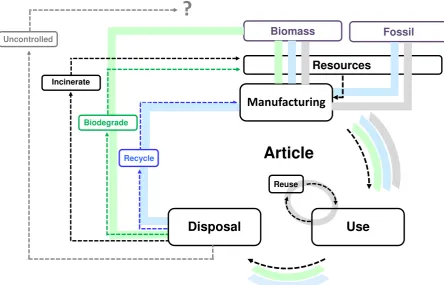
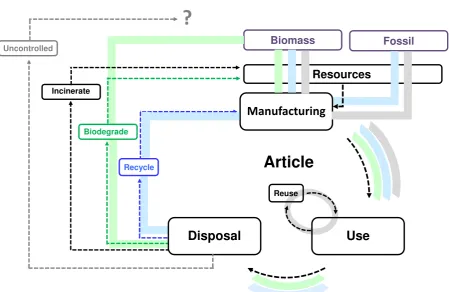
[image:5.595.75.520.446.731.2]In order to track the constituent elements and molecules contained within an article before and after use, suitable definitions describing renewability, considering both up-stream and down-stream movements have been prepared. Several pathways have been identified and differentiated thusly: “renewable”, “reusable”, “recyclable” and “recirculated”. These 4 definitions are stated as follows, and represented in the accompanying diagram (Figure 1).
Figure 1: Coverage of the renewability definitions within the life cycle of bio-based products.
Manufacturing
Use
Disposal
Uncontrolled
Incinerate
Biodegrade
Resources
Reuse
Recycle
Article
?
An ‘article’ means an object which during production is given a special shape, su r-face or design which determines its function to a greater degree than does its chemical com-position [EC 2008].An article is the end product of a manufacturing process, that consumers and procurers purchase and apply in the intended application (e.g. packaging, clothing, cleaning products, etc.). Articles consist of a composite or formulated combination of mole-cules, in turn constructed from atoms of various elements. Accordingly an article can be thought of in terms of the sum of its constituent molecules or atoms. This approach is helpful when considering the life cycle of an article, because the complete article will not necessarily remain whole as its constituent parts are recirculated. Biodegradation is an example of this.
Recirculated. Returned to use within a certain timeframe by an anthropogenic process
and/or a natural process. Any element that is not returned to use is considered in an ‘unco
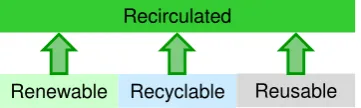
n-trolled’ framework. Recirculated includes the terms renewable, reusable and recyclable (Figure 2).
Renewable. Comes from renewable resources and is returned to use within a certain timeframe by a natural process.
Recyclable. Returned to use within a certain timeframe by an anthropogenic process.
Reusable. Returned to use within a certain timeframe without modification to the parent arti-cle or loss of performance.
Figure 2: The hierarchy of the renewability definitions.
Subsequently these definitions will be used by Open-BIO partners to generate sus-tainability criteria (in terms of components and used elements/molecules) for bio-based products. General use of these definitions is also encouraged when describing the renewabil-ity of based products, including plastics, lubricants, based solvents and bio-based surfactants.
Renewable Recyclable Reusable
6
Acknowledgements
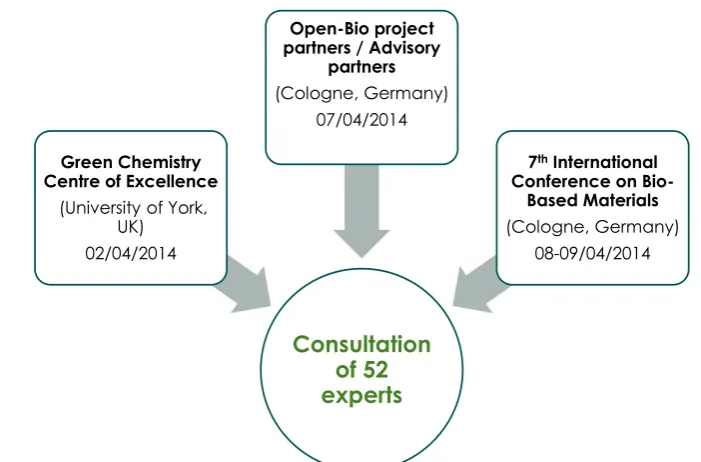
It is here that the authors of this report would like to thank all persons that participat-ed in the questionnaire that helpparticipat-ed refine the definitions. A consultation with members of the Green Chemistry Centre of Excellence (University of York, UK) was held on 2nd April 2014. Open-BIO project partners and advisory partners from industry and standardisation and regulatory organisations were consulted at the KBBPPS and Open-BIO (Bio-based products' standardization and market implementation research) combined advisory workshop on 7th April 2014 (Cologne, Germany). Lastly, delegates at the 7th International Conference on Bio-Based Materials (Cologne, Germany) were helpful in filling in questionnaires on 8th April 2014.
1
Project Introduction
Application of standards, certification schemes and labels has positive long-term ef-fects on the overall development of the European bio-based product market. Good product information that presents correct claims to industry and public procurers is vital for the usage of these new products. Ensuring the sustainable sourcing of raw materials and the effective measurement of bio-based content are important additional steps towards public confidence. A clear indication of the (comparative) functionality and optimal possible end-of-life options needs to underline the positive impact of bio-based products compared to regular products.
The Open-BIO project (www.open-bio.eu) aims at increasing the uptake speed of standards, labels and harmonized product information lists for bio-based products. It covers research into direct and indirect bio-based content methods, biodegradability, and ecotoxicity tests. Working with European standardisation committee CEN/TC 411 (http://www.biobasedeconomy.eu/standardisation/cen-tc411) the goal is to translate results from the Open-BIO project into European standards and product information lists. These will also form the basis for a database cataloguing bio-based products. A label will be developed in order to clearly distinguish bio-based products on the basis of the functionality to be de-scribed in standards. Public acceptance comes with clear and harmonized labels on products and packages.
Led by ECN (Stichting Energieonderzoek Centrum Nederland), work package num-ber 3 of the Open-BIO project addresses bio-based content and sustainability impacts. When a product is labelled ‘bio-based’, it does not necessarily guarantee that the product itself is sustainable or renewable. It is for this reason that one of the objectives of this research is to develop an indirect assessment of renewability considering both up-stream and down-stream (after use) movements of elements and molecules. With this in mind, sustainability criteria are being developed for bio-based products based on elemental renewability, whereby the required renewability of a bio-based product is based on its component elements. The pro-posed sustainability criteria for elemental/molecular renewability will then be incorporated into the overall sustainability criteria being developed by Open-BIO partners.
To assist all Open-BIO partners in the task of addressing the sustainability of bio-based products and prior to developing the indirect methodology/assessment of renewability, suitable definitions for renewable molecules and renewable chemical elements must be cre-ated that are sympathetic to concerns about the length of time required for a certain propor-tion of an element to be returned to use again. The goal is to ‘track’ the constituent elements contained within an article before and after use. Since there are several routes which the elements can take to be returned to use, these paths must be clearly identified and
defini-8
2
Renewability definitions
2.1 The life cycle of elements and molecules with respect to an article
An ‘article’ means an object which during production is given a special shape, su r-face or design which determines its function to a greater degree than does its chemical com-position [EC 2008].An article is the end product of a manufacturing process, that consumers and procurers purchase and apply in the intended application (e.g. packaging, clothing, cleaning products, etc.). Articles consist of a composite or formulated combination of mole-cules, in turn constructed from atoms of various elements (Figure 3). Accordingly an article can be thought of in terms of the sum of its constituent molecules or atoms. This approach is helpful when considering the life cycle of an article, because the complete article will not necessarily remain whole as its constituent parts are recirculated. Biodegradation is an ex-ample of this.
Figure 3: Article, molecules and atoms (e.g. a PLA spoon).
Every chemical product is produced from some form of feedstock. In terms of organ-ic feedstocks these resources may be virgin biomass, a fossil derived material, or intermedi-ates made or extracted from either of these feedstocks (e.g. bio-ethanol or naphtha). Broadly speaking elements are also incorporated into articles from three other sources: mineral re-serves (the source of all metallic elements), water (by means of hydrolysis and hydration), and direct synthesis with atmospheric gases (e.g. oxidation chemistry) [KBBPPS D4.3]. Wastes including higher value recycled articles are also considered as resources and may incorporate elements and molecules from any of the five resources identified [Clark 2013].
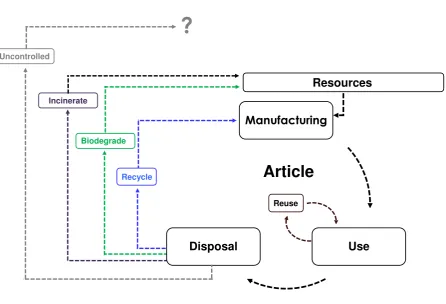
After use, possibly after a number of reuses, when an article has served its intended purpose, it is then disposed of. Landfill disposal or analogous end-of-life options that act as a stopping point mean the article and its constituent elements are no longer part of a recirculat-ing system of elemental and molecular renewal. Other processes of waste treatment can return the elements or molecules of an article into a useful form, a resource from which other articles can be produced. These are represented on the following diagram as incineration, biodegradation, and recycling (Figure 4).
C H O
S Ca
10
Figure 4: Circulation of atoms and molecules.
The concept of ‘biological recycling’, specifically corresponding to the “aerobic (composting) or anaerobic (digestion) treatment of biodegradable plastics waste under con-trolled conditions using micro-organisms to produce, in the presence of oxygen, stabilized organic residues, carbon dioxide and water or, in the absence of oxygen, stabilized organic residues, methane, carbon dioxide and water” is considered as incorporated within the more general biodegradation pathway presented in Figure 4 [ISO 2008]. It is important to mention that besides biodegradation other requirements with regard to disintegration and environ-mental safety have to be fulfilled for the product to be biologically recyclable or compostable. A biodegradable product is not always compostable but a compostable product is always biodegradable (under composting conditions).
Recycling, as it is presented in Figure 4, refers to the (physical or chemical) anthro-pogenic process of returning an article to a useable form, either in the same form or another chemical product or article [Soroudi 2013]. Incineration refers to combustion of organics, pri-marily to carbon dioxide and water. Other gases will be emitted depending on the composi-tion of the material that is incinerated. Any solids remaining can be retrieved and used as a feedstock. Metal containing wastes are particularly valuable in this respect.
Though an appreciation of the processes represented in Figure 4, the definitions that describe the concept of renewability can be established. General life cycle thinking has been employed to assist the generation of definitions compatible with environmental sustainability. The material flows indicated in Figure 4 suggest that a complete cycle is required to return
Manufacturing
Use Disposal
Uncontrolled
Incinerate
Biodegrade
Resources
Reuse
Recycle
Article
elements, molecules and entire articles back to use via a suitable resource. The concept of recirculation will be employed to convey this closed loop of resource valorisation, article use, and end-of-life treatment. The definition of a recirculated element, molecule or article must encompass all waste treatments and the replenishment of resources in such a way that envi-ronmental sustainability is secured.
Pre-existing definitions for renewability are directed at the feedstock. For instance, in
the United States the term ‘renewable chemical’ means “a monomer, polymer, plastic,
formu-lated product, or chemical substance produced from renewable biomass.’’ [US 2013] A re-newable resource, including biomass, has the ability to be continually replenished by natural processes, as defined by BSI [BSI 2013]. The actual replenishment of the resource is ambig-uous in the definition, and there is clearly no reference to where the constituent elements of the article will go after use. For compatibility with the notion of environmental sustainability, the entire life cycle from the perspective of the article must be considered.
Applied in the intended application (the use phase) the article may be reused many times. This is ideal for minimising the cost of energy and material demands required to manufacture the article, preferable to recycling which requires further energy input. Recycling is beneficial at end-of-life as it directs and thus shortens the loop from waste to resource. With recycling, synthetic chemical components can be put back to use as new articles with-out major deconstruction and re-manufacture as would be the case if the article was inciner-ated or degraded to a resource (such as biomass via the photosynthetic utilisation of carbon dioxide).
Conversely the article may decompose making it impossible to reuse or even recy-cle in some instances. This could be either an undesirable effect that is not preventable or designed deliberately as part of the article’s functionality. Lubricants fall into the former cat e-gory, while fuels are intentionally combusted to fulfil their purpose. Some containment mate-rials and packaging articles may be designed for the slow release of their contents, and will degrade in a controlled fashion during their life span. As such considering an article as the sum of its constituent molecules or elements is understandable. The combustion products of a fuel (or any incinerated wastes) can recirculate and form the basis of a new resource for making other articles. The decomposition products of a lubricant and what remains of the lubricant itself could biodegrade into the precursors of a future renewable resource. Either way the entire article as originally constructed is not preserved, and to consider the recircula-tion of an article only in terms of the complete object is flawed.
12
product market as a resource. Such plants may contribute to peat bogs and hence the car-bon content is locked outside of any resource base for a very considerable length of time. The time permitted for recirculation to occur is important and raises questions such as should it match demand so that the present production volume of a given article can be continued? Or should a single cycle equate to a human lifetime or perhaps the defined age of biomass (less than 150 years) without additional recirculation considered?.
It is important to move beyond carbon focused cycles and establish a broader re-spect for all the elements present in articles. This is especially true of bio-based products, which should inherently have a significant degree of renewability associated with them as a whole, and not just to their carbon content. In some ways it is a hindrance to the renewability of elements as a whole that the carbon cycle is so well understood and important to modern society, for it overshadows the other elements which will regularly exceed the mass of car-bon in an article. The severity of elemental scarcity across the periodic table is well known [Dodson 2012, EC 2010, Hunt 2013]. Furthermore, bio-based content is currently determined using radiocarbon techniques, reinforcing the carbon-centric view concerning renewability and bio-based products.
It is also essential not just to limit discussion to only biomass derived materials as many bio-based products contain a mixture of bio-based atoms and atoms from other sources, including petroleum. One common example is PET plastic made from bio-based ethylene glycol. The majority of the mass of this article is fossil derived (the terephthalate component). Articles produced from fossil resources such as PET plastic bottles can be recycled indefinately and hence once in circulation do not necessarily need to be automatically excluded from definitions relating to “renewable”, “reusable”, “recyclable” and “recirculated”. It could be argued that it is better to obtain articles from expired products than from newresources, whether if that resource is renewable biomass.
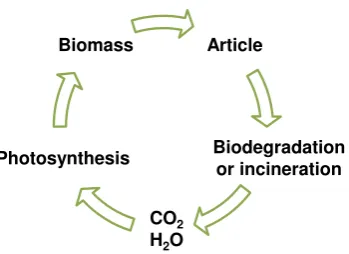
The carbon, oxygen and hydrogen in molecules and articles subjected to biodegra-dation or incineration will become water and carbon dioxide if the process is complete. As the reactants of photosynthesis the recirculation of bio-based products composed solely of these three elements seems quite assured (See Figure 5).
Figure 5: Recirculation of C, O, H in the case of a bio-based article subjected to a complete biodegradation or incineration.
Biomass Article
Biodegradation or incineration
CO2 H2O
[image:13.595.237.412.609.736.2]Non-biodegradable bio-based products would have to be incinerated when recycling is not possible, in order to be recirculated. A large number of bio-based products will contain carbon, oxygen and hydrogen and no other elements (e.g. PET, PLA, bio-ethanol, FAME). The vast majority of bio-based products will be predominately comprised of just these three elements with only small quantities other elements present. Notable additions of other ele-ments, although not as major mass contributors, might include nitrogen, sodium in plant de-rived anionic surfactants, and other metals in composite materials. The metal will usually be contained as a salt for bio-based products, such as in the PLA-calcium sulphate composites that are moulded into cutlery and other functional objects.
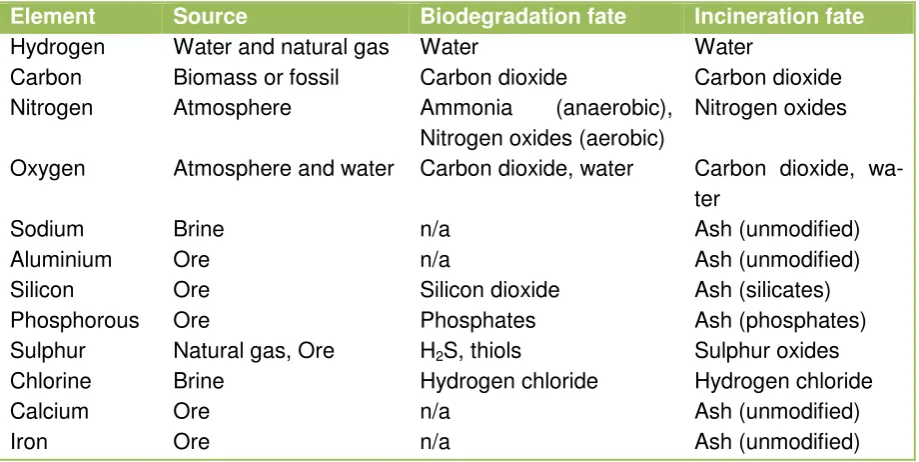
In the following table are the elements most commonly present in bio-based materials with their expected full decomposition products after biodegradation and incineration (Table 1). Sometimes the end product is the same regardless of the treatment process (hydrogen, carbon, oxygen, phosphorus and chlorine included). In some cases incineration tends to oxi-dize elements while biodegradation can result in reduced species. In the case of nitrogen and sulphur, anaerobic biodegradation may return the element back to the molecule found in the original feedstock resource.
14
Table 1: The origin and fate of elements after destructive end-of-life options.
Element Source Biodegradation fate Incineration fate
Hydrogen Water and natural gas Water Water
Carbon Biomass or fossil Carbon dioxide Carbon dioxide
Nitrogen Atmosphere Ammonia (anaerobic),
Nitrogen oxides (aerobic)
Nitrogen oxides
Oxygen Atmosphere and water Carbon dioxide, water Carbon dioxide, wa-ter
Sodium Brine n/a Ash (unmodified)
Aluminium Ore n/a Ash (unmodified)
Silicon Ore Silicon dioxide Ash (silicates)
Phosphorous Ore Phosphates Ash (phosphates)
Sulphur Natural gas, Ore H2S, thiols Sulphur oxides
Chlorine Brine Hydrogen chloride Hydrogen chloride
Calcium Ore n/a Ash (unmodified)
Iron Ore n/a Ash (unmodified)
Chlorine is incinerated to hydrogen chloride, whereas the resource for chlorine in manufacturing is brine, which is electrochemically hydrolysed to give chlorine gas and sodi-um hydroxide. If the hydrogen chloride is left to naturally return to the ocean as its sodisodi-um salt it may be recirculated but this is uncontrolled and unverifiable. The direct use of waste hydrogen chloride would be preferable as this is controlled and traceable, and also elimi-nates a source of pollution. Ultimately the abundance of chlorine (and sodium) in the ocean means that recirculation is not a priority and does not need to be controlled to sustain pro-duction of chlorinated articles. Biodegradation of chlorinated compounds is possible for some solvents [Field 2004], but many compounds are purposely made with antibacterial function-ality with the introduction of chlorine, and may resist biodegradation. Sodium and other met-als are not subject to biodegradation or incineration, and are present in the ashes of incinera-tors [Jung 2004], from which they can be reclaimed. Dedicated recycling presents a better option for metal and alloy recovery.
2.2 Glossary of renewability definitions
The following definitions of renewability (and related terms) have been generated to treat articles as the sum of their constituent elements (Figure 3). If all the atoms in a mole-cule adhere to a definition, that same definition can be applied to the molemole-cule. Similarly, if all the different chemicals within in an article adhere to a definition, that same definition applies to the article as a whole.
[image:16.595.209.390.342.396.2]The definitions for ‘recyclable’, ‘renewable’, and ‘reusable’ are subsets of the recir-culated element definition (Figure 6), as all three involve the constituent elements of an arti-cle being returned to use. During discussions it seemed that the arti-clearest and most useful framework for any renewability terms was to make a distinction between anthropogenic and natural recirculation processes, but not to monitor precisely the chemical pathway after end-of-life processing back to a resource.
Figure 6: Hierarchy of renewability definitions.
Recirculated. Returned to use within a certain timeframe by an anthropogenic process and/or a natural process. Any element that is not returned to use is considered in an ‘ uncon-trolled’ framework. Recirculated includes the terms renewable, reusable and recyclable.
Renewable. Comes from renewable resources and is returned to use within a certain timeframe by a natural process.
Recyclable. Returned to use within a certain timeframe by an anthropogenic process.
Reusable. Returned to use within a certain timeframe without modification to the parent arti-cle or loss of performance.
Renewable Recyclable Reusable
16
2.3 Proper use of renewability definitions
Some concessions have been made regarding the definitions to accommodate exist-ing definitions that encompass the concept of renewability. For example ‘renewable’ is spe-cific to the recirculation of bio-based products. This leaves biodegradable fossil derived
arti-cles unclassified with respect to the three subset definitions for ‘recyclable’, ‘renewable’, and ‘reusable’ (Figure 7). However if the substituent elements of that article can be proven to replenish a resource used to produce more articles (most obviously a biomass resource) than the term ‘recirculated’ can be applied. Validation of the recirculation must be obtained to
apply the term ‘recirculated’ with its derivational suffix as written here. The new article does not have to be chemically equivalent to its predecessor, so for example polyesters could be hydrolysed to give alcohols and carboxylic acid intermediates for producing different chemi-cals.
Different types of end-of-life options are differentiated in the field of packaging and waste packaging into mechanical recycling, chemical or feedstock recycling, and biological or organic recycling and energy recycling (incineration). [EC2008] [Directive1994] All these end-of-life option categories have been covered within our definitions although they are not ex-plicitly stated as such, because our goal is to emphasise the recirculation of chemical ele-ments. For instance, if an article is compostable, then a portion of the elements of the article will be returned to use through a biodegradation process (producing CO2 and H2O), while the remaining part of the elements corresponding to stabilized organic residue (compost) – alt-hough valuable as an organic soil amendment – will not be returned to use. Therefore, the use of terminology relating to packaging is not broadly suitable for our purpose because they do not demand the return to use of the chemical elements.
Incineration is not directly addressed in the aforementioned definitions as it is out of the scope of the Open-BIO project. However an article incinerated after use, although not
qualifying as recycling in the conventional sense, can be considered as ‘recyclable’ in terms of its constituent elements for the potential of replenishing biomass resources (via carbon dioxide and water), while reclaiming any metals and silicates from the incinerator ashes.
Figure 7: Coverage of the renewability definitions within the life cycle of bio-based products (green
colour refers to “renewable”, blue to “recyclable” and black to “reusable”).
The use of inflectional suffixes is applicable to the subset definitions when appropri-ate: ‘recycled’, ‘renewed’, and ‘reused’. To consider these terms as valid, recirculation must be actually proved. Then the overarching term ‘recirculated’ also applies as a more general term. With its derivational suffix, ‘recirculatable’ is not part of the terminology developed here because the broadness of this definition undermines any potential usefulness. The use of
‘recyclable’,‘renewable’, and ‘reusable’ is advocated however as the burden of proof of recir-culation is quite high and furthermore it is left unspecified in this report. Thus, these defini-tions imply a potential, and not a certainty that recirculation is achieved. The associated terms ‘recycled’, ‘renewed’, and ‘reused’ can be used for occasions where the movement of elements, molecules, or the entire article has been tracked and is well understood in both its timeframe and reclamation efficiency.
It is also notable that the definitions have a focus on end-of-life that has previously been absent in the terminology of bio-based products and renewable resources. However some aspects of the definitions are not specific to firstly comply with public and expert per-ception, but also to avoid introducing a bottleneck into the bio-based economy. As a result the timeframe within which recirculation must occur is not specified, but must be understood and will form part of the subsequent sustainability criteria. Also the resource to which the elemental constituents of an article are returned to does not need to be the same as that which is required to manufacture more of that same article (e.g. a petrochemical polyester could be biodegraded and the resulting carbon dioxide and water used by plants to produce
Manufacturing
Use
Disposal
Uncontrolled
Incinerate
Biodegrade
Resources
Reuse
Recycle
Article
?
[image:18.595.75.525.114.406.2]18
3
Generating definitions of renewability
3.1 Pre-consultation
During the development of the renewability definitions, a series of dissemination sessions and three rounds of questionnaires (See annex) were used to guide the process. The responses were analysed to show trends in current thought and also to highlight any common misunderstandings in terminology that these definitions could rectify. It was decided before any consultation, by deriving aims from the description of work that governs the re-search goals of Open-BIO, that the terminology needed to balance the cradle-to-gate and gate-to-cradle portions of a life cycle respectfully and not focus just on resources. This is compatible with the circular economy of material reuse and the concept of environmental sustainability. It was also decided for simplification purposes that it is the elements that should be tracked, not fully formulated articles. Then if a definition applies to all its constitu-ent atoms, it applies to the molecule itself. In turn if all the compounds in an article adhere to a definition then the same definition applies to the article. This is because some end-of-life management choices may not be fully applicable to an entire article, and that biodegradation for example produces decomposition products that may not necessarily be a direct feedstock resource.
It also seemed inevitable that a family of definitions would be required, which we
have placed under the umbrella term of ‘recirculated’ in the context of either elements, mol e-cules or entire articles. One of these definitions, ‘reusable’ was conceptualised without con-sultation. For the remaining terms a questionnaire was prepared asking respondents about
20
Figure 8: Persons that participated in the questionnaire and that helped refine the definitions.
Consultation of 52 experts
Green Chemistry Centre of Excellence
(University of York, UK)
02/04/2014
Open-Bio project partners / Advisory
partners
(Cologne, Germany) 07/04/2014
7thInternational
Conference on Bio-Based Materials
[image:21.595.105.456.107.338.2]3.2 Consultation on resource terminology
Respondents were asked whether ‘recirculated’, ‘recyclable’ and ‘renewable’ el e-ments within an article should be sourced from biomass, petroleum, a waste (written as ‘a
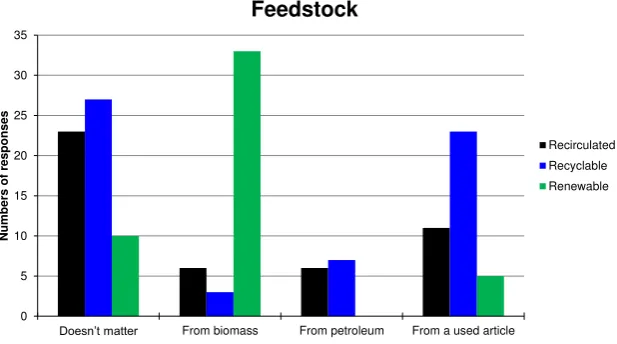
used article’ in the questionnaire), or if the resource is not relevant (i.e. any resource is valid). The results are presented in the following chart (Figure 9). It is clear that there is a very
[image:22.595.145.454.302.474.2]strong perception that a ‘renewable’ element must be bio-based. This is also reflected by the fact that no respondents said that a ‘renewable’ element can come from a petroleum fee d-stock. Few respondents believed the resource for a ‘renewable’ element did not matter. There is also a clear association between ‘recyclable’ and returning used articles back to use, while the origin of the resource is not of concern to most.
Figure 9: Association of renewability terms with a feedstock.
The perception of ‘recirculated’ as a term was viewed as independent of a particular resource, although there is a spread of opinion, with some support with ‘recirculated’ el e-ments coming from used articles. The idea of elemental circulation must include the returning of use of expired articles, but of course there must be an original, virgin resource to make the original article. However near equal numbers of correspondents answered that biomass or
petroleum are suitable feedstocks for articles composed of ‘recirculated’ elements.
The feedback collected on the permitted resources allowed within the renewability definition set instigated a revision to the definition of ‘renewable’. This was changed to spec i-fy a bio-based resource (i.e. “comes from renewable resources and is returned to use within a certain timeframe by a natural process”). This obviously created a gap in the coverage of the definitions where biodegradable fossil based articles are concerned. However this is not a direct issue when applying these definitions to describe bio-based products, and such an
article could be covered by the definition of ‘recirculated’ anyway if required. To oppose the ingrained perception of renewability being associated with biomass resources (and not an actual renewing of an article) would have diminished the acceptance and uptake of these definitions. 0 5 10 15 20 25 30 35
Doesn’t matter From biomass From petroleum From a used article
22
3.3 Consultation on returning articles to use
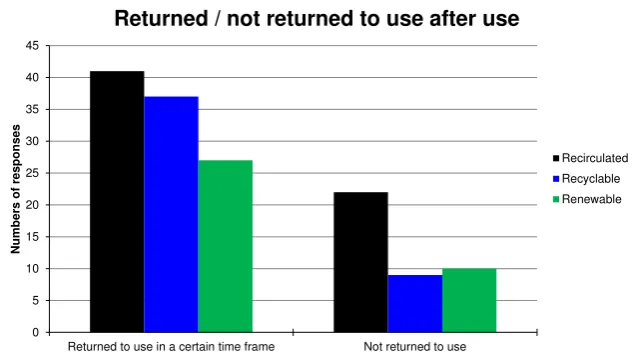
Respondents to the questionnaire also commented on whether articles need to be returned to use to qualify under the proposed renewability terminology. We found that rather than stating definitively that the elements that comprise an article should not be returned to use, respondents suggested that being returned to use is only implied and not necessarily monitored or ensured. So in terms of the feedback represented in Figure 10, entries under
‘Not returned to use’ generally apply to articles containing elements that are capable of being returned to use, and entries under ‘Returned to use in a certain timeframe’ demand recircula-tion. Some respondents answered both options. This situation has arisen from a number of perceptions imposed by sectors related to bio-based products. At present articles are sold with the intention that they can be recycled, and some articles are produced from recycled materials. These two types of articles and their constituent elements are not necessarily go-ing to be returned to use again. There is no guarantee that recyclable articles will be recycled which may have caused some confusion amongst respondents.
Figure 10: Association of the renewability terms with whether elements are returned to use or not returned to use.
In light of the results of the questionnaire, in which a majority of respondents said re-turn to use is necessary for all definition categories, a phrase was inserted into all the defini-tions presented in this work to state the element, molecule, or entire article is “returned to use within a certain timeframe”. Without return to use, an article is not environmentally sus-tainable. To alleviate the problem surrounding articles capable of being recirculated but not necessarily actually being recycled or renewed, the suffixes of the definition terms were cho-sen to be inflectional to state that articles (or their components) are either ‘recyclable’, ‘ re-newable’, or ‘reusable’. However a derivational suffix is given to ‘recirculated’ as it is i
m-portant to be able to distinguish truly ‘recirculated’ articles from those that are only compati-ble with the concept.
0 5 10 15 20 25 30 35 40 45
Returned to use in a certain time frame Not returned to use
Nu mb er s o f r es p o n se s
Returned / not returned to use after use
[image:23.595.139.458.358.536.2]The concept of a timeframe within which recirculation needs to occur is important. This could be done on either of the following principles:
1. How long does it take for the recirculation of a given percentage of the elements within the article? Complete (100%) recirculation or a lower more attainable value (e.g. 25%), or only the carbon or organic portion of the article might be considered.
2. What percentage of the elements in the article is recirculated after a set time? This time frame could reflect a human generation, or the maximum age of biomass (150 years) for example. The time between applications of recirculated articles could also be used as the basis of the timeframe, but this is dependent on the article.
Ultimately respondents were mostly confined to cradle-to-gate interpretations of renewability because of the established but conflicting terminology used in the renewable energy sector, and so the timespan has not been precisely defined in this report. Also because of the use of
inflectional suffixes in the terms ‘recyclable’, ‘renewable’, and ‘reusable’, articles should be compatible with the concept of “return to use” but not necessarily proven definitively to be
24
3.4 Consultation on methods of returning articles to use
Finally respondents to the questionnaire were asked about the methods by which the elements within articles (‘recirculated’, ‘recyclable’, ‘renewable’) are returned to use (Figure 11). There is a clear preference that ‘renewable’ substances return to use through natural processes. Biodegradation serves this purpose, and can be controlled by restricting the release of waste articles and operating dedicated biological treatment plants under moni-tored conditions. A similarly strong preference is clear for ‘recyclable’ articles to not be r e-turned to use by natural processes, but the actual process required for recycling divided the respondents. Approximately half the responses suggested recycling through typical anthro-pogenic means associated with present day recycling practices, and a similar number of re-spondents said it did not matter. There was a consensus that ‘recirculated’ elements can be returned to use by any means. This is consistent with the presentation of the definitions
[image:25.595.145.459.361.537.2]pro-vided earlier, in which ‘recyclable’ refers to anthropogenic processes of recirculation and ‘ re-newable’ refers to natural processes of recirculation.
Figure 11: Association of the following terms recirculated, recyclable and renewable elements with the process in which it is returned to use.
0 5 10 15 20 25 30 35
By a natural process By an anthropogenic process Doesn’t matter
Nu mb er s o f r es p o n se s
How it is returned to use?
4
Conclusion
It is important to appreciate renewability as a cradle-to cradle, circular concept. This is often neglected in favour of narrower feedstock arguments. In this report a collection of definitions relating to renewability have been proposed. These definitions have a general utility across the bio-based product sector and related disciplines, and will assist the Open-BIO consortium to prepare sustainability criteria for the indirect assessments of bio-based products.
26
References
Ab Rani 2014 M. A. Ab Rani, N. Borduas, V. Colquhoun, R. Hanley, H. John-son, S. Larger, P. D. Lickiss, V. Llopis-Mestre, S. Luu, M. Mogstad, P. Oczipka, J. R. Sherwood, T. Welton and J. –Y. Xing, Green Chem., 2014, 16, 1282.
BSI 2013 BSI Standards Publication PAS 600:2013, Bio-Based Products Guide to Standards and Claims, BSI Standards Limited, Lon-don, 2013.
Clark 2013 J. H. Clark, L. A. Pfaltzgraff, V. L. Budarin, A. J. Hunt, M. Gronnow, A. S. Matharu, D. J. Macquarrie and J. R. Sherwood, Pure Appl. Chem., 2013, 85, 1625.
Directive1994 European Parliament and Council Directive 94/62/EC of 20 De-cember 1994 on packaging and packaging waste (OJ L 365, 31.12.1994, p. 10).
Dodson 2012 J. R. Dodson, A.J. Hunt, H. L. Parker, Y. Yang and J. H. Clark, Chem. Eng. Process., 2012, 51, 69.
Dodson 2013 J. R. Dodson, E. C. Cooper, A. J. Hunt, A. Matharu, J. Cole, A. Minihan, J. H. Clark and D. J. Macquarrie, Green Chem., 2013,
15, 1203.
EC 2008 EC Regulation 1272/2008, Classification, Labelling and Pack-aging of Substances and Mixtures, Amending and Repealing Directives 67/548/EEC and 1999/45/EC, and Amending Regu-lation (EC) No 1907/2006, 2008.
EC 2010 European Commission Enterprise and Industry, Critical Raw Materials for the EU: Report of the Ad-hoc Working Group on Defining Critical Raw Materials, 2010. Available online at
http://ec.europa.eu/enterprise/policies/raw-materials/files/docs/report-b_en.pdf, accessed 22th April 2014.
Hunt 2013 A. J. Hunt, T. J. Farmer and J. H. Clark in Element Recovery and Sustainability, edited by A. J. Hunt, 2013, RSC Publishing, Cambridge UK, page 1.
ISO 2008 International Standard ISO 15270:2008(E), Second edition 2008-06-15, Plastic – Guidelines for the recovery and recycling of plastics waste.
Jung 2004 C. H. Jung, T. Matsuto, N. Tanaka and T. Okada, Waste Management, 2004, 24, 381.
KBBPPS D4.3 Knowledge Based Bio-Based Products' Pre-Standardization (KBBPPS) project deliverable report D4.3, Sample Preparation Techniques For Total Biomass Content Determination, J. Clark, T. Farmer and J. Sherwood, 2014. Available to download at
http://www.biobasedeconomy.eu/wp-content/plugins/download-monitor/download.php?id=43.
Soroudi 2013 A. Soroudi, I. Jakubowicz, Eur. Polym. J. 2013, 49, 2839.
US 2013 Authenticated U.S. Government Information GPO, 113th Con-gress 1st Session H.R. 2421, 2013, “To provide biorefinery a s-sistance eligibility to renewable chemicals projects and for other
purposes. Available online at
28