This is a repository copy of
Stakeholder preference mapping-seeking a way forward for
the processing of spent nuclear fuel
.
White Rose Research Online URL for this paper:
http://eprints.whiterose.ac.uk/83830/
Version: Accepted Version
Article:
McGlynn, G, Butler, G and Pearman, A (2015) Stakeholder preference mapping-seeking a
way forward for the processing of spent nuclear fuel. Journal of the Operational Research
Society, 66 (2). 219 - 230. ISSN 0160-5682
https://doi.org/10.1057/jors.2013.179
[email protected] https://eprints.whiterose.ac.uk/ Reuse
Unless indicated otherwise, fulltext items are protected by copyright with all rights reserved. The copyright exception in section 29 of the Copyright, Designs and Patents Act 1988 allows the making of a single copy solely for the purpose of non-commercial research or private study within the limits of fair dealing. The publisher or other rights-holder may allow further reproduction and re-use of this version - refer to the White Rose Research Online record for this item. Where records identify the publisher as the copyright holder, users can verify any specific terms of use on the publisher’s website.
Takedown
If you consider content in White Rose Research Online to be in breach of UK law, please notify us by
S
P
M
Abstract
Continuing concern in many countries about the processing of spent nuclear fuel has sparked new interest in how best to make evidence-based decisions about divisive issues. Stakeholder Preference Mapping, described here, is a way of applying multi-attribute decision analysis to structured dialogue and engagement with stakeholders. It uses the recorded views of stakeholders, supplemented where necessary by direct stakeholder contact, to understand and evidence stakeholder perspectives and to anticipate arguments for and against particular outcomes. It is illustrated in this paper through an exercise to examine competing options for the processing of spent nuclear fuel. The potential merits of Stakeholder Preference Mapping in terms of informing, focusing and accelerating stakeholder interactions and its relationship to other similar approaches are described and discussed.
Keywords: Decision analysis; multi-objective; energy
Introduction
Continuing concern about how to cope with some of the legacy effects of existing nuclear installations has served to ignite renewed concern about how society can make informed, evidence-based decisions about potentially divisive issues.
the various parameters being considered by decision makers and to anticipate the arguments both for and against any particular outcome. Like other MADA applications, it is scalable and flexible in use. It can equally well be applied (in simple cases) within a 1-day workshop to consider a contentious issue within an organisation through to much wider, more resource-intensive dialogues. Unlike many other MADA applications, SPM is as much a mechanism to explore the views of a range of stakeholders as it is a direct decision support device.
The application of SPM described later in the paper concerns spent fuel and nuclear materials management and a wish to understand and respond not only to the financial dimensions of a range of options, but also the socio-political, technological, environmental and security aspects of the available courses of action (see, e.g., American Nuclear Society, 2011). UK society, like many others, has a legacy of nuclear waste to accommodate (e.g., MacKerron, 2012). How, where and when to process the waste continues to be a contentious issue, not simply in terms of the technical strengths and weaknesses of the options available, but particularly because of societal reactions to actual and perceived impacts on the environment, employment, health and safety (e.g., CARL Project, 2008).
This is not an untypical picture. It can be replicated, more or less, in many fields of activity new high speed rail links, nano-technology applications, genetic modification of crops, etc.
A UK N D A Consultation on a
Public and Stakeholder Engagement and Communications Framework for Geological Disposal (NDA, 2008) circumstances facing the stakeholders involved often include:
New or unfamiliar technology
Both scientific and social complexity, with outcomes often contested
Significant uncertainty about potential impacts
Lack of trust among some of the parties involved
Lack of shared language and understanding of concepts
authority services, etc. SPM is a response to the increasingly accepted practice in public and, indeed, private sector decision making that stakeholders should be actively engaged on matters that may affect them. As Fiorino (1990) has argued, there are substantive arguments in favour of this view [lay judgements, especially about risk are sometimes as sound or more so than those of experts], a normative argument [a purely technocratic orientation is incompatible with democratic ideals] and an instrumental argument [effective lay participation can make decisions more legitimate, leading to better results]. In this paper, following the definition offered by the Stakeholder Forum for a Sustainable Future (2012), who have an interest in a particular decision,
either as individuals or representatives of a group. This includes people who influence a
decision, or can influence it, as well as those affected by it”. However, the process of engaging with stakeholders is often seen as expensive and time-consuming. SPM seeks to alleviate some of these concerns.
Especially where impacts are difficult to monetise, multi-criteria analysis, sometimes in combination with a cost-benefit or financial analysis, is often used to help elucidate the reasons for disagreements between stakeholders and to identify areas where views are broadly shared (see, e.g., Vatn, 2009). Although there are some notable success stories, for example the initial phase of the work of the Committee on Radioactive Waste Management (see, e.g., Morton et al., 2009), some applications (e.g., infrastructure planning see Omega Centre, 2010, p.28) can be perceived as k giving pre-eminence to the values of the instigator of the consultation and thus lacking transparency and credibility when shared with a wider audience.
Public consultation (two-way exchange of information between decision makers and the
public before decisions are made), especially if unstructured and unsupported by any analytical framework, should not be confused with the need truly to engage with stakeholders through interactive dialogue used as a means of orienting dialogic discourse toward problem understanding and consensual action (see, e.g., Christakis, 2004).. This latter promotes the exploration of different options, negotiation, and a search for compromise or consensus. Building relationships which transcend extremes of view and
D A D A I , then
D . Clarity of process, to keep matters as comprehensible as
possible to as wide a range of stakeholders as possible, is important.
process should be to acknowledge the full spectrum of views and to understand explicitly why a particular viewpoint is held (see, for example, the multi-criteria mapping exercise undertaken in Stirling and Mayer, 2001). This broader approach both demonstrates respect for views sincerely held and provides an indication of how unsatisfied views could be furthered through the democratic process more widely.
Multicriteria mapping and other processes exist in a wide variety, reflecting not only the different perspectives of those facilitating the process, but also the range of application contexts in terms of resources, problem types, stakeholder numbers, political context, etc.
A recent review by Stagl (2007) has examined stakeholder oriented assessment methods particularly appropriate to addressing sustainability questions and includes useful assessments of six key approaches in terms of their transparency, level of stakeholder engagement, approach to uncertainty, implementation cost and time requirements; see also Stagl 2006 and Kowalski et al., 2009. Cost and time are non-trivial issues for a number of these approaches. Hobbs and Meier (2000) have reviewed a wide range of multi-criteria evaluation exercises and techniques specifically in the context of the energy and environmental sectors and there are continuing applications of the Decision Conferencing format, pioneered in the late 1970s by Cameron Peterson in the USA but subsequently adopted and adapted by a number of consulting companies, broadly around the structure of a two or three day meeting attended by key stakeholders and facilitated by multi-criteria techniques, group processes and information technology. Phillips (1984) and McCartt and Rohrbough (1989) both discuss the nature and the performance of decision conferencing. A more recent summary of the field is given in Phillips (2006).
There is a substantial literature developing techniques that formalise models of multicriteria group decision making, although often with limited attention to the process of stakeholder engagement. Notable recent research that has developed and applied multi-criteria methods with an explicit emphasis on stakeholder engagement, however, includes, in the energy sector, Trutnevyte et al. (2011); Trutnevyte et al. (2012) and Turcanu et al. (2008); and applications of the MAMCA (Multi-Actor Multi-CriteriaAnalysis) model, with a range of fields of application including again energy, Turcksin et al. (2011), but also in transport, Macharis et al. (2009, 2010) and in sustainability, de Brucker et al. (2013).
audit trail to support conclusions reached and to evidence that a full range of views was properly considered. At the same time, there are concerns about the potential length of time that a stakeholder engagement might take and about its cost.
How does SPM work?
T f the SPM process is the conventional MADA model (see, for example, Dodgson et al, 2000, for an outline of this and other multi-criteria models). Software support, preferably with effective and flexible graphical representations, is highly desirable examples include Logical Decisions for Windows or Hiview3 (see Dodgson et al., 2000 for further details).
Because the MADA model underpins the SPM process (see later), it follows that many of the key assumptions and limitations of MADA are embedded in SPM:
Formally, MADA models one person preferences at a particular point in time; used
to represent the preferences of a group, it is only an approximation.
MADA does not formally model attitude to risk; it assumes outcomes are treated as
certain and addresses risk and uncertainty through sensitivity testing.
MADA assumes preferential independence between the different pairs of attributes;
that is, it assumes that the trade-offs between attributes are independent of the values at which other attributes are fixed.
But in return for accepting a degree of approximation in the way the model formally represents the choice being supported, using the linear additive value function model offers:
Transparency to non-expert users
Ease of application
All options assessed consistently, using shared criteria and scores, and preference
weights that are clear to all.
Readily available software support.
involved, when and why; what procedures best match different levels of public participation (information, consultation, collaboration, empowerment); and what techniques best match different circumstances. The exercise reported in this paper represents a contribution to the continuing search for effective procedures.
It is important to recognise and to bound the ambitions of exercises such as the ones SPM is designed to support. Developing a proposal to outline a specific proposal in all its detail lies, both in scope and time, beyond the likely remit of the type of exercise reported here. Nuclear waste management involves multiple uncertainties and conflicting, interdependent objectives. In practice, SPM and arguably no other procedure can capture the full set of complexities and deliver a demonstrably optimal modelled solution. What SPM does have the potential to do, however, is to provide a framework that brings an acceptable degree of rigour and openness to discussion of such problems and, in particular, greater clarity about differing viewpoints, their underlying implications for the choice being faced, and possibilities for some degree of agreement, even if only on certain aspects of the options being considered.
SPM seeks to exploit the strengths of the MADA model by applying it in a novel and flexible way, treating each stakeholder group as a quasi-individual with its own weight set derived to reflect, in an evidenced way, the broad perspective of that group. Intra-group differences of view about weights of course may remain; these may be explored subsequently, when the full set of stakeholder responses is discussed. At root, SPM consists of multiple applications of the MADA model. The purpose of the multiple applications is to explore the consequences for preference between options of the often diverse set of values held by different stakeholder groups. Different preferences are reflected in different weight sets applied within a single MADA model, but, in SPM, these weights are not gathered by a long, expensive and potentially confusing set of direct interactions with stakeholder representatives, but, rather, are initially deduced from, or at least approximated from, the publically stated positions of those groups, which, as is discussed further below, may be viewed as Virtual Stakeholder Groups [VSGs]. The VSGs represent the full spectrum of viewpoints of as many of the recognised perspectives on the issue at hand as can be accommodated.
The VSGs are put together and characterised to anticipate, support and make more effective later interaction with the real stakeholder groups and to add clarity on the range of viewpoints that needs to be considered. They do not replace the real stakeholders.
From this approach, there potentially follows a depth of understanding of viewpoints, of areas both of agreement and disagreement, which are quantified and open to discussion and argument. Moreover, SPM illuminates, supports and facilitates the process of societal choice among complex options in a cost-effective and, importantly, time-effective manner.
Experience of supporting many stakeholder dialogues suggests that different stakeholder groups can find it relatively easy to agree (or at least not to irreconcilably disagree) on what the potential impacts dimensions of different options could be. Experience also suggests that a reasonable degree of agreement can be achieved as well about what the likely scores (levels of impact) will be on many of the different dimensions. However, views as to the importance or otherwise of the impacts concerned are often highly variable.
This is not entirely surprising. Forecasting performance is often underpinned by technical modelling which is (or is seen to be) relatively objective and unquestioned. At the same time, many of the groups brought together to make decisions (whether formally conceived stakeholder events or not) bring together individuals with strikingly different perspectives on what is important, in turn reflected as disagreement about the true values of the wj.
This form of divergence of views is recognised in many MADA computer support packages through the ability to store and explore the consequences of multiple weight sets. It is also our experience from a number of stakeholder dialogue applications of MADA that derivation of alternative weight sets and discussion of their validity and implications often account for a significant part of the time (and resource) consumed.
These sorts of difference can, of course, be flushed out through a conventional decision conference (see, e.g., Phillips, 2006). However, such events are expensive to run. It is on this issue that SPM concentrates.
relevant to a consultation exercise. These views are, of course, necessarily subject to debate and refinement during the consultation process itself,
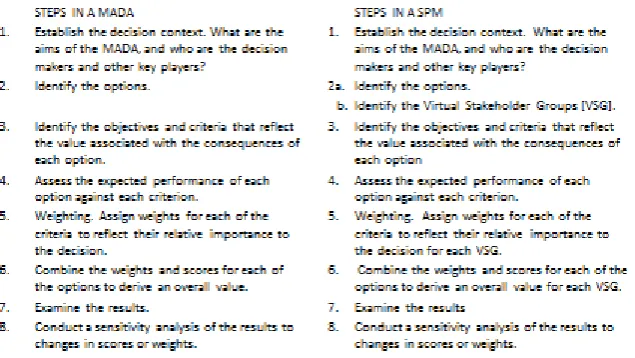
Figure 1 contrasts the steps in a conventional MADA (see, e.g., Dodgson et al., 2000, p.50) with those of a SPM application.
FIGURE 1 ABOUT HERE
The differences are relatively small, but important from a practical perspective, relating to the identification of VSGs and to the derivation of an initial suggestion for weights for Step 5 of the SPM procedure, both of which are central to its implementation. Building on Figure 1, typical components (C) of an SPM application, especially larger scale, more technical applications, are:
C1. Scope the problem and identify key stakeholder groups, in much the same way as might be done in a straightforward MADA application (see, e.g., Dodgson et al., 2000, p.52-4) but with special emphasis on information about alternative stakeholder perspectives.
C2. Identify one or more initial contacts from each stakeholder group for detailed
including probing their
awareness of alternative stakeholder perceptions.
C3. Prepare an initial scoping document as a foundation for an introductory
workshop
opinions in relation to likely key criteria.
different, carefully facilitated joint work to characterise and understand the problem and available options and their consequences in our experience raises levels of mutual understanding and trust.
C5. In the light of the workshop, to pull together required data and other information sources, to commission individuals or groups to specify more fully options for possible evaluation; technical experts to assess the performance of options; if not already a member of the facilitation team, identify an evaluation expert with a specialism in multi-criteria choice modelling.
C6. Using the initial expert evaluation of the identified options and estimates of the weights that different stakeholder groups would give to the different impacts of the options (derived from review of the publically stated views of different stakeholder groups), perform an initial, first-cut evaluation of options to get a preliminary view of how preferences between options may stack up. The underlying MADA model is that the overall score or value of any particular option is simply the weighted sum of the forecast performance scores of that option on a series of criteria which have been selected as appropriate to the context of the choice exercise in question, where
view as to their relative importance:
where is the weight attached to attribute j, is the score estimated for alternative i on attribute j and is the overall performance score for alternative i. Within this model framework, the alternative with the highest aggregate value score,
, should be chosen as the preferred one. See, for example, Keeney and Raiffa (1993) chapter 3 for a discussion of the implications of choosing this model form.
appropriate to look to design new (sometimes compromise) options, based on the initial evaluation of the first set.
C8. Further expert work off-line to evaluate new options, confirm technical assessments and to explore how sensitive the choice of a preferred option may be to different views on the assessment of impacts or the relative importance of (weights given to) different impacts. Sensitivity testing of this type is important, given that the basic MADA/SPM model does not formally model uncertainty or risk attitudes. In this way, the opportunity exists to explore uncertainties about estimated impacts of options as well as about weights and the outcome of such work can be made available to the final workshop (C9).
C9. (Typically) a final workshop to review this further work and to seek to move towards an agreed way forward. In the event that the stakeholder groups are unable
-
Strategic Action Planning see Harris, 2005) to look to identify short-term agreed actions with a view to re-visiting the overall decision after some time and once the outcome of the initial actions is known.
Smaller scale applications can readily be accommodated with less resource and time commitments, especially in relation to fewer workshops, less commissioning of outside technical support and more willingness to use the inherent (and sometimes subjective) judgements of the stakeholder group itself to score the performance of options. A consequence of this approach, as will be illustrated below, is that it quickly provides a set of criteria and alternative (VSG) weight sets that allow the stakeholder group to get rapidly to the core of the problem they are facing, specifically, how should assessed and what is the relative importance of the different performance criteria in terms of the various groups represented? Supported by an explicit articulation of where and why differences of view exist, rapid progress to that stage frees up more time for constructive engagement in seeking alternative and more consensual ways forward.
An illustrative application
The illustration given here outlines the principal steps in applying SPM and, in relation to a
dimensions of concern underlines that for this decision there was substantial societal interest in the option chosen from a number of perspectives beyond the immediate financial implications for the organisation concerned. Understanding and taking into account the views of a range of stakeholders was both necessary and important, as was the ability to evidence that an appropriate process had been followed whereby those views were indeed gathered, recognised and taken into account.
The emphasis was placed on targeted communication of modelling results and subsequent discussion, rather than direct stakeholder involvement in the decision making process. Indeed, the role of SPM typically is to diminish the amount of time and money on the process of face-to-face elicitation of views in order to target limited resources more constructively on sharing understanding of differences of viewpoint and looking for new options, compromise and a workable degree of consensus. Key to this process is the identification of the appropriate Virtual Stakeholder Groups. In setting out the illustration, primary emphasis will be on the elements most relevant to the use of VSGs, with the other steps of the process outlined in less detail, since they are more familiar through other MADA applications.
A key step from the perspective of the current paper is Step 2b/C2. In this application, nine VSGs were established:
Group identifier Name
VSG1 Stop nuclear power
VSG2 Stop reprocessing of spent fuel VSG3 Security and terrorist threat averse
VSG4 Conserving resources
VSG5 Need nuclear in the energy mix
VSG6 Fiscally driven
VSG7 Local, socio-economically motivated
VSG8 Transport averse
VSG9 Nuclear power enthusiasts
The Virtual Stakeholder Groups (VSGs) are based upon visualisations or descriptions of the preferred outcomes of different stakeholder organisations and individuals based on public domain material. The nine groups themselves were identified based on expert knowledge of the sector shared between the consultants undertaking the analysis and the client. These Virtual Stakeholder Groups are characterised according to the primary driver influencing their desired outcome and reflect the range of views on the management of spent fuels and nuclear materials which have been used by respondents to several consultation exercises. Although no formal validation of this choice of groupings was undertaken, experience of the field and the fact that there were no gaps in characterisation subsequently identified during the SPM process suggest that all key perspectives were incorporated. In all cases the commentary given points to the arguments the VSG would use to achieve the desired outcome, but implies no value judgement of the validity of the argument used, or of the beliefs underlying its use. By reference to the VSG descriptions, it is possible to explore which of the non-financial criteria would be preferred (and therefore valued and weighted) in order for the stakeholder group to achieve its desired outcomes.
relevant perspectives were represented in the workshops, typically by articulate and forthright individuals who were certainly able to correct any misrepresentation.
Step 3/C1/C4 is the conventional MADA step of identifying criteria that summarise the
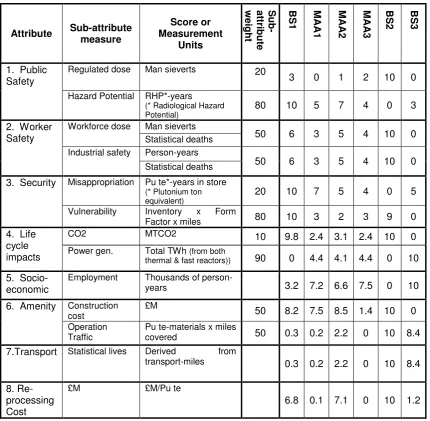
performance of and allow discrimination between the available options, as is Step 4/C5, which involves assessing numerically the performance of each option against each of the criteria (Table 1). It is important in Step 3 to anticipate and understand the criteria which may be important to any of the nine VSGs as omitting them would distort subsequent results and undermine subsequent use of them within any dialogue process. Some of the criteria identified in Step 3 are split down into one further hierarchical level in the value tree (see Table 1) for ease and accuracy of assessment.
Previous work had already been done, by a number of influential studies, on the range of non-financial criteria which could be used to evaluate options for managing radioactive materials and wastes. A valuable source of information on the non-financial criteria which stakeholders had previously used to evaluate spent fuel management options was found in the Spent Fuel Management Options Working Group (SFMOWG) of the British Nuclear Fuel Limited (BNFL) National Stakeholder Dialogue (BNFL, 2003). These formed the basis of the development of the criteria for the current exercise.
Table 1 below shows an example of the type of attribute and scores table that resulted from this analysis. A number of such tables were in fact derived, to help address issues in relation to the discounting or otherwise of financial flows. This question is not covered in the current paper and, for simplicity, only undiscounted cost figures are analysed here. Vulnerability in Table 1 is a workshop-derived score a proxy measure is the amount of inter-site movements of high-RHP materials. MtCO2 is the lifetime CO2 impact of the option concerned.
TABLE 1 ABOUT HERE
Step 5/C6 of the SPM process now examines how different viewpoints, beliefs and values
reasons. This may
by the VSG, which in this application was achieved when necessary by manipulating the ranking of the criteria in terms of their weights (see below) while ensuring that the resulting adjusted ranking nonetheless remained plausible in light of the perspective of the group concerned.
In the current application, weighting was undertaken in a workshop format with stakeholders or, where no stakeholder representative was available, individuals briefed to mimic as closely as possible the VSG information based perspective it was believed the stakeholders would take. Individuals were invited to attend the workshop based, among other factors, on their record of previous engagement in related discussions, their ability and willingness to articulate a point of view and their availability. Typically, only one individual from a given organisation was invited, although some of the individuals who made up the VSG viewpoints had associations with groups that were broadly aligned.
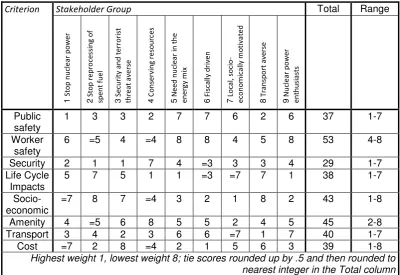
Use was made of the SMARTER technique of weight derivation (Edwards and Barron, 1994) whereby individual participants first ranked criteria weights and, after discussion and any agreed subsequent amendment to the ranking, a single ranking for the VSG was represented by the Rank Order Centroid (ROC) of the weights. Although there are some disadvantages to this method (Belton and Stewart, 2002) it is straightforward and commonly supported in software applications. Use of this type of approach is consistent with the wider aim of making the weighting process as straightforward as possible in order to concentrate stakeholder time and attention on discussion of the options and the search for shared viewpoints on ways forward. Table 2 illustrates the process for VSG1, the Stop Nuclear Power group.
TABLE 2 ABOUT HERE
TABLE 3 ABOUT HERE
In Step 6/C7, the nine VSG ROC weight sets are combined with the underlying performance
data from steps 3 and 4 as input to a stakeholder workshop at which representatives of as many of the nine stakeholder perspectives as could be present discussed the results. These were displayed as stacked bar charts such as the one in Figure 2. This form of representation has the attraction of making it visually very clear which option is preferred
VSG
FIGURE 2 ABOUT HERE
Step 7/C7 involves examination of the results for all VSGs. In SPM, this is a significant activity
as the range of results can be quite large and the core of the exercise lies in participants understanding their own results, those of others and being sufficiently confident to begin to explore differences of view and, ultimately, possibilities for compromise.
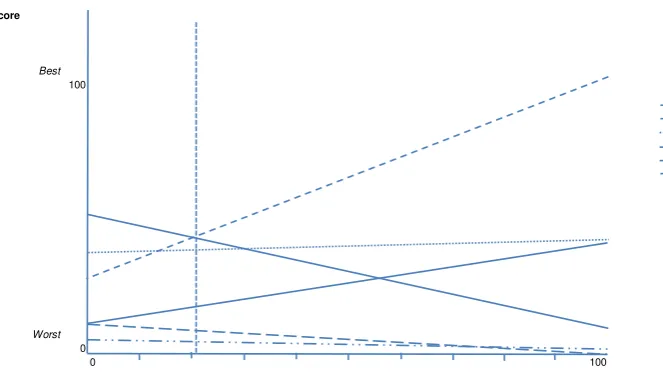
For example, Figure 3 shows that VSG4, whose main motivation was the maximisation of the
use of natural resources, p Us W MAA2,
MAA1, etc. At this stage the results could be compared with the previously expressed preference of the VSG, and adjustments, with approval from the workshop participants, made to individual attribute weights. Where this was done, the resulting preference set was designated VSG-a. In the event, two VSGs, VSG4 and VSG7 presented here, were in fact the product of such a modification process.
Integral to this type of refection and amendment is Step 8/C8/C9 of the MADA process which, in reality, iterates repeatedly with Step 7. Step 8 invites each stakeholder group to ask whether small variations in their initially estimated weights, wj, might make a significant
change to their ranking of options and, if so, whether they wish to reflect further on precisely what their weights should be. Figure 3 provides an illustration.
The output of the workshop was thus in a formal sense simply a set of nine considered and accepted VSG preference rankings. However, a benefit observed in this application was the transparency brought by the use of the SPM/MADA process and computer software to the communication of views. It made explicitly clear to stakeholders which criteria contributed most significantly to the whole set of nine expressed rankings of the six options, particularly viewpoints with which they disagreed. This type of outcome can have great worth in stakeholder terms, in that clarified disagreement is far more respectful than simply being ignored and, in turn, some form of agreement, even if it is only partial or in relation to a limited set of actions, can in a democratic society be an important step through which real change is instituted.
Discussion and Conclusions
This paper has illustrated the application of SPM as a tool to support, in a time- and cost-effective way, the deliberations of a stakeholder group addressing a complex and divisive issue. SPM, it has been argued, is relatively simple, economical and flexible as a means of supporting a form of consideration of complex societal issues, revolving around the stakeholder engagement, which is increasingly sought after. If contention is long-standing, then it is highly probable that there will be limited common ground between those holding strong but contrasting views and neither SPM nor any support can directly influence that
I
positions. However, circumstances do change, views do a matters move on step by step and, in these cases, a stakeholder engagement supported by an explicit and structured process that facilitates mutual understanding can make a real contribution towards constructive progress.
SPM demonstrates:
The preferred option for each stakeholder group
The MADA weightings adopted to support this
The principles and arguments that are used by each VSG to support its desired
decision
The principles and arguments that will be used by each VSG to oppose the
options
The key attributes whose weightings or scores would need to change to move the
VSG preference to another option
Which groups they may potentially satisfy through one or more of the options
considered, and why
Which groups they may not satisfy, and why
Some of the arguments which may be brought forward by dissatisfied groups, the
principles that may be quoted in favour of these arguments, and hence possible bases for any challenge, legal or otherwise
Possible adjustment to existing options that may achieve wider support by the set of
stakeholder groups as a whole, and which might be assessed in subsequent work.
SPM has the potential to underpin for more significant and contentious contexts further specific analyses oriented, for example, towards:
Confirmation for the decision maker that communicating the proposed decision
through recognised media White Paper, draft legislation, regulatory guidance, advertisements, press release, website is sufficient provided that opposing arguments are acknowledged and addressed
Confirmation, where relevant, for the decision maker that there is likely to be
substantial and prolonged opposition, with the need to have suitable contingency measures in place, including sometimes preparing to respond to legal challenge.
Guidance for the decision maker in undertaking supplementary studies, possibly in
support of the decision before its announcement, or perhaps to explore new options e.g., additional research and development; joint fact-finding.
The incentive for the decision maker to sponsor a more collaborative stakeholder
process as the project moves forward to implementation.
Overall, the paper has argued that SPM offers a way to inform, focus and accelerate stakeholder interactions across a range of scales and degrees of complexity. SPM does not stand in isolation. There are other related methods that have been reported, perhaps the S M riteria Mapping (MCM) (e.g., Stirling and Mayer, 2001). Relative to MCM, the SPM approach outlined here emphasises many of the same features: .developing a set of options, characterising a range of criteria, scoring each option under each criterion, assigning a weight to each criterion and allowing an overall rank to be expressed. One important area of difference, however, is that in MCM participants are entirely free to choose and define their own criteria rather than having a shared set to work
with. While this is not without its advantages, arguably it does put limitations on some of the
In company with many other multi-criteria procedures for decision support, there are a number of outstanding issues about such interventions that would benefit from further reflection, innovation and evaluation. Overall, perhaps the most important is the limited truly scientific evidence base on effectiveness, see for example Montibeller (2007). Although very difficult to construct, this remains perhaps the most pressing research gap.
Not uncommonly, the time of well-informed, articulate stakeholders is at a premium. SPM, it has been argued here, is able to make a significant contribution to the type of stakeholder process desired, while paying due attention to the practicalities of cost and time. In particular, the VSGs allow acceleration through the early stages of understanding and formalising in multi-criteria terms, the issue faced and thus allow face-to-face time between stakeholders to be exploited more gainfully. Often, of course, initially approximating weight sets based on publically stated views of stakeholders owes as much to art as to science. However, the experience of this application is that the stakeholders in face-to-face meetings are, on the one hand, well able to question and where agreed to adjust the initial weightings and, on the other, that the initial estimations done through the VSGs do indeed focus and accelerate the weighting element of the overall process, freeing up time for discussion and exploration of the options.
The VSG weight sets, on the basis of our experience, are good approximations to what the face-to-face meetings accept, but they are approximations even if only because there is inevitably a range of views within any one stakeholder perspective. Nonetheless, The VSG weights were seen by the participants as plausible starting points for discussion and helped focus early discussion on matters of substance rather than the technicalities of weight derivation. The ability readily to explore sensitivity to changes in weights proved invaluable. Arguably a weakness, although one that is difficult to avoid, is how to respond to changes in individual options. Although these can be assessed to some extent using the expert judgement of some of the analysts present, the complex system effects potentially present in this particular application limited the confidence that could be had in such assessments which in practice can perhaps only be handled by analysis outside the meeting followed by a further round of presentation to the stakeholders.
References
Belton V and Stewart TJ (2002) Multiple Criteria Decision Analysis: an Integrated Approach. Kluwer Academic Publishers, Norwell, Massachusetts.
BNFL (2003) Spent Fuel Management Options Working Group Final Report, BNFL National Stakeholder Dialogue, The Environment Council, March 2003
CARL Project (2008) Wanting the Unwanted: Effects of Public and Stakeholder Involvement in the Long-Term Management of Radioactive Waste and the Siting of Repository Facilities: Final Report, CARL Project.
Christakis, AN (2004) Wisdom of the people. Systems Research and Behavioral Science 21: 479-8.
De Brucker, K., Macharis, C. and Verbeke, A. (2013). Multi-criteria analysis and the resolution of sustainable development dilemmas: a stakeholder management approach. European Journal of Operational Research 224: 122-31.
Dodgson J, Spackman M, Pearman AD and Phillips LD (2000) Multi-Criteria Analysis: a Manual, Department of the Environment, Transport and the Regions, London, pp.158. Also at: http://www.communities.gov.uk/publications/corporate/multicriteriaanalysismanual Edwards W and Barron FH (1994) SMARTS and SMARTER: improved simple methods for multiattribute utility assessment. Organizational Behavior and Human Decision Processes 60: 306-25.
Fiorino, DJ (1990) Citizen Participation and Environmental Risk: A Survey of Institutional Mechanisms. Science Technology Human Values 15: 226-43.
Harris, R (2005) The plutonium predicament: managing conflict through strategic action planning, p.331-5 in Friend J and Hickling A, Planning Under Pressure: the Strategic Choice Approach, Elsevier.
Keeney RL and Raiffa H (1993) Decisions with Multiple Objectives: Preferences and Value Tradeoffs. Cambridge University Press.
Kowalski, K., Stagl, S., Madlener, R and Omann, I. (2009) Sustainable energy futures: methodological challenges in combining scenarios and participatory multicriteria analysis. European Journal of Operational Research 197: 1063-74.
Krütli, P., Stauffacher, M., Flüeler, T and Scholz, W. (2010) Functional-dynamic public participation in technological decision-making: site selection processes of nuclear waste repositories. Journal of Risk Research 13:861-75.
McCartt A and Rohrbaugh J (1989)Evaluating group decision support system effectiveness: A performance study of decision conferencing. Decision Support Systems 5: 243-53.
Macharis, C, de Witte, A and Ampe, J (2009). The multi-actor, multi-criteria analysis methodology (MAMCA) for the evaluation of transport projects: theory and practice. Journal of Advanced Transportation 43: 183-202.
Macharis, C., De Witte, A. and Turcksin, L. (2010). The Multi-Actor Multi-Criteria Analysis (MAMCA) application in the Flemish long-term decision making process on mobility and logistics. Transport Policy 17: 303-311.
MacKerron, G. Evaluation of Nuclear Decommissioning and Waste Management, Final
Report for the Department of Energy and Climate Change, SPRU, University of Sussex, March 2012.
Montibeller, G. (2007) Action-researching MCDA interventions. In Shaw, D. (ed). Key-Note Papers, 49th British Operational Research Society Conference (OR49), University of Edinburgh. The OR Society.
Morton A, Airoldi M and Phillips LD (2009) Nuclear risk management on stage: a decision
UK Risk
analysis, 29 (5): 764-779.
Omega centre (2010) Incorporating Principles of Sustainable Development within the Design and Delivery of Major Projects: An international study with particular reference to Major Infrastructure Projects, Final Report for the Institution of Civil Engineers and the Actuarial Profession, Centre of Excellence in Future Urban Transport, Bartlett School of Planning, University College, London.
Phillips LD (2006) Decision Conferencing. Operational Research Group, Department of Management, London School of Economics, Working Paper LSEOR 06.85.
Phillips LD (1984) A theory of requisite decision models. Acta Psychologica 56: 29-84.
Phillips LD and Bana e Costa C (2007) Transparent prioritisation, budgeting and resource allocation with multi-criteria decision analysis and decision conferencing. Annals of operations research, 154 (1). pp. 51-68. ISSN 0254-5330.
Stagl S (2007) SDRN Rapid Research and Evidence Review on Emerging Methods for Sustainability Valuation and Appraisal. Sustainable Development Research Network, London.
Stakeholder Forum for a Sustainable Future (2012)
http://www.earthsummit2002.org/msp/index.html [accessed 20 December 2012] Stirling, A. (2010) Keep it complex, Nature, 468: 1029 1031
Stirling, A and Mayer, S. (2001) A novel approach to the appraisal of technological risk: a multicriteria mapping study of a genetically modified crop. Environment and Planning C 19: 529-55.
Trutnevyte, E, Stauffacher, M and Scholz RW (2011). Supporting energy initiatives in small communities by linking visions with energy scenarios and multi-criteria assessment. Energy Policy 39: 7884-95.
Trutnevyte, E, Stauffacher, M and Scholz RW (2012). Linking stakeholder visions with resource allocation scenarios and multi-criteria assessment. European Journal of Operational Research 219: 762-72.
Turcanu, C, Carle, B and Hardeman, F (2008) Agricultural countermeasures in nuclear
-criteria model development.
Journal of the Operational Research Society 59: 305-12.
Turcksin, L, Macharis, C, Lebeau, K, Boureima, F, van Mierlo, J, Bram, S, de Ruyck, J, Mertens, L, Jossart, J-M, Gorissen, L and Pelkmans, L (2011) A multi-actor multi-criteria framework to assess the stakeholder support for different biofuel options: the case of Belgium. Energy Policy 39: 200-14.
Figure 1: Comparison of the steps in a MADA and an SPM application
Figure 2: Ranking of Options for VSG4 Option Score
BS3: Use 0.557 BS1: Waste 0.376 MAA2 0.347 MAA1 0.186 BS2: Store 0.158 MAA3 0.122
The vertical dotted line corresponds to the initial weight on Public Safety
Figure 3: Sensitivity Testing of the Public Safety Weight for VSG4
Score
Best 100
BS1: Waste BS3: Use MAA2 MAA1 BS2: Store MAA3
Worst 0
0 100
Attribute Sub-attribute measure Score or Measurement Units S u b -att ribu te w eigh t BS 1
MAA1 MAA2 MAA3 BS
2
BS
3
1. Public Safety
Regulated dose Man sieverts 20
3 0 1 2 10 0
Hazard Potential RHP*-years
(* Radiological Hazard Potential)
80 10 5 7 4 0 3
2. Worker Safety
Workforce dose Man sieverts
50 6 3 5 4 10 0
Statistical deaths
Industrial safety Person-years
50 6 3 5 4 10 0
Statistical deaths
3. Security Misappropriation Pu te*-years in store
(* Plutonium ton equivalent)
20 10 7 5 4 0 5
Vulnerability Inventory x Form
Factor x miles 80 10 3 2 3 9 0
4. Life cycle impacts
CO2 MTCO2 10 9.8 2.4 3.1 2.4 10 0
Power gen. Total TWh (from both
thermal & fast reactors)) 90 0 4.4 4.1 4.4 0 10
5. Socio-economic
Employment Thousands of
person-years 3.2 7.2 6.6 7.5 0 10
6. Amenity Construction cost
£M
50 8.2 7.5 8.5 1.4 10 0
Operation Traffic
Pu te-materials x miles
covered 50 0.3 0.2 2.2 0 10 8.4
7.Transport Statistical lives Derived from
transport-miles 0.3 0.2 2.2 0 10 8.4
8. Re-processing Cost
£M £M/Pu te
[image:25.595.84.515.69.490.2]6.8 0.1 7.1 0 10 1.2
Table 1: MADA Model Attributes, Sub-Attribute Weights and an Example of Scores (scaled 0 [worst] 10 [best])
Criterion Weighting
A B C D E F Total Ranking Public
safety
2 1 1 2 1 2 9 1
Worker safety
5 4 8 5 4 6 32 6
Security 1 3 2 1 2 1 10 2
Life cycle impacts
6 5 5 6 5 3 30 5
Socio-economic
7 8 7 7 6 8 43 = 7
Amenity 4 7 4 4 3 5 27 4
Transport 3 2 3 3 7 4 22 3
Costs 8 6 6 8 8 7 43 = 7
[image:25.595.132.465.544.713.2]Criterion Stakeholder Group Total Range 1 S to p n u cl e ar p o w e r 2 S to p r e p ro ce ss in g o f sp e n t fu e l 3 S e cu ri ty a n d t e rr o ri st th re at a v e rs e 4 C o n se rv in g r e so u rc e s 5 N e e d n u cl e a r in t h e e n e rg y m ix 6 F is cal ly d ri v e n 7 L o cal , so ci o -e co n o m ic al ly m o ti v a te d 8 T ran sp o rt a v e rs e 9 N u cl e ar p o w e r e n th u si as ts Public safety
1 3 3 2 7 7 6 2 6 37 1-7
Worker safety
6 =5 4 =4 8 8 4 5 8 53 4-8
Security 2 1 1 7 4 =3 3 3 4 29 1-7 Life Cycle
Impacts
5 7 5 1 1 =3 =7 7 1 38 1-7
Socio-economic
=7 8 7 =4 3 2 1 8 2 43 1-8
Amenity 4 =5 6 8 5 5 2 4 5 45 2-8 Transport 3 4 2 3 6 6 =7 1 7 40 1-7
Cost =7 2 8 =4 2 1 5 6 3 39 1-8
[image:26.595.97.498.123.398.2]Highest weight 1, lowest weight 8; tie scores rounded up by .5 and then rounded to nearest integer in the Total column
Appendix 1: Examples of VSG characterisation
T SPM
team and stakeholder representatives in deriving viewpoints about the likely criteria and criteria weighting that might be associated with varying stakeholder perspectives on the spent nuclear fuel issue.
VSG1. Stop nuclear power.
This virtual group views the safety and security risks of nuclear power as the primary
detriments to be avoided, and remains sceptical of claims of scientific or technical fact. Any
reduction in fuel cycle costs and any re-use of materials would be viewed as increasing the
credibility of nuclear power as a sustainable power source and hence the unacceptable
prospect of the construction of new nuclear power stations. The security and proliferation
aspects of continued nuclear power operations are of concern as are issues around the
inability of inspection to provide adequate assurances and protection, together with a more
general fear about the erosion of civil liberties if significantly augmented security measures
were to be implemented as a response to possible threats. Therefore arguments are set out
to arrive at an outcome where Materials and Fuel are declared as waste or at least put
beyond use. This is to reflect that while the objective may be to declare the fuel and materials
to be waste, there is much resistance amongst some of this VSG to the concept of geological
disposal.
Indicative arguments potentially used by the VSG are:
Nuclear power is dangerous, the waste problem is insoluble and detriments
associated with it are unacceptable.
Nuclear power is expensive to build, to operate and to decommission.
Re-use of nuclear materials and recycling of spent fuels is unjustified, being
uneconomic, increasing environmental burdens, the risk of accidents and security concerns.
The energy input into nuclear power and its fuel cycle is much larger than official
estimates.
The detriment of radiation dose from discharges is greatly underestimated.
Transport of nuclear materials is very dangerous and should be rigorously
minimised.
Global warming and climate change can be overcome without the use of nuclear
power.
Proliferation and materials control regimes cannot be relied upon to adequately
prevent diversion or terrorist activity.
Valued concepts may be:
Security, public safety, life cycle impacts, amenity, transport, socio-economic, costs
VSG7. Local Socio-economically Motivated Stakeholder.
The VSG is motivated by the perceived socio-economic value of a nuclear licensed site and the desire to maintain or attract processes which will underpin or enhance employment opportunities and associated local community well-being. It considers that local oversight (through planning and engagement processes) and the workforce will ensure that activities are safe, secure and do not impinge upon worker safety or public amenities. Continued support will depend on whether socio-economic prosperity and community well-being are perceived to be linked to the activities on site, and therefore the relative socio-economic profiles of storage, re-use and waste management options will be important. The amount of disruption caused by operations in terms of local amenities and transport will be of concern. The Group would not be constrained to support cheaper options on behalf of the United Kingdom as a whole and some would not want to see more nuclear materials being moved into their areas, so opposing centralised storage. The VSG believes that some subsidy is justified by the delivery of local benefits.
Typical arguments used by the VSG are:
The operations at the site and its environmental effects are assured by the scrutiny
afforded by the regulators, the local workforce and community.
Options will be favoured which offer sustainable employment the numbers of jobs
and the timescales involved.
The employment provided by operations contributes to the social prosperity of the
locality.
Amenity impacts of operations and mitigating the effects of transporting nuclear
materials are part of the partnership and socio-economic packages agreed between site operators, the Nuclear Decommissioning Authority and the local community.
Valued concepts would be: