iCD[KI)p©G]DQ DmW©8Ö[]u]©GQÖ ©QŒife
©Sou ©QÎ)(?®(ô)£§fl§CS© D(iu^i^®gog(70(iì)g)g[o)®[n)fóllMRô)^B©(§(}i)© OöM§sßOßfl®cra§(o)©öij]s
[Daoi](ô){M)© [i(îfl(ï®^)ê©(n)Oi)© (olO(JDW§gßfl§@©(Aiö©ffi)ß
©a(Â)@® \Ewmionm \ôm q ß \ìm!ì(a§Ìi^mmM
(l(M]Rô)(5)(§@© 0[nKi©§ite(rfi(n)g]§(s)©(n)te
N° 29 · March 1982
ISSN 0250-3891The International Capital Market in 1981
The international capital market after virtually stag-nating in 1980 resumed its growth in 1981 but not without stresses and strains. Public issues of bonds were substantially 'higher in amount in 1981 than a year earlier whether they were made on the so-called eurobond market (including those launched partly or wholly on markets outside Europe) or on the foreign bond sectors of national markets. As may be seen in Table 1, issues of the first type rose last year by 7.7 billion ECUs and those of the second by 5.3 billion ECUs; taking the two forms together, public
bond issues raised 13 billion ECUs more in 1981, an increase of 64%. The growth of internationally syndi-cated medium and long-term credits of nearly 70% in terms of US dollars, in which most of the credits are denominated, was even greater. A substantial part of the growth in bank credits, however, consisted of a few exceptionally large borrowings of around $ 45 billion by US oil companies at the beginning of the third quarter, either to finance take-over bids or to resist them, but the increase nevertheless remains significant after excluding such transactions.
The increase in international bor-rowing in 1981 was all the more remarkable in view of the higher rates of interest which generally pre-vailed. These circumstances led bor-rowers on fixed interest rate terms to concentrate their fund raising ef-forts in the brief periods when inter-est rates eased and "borrowing win-dows" appeared. They also encour-aged the resort to new borrowing
In this issue
The International Capital Market in 1981
Outline of mam
developments p. 1-2 The bond market
— market conditions — currencies — borrowers — eurobond issues
by sector p. 2-6 Internationally
syndicated loans p. 6-8 ECU exchange
rates used for this
review p. 2
formulae to tempt investors (such as attaching warrants to give bond-holders the right to acquire within a stipulated period an equal amount of the same security on. Identical terms) or to exploit the exemption of certain investors from tax on capital gains (by issuing securities with a zero coupon and an issue price at a large discount on their redemption value). The maturities of fixed inter-est issues also tended to be short-ened as borrowers sought to limit as far as possible the period during which they would be called upon to meet exceptionally high interest charges, possibly hoping to secure refinancing upon more favourable terms.
Increased resort to borrowing through issues of floating rate notes was evidently encouraged by the prevalence of high interest rates. A certain degree of resistance on the part of borrowers to the high charges resulting from the applica-tion of convenapplica-tional floating rate terms induced them to seek lower spreads and/or reference interest rates which appeared likely to favour them.
Borrowers in developed countries seemed to be more prepared than others to pay the high interest rates prevailing in 1981 and were able to increase substantially their offtake from the international capital market (see Table 2). Most of this growth originated with borrowers in Canada and the USA - even if one excludes the exceptional deals negotiated by US oil companies - and in Japan. The EEC, in contrast, accounted for relatively little of the increase. Bor-rowers in non-OPEC developing countries secured more finance in 1981 but here the increase - mainly in syndicated bank credits - was confined to a small number of coun-tries, including Brazil, Chile, Mexico and South Korea. On the other hand, the demands of OPEC countries for finance rose little and, with the inter-ruption of lending to Poland, the total for Eastern Europe was smaller.
A further possible explanation of their willingness to tap the interna-tional market is that for the most part they were borrowing in their domestic currencies and so, at a time when the Canadian as well as the u s dollar was appreciating in terms of most other currencies, were privileged as regards protection from exchange risk. The circum-stances of the growth in borrowing by Japanese enterprises were some-what different in that this was mostly in convertible issues which attracted strong support from investors be-cause of the better prospects of industrial recovery in Japan, but here too the foreign exchange per-formance of the Yen may have reas-sured the firms approaching the market. The more extensive changes in 1981 in the relative exchange values of currencies than in recent years have, however, tended to dis-tort statistical comparisons which should be taken as only broadly indicative.
The bond market
Market conditions
During 1981 bond markets con-tinued to be strongly influenced by the tightening of credit in the USA which began the previous year. In their resolute attack on inflationary pressures, the US monetary au-thorities succeeded in reducing the growth rate of the money supply to well within the target range. To the extent that the rate of price inflation had fallen to single figures by the end of 1981, the policy could be said to have been effective but it also resulted in very high and very vol-atile interest rates on the US market as investors responded either direct-ly to reports of weekdirect-ly (and often erratic) changes in the domestic money supply or tried to anticipate the likely reaction of the Federal Reserve. The inflows of capital which were attracted by the high
Note
Unless otherwise stated, the statistics of bond issues in this article are of public issues on the international market (of eurobonds) or of public issues by foreign borrowers on national markets.
Eurobond issues are those which are sold through international banking syndicates, usually in more than one market including markets outside Europe; they include all issues to which special monetary clauses are attached (ECU, EUA, EURCO, SDR and other multiple-currency issues). Foreign bond issues are those which are sold on a single national market on behalf of non-resident borrowers by financial institutions of the country concerned! The distinction between eurobond and foreign bond issues is no longer clear-cut.
Syndicated credits consist of loans granted by international banking syndicates as publicly reported; they are recorded at the time of signature and not of drawdown.
The classification of developed or "industrialised" and developing coun-tries is based on that of the World Bank, i.e., developing councoun-tries are mostly those which had an average income per head in 1978 of less than US$ 3 500. South Africa, however, has been classified as an industrialised country.
For the purpose of comparison, amounts in various currencies and currency units have been converted in the summary tables into ECU (consisting of specific amounts of the currencies of EEC Member Countries, excluding the Greek drachma). The rates applied in this article in converting the ECU into the main currency units in use on the international market are as follows:
US$ DM : Sfrs Yen Ffrs 1980
1981
1980 1981
1 ECU 1 ECU
1 ECU 1 ECU
1.393 1.160
2.519 2.527 Can. $
2.332 2.222 Fl
319.38 251.44 SDR
5.840 5.974
0.6099 0.5555
1.630 1.387
2.755 2.793
1.0703 0.9656
returns available on the US market not only helped to strengthen fur-ther an exchange rate that was al-ready firming but also transmitted US influences almost without delay to virtually all other capital markets.
The general rise in bond yields which occurred on the international market and foreign bond compart-ments of national markets in Europe during the first three quarters of 1981 (see chart of average yields on new bond issues) may thus be attri-buted more to events in the USA than to domestic developments in the other countries. For the first two months of the fourth quarter it looked as if tensions might be eas-ing on the US capital market as the economy slid into recession. The decline in interest rates and bond yields in the USA which began in early October and, apart from a brief set-back in the second half of the same month, continued until early December provided an opportunity for substantial interest rate reduc-tions on other markets. Hopes that the process of lowering interest rates could be carried further, par-ticularly in countries where unem-ployment is high and rising, were disappointed in December when the US market was again unsettled by heavy issuing activity, upward revi-sions to the Federal Government's budgetary deficit and fresh in-creases in the money supply as a re-sult of which rates began to climb once more.
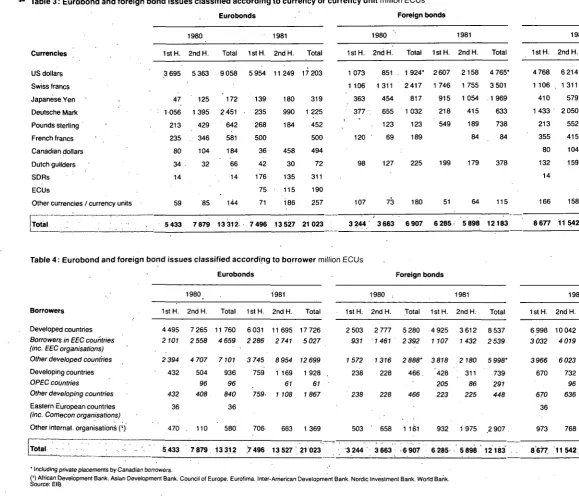
In spite of their marked instability during the year, bond markets deal-ing in US dollars provided borrowers in 1981 with approximately double the amount of resources that they did in 1980 (see Table 3) but on average at higher cost. The dollar sector was not the only part of the international market to grow rapidly, as the Canadian dollar sector ex-panded more than two and a half times and the euro-Yen sector in-creased by about 85%, but in terms of sheer size it overshadowed the rest.
cur-rendes traded on the international capital market. It seems, however, that the SDR in its new form of a five-currency rather than a sixteen-cur-rency basket has been found to be a more convenient unit for bond issues and has also encouraged the creation of a market in SDR certifi-cates of deposit. A number of issues, including two by the European In-vestment Bank, have been denomi-nated in ECU, a similar unit consist-ing of nine currencies of Member States of the EEC (see note p. 2). Of much more recent origin than the SDR and appealing more perhaps to borrowers and investors within the European Community than those outside, the ECU nevertheless stands comparison with the SDR as a fund-raising instrument.
Foreign issues on the New York market in 1981 were nearly two and a half times the amount of those in the previous year but most of this increase was in borrowing by Cana-dian enterprises and public au-thorities. The greater part of the issuing activity was in the first half of the year before borrowing costs climbed to their highest point in the third quarter. As these costs de-clined from October to early De-cember the flow of new issues, in-cluding two large-scale operations by the World Bank and one each by the European Investment Bank and the Inter-American Development Bank, again became heavy.
Foreign issues on the Swiss, Japan-ese and Netherlands national mar-kets were all substantially higher in 1981 than in recent years. While activity on these primary markets was fairly evenly distributed bet-ween the two halves of 1981, foreign issues on the London market, which also rose sharply, in amount, were particularly heavy in the earlier part of the year when the cost of borrow-ing was tendborrow-ing to decline. In con-trast, public issues of foreign bonds on the German domestic market to-gether with issues denominated in Deutsche Marks on the international market fell back in 1981 as invest-ment demand for both was affected adversely until September by rising yields on dollar markets and by the weakness of the Deutsche Mark against the dollar.
The currencies
The resultant sharp decline in the use of the Deutsche Mark in interna-tional and foreign bond issues from 17.2% of the total of such issues in 1980 to 5.6% last year was almost exactly counterbalanced by an in-crease in the percentage of issues denominated in^ US dollars from 54.3% to 66.2%. On a smaller scale, issues denominated in Yen, at 6.9% compared with 4.9% a year earlier, and in Canadian dollars, at 1.5% as against 0.9%, gained at the expense
of issues in Swiss francs, down from 12.0% to 10.5%, and issues in French francs which fell from 3.8% of the total to 1.8%. The fall in the proportion of total issues accounted for by those on the Swiss market, it should be noted, occurred in spite of a growth of about 45% in the amount of such issues in 1981, thus emphasising hovv large was the in-crease in total activity.
The relative importance of the pound sterling and the Dutch guil-der as currencies used in
interna-Table 1 : Total International financing 1977-1981 through public bond issues and syndicated bank credits
Eurobonds
Foreign b o n d s
Syndicated bank credits
••
1977
13 095
8 8 9 8
29 7C4
5 1 7 5 7
1978
9 3 5 0
9 2 7 7
52 338
70 925
m i l l i o n E C U s
1979
10 693
7 9 4 3
56 713
75 349
1980
1 3 3 1 2
6 9 0 7
57 360
77 579
1981
21 023
12 183
115 732
148 938
Table 2: Total international financing through public issues of eurobonds, foreign bonds and syndicated credits, classified according to borrowers
Eurobonds F-orcign bonds
Total b o n d s
Syndicated ciödils
T O T A L
B o r r o w e r s
D e v e l o p e d c o u n t r i e s
Borrowers in EEC counlri-js line EEC organisationsi
Ottier developed countries
D e v e l o p i n g c o u n t r i e s
OPEC countnes
Otfier developing countries
E a s t e r n E u r o p e a n c o u n t r i e s (inc C o m e c o n organisations)
O t t i e r i n t e r n a t i o n a l o r g a n i s a t i o n s
U n a l l o c a t e d
T O T A L
l i t H
5 4 } 3 .Τ 244
8 677
23 092
3 1 7 6 9
1 6 1 4 8 7 704
8 4.14 13 484 1 823 11 661
705
1 460
72
3 1 7 6 9
1980
ï n d H
7 879 3 663
11 542
34 275
45 817
27 000
11 421
15 579
16 759 2 621
14 138
1 245
768
45
45 817 Total
1 3 3 1 2 6 907
20 219
57 3R7
77 586
4 3 1 4 8
19 125
24 023
30 243 4 444
25 799
1 9 5 0
2 1 2 8
117
77 586
ΠΊΐΙΙιοη E C U s
'/ό
1 7 2 8 9
26.1
73 9
100.0
55.6 24 6
31 0 39.0 5 7 33 3
2.5
2.7
0.2
100.0 I s t H
7 496 6 285
13 781
37 442
5 1 2 2 3
26 733 11 355
15 378 2 1 8 2 9 2 338 1 9 4 9 1
1 0 2 3
1 6 3 8
5 1 2 2 3
1981
2nd H
13 527 5 898
19 425
78 290
97 715
70 021 10 797
59 224 24 778 2 713 22 065
278
2 638
97 715 Total
21 023 12 185
33 206
115 732
148 938
96 754 22 152
74 602 46 607 5 051 41 "jbo
1 3 0 1
4 276
148 938 lb
14 1 8 2
22.3
77 7
100.0
64.9 1 4 8
50 1 31.3 3 4 27 9
0.9
2.9
•*^ Table 3 : E u r o b o n d a n d f o r e i g n b o n d I s s u e s c l a s s i f i e d a c c o r d i n g t o c u r r e n c y or c u r r e n c y u n i t million ECUs
Eurobonds Foreign l>onds Total
Currencies
u s dollars
Swiss francs Japanese Yen Deutsctie Mark Pounds sterling Prenoti francs Canadian dollars Dutcti guilders SDRs ECUs
Ottier currencies / currency units
Total
I s t H .
3 695 47 - 1056 213 235 80 34 14 59 5 433 1980 2ndH. 5 363 125 1395 429 . 346 104 32 85 7 879 Total 9 058 172 24:51 642 581 184 66 14 144 13 312 I s t H .
5 954 139 . 235 268 500 36 42 176 75 71 7 496 1981 2ndH. 11 249 180 990 184 458 30 135 115 186 13 527 Total 17 203 319 1 225 452 500 494 72 311 190 257 21023
I s t H .
1 073 1 106 363 377
\
120 98 107 3 244 1980 2ndH. 851 1 311 454 655 123 69 127 73 3663 Total 1924* 2417 817 1 032 123 189 225 180 6907 I s t H .2607 1 746 915 218 549 199 51 6 285 1981 2ndH. 2158 1 755 1054 415 189 84 179 64 5 898 Total 4 765* 3 501 1 969 633 738 84 378 115 12183
I s t H .
4 768 1 106 410 1433 213 355 80 132 14 166 8 677 1980 2nd H. 6214 1 311 579 2 050 552 415 104 159 158 11 542 Total 10 982 2417 989 3 483 765 770 184 291 14 324 20 219
%
54.3 12.0 4.9 17.2 3.8 3.8 0.9 1.4 0.1 1.6 10l).0 I s t H .8 561 1 746 1054 453 817 500 36 241 176 75 122 13 781 1981 2ndH. 13 407 1755 1234 1405 373 84 458 209 135 115 250 19 425 • Total 21 968 3 501 2 288 1 858 1 190 584 494 450 311 190 372 33 206.
%
66.2 10.5 6.9 5.6 3.6 1.8 1.5 1.3 0.9 0.6 1.1 100.0Table 4 : E u r o b o n d a n d f o r e i g n b o n d Issues c l a s s i f i e d a c c o r d i n g t o b o r r o w e r million ECUs
Borrowers
Developed countries Borrowrers In EEC countries (inc. EEC organisations) Ottier developed countries Developing countries OPEC countries
Other developing countries
Eastern European countries (Inc. Comecon organisations)
Ottier internal, organisations (')
1stH. 4 495 2101 2 394 432 1980 2ndH. 7 265 2 558 4 707 504 Eurobonds Total 11 760 4 659 7 707 936 IStH. 6 031 2 286 3 745 759 Î981 2ndH. 11 695 2 747 8 954 1 169 Total 17 726 5 027 12 699
1 928 . 1StH. 2 503 937 7 572 238 1980 . 2ndH. 2 777 7 467 7 376 228 Foreign Total 5 280 2 392 2 888· 466 bonds
I s t H .
4 925 7 707 3 878 428 1981 2nd H. 3612 7 432 2 780 311 Total 8 537 2 539 5 998* 739
96 96 61 61
432 408 840 759· 7 708 7 867 36 36
470 110 580 706· 663 1 369
238
503
228 466
658 1 161
205 86 297
223 225 448
932 1 975 2 907 .
Total
1980 1981
IstH. 2ndH. Total IstH. 2ndH. Total
6998 10042 17040 3 032 4 079 7057
3966 6 023 9 989 670 732 1 402
96 96 670 636 1306
36 36
973 768 1 741
84.3 10 956 15 307 26 263 79.1
34.9 3 393 4 173 7566 22.8
49.4 7563 11134 18 697 56.3
6.9 1 187 1 480 2 667 8.0 0.5 205 747 352 7.7 6.4 982 7 333 2375 6.9 0.2
8.6 1638 2 638 4 276 12.9
Total 5 433 7 879 Ì3312 > 4 9 6 13527 "21023 3 2 4 4 3663 6907 6285 5898 12183 8677, 11542 20219 100.0 13781 19425 33206 100.0
* Including private placements by Canadian borrowers.
[image:4.833.46.626.59.556.2]tional and foreign issues, in contrast to those mentioned above, changed little during 1981 though the indica tions in the second half of the year were of a decline in issues denomi nated in sterling. It is perhaps a little early to assess how far the role played in international issues in 1981 by the SDR and the ECU (in accounting together for 1.5% of the total market after one small issue denominated in SDR in 1980) might have been influenced by special cir cumstances prevailing at the time or how it corresponds with longer-last ing ideas among investors. The borrowers
Of the total increase of 13 billion ECUs in public bond issues in 1981, developed countries accounted for 9 billion and within this EEC borrow ers took only half a billion more than in 1980 (see Table 4), with a conse quent fall in their share of the market from 34.9% to 22.8%. As indicated earlier, most of the increase in capi tal raising by developed countries was on account of borrowers in the USA, Canada and Japan. This ap plies to public bond issues as well as to other forms of international bor rowing. In addition, Australia, New Zealand and Finland borrowed more in 1981 but on the other hand the Scandinavian countries Norway and Sweden took less.
Largely because of the low demand from the EEC, the share of the mar ket accounted for by developed countries fell from 84.3% to 79.1% while OPEC and non-OPEC coun tries each increased their proportion by 0.5% to 1.1% and 6.9% respec tively. Among OPEC members, Venezuela borrowed more and among the others Mexican borrow ers tapped several markets, raising substantial amounts through float ing rate issues denominated in US dollars on the international market but also launching fixed interest rate issues on the US, German, Swiss and UK markets.
To the amounts raised on behalf of developing countries should be ad ded borrowing by international or ganisations which lend to them, namely the World Bank, Inter-Ameri can Development Bank, Asian De velopment Bank, and African De velopment Bank. In 1981 the first three of these increased the
amounts they raised through public bond issues and thus accounted for the greater part of the rise of 2.5 billion ECUs borrowed by "Other international organisations".
Eurobond issues by sector
An attempt has been made in Table 5 to identify the purposes for which public bond issues on the interna tional capital market were launched and within the limitations of the statistics to examine how the prob able end-uses of resources have de veloped in recent years. In this last respect the much larger amount raised on eurobond markets in 1981
Table 5 : Eurobond issues by sector
Mining, exploitation of hydrocarbon deposits
resulted from heavier borrowing by all of the sectors shown in the Table, though their relative importance changed.
Perhaps the most outstanding fea ture in 1981 was the increased share of the market secured by manufac turing industry after its set-back in 1980. This, however, was more the result of Japanese enterprises ex ploiting the favourable reception given by the market to theii· issues of convertible bonds than an indication of a general improvement in the outlook for industry.
The role of the international market in financing energy supplies
under-Percentage of total
1978
99
1979 1980 1981
59 67 79
l\^anufacturing
Commerce
Transport and communications
Public utilities (electricity, gas, w/ater)
Financial institutions
International organisations
National governments, provincial and local authorities
Miscellaneous
12 4
2 6
4 0
4 9
29 4
13 4
23 4
100.0
18 1
3 5
3 8
4 6
36 7
11 9
154
0 1
100.0
135
3 2
4 3
8 3
40 2
108
125
0 4
100.0
20 2
1 6
54
105 37 0
9 0
7 8
0 6
100.0
Table 6: Internationally syndicated bank loans, classified according to borrowers
million ECUs
1980 1981
Ist H 2nd H Total 1 si H 2nd H Total
Developed countries Borrowers m EEC couninp«!
(ine EEC organisations) Ottier developed countnes
Developing countries OPEC countries Ottier developing countnes Eastern European countries (inc Comecon organisations) Other international organisations Unallocated
TOTAL
9150 16958 26108 45.5 15777 54714 70491 60.9
4 672 7 402 12 074 210
4478 9556 14034 24 5 7815 48090 55 905 48 3 12814 16027 28 841 50.3 20642 23298 43940 38.0
1823 2 525 4 348 76 ι 2133 2 566 4 699 4 1 7 962 6 624 14 586 12 6
10 991
669
387 72
13 502
1245
45 24 493
1914
387 117
42 7
3.3
0.7 0.2
18 509 20 732 39241
1 023 278 1 301 33 9
1.1
lies the increased offtake by public utilities, most of whose borrowing was to finance electricity generation in one form or another, as well as the higher proportion of resources go ing to mining and, predominantly, the exploitation of hydrocarbon de posits.
Financial institutions and interna tional organisations still absorbed a substantial part of the resources coming on to the market, if some what less, proportionately, than in
the last year or so. The decline in the share of new bond issues accounted for by national governments and provincial and local authorities con tinued in 1981 in spite of increased borrowing activity by Canadian pro vinces and cities. The closure of the Deutsche Mark sector to most bor rowers during the first quarter of the year and for a while during the sec ond appears to offer a partial expla nation, as by the last quarter Deut sche Mark issues by national gov ernments were resumed at much the same pace as during the previous year.
Internationally syndicated loans
An abundant supply of liquidity in 1981, albeit at high rates of interest, ensured that internationally syndi cated loans resumed their growth in the first half of the year (see Table 6) after stagnating during 1980. In the circumstances, potential borrowers sought to negotiate lower average interest rate spreads and/or to base the interest charge on a reference rate which they expected to remain in their favour.
Average yields on new bond issues made in selected markets
%
18
17
16
15
14
13
12
I t
10
9
—
. — :_: '—
[—
—
—
=3
1
—'
.^
f - ^
' —
L l
^*%-t
— 1
—
.
Γ
1
• • " *
*-i
^
1 ^
•^
. ^
: ^
:
—
1
1 1
έ-—>
2
À
—
s
2
^ '
—
3 >
r--\
^
^
-.>
* n
• " " S M
-—»
f^
•"^ 1
1
-t
tH
t
" *' i * - ^
.
— —
Î4_ s Ί
^—
^
7 ^
— .— '— '—
I —
zz
^
>
• • " •
—fi —ri
Τ
ι I
I ""
Ρ
ρ
^
- i
ν-«{^
y
1
(
—
-__
-l·
t
-έ
—
r ' ^
I—
\—
y
ι
è
/
-^
— —
ρ
^
^
^__
^
k
V
—* —
^ ^
—. —
/
f ,
^_
' - - S
χ
—
i
r
*
-"
I
Φ
y
r- ^
i ^
~~^
Λ-0 /
M
_.—, —
-a»·'
d
r
-έ
—
- i
t
.—_
—
-—
—
~'~' ~
'— \—
— Γ
— h
_ L
^ \
t ^ ^
• —
—
-— h
^*ΐ ~
:r '~
— 1
— L
— P
~-l
— —
-—\—-y
-VJ-t
,• *
Jz.
_ L i .
:
" Y —'
\—
^
^
1
1
, ^
^
= ^
1
' ^~
Ί ~
^
^
0
4-"^ηΚ^
î
—
_^
Z^
;z
— 4
,
1
1
^ 4
"
*.
i -
tΨ
f
-^
—
*
p *
Îwmi
- ^
4
f'—
^
—/
ί
u
-V
---.—
-1
, ;:Λ
= "
h-v
~ —
J ^ Π.
—
Ξ
— =
—
~ — ^ —
—
—
—
= —
— —
J F M A M J J A S O N D J F M A M J J A S O N D J F M A M J J A S O N D
1979 1980 1981
Euro-$ bond market Euro-DM bond market SWISS market in foreign issues Japanese market m foreign issues
US domestic market (medium-term issues by Aa rated public utilities)
bonds with maturities between 7 and 15 years issued by first-Class borrowers Source EIB
Source Salomon Brothers
As an example of spreads improving in favour of the borrower, Denmark was reported at the beginning of the year to have negotiated an eight-year loan with a spread of 0.375% above the London inter-bank offered rate (LIBOR) for the first four years and of 0.5% for the remaining four. A few months later Denmark negoti ated a second loan with the same maturity but with a spread of 0.375% for five years and of 0.5% for three years. It was not until July, however, that loans were arranged by US oil companies to finance take-overs or to resist them carrying no spread at all over US prime rate. Some of these loan contracts offered the bor rower the option of spreads above LIBOR of 0.375% for three years, of 0.5% for the next five years and then of 0.625% for the remainder what ever it might be or of spreads above the u s prime rate of zero for the first three years, of 0.25% for the next five years and of 0.5% for the re maining life of the loan. The option based on the US prime rate obtained by one of the oil companies carried spreads of zero for the first five years, of 0.125% for the next two years and of 0.25% for the last three. These deals were admittedly excep tional in view of the borrowers and the very large amounts involved but during the last quarter of the year a more typical customer, the Repub lic of Austria, obtained a loan with a spread above LIBOR of 0.375% for its entire life of ten years.
Internationally syndicated credits during 1981 saw not only resort to a wider range of reference rates in loan contracts - such as the US six-months' certificate of deposit rate, the Canadian banks' prime rate, the base lending rate of French banks, Madrid inter-bank rate, Singapore inter-bank rate - but also the lend ing of a greater number of curren cies, including Swiss francs, sterling and Deutsche Mark as well as Cana dian dollars, French francs and Pesetas. It is possible that the appa rent widening of activity may have been largely the result of publicising existing techniques but this in itself would seem to indicate a growth of confidence among market partici pants.
Borrowers in developing countries were among the recipients of loans denominated, in currencies other than dollars. The Caisse Autonome
d'Amortissement in the Ivory Coast, for example, borrowed Ffrs 600 mil lion for ten years on spreads rising from 1.0% to 1.375%. The terms were better than on an $ 80 million loan for eight years obtained by the Ivory Coast itself on a spread of 1.5%. Similarly in Nigeria the Imo State obtained better terms on its Sfrs 120 million loan carrying a spread of 0.75% throughout its seven and a half years than the Plateau State which paid 0.875% on an eight-year $ 111 million bor rowing.
In dealing with developing countries international banking syndicates have as a matter of prudence orien tated their lending operations gener ally towards borrowers in the more prosperous of these countries. The large increase in 1981 of over 50% in syndicated loans granted to de veloping countries thus had little direct bearing, even if OPEC did not share in the increase, on the financ ing problems of lower income coun tries which remain more the concern of official aid and official financial intermediaries. In this last respect the African Development Bank ap pears not to have concluded any new loan agreements in 1981 but was negotiating towards the end of the year an eight-year 200 SDR mil lion loan carrying spreads above the offered rate for SDRs of 0.5% for the first three years and 0.625% for the
remainder.
Irrespective of the developing coun tries to which the funds went, the increase of over 50% in loans granted by banking syndicates re presented a considerable expansion
in view of the unsettled market con ditions which prevailed for most of the year, of the probable reduction in the available surpluses of OPEC and of very much larger demands by borrowers in developed countnes. It would seem that Japanese banks, which were allowed as from 1 April 1981 to increase their participation in syndicated loans in currencies other than Yen, probably played a leading role in the growth of the market. Banks in the Middle East were also an important source of funds but towards the end of the year became reluctant to participate in deals in which they considered the terms to be too tight. American banks generally showed a prefer ence for participating in loans in which spreads were related to the US prime lending rate; these in cluded, naturally, the very large loans at mid-year to US oil com panies. Banks in Europe tended from time to time to be more preoc cupied with problems on their domestic markets than with interna tional lending but clearly took a leading part in syndicated loans denominated in European curren cies.·
The issuing of foreign bonds on national capital markets was a well-established practice long before the international capital market began to develop iri the late 1950s and extended into bond finance in the 1960s but since then the two techni ques of issuing bonds outside a bor rower's domestic market have been tending to overlap and distinguish ing features to disappear. This pro cess is not altogether surprising as
Table 7: Resources raised by official international institutions for financing ' development
million ECUs
1980 1981
Public bond
issues Other
Public bona
issues Ottii-r
World Banii
Inter-American Development Bank
Asian Development Bani«
African Development Bank
European Investment Bank
1 153
222
14')
1 509
2 304
108
149
354*
958
2 949
519
351
1268
?841
n ; i
η a
η a
1Ü42
the market intermediaries, while handling funds from different sources, would in many instances be the same. It has perhaps encour-aged the markets to become more flexible and resourceful and hence more resilient when confronted with difficulties such as those experi-enced in 1981.
The greater resilience which the in-ternational market has developed enabled it not only to continue to absorb bond issues while yields climbed to much higher levels than in recent years, including 1974, the year of the first oil crisis, but also to supply a larger amount of new fi-nance. The question of recycling the surplus revenues of oil exporters remains a preoccupation of financial intermediaries but with the develop-ment of contacts with the holders of the surpluses and of understanding their aims the problem seems less difficult to overcome.
Internationally syndicated bank loans still remain somewhat apart from issues on bond markets, though they share a number of characteristics in that, for example, loan participations may be sold in a similar way to bond holdings and interest rates are usually based on the same reference rates as used in issues of floating rate notes. It also seems that the banking syndicates granting medium and long-term in-ternational loans, having used their dollar resources almost exclusively
from the beginning of such opera-tions, are beginning to diversify into other currencies. If this process were to continue, the currency com-position of the market could gradu-ally approach that of the internation-al bond market, with the US dollar remaining in first place but with other currencies and currency units forming a significant part.
The risks incurred in international loans are spread between the mem-bers of the banking syndicates but they nevertheless remain heavier than those generally borne by banks lending on their own domestic mar-kets. The very substantial growth in international lending has been con-"centrated, as a matter of prudence,
in loans to borrowers in developed countries or in the more advanced developing countries. As the scope for channelling a larger part of the expansion in bank lending to lower-income developing countries is lim-ited, the supply of development fi-nance to the Third World seems likely to continue to be mainly the concern of the governments of donor countries and official long-term credit institutions. Insofar as these latter institutions depend upon bond issues as a main source of their funds, the continuing growth of the international bond market would seem to offer a better oppor-tunity for providing finance for a wider range of developing coun-tries.
Personalia
There are several changes in the composition of the European investment Bank's Board of Directors.
Jean-Yves HABERER, Director since 1973, has left the Board following his appointment as Administrateur Général of the Compagnie Financière de Paris et des Pays-Bas (PARIBAS). The French Government has nominated Michel CAMDESSUS as successor, subject to approval by the ElB's Board of Governors. Mr Camdessus, who has served the EIB às an Alternate Director since 1971, has taken over Mr Haberer's former position as Directeur du Trésor, Ministry of Economic and Financial Affairs.
David HANCOCK, Director since the beginning of 1980, has left the Board following his appointment as a Deputy Secretary in the United Kingdom Government Cabinet Office. His successor is J. Geoffrey LITTLER, who has replaced Mr Hancock as Deputy Secretary, Overseas Finance, H.M. Trea-sury; Mr Littler served as an Alternate Director from 1973 to 1977.
Sotiris G. MOUSOURIS, Vice-Governor of the Hellenic Bank for Industrial Development, has joined the Board as successor to John N. SPENTZAS; Mr Spentzas was the first Director nominated by Greece, when the country joined the European Community and became a Member of the EIB at the beginning of 1981.
The public bond issues of the World Bank and the regional development banks included in the foregoing statistics of the international market are shown in Table 7 which also covers, as far as information is avail-able, the private placements and as-signments of participations in their loans that these institutions have been able to effect. For the sake of comparison, the table includes bor-rowing by the EIB whose loans in developing countries in the Mediter-ranean area, Africa, the Caribbean and the Pacific account for about 15% of its annual lending activities.
Mew ieleplhioinie miymbeirs •
ο The ElB's Department for Opera tions in Italy, in Rome, has changed number to 49 79 41.
ο From 15 April next, the number of the Representative Office in Brus sels will be 230 98 90 (remains 735 21 38 up to that date).
-Γ
EIB-INFORMATION is published periodically by the European Invest ment Bank in seven different languages (Danish, Dutch, English, French, German, Greek and Italian). Material which appears- in EIB-INFORMATION may be freely repro duced; an acknowledgement would be appreciated and also a clipping of any article published.
700, bd Konrad Adenauer L-2950 Luxembourg . tel. 4379-1 - telex 3530 bnkeu lu
telecopier 43 77 04 Department for Italy: Via Sardegna, 38 - 1-00187 Rome tel. 49 79 41 - telex.611130 bankeu i
telecopier 474 58 77 Representative Office in Brussels:,
Rue dé la Loi 227 B-1040 Brussels
tel. 735 21 38 - telex 21721 bankeu b telecopier: 230 58 27
Liaison Qffice for the Doited Kingdom: 23, Queen Anne's Gate, Westminster
London SW1H9BU tel. 222 2933 telex 919159 bankeu g
Telecopier 222 2936