A STUDY ON
VATHA GUNMAM
(DISSERTATION SUBJECT)
For the Partial fulfillment of the requirements
to the Degree of
DOCTOR OF MEDICINE (SIDDHA)
Branch - I, Maruthuvam (Pothu)
GOVERNMENT SIDDHA MEDICAL COLLEGE
(Affiliated to the Tamilnadu Dr.M.G.R. Medical University, Chennai)
Palayamkottai – 627 002
ACKNOWLEDGEMENT
I am extremely grateful to my lord almighty that empowered me with his
blessings and grace to complete my dissertation work successfully.
I acknowledge my dept to the Vice Chancellor, the Tamil Nadu
Dr.M.G.R. Medical University, Chennai for giving me permission to
undertake this dissertation work.
I express my whole hearted thanks to Dr.M.Dhinakaran M.D(S).,
Principal, Government Siddha Medical College, Palayamkottai for permitting
me to make use of the facilities available in the institution for my dissertation
work. I also thank Dr.R.Devarajan M.D(S)., Vice Principal Government
Siddha Medical College, Palayamkottai for his guidance.
I am really indepted to Dr.K.R.Revathy M.D(S)., Former Vice Principal
& Head of the Department, Post Graduate, Department of Pothu
Maruthuvam, Government Siddha Medical College, Palayamkottai for his
valuable guidance and encouragement in selecting this topic.
It is my privilege to record my deep sense of gratitude to
Dr.A.Prema M.D(S)., Head of the Department,Post Graduate, Department of
admitted in the ward, without her constant and authertic support, this study
would not have seen the light of day.
.I express my thanks to Dr.S.Mohan M.D(S)., Lecturer,
P.G.Maruthuvam Branch for his valuable guidance.
I express my gratitudes to Dr.S.Chitra M.D(S)., Assistant Lecturer,
P.G.Maruthuvam Branch for his valuable guidance
My sincere thanks to Dr.S.Justus Antony M.D(S)., for his guidance
and support during this study.
I express my sincere thanks to Dr.K.Sankar Ganesh M.D(S)., &
Dr.P.Shanmugam M.D(S)., Government Siddha Medical College,
Palayamkottai and also thanks to Dr.Muthu Krishnan M.B.B.S., M.S., for his
timely guidance.
I owe special gratitude to Dr.M.R.Vairamuthu Raja M.B.B.S., M.D.,
Former Professor and Dr.Arumuga Pandian @ S.Mohan.M.B.B.S., M.D.,
Professor, Modern Medicine Department, Government Siddha Medical College
for his valuable guidance in modern aspect of approach to this study.
I express my thanks to Dr.J.Joseph Doss M.B.B.S., P.hd., Former
staffs of Pharmacology Department for their keen cooperation in eliciting the
Pharmacological evaluation of the trial medicine.
I also thanks to Mrs.N.Nagaprema M.Sc., M.Phil. Head of the
Department and staffs of Biochemistry Department for their cooperation in
eliciting the Biochemical analysis of the trial medicine.
I express my thanks to librarian Mrs.T.Poonkodi M.A., M.L.I.S., for
permitting me to utilize the college library for my dissertation work and I also
thanks to Mrs.M.Sasikala, Assistant Librarian.
I sincerely thank my colleagues and other staff members who helped
me during this whole study period.
I remember with gratitude the love, affection and innumerable sacrifices
showered upon me by my parents & also by my sister Dr.G.Amutha Devi
M.B.B.S, Ms.G.Anitha Devi M.Sc., B.Ed., and my brother G.Arun D.C.E.
without whom my effects would not have crystallized.
Above all its is my responsibility and duty to register my thanks to my
Better half Er. N. Ragavan M.Sc, M.Tech., B.Ed., M.Phil., for giving full
support behind my in my studies & this dissertation works.
ABSTRACT
Since being the commonest disease in the society, number of suffers
increasing day by day, the author has chosen the disease, ‘Vatha Gunmam’
for her dissertation work. The evidence of the disease ‘Vatha Gunmam’ is
derived from ‘Yugi Vaidhya Chinthamani – 800’. The signs and symptoms
mentioned in Yugi Vaidhya Chinthamani closely resembles with that of
‘Peptic Ulcer’ in Modern Medicine. Its increased occurrence in recent times
is due to stress, strain and abnormal dietary habits.
20 Inpatients & 20 Outpatients of either sex were selected. They were
administered with the trial medicines, Ayilpattai Chooranam 1gm B.D with
hot water, during the whole study period. Ayilpattai Chooranam was chosen
for this study with reference from ‘Agasthiyar Attavanai Vagadam’.
The trial medicines were subjected to bio-chemical and
pharmacological analysis.
At the end of the trial study, the majority of the cases showed good
CONTENTS
Page. No
ACKNOWLEDGEMENT i
ABSTRACT iv
1. INTRODUCTION 1
2. AIM AND OBJECTIVES 4
3. REVIEW OF LITERATURES
a) Siddha Aspects 6
b) Modern Aspects 52
4. MATERIALS AND METHODS 89
5. RESULTS AND OBSERVATIONS 92
6. DISCUSSION 118
7. SUMMARY 127
8. CONCLUSION 129
9. ANNEXURE
a) PREPARATION AND PROPERTIES OF
TRIAL DRUGS 130
b) BIOCHEMICAL ANALYSIS 131
c) PHARMACOLOGICAL ANALYSIS 132
d) PROFORMA OF CASE SHEET 133
INTRODUCTION
Siddha system is one of the ancient systems of medicine in India.
This system has been developed with ‘Philosophy’ or ‘Thathuvam’ as its
base. Siddhars had given equal importance to ‘Vedanta’ and ‘Siddhanta’.
It may surprise one to know that the fundamental principles of siddha
system are not to be found in any other medical system of the world.
This system is said to have been developed by 18 siddhars. The
siddha system flourished in south and ayurveda in north. According to
tradition it was lord Shiva who unfolded the knowledge of siddha system of
medicine to his concert parvathi who handed in down to nandhi deva and
he to the siddhars.
They were able to diagnose and cure disease through their ‘Aanma
Shakthi’ which they attained through the worship of the supreme power.
Siddhar is a Tamil word that is derived from it root ‘chit’ which
means perfection in life or heavenly bliss. It generally refers to eight kinds
of supernatural powers attainable by man. The person who had attained
such miraculous power in life is known as ‘siddhar’.
In siddha medicine, the physiological function in the human system is
mediated by three substances thathus.
1. vatham
2. pitham
3. kabam
Which are made up of the five elements (Bhutas)
1. Mann
2. Neer
3. Thee
4. Vayu
If these three thathus function normally normal health to maintained.
The normal order of vatham, pitham and kabam are in the proportion of
4:2:1 respectively. Any change in these proportions will lead to disease.
Natural forces working in the several organs of the human body are
related to the corresponding forces acting through the five elements of the
world. Ninety six thatthuvam (fundamental principles) regulate the
functions of the human body.
Siddha medicine emphasizes the use of herbs-roots-stem and
leaves.These is not effectively gradual use of metals and mineral is
suggested.
“NtH ghU jioghU kpQ;rpdf;fhy;
nky;y nky;y gw;g nre;J}uk; ghNu”
- mfj;jpaH gpzp 80
In our siddha system of medicine siddhars have insisted to use the
herbal medicines to cure a disease. If the prognosis of the disease is not
good, then try with metalic preparation. This is the reason for selecting the
herbal medicine for this disease by the author namely “Ayilpattai
chooranam”.
“czNt kUe;J kUe;Nj czT”
- jpU%yH
Thirumoolar is a famous sage, which advocates the importance of
diet.
Siddha systems of health care lay a great emphasis on
understanding the properties of food. Food and nutrition are more
important than medicines in maintaining good health and in restoring the
As in the words of Thiruvalluvar the great tamil sage,
“kUe;njd Ntz;lhth ahf;iff;F
mUe;jpaJ mw;wJ Nghw;wpAzpd;”
“mw;whs twpe;Jz;f m/Jlk;G
ngw;whd; neb Ja;f;FkhW”
“khW ghby;yhj cz;b kWj;Jz;zpd;
CW ghby;iy capHf;F”
-jpUf;Fws;
All the above kurals are given under the heading ‘marunthu’
(Medicine) which explains the importance of dietary habits.
Siddhars have classified the disease into 4448 types. For all these
types they have given clearly the aetiology, symptom, pathalogy,
diagnosis, treatment and diet restriction which show the knowledge about
disease and treatment. Out of these 4448 disease the author selected
‘Gunmam’.
The evidence of the disease ‘Vatha Gunmam’ is derived from ‘Yugi
Vaidhya Chinthamani – 800’. The signs and symptoms mentioned in yugi
vaidhya chintamani closely resembles with that of “peptic ulcer” in
modern medicine.
“Ayilpattai chooranam” was choosen for this study with reference
from ‘Agasthiyar Attavanai Vagadam’.
Bio-chemical & Pharmacological analysis for the above said
AIM AND OBJECTIVE
In the present world about 80% of population suffers from Gastro
Intestinal tract disorders due to excessive stress, strain and irregular diet.
Reportedly about 150 persons per lakh of people suffer from peptic
ulcer in Tamil Nadu state alone. The incidence is reportedly high in
Calcutta and low in Punjab. The incidence of peptic ulcers recorded high in
south India.
The main aim of this dissertation work is to do a scientific review on
‘Vatha Gunmam’.
The main aim of present study is to analyse in detail the aetiology,
pathology, symptomatology and diagnostic methods of ‘Vatha Gunmam’
and make it acceptable and scientifically approachable in this modern
world.
So most of the people are prone to suffer from Vatha Gunmam.
Hence that induces the author to find out better remedy for this disease.
The author desire to conduct a detailed study on the clinical course of
‘Vatha Gunmam’ and its response to siddha way to treatment with a
specific formula known as ‘Ayilpattai Chooranam’.
To establish these aims, the following objectives have been drawn.
1. To collect both siddha and modern literary evidences.
2. To have an idea of the incidence of the disease with reference to
sex, age, occupation, socio-economic status, habits etc.
3. To have clinical trial on ‘Vatha Gunmam’ with the known specific
4. To ayalyse the aetiology, classification and symptomatology of
Gunma rogam.
5. To know in detail the specific aetiological factor of ‘Vatha Gunmam’.
6. To analyse the clinical symptoms and pathology of ‘Vatha Gunmam’.
7. To compare and study the pathology of Vatha Gunmam with
modern concepts of Peptic Ulcer.
8. To discuss the complication of Vatha Gunmam.
9. To study the diagnostic methods (Envagai Thervugal etc.) and
compare with modern investigation technique with respect to Vatha
Gunmam.
10. To utilize the modern parameters for the confirmation of diagnosis.
11. To know the role of diet control, medical advices in attaining good
results along with the trial medicine.
12. To find the changes in three humours and their thannilai valarchi
and vetrunilai valarchi in case of Vatha Gunmam.
13. To study the bio-chemical analysis and pharmacological actions
SIDDHA ASPECTS
“khWghby;yhj cz;b kWj;Jz;zp
D}Wghby;iy AapHf;F”
- jpUf;Fws;
Nowadays, the industrialization and development of house hold
electronic equipments have changed the life style of this society. The
changes has main role in the development of many diseases like obesity,
peptic ulcer, diabetes mellitus, hypertension. Eventhough these have
genetic predisposition siddha system has variety of etiological factors for
the development of peptic ulcer. Here, the author is discussing the peptic
ulcer are Guma rogam from siddha literature.
The siddha system of medicine is one of the indigenous systems of
medicine. It was systematically developed by siddhars. According to
siddha system all the living and non living things in the world consist of five
elements namely,
1. Mann
2. Neer
3. Thee
4. Vayu
5. Akayam
Like the above human body is also composed of the same five
elements. These five elements are the fundamental principles of creation,
protection and destruction. The forces behind the three are
1. Vatham
In healthy individual the ratio between the three remain 1, ½, ¼. Any
imblances in the three causes diseases. This is what saint thiruvalluvar
says,
“kpfpDk; FiwapDk; Neha; nra;Ak; E}NyhH
tsp Kjyh vz;zpa %d;W”
- jpUf;Fws;
Formation of three humours
Human body is made up of 5 basic elements known as pancha
bootham. The major part of human body is built by prithivi bootham,
other boothas namely appu, theyu and vayu work together means that
appu takes the kabam from our food. They taken the pitham and vayu
taken the vatham; since these three boothas suits the 3 thathus; these
three thathus could be taken as the 3 types of energy in our body namely
idakalai, pinkalai and sulumunai respectively; when these three naadies
activate the praanavayu through the nasal opening the 3 vayus namely
abaanan, praananar vayu and samaanan act with the respective 3
naadies namely idakalai, pinkalai and sulumunai, thereby generating
Vatham, pitham and kabam.
GUNMAM
Definition
Gunmam is the genetic name for the gastro intestinal disorder
pertaining to the stomach, characterized by indigestion, epigastric pain,
gastric eructation, nausea and vomiting etc.,
The disease not only affects the physical health of a person but also
the mental health. The characteristic excruciating pain in the abdomen
drives one to the extent of committing suicide. In short Gunmam means
Aetiology
According to the siddha concept, Gunmam occurs due to the vitiation
of vatham saint Therayar says that
‘njhlHthj ge;jkyhJ Fd;kk; tuhJ”
When the vayu permanently accumulates in the intestine, it impairs
the pitha and kaba kutram leading to Gunmam.
One should not restrict his deep sorrow by preventing the tears.
Such a restricted emotion will result in Gunmam.
‘tpopapdpy; ePulf;fpy;
tpjkhd apUj;Nuhfk;
topgL gPerq;fs;
te;jpL Nej;u Nuhfk;
mOfpLk; rpurpy; Nuhfk;
mjDld; thjq; $by;
gOJly; gz;zpf; Fd;kk;
gw;wpLk; FzKz;Nlh “
- rpj;j kUj;Jthq;fr; RUf;fk;
YUGI VAITHYA CHINTHAMANI 800
The saint yugi says that there are two main reasons for Gunmam.
1. Personal habit
2. Mental make up
“nra;ahd Fd;kj;jpDs; gj;jp jd;idr;
nrg;gplNt JtHg;ghd Grpg;gpdhYk;
ikahd kq;ifAld; khHf;fj;jhYk;
ca;ahd kpsFfh Aiug;gpdhYk;
cWgrpia alf;fpbD ke;jj;jhYk;
ijahd rz;lhs Nfhgj;jhYk;
rypg;ghYk; Fd;kk; te;J jhf;Fk; ghNu”
- A+fp itj;jpa rpe;jhkzp
According to yugi, the following factors will cause Gunma rogam.
1. Excessive intake of astringent.
2. Excessive sexual intercourse.
3. Excessive intake of tubers, capsicum and spices.
4. Suppression of appetite and mental upset.
5. Excessive anger.
“ghHf;fNt FUepe;ij gz;zpNdhHf;Fk;
ghy;fiu rpRit gl;bdpitj; NjhHf;Fk;
khHfkhk; khjhit gpjhit epe;ij
tQ;rid jhd; nra;NjhHf;Fk; kle;ijjid
fhHf;fNt fw;gopj;j fhKfHf;Fk;
fUjpNa rptepe;ij gz;zpNdhHf;Fk;
MHf;fNt al;lFd;kk; kDF nkd;W
mwd; nrhy;y Njtpnrhd;dhswpe;J ghNu”
-A+fp itj;jpa rpe;jhkzp
The saint yugi says that guilty mindedness, disobedience of teacher,
antisocial activities like starvation of young children, raping etc., are the
AGASTHIYAR KANMA KANDAM
According to agasthiyar kanma kandam – yoga kandam
“Fd;kk; te;j fhuze;jh NdNjhntdpy;
FbnfLj;J tapw;nwhpr;ry; nfhz;l ghtk;
ed;ikapy;yh kdf;ftL ngUj;j ghtk;
ey;Nyhiu kdk; Nehf gopj;j ghtk;
jd;ikapy;yh gpwH grpf;f cz;l ghtk;
rz;lhs jj;JtNk nra;j ghtk;
,k;ikapy; ,g;ghtk; te;J Rw;wp
mjdhNy Fd;knkd ntFj;j thNw”
- mfj;jpaH fd;k fhz;lk;
The disease of a person is predetermined in his earlier birth and he
will be suffering onslaught of previous deeds. The occurrence of disease is
represented in one’s chromosomes.
AGASTHIYAR GUNA-VAHADAM
“jhdhd Fd;k tif vl;L kpe;j
juzpapYz;lhd tpjj;ijf; Nfsha;
Czhd mrPuzj; jhype;j Nuhfk;
cw;gj;jpahF nkd;Nw cWjp nrhy;Y”
- mfj;jpaH Fzthflk;
According to the great physician of Tamil land Agasthiyar. The eight
types of Gunmam are used by indigestion. It is one of the causative
factors.
PADARTHA GUNA CHINDAMANI
“CDf;F Kd; ePUz;lhw; grpNghk;
According to Padartha Guna Chindhamani intake of water before
food will subside the appetite consequently leading to Gunmam.
PARARASASEKARAM
“fakhd FlypYs;Ns fy;Ykp ney;YkhNk
fy;nyhL kapuhAs;s frlJ Flypw; gw;wp
ty;Ygha; fJtha; md;dk; nrhpahj khrpdhNy
nky;ypa fpUkp nfhz;L Fd;k Neha; kUTq;fhNd”
- guuhrNrfuk;
Pararasaekaram says that the food substances containing rice
husks, stones, and indigested food particles. Excessive cellulose contents,
hairs and other unwanted materials can cause Gunman by producing micro
organism in the stomach.
THIRUMOOLAR VAIDHYAM (KARUKKADI)
“Vw;wpa Fd;K nkOe;j tpjq;Nfs;
Njhw;wpa gpj;jKk; thATk; njhe;jpf;fpy;
Nrw;wp td;dk; nrhpf;fpy; typg;NgWk;
khw;wpa ePUwp the;jpAkhNk”
- jpU%yH fUf;fil itj;jpak;
According to Thirumoolar Karukkadai Vaidhyam, Gunman occurs
when the pitham combines with vayu and cause pain in the stomach during
digestion.
SIMITTU RATHNA SURUKKAM
“Vjehq;fp JRl;Lld; Fd;kNk
NghjNt nfz;il Gul;LNk tha;tJ
vjkpyhk ypak;gpa khKdp
#J nra;NthH gl;re; Njhd;wpL Fd;kNk”
According to Simittu Rathna Surukkkam, the important causative
factor for the eight types of Gunmam is iniquitous.
ASTROLOGICAL CAUSES
“nrhy;ypa Ie;jpDf;F ,iwtH JHgyNk Mfpjp
nrhy;Y kjpghyH tjak; nrd;wpUf;f MSikNahd;
ty;YWNt Nuk; ghHf;f td;rd; Voptpy; epw;f
nfhy;Yk; ekidg; Nghyhff; Fd;kk; Nuhfe; Njhd;Wk;”
- kzpke;ju itj;jpa Nuhfk;
The astrologer has found out the intimate relationship between
human body and the planetary movements and the disease like Gunmam.
The above planetary movements are mentioned to have produced
Gunmam.
AGASTHIYAR GURUNADI SASHTHIRAM 235
“Fd;kkJ jhndOg;Gk; tpgunkd;dpy;
Fly;jdpNy fy;Ykp ndy;YKf;Fk;
apd;dKld; tapWg;gpr; Nrhiug; rhHe;jhf;fhy;
GuStJ FlNyhNl khL gw;Wk;
md;dkJ nrhpf;fhJ khrpdhNy
mJTauk; ckp%f;Ff; fpUkpGf;Fk;
td;dkidf;FapyhNs Fd;kNuhfk;
khrw;why; Fd;kkW tifjhd; ghNu”
- mf];jpaH FUehb rh];jpuk; 235
The sage Agasthiyar said that the food substances mined with rice,
husks, stones will produce gastric upset and indigestion. This will lead to
AGASTHIYAR ANGATHIPATHAM
“epakhd FlypYs;Ns ney;Ykpfy; Ee;jhNk
fy;NyhL kapHney;ypd;thy; frlJ Flypw;gw;wpy;
ty;ykh rJthad;dQ; nrhpahjk; khrpdhNy
Gy;ypa fpUkpNrHe;J Fd;kNeha; nghUe;Jnkd;f”
- mf];jpaH mq;fhjpghjk;
According to Angathipatham, indigestable materials like stone, rice -
husks, hairs will produce indigestion and eventually cause Gunmam.
CLASSIFICATION OF GUNMAM
According to siddha literatures, Gunmam noi is classified into eight
varieties.
YUGI VAIDHYA CHINDAMANI
“ nra;aNt vz;Fd;k nraiyf; Nfsha;
nrayhd thA Fd;kk; thj Fd;kk;
va;aNt gpj;j Fd;kk; vhpFd;kkh Fk;
Vyhd typFd;k rj;jp Fd;k
ijaNt rd;dp Fd;kQ; Nrl;g Fd;k
rhfrkhq; Fd;k nkl;L khFk;
nfha;aNt apjDila Fzq;fnsy;yhk;
Fwpg;gwpe;J xt;nthd;wha; $He;J ghNu”
- A+fp itj;jpa rpe;jhkzp
Saint Yugi is classified the Gunmam into eight types.
They are,
1. Vayu Gunmam
2. Vatha Gunmam
3. Pitha Gunmam
4. Eri Gunmam
5. Vali Gunmam
6. Saththi Gunmam
7. Sanni Gunmam
THIRUMOOLAR THIRUMANTHIRAM
Saint Thirumoolar also classified the Gunmam into eight varieties.
Further he grouped the eight into three main headings as follows
A. Due to the derangement of Vatham
1. Vatha Gunmam
2. Vayu Gunmam
3. Vali Gunmam
B. Due to the derangement of pitham
1. Eri Gunmam
2. Saththi Gunmam
3. Pitha Gunmam
C. Due to the derangement of kabam
1. Silethuma Gunmam
2. Sanni Gunmam
DHANVANDRI VAIDHYAM
“jpUe;jpa Tjue;jd;dpw; NrUk; NehnahW E}w;nwl;bw;
nghUe;jpa Fd;k nkl;bd; ngaHFzk; Gfy; Yw;wh
kUe;jpdhw; wPUq; Fd;knkhU ehd;F kw;w ehd;F
kUe;jpa kUe;jhw; wPuh jrhj;jpa nkd;dyhNk”
- jd;te;jphp itj;jpak;
Saint Dhanvandri says that 108 diseases arise from the abdomen, 8
among them are Gunmam as follows.
“vd;wjpy; thjFd;k typFd;kk; rj;jp Fd;kk;
Jd;wpa #yFd;kk; nrhy;Ykp jrhj;jpae;jhd;
fd;wpa gpj;jFd;kq; fgFd;kq; Fd;k#iu
1. Vatha Gunmam
2. Vali Gunmam
3. Saththi Gunmam
4. Soolai Gunmam
5. Pitha Gunmam
6. Surai Gunmam
7. Kaba Gunmam
8. Eri Gunmam
Among the eight, Vatha Gunmam, Saththi Gunmam, Soolai
Gunmam are incurable and Pitha Gunmam, Kaba Gunmam, Eri Gunmam,
Surai Gunmam and Vali Gunmam are the curable varieties by the
treatment.
AGASTHIYAR GUNAVAGADAM
“ jhdhd Fd;ktif vl;Lkpe;jj;
juzpap Yz;lhd tpjj;ijf; Nfsha;
...”
- mfj;jpaH Fzthflk;
PATHARTHA GUNA CHINDAMANI
“ ky;yhUk; ml;l Fd;kk; ...
...”
- gjhHj;j Fz rpe;jhkzp
ATHMA RAKSHAMIRTHAM
“nrg;gpNdhq; Fdk; nkl;Le; njdpNt khdplHf;F
xg;gpyh gy E}yha;e;J xOq;Fld; gpzpfs; ePq;f”
-Mj;k uf;\hkpHjk;
According to the above the verse, eight types of Gunman has been
described
1. Vatha Gunmam
2. Pitha Gunmam
3. Silethuma Gunmam
4. Vatha pitha Gunmam
5. Vatha silethuma Gunmam
6. Trithosha Gunmam
7. Raththa Gunmam
KANNUSAMIYAM SIKICHAH RATHNA DEEPAM ENUM
VAIDHYA CHINTHAMANI – PART II
According to Sikichah Rathna Deepam Gunmam is classified in to eight types.
1. Vatha Gunmam
2. Pitha Gunmam
3. Silethuma Gunmam
4. Sanni Gunmam
5. Soolai Gunmam
6. Eri Gunmam
7. Saththi Gunmam
8. Vali Gunmam
Further he says two types of Gunmam namely
1. Raktha vatha Gunmam
2. Raktha pitha Gunmam
AGASTHIYAR MANAKKOLAM
“gz;zpa thjgpj;jk; gfiua Fd;kNkhL
rd;dpNa nahpT Fd;kk; fdj;Jly; gpul;Lq; Fd;kk;
ed;dpNa rj;jp Fd;kk; ehbLQ; #iy Fd;kk;
Fd;dpNa typj;j Fd;kk; Fjpj;Njhl ...”
- mf];jpaH kzf;Nfhyk;
Most of the authors described about the classification of Gunmam as
‘Atta Gunmam”.
SIGNS AND SYMPTOMS OF VATHA GUNMAM
It is evident from above literary collection, Gunma rogam has many
classification and specific aetiological factors. Vatha Gunmam, a clinical
condition which is commonly encountered in our clinical side has been
chosen as a subject for this dissertation.
SIGNS & SYMPTOMS
“tpFj;jkhk; thjFd;kk; tpsk;gf; Nfsha;
kpfj;jhDk; eilFiwAk; kyk; tplhJ
cFj;jkh Kly;jhD kpff;f fLf;Fk;
cuf;fnkhL jpaf;fkh Aliy ahFk;
jFj;jkhQ; rhPukJ fdj;Jj; Njhd;Wk;
rq;ifah ardkpfj; jhDQ; nry;yh
kpFj;jkhk; ngyf;Nflhk; iffh NyhAk;
Ngnrhdh ehtuSe;j iyA NehNk”
-A+fp itj;jpa rpe;jhkzp
According to Yugi, the symptoms of Vatha Gunmam are,
1. Fatigue & weakness
2. Constipation
3. General body pain
4. Tiredness – Drowsiness
5. Heaviness of Body
6. Loss of appetite
7. Loss of strength
8. Dryness of the tongue
9. Headache
DHANVANTHIRI VAITHIYAM
“clk;G fhy; fuKNkhA Kijah Yjuk; tpk;k
Elq;fpil kapNy aPuy; Ejy; jdpw; wpuz;LNfh th
kplk;gl tpyhtpuz;L NkwpNt jidA Kz;lhe;
jplk;gl thjFd;ke; nra;Fz; kwpe;J nfhs;Ns”
“<uYk; neQ;Rk; gw;wp nahpj;jpL KisAk; gf;fq;
fhHnrwp fghye;jhDq; fdj;jpLq; Flw; Gul;Lk;
NeHglf; fpWfpWf;Fk; epidtuf; Fly; typf;F
thHKiykhNd;! thj Fd;kj;jpd; kfpik jhNd”
According to Dhanvanthiri, the symptoms of Vatha Gunmam are
1. Weakness of four limbs
2. Flatulence
3. Pain in the flanks
4. Heart burn
5. Heaviness of head
6. Nausea
7. Giddiness
8. Colic pain
THIRUMOOLAR KARUKKADAI VAITHIYAM – 600
“ghUNk thjKk; thATk; $bby;
XUNk Fk;gpapy; cod;W kpf NehFk;
NfhUNk Fj;Jk; Fliy KWf;fpLk;
thUNk thjj;jpy; toq;fpa Fd;kNk”
- jpU%yH fUf;fil itj;jpak; 600
According to Thirumoolar, the symptoms of Vatha Gunmam are pain
in gastrium & intestine.
AGASTHIYAR AYULVEDHAM – 1200
“Nky;tapWtyp jsHj;jpapisg;GKz;lh
kpf;fhd ghjq;fSise;J gpd;De;
rhyNt fPo;tapW jdpylq;fpr;
rj;jpNa Njhd;wpLjy; jhDKz;lh
khtpl;Lf;Fj;J Nghyf;fz; ntSj;Nj
ajpfJaUz;lhF kjidj; jhNd
rPyKld; kdjpNy njspe;J nfhz;L
njspthj Fd;knkdr; nra;ayhNk”
- mf];jpaH MAs;Ntjk; 1200
According to Agasthiyar, the symptoms of Vatha Gunmam are
1. Epigastric pain
2. Tiredness
4. Vomiting
“ fhYlneQ; Rtw;wpf; fdd;nwhpj; JisAk; gf;fQ;
rhyNt njwpfghyQ;rw;Wly; kpul;bf; Fj;Jk;
NeyNt fpWfpWf;Fk; epiuFly; kpf typf;Fk;
thyNfhfpyNk khNd thj Fd;kq;fshNk”
- mf];jpaH MAs;Ntjk; 1200
1. Tiredness
2. Flatulence
3. Headache
4. Body pain
5. Giddiness
6. Intestinal pain
§ÅÚ áø¸Ç¢ø Å¡¾ ÌýÁò¾¢ý ÌȢ̽í¸û
capHfhf;Fk; rpj;j kUj;Jtk; thjFd;kj;jpd; ,ay;G
<uYk;> neQ;Rk;> tw;Wk;;;;; xU gf;fj;ijg; gw;wp tapW vhpe;J cisAk;;
Fliyg; Gul;b typf;Fk;; rj;jpf;Fk;; rpWePH rpWj;J re;J fhy;> if
nghUj;Jfs; cisAk;; ,utpy; typ mjfphpj;J cwf;fk; rw;Wk; tuhJ.
rpfpr;rhuj;d jPgk;
eilFiwjy;> kyr;rpf;fy;> Njfq;fUj;jy;> cwf;fk;> jpaf;fk;> Njfk;
fdj;jy;> coiy> mw;gTz;b> rf;jpf; FiwT> iffhNyhr;ry;> jiytyp
Kjypa FwpFzq;fs; cilaJ thjFd;kk;.
,uh[ itj;jpa Nghjpdp
thjehbahdJ Jbj;J gpj;jj;jpy; ciwe;J rhiuiag; Nghy; elf;fpy;
kyQ;rpf;Fjy;> eilFiwjy;> Njfq; fUj;jy;> rhPuk; gStha; Njhd;wy;>
jpaq;fy;> md;dQ;nry;yhik> if> fhy; cisr;ry;> eh tul;ly;> jiy
mDgt itj;jpa Njt ufrpak;
fOj;J> rpuR euk;Gfspy; Nehjy;> Ruk;> Flypy; ,iur;ry;> tapw;wpy;
Crpahy; Fj;Jjy; NghypUj;jy;> kyge;jk;> %r;Rj; jpzwy;> Njfkpisj;jy;>
rUkk; rg;j jhJf;fs; cyuYld; fWj;jy;> kaf;fk;> tapw;wp;y; mjpf typ
vDk; FwpFzq;fis cilaJ thj Fd;kk;.
[Ptuf;\hkpHjk;
fOj;J euk;GfspYk;> rpuR euk;GfspYk; Nehjy;> Ruk;>
gPypf];jhdj;jpYk;> FlypYk; ,iur;ry;> tapw;wpy; Crpahy; Fj;Jjy;
NghypUj;jy;> kyge;jk;> jpzwyhd %r;R> Njfk; ,isj;jy;> Kfr;RUf;fk;>
rUkk;> rg;j jhJf;fs; cise;J fWj;jy; Kjypad.
PATHOGENESIS OF VATHA GUNMAM
In the pathogenesis of Vatha Gunmam, the changes in three
humours plays major role in the development of diseases which causes
changes in udal thathukkal affects the udal vanmai and these pathological
changes can be seen by the 8 types of examination that is Envagai
SYMPTOMATOLOGY (YUGI)
Sl.
No
Type of
Gunmam GIT CNS RS CVS Others
1 Vatha
Gunmam
Loss of appetite, Constipation, dryness of the
tongue, disphagia. General body pain, headache, confusion, drowsy. Restlessness. Heaviness of the body. Tiredness, Fever, confusion, loss of strength.
2 Pitha
Gunmam Nausea, vomiting, constipation, salivation, excessive thirst, anorexia. Burning sensation of the extrimities, body pain, lethargy. Dyspnoea. Pallor of the face, giddiness. Burning micturation, general debility.
3 Silethuma Gunmam Anorexia, diarrhoea, borborygmous, ptylism. Tremor, heaviness of head, phobias, hallucination.
Dry cough. Anaemia.
Loss of strength, dryness of
the skin, swelling.
4 Sanni
5 Eri Gunmam Burning sensation, nausea, ptylism, borborygmus, loss of appetite,
diarrhoea.
Giddiness, perspiration.
Heaviness of
head. ---
Emaciation, headache.
6 Saththi
Gunmam
Pain in the stomach, vomiting, broborygmus, constipation, anorexia. Giddiness, bizzare state, drowsiness. Cough. Dyspnoea. Burning sensation, pain, tiredness, fever.
7 Vali
Gunmam
Abdominal bloating, borborygmus, loss of appetite,
pain in the hypochondrium, false appetite. Mental confusion, disturbed sleep. --- --- Dryness of skin, pain over the body especially in back and
hip.
8 Vayu
MUKKUTRA THEORY
Generally the human body is divided into three portions namely,
Vatha Portion
Pitha Portion
Kaba Portion
Vatha Portion - From foot to umbilicus
Pitha Portion - From umbilicus to neck
Kaba Portion - From the neck up to the
Vertex of the head
Five basic elements are essential for the formation of universe
namely,
1. Mann (Earth)
2. Neer ( Water)
3. Thee (Fire)
4. Vayu (Air)
5. Akayam (Ether)
This is called pancha bootha principle. The five bootha principle is
also mingled with the vatha, pitha, kaba kaalam. The six taste variation
and the seven body elements were also related with mukkutra theory. The
three thathus and tastes are formed by the different combination of five
elements.
The combinations of five elements in three thathus are as follows
1. Vatham Æ Vali + Agayam
2. Pitham Æ Thee
The elemental combination of taste as follows
Mann + Neer - Sweet
Mann + Thee - Sour
Mann + Vali - Astringent
Neer + Thee - Salt
Vali + Thee - Pungency
Agayam + Vali - Bitter
Knowledge of this combination will be helpful to know which dosha
has been disturbed and which are the tastes should be given to correct the
deranged dosha.
Gnaenthiryangal
The five Gnaenthiryangal are,
1. Mei – Feels all types of sensation
2. Vai – For knowing taste
3. Kann – Meant for vision
4. Mookku – For knowing the smell
5. Sevi – For hearing
Kanmenthiryangal
The five Kanmenthiryangal are,
1. Kai – Majority of normal works done by
2. Kaal – For walking
3. Vai – For speaking
4. Eruvai – For defaecation
VATHAM
The quality of vatham can be described as dry, light, mobile,
expansible, quick, cold, rough, clear and astringent in taste.
Vatham is responsible for respiration and control of movement.
Classification of vatham
It can be classified into ten types. This has been same in yugimuni
800 as follows
‘Kiwahk; gpuhzNzh ahdd; tpahdd;
%Hf;fkh KjhdndhL rkhddhFk;
jpwikaha; $HkndhL fpUfud; jhd;
Njtjj;j ndhLjdQ; raDkhFk;”
- A+fp itj;jpa rpe;jhkzp
10 types
1. Piraanan
2. Abaanan
3. Viyaanan
4. Uthaanan
5. Samaanan
6. Naagan
7. Koorman
8. Kirukaran
9. Devathathan
10. Dhananjayan
1. Piraanan
It is responsible for respiration and digestion.
2. Abaanan
It lies below the umbilicus responsible for the downward expulsion of
stools, urine and constriction of anal sphincter.
3. Viyaanan
It is responsible for the actions of all organs sensation and
4. Uthaanan
It is responsible for the absorption and distribution of food.
5. Samaanan
It is responsible for the activities of the other vayus, nutrition and
water balance of the body.
6. Naagan
It is responsible for the movements of eyelids.
7. Koorman
It is responsible for the closing of eyelids, yawning and closure of
mouth.
8. Kirukaran
It is responsible for the restriction of mouth and nose, appetite,
sneezing, cough.
9. Devathathan
It aggravates the emotional behaviours like anger, fighting,
frustration, quarreling, argument etc.
10. Dhananjayan
It escapes from the head on the third day after death.
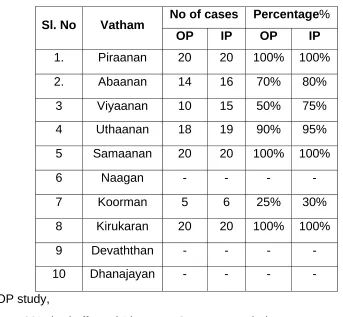
In Vatha Gunmam, piraanan, abaanan, uthanan, kirugaran,
koorman are affected and the products symptoms as follows.
1. Affected piraanan produces Indigestion.
2. Affected abaanan produces Constipation.
3. Affected uthaanan produces Nausea, Vomiting.
PITHAM
The qualities of pitham are,
1. Hot
2. Penetrating
3. Slightly foul smelling
4. Liquid
5. Sour and pungent in taste
Pitham is responsible for maintenance of body heat.
The pitha thosham is further divided into five as follows,
1. Anar Pitham
2. Ranjaga Pitham
3. Saathaga Pitham
4. Aalosaga Pitham
5. Praasaga Pitham
1. Anar Pitham
Its action is characteristics of theyu. This is responsible for dryness
and digestion of food.
2. Ranjaga Pitham
It is responsible for the colour and contents of the blood.
3. Saathagam
It lies in the heart. It is responsible for the action in accordance to
our thinking.
4. Aalosagam
It is responsible for the vision.
5. Praasagam
In Vatha Gunmam Anar pitham, Ranjagam, Saathagam are
affected.
1. Affected Anar pitham produces indigestion.
2. Affected Ranjaga pitham produced anaemia.
KABAM
The qualities of kabam are,
Greesy Dense
Smooth Slow
Soft Rigid
Sweet Cold
Stable Clear
Kaba in responsible for maintenance of body form and structure.
Kabam is classified into fivetypes. They are,
1. Avalambagam
2. Kilethagam
3. Pothagam
4. Tharpagam
5. Santhigam
1. Avalambagam
Heart is the seat of Avalambagum. It controls all other kabam.
2. Kilethagam
Stomach is the seat of kilethagam. It gives moisture and softness to
3. Pothagam
Tongue is the seat of Pothagam and it is responsible for the sense of
taste.
4. Tharpagam
Head in the seat of Tharpagam. It cools the eyes.
5. Santhigam
It lies in the joints and responsible for the action of joints. The above
function may be altered when ever the mukkuttram is altered.
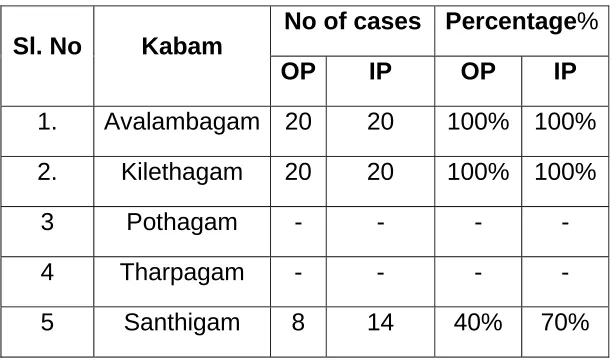
In Vatha Gunman, Avalmbagam, Kilethagam are affected.
1. Affected Kilethagam produces loss of appetite.
1. Increased Vatha
Emaciation, desire to hot food, shivering, abdominal bloating,
constipation, fatigue, sleeplessness, giddiness and laziness.
2. Decreased Vatha
Pain all over the body, low voice, loss of attentiveness,
unconsciousness and other disease of increased kaba.
3. Increased Pitha
Yellowishness of eye, stools, urine and skin. Excessive thirst and
appetite, burning sensation of the body and sleeplessness.
4. Decreased Pitha
Hypothermia, loss of skin complexion and also causes derangement
of kaba.
5. Increased Kaba
Increased salivation, inactiveness, heaviness of the body, impaired
joint movements, dyspnoea, coughs and increased sleep.
6. Decreased Kaba
Factors which promotes the Vatham
Diet habits
According to pararasasekram
“njhopy; ngW ifg;Gf; fhHj;jy; JtHj;jy; tQ;RQ; NrhWk;
goajhk; tuF kw;iwg; ige;jpid aUe;jpdhYk;
vopy; ngw gfYwq;fp ,utpdpYwq;fhj jhYk;
kio epfw; FoypdhNy thjq; Nfhgpf;Fk; fhNz”
Excessive intake of spicy, pungent, astringent, unhealthy food
habits, sleeping, loss of sleep in the night.
“fhzNt kpfTz;lhk; fUJ gl;bdp tpl;lhYk;
khdidahH fz; Nkhfkpwf;fpD kpFe;jpl;lhYk;
Mzt kyq;flk;ik aq;fNd tplhjjhYk;”
-guuhrNrfuk;
“Excessive food or starvation
Excessive indulgence of sex and ego”
‘fhyq;fs; khwpAz;Zk; fhhpaj; jhYe; jz;zPH
rhyNt kUe;jpdhYk; re;jpAYl; fhHe;jhYk;
Nfhykha; Gspg;G nea;ia Fiwtw tUe;jpdhYk;
thythH Kiy ey;yhNs thj Kw;gtpf;Fk; fhNz”
- guuhrNrfuk;
Irregular time of diet, excessive intake of water, excessive intake of
sour and ghee.
‘GspJtH tpQ;Rq;fwp ahw;g+hpf; Fk;thjk;”
Denotes apart from sour, astringent and pungent taste holds its part
Pitha promotes
Astringent, chilly and salt are taste which increases pitha kuttram.
Kaba Promotes
Sweet, astringent the taste which promotes kaba kuttram.
In Vatha Gunmam vatha kuttram is predominately vitiated.
“njhlHthj ge;jkyhJ Fd;kk; tuhJ”
The vitiation of vatham is due to irregular food habits and physical
activities etc. As a result of vitiated vatham three important vayus
uthaanan, abaanan and samaanan are vitiated.
The vitiation of the above vayus resulted in indigestion, pain in the
abdomen, bloating, increased peristalsis and vomiting etc., which are the
signs and symptoms of Vatha Gunmam. The persistance of the above
results in debilitation of udal kattugal.
SEVEN UDAL KATTUGAL
There are seven primary tissues which constitute the entire human
body and all the organs of the various systems.
1. Saaram
It is the end product of digestive process. It gives strength to the
body and mind.
2. Senneer
The saram after absorption is converted in to senneer. It is
responsible for knowledge strength and health complexion.
3. Oon
It gives figure and shape to the body. It is responsible for the
4. Kozhuppu
It lubricants the organs and facilitates their function.
5. Enbu
Gives shape to the body helps locomotion and protects vital organs.
6. Moolai
Present in the care of the bone and it gives strength maintains the
normal condition of the bone.
7. Sukkilam / Suronitham
Responsible for reproduction.
In Vatha Gunmam saaram, senneer are affected
1. Affected saaram produces Tiredness, Loss of appetite.
2. Affected senneer produces Anaemia, Loss of appetite.
MUKKUTRA VERUPAADUGAL (PATHOGENESIS)
1. By any one or other etiological factors vatha is vitiated first.
2. Then it affects the other thathus pitha and kaba which are in a state
of equilibrium.
3. And then the ten vayus, seven udal kattugal and other structure are
also affected according to the severity of the illness.
4. By the affection of “Piraanan” wheezing, cough, dyspnoea, nasal
congestion and indigestion may occur.
5. By the vitiation of “Abaanan” constipation, oliguria and menstrual
disorders may occur.
6. By the affection of “Uthaanan” heart, chest, mouth and eyes are
7. By the vitiation of “Viyaanan” muscle wasting, loss of sensation,
giddiness, coma, bodyache, numbness, itching and tingling
sensation are formed.
8. By the affection of “Samaanan” disturbances of other vayus,
abdominal distension, anorexia, malnutrition and indigestion may
occur.
9. When “Pitha” is affected anorexia, anaemia, indigestion, blurring of
vision, dryness and darkness of skin, vomiting, giddiness, burning
sensation of the body and difficulty to do works are formed.
10. When “Kaba” is affected respiratory disorders, indigestion,
tastelessness, burning sensation of eyes and joint diseases may
occur.
11. When “Saaram” is affected anorexia, laziness, weakness and
dryness of skin are formed.
12. When “Senneer” is affected nerve weakness, dryness, mental
disorders, haematuria, jaundice, anaemia, anorexia, spleenomegaly
and skin diseases may occur.
13. When “Oon” is affected muscle wasting, dropsy, bodyache,
oedema and weakness of fire, sensory organs are formed.
14. When “Kozhuppu” is affected debility, bodyache, joint pain,
spleenomegaly and tiredness may occur.
15. When “Enbu” is affected arthritis, joint pain, osteophytes formation
and other bone diseases are formed.
16. When “Moolai” is affected blurring of vision, ulcers, heaviness of
the body and bone diseases may occur.
17. When “Sukkilam” is affected urinary calculus, bleeding during
PINIYARI MURAIMAI (DIAGNOSIS METHODS)
The diagnosis to find out the disease in siddha system is known as
“Piniyari Muraimai”.
It is very important part of the treatment. It is helpful to select the
correct line of treatment and good prognosis.
It is based on the following principles
1. Porial Arithal
2. Pulanal Arithal
3. Vinathal
I. Poriyal Arithal
Poriyal arithal means the art of perception five organs viz.
1. Nose
2. Tongue
3. Eyes
4. Ears
5. Skin
II. Pulanal Arithal
It is an art of knowing objective series Viz.
1. Smell
2. Taste
3. Vision
4. Hearing
5. Touch
III. Vinathal (Interrogation)
frequency of attacks. If the patient is in the stage of inability to speak or a
child physical should interrogate the details with his immediate relatives
who are taking care of him.
ENVAGAI THERVUGAL
The important method adopted to diagnose the disease is by means
of Envaigai Thervugal. The value of Envagai Thervugal is very important
for diagnosing purpose, which is the unique and special method describing
in siddha system of medicine.
An Agasthiyar Vaidhya Vallathi 600, Envagai Thervugal has been
mentioned as “Attavitha paritchai”.
“njhFf;fYw;W ml;ltpj ghpl;irjd;id
Jyf;fKWk; gz;bjNu njspthfg;
gFf;fhpa ehbia eP gpbj;Jg;ghU
gfHfpd;w thHj;ijg; ghH ehitg; ghU
tFf;fhpa Njfnkdj; njhl;Lg; ghU
tskhd rhPuj;jpd; epwj;ijg; ghU
rfpf;fhpa kyj;ijg; ghH ryj;ijg; ghU
rhHe;j tpopjidg; ghHj;J njsptha; fhNz”
-mf];jpa itj;jpa ty;yhjp 600
The Envagai Thervugal are,
“ehb ];ghprk; eh epwk; nkhop tpop
kyk; %j;jpukpit kUj;Jt uhAjk;”
Envaigai Thervugal Constitute
1. Naadi
2. Sparism
3. Naa
4. Niram
5. Mozhi
6. Vizhi
7. Malam
8. Moothiram
1. NAADI (PULSE)
The study of ‘Naadi’ is the important factor in Envagai Thervugal
which gives almost the correct diagnosis. The unique factor which is
responsible for the soul in the body is known as ‘Naadi’. Naadi may by
studied at ten placed in the body, which are heel, genital organ, abdomen,
chest, ear, nose, neck, hand, eyebrow and vertex. But the study of naadi at
hand is the best because the radial artery is located superficially.
Naadi must be studied in right hand for men and left hand for
women. The three uyir thathukkal are formed by use combination of,
Edakalai + Abaanan Æ Vatham
Pinkalai + Piraanan Æ Pitham
Suzhumunai + Samaanan Æ Kabam
They can be felt one inch below the wrist in the radial side by means
of palpation and percussion with the tip of the index, middle and ring finger,
corresponding to vadha, pitha, kaba respectively.
The three humours exist in the ratio of 1: ½ : ¼ normally.
Derangement of this ratio leads to various disease.
‘ fhpKfdbia tho;j;jpf;
ifjdpy; ehbghHffpy;
xU tpuNyhby; thjk;
caH eLtpuypw; gpj;jk;
jpUtpuy; %d;wpNyhby;
Nrj;Jk ehbjhNd ”
- mfj;jpaH 2000
In the Gunma noi, the following naadi can be felt, commonly Vatha
Nadi, Pitha Vatha Nadi.
Vatha Naadi
‘thjnkDk; ehbaJ Njhd;wpy;
rPjke;jnkhL tapW nghUky; jpul;rptha;T
rPjKWq; fpuhzp kNfhjuk; ePuhik
jpus;tha;T #iy typ fLg;Gj jPiu
ePjKWq; fpUkp Fd;kk; mz;lthjk;
epiyAk; ePHf; fphpr;ruq;fs; je;JNkfk;
Ngjfkh Kjug;gpzp %y Nuhfk;
NgrntF gpzpfSNk nghUs jhNk”
- rjfehb
Pitha Vatha Naadi
“ rpwg;ghd gpj;jj;jpy; thj ehb
NrhpYWjhJ el;lKju gPil
ciwg;ghfr; nrhpahikf;Fd; ke; #iy
Aw;w Ruq;fpuhzp tapw;wpiur;ry; ke;jk;
miwg;ghd Xq;fhu GwePHf;Nfhit
Mahrkpuf;f nkhL kaf;f %Hr;ir
Kiwf;fha;T tp\ tPf;fk; %ytha;T
Kulhd Neha; gyT KLFk; gz;Ng”
gpj;j kpFjpAld; cl;bzk; NrHe;jjhYz;lhk; FwpFzq;fs;
“jiog;ghd gpj;jj;jpYl;bzq; nfhz;lhy;
rakj;jp Ruk; ntJg;G rj;jpFzk;
fisg;ghd nghUj;J isTtjprhuq;fs;
fLg;GlNd tapw;Wtyp %ythA
,iwg;ghfp A+z;kWj;jy; ehf;frg;G
,utpy; fdTlNd rq;fhu Njhlk;
giog;ghd gapj;jpa NehnahpTjhfk;
te;jZfpy; gy gpzpf;Fk; tifajhNk”
- rjf ehb
Ia kpFjpAld; thA NrH;e;jjhYz;lhk; FwpFzq;fs;
“njhe;jpj;j Nrj;Jkj;jpy; thA $bj; njhlHe;j
Fd;kk; neQ;rilg;G Rthrfhrk;
te;jpj;j Fuy;jdpNa cWj;jyPis
tOtOg;G ePUwy; kyj;jpy; rPjk;
nte;jpj;jy; nfhOj;jy; Fj;Je; jpkpHtpahjp
tPr;RlNd typ nal;Le;jpul;rp ghz;L
me;jpj;j fpWfpWg;G kaf;fk; tpf;fy;
Mdgy gpzpfSNk te;jl Ue;jhNd”
- rjf ehb
“thje;jhd; cjwp epw;fpy;
typ Fd;kk; te;J NrUk;”
- Fzthflk;
“ thjj;jhy; typ Fd;kk; #iy
“tspehb ,lj;jpypire;jhy; tsp Fd;kkhk;”
“gpj;jehb ,lj;jpypire;jhy; gpj;j Fd;kkhk;”
“Iaehb ,lj;jpypire;jhy; Ia Fd;kkhk;”
2. SPARISM (PALPATION)
By sparism the temperature of skin (heat and cold) smoothness or
roughness, sweat, dryness, hard patches, swelling, growth of abdominal
organs, tenderness and nourishment can be felt.
In Vatha Gunmam, Tenderness was present in the epigastric region.
3. NAA (TONGUE)
By the examination of tongue its colour, coating, dryness, deviation,
movements, variation in taste, ulcer and the condition of teeth and gums
ability to appreciate the taste can be noted.
In Vatha Gunmam the tongue may be coated. If anaemia is present
the tongue is pale.
4. NIRAM (COLOUR)
By the examination of niram the type of thegam (body) cyanosis,
redness, pallor, yellowish discoloration can be noted.
Vatha Thegi Æ Dark colour
Pitha Thegi Æ Yellow or red colour
Kaba Thegi Æ White or yellow colour
5. Mozhi (Speech or voice)
In the examination of mozhi, the pitch of voice (low or high) slurring
6. VIZHI (EYE)
By the examination of vizhi, pallor, redness, yellowishness, dryness,
lacrimation, sharpness of vision must be noted.
7. MALAM (STOOLS)
By the examination of malam its nature, colour, quantity, presence of
blood or mucous can be noted.
In Vatha Gunmam constipation may be present.
8. MOOTHIRAM (URINE)
The examination of urine is classified in to two types,
1. Neerkuri
2. Neikuri
,aw;if ePH ,yf;fzk;
‘kpfj;jbg;Gk; kpfj; NjwYk ,d;nwdpy;
Rfj;ijj; jUk; nka;Rght ePH ed;Nw”
I. Neerkuri
1. Niram - Niram indicates the colour of the urine voided.
2. Edai - Edai indicates the specific gravity of urine.
3. Manam - Manam indicates the smell of the urine voided.
4. Nurai - Nurai indicates the frothy nature of the urine voided.
5. Enjal - Enjal indicates the quantity (increased or decreased)
In addition, frequency of micturition and sediments are noted.
‘mUe;J khwpujKk; mtpNuhj kjha;
m/fy; myHjy; mfhyT+z; jtpHe;jow;
Fw;wstUe;jp cwq;fp itfiw
Mbf; fyrj; jhtp Na fhJ nga;
njhU K$Hj;jf; fiyf;Fl;gL ePHpd;
epwf;Fwp nea;f;Fwp epUkpj;jy; flNd ”
- NjiuaH
Preparation of patient
Prior to the day of urine examination for neerkuri and neikuri. The
patient is advised to take the balanced diet and the quantity of food must
be proportionate to his appetite. He should have a good sleep.
Neikuri
‘epwf;Fwpf; Fiuj;j epUkhd ePhpw;
rpwf;f ntz;nza; NahH rpWJsp eLtpLj;
njd;Dwj; jpwe;njhyp Nafhj ikj;jjp
dpd;wjptiy Nghk; newp tpopawpTk;
nrd;wJ GfYe; nra;jpia AzNu”
- NjiuaH
Method
After waking up in the early morning urine was collected in glass
contains and examined with 1.30 hours. A drop of gingelly oil is added
through the side of the vitreous without any disturbing. The nature of
Observation
If drops of oil
Lengthens like a snake Æ Vatha neer
Spread like a ring Æ Pitha Neer
Appears like a pearl Æ Kaba Neer
Spreads like,
Snake in ring
Ring in pearl - Thontha Neer
Snake in pearls etc
The Character of Vatha Neer
‘muntd ePz;bd/Nj thjk;”
When the drop of oil spreads like a snake, it indicates vatha neer.
The Character of Pitha Neer
‘MopNghy; gutpd; m/Nj gpj;jk;”
When the drop of oil spread like a ring, it indicates pitha neer.
The character of Kaba Neer
‘Kj;njhj;J epw;fpd; nkhoptnjd; fgNk”
When the drop of oil remain as that of a pearls it indicates kaba neer.
The character of Thontha Neer
‘mutpyhopAk;> Mopapy; muTk;
mutpd; Kj;Jk; Mopapy; Kj;Jk;
Njhw;wpy; njhe;j Njhlq;fshNk”
-Neha; ehly; Neha; Kjdhly;
When the drop of oil shown two shapes enclosed within one another,
The Character of Mukkutra Neer
When the drop of oil drawn in to the urine, it indicates mukkutra neer.
The fats regarding Envagai Thervugal suggests that it is monthly
used as diagnostic tool in siddha system of medicine and more
concentration should be emphasised to earn proficient knowledge.
Beside Envagai Thervugal a disease can also be diagnosed by
means of other methods namely Kanmenthriyangal, Gnaenthiriyangal, uyir
thathukkal, ezhu udal thathugal, paruvakaalangal and thinaigal.
Hence a through knowledge about the disease can be studied out
systematically and properly in siddha system of medicine.
THINAIGAL
Nilam is classified into five types. They are,
1. Kurinji
Mountain and its surroundings kaba noigal and liver diseases are
common.
2. Mullai
Forests and its surroudings pitha noigal, vatha noigal, liver diseases
are common.
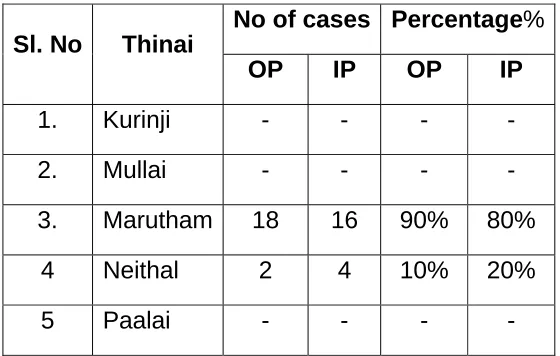
3. Marutham
Field and its surroundings safest place to maintain good health.
4. Neithal
Sea and its surroundings vatha diseases and liver enlargements are
common.
5. Paalai
Desert and its surroundings vatha, pitha, kaba noigal are common.
Studies of five lands are very much needed as same diseases are
Each region has its own characters which influences the inhabitation,
physical, mental, economic, occupational and cultural activities. In each
region same ailments are endemic based on the climatic features.
Prevention and curative measures for these ailments are stated in medical
literatures.
Vatha Gunmam is common in Marutham and Neithal.
PARUVAKAALANGAL
A year is classified into six seasons each constituting two months.
They are,
1. Karkaalam - Avani & Purattasi - Aug & Oct
2. Koothirkaalam - Iyppasi & Karthigai - Oct & Nov
3. Munpanikaalam - Margali & Thai - Dec & Jan
4. Pinpanikaalam - Masi & Panguni - Feb& March
5. Elavenilkaalam - Chithirai & Vaikasi - April & May
6. Muthuvenilkaalam - Aani & Aadi - June & July
Some of the diseases are commonly prevalent during a particular
season and study of its will also be useful for diagnosis.
UDALVANMAI
It means strength and vitality of the body and classified into three
types.
Eyarkai vanmai - Inherited immunity.
Kala vanmai - Age, Season and time.
KAALAM (AGE AND DISTRIBUTION)
In siddha text, the normal human life is 100 years. It is divided into 3
stages based on dominant humors.
Stage Years Dominant Humors
First Stage 33 years and 4 months Vatha Period
Second Stage 33 years and 4 months Pitha period
Third Stage 33 years and 4 months Kaba Period
DIFFERENTIAL DIAGNOSIS
1. VAYU GUNMAM
‘ghHf;fNt thAFd;kk; gfuf; Nfsha;
gUfpaNjhH gjhHj;jq;fs; nrhpj;jplhJ
NjHf;fNt arde;jhd; nry;yh jhFk;
JUj;j;pnfhs; fhw;wJ Nghy; tapWKg;Gk;
CHf;fNt cs;ngyDk; nfLg;gjhFk;
clYyUk; eilFiwAk; Xa;r;ryhFk;
NtHf;fNt abtapW jdpNa te;J
kpfg;Guz;L tpy;Yg; Nghy; tpFj;jyhNk”
Indigestion, loss of appetite, borborygmus, malaise, tiredness,
general debility, lower abdominal pain.
In Vatha Gunmam, there is no lower abdominal pain.
2. PITHA GUNMAM
‘Nehk;gpj;j Fd;kj;jp Dl;gq; Nfsha;
Edp kQ;r zpwk;Nghy KfK khFk;
thQ; rj;jp the;jpAz;lha; kdk Wf;Fk;
fhk neUg;gha;j; jhdpUf;Fq; iffh NyhAk;
fLk; nta;apw; fz;lTld; jiyR ow;Wk;
%j;jpuQ; rpte;jpUf;Fe; jhfk; fhZk;
Kf;fpNa kyk; tPOk; %r;Rz; lhNk”
Yellowish discolouration of the face, Nausea, Vomiting, Excessive
sputum, Hyperpyrexia, Pain in the upper & lower limbs, Giddiness,
Haematuria, Excessive thirst, Constipation and Dyspnoea.
In Vatha Gunmam there is no yellowish discolouration of the face,
haematuria and excessive sputum.
3. VALI GUNMAM
‘ jpkpuhf tapW}We; jpiuA Nkdp
nrlKiye;J fUj;jopAQ; rpjWe;J}f;fk;
tkpuhf tapwpiue;J Kd; NghyhFk;
tUj;jkh ardkpfj; jhDQ; nry;yh
Kkpuhf tpyhtjdpw; nrhUfyhFk;
KJFjz;L typ fhZ kpLg;G Nehthk;
fkpuhf fhakJ fLg;G fhZk;
fzRukha; ngha;grpAq; fhZq; fhNz”
Abdominal bloating, dryness of the skin, mental confusion, disturbed
sleep, loss of appetite, pain in the hypochondrium, pain in the vertebral
coloumn & hip, hyperpyrexia and false appetite.
In Vatha Gunmam there is no pain in the vertebral coloumn & hip,
FINAL DIAGNOSIS
After the confirmation of diagnosis as Gunmam, the type of Gunmam
is confirmed by comparing the identifies and differences of the signs and
symptoms and the results obtained by Envagai Thervugal, Naadi and
Mukkutram.
SATHAGA NAADI
‘jhdhd gpuNkfk; Cj #iy
rhHthd ePhpopT Fd;k Nuhfk;
- - -
Cz;lhf;fp arhj;jpakh KWjpjhNd”
‘ cWjpnfhz;l tYtPr;R re;jpNjhlk;
cuj;j fuk; tplNrhig> cs;S Nuhfk;
kwjpAs;s ,uhzp ajprhuq; Fd;kk;
- - -
- - -
- - -
Njhd;WLfpy; kuznkd;W njhFj;j nrhy;Ny”
‘nrhy;Yfpd;w tplghfk; tPf;fQ; Nrhif
- - -
tPwhd Fd;k kj;jp Ruk; fhkhiy
- - -
te;jZfpy; kuznkd;W trdpg;ghNa”
Fd;k Nuhfj;jpy; cz;lhFk; Njhlf;Fwpfs;
‘GfYtJNfs; mj;jpthA thfh
nghUe;JtNjhw; thAtjpy; Fd;k khfh
jifik ngWk; Fd;kj;jpy; Ngjpahfh
- - -
Njhd;wpLfpy; kuzk; te;J njhlUe;jhNd”
- rjfehb
According to the Sathaganadi, the Gunmam which is associated with
hiccough, dyspnoea, diarrhoea, unconsciousness are the signs of bad
prognosis and leads to death.
TREATMENT (PINI NEEKAM / MANAGEMENT)
The aim of pini neekam is based on
1. To bring the thirithosha in equilibrium.
2. Treatment of the disease signs and symptoms.
3. Pathiyam.
Siddha system of medicine is based on the mukkutra theory and
hence the treatment is mainly aimed to bring down the thirithosha to its
equilibrium state and thereby restoring the physiological condition of
various thathus.
‘tpNurdj;jhy; thjk; jhOk;
tkdj;jhy; gpj;jk; jhOk;
erpa mQ;rdj;jhy; fgk; jhOk;”
- Neha; ehly; Neha; Kjdhly;
Vatha disease can be brought down by viresanam, pitha disease
‘njhlHthj ge;jkyhJ Fd;kk; tuhJ”
Since the Vatha Gunmam occurs due to the vitiation of Vatha it can
be set right by giving viresanam.
For viresanam strong purgatives containing nervalam are usually
avoided and laxatives like
Nilavagai chooranam – 5 to 10 gm with hot water at bed time is
given for this study.
Any one of the following purgative may also given.
1. Sanjeevi mathirai – 2 to 4 pills (100 mg) with sufficient amount of
extract.
2. Mehanatha kuligai – 1-2 tablets at bed time with chukku decoation.
3. Vellai ennai – 15 to 30 ml early in the morning (3 to 5 days).
4. Merugulli ennai – 8 to 15 ml early in the morning.
According to the patient’s body built and severity of the disease the
selection of the medicine and dosage may be altered.
TREATMENT OF DISEASE
After the thirithosha are brought down to its equilibrium state the
signs and symptoms of disease should be treated properly for this study.
Ayilpattai chooranam – 1 to 2 gms BD with hot water.
PREVENTION OF DISEASE
Tiruvalluvar says that when a patient approaches a physician for a
disease, the physician should follow some important points.
1. Diagnosis of disease
2. Causes of disease
‘Neha;ehb Neha; Kjy;ehb mJjzpf;Fk;
tha;ehb tha;g;gr; nray;”
- jpUf;Fws;
Thiruvalluvar also says some preventive measures
‘kUe;njd NTz;lhthk; ahf;iff;F mUe;jpaJ mw;wJ Nghw;wp czpd;”
‘mw;wJ mwpe;J filgpbj;J khwy;y Ja;f;f Jtug; grpj;J”
‘khWghL ,y;yhj czT kWj;Jz;zpd; CWghL ,y;iy capHf;F”
‘,optwpe;J cz;ghd;fz; ,d;gk;Nghy; epw;Fk; fopNg hpiuahd;fz; Neha;”
‘jPas td;wpj; njhpahd; nghpJz;zpd; Nehas tpd;wpg; gLk;”
-jpUf;Fws;
PATHIYAM
During the course of the treatment all the patients were given
uniform hospital diet. The patients also adviced to follow certain precaution
and physical activities. Adviced to get rid of spicy foods, alcohol, stress and
strainful condition, roughage diet, semi cooked and unhygenic diet. Patient
were advised to avoid non-vegetarian diet. Adviced to take regular meals.
HABITS
Patients were advised to get rid off the smoking, alcohol, chewing
YOGASANA TREATMENT
Yogasana according to Thirumanthiram is the basic principle science
for achieving salvation during life itself. As the body is said to be the
residence of divinity the siddha saint Thirumoolar has advised each and
every individual who aspires for self realization to build up his physical
body and mind to practice yogasana.
In yogam, asanam is the first step in practice. By practicing
yogasana the physical body and the mind are brought under control aiding.
Perfect meditation and concentration which will enable to achieve vivegam,
essential for self realization. The concise aim for yogam is to possess
sound body and sound mind to achieve longevity for attaining salvation, if
the body falls pray to several diseases, constantly the mind gets perverted
leading to last prejudice misunderstanding or ignorance.
Asanas are nothing but a sort of yogic exercise, which differs from
physical exercise. Tirumoolar in his Thirumanthiram, describes the uses of
yogasana under the heading “Attanga yoga”.
The asanas are strongly advocated for controlling Vatha Gunman.
The technique of practicing it is to be learnt under the guidance of a
yogasana specialist who has the knowledge of disease process.
The following asanas are useful to treat the abdominal disorders.
1. Uthanapada asana
2. Pavanarnukta asana
3. Bhujanga asana
4. Shalabha asana
5. Patchimoota asana
MODERN ASPECTS
ANATOMY
Anatomy of the Stomach
The stomach is a muscular bag. It is the most dilated part of the
gastrointestinal system. It has both digestive and not digestive functions.
It’s development is in the foregut. It is situated in the upper abdomen, left
hypochondriac, epigastric and umbilical regions.
It is normally J shaped.
Capacity
New born Æ 30 ml
At puberty Æ 1000 ml
Adult Æ 1500 ml
Shape
When empty the stomach is somewhat J shaped. When partially it
becomes piriform in shape. In obese persons it is more horizontal.
Size
It is about 10 inches long and the mean capacity is one Ounce
(30 ml) at birth, one litre at puberty and 1.5 - 2 litres or more in adults.
External Features
The stomach has
1. 2 openings or ends.(orifices)
2. 2 borders.
3. 2 surfaces
4. 2 peritoneal sacs are related.
Openings of the Stomach
Cardiac end
This is the upper opening of the stomach. This is not an anatomical
sphincter. The Oesophagus opens in to the stomach at the level of
T11 vertebra.
Pyloric end
This is the lower opening of the stomach. It is situated 1.25 cm to the
right of the midline at the transpylorie line. It opens into the duodenum. It
has a well defined anatomical pyloric sphincter. Pyloric groove separates it
from the duodenum. The pyloric end is greenish as it is stained by the bile.
Borders of the stomach
It has 2 borders
1. Lesser Curvature.
2. Greater Curvature.
Lesser Curvature
It is the right upper border. It is the direct continuation of the right
border of angularis. Lesser curvature gives attachment to the lesser
Omentum. A peptic ulcer commonly occurs along or nearer to the lesser
curvature.
Greater Curvature
It is the lower and left border of the stomach. It is 5 times longer than
the lesser Curvature. Between the Oesophagus and greater curvature the
cadiac notch is situated.
To the greater curvature the following peritoneal folds are attached,
Surface of the Stomach
It has two surfaces,
1. The antero superior surface.
2. The postero inferior surface.
Structures forming the stomach bed
1. The diaphragm (left crus)
2. Left kidney.
3. Left supra renal gland.
4. Splenic artery and spleen.
5. Body of the Pancreas.
6. Transverse Mesocolen.
7. Left colic flexure.
Parts of the Stomach (Fig.1)
1. Fundus
2. Body
3. Pyloric Antrum
4. Pyloric canal.
Fundus
It is the highest part of the stomach. Usually it is filled with gas.
Body
It is situated below the fundus.
Pylorus
BLOOD SUPPLY
ARTERIAL SUPPLY (Fig. 2)
Along the lesser Curvature
1. Left gastric artery from coeliac artery.
2. Right gastric artery from hepatic artery.
Along the greater Curvature
1. Right gastroepiploic artery from the gastroduodentral artery.
2. Left gastroepiploic artery from the splenic artery.
Fundus of the stomach
5-6 short gastric arteriers from splenic artery.
Venous Drainage
Among the lesser Curvature
1. Left gastric vein.
2. Right gastric vein – into portal vein.
Among the greater Curvature
1. Left gastroepiploic vein into splenic vein.
2. Right gastroepiploic vein into superior mesentric vein.
Fundus of the Stomach
5-6 short gastric veins into splenic vein.
Nerve supply
Parasympathetic supply
1. Right and left vagus nerves via anterior and posterior gastric
nerves.