Copyright © 1998, American Society for Microbiology. All Rights Reserved.
A Functionally Distinct TATA Box Required for Late
Progression through the Epstein-Barr Virus Life Cycle
TRICIA R. SERIO,1† NIAMH CAHILL,1MATTHEW E. PROUT,1ANDGEORGE MILLER1,2,3*Department of Molecular Biophysics and Biochemistry,1Department of Epidemiology and Public Health,2and
Department of Pediatric Infectious Diseases3Yale University, New Haven, Connecticut 06520
Received 15 April 1998/Accepted 16 July 1998
During EBV infection, lytic DNA replication activates late gene expression in trans via an uncharacterized pathway. In this study, we mapped the target of this regulatory cascade to a variant TATA box (TATTAAA) and the 3* flanking region within the core promoter of the BcLF1 gene. The inherent late activity of this core promoter is, surprisingly, disrupted by a heterologous enhancer, suggesting that late gene expression is regulated through core promoter sequences located in a transcriptionally inert environment.
Lytic infections of DNA viruses are characterized by cas-cades of temporally regulated gene expression ultimately lead-ing to the release of infectious virus. Progression through the viral life cycle is monitored at specific checkpoints; the basic organization of these checkpoints is strikingly similar from bacteriophage to mammalian viruses (33). In the case of Ep-stein-Barr virus (EBV), entry into the lytic phase of infection is regulated at the level of expression of the immediate-early genes for ZEBRA and Rta (4, 10, 31, 45). Transcription of these products proceeds in the presence of translational inhib-itors (2, 44). Expression of the early genes is directed by the immediate-early factors (24), and together, these two groups stimulate replication of the viral genome (2, 7, 8, 44). Follow-ing this checkpoint, the structural proteins are synthesized (5, 21, 32, 35, 43) and assembled into mature virions during the late phase of infection. Virion particles encapsidate the newly replicated viral genomes and are then released to initiate a new round of infection.
While lytic replication of the viral genome serves as a key checkpoint in the production of infectious virus, the mecha-nism by which this event releases the expression of late prod-ucts has not been elucidated in any viral system. The available information, however, suggests a complex relationship be-tween these two processes. In EBV infection, for example, the viral genome must be amplified for infected cells to support expression of late products (24); however, the transcriptional template itself need not be replicated (36). EBV DNA repli-cation acts in trans, likely initiating a cascade of events which culminates at specific late promoter sequences. By using a reporter assay with EBV-infected human B cells as a model system, we have identified the cis target of this regulatory pathway as the first step in understanding the link between replication and late gene expression.
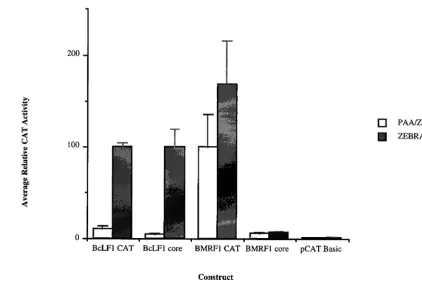
We have previously demonstrated in EBV-infected human B cells that cloned viral promoters of different temporal classes retain the ability to direct viral stage-specific expression of a reporter gene (36). Expression from the BcLF1 late promoter, BcLF1 chloramphenicol acetyltransferase (CAT), exhibits rep-lication-dependent activity: reporter gene expression is mark-edly decreased by treatment with an inhibitor of the viral DNA
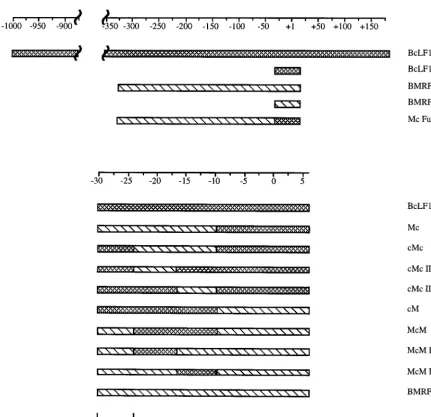
polymerase, phosphonoacetic acid (32, 43) (Fig. 1). In contrast, amplification of the viral genome does not alter the level of reporter gene expression from an early viral promoter, BMRF1 CAT, in comparison with the vector control, pCAT Basic (Fig. 1). The faithful recapitulation of viral gene expres-sion by these cloned promoters in infected cells has provided us with an experimentally tractable model to study the regula-tion of late gene expression in EBV. We have employed a combination of deletional mutagenesis and hybrid promoter construction between BcLF1 and BMRF1 sequences (Fig. 2) to elucidate the cis modulator of late gene expression reported here.
Deletional analysis of the BMRF1 and BcLF1 promoters suggested that their distinct expression patterns were reflected in different structural organizations. Promoters transcribed by RNA polymerase II are composed of multiple cis-active com-ponents residing in two regions, the core promoter and the enhancer (for a review, see reference 49). The core promoter is defined by the presence or absence of two basal DNA ele-ments: the TATA box and the initiator (41). These elements are thought to act in concert to position the basal tional machinery correctly for accurate initiation of transcrip-tion. Enhancers of transcription are believed to increase the occupancy of these sites from a distance, thus stimulating gene expression (for a review, see reference 49).
The BMRF1 early promoter exhibited classic promoter con-struction (49) with strong enhancer sequences 59to the basal core elements (Fig. 1, compare BMRF1 CAT to BMRF1 core) (13, 14, 22, 46). In contrast, the BcLF1 late promoter repre-sented a novel promoter class in which regulation occurred exclusively through a core promoter with a unique TATA box, independently of upstream or downstream sequences. Progres-sive removal of sequences outside of the late BcLF1 core promoter (i.e., upstream of the TATA box and downstream of
16 relative to the transcriptional start site) had no conse-quence for either the replication dependence or amplitude of reporter gene expression in this system (Fig. 1). Indeed, ex-pression from a 36-bp promoter spanning 230 to16 of the BcLF1 late promoter, BcLF1 core (Fig. 2), exhibited an even greater replication dependence than did the full-length pro-moter (Fig. 1, compare BcLF1 CAT to BcLF1 core). This ability to direct strong late temporal expression exclusively through the core region was an intrinsic property of the BcLF1 promoter, as the analogous region of an early promoter, BMRF1 core, did not support this pattern (Fig. 1, compare BcLF1 core to BMRF1 core). This functional difference be-* Corresponding author. Mailing address: 333 Cedar St., New
Ha-ven, CT 06520. Phone: (203) 785-4758. Fax: (203) 785-6961. E-mail: [email protected].
† Present address: Department of Molecular Genetics and Cell Bi-ology, The University of Chicago, Chicago, IL 60637.
8338
on November 9, 2019 by guest
http://jvi.asm.org/
tween early and late core promoters, furthermore, suggested that DNA replication stimulates gene expression by a se-quence-dependent mechanism rather than by evoking a glo-bally acting change in the basal transcriptional machinery.
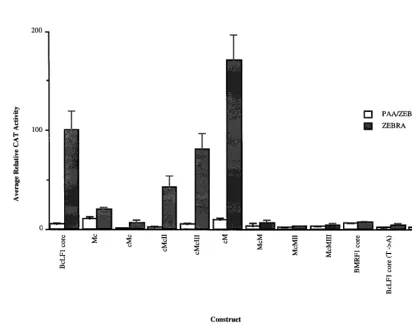
Exploiting the functional differences between late and early promoter core sequences to characterize cis-active regulatory elements further, we constructed a series of hybrid early and late core promoters (Table 1 and Fig. 2, bottom) and analyzed their ability to direct replication-dependent expression of CAT in EBV-infected human B cells. Bisection of the core promot-ers at29 relative to the transcriptional start site localized the replication-dependent cis-active site to the 59 end of the late core promoter, between 230 and 210, suggesting that the initiator element was neither necessary nor sufficient for late gene expression (Fig. 2 and 3, compare cM to Mc). Substitu-tion of the BMRF1 early gene TATA box into cM (Fig. 2, bottom) abolished replication-dependent activity from that promoter (Fig. 3, compare cM to McM). Reciprocally, intro-duction of the BcLF1 late gene TATA box into Mc (Fig. 2, bottom) imparted increased replication dependence to this promoter, albeit at a reduced level (Fig. 3, compare Mc to cMc). Sequences between 225 and 210 of the BcLF1 pro-moter restored full-level activity to this hybrid propro-moter (Fig. 3, compare cMcII and cMcIII to cMc), but this region did not alter expression in the presence of an early gene TATA box (Fig. 3, compare BMRF1 core to McM, McMII, and McMIII). Despite the functional differences between the early and late
promoter TATA sequences, both were capable of binding to purified TATA binding protein (TBP) in vitro (data not shown). Surprisingly, core promoters with late activity pro-duced identical electrophoretic mobility shift patterns when incubated with nuclear extracts from virally infected cells dur-ing the early or late phase (data not shown). Therefore, late gene expression in EBV infection was mediated through a basal transcriptional element, the TATA box, without obvious recruitment of additional DNA binding factors, a mechanism proposed in other viral systems (27).
[image:2.612.88.510.70.374.2]Comparison of the early BMRF1 TATA box sequence (CA TAAAT) to that of the late BcLF1 TATA box sequence (TA TTAAA) (1) implicated three potential positions for regula-tion. A total of 13 (72%) of 18 TATA box sequences from known EBV late promoters contained a T at the fourth posi-tion, while this variation was not observed in any latent or early EBV TATA boxes (1). By comparison, the promoters of sev-eral homologs of EBV late genes in Kaposi sarcoma-associated herpesvirus, a related gammaherpesvirus, contained a T in the fourth position of the TATA box (34), and this variant also occurred in 30% of the promoters in the eukaryotic database (3). Mutation of this T to an A, restoring the consensus TATA box sequence (20, 29, 48) to the late BcLF1 core promoter, abolished replication-dependent activity (Fig. 3, compare BcLF1 core to BcLF1 core [T3A]). While the activity of this promoter is extremely low, expression was reproducibly higher than that obtained with both the vector control and an A-to-G FIG. 1. Activities of lytic promoters and their corresponding core fragments in EBV-infected cell line HH514-16. The activities of the promoter fragments are expressed as average CAT activity relative to BcLF1 CAT activity in HH514-16 cells (30) cotransfected with ZEBRA as previously described (36). CAT activities are standardized to luciferase activities expressed from the cotransfected pGL2 promoter plasmid (36). The data represents the average of at least two separate transfections, and the error bars indicate the standard error of the mean. The white bars represent the activity of the promoter fragments during the early lytic cycle (PAA [phosphonoacetic acid]/ZEBRA), while promoter activity during the late lytic cycle (ZEBRA) is shown in gray. The ratio of late activity to early activity (late index) for each promoter fragment is shown below the graph.
VOL. 72, 1998 NOTES 8339
on November 9, 2019 by guest
http://jvi.asm.org/
mutation in the second position of the TATA box (TGTTAA) which disrupts TBP binding (48 and data not shown). These data strongly implicate the alternative TATA box sequence (TATTAAA) in late temporal regulation of viral gene expres-sion in EBV-infected human B cells.
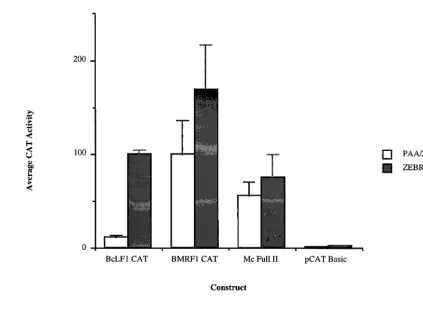
An obvious explanation for these observations was active repression of late promoter activity through the unique TATA box prior to lytic viral DNA replication. To address this pos-sibility, we constructed a hybrid promoter linking the BMRF1 early enhancer region (13, 14, 22, 46) to the BcLF1 late core promoter (Mc Full II, Fig. 2). As is characteristic of early promoters, this promoter directed reporter gene expression to nearly identical levels before and after lytic replication of the viral genome (Fig. 4). The ratio of these activities was nearly identical to that of the wild-type BMRF1 early promoter (Fig. 4, compare BMRF1 CAT to Mc Full II). The late TATA box sequence was, therefore, able to support expression from an upstream enhancer element, fulfilling its well-documented role as a basal transcriptional element (49). In the absence of an
upstream enhancer, however, the late TATA box sequence functioned in temporal regulation, directing replication-de-pendent gene expression (Fig. 3). These observations were consistent with the activity of the BcLF1 core promoter within its normal context: the region 59to the BcLF1 core promoter in the viral genome did not confer activity when transferred to a heterologous core promoter, and removal of this region did not alter expression from its own promoter (Fig. 1).
[image:3.612.84.516.68.485.2]The TATA box has classically been regarded as a static component in the temporal regulation of gene expression. While this element is absolutely required for activity from most promoters, the expression pattern is generally dictated by spe-cific regulators acting outside of the core promoter (19, 28). Recently, however, general transcription factors, such as alter-nate TBPs or TBP-associated factors, have been directly im-plicated in temporal or cell type-specific expression (6, 12, 37), although the mechanisms by which these factors target a spe-cific promoter have yet to be elucidated. Other studies have hinted at the importance of enhancer-TATA sequence cross FIG. 2. Schematic diagram of promoter fragments. Checked bars represent sequences from the BcLF1 late promoter, while striped bars correspond to sequences from the BMRF1 early promoter. Numbering relative to the transcriptional start site is shown above the schematics, and an expanded view of the core promoters is shown in the lower portion of the diagram.
on November 9, 2019 by guest
http://jvi.asm.org/
talk (25, 39, 40, 47, 48), but the dominant regulation in these cases is always the promoter-specific enhancer rather than the basal element. Here, we have characterized a system in which an alternate TATA sequence itself directs temporal expression which is enhanced by nearby cis-active sequences.
Our findings indicate the existence of at least two distinct
promoter architectures in the EBV genome. The BMRF1 early promoter directs expression through sequences outside of the core promoter (Fig. 1) (13, 14, 22, 46). In contrast, temporal expression from the BcLF1 late promoter is solely dependent upon a variant TATA element and its interaction with flanking sequences within the core promoter (Fig. 3). While both the
[image:4.612.94.506.382.706.2]FIG. 3. Activities of hybrid core promoter fragments in EBV-infected cell line HH514-16. Shading is described in the legend to Fig. 1. The data represents the average of at least two separate transfections. PAA, phosphonoacetic acid.
TABLE 1. Oligonucleotides used to construct promoters
Construct Sequence(s)a
cmin ...AACTGCAGTATTAAACCGGGTGGCAGCTCCT GGCAGTCATTCATCTAGAGC Mmin ...AACTGCAGCATAAATTCTCCTGCCTGCCTCTGCTCTGGTACGTTGTCTAGAC Mc ...AACTGCAGCATAAATTCTCCTGCCTGCCTCCTGGCAGTCATTCATCTAGAGC cMc ...AACTGCAGTATTAAATC TCCTGCCTGCCCCTGGCAGTCATTCATTCTAGAGC cMcII ...AACTGCAGTATTAAATCTCCTGGCAGCTCCTGGCAGTCATTCATTCTAGAGC cMcIII...AACTGCAGTATTAAACCGGGTGCCTGCCCCTGGCAGTCATTCATTCTAGAGC cM ...AACTGCAGTATTAAACCGGGTGGCAGCTCTGCTCTGGTACGTTCTCTAGAGC McM ...AACTGCAGCATAAATCCGGGTGGCAGCTCTGCTCTGGTACGTTGTCTAGAGC McMII ...AACTGCAGCATAAATCCGGGTGCCTGCCTCTGCTCTGGTACGTTGCTAGAGC McMIII...AACTGCAGCATAAATTCTCCTGGCAGCTTCTGCTCTGGTACGTTGTCTAGAC cmin (T3A) ...AACTGCAGTATAAAACCGGGTGGCAGCTCCTGGCAGTCATTCATCTAGAGC McFull IIb...AACTGCAGGGATCCAGGAGCTGTT
GAGGCGGCAGGAGATTTAATAATTCT
TCTCCTGCCTGCCTCTGCTCTGGTATTCATTCGGATAAC
GCTCTAGATGAATGACTGCCAGGAGCTGCCACCCGGTTTAA TACCCAGAAA
aTATA sequences are italicized, and the transcriptional start site is underlined for the minimal promoters. Core promoters were cloned between the PstI and XbaI
sites of pCAT Basic (Promega).
bMc Full II fuses BMRF1 promoter sequences between2335 and231 relative to the start of transcription to BcLF1 promoter sequences between230 and16.
The oligonucleotides listed were used in a two-step PCR.
VOL. 72, 1998 NOTES 8341
on November 9, 2019 by guest
http://jvi.asm.org/
early enhancer and late core promoter are autonomous regu-latory units, their combination into a heterologous system (Fig. 4) leads to an observed dominance of the early enhancer, rather than a hybrid expression pattern. This complex interac-tion suggests that regulatory mechanisms active before and after amplification of the EBV genome are unique and high-lights the importance of studying both basal expression and enhancer contributions to observed expression patterns.
Comparison of these results with the extensive work com-pleted on herpes simplex virus (HSV) late gene expression reveals both striking similarities and unique adaptations by EBV. For example, late gene expression in both EBV and HSV (g2) is dependent upon lytic DNA replication, but the requirement is in cis for HSV (18, 26, 38, 48) and in trans for EBV (36). A cis regulator of late gene expression in HSV, as in EBV, occurs near the core promoter (9, 11, 15, 16, 18, 23). In both HSV and EBV, early minimal promoters cannot func-tionally substitute for late minimal promoters (Fig. 3) (15), but late minimal promoters can support replication-independent expression from early enhancers (Fig. 4) (15). While both viruses have targeted regulatory elements near late core pro-moters, the specific targets are unique. HSV late gene expres-sion requires specific sequences within the vicinity of the tran-scriptional start site (9, 11, 15, 16, 18, 23), but in contrast to EBV, the TATA boxes of early and late genes are interchange-able in HSV (17, 42). Identification of the cis regulators of late gene expression in both HSV and EBV are important initial steps in ultimately understanding the complex link to lytic DNA replication, but a complete understanding requires
iden-tification of trans factors, basal or promoter specific, interact-ing with these elements. The work presented here provides a foundation for a detailed mechanistic understanding of late gene expression regulation in EBV.
This work was supported by NIH grants (CA 12055 and CA 16038) to G.M. and an HHMI predoctoral fellowship to T.R.S.
We thank Sean Juo for supplying purified TBP and Bernard Roiz-man and Lucia RothRoiz-man-Denes for helpful discussions and comments on the manuscript.
REFERENCES
1. Baer, R., A. T. Bankier, M. D. Biggin, P. Deininger, P. J. Farrell, T. J. Gibson, G. Hatfull, G. S. Hudson, S. C. Satchwell, C. Seguin, P. S. Tuffnell, and B. G. Barrell.1984. DNA sequence and expression of the B95-8 Epstein-Barr virus genome. Nature 310:207–211.
2. Biggin, M., M. Bodescot, M. Pericaudet, and P. Farrell. 1987. Epstein-Barr virus gene expression in P3HR-1-superinfected Raji cells. J. Virol. 61:3120– 3132.
3. Bucher, P. 1990. Weight matrix descriptions of four eukaryotic RNA poly-merase II promoter elements derived from 502 unrelated promoter se-quences. J. Mol. Biol. 212:563–578.
4. Countryman, J., and G. Miller. 1985. Activation of expression of latent Epstein-Barr virus after gene transfer with a small cloned subfragment of heterogeneous viral DNA. Proc. Natl. Acad. Sci. USA 82:4085–4089. 5. Datta, A. K., and R. E. Hood. 1981. Mechanism of inhibition of Epstein-Barr
virus replication by phosphonoformic acid. Virology 114:52–59.
6. Dikstein, R., S. Zhou, and R. Tjian. 1996. Human TAFII105 is a cell type-specific TFIID subunit related to hTAFII130. Cell 87:137–146.
7. Fixman, E. D., G. S. Hayward, and S. D. Hayward. 1995. Replication of Epstein-Barr virus oriLyt: lack of a dedicated virally encoded origin-binding protein and dependence on Zta in cotransfection assays. J. Virol. 69:2998– 3006.
8. Fixman, E. D., G. S. Hayward, and S. D. Hayward. 1992. trans-acting re-FIG. 4. Effect of fusion of the BcLF1 core promoter to the BMRF1 enhancer. See Fig. 1 for a description of the constructs. Shading is described in the legend to Fig. 1. The data represents the average of at least two separate transfections. PAA, phosphonoacetic acid.
on November 9, 2019 by guest
http://jvi.asm.org/
[image:5.612.89.512.66.393.2]quirements for replication of Epstein-Barr virus ori-Lyt. J. Virol. 66:5030–5039. 9. Flanagan, W. M., A. G. Papavassiliou, M. Rice, L. B. Hecht, S. Silverstein, and E. K. Wagner.1991. Analysis of the herpes simplex virus type 1 promoter controlling the expression of UL38, a true late gene involved in capsid assembly. J. Virol. 65:769–786.
10. Grogan, E., H. Jenson, J. Countryman, L. Heston, L. Gradoville, and G. Miller.1987. Transfection of a rearranged viral DNA fragment, WZhet, stably converts latent Epstein-Barr viral infection to productive infection in lymphoid cells. Proc. Natl. Acad. Sci. USA 84:1332–1336.
11. Guzowski, J. F., and E. K. Wagner. 1993. Mutational analysis of the herpes simplex virus type 1 strict late UL38 promoter/leader reveals two regions critical in transcriptional regulation. J. Virol. 67:5098–5108.
12. Hansen, S., S. Takada, R. Jacobson, J. Lis, and R. Tjian. 1997. Transcription properties of a cell type-specific TATA-binding protein, TRF. Cell 91:71–83. 13. Hardwick, J. M., P. M. Lieberman, and S. D. Hayward. 1988. A new Epstein-Barr virus transactivator, R, induces expression of a cytoplasmic early anti-gen. J. Virol. 62:2274–2284.
14. Holley-Guthrie, E. A., E. B. Quinlivan, E.-C. Mar, and S. Kenney. 1990. The Epstein-Barr virus (EBV) BMRF1 promoter for early antigen (EA-D) is regulated by the EBV transactivators, BRLF1 and BZLF1, in a cell-specific manner. J. Virol. 64:3753–3759.
15. Homa, F. L., J. C. Glorioso, and M. Levine. 1988. A specific 15-bp TATA box promoter element is required for expression of a herpes simplex virus type 1 late gene. Genes Dev. 2:40–53.
16. Homa, F. L., T. M. Otal, J. C. Glorioso, and M. Levine. 1986. Transcriptional control signals of a herpes simplex virus type 1 late (g2) gene lie within bases 234 to1124 relative to the 59terminus of the mRNA. Mol. Cell. Biol. 6:3652–3666.
17. Imbalzano, A. N., and N. A. DeLuca. 1992. Substitution of a TATA box from a herpes simplex virus late gene in the viral thymidine kinase promoter alters ICP4 inducibility but not temporal expression. J. Virol. 66:5453–5463. 18. Johnson, P. A., and R. D. Everett. 1986. The control of herpes simplex virus
type-1 late gene transcription: a ‘TATA-box’/cap site region is sufficient for fully efficient regulated activity. Nucleic Acids Res. 14:8247–8264. 19. Johnson, P. F., and S. L. McKnight. 1989. Eukaryotic transcriptional
regu-latory proteins. Annu. Rev. Biochem. 58:799–839.
20. Juo, Z. S., T. K. Chiu, P. M. Leiberman, I. Baikalov, A. Berk, and R. Dickerson. 1996. How proteins recognize the TATA box. J. Mol. Biol. 261:239–254.
21. Katz, B. Z., N. Raab-Traub, and G. Miller. 1989. Latent and replicating forms of Epstein-Barr virus DNA in lymphomas and lymphoproliferative diseases. J. Infect. Dis. 160:589–598.
22. Kenney, S., J. Kamine, E. Holley-Guthrie, J.-C. Lin, E. C. Mar, and J. Pagano.1989. The Epstein-Barr virus (EBV) BZLF1 immediate-early gene product differentially affects latent versus productive EBV promoters. J. Vi-rol. 63:1729–1736.
23. Kibler, P. K., J. Duncan, B. D. Keith, T. Hupel, and J. R. Smiley. 1991. Regulation of herpes simplex virus true late gene expression: sequences downstream from the US11 TATA box inhibit expression from an unrepli-cated template. J. Virol. 65:6749–6760.
24. Kieff, E. 1996. Epstein-Barr virus and its replication, p. 2343–2396. In B. Fields, D. Knipe, and P. Howley (ed.), Fields virology, vol. 2. Lippincott-Raven, Philadelphia, Pa.
25. Leitman, D. C., E. R. Mackow, T. Williams, J. D. Baxter, and B. L. West. 1992. The core promoter region of the tumor necrosis factor alpha gene confers phorbol ester responsiveness to upstream transcriptional activators. Mol. Cell. Biol. 12:1352–1356.
26. Mavromara-Nazos, P., and B. Roizman. 1987. Activation of herpes simplex virus 1 gamma 2 genes by viral DNA replication. Virology 161:593–598. 27. Miller, A., D. Wood, R. Ebright, and L. Rothman-Denes. 1997. RNA
poly-merase b9subunit: a target of DNA binding-independent activation. Science 275:1655–1657.
28. Mitchell, P. J., and R. Tijan. 1989. Transcriptional regulation in mammalian
cells by sequence-specific DNA binding proteins. Science 245:371–378. 29. Nikolov, D. B., H. Chen, E. D. Halay, A. Hoffmann, R. G. Roeder, and S. K.
Burley. 1996. Crystal structure of a human TATA box-binding protein/ TATA element complex. Proc. Natl. Acad. Sci. USA 93:4862–4867. 30. Rabson, M., L. Heston, and G. Miller. 1983. Identification of a rare
Epstein-Barr virus variant that enhances early antigen expression in Raji cells. Proc. Natl. Acad. Sci. USA 80:2762–2766.
31. Ragoczy, T., L. Heston, and G. Miller. 1998. The Epstein-Barr virus Rta protein activates lytic cycle genes and can disrupt latency in B lymphocytes. J. Virol. 72:7978–7984.
32. Rickinson, A. B., S. Finerty, and M. A. Epstein. 1978. Inhibition by phos-phonoacetate of the in vitro outgrowth of Epstein-Barr virus genome-con-taining cell lines from the blood of infectious mononucleosis patients. IARC Sci. Publ. 1978:721–728.
33. Roizman, B., and P. Palese. 1996. Multiplication of viruses: an overview, p. 101–112. In B. Fields, D. Knipe, and P. Howley (ed.), Fields virology, vol. 1. Lippincott-Raven, Philadelphia, Pa.
34. Russo, J. R., Bohenzky, M. Chien, J. Chen, M. Yan, D. Maddalena, J. Parry, D. Peruzzi, I. Edelman, Y. Chang, and P. Moore.1996. Nucleotide sequence of the Kaposi sarcoma-associated herpesvirus (HHV8). Proc. Natl. Acad. Sci. USA 93:14862–14867.
35. Seibel, R., and H. Wolf. 1985. Mapping of Epstein-Barr virus proteins on the genome by translation of hybrid-selected RNA from induced P3HR1 cells and induced Raji cells. Virology 141:1–13.
36. Serio, T. R., J. L. Kolman, and G. Miller. 1997. Late gene expression from the Epstein-Barr virus BcLF1 and BFRF3 promoters does not require DNA replication in cis. J. Virol. 71:8726–8734.
37. Shen, W., and M. Green. 1997. Yeast TAFII145 functions as a core promoter selectivity factor, not a general coactivator. Cell 90:615–624.
38. Silver, S., and B. Roizman. 1985.g2-Thymidine kinase chimeras are identi-cally transcribed but regulated asg2genes in herpes simplex virus genomes and asbgenes in cell genomes. Mol. Cell. Biol. 5:518–528.
39. Simon, M. C., T. M. Fisch, B. J. Benecke, J. R. Nevins, and H. Heintz. 1988. Definition of multiple, functionally distinct TATA elements, one of which is a target in the hsp70 promoter for E1A regulation. Cell 52:723–729. 40. Simon, M. C., R. J. Rooney, T. M. Fisch, N. Heintz, and J. R. Nevins. 1990.
E1A-dependent trans-activation of the c-fos promoter requires the TATAA sequence. Proc. Natl. Acad. Sci. USA 87:513–517.
41. Smale, S., and D. Baltimore. 1989. The “initiator” as a transcription control element. Cell 57:103–113.
42. Steffy, K. R., and J. P. Weir. 1991. Mutational analysis of two herpes simplex virus type 1 late promoters. J. Virol. 65:6454–6460.
43. Summers, W. C., and G. Klein. 1976. Inhibition of Epstein-Barr virus DNA synthesis and late gene expression by phosphonoacetic acid. J. Virol. 18:151– 155.
44. Takada, K., and Y. Ono. 1989. Synchronous and sequential activation of latently infected Epstein-Barr virus genomes. J. Virol. 63:445–449. 45. Takada, K., N. Shimizu, S. Sakuma, and Y. Ono. 1986. trans activation of the
latent Epstein-Barr virus (EBV) genome after transfection of the EBV DNA fragment. J. Virol. 57:1016–1022.
46. Urier, G., M. Buisson, P. Chambard, and A. Sergeant. 1989. The Epstein-Barr virus early protein EB1 activates transcription from different responsive elements including AP-1 binding sites. EMBO J. 8:1447–1453.
47. Wefald, F., B. Devlin, and R. Williams. 1990. Functional heterogeneity of mammalian TATA-box sequences revealed by interaction with a cell-specific enhancer. Nature 344:260–262.
48. Wobbe, C. R., and K. Struhl. 1990. Yeast and human TATA-binding pro-teins have nearly identical DNA sequence requirements for transcription in vitro. Mol. Cell. Biol. 10:3859–3867.
49. Zawel, L., and D. Reinberg. 1993. Initiation of transcription by RNA poly-merase II: a multi-step process. Prog. Nucleic Acid Res. Mol. Biol. 44:67– 108.
VOL. 72, 1998 NOTES 8343