EFFECTIVENESS OF FLUTTER MUCUS
CLEARANCE DEVICE ON LUNG FUNCTION
IN COPD SUBJECTS WITH RETAINED
SECRETION
A Dissertation Submitted In Partial Fulfillment
of the Requirements for the Degree of
MASTER OF PHYSIOTHERAPY
With Specialization In
ADVANCED PHYSIOTHERAPY IN ORTHOPAEDICS
Register Number:
27091415
Submitted to
THE TAMILNADU DR. M.G.R MEDICAL
UNIVERSITY
Chennai
JKK MUNIRAJAH MEDICAL RESEARCH FOUNDATION COLLEGE OF PHYSIOTHERAPY
Department Of Post Graduate Studies
Komarapalayam -
638 183
EFFECTIVENESS OF FLUTTER MUCUS
CLEARANCE DEVICE ON LUNG FUNCTION
IN COPD SUBJECTS WITH RETAINED
SECRETION
Internal Examiner:
External examiner:
A Dissertation Submitted In Partial Fulfillment
of the Requirements for the Degree of
MASTER OF PHYSIOTHERAPY
To
THE TAMILNADU DR.M.G.R MEDICAL UNIVERSITY
Chennai
CERTIFICATE
This is to certify that the Research work entitled
“
EFFECTIVENESS OF FLUTTER MUCUS CLEARANCE
DEVICE ON LUNG FUNCTION IN COPD SUBJECTS WITH
RETAINED SECREATION
”
was carried out at JKK MUNIRAJAHMEDICAL RESEARCH FOUNDATION COLLEGE OF
PHYSIOTHERAPY, KOMARAPALAYAM, affiliated to The Tamilnadu
Dr. M.G.R. Medical university, Chennai – 32, towards partial
fulfillment for the award of Degree of “Master of Physiotherapy”
course with “Advanced Physiotherapy in cardio respiratory” as
specialization. This work was done under the supervision and guidance
of Professor Mrs.S.SHARMILA, M.P.T., M.I.A.P
Mr. D. KANNAN, M.P.T. MIAP
,
Principal
CERTIFICATE
This is to certify that the research work entitled
“
EFFECTIVENESS OF FLUTTER MUCUS CLEARANCE
DEVICE ON LUNG FUNCTION IN COPD SUBJECTS WITH
RETAINED SECREATION
”
was carried out at JKK MUNIRAJAHMEDICAL RESEARCH FOUNDATION COLLEGE OF
PHYSIOTHERAPY, KOMARAPALYAM, affiliated to The Tamilnadu
Dr.M.G.R. Medical university, Chennai – 32, towards partial fulfillment
for the award of Degree of “Master of Physiotherapy” course with
“Advanced Physiotherapy in Cardio-respiratory” as specialization. This
work was done under my supervision and guidance.
Mrs. S. SHARMILA, M.P.T. MIAP
,
Professor,
CONTENTS
S.NO TOPIC Page. Np
1 INTRODUCTION
Aim of the study
Hypothesis
1
2
2
2 REVIEW OF LITERATURE 4
3 MATERIALS AND METHODOLOGY
Materials Study design Study setting Study sampling Inclusion criteria Exclusion criteria Parameter Description Procedure Statistical tools 8 8 8 8 8 9 9 11 11 13
4 DATA PRESENTATION
DATA ANALYSIS AND INTERPRETATION
DISCUSSION
SUMMARY AND CONCLUSION
ACKNOWLEDGEMENT
The investigator expresses her whole hearted gratitude to “THE
GOD ALMIGHTY” who has given countless opportunities and parents
and brother who laid the foundation for knowledge and wisdom.
The investigator extends sincere thanks to
Dr. J.K.K MUNIRAJAHH, M.Tech., (Bolton), Managing Director,
JKKKMRF college of Physiotherapy for providing all necessary
infrastructure for an excellent P.G. Programme.
The investigator expresses deep concern and gratitude to
Mr. D.KANNAN, M.P.T, (Neuro), MIAP, Principal, JKKMRF college
physiotherapy for his valuable suggestion, guidance and support.
The investigator acknowledges with all gratitude and deep
indebtedness for the guidance and encouragement provided by
Mrs. S.SHARMILA, M.P.T. (Cardio), MIAP, Professor JKKMRF
college of Physiotherapy.
The investigator expresses much gratitude to Mr.JOHN
VINOTH RAJ, M.P.T., (Neuro), Mr.S.SARAVANAN, M.P.T.,
(Ortho), Mr.A.AYYAPPAN, M.P.T. (Neuro), Mr.K.NANDHA
KUMAR, M.P.T., (Neuro), Mr.C.RAVISANKAR, M.P.T. (Cardio),
The investigator expresses much gratitude to
Mr.UDHAYAKUMAR, B.P.T., Mrs.KOHILAVANI, B.P.T.,
Ms.MEENA, B.P.T., Mrs.THENMOZHI, B.P.T., for their valuable
support.
The investigator also has much gratitude to Mr.K.DHANAPAL,
M.Sc., JKKMRF college of Physiotherapy, Statistician for his
unrelenting devotion and determination for statistical excellence.
The investigator also has much gratitude to Mr.V.MOHANRAJ
& TEAM, for helping the project run smoothly.
The investigator is also indebted to his friends for their support and
criticism during the work of this dissertation.
The investigator extends her sincere thanks to subjects who took
LIST OF TABLES
S.
No.
Contents
Page
No.
1. Data presentation
2. Pre Vs Post test of FVC among Group A
3. Pre Vs Post test of FVC among Group B
4. Post test scores of FVC among Group A &B
5. Pre Vs Post test of FEV1 among Group A
6. Pre Vs Post test of FEV1 among Group B
LIST OF GRAPHS
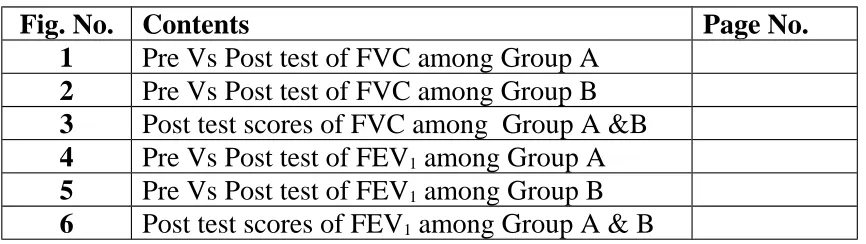
Fig. No. Contents Page No.
1 Pre Vs Post test of FVC among Group A
2 Pre Vs Post test of FVC among Group B
3 Post test scores of FVC among Group A &B
4 Pre Vs Post test of FEV1 among Group A
5 Pre Vs Post test of FEV1 among Group B
LIST OF FIGURES
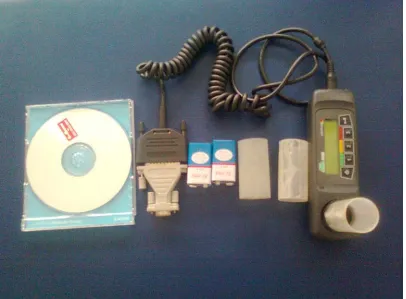
Fig. No. Contents Page No. 1 Computerized spirometer and its accessory
INTRODUCTION
Chronic obstructive pulmonary disease is the most common lung
disease and major causes of disability and death in the world population.
WHO estimates that by 2000, 2.74 million copd people died, world wide.
Copd is the most common disorder, affiliating 10-15% of adults
over the age of 40 Yrs and prevalence is increasing.
According to American thoracic society 1952, chronic bronchitis is
defined as chronic cough, expectoration for at least for 3 months for 2
consecutive years. Most common causes are cigarette smoking (Vs
surgeon general, 1984), air pollution, frequent bronchial infection and
certain occupation.
Institution based pulmonary rehabilitation programs incorporating
the airway clearance technique have shown to improve HRQL (Health
related quality of life), reduces dyspnoea and improve exercise tolerance.
Mechanical device such as the flutter valves is able to provide the
benefits of improved airway clearance in COPD patients.
Flutter a positive expiratory pressure technique eliminates mucus
from the bronchial airway and thus improves bronchial hygiene in
chronic bronchitis patients.
By using flutter device there was a statistically significant
mucus clearance device there was a significant improvement in lung
function compared to baseline with combined bronchodilator therapy.
Therefore the present study is intended to analyze the effectiveness
of flutter device on lung function in copd subjects with retained secretion.
AIM OF STUDY
The aim of the study is to analyze the effectiveness of flutter
mucous clearance device on lung function in copd subjects with retained
secretion.
OBJECTIVES OF THE STUDY
• To study the effectiveness of flutter device on mucous clearance in
copd subjects and retained secretion.
• To study the effectiveness of lung function in copd with retained
secretion.
HYPOTHESIS
Null Hypothesis
There will be no significant difference between pre and post test
value of flutter device on mucus clearance and lung function in copd
Alternate Hypothesis
There will be significant difference between pre and post test value
of flutter device on mucus clearance and lung function in copd subjects
REVIEWS OF LITERATURE
NORMAN WOLKOVE et al., (2010)
Conducted this study with 23 copd patients, to determine the use of
mucus clearance device (MCD) could improve the bronchodilator
response delivered by a metered – dose inhaler. And concluded
immediately after the use of MCD there was a statistically significant
improvenment in FEV1, and FVC.
ANGSHU BROWMIKA et al., (2008)
Conducted a study in patients with copd experience mucus
hypersecretion. This review examines the current evidence base and best
clinical practise in the area of airway clearance. Mechanical device such
as flutter valves, positive end expiratory pressure, high frequency chest
wall oscillation may be able to provide the benefits of improved airway
clearance.
CHIEN LING SU et al., (2007)
A Prospective, randomized, controlled study of 32 patients with
COPD. They have been divided into 2 groups, of either PEP+FET(n=16)
or FET alone(n=16) for 4 weeks. Finally the result shows, at the end of 4
weeks intervention PEP + FET had shows significant increase in
L.C.de LIMAA et al., (2004)
Conducted this study to show the mechanical behavior of the
flutter VRP1, a respiratory physiotherapy device designed to aid sputum
clearance and showed information that could be beneficial to the
professional of the respiratory physiotherapy.
HRISTARA – PAPADOPOULON et al., (2003)
Conduced a study to show the effectiveness of current devices of
respiratory physiotheraphy, like PEP, High frequency chest wall
oscillation, oral high frequency oscillation, Incentive spirometer, the
flutter and the cornet, and concluded these devices, help the removal of
mucus from the airways and improvement of pulmonary function.
SHARON M.H. et al., (2003)
Conducted a randomized study with 15 bronchiectasis patients,
divided into 3 groups: postural drainage and breathing and coughing;
flutter valve + Breathing and coughing; Breathing coughing along,
applied for 15 minutes daily in all groups and concluded flutter device
was perceived as being the most effective in clearing secretion.
ANDREA BELLONE et al., (2000)
Conducted a study to compare the short-term effects of postural
and expiration with the glottis open in the lateral posture (ELTGOL) with
10 chronic bronchitis patients, at the end of the treatment, concluded that
FLUTTER and ELTGOL techniques were more effective in prolonging
secretion removal in chronic bronchitis.
ANNE E HOLLANDI et al., (2000)
A clinical trials of airway clearance techniques (ACTS) in COPD
have shown a physiological rationale for the use of ACTS in COPD.
Positive Expiratory pressure theraphy or autogenic drainage may prove
effective in COPD Patients.
SKARIA SMIBI et al., (1998)
Conducted a randomized controlled study by, comparing the effect
of positive pressure technique using flutter device, over forced expiratory
pressure technique, with 30 chronic bronchitis patients divided into 2
groups (Group A and Group B) each of 2 session per day for 15 minutes
for 5 days weekly for totally 2 weeks and concluded at the end of 2nd
week, significant improvement in bronchial hygiene was found with
independent ‘t’ test at in Group-A when compared with Group – B.
LANGENDERFER et al., (1998)
Conducted the studies on the efficacy of old and new mucus
clearance techniques and the recommendation for different patients.
Percussion and postural drainage was the traditional method of
with poor patient complaints led to the development of alternative
therapy like autogenic drainage, PEP, flutter valve therapy and
high-frequency cheast compression. These alternatives depends on the ability,
MATERIALS AND METHODOLOGY
MATERIALS
Personal data
Flutter device
Stethoscope
Computerized Spirometer
Sputum box
METHODOLOGY
Study Design
Quasi experimenta study
Study Setting
The study was conducted at the outpatient department in
JKKMMRF College of physiotherapy, and District Head Quarters
Hospital, Erode, under the supervision of concerned authority.
Study sampling
A total of 30 subject were selected by purposive random sampling
method after due consideration to the inclusion and exclusion criteria.
They were divided into Group A and Group B, with 15 subjects in each
STUDY DURATION
Duration of study : 1 Month
Group A: Flutter Device by the session of 5 to 15 perday along with
general medication
Group B : Chest physiotherapy for 5 to 15 minutes along with general
medication.
INCLUSION CRITERIA • Sex : Both
• Age : 40 – 60
• Stable clinical subject
• Chronic bronchitis (COPD)
• Smokers
• History of copd for past 2 years
EXCLUSION CRITERIA • Pneumothorax
• Overt right sided heart failure
• Severe heart, Renal, Liver, Blood system and endocrine system
dysfunction
• Active hemoptysis
• Acute coronary syndrome
PARAMETERS
Pulmonary Function Test • Force vital capacity (FVC)
• Forced Expiratory volume in one second (FEV1)
PARAMETER DESCRIPTION
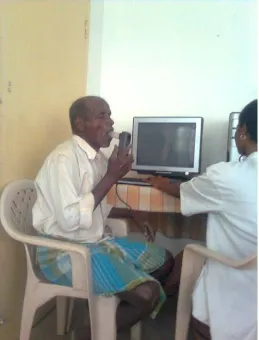
Computerization of pulmonary function testing is forcing rewrites of time – honored protocols and shifting responsibilities from technician to machine. Pulmonary function testing measures how well we are breathing. Spirometry is a simple test to measure how much (volume) and how fast (flow) you can move air into and out of our lungs, and provide visual and auditory feed back as the patient breaths.
FVC (FORCED VITAL CAPACITY)
The Maximum volume of air forcibly expired after a maximum inspiration. It consist of tidal volume + inspiratory and Expiratory reserve volume. Normal value of FVC is 4.7 to 5 liters.
FEV1 (FORCED EXPIRATORY VOLUME PER SECOND)
The Volume of air forcibly expired after a maximum inspiration in one second. Normal value of FEV1 is 4.3 – 4.6 liters.
PROCEDURE
¾ 30 Subjects were selected by convenient sampling method with due consideration of inclusion and exclusion criterias, each group consist of 15 subjects.
¾ Experimental group-A were given general medicine along with flutter device
¾ Control group-B subjects were given general medicine with chest physiotherapy.
¾ Pre test values were obtained for both experimental and control group.
¾ After the intervention the post test values were obtained for both experimental and control group.
STATISTICAL TOOLS
The collected data was subjected to statistical analysis using paired
and unpaired ‘t' test to find out the research effectiveness.
Paired “t” Test
The paired “t” test will be used to find out the statistical
significance between pre and post test values of flutter device by using
lung function in Group A and B subjects.
Formula: Paired t-test
S = 1 ) ( 2 2 − −
∑
∑
n n d d t = S n dd = Difference between the Pre Test Vs Post Test
d
=
Mean differencen = Total number of subjects
S = Standard deviation
Unpaired T-Test :
The unpaired t-test was used to compare the statistically significant
difference between Group A and B subjects treated with flutter device by
using Lung function test.
t = 2 1 2 1 1 1 n n S x x + −
n1 = Total number of subject in Group - A
n2 = Total number of subject in Group – B
x1 = Difference between Pre test Vs post test of Group - A
1
x = Mean Difference between Pre test Vs post test of Group – A
x2 = Difference between Pre test Vs post test of Group – B
2
x = Mean Difference between Pre test Vs post test of Group – B
DATA PRESENTATION
TABLE – 1
Sl.No.
FVC in liters FEV1 in liters
Group – A Group – B Group – A Group – B
Pre Post Pre Post Pre Post Pre Post
1. 3.2 3.3 2.1 2.12 3.2 3.8 3.0 3.2 2. 2.30 2.41 1.52 2.18 2.30 2.41 2.13 2.17 3. 4.54 4.63 3.12 3.16 4.54 4.58 4.29 4.50 4. 2.8 2.64 3.02 3.17 2.8 2.12 3.9 3.50 5. 4.97 5.10 2.0 2.22 4.97 5.4 2.89 3.10 6. 2.29 3.06 2.07 3.12 2.29 2.44 2.18 3.2 7. 2.04 2.06 2.15 2.33 2.04 2.12 1.18 1.29 8. 2.45 2.49 2.04 2.18 2.45 2.58 2.40 2.43 9. 3.77 3.78 2.15 3.93 3.77 3.82 3.70 3.88 10. 3.85 3.93 2.47 3.52 3.85 3.98 3.80 3.88 11. 3.57 3.64 2.15 2.42 3.57 3.78 3.58 3.65 12. 2.92 3.94 3.08 3.12 2.92 2.98 2.88 3.91 13. 2.33 2.52 3.11 3.21 2.33 2.47 2.02 2.17 14. 2.08 2.12 2.07 2.14 2.08 3.02 2.08 2.15 15. 1.12 1.49 2.33 2.47 1.12 1.49 1.07 1.17
FVC- Forced Vital Capacity
FEV1 – Forced Expiration Volume in 1 Second
DATA ANALYSIS & INTERPRETATION
TABLE II FVC in Liters Mean Mean Diff. SD Paired T value
Pre Test 2.94
The paired “t” value 10.15 was greater than that of the tabulated
value 2.15, which showed a significant difference at 0.05 the level of
between pre & post test result. The pre test mean was 2.94 & post test
mean was 3.14 with a mean difference of 0.2. This showed a significant
difference in FVC level between pre & post scores in experimental
TABLE III
FVC
in Liters Mean Mean Diff. SD
Paired ‘t’
Value Pre Test 2.35
0.4 0.19 8.96 Post test 2.75
The paired ‘t’ value 8.96 greater than that of the tabulated ‘t’
value 2.15 which showed no significant difference at 0.05 level between
pre vs. post test result. The pre test mean was 2.35 & post test mean
2.75 with mean difference only 0.4. This showed no significant
TABLE IV
FVC
in Liters
Mean Mean
Diff.
SD Unpaired
T – value
Post Test
(Experimental group) 3.14
0.39 0.13 7.95 Post test
(Control Group) 2.75
The unpaired ‘t’ value 7.95 was greater than that of the tabulated
value 2.05 which showed a significant difference at the level of 0.05
between post FVC of control & experimental group.
The post test mean of control group being 2.75 & that of
experimental group being 3.14 with mean difference of 0.39. This
showed a significant difference in FVC level between post test score
TABLE V
FEV1
Liters / Sec Mean
Mean
Diff. SD
Paired
T – value Pre Test 2.94
0.19 0.08 13.06 Post test 3.13
The paired ‘t’ value 13.06 was greater than that of the tabulated
value 2.15 which showed significant difference at 0.05 level between
pre vs. post test result. The pre test mean was 2.94 & post test mean
was 3.13 with mean difference of 0.19. This showed significant
difference in FEV1 level between pre & post level in experimental
TABLE VI
FEV1 Liters / Sec Mean
Mean
Diff. SD
Paired
T – value
Pre Test 2.74
0.2 0.10 10.06 Post test 2.94
The paired ‘t’ value 10.06 was greater than that of the tabulated
‘t’ value 2.15 which showed no significant difference at 0.05 level
between pre vs. post test result. The pre test mean was 2.74 & post test
mean 2.94 with mean difference only 0.2. This showed no significant
difference in FEV1 level between pre & post stress level of control
TABLE VII
FEV1
Liters / Sec Mean
Mean
Diff. SD
Un Paired
T – value
Post Test (Experimental Group) 3.13
0.19 0.09 5.93
Post test (Control Group) 2.94
The unpaired “t” value 5.93 was greater than that of the tabulated
‘t’ value 2.05 which showed a significant difference at the level of 0.05
between post FEV1 of control & experimental group.
The post test mean of control group being 2.94 & that of
experimental group being 3.13 with mean difference of 1.19. This
showed a significant difference in FEV1 level between post test score
DISCUSSION
The aim of the study was to assess the effectiveness of flutter
mucus clearance device on Lung function in COPD subjects with
Retained secretion.
TOOL SELECTION
Tool selection was based on the study of HARISTARA –
PAPADOPOULON, NORMAN WOLKOVE, Which is highly reliable.
STUDY SELECTION
Studier done by SHARON M.H. et al., L.C. de. LIMAA et al.,
ANGSHU BROWMIKA et al., supported the present study result of
increased pulmonary function and mucus removal with flutter mucus
clearance device.
In the data analysis and interpretation using forced vital capacity
the post test value of controlled group was 2.75. The post test value of
Experimental group was 3.14, which showed a significant different in
FVC levels between post test levels between controlled and Experimental
group of 0.39.
By using the Force expiratory volume in one second, the post test
mean of control group was 2.94 and that of experimental group
This showed a significant difference in FEV1 and FVC level
between post test scores between control and experimental groups.
REASONS FOR IMPROVEMENT
Norman wolkove 2010 found that flutter device produce a positive
expiratory pressure which is turn produces a vibrating movement is the
chest which looses the mucus and retained it out, thus improving the lung
function in COPD subjects.
Hristara papadopoulon 2003 determine the effectiveness of
current devices of respiratory physiotherapy as an alternative method.
These mucus clearance devices, seem to increases patient’s compliance of
daily treatment, as an independent application, full control of therapy and
easy use, which helps removal of mucus from the airways and improves
SUMMARY & CONCLUSION
SUMMARY
The purpose of this study was to find out the effect of Flutter
mucous clearance device on Lung function in CODD subjects. The total
30 subjects of age group 40 to 60 years were diagnosed as bronchitis
(COPD) from GH and OP were randomly selected for this study and they
were taught to use flutter device for the period of 2 months. Before and
after 2 months of training programme, the pre and post test values were
measured with computerized spirometer were recorded. The paired t-test
was used to compare the difference between pre and post test value.
Based on the statistical analysis the result of the study showed
significant improvement in increasing Lung function by using flutter
Device.
CONCLUSION
As the incidence of stress and chronic illness increase the challenge
to the physiotherapist to treat Bronchitis (COPD) Patients. Flutter device
increases the Lung function and reduce mucous retention.
This study concluded that there was a significant effect of flutter
Mucus clearance device on Lung function in COPD subjects with
RECOMMENDATION
¾ Further studies can be conducted with
positive end expiratory Pressure and High frequency chest
wall oscillation with the same parameter which were
followed in this study.
¾ Further studies can be conducted with
flutter device on other respiratory conditions such as
Bronchiectasis, Cystic fibrosis, Asthma etc.,
¾ Further Studies can be done with flutter
device on Parameters like Sputum scale, dyspnoea scale etc.,
¾ Further studies may be done to compare
BIBLIOGRAPHY
1. Brannon Frances. J., “Cardiopulmonary rehabilitation : Basic
theory and Application”, F.A. Davis company, Philadelphia, 2nd
Ed., 1993.
2.
Cash’s
“Text book of chest heart and vascular
disorders for physiotherapist”,
Jaypee brothers, New
delhi, 4
thEd., 1993.
3.
Crofton and Dougloss,
“Respiratory diseases”
, Vol-2,
Blackwell Science, England, 5
thEd., 2003.
4. Davidson’s, “Principles and practice of Madicine”, Churchill
Livingstone, Philadelphia, 19th Ed., 2002.
5. Dr. Shan Siddharth.N., “AP1 text book of medicine: The
association of physician of India”, Mumbai, 7th Ed., 2003.
6. Frown Felter, “Principles and practice of cardiopulmonary
physical therapy”, C.V. Mosby company, Philadelphia; 3rd Ed.,
1996.
7. Gupta.S.P., “Statistical methodes”, Sultanchand and Sons, New
Delhi, 2000
8. Kothari.C.R., “Research Methodology”, Vshwa Prakasham, Pun.,
New Delhi, 2000.
9. Guyton, “Text book of medical physiology”, W.B. Saunder
Company, Philadelphia; 9th Ed., 1988.
10.Mahajan B.K., “Methods in Biostatistics”, Jaypee Brothers, New
Delhi; 5th Ed., 1991.
11.Scotirwin, “Cardio pulmonary physical therapy”, C.V. Mosby
REFERENCES
1. Brenda M Buttonl, “Is there a role for airway clearance
techniquest in chronic obstructive pulmonary disease”,
Department of physiotherapy, alfred Hospital melbourne,
Australia, 2000.
2. Diomou G, “Current devices of respiratory physiotheraphy”,
2003.
3. Sharon M.H. Tsang, “Postural Drainage or flutter device in
conjunction with breathing and coughing compared to
breathing and coughing along in improving secretion
removal”, Sep 2003.
4. Gillian Austinb, “Improving mucociliary clearance in chronic
obstructive pulmonary disears”, 16 Oct – 2008.
5. Skeria smibi et at., “Effect of positive expiratory pressure
technique over forced expiratory technique on bronchial
hygiene in patients with moderate chronic bronchitis”,
Goutham college of Physiotheraphy, Bangalore.
6. Norman Wolkove, “Use of a Mucus clearance Device Enhances
the Broncholdilator response in patients with stable COPD”,
Chest Journal.
7. L.C. de, Limaa et al., “Mechanical evaluation of a respiratory
device”, 29 Sep – 2004.
8. Langender fer et al., “Alternatives to percussion and postural
Drainage”, July / august 1998 – vol 18 – Issue 4 PP 283 – 289.
9. Chien – Ling su, “Domiciliary PEP improves pulmonary
function and Exercise capacity in patients with COPD”, 2007,
10.Andrea Bellone “Chest physical Therapy in patients with Acute
Exacerbation of Chronic bronchitis: Effectiveness of three
APPENDIX
TECHNIQUE
POSITION OF PATIENT
The patient should be seated with back straight and head slightly
tilted upward so the upper airway is wide open.
As an alternative, the patient may be seated with elbows resting on
a table at a comfortable level and head positioned as slightly tilted
upward.
TECHNIQUES
STAGE 1- MUCUS LOOSENING AND MUCUS MOBILIZATIONS
¾ Make the patient to relax assume proper posture and position.
¾ Ask the patient to slowly inhale beyond a normal breath, but do not
fill lungs completely.
¾ Now ask the patient to hold breath for 2 to 3 seconds.
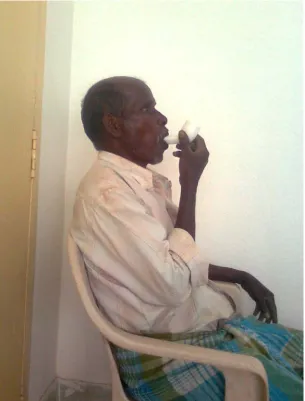
¾ Now ask the patient to place the FLUTTER in Mouth, adjust tilt to
feel maximum of vibrations within chest, keep checks stiff.
¾ Now exhale through FLUTTER at a reasonably fast but not too
forceful speed, using abdominal breathing.
¾ Exhale beyond a normal breath, but do not empty lungs
¾ Patient should Attempt to suppress cough.
[image:46.595.164.469.199.600.2]¾ Make the patient to repeat stage 1 for 5 to 10 breaths.
STAGE 2 – MUCUS ELIMINATION
¾ Ask the patient to slowly inhale, filling lungs completely.
¾ Ask to hold the breath for 2 to 3 seconds.
¾ Now ask the patient to place FLUTTER in mouth, adjust tilt to
feel maximum of vibrations with in chest, keep cheeks stiff.
¾ Ask to exhale forcefully through FLUTTER as completely as
possible.
¾ Make the patient to repeat stage 2 for 1 to 2 breaths.
¾ Now the patient should initiate cough (or “huff” maneuver) and
return to stage 1 and repeat full sequence (stage 1 and 2) until
lungs are clear or therapy is over.
Each Session ranging from 5-15 minutes per day
TERMINATION
FLUTTER therapy is complete when no further mucus can be
expectorated following several diligent sequences, and successful
INFORMED CONSENT FOR VOLUNTARY
PARTICIPATION IN A RESEARCH INVESTIGATION
Name :
Age :
Sex :
Occupation :
Address for communication :
Declaration
I have fully understood the nature and purpose of the study. I
accept to be a subject in this study. I declare that the above informed is
true to my knowledge.
Date :
Place :
ASSESSMENT CHART
Name :
Age :
Sex :
Side :
Mode of treatment : Flutter device
Measurement
Parameter Before treatment After treatment
Forced vital capacity
in litres
Forced expiratory
volume per second