C O R R E S P O N D E N C E
Open Access
Are more observational studies being included in
Cochrane Reviews?
Hans Christian Kongsted
1*and Merete Konnerup
2Abstract
Background:Increasing the scope of an evidence based approach to areas outside healthcare has renewed the importance of a long-standing discussion on randomised versus observational study designs in evaluating the effectiveness of interventions. We investigate statistically if an increasing recognition of the role of certain nonrandomised studies to support or generalize the results of randomised controlled trials has had an impact on the actual inclusion criteria applied in Cochrane reviews.
Methods:We conduct an on-line search of the Cochrane Database of Systematic Reviews (CDSR) and divide all Cochrane reviews according to their design inclusion criterion: (A) RCTs only or (B) RCTs and (some subset of) observational studies. We test statistically whether a shift in the proportion of category B reviews has occurred by comparing reviews published before 2008 with reviews published during 2008/09.
Results:We find that the proportion of Cochrane reviews choosing a broader inclusion criterion has increased, although by less than two percentage points. The shift is not statistically significant (P = 0.08).
Conclusions:There is currently not sufficient data to support a hypothesis of a significant shift in favour of including observational studies, neither at the aggregate level nor at the level of individual Review Groups within the Cochrane Collaboration.
Keywords:Systematic reviews, Observational study, Randomized controlled trial
Background
“Evidence based medicine is the conscientious, explicit, and judicious use of current best evidence in making decisions about the care of individual patients”[1]. This is the oft-cited definition of evidence based medicine (EBM) [2]. As one of the most visible parts of the EBM movement, the Cochrane Collaboration [3] was estab-lished in 1993 as an international not-for-profit inde-pendent organization. It has produced around 4,000 systematic reviews of the effects of healthcare interven-tions. More recently, there have been efforts to extend the evidence based approach to policy areas outside healthcare. The Campbell Collaboration [4,5] was set up in 2000 to facilitate systematic reviews of the effects of social interventions in areas such as social work, educa-tion and crime & justice. (Its close cooperaeduca-tion with the
Cochrane Collaboration is witnessed by the recent October 2010 joint colloquium [6]).
This expansion of scope of the evidence-based approach has renewed the long-standing discussion of the role of randomised versus observational study designs [7-27]. A key feature of EBM is advocating a hierarchy of what con-stitutes “current best evidence” on effectiveness. Evidence from systematic reviews of several high-quality rando-mised controlled trials (RCTs) rank at the top, followed by single RCTs, and then observational studies [28]. Rando-mised studies are thus widely regarded as a priori most likely to produce an unbiased estimate of effect [24]. There is, however, an increasing recognition of the role of non-randomised studies, either to support the results of RCTs, or in cases where there are no existing RCTs [24]. This role is likely to be much emphasized when assessing the effectiveness of non-healthcare public policies due to the relative shortage of RCTs in such areas.
Despite this focus on primary study design, there appears to be little if any quantitative information on how the actual * Correspondence:[email protected]
1
Department of Economics, University of Copenhagen, Øster Farimagsgade 5, DK-1353 Copenhagen K, Denmark
Full list of author information is available at the end of the article
inclusion criteria applied in systematic reviews of healthcare interventions have evolved over time. By producing such evidence based on the existing reviews of the Cochrane Database of Systematic Reviews (CDSR), our primary aim is to inform the discussion of the roles of randomised and nonrandomised studies for an evidence-based approach in fields outside healthcare. Due to similarity of the setups of the Cochrane and Campbell Collaborations [5], we argue that analysing the former is informative for the discussion on how to implement systematic reviewing of social inter-ventions within the latter. It is known that the Cochrane Collaboration has a stronger focus on RCTs when com-pared to systematic reviews produced by others in the med-ical literature [29,30]. Still, the analysis of the CDSR is arguably of interest in itself. It has risen to the top-10 in the Thomson ISI“MEDICINE, GENERAL & INTERNAL” cat-egory [3] in terms of its impact factor and it is thus an in-creasingly influential source of information within the medical literature.
Specifically, we examine how the criteria for inclusion of different primary study designs have varied both over time and across different medical fields. The fundamen-tal distinction that we focus on is between experimenfundamen-tal and observational designs [24]. As most of the existing literature, we will use the terms observational and non-randomised interchangeably.
The production of Cochrane reviews and the subse-quent editorial review process is guided (but not ruled) by the Cochrane Handbook [31]. The overarching principle of the current Handbook (section 5.5) is that“ [r]andomi-sation is the only way to prevent systematic differences be-tween baseline characteristics of participants in different intervention groups in terms of both known and unknown (or unmeasured) confounders. . .”[31].Still, in accordance with this principle, the Handbook (section 13.1.2) allows the inclusion of non-randomised studies“a) [t]o examine the case for undertaking a randomised trial by providing an explicit evaluation of the weaknesses of available [non-randomised studies] . . . b) [t]o provide evidence of the effects (benefit or harm) of interventions that cannot be randomised, or which are extremely unlikely to be studied in randomised trials. . .c)[or to] provide evidence of effects (benefit or harm) that cannot be adequately studied in randomised trials, such as long-term and rare outcomes, or outcomes that were not known to be important when exist-ing, major randomised trials were conducted”[31].
In analyzing if there are changes in the actual inclusion criteria applied in Cochrane reviews, we pay special atten-tion to the time of publicaatten-tion of version 5 of the Cochrane Handbook [31] in September 2007. It devotes a full chapter to the role and quality of observational stud-ies. Previous versions of the Handbook (up to and includ-ing version 4.2.6) relegated the discussion to a short appendix. While we focus on end-2007, the exact cut-off
point in time should not be seen as a main issue. We con-duct sensitivity analyses for alternative dates of a potential shift and investigate more generally if there was a shift in research design inclusion criteria of Cochrane reviews published towards the end of the recent decade.
The above list of cases in which non-randomised study designs can be included, could apply more often in some medical subfields than in others. We therefore also in-vestigate the set of reviews that originates from each of the so-called Cochrane Review Groups (CRGs) set up in the Cochrane Collaboration to manage the editorial process within a specific medical subfield.
Methods
Data sources and definitions
We conducted an on-line search of the Cochrane Data-base of Systematic Reviews (CDSR), issue 3, 2009. We split the total pool of Cochrane reviews into two mutually ex-clusive and exhaustive categories according to their choice of which research designs to include: (A) RCTs only or (B) RCTs and (some subset of) observational studies. We identified category (B) reviews among those generated by the search string “non NEXT random* OR nonrandom* OR non NEXT rct”applied to the full text of the review. The Cochrane Handbook uses the term “non-random” when discussing observational studies. Our search string thus identifies the reviews that explicitly consider whether or not to include such studies.
The identified reviews constitute a gross measure of category (B) reviews in the sense that some reviews sim-ply mention observational studies but decide not to in-clude them. We therefore manually analyzed each review within the gross selection and identified those reviews that actually allowed for the inclusion of (some subset of ) observational studies. The manual analysis was based on the subsection “Types of Studies” in the Methods section of the standardized lay-out for Cochrane reviews. We checked inter-coder reliability by having the two authors independently assign categories to 1 review randomly selected in every 25 reviews within the gross selection. There was agreement on the proper categorization of all randomly sampled reviews. As a fur-ther check for possible misclassification, we also applied our manual search to the first 25 reviews listed when we simply sorted all Cochrane reviews alphabetically by title. Eight of these were already in our selection. One had been withdrawn. Of the remaining 16 reviews, all included only RCTs or quasi-RCTs, none allowed for the inclusion of observational studies. This validates our gross selection criteria.
Statistical analysis
distinguished by the year of publication of the review. The editorial process of reviews published before January 1st, 2008, was fully or predominantly guided by the Handbook version 4.2.6 (or earlier versions). For reviews published after January 1st, 2008, version 5 of the Hand-book [31] from September 2007 has definitely been avail-able during long stretches of the review production process. We use likelihood ratio χ2 tests throughout. A P-value of less than 0.05 was considered to indicate stat-istical significance.
Sensitivity analyses
We subdivided category (A) into an (A1) category of reviews that use a strict RCT-only inclusion criterion and an (A2) category of reviews that additionally allow for the inclusion of quasi-randomised trials. The Cochrane Handbook [31] (section 13.1.1) uses the term quasi-randomised trial to signify“inappropriate random-isation strategies” (e.g. alternate or case file number)
where bias is potentially introduced through
unrecognized correlation between the sequence gener-ation mechanism and the outcome(s) of interest. While quasi-randomised studies cannot be considered as a proxy for observational studies, they are a“grey zone”in terms of proper randomisation. For the main analysis, we grouped categories (A1) and (A2) together. We per-form a sensitivity analysis by eliminating category (A2) from the analysis altogether.
In order to increase the power of our analysis against changes that took place gradually, we also present a sen-sitivity analysis that compares 2008/09 reviews to the reviews that were published prior to 2006.
Results and discussion
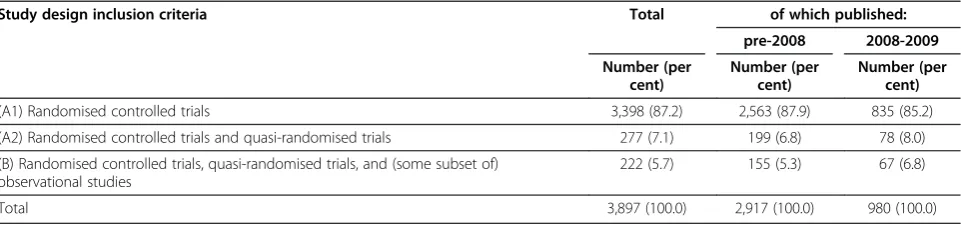
Table 1 illustrates how the total pool of Cochrane reviews is distributed according to study design inclusion criteria. The reviews are divided into three categories: (A1) Reviews that only allow for RCTs; (A2) for RCTs and quasi-randomised designs; or (B) for RCTs, quasi-randomised designs and (some subset of) observational study designs. The table also
provides separate distributions for reviews published prior to 2008 or during 2008/09.
The vast majority of existing Cochrane reviews–87 per cent–belong to category (A1). They only allow for the in-clusion of RCTs. Category (A2) reviews which in addition include quasi-randomised designs, add another seven per-centage points. Approximately six per cent of all Cochrane reviews are category (B) reviews that allow for the inclu-sion of (some subset of) observational study designs.
Figure 1 illustrates the evolution of this distribution since the mid 1990ies. An eye-ball inspection seems to suggest that the proportion of category (B) reviews is trending upwards although quite slowly. The early part of the figure is based on very few reviews – hence the large variance.
Comparing the reviews published pre-2008 to reviews published in 2008/09 (Table 1), we find that the category (B) proportion has increased by less than two percentage points. The change is not statistically significant (P = 0.08). Likewise, a statistically insignificant result (P = 0.07) is obtained when we eliminate“grey zone”category (A2) reviews from the analysis. Consequently, there is currently not sufficient data at the aggregate level to sta-tistically reject that the proportion of Cochrane reviews which include (some subset of ) observational studies has remained constant.
Despite the insignificant finding at the aggregate level, there is still a possibility of diverging trends within dif-ferent medical subfields. To investigate this, Figure 2 orders the CRGs horizontally by increasing pre-2008 proportion of category (B) reviews. (A similar picture emerges when eliminating the“grey zone”category (A2) reviews.) Individual subfields are seen to range widely from a low of zero category (B) reviews in the “Haem-atological Cancer Group”and the“Hypertension Group” to a high of 22 per cent in the “Gynaecological Cancer Group”. The variation across fields confirms the hypoth-esis that the supplementary role of observational studies differs greatly between fields.
[image:3.595.58.539.613.727.2]Figure 2 makes it possible to do an eye-ball inspection of the possible presence of a structural shift at the level
Table 1 Distribution of Cochrane reviews over inclusion criteria
Study design inclusion criteria Total of which published:
pre-2008 2008-2009 Number (per
cent)
Number (per cent)
Number (per cent)
(A1) Randomised controlled trials 3,398 (87.2) 2,563 (87.9) 835 (85.2)
(A2) Randomised controlled trials and quasi-randomised trials 277 (7.1) 199 (6.8) 78 (8.0)
(B) Randomised controlled trials, quasi-randomised trials, and (some subset of) observational studies
222 (5.7) 155 (5.3) 67 (6.8)
Total 3,897 (100.0) 2,917 (100.0) 980 (100.0)
of each individual Cochrane Review Group. It shows the difference between the actual number of category (B) reviews published in 2008/09, and the number to be expected had the pre-2008 proportions remained un-changed. Values larger (smaller) than zero indicate that the proportion of category (B) reviews in a CRG increased (decreased).
The differences between actual and expected changes are seen to be fairly equally divided between increases (21 CRGs) and decreases (28 CRGs). (The “Childhood Cancer Group”had no pre-2008 reviews and is therefore not included.) The graphical interpretation of Figure 2 needs to take account of the fact that the category (B)
proportion has limited “downside” within previously low-proportion CRGs. Among the ten CRGs having the highest pre-2008 proportion of category (B) reviews, eight show a declining proportion (Figure 2). Increases are found only in two of the top-ten CRGs: The “Effect-ive Practice and Organisation Group” and the “Injuries Group”. Both groups focus on behavior modifying inter-ventions rather than RCT-intense pharmacological interventions.
Formal testing of significance within subfields requires a sufficiently large number of reviews to be expected in 2008/09 (given unchanged pre-2008 proportions). This can be achieved by a large review production in general, a high pre-2008 proportion of category (B) reviews, or both. None of the individual CRGs currently qualify for testing under a standard requirement of at least five expected observations.
The strict comparison of pre- and post-2008 reviews could potentially miss a shift that happened gradually. First, a number of reviews published in 2008/09 had their protocol formally approved under the guidance of Handbook version 4.2.6. The protocol includes the very study design criterion on which we base our categorization of reviews. Cochrane reviews are approved sequentially (title, protocol, review) and typic-ally over several years. Statistictypic-ally correcting for this po-tential source of bias must await the publication of more reviews governed by Handbook version 5 “from start to finish”. Secondly, any change within an individual CRG could have predated the publication of Cochrane Hand-book version 5. Given that the HandHand-book is a guide, not a rule book, a change in the rate of inclusion of observa-tional studies could have been present in actual review practice already during years prior to the actual publica-tion date of Handbook version 5.
As a sensitivity analysis, we therefore introduced a two-year separation between the sub periods, comparing 980 2008/09 reviews and 1,755 reviews published prior to 2006. A very similar picture emerged from this ana-lysis: The aggregate proportion of category (B) reviews does increase but still not significantly; 20 CRGs show increasing category (B) proportions, 29 show decreases; and there is not enough data to allow formal significance testing at the level of the individual CRGs.
Conclusions
The methodological debate on the role of observational studies in formalized research synthesis has been on-going in medical research. The present analysis docu-ments how the formal guidelines of the Cochrane Collaboration have impacted on actual review practice. The main conclusions are threefold.
First, the overall distribution of Cochrane reviews according to inclusion criteria reflects a clear and
-4
-2
0
2
4
0 .05 .1 .15 .2
Pre-2008 proportion
[image:4.595.56.292.88.268.2]Actual minus predicted number
[image:4.595.58.290.482.645.2]Figure 2Production of observational-inclusive (category B) reviews by Review Groups in the Cochrane Collaboration.Note for Figure 2: Vertical axis: Actual number of category (B) reviews published in 2008/09 minus the number to be expected given pre-2008 proportions. Horizontal axis: Pre-pre-2008 proportion of category (B) reviews. Example: a negative number means that a review group has produced fewer category (B) reviews in 2008 or 2009 than would be expected from its production prior to 2008.
dominant preference for RCTs. Second, the analysis showed a large range of variation in the rate at which reviews allow for the inclusion of observational studies across different medical subfields. Third, we found no significant evidence of any subsequent shift in actual re-view practice. This conclusion holds irrespective of whether we use the time of publication of the Cochrane Handbook version 5 to date the potential shift; allow for a more gradual change by separating the sub periods by a window of two years; or exclude reviews that allow for quasi-randomised trials but not observational studies from the analysis.
These conclusions have implications for extending a similar“industrial scale”[32] review production initiative to public policy areas outside healthcare. Even within the realm of healthcare interventions, there is no “one size fits all” prescription. The need for supplementing the evidence from randomised controlled trials with sup-porting evidence from observational studies varies greatly across medical subfields. Most likely, this will apply to an even greater extent for interventions outside healthcare. Moreover, the fact that we found no signifi-cant trends either at the aggregate level or within spe-cific medical subfields, suggests that the rate of inclusion of observational studies is dictated by field-specific needs which remain fairly constant over time, rather than the ups and downs of ongoing methodological discussions.
Additional file
Additional file 1:List of categories assigned to individual reviews.
Competing interests
The opinions expressed in this paper do not necessarily reflect the views neither of the Campbell Collaboration as such nor of other members of the Campbell Collaboration’s steering group. Merete Konnerup has been reimbursed for attending the Joint Cochrane-Campbell Colloquium by the Campbell Collaboration. Hans Christian Kongsted has nothing to declare.
Authors’contributions
The authors have jointly collected the data and drafted the text. HCK performed the statistical analyses. Both authors read and approved the final manuscript.
Acknowledgements
Financial support for Kongsted fromCarlsbergfondetis gratefully acknowledged.
Author details 1
Department of Economics, University of Copenhagen, Øster Farimagsgade 5, DK-1353 Copenhagen K, Denmark.2The Campbell Collaboration’s steering group and Trygfonden, Lyngby Hovedgade 4, 2. sal, DK-2800 Kongens Lyngby, Denmark.
Received: 16 May 2012 Accepted: 22 September 2012 Published: 16 October 2012
References
1. Sackett DL,et al:Evidence based medicine: what it is and what it isn’t.
BMJ1996,312(7023):71–72.
2. Evidence-based medicine working group:Evidence-based medicine: a new approach to teaching the practice of medicine.JAMA1992, 268:2420–2425.
3. Website of the Cochrane Collaboration.http://www.cochrane.org (accessed September 27, 2012).
4. Website of the Campbell Collaboration.http://www. campbellcollaboration.org/ (accessed September 27, 2012).
5. Davies P, Boruch R:The Campbell Collaboration. Does for public policy what Cochrane does for health.BMJ2001,323:294–295. Editorial. 6. From the website of the Cochrane Collaboration.http://www.cochrane.
org/multimedia/multimedia-cochrane-colloquia-and-meetings/colloquium-colorado-2010 (accessed September 27, 2012).
7. Chalmers TC, Matta RJ, Smith H Jr, Kunzler A-M:Evidence favouring the use of anticoagulants in the hospital phase of acute myocardial infarction.N Engl J Med1977,297:1091–6.
8. Sacks H, Chalmers TC, Smith H Jr:Randomised versus historical controls for clinical trials.Am J Med1982,72:233–40.
9. Wortman P, Yeaton WH:Synthesis of results in trials of coronary artery bypass graft surgery. InEvaluation Studies Review Annual, Volume 8. Edited by Light R. Beverly Hills, CA: Sage Publications; 1983:536–57.
10. Diehl LF, Perry DJ:A comparison of randomised concurrent control groups with matched control groups: are historical controls valid?J Clin Oncol1986,4:1114–20.
11. Colditz GA, Miller JN, Mosteller F:How study design affects outcomes in comparisons of therapy. I:medical.Stat Med1989,8:441–54.
12. Miller JN, Colditz GA, Mosteller F:How study design affects outcomes in comparisons of therapy. II:surgical.Stat Med1989,8:455–66.
13. Kunz R, Vist GE, Oxman AD:Randomisation to protect against selection bias in healthcare trials.Cochrane Database of Systematic Reviews2007,: . Issue 2 (an update - with conclusions unchanged - of Kunz R, Oxman AD. The unpredictability paradox: review of empirical comparisons of randomised and non-randomised clinical trials.BMJ1998, 317:1185–1190.). 14. Reeves BC, MacLehose RR, Harvey IM, Sheldon TA, Russell IT, Black AMS:
Comparison of effects size estimates derived from randomised and non-randomised studies. InHealth Services Research Methods: a guide to best practice. Edited by Black N,et al. London: BMJ Publishing Group; 1998:73–85. 15. McKee M, Britton A, Black N, McPherson K, Sanderson C, Bain C:Methods in
health services research: Interpreting the evidence: choosing between randomised and non-randomised studies.BMJ1999,319:312–315. 16. Kunz R, Oxman A:Two systematic reviews–two different answers?BMJ
Rapid Responses1999,319:312.1.
17. Britton A, McKee M, Black N, McPherson K, Sanderson C, Bain C:Three systematic reviews–not so difference answers?BMJ Rapid Responses
1999,319:312.1.
18. Concato J, Shah N, Horwitz RI:Randomised controlled trials, observational studies, and the hierarchy of research designs.New England Medical Journal2000,342(25):1887–1892.
19. Benson K, Hartz AJ:A comparison of observational studies and randomised, controlled trials.New England Journal of Medicine2000, 342(25):1878–1886.
20. Pocock SJ, Elbourne DR:Randomised Trials or Observational Tribulations?
New England Journal of Medicine2000,342:1907–1909. Editorial. 21. Ioannidis JPA, Haideich A-B, Pappa M, Pantazis N, Kokori SI, Tektonidou MG,
Contopoulos-Ioannidis DG, Lau J:Comparison of Evidence of Treatment Effects in Randomised and Nonrandomised Studies.JAMA2001, 286(7):821–830.
22. Barton S:Which clinical studies provide the best evidence? The best RCT still trumps the best observational study.BMJ Editorials2000,321(25):155–6. 23. Kristiansen IS, Gosden T:Evaluating economic interventions: a role for
non-randomised designs? Chp. 9 in Donaldson, CAM (Editor). Evidence Based Health Economics. London: GBR: BMJ Publishing Group; 2002.
24. Deeks JJ,et al:Evaluating non-randomised intervention studies.Health Technology Assessment2003,7:27.
25. Vandenbroucke JP:When are observational studies as credible as randomised trials?Lancet2004,363:1728–1731.
26. Concato J, Horwitz RI:Beyond randomised versus observational studies.
Lancet2004,363:1660–1661.
28. National Health and Medical Research Council (NHMRC):Guidelines for the Development and Implementation Service. Canberra, Australia: 1995. 29. Moher D, Tetzlaff J, Tricco AC, Sampson M, Altman DG:Epidemiology and
Reporting Characteristics of Systematic Reviews.PLoS Med2007,4(3):e78. doi:10.1371/journal.pmed.0040078.
30. Konnerup M, Kongsted HC:Do Cochrane Reviews Provide a Good Model for Social Science? The role of Observational Studies in Systematic Reviews.Evidence and Policy2012,8(1):79–96.
31. Higgins JPT, Green S:Cochrane Handbook for Systematic Reviews of Interventions. 2009. Version 5.0.2 [updated September 2009]. The Cochrane Collaboration. Available from www.cochrane-handbook.org.
32. Taubes G:Looking for the Evidence in Medicine.Science New Series1996, 272(5258):22–24.
doi:10.1186/1756-0500-5-570
Cite this article as:Kongsted and Konnerup:Are more observational studies being included in Cochrane Reviews?BMC Research Notes2012
5:570.
Submit your next manuscript to BioMed Central and take full advantage of:
• Convenient online submission
• Thorough peer review
• No space constraints or color figure charges
• Immediate publication on acceptance
• Inclusion in PubMed, CAS, Scopus and Google Scholar
• Research which is freely available for redistribution