S H O R T R E P O R T
Open Access
Development and characterization of 16
polymorphic microsatellite markers from Taiwan
cow-tail fir,
Keteleeria davidiana
var.
formosana
(Pinaceae) and cross-species amplification in
other
Keteleeria
taxa
Chin-Shang Ho
1, Huei-Chuan Shih
2, Ho-Yih Liu
3, Shau-Ting Chiu
4, Mei-Hui Chen
5, Li-Ping Ju
6, Ya-Zhu Ko
3,
Yu-Shen Shih
7, Chaur-Tzuhn Chen
8, Tsai-Wen Hsu
9*and Yu-Chung Chiang
3*Abstract
Background:Keteleeria davidianavar.formosana(Pinaceae), Taiwan cow-tail fir, is an endangered species listed on the IUCN Red List of Threatened Species and only two populations remain, both on the Taiwan Island. Sixteen polymorphic microsatellite loci were developed in an endangered and endemic gymnosperm species,Keteleeria davidianavar.formosana, and were tested in an additional 6 taxa,K. davidianavar.calcarea,K. davidianavar. chienpeii,K. evelyniana,K. fortunei,K. fortuneivar.cyclolepis, andK. pubescens, to evaluate the genetic variation available for conservation management and to reconstruct the phylogeographic patterns of this ancient lineage. Findings:Polymorphic primer sets were developed fromK. davidianavar.formosanausing the modified AFLP and magnetic bead enrichment method. The number of alleles ranged from 3 to 16, with the observed heterozygosity ranging from 0.28 to 1.00. All of the loci were found to be interspecifically amplifiable.
Conclusions:These polymorphic and transferable loci will be potentially useful for future studies that will focus on identifying distinct evolutionary units within species and establishing the phylogeographic patterns and the process of speciation among closely related species.
Keywords:Keteleeria, Conservation, Microsatellites, Simple sequence repeat markers, Pinaceae
Findings
Background
For conservation management, the evaluation of genetic diversity and the identification of distinct evolutionary units in endangered taxa should allow for the develop-ment of more efficient conservation strategies [1-3]. Over the past century, human activities associated with the lumber industry and agriculture have destroyed and fragmented forest habitats at altitudes of 500–2500 m on Taiwan Island. Several gymnosperm species have
decreased in population size and are now under threat, including Cycas taitungensis [4-6], Podocarpus nakaii [1], Amentotaxus formosana [2], andKeteleeria davidi-ana var. formosana [7]. Extreme population declines can affect the genetic diversity of a species [8]. The loss of genetic diversity carries serious evolutionary con-cerns regarding both the ability to adapt to changes on oceanic islands and longer-term interactions with other organisms [9]. Thus, molecular markers are used to evaluate endangered species in greater depth, with the purpose of applying this genetic diversity information to the conservation and restoration of biodiversity [10].
Keteleeria davidiana var. formosana (Pinaceae), Taiwan cow-tail fir, is an endangered species listed on the IUCN Red List of Threatened Species [11] and derived from K.
* Correspondence:[email protected];[email protected]
9Endemic Species Research Institute, Nantou 552, Taiwan 3
Department of Biological Sciences, National Sun Yat-sen University, Kaohsiung 804, Taiwan
Full list of author information is available at the end of the article
davidiana, including var. davidiana and var. calcarea, occurred in China by geographical disjunction and leaf scars obscurely or obviously protruding on branchlets [12]. The taxa has only two wild populations, the Dawu Taiwan KeteleeriaForest Reserve (Dawu) and the Pin-glin TaiwanKeteleeriaNature Reserve (Pinglin), which are located in Northern and Southern Taiwan, respect-ively [13]. A previous inventory study has found that less than a hundred individuals remain in the wild, few seedlings are found in the field, and adult trees are vulner-able to lightning damage or death [14]. Additionally, con-tinuous logging over the past century in the low-elevation broadleaf forests has restrictedK. davidianavar.formosana to narrow habitats and has decreased its population size [15]. Therefore, the conservation strategies for Keteleeria davidianavar.formosanashould includein situprotection and management in conjunction with ex situ approaches such as clonal orchards. Hence, the population genetics of this species should be evaluated beforein situ andex situ conservation management begins. In this study, we devel-oped polymorphic microsatellite loci from Taiwan cow-tail fir to estimate the population structure within the species and to identify distinct evolutionary units within the popu-lation. In addition, the transferability of the microsatellite primers developed in this study was tested in other taxa, specifically, three species and three varieties of the Kete-leeriagenus.
Methods
Sampling and DNA extractions
Twenty-five individuals were sampled from each of the two remaining populations of K. davidiana var. formo-sana from Dawu and Pinglin, Taiwan (Table 1). To test the transferability of the markers, two to three individ-uals of three species, K. pubescens, K. fortune, and K. evelyniana, and three varieties,K. fortuneivar.cyclolepis, var.calcarea, andK. davidianavar.chienpeii, were sam-pled from the field. Permission for tissue collection was obtained from the Council of Agriculture, Republic of China, authorities. All taxa of the Keteleeria genus are
diploid with 24 chromosomes [13]. The sample size, lo-cation, and storage herbarium for the voucher specimens are listed in Table 1. Total genomic DNA was extracted from silica-dried leaf powder using the Plant Genomic DNA Extraction Kit (RBC Bioscience, Taipei, Taiwan).
[image:2.595.58.539.589.717.2]Isolation of microsatellite DNA loci and identification To isolate the microsatellites efficiently, we used the modi-fied AFLP [16] and magnetic bead enrichment method [1,17,18] to select microsatellite loci. Genomic DNA from one individual ofK. davidianavar.formosanawas treated with the restriction enzyme MseI (Promega, Madison, Wisconsin, USA) and separated using 1% Nusieve® 3:1 agarose gel (FMC Bio Products, Rockland, ME, USA) electrophoresis. The cut DNA fragments ranged from 400 to 1000 bps, and the purified fragments were extracted from the agarose gel using the HiYield™ Gel PCR DNA Fragments Extraction Kit (RBC Bioscience). Purified DNA fragments were ligated to a double-stranded MseI-adaptor (complementary oligo A: 5′-TACTCAG GACTCAT-3′; 5′phosphorylated oligo B: 5′-GACGAT GAGTCCTGAG-3′) using the Quick Ligation™ Kit (New England Biolabs, MA, USA) at 25°C for 5 minutes. The ligation product was used as the template DNA for the enrichment of the partial genomic library, and the adaptor-specific primers, named Mse I-N (5′-GATGAGTCCT GAGTAAN-3′), were used to perform 20 cycles of prehy-bridization PCR amplification. The PCR mixture contained 20 ng template DNA, 10 pmol adapter-specific primer, 2μL 10 × reaction buffer, 2 mM dNTP mix, 2 mM MgCl2, 0.5 U Taq DNA polymerase (Promega), and sterile water was added to reach a total volume of 20 μL. The PCR protocol was set at 94°C for 5 min, followed by 18 cycles of 94°C for 30 s, 53°C for 1 min, and 72°C for 1 min, using a Labnet MultiGene 96-well Gradient Thermal Cycler (Labnet, Edison, New Jersey, USA). The amplicons were denatured and hybridized to four separated 5′-biotinylated oligonucleotide probes, (AG)15, (AC)15, (TCC)10, and (TTG)10, in 250 μL of hybridization solution at 68°C for 1 h, and 1 mg of Streptavidin
Table 1 Sample location for each species, variety, and population of theKeteleeriaspecies
Species Location Sample size Latitude Longitude Herbarium
K. davidianavar.formosana Pinglin, Taiwan 25 N 24°53′28″ E 121°42′12″ TAIF
Dawu, Taiwan 25 N 22°21′23″ E 120°47′27″ TAIF
K. fortuneivar.cyclolepis Fujian, China 3 N 27°09′18″ E 118°13′03″ TAIF
K. pubescens Guizhou, China 3 N 26°30′54″ E 108°03′52″ TAIE
K. davidianavar.calcarea Guangxi, China 3 N 25°12′47″ E 110°11′50″ TAIE
K. davidianavar.chienpeii Guizhou, China 3 N 26°20′26″ E 106°41″52″ TAIE
K. fortunei Fujian, China 3 N 26°09′57″ E 119°02′19″ TAIF
K. evelyniana Yunnan, China 3 N 23°42′55″ E 105°07′24″ TAIE
Sample size, location, coordinates, and voucher specimens are indicated.
MagneSphere Paramagnetic Particles (Promega) was added to the mixture solution to capture the hybridiza-tions at 42°C for 2 h. The four enriched microsatellite DNA fragments were washed with high-salt and low-salt solutions and then used as templates for 25 cycles of PCR amplification using the adaptor-specific primers; the ampli-fication protocol was same as that used for the prehybridi-zation PCR. The PCR products were purified using the HiYield™ Gel PCR DNA Fragments Extraction Kit (RBC Bioscience) and then cloned using the pGEM®-T Easy Vector System (Promega). The plasmid DNAs that were purified from white colonies were digested by the restric-tion enzymeEcoRI (Promega) and screened using 1% agar-ose electrophoresis to determine the size of the inserted DNA fragments. In total, 670 white colonies were selected to purify plasmids for sequencing from Keteleeria davidi-ana var. formosana. The sequencing cocktail contained 200 ng plasmid DNA as the template DNA, 0.5 mM T7 or SP6 primers, 4μL Big Dye Terminator v3.1 Ready Reaction Premix Reactions (Applied Biosystems, Carlsbad, Califor-nia, USA), and sequencing buffer in a total volume of 20μL. Selected plasmid DNAs were sequenced in both directions using an ABI PRISM® 3700 DNA Sequencer (Applied Biosystems). These sequences, including their microsatellite loci, were recognized using Tandem Re-peats Finder version 4.07b [19], and a pair of specific primers for each microsatellite locus was designed using FastPCR software version 6.4.18 [20].
DNA amplification and genotyping
The optimal annealing temperature was evaluated by gradi-ent PCR using a Labnet MultiGene 96-well Gradigradi-ent Ther-mal Cycler (Labnet) for a temperature range from 50°C to 65°C. For each Keteleeria taxon, two to three individuals were evaluated for the optimal annealing temperature. The polymorphism of the two remaining populations of K. davidiana var.formosana was evaluated using 25 individ-uals from each population (Table 1). To test the optimal an-nealing temperature, a 20μL reaction mixture containing 20 ng template DNA, 0.2μM each of the reverse and for-ward primers, 2μL 10 × reaction buffer, 2 mM dNTP mix, 2 mM MgCl2, 0.5 U Taq DNA polymerase (Promega), and sterile water was amplified using a Labnet MultiGene 96-well Gradient Thermal Cycler (Labnet). The PCR program was set at 94°C for 5 min, followed by 30 cycles of 94°C for 40 s, a temperature gradient ranging from 50 to 65°C for 60 s, and 72°C for 60 s, and a final extension of 72°C for 10 minutes [21]. Amplicons were checked by 1% agarose electrophoresis to isolate the target DNA bands, which were confirmed by sequencing [18]. To examine the genetic polymorphisms, the PCR cocktail was amplified using the previously described program with the temperature gradient replaced by the optimal an-nealing temperature (Ta). The amplicons were checked by
1% agarose electrophoresis to isolate the target DNA bands, which were confirmed by sequencing [18]. The amplicons were separated by electrophoresis on a 10% polyacrylamide gel (acrylamide: bisacrylamide 29: 1, 80 V for 14–16 hours) using a 25 or 50 bp DNA Step Ladder (Promega) to determine the allele size. The bands were then imaged under UV light using the Flo Gel FGIS-3 fluorescent gel image system (Top BIO Co., Taipei, Taiwan), and the sizes of the PCR products were identified using Quantity One software version 4.62 (Bio-Rad Laboratories, Hercules, California, USA).
Data analysis
The genetic variation indices, including the number of al-leles (Na), the number of effective alal-leles (Ne), the ob-served heterozygosity (Ho) and expected heterozygosity (He), Shannon’s information index (H), and fixation index (FIS) were estimated using GenAlEx version 6.5 [22]. The
Hardy–Weinberg equilibrium (HWE) was tested using
Arlequin software version 3.5.1.2 [23].
Results and discussion
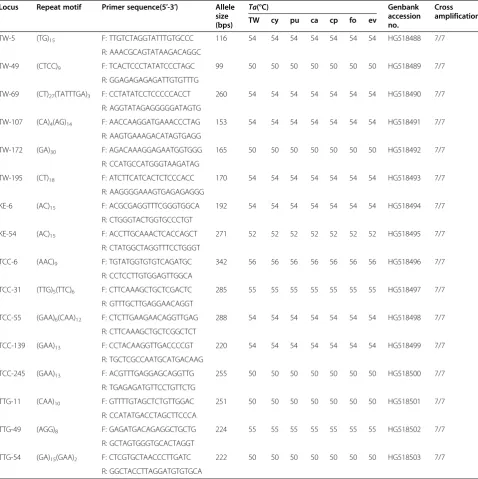
Development of polymorphic microsatellite markers A total of 392 microsatellite loci containing repeat motifs were discovered, with maximum and minimum lengths of 992 bps and 119 bps, respectively, and an average sequence length of 477 bps. We designed 102 primer pairs between the up- and down-flanking regions of the motifs based on the primer design parameters computed using FastPCR software version 6.4.18 [20]. To test the optimal an-nealing temperatures, which were obtained using gra-dient temperature PCRs, template DNA was derived from three individuals of each of the Keteleeria taxa, which are listed in Table 1. We tested the polymor-phisms forK. davidiana var.formosanausing 25 indi-viduals from each population. Finally, we selected 16 polymorphic loci from the 102 microsatellites based on the detection of unambiguous polymorphic amplicons using fixed annealing temperature PCR and a poly-acrylamide gel genotyping protocol. The characteris-tics of the 16 polymorphic microsatellite loci are listed in Table 2. Of the 16 loci, 11 are complete microsatel-lite loci, consisting of 5 with a dinucleotide motif, 5 with a trinucleotide motif, and 1 with a tetranucleotide motif. Of the 5 remaining loci, 3 carried a compound motif and 2 carried an interrupted motif. The sequences of 16 loci reported in this paper are available from GenBank (accession numbers: HG518488–HG518503) (Table 2).
Genotyping and population genetics analysis
microsatellite loci, the number of alleles per locus (Na) and the number of effective alleles (Ne) ranged from 5 to 14 and 2.59 to 11.25 in the Dawu population, respect-ively, and from 3 to 16 and 2.14 to 10.59 in the Pinglin population, respectively (Table 3). The observed and ex-pected heterozygosity (Ho and He, respectively) varied from 0.44 to 1.00 (average of 0.68) and 0.61 to 0.91 (average of 0.82) in the Dawu population, respectively, and from 0.28 (average of 0.63) to 0.80 (average of 0.78)
in the Pinglin population. The means of Shannon’s infor-mation index (H) and the fixation index (FIS) were 1.93
and 0.175 and 1.73 and 0.188 in the Dawu and Pinglin populations, respectively (Table 3). Significant deviations from Hardy–Weinberg equilibrium (HWE) were detected
[image:4.595.58.537.111.591.2]at 6 and 3 loci in the two populations, respectively, and these deviations were attributed to the heterozygote defi-ciency of the endangered species (Table 3). A total of 52 and 29 private alleles were observed in the Dawu and Table 2 Summary of general information for the 16 polymorphic microsatellite loci isolated fromKeteleeria davidiana
var.formosanaand their transferability to sixKeteleeriataxa Locus Repeat motif Primer sequence(5′-3′) Allele
size (bps)
Ta(°C) Genbank
accession no.
Cross amplification TW cy pu ca cp fo ev
TW-5 (TG)15 F: TTGTCTAGGTATTTGTGCCC 116 54 54 54 54 54 54 54 HG518488 7/7
R: AAACGCAGTATAAGACAGGC
TW-49 (CTCC)9 F: TCACTCCCTATATCCCTAGC 99 50 50 50 50 50 50 50 HG518489 7/7
R: GGAGAGAGAGATTGTGTTTG
TW-69 (CT)27(TATTTGA)3 F: CCTATATCCTCCCCCACCT 260 54 54 54 54 54 54 54 HG518490 7/7
R: AGGTATAGAGGGGGATAGTG
TW-107 (CA)4(AG)14 F: AACCAAGGATGAAACCCTAG 153 54 54 54 54 54 54 54 HG518491 7/7
R: AAGTGAAAGACATAGTGAGG
TW-172 (GA)30 F: AGACAAAGGAGAATGGTGGG 165 50 50 50 50 50 50 50 HG518492 7/7
R: CCATGCCATGGGTAAGATAG
TW-195 (CT)18 F: ATCTTCATCACTCTCCCACC 170 54 54 54 54 54 54 54 HG518493 7/7
R: AAGGGGAAAGTGAGAGAGGG
KE-6 (AC)15 F: ACGCGAGGTTTCGGGTGGCA 192 54 54 54 54 54 54 54 HG518494 7/7
R: CTGGGTACTGGTGCCCTGT
KE-54 (AC)15 F: ACCTTGCAAACTCACCAGCT 271 52 52 52 52 52 52 52 HG518495 7/7
R: CTATGGCTAGGTTTCCTGGGT
TCC-6 (AAC)9 F: TGTATGGTGTGTCAGATGC 342 56 56 56 56 56 56 56 HG518496 7/7
R: CCTCCTTGTGGAGTTGGCA
TCC-31 (TTG)5(TTC)6 F: CTTCAAAGCTGCTCGACTC 285 55 55 55 55 55 55 55 HG518497 7/7
R: GTTTGCTTGAGGAACAGGT
TCC-55 (GAA)6(CAA)12 F: CTCTTGAAGAACAGGTTGAG 288 54 54 54 54 54 54 54 HG518498 7/7
R: CTTCAAAGCTGCTCGGCTCT
TCC-139 (GAA)13 F: CCTACAAGGTTGACCCCGT 220 54 54 54 54 54 54 54 HG518499 7/7
R: TGCTCGCCAATGCATGACAAG
TCC-245 (GAA)13 F: ACGTTTGAGGAGCAGGTTG 255 50 50 50 50 50 50 50 HG518500 7/7
R: TGAGAGATGTTCCTGTTCTG
TTG-11 (CAA)10 F: GTTTTGTAGCTCTGTTGGAC 251 50 50 50 50 50 50 50 HG518501 7/7
R: CCATATGACCTAGCTTCCCA
TTG-49 (AGG)8 F: GAGATGACAGAGGCTGCTG 224 55 55 55 55 55 55 55 HG518502 7/7
R: GCTAGTGGGTGCACTAGGT
TTG-54 (GA)15(GAA)2 F: CTCGTGCTAACCCTTGATC 222 50 50 50 50 50 50 50 HG518503 7/7
R: GGCTACCTTAGGATGTGTGCA
Note:TW =K. davidianavar.formosana;cy =K. fortunei var. cyclolepis;pu =K. pubescens;ca =K. davidianavar.calcarea;cp =K. davidianavar.chien-peii;
Table 3 Genetic diversity characteristics of the 16 polymorphic microsatellite loci tested on two populations of
Keteleeria davidianavar.formosana
K. davidianavar.formosana
Dawu population (N = 25) Pinglin population (N = 25)
Locus Na Ne Ho He H FIS Na Ne Ho He H FIS
TW-5 5 2.59 0.44 0.61 1.18 0.284 3 2.68 0.56 0.63 1.03 0.106
TW-49 7 3.93 0.68 0.75 1.55 0.088 3 2.14 0.48 0.53 0.90 0.100
TW-69 8 5.30 0.68 0.81 1.84 0.162 7 4.73 0.64 0.79 1.71 0.189
TW-107 7 4.36 0.56 0.77* 1.68 0.273 4 3.24 0.52 0.69 1.28 0.248
TW-172 6 4.63 0.68 0.78 1.63 0.133 3 2.35 0.52 0.57 0.97 0.093
TW-195 5 4.96 0.72 0.80 1.61 0.098 6 5.00 0.72 0.80 1.66 0.100
KE-6 12 9.69 0.60 0.90* 2.37 0.331 8 7.27 0.28 0.86* 2.03 0.675
KE-54 10 7.62 0.68 0.87 2.14 0.217 8 7.23 0.68 0.86 2.02 0.211
TCC-6 10 5.79 0.80 0.83 1.98 0.033 10 8.56 0.80 0.88 2.22 0.094
TCC-31 8 5.76 0.72 0.83 1.89 0.129 9 5.73 0.72 0.83 1.96 0.128
TCC-55 10 8.50 0.68 0.88 2.22 0.229 10 8.22 0.76 0.88 2.18 0.135
TCC-139 6 4.92 0.64 0.80* 1.67 0.197 10 5.73 0.56 0.83* 1.96 0.322
TCC-245 8 6.04 0.72 0.83 1.91 0.137 4 3.33 0.72 0.70 1.29 −0.029
TTG-11 13 7.76 0.76 0.87* 2.28 0.128 8 6.19 0.72 0.84 1.93 0.141
TTG-49 14 11.26 1.00 0.91* 2.51 −0.097 10 6.87 0.80 0.85 2.06 0.064
TTG-54 13 9.92 0.48 0.90* 2.42 0.466 16 10.59 0.52 0.91* 2.55 0.426
Mean 8.88 6.44 0.68 0.82 1.93 0.175 7.44 5.62 0.63 0.78 1.73 0.188
*Significant deviation from Hardy-Weinberg equilibrium: P < 0.05.
The number of different alleles (Na), number of effective alleles (Ne), observed heterozygosity (HO), expected heterozygosity (He), Shannon’s information index (H),
and fixation index (FIS) are reported.
Table 4 Result of cross-species transferability in sixKeteleeriataxa using the 16 microsatellite primers developed from
Keteleeria davidianavar.formosana Locus K. fortuneivar.
cyclolepis(N = 3) K. pubescens(N = 3) K. davidiana var.
calcarea(N = 3) K. davidiana var.
chienpeii(N = 2) K. fortunei
(N = 3) K. evelyniana(N = 3)
TW-5 1 2 1 2 1 1
TW-49 2 2 2 1 1 2
TW-69 3 2 2 2 1 2
TW-107 3 1 2 2 1 1
TW-172 2 1 2 1 1 2
TW-195 2 2 3 2 2 1
KE-6 2 3 3 2 2 2
KE-54 3 3 2 1 2 2
TCC-6 3 3 3 2 3 3
TCC-31 2 3 2 2 2 1
TCC-55 3 2 1 2 1 2
TCC-139 2 3 2 1 2 2
TCC-245 2 2 2 2 2 1
TTG-11 3 3 3 2 3 3
TTG-49 3 2 3 2 3 3
TTG-54 2 2 3 2 2 2
[image:5.595.58.537.478.725.2]Pinglin populations, respectively, revealing population differentiation between the two remaining populations of the species.
The genetic variability, including the means of the ob-served and expected heterozygosity (Table 3), of K. davidiana var. formosana was high compared with that of other Pinaceae species such asPinus koraiensis(0.38 and 0.57) [24] and P. massoniana (0.27 and 0.65) [25,26], but was similar to that ofP. pinaster(0.65 and 0.83) [27]. Un-fortunately, no data for otherKeteleeria taxa are available for the comparison of genetic variability. However, the high observed and expected heterozygosity values implied that the species was historically larger in population size and was more common in low-elevation forests than it is at present [7].
Test of transferability
To test the transferability of these microsatellite loci, we tested these primers in six other cow-tail fir taxa:K. fortunei var. cyclolepis, K. pubescens, K. davidiana var. calcarea, K. davidiana var. chienpeii, K. fortune, and K. evelyniana (Table 1). Two to three samples of each taxon were used in the evaluation of cross-amplification. All loci were transfer-able to the six taxa ofKeteleeria(Table 4), and the anneal-ing temperatures are listed on Table 2. However, few alleles were recovered in the six other Keteleeria taxa sampled here were caused by a small sampling effect. Nonetheless, the systematic and phylogeographic patterns among the Keteleeria species remain unclear. The transferability of these microsatellite loci among differentKeteleeriataxa in-dicates the usefulness of these molecular genetic markers for interspecific and intraspecific research on such topics as phylogeography, speciation and introgression.
Conclusions
For conservation purposes, 16 new polymorphic microsat-ellite loci were developed fromK. davidiana var. formo-sana. The genetic variation indices evaluated using these 16 polymorphic microsatellite loci for the two remaining populations of this endangered species are potentially use-ful for future studies that will focus on identifying distinct evolutionary units within the populations for conservation management. The interspecies transferability of these microsatellite loci may also be useful for future research aiming to reconstruct the phylogeographic patterns and the process of speciation among closely related species.
Availability of supporting data
The microsatellite sequences are available through the National Centre for Biotechnology Information (see http://www.ncbi.nlm.nih.gov/). The accession numbers on the repository are the following: GenBank accession number HG518488 through HG518503.
Competing interests
The authors declare that they have no competing interests.
Authors’contributions
T-WH and Y-CC supervised the project. C-SH, H-CS, H-YL, S-TC, L-PJ, C-TC, T-WH and Y-CC collected plant sample in the field. H-CS, M-HC, Y-ZK, Y-SS and Y-CC mined the SSR primers. C-SH, Y-ZK, Y-SS and Y-CC analyzed the data. Y-CC wrote the manuscript. All authors read and approved the final manuscript.
Acknowledgments
We thank Dr. Xun Gong and Dr. Jianwen Dong for their assistance in collecting the related species. We also thank two anonymous reviewers for their helpful comments. This work was supported by grants from the National Science Council, Taiwan (NSC 98-2815-C-020-014-B, 98-2621-B-110-004-MY3, 100-2621-B-110-001-MY3, and NSC 102-2628-B-110 -001 -MY3) and the Forestry Bureau, Council of Agriculture, Republic of China (tfba-1010621) to Y-C Chiang.
Author details 1
Graduate Institute of Bioresources, National Pingtung University of Science and Technology, Pingtung 91201, Taiwan.2Department of Nursing, Meiho University, Pingtung 912, Taiwan.3Department of Biological Sciences, National Sun Yat-sen University, Kaohsiung 804, Taiwan. 4Department of Biology, National Museum of Natural Science, Taichung 404, Taiwan. 5Conservation Division, Forestry Bureau, Council of Agriculture, Executive
Yuan, Taipei 100, Taiwan. 6Botanical Garden Division, Taiwan Forestry Research Institute, Taipei 100, Taiwan.7Department of Life Sciences, National Chung Hsing University, Taichung 40227, Taiwan.8Department of Forestry, National Pingtung University of Science and Technology, Pingtung 912, Taiwan.9Endemic Species Research Institute, Nantou 552, Taiwan.
Received: 13 February 2014 Accepted: 16 April 2014 Published: 23 April 2014
References
1. Chiang YC, Shih HC, Chang LW, Li WR, Lin HY, Ju LP:Isolation of 16 polymorphic microsatellite markers from an endangered and endemic species,Podocarpus nakaii(Podocarpaceae).Am J Bot2011,98:e306–e309. 2. Ho CS, Chen CT, Ko YZ, Ge XJ, Hung KH, Hsu TW, Chiang YC:Isolation and
characterization of 15 microsatellite loci in four endangered
Amentotaxusspecies (Taxaceae).Am J Bot2012,99:e157–e159. 3. Ju LP, Shih HC, Chiang YC:Microsatellite primers for the endangered
beech tree,Fagus hayatae(Fagaceae).Am J Bot2012,99:e453–e456. 4. Huang S, Chiang YC, Schaal BA, Chou CH, Chiang TY:Organelle DNA
phylogeography ofCycas taitungensis, a relict species in Taiwan.Mol Ecol 2001,10:2669–2681.
5. Huang S, Hsieh HT, Fang K, Chiang YC:Patterns of genetic variation and demography ofCycas taitungensisin Taiwan.Bot Rev2004,70:86–92. 6. Ju LP, Kuo CC, Chao YS, Cheng YP, Gong X, Chiang YC:Microsatellite
primers in the native perennial cycad,Cycas taitungensis(Cycadaceae). Am J Bot2011,98:e84–e86.
7. Fang JY, Chung JD, Chiang YC, Chang CT, Chen CY, Hwang SY:Divergent selection and local adaptation in disjunct populations of an endangered conifer,Keteleeria davidianavar.formosana(Pinaceae).PLoS One2013, 8:e70162.
8. Frankham R, Ballou JD, Briscoe DA:Introduction to Conservation Genetics. Cambridge, UK: . Cambridge University Press; 2002.
9. Schneider D, Wink M, Sporer F, Lounibos P:Cycads: their evolution, toxins, herbivores and insect pollinators.Naturwissenschaften2002,89:281–294. 10. Frankham R:Genetics and conservation biology.C R Biol2003,326:S22–S29. 11. Luscombe D, Yang Y:Keteleeria davidianavar.formosana. InIUCN 2013.
IUCN Red List of Threatened Species.2013:1.
12. Farjon A:A second revision of the genusKeteleeriaCarrière (Taxonomic notes on Pinaceae II).Notes Roy Bot Gard Edinburgh1989,46:81–99. 13. Li HL, Hsuan K:Pinaceae.InFlora of Taiwan, 1, Volume 2. 2nd edition.
15. Kanehira R:Pinaceae. InFormosan trees: Indigenous to the island (revised). Taipei, Formosa: Department of Forestry, Government Research Institute; 1936:39–41.
16. Zane L, Bargelloni L, Patarnello T:Strategies for microsatellite isolation: A review.Mol Ecol2002,11:1–6.
17. Liao PC, Gong X, Shih HC, Chiang YC:Isolation and characterization of eleven polymorphic microsatellite loci from an endemic species,
Piper polysyphonum(Piperaceae).Conserv Genet2009,10:1911–1914. 18. Hsu TW, Shih HC, Kuo CC, Chiang TY, Chiang YC:Characterization of 42
microsatellite markers from poison ivy,Toxicodendron radicans
(Anacardiaceae).Int J Mol Sci2013,14:20414–20426.
19. Benson G:Tandem repeats finder: A program to analyze DNA sequences. Nucleic Acids Res1999,27:573–580.
20. Kalendar R, Lee D, Schulman AH:Java web tools for PCR,in silicoPCR, and oligonucleotide assembly and analysis.Genomics2011,98:137–144. 21. Chiang YC, Shih HC, Huang MC, Ju LP, Hung KH:Characterization of
microsatellite loci fromLitsea hypophaea(Lauraceae), a tree endemic to Taiwan.Am J Bot2012,99:e251–e254.
22. Peakall R, Smouse PE:GenAlEx 6.5: genetic analysis in Excel. Population genetic software for teaching and research-an update.Bioinformatics 2012,28:2537–2539.
23. Excoffier L, Lischer HEL:Arlequin suite ver 3.5: A new series of programs to perform population genetics analyses under Linux and Windows. Mol Ecol Resour2010,10:564–567.
24. Yu JH, Chen CM, Tang ZH, Yuan SS, Wang CJ, Zu YG:Isolation and characterization of 13 novel polymorphic microsatellite markers forPinus koraiensis(Pinaceae).Am J Bot2012,99:e421–e424.
25. Hung KH, Lin CY, Huang CC, Hwang CC, Hsu TW, Kuo YL, Wang WK, Hung CY, Chiang TY:Isolation and characterization of microsatellite loci fromPinus massoniana(Pinaceae).Bot Stud2012,53:191–196.
26. Ge XJ, Hsu TW, Hung KH, Lin CJ, Huang CC, Huang CC, Chiang YC, Chiang TY:Inferring mutiple refugia and phylogeographical patterns inPinus massonianabased on nucleotide sequence variation and DNA fingerprinting.PLoS One2012,7:e43717.
27. Mariette S, Chagné D, Lézier C, Pastuszka P, Raffin A, Plomion C, Kremer A: Genetic diversity within and amongPinus pinasterpopulations: comparison between AFLP and microsatellite markers.Heredity2001, 86:469–479.
doi:10.1186/1756-0500-7-255
Cite this article as:Hoet al.:Development and characterization of 16 polymorphic microsatellite markers from Taiwan cow-tail fir,Keteleeria davidianavar.formosana(Pinaceae) and cross-species amplification in otherKeteleeriataxa.BMC Research Notes20147:255.
Submit your next manuscript to BioMed Central and take full advantage of:
• Convenient online submission
• Thorough peer review
• No space constraints or color figure charges
• Immediate publication on acceptance
• Inclusion in PubMed, CAS, Scopus and Google Scholar
• Research which is freely available for redistribution