S H O R T R E P O R T
Open Access
The nucleotide-binding oligomerization
domain-containing protein 1 (NOD1)
polymorphism S7N does not affect receptor
function
Sophie Mayle and Tom P Monie
*Abstract
Background:Activation and signal transduction in the Nucleotide binding, leucine-rich repeat containing receptor (NLR) family needs to be tightly regulated in order to control the inflammatory response to exogenous and endogenous danger signals. Phosphorylation is a common cellular mechanism of regulation that has recently been shown to be important in signalling in another family of cytoplasmic pattern recognition receptors, the RIG-I like receptors. In addition, single nucleotide polymorphisms can alter receptor activity, potentially leading to dysfunction and/or a predisposition to inflammatory barrier diseases.
Findings:We have computationally analysed the N-terminus of NOD1 and found seven theoretical phosphorylation sites in, or immediately before, the NOD1 Caspase Activation Domain (CARD). Two of these, serine 7 and tyrosine 49 are also found as rare polymorphisms in the African-American population and European-American populations respectively. Mutating serine 7 to either an aspartic acid or an asparagine to mimic the potential impact of phosphorylation or the polymorphism respectively did not affect the response of NOD1 to ligand-mediated NFκB signalling.
Conclusions:The NOD1 polymorphism S7N does not interfere with receptor function in response to ligand stimulation.
Keywords:NOD1, NOD2, SNP, Polymorphism, Phosphorylation, RIG-I, NLR, Pattern recognition receptor, Serine, Caspase activation domain (CARD)
Findings Background
Tight regulation and control of innate immune pattern recognition receptor (PRR) signalling pathways is essen-tial to limit inappropriate receptor activation and excess inflammation. PRR signalling can be altered as a result of single nucleotide polymorphisms (SNPs). SNPs often serve as risk factors, or predispositions, for specific dis-eases. For example, in Nucleotide-binding Oligomerisa-tion Domain (NOD) 2 the SNPs R702W, G908R, and 1007fsincC all inhibit receptor activation and predispose to Crohn’s Disease [1,2]. In contrast the mutations R334Q, R334W and L469F in the NOD region of NOD2 act as gain-of-function mutants and are associated with
Blau syndrome and Early Onset Sarcoidosis [3-6]. Simi-larly, mutations in the NOD of the inflammasome form-ing protein NLRP3 result in hyper- or auto-activation of the receptor and lead to development of a spectrum of inflammatory diseases collectively known as cryopyrin associated periodic syndromes [7]. Polymorphisms in NOD1 have been less extensively studied but the E266K SNP has been linked to an increased risk of peptic ulcer-ation in patients infected withHelicobacter Pylori[8].
Polymorphisms can affect protein function in unantici-pated, and potentially unwelcome, ways. A more predict-able and highly important mechanism of PRR regulation is post-translational modification. For example, serine 8 in helix 1 of the first RIG-I (Retinoic inducible gene–I) CARD and threonine 170 within helix 5 of the second RIG-I CARD are phosphorylated by protein kinase C alpha (PKCα) and PKCβ [9-12]. This restricts receptor * Correspondence:[email protected]
Department of Biochemistry, University of Cambridge, 80 Tennis Court Road, CB2 1GA, Cambridge, UK
activation by inhibiting the interaction of RIG-I with polyubiquitin and MAVS (mitochondrial antiviral signalling protein). The activity of MDA5 (melanoma differentiation-associated protein 5) is also influenced by phosphorylation. In this instance receptor function is inhibited by phosphor-ylation of serine 88 and serine 104; but stimulated when these residues are dephosphorylated by phosphoprotein phosphatase 1α(PP1α) or PP1γ[13]. In the case of murine NLRC4 phosphorylation of S533 by PKCδ serves to en-hance receptor activation [14].
Previous studies and ongoing work in our own labora-tory have investigated the functional role of residues in the NOD1 CARD [15,16], but none have explicitly addressed phosphorylation. Given the importance of CARD phos-phorylation in the regulation of RIG-I and MDA-5 signal-ling we hypothesised that serine 7 in human NOD1 could be a possible candidate for the regulation of NOD1 signal-ling and that the NOD1 SNP S7N may consequently dis-rupt receptor function.
Methods Bioinformatics
The sequence of human NOD1 [Genbank: AAD28350.1] was submitted to the NetPhos 2.0 server [17] for the identification of potential serine, threonine and tyrosine phosphorylation sites. Solvent accessibility of residues in the monomeric [PDB: 2dbd] and dimeric [PDB: 2nz7] [18] forms of the NOD1 CARD was determined using ASAview [19]. Mammalian NOD1 orthologues were recovered from the NCBI non-redundant protein data-base using blastp (protein-protein BLAST) with hu-man NOD1 [Genbank: AAD28350.1] as a search term using the standard parameters. Sequences were collated in FASTA format, aligned using MUSCLE [20] and incom-plete or duplicate sequences manually removed. Thirty-six orthologues remained in the final alignment and the level of identity with human NOD1 residues 1-120 containing the CARD is shown in parentheses (all sequences were re-covered from the NCBI REFSEQ database): Ailuropoda melanoleuca (84%) [REFSEQ: XP_002919315.1]; Bos taurus (83%) [REFSEQ: XP_598513.3]; Callithrix jacchus (95%) [REFSEQ: XP_002751479.1]; Canis lupus familiaris (86%) [REFSEQ: XP_539499.3]; Ceratotherium simum simum (88%) [REFSEQ: XP_004418924.1]; Condylura cristata (85%) [REFSEQ: XP_004677197.1]; Cricetulus griseus (83%) [REFSEQ: XP_003507840.1]; Dasypus novemcinctus (88%) [REFSEQ: XP_004453256.1]; Echinps telfairi (71%) [REFSEQ: XP_004702914.1]; Equus caballus (88%) [REF SEQ: XP_001499616.1]; Felis catus (88%) [REFSEQ: XP_ 003982953.1]; Heterocephalus_glaber (83%) [REFSEQ: EHB 11938.1]; Homo Sapiens [REFSEQ: NP_006083.1]; Jaculus jaculus (78%) [REFSEQXP_004652693.1]; Loxodonta_afri-cana (83%) [REFSEQ: XP_003407068.1]; Macaca fascicu-laris (98%) [REFSEQ: EHH52238.1]; Macaca mulatta (98%)
[REFSEQ: EHH17407.1]; Mus musculus (79%) [REFSEQ: NP_766317.1]; Mustela putorius furo (84%) [REFSEQ: XP_004762622.1]; Nomascus leucogenys (99%) [REFSEQ: XP_003270528.1]; Octodon degus (86%) [REFSEQ: XP_ 004626575.1]; Odobenus rosmarus divergens (89%) [REFS EQ: XP_004414009.1]; Orcinus orca (82%) [REFSEQ: XP_004269993.1]; Ornithorhynchus anatinus (69%) [REF SEQ: XP_001512159.1]; Oryctolagus cuniculus (83%) [REFSEQ: XP_002713781.1]; Otolemur garnettii (84%) [REFSEQ: XP_003788597.1]; Ovis aries (80%) [REFSEQ: XP_004007979.1]; Pan troglodytes (100%) [REFSEQ: XP_001165528.1]; Pan paniscus (100%) [REFSEQ: XP_0 03833425.1]; Papio Anubis (98%) [REFSEQ: XP_003896 196.1]; Pongo abelii (98%) [REFSEQ: XP_002818130.1]; Rattus norvegicus (78%) [REFSEQ: NP_001102706.1]; Saimiri boliviensis boliviensis (93%) [REFSEQ: XP_003935 228.1]; Sorex araneus (67%) [REFSEQ: XP_004604307.1]; Sus scrofa (83%) [REFSEQ: BAG12313.1]; Trichechus man-atus latirostris (82%) [REFSEQ: XP_004377558.1].
Consensus sequence images were generated using WebLogo v3.3 [21]. Molecular structure images were created using The PyMOL Molecular Graphics System, Version 1.5.0.5 Schrödinger, LLC. SNP frequencies were retrieved from the “Exome Variant Server” (http://evs.gs. washington.edu/EVS/).
Plasmids
pUNO-NOD1 encodes full-length untagged human NOD1 and was a kind gift from Dr Peter Murray. Point mutants S7N, S7D and E56K were generated in the pUNO-NOD1 vector by site-directed mutagenesis. The plasmids pLuc and phrG (Promega) are components of the dual-luciferase assay and encode Firefly and Renilla luciferase respectively.
NFκB-luciferase reporter assays
HEK293 cells were maintained in DMEM (Sigma) supple-mented with 10% FCS, 100μg/ml Penicillin/Streptomycin and 2 mM L-glutamine at 37°C and 5% CO2. Assays were
Ethics statement
This work did not involve human subjects, human ma-terial or human data and therefore does not require eth-ical approval.
Results and discussion
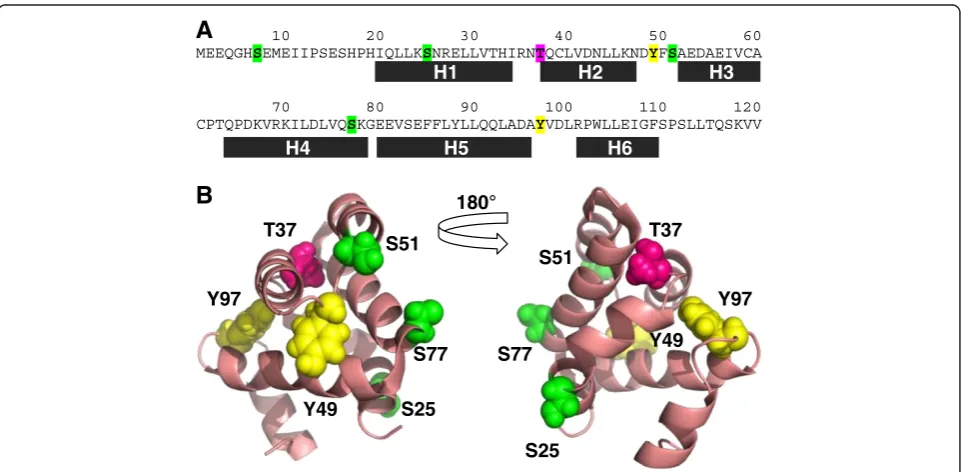
Potential serine, threonine and tyrosine phosphorylation sites in and immediately adjacent to the CARD of the NLR family member NOD1 were identified using the pre-diction software NETPhos 2.0. Within the first 120 resi-dues of human NOD1 (CARD structure 19-110) there were four predicted serine phosphorylation sites (residues 7, 25, 51, and 77); one predicted threonine phospho-rylation site (residue 37); and two predicted tyrosine phosphorylation sites (residues 49 and 97) (Figure 1A). Analysis of the Exome Variant Server indicated that two of these residues are present as low frequency polymor-phisms. Serine 7 is replaced with an asparagine in appro-ximately 1 in 2200 of the African-American population; whilst tyrosine 49 is mutated to a cysteine in approximately 1 in 8500 of the European-American population.
We mapped the position of the potential phosphoryl-ation sites onto the structure of the NOD1 CARD. Serine 7 is immediately prior to the structured CARD; serine 25 is within helix 1; threonine 37 is in the helix 1–helix 2 loop; tyrosine 49 and serine 51 are in the helix 2–helix 3 loop; serine 77 is in helix 4; and tyrosine 99 in the helix 5–helix 6 loop (Figure 1B). The relative surface accessibility of
these residues was determined using ASAview [19] from the NMR structure of the NOD1 CARD [PDB ID: 2dbd]. Serine 7 is not included in the structure so no information could be obtained for this residue. Its position near the start of the protein, prior to the first structured domain, makes it plausible that it is surface exposed; though the possibility remains that it may pack against the CARD helices in a manner that would inhibit kinase access. The order of relative surface accessibility of the remaining sites runs as follows: S77 > S25 > S51 > Y49 > Y97 > T37. As crystal structures of the NOD1 CARD show formation of a homodimer we also checked the relative surface ac-cessibility of these residues in the dimeric form [PDB ID:2nz7]. The pattern of accessibility was broadly similar with the overall order S77 > S25 > S51 > Y49 > T37 > Y97. T37 and Y97 were consistently the two least accessible po-tential targets for phosphorylation in the whole CARD structure, making it highly unlikely that these residues undergo post-translational modification.
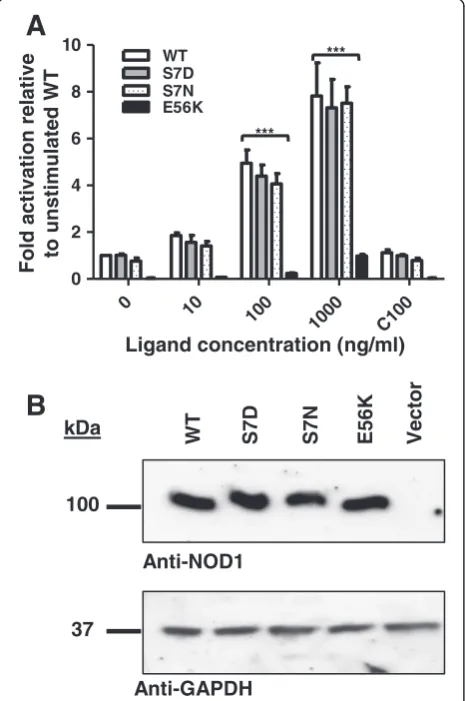
Given the importance of serine phosphorylation in the regulation of RIG-I signalling and the potential for poly-morphisms to disrupt receptor activity we mutated serine 7 to an asparagine to mimic the polymorphism; and to an aspartic acid to mimic phosphorylation. The ability of these mutants to activate NFκB signalling was then tested in HEK293 cells using a dual-luciferase NFκB reporter assay system. Both of the serine 7 mutants signalled in an identical manner to wild-type NOD1 in response to
10 20 30 40 50 60 MEEQGHSEMEIIPSESHPHIQLLKSNRELLVTHIRNTQCLVDNLLKNDYFSAEDAEIVCA
70 80 90 100 110 120 CPTQPDKVRKILDLVQSKGEEVSEFFLYLLQQLADAYVDLRPWLLEIGFSPSLLTQSKVV
H1 H2 H3
H4 H5 H6
180°
Y49
S51
S77 Y97
T37
S25
Y49 S51
S77
Y97 T37
S25
A
[image:3.595.58.539.440.676.2]B
increasing concentrations of the stimulatory ligand diami-nopimelic acid (iE-DAP). In contrast, the mutation E56K removed the ability of NOD1 to respond to ligand stimu-lation consistent with previous studies (p < 0.0005) [16] (Figure 2A). Western blot analysis confirmed that each construct expressed at a level comparable to wild-type protein (Figure 2B).
To reinforce the lack of impact on NOD1 function fol-lowing mutation of serine 7 we compared the sequence conservation of this residue in NOD1 across 36 different mammalian species. Although serine was the most com-mon residue in this position (21/36), numerous other residues were also present. These were: glycine (5/36),
arginine (4/36), histidine (4/36), cysteine (1/36) and iso-leucine (1/36) (Table 1 and Figure 3). The lack of exten-sive conservation in this position is consistent with a lack of role for phosphorylation of serine 7 in NOD1 function; and also with the lack of impact on receptor signalling of the S7N polymorphism. We also compared the cross-species conservation of the other putative phosphorylation sites (Table 1). Serine 25 and serine 51 were poorly conserved making it unlikely that they are important sites of phosphorylation. Threonine 37 was conserved in 34/36 species, whilst serine 77, tyrosine 49 and tyrosine 97 were all completely conserved. Combin-ing the level of conservation with the relative surface ac-cessibility suggests that serine 77 is a prime candidate for phosphorylation; that threonine 37 and tyrosine 97 play important structural roles; and that tyrosine 49 may be a potential phosphorylation target.
[image:4.595.305.539.110.250.2]This work has identified residues that may be poten-tially phosphorylated in the NOD1 CARD and which consequently have the potential to modulate receptor activity in a manner analogous to that seen with RIG-I Table 1 Conservation of potential phosphorylation sites across 36 mammalian species
Residue Residue conservation
Serine 7 21 serine, 5 glycine, 4 histidine, 4 arginine, 1 cysteine, 1 isoleucine
Serine 25 12 isoleucine, 10 serine, 9 valine, 4 threonine, 1 alanine
Threonine 37 34 threonine, 2 isoleucine
Tyrosine 49 36 tyrosine
Serine 51 19 alanine, 6 threonine, 5 serine, 3 glutamic acid, 1 isoleucine, 1 asparagine, 1 valine
Serine 77 36 serine
[image:4.595.58.291.254.605.2]Tyrosine 97 36 tyrosine
Figure 3Serine 7 shows limited conservation in mammalian NOD1.A sequence logo representation of the first 10 amino acids of NOD1 in which letter height reflects the likelihood of finding a particular residue in that position. The location of serine 7 is marked with a purple arrow.
0 10
100 1000
C100 0
2 4 6 8 10
WT S7D S7N E56K
Ligand concentration (ng/ml) Fold activation relative to unstimulated
W
T
100
37 kDa
Anti-NOD1
WT S7D S7N E56K Vector
Anti-GAPDH
A
B
***
***
[image:4.595.303.540.538.676.2]and MDA-5. It also shows that mutation of one of these residues, serine 7, to either an aspartic acid to mimic phosphorylation, or to asparagine to reflect the natural polymorphism S7N does not affect receptor function. We can therefore conclude that the SNP S7N has no im-pact on NOD1 activation and signalling and that serine 7 is not involved in regulation of NOD1 signalling.
Abbreviations
CARD:Caspase activation domain; MAVS: Mitochondrial antiviral signalling protein; MDA-5: Melanoma differentiation-associated protein 5; PKC: Protein kinase C; PRR: Pattern recognition receptor; NFκB: Nuclear factor kappa B; NLR: Nucleotide binding, leucine-rich repeat containing receptor; NLRC4: Nucleotide binding, leucine-rich repeat containing receptor, with a CARD 4; NLRP3: Nucleotide binding, leucine-rich repeat containing receptor with a pyrin 3; NOD1/2: Nucleotide oligomerisation domain containing 1/2; RIG-I: Retinoic acid inducible gene I; SNP: Single nucleotide polymorphism.
Competing interests
The authors declare that they have no competing interests.
Authors’contributions
SM performed the reporter assays and western blots and edited the manuscript. TPM designed the experiments, performed the bioinformatic analyses, and wrote the manuscript. Both authors read and approved the final manuscript.
Acknowledgements
This work was funded by a Wellcome Trust Career Development Fellowship (WT085090MA) to TPM.
Received: 22 October 2013 Accepted: 28 February 2014 Published: 5 March 2014
References
1. Hugot JP, Chamaillard M, Zouali H, Lesage S, Cézard JP, Belaiche J, Almer S, Tysk C, O’Morain CA, Gassull M, Binder V, Finkel Y, Cortot A, Modigliani R, Laurent-Puig P, Gower-Rousseau C, Macry J, Colombel JF, Sahbatou M, Thomas G:Association of NOD2 leucine-rich repeat variants with susceptibility to Crohn’s disease.Nature2001,411:599–603.
2. Girardin SE, Boneca IG, Viala J, Chamaillard M, Labigne A, Thomas G, Philpott DJ, Sansonetti PJ:Nod2 is a general sensor of peptidoglycan through muramyl dipeptide (MDP) detection.J Biol Chem2003,278:8869–72. 3. Miceli-Richard C, Lesage S, Rybojad M, Prieur a M, Manouvrier-Hanu S,
Häfner R, Chamaillard M, Zouali H, Thomas G, Hugot JP:CARD15 mutations in Blau syndrome.Nat Genet2001,29:19–20.
4. Vignal C, Singer E, Peyrin-Biroulet L, Desreumaux P, Chamaillard M:How NOD2 mutations predispose to Crohn’s disease?Microbes Infect2007, 9:658–63.
5. Tanabe T, Chamaillard M, Ogura Y, Zhu L, Qiu S, Masumoto J, Ghosh P, Moran A, Predergast MM, Tromp G, Williams CJ, Inohara N, Núñez G: Regulatory regions and critical residues of NOD2 involved in muramyl dipeptide recognition.EMBO J2004,23:1587–97.
6. Chamaillard M, Philpott D, Girardin SE, Zouali H, Lesage S, Chareyre F, Bui TH, Giovannini M, Zaehringer U, Penard-Lacronique V, Sansonetti PJ, Hugot J-P, Thomas G:Gene-environment interaction modulated by allelic het-erogeneity in inflammatory diseases.Proc Natl Acad Sci USA2003, 100:3455–60.
7. Yu JR, Leslie KS:Cryopyrin-associated periodic syndrome: an update on diagnosis and treatment response.Curr Allergy Asthma Rep2011,11:12–20. 8. Hofner P, Gyulai Z, Kiss ZF, Tiszai A, Tiszlavicz L, Tóth G, Szõke D, Molnár B,
Lonovics J, Tulassay Z, Mándi Y:Genetic polymorphisms of NOD1 and IL-8, but not polymorphisms of TLR4 genes, are associated with Helicobacter pylori-induced duodenal ulcer and gastritis.Helicobacter2007,12:124–31. 9. Feng M, Ding Z, Xu L, Kong L, Wang W, Jiao S, Shi Z, Greene MI, Cong Y, Zhou Z:Structural and biochemical studies of RIG-I antiviral signaling. Protein Cell2013,4:142–54.
10. Ferrage F, Dutta K, Nistal-Villán E, Patel JR, Sánchez-Aparicio MT, De Ioannes P, Buku A, Aseguinolaza GG, García-Sastre A, Aggarwal AK:Structure and
dynamics of the second CARD of human RIG-I provide mechanistic insights into regulation of RIG-I activation.Structure2012,20:2048–61. 11. Nistal-Villán E, Gack MU, Martínez-Delgado G, Maharaj NP, Inn K-S, Yang H,
Wang R, Aggarwal AK, Jung JU, García-Sastre A:Negative role of RIG-I serine 8 phosphorylation in the regulation of interferon-beta production. J Biol Chem2010,285:20252–61.
12. Maharaj NP, Wies E, Stoll A, Gack MU:Conventional protein kinase C-α (PKC-α) and PKC-βnegatively regulate RIG-I antiviral signal transduction. J Virol2012,86:1358–71.
13. Wies E, Wang MK, Maharaj NP, Chen K, Zhou S, Finberg RW, Gack MU: Dephosphorylation of the RNA Sensors RIG-I and MDA5 by the Phosphatase PP1 is essential for innate immune signaling.Immunity 2013,38:437–449.
14. Qu Y, Misaghi S, Izrael-Tomasevic A, Newton K, Gilmour LL, Lamkanfi M, Louie S, Kayagaki N, Liu J, Kömüves L, Cupp JE, Arnott D, Monack D, Dixit VM: Phosphorylation of NLRC4 is critical for inflammasome activation.Nature 2012,490:539–42.
15. Boyle JP, Mayle S, Parkhouse R, Monie TP:Comparative genomic and sequence analysis provides insight into the molecular functionality of NOD1 and NOD2.Front Immunol2013,4:317.
16. Manon F, Favier A, Núñez G, Simorre J-P, Cusack S:Solution structure of NOD1 CARD and mutational analysis of its interaction with the CARD of downstream kinase RICK.J Mol Biol2007,365:160–74.
17. Blom N, Gammeltoft S, Brunak S:Sequence and structure-based prediction of eukaryotic protein phosphorylation sites.J Mol Biol1999,294:1351–62. 18. Srimathi T, Robbins SL, Dubas RL, Hasegawa M, Inohara N, Park YC:
Monomer/dimer transition of the caspase-recruitment domain of human Nod1.Biochemistry2008,47:1319–25.
19. Ahmad S, Gromiha M, Fawareh H, Sarai A:ASAView: database and tool for solvent accessibility representation in proteins.BMC Bioinforma2004, 5:51.
20. Edgar RC:MUSCLE: multiple sequence alignment with high accuracy and high throughput.Nucleic Acids Res2004,32:1792–7.
21. Crooks GE, Hon G, Chandonia J-M, Brenner SE:WebLogo: a sequence logo generator.Genome Res2004,14:1188–90.
22. Kufer TA, Kremmer E, Adam AC, Philpott DJ, Sansonetti PJ:The pattern-recognition molecule Nod1 is localized at the plasma membrane at sites of bacterial interaction.Cell Microbiol2008,10:477–86.
doi:10.1186/1756-0500-7-124
Cite this article as:Mayle and Monie:The nucleotide-binding oligomerization domain-containing protein 1 (NOD1)
polymorphism S7N does not affect receptor function.BMC Research
Notes20147:124.
Submit your next manuscript to BioMed Central and take full advantage of:
• Convenient online submission
• Thorough peer review
• No space constraints or color figure charges
• Immediate publication on acceptance
• Inclusion in PubMed, CAS, Scopus and Google Scholar
• Research which is freely available for redistribution