RESEARCH ARTICLE
Choice of reference-guided sequence
assembler and SNP caller for analysis of
Listeria
monocytogenes
short-read sequence data
greatly influences rates of error
Arthur W. Pightling
1*, Nicholas Petronella
2and Franco Pagotto
3Abstract
Background: The influences that different programs and conditions have on error rates of single-nucleotide poly-morphism (SNP) analyses are poorly understood. Using Illumina short-read sequence data generated from Listeria monocytogenes strain HPB5622, we assessed the performance of four SNP callers (BCFtools, FreeBayes, UnifiedGeno-typer, VarScan) under a variety of conditions, including: (1) a range of sequencing coverages; (2) use of four popular reference-guided assemblers (Burrows-Wheeler Aligner, Novoalign, MOSAIK, SMALT); (3) with and without read quality trimming and filtering; and (4) use of different reference sequences.
Results: At 8-fold coverage the proportions of true positive calls ranged from 0.22 to 25.00 % when reads were aligned to a nearly identical reference (0.000096 % distant). Calls made when reads were aligned to a non-identical reference (0.85 % distant) were from 92.54 to 98.88 % accurate. At 79-fold coverage accuracies ranged from 3.95 to 20.00 % with the nearly identical reference and 93.80–98.75 % with the non-identical reference. Read preprocessing significantly changed the numbers of false positive calls made, from a 65.24 % decrease to a 54.55 % increase. Conclusions: The combinations of reference-guided sequence assemblers and SNP callers greatly influenced not only the numbers of true and false positive sites but also the proportions of true positive calls relative to the total numbers of calls made. Furthermore, the efficacy of different assembler and caller combinations changed dramati-cally with the different conditions tested. Researchers should consider whether identifying the greatest numbers of true positive sites, reducing the numbers of false positive calls, or achieving the highest accuracies are desired. Keywords: SNP detection, Short-read sequence assembly, Reference-guided sequence assembler, Reference sequence, Sequencing coverage, Listeria monocytogenes, 08-5578, HB5622, EGD-e, SNP caller
© 2015 Pightling et al. This article is distributed under the terms of the Creative Commons Attribution 4.0 International License (http://creativecommons.org/licenses/by/4.0/), which permits unrestricted use, distribution, and reproduction in any medium, provided you give appropriate credit to the original author(s) and the source, provide a link to the Creative Commons license, and indicate if changes were made. The Creative Commons Public Domain Dedication waiver (http://creativecommons.org/ publicdomain/zero/1.0/) applies to the data made available in this article, unless otherwise stated.
Background
Next-generation sequencing of bacterial genomes is an increasingly valuable tool in a number of fields, includ-ing epidemiology [1–3], population genetics [4, 5], and experimental evolution [6]. Reduced sequencing costs [7] and a wide availability of open-source software have made assembling and analyzing whole-genome sequence
data more accessible than ever [8]. Comparative analy-ses in which nucleotide differences (single nucleotide polymorphisms or, simply, SNPs) between a subject and reference are identified can be particularly useful for distinguishing bacterial lineages [9] and may provide markers for phenotypes such as antibiotic resistance [10]. SNPs are usually identified by first using reference-guided sequence assembly software to align large num-bers of short sequence reads to a fully sequenced (closed) reference chromosome or plasmid sequence [11]. Then, additional programs (SNP callers) are used to analyze assemblies and identify differences between the reference
Open Access
*Correspondence: [email protected]
1 Office of Analytics and Outreach, Center for Food Safety and Applied Nutrition, U.S. Food and Drug Administration, 5100 Paint Branch Parkway, College Park, MD 20740, USA
Page 2 of 9 Pightling et al. BMC Res Notes (2015) 8:748
and draft genome sequences by using a combination of sequence coverage and read quality information [12,
13]. Importantly, different SNP callers use different algo-rithms and assumptions that are likely to influence the accurate identification of SNPs.
Inaccuracies in sequence assemblies can arise due to a combination of the short length of sequence reads (for example, ~200–250 bp for Illumina sequencing) and inherent errors associated with sequencing technologies [14] (possibly influenced by the quality of DNA extrac-tions and library preparaextrac-tions [15]). In addition, low sequencing coverage [16] and the use of genetically dis-tant reference sequences [17] provide additional compu-tational challenges for both reference-guided sequence assemblers and SNP callers [18], especially around regions of repeated DNA sequence [19]. These issues may result in diminished detection of true SNP differences (true positive calls) and increased numbers of misidenti-fied SNPs (false positive calls). In order to mitigate errors, read quality trimming and filtering prior to assembly may be performed [20]. However, while some research-ers have reported benefits from such preprocessing [18], others have demonstrated that trimming and filtering did not improve the accuracy of SNP calls [21]. Thus, several factors may influence the accurate identification of true nucleotide differences: (1) sequencing coverage, (2) read preprocessing, (3) availability of an appropriate reference sequence, (4) selection of short-read sequence assembler, and (5) one’s choice of SNP calling software.
We assessed the efficacy of SNP calling programs by generating next-generation sequence datasets of vary-ing quality, assemblvary-ing and analyzvary-ing the resultvary-ing reads under a variety of conditions, and by counting the num-bers of true and false positive calls that were made under different conditions. We isolated genomic DNA from the Listeriosis Reference Service for Canada’s (LRS) Lis-teria monocytogenes strain HPB5622 isolate and gener-ated eight sets of Illumina short-read sequence data with a MiSeq benchtop sequencer (Illumina, San Diego). L. monocytogenes is a Gram-positive pathogenic bacterium [22] that experiences few chromosomal rearrangements [23, 24]. We then assembled and analyzed the result-ing reads under a variety of conditions: (1) a range of sequencing coverages; (2) the use of four popular refer-ence-guided assemblers (Burrows-Wheeler Aligner [25], Novoalign, MOSAIK, and SMALT) that use different algorithms for assembly (Burrows-Wheeler transform [26], global Needleman-Wunsch [27], banded Smith-Waterman, and a combination of short-word hashing and Smith-Waterman [28, 29], respectively); (3) with and without read quality trimming and filtering prior to assembly; (4) the use of reference sequences of differ-ent genetic distances; and (5) the use of differdiffer-ent SNP
callers (BCFtools [30], FreeBayes [31], UnifiedGeno-typer (https://www.broadinstitute.org/gatk/gatkdocs/ org_broadinstitute_gatk_tools_walkers_genotyper_Uni-fiedGenotyper.php), and VarScan [32, 33]). We assembled each dataset using both L. monocytogenes strain 08-5578 [2, 3] and EGD-e [34] chromosome sequences obtained from the National Center for Biotechnology archive as references. Strains 08-5578 and EGD-e are approximately 0.000096 and 0.82 % distant from the HPB5622 chromo-some sequence at the nucleotide level, respectively.
Results and discussion
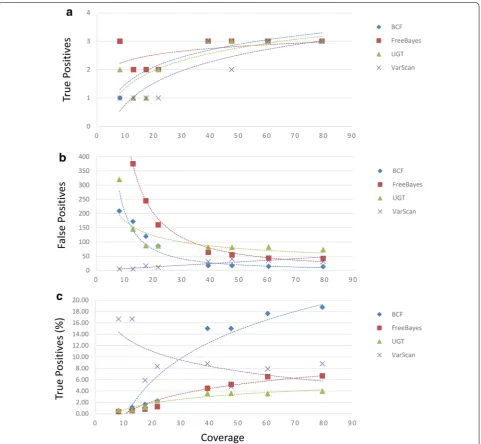
We assessed the ability of four commonly used single-nucleotide polymorphism (SNP) callers (BCFtools, FreeBayes, UnifiedGenotyper, and VarScan) to identify SNPs from alignments of eight sets of Listeria monocy-togenes strain HPB5622 genomic DNA sequence data of varying quality generated on an Illumina MiSeq bench-top sequencer. All sequencing runs were performed on genomic DNA obtained from a single extraction. Per-formance was measured by counting the numbers of known nucleotide differences between the subjects and references (true positive sites) correctly identified and the numbers of incorrect calls made (false positive sites) with each SNP caller under a variety of conditions. We assembled each of the short-read sequence datasets with the Burrows-Wheeler Aligner (BWA) using reference chromosome sequences (08-5578 and EGD-e) obtained from the National Center for Biotechnology Informa-tion (NCBI) sequence database (NC_013766.1 [2] and NC_003210.1 [34], respectively). The Listeriosis Refer-ence Service for Canada’s (LRS) strain HPB5622 isolate differs from the strain 08-5578 sequence at three nucle-otide positions (1,3629,720; 2,870,261; and 2,870,308). In addition, the HPB5622 chromosome sequence differs from the strain EGD-e sequence at 24,890 nucleotide positions. Thus, we were able to measure the numbers of true and false positive sites identified by SNP call-ers when a nearly identical (~0.000096 % distant at the nucleotide level) and a non-identical (~0.85 % distant) chromosome sequence was used for short-read sequence assembly.
average of 2.63 sites (Fig. 1a). When sequence assem-blies of at least 50-fold coverage are considered each SNP caller identified all 3 true positive SNPs. We observed also that between 5 and 818 false positive sites were reported, averaging between 21.75 (VarScan) and 225.25 (FreeBayes; Fig. 1b). When runs of at least 50-fold cover-age are considered the avercover-age numbers of false positive
[image:3.595.59.541.88.532.2]Page 4 of 9 Pightling et al. BMC Res Notes (2015) 8:748
18.20 % (BCFtools) correct calls (Fig. 1c). Interestingly, we observed an inverse relationship between identifica-tion of false positive sites and sequence coverage when VarScan was used. At approximately eightfold coverage we observed 5 such sites and at approximately 79-fold coverage we observed 31 sites. Thus, we observed that although VarScan is the most accurate SNP caller when coverage is low, due to reductions in false positive calls, BCFtools is the most accurate SNP caller when coverage is high.
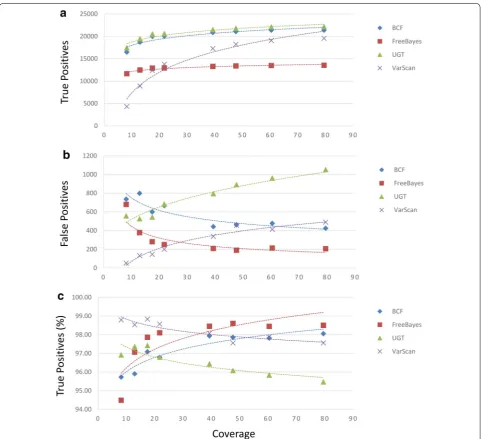
When a strain EGD-e chromosome sequence was used to align the short-read sequence data, we observed true positive averages ranging from 12,960.38 to 20,692.13 for all datasets and from 13,509.00 to 22,124.00 for runs of at least 50-fold coverage (FreeBayes and UnifiedGenotyper, respectively, in each case; Fig. 2a, Additional file 2). The average numbers of false positive sites observed ranged from 278.50 (VarScan) to 751.13 (UnifiedGenotyper) and 209.50 (FreeBayes) to 1006.50 (UnifiedGenotyper) for alignments of 50-fold coverage greater (Fig. 2b). The accuracies of SNP callers was measured between 96.54 (UnifiedGenotyper) and 98.22 % (VarScan). For runs of at least 50-fold coverage between 95.65 (UnifiedGeno-typer) and 98.47 % (FreeBayes) accuracies were observed (Fig. 2c). While both the UnifiedGenotyper and VarScan demonstrated an inverse correlation between sequence coverage and false positive sites, VarScan, once again, had the greatest accuracy among low coverage sequenc-ing runs.
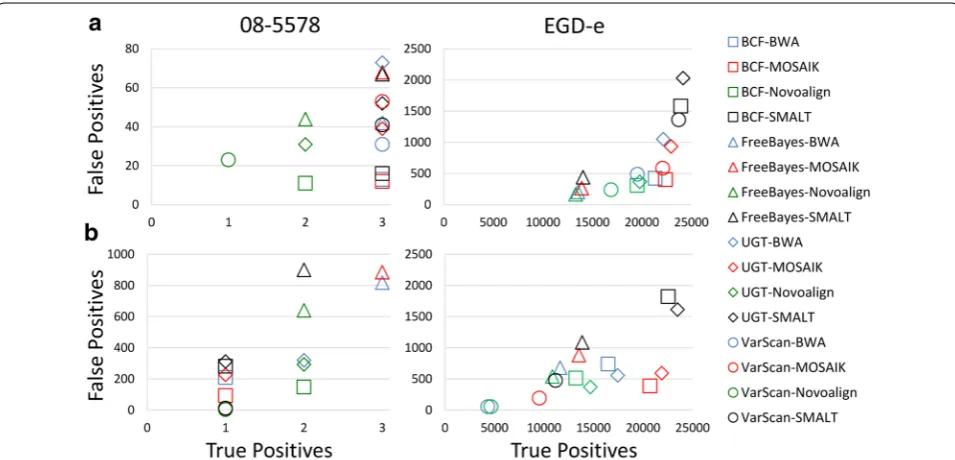
We counted the numbers of true and false positive sites observed using 16 different combinations of reference-guided sequence assemblers and SNP callers (BCFtools, FreeBayes, UnifiedGenotyper, and VarScan with BWA, MOSAIK, Novoalign, and SMALT) with both strain 08-5578 and EGD-e chromosomes as references and with high and low levels of sequence coverage (Fig. 3, Additional file 3). When reads from the high sequence coverage dataset were aligned to the strain 08-5578 chro-mosome (Fig. 3a) we observed that all the three true posi-tive SNPs were correctly identified by each SNP caller when either BWA, MOSAIK, or SMALT were used, while assemblies generated by Novoalign resulted in only 1 (VarScan) or 2 (BCFtools, FreeBayes, and UnifiedGeno-typer) correct calls. In addition, we observed between 11 (BCFtools-Novoalign) and 73 (UnifiedGenotyper-BWA) false positive calls. The percentages of the total num-bers of calls made that were correct (i.e., true positive) ranged from 3.95 (UnifiedGenotyper-BWA) to 20.00 % (BCFtools-MOSAIK). More generally, use of BCFtools resulted in substantially fewer false positive calls (average 13.00) regardless of which sequence assembler was used.
When reads from the high coverage dataset were aligned to the strain EGD-e chromosome (Fig. 3a) we
observed that between 13,304 and 24,164 true positive sites were identified and from 168 to 2032 incorrect calls were made (FreeBayes-Novoalign and UnifiedGenotyper-SMALT, respectively, in both cases). We also observed accuracies ranging from 92.24 (UnifiedGenotyper-SMALT) to 98.75 % (FreeBayes-Novoalign). Thus, we observed a correlation, albeit a non-linear one, between the numbers of true and false positive calls made, with FreeBayes-Novoalign resulting in both the fewest true and false positive calls and UnifiedGenotyper-SMALT resulting in both the greatest numbers of true and false positive calls. We also observed that although the Uni-fiedGenotyper-SMALT combination resulted in the identification of nearly all true positive sites, the greater number of false positive calls resulted in low accuracy, while the FreeBayes-Novoalign combination has the highest accuracy, despite the fact that only about half of the total numbers of true nucleotide differences were correctly identified.
We assembled reads from a low coverage dataset by aligning them to the strain 08-5578 chromosome sequence (Fig. 3b, Additional file 3). Only two combi-nations of reference-guided sequence assemblers and SNP callers (FreeBayes-BWA and FreeBayes-MOSAIK) resulted in the correct identification of all three nucleo-tide differences. The numbers of false positive sites ranged from 3 (VarScan-Novoalign) to 900 (FreeBayes-SMALT). Indeed, VarScan consistently called the fewest numbers of false positive sites and FreeBayes consistently called the greatest numbers of false positive sites, no mat-ter which assembler was used. The frequencies of true positive calls ranged from 0.31 (FreeBayes-Novoalign) to 25.00 % (VarScan-Novoalign). Again, we observed a pattern in which VarScan-Novoalign only correctly identified one true positive SNP but, due to a paucity of false positive calls, demonstrated the highest degree of accuracy.
We further analyzed the high coverage data by align-ing the reads to both strain 08-5578 and EGD-e chromo-some sequences before and after read quality filtering and trimming (Additional files 4, 5). When reads were aligned using the strain 08-5578 chromosome sequence, we observed no differences in the ability of SNP callers to identify nucleotide differences with and without trim-ming (Additional file 4A). We did observe substantial
[image:5.595.58.540.87.526.2]Page 6 of 9 Pightling et al. BMC Res Notes (2015) 8:748
combinations of assembler and SNP caller. Using the Uni-fiedGenotyper-BWA combination to assemble and ana-lyze reads after trimming resulted in a 65.24 % reduction in false positive calls, while using FreeBayes-MOSAIK to assemble reads after trimming caused a 54.55 % increase in the number of false positive calls (Additional file 6A). The highest accuracy (25.00 %) was achieved when using the BCFtools-MOSAIK combination without read quality trimming or filtering (Additional file 4C).
When the strain EGD-e chromosome sequence was used to align reads from the high coverage dataset we observed between 13,338 and 24,159 true positive sites identified prior to read quality filtering and trimming and from 13,304 and 24,164 after (FreeBayes-Novoalign and UnifiedGenotyper-SMALT, respectively, in each case; Additional file 5A). In addition, the numbers of false pos-itive sites identified ranged from 167 and 2054 prior to trimming and from 168 to 2032 after (Additional file 5B). We also observed that the proportion of true positive calls to total calls ranged from 92.24 to 98.75 % (Addi-tional file 5C). Again, whether read quality trimming and filtering provided any benefit depended heavily upon the assembler and SNP caller combinations. We noticed that read trimming had very little influence on the detection of true positives, no matter which combination of was used. However, when preprocessed reads were assembled
and analyzed with FreeBayes-SMALT we observed a drop in false positive sites of approximately 20.68 % and when FreeBayes-MOSAIK was used we calculated an 11.25 % increase in the numbers of false positive calls (Additional file 6B).
In order to determine processing times for all combi-nations of reference-guided sequence assemblers and SNP callers assessed during this study, we assembled and reads obtained from a single run with an estimated 40-fold coverage using the strain EGD-e chromosome sequence as a reference (Additional file 7). We observed a wide range of processing times from approximately 152 s (BCF-SMALT) to 1440 s (VarScan-Novoalign) and an average processing time of 834 s for all combinations.
Conclusions
[image:6.595.59.537.89.319.2]sequencing errors associated with specific sequenc-ing technologies or the quality of DNA extractions and library preparations. The placement of these reads must then be accurately determined by assemblers that calcu-late the probability of its match with reference sequences that are usually megabases in length. Thus, genome sequence assembly is a formidable computational chal-lenge that can be influenced by several factors, including: (1) the amount sequence coverage, (2) the algorithm used by the reference-guided sequence assemblers to place each read, (3) the distance of the reference sequence from the subject, and (4) whether read quality trimming and filtering has been performed. We have shown that each of the conditions listed here profoundly affected the per-formance of SNP callers, illustrating the complex rela-tionship between genome sequence assembly and the accurate identification of nucleotide differences.
We found that, although true positive calls tend to increase with more sequencing coverage as one would expect, under some conditions false positive calls actually increased with higher coverage (Figs. 1, 2 and Additional files 1, 2: Tables S1, S2). Importantly, this phenomenon was observed when either the strain 08-5578 or the more distant EGD-e chromosome sequences were used as references. For example, assemblies generated with the Burrows-Wheeler aligner (BWA) and the strain 08-5578 reference sequence that were analyzed with VarScan gen-erated such a trend, as did the use of BWA with the strain EGD-e reference when either the UnifiedGenotyper or VarScan were used. Interestingly, when we estimated the accuracy of SNP callers by calculating the propor-tions of calls made that correctly identified true positive sites, VarScan consistently outperformed other SNP call-ers when the low coverage dataset was analyzed (Figs. 1,
2, 3, Additional files 1, 2, 3: Tables S1, S2, S3). However, this was despite the fact that VarScan often reported the fewest numbers of true positive calls at low coverage and was due to reduced numbers of false positive calls. We observed also that assembling either low or high cover-age data with SMALT using the strain EGD-e chromo-some sequence as a reference and making SNP calls with the UnifiedGenotyper resulted in the greatest numbers of true positive calls (Fig. 3, Additional file 3). However, these conditions also resulted in the lowest (in the case of the high coverage dataset) or nearly the lowest (with the low coverage dataset) accuracy measurements, due to the high numbers of false positive calls. Finally, we have shown that whether read quality trimming and fil-tering provides benefit depends upon the combinations of assemblers and SNP callers used, in addition to one’s selection of reference sequence (Additional file 6).
In summary, we have revealed here an extraordinar-ily complex relationship between short read sequence
assembly and SNP calling. The combinations of soft-ware tested here under a variety of conditions resulted in different numbers of true and false positive calls and different levels of accuracy (Additional files 4, 5: Figures S1, S2). This insight into the behaviors of SNP callers is useful for making informed decisions when designing experiments. It is important to note that we were unable to eliminate these tendencies by using either internal or external SNP filters; we observed that when false positive SNPs were filtered there was also a reduction (albeit non-linear) in the numbers of true positive calls as well. There-fore, researchers may need to consider whether detecting the greatest numbers of true positive sites, reducing the numbers of false positive calls, or achieving the highest levels of accuracy are in their best interest. And, it may be important to assess the abilities of different combinations of assemblers and SNP callers under various conditions in order to attain the most relevant results.
Methods
DNA extraction, library construction, and DNA sequencing
Page 8 of 9 Pightling et al. BMC Res Notes (2015) 8:748
previously described [37–39]. Briefly, each subsample was indexed with Nextera XT DNA Sample Preparation Kits (Illumina, San Diego, CA, USA) according to the standard protocol and sequenced (2 × 250 bp reads) on a MiSeq benchtop sequencer (Illumina) three separate times for a total of twelve sets of short-read sequences. These data have been deposited to the National Center for Biotechnology Information (NCBI) Sequence Read Archive (SRA) under accession numbers SRR1342176, SRR1342220, SRR1373524, SRR1373525, SRR1373534, SRR1373535, SRR1507228, and SRR1508282.
Assembly of short‑read sequence data
In order to ensure that only the highest quality data was used for assembly, reads were trimmed and filtered with PoPoolation set to a minimum length of 50 bp and a quality score threshold of 20. Global mapping of reads was then performed with each of four reference-guided short-read sequence assemblers: Burrows-Wheeler aligner v0.6.1-r104, MOSAIK v2.1 (code.google.com/p/ mosaik-aligner/), Novoalign v3.00.03 (novocraft.com/ main/index.php), and SMALT v0.7.4 (sanger.ac.uk/ resources/software/smalt/). We used the Genome Analysis Toolkit [33] to perform local realignments around indels according to GATK best practices [40]. Single nucleotide polymorphisms were then identified with BCFtools (BCF) [30], FreeBayes [31], the Uni-fiedGenotyper (UGT; https://www.broadinstitute.org/ gatk/gatkdocs/org_broadinstitute_gatk_tools_walk-ers_genotyper_UnifiedGenotyper.php), and VarScan [32, 33].
Abbreviations
SNP: single-nucleotide polymorphism; LRS: Listeriosis reference service for Canada; BWA: burrows-wheeler aligner; NCBI: National Center for Biotechnol-ogy Information; BCF: BCFtools; UGT: UnifiedGenotyper.
Additional files
Additional file 1: Calls made by SNP callers from alignments of reads to a nearly identical reference.
Additional file 2: Calls made by SNP callers from alignments of reads to a non-identical reference.
Additional file 3: The numbers of true and false positive SNPs detected with 16 combinations of sequence assemblers and SNP callers.
Additional file 4: Calls made with 16 combinations of assemblers and SNP callers using a nearly identical reference.
Additional file 5: Calls made with 16 combinations of assemblers and SNP callers using a non-identical reference.
Additional file 6: Changes in the numbers of calls made after read qual-ity trimming and filtering.
Additional file 7: Processing times for assembly and SNP calling of a short-read dataset of approximately 40-fold coverage with 16 combina-tions of assemblers and SNP callers.
Authors’ contributions
AWP conceived the project. AWP and NP generated the data. AWP analyzed the data. AWP and FP wrote the manuscript. All authors read and approved the final manuscript.
Author details
1 Office of Analytics and Outreach, Center for Food Safety and Applied Nutri-tion, U.S. Food and Drug AdministraNutri-tion, 5100 Paint Branch Parkway, College Park, MD 20740, USA. 2 Biostatistics and Modelling Division, Bureau of Food Surveillance and Science Integration, Food Directorate, Health Products and Food Branch, Health Canada, 251 Sir Frederick Banting Driveway, Ottawa, ON K1A 0K9, Canada. 3 Listeriosis Reference Service for Canada, Microbiol-ogy Research Division, Bureau of Microbial Hazards, Food Directorate, Health Products and Food Branch, Health Canada, 251 Sir Frederick Banting Driveway, Ottawa, ON K1A 0K9, Canada.
Acknowledgements
We thank Robyn Kenwell for her expertise with the MiSeq benchtop sequencer.
Competing interests
The authors declare that they have no competing interests.
Received: 6 November 2015 Accepted: 11 November 2015
References
1. Laksanalamai P, Joseph LA, Silk BJ, Burall LS, L Tarr C, Gerner-Smidt P, Datta AR. Genomic characterization of Listeria monocytogenes strains involved in a multistate listeriosis outbreak associated with cantaloupe in US. PLoS One. 2012;7:e42448.
2. Gilmour M, Graham M, Van Domselaar G, Tyler S, Kent H, Trout-Yakel KM, Larios O, Allen V, Lee B, Nadon C. High-throughput genome sequencing of two Listeria monocytogenes clinical isolates during a large foodborne outbreak—1471-2164-11-120.pdf. BMC Genomics 2010; 11.
3. Knabel SJ, Reimer A, Verghese B, Lok M, Ziegler J, Farber J, Pagotto F, Graham M, Nadon CA, Gilmour MW. Sequence typing confirms that a predominant Listeria monocytogenes clone caused human listeriosis cases and outbreaks in Canada from 1988 to 2010. J Clin Microbiol. 2012;50:1748–51.
4. Williams LM, Ma X, Boyko AR, Bustamante CD, Oleksiak MF. SNP identifica-tion, verificaidentifica-tion, and utility for population genetics in a non-model genus. BMC Genet. 2010;11:32.
5. Wilson DJ. Insights from genomics into bacterial pathogen populations. PLoS Pathog. 2012; 8(9):e1002874. doi:10.1371/journal.ppat.1002874. 6. Dettman JR, Rodrigue N, Melnyk AH, Wong A, Bailey SF, Kassen R.
Evolutionary insight from whole-genome sequencing of experimentally evolved microbes. Mol Ecol. 2012;21:2058–77.
7. Loman NJ, Constantinidou C, Chan JZM, Halachev M, Sergeant M, Penn CW, Robinson ER, Pallen MJ. High-throughput bacterial genome sequencing: an embarrassment of choice, a world of opportunity. Nat Rev Microbiol. 2012;10:599–606.
8. Brockhurst MA, Colegrave N, Rozen DE. Next-generation sequencing as a tool to study microbial evolution. Mol Ecol. 2011;20:972–80.
9. Moorhead SM, Dykes GA, Cursons RT. An SNP-based PCR assay to dif-ferentiate between Listeria monocytogenes lineages derived from phylo-genetic analysis of the sigB gene. J Microbiol Methods. 2003;55:425–32. 10. Courvalin P. Antimicrobial drug resistance: “Prediction is very difficult,
especially about the future”. Emerg Infect Dis. 2005;11:1503–6. 11. Nielsen R, Paul JS, Albrechtsen A, Song YS. Genotype and SNP calling
from next-generation sequencing data. Nat Rev Genet. 2011;12:443–51. 12. Li H, Handsaker B, Wysoker A, Fennell T, Ruan J, Homer N, Marth G, Abe-casis G, Durbin R. The sequence alignment/map format and SAMtools. Bioinformatics. 2009;25:2078–9.
13. Li H, Ruan J, Durbin R. Mapping short DNA sequencing reads and calling variants using mapping quality scores. Genome Res. 2008;18:1851–8. 14. Nakamura K, Oshima T, Morimoto T, Ikeda S, Yoshikawa H, Shiwa Y,
Kanaya S: Sequence-specific error profile of Illumina sequencers. Nucleic Acids Res 2011;39.
15. Ross MG, Russ C, Costello M, Hollinger A, Lennon NJ, Hegarty R, Nus-baum C, Jaffe DB. Characterizing and measuring bias in sequence data. Genome Biol. 2013;14:R51.
16. Sims D, Sudbery I, Ilott NE, Heger A, Ponting CP. Sequencing depth and coverage: key considerations in genomic analyses. Nat Rev Genet. 2014;15:121–32.
17. Pightling AW, Petronella N, Pagotto F. Choice of reference sequence and assembler for alignment of Listeria monocytogenes short-read sequence data greatly influences rates of error in SNP analyses. PLoS One. 2014;9:e104579.
18. Farrer RA, Henk DA, MacLean D, Studholme DJ, Fisher MC. Using false discovery rates to benchmark SNP-callers in next-generation sequencing projects. Sci Rep. 2013;3:1512.
19. Olson ND, Lund SP, Colman RE, Foster JT, Sahl JW, Schupp JM, Keim P, Morrow JB, Salit ML, Zook JM. Best practices for evaluating single nucleotide variant calling methods for microbial genomics. Front Genet. 2015;6:235.
20. Del Fabbro C, Scalabrin S, Morgante M, Giorgi FM. An extensive evalu-ation of read trimming effects on illumina NGS data analysis. PLoS One 2013; 8.
21. Liu Q, Guo Y, Li J, Long J, Zhang B, Shyr Y. Steps to ensure accuracy in genotype and SNP calling from Illumina sequencing data. BMC Genom. 2012;13(Suppl 8):S8.
22. Farber JM, Peterkin PI. Listeria monocytogenes, a food-borne pathogen. Microbiol Rev. 1991;55:476–511.
23. Den Bakker HC, Cummings CA, Ferreira V, Vatta P, Orsi RH, Degoricija L, Barker M, Petrauskene O, Furtado MR, Wiedmann M. Comparative genomics of the bacterial genus Listeria: Genome evolution is character-ized by limited gene acquisition and limited gene loss. BMC Genom. 2010;11:688.
24. Kuenne C, Billion A, Mraheil MA, Strittmatter A, Daniel R, Goesmann A, Barbuddhe S, Hain T, Chakraborty T. Reassessment of the Listeria monocy-togenes pan-genome reveals dynamic integration hotspots and mobile genetic elements as major components of the accessory genome. BMC Genom. 2013;14:47.
25. Li H, Durbin R. Fast and accurate short read alignment with Burrows-Wheeler transform. Bioinformatics. 2009;25:1754–60.
26. Burrows M, Wheeler DJ. A Block-sorting lossless data compression algo-rithm. 1994.
27. Needleman SB, Wunsch CD. A general method applicable to the search for similarities in the amino acid sequence of two proteins. J Mol Biol. 1970;48:443–53.
28. Smith TF, Waterman MS, Fitch WM. Comparative biosequence metrics. J Mol Evol. 1981;18:38–46.
29. Smith TF, Waterman MS. Identification of common molecular subse-quences. J Mol Biol. 1981;147:195–7.
30. Li H, Handsaker B, Wysoker A, Fennell T, Ruan J, Homer N, Marth G, Abecasis G, Durbin R. The sequence alignment/map (SAM) format and SAMtools 1000 genome project data processing subgroup. Bioinformat-ics. 2009;25:1–2.
31. Garrison E, Marth G: Haplotype-based variant detection from short-read sequencing. arXiv Prepr arXiv12073907 2012; 9.
32. Koboldt DC, Chen K, Wylie T, Larson DE, McLellan MD, Mardis ER, Weinstock GM, Wilson RK, Ding L. VarScan: variant detection in massively parallel sequencing of individual and pooled samples. Bioinformatics. 2009;25:2283–5.
33. Koboldt DC, Zhang Q, Larson DE, Shen D, McLellan MD, Lin L, Miller CA, Mardis ER, Ding L, Wilson RK. VarScan 2: Somatic mutation and copy number alteration discovery in cancer by exome sequencing. Genome Res. 2012;22:568–76.
34. Chatterjee SS, Hossain H, Otten S, Kuenne C, Kuchmina K, Machata S, Domann E, Chakraborty T, Hain T. Intracellular gene expression profile of
Listeria monocytogenes. Infect Immun. 2006;74:1323–38.
35. Toledo-Arana A, Dussurget O, Nikitas G, Sesto N, Guet-Revillet H, Bal-estrino D, Loh E, Gripenland J, Tiensuu T, Vaitkevicius K, Barthelemy M, Vergassola M, Nahori M-A, Soubigou G, Régnault B, Coppée J-Y, Lecuit M, Johansson J, Cossart P. The Listeria transcriptional landscape from saprophytism to virulence. Nature. 2009;459:950–6.
36. Oliver HF, Orsi RH, Ponnala L, Keich U, Wang W, Sun Q, Cartinhour SW, Filiatrault MJ, Wiedmann M, Boor KJ. Deep RNA sequencing of L. mono-cytogenes reveals overlapping and extensive stationary phase and sigma B-dependent transcriptomes, including multiple highly transcribed noncoding RNAs. BMC Genom. 2009;10:641.
37. Pightling AW, Pagotto F. Draft genome sequence of Cronobacter sakazakii
clonal complex 45 strain HPB5174, isolated from a powdered infant formula facility in Ireland. Genome Announc. 2014;2:2013–4.
38. Petronella N, Kenwell R, Pagotto F, Pightling AW. Draft genome sequences of two Clostridium botulinum group II (Nonproteolytic) type B strains (DB-2 and KAPB-3). Genome Announc. 2014;2:2013–4.
39. Pightling AW, Lin M, Pagotto F: Draft genome sequence of Listeria monocytogenes Strain LI0521 (syn. HPB7171), Isolated in 1983 during an outbreak in massachusetts caused by contaminated cheese. Genome Announc 2014; 2:2013–2014.
40. Auwera G, Carneiro M: From FastQ data to high‐confidence variant calls: the genome analysis toolkit best practices pipeline. Curr Protoc. 2013:1–33.
Submit your next manuscript to BioMed Central and take full advantage of:
• Convenient online submission
• Thorough peer review
• No space constraints or color figure charges
• Immediate publication on acceptance
• Inclusion in PubMed, CAS, Scopus and Google Scholar
• Research which is freely available for redistribution