M E T H O D O L O G Y
Open Access
A framework for assessing the risk of resistance
for anti-malarials in development
Xavier C Ding
*, David Ubben and Timothy NC Wells
Abstract
Resistance is a constant challenge for anti-infective drug development. Since they kill sensitive organisms, anti-infective agents are bound to exert an evolutionary pressure toward the emergence and spread of resistance mechanisms, if such resistance can arise by stochastic mutation events. New classes of medicines under
development must be designed or selected to stay ahead in this vicious circle of resistance control. This involves both circumventing existing resistance mechanisms and selecting molecules which are resilient against the development and spread of resistance. Cell-based screening methods have led to a renaissance of new classes of anti-malarial medicines, offering us the potential to select and modify molecules based on their resistance potential. To that end, a standardizedin vitromethodology to assess quantitatively these characteristics inPlasmodium falciparumduring the early phases of the drug development process has been developed and is presented here. It allows the identification of anti-malarial compounds with overt resistance risks and the prioritization of the most robust ones. The integration of this strategy in later stages of development, registration, and deployment is also discussed.
Keywords:Resistance,P. falciparum, Drug development, Risk assessment
Background
Resistance is a phenomenon common to all anti-infective agents that can be defined as a genetically encoded reduction in efficacy of a drug. Anti-malarial medicines are amongst the most commonly used drugs worldwide, and historically the supervision of their ad-ministration has been relatively unsupervised. This com-bination of factors has led to the successive demise of first line treatments such as chloroquine, proguanil, pyrimethamine, sulphadoxine-pyrimethamine and meflo-quine, which are unable to produce a 90% clinical re-sponse in many areas where they have been deployed intensively [1,2]. Some medicines are clearly more prone to resistance selection than others: resistant strains to chloroquine took decades to emerge, but those to the electron transport inhibitor atovaquone were identified almost in parallel with its first clinical use [3]. This dif-ference has a clear molecular basis: chloroquine resist-ance requires several mutations in the transporter pfcrt
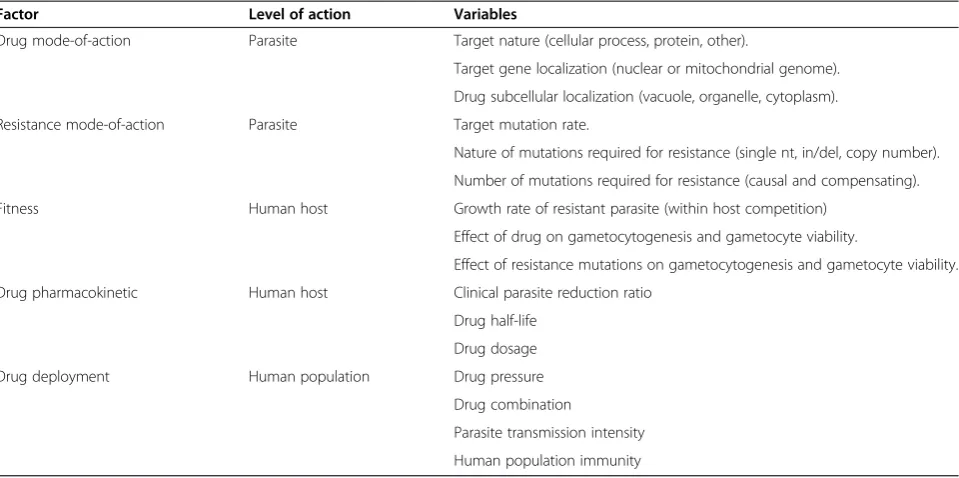
(chloroquine resistance transporter), whilst atovaquone resistance requires a single point mutation in the mito-chondrially encoded cytochrome bc1pfcytb(cytochrome b) [4]. Altogether, the nature of antimalarial compounds, of their targets, and of the interactions between them ul-timately determines the genetic ability of Plasmodium parasites to acquire resistance mechanisms. Whether these mechanisms will emerge and spread in the wild further depends on several factors operating at the host and population levels (Table 1).
Fortunately, development of resistance to artemisinin, on which are based current first-line therapies for un-complicated and severe P. falciparum malaria, has been relatively slow. This is partly due to recommendations from the World Health Organization (WHO) that only fixed-dose combinations of artemisinin derivatives with other anti-malarials should be used. It is also because of the relative difficulty of generating artemisinin resist-ance, which has been reassuringly problematic, even in the laboratory [5]. The first signs of a reduction of the anti-parasitic activity of artemisinins are emerging, with a decrease in parasite clearance time being seen in Cambodia and Thailand, and the first hints of a possible * Correspondence:[email protected]
1Medicines for Malaria Venture, 20 rte de Pré Bois, Geneva CH 1215,
Switzerland
Full list of author information is available at the end of the article
© 2012 Ding et al.; licensee BioMed Central Ltd. This is an Open Access article distributed under the terms of the Creative Commons Attribution License (http://creativecommons.org/licenses/by/2.0), which permits unrestricted use, distribution, and reproduction in any medium, provided the original work is properly cited.
molecular mechanism have been suggested [6-8]. Even if the spread of resistance can be controlled, there will be a need for new classes of anti-malarial drugs. This is a race against time, given that the time taken to develop new medicines often exceeds a decade. Developing new medicines that will withstand resistance is a combination of reducing the possibility that resistant parasites will arise and preventing their transmission. First, finding new molecular classes with a low probability that resist-ance would arise should be a consequence of more hol-istic cellular based screening, which has the advantage of potentially selecting for polypharmacology; in other words molecules that hit more than one target. Fitness cost is a key factor in this equation as well: if it is not possible to produce a resistant phenotype with a low fit-ness cost, then these strains are likely to be replaced by sensitive strains when the drug pressure is relaxed. Sec-ond, understanding the role of new inhibitors on trans-mission is also critical at an early stage, since resistant parasites which are inefficiently transmitted are a far lower threat to global public health concern. Anti-folate resistance had a marked differential effect on transmis-sion which may have accelerated its spread [9]: clearly a molecular class with the opposite trend would be prefer-able. Third, the spread of resistance can be reduced by combining multiple agents with distinct modes of-action; since any organism resistant to one component of the combination should be eliminated by the other. This raises the barrier for resistance, since the parasite would have to acquire both resistances simultaneously, which is far less likely, assuming the mutation events
are stochastic [10]. The combination of artemether-lumefantrine has been protected against the emergence of lumefantrine resistance despite being used to treat over 500 million patients, partly because lumefantrine has never been used as a monotherapy. Fixed dose combina-tions prevent sub-optimal monotherapy treatment, and will restrict the spread of resistance [10,11], provided the optimal dose ratio can be deployed. Multiple first-line therapies would also help, but the key is to have medicines which are as different as possible and current strategies would only allow use of artemisinin combination therapies [12,13]. Putting together these three factors in models to simulate drug resistance emergence in the wild is an im-portant task, but is still at an early stage [14-16].
[image:2.595.59.539.100.339.2]The lifespan of the next generation of anti-malarials in the face of resistance is a critical question in the debate over malaria elimination and eradication. If through ju-dicious selection of the right molecules and good prac-tice, the time interval from introduction to clinically significant resistance for the next generation of therapy can be put at the level of artemisinin, or even better, it is possible that the disease will be eliminated before clin-ical resistance occurs. This increases the need to have an early assessment of the risk of developing resistance associated with each compound and each combination. This would not be the single decision criterion, but would be part of the overall framework of deciding which compounds to prioritize. The Medicines for Malaria Venture (MMV) is a product development part-nership with the mission to discover, develop, and facili-tate delivery of new, effective and affordable anti-malarial Table 1 Resistance associated factors
Factor Level of action Variables
Drug mode-of-action Parasite Target nature (cellular process, protein, other).
Target gene localization (nuclear or mitochondrial genome).
Drug subcellular localization (vacuole, organelle, cytoplasm).
Resistance mode-of-action Parasite Target mutation rate.
Nature of mutations required for resistance (single nt, in/del, copy number).
Number of mutations required for resistance (causal and compensating).
Fitness Human host Growth rate of resistant parasite (within host competition)
Effect of drug on gametocytogenesis and gametocyte viability.
Effect of resistance mutations on gametocytogenesis and gametocyte viability.
Drug pharmacokinetic Human host Clinical parasite reduction ratio
Drug half-life
Drug dosage
Drug deployment Human population Drug pressure
Drug combination
Parasite transmission intensity
medicines. Part of the process of developing new medi-cines is to have a coherent view on the required properties of new medicines, a process often referred to as develop-ing the“target product profile”or TPP. Since one key as-pect of this product profile has to be minimal susceptibility to resistance, it is important to have a stan-dardized framework to quantitatively assess the risk of re-sistance associated with preclinical anti-malarial compounds. Such a framework, based onin vitro P. falcip-arum experiments, has been developed and is presented. The experimental strategy is discussed together with the benefits and limitations of such a standard approach and its implications for clinical development.
Resistance assessment strategy
The MMV assessment strategy has been designed to achieve three goals: (i) identify potential cross-resistance to other anti-malarial compounds and naturally occur-ring phenotypic differences, (ii) quantify the risk, or fre-quency, of de novo resistance selection in vitro and the associated fitness cost, (iii) characterize the molecular mode-of-action of resistance, including an understand-ing of its genetic basis. This work goes on in parallel with the optimization and selection of candidate cules. Clearly not all work needs to be done on all mole-cules in the discovery pipeline, since the sad truth is that most chemical series do not result in a molecule which can be tested in humans. The first aspect should be ana-lysed when a new chemical series is identified, since this is something that may be optimized by a medicinal chemistry approach. The second aspect is probably series dependent, and requires more intensive measure-ment, and should wait until a project is at the lead optimization stage. The final steps should be carried out in parallel to the clinical candidate selection, since they are relatively labour intensive. Two test cascades have been defined to achieve the first two goals systematically, the results of which can be exploited to the third one (Figure 1).
Goal I: cross-resistance
One of the hallmarks of genetically determined drug-resistance is a shift in the 50% inhibitory concentration (IC50) compared to sensitive strains. The first step is
establishing that a new compound is fully active on known multi-drug resistant (MDR)P. falciparum strains by measuring its IC50, which is a more robust and
repro-ducible measure than IC90 or IC99. Known anti-malarial
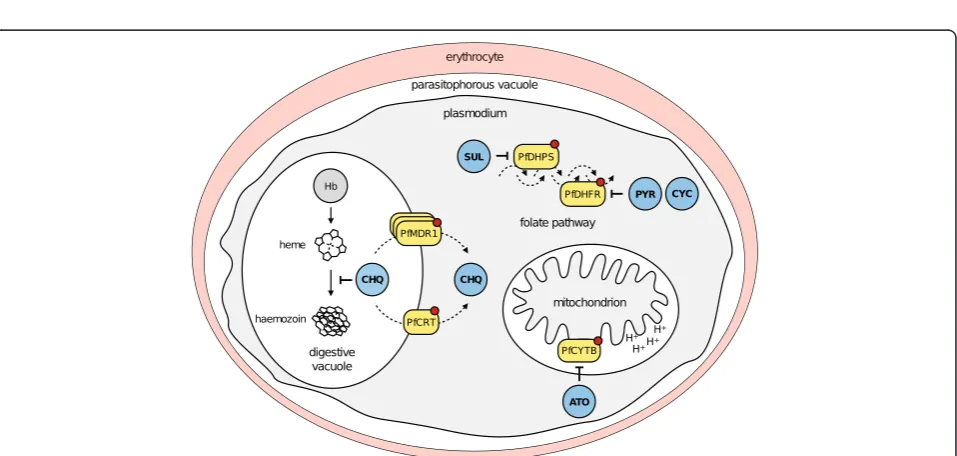
resistance is principally determined by only a handful of genes (Figure 2). These include specific molecular tar-gets, such as those for antifolates pfdhps (dihydroptero-ate synthase) and pfdhfr (dihydrofolate reductase) and electron transport inhibitorspfcytb(cytochrome bc1). In
addition there are transporters such as pfcrt (chloro-quine) andpfmdr1(multidrug resistance 1).
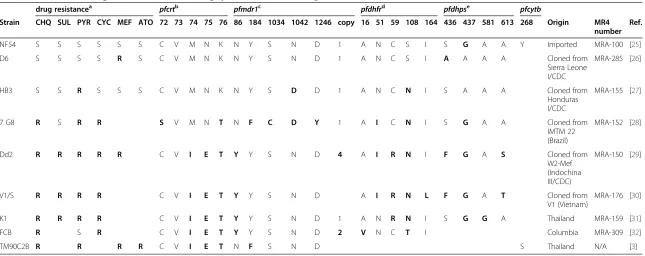
A collection of resistant strains has been selected to cover at least all the naturally occurring and genetically defined known resistance mechanisms (Table 2). In this context, we will define resistance as IC50 value 20-fold
higher than that of the reference IC50value from a
pan-sensitive P. falciparum strain, typically NF54. This threshold gives room for intrinsic IC50 variations in the
growth rate or other biological or experimental para-meters not directly related to resistance mechanisms [17]. The strains selected cover the majority of known genetic variations. The chloroquine transporter pfcrt mutation K76T is associated with additional mutations (CVIET and SVMNT alleles which are found in the FCB and 7G8 strains). The V1/S strain has mutations in
pfdhfrleading to four amino acid substitutions showing
high levels of resistance to cycloguanil and pyrimeth-amine [18]. HB3 is resistant to pyrimethpyrimeth-amine but not cycloguanil, while FCB shows the contrary pattern [18]. Dd2 and FCB show increased copy numbers ofpfmdr1, and mutations at several codons. These changes influ-ence sensitivity to multiple drugs, including mefloquine and artemisinin derivatives [5,19]. NF54 and 7G8 have a 20-fold shift in IC50to sulphadoxine, as a result of
muta-tions in pfdhps whilst Dd2 has a high level resistance, when tested in a low para-aminobenzoic acid (pABA) medium [20,21]. TM90C2B is resistant to atovaquone, due to a mutation in pfcytb [22]. Finally the set also includes the D6 strain, which shows, in some studies, a low level of natural resistance to mefloquine [23]. The K1 strain recapitulates most of the natural resistance mechanisms described above and therefore is a good first filter that can be performed early in the screening process. Clearly over the next few years it will be import-ant to add new resistance mechanisms. For example, re-sistance to the new spiroindolone NITD609 (in Phase IIa) is linked topfatp4as a potential resistance mechan-ism [24], demonstrating that new classes of compounds can bring new resistance mechanisms.
Since these MDR strains were adapted to culture and cloned many years ago, and have been passaged since that time, they may not represent the wild-type field
Plasmodiumparasites. Moreover, onlyP. falciparum can
be stably cultured in the laboratory. It is therefore essen-tial to test compounds against contemporary field isolates of all the human-infecting species, including
Plasmodium vivax, Plasmodium ovale andPlasmodium
malariae. This gives good background information on
variability, and allows confirmation that the compound is active on all species. The analysis of at least 10 P. falciparumand 10P. vivaxisolates appears a minimal requirement, if a 20-fold change in IC50 is used as a cut-off [42].
Dinget al. Malaria Journal2012,11:292 Page 3 of 11
Figure 1Resistance risk assessment workflow.The resistance risk assessment workflow encompasses three goals: cross-resistance
determination (goal I),de novoresistance selection frequency determination (goal II), and resistance mode-of-action determination (goal III). These can be achieved trough a straightforward set of quantitative experiments applied to compounds at the lead and preclinical developmental stages. A resistant IC50corresponds to a 20-fold increase as compared to a fully sensitive strain (NF54 or HB3 in the case of sulphonamides). C is the theoretical cost of fitness associated with resistance (see main text). C<0 indicates that resistance provides a fitness advantage, which is a major risk factor. Ultimately, the overall risk level can be classified as low, elevated, or major and allows to prioritize the development of robust compounds and to establish risk mitigation strategies for the others.
[image:4.595.60.539.414.642.2]Table 2 Panel of multidrug resistant strains including specifc amino acid changes drug resistancea
pfcrtb
pfmdr1c
pfdhfrd
pfdhpse
pfcytb
Strain CHQ SUL PYR CYC MEF ATO 72 73 74 75 76 86 184 1034 1042 1246 copy 16 51 59 108 164 436 437 581 613 268 Origin MR4 number
Ref.
NF54 S S S S S S C V M N K N Y S N D 1 A N C S I S G A A Y Imported MRA-100 [25]
D6 S S S S R S C V M N K N Y S N D 1 A N C S I A A A A Cloned from
Sierra Leone I/CDC
MRA-285 [26]
HB3 S S R S S S C V M N K N Y S D D 1 A N C N I S A A A Cloned from Honduras I/CDC
MRA-155 [27]
7 G8 R S R R S V M N T N F C D Y 1 A I C N I S G A A Cloned from
IMTM 22 (Brazil)
MRA-152 [28]
Dd2 R R R R R C V I E T Y Y S N D 4 A I R N I F G A S Cloned from
W2-Mef (Indochina III/CDC)
MRA-150 [29]
V1/S R R R R C V I E T Y Y S N D A I R N L F G A T Cloned from
V1 (Vietnam)
MRA-176 [30]
K1 R R R R C V I E T Y Y S N D 1 A N R N I S G G A Thailand MRA-159 [31]
FCB R S R C V I E T Y Y S N D 2 V N C T I Columbia MRA-309 [32]
TM90C2B R R R R C V I E T N F S N D S Thailand N/A [3]
a
S: sensitive, R: resistant, as reported in the literature. b
Allelic information based on references [33-35]. c
Allelic information based on references [33,35-37]. d
Allelic information based on references [18,35,38]. e
Allelic information based on references [20,39-41].
Ding
et
al.
Malaria
Journal
2012,
11
:292
Page
5
o
f
1
1
http://ww
w.malariajou
rnal.com/co
ntent/11/1/29
Goal II: resistance selection frequency
Resistant parasites can be selected by applying drug pressurein vitroandin vivo[22]. These approaches have successfully identified genes, and sometimes codons involved in naturally occurring resistance [22]. The sin-gle nucleotide changes behind these mutations are estimated to occur at a rate of approximately 10-9 per nucleotide site per replication, similar to other eukar-yotes [43-45]. Changes in sensitivity are also caused by gene copy number variations, which occur as often as 10-4per nucleotide site per replication [45,46].
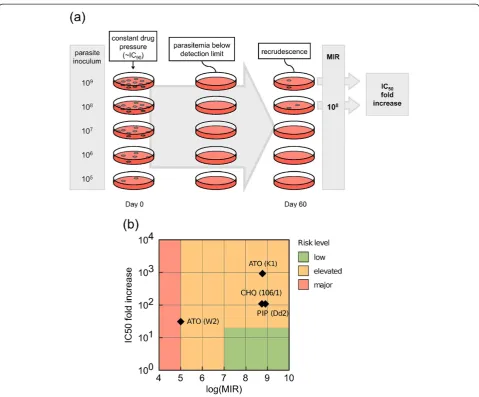
The simplest approach isin vitro selection of resistant parasites, which can be applied on a large number of com-pounds earlier in drug discovery. P. falciparum intraery-throcytic cultures, with starting inocula ranging from 105 to 109 parasites, are exposed to a concentration of the compound nearing IC90and monitored during 60 days for
recrudescent parasites (Figure 3a). The minimal inoculum for resistance (MIR) can be determined and is an indirect measure of the likelihood of a resistant genotype to occur and to be selected in vitro. In addition, the IC50 shift of
the resistant mutants as compared to the parental sensi-tive strain is a measure of the resistance intensity [47-49]. Dd2 has an accelerated resistance to multiple drugs (ARMD) phenotype, possibly due to defective DNA repair mechanisms [47,50], and is therefore an ideal strain to in-vestigate rare mutational events within the practical limits
of in vitro culture volumes. Importantly, MIR from
ARMD strains are assumed to be lower because of the general higher mutation rate of these parasites and not be-cause they acquire alternative resistance mechanisms. Moreover, ex vivo results seem to be in good agreement with clinical experience. Atovaquone resistance is gener-ated relatively easily in patients, and in laboratory experi-ments results either in low MIR or large IC50 increases
[3,4,47]. Chloroquine and artemisinin derivatives, which escaped resistance clinically for a long time despite wide-spread use as monotherapy, do not readily produce stable resistant mutants in selection experiments [22].
A combination of MIR and IC50increase in Dd2 can be
used to flag compounds at high risk of resistance (Figure 3b). An MIR equal to or below 105is a major risk, as it suggests that only a single nucleotide mutation is suf-ficient. A MIR of 107would also be high risk, if combined with a greater than 20-fold shift in the IC50.Combinations
of MIR and IC50 shift data available in the literature are
presented in the Figure 3b and Table 3. This limited data set shows strain dependence of MIRs, atovaquone show-ing an MIR of 105for in W2 and at 6×10⁸in K1 [4,47]. For example, the confirmation that cyclopropyl carboxa-mides had an MIR of less than 108 in the standard 3D7 strain, and an IC50shift of 100-fold range, gives two clear
signals that the series should be put on hold, unless other redeeming features can be identified [51].
Mutations that give a selective advantage against drugs often cause a reduction in fitness in its absence [53,54]. A key fitness parameter is the relative asexual growth rate [55], measured in vitro by monitoring cultures seeded with the derived resistant and the original (sensi-tive) parental strain at a given ratio. The evolution of the strain ratio can then be monitored by DNA sequencing or qPCR [56-58]. The proportional loss of fitness (C) can be calculated from the change in strain ratio ΔRn,
afterngenerations, where that value is equal to 1/(1-C)n [58]. If C≥0 the sensitive strain will outgrow the resist-ant strain, however, if C<0 this would be major potential risk, suggesting that the strain may also out-compete the original wild type in humans. Of note, such a scenario has already been observed withP. chabaudichloroquine and pyrimethamine resistant parasites displaying a fit-ness gain even in the absence of drug pressure [53]. A second key parameter of parasite fitness is its transmis-sion potential, which depends not only on its growth rate but also on its ability to produce viable gametocytes. The effect of resistance can also be investigated on the sexual phase of the parasite cycle, using recently
devel-oped in vitro methods [59]. A resistant parasite unable
to complete a sexual cycle is of no clinical relevance, as it cannot be transmitted.
In vivo resistance selection experiments allow a more
physiological variation of the drug concentration and are more representative of the clinical situation [60]. For in-stance, the pfcytb Y268C mutation conferring atova-quone resistance in the wild could only be reproduced using a rodent in vivo model [61]. However, in vivo experiments do not allow to control the level of drug pressure or the number of parasite subjected to it and are not ideal to profile and cross-compare a large num-ber of early compounds.
Goal III: understanding the molecular mechanism of resistance
highly polymorphic in these natural populations. This straightforward examination will give advance warning of any regions where resistant parasites might already by present, and easily selected by use of the drug.
[image:7.595.58.538.86.483.2]Additionally, in vitro experiments performed to cha-racterize the compound speed of action and its activity at various stages of the parasite lifecycle can be repeated using resistant parasites in order to better understand Figure 3In vitroresistance selection assessment.(a) A standardin vitroprotocol for resistance selection frequency measurement uses defined starting inocula of aP. falciparumstrain pressured with a constant level of drug nearing the IC90. Parasitemia falls below detection limits but eventual resistant parasites are able to recrudesce and to be cloned for subsequent determination of the IC50fold increase. The minimal inoculum for resistance (MIR) is a measure of the resistance selection frequency, while the IC50fold increase measures the level of resistance. (b) These two endpoints are used to classify anti-malarial compounds according to risk levels (see main text). It is advisable to run control experiments in parallel with compounds known to select resistance readily, such as atovaquone.
Table 3 MIR and associated IC50 fold increase reported in the literature
Compound Strain Pressure MIR IC50fold increase Mechanisma Ref.a
Atovaquone W2 10×IC50 1×10
5
30x n/a [47]
Atovaquone K1 6×/16×IC50 6×10
8
900x single point mutations inpfcytb [4]
Piperaquine Dd2 2×IC50 8.5×10
8
100x 63-kb fragment amplification [49]
Chloroquine 106/1 3×IC50 6×10
8
100x single point mutations inpfcrt [52]
GSK2645947 3D7 10×IC50 <10
8
100x n/a [51]
a
n/a:non available.
Dinget al. Malaria Journal2012,11:292 Page 7 of 11
[image:7.595.55.543.641.725.2]the resistance mode-of-action [59,67]. Recent advances in imaging also allow monitoring the intraerythrocitic life cycle of the parasites in vitroand in vivo and could similarly be used to compare resistant and sensitive parasites [68].
Clinical and regulatory requirement
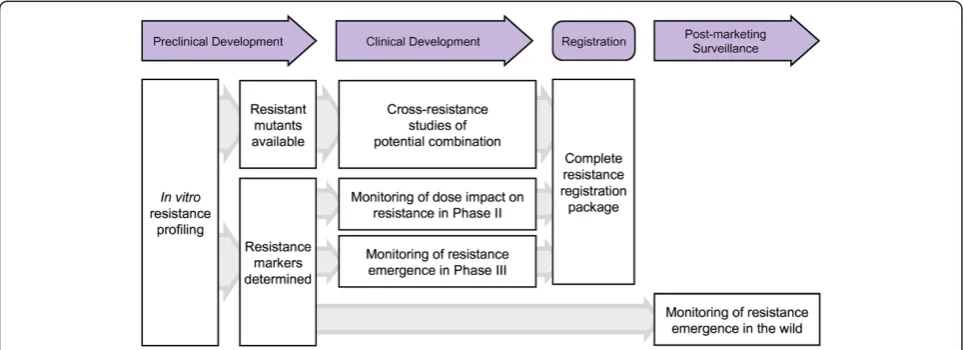
The development of technologies for assessing resistance means that comprehensive resistance testing should take place at all phases of drug development, including post-marketing pharmacovigilance (Figure 4). Ideally, the preclin-ical studies will have produced resistant strains and identi-fied resistance markers, which are especially useful in the post-marketing surveillance phase. Resistance selection could also be performed for both partners of potential thera-peutic combination using single-resistant mutants to evalu-ate the frequency of double-resistance, which should be equal or inferior to the single-resistance selection frequency. The identification ofin vitroresistance markers allows care-ful monitoring for their potential appearance during clinical trials. Analysis of samples during dose ranging studies for re-sistance selection could have an impact on dose selection, but presumably only if the changes in the IC50value were
relatively minor. Systematic monitoring of resistance selec-tion in Phase III will consolidate the data on frequency and help to consolidate the understanding of the development of resistance in different geographic and endemicity settings. This will be important information for the regulatory filings, for national malaria control programmes, and for coordi-nated efforts of resistance monitoring [69]. Regulators have universally recognized the importance of a systematic ap-proach to the characterization of new compounds in regard to their resistance generation potential. The US-FDA
recommend in their‘Guidance for Industry for Malaria drug development’that“the ability ofPlasmodiumstrains to de-velop resistance when subjected to drug pressure should be examined in appropriatein vitroand/orin vivomodels; this examination should include evaluating the potential for cross-resistance to drugs in the same class or in other classes. If resistance is demonstrated, it is important to iden-tify the mechanism of resistance. Attempts should be made to evaluate the clinical significance of any changes in pheno-type (e.g., in vitro susceptibility to the drug) or genotype observed in preclinical studies by correlating such changes with clinical outcome”[70].
Characterization of resistance potential has been men-tioned in the registration summaries of all anti-malarials submitted stringent regulatory authorities in the past ten years: CoartemW (artemether-lumefantrine, Novartis) to the US-FDA; Eurartesim (dihydroartemisinin-piperaquine, Sigma-Tau) at the EMA; and more recently Pyramax (pyronaridine-artesunate, Shin Poong Pharmaceuticals) which obtained marketing authorization under the EMA’s article 58) [71-73]. The MMV strategy for resistance characterization will provide this information for the regulators and ensure a complete resistance registration package.
Conclusion
[image:8.595.57.539.501.676.2]The process presented here integrates information about the potential importance of resistance selection and spreading into the preclinical and clinical development programme for new anti-malarial drugs. At the preclin-ical level, the experimental framework requires a test cascade of six essential steps covered by three specific experimental procedures. The output of this workflow
allows to classify the compound risk profiles as low, ele-vated or major (Figure 1 and 3b). This is one of the fac-tors that will be discussed as part of the preclinical candidate selection process, a decision matrix which includes safety margin, and severity of safety signals observed, human predicted potency, speed of killing, ef-fect on other lifecycle stages such as gametocytes and hypnozoites [74]. A major risk suggests that the com-pound will either face pre-existing resistance or will se-lect new clinically significant mechanisms of resistance. This risk level should prevent further development of the compound, in the absence of a clear mitigating fac-tor linked to major synergy in combination studies. An elevated risk is associated where there is a clear signal, and is an obvious concern. Provided that there are a small number of other elevated risks in the candidate se-lection matrix these compounds can be progressed, but resistance needs to be continually monitored in clinical studies, and will be a key factor in the selection of dose and combination partner. Risk mitigation is essential, making it important to understand the molecular mech-anism, and to have genetic markers to survey its occur-rence. A low risk classification suggests that resistance is unlikely to arise, although it is still important to continu-ally monitor for changes in IC50in the clinical program.
The outcome of resistance studies has several implica-tions influencing decision making in drug development. First, the IC50 as part of the calculation for the
predic-tion of human dose should include the range of poten-cies observed, and focus on the value from the most resistant parasites. This needs to be continually re-evaluated based on emerging data from primary field isolates. Second, potential cross-resistance amongst part-ners in drug combinations can be checked using labora-tory derived resistant strains. Ideal drug combinations are these that regroup compounds driving opposed or even incompatible resistance mechanisms [75]. Third, the knowledge ofin vitroidentified mutations conferring resistance and susceptible genes allow monitoring during the large scale clinical trials in Phase III and post-launch, to give an early warning signal for the emergence of clin-ically significant effects.
The experimental strategy presented here also has limita-tions. It applies to compounds acting againstP. falciparum asexual intraerythrocytic stage only. However, these repre-sent the majority of the parasite biomass. Although the next generation of anti-malarials may include increased focus on the hepatic forms, understanding potential resistance selec-tion at these lifecycle stages will be supported by knowledge of the resistance mechanisms in intraerythrocytic stages. Another limitation is the standardized approach itself. Resistance is a complex phenomenon that will require tailor-made studies. For instance, artemisinin resistance as currently observed does not translate into clear IC50 shift,
rendering its study in cross-resistance and resistance selec-tion experiments challenging [5]. However a standardized method does at least allow a common framework for com-paring compounds and making development decisions.
The workflow presented here allows to measure the risks of resistance generation, the magnitude of the change in IC50, and the effect on transmission at an early stage in drug discovery. By determining the mo-lecular mechanism of resistance, and identifying poten-tial cross-resistance issues, high-risk chemical series can be de-prioritized, in a time and cost effective manner. The generation of a standard resistance profile of new drugs will supply common information to regulators and national control bodies to facilitate decision-making. This information will also allow for the focused monitor-ing of compounds after registration. This strategy will contribute to developing long-lasting anti-malarial drugs by identifying and monitoring robust compounds during their development.
Competing interests
The authors declare that they have no competing interests.
Authors’contributions
Wrote the first draft of the manuscript and consulted with experts: XCD. Contributed to the writing of the manuscript: XCD, DU, TNCW. ICMJE criteria for authorship read and met: XCD, DU, TNCW. Agree with manuscript results and conclusions: XCD, DU, TNCW. All authors read and approved the final version of the paper.
Acknowledgements
We thank all MMV advisors and members of our External Scientific Advisory Committee and especially Arjen Dondorp, Carol Sibley, David Fidock, Dyann Wirth, Francois Nosten, Harald Noedl, Nicholas White, Pascal Ringwald, Ric Price, and Sergio Wittlin for insightful discussions that contributed to define the framework presented here. The authors also grateful to Elizabeth Winzeler, Francisco-Javier Gamo, Michael Makanga, Neena Valecha, Salim Abdullah, Steve Ward, Thierry Diagana, Wallace Peters for comments and suggestions on initial thoughts about the optimal strategy to assess resistance selection. Of note, the panel of experts acknowledged here does not specifically endorse the opinions expressed in this article.
The authors also acknowledge Brice Campo, Didier Leroy, Jeremy Burrows, and Thomas Spangenberg for critical comments on the manuscript.
Author details
Medicines for Malaria Venture, 20 rte de Pré Bois, Geneva CH 1215, Switzerland.
Received: 7 June 2012 Accepted: 1 August 2012 Published: 22 August 2012
References
1. Mita T, Tanabe K, Kita K:Spread and evolution ofPlasmodium falciparum
drug resistance.Parasitol Int2009,58:201–209.
2. World Health Organization:Global report on antimalarial drug efficacy and drug resistance: 2000–2010. Geneva: WHO; 2010:121.
3. Looareesuwan S, Viravan C, Webster HK, Kyle DE, Hutchinson DB, Canfield CJ:Clinical studies of atovaquone, alone or in combination with other antimalarial drugs, for treatment of acute uncomplicated malaria in Thailand.AmJTrop Med Hyg1996,54:62.
4. Korsinczky M, Chen N, Kotecka B, Saul A, Rieckmann K, Cheng Q:Mutations inPlasmodium falciparumcytochrome b that are associated with atovaquone resistance are located at a putative drug-binding site. Antimicrob Agents Chemother2000,44:2100–2108.
Dinget al. Malaria Journal2012,11:292 Page 9 of 11
5. Ding XC, Beck H-P, Raso G:Plasmodium sensitivity to artemisinins: magic bullets hit elusive targets.Trends Parasitol2011,27:73–81.
6. Noedl H, Se Y, Schaecher K, Smith BL, Socheat D, Fukuda MM, Artemisinin Resistance in Cambodia 1 (ARC1) Study Consortium:Evidence of artemisinin-resistant malaria in Western Cambodia.N Engl J Med2008, 359:2619–2620.
7. Phyo AP, Nkhoma S, Stepniewska K, Ashley EA, Nair S, McGready R, Ler Moo C, Al-Saai S, Dondorp AM, Lwin KM, Singhasivanon P, Day NPJ, White NJ, Anderson TJC, Nosten F:Emergence of artemisinin-resistant malaria on the western border of Thailand: a longitudinal study.Lancet2012, 379:1960–1966.
8. Cheeseman IH, Miller BA, Nair S, Nkhoma S, Tan A, Tan JC, Saai Al S, Phyo AP, Moo CL, Lwin KM, McGready R, Ashley E, Imwong M, Stepniewska K, Yi P, Dondorp AM, Mayxay M, Newton PN, White NJ, Nosten F, Ferdig MT, Anderson TJC:A major genome region underlying artemisinin resistance in malaria.Science2012,336:79–82.
9. Barnes KI, Little F, Mabuza A, Mngomezulu N, Govere J, Durrheim D, Roper C, Watkins B, White NJ:Increased gametocytemia after treatment: an early parasitological indicator of emerging sulfadoxine-pyrimethamine resistance in falciparum malaria.J Infect Dis2008,197:1605–1613. 10. White N:Strategies for the prevention of antimalarial drug resistance:
Rationale for combination chemotherapy for malaria.Parasitol Today 1996,12:399–401.
11. Price RN, Nosten F:Drug resistant falciparum malaria: clinical consequences and strategies for prevention.Drug Resist Updat2001, 4:187–196.
12. Foster KR, Grundmann H:Do we need to put society first? The potential for tragedy in antimicrobial resistance.PLoS Med2006,3:e29. 13. Boni MF, Smith DL, Laxminarayan R:Benefits of using multiple first-line
therapies against malaria.Proc Natl Acad Sci USA2008,105:14216–14221. 14. White NJ, Pongtavornpinyo W:The de novo selection of drug-resistant
malaria parasites.Proc R Soc B: Biol Sci2003,270:545–554.
15. Mackinnon MJ, Hastings IM:The evolution of multiple drug resistance in malaria parasites.Trans R Soc Trop Med Hyg1998,92:188–195.
16. Smith DL, Klein EY, McKenzie FE, Laxminarayan R:Prospective strategies to delay the evolution of anti-malarial drug resistance: weighing the uncertainty.Malar J2010,9:217.
17. Reilly HB, Wang H, Steuter JA, Marx AM, Ferdig MT:Quantitative dissection of clone-specific growth rates in cultured malaria parasites.Int J Parasitol 2007,37:1599–1607.
18. Peterson DS, Milhous WK, Wellems TE:Molecular basis of differential resistance to cycloguanil and pyrimethamine inPlasmodium falciparum
malaria.Proc Natl Acad Sci USA1990,87:3018–3022.
19. Duraisingh MT, Cowman AF:Contribution of the pfmdr1 gene to antimalarial drug-resistance.Acta Trop2005,94:181–190.
20. Wang P, Read M, Sims PF, Hyde JE:Sulfadoxine resistance in the human malaria parasitePlasmodium falciparumis determined by mutations in dihydropteroate synthetase and an additional factor associated with folate utilization.Mol Microbiol1997,23:979–986.
21. Triglia T, Wang P, Sims PF, Hyde JE, Cowman AF:Allelic exchange at the endogenous genomic locus inPlasmodium falciparumproves the role of dihydropteroate synthase in sulfadoxine-resistant malaria.EMBO J1998, 17:3807–3815.
22. Witkowski B, Berry A, Benoit-Vical F:Resistance to antimalarial compounds: Methods and applications.Drug Resist Updat2009,12:42–50.
23. Cerutti Junior C, Marques C, Alencar FE, Durlacher RR, Alween A, Segurado AA, Pang LW, Zalis MG:Antimalarial drug susceptibility testing of
Plasmodium falciparumin Brazil using a radioisotope method.Mem Inst Oswaldo Cruz1999,94:803–809.
24. Rottmann M, McNamara C, Yeung BKS, Lee MCS, Zou B, Russell B, Seitz P, Plouffe DM, Dharia NV, Tan J, Cohen SB, Spencer KR, Gonzalez-Paez GE, Lakshminarayana SB, Goh A, Suwanarusk R, Jegla T, Schmitt EK, Beck HP, Brun R, Nosten F, Renia L, Dartois V, Keller TH, Fidock DA, Winzeler EA, Diagana TT:Spiroindolones, a potent compound class for the treatment of malaria.Science2010,329:1175–1180.
25. Ponnudurai T, Leeuwenberg AD, Meuwissen JH:Chloroquine sensitivity of isolates ofPlasmodium falciparumadapted toin vitroculture.Trop Geogr Med1981,33:50–54.
26. Oduola AM, Weatherly NF, Bowdre JH, Desjardins RE:Plasmodium falciparum: cloning by single-erythrocyte micromanipulation and heterogeneityin vitro.Exp Parasitol1988,66:86–95.
27. Bhasin VK, Trager W:Gametocyte-forming and non-gametocyte-forming clones ofPlasmodium falciparum.AmJTrop Med Hyg1984,33:534–537. 28. Burkot TR, Williams JL, Schneider I:Infectivity to mosquitoes of
Plasmodium falciparumclones grownin vitrofrom the same isolate. Trans R Soc Trop Med Hyg1984,78:339–341.
29. Guinet F, Dvorak JA, Fujioka H, Keister DB, Muratova O, Kaslow DC, Aikawa M, Vaidya AB, Wellems TE:A developmental defect inPlasmodium falciparummale gametogenesis.J Cell Biol1996,135:269–278. 30. Rosario V:Cloning of naturally occurring mixed infections of malaria
parasites.Science1981,212:1037–1038.
31. Thaithong S, Beale GH:Resistance of ten Thai isolates ofPlasmodium falciparumto chloroquine and pyrimethamine byin vitrotests.Trans R Soc Trop Med Hyg1981,75:271–273.
32. Eastham GM, Rieckmann KH:The activity of pyrimethamine and sulphadoxine againstPlasmodium falciparumdetermined by thein vitro
microtechnique.Trans R Soc Trop Med Hyg1983,77:91–93.
33. Valderramos SG, Valderramos J-C, Musset L, Purcell LA, Mercereau-Puijalon O, Legrand E, Fidock DA:Identification of a mutant PfCRT-mediated chloroquine tolerance phenotype inPlasmodium falciparum.PLoS Pathog 2010,6:e1000887.
34. Fidock DA, Nomura T, Talley AK, Cooper RA, Dzekunov SM, Ferdig MT, Ursos LM, Sidhu AB, Naudé B, Deitsch KW, Su XZ, Wootton JC, Roepe PD, Wellems TE:Mutations in theP. falciparumdigestive vacuole transmembrane protein PfCRT and evidence for their role in chloroquine resistance.Mol Cell2000,6:861–871.
35. Van Tyne D, Park DJ, Schaffner SF, Neafsey DE, Angelino E, Cortese JF, Barnes KG, Rosen DM, Lukens AK, Daniels RF, Milner DA, Johnson CA, Shlyakhter I, Grossman SR, Becker JS, Yamins D, Karlsson EK, Ndiaye D, Sarr O, Mboup S, Happi C, Furlotte NA, Eskin E, Kang HM, Hartl DL, Birren BW, Wiegand RC, Lander ES, Wirth DF, Volkman SK, Sabeti PC:Identification and functional validation of the novel antimalarial resistance locus PF10_0355 inPlasmodium falciparum.PLoS Genet2011,7:e1001383. 36. Chavchich M, Gerena L, Peters J, Chen N, Cheng Q, Kyle DE:Role of pfmdr1
amplification and expression in induction of resistance to artemisinin derivatives inPlasmodium falciparum.Antimicrob Agents Chemother2010, 54:2455–2464.
37. Rohrbach P, Sanchez CP, Hayton K, Friedrich O, Patel J, Sidhu ABS, Ferdig MT, Fidock DA, Lanzer M:Genetic linkage of pfmdr1 with food vacuolar solute import inPlasmodium falciparum.EMBO J2006,25:3000–3011. 38. Sirawaraporn W, Sathitkul T, Sirawaraporn R, Yuthavong Y, Santi DV:
Antifolate-resistant mutants ofPlasmodium falciparumdihydrofolate reductase.Proc Natl Acad Sci USA1997,94:1124–1129.
39. Triglia T, Cowman AF:Primary structure and expression of the dihydropteroate synthetase gene ofPlasmodium falciparum.Proc Natl Acad Sci USA1994,91:7149–7153.
40. Triglia T, Menting JG, Wilson C, Cowman AF:Mutations in dihydropteroate synthase are responsible for sulfone and sulfonamide resistance in
Plasmodium falciparum.Proc Natl Acad Sci USA1997,94:13944–13949. 41. Zhou Z, Poe AC, Limor J, Grady KK, Goldman I, McCollum AM, Escalante AA,
Barnwell JW, Udhayakumar V:Pyrosequencing, a high-throughput method for detecting single nucleotide polymorphisms in the dihydrofolate reductase and dihydropteroate synthetase genes ofPlasmodium falciparum.J Clin Microbiol2006,44:3900–3910.
42. Marfurt J, Chalfein F, Prayoga P, Wabiser F, Kenangalem E, Piera KA, MacHunter B, Tjitra E, Anstey NM, Price RN:Ex vivodrug susceptibility of ferroquine against chloroquine-resistant isolates ofPlasmodium falciparumandP. vivax.Antimicrob Agents Chemother2011, 55:4461–4464.
43. Paget-McNicol SM:Estimation of mutation and switching rates in Plasmodium falciparum genes. PhD thesis. The University of Queensland: School of Population Health; 2001.
44. Paget-McNicol S, Saul A:Mutation rates in the dihydrofolate reductase gene ofPlasmodium falciparum.Parasitology2001,122:497–505. 45. Donald F, Conrad MEH:The population genetics of structural variation.
Nat Genet2007,39:S30.
46. Cheeseman IH, Gomez-Escobar N, Carret CK, Ivens A, Stewart LB, Tetteh KK, Conway DJ:Gene copy number variation throughout thePlasmodium falciparumgenome.BMC Genomics2009,10:353.
48. Istvan ES, Dharia NV, Bopp SE, Gluzman I, Winzeler EA, Goldberg DE: Validation of isoleucine utilization targets inPlasmodium falciparum.Proc Natl Acad Sci USA2011,108:1627.
49. Eastman RT, Dharia NV, Winzeler EA, Fidock DA:Piperaquine resistance is associated with a copy number variation on chromosome 5 in drug-pressuredPlasmodium falciparumparasites.Antimicrob Agents Chemother 2011,55:3908–3916.
50. Trotta RF, Brown ML, Terrell JC, Geyer JA:Defective DNA repair as a potential mechanism for the rapid development of drug resistance in
Plasmodium falciparum.Biochemistry2004,43:4885–4891. 51. Sanz LM, Jimenez-Diaz MB, Crespo B, De-Cozar C, Almela MJ,
Angulo-Barturen I, Castaneda P, Ibanez J, Fernandez EP, Ferrer S, Herreros E, Lozano S, Martinez MS, Rueda L, Burrows JN, Garcia-Bustos JF, Gamo FJ:
Cyclopropyl carboxamides, a chemically novel class of antimalarial agents identified in a phenotypic screen.Antimicrob Agents Chemother 2011,55:5740–5745.
52. Cooper RA, Ferdig MT, Su X-Z, Ursos LMB, Mu J, Nomura T, Fujioka H, Fidock DA, Roepe PD, Wellems TE:Alternative mutations at position 76 of the vacuolar transmembrane protein PfCRT are associated with chloroquine resistance and unique stereospecific quinine and quinidine responses in
Plasmodium falciparum.Mol Pharmacol2002,61:35–42.
53. Rosario VE, Hall R, Walliker D, Beale GH:Persistence of drug-resistant malaria parasites.Lancet1978,1:185–187.
54. Walliker D, Hunt P, Babiker H:Fitness of drug-resistant malaria parasites. Acta Trop2005,94:251–259.
55. Huijben S, Nelson WA, Wargo AR, Sim DG, Drew DR, Read AF: Chemotherapy, within-host ecology and the fitness of drug-resistant malaria parasites.Evolution2010,64:2952–2968.
56. Hunt P, Fawcett R, Carter R, Walliker D:Estimating SNP proportions in populations of malaria parasites by sequencing: validation and applications.Mol Biochem Parasitol2005,143:173–182.
57. Cheesman SJ, de Roode JC, Read AF, Carter R:Real-time quantitative PCR for analysis of genetically mixed infections of malaria parasites: technique validation and applications.Mol Biochem Parasitol2003, 131:83–91.
58. Peters JM, Chen N, Gatton M, Korsinczky M, Fowler EV, Manzetti S, Saul A, Cheng Q:Mutations in cytochrome b resulting in atovaquone resistance are associated with loss of fitness inPlasmodium falciparum.Antimicrob Agents Chemother2002,46:2435–2441.
59. Delves M, Plouffe D, Scheurer C, Meister S, Wittlin S, Winzeler EA, Sinden RE, Leroy D:The activities of current antimalarial drugs on the life cycle stages of Plasmodium: a comparative study with human and rodent parasites.PLoS Med2012,9:e1001169.
60. Peters W:The chemotherapy of rodent malaria. LVII. Drug combinations to impede the selection of drug resistance, Part 1: Which model is appropriate?Ann Trop Med Parasitol1999,93:569–587.
61. Srivastava IK, Morrisey JM, Darrouzet E, Daldal F, Vaidya AB:Resistance mutations reveal the atovaquone-binding domain of cytochrome b in malaria parasites.Mol Microbiol1999,33:704–711.
62. Anderson T, Nkhoma S, Ecker A, Fidock D:How can we identify parasite genes that underlie antimalarial drug resistance?Pharmacogenomics 2011,12:59–85.
63. Dharia NV, Sidhu ABS, Cassera MB, Westenberger SJ, Bopp SE, Eastman RT, Plouffe D, Batalov S, Park DJ, Volkman SK, Wirth DF, Zhou Y, Fidock DA, Winzeler EA:Use of high-density tiling microarrays to identify mutations globally and elucidate mechanisms of drug resistance inPlasmodium falciparum.Genome Biol2009,10:R21.
64. Su X, Ferdig MT, Huang Y, Huynh CQ, Liu A, You J, Wootton JC, Wellems TE: A genetic map and recombination parameters of the human malaria parasitePlasmodium falciparum.Science1999,286:1351–1353. 65. Manske M, Miotto O, Campino S, Auburn S, Almagro-Garcia J, Maslen G,
O’Brien J, Djimdé A, Doumbo O, Zongo I, Ouédraogo JB, Michon P, Mueller I, Siba P, Nzila A, Borrmann S, Kiara SM, Marsh K, Jiang H, Su X-Z, Amaratunga C, Fairhurst R, Socheat D, Nosten F, Imwong M, White NJ, Sanders M, Anastasi E, Alcock D, Drury E, Oyola S, Quail MA, Turner DJ, Ruano-Rubio V, Jyothi D, Amenga-Etego L, Hubbart C, Jeffreys A, Rowlands K, Sutherland C, Roper C, Mangano V, Modiano D, Tan JC, Ferdig MT, Amambua-Ngwa A, Conway DJ, Takala-Harrison S, Plowe CV, Rayner JC, Rockett KA, Clark TG, Newbold CI, Berriman M, MacInnis B, Kwiatkowski DP: Analysis ofPlasmodium falciparumdiversity in natural infections by deep sequencing.Nature2012,487:375–379.
66. Volkman SK, Neafsey DE, Schaffner SF, Park DJ, Wirth DF:Harnessing genomics and genome biology to understand malaria biology.Nat Rev Genet2012,13:315–328.
67. Sanz LM, Crespo B, de Cozar C, Ding XC, Llergo JL, Burrows JN, Garcia-Bustos JF, Gamo F-J:P. falciparumin vitrokilling rates allow to discriminate between different antimalarial mode-of-action.PLoS One 2012,7:e30949.
68. Cho S, Kim S, Kim Y, Park Y:Optical imaging techniques for the study of malaria.Trends Biotechnol2012,30:71–79.
69. Sibley CH, Guerin PJ, Ringwald P:Monitoring antimalarial resistance: launching a cooperative effort.Trends Parasitol2010,26:221–224. 70. Malaria: developing drug and nonvaccine biological products for treatment
and prophylaxishttp://www.fda.gov/downloads/Drugs/
GuidanceComplianceRegulatoryInformation/Guidances/UCM071951.pdf. 71. Pyramax Summary of Opinionhttp://www.ema.europa.eu/docs/en_GB/
document_library/Other/2012/02/WC500122945.pdf.
72. Coartem Summary Reviewhttp://www.accessdata.fda.gov/drugsatfda_docs/ nda/2009/022268s000_SumR.pdf.
73. Eurartesim Summary of Opinionhttp://www.ema.europa.eu/docs/en_GB/ document_library/Summary_of_opinion_-_Initial_authorisation/human/ 001199/WC500108010.pdf.
74. Burrows JN, Leroy D, Lotharius J, Waterson D:Challenges in antimalarial drug discovery.Future Med Chem2011,3:1401–1412.
75. Cammack N:Exploiting malaria drug resistance to our advantage.Science 2011,333:705–706.
doi:10.1186/1475-2875-11-292
Cite this article as:Dinget al.:A framework for assessing the risk of resistance for anti-malarials in development.Malaria Journal201211:292.
Submit your next manuscript to BioMed Central and take full advantage of:
• Convenient online submission
• Thorough peer review
• No space constraints or color figure charges
• Immediate publication on acceptance
• Inclusion in PubMed, CAS, Scopus and Google Scholar
• Research which is freely available for redistribution
Submit your manuscript at www.biomedcentral.com/submit
Dinget al. Malaria Journal2012,11:292 Page 11 of 11