R E V I E W
Open Access
The biased nucleotide composition of the HIV
genome: a constant factor in a highly variable
virus
Antoinette C van der Kuyl
*and Ben Berkhout
Abstract
Viruses often deviate from their hosts in the nucleotide composition of their genomes. The RNA genome of the lentivirus family of retroviruses, including human immunodeficiency virus (HIV), contains e.g. an above average percentage of adenine (A) nucleotides, while being extremely poor in cytosine (C). Such a deviant base
composition has implications for the amino acids that are encoded by the open reading frames (ORFs), both in the requirement of specific tRNA species and in the preference for amino acids encoded by e.g. A-rich codons. Nucleotide composition does obviously affect the secondary and tertiary structure of the RNA genome and its biological functions, but it does also influence phylogenetic analysis of viral genome sequences, and possibly the activity of the integrated DNA provirus. Over time, the nucleotide composition of the HIV-1 genome is
exceptionally conserved, varying by less than 1% per base position per isolate within either group M, N, or O during 1983–2009. This extreme stability of the nucleotide composition may possibly be achieved by negative selection, perhaps conserving semi-stable RNA secondary structure as reverse transcription would be significantly affected for a less A-rich genome where secondary structures are expected to be more stable and thus more difficult to unfold. This review will discuss all aspects of the lentiviral genome composition, both of the RNA and of its derived double-stranded DNA genome, with a focus on HIV-1, the nucleotide composition over time, the effects of artificially humanized codons as well as contributions of immune system pressure on HIV nucleotide bias.
Review
Nucleotide composition: the HIV genome
Viruses, whether their genomes are composed of RNA or DNA, and whether they have single (ss)- or double (ds) -stranded genomes, often differ substantially in the base composition of their genomes, compared to each other and to their hosts. Retroviruses are a special class of viruses, as they alternate between a ssRNA (in the vir-ion) and a dsDNA genome (integrated in the host gen-ome). The RNA genome is reverse transcribed into dsDNA by the viral reverse transcriptase (RT) enzyme that generates both strands of DNA using the genomic RNA template for first strand synthesis and the resulting cDNA for second strand synthesis, while the (integrated)
dsDNA genome is transcribed into viral RNA by the host RNA polymerase II.
The remarkable adenine (A)-richness of the HIV RNA genome was already noticed several decades ago [1], and was investigated in more detail thereafter [2-5]. Having RNA genomes that are rich in A and low in cytosine (C) was found to be a general property of the lentivirus fam-ily [3,5,6] to which HIV belongs, in contrast to e.g. del-taretroviruses such as human T-cell leukaemia virus (HTLV) that possess genomes poor in A and rich in C [2], e.g. 23.6% A, 34.9% C, 18.3% G and 23.2% U for HTLV type 1 (GenBank accession no. D13784).
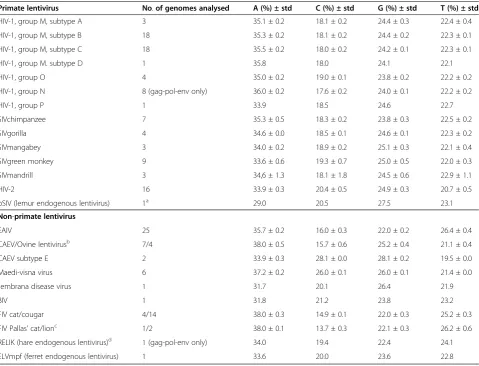
Although HIV is one of the most variable viruses known with regard to its nucleotide substitution rate, the base composition of the genome is surprisingly stable over time, varying less than 1% per base per isolate whether originating from early or later years of the epidemic and gardless of HIV-1 group or subtype (Table 1). Subtle re-gional differences in base composition are present across
* Correspondence:[email protected]
Laboratory of Experimental Virology, Department of Medical Microbiology, Center for Infection and Immunity Amsterdam (CINIMA), Academic Medical Center of the University of Amsterdam, Meibergdreef 15, Amsterdam, AZ 1105, The Netherlands
the HIV genome; e.g. the early genes such as tat, rev, nef, and the untranslated 5’ leader RNA are less A-rich than the pol gene (Table 2). The stability of the base compos-ition over time also holds when examining smaller gen-ome fragments, e.g. from the gag or pol genes, and is even true for highly variable genes such asenv.
[image:2.595.59.539.99.465.2]The intriguing question is then: how can such a vari-able virus maintain such stvari-able nucleotide frequencies? For this, we have to consider the various aspects of the HIV replication cycle in the host cell that influence the RNA and/or DNA genome. Reverse transcription, trans-lation, splicing, encapsidation in virions to name a few, all have their own requirements with respect to the viral RNA genome. And how are viral genomes with a deviant nucleotide composition selected against, or selected for? A recent paper suggests that RNA genome structure, and not the encoded proteins, is the most decisive factor
Table 1 Average nucleotide composition of full-length lentivirus DNA genomes
Primate lentivirus No.of genomes analysed A (%) ± std C (%) ± std G (%) ± std T (%) ± std
HIV-1, group M, subtype A 3 35.1 ± 0.2 18.1 ± 0.2 24.4 ± 0.3 22.4 ± 0.4
HIV-1, group M, subtype B 18 35.3 ± 0.2 18.1 ± 0.2 24.4 ± 0.2 22.3 ± 0.1
HIV-1, group M, subtype C 18 35.5 ± 0.2 18.0 ± 0.2 24.2 ± 0.1 22.3 ± 0.1
HIV-1, group M. subtype D 1 35.8 18.0 24.1 22.1
HIV-1, group O 4 35.0 ± 0.2 19.0 ± 0.1 23.8 ± 0.2 22.2 ± 0.2
HIV-1, group N 8 (gag-pol-env only) 36.0 ± 0.2 17.6 ± 0.2 24.0 ± 0.1 22.2 ± 0.2
HIV-1, group P 1 33.9 18.5 24.6 22.7
SIVchimpanzee 7 35.3 ± 0.5 18.3 ± 0.2 23.8 ± 0.3 22.5 ± 0.2
SIVgorilla 4 34.6 ± 0.0 18.5 ± 0.1 24.6 ± 0.1 22.3 ± 0.2
SIVmangabey 3 34.0 ± 0.2 18.9 ± 0.2 25.1 ± 0.3 22.1 ± 0.4
SIVgreen monkey 9 33.6 ± 0.6 19.3 ± 0.7 25.0 ± 0.5 22.0 ± 0.3
SIVmandrill 3 34,6 ± 1.3 18.1 ± 1.8 24.5 ± 0.6 22.9 ± 1.1
HIV-2 16 33.9 ± 0.3 20.4 ± 0.5 24.9 ± 0.3 20.7 ± 0.5
pSIV (lemur endogenous lentivirus) 1a 29.0 20.5 27.5 23.1
Non-primate lentivirus
EAIV 25 35.7 ± 0.2 16.0 ± 0.3 22.0 ± 0.2 26.4 ± 0.4
CAEV/Ovine lentivirusb 7/4 38.0 ± 0.5 15.7 ± 0.6 25.2 ± 0.4 21.1 ± 0.4
CAEV subtype E 2 33.9 ± 0.3 28.1 ± 0.0 28.1 ± 0.2 19.5 ± 0.0
Maedi-visna virus 6 37.2 ± 0.2 26.0 ± 0.1 26.0 ± 0.1 21.4 ± 0.0
Jembrana disease virus 1 31.7 20.1 26.4 21.9
BIV 1 31.8 21.2 23.8 23.2
FIV cat/cougar 4/14 38.0 ± 0.3 14.9 ± 0.1 22.0 ± 0.3 25.2 ± 0.3
FIV Pallas’cat/lionc 1/2 38.0 ± 0.1 13.7 ± 0.3 22.1 ± 0.3 26.2 ± 0.6
RELIK (hare endogenous lentivirus)d 1 (gag-pol-env only) 34.0 19.4 22.4 24.1
ELVmpf (ferret endogenous lentivirus) 1 33.6 20.0 23.6 22.8
a
Consensus sequence of pSIVgml (gray mouse lemur, one proviral copy) and pSIVfdl (fat-tail mouse lemur, several proviral copies).
b
Viruses labeled CAEV subtype E and Maedi-visna virus, respectively, different significantly in nucleotide composition from other CAEV types including viruses labeled ovine lentivirus.
c
FIV isolated from cats and cougars is phylogenetically distinct from FIV found in Pallas’cat and lions.
d
Similar frequencies for rabbit endogenous retrovirus sequences. Std = standard deviation.
Table 2 HIV-1 nucleotide composition of genome segments
HIV-1 genome segmenta Length (nt) A (%) C (%) G (%) U (%)
LTR (R3-U-R5) 635 25.0 24.4 27.2 23.3
Gag-ORF 1503 36.9 19.6 24.5 19.1
Pol-ORF 3012 38.9 16.5 22.8 21.9
Env-ORF 2571 34.7 17.1 24.0 24.3
Vif-ORF 579 36.1 18.0 24.0 21.9
Vpr-ORF 292 32.5 18.5 26.7 22.3
Tat-ORF 306 33.0 23.9 24.2 19.0
Rev-ORF 351 29.9 23.1 28.2 18.8
Vpu-ORF 249 38.6 11.7 26.5 23.3
Nef-ORF 621 30.6 21.3 28.2 20.0
a
[image:2.595.305.539.572.725.2]that triggers HIV-1 conservation [7]. In this review, an overview of lentiviral genome composition characteris-tics will be given with an emphasis on HIV-1, elucidating possible mechanisms for the generation of this bias and the biological consequences.
A-bias of HIV and other lentiviruses
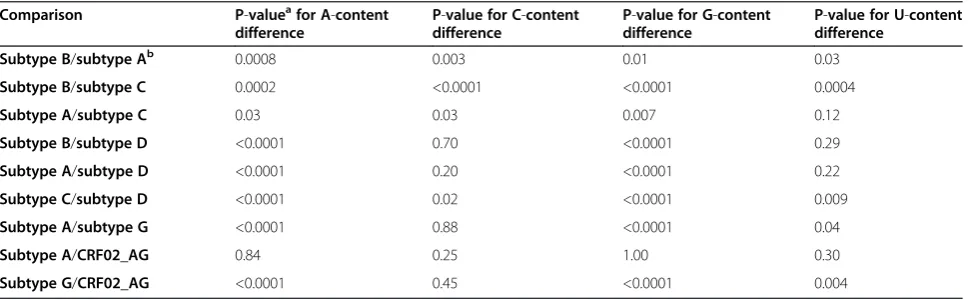
The RNA genomes of HIV-1 group M virus isolates con-tain a similar amount of A-nucleotides as those of group O (35%, Table 1). Group N and P viruses appear to con-tain slightly higher (group N) or lower (group P) levels of A-nucleotides, but only one (group P) or no (group N) full-length genomes with long terminal repeats (LTRs) are available for these groups (Table 1). As the LTR is relatively A-poor [5], calculations based upon the coding regions only will result in higher A-levels. Inter-estingly, HIV-1 group M subtypes A, B, C and D have significantly different nucleotide compositions concern-ing the A- and G-percentages (for 6 out of 6 compari-sons p<0.05), but less so for the C- and U-nucleotide levels (only for 3 out of 6 comparisons p<0.05) (Table 3). This suggests that HIV-1 group M subtypes have dis-similar nucleotide compositions; the A and G levels are variable, while the C and U levels are more conserved. The time period elapsed since the subtypes shared a common ancestor could account for these differences. The recombinant CRF02_AG strain did not differ appre-ciably in genome composition from its subtype A paren-tal strain with whom it shares the larger part of its genome, but it was significantly divergent from the other parent that belongs to subtype G (Table 3).
Among the simian immunodeficiency viruses (SIV), isolates from chimpanzees have the highest A-content (35.3%), comparable to the HIV-1 viruses. HIV-1 group M, N, and O viruses are all likely descendants from in-dependent cross-species transmissions of SIVcpz, al-though it is debatable whether group O viruses were transmitted from chimpanzees to gorillas and then to
humans, or directly to humans from chimpanzees, as group O viruses fall within the SIVcpz cluster, but simi-lar strains have been detected in gorillas only and not in chimpanzees (for a review see [8]). Another SIV from gorillas, SIVgor, is the probable origin of HIV-1 group P [9]. SIVgor has indeed a lower level of A-nucleotides, similar to the group P virus. SIV from other monkeys, including HIV-2 that originates from mangabeys, also contain somewhat lower A-levels ranging than SIVcpz or HIV-1 (Table 1).
Bovine immunodeficiency virus (BIV) and the related Jembrana disease virus have the lowest percentage of A-nucleotides (31.7%) of all exogenous lentiviruses analysed.
Interestingly, the endogenous lentiviral genomes detected in prosimians [10,11], and estimated to be be-tween 4 and 14 million years old, have an even lower A-count (29.0%), although A remains the most frequently used nucleotide. In contrast, endogenous lentiviral sequences from rabbit [12,13], hare [14], and ferret [15], all estimated to be at least 7, but more likely at least 12 million years old, have A-counts more similar to that of exogenous lentiviruses (around 34%). In line with the nucleotide characteristic of exogenous lentiviruses, the endogenous lentiviruses are also C-poor (Table 1).
[image:3.595.57.543.567.717.2]Feline immunodeficiency virus (FIV) strains and some viruses belonging to the caprine/ovine lentivirus group display the highest A-nucleotide percentage of all len-tiviruses (maximum of 38.0%), with a concomitant drop in C-count to minimally 13.7%. Among the ovine/-caprine lentiviruses, the nucleotide composition differs significantly between subgroups. Caprine arthritis-encephalitis virus (CAEV) subtype E isolates have A-nucleotide levels as low as 33.9% , while viruses labelled maedi-visna virus have increased A-levels reaching 37.2%. CAEV non-E subtypes together with viruses clas-sified as ovine lentiviruses display frequencies of A-nucleotides up to 38.0%.
Table 3 Nucleotide composition of the different HIV-1 subtypes (group M)
Comparison P-valueafor A-content difference
P-value for C-content difference
P-value for G-content difference
P-value for U-content difference
Subtype B/subtype Ab 0.0008 0.003 0.01 0.03
Subtype B/subtype C 0.0002 <0.0001 <0.0001 0.0004
Subtype A/subtype C 0.03 0.03 0.007 0.12
Subtype B/subtype D <0.0001 0.70 <0.0001 0.29
Subtype A/subtype D <0.0001 0.20 <0.0001 0.22
Subtype C/subtype D <0.0001 0.02 <0.0001 0.009
Subtype A/subtype G <0.0001 0.88 <0.0001 0.04
Subtype A/CRF02_AG 0.84 0.25 1.00 0.30
Subtype G/CRF02_AG <0.0001 0.45 <0.0001 0.004
a
Differences in nucleotide composition between HIV-1 subtypes were analysed using Student’s t-test. b
Among lentivirus groups for which more than a single isolate could be analysed, the percentage of each nucleo-tide is stable, and the overall nucleonucleo-tide composition serves as a distinguishing trait. For instance, HIV-2 is the only lentivirus that has similar levels of C and U nucleotides (20.4% and 20.7%, respectively), and this characteristic is found in all full-length HIV-2 genomes available, except for one that was described as a highly divergent strain of HIV-2, probably originating from an-other zoonotic transmission [16].>
Nucleotide composition of HIV-1 over time
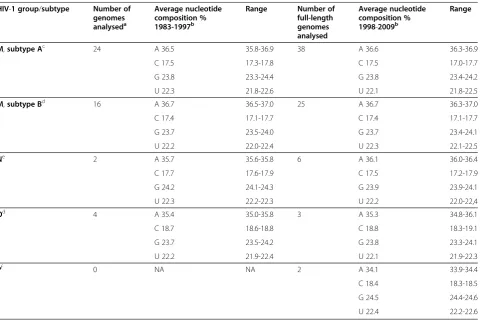
The nucleotide composition of HIV-1 has remained re-markably constant over the three decades that virus var-iants from the current epidemic have been monitored (Table 4). Early isolates (1983–1997) of HIV-1 group M (analysed for subtypes A and B), N, and O viruses do not significantly differ from more recent isolates (1998–2009) with regard to nucleotide composition (Table 4). Compar-ing isolates obtained before 1990 to isolates obtained after the year 2000, or other variations of the time window, did
not change the results (not shown). This suggests that the precise nucleotide composition of the HIV-1 genome, and most likely of other lentivirus genomes is a stable and unique trait that is highly preserved throughout evolution.
[image:4.595.60.541.363.685.2]Unfortunately, of the early HIV-1 group M viruses from 1959 and 1960, only very short fragments (< 200 nucleotides) have been amplified, from which the genomic nucleotide composition cannot be reli-ably estimated [17,18]. For HIV-1 group O, a total of 1770 nucleotides of four pol gene fragments are avail-able for an isolate recovered from autopsy material collected in 1976 of a father and daughter infected in the 1960s [19]. The base composition of these com-bined fragments is 39.7% A, 15.6% C, 22.4% G and 21.8% U, which, except for G, falls within the range of the base composition of homologous pol gene frag-ments from group O isolates from 1986–1995 (ANT70 from 1986 acc. no. L20587; MVP5180 from 1991 acc. no. L20571; pCMO2.3 from 1995 acc. no. AY618998): 39.2-40.3% A, 14.7-15.7% C, 22.7-23.6% G and 21.9-22.3% U.
Table 4 Nucleotide composition of the HIV-1 RNA genome over time (1983–2009)
HIV-1 group/subtype Number of genomes analyseda
Average nucleotide composition % 1983-1997b
Range Number of full-length genomes analysed
Average nucleotide composition % 1998-2009b
Range
M,subtype Ac 24 A 36.5 35.8-36.9 38 A 36.6 36.3-36.9
C 17.5 17.3-17.8 C 17.5 17.0-17.7
G 23.8 23.3-24.4 G 23.8 23.4-24.2
U 22.3 21.8-22.6 U 22.1 21.8-22.5
M,subtype Bd 16 A 36.7 36.5-37.0 25 A 36.7 36.3-37.0
C 17.4 17.1-17.7 C 17.4 17.1-17.7
G 23.7 23.5-24.0 G 23.7 23.4-24.1
U 22.2 22.0-22.4 U 22.3 22.1-22.5
Ne 2 A 35.7 35.6-35.8 6 A 36.1 36.0-36.4
C 17.7 17.6-17.9 C 17.5 17.2-17.9
G 24.2 24.1-24.3 G 23.9 23.9-24.1
U 22.3 22.2-22.3 U 22.2 22.0-22,4
Od 4 A 35.4 35.0-35.8 3 A 35.3 34.8-36.1
C 18.7 18.6-18.8 C 18.8 18.3-19.1
G 23.7 23.5-24.2 G 23.8 23.3-24.1
U 22.2 21.9-22.4 U 22.1 21.9-22.3
Pf 0 NA NA 2 A 34.1 33.9-34.4
C 18.4 18.3-18.5
G 24.5 24.4-24.6
U 22.4 22.2-22.6
a
Gag-pol-env only.
b
No significant differences in nucleotide composition were scored between groups over time (p>0.05, Student’s t-test).
c
A shorter sequence of HIV-1 subtype A was analysed (approx. 8600 nt), as not many full-length genomes were available.
d
Only genomes with≤10 ambiguous nucleotides were used for the analysis.
e
Seven of eighth group N genomes contain ambiguous nucleotides (range 5–38).
f
HIV nucleotide composition and drug-resistance
Antiretroviral therapy (ART) targeting HIV has been available from the 1990s, with effective treatment involv-ing multiple drugs beinvolv-ing instituted since 1995. Most antiretroviral drugs target the products of the polgene, especially the protease and RT. HIV rapidly develops drug resistance when only one or two drugs are given, or when compliance is low. The dominant type of muta-tion involved in the generamuta-tion of drug-resistance is G-to-A [20], which on a microscale could further in-crease the A-content. To test the hypothesis that ART use could change HIV-1 genome composition, we have compared the sequence composition of approximately 1300 nt of the pol gene of blood plasma virus of 38 untreated Dutch patients MSM (men having sex with men) infected with HIV-1 subtype B, with pol gene sequences of 14 ART treated Dutch patients (MSM) infected with subtype B virus, five of which failed therapy due to the emergence of drug resistant virus. Comparison of the nucleotide composition of the pol gene between the two groups showed no significant statistical difference (e.g. p = 0.13 when comparing the % of A-nucleotides in both groups), and there was also no significant difference betweenpolgenes with or with-out drug resistance mutations (p = 0.76). This suggests that replication in the presence of ART, which frequently includes nucleotide analogue drugs, and the selection of drug-resistance mutations do not appreciably change the nucleotide composition of the HIV-1polgene and most likely, of the complete genome.
Nucleotide composition and RNA structure
Inside the HIV-1 virus particle, two copies of its single-stranded RNA genome are packaged, together with virus-encoded proteins and cellular RNA molecules in-cluding tRNAlys3that acts as a primer for reverse tran-scription [21,22]. Packaging signals in the viral RNA are essential for its incorporation into an assembling virion particle [23], as are signals for RNA dimerization and nucleocapsid (NC) protein binding [24]. The NC protein covers the complete viral RNA genome and could thus be a sensor of nucleotide composition (for a review, see [25]). This mechanism could underlie the differences in genome composition described for the HIV-1 groups and subtypes, and for HIV-2. Most likely RNA structure and not the primary sequence, is a determining factor here; but the formation and stability of such RNA struc-tures are influenced by the base composition of the HIV-1 genome. This seems particularly true because the biased nucleotide composition is distorted even further when the structured and unstructured regions of the HIV-1 RNA genome [26] were analysed separately. The percentage of A-nucleotides is particularly low in double-stranded structures (21%) compared to the
single-stranded parts (79%) (van Hemert et al., submit-ted for publication). In contrast, the majority of C-nucleotides are present in structured regions (62%) over single-stranded parts (38%).
The length of the RNA molecule plays a role in effi-cient packaging; HIV-1 based lentiviral vectors do toler-ate genomes up to 18 kilobase in size, but infectious titers decline with insert size, probably due to encapsida-tion difficulties [27]. Genes or gene fragments from mul-tiple sources (e.g. bacterial, viral, and human) are tolerated by these HIV-based vectors, suggesting that the nucleotide composition of the inserted fragment is not critical for packaging.
Dinucleotide composition of the HIV-1 genome
Not surprisingly given the A-richness of HIV genomes, AA is the most common dinucleotide in HIV-1: 12.5% of dinucleotides in gag, 13.7% in env [28], while CG is found at the lowest frequency: 1.0% in gag, 0.6% inenv [2,3,28]. Rima and McFerran [29] showed that CpG is actively suppressed in viral genomes and that the low numbers are not the result of a low genomic C+G con-tent, in other words, CpG is suppressed but not GpC. The actual number of CpG dinucleotides was always much lower than expected based on the C+G content of diverse viruses. According to a statistical codon-based model developed by Pedersen et al. the nucleotide bias in HIV-1 could be totally explained by negative selection on CpG dinucleotides [30]. However, such a model only partly explains the observed bias, as it does not clarify the preference for A-nucleotides. Active selection against CpG dinucleotides was postulated as an explanation for the low CG content in the lentivirus family. Negative se-lection against CpG methylation of the DNA genome or a biased mutational spectrum of the reverse transcript-ase was proposed as sources of the low CG content of onco-retroviruses [31]. However, the human genome in general also has a lower than expected number of CpG dinucleotides, and the mutation rate of this motif is at least tenfold higher than other dinucleotides, especially in higher primates [32]. This is probably due to cytosine methylation of CpG motifs which results in deamination to thymine [32].
latency that is beneficial for the virus, as HIV-1 could have evolved to avoid CpG dinucleotides in the pro-moter region. Analysis of other virus families showed that most small virus genomes (<30kb), whether DNA or RNA, are CpG suppressed, a phenomenon not observed in large viruses (>30kb), except for gammaher-pesviruses [34]. Only members of the Togaviridae, a virus family with plus-strand ssRNA genomes that have a relatively high genomic CG content (~ 50% in the alphavirus group; ~70% in rubella viruses), are not CpG suppressed [34,35]. Thus, CpG suppression is also present in many RNA viruses that lack a DNA phase in their replication cycle, and are thus not subjected to DNA methylation [29,34]. This observation suggests that evasion of DNA methylation cannot be the sole reason for the low CpG content of most viral genomes. Codon usage or amino acid preferences were ruled out as the driving factors in CpG depletion during virus evolution [29,34]. Other explanations may be needed to explain the low CpG levels [34], such as recognition of nucleo-tide signature by components of the innate immune sys-tem. Factors of the innate immune system and the relation with genomic nucleotide composition or sequences are discussed below (see: Innate immunity and nucleotide composition).
Nucleotide composition: the viral genes and regulatory elements
The main open reading frames of HIV-1 aregag (encod-ing the matrix (p17MA), capsid (p24CA), nucleocapsid (p7NC), p1gag, p2 gag and p6 gag proteins), pol(encoding the protease, reverse transcriptase, and the integrase enzymes), and env (encoding the envelope proteins gp120 and gp41). Small, overlapping open reading frames encode additional proteins such as Vif, Vpu, Vpr, Nef, Tat, and Rev. Although lentiviral genomes are uni-formly rich in A-nucleotides, there is local variation. Nu-cleotide percentages for the individual HIV-1 genes are shown in Table 2. For instance, thepolgene of HIV-1 is more A-rich thangag, which in turn is more A-rich than
env [1,3,5]. Overlapping HIV-1 reading frames that en-code Tat, Rev and Nef, the latter overlapping with the LTR, contain a lower percentage of A nucleotides than the gag-pol region [3,5], possibly because the double coding capacity limits the number of A nucleotides that can be accommodated. The LTR promoter region may contain less A nucleotides to expose important regula-tory DNA/RNA elements that are A-rich, such as the TATAA box for transcription initiation and the AATAAA motif for transcription termination [36,37]. In general, early genes such as tatare less A-rich than late genes [38]. It is possible that the typical nucleotide com-position is used to restrict the stability of local RNA structures [39]. In particular, A-nucleotides have limited
base pairing potential (only with U, and A-U is a rela-tively weak base-pair). Clustering A-nucleotides in the ss-genomic regions would prevent the formation of in-hibitory RNA structures. To investigate this hypothesis, Keating et al. modified the HIV-1 gag and/orpol genes so that up to 4% of the A-nucleotides were mutated without altering the encoded amino acids or affecting known regulatory sequences [39], including the AU-rich instability elements important for Rev function [40]. Re-ducing the A-content of the gag-pol ORF from 36% to 32% resulted in increased RNA stability but also a reduc-tion in cDNA synthesis, suggesting that excessively stable RNA structures can interfere with reverse tran-scription [39]. In cell culture, reduced viral replication in peripheral blood mononuclear cells (PBMCs) was scored for viruses with modified gag-codons, but viral protein expression and viral entry were unaffected. Viral con-structs that were codon-modified inpolorgag-polwere infectious, but did barely replicate in PBMCs. These constructs produced strongly reduced levels of infectious particles upon DNA transfection of 293T cells, and the stability of the dimeric RNA genome that is packaged in virions was significantly increased compared to unmodi-fied HIV-1 [39]. Modifying the A-content of gag seems to have less effect on viral replication than modification of the pol gene, suggesting that local variation in A-richness may reflect functional differences in sequence requirement.
Codon usage in the HIV-1 genome: triplet analysis, protein composition and translation
Codon bias is the tendency of an organism to encode amino acids by a non-random usage of the 61 degener-ate codons available to specify the 20 amino acids during protein synthesis (for a review, see [41]). Codon bias has been described for many organisms, and is usually linked to specific tRNA levels that are mainly determined by the number of tRNA genes that encode a certain tRNA [42]. In humans, tissue specific differences in tRNA ex-pression levels have also been documented [43]. Codons for rare human tRNAs are often found clustered in only a subset of genes, and have been associated with expression modulation of mRNA translation [44,45]. Both highly and lowly expressed human genes can con-tain such rare codon clusters, and it has been specu-lated that the proteins encoded by the corresponding mRNAs are not co-translationally folded [44]. It has also been suggested that the use of codons with rare anti-codon tRNAs in an mRNA increases the transla-tional accuracy [45].
most A-rich codon to encode a certain amino acid. Es-pecially the more flexible third codon positions are pre-ferentially occupied by A-nucleotides, e.g. in the pol gene the A-content goes up from 34.3% in the first codon position to 46.5% in third positions [4]. In HIV-1 genomes, amino acids that are encoded by A-rich codons are preferentially selected. For example, HIV encoded proteins are relatively rich in lysine (codon = AAR) and poor in proline (codon = CCN), while the opposite is true for similar proteins encoded by the C-rich HTLV retro-virus [3,4,50]. A similar amino acid composition is seen in proteins encoded by other A-rich pathogens such as influenza virus, and in several bacterial proteins, but not in vertebrate ones [50]. Codon usage in HTLV is also dif-ferent from the human codon use, even with a preference for C-rich codons [5]. Possibly, the use of rare codons in retroviral genes is associated with protein processing, as suggested for human genes [44].
Protein characteristics are affected by biased codon use, as the prevalence of hydrophobic and amphypathic amino acids increases at the expense of hydrophilic resi-dues with increasing G/C-use in the third codon pos-ition, which influences protein hydropathy and stability as hydrophobic proteins are generally more stable [51]. In eukaryotic proteins, decreasing hydrophobicity values are accompanied by an increase in the percentage of cyst-eine residues [51]. Cystcyst-eines can form disulfide bridges that enhance protein stability. For instance, HIV Env-gp120 protein contains nine disulfide bridges [52], pos-sibly related to the low number of hydrophobic amino acids as dictated by the low GC-content of the viral codons. Thus, biased codon use may lead to the expres-sion of viral proteins that have an appreciably different composition and characteristics than host cell proteins.
It has been speculated that the HIV-1 codon bias leads to suboptimal protein expression in infected cells due to the limited availability of the matching tRNAs. To ex-press large quantities of HIV-1 proteins for vaccine pur-poses, codon-optimized viral genes were constructed that are better adapted to the tRNA pool of the host cell [53-55]. Indeed, protein expression increased signifi-cantly, although not necessarily due to enhanced transla-tional efficiency, because the mutatransla-tional inactivation of instability elements resulted in increased mRNA stability [54,55]. Also, altered export of nuclear RNA contributed significantly to increased protein production levels [56]. The requirement of Rev to export the unspliced and singly-spliced HIV-1 mRNAs from the nucleus was lost, probably due to inactivation of the AU-rich instability elements [56].
If HIV-1 gene expression can so easily be upregu-lated by adapting codons to better suit the hosts tRNA population, why does HIV-1 not change its strategy so that it can produce more offspring? First of all, there
is good evidence that HIV-1 gene expression is not maximal, but fine-tuned to allow regulation of diverse processes such as transcriptional activation by the Tat protein and the nuclear export of unspliced HIV-1 transcripts by the Rev protein, and possibly to avoid cell toxicity [57]. Second, HIV-1 expression levels are not at all that low in HIV-1 infected cells, as one out of every 143 cellular transcripts is of viral origin 24 hours after infection as determined by SAGE analysis and high-throughput sequencing [58]. Human en-dogenous retrovirus (HERV) transcripts were expressed in that study at a ratio of 1:237, highly expressed human genes were found at a ratio of approximately 1:10, but on average human genes were expressed at a ratio of 1:2 million transcripts [58]. It is also important to realize that the codon-optimized genes have been tested in uninfected cells, which may have a different tRNA profile than HIV-1 infected cells. A first indica-tion for this idea comes from the work of van Weringh et al. [38], who reported differences in the tRNA pool of HIV-1 infected versus uninfected cells. Analysing the tRNA species present in HIV-1 particles, many tRNAs besides the reverse transcription primer tRNAlys were found [38]. In fact, these tRNAs match well with the typical HIV-1 codon use. If tRNA pack-aging in the virion would occur without specificity, ex-cept for the tRNAlys primer, the tRNA pool of the virion may reflect that of the cell at the time of virion production. Therefore, the authors speculate that at later stages of infection the tRNA pool has changed to suit the translation of HIV-1 late proteins, possibly be-cause the normal tRNA pool has been exhausted by translation of the HIV-1 early proteins. So, in line with the observation that HIV-1 replication and protein ex-pression occur at high levels in infected human cells, the codon bias may reflect the altered milieu of the virus-infected cell.
In addition, there is some evidence that HIV-1 is adapting its codon use to better suit the host’s tRNA pool; e.g. Meintjes and Rodrigo [59] analysed partial
Effect of the viral Reverse Transcriptase and lack of dUTPase
Multiple enzymes are involved in replication of the HIV-1 genome, each with their own unique error rate. Replica-tion of proviral DNA by host DNA polymerases and tran-scription of the proviral genome by the host RNA polymerase II is probably not that error prone, as these processes are subject to proofreading [61,62]. The viral Reverse Transcriptase (RT), an RNA/DNA-dependent DNA polymerase, lacks 3’-5’exonuclease proofreading ac-tivity [63], and has therefore been implicated in the high mutability of HIV-1 (see [63,64]). Indeed, when copying LTR sequences, HIV RT was more mutagenic than RNA polymerase II, suggesting an important role of the former in creating viral variability [65]. A recent study suggests that the mutation rate of HIV RT might be lower than early estimates, but it is still significant at 1.4 x 10⁻⁵ muta-tions/bp/cycle [66]. Error rates of HIV-1 RT differ with respect to the nucleic acid template, e.g. the enzyme is more accurate while copying RNA than DNA [67]. The fidelity of HIV RT is different for distinct nucleotides, so that the creation of mismatches is not completely random, e.g. misincorporation of dATP is negligible, low for dGTP, but substantial for dCTP and dTTP [64]. This could imply that HIV-1 RT does not actively contribute to the A-nucleotide content of the viral genome. However, at low dCTP or dATP concentrations, HIV-1 RT induces G-to-A and U-to-C hypermutation of the viral DNA, respectively [68]. In blood T lymphocytes, the natural host cell for HIV-1, dCTP levels are much lower than dATP levels [69], which could drive G-to-A hypermutation in HIV-1. The frequent G-to-A mutations observed in the HIV-1 genome that were initially attributed to RT can however also be assigned to the action of host enzymes of the APOBEC3 (A3) family [20,70-72], which will be discussed below.
Another factor relevant for genome modification is the absence of dUTP pyrophophatase (dUTPase) activity encoded by HIV-1. The nonprimate lentiviruses FIV, CAEV, equine infectious anemia virus (EIAV), and the betaretroviruses all encode such an enzyme in the pol gene [73]. This enzyme reduces dUTP levels in the cell, such that incorporation of dUTP into the nascent DNA is minimized during cDNA synthesis. Misincorporation of dUTP for dCTP during cDNA synthesis results in G-U mismatches that eventually result in GC→AT transitions. Such a dUPTase gene is absent from all exogenous primate lentiviruses, although a similar sequence was once described in the HIV-1 env-gp120 open reading frame [74]. Deletion or disruption of dUTPase gene in CAEV [75] and FIV [76] induced G-to-A transitions in the viral genome, in line with the frequent incorporation of dUTP opposite G during first-strand cDNA synthesis. However, as HIV-1 normally replicates without a viral
dUTPase it may have found alternative ways to circum-vent excessive dUTP incorporation [77]. HIV-1 RT was found to efficiently discriminate between dUTP and dTTP in vitro, suggesting that HIV-1 DNA synthesis is not affected by the presence of dUTP [78]. However, G-to-A is the premier type of mutation scored during HIV-1 evolution [79,80], which likely also relates to the absence of dUTPase activity.
Innate immunity and nucleotide composition
Proteins of the innate immunity system recognize the se-quence or structure of invading viral RNA or DNA molecules. The overall nucleotide composition as well as specific sequence motifs, such as dinucleotides, are im-portant determinants in the recognition by and escape from these sensors. It has been suggested that the biased nucleotide composition of HIV-1 is directly responsible for the induction of the type I interferon response, as “humanized”gag,polandenvRNA transcripts that were codon-optimized to resemble human genes, lost the abil-ity to induce IFN-α/βproductionin vitro[81]. A priori, it seems more likely that particular sequence elements or certain HIV-1 RNA structures trigger an innate im-mune response than the overall base composition of the HIV-1 genome.
in HIV-1 could still be attributed to the RT enzyme operating at low dCTP levels in virus infected cells [68], as was also predicted by a computer model ana-lysing the bias in HIV-1 pol nucleotide misincorpora-tion [88], or possibly to dUTP incorporamisincorpora-tion during reverse transcription.
Not all proteins of the innate immunity system modify viral nucleic acids. Many are specialized in recognition of certain motifs, dinucleotides or more extended signatures to induce the corresponding signaling pathway to trigger cytokine secretion and immune activation. Avoiding these motifs might thus confer an advantage to the virus, and es-cape from these factors might influence viral genome com-position. Unmethylated CpG motif-containing bacterial and viral DNA is recognized by toll-like receptor 9 (TLR9), a pathogen sensor of the innate immune system that is loca-lized on the endoplasmic reticulum and highly expressed by plasmacytoid dendritic cells (pDCs) [89]. However, as HIV-1 probably does not replicate in pDCs [90], except for thymic pDCs [91], it is not likely that cytosolic DNA would be available for TLR9 stimulation. The optimal DNA recog-nition motif for human TLR9 is GTCGTT [92], which is on average present only once per HIV-1 genome [93] and absent from the HIV-1 reference strain HXB2, making it uncertain whether HIV-1 DNA is targeted by TLR9. In HIV-1 infected individuals, responses to TLR9, but not TLR7 or TLR8 stimulation were universally decreased com-pared to uninfected controls [94], possibly due to Env-mediated suppression of TLR9 function [95]. The active suppression of TLR9 by a viral protein, combined with the near absence of binding motifs, may suggest that TLR9 was once involved in an anti-SIV response in primates, but that the virus has successfully circumvented this restriction dur-ing evolution. Toll-like receptors 7 and 8 (TLR7 and TLR8) are closely related receptors in endosomes of dendritic cells and macrophages that recognize guanosine- and uridine-rich (GU-uridine-rich) stretches in foreign long ssRNA molecules such as uridine-rich stretches in the HIV-1 LTR [96] and other genomic regions [97]. HIV-1 viral RNA was found to induce interferon-alpha secretion by pDCs through TLR7 or TLR8 stimulation [96,98]. This recognition leads to strong immune activation, and HIV-1 has apparently not been able to circumvent this activity [96-99]. In the HIV-1 reference strain HXB2, at least 9 uridine-rich 20-mers have been identified in the ORFs that stimulate TLR7/8 [97], suggesting that viral escape from TLR7/8 pressure is not easy. Induction of the innate immune response can also be initiated through detection of viral RNA by retinoic acid-inducible gene I (RIG-I)-like receptors (RLRs). RIG-I is an RNA helicase that is expressed in epithelial and fibroblastic cells as well as dendritic cells and macrophages [100]. Al-though RIG-I mainly senses uncapped viral ssRNAs, it also recognizes the dimeric capped retroviral HIV-1 RNA found in mature virions [100]. Monomeric HIV-1 RNA was an
even better inducer of RIG-I than dimeric HIV-1 RNA [100]. Secondary structures in the viral ssRNA such as the TAR hairpin are better inducers of cytokine expression than HIV-1 RNA oligos without (predicted) extensive secondary structure [101]. However, RIG-I signaling is efficiently inhibited by the HIV-1 protease that depletes RIG-I from the cytoplasm [100].
Another interferon-induced antiviral factor is RNase L (also named 2',5'-oligoadenylate-dependent RNase L or 2-5A-dependent ribonuclease), an enzyme that cleaves viral RNA predominantly at UpA and UpU dinucleotides [102,103]. The enzyme 2',5'-oligoadenylate-synthetase (OAS) that is needed to activate RNase L is itself induced by the HIV-1 TAR RNA hairpin [104,105], a regulatory structure present at the 5’-end of all viral transcripts. However, OAS binding can be inhibited
in vitro, and most likely alsoin vivo, by addition of the HIV-1 Tat protein, which competes efficiently for TAR binding [104]. RNase L expression decreases HIV-1 rep-lication when the human RNase L gene is artificially introduced into the viral genome [106], but RNase L is not effective during natural HIV-1 infection [107]. After HIV-1 infection, the RNase L pathway is downregulated through induction of RNAse L inhibitor (RLI) expression [108]. UpA and UpU dinucleotide frequencies, the main targets for RNase L cleavage, are not particularly reduced in HIV-1 genomes [28], in line with the lack of RNAse L pressure on HIV-1 RNA.
SAMHD1 (sterile alpha factor and HD-domain 1) is another HIV-1 restriction factor that was recently identi-fied [109,110]. SAMHD1 is a deoxynucleoside triphos-phate triphosphohydrolase [111] that can be upregulated by type I and II interferons and by TLR ligands. It regu-lates dNTP pools in non-cycling myeloid cells such as macrophages, and possibly also in quiescent CD4+ T cells (for a review, see [112]). SAMHD1 is counteracted by the retroviral Vpx protein that is encoded by SIV and HIV-2, but this gene is lacking from the HIV-1 and FIV genomes [109,110]. Despite the lack of Vpx function, HIV-1 is able to replicate in non-cycling myeloid cells, albeit a low levels, possibly because HIV-1 RT has a very high affinity for dNTPs [112]. SAMHD1 efficiently hy-drolyses all four dNTPs, although it needs dGTP to initi-ate hydrolysis, suggesting that dGTP might be the preferred substrate for the enzyme [112]. As SAMHD1 affects the total dNTP pool, it remains uncertain if SAMHD1 can influence HIV-1 genome composition through induction of nucleotide pool imbalances, but the subject warrants further study.
observed after HIV infection [113]. The rare tRNAs that are increased by HIV-1 are repressed in the presence of SLFN11 [113]. However, the HIV-1 encoded Vpu protein effectively depletes IRF3 during HIV infection [114], thus antagonizing the induction of SLFN11. This sug-gests that SLFN11 does probably not have an appre-ciable effect upon HIV-1 replication and codon usage
in vivo, as there is little need for the virus to escape from this putative restriction factor.
One may cautiously conclude that antiviral factors of the innate immune system are unlikely to influence the nucleotide composition of HIV-1 in an appreciable way, neither by directly mutating the genome nor through HIV-1 escape from the antiviral pressure imposed by these factors.
Nucleotide bias problem
A biased nucleotide composition will influence the phylogenetic analysis of viral genome sequences. The same holds for amino acid sequences if the typical nu-cleotide bias results in a biased protein composition, as is the case for HIV. All phylogenetic methods used today are sensitive to nucleotide composition in a sequence alignment. Sequences with similar base frequencies will be clustered together in the resulting tree, whether or not this results from shared ancestry [3]. In practice, this limitation will not affect most studies that involve intras-pecies or intragenus comparisons, in which the viral genomes do possess a similar base composition that is inherited from a common ancestor. Tree analyses in-volving different retrovirus families could however lead to erroneous conclusions about clade relationships and divergence times [3,5,6]. And even relationships between distinct virus families can be obscured by genomic nu-cleotide composition. For instance the A-rich influenza virus of the (−) ssRNA family of Orthomyxoviridae has a codon use comparable to HIV-1, in contrast to the C-rich retrovirus murine leukaemia virus (MLV) that con-sequently appears to be more distinct from HIV-1 than influenza virus [47]. Manipulating sequence alignments, e.g. leaving out the third, most variable codon position does not appreciably improve the accuracy of the result-ing phylogeny, as all three codon positions are affected by nucleotide bias, with the exception of U at the second codon position [3]. However, uridines at second codon positions are generally quite conserved among retro-viruses, and do thus not provide a solution to resolving phylogenetic relationships [3].
Nucleotide composition of retroviral versus host DNA We have focused thus far on the HIV-1 RNA genome. Upon infection of the host cell, the HIV-1 genomic RNA is converted into dsDNA by reverse transcription. The newly made HIV DNA, complexed with viral and
cellular proteins, is actively imported into the nucleus through the nuclear pore, such that HIV is not dependent on cell division for nuclear import and subse-quent DNA integration into the host genome. Can the biased nucleotide composition also affect the function of the HIV-1 DNA genome?
HIV-1 integration sites can be found on all chromo-somes, but integration is not completely random. Viral pre-integration complexes (PICs) target specific chromo-somal locations that are associated both with gene dens-ity and transcriptional activdens-ity (“integration hotspots”) [115]. What would be the effect when an AT-rich DNA such as the HIV genome integrates into a genomic loca-tion that is not AT-rich? Although the human reference genome is AT-rich (60%) and GC-poor (40%), much like HIV-1 genomes (strain HXB2: 57% AT, 43% GC), there is considerable variation in local sequence composition. The human genome consists of mosaics of isochores, which are megabase-sized DNA stretches with a homo-geneous base composition [116]. In addition, CpG islands, short sequences of 0.5-2 kb in size that are rich in GC but low in methylated CpG dinucleotides, are dis-tributed throughout the human genome (see [115]). CpG islands are associated with gene-rich regions, and their frequency is positively associated with the GC-richness of the isochores [117].
approximately 60% AT) integrated into GC-rich regions far more often than would be expected based on the an-cient HERV-K provirus locations [122]. This may sug-gest that HERV-K integrations may be deleted from GC-rich chromosomal fragments over time, although no such activity is currently known.
Comparing HIV-1 integration sites in the human gen-ome in both primary cells and cell lines, Mitchell et al. showed that HIV-1 may prefer GC-rich isochores for in-tegration, but it disfavours the regions around CpG islands, in contrast to the GC-rich (64%) MLV [115]. HIV-1 favours active genes for integration, but does not integrate into the gene subset with the highest expres-sion level [115]. Integration is thought to involve inter-action of the PIC with proteins bound to the host DNA [115]. Possibly, HIV-1 PICs cannot interact with the spe-cific (regulatory) proteins bound to chromosomal DNA in or in close proximity to CpG islands, in contrast to MLV PICs, but instead bind transcription factors present in active transcription units.
In summary, HIV-1 prefers, like other retroviruses and repeat elements such as Alu repeats, the open, active chromatin in GC-rich isochores for DNA integration, but being GC-poor the provirus may be somewhat un-stable at that location. This may not be a problem for HIV-1, as integration into cells of the germ-line has not been described until now, and proviral integrations in relatively short lived cells will probably be stable for the duration of the cell’s life. Studies examining the stability of HIV-1 integrations in long-term infected cells have not been performed yet. However, as ancient endogen-ous lentivirus genomes with relatively low GC-counts have been detected in several mammalian species, and HERV-K integrations survive in the germ-line while being GC-poor (the 34 HERV-K proviruses analysed have 35-38% GC) [37], it is likely that at least some retroviral GC-poor integrations can survive for a long time. Furthermore, GC-rich isochores are decreasing in most mammalian orders including primates, murids and carnivores when compared to other mammalian orders such as lagomorphs, perissodactyls and cetartio-dactyls, probably due to the higher recombination rate in GC-rich genomic regions in the former mammalian lineages [123]. It has been estimated that the isochore structure is disappearing entirely from the human and chimpanzee genome, but not yet from the baboon genome [124]. Human and chimpanzee genomes are homogenising to an average GC-content of 42% [124], similar to HIV DNA (43% GC) and SIV DNA from chimpanzees (42% GC). Possibly, somewhere in the fu-ture, HIV proviruses will be more stable in a homogenous host genome where the rate of homolo-gous recombination has decreased, which is important should HIV-1 ever infect the germ-line.
Conclusions
The HIV-1 RNA genome is particularly rich in A-nucleotides while the C-content is low. HIV-1 is one of the most variable viruses known, yet it is able to main-tain this highly biased nucleotide composition. Compar-ing HIV-1 genomes from the beginnCompar-ing of the epidemic with more recent isolates shows that the nucleotide composition is extremely stable over the past 30 years. Even the cross-species transmission events from chim-panzees to humans did not substantially change the nu-cleotide composition of HIV-1 genomes of group M, N and O viruses, although the single HIV-1 group P virus seem to contain slightly less adenine and somewhat more C nucleotides, in line with non-chimpanzee pri-mate SIVs and HIV-2, and its supposed descent from SIVgor. The base composition of HIV-1 has been linked to differences in pathogenicity of the subtypes, whereby a base composition that deviates most from that of the human host correlates with increased virulence [81]. In that context, the slightly different base composition of HIV-1 compared to HIV-2 may also correlate with the increased pathogenicity of the former.
The A-richness of the HIV-1 genome may have been caused by a distinct mutation pattern of the viral RT polymerase, but there could also have been evolutionary pressure to select an A-rich RNA genome. Further re-search is needed to identify possible RNA functions imposed by the A-abundance. No evidence has been reported that factors of the innate immune system shape the nucleotide composition of the viral genome, either by direct mutational activity or indirectly through viral escape.
Competing interests
The authors declare no competing interests.
Authors' contributions
ACvdK conceived the review topic and ACvdK and BB drafted the manuscript. Both authors read and approved the final manuscript.
Acknowledgements
The authors are indebted to Suzanne Jurriaans (Laboratory of Clinical Virology, AMC) and Marion Cornelissen (Laboratory of Experimental Virology, AMC) for providing a dataset of HIV-1polgene sequences of ART treated and untreated HIV-1 infected Dutch patients. This study was sponsored in part by a TOP grant of NWO-Chemical Sciences.
Received: 17 July 2012 Accepted: 14 October 2012 Published: 6 November 2012
References
1. Kypr J, Mrazek J:Unusual codon usage of HIV.Nature1987,327:20. 2. Kypr J, Mrazek J, Reich J:Nucleotide composition bias and CpG
dinucleotide content in the genomes of HIV and HTLV 1/2. Biochim Biophys Acta1989,1009:280–282.
3. Bronson EC, Anderson JN:Nucleotide composition as a driving force in the evolution of retroviruses.J Mol Evol1994,38:506–532.
5. van Hemert FJ, Berkhout B:The tendency of lentiviral open reading frames to become A-rich: constraints imposed by viral genome organization and cellular tRNA availability.J Mol Evol1995,41:132–140. 6. Berkhout B, Grigoriev A, Bakker M, Lukashov VV:Codon and amino acid
usage in retroviral genomes is consistent with virus-specific nucleotide pressure.AIDS Res Hum Retroviruses2002,18:133–141.
7. Snoeck J, Fellay J, Bartha I, Douek DC, Telenti A:Mapping of positive selection sites in the HIV-1 genome in the context of RNA and protein structural constraints.Retrovirology2011,8:87.
8. Sharp PM, Hahn BH:The evolution of HIV-1 and the origin of AIDS. Philos Trans R Soc Lond B Biol Sci2010,365:2487–2494.
9. Plantier JC, Leoz M, Dickerson JE, De OF, Cordonnier F, Lemee V,et al:
A new human immunodeficiency virus derived from gorillas.Nat Med
2009,15:871–872.
10. Gifford RJ, Katzourakis A, Tristem M, Pybus OG, Winters M, Shafer RW:
A transitional endogenous lentivirus from the genome of a basal primate and implications for lentivirus evolution.Proc Natl Acad Sci U S A
2008,105:20362–20367.
11. Gilbert C, Maxfield DG, Goodman SM, Feschotte C:Parallel germline infiltration of a lentivirus in two Malagasy lemurs.PLoS Genet2009,
5:e1000425.
12. Katzourakis A, Tristem M, Pybus OG, Gifford RJ:Discovery and analysis of the first endogenous lentivirus.Proc Natl Acad Sci U S A2007,
104:6261–6265.
13. van der Loo W, Abrantes J, Esteves PJ:Sharing of endogenous lentiviral gene fragments among leporid lineages separated for more than 12 million years.J Virol2009,83:2386–2388.
14. Keckesova Z, Ylinen LM, Towers GJ, Gifford RJ, Katzourakis A:Identification of a RELIK orthologue in the European hare (Lepus europaeus) reveals a minimum age of 12 million years for the lagomorph lentiviruses. Virology2009,384:7–11.
15. Cui J, Holmes EC:Endogenous lentiviruses in the ferret genome. J Virol2012,86:3383–3385.
16. Damond F, Worobey M, Campa P, Farfara I, Colin G, Matheron S,et al:
Identification of a highly divergent HIV type 2 and proposal for a change in HIV type 2 classification.AIDS Res Hum Retroviruses2004,
20:666–672.
17. Zhu T, Korber BT, Nahmias AJ, Hooper E, Sharp PM, Ho DD:An African HIV-1 sequence from 1959 and implications for the origin of the epidemic.Nature1998,391:594–597.
18. Worobey M, Gemmel M, Teuwen DE, Haselkorn T, Kunstman K, Bunce M,
et al:Direct evidence of extensive diversity of HIV-1 in Kinshasa by 1960.
Nature2008,455:661–664.
19. Jonassen TO, Stene-Johansen K, Berg ES, Hungnes O, Lindboe CF, Froland
SS,et al:Sequence analysis of HIV-1 group O from Norwegian patients
infected in the 1960s.Virology1997,231:43–47.
20. Berkhout B, de Ronde A:APOBEC3G versus reverse transcriptase in the generation of HIV-1 drug-resistance mutations.AIDS2004,
18:1861–1863.
21. Houzet L, Paillart JC, Smagulova F, Maurel S, Morichaud Z, Marquet R,et al:
HIV controls the selective packaging of genomic, spliced viral and cellular RNAs into virions through different mechanisms.Nucleic Acids Res
2007,35:2695–2704.
22. Rulli SJ Jr, Hibbert CS, Mirro J, Pederson T, Biswal S, Rein A:Selective and nonselective packaging of cellular RNAs in retrovirus particles.J Virol
2007,81:6623–6631.
23. Lever A, Gottlinger H, Haseltine W, Sodroski J:Identification of a sequence required for efficient packaging of human immunodeficiency virus type 1 RNA into virions.J Virol1989,63:4085–4087.
24. Heng X, Kharytonchyk S, Garcia EL, Lu K, Divakaruni SS, LaCotti C,et al:
Identification of a minimal region of the HIV-1 5'-leader required for RNA dimerization, NC binding, and packaging.J Mol Biol2012,417:224–239. 25. Darlix JL, Godet J, Ivanyi-Nagy R, Fosse P, Mauffret O, Mely Y:Flexible
nature and specific functions of the HIV-1 nucleocapsid protein. J Mol Biol2011,410:565–581.
26. Watts JM, Dang KK, Gorelick RJ, Leonard CW, Bess JW Jr, Swanstrom R,et al:
Architecture and secondary structure of an entire HIV-1 RNA genome. Nature2009,460:711–716.
27. Kumar M, Keller B, Makalou N, Sutton RE:Systematic determination of the packaging limit of lentiviral vectors.Hum Gene Ther2001,
12:1893–1905.
28. Lang DM:Circuit assemblages derived from net dinucleotide values provide a succinct identity for the HIV-1 genome and each of its genes. Virus Genes2008,36:11–26.
29. Rima BK, McFerran NV:Dinucleotide and stop codon frequencies in single-stranded RNA viruses.J Gen Virol1997,78(Pt 11):2859–2870. 30. Pedersen AK, Wiuf C, Christiansen FB:A codon-based model designed to
describe lentiviral evolution.Mol Biol Evol1998,15:1069–1081. 31. Shpaer EG, Mullins JI:Selection against CpG dinucleotides in lentiviral
genes: a possible role of methylation in regulation of viral expression. Nucleic Acids Res1990,18:5793–5797.
32. Hodgkinson A, Eyre-Walker A:Variation in the mutation rate across mammalian genomes.Nat Rev Genet2011,12:756–766.
33. Adhya D, Basu A:Epigenetic modulation of host: new insights into immune evasion by viruses.J Biosci2010,35:647–663.
34. Karlin S, Doerfler W, Cardon LR:Why is CpG suppressed in the genomes of virtually all small eukaryotic viruses but not in those of large eukaryotic viruses?J Virol1994,68:2889–2897.
35. Zhou Y, Chen X, Ushijima H, Frey TK:Analysis of base and codon usage by rubella virus.Arch Virol2012,157:889–899.
36. Berkhout B:Structure and function of the human immunodeficiency virus leader RNA.Prog Nucleic Acid Res Mol Biol1996,54:1–34.
37. Zsiros J, Jebbink MF, Lukashov VV, Voute PA, Berkhout B:Biased nucleotide composition of the genome of HERV-K related endogenous retroviruses and its evolutionary implications.J Mol Evol1999,48:102–111. 38. van Weringh A, Ragonnet-Cronin M, Pranckeviciene E, Pavon-Eternod M,
Kleiman L, Xia X:HIV-1 modulates the tRNA pool to improve translation efficiency.Mol Biol Evol2011,28:1827–1834.
39. Keating CP, Hill MK, Hawkes DJ, Smyth RP, Isel C, Le SY,et al:The A-rich RNA sequences of HIV-1 pol are important for the synthesis of viral cDNA.Nucleic Acids Res2009,37:945–956.
40. Schneider R, Campbell M, Nasioulas G, Felber BK, Pavlakis GN:Inactivation of the human immunodeficiency virus type 1 inhibitory elements allows Rev-independent expression of Gag and Gag/protease and particle formation.J Virol1997,71:4892–4903.
41. Hershberg R, Petrov DA:Selection on codon bias.Annu Rev Genet2008,
42:287–299.
42. Goodenbour JM, Pan T:Diversity of tRNA genes in eukaryotes.Nucleic Acids Res2006,34:6137–6146.
43. Dittmar KA, Goodenbour JM, Pan T:Tissue-specific differences in human transfer RNA expression.PLoS Genet2006,2:e221.
44. Parmley JL, Huynen MA:Clustering of codons with rare cognate tRNAs in human genes suggests an extra level of expression regulation.
PLoS Genet2009,5:e1000548.
45. Lavner Y, Kotlar D:Codon bias as a factor in regulating expression via translation rate in the human genome.Gene2005,345:127–138. 46. Grantham P, Perrin P:AIDS virus and HTLV-I differ in codon choices.
Nature1986,319:727–728.
47. Sharp PM:What can AIDS virus codon usage tell us?Nature1986,324:114. 48. Chou KC, Zhang CT:Diagrammatization of codon usage in 339 human
immunodeficiency virus proteins and its biological implication.AIDS Res Hum Retroviruses1992,8:1967–1976.
49. Zoubak S, Rynditch A, Bernardi G:Compositional bimodality and evolution of retroviral genomes.Gene1992,119:207–213.
50. Fitzgerald DJ, Bronson EC, Anderson JN:Compositional similarities between the human immunodeficiency virus and surface antigens of pathogens.AIDS Res Hum Retroviruses1996,12:99–106.
51. D'Onofrio G, Jabbari K, Musto H, Bernardi G:The correlation of protein hydropathy with the base composition of coding sequences. Gene1999,238:3–14.
52. Leonard CK, Spellman MW, Riddle L, Harris RJ, Thomas JN, Gregory TJ:
Assignment of intrachain disulfide bonds and characterization of potential glycosylation sites of the type 1 recombinant human immunodeficiency virus envelope glycoprotein (gp120) expressed in Chinese hamster ovary cells.J Biol Chem1990,265:10373–10382. 53. Haas J, Park EC, Seed B:Codon usage limitation in the expression of HIV-1
envelope glycoprotein.Curr Biol1996,6:315–324.
54. Anson DS, Dunning KR:Codon-optimized reading frames facilitate high-level expression of the HIV-1 minor proteins.Mol Biotechnol2005,
31:85–88.
55. Ngumbela KC, Ryan KP, Sivamurthy R, Brockman MA, Gandhi RT, Bhardwaj
efficiency of mRNA encoding HIV-1 gag in intact T cells.PLoS One2008,
3:e2356.
56. Kotsopoulou E, Kim VN, Kingsman AJ, Kingsman SM, Mitrophanous KA:A Rev-independent human immunodeficiency virus type 1 (HIV-1)-based vector that exploits a codon-optimized HIV-1 gag-pol gene.J Virol2000,
74:4839–4852.
57. Marzio G, Vink M, Verhoef K, de RA, Berkhout B:Efficient human immunodeficiency virus replication requires a fine-tuned level of transcription.J Virol2002,76:3084–3088.
58. Lefebvre G, Desfarges S, Uyttebroeck F, Munoz M, Beerenwinkel N, Rougemont J,et al:Analysis of HIV-1 expression level and sense of transcription by high-throughput sequencing of the infected cell. J Virol2011,85:6205–6211.
59. Meintjes PL, Rodrigo AG:Evolution of relative synonymous codon usage in Human Immunodeficiency Virus type-1.J Bioinform Comput Biol2005,
3:157–168.
60. Pandit A, Sinha S:Differential trends in the codon usage patterns in HIV-1 genes.PLoS One2011,6:e28889.
61. Shevelev IV, Hubscher U:The 3' 5' exonucleases.Nat Rev Mol Cell Biol2002,
3:364–376.
62. Thomas MJ, Platas AA, Hawley DK:Transcriptional fidelity and proofreading by RNA polymerase II.Cell1998,93:627–637.
63. Roberts JD, Bebenek K, Kunkel TA:The accuracy of reverse transcriptase from HIV-1.Science1988,242:1171–1173.
64. Preston BD, Poiesz BJ, Loeb LA:Fidelity of HIV-1 reverse transcriptase. Science1988,242:1168–1171.
65. O'Neil PK, Sun G, Yu H, Ron Y, Dougherty JP, Preston BD:Mutational analysis of HIV-1 long terminal repeats to explore the relative contribution of reverse transcriptase and RNA polymerase II to viral mutagenesis.J Biol Chem2002,277:38053–38061.
66. Abram ME, Ferris AL, Shao W, Alvord WG, Hughes SH:Nature, position, and frequency of mutations made in a single cycle of HIV-1 replication. J Virol2010,84:9864–9878.
67. Boyer JC, Bebenek K, Kunkel TA:Unequal human immunodeficiency virus type 1 reverse transcriptase error rates with RNA and DNA templates. Proc Natl Acad Sci U S A1992,89:6919–6923.
68. Martinez MA, Vartanian JP, Wain-Hobson S:Hypermutagenesis of RNA using human immunodeficiency virus type 1 reverse transcriptase and biased dNTP concentrations.Proc Natl Acad Sci U S A1994,
91:11787–11791.
69. Cohen A, Barankiewicz J, Lederman HM, Gelfand EW:Purine and pyrimidine metabolism in human T lymphocytes. Regulation of deoxyribonucleotide metabolism.J Biol Chem1983,258:12334–12340. 70. Zhang H, Yang B, Pomerantz RJ, Zhang C, Arunachalam SC, Gao L:The
cytidine deaminase CEM15 induces hypermutation in newly synthesized HIV-1 DNA.Nature2003,424:94–98.
71. Mangeat B, Turelli P, Caron G, Friedli M, Perrin L, Trono D:Broad antiretroviral defence by human APOBEC3G through lethal editing of nascent reverse transcripts.Nature2003,424:99–103.
72. Jern P, Russell RA, Pathak VK, Coffin JM:Likely role of APOBEC3G-mediated G-to-A mutations in HIV-1 evolution and drug resistance.PLoS Pathog
2009,5:e1000367.
73. Elder JH, Lerner DL, Hasselkus-Light CS, Fontenot DJ, Hunter E, Luciw PA,
et al:Distinct subsets of retroviruses encode dUTPase.J Virol1992,
66:1791–1794.
74. Abergel C, Robertson DL, Claverie JM:"Hidden" dUTPase sequence in human immunodeficiency virus type 1 gp120.J Virol1999,73:751–753. 75. Turelli P, Guiguen F, Mornex JF, Vigne R, Querat G:dUTPase-minus caprine
arthritis-encephalitis virus is attenuated for pathogenesis and accumulates G-to-A substitutions.J Virol1997,71:4522–4530. 76. Lerner DL, Wagaman PC, Phillips TR, Prospero-Garcia O, Henriksen SJ, Fox
HS,et al:Increased mutation frequency of feline immunodeficiency virus
lacking functional deoxyuridine-triphosphatase.Proc Natl Acad Sci U S A
1995,92:7480–7484.
77. van der Kuyl AC:HIV infection and HERV expression: a review. Retrovirology2012,9:6.
78. Martinez MA, Sala M, Vartanian JP, Wain-Hobson S:Reverse transcriptase and substrate dependence of the RNA hypermutagenesis reaction. Nucleic Acids Res1995,23:2573–2578.
79. Keulen W, Boucher C, Berkhout B:Nucleotide substitution patterns can predict the requirements for drug-resistance of HIV-1 proteins.Antiviral Res1996,31:45–57.
80. Keulen W, Back NK, van Wijk A, Boucher CA, Berkhout B:Initial appearance of the 184Ile variant in lamivudine-treated patients is caused by the mutational bias of human immunodeficiency virus type 1 reverse transcriptase.J Virol1997,71:3346–3350.
81. Vabret N, Bailly-Bechet M, Najburg V, Muller-Trutwin M, Verrier B, Tangy F:
The biased nucleotide composition of HIV-1 triggers type I interferon response and correlates with subtype D increased pathogenicity. PLoS One2012,7:e33502.
82. Romani B, Engelbrecht S, Glashoff RH:Antiviral roles of APOBEC proteins against HIV-1 and suppression by Vif.Arch Virol2009,154:1579–1588. 83. Thielen BK, McNevin JP, McElrath MJ, Hunt BV, Klein KC, Lingappa JR:Innate
immune signaling induces high levels of TC-specific deaminase activity in primary monocyte-derived cells through expression of APOBEC3A isoforms.J Biol Chem2010,285:27753–27766.
84. Goila-Gaur R, Strebel K:HIV-1 Vif, APOBEC, and intrinsic immunity. Retrovirology2008,5:51.
85. de Arellano ER, Alcami J, Lopez M, Soriano V, Holguin A:Drastic decrease of transcription activity due to hypermutated long terminal repeat (LTR) region in different HIV-1 subtypes and recombinants.Antiviral Res2010,
88:152–159.
86. Armitage AE, Deforche K, Chang CH, Wee E, Kramer B, Welch JJ,et al:
APOBEC3G-induced hypermutation of human immunodeficiency virus type-1 is typically a discrete "all or nothing" phenomenon.PLoS Genet
2012,8:e1002550.
87. Suspene R, Rusniok C, Vartanian JP, Wain-Hobson S:Twin gradients in APOBEC3 edited HIV-1 DNA reflect the dynamics of lentiviral replication. Nucleic Acids Res2006,34:4677–4684.
88. Deforche K, Camacho R, Laethem KV, Shapiro B, Moreau Y, Rambaut A,et al:
Estimating the relative contribution of dNTP pool imbalance and APOBEC3G/3F editing to HIV evolution in vivo.J Comput Biol2007,
14:1105–1114.
89. Kumagai Y, Takeuchi O, Akira S:TLR9 as a key receptor for the recognition of DNA.Adv Drug Deliv Rev2008,60:795–804.
90. Fitzgerald-Bocarsly P, Jacobs ES:Plasmacytoid dendritic cells in HIV infection: striking a delicate balance.J Leukoc Biol2010,87:609–620. 91. Evans VA, Lal L, Akkina R, Solomon A, Wright E, Lewin SR,et al:Thymic
plasmacytoid dendritic cells are susceptible to productive HIV-1 infection and efficiently transfer R5 HIV-1 to thymocytes in vitro. Retrovirology2011,8:43.
92. Bauer S, Kirschning CJ, Hacker H, Redecke V, Hausmann S, Akira S,et al:
Human TLR9 confers responsiveness to bacterial DNA via species-specific CpG motif recognition.Proc Natl Acad Sci U S A2001,
98:9237–9242.
93. Los Alamos National Laboratory HIV Databases: http://www.hiv.lanl.gov/ content/index.
94. Chang JJ, Lacas A, Lindsay RJ, Doyle EH, Axten KL, Pereyra F,et al:
Differential regulation of toll-like receptor pathways in acute and chronic HIV-1 infection.AIDS2012,26:533–541.
95. Martinelli E, Cicala C, Van RD, Goode DJ, Macleod K, Arthos J,et al:HIV-1 gp120 inhibits TLR9-mediated activation and IFN-{alpha} secretion in plasmacytoid dendritic cells.Proc Natl Acad Sci U S A2007,104:3396–3401. 96. Heil F, Hemmi H, Hochrein H, Ampenberger F, Kirschning C, Akira S,et al:
Species-specific recognition of single-stranded RNA via toll-like receptor 7 and 8.Science2004,303:1526–1529.
97. Meier A, Alter G, Frahm N, Sidhu H, Li B, Bagchi A,et al:MyD88-dependent immune activation mediated by human immunodeficiency virus type 1-encoded Toll-like receptor ligands.J Virol2007,81:8180–8191. 98. Beignon AS, McKenna K, Skoberne M, Manches O, DaSilva I, Kavanagh DG,
et al:Endocytosis of HIV-1 activates plasmacytoid dendritic cells via Toll-like receptor-viral RNA interactions.J Clin Invest2005,115:3265–3275. 99. Han X, Li X, Yue SC, Anandaiah A, Hashem F, Reinach PS,et al:Epigenetic
regulation of tumor necrosis factor alpha (TNFalpha) release in human macrophages by HIV-1 single-stranded RNA (ssRNA) is dependent on TLR8 signaling.J Biol Chem2012,287:13778–13786.
100. Solis M, Nakhaei P, Jalalirad M, Lacoste J, Douville R, Arguello M,et al:
101. Berg RK, Melchjorsen J, Rintahaka J, Diget E, Soby S, Horan KA,et al:
Genomic HIV RNA induces innate immune responses through RIG-I-dependent sensing of secondary-structured RNA.PLoS One2012,
7:e29291.
102. Wreschner DH, McCauley JW, Skehel JJ, Kerr IM:Interferon action– sequence specificity of the ppp(A2'p)nA-dependent ribonuclease. Nature1981,289:414–417.
103. Floyd-Smith G, Slattery E, Lengyel P:Interferon action: RNA cleavage pattern of a (2'-5')oligoadenylate–dependent endonuclease.Science1981,
212:1030–1032.
104. Schroder HC, Ugarkovic D, Wenger R, Reuter P, Okamoto T, Muller WE:
Binding of Tat protein to TAR region of human immunodeficiency virus type 1 blocks TAR-mediated activation of (2'-5')oligoadenylate synthetase.AIDS Res Hum Retroviruses1990,6:659–672.
105. Maitra RK, McMillan NA, Desai S, McSwiggen J, Hovanessian AG, Sen G,et al:
HIV-1 TAR RNA has an intrinsic ability to activate interferon-inducible enzymes.Virology1994,204:823–827.
106. Maitra RK, Silverman RH:Regulation of human immunodeficiency virus replication by 2',5'-oligoadenylate-dependent RNase L.J Virol1998,
72:1146–1152.
107. Carter WA, Strayer DR, Brodsky I, Lewin M, Pellegrino MG, Einck L,et al:
Clinical, immunological, and virological effects of ampligen, a
mismatched double-stranded RNA, in patients with AIDS or AIDS-related complex.Lancet1987,1:1286–1292.
108. Martinand C, Montavon C, Salehzada T, Silhol M, Lebleu B, Bisbal C:RNase L inhibitor is induced during human immunodeficiency virus type 1 infection and down regulates the 2-5A/RNase L pathway in human T cells.J Virol1999,73:290–296.
109. Laguette N, Sobhian B, Casartelli N, Ringeard M, Chable-Bessia C, Segeral E,
et al:SAMHD1 is the dendritic- and myeloid-cell-specific HIV-1 restriction
factor counteracted by Vpx.Nature2011,474:654–657.
110. Hrecka K, Hao C, Gierszewska M, Swanson SK, Kesik-Brodacka M, Srivastava S,
et al:Vpx relieves inhibition of HIV-1 infection of macrophages mediated
by the SAMHD1 protein.Nature2011,474:658–661. 111. Goldstone DC, Ennis-Adeniran V, Hedden JJ, Groom HC, Rice GI,
Christodoulou E,et al:HIV-1 restriction factor SAMHD1 is a deoxynucleoside triphosphate triphosphohydrolase.Nature2011,
480:379–382.
112. Ayinde D, Casartelli N, Schwartz O:Restricting HIV the SAMHD1 way: through nucleotide starvation.Nat Rev Microbiol2012,10:675–680. 113. Li M, Kao E, Gao X, Sandig H, Limmer K, Pavon-Eternod M,et al:
Codon-usage-based inhibition of HIV protein synthesis by human schlafen 11.Nature2012,491:125-128
114. Doehle BP, Chang K, Rustagi A, McNevin J, McElrath MJ, Gale M Jr:Vpu mediates depletion of interferon regulatory factor 3 during HIV infection by a lysosome-dependent mechanism.J Virol2012,86:8367–8374. 115. Mitchell RS, Beitzel BF, Schroder AR, Shinn P, Chen H, Berry CC,et al:
Retroviral DNA integration: ASLV, HIV, and MLV show distinct target site preferences.PLoS Biol2004,2:E234.
116. Macaya G, Thiery JP, Bernardi G:An approach to the organization of eukaryotic genomes at a macromolecular level.J Mol Biol1976,
108:237–254.
117. Varriale A, Bernardi G:Distribution of DNA methylation, CpGs, and CpG islands in human isochores.Genomics2010,95:25–28.
118. Kettmann R, Meunier-Rotival M, Cortadas J, Cuny G, Ghysdael J, Mammerickx M,et al:Integration of bovine leukemia virus DNA in the bovine genome.Proc Natl Acad Sci U S A1979,76:4822–4826.
119. Salinas J, Zerial M, Filipski J, Crepin M, Bernardi G:Nonrandom distribution of MMTV proviral sequences in the mouse genome.Nucleic Acids Res
1987,15:3009–3022.
120. Roy-Engel AM:LINEs, SINEs and other retroelements: do birds of a feather flock together?Front Biosci2012,17:1345–1361.
121. Costantini M, Auletta F, Bernardi G:The distributions of "new" and "old" Alu sequences in the human genome: the solution of a "mystery". Mol Biol Evol2012,29:421–427.
122. Brady T, Lee YN, Ronen K, Malani N, Berry CC, Bieniasz PD,et al:Integration target site selection by a resurrected human endogenous retrovirus. Genes Dev2009,23:633–642.
123. Duret L, Eyre-Walker A, Galtier N:A new perspective on isochore evolution.Gene2006,385:71–74.
124. Webster MT, Smith NG, Ellegren H:Compositional evolution of noncoding DNA in the human and chimpanzee genomes.Mol Biol Evol2003,
20:278–286.
doi:10.1186/1742-4690-9-92
Cite this article as:Kuyl and Berkhout:The biased nucleotide composition of the HIV genome: a constant factor in a highly variable virus.Retrovirology20129:92.
Submit your next manuscript to BioMed Central and take full advantage of:
• Convenient online submission
• Thorough peer review
• No space constraints or color figure charges
• Immediate publication on acceptance
• Inclusion in PubMed, CAS, Scopus and Google Scholar
• Research which is freely available for redistribution