RESEARCH
CD8
+
T cells specific for conserved,
cross-reactive Gag epitopes with strong ability
to suppress HIV-1 replication
Hayato Murakoshi
1†, Chengcheng Zou
1†, Nozomi Kuse
1, Tomohiro Akahoshi
1, Takayuki Chikata
1,
Hiroyuki Gatanaga
1,3, Shinichi Oka
1,3, Tomáš Hanke
2,4and Masafumi Takiguchi
1*Abstract
Background: Development of AIDS vaccines for effective prevention of circulating HIV-1 is required, but no trial has demonstrated definitive effects on the prevention. Several recent T-cell vaccine trials showed no protection against HIV-1 acquisition although the vaccines induced HIV-1-specific T-cell responses, suggesting that the vaccine-induced T cells have insufficient capacities to suppress HIV-1 replication and/or cross-recognize circulating HIV-1. Therefore, it is necessary to develop T-cell vaccines that elicit T cells recognizing shared protective epitopes with strong ability to suppress HIV-1. We recently designed T-cell mosaic vaccine immunogens tHIVconsvX composed of 6 conserved Gag and Pol regions and demonstrated that the T-cell responses to peptides derived from the vaccine immunogens were significantly associated with lower plasma viral load (pVL) and higher CD4+ T-cell count (CD4 count) in HIV-1-infected, treatment-naive Japanese individuals. However, it remains unknown T cells of which specificities have the ability to suppress HIV-1 replication. In the present study, we sought to identify more T cells specific for protective Gag epitopes in the vaccine immunogens, and analyze their abilities to suppress HIV-1 replication and recognize epitope variants in circulating HIV-1.
Results: We determined 17 optimal Gag epitopes and their HLA restriction, and found that T-cell responses to 9 were associated significantly with lower pVL and/or higher CD4 count. T-cells recognizing 5 of these Gag peptides remained associated with good clinical outcome in 221 HIV-1-infected individuals even when comparing respond-ers and non-respondrespond-ers with the same restricting HLA alleles. Although it was known previously that T cells specific for 3 of these protective epitopes had strong abilities to suppress HIV-1 replication in vivo, here we demonstrated equivalent abilities for the 2 novel epitopes. Furthermore, T cells against all 5 Gag epitopes cross-recognized variants in majority of circulating HIV-1.
Conclusions: We demonstrated that T cells specific for 5 Gag conserved epitopes in the tHIVconsvX have ability to suppress replication of circulating HIV-1 in HIV-1-infected individuals. Therefore, the tHIVconsvX vaccines have the right specificity to contribute to prevention of HIV-1 infection and eradication of latently infected cells following HIV-1 reactivation.
Keywords: HIV-1, Gag, CTL, Vaccine, Conserved epitope
© The Author(s) 2018. This article is distributed under the terms of the Creative Commons Attribution 4.0 International License (http://creat iveco mmons .org/licen ses/by/4.0/), which permits unrestricted use, distribution, and reproduction in any medium, provided you give appropriate credit to the original author(s) and the source, provide a link to the Creative Commons license, and indicate if changes were made. The Creative Commons Public Domain Dedication waiver (http://creat iveco mmons .org/ publi cdoma in/zero/1.0/) applies to the data made available in this article, unless otherwise stated.
Open Access
*Correspondence: [email protected]
†Hayato Murakoshi and Chengcheng Zou contributed equally to this
work
1 Center for AIDS Research, Kumamoto University, 2-2-1 Honjo, Chuo-ku,
Kumamoto 860-0811, Japan
Page 2 of 14 Murakoshi et al. Retrovirology (2018) 15:46
Background
Development of effective vaccines against HIV-1 is the best hope for controlling the AIDS epidemic, but no trials has yet showed definitive effect on prevention of HIV-1 infection. Although the RV144 trial in Thailand showed weak protection against HIV-1 most likely through gen-eration of non-neutralizing antibodies [1–7], the out-come of this vaccine trial remains to be reproduced [8,
9]. The STEP study of a candidate T-cell vaccine induced low frequency responses in 77% of vaccine recipients and showed no protection against HIV-1 acquisition [10,
11]. Although a sieve effect of break-through viruses was described, overall, the vaccine-elicited CD8+ T cells had insufficient capacity to suppress HIV-1 replication. There is no simple functional or phenotypic T-cell marker consistently associated with HIV-1 control. The protec-tive capacity of CD8+ T cells likely comes from multiple attributes including specificity, breadth, quality, quantity and being at the right time at the right place. Targeting protective epitopes is one of the key traits.
Our strategy for induction of effective responses is to focus the CD8+ T cells on the highly functionally con-served regions of the HIV-1 proteome [12, 13]. To further improve their efficacy, vaccine immunogens tHIVconsvX consist of 6 protein regions from Gag and Pol with high coverage of known protective epitopes and employ a bi-valent mosaic (two versions of each region, which dif-fer in approximately 1/10 amino acids) to maximize the match of the vaccine to the global circulating viruses. Indeed, using overlapping 15-mer peptides derived from the tHIVconsvX immunogens, we demonstrated the cor-relation of both the total magnitude and breadth of the tHIVconsvX-specific T-cell responses to lower plasma
viral load (pVL) and higher CD4+ T-cell count (CD4
count) in a cohort of 120 treatment-naïve, HIV-1-positive patients in Japan [14].
Numerous studies have showed that CD8+ T cell
tar-geting of HIV-1 Gag linked to viral load or disease out-come in HIV-1 infection [15–17]. The mechanism of this effect may involve that the viral genome is delivered into the cell in a ribonucleoprotein complex composed largely of Gag after infection, so that Gag epitopes can be pro-cessed, presented on the cell surface and finally recog-nized by Gag-specific CD8+ T cells within a few hours of infection before Nef-mediated down-regulation takes place [18–20].
We previously showed association of CD8+ T cells
specific for several Gag and Pol epitopes with signifi-cantly lower pVL and higher CD4 count in chronically
HIV-1-infected Japanese patients [21]. The majority of
these CD8+ T cells recognized conserved or cross-recog-nized mutated epitopes mostly on the Gag protein. Half of these T cells were restricted by 2 protective alleles,
HLA-B*52:01 or HLA-B*67:01, while the remaining recognized peptides presented by A*02:06, HLA-B*40:02, or HLA-B*40:06.
In the present study, we determined fine specificities and HLA-restriction of CD8+ T-cell responses specific for the two Gag conserved regions of the candidate tHIV-consvX vaccine and extended the protective correlations to clinical outcome in 221 treatment-naïve HIV-1-posi-tive patients. The study identified additional CD8+ T cells specific for Gag conserved epitopes with strong ability to suppress HIV-1 replication. Thus, Gag-specific CD8+ T cells induced by the tHIVconsvX vaccine have the poten-tial to significantly contribute to prevention of HIV-1 infection and eradication of latently infected cells.
Results
T‑cell responses to the conserved regions of Gag were protective
We previously showed in 120 treatment-naive HIV-1+
Japanese patients that CD8+ T-cell responses specific for the conserved regions of the tHIVconsvX immunogen were protective [14]. Here, we focused on the two vaccine conserved regions of Gag, since the responses to Gag had the strongest effect on the suppression of HIV-1 replica-tion in most previous studies [15–17]. We analyzed addi-tional 80 treatment-naive HIV-1-positive patients and reanalyzed the data together from 200 individuals for the
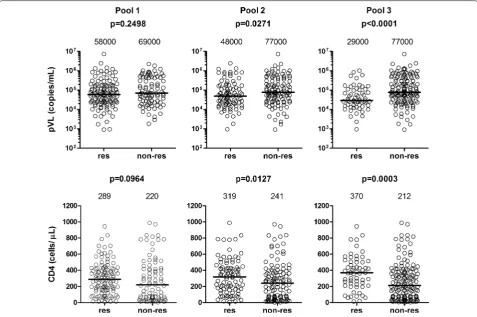
magnitude and breadth of CD8+ T-cell responses to 3
pools of the Gag 15-mer peptides (Pools 1, 2, and 3). The magnitude and breadth of the T-cell responses to Pools 2 and 3, and particularly responses to Pool 3, were sig-nificantly correlated with high CD4 count and low pVL, whereas those to Pool 1 were not (Fig. 1 and Additional file 1: Fig. S1). These results suggest that T cells specific for peptides within Pools 2 and 3 contribute to the sup-pression of HIV-1 replication.
Mapping the CD8+ T‑cell Gag‑specificity to optimal
epitopes
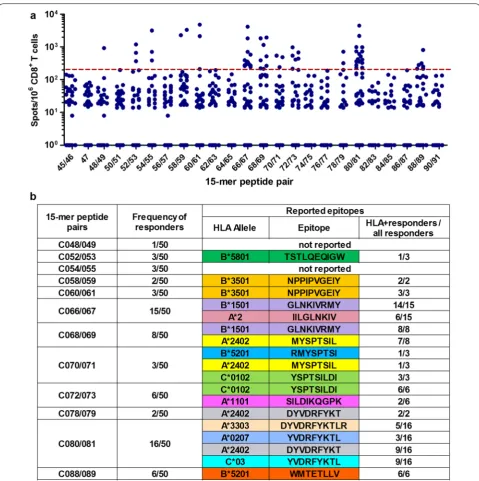
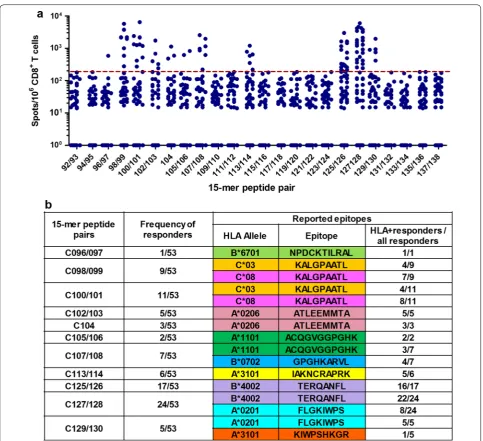
We found that 89 and 59 individuals recognized 15-mer peptides in Pools 2 and 3, respectively. Of these, we selected 50 and 53 based on sufficient PBMC sample availability for the fine definition of optimal epitopes. Pools 2 and 3 included peptide pairs derived from the bi-valent mosaic and one single peptide common between the two mosaics. By using an IFN-γ ELISPOT assay, we found T-cell responses to 12 peptide pairs in Pool 2
(Fig. 2a) and 10 peptide pairs and one common
alleles (Figs. 2b and 3b). However, responders to 15-mer peptides C48/49, C052/053, C054/055, C113/114, or C125/126 did not have the matching restricting HLA alleles, indicating that their CD8+ T cells may recognize novel, previously unreported epitopes.
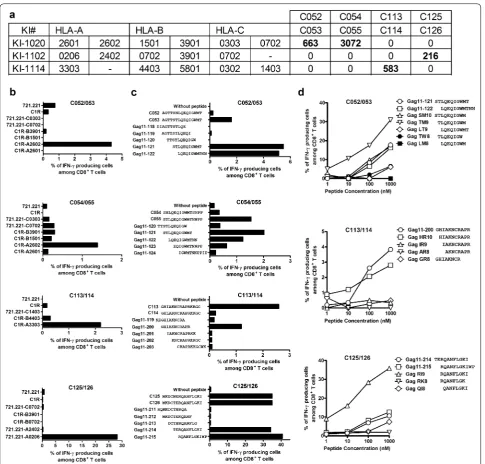
Next, we sought to define these novel epitopes and their HLA restriction. We did not pursue the epitope in C48/49 since only one responder to this peptide pair was detected in the 50 tested individuals. The responder KI-1020 had T cells specific for the C052/053 and C054/055 peptide pairs, while KI-1102 and KI-1114 had responses to C125/126 and C113/114 peptides, respec-tively (Fig. 4a). To define the HLA restriction, subjects’ PBMCs were first expanded with each peptide pair for 12–14 days and these STCL were tested in ICS assay using either C1R or 721.221 cells stably transfected with all subject’s HLA class I molecules and pulsed with the peptides. The results showed that both T-cell responses to the C052/053 and C054/055 15-mer peptide pairs were restricted by HLA-A*26:02 and responses to the
C113/114 and C125/126 peptides were restricted by HLA-A*33:03 and HLA-A*02:06, respectively (Fig. 4b).
We next narrowed the optimal epitopes by using over-lapping 11-mer and further truncated peptides. Both the C052/053 STCL and C054/055 STCL recognized
both Gag 11-121 and Gag 11-122 peptides (Fig. 4c),
suggesting that all the STCL were specific for the same epitope. Analysis using truncated peptides showed that
the optimal peptide was TLQEQIGWM (TM9) (Fig. 4d)
restricted by HLA-A*26:02. This epitope has not been previously reported. The C113/114 STCL and C125/126 STCL recognized Gag 11-200 and Gag 11-214/215, respectively (Fig. 4c). Again using truncated peptides, we identified previously unreported epitopes HIAKN-CRAPR (HR10) and RQANFLGKI (RI9) as the optimal peptides presented by HLA-A*33:03 and HLA-A*02:06, respectively (Fig. 4d). Thus, we identified three novel can-didate peptides for the Los Alamos National Laboratory
HIV Sequence Database (LANL-HSD; www.hiv.lanl.gov)
‘A’ list of well-defined epitopes.
[image:3.595.59.537.88.405.2]Page 4 of 14 Murakoshi et al. Retrovirology (2018) 15:46
CD8+ T cells recognizing Gag conserved epitopes are
protective in vivo
As described in above (Figs. 2b and 3b), T cells specific for 23 reported and 3 novel HIV-1 epitopes recognize tHIVconsvX-derived Gag peptides in HIV-1-infected patients in Japan. To investigate further these T-cell responses, we selected 221 individuals whose PBMCs
were available for this analysis. Thus, T cells spe-cific for epitopes SK10/HLA-A*11:01 and KR9/HLA-A*31:01 were not detected in any patients. CD8+ T-cells responses recognizing epitopes DT9/HLA-A*24:02, ML8/HLA-A*24:02, NY10/HLA-B*35:01, NL11/HLA-B*67:01, IV9/HLA-A*02, YL9/HLA-A*02:07 and TW10/ HLA-B*58:01 were only detected in 1 or 2 patients Fig. 2 T-cell responses to 15-mer peptide pairs in Gag Pool 2. a The responses to individual pairs of 15-mer peptides in Gag Pool 2. Responses to peptide pairs in 50 responders to Pool 2 were analyzed by an IFN-γ ELISPOT assay. The dotted line at 200 SFU/106 CD8+ T cells indicates a threshold
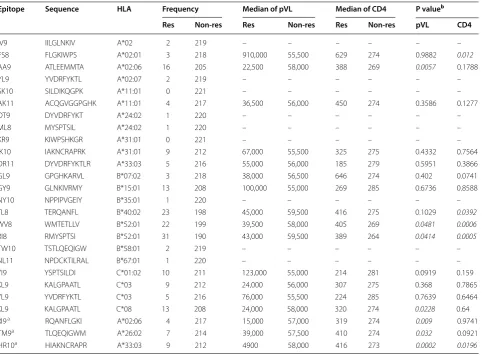
[image:4.595.58.538.85.567.2](Table 1) and were excluded from further statistical analysis because of the small number of responders. The analysis of CD8+ T-cell responses to 9 epitopes with suf-ficient number of responders showed a significant asso-ciation with lower pVL and/or higher CD4 count relative to non-responders to these epitopes. T cells specific for the WV8/HLA-B*52:01, RI8/HLA-B*52:01 and AA9/ HLA-A*02:06 epitopes were previously shown to inhibit HIV-1 in vivo [21, 22]. Therefore, the present study in treatment-naïve, HIV-1-positive patients newly identified
T cells specific for 6 epitopes FS8/HLA-A*02:01, TL8/ HLA-B*40:02, KL9/HLA-C*08, RI9/HLA-A*02:06, TM9/ HLA-A*26:02 and HR10/HLA-A*33:03, that could effec-tively suppress HIV-1 replication (Table 1).
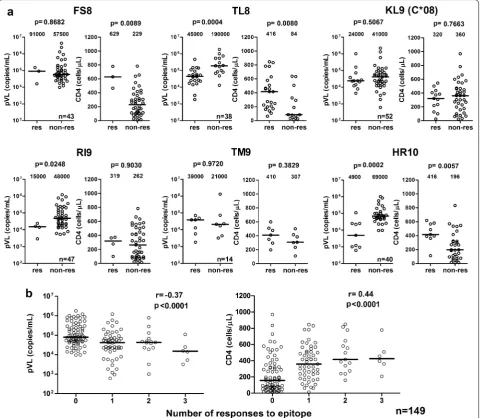
We further analyzed the association of responses to these 9 epitopes with lower pVL and/or higher CD4 count in individuals having the epitopes’ restricting HLA molecules. We again confirmed that respond-ers to the WV8/HLA-B*52:01, RI8/HLA-B*52:01 or AA9/HLA-A*02:06 epitopes had significantly lower Fig. 3 T-cell responses to 15-mer peptide pairs in Gag Pool 3. a The responses to individual pairs of 15-mer peptides in Gag Pool 3. Responses to peptide pairs in 53 responders to Pool 3 were analyzed by an IFN-γ ELISPOT assay. The dotted line at 200 SFU/106 CD8+ T cells indicates a threshold
[image:5.595.57.541.84.525.2]Page 6 of 14 Murakoshi et al. Retrovirology (2018) 15:46
pVL than non-responders with the same HLA alleles, while responders to WV8 and RI8 also had significantly higher CD4 count than the non-responders (Additional
file 2: Fig. S2). Responders to HR10/HLA-A*33:03 and
TL8/HLA-B*40:02 had significantly both lower pVL and
higher CD4 count than the non-responders (Fig. 5a).
[image:6.595.57.543.85.549.2]We also analyzed the impact of the total breadth (num-ber of recognized epitopes) and magnitude of the T-cell responses to 5 protective epitopes AA9, TL8, WV8, RI8, and HR10 on clinical outcome and found their very strong negative and positive association with respec-tive pVL (breadth: p < 1 × 10⁻⁴, r = − 0.37;
magni-tude: p < 1 × 10⁻⁴, r = − 0.40) and CD4 count (breadth:
p < 1 × 10⁻⁴, r = 0.44; magnitude: p < 1 × 10⁻⁴, r = 0.44),
respectively (Fig. 5b and Additional file 3: Fig. S3).
TL8‑ and HR10‑specific T cells suppress HIV‑1 replication in vitro
We next investigated the ability of T cells specific for
the reported TL8/HLA-B*40:02 [23, 24] and novel
HR10/A*33:03 epitopes to suppress HIV-1 replication
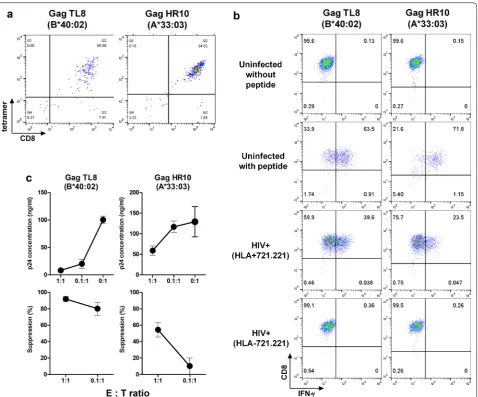
in vitro. We established T-cell lines specific for TL8 and HR10 from PBMCs of individuals KI-1391 (HLA-B*40:02+) and KI-1320 (HLA-A*33:03+), respectively, by
FACS sorting using the HLA/peptide tetrameric com-plexes (Fig. 6a). TL8- and HR10-specific T-cell lines were effectively stimulated by peptide-pulsed and HIV-1-in-fected target cells 721.221/HLA-B*40:02 and 721.221/ A*33:03, respectively, but not uninfected or HLA-untransfected 721.221 cells (Fig. 6b). These T-cell lines efficiently suppressed HIV-1 replication in vitro (Fig. 6c). This HIV-1-inhibitory activity concurs with their improved clinical outcome.
Gag‑specific CD8+ T cells cross‑recognize epitope variants
Our previous study showed that CD8+ T cells specific
for conserved epitopes WV8/HLA-B*52:01 and AA9/ HLA-A*02:06 recognized 97 and 90%, respectively, of the circulating viruses in Japan. In contrast, RI8/HLA-B*52:01-specific T cells selected escape mutations, which were present in approximately 27% of the circulating
HIV-1 variants [21]. Consensus sequences of HR10/
Table 1 Association of CTL responses to Gag epitopes with pVL and CD4 count
a New epitope
b Statistically analyzed differences in pVL or CD4 count between responders and non-responders by Mann–Whitney test. Italics indicates that differences were
statistically significant
Epitope Sequence HLA Frequency Median of pVL Median of CD4 P valueb
Res Non‑res Res Non‑res Res Non‑res pVL CD4
IV9 IILGLNKIV A*02 2 219 – – – – – –
FS8 FLGKIWPS A*02:01 3 218 910,000 55,500 629 274 0.9882 0.012
AA9 ATLEEMMTA A*02:06 16 205 22,500 58,000 388 269 0.0057 0.1788
YL9 YVDRFYKTL A*02:07 2 219 – – – – – –
SK10 SILDIKQGPK A*11:01 0 221 – – – – – –
AK11 ACQGVGGPGHK A*11:01 4 217 36,500 56,000 450 274 0.3586 0.1277
DT9 DYVDRFYKT A*24:02 1 220 – – – – – –
ML8 MYSPTSIL A*24:02 1 220 – – – – – –
KR9 KIWPSHKGR A*31:01 0 221 – – – – – –
IK10 IAKNCRAPRK A*31:01 9 212 67,000 55,500 325 275 0.4332 0.7564
DR11 DYVDRFYKTLR A*33:03 5 216 55,000 56,000 185 279 0.5951 0.3866
GL9 GPGHKARVL B*07:02 3 218 38,000 56,500 646 274 0.402 0.0741
GY9 GLNKIVRMY B*15:01 13 208 100,000 55,000 269 285 0.6736 0.8588
NY10 NPPIPVGEIY B*35:01 1 220 – – – – – –
TL8 TERQANFL B*40:02 23 198 45,000 59,500 416 275 0.1029 0.0392
WV8 WMTETLLV B*52:01 22 199 39,500 58,000 405 269 0.0481 0.0006
RI8 RMYSPTSI B*52:01 31 190 43,000 59,500 389 264 0.0414 0.0005
TW10 TSTLQEQIGW B*58:01 2 219 – – – – – –
NL11 NPDCKTILRAL B*67:01 1 220 – – – – – –
YI9 YSPTSILDI C*01:02 10 211 123,000 55,000 214 281 0.0919 0.159
KL9 KALGPAATL C*03 9 212 24,000 56,000 307 275 0.368 0.7865
YL9 YVDRFYKTL C*03 5 216 76,000 55,500 224 285 0.7639 0.6464
KL9 KALGPAATL C*08 13 208 24,000 58,000 320 274 0.0228 0.64
RI9a RQANFLGKI A*02:06 4 217 15,000 57,000 319 274 0.009 0.9741
TM9a TLQEQIGWM A*26:02 7 214 39,000 57,500 410 274 0.032 0.0921
[image:7.595.59.543.100.457.2]Page 8 of 14 Murakoshi et al. Retrovirology (2018) 15:46
HLA-A*33:03 and TL8/HLA-B*40:02 were found in approximately 60% of circulating viruses in the present Japanese cohort. We therefore analyzed cross-recog-nition of mutant epitopes by CD8+ T cells recognizing the two conserved Gag epitopes, HR10 and TL8. Three mutants for each of these epitopes were detected in > 5% of circulating viruses (Fig. 7a). We therefore assessed the recognition of these mutant epitope peptides by using the IFN-γ ELISPOT assay. Three TL8 mutant pep-tides were cross-recognized by T cells in 5
HIV-1-in-fected HLA-B*40:02+ patients with the TL8-specific
responses, although the recognition of the 1D mutation was reduced (Fig. 7b). Indeed in a dose response analy-sis, the stimulation of the TL8-specific T-cell line by
the 1D mutant peptide was severely reduced (Fig. 7c).
The HLA-B*40:02-associated mutation in Gag T427N (p = 1.0 × 10⁻⁹, q= 3.2 × 10⁻⁶) was found within the TL8/
HLA-B*40:02 epitope [25], suggesting that this mutation
represented an escape from CD8+ T-cell recognition.
Nevertheless, the TL8-1N mutated peptide was cross-recognized in all of the 5 tested individuals including 2
having the TL8-1N mutant viruses (Additional file 4:
[image:8.595.59.542.89.507.2]Fig. S4). Similarly, the HR10-2L mutant peptide was cross-recognized by T cells in all 5 HIV-1-infected
HLA-A*33:03+ individuals who were not infected with
HR10-2L or HR10-4R mutant viruses (Additional file 4: Fig. S4), whereas HR10-2L4R and/or HR10-4R mutant peptides were cross-recognized by T cells in patients KI-1002 and KI-1320. HR10-specific T cells from KI-1320 confirmed
cross-recognition of these mutant peptides (Fig. 7c).
Thus, CD8+ T-cells responses specific for TL8 and HR10
epitopes can recognize 70–75% of the circulating HIV-1 isolates in Japan.
Discussion
Unique vaccine immunogens tHIVconsvX were assem-bled, which use 2 Gag and 4 Pol conserved regions to focus T-cell responses on the most vulnerable regions (not full-size proteins and not epitopes) of HIV-1 with the bi-valent mosaic design providing the vaccine with a Fig. 6 Ability of CTLs to recognize HIV-1-infected cells and to suppress HIV-1 replication in vitro. a Generation of the T-cell lines specific for
TL8 or HR10 from PBMCs of HLA-B*40:02+ individual (KI-1391) or HLA-A*33:03+ one (KI-1320). The T-cell lines were established as shown in
Materials and Methods. The T-cell lines established were stained with the specific tetramers. b Recognition of HIV-1-infected cells by CTLs specific for TL8 or HR10 epitopes. The T-cell lines stimulated with HIV-1 (NL4-3)-infected 721.221 cells (HIV+) expressing the corresponding HLAs or HLA-negative 721.221 cells, and IFN-γ production from the T cells was measured by the ICS assay. The proportions of 721.221-B4002, -A3303 and HLA-negative 721.221 cells infected with NL4-3 were 56.0, 59.7, and 64.1%, respectively. c Suppression of HIV-1 replication by the T-cell lines specific for TL8 or HR10. Primary CD4+ T-cells from healthy donors carrying the corresponding HLA alleles were infected with NL4-3, and then
[image:9.595.61.540.86.483.2]Page 10 of 14 Murakoshi et al. Retrovirology (2018) 15:46
high match to global HIV-1 variants. To date, the immu-nogenicity of these regions was demonstrated in pre-clinical studies [14, 26]. Importantly, we were previously able to show that CD8+ T-cell responses to 10 peptide
pools derived from the two tHIVconsvX mosaic immu-nogens correlated significantly with low pVL and high CD4 count in 120 treatment-naïve, HIV-1-infected Jap-anese patients [14]. In the present study, we focused on Fig. 7 Recognition of mutant epitope peptides by T cells in HIV-1-infected individuals. a Frequencies of TL8 and HR10 mutant epitopes in Japanese individuals. The frequencies of mutant epitopes were investigated from 430 chronically HIV-1-infected Japanese individuals. b The CD8+ T-cell
[image:10.595.57.540.86.591.2]Gag-specific CD8+ T-cells because of their strong contri-bution to favorable clinical outcome. We defined a num-ber of optimal epitopes and their HLA restriction, which
were recognized by CD8+ T cells specific for the Gag
conserved regions of tHIVconsvX. Furthermore, we dem-onstrated that 9 Gag-specific CD8+ T-cell responses were significantly associated with low pVL and/or high CD4 count in an extended 221-patient cohort of treatment-naïve patients, implying that T cells specific for these 9 epitopes may contribute to suppression of HIV-1 replica-tion in these individuals. To increase the analysis sensi-tivity and further endorse the ability of these CD8+ T-cell responses to suppress HIV-1 replication, we confirmed the association of these T-cells with good clinical param-eters among the individuals carrying the appropriate HLA restriction molecules. Finally, we identified 5 Gag
epitope-specific protective CD8+ T-cell responses and
showed a strong association of the magnitude and the breadth of the responses to the 5 epitopes with favorable pVL or CD4 count, indicating again that the responses to 5 Gag epitopes are beneficial. Although escape mutants were selected by the RI8-specific T cells and these HIV-1
mutants accumulated in the Japanese population [21],
70% of circulating HIV-1 still contain variants of the RI8 epitope recognized by RI8-elicited T cells.
It has now been well documented that not all CD8+
T-cell responses contribute to the suppression of HIV-1 replication equally [14, 15, 21, 27]. Mothe et al. showed that the T-cell responses to forty-eight 18-mer overlap-ping peptides associated with low viral load in South Africa, Peru, and Spain cohorts [27]. These 18-mer over-lapping peptides covering Gag, Pol, Nef, and Vif regions include 59 optimal defined epitopes in the LANL-HSD. The tHIVconsvX immunogen contains most of these; 19 in Gag and 14 in Pol. In the present study, we identi-fied CD8+ T cells specific for 5 Gag conserved epitopes with the ability to suppress HIV-1 replication in Japanese individuals. These CD8+ T cells are restricted by HLA-B*52:01, HLA-A*02:06, HLA-A*33:03, and HLA-B*40:02, and at least one of these four alleles are shared in approxi-mately 70% of Japanese population [28]. Since at least one of these alleles is also found in 45% of Chinese [29], 35% of Vietnamese [30], 40% of Thai [31], 50% of Indian [32],
and 65% of Korean [33], we hypothesize that if indeed
effective, the tHIVconsvX vaccine could be deployed in all these countries; the vaccine would be universal.
To confirm whether the 5 Gag epitopes were recog-nized by specific T cells as conserved epitopes, we ana-lyzed cross-recognitions of mutant epitopes among the subtype B using the IFN-γ ELISPOT assay. Nota-bly, the circulating viruses carry epitopes with a perfect 9/9 amino acid match or cross-recognized variations in 70–97% isolates from the Japanese population and
46–97% of subtype B viruses (LANL-HSD) and were recognized by T cells specific for 4 epitopes WV8, AA9, TL8, and HR10, though escape mutants selected by the RI8-specific T cells were detected in 27% of the circulat-ing virus in the Japanese cohort [21]. These results sug-gest that the 4 epitopes are functionally conserved at least among the subtype B viruses. We further analyzed HLA-associated mutations within these six epitopes and found HLA-B*40:02-associated Gag mutation T427N
within the HLA-B*40:02/TL8 epitope [25], suggesting
that this mutant is accumulated in the HLA-B*40:02+
Japanese individuals. However, since mutant Gag epitope TL8-1N was cross-recognized by CD8+ T cells in 5 indi-viduals with HLA-B*40:02 (Fig. 7b), TL8-1N may elicit a new T-cell repertoire specific for the 1N mutant or cross-recognizing this mutant. CD8+ T-cells responses specific for TL8 and HR10 epitopes can recognize 70–75% of the circulating HIV-1 isolates in Japan while those specific for WV8, AA9, and RI8 did recognized > 70% of them.
We previously demonstrated that three HLA-B*52:01-, two HLA-B*67:01-, and one HLA-B*02:06-restricted CD8+ T cells specific for Gag epitopes had a strong abil-ity to suppress HIV-1 replication in the Japanese popula-tion [21]. The present study demonstrated that CD8+ T cells specific for additional 2 Gag epitopes also contribute to the suppression of HIV-1. Although contained in the tHIVconsvX vaccines, T cells specific for MI8 restricted
by HLA-B*52:01 [21], and TL9 and NL11 restricted
by HLA-B*67:01 [21] were not identified in this study. This may be explained by the fact that MI8 and TL9 are included in Pool 1 and that the HLA-B*67:01 is a rare allele found in only 4 out of 221 patients involved in the present study. These findings suggest that Japanese indi-viduals vaccinated with the tHIVconsvX vaccines may respond to 8 Gag epitopes and suppress better HIV-1 replication by killer T cells (Additional file 5: Fig. S5).
The present work supports the hypothesis that the
CD8+ T-cell responses, which the tHIVconsvX vaccines
aim to elicit, have a real chance to contribute to the sup-pression of HIV-1 replication in vivo in Japan and other Asian populations both in the context of prevention of HIV-1 infection complementing neutralizing antibod-ies and in HIV cure by eradicating latently infected cells after HIV-1 reactivation. These results warrantee timely testing of this target immunogen strategy in the clinic.
Methods
Subjects
Page 12 of 14 Murakoshi et al. Retrovirology (2018) 15:46
Health and Medicine. Informed consent was obtained from all individuals according to the Declaration of Hel-sinki. Plasma and PBMCs were separated from whole blood. HLA types of the individuals were determined by standard sequence-based genotyping.
Peptides
The mosaic proteins maximize the coverage of potential T-cell epitopes for the global circulating viruses. We gen-erated three pools containing pairs of 15-mer Gag pep-tides overlapped by 11 amino acids covering two mosaic regions in the tHIVconsvX. Each pool contains 17 to 23 pairs of the 15-mer peptides. Pool 1, 2, and 3 cover Gag 133-231, Gag 221-327, and Gag 317-363/391-459, respec-tively [14]. The sequences of the 15-mer peptides in each Pool are shown in Additional file 6: Fig. S6. The 15-mer peptides derived from the tHIVconsvX mosaics were generously provided by the International AIDS Vaccine Initiative. Shorter mapping peptides were synthesized by utilizing an automated multiple peptide synthesizer and purified by high-performance liquid chromatography (HPLC). Purity of all peptides (> 90%) was examined by HPLC and mass spectrometry.
Cell lines
C1R cells expressing A*26:01 (C1R-A2601), HLA-A*26:02 (C1R-A2602), HLA-A*33:03 (C1R-A3303), HLA-B*07:02 (C1R-B0702), HLA-B*15:01 (C1R-B1501), HLA-B*39:01 B3901), or HLA-B*44:03 (C1R-B4403) were previously generated by transfecting these genes into C1R cell lines [21, 34–39]. 721.221 cells expressing CD4 molecules and HLA-C*03:03 (721.221-C0303) were generated by transfecting the genes into the 721.221 cell line. 721.221 cells expressing CD4 mol-ecules and HLA-A*02:06 (721.221-A0206), HLA-A*24:02 (721.221-A2402), A*33:03 (721.221-A3303), HLA-B*40:02 (721.221-B4002), HLA-C*14:03 (721.221-C1403), or HLA-C*07:02 (721.221-C0702) were previously gen-erated [21, 40–43]. All cell lines were cultured in RPMI 1640 medium containing 10% FCS medium (R10) with 0.15 mg/ml hygromycin B.
Expansion of HIV‑1‑specific T cells from HIV‑1‑infected individuals
PBMCs from KI-1020, KI-1102, and KI-1114 were incu-bated with 1 μM 15-mer peptide pairs (C052/053 or C054/055, C113/114, and C125/126, respectively) and cultured for 12-14 days to induce peptide-specific short-term cell lines (STCL).
Intracellular cytokine staining (ICS) assay
C1R and 721.221 cells prepulsed with each peptide or 721.221 cells infected with the HIV-1, strain NL4-3, were
added to the effector STCLs in a 96-well plate and incu-bated for 2 h at 37 °C. Brefeldin A (10 μg/ml) was then added and the cells were incubated further for 4 h, fixed with 4% paraformaldehyde and incubated in permeabili-zation buffer [0.1% saponin–10% FBS–phosphate-buff-ered saline (PBS)] after staining with allophycocyanin (APC)-labeled anti-CD8 monoclonal antibody (mAb) (Dako, Glostrup, Denmark). Thereafter, the cells were stained with fluorescein isothiocyanate (FITC)-labeled anti-interferon γ (IFN-γ) mAb (BD Bioscience, CA). The
percentage of IFN-γ-producing cells among the CD8+
T-cell population was determined by flow cytometry.
IFN‑γ enzyme‑linked immunospot (ELISPOT) assay
1×10⁵ PBMCs from HIV-1-positive individuals and
pep-tides were added to 96-well polyvinylidene plates (Milli-pore, Bedford, MA) that had been precoated with 5 μg/ ml anti-IFN-γ mAb; 1-D1K (Mabtech, Stockholm, Swe-den). Peptide pools or 15-mer peptide pairs were used at a concentration of 1 µM whereas optimal epitope peptides at a concentration of 100 nM in this assay. The plates were then incubated for 16 h at 37 °C before the addition of biotinylated anti-IFN-γ mAb (Mabtech) at 1 μg/ml at room temperature for 90 min, streptavidin-conjugated alkaline phosphatase (Mabtech) for at room temperature 60 min. Individual cytokine-producing cells were visualized as dark spots after a 20-min reaction with 5-bromo-4-chloro-3-indolyl phosphate and nitro blue tetrazolium in the presence of an alkaline phos-phatase-conjugated substrate (Bio-Rad, Richmond, CA, USA). The spots were counted with an Eliphoto-Counter (Minerva Teck, Tokyo, Japan). The frequencies of the responding cells were represented as spot-forming units (SFU)/106 CD8+ T cells by measuring frequency of CD8+ T cells using a flow cytometry. A mean+5 SD of the SFUs of samples (N = 3) from 12 HIV-1-naïve individuals for the peptide pool was 115 SFU/106 CD8+ T cells. There-fore, we defined a positive ELISPOT response as larger than 200 SFU/106 CD8+ T cells to exclude false positive.
Establishment of T‑cell lines specific for TL8 and HR10 peptides using HLA/peptide tetramer complexes
To establish T-cell lines specific for TL8 and HR10 peptides, HLA-B*40:02/TL8 or HLA-A*33:03/HR10 tetrameric complexes (tetramers) were synthesized
as previously described [44]. Briefly, PBMCs of
HLA-B*40:02+ individual (KI-1391) and HLA-A*33:03+ one
FACSAria. The sorted cells were stimulated with 100 nM of the corresponding epitope peptides and then cultured for 12–14 days to induce T cell lines specific for TL8 and HR10. To confirm purities of the specific T cells, the cell lines were analyzed by using the specific tetramers.
In vitro virus inhibition assay
The ability of HIV-1-specific CTLs to suppress HIV-1
replication was examined as previously described [45,
46]. CD4+ T cells isolated from PBMCs of healthy donors carrying HLA-B*40:02 or -A*33:03 were infected with NL4-3 and then the infected cells were co-cultured with epitope-specific T-cell lines at E:T ratios of 1:1 and 0.1:1. On day 3–4 post infection, the concentration of p24 Ag in the culture supernatant was measured by using an enzyme-linked immunosorbent assay.
Statistical analyses
Two-tailed Mann–Whitney’s test was performed for com-parison of two groups. Correlations between magnitudes and breadths of T cell responses and pVL or CD4 count were statistically analyzed using Spearman rank test. P values < 0.05 were considered to be statistically significant. Additional files
Additional file 1: Fig. S1. Correlation of the magnitudes of the Gag responses with pVL and CD4 count. T-cell responses to Gag peptide Pools 1, 2 and 3 derived from vaccine immunogen tHIVconsvX were enumerated using an IFN-γ ELISPOT assay in 200 HIV-1-infected Japanese individuals. Correlation coefficients (r) and p-values were determined by using the Spearman rank correlation test.
Additional file 2: Fig. S2. Association of the T-cell responses to AA9, WV8, or RI8 with pVL or CD4 count. T-cell responses to the 3 epitope peptides were analyzed by using the IFN-γ ELISPOT assay. The differences in pVL or CD4 count between responders and non-responders to each epitope peptide in the individuals having HLA restriction molecules for the epitopes were statistically analyzed by using the Mann-Whitney test.
Additional file 3: Fig. S3. Correlation between a total magnitude of T-cell responses to 5 epitopes and pVL and CD4 count. T-cell responses to 5 epitope peptides (AA9, TL8, WV8, RI8, and HR10) were analyzed in 149 individuals carrying the HLA restriction molecules by using the IFN-γ ELISPOT assay. Correlation coefficients (r) and p-values were determined by using the Spearman rank correlation test.
Additional file 4: Fig. S4. HIV-1 sequences within Gag TL8 and Gag HR10 epitopes in HIV-1-infected individuals. HIV-1 sequences within Gag TL8 and Gag HR10 were analyzed in HIV-1-infected individuals tested in Figure 7b. Mutant positions are highlighted in red.
Additional file 5: Fig. S5. Location of the 8 Gag CTL epitopes in the tHIVconsvX. The tHIVconsvX vaccine is composed of 2 Gag and 4 Pol conserved fragments. The two complementing mosaic immunogens corresponding to the 6 conserved regions are used in this vaccine. HLA-B*67:01-restricted TL9-specific, HLA-B*52:01-restricted MI8-specific, and HLA-B*67:01-restricted NL11-specific CTLs also have strong abilities to suppress HIV-1 replication in vivo (highlighted in green, Murakoshi et al., 2015).
Additional file 6: Fig. S6. List of 15-mer overlapping peptide pairs in Pools 1-3. Pool 1, 2, and 3 cover Gag133-231, Gag221-327, and Gag317-363 / 391-459, respectively.
Authors’ contributions
HM wrote the manuscript, performed assays, and analyzed assay results. CZ performed assays and analyzed assay results. NK, TA and TC performed assays. HG and SO collected samples and clinical data from patients. TH provided the overlapping 15-mer peptides derived from the tHIVconsvX immunogens and contributed to writing the manuscript. MT designed the study, oversaw the experiments, analyzed all of the data, and wrote and edited the manuscript. All authors read and approved the final manuscript.
Author details
1 Center for AIDS Research, Kumamoto University, 2-2-1 Honjo, Chuo-ku,
Kumamoto 860-0811, Japan. 2 International Research Center of Medical
Sciences, Kumamoto University, Kumamoto, Japan. 3 AIDS Clinical Center,
National Center for Global Health and Medicine, Tokyo, Japan. 4 The Jenner
Institute, University of Oxford, Old Road Campus Research Building, Roosevelt Drive, Oxford, UK.
Acknowledgements
Not applicable.
Competing interests
The authors declare that they have no competing interests.
Availability of data and materials
Not applicable.
Consent for publication
Not applicable.
Ethics approval and consent to participate
This study was approved by the ethics committees of Kumamoto University and the National Center for Global Health and Medicine. Informed consent was obtained from all individuals according to the Declaration of Helsinki.
Funding
This research was supported by grants-in-aid (15fk0410019h0001,
16fk0410202h0002, and17fk0410302h0003) for AIDS Research from AMED and by grants-in-aid (26293240, 17K10021) for scientific research from the Ministry of Education, Science, Sports, and Culture, Japan. C.Z. was supported by the China Scholarship Council (CSC) scholarship. The funders had no role in study design, data collection and interpretation, or the decision to submit the work for publication.
Publisher’s Note
Springer Nature remains neutral with regard to jurisdictional claims in pub-lished maps and institutional affiliations.
Received: 9 May 2018 Accepted: 25 June 2018
References
1. Rerks-Ngarm S, Pitisuttithum P, Nitayaphan S, Kaewkungwal J, Chiu J, Paris R, et al. Vaccination with ALVAC and AIDSVAX to prevent HIV-1 infection in Thailand. N Engl J Med. 2009;361:2209–20.
2. Haynes BF, Gilbert PB, McElrath MJ, Zolla-Pazner S, Tomaras GD, Alam SM, et al. Immune-correlates analysis of an HIV-1 vaccine efficacy trial. N Engl J Med. 2012;366:1275–86.
3. Rolland M, Edlefsen PT, Larsen BB, Tovanabutra S, Sanders-Buell E, Hertz T, et al. Increased HIV-1 vaccine efficacy against viruses with genetic signatures in Env V2. Nature. 2012;490:417–20.
4. Liao HX, Bonsignori M, Alam SM, McLellan JS, Tomaras GD, Moody MA, et al. Vaccine induction of antibodies against a structurally heterogene-ous site of immune pressure within HIV-1 envelope protein variable regions 1 and 2. Immunity. 2013;38:176–86.
Page 14 of 14 Murakoshi et al. Retrovirology (2018) 15:46
6. Yates NL, Liao HX, Fong Y, deCamp A, Vandergrift NA, Williams WT, et al. Vaccine-induced Env V1-V2 IgG3 correlates with lower HIV-1 infection risk and declines soon after vaccination. Sci Transl Med. 2014;6:228ra239. 7. McMichael AJ, Haynes BF. Lessons learned from HIV-1 vaccine trials: new
priorities and directions. Nat Immunol. 2012;13:423–7.
8. Gray GE, Allen M, Moodie Z, Churchyard G, Bekker LG, Nchabeleng M, et al. Safety and efficacy of the HVTN 503/Phambili study of a clade-B-based HIV-1 vaccine in South Africa: a double-blind, randomised, placebo-controlled test-of-concept phase 2b study. Lancet Infect Dis. 2011;11:507–15.
9. Hammer SM, Sobieszczyk ME, Janes H, Karuna ST, Mulligan MJ, Grove D, et al. Efficacy trial of a DNA/rAd5 HIV-1 preventive vaccine. N Engl J Med. 2013;369:2083–92.
10. Buchbinder SP, Mehrotra DV, Duerr A, Fitzgerald DW, Mogg R, Li D, et al. Efficacy assessment of a cell-mediated immunity HIV-1 vaccine (the Step Study): a double-blind, randomised, placebo-controlled, test-of-concept trial. Lancet. 2008;372:1881–93.
11. McElrath MJ, De Rosa SC, Moodie Z, Dubey S, Kierstead L, Janes H, et al. HIV-1 vaccine-induced immunity in the test-of-concept Step Study: a case-cohort analysis. Lancet. 2008;372:1894–905.
12. Hanke T. Conserved immunogens in prime-boost strategies for the next-generation HIV-1 vaccines. Expert Opin Biol Ther. 2014;14:601–16. 13. Letourneau S, Im EJ, Mashishi T, Brereton C, Bridgeman A, Yang H, et al.
Design and pre-clinical evaluation of a universal HIV-1 vaccine. PLoS ONE. 2007;2:e984.
14. Ondondo B, Murakoshi H, Clutton G, Abdul-Jawad S, Wee EG, Gatanaga H, et al. Novel conserved-region T-cell mosaic vaccine with high global HIV-1 coverage is recognized by protective responses in untreated infec-tion. Mol Ther. 2016;24:83242.
15. Kiepiela P, Ngumbela K, Thobakgale C, Ramduth D, Honeyborne I, Moodley E, et al. CD8+ T-cell responses to different HIV proteins have discordant associations with viral load. Nat Med. 2007;13:46–53. 16. Klein MR, van Baalen CA, Holwerda AM, Kerkhof Garde SR, Bende RJ, Keet
IP, et al. Kinetics of Gag-specific cytotoxic T lymphocyte responses during the clinical course of HIV-1 infection: a longitudinal analysis of rapid progressors and long-term asymptomatics. J Exp Med. 1995;181:1365–72. 17. Ogg GS, Jin X, Bonhoeffer S, Dunbar PR, Nowak MA, Monard S, et al.
Quantitation of HIV-1-specific cytotoxic T lymphocytes and plasma load of viral RNA. Science. 1998;279:2103–6.
18. Chen DY, Balamurugan A, Ng HL, Cumberland WG, Yang OO. Epitope targeting and viral inoculum are determinants of Nef-mediated immune evasion of HIV-1 from cytotoxic T lymphocytes. Blood. 2012;120:100–11. 19. Kloverpris HN, Payne RP, Sacha JB, Rasaiyaah JT, Chen F, Takiguchi M, et al.
Early antigen presentation of protective HIV-1 KF11Gag and KK10Gag epitopes from incoming viral particles facilitates rapid recognition of infected cells by specific CD8+ T cells. J Virol. 2013;87:2628–38. 20. Sacha JB, Chung C, Rakasz EG, Spencer SP, Jonas AK, Bean AT, et al.
Gag-specific CD8+ T lymphocytes recognize infected cells before AIDS-virus integration and viral protein expression. J Immunol. 2007;178:2746–54. 21. Murakoshi H, Akahoshi T, Koyanagi M, Chikata T, Naruto T, Maruyama R, et al. Clinical control of HIV-1 by cytotoxic T cells specific for multiple conserved epitopes. J Virol. 2015;89:5330–9.
22. Chikata T, Murakoshi H, Koyanagi M, Honda K, Gatanaga H, Oka S, et al. Control of HIV-1 by an HLA-B*52:01-C*12:02 Protective Haplotype. J Infect Dis. 2017;216:1415–24.
23. Sabbaj S, Bansal A, Ritter GD, Perkins C, Edwards BH, Gough E, et al. Cross-reactive CD8+ T cell epitopes identified in US adolescent minorities. J Acquir Immune Defic Syndr. 2003;33:426–38.
24. Borthwick N, Lin Z, Akahoshi T, Llano A, Silva-Arrieta S, Ahmed T, et al. Novel, in-natural-infection subdominant HIV-1 CD8+ T-cell epitopes revealed in human recipients of conserved-region T-cell vaccines. PLoS ONE. 2017;12:e0176418.
25. Chikata T, Carlson JM, Tamura Y, Borghan MA, Naruto T, Hashimoto M, et al. Host-specific adaptation of HIV-1 subtype B in the Japanese popula-tion. J Virol. 2014;88:4764–75.
26. Wee EG, Ondondo B, Berglund P, Archer J, McMichael AJ, Baltimore D, et al. HIV-1 conserved mosaics delivered by regimens with integration-deficient DC-Targeting lentiviral vector induce robust T cells. Mol Ther. 2017;25:494–503.
27. Mothe B, Llano A, Ibarrondo J, Daniels M, Miranda C, Zamarreno J, et al. Definition of the viral targets of protective HIV-1-specific T cell responses. J Transl Med. 2011;9:208.
28. Ikeda N, Kojima H, Nishikawa M, Hayashi K, Futagami T, Tsujino T, et al. Determination of HLA-A, -C, -B, -DRB1 allele and haplotype frequency in Japanese population based on family study. Tissue Antigens. 2015;85:252–9.
29. Qin Qin P, Su F, Xiao Yan W, Xing Z, Meng P, Chengya W, et al. Distribu-tion of human leucocyte antigen-A, -B and -DR alleles and haplotypes at high resolution in the population from Jiangsu province of China. Int J Immunogenet. 2011;38:475–81.
30. Hoa BK, Hang NT, Kashiwase K, Ohashi J, Lien LT, Horie T, et al. HLA-A, -B, -C, -DRB1 and -DQB1 alleles and haplotypes in the Kinh population in Vietnam. Tissue Antigens. 2008;71:127–34.
31. Kupatawintu P, Pheancharoen S, Srisuddee A, Tanaka H, Tadokoro K, Nathalang O. HLA-A, -B, -DR haplotype frequencies in the Thai Stem Cell Donor Registry. Tissue Antigens. 2010;75:730–6.
32. Rani R, Marcos C, Lazaro AM, Zhang Y, Stastny P. Molecular diversity of HLA-A, -B and -C alleles in a North Indian population as determined by PCR-SSOP. Int J Immunogenet. 2007;34:201–8.
33. Huh JY, Yi DY, Eo SH, Cho H, Park MH, Kang MS. HLA-A, -B and -DRB1 polymorphism in Koreans defined by sequence-based typing of 4128 cord blood units. Int J Immunogenet. 2013;40:515–23.
34. Satoh M, Takamiya Y, Oka S, Tokunaga K, Takiguchi M. Identification and characterization of HIV-1-specific CD8+ T cell epitopes presented by HLA-A*2601. Vaccine. 2005;23:3783–90.
35. Kawashima Y, Satoh M, Oka S, Shirasaka T, Takiguchi M. Different immu-nodominance of HIV-1-specific CTL epitopes among three subtypes of HLA-A*26 associated with slow progression to AIDS. Biochem Biophys Res Commun. 2008;366:612–6.
36. Hossain MS, Tomiyama H, Inagawa T, Ida S, Oka S, Takiguchi M. Identifica-tion and characterizaIdentifica-tion of HLA-A*3303-restricted, HIV type 1 Pol- and Gag-derived cytotoxic T cell epitopes. AIDS Res Hum Retroviruses. 2003;19:503–10.
37. Falk K, Rotzschke O, Takiguchi M, Gnau V, Stevanovic S, Jung G, et al. Peptide motifs of HLA-B58, B60, B61, and B62 molecules. Immunogenet-ics. 1995;41:165–8.
38. Ogawa A, Tokunaga K, Nakajima F, Kikuchi A, Karaki S, Kashiwase K, et al. Identification of the gene encoding a novel HLA-B39 subtype. Two amino acid substitutions on the beta-sheet out of the peptide-binding floor form a novel serological epitope. Hum Immunol. 1994;41:241–7. 39. Kato N, Kikuchi A, Kano K, Egawa K, Takiguchi M. Molecular analysis of
a novel HLA-A33 subtype associated with HLA-B44. Tissue Antigens. 1993;41:211–3.
40. Watanabe K, Murakoshi H, Tamura Y, Koyanagi M, Chikata T, Gatanaga H, et al. Identification of cross-clade CTL epitopes in HIV-1 clade A/E-infected individuals by using the clade B overlapping peptides. Microbes Infect. 2013;15:874–86.
41. Koizumi H, Iwatani T, Tanuma J, Fujiwara M, Izumi T, Oka S, et al. Escape mutation selected by Gag28-36-specific cytotoxic T cells in HLA-A*2402-positive HIV-1-infected donors. Microbes Infect. 2009;11:198–204. 42. Lin Z, Kuroki K, Kuse N, Sun X, Akahoshi T, Qi Y, et al. HIV-1 Control by NK
Cells via Reduced Interaction between KIR2DL2 and HLA-C *12:02/C *14:03. Cell Rep. 2016;17:2210–20.
43. Watanabe T, Murakoshi H, Gatanaga H, Koyanagi M, Oka S, Takiguchi M. Effective recognition of HIV-1-infected cells by HIV-1 integrase-specific HLA-B *4002-restricted T cells. Microbes Infect. 2011;13:160–6.
44. Akahoshi T, Chikata T, Tamura Y, Gatanaga H, Oka S, Takiguchi M. Selection and accumulation of an 1 escape mutant by three types of HIV-1-specific cytotoxic T lymphocytes recognizing wild-type and/or escape mutant epitopes. J Virol. 2012;86:1971–81.
45. Tomiyama H, Akari H, Adachi A, Takiguchi M. Different effects of Nef-mediated HLA class I down-regulation on human immunodeficiency virus type 1-specific CD8(+) T-cell cytolytic activity and cytokine produc-tion. J Virol. 2002;76:7535–43.