Theses Thesis/Dissertation Collections
10-1-2007
Emphasizing the user in the usability study:
Investigating activity theory and website navigation
Heidi TrostFollow this and additional works at:http://scholarworks.rit.edu/theses
This Thesis is brought to you for free and open access by the Thesis/Dissertation Collections at RIT Scholar Works. It has been accepted for inclusion in Theses by an authorized administrator of RIT Scholar Works. For more information, please [email protected].
Recommended Citation
THE ROCHESTER INSTITUTE OF TECHNOLOGY DEPARTMENT OF COMMUNICATION
EMPHASIZING THE USER IN THE USABILITY STUDY: INVESTIGATING ACTIVITY THEORY AND WEBSITE NAVIGATION
By
HEIDI M. TROST
A paper submitted
in partial fulfillment of the Master of Science degree in Communication & Media Technologies
Heidi M. Trost on October 16, 2007
____________________________________ Bruce A. Austin, Ph.D.
Chairman and Professor of Communication Department of Communication
Thesis Advisor
____________________________________ Susan B. Barnes, Ph.D.
Professor of Communication Department of Communication Associate Director, Lab for Social Computing Thesis Advisor
____________________________________ Rudy Pugliese, Ph.D.
Professor of Communication
Coordinator, Communication & Media Technologies Graduate Degree Program Department of Communication
____________________________________ Dhanraj Vishwanath, Ph.D.
Program: Communication & Media Technologies College: Liberal Arts
I understand that I must submit a print copy of my thesis or dissertation to the RIT
Archives, per current RIT guidelines for the completion of my degree. I hereby grant to the Rochester Institute of Technology and its agents the non-exclusive license to archive and make accessible my thesis or dissertation in whole or in part in all forms of media in perpetuity. I retain all other ownership rights to the copyright of the thesis or dissertation. I also retain the right to use in future works (such as articles or books) all or part of this thesis or dissertation.
Print Reproduction Permission Granted:
I, Heidi Trost, hereby grant permission to the Rochester Institute Technology to
reproduce my print thesis or dissertation in whole or in part. Any reproduction will not be for commercial use or profit.
Signature of Author: Heidi M. Trost Date: 02-04-2008
Print Reproduction Permission Denied:
I, __________________________________, hereby deny permission to the RIT Library of the Rochester Institute of Technology to reproduce my print thesis or dissertation in whole or in part.
Signature of Author: _____________________________________ Date: ____________
Inclusion in the RIT Digital Media Library Electronic Thesis & Dissertation (ETD) Archive
I, Heidi Trost additionally grant to the Rochester Institute of Technology Digital Media Library (RIT DML) the non-exclusive license to archive and provide electronic access to my thesis or dissertation in whole or in part in all forms of media in perpetuity. I understand that my work, in addition to its bibliographic record and abstract, will be available to the world-wide community of scholars and researchers through the RIT DML. I retain all other ownership rights to the copyright of the thesis or dissertation. I also retain the right to use in future works (such as articles or books) all or part of this thesis or dissertation. I am aware that the Rochester Institute of Technology does not require registration of copyright for ETDs. I hereby certify that, if appropriate, I have obtained and attached written permission statements from the owners of each third party copyrighted matter to be included in my thesis or dissertation. I certify that the version I submitted is the same as that approved by my committee.
Abstract
The effects of organizational schemes in website design have been studied using measures of speed, number of mouse-clicks, accuracy, and user recollection of website content information. This study investigates self-reported user confidence and satisfaction of websites using two different organizational schemes. Users were randomly assigned to one of the two sites and asked to perform a series of information-retrieval tasks. Time taken to complete the tasks was recorded and participants completed a survey measuring their confidence and satisfaction using a website. No significant differences were found between the two websites in respect to user self-reported confidence and satisfaction. The results suggest that the design and layout of the website are not significant, as long as basic design guidelines are followed.
Emphasizing the User in the Usability Study:
Investigating Activity Theory and Website Navigation
Though a relatively recent innovation, the World Wide Web has had an unquestionable impact on our lives. With over 100 million websites available by November 2006, according to Netcraft.com’s latest web survey, Web-users have more choices than ever. Due to the rise in web-based competition, companies and
organizations have a vested interest in communicating effectively with Web-users and have great incentives to design websites that are not only attractive to users, but also user-friendly.
In an effort to create and enhance user-friendly websites, the latest push by Web developers has been for website usability studies—understanding and measuring the degree to which users can successfully perform a task or set of tasks on a particular website (Brinck, Gergle, & Wood, 2002). Creating a user-friendly website means not only providing a place where users can achieve their goals with ease and efficiency, but also providing an intuitive site for users through which the company or organization can communicate effectively with those who visit the website (Brinck, Gergle, & Wood, 2002). Web-users have little desire to stay, much less spend money at a poorly designed site.
Usability Studies and Human-Computer Interaction
under two general categories: gathering data based on the actual behavior of users and gathering data without a user present (Brinck, et al. 2002). Focus groups and interviews, along with observation of individuals using a website or prototype are examples of procedures for collecting data from actual users. At other times, web designers rely on “standard” models of user behavior provided by usability experts or results from previous website usability studies (Brinck, et al., 2002). This typically involves reviewing usability “rules” or “guidelines” based on information gathered from previous website usability studies that apply to a wide variety of websites. For example, basic guidelines for website design include: use small chunks of text, use consistent visual cues throughout the site, and minimize the need for the user to scroll within the site.
satisfied, challenged or excited, hesitant or confident?” (p. 11).
It is through the lens of HCI that researchers come the closest in emphasizing the individual user in the usability study. Additionally, applying research of how humans interact with other information media, particularly maps and other navigational aids, is useful (Badre, 2002) in studying how users navigate in the World Wide Web. A website’s information architecture (IA) refers to “how the information space [within a website] is structured” (Nielsen & Loranger, 2006, p. 172). Navigation and menus, links, labeling, and IA determine how easy it is to find information within a website (Nielsen & Loranger, 2006). All of these factos are a part of a website’s overall organizational scheme and any deficiencies can result in a website with poor usability. The following navigation
studies—though their methods may differ—emphasize the individual user. In addition, the studies apply principles of HCI research, particularly by stressing individual context, “ease of learning,” and “ease of use” (Badre, 2002, p. 4).
User-Centered Navigation Studies
list and manipulate this information to conform to an internal mode of representation. For Bartram’s (1980) study, 32 undergraduates at an English university were given four sets of bus route representations: an alphabetical list, a chronological list, a road map, and a schematic map. The participants were able to solve routing problems (how to get from one place to another) the quickest with the schematic map. Bartram theorizes that the schematic map most closely resembles the individual’s internal representation of information—therefore requiring the least amount of “recoding input information.” This study supports the idea that people tend to create an internal
representation of places and space. Therefore, a physical representation that is similar to that of the person’s internal representation requires little recoding and can be processed faster, with less confusion, greater accuracy and greater satisfaction. Although this study was limited to how we process and use bus route information, the research contributes to the examination of how users approach the organizational structure of a website. Most importantly, Bartram’s (1980) study suggests an emphasis on measuring how the user performs tasks in a given situation—a focus included in more recent literature.
Shneiderman (1997) suggests adhering to personal internal representations by utilizing metaphors and hierarchy. To achieve this, Schneiderman offers a basic overview of the issues in website organization and structure and recommends website designers rely on previous user-interface and information retrieval studies. Shneiderman, like Bartram (1980), stresses the need to identify the user and the user’s tasks:
objects and actions. Next, designers can create the interface metaphors (bookshelf, encyclopedia and shopping mall) and the handles for actions (scrolling, linking and zooming). Finally, the webpage design can be created in multiple visual formats and international versions, while providing access for handicapped or poor readers (p. 27).
According to Shneiderman, the goal stated above can be achieved by employing a hierarchy—where large chunks of information are broken down into more manageable pieces. Shneiderman’s Objects/Actions Interface Model (a way to analyze content according to the actions of the user) can help designers establish a hierarchy and break down large chunks of information into smaller, more manageable parts—both critical to the organization of information on a website and users’ success in navigating the sites. Shneiderman’s argument is useful in investigating the broad issues in website information organization and navigation. In particular, his stress on the user and user tasks and emphasis on making large information chunks more manageable, provides a foundation for research on website navigation.
Like Shneiderman, Nielsen and Loranger (2006) stress that navigation, menus, labeling, and information architecture (which refers to how information within a space is structured) influence how well the user can find information. Their book, Prioritizing
Web Usability, is based on a great number of usability studies—most of them contracted
are able to navigate successfully when labeling and information architecture is presented in a way users can easily understand. In addition—and a reflection of Shneiderman’s
emphasis on the user and user tasks—users perform better in websites specifically tailored to the their needs. Websites reflecting the structure or organization of the
company (i.e., organizing the website based on product name or brand) confuse users and result in poor usability. Likewise, links and label names should be chosen according to the needs of the user because different websites have different purposes—each site requires a unique IA specifically tailored to the needs and goals of the user. This insight emphasizes the need to differentiate between context and user experience, as suggested by Badre (2002) in the study of HCI.
Nielsen and Loranger (2006) refer to a number of studies (presumably client-contracted) that exemplify both good and bad information architecture and navigation systems. However, each study and its findings are only briefly described and methods and references are completely omitted. The vast number of examples provided by Nielsen and Loranger are useful in putting navigation and information architecture into context but their studies are impossible to replicate based on the lack of specific information. Nevertheless, the results of the studies support the idea that the needs of the individual user must be emphasized in order to create an optimal information architecture or navigation design.
Nielsen and Loranger (2006) and Scheiderman (1997), Brinck, et al. argue for an approach theoretically based on HCI research. The authors, like Shneiderman (1997) and Nielsen and Loranger (2006), suggest labeling with the user in mind (i.e., according to user type or user task). They provide seven basic models of human navigation (omniscience, optimal rationality, satisficing, mental maps, rote memorization, information foraging, and
information costs) and explain how designers should approach the navigation design based on the model of human navigation employed by the identified users. Likewise, the
authors present different organization schemes (topology, linear topology [sequence], matrix [grid], full mesh, arbitrary network, and a hybrid of these) to be utilized based on the user and user task. In particular, the authors suggest using a reasonably broad and shallow navigation system as opposed to a narrow and deep navigation system to encourage meaningful categories (this means including many categories with specific names, rather than a few categories with broad names). This type of approach to navigation has also been studied by Larson and Czerwinski (1998), who sought to empirically study the effect of depth and breadth in navigation on user performance.
choosing that particular category.
Larson and Czerwinski (1998) constructed websites containing three different information hierarchies: 8 x 8 x 8, 32 x 16, and 16 x 32, the first number indicating the primary level in the hierarchy and subsequent numbers indicating sections falling under the primary level. For example, for the 32 x 16 hierarchy, under the category of “Plants,” there are sixteen subcategories (including items such as,“Bamboo, Botanical Garden, Cactus, Conifer,” etc.). The subjects, all experienced Web users, performed eight searches in each structure. Participants completed search tasks the fastest in the 16 x 32 hierarchy and the slowest in the 8 x 8 x 8 hierarchy.
However, when the participants were given a questionnaire, they indicated that they preferred the 32 x 16 and 16 x 32 hierarchies, though there were no significant
differences between the preferences. The researchers suggest that because the 32 x 16 and 16 x 32 information structures allowed for more distinct categories at the top levels than the 8 x 8 x 8 hierarchy, participants were better able to search for information and, therefore, more satisfied when the task was completed. Because the 32 x 16 and 16 x 32 hierarchies allowed for more specific, meaningful categories, participants were satisfied with both. This study is significant because it questions whether multiple designs differing only in navigation or information architecture really have an impact on user performance or satisfaction.
difficulty. Participants, 42 adult volunteers, were asked to navigate an online price
catalog and were provided with an online notebook (similar to an electronic “laundry list”) to keep track of information, the use of which indicated a greater perception of cognitive difficulty. Subjects were more likely to use the notebook for longer lists and the use of the notebook varied based on the type of interface (the interfaces varied by number of clicks needed to access the information: no clicks, one click, or double-click). Wright, et al. conclude that, while people will typically select what is perceived as the less
demanding navigation option, their choice can be altered by personal perception or interface factors. Therefore, if the navigation appears to be less difficult, users will choose it first. It is important that designers think about what users may perceive as being difficult to find or achieve—though the answer may only be one or two clicks away. The perception factor becomes more convoluted in reference to knowledgeable versus non-knowledgeable Internet users.
Knowledgeable subjects performed better than non-knowledgeable subjects, except using the map navigational aid, where both types of users performed equally well. Because both knowledgeable and non-knowledgeable subjects were able to perform equally well using the map navigational aid, it should be questioned whether an optimally designed website will impact user performance or satisfaction—regardless of experience.
Resnick and Sanchez (2004), like McDonald and Stevenson (1998) investigated usability of the same website content created with different organizational structures. There were two independent variables: the organizational scheme had two levels (task-based and product-(task-based); the label quality had three levels (high, medium, and low quality). Labels were created using a card-sorting technique. Participants were asked to arrange 4 x 6 cards by putting contents of a health food store website under appropriate categories. Participants were then asked to find six products in these different website organizations, using the organizational schemes resulting from the card sorting as well as research on other health food store websites. Participants were then given questionnaires to rate their satisfaction with the sites.
designed poorly” (p. 115). From this study it appears that label quality has a more significant impact on user satisfaction and performance than does organizational scheme.
However, research such as Resnick and Sanchez’s (2004) is limited. The study only investigates an e-commerce website—a website with the sole intention of selling a product or service to the user. Other websites that have different goals (such as websites seeking to inform or generate community) may differ in their users’ ideal organizational structure. The research outlined above, in almost all cases, relied on some degree of user self-reported satisfaction. These were typically recorded using both open and closed-ended questionnaires or interviews. Though user satisfaction is a part of the research represented in Resnick and Sanchez’s research, a ten-question survey, each with a five-point scale varying from “strongly agree” to “strongly disagree” seems to severely limit the results. This is most likely because this research placed a greater emphasis on user performance. For the user to be properly emphasized, less attention needs to be given to performance and equal, if not more, attention to the user’s reported satisfaction.
Further, the above research presents important questions. First, is there a single navigation design that allows users to perform tasks with the greatest ease and
satisfaction? Or are there multiple designs that will fulfill these requirements? Second, can a single design allow both knowledgeable and non-knowledgeable Internet users to perform tasks with ease? Finally, how can user satisfaction be thoroughly measured and represented?
which advocates a user-centered approach to research. Because activity theory stresses the need to use a variety of instrumentation, research can include a combination of experiment, survey, and content analysis of responses obtained from open-ended survey questions. By utilizing these three types of instrumentations, the researcher has a better chance of effectively representing the website user.
Activity Theory
Nardi (1996) presents activity theory as a means through which researchers can effectively represent the user in usability studies. Activity theory was developed with the influence of Russian psychologist L.S. Vygotsky, as well as the work of Soviet scientists, S.L. Rubinshtein and A.N. Leont’ev. Activity theory, in contrast to more traditional models such as situated action models and distributed cognition, has the key idea of “mediation by artifacts” where artifacts include instruments and machines and are used by people to perform tasks. In activity theory, it is the activity that is the context, involving both internal (personal goals and objectives) and external (other people,
artifacts, or environments) factors. Activity theory stresses the need to provide a research time frame that is long enough to thoroughly study users, an emphasis on broad patterns of activity, the use of varied instrumentation to measure data, and an over-arching focus on the user’s point of view.
Kaptelinin (1996) argues for the need to apply activity theory to
the information-processing loop. Activity theory, by incorporating the objective, the ecological, and the sociocultural, creates a model that differs greatly from the information-processing loop. In fact, activity theory stresses the need to consider two interfaces: the human-computer interface and the computer-environment interface. Further, activity theory can account for social interactions, cultural factors, and goals.
Activity theory can provide the necessary framework of a user-centered
investigation of website organizational schemes. Not only does activity theory seek to emphasize the individual user and his or her surrounding environment, sociocultural background, and objectives, it stresses the need to use more than one instrument to measure the user’s experience.
Previous research has employed methods of measuring user satisfaction but few have this as the main focus of the study. Because activity theory places special
importance on the goals and needs of the user, the research methods of activity theory-based studies must reflect this. As a result, the present study employs several types of measures to gauge the user experience. In addition, two website designs were created by emphasizing user-context as described by activity theory and by using guidelines based in HCI research.
focuses on how Web-users actually process information found on websites. Software tracking is a useful tool to learn what users do but human-computer interaction (HCI) research is vital to understanding why. Research focusing on the user helps to build web design guidelines that emphasize the user and, essentially, give the user a voice.
In addition, this study utilizes a combination of existing and modified surveys to test user confidence and satisfaction. The Center for Research and Education on Aging and Technology Enhancement (CREATE) questionnaire from previous research (Czaja, et al., 2006) is a comprehensive survey designed to assess individual’s Internet experience. This survey was modified for the present research to identify each subject’s Internet experience level. User confidence was measured using a question-design based on previous research done in website usability by Mat-Hassan and Levene (2001). The System Usability Scale (SUS; Brookes, 1996), used in previous research was expanded upon in order to measure user satisfaction. These three surveys seek to effectively represent the user, as stressed by activity theory. By combining three different surveys into a larger, cohesive survey/experiment, the user experience is more effectively
represented.
the study will enhance our understanding of how users interact with websites—something of interest to those on the developing end of the website, as well as those who are
everyday users of the website.
Research Questions
The present study investigates the usability factor of information architecture and its relationship to user reported confidence and satisfaction. Information architecture and labeling are closely related and together make up the website’s organizational scheme. This study examines the relationship between the organizational system employed by a website and user reported satisfaction with the website’s organization and user reported confidence navigating the website’s contents.
RQ1: What differences in confidence navigating the website’s content do users report between websites utilizing different organizational schemes?
RQ2: What differences in satisfaction do users report between websites utilizing different organizational schemes?
Because low-experience Internet users tend to have more difficulty performing tasks than high-experience users (Nielsen & Loranger, 2006), it is hypothesized:
H1: High-experience users will report more satisfaction regardless of organizational scheme compared to low-experience users.
H2: High-experience users will report higher confidence navigating the website regardless of organizational scheme compared to low-experience users.
user satisfaction with a website (Nielsen & Loranger, 2006), Hypotheses 3 is related to time to complete tasks on each organizational scheme:
H3: Users will report a greater satisfaction with websites that required less time to complete tasks compared to websites that took more time.
Method
General Design
Volunteers participated in an experiment and answered a survey designed to test their confidence using and satisfaction with a website used as both an informational resource and an interactive tool. The organization creating the website, a technology consulting company, seeks to inform potential clients of its services. In addition, the website is an interactive portal through which clients can contact the company, view current projects, and “test-drive” software. Though the website is promotional in nature, the website’s main objective is not e-commerce. Unlike the research performed by Resnick and Sanchez (2004), the present research investigates user self-reported experience with a website intended to be informational, as well as interactive.
satisfaction of the website than low-experience users. These questions helped
to distinguish between high- and low-experience users—the highest score indicating an Internet expert, the lowest score indicating no Internet experience.
Two versions of the same informative website with different organizational schemes were created. These schemes were constructed using guidelines derived from previous research (Brinck, Gergle, & Wood, 2002; Nielsen & Loranger, 2006;
Shneiderman, 1997; Resnick & Sanchez, 2004; Boechler & Dawson, 2004) and research of similar existing websites.
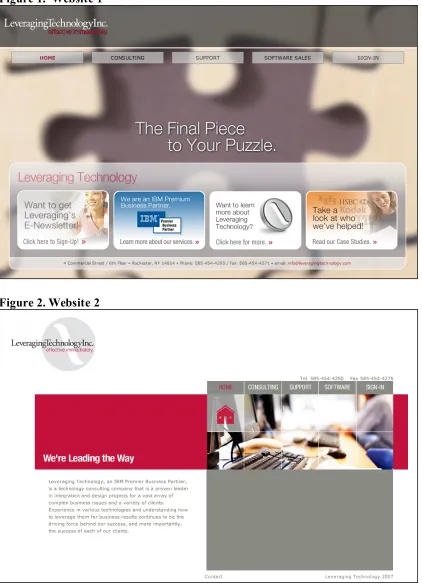
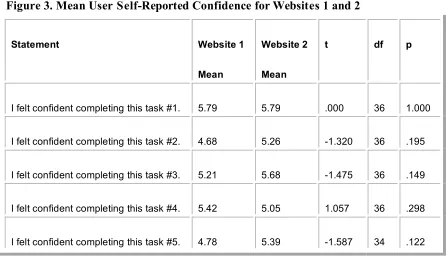
Each website contained the same content information, however, the mode of navigation, design, and layout differed. Though the content was identical between the two sites, users were required to follow different paths to achieve the same information. The overall look and layout of the sites, while still adhering to branding style dictated by the company, were completely different. The content information for two sites was created using organization and labeling guidelines from previous research (Resnick & Sanchez, 2004; Boechler & Dawson, 2004), as well as by adhering to user-context, as stressed by activity theory (Nardi, 1996; Kaptelinin, 1996). Figure 1 illustrates Website 1 and Figure 2 depicts Website 2.
Figure 1. Website 1
Procedures
Participants were given five information-retrieval tasks that required them to navigate through one of two websites to find the information. Each participant was asked the same questions but was assigned one of two sites—each with a different navigation design (participants were randomly assigned to one of the two sites, with participants divided equally among the sites). Following each task, the participant was asked to score how confident he or she felt trying to accomplish that task, on a six-point scale labeled “Strongly Agree” at one end and “Strongly Disagree” at the other. This portion of the survey was based on previous research done in website usability by Mat-Hassan and Levene (2001) (see Appendix A).
Before and after completing the tasks, the participants were asked to record the time. By subtracting the times, the amount of time taken to complete the assigned tasks was compiled (H3).
Following the completion of the tasks, participants were asked to complete a questionnaire based on the System Usability Scale (SUS; Brookes, 1996) used in previous research (see Appendix A). The statements measured the user’s general satisfaction with the site (RQ2), based on a six-point scale ranging from “strongly disagree” to “strongly agree.” The last question allowed the participant, in his or her own words, to include any additional information relevant to the website’s design.
reliability of data entry.
Subjects
Participants were recruited from several Rochester, New York organizations, as well as a local university, through announcements e-mailed to individuals. Thirty-eight subjects participated in the study. Out of these, 23 were female and 15 were male. The majority of respondents had attended or are currently attending graduate school. All respondents had completed at least some college. Subjects ranged in age from 20 to 55 years old, with a mean age of 30. All participants had been using the Internet for more than one year, with most participants having used the Internet for more than five years. Participants reported using Internet communication (e.g., e-mail, instant messaging) frequently. Most participants reported using other Internet features such as banking/money management, entertainment, and education frequently.
Results
A t-test was used to ascertain whether there were statistically significant
Figure 3. Mean User Self-Reported Confidence for Websites 1 and 2
Statement Website 1
Mean
Website 2
Mean
t df p
I felt confident completing this task #1. 5.79 5.79 .000 36 1.000
I felt confident completing this task #2. 4.68 5.26 -1.320 36 .195
I felt confident completing this task #3. 5.21 5.68 -1.475 36 .149
I felt confident completing this task #4. 5.42 5.05 1.057 36 .298
I felt confident completing this task #5. 4.78 5.39 -1.587 34 .122
Website 1 users reported a mean score of 5.2 for all five tasks. Website 2 users had an overall average score of 5.43. The scale asked the user to rate “I felt confident completing the task” where 1 indicated “Strongly Disagree” and 6 indicated “Strongly Agree.” There were also no significant differences between user self-reported satisfaction with the two different sites (RQ2).
Because the majority of the participants were high-experience users, it was difficult to compare user self-reported confidence and satisfaction between low- and high-experience users (H1 and H2). The majority of users for both Websites 1 and 2 reported using the Internet for more than five years. In addition, mean self-reported weekly Internet usage was between 11 hours and 15 hours a week.
and the mean time taken for Website 2 was 7.05 minutes. The difference between the time taken and the users’ self-reported satisfaction (H3) was not significant. The average correct number of responses for Website 1 was 4.74 out of 5 and for Website 2, 4.79 out of 5. Though not all participants chose to provide comments about the websites, the comments given were consistent with the data above—that is, there was no difference between the two groups. Website 1 comments included “I found the website helpful and easy to find the desired information.” A Website 2 users commented “Easy to use; well organized website.” Even when users were given the opportunity to give constructive criticism, neither group had any design or navigation-relevant criticism.
Discussion
The similarities of responses between respondents using Website 1 and those using Website 2 suggest that websites that follow basic, established design guidelines foster user confidence and satisfaction despite variances in layout and design. Though average overall user self-reported confidence for Website 2 was slightly higher than
Website 1, the difference was not significant. This is consistent with more recent research suggesting that, as long as a website adheres to universal design guidelines and is created specifically for a target audience, design and layout choices do not affect user performance (Brinck, Gergle, & Wood, 2002; Nielsen & Loranger, 2006; Schneiderman, 1997).
Further, as Resnick and Sanchez (2004) suggest, it is label quality—not
of the site were not significant. Users were able to perform all of the tasks with minimal errors and reported similar confidence and satisfaction between the two sites. Therefore, it is the inherent structure of the information—not the way it is laid out—that decides the usability of the website. These types of design decisions (“information design”) have to occur before the website is physically created.
The relevant similarity between respondent responses between the two sites— despite their differences in design and layout—can be best attributed to the user-centered approach employed to create them. First, content information was created specifically for the target audience (already identified by the client). Different designers
independently created the two site designs—however, both designers adhered to universal design guidelines described by Brinck, Gergle, and Wood (2002), Nielsen and Loranger (2006), and Schneiderman, (1997). These guidelines are consistent with those described by Kaptelinin (1996) and Nardi (1996), who proposed using activity theory as an approach to HCI. This approach is user-centered, stressing the user’s surrounding environment, socio-cultural factors, and user objectives.
The implications of this research relate to the future of website design, as well as the changing needs of the modern Web-user. While individual user-testing will never lose its importance, the results of this survey suggest that today’s Internet user can navigate and retrieve information fairly easily on a well-designed website. This reinforces
users have internalized what a website is “supposed” to look like and, when navigating websites that follow this internal representation, can quickly and easily make adjustments to find information on websites that differ slightly from one another. It is when the Internet user encounters a website that breaks all of the universal rules and conventions that he or she becomes confused or frustrated. Therefore, it may be more important than ever for website designers to conform to these standards.
However, user-testing should not be abandoned. User expectations and needs will doubtlessly change as rapidly as technology advances. Further, user objectives vary depending on a variety of both internal and external factors. User testing is the only way to reveal these objectives and needs.
Conclusion
This study has several important limitations: the sample size is small and the volunteers comprised a fairly homogenous group of well-educated, high-experience
Internet users. As a result, it was impossible to answer the hypotheses posed to measure differences in satisfaction between high- and low-experience users. A larger sample size of varying education levels and Internet skills are necessary for future research. In
addition, more than two layouts could be created to judge user confidence and satisfaction among a variety of sites.
does not mean they have completed the task easily or correctly. Conversely, though a user may perform the task easily and correctly, he or she may not have felt confident doing so. Future research should seek to measure other, more objective factors.
This survey was created by compiling questions obtained by previous research. However, as the average Internet-user becomes more experienced, the questions posed by the survey may need to be altered. Sophisticated users are quickly becoming
References
Badre, A. N. (2002). Shaping web usability: Interaction Design in context. Boston: Addison-Wesley.
Baravallie, A. & Vitaveska, L. (2003). Remote web usability testing. Behavior Research
Methods, Instruments, & Computers, 35 (3), 364-368.
Bartram, D.J. (1980). Comprehending spatial information: The relative efficiency of different methods of presenting information about bus routes. Journal of Applied
Psychology, 65(1), 103-110.
Boechler P.M. and Dawson, M.R.W. (2002). Effects of navigation tool information on hypertext navigation behavior: A configural analysis of page-transition data.
Journal of Educational Multimedia and Hypermedia, 11(2), 95-115.
Brinck, T., Gergle, D., & Wood, S. (2002). Usability for the web. San Francisco: Morgan Kaufmann Publishers.
Brookes, J. (1996). SUS: A “quick and dirty” usability scale. In P. Jordan (Ed.),
Usability evaluation in industry (pp. 189-194). Bristol: Taylor & Francis.
Czaja, S. J., Charness, N., Dijkstra, K., Fisk, A.D., Rogers, W.A., Sharit, J. (2006).
Computer and Technology Experience Questionnaire. Center for Research and
Education on Aging and Technology Enhancement.
Computer Interaction (p. 103-116). Cambridge: The MIT Press.
Kaptelinin, V. and Nardi, B. (1997). Activity theory: Basic concepts and applications.
CHI ‘97 Electronic Publications: Tutorials. Accessed May 12, 2007
[http://acm.org/sigchi/chi97/proceedings/tutorial/bn.htm] Kaptelinin, V. and Nardi, B., (2006). The UMEA system. In
V. Kaptelinin, and B. Nardi (Eds.), Acting with technology: Activity theory and
interaction design (pp. 117-134). Cambridge: The MIT Press
Larson, K. (1998). Web page design: Implications of memory, structure and scent for information retrieval. Human factors in computing systems: CHI ’98 Conference
proceedings, April 18-23 (pp. 25-32). Los Angeles.
Mat-Hassan, M. and Levene, M. (2001). Can navigational assistance improve search experience? A user study. First Monday, 6 (9)
.
http://firstmonday.org/issues/issue6_9/mat/index.html
McDonald, S. and Stevenson, R. (1998). Navigation in hyperspace: An evaluation of the effects of navigational tools. Interacting with computers, 10 (2), 129-142.
Nardi, B.A. (1996). Studying context: A comparison model of activity theory, situated action models, and distributed cognition. In Nardi, B.A., (Ed.), Context and
Consciousness: Activity Theory and Human-Computer Interaction (p. 69-102).
Cambridge: The MIT Press.
Paganelli, L. & Paterno, F. (2003). Tools for remote usability evaluation of web
applications through browser logs and task models. Behavior Research Methods,
Instruments, & Computers, 35 (3), 369-378.
Resnick, M.L. and Sanchez, J. (2004). Effects of organizational scheme and labeling on task performance in product-centered and user-centered retail web sites. Human
Factors, 46(1), 104-117.
Shneiderman, B. (1997). Designing information-abundant Web sites: Issues and
recommendations. International Journal of Human-Computer Studies, 47, 5-29. Wright, P., Lickorish, A., & Milroy, R. (2000). Route choices, anticipated forgetting, and
interface design for on-line reference documents. Journal of Experimental