RESEARCH
Effect of water source and feed regime
on development and phenotypic quality
in
Anopheles gambiae
(
s.l.
): prospects
for improved mass-rearing techniques
towards release programmes
Nwamaka O. Akpodiete
1, Abdoulaye Diabate
2and Frédéric Tripet
1*Abstract
Background: In many malaria-endemic sub-Saharan countries, insecticide resistance poses a threat to exist-ing mosquito control measures, underscorexist-ing the need for complementary control methods such as sterile and/ or genetically-modified mosquito release programmes. The sibling species Anopheles gambiae and An. coluzzii are responsible for malaria transmission in most of this region. In their natural habitat, these species generally breed in clean, soft water and it is believed that divergent preference in their larval breeding sites have played a role in their speciation process. Mosquito release programmes rely on the rearing of mosquitoes at high larval densities. Current rearing protocols often make use of deionised water regardless of the strain reared. They also depend on a delicate balance between the need for adequate feeding and the negative effect of toxic ammonia and food waste build-up on mosquito development, making managing and improving water quality in the insectary imperative.
Methods: Here, we investigated the impact of water source and feed regimes on emergence rate and phenotypic quality of mosquitoes in the insectary. First-instar larvae of An. gambiae (Kisumu strain) and An. coluzzii (Mopti and VK3 strains) were reared in three water sources with varying degrees of hardness (deionised, mineral and a mix of the two), with a daily water change. Larvae were fed daily using two standardised feeding regimes, solution and powder feed.
Results: Water source had a significant impact on mosquito size and development time for all strains. Earlier emer-gence of significantly larger mosquitoes was observed in mineral water with the smallest mosquitoes developing later from deionised water. Wing-length was significantly longer in mineral, mixed water and in powder feed, irrespec-tive of sex, strains or water types. Deionised water was the least favourable for mosquito quality across all strains.
Conclusions: Mineral water and powder feed should be used in rearing protocols to improve mosquito quality where the optimal quality of mosquitoes is desired. Although results obtained were not significant for improved mosquito numbers, the phenotypic quality of mosquitoes reared was significantly improved in mineral water and mix water. Further studies are recommended on the impact mineral water has on other fitness traits such as longevity, fecundity and mating competitiveness.
Keywords: Water hardness, Feed, Anopheles coluzzii, Anopheles gambiae, Mass rearing, Insectary, Kisumu, Mopti, VK3
© The Author(s) 2019. This article is distributed under the terms of the Creative Commons Attribution 4.0 International License (http://creat iveco mmons .org/licen ses/by/4.0/), which permits unrestricted use, distribution, and reproduction in any medium, provided you give appropriate credit to the original author(s) and the source, provide a link to the Creative Commons license, and indicate if changes were made. The Creative Commons Public Domain Dedication waiver (http://creat iveco mmons .org/ publi cdoma in/zero/1.0/) applies to the data made available in this article, unless otherwise stated.
Open Access
*Correspondence: [email protected]
1 Centre for Applied Entomology and Parasitology, School of Life Sciences, Keele University, Staffordshire, UK
Background
Despite the constant increase in malaria funding, this persistent, multifaceted disease was still responsible for 445,00 deaths in 2016, with 91% of these cases occurring in the African region [1]. Incidentally, that year, there was an increase of 5 million cases, from the 216 million cases reported in 2015 [1]. This illustrates how fragile are the gains made in our quest to control, and ultimately eradi-cate the disease. In the absence of effective vaccines and the evolution of resistance to available drugs by Plasmo-dium malaria parasites, vector control continues to be the most cost-effective line of defence as it interrupts the disease cycle by preventing the transfer of malaria-caus-ing parasites to humans [2].
In sub-Saharan Africa, malaria is primarily transmit-ted by mosquitoes of the Anopheles gambiae complex with Anopheles gambiae and Anopheles coluzzii being the most abundant and widespread [3]. These morphologi-cally indistinguishable sibling species co-occur over large areas of sub-Saharan Africa and do not exhibit intrinsic post-mating barriers to reproduction [4]. Anopheles gam-biae (s.s.) is widespread throughout the region, extend-ing across the continent all the way from West Africa, through Central and East Africa and into Madagascar.
Anopheles coluzzii has a westerly distribution which spans from Northern Senegal (West Africa), West-cen-tral Africa and Angola (Southern Africa) [5]. In many of these regions, the two species are found in sympatry and are separated genetically by strong assortative mating, hence low hybridization rates [6, 7]. The first exception to this rule is some sympatric populations from far-West of Africa in Guinea-Bissau and The Gambia where hybrid frequencies as high as 22.9% have been recorded [8]. The second exception is populations in which the kdr-resistance allele of An. gambiae recently selectively intro-gressed into An. coluzzii which resulted in a temporary increase in hybrid-like genotypes [9, 10].
The current toolbox for controlling these prevalent vectors includes the use of insecticide-treated nets (ITN), indoor residual spraying (IRS) and integrated vector management (IVM) [1]. Although these methods have been very effective in the reduction of mortality and morbidity over the past decade, 50% of the countries with ongoing malaria transmission which were on track towards critical targets for reduction in mortality and morbidity, have recorded a stall in progress [1]. Insecti-cide resistance amongst other factors seems to stand out as a major driver for this change in trajectory. This cur-rent trend brings to the forefront the research for new vector control methods to complement the existing IVM techniques. The release of sterile or genetically-modified mosquitoes for the replacement suppression of mosquito populations is one such promising tool [11–13]. These
approaches bear similarities with 1950s and 1960s ster-ile male releases, in that they involve the production of large number of males which by mating with wild females will cause either the decline in the target population over a short period [2] or its replacement with a population refractory to the malaria parasite [11]. Successful imple-mentation of these techniques is based amongst other factors, on rearing protocols designed specifically for An. gambiae (s.l.), a species for which no large-scale release programme has ever been conducted. Since the species in this complex are particularly demanding in terms of water cleanness compared to culicid species [14, 15], the need for efficient water management whilst provid-ing enough larval food for production is crucial. Equally important is the need for the resulting sterile or geneti-cally-modified male mosquitoes to be of sufficient phe-notypic quality to ensure optimal survival and mating competitiveness after release [2].
In nature, the sibling species, An. gambiae and An. coluzzii are thought to differ subtly in their preferred larval breeding sites [16]. Although larvae of both spe-cies can be found in the same habitat, An. coluzzii tends to prefer more permanent breeding sites often resulting from human activities such as irrigated rice fields, reser-voirs, abandoned mines and quarries, deforestation, and drainage ditches [17]. In contrast, An. gambiae, whose populations usually peak during the rainy season, thrives in habitats that are more ephemeral and rain-dependent [5, 16, 18, 19]. Larval habitat divergence has repeatedly been cited as a possible driver of ecological speciation between these species and larval transplant experiments have shown that An. coluzzii avoids the aquatic predators associated with more permanent habitats more effec-tively [20, 21]. Whether An. gambiae develops better in the water with low mineral content such as rain filled pools is currently unknown. However, there is some evi-dence that An. coluzzii may tolerate water with a higher mineral content at least in some areas of Africa [22].
There is a dearth of information on the effect of water source (in relation to mineral content or hardness) on the development and phenotypic quality of An. gambiae (s.l.) in the laboratory. Deionised water is commonly used in mosquito rearing in the laboratory regardless of strain. Although, it has been demonstrated that different feed regimes affect mosquito phenotypic quality and devel-opment time [23, 24], these studies focused on the effect of feed in isolation and not in relation to different water sources. Some of these studies have linked food quality to development of larger mosquitoes which have higher fecundity and longevity especially in females [24, 25].
well-established strains and one recently colonized strain of An. gambiae (s.l.) in the laboratory. First-instar larvae were reared in three water types with different levels of hardness and data were collected on larval sur-vival, pupal survival and mortality, adult emergence, development time, wing-length and sex. Larvae were fed with food delivered as floating flakes, referred to as
‛powder feedʼ, or as liquid solution or ‛solution feedʼ. The results obtained show an improvement in mosquito phenotypic quality when mineral water is used, and this could be beneficial for mosquito rearing programmes small or large. These findings should lead to better pro-tocols for mass-rearing of sterile or genetically-modified male anopheline mosquitoes towards releases for vector control.
Methods
Mosquito maintenance
All bioassays were conducted in dedicated insectar-ies of the Centre of Applied Entomology and Parasitol-ogy, Keele University, UK. The Kisumu strain of An. gambiae, colonized over 39 years ago, from the area of Kisumu, Kenya, East Africa; 14-year-old Mopti strain of An. coluzzii, colonized in 2003 by the Lanzaro Labo-ratory (UC Davis) from the village of NʼGabacoro droit near Bamako, Mali, West Africa, and a recently-colonised 1-year-old VK3 An. coluzzii strain from Vallee du Khou in Burkina Faso, West Africa (supplied by IRSS, Bobo Dioulasso), were used for the bioassays [26]. Mosqui-toes were maintained at 25 ± 2 °C, relative humidity of 70 ± 5%, with a 12-h light/dark photocycle. Larvae were fed an optimized diet of ground fish food (Tetramin, Tetra, Melle, Germany) at a rearing density of 200 larvae/ litre by manual counting [27]. Pupae were transferred to 5l plastic cages (c.20.5 cm height × 20 cm diameter), cov-ered with netting for adult emergence. Cages had sleeved opening for easy management of mosquitoes and acces-sories. Approximately 600–800 adults were held in a cage, sugar was provided via a paper towel soaked in 10% glucose solution, and water via a soaked cotton pad in an upturned bowl placed on the cage netting. Female adult
mosquitoes were fed with horse blood using an artificial feeding membrane (Hemotek feeding membrane system, Discovery workshops, Blackburn, UK). Styrofoam cups (egg cups) containing filter paper and water were placed in the cages four days post blood feeding, to collect eggs. Following the removal of the egg cups, the cages were washed thoroughly and sterilised with bleach. Mouth aspirators were used to transfer adults from one con-tainer to another when necessary.
Experimental design
Ten first-instar larvae were placed in styrofoam cups con-taining 150 ml of water at 5 cm depth. Mosquitoes were reared in three water types with different levels of hard-ness: deionised water, mineralised water, and a 50:50 mix of both water types: (i) deionised water: sourced from the reverse osmosis unit installed in the laboratory; (ii) mineral water: bottled water containing minerals which are natural compounds formed through geological pro-cesses, sourced from a local shop with the following typical nutrient values/litre: calcium (11 mg), magnesium (3.5 mg), potassium (2.5 mg), sodium (10 mg), bicarbo-nate (25 mg), sulphate (11 mg), nitrate (15 mg), chloride (14 mg), dry residue at 180 °C (85 mg) and pH (6.2); and (iii) mix water: a 50:50 mix of deionised and mineral water.
[image:3.595.56.540.631.717.2]Although water hardness is usually defined as the total concentration of calcium and magnesium in water in mg/l, it is caused by a variety of dissolved polyvalent metallic ions, mainly calcium and magnesium and other ions such as aluminium, barium, iron, manganese, stron-tium and zinc [28]. To determine the water hardness/ nutrient content of the water treatments used, 42 read-ings of conductivity (µS), total dissolved solids (mg/l), and salinity (ppm) per treatment at 3 points during the experiment were taken using an EXTECH conductivity/ TDS/salinity/Temperature hand-held meter (FLIR Com-mercial Systems, Inc., Nashua, USA). Mean values for TDS, salinity and conductivity of the three water types at 3 points during the study are shown in Table 1.
Table 1 Mean (95% CI) of total dissolved solids, salinity and conductivity: measure of water hardness
Note: Sample size (n = 42) is italicized
Water type TDS (mg/l) Salinity (ppm) Conductivity (µS)
Deionised 27.55 (25.93–29.18)
42 18.48 (17.38–19.58)42 39.54 (37.24–41.84)42
Mix 70.54 (68.97–72.12)
42 47.47 (46.38–48.55)42 100.85 (98.58–103.12)42
Mineral 112.21 (110.53–113.89)
Larvae were fed with two standardised feeding regimes (solution and powder feed). Powder feeding regime con-sisted of daily rations of ground fish food, using a spatula to spread on the water surface: 0.1 μl of Liquifry liquid fish food (Interpret Ltd, Surrey, UK) on day 1, 2 mg on days 2–3, 4 mg on day 4, and 10 mg on day 5 until pupa-tion. Solution feeding regime consisted of the same food quantity dissolved in deionised water (0.1 μl of Liquifry on day 1, 0.1 ml of 1 g/50 ml of TetraMin Baby on days 2–3, 0.2 ml of 1 g/50 ml of TetraMin Baby on day 4, and 0.5 ml of 1 g/50 ml of TetraMin Baby on day 5 until pupa-tion) and injected into the larval tray using a pipette.
The resulting balanced experimental design consisted of 3 strains × 3 water types × 2 feeding patterns × 10 replicates × 10 larvae per pot, for a total sample size of 1800 larvae. Larvae from each experimental group were transferred to fresh water (same water source as the orig-inal set-up) containers daily.
Collection of data at life‑cycle stages
Depending on the life-cycle stage of the mosquitoes the following data was observed and recorded: (i) larval sur-vival: determined as the percentage of larvae that devel-oped into pupae from the total number of larvae for each treatment; (ii) pupal survival: determined as the percent-age of mosquitoes that emerged as adults from those that pupated in each treatment; (iii) pupal mortality: deter-mined as the percentage of mosquitoes that died at the pupal stage from the total number of mosquitoes per treatment; (iv) adult emergence: determined as the per-centage of mosquitoes that emerged as adults from the total number of larvae in each treatment; (v) develop-ment time: determined as the number of days from place-ment of first instar larvae in treatplace-ment cups until adult emergence; and (vi) wing-length: following emergence, adult mosquitoes were sexed and stored in 75% ethanol. One wing of all emerged adults was measured from the distal end of the allula to the apical margin (radius veins), excluding the fringe scale using a binocular microscope [29, 30]. A stage micrometer of 1 mm ruler length (Grati-cules Ltd, Kent, UK) was used for calibration on 2.5 mag-nification on a scale of 1 microscope unit = 0.04 mm).
Statistical analysis
All data collected were analysed using the software JMP 13 (SAS Institute, Inc., Cary, North Carolina, USA). All data were checked for deviations from normality and heterogeneity, and analyses were conducted using para-metric and non-parapara-metric methods as appropriate. Replicate effects were tested and only reported when significant. Interactions between independent variables were tested using step-wise models and only those sig-nificant were retained in the final models. For analyses of
proportion of larvae, pupae and adults, likelihood odds ratios were used for post-hoc pairwise group compari-sons following logistic regressions. Body size was ana-lysed through general linear models followed by Tukeyʼs HSD post-hoc pairwise comparisons. Finally, develop-ment times (day of emergence) were analysed by Cox Proportional-Hazard models and post-hoc Tukeyʼs HSD pairwise comparisons.
Results
Effect of water types and feed types on larval survival
Across all experiments An. gambiae larvae survived significantly (93%) better than An. coluzzii (Mopti: 82%; VK3: 77%) (Tables 2, 3). A full logistic regression model showed that water source had a small but signifi-cant positive effect on larval survival across all strains (P = 0.0405) but that its impact differed between strains (P = 0.0117) (Table 4). The same analyses performed within strains showed that water source improved lar-val survilar-val for Kisumu and VK3 strains but not Mopti (Fig. 1, Additional file 1: Table S1). Post-hoc pairwise comparisons (Odds-ratio tests) revealed that mineral water significantly improved larval survival compared to deionised water (P = 0.0186), other water type compari-sons were non-significant (Additional file 2: Table S2). Within the Kisumu strain there was 98% larval survival in mineral water compared to 93% for both mix and deion-ised water. VK3 strain conversely had the highest larval survival in mix water (83%) followed by deionised water (76%) with mineral water having the lowest larval sur-vival of 72% (Fig. 1). Although overall feed type was not significant for larval survival (Table 4), there was a sig-nificant interaction between feed and strain (Table 4). For Kisumu, solution feed type resulted in significantly higher larval survival for Kisumu strain (Fig. 2, Addi-tional file 1: Table S1).
Pupal mortality in relation to water types and feed regimes
Pupal mortality was significantly different between strains (P < 0.0001), with 10% mortality in Kisumu strain, 4% and 3% in Mopti and VK3 respectively (Tables 2, 4).
Post-hoc comparisons revealed significant difference in pupal mortality between An. gambiae and both strains of
An. coluzzii (Odds ratio tests: P < 0.0014 in both cases) (Additional file 1: Table S1). There were no significant effects of water source or feed regimes on pupal mortality (Table 4).
Effect of water types and feed regimes on adult emergence
showed that the Kisumu strain of An. gambiae had signif-icantly higher adult emergence (84%) than Mopti (78%) and VK3 (74%) (Tables 2, 4, Figs. 3, 4). Within strains, water type significantly impacted adult emergence in the VK3 strain with mineral water having the lowest emer-gence (69%), followed by deionised water (73%), and mix (80%) (Fig. 3) but there were no effects on Mopti and Kisumu (Additional file 2: Table S2). In Kisumu, solution
feed yielded 10% (P < 0.001) more adults compared to powder feed (Tables 2, 4, Fig. 4).
Wing length of emerged adults in relation to water types and feed types
[image:5.595.57.543.102.566.2]Water source and feed regime significantly (P < 0.0001) impacted wing length of both sexes of adult mosquitoes of all strains. There were significant interactions between
Table 2 Effect of water types and feed regime on life history stages
Notes: Ninety-five percent confidence intervals are in parentheses and sample sizes are italicized. Larval survival, pupal mortality and emergence rates are calculated out of an initial number of 100 larvae (per treatment) and 600 larvae in total, and pupal survival is calculated out of a variable number of surviving larvae at pupation
Strain Water type Feed regime % Larval survival % Pupal survival % Pupal mortality % Adult emergence
Mopti
(An. coluzzii) Total Total 82 (79–85)600 4 (3–7)600 78 (74–81)600
Deionised Solution 77 (68–84)
100 96 (89–99)77 3 (1–8)100 74 (65–82)100
Powder 79 (70–86)
100 97 (91–99)79 2 (1–7)100 77 (68–84)100
Mixed Solution 82 (73–88)
100 93 (85–97)82 6 (3–12)100 76 (67–83)100
Powder 85 (77–91)
100 94 (87–97)85 5 (2–11)100 80 (71–87)100
Mineral Solution 84 (76–90)
100 90 (82–95)84 8 (4–15)100 76 (67–83)100
Powder 87 (79–92)
100 95 (89–98)87 4 (2–10)100 83 (74–89)100
Total Total 94 (92–96)
600 10 (8–12)600 84 (81–87)600
Kisumu
(An. gambiae) Deionised Solution 96 (90–98)100 89 (81–93)96 11 (6–19)100 85 (77–91)100
Powder 89 (81–94)
100 85 (77–91)89 13 (8–21)100 76 (67–83)100
Mixed Solution 96 (90–98)
100 97 (91–99)96 3 (1–8)100 93 (86–97)100
Powder 90 (83–94)
100 83 (74–90)90 15 (9–23)100 75 (66–82)100
Mineral Solution 98 (93–99)
100 93 (86–96)98 7 (3–14)100 91 (84–95)100
Powder 97 (92–99)
100 90 (82–94)97 10 (6–17)100 87 (79–92)100
Total Total 77 (73–80)
600 3 (2–5)600 74 (70–77)600
VK3
(An. coluzzii) Deionised Solution 69 (59–77)100 97 (90–99)69 2 (1–7)100 67 (57–75)100
Powder 82 (73–88)
100 95 (88– 98)82 4 (2–10)100 78 (69–85)100
Mixed Solution 87 (79–92)
100 98 (92–99)87 2 (1–7)100 85 (77–91)100
Powder 79 (70–86)
100 95 (88–98)79 4 (2–10)100 74 (64–82)100
Mineral Solution 72 (63–80)
100 96 (88–99)72 3 (1–8)100 69 (59–77)100
Powder 72 (63–80)
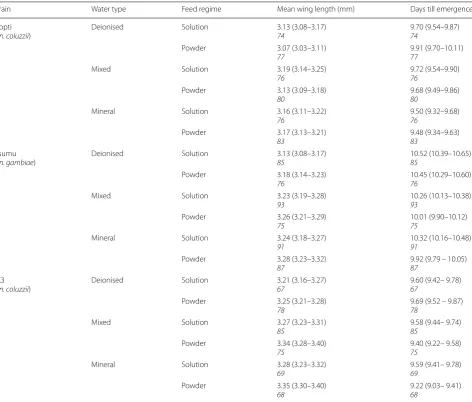
feed vs strain and sex vs water type (Table 5). Gener-ally, females had longer wing-length than males. How-ever, females from deionised water were significantly (P < 0.0001) smaller than those from mineral and mix water (Table 5). Similarly, males from deionised water had significantly shorter wing length compared to those from mineral water (Table 5). Post-hoc pairwise com-parisons (Tukeyʼs tests) revealed mineral water yielded the largest adults, followed by mix, with deionised water producing the smallest mosquitoes (Additional file 3: Table S3, Fig. 5). Adults that emerged from powder feed were significantly larger than those from solution feed (Fig. 6, Table 5). Amongst strains, VK3 adults were signif-icantly (P < 0.0001) the largest, then Kisumu, lastly Mopti
(Fig. 6, Additional file 3: Table S3). Powder feed impacted positively on adult size for VK3 and Kisumu strain but was not significant for Mopti (Fig. 6, Additional file 3: Table S3).
Development time in different water types and feed regimes
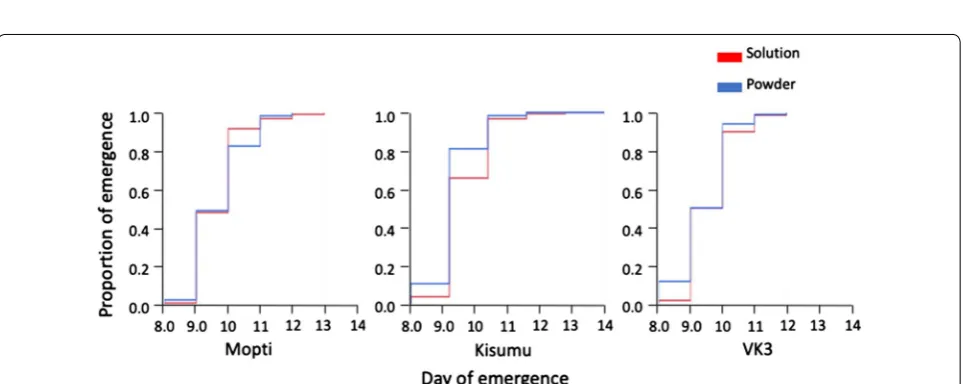
[image:6.595.64.537.100.502.2]Overall, the duration of development from first instar larvae to adults was significantly impacted for all strains by water source (Cox Proportional Hazard: P < 0.0001) (Table 6). Mosquito development was significantly longer in deionised water compared to mix and mineral water (P < 0.05) (Additional file 4: Table S4, Fig. 7). Develop-ment time was not significantly different between mix
Table 3 Effect of water types and feed on mosquito body size (wing length) and day of emergence
Notes: Ninety-five percent confidence intervals are in parentheses and the samples sizes, the number of surviving individuals out of an initial number of 100 larvae are italicized
Strain Water type Feed regime Mean wing length (mm) Days till emergence
Mopti
(An. coluzzii) Deionised Solution 3.13 (3.08–3.17)74 9.70 (9.54–9.87)74
Powder 3.07 (3.03–3.11)
77 9.91 (9.70–10.11)77
Mixed Solution 3.19 (3.14–3.25)
76 9.72 (9.54–9.90)76
Powder 3.13 (3.09–3.18)
80 9.68 (9.49–9.86)80
Mineral Solution 3.16 (3.11–3.22)
76 9.50 (9.32–9.68)76
Powder 3.17 (3.13–3.21)
83 9.48 (9.34–9.63)83
Kisumu
(An. gambiae) Deionised Solution 3.13 (3.08–3.17)85 10.52 (10.39–10.65)85
Powder 3.18 (3.14–3.23)
76 10.45 (10.29–10.60)76
Mixed Solution 3.23 (3.19–3.28)
93 10.26 (10.13–10.38)93
Powder 3.26 (3.21–3.29)
75 10.01 (9.90–10.12)75
Mineral Solution 3.24 (3.18–3.27)
91 10.32 (10.16–10.48)91
Powder 3.28 (3.23–3.32)
87 9.92 (9.79 – 10.05)87
VK3
(An. coluzzii) Deionised Solution 3.21 (3.16–3.27)67 9.60 (9.42– 9.78)67
Powder 3.25 (3.21–3.28)
78 9.69 (9.52 – 9.87)78
Mixed Solution 3.27 (3.23–3.31)
85 9.58 (9.44– 9.74)85
Powder 3.34 (3.28–3.40)
75 9.40 (9.22– 9.58)75
Mineral Solution 3.28 (3.23–3.32)
69 9.59 (9.41– 9.78)69
Powder 3.35 (3.30–3.40)
and mineral water (Additional file 4: Table S4, Fig. 7). Across all water types, development time was signifi-cantly (P < 0.0001) longer in Kisumu strain compared to Mopti and VK3 (Table 6, Fig. 7). Feed regime did not sig-nificantly impact development time (Fig. 8).
Discussion
[image:7.595.307.539.87.253.2]The results from this study show that mineral water and mixed water produced significantly larger mosquitoes compared to deionised water in the laboratory. This was true for all three strains, from the very old Kisumu strain to the recently-colonized VK3 colony. In mosqui-toes, environmental conditions at the larval stage deter-mine the size of the images [31] and larger body size is usually synonymous with higher phenotypic quality [31]. In An. gambiae (s.l.), optimal larval nutrition has been
Table 4 Logistic regressions of the overall effect of water types and feed regime on development
***P < 0.0001, **P < 0.001, P* < 0.05ns > 0.05 Abbreviation: df, degrees of freedom
Parameter Source df Likelihood ratio P-value
Larval survival Strain 2 86.74 < 0.0001***
Water type 2 6.41 0.0405*
Feed 1 1.88 0.1708ns
Feed vs Strain 2 7.32 0.0258*
Water type vs
Strain 4 12.92 0.0117*
Pupal mortality Strain 2 23.09 < 0.0001***
Water type 2 0.02 0.9898ns
Feed 1 1.22 0.2690ns
Feed vs Strain 2 5.62 0.0601 ns
Adult emergence Strain 2 25.61 < 0.0001***
Water type 2 4.11 0.1283ns
Feed 1 2.51 0.1129ns
Feed vs Strain 2 13.36 0.0013*
Water type vs
Strain 2 9.75 0.0448*
Fig. 1 Effect of water source on larval survival. The percentage larval survival in deionised (light grey), mixed (dark grey) and mineral (blue) is shown across three strains of mosquitoes (Mopti, Kisumu, VK3). Whiskers represent 95% confidence intervals. Within strains, bar plots sharing a letter are not significantly different, those with different letters are significantly different
Fig. 2 Effect of feed regimes on larval survival. The percentage larval survival for solution feed (light grey) and powder feed (dark grey) is shown for three mosquito strains (Mopti, Kisumu, VK3). Whiskers represent 95% confidence intervals. Within strains, bar plots sharing a letter are not significantly different, those with different letters are significantly different
[image:7.595.56.292.112.320.2] [image:7.595.301.542.347.506.2] [image:7.595.59.299.377.554.2]linked to female body size, fecundity and increased vec-torial capacity [32]. In males, body size has been directly linked to successful mating and longevity in the wild and in the laboratory [12]. Standardization of mosquito adult size and phenotypic quality during rearing is therefore essential to ensure the reproducibility and efficiency of vector control programmes relying on mosquito releases [33]. Therefore, the results of this study suggest that the use of mineral water in mosquito culture laboratories can play an important part in achieving adequate standards of mosquito phenotypic quality. This is relevant to small-scale rearing in mosquito insectaries and may prove cru-cial for mass rearing protocols for larger mosquito release control programmes.
Quality and delivery of larval diet has been shown to impact on mosquito size and development [34]. In this study, the powder diet resulted in improved mos-quito size, hence phenotypic quality, in two of the three strains studied, the Kisumu and VK3 strains. No signif-icant effect of larval diet in adult size was observed for the Mopti strain. Both the Mopti and VK3 strains are of the An. coluzzii sibling species which is thought to be more prone to bottom feeding to avoid predators [21, Fig. 4 Effect of feed regimes on adult emergence. The percentage
[image:8.595.58.295.87.282.2]adult emergence for solution (light grey), and powder (dark grey) feed regimes across three mosquito strains (Mopti, Kisumu and VK3). Whiskers represent 95% confidence intervals. Within strains, bar plots sharing a letter are not significantly different, those with different letters are significantly different
Table 5 General linear model of the effect of water types and feed regime on wing length
***P < 0.0001, **P < 0.001, P* < 0.05ns > 0.05 Abbreviation: df, degrees of freedom
Parameter Source df F-ratio P-value
Wing length Strain 2 60.08 < 0.0001***
Water type 2 26.07 < 0.0001***
Feed 1 7.17 0.0075*
Sex 1 146.50 < 0.0001***
Feed vs Strain 2 8.60 0.0002**
Sex vs Water type 2 4.23 0.0147*
Fig. 5 Effect of water source on wing-length. The mean wing-length for deionised (light grey), mixed (dark grey) and mineral water (blue) types for Mopti, Kisumu and VK3. Whiskers represent 95% confidence intervals. Within strains, bar plots sharing a letter are not significantly different, those with different letters are significantly different
[image:8.595.301.539.88.270.2] [image:8.595.308.539.348.519.2] [image:8.595.58.292.411.505.2]22]. Therefore, the contrasted responses to liquid feed of these two strains remains to be explained. Kisumu strain is a strain of An. gambiae, which is thought to prefer sur-face filter feeding [21]. In addition, it is a far older strain
which may have become better adapted to powder food because it is widely used in insectaries.
[image:9.595.56.291.101.160.2]The duration of the developmental cycle is another important parameter for mosquito rearing that is dependent on an optimal combination of feed quantity and quality, water type and ambient conditions [30]. An ideal culture timeline should be the shortest possible time required to produce good sized, long-lasting and viable mosquitoes that are able to compete with those in the wild [30]. Mineral water led to faster development, longer wing length, therefore, it stands out as the best option for improved mosquito culture. Deionised water on the other hand, had the longest developmental time and resulted in smaller mosquitoes. Small size females
Table 6 Cox Proportional-Hazard analyses on development time
***P < 0.0001, **P < 0.001, ns > 0.05 Abbreviation: df, degrees of freedom
Parameter Source df Likelihood ratio P-value
Day of emergence Strain 2 79.61 < 0.0001***
Water type 2 15.26 0.0005**
Feed 1 2.25 0.1337ns
Fig. 7 Effect of water source on development time. The mean development time for deionised (red), mixed (green) and mineral (blue) water types is shown for three mosquito strains, Mopti, Kisumu and VK3
[image:9.595.58.541.290.469.2] [image:9.595.58.540.504.696.2]have been reported to have higher mortality especially after a blood feed or do not produce viable eggs [30].
Although mineral water positively impacted larval sur-vival for Kisumu strain and had no effect on the Mopti strain, it seemed to negatively impact larval survival in the newly colonised VK3 strain. This effect might be a due to the fact that this strain is not yet adapted to the confinement conditions in the insectary or other factors. Of more importance, wing-length and development time was positively impacted by mineral water even for VK3 strain.
Mixed water and mineral water had similar impact on larval survival, adult emergence, wing length and devel-opment time despite the former having 50% less mineral content. Given that mineral water represents a significant cost, using mixed water is a cost-effective and sustainable option for mosquito rearing, especially in areas of water scarcity and with limited financial resources.
Ad-hoc tests revealed strong differences between the three species in how they responded to water source and feed type. Overall, An. gambiae (Kisumu) larvae survived significantly better than both An. coluzzii strains (Mopti and VK3). This higher larval survival of the An. gambiae
Kisumu strain may be the result of 39 years of selec-tion for insectary rearing compared to the Mopti strain of intermediate age and the young VK3 strain. The con-trasted age of colonization of the strains, whilst relevant for understanding adaptations to the laboratory, limited our ability to distinguish species-specific differences such as hardness tolerance and generally prevented inferences with regards to processes that associated to larval ecolog-ical speciation between the sibling species [5, 16–19, 22].
Conclusions
Based on the results of this study, the use of miner-alized or mixed water resulting in hardness (TDS 70.5–112.2 mg/l, salinity 47.5–75.8 ppm, conductivity 100.6–160.4 μS) is recommended for rearing An. coluzzii
and An. gambiae to ensure optimal qualitative yield. Powder feed is also recommended. Although the cost of mineral water may be an economic challenge in some settings, the results obtained show that a mix of mineral and deionised water produces a similar result as mineral water. Further research is needed to investigate if these gains are directly linked to mosquito longevity and fecun-dity as well as male competitiveness.
Additional files
Additional file 1: Table S1. Odds ratios for pairwise group comparisons of the effect of water types and feed on life-cycle stages.
Additional file 2: Table S2. Logistic regressions of the effect of water types and feed regime on life stages within strains.
Additional file 3: Table S3.Post-hoc following General linear model, Turkey’s pairwise differences on wing length.
Additional file 4: Table S4.Post-hoc analysis following proportional-hazards fit for development time.
Acknowledgements
The authors are grateful to all laboratory members of the Tripet Laboratory, Centre of Applied and Entomology and Parasitology, Keele University, UK, for their support during the study.
Funding
This work was funded by a PhD scholarship from Faculty for the Future fel-lowship, Schlumberger Foundation, The Hague, Netherlands and Niger Delta Development Commission, Nigeria to N.O.A.
Availability of data and raw materials
All datasets generated and/or analysed during this study are included in this published article and its additional files.
Authorsʼ contributions
Experiments were planned by FT and NOA, conducted by NOA, analysed by FT and NOA. AD contributed to experimental design and provided materials for the experiments. Manuscript was written by NOA and FT. All authors edited the manuscript. All authors read and approved the final manuscript.
Ethics approval and consent to participate Not applicable.
Consent for publication Not applicable.
Competing interests
The authors declare that they have no competing interests.
Publisher’s Note
Springer Nature remains neutral with regard to jurisdictional claims in pub-lished maps and institutional affiliations.
Author details
1 Centre for Applied Entomology and Parasitology, School of Life Sciences, Keele University, Staffordshire, UK. 2 Institut de Recherche en Sciences de la Santé, Bobo-Dioulasso, Burkina Faso.
Received: 19 July 2018 Accepted: 29 April 2019
References
1. WHO. World malaria report, 2017. Geneva: World Health Organization; 2017. https ://doi.org/10.1071/EC125 04.
2. Lees RS, Gilles JRL, Hendrichs J, Vreysen MJB, Bourtzis K. Back to the future: the sterile insect technique against mosquito disease vectors. Curr Opin Insect Sci. 2015;10:156–62.
3. Della Torre A, Costantini C, Besansky NJ, Caccone A, Petrarca V, Powell JR, et al. Speciation within Anopheles gambiae—the glass is half full. Science. 2002;298:115–7.
4. Aboagye-Antwi F, Alhafez N, Weedall GD, Brothwood J, Kandola S, Paton D, et al. Experimental swap of Anopheles gambiae’s assortative mating preferences demonstrates key role of X-chromosome divergence island in incipient sympatric speciation. PLoS Genet. 2015;11:e1005141. 5. Della Torre A, Tu Z, Petrarca V. On the distribution and genetic
•fast, convenient online submission •
thorough peer review by experienced researchers in your field • rapid publication on acceptance
• support for research data, including large and complex data types •
gold Open Access which fosters wider collaboration and increased citations maximum visibility for your research: over 100M website views per year •
At BMC, research is always in progress.
Learn more biomedcentral.com/submissions
Ready to submit your research? Choose BMC and benefit from: 6. Tripet F, Touré YT, Taylor CE, Norris DE, Dolo G, Lanzaro GC. DNA analysis
of transferred sperm reveals significant levels of gene flow between molecular forms of Anopheles gambiae. Mol Ecol. 2001;10:1725–32. 7. Diabaté A, Dabire RK, Kengne P, Brengues C, Baldet T, Ouari A, et al. Mixed swarms of the molecular M and S forms of Anopheles gambiae
(Diptera: Culicidae) in sympatric area from Burkina Faso. J Med Entomol. 2006;43:480–3.
8. Caputo B, Santolamazza F, Vicente JL, Nwakanma DC, Jawara M, Palsson K, et al. The ‘far-west’ of Anopheles gambiae molecular forms. PLoS ONE. 2011;6:e16415.
9. Lee Y, Marsden CD, Norris LC, Collier TC, Main BJ, Fofana A, et al. Spati-otemporal dynamics of gene flow and hybrid fitness between the M and S forms of the malaria mosquito, Anopheles gambiae. Proc Natl Acad Sci USA. 2013;110:19854–9.
10. Norris LC, Main BJ, Lee Y, Collier TC, Fofana A, Cornel AJ, et al. Adap-tive introgression in an African malaria mosquito coincident with the increased usage of insecticide-treated bed nets. Proc Natl Acad Sci USA. 2015;112:815–20.
11. Burt A. Heritable strategies for controlling insect vectors of disease. Philos Trans R Soc Lond B Biol Sci. 2014;369:20130432.
12. Diabate A, Tripet F. Targeting male mosquito mating behaviour for malaria control. Parasites Vectors. 2015;8:347.
13. Klassen W. Introduction: development of the sterile insect technique for African malaria vectors. Malar J. 2009;8(Suppl. 2):I1.
14. Subra R. Biology and control of Culex pipiens quinquefasciatus Say, 1823 (Diptera, Culicidae) with special reference to Africa. Int J Trop Insect Sci. 1981;1:319–38.
15. Tene Fossog B, Antonio-Nkondjio C, Kengne P, Njiokou F, Besansky NJ, Costantini C. Physiological correlates of ecological divergence along an urbanization gradient: differential tolerance to ammonia among molecular forms of the malaria mosquito Anopheles gambiae. BMC Ecol. 2013;13:1.
16. Kamdem C, Tene Fossog B, Simard F, Etouna J, Ndo C, Kengne P, et al. Anthropogenic habitat disturbance and ecological divergence between incipient species of the malaria mosquito Anopheles gambiae. PLoS ONE. 2012;7:e39645.
17. Diabaté A, Dao A, Yaro AS, Adamou A, Gonzalez R, Manoukis NC, et al. Spatial swarm segregation and reproductive isolation between the molecular forms of Anopheles gambiae. Proc R Soc Lond B Biol Sci. 2009;276:4215–22.
18. Edillo FE, Tripét F, Touré YT, Lanzaro GC, Dolo G, Taylor CE. Water quality and immatures of the M and S forms of Anopheles gambiae s.s. and An. arabiensis in a Malian village. Malar J. 2006;5:35.
19. Lehmann T, Diabate A. The molecular forms of Anopheles gambiae: a phenotypic perspective. Infect Genet Evol. 2008;8:737–46.
20. Coetzee M, Hunt RH, Wilkerson R, Della Torre A, Coulibaly MB, Besansky NJ. Anopheles coluzzii and Anopheles amharicus, new members of the
Anopheles gambiae complex. Zootaxa. 2013;3619:246–74.
21. Gimonneau G, Bouyer J, Morand S, Besansky NJ, Diabate A, Simard F. A behavioral mechanism underlying ecological divergence in the malaria mosquito Anopheles gambiae. Behav Ecol. 2010;21:1087–92.
22. Mattah PAD, Futagbi G, Amekudzi LK, Mattah MM, De Souza DK, Kartey-Attipoe WD, et al. Diversity in breeding sites and distribution of Anopheles
mosquitoes in selected urban areas of southern Ghana. Parasites Vectors. 2017;10:25.
23. Yahouédo GA, Djogbénou L, Saïzonou J, Assogba BS, Makoutodé M, Gilles JRL, et al. Effect of three larval diets on larval development and male sex-ual performance of Anopheles gambiae s.s. Acta Trop. 2014;132:S96–101. 24. Faeza N, Webb CE, Russell RC. The importance of males: larval diet and
adult sugar feeding influences reproduction in Culex molestus. J Am Mosq Control Assoc. 2012;28:312–6.
25. Takken W, Klowden MJ, Chambers GM. Effect of body size on host seeking and blood meal utilization in Anopheles gambiae sensu stricto
(Diptera: Culicidae): the disadvantage of being small. J Med Entomol. 1998;35:639–45.
26. Baeshen R, Ekechukwu NE, Toure M, Paton D, Coulibaly M, Traoré SF, et al. Differential effects of inbreeding and selection on male reproductive phenotype associated with the colonization and laboratory maintenance of Anopheles gambiae. Malar J. 2014;13:19.
27. Ekechukwu NE, Baeshen R, Traorè SF, Coulibaly M, Diabate A, Catteruccia F, et al. Heterosis increases fertility, fecundity, and survival of laboratory-produced F1 hybrid males of the malaria mosquito Anopheles coluzzii. G3 (Bethesda). 2015;5:2693–709.
28. Rubenowitz-Lundin E, Hiscock KM. Water hardness and health effects. In: Essentials of medical geology. Dordrecht: Springer; 2013. p. 337–50. 29. Koella JC, Lyimo EO. Variability in the relationship between weight and
wing length of Anopheles gambiae. J Med Entomol. 1996;33:261–4. 30. Araújo MS, Gil LHS. Larval food quantity affects development time,
survival and adult biological traits that influence the vectorial capacity of
Anopheles darlingi under laboratory conditions. Malar J. 2012;11:261. 31. Aboagye-Antwi F, Tripet F. Effects of larval growth condition and water
availability on desiccation resistance and its physiological basis in adult
Anopheles gambiae sensu stricto. Malar J. 2010;9:225.
32. Takken W, Smallegange RC, Vigneau AJ, Johnston V, Brown M, Mordue-Luntz AJ, et al. Larval nutrition differentially affects adult fitness and
Plasmodium development in the malaria vectors Anopheles gambiae and
Anopheles stephensi. Parasites Vectors. 2013;6:345.
33. Valerio L, Matilda Collins C, Lees RS, Benedict MQ. Benchmarking vector arthropod culture: an example using the African malaria mosquito,
Anopheles gambiae (Diptera: Culicidae). Malar J. 2016;15:262. 34. Linenberg I, Chri GK, Gendrin M. Larval diet affects mosquito