COMPARING THE EFFICACY OF OPEN CHAIN EXERCISE
VERSUS CLOSED CHAIN EXERCISE IN REDUCING PAIN
AND IMPROVING THE FUNCTIONAL STATUS IN PATIENTS
WITH ROTATOR CUFF TENDINOPATHY
Dissertation submitted
in partial fulfillment
For the degree of
MASTER OF PHYSIOTHERAPY
(ORTHOPAEDICS)
The Tamil Nadu Dr.M.G.R Medical University
Chennai
May 2018
PSG COLLEGE OF PHYSIOTHERAPY
PSG COLLEGE OF PHYSIOTHERAPY
Coimbatore
CERTIF ICATE
This is to certify that the research work entitled
“COMPARING THE
EFFICACY
OF
OPEN
CHAIN
EXERCISE
VERSUS
CLOSED
CHAINEXERCISE
IN
REDUCING PAIN
AND
IMPROVING
THE
FUNCTIONAL
STATUS
IN
PATIENTS
WITH
ROTATOR
CUFF
TENDINOPATHY”
was carried out by
Reg.No:271610241
, P.S.G College of
Physiotherapy, towards partial fulfillment of the requirements of the
MASTER OF
PHYSIOTHERAPY (Physiotherapy in Orthopedics)
degree programme of The
Tamil Nadu Dr. M.G.R Medical University, Chennai.
Internal examiner
External examiner
PSG COLLEGE OF PHYSIOTHERAPY
Coimbatore
CERTIF ICATE
This is to certify that the research work entitled
“COMPARING THE
EFFICACY
OF
OPEN
CHAIN
EXERCISE
VERSUS
CLOSED
CHAINEXERCISE
IN
REDUCING PAIN
AND
IMPROVING
THE
FUNCTIONAL
STATUS
IN
PATIENTS
WITH
ROTATOR
CUFF
TENDINOPATHY.”
was carried out by
Reg.No: 271610241
, P.S.G College of
Physiotherapy, towards partial fulfillment for the degree of the
MASTER OF
PHYSIOTHERAPY (Physiotherapy in Orthopedics)
affiliated to The Tamil Nadu
Dr. MGR Medical University, Chennai.
Prof. R. MAHESH, MPT,
PRINCIPAL,
P.S.G. College of Physiotherapy,
Coimbatore - 641 004
PSG COLLEGE OF PHYSIOTHERAPY
Coimbatore
CERTIF ICATE
This is to certify that the dissertation work entitled
“COMPARING THE EFFICACY
OF OPEN CHAIN EXERCISE VERSUS CLOSED CHAINEXERCISE IN
REDUCING PAIN AND IMPROVING THE FUNCTIONAL STATUS IN
PATIENTS WITH ROTATOR CUFF TENDINOPATHY”
was carried out by
AJITHA.C.T, Reg.No: 271610241
,of P.S.G. College of Physiotherapy, Coimbatore,
affiliated to The Tamil Nadu Dr. M.G.R. Medical University, Chennai, under our
guidance.
GUIDE CO-GUIDE
Prof. R. MAHESH, MPT, Mr. B. Nagaraj, MPT,
Principal, Assistant professor
P.S.G. College of Physiotherapy, P.S.G. College of Physiotherapy
Coimbatore - 641 004. Coimbatore - 641 004.
ACKNOWLEDGEMENTS
It is my privilege to express my deep sense of gratitude to the
HEAVENLY
FATHER, JESUS CHRIST AND HOLY SPIRIT
for showering his blessings, who
has always been my source of strength and who guides me throughout.
I dedicate this study to
my family, my dear brothers
for providing their moral
support and love in each and every step of my life.
With due respect, I would like to express my immense gratitude to
Professor
R.Mahesh, MPT,
PSG College of Physiotherapy, Coimbatore, for his
encouragement and inspiration during the course of my study.
I am very grateful to
Dr. V. Ramamoorthy, MD.,
Professor and HOD,
Department of PMR,
DR. B.K. DinakarRai, M.S.,
Professor and HOD,
Department of orthopedics & orthopedic surgery, PSG hospitals, Coimbatore for
his encouragement, kind, calm, and patient help throughout the study.
I am thankful to my project guides
Mr. R.Mahesh, MPT
and
Mr. B.Nagaraj,
MPT
for his encouragement and inspiration given throughout the study.
I am indebted to
Mr. B.Nagaraj, MPT
for his expert guidance, valuable ideas,
and untiring efforts without whom the study would have not been completed.
My special thanks to
Mrs. V.Mahalakshmi, MPT
, Post graduate Coordinator,
PSG College of physiotherapy who has molded me in my academics activities and
made my project completion easier.
I express my gratitude to
Mrs. Y. Ashraf, MPT, Ms. P.Shanmugapriya,
MPT,
Mr. J. Raja Regan, MPT, Mr. M. Mahendiran
,
MPT,
Mr. Saravanan.K, MPT, Mrs. SweetySubha, MPT, Mrs. Malarvizhi, MPT
My special thanks to
Dr. Anil Mathew Ph.D, Professor,
Department of
Biostatistics, PSG Institute of Medical Science and Research who gave me a helping
hand in statistical method of data analysis.
My special thanks to
Dr. N.Ramkumar, MBA., Ph.D, Assistant
Professor
, Faculty of Human Resource, PSG Institute of management, Coimbatore
for his guidance in research and statistical method of data analysis.
I thank all the member of
Institutional review committee of research,
College
of Physiotherapy and
Institutional Human Ethics Committee
of PSG Institute of
Medical Science and Research for their kind suggestions to complete the dissertation.
I also thank all the staff members of the PSG College of Physiotherapy and
Department of Physiotherapy for helping me to complete this project successfully.
And also I thank to
My Friends, Colleagues
,
seniors and juniors
for
sharing their knowledge, love, support and exclusive cooperation.
ABBREVIATIONS
SIS
-
Shoulder Impingement Syndrome
RC
-
Rotator Cuff
OCE
-
Open Chain Exercise
CCE
-
Closed Chain Exercise
VAS
-
Visual Analogue Scale
WORC
-
Western Ontario Rotator Cuff Index
CONTENTS
CHAPTER TITLE PAGE NO
I INTRODUCTION 1
1.1 Need for the Study 5 1.2 Objective 5 1.3 Hypothesis 5 1.4 Operational Definitions 6
1.5 Projected Outcome 6
II LITERATURE REVIEW 7
III MATERIALS AND METHODOLOGY 12
3.1 Materials 12 3.2 Study Design 12
3.3 Study Setting 12
3.4 Human Participant Protection 12
3.5 Population / Participant 13
3.6 Sampling 13
3.7 Criteria for Sample Selection 13
3.7.1 Inclusion Criteria 13
3.7.2 Exclusion Criteria 13
3.8 Study Duration 14
3.9 Treatment Duration 14
3.10 Intervention 14
3.11 Instrument and Tool for Data Collection 16
3.12 Techniques of Data Analysis and Interpretation 17
3.13 Technique of Data Collection 17
IV STATSTICAL ANALYSIS AND INTERPRETATION 20
V RESULTS AND DISCUSSION 35 5.1 Limitations 37 5.2 Suggestion for Future Research 37 VI SUMMARY AND CONCLUSION 39
BIBLIOGRAPHY 40
ANNEXURE
LIST OF ANNEXURES
Annexure
Content
I
Ethical Committee Clearance Letter
II
Assessment form
III
Informed Consent (English and Tamil)
IV
Outcome measures (English and Tamil)
V Treatment Protocol
1
CHAP TER-I
INTRODUCTION
Shoulder pain is the third most common musculoskeletal complaint encountered in
clinical practice[1]. Prevalence studies indicate that 16 to 34 percent of the general popula tion suffers from shoulder pain. In working populations, the incidence of shoulder-related symptoms
may be as high as 14 to 18 percent [2].
One of the most common causes of shoulder pain is rotator cuff (RC) tendinopathy /shoulder impingement syndrome (SIS)[3]. The syndrome has been described by Neer as impingement of the rotator cuff tendons against the anterior edge and undersurface of the
anterior third of the acromion, the coracoacromial ligament, and at times the
2
Tendons are interposed between muscles and bones, and transmit the force created in the
muscle to the bone which, in turn, enables joint movement[4]. Tendinopathy is a term usually used for all pain conditions in and around the tendon. The causes of the tendinopathies include,
both the intrinsic (anatomical variants and alterations, muscle tightness/imbalance/weakness, nutrition, age, joint laxity, systemic disease, vascular perfusion, overweight and all conditions
linked to apoptosis) and the extrinsic factors (occupation, physical load and overuse, technical
errors, inadequate equipment and environmental conditions) which is contributing to the pathologic processes.[5-7]
Excessive mechanical loading is considered the major cause of rotator cuff tendinopathy.
Tendon injuries in the shoulder account for overuse injuries in sports as well as in jobs that require repetitive activity. Although tendon problems are very frequent, they are not always easy
to manage[8]. Lesions of the rotator cuff typically start where the loads are presumably the greatest at the deep surface of the anterior insertion of the supraspinatus.[9] In absence of a total tear, when the repetitive load exceeds the healing capacity of the tenocyte (overuse), the
tendinopathy occurs.[10]
Overuse may cause damage at both the micro and the macrovasculature[11]. Impaired metabolic activity including disturbed oxygen transport is likely to be detrimental to molecular
cross- linking and tissue repair. The ageing tendon is characterized by a low rate of metabolism, a
progressive decrease in elasticity and tensile strength and a decreasing tendon blood flow; thus,
age would be regarded as an important predisposing factor in the occurrence of tendinopathy [12]. In most cases, the tendon involved shows no signs of inflammation but instead shows
fibroblasts, vascular hyperplasia, hyper cellularity, and disorganized collagen [13]. The rotator cuff consistently show both weakness and muscular imbalance of the external and internal
rotator muscles on the injured extremity in patients with rotator cuff impingement and glenohumeral joint instability[14].
Chronic pain or repeated tendinopathies could result from the absence of consensus in
3
Research has demonstrated moderate evidence for exercise in the treatment of rotator cuff (RC) tendinopathy. This evidence has primarily addressed traditional concentric-eccentric
resistance training with a lack of rationale for selection of contraction type, dosage, or
progression of resistance. Recent literature has suggested that patients with tendinopathies
respond well to eccentric training[15].
Eccentric strength training, first introduced in 1984 by Stanish et al., have been used
successfully to treat tendinopathies for many years[1].Eccentric training has been proposed as an effective conservative treatment for the Achilles and patellar tendinopathies[8]. Histological changes in the supraspinatus tendon have been found to have similarities with those of the
4
Three basic principles in an eccentric loading regime have been proposed[16].
(1) Length of tendon: the tendon length increases when the tendon is pre-stretched, and
less strain will happen on that tendon during movement
(2) Load: the strength of the tendon should increase by progressively increasing the load
exerted on the tendon
(3) Speed: by increasing the speed of contraction, a greater force will be developed.
It has been suggested that eccentric exercises expose the tendon to a greater load than
concentric exercises[17]. So, the prescription of an eccentric exercise program could be the best mechanism for strengthening the tendon[18].
First bout of eccentric training could result in damage, including muscle pain,
inflammation, cellular and subcellular alterations, force loss, blood markers of muscle damage[19]. The damage of eccentric contractions is related to a “mechanical insult”, because as muscle lengthens, the ability to generate tension increases and a higher load is distributed among the same number of fibers, resulting in a higher load per fiber ratio and, curiously, a lower
muscle activity[20]
The use of open chain exercise, initially in the modified base position, which is
characterized by the glenohumeral joint elevated 20–30° in the scapular plane position[21-22] and progressing to 90° abducted training, has been shown to increase multiple parameters of muscle
function[23-24] and also to improve functional performance.
Closed kinetic chain exercises promote cocontraction of rotator cuff musculature which decreases glenohumeral translation at various levels of elevation. Early in the rehabilitation
process, closed kinetic chain exercises promote safe, functional co-contractions and can
5
1.1 NEED FOR THE STUDY
Eccentric training has been proposed as an effective conservative treatment for the
Achilles and patellar tendinopathies, but less evidence exists about its effectiveness for the
rotator cuff tendinopathy[8].Open chain and closed chain exercises seem to be effective in bringing about short term changes in pain and disability in patients with rotator cuff tendinopathy[3].
But there is lack of evidence on the effect of eccentric training combined with open chain exercise versus eccentric training combined with closed chain exercise in individual with the
rotator cuff tendinopathy. So this study is sought to “Compare the efficacy of open chain
exercise versus closed chain exercise in reducing pain and improving the functional status
in patients with rotator cuff tendinopathy”.
1.2 OBJECTIVE
1. To determine the effects of open chain exercise along with eccentric training in reducing
pain and improving functional status in patients with rotator cuff tendinopathy.
2. To determine the effects of closed chain exercise along with eccentric training in
reducing pain and improving functional status in patients with rotator cuff tendinopathy.
3. To compare the effectiveness of open chain exercise versus closed chain exercise in reducing pain and improving functional status in patients with rotator cuff tendinopathy .
1.3 HYPOTHESIS
Null hypothesis: There will be no significant difference in pain reduction and functional
improvement in patients with rotator cuff tendinopathy between the groups.
Alte rnative hypothesis: There will be a significant difference in pain reduction and
6
1.4 OPERATIONAL DEFINITION:
Tendinopathy
Tendinopathy is a failed healing response of the tendon, with proliferation of tenocytes,
intracellular abnormalities in tenocytes, disruption of collagen fiber, and a subsequent increase in
the non-collagenous matrix. The term tendinopathy is a generic descriptor of the clinical condition including both pain and pathological characteristics associated with overuse in and
around tendons.[26]
Eccentric training
The eccentric exercise is the contraction of a muscle for controlling or decelerating a load
while the muscle and the tendon are stretching or remain stretched.[27] The tension in muscle fibers when lengthening is considerably greater than when muscle fibers are shortening it can help the healing of the tendon by changing its metabolism and their structural and mechanical
properties[28].
Open kinetic chain exercise
An open kinetic chain is defined as “a combination of successively arranged joints in which the terminal segments can move freely”.
Closed kinetic chain exercise
Closed Kinetic Chain (CKC) exercises or closed chain exercises are exercises or movements where the distal aspect of the extremity is fixed to an object that is stationary. With
the distal part fixed, movement at any one joint in the kinetic chain requires motion as well at the
other joints in the kinetic chain therefore, both proximal and distal parts receive resistance
training at the same time.
1.5 PROJECTED OUTCOME
Relaying on the literature review, it is expected that both open chain exercise and closed
chain exercise along with eccentric training will reduce pain and improve the functional status in
7
CHAP TER – II
REVIEW OF LITERATURE
Stuart R Heron et al (2016) conducted a randomised cross-over trial Comparing three types
of exercise in the treatment of 120 patients with rotator cuff tendinopathy/shoulder
impingement syndrome. Shoulder Pain and Disability Index (SPADI) was used. The outcome was measured at baseline and six weeks after commencing treatment. They concluded that
Open chain, closed chain and range of movement exercises all seem to be effective in
bringing about short term changes in pain and disability in patients with rotator cuff
tendinopathy.
Nikos V. Margaritelis et al (2015) this study is to challenge the repeated bout effect always appears after few eccentric exercise sessions, by exploiting specificity in muscle plasticity.
Seventeen young men were randomly assigned into one of the following groups: the
alternating eccentric-concentric exercise group; and the eccentric-only exercise group. Both groups performed 8 weeks of resistance exercise using the knee extensors of both legs on an
isokinetic dynamometer. The study concluded that muscle strength was elevated similarly for
both alternating and eccentric-only exercise groups after 13 weeks of training. The
alternating eccentric-concentric exercise scheme, implemented in the present study, has for
the first time successfully overcame the repeated bout effect. The similarity in muscle strength measurements following the two protocols is against the notion that inflammation
plays an important role in exercise- induced adaptations in muscle.
Christiana lynneblume (2014) conducted a study to compare the effectiveness of an
eccentric progressive resistance exercise (PRE) intervention to a concentric PRE intervention
in adults with SAIS, to determine if five or eight weeks of intervention was adequate to
achieve significant changes in the shoulder outcome measures and to examine the
correlations between the DASH and the physical measures of shoulder AROM and strength.
The findings of this study indicate that supervised PRE both concentric and ecce ntric
8
Paula R Camargo, Francisco Alburque rque -Sendín et al (2014) conducted asystemic
review on “Eccentric training as a new approach for rotator cuff tendinopathy” concluded
that the eccentric training should be used aiming improvement of the tendon degeneration,
and usual stretching and strengthening exercises associated with manual therapy techniques should be used to restore kinematics and muscle activity.
Adilson J. Meneghel (2013) the present review addresses the issue by bringing up to date
information about the protective effect to physical exercise when performed by untrained
and trained populations. The data indicate that there is a reduction in the magnitude of
indirect markers of muscle damage when the trained population conducts repeated exercise
sessions compared to untrained and/or sedentary individuals. Among the adaptive responses
involved, the neural theory appears to be the main mechanism involved in mitigating the
indirect markers of muscle damage.
Jeong-Il Kang, Young-Jun Moon et al conducted the study to find the effect on activities,
shoulder muscle fatigue, upper limb disability of two exercise types performed by patients in the post- immobilization period of rotator cuff repair. The intervention program was
performed by 20 patients from 6 weeks after rotator cuff repair. Ten subjects each were
randomly allocated to a group performing open kinetic chain exercise and a group
preforming closed kinetic chain exercise. Muscle activity and median frequency were
measured by using sEMG and the Upper Extremity Functio n Assessment before and after conducting the intervention .The Median power frequencies of all these muscles after closed
kinetic chain exercise increased indicating that muscle fatigue decreased. Therefore, research into exercise programs using closed kinetic chain exercises will be needed to establish
exercise methods for reducing muscle fatigue.
Philip W McClure, Jason Bialker et al the purpose of this study was to identify changes
that might occur in 3-dimensional scapular kinematics, physical impairments, and functional
limitations. Fifty- nine patients with impingement syndrome were recruited, and 39 patients
successfully completed the 6-week rehabilitation program and follow- up testing. Pain, satisfaction, and function were measured using the University of Pennsylvania Shoulder
9
also were collected. Subjects were given a progressive exercise program that included
resistive strengthening, stretching, and postural exercises that were done daily at home. The
study concluded that the exercise protocol in the management of shoulder impingement
syndrome may have a positive impact on patients‟ impairments and functional limitations.
F. Struyf, J. Nijs et al (2012) conducted a study on scapular- focused treatment in patients
with shoulder impingement syndrome: a randomized clinical trial. The purpose of this
clinical trial is to compare the effectiveness of a scapular- focused treatment with a control
therapy in patients with shoulder impingement syndrome. 22 patients with shoulder
impingement syndrome were selected. The primary outcome meas ures included self-reported
shoulder disability and pain. The scapular-focused treatment included stretching and scapular
motor control training. The control therapy included stretching, muscle friction, and eccentric
rotator cuff training. Main outcome measures were the shoulder disability questionnaire,
diagnostic tests for shoulder impingement syndrome, clinical tests for scapular positioning, shoulder pain (visual analog scale; VAS), and muscle strength.
John McMullen, Timothy L. Uhl, et al introduced an approach to rehabilitate shoulder under the topic “A Kinetic Chain Approach for Shoulder Rehabilitation” that integrates the
kinetic chain throughout the rehabilitation. They narrated that the exercises in this approach
are consistent with biomechanical models, apply biomechanical and motor control theory,
and work toward sport specificity. The exercises are designed to stimulate weakened tissue by motion and force production in the adjacent kinetic link segments. The paradigm of
kinetic chain shoulder rehabilitation suggests that functional movement patterns and closed kinetic chain exercises should be incorporated throughout the rehabilitation process.
Salvador Israel Macías-Hernández and Luis Enrique Pére z-Ramíre z conducted a study
to present the overview of the efficacy of eccentric training in tendinopathies and current
evidence of its benefit in rotator cuff tear. Four studies published on eccentric strengthening
for rotator cuff tears were analyzed. There is theoretical evidence abo ut its usefulness in this
10
better methodological designs in order to generate evidence of their utility and
recommendation.
Paula R. Camargo et al (2012) conducted a study to evaluate the effects of eccentric
training for shoulder abductors on pain, function, and isokinetic performance during
concentric and eccentric abduction of the shoulder in subjects with SIS. Twenty subjects with
unilateral SIS were selected. Bilateral isokinetic eccentric training for shoulder abductors was performed for six consecutive weeks, twice a week, on alternate days. The Disabilities of the
Arm, Shoulder and Hand (DASH) questionnaire was used to evaluate functional status and
symptoms of the upper limbs. This study suggests that isokinetic eccentric training for
shoulder abductors improves physical function of the upper limbs in subjects with SIS.
Aaron Sciascia and Robin Cromwell (2012) purpose of this paper is to present a theoretical
framework which focuses on maximizing kinetic chain utilization and output, accomplished through improving flexibility of all involved joints and soft tissue, strengthening the lower
extremity and core musculature, optimizing scapular control, and improving muscular
endurance of persons experiencing shoulder pain. The study concluded that rehabilitation of the throwing athlete‟s shoulder should follow a kinetic chain-based regimen that addresses specific deficits within individual links which can aid in restoring the natural proximal to
distal muscle activation sequencing.
Susanne Bernhardsson et al (2011) conducted a study to evaluate the effect on pain
intensity and function of an exercise concept focusing on specific eccentric strength of the
rotator cuff which is a home-based training programme supervised and supported by visits to physiotherapy clinic in 10 patients with subacromial impingement syndrome. The outcome
was measured using visual analogue scale, Patient-Specific Functional Scale and Western
Ontario Rotator Cuff Index. They concluded that a 12-week eccentric strengthening
programme targeting the rotator cuff and incorporating scapular control and correct
11
Todd S Ellenbecker, Ann Cools (2010) the purpose of this article is to present an
evidence-based review of the key treatment strategies to rehabilitate and restore shoulder function of
the athlete with rotator cuff impingement. The study concluded that the integration of key
physical examination techniques with evidence-driven rehabilitation concepts to restore optimal ROM and rotator cuff and scapular strength and stabilization forms the basis of
clinical rehabilitation of the athlete with rotator cuff impingement.
M Roiget al (2008) this systematic review with meta analysis was conducted to determine if
eccentric exercise is superior to concentric exercise in stimulating gains in muscle strength
and mass. Twenty randomized controlled trial studies met the inclusion criteria.
Meta-analyses showed that when eccentric exercise was performed at higher intensities compared
with concentric training, total strength and eccentric strength increased more significantly. The study concluded that Eccentric training performed at high intensities was shown to be
more effective in promoting increases in muscle mass measured as muscle girth.
Anne M. Boonstra, et al (2008) conducted a study to determine the reliability and
concurrent validity of a visual analogue scale (VAS) for disability as a single- item instrument
measuring disability in chronic pain patients was the objective of the study. Concluded that
reliability of the VAS for disability in patients with chronic musculoskeletal pain is good.
Andre´aDiniz Lopes, et al (2008) this study is to evaluate the validity and re liability of the
Brazilian Portuguese version of the Western Ontario Rotator Cuff Index. Concluded that Brazilian version of the WORC proved to be a valid and reliable measurement tool for
12
CHAP TER III
MATERIALS AND METHODS
3.1 MATERIALS:
1. Theraband 2. Weight cuffs 3. Ball4. Mat
5. Armed chair
6. WORC questionnaire 7. Pamphlets
3.2 STUDY DESIGN:
Randomized clinical trial study design.
The subjects are randomly allocated into 2 groups (Group A and Group B) by Co mputer
generated random numbers.
The assessment was taken for all the participants before training session and after the end
of fourth week for statistical analysis and pretest values of both groups were compared with
posttest values in selected parameters over a period of time.
3.3 STUDY SETTING:
The study was conducted in the Department of Orthopedics& Department of Physical Medicine and Rehabilitation, PSG hospitals, Coimbatore.
3.4 HUMAN PARTICIPATION PROTECTION:
The study was reviewed and approved by institutional human ethics committee at PSG
13
3.5 POPULATION/PARTICIPANTS:
30 individuals with rotator cuff tendinopathy, age group ranging from 30-60 years were participated. Based on the selection criteria 15 individuals were randomly assigned into each
groups using computer generated randomization method.
Group A: open chain exercise with eccentric training
Group B: closed chain exercise with eccentric training
The above 2 groups will receive warm up, eccentric training and cool down exercise.
3.6 SAMPLING:
Computer based randomized sampling method
3.7 CRITERIA FOR SAMPLE SELECTION
3.7.1
Inclusion criteria:
Age: 30-60years
Shoulder pain for at least 3 months.
3 positive out of 5 following diagnostic test
o Neers impingement test
o Hawkin kennedy impingement test
o Jobes suprespinatus test
o Painful arc between 60-120° during active abduction.
o Tenderness on palpation over supraspinatus or infraspinatus insertio n.
3.7.2 Exclusion Criteria:
Complete tendon rupture
Substantial radiating neck pain
Chronic rheumatic or inflammatory disease
Previous surgery of the affected shoulder
Instability of the shoulder
Osteoarthritis in the acromio-clavicular joint
Adhesive capsulitis
14
3.8 STUDY DURATION:-
Total duration of 8 months was adopted for this study.
3.9 TREATMENT DURATION:
-
3days /week for 4 week
2 sessions per day
45 minutes per session
3.10 INTERVENTION
Based on Stuart R. heron et al the protocol consists of 3 phases of exercise for both the groups. The 3 phases of exercise include: a warm-up phase, a work phase and a cool down phase
with relaxation activities. The sessions last approximately 45 min, and the loads are adapted to
the possibilities of the subjects to avoid fatigue. A total of 12 sessions are prescribed, on alternate
days, 3 times a week for four weeks[3]. The distributions of the intervention in the groups and the weekly progression are shown in the Tables below.
The emphasis and relative success of these exercise programmes for the rotator cuff tendinopathy has been outlined in “Rehabilitation of shoulder impingement syndrome and rotator
cuff injuries: an evidence-based review by Todd S Ellenbecker et al. The weekly progression of
15
Exercise protocol
Treatment duration -45 minutes
GROUP-A GROUP-B
10 MINUTES-WARM UP EXERCISE
Shoulder shrugs Shoulder bracing Shoulder circles Trapezius stretching Pectoralis stretching
20 MINUTES OPEN CHAIN EXERCISE
Shoulder abduction using theraband Shoulder external rotation using theraband
10 MINUTES ECCENTRIC TRAINING
Shoulder abduction using weights Shoulder external rotation using weights Rolling ball on the wall
5 MINUTES OF COOL DOWN PERIOD
Shoulder shrugs
Shoulder bracing exercise Shoulder circles
10 MINUTES WARM UP EXERCISE
Shoulder shrugs Shoulder bracing Shoulder circles Trapezius stretching Pectoralis stretching
20 MINUTES CLOSED CHAIN EXERCISE
Wall press up
Press up in 4 point kneeling Press up in sitting
10 MINUTES ECCENTRIC TRAINING
Shoulder abduction using weights Shoulder external rotation using weights Rolling ball on the wall
5 MINUTES OF COOL DOWN PERIOD
Shoulder shrugs
16
Weekly progression of exercises
WEEK-1 WEEK-2 WEEK-3 WEEK-4
OPEN
CHAIN
EXERCISE
Degree of motion-
0o to 30-45o
Degree of motion-
0o to 30-45o
Degree of
motion- 0o to full available range
Degree of
motion- 0o to full available range
1 set of 10
repetition
1 set of 15
repetition
2 set of 10
repetition
2 set of 15
repetition
2 sessions per day 2 sessions per day 2 sessions per
day
2 sessions per
day
CLOSED
CHAIN
EXERCISE
Using both the
hands during
exercise
Using both the
hands during
exercise
Using only the
affected hands
during exercise
Using only the
affected hands
during exercise
1set of 10
repetition
1set of 15
repetition
2 set of 10
repetition
2 set of 15
repetition
2 sessions per day 2 sessions per day 2 sessions per
day
2 sessions per
day
3.11 INSTRUMENT& TOOL FOR DATA COLLECTION:
Visual analogue scale[VAS]
17
3.12 TECHNIQUE OF DATA COLLECTION:
Initial assessment was taken on the first day of intervention by using outcome measures.
After obtaining the informed consent form, the Intervention was given to each group separately
for 4 weeks. Final assessment was taken after the 4 weeks of exercise therapy treatment using
same outcome measures. Comparison of pretest and posttest values within the group and
between the groups was done finally.
3.13 TECHNIQUE OF DATA ANALYSIS &INTERPRETATION:
Data collected from subjects were analyzed using paired„t‟ test to measure changes between pretest and posttest values of outcome measures within the group. Independent„t‟ test
was used to measure the changes between the groups.
Paired „t‟ test
= Calculated Mean Difference of pretest and posttest values
SD = Standard Deviation
n = Number of samples
d = Difference between pretest and posttest values d
1 )
( 2
n d d SD
18 2 n n 1)SD -(n 1)SD -(n SD Where, n 1 n 1 | x x | t 2 1 2 2 2 2 1 1 2 1 2 1 SD
Independent „t‟ test
X1 = Mean difference in Group A
X2 = Mean difference in Group B
SD = Combined standard deviation of Group A and Group B
n1 = Number of patients in Group A
n2 = Number of patients in Group B
SD1 = Standard Deviation of Group A
19
SCHEMATIC REPRESENTATION OF FLOW OF PARTICIPANTS
Individuals with Rotator cuff tendinopathy
Patient selection
(inclusion & exclusion criteria)
Consent form Group allocation
(simple random sampling)
Group B
[closed chain exercise]
n=15 Group A
[Open chain exercise]
n=15
Pretreatment assessment
Measure ment tools :
Western Ontario rotator cuff index Visual analog scale
Each individual receive 24 treatment sessions (2 sessions /day , 3 days a week for 4 weeks)
Post treatment assessment
(Same measure ment tools used)
Data Analysis
Results Drop out from Group
A 1 [n=14]
20
CHAP TER - IV
STATISTICAL ANALYSIS AND INTERPRETATION
Data analysis is the systemic organization and synthesis of research data and testing of research hypothesis using these data. Interpretation is the process of making sense of the results
of a study and examining the implication (Polit & Belt, 2004). The pretest and posttest values for Groups A& B were obtained before and after intervention. The pain reduction and improvement
in functional status was measured using Visual analogue scale [VAS], Western Ontario rotator
cuff index. The mean, standard deviation and Paired “t” test values were used to find out whether
there was any significant difference between pretest and posttest values within the groups.
Independent “t” test is used to find the significant differences between the groups after
21
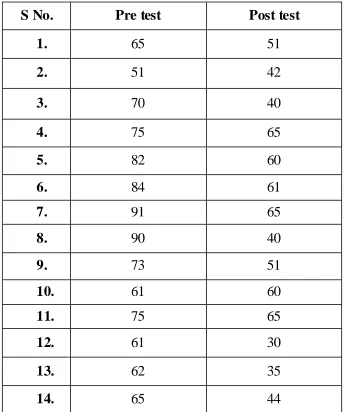
TABLE: 1
Pre and Post test values of visual analogue scale in Group A (n=14)
S No.
Pre test
Post test
1.
65
51
2.
51
42
3.
70
40
4.
75
65
5.
82
60
6.
84
61
7.
91
65
8.
90
40
9.
73
51
10.
61
60
11.
75
65
12.
61
30
13.
62
35
22
Graph: 1
Pre and Post test values of visual analogue scale in Group A (n=14)
0 10 20 30 40 50 60 70 80 90 100
1 2 3 4 5 6 7 8 9 10 11 12 13 14
Values of visual analogue scale in Group A
23
Table: 2
PRE AND POST TEST VALUES OF VISUAL ANALOGUE SCALE IN
GROUP B (N=12)
S No.
Pre test
Post test
1.
80
52
2.
70
43
3.
77
30
4.
75
60
5.
76
55
6.
85
52
7.
60
43
8.
85
65
9.
45
20
10.
71
21
11.
55
25
24
Graph: 2
PRE AND POST TEST VALUES OF VISUAL ANALOGUE SCALE IN
GROUP B (N=12)
0 10 20 30 40 50 60 70 80 90
1 2 3 4 5 6 7 8 9 10 11 12
Values of visual analogue scale in Group B
25
Table: 3
MEAN, MEAN DIFFERENCE, STANDARD DEVIATION AND PAIRED „t‟
TEST VALUES OF VISUAL ANALOGUE SCALE OF GROUPS A AND
GROUP B
Groups
(VAS)
Mean
Mean
Difference
Standard
Deviation
„t‟ Value „p‟ Value
Group A
Pre-test
71.79
21.14
12.16
6.50
p<0.01
Group A
Post-test
50.64
Group B
Pre-test
69.92
27.42
11.39
8.34
p<0.01
Group B
Post-test
42.50
Based on Table 3, the mean difference of group A was found to be 21.14, Standard deviation was
12.16, the „t„ value using the paired „t„ test was 6.50 which was greater than the table value of
3.012 at p<0.01. In Group B the mean difference was 27.42, standard deviation was 11.39, the „t„value using the paired test was 8.34 which was greater than the table value of 3.012 at p<0.01.
This shows there is a significant reduction in pain for VAS in both groups. The result shows that
26
GRAPH: 3
MEAN, MEAN DIFFERENCE, STANDARD DEVIATION AND PAIRED „t‟
TEST VALUES OF VISUAL ANALOGUE SCALE OF GROUPS A AND
GROUP B
0 10 20 30 40 50 60 70 80
Group A Group B
Mean value of VAS for both group A and B
27
TABLE: 4
PRE AND POST TEST VALUES OF WESTERN ONTARIO ROTATOR
CUFF INDEX IN GROUP A (n=14)
S No.
Pre test
Post test
1
46.6
56.1
2
53.3
75.4
3
30
50.7
4
42.6
50.2
5
26.4
46.9
6
35
55
7
14.2
46.4
8
23.3
61.4
9
35.9
54.4
10
39.5
44.5
11
30.7
45.9
12
50.9
75
13
46.6
65.4
28
GRAPH: 4
PRE AND POST TEST VALUES OF WESTERN ONTARIO ROTATOR
CUFF INDEX IN GROUP A (N=14)
0 10 20 30 40 50 60 70 80
1 2 3 4 5 6 7 8 9 10 11 12 13 14
Values of western Ontario rotator cuff index in group A
29
TABLE: 5
PRE AND POST TEST VALUES OF WESTERN ONTARIO ROTATOR
CUFF INDEX IN GROUP B (N=12)
S No.
Pre test
Post test
1.
44.5
65.9
2.
41.9
64.5
3.
64.75
92.8
4.
29.5
49.2
5.
31.6
47.6
6.
24.2
46.6
7.
50.4
69.5
8.
19.2
41.1
9.
65.2
86.4
10.
40.9
84.5
11.
40.4
61.4
30
GRAPH: 5
PRE AND POST TEST VALUES OF WESTERN ONTARIO ROTATOR
CUFF INDEX IN GROUP B (n=12)
0 10 20 30 40 50 60 70 80 90 100
1 2 3 4 5 6 7 8 9 10 11 12
Values of western Ontario rotator cuff index in group B
31
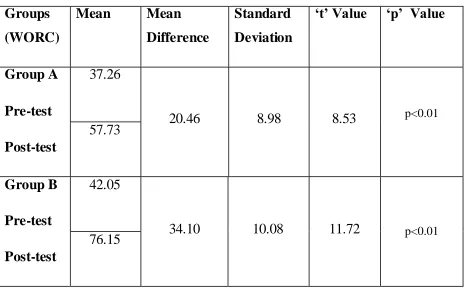
TABLE: 6
MEAN, MEAN DIFFERENCE, STANDARD DEVIATION AND PAIRED „t‟
TEST VALUES OF WORC OF GROUPS A AND GROUP B
Groups
(WORC)
Mean
Mean
Difference
Standard
Deviation
„t‟ Value „p‟ Value
Group A
Pre-test
Post-test
37.26
20.46
8.98
8.53
p<0.0157.73
Group B
Pre-test
Post-test
42.05
34.10
10.08
11.72
p<0.0176.15
Based on Table 6, the mean difference of group A was found to be 20.46, Standard
deviation was 8.98, the „t„ value using the paired „t„ test was 8.53 which was greater than the table value of 3.106 at p<0.01. In Group B the mean difference was 34.10, standard deviation
was 10.08, the „t„value using the paired test was 11.72 which was greater than the table value of
3.106 at p<0.01. This shows there is a significant improvement in WORC in both groups. The result shows that pretest and posttest mean differe nce of WORC of group B is statistically
32
GRAPH: 6
MEAN, MEAN DIFFERENCE, STANDARD DEVIATION AND PAIRED „t‟
TEST VALUES OF WORC OF GROUPS A AND GROUP B
0 10 20 30 40 50 60 70 80
Group A Group B
Mean values of WORC -Group A and Group B
pre test
33
TABLE: 7
COMPARISON BETWEEN THE GROUP A AND GROUP B
Outcome
Measures
Mean
Difference
Standard
Deviation
“t” value
“p” value
VAS 8.14 12.14 1.51 NS*
WORC 17.59 12.60 3.84 P<0.01
*NS= Non Significant
The Independent „t„ test was performed between Group A and Group B to analyze the
significance between the open chain exercise with eccentric training and closed chain exercise with eccentric training on pain reduction and functional improvement in patients with rotator cuff tendinopathy.
The visual analog scale (VAS) between the groups were calculated using independent „t„ test & the „t„ value was 1.51 which was lesser than the table value of 2.779 at p>0.01.
The western Ontario rotator cuff index (WORC) between the group were calculated using
independent „t„ test & the obtained „t‟ value is 3.84 which was greater than that of table value of
2.779 at p<0.01.
Therefore the results of these statistical analyses showed that the Group B is effective on improving the functional status compared to Group B. And there is no significant difference in
34
GRAPH: 7
COMPARISON BETWEEN THE GROUP A AND GROUP B
0 10 20 30 40 50 60 70 80
VAS WORC
COMPARISON OF POST TEST VAULES OF VAS AND WORC BETWEEN THE GROUPS
GROUP A
35
CHAP TER V
RESULTS AND DISCUSSION
The aim of this study was to compare the efficacy of open chain exercise versus closed chain
exercise in reducing pain and improving the functional status in patients with rotator cuff
tendinopathy.
A total of 30 patients diagnosed with rotator cuff tendinopathy in the age group of 30-60 years
participated in this study. The participants who satisfied the selection criteria were randomly
assigned into two groups. Baseline measurements were taken using the visual analogue score
(VAS) and Western Ontario rotator cuff index (WORC) for both groups. One group received open chain exercise combined with eccentric training and the other group received closed chain
exercise combined with eccentric training for4 weeks. At the end of 4 weeks, participants were again evaluated and measurements were taken using same outcome measures. Statistical analysis
for the present study was done using SPSS (version 16).
No two individual with rotator cuff tendinopathy have similar impairment and thus same
functional limitation. Both males and females are affected equally. Dropout rate was higher in
closed chain exercise group than the open chain exercise group.
The drop-out rate was higher than anticipated; three participants from closed chain exercise
dropped the intervention program. The greater drop-out rate in the CC group may be due to patient‟s lack of knowledge and importance about the exercise protocol. Three participants
dis-engaged from closed chain exercise treatment protocol totally. One participant dropped out
choosing the surgical repair to correct rotator cuff tear following a fall on outstretched hand.
One participant from open chain exercise group failed to complete the intervention and did not
provide follow up data. It is plausible that a key component in successful rehabilitation of RC
tendinopathy in open chain exercise group is patient compliance.
Participants were selected cautiously not to generalize these results to younger or older patients.
All participants in this study were between 30 and 60 years old a typical age group for the
36
factor. In younger patients, impingement is often secondary to instab ility, requiring different
treatment
The WORC index score item related to Physical Symptoms, Sports/Recreation, Work and
Lifestyle were the major issue for the patient and this was addressed and found significant
improvement after the treatment. It takes four minutes to complete and is one of the easiest and
quickest tools available to assess function and an excellent way to monitor individual patient
progress. The Patient-Specific Functional Scale was selected in order to measure relevant and
meaningful activities for each patient and because it is sensitive to individual change over time.
Tendon injuries are known to require a long healing time, and our results suggest that complete
resolution of symptoms may not be expected within 4 weeks of eccentric training combined with
open and closed chain exercise. The anatomical and functional complexity of the shoulder joint may require a more diversified rehabilitation program involving other muscles, and/or a longer
treatment period.
Moncrief et al[30] have demonstrated the efficacy of these exercises in a 4-week training paradigm, and measured 8–10% increases in isokinetically measured internal and external
rotation strength in healthy subjects.
The data from group A and B for VAS were analyzed using paired„t‟ test and independent„t‟ test. The calculated value of paired ‟t„ test for group A is 6.50 and for group B is 8.34 which is greater
than the table value indicating there is a significant difference within both the group. The value
of independent t test for both groups are 1.51 which is less than the table value indicating there is
no significant difference between the groups. Hence the null hypothesis is accepted, alternate
hypothesis is neglected.
The data from group A and B for WORC were analyzed using paired‟t‟ test and independent „t‟ test. The calculated value of paired‟t„test for group A is 8.53 and for group B is 11.72 which is
greater than the table value indicating there is a significant difference within both the group. The
value of independent „t‟ test for both groups are 3.84 which is greater than the table value indicating there is significant difference between the groups. Hence the alternate hypothesis is
37
The principal finding of the present study was that both Group A and group B was significantly
effective in reducing pain and improving functional status. Group B was more effective
compared to Group A in improving functional status. And both groups show no more difference
in pain.
Repeated activation of the RC following the exercise protocol may have reduced peripheral and
central neurological sensitivity, this resulted in reductions in biochemical driven nociception.
The mechanical loading stimulates the healing response of the tendon as it accelerates tenocytes
metabolism and may speed repair. Gradual exposure to increasing use of the shoulder may have reduced psychological risk factors; it is also possible that changes in psychosocial factors may
have contributed to the improvements observed in pain and functional status.
Eccentric training is a “tendon-strengthening” program. Eccentric exercises expose the tendon to a greater load than concentric exercises[31]thus strengthening the tendon[32]. High frequency oscillations are produced by eccentric contractions in the tendon and these fluctuations in force provide an important stimulus for the remodeling of the tendon these are the reasons behind the
pain reduction and functional improvement.
Patients who completed the training program improved to the extent that they did not need
surgery.
5.1 LIMITATIONS OF THE STUDY:
• All participants in this study were between 30 and 60 years.
• The study measures only pain and functional status.
• No blinding was done.
• There was a lack of long term follow up of patients to find out the carry over effects of
the intervention
5.2 SUGGESTIONS FOR FUTURE RESEARCH:
• In future studies long term follow-up can be done to determine the effect of intervention.
• The study can also emphasize that scapular control and relearning program to correct
38
• The study can be conducted with control group to rule out that the natural maturation of
the syndrome which would influence the results.
• Further research is needed in the clinical setting to avoid the some patients dis-engaging
from treatment.
• The Further studies can be done in large samples because if more the sample size used,
greater would be the significance.
• The study can be conducted with bilateral rotator cuff tendinopathy individuals.
• The future studies can be added with other outcome measures to assess the
39
CHAP TER VI
SUMMARY AND CONCLUSION
This study was conducted to compare the efficacy of open chain exercise versus closed
chain exercise in reducing pain and improving the functional status in patients with rotator cuff tendinopathy.
Thus the statistical analysis of data concluded that “Closed chain exercise group shows
statistically significant improvement on functional status compared to Open chain exercise
group, whe reas there was statistically no significant diffe rence in both Closed chain
40
BIBILIOGRAPHY
1. Susanne Bernhardsson et al Evaluation of an exercise concept focusing on eccentric strength
training of the rotator cuff for patients with subacromial impingement syndrome Clinical Rehabilitation 2011; 25: 69–78
2. Stephen M Simons, David Kruse et al Rotator cuff tendinopathy, this topic last updated: Jul 07,
2016. Available from:https://www.uptodate.com/contents/rotator-cuff- tendinopathy
3. Stuart R. Heron Steve R. et al Comparison of three types of exercise in the treatment of
rotator cuff tendinopathy/shoulder impingement syndrome: a randomized control trial
assessing Physiotherapy 2016
4. Per Jonsson,(2009) Eccentric training in the treatment of tendinopathy. Umeå University
Department of Surgical and Perioperative Sciences Sports Medicine.
5. Fredberg U, Stengaard-Pedersen K. Chronic tendinopathy tissue pathology, pain
mechanisms, and etiology with a special focus on inflammation. Scand J Med Sci Sports 2008; 18:3-15 [PMID: 18294189 DOI: 10.1111/j.1600-0838.2007.00746.x]
6. Yuan J, Wang MX, Murrell GA. Cell death and tendinopathy. Clin Sports Med 2003; 22:693-701 [PMID: 14560541]
7. Riley G. The pathogenesis of tendinopathy. A molecular perspective. Rheumatology
(Oxford) 2004; 43: 131-142 [PMID:12867575]
8. Paula R Camargo, Francisco Alburquerque-Sendín et al Eccentric training as a new approach
for rotator cuff tendinopathy: Review and perspectives World Journal of Orthopedics 2014 November 18; 5(5): 634-644
9. Matsen FA, Fehringer EV, Lippitt SB, Wirth MA, Rockwood.CA. Rotator Cuff. In:
Rockwood CA, Matsen FA, Wirth MA,Lippitt SB. The Shoulder. Philadelphia: Elsevier, 2009
10.Scott A, Cook JL, Hart DA, Walker DC, Duronio V, Khan.KM. Tenocyte responses to
mechanical loading in vivo: arole for local insulin- like growth factor 1 signaling in early
tendinosis in rats. Arthritis Rheum 2007; 56: 871-881 [PMID:17328060]
41
12.Jean-François Kaux, Benedicte Forthomme et al Current opinions on tendinopathy Journal of
Sports Science and Medicine (2011) 10, 238-253
13.Bryan Murtaugh, MD and Joseph M. Ihm, MD(2013) Eccentric Training for the Treatment of
Tendinopathies 2013 by the American College of Sports Medicine Volume 12 & Number 3 & May/June 2013
14.Erol O, Ozçakar L, Celiker R. Shoulder rotator strength in patients with stage I-II
subacromial impingement: relationship to pain, disability, and quality of life. J Shoulder Elbow Surg 2008; 17: 893–7.
15.Christiana lynneblume Comparison of an eccentric exercise intervention to a concent ric exercise intervention in adults with subacromial impingement syndrome Texas woman‟s
university may 2014
16.Maffulli N, Longo UG. How do eccentric exercises work in tendinopathy? Rheumatology (Oxford) 2008; 47: 1444-1445 [PMID: 18697828 DOI: 10.1093/rheumatology/ken337]
17.Stanish WD, Rubinovich RM, Curwin S. Eccentric exercise in chronic tendinitis. ClinOrthopRelat Res 1986; (208): 65-68 [PMID: 3720143]
18.Peers KH, Lysens RJ. Patellar tendinopathy in athletes: current diagnostic and therapeutic
recommendations. Sports Med 2005; 35: 71-87 [PMID: 15651914]
19.Clarkson PM, Hubal MJ. Exercise- induced muscle damage in humans. Am J Phys Med
Rehabil 2002; 81: S52-S69 [PMID: 12409811]
20.Enoka RM. Eccentric contractions require unique activation strategies by the nervous system.
J Appl Physiol (1985) 1996; 81: 2339-2346
21.Ellenbecker TS, Davies GJ. The application of isokinetics in testing and rehabilitation of the shoulder complex. J Athl Train 2000; 35: 338–50.
22.Davies GJ. A compendium of isokinetics in clinical usage. LaCrosse, Wisconsin, USA: S & S Publishers, 1992.
23.Ellenbecker TS, Davies GJ, Rowinski MJ. Concentric versus eccentric isokinetic
strengthening of the rotator cuff. Objective data versus functional test. Am J Sports Med
1988; 16: 64–9.
24.Mont MA, Cohen DB, Campbell KR, et al. Isokinetic concentric versus eccentric training of shoulder rotators with functional evaluation of performance enhancement in elite tennis
42
25.John McMullen; Timothy L-A Kinetic Chain Approach for Shoulder Rehabilitation Journal
of Athletic Training 2000 ;35(3):329-337
26.Alfredson H, Pietilä T, Jonsson P, Lorentzon R. Heavy- load eccentric calf muscle training
for the treatment of chronic Achilles tendinosis. Am J Sports Med 1998; 26: 360-366 [PMID:9617396]
27.Wang JH, Iosifidis MI, Fu FH. Biomechanical basis for tendinopathy. ClinOrthop Related
Res 2006; 443: 320-332 [PMID:16462458]
28.Jeong-Il Kang, Young-Jun Moon et al The effect of exercise types for rotator cuff repair
patients on activities of shoulder muscles and upper limb disability The Journal of Physical
Therapy Science 28: 2772–2777, 2016
29.Todd S Ellenbecker et al Rehabilitation of shoulder impingement syndrome and rotator cuff
injuries: an evidence-based review BrJ Sports Med, Shoulder injuries in athletes 2010; 44:319–327. doi:10.1136/bjsm.2009.058875
30.Maffulli et al. Novel Approaches for the Management of Tendinopathy. J Bone Joint Surg Am. 2010; 92: 2604-2613. doi:10.2106/JBJS.I.01744
31.Stanish WD, Rubinovich RM, Curwin S. Eccentric exercise in chronic tendinitis. Clinical
Orthopedic Relat Res 1986; (208): 65-68 [PMID: 3720143]
32.Peers KH, Lysens RJ. Patellar tendinopathy in athletes: current diagnostic and therapeutic
ANNEXURE II
ASSESSMENT FORM
Subject Number:
Date of Assessment:
DEMOGRAPHIC DATA:
Name: IP/OP Number:
Age: Contact number:
Sex:
Occupation:
Address:
SUBJECTIVE ASSESSMENT:
Chief complaints:
Present medical history:
Past medical history:
Personal history:
Family history:
PAIN HISTORY:
Site:
Side:
Onset:
Duration:
Aggravating factors:
Relieving factors:
VAS: (Visual Analog scale)
OBJECTIVE ASSESSMENT:
ON OBSERVATION:
Built:
Posture:
Attitude of Limbs:
Muscle Wasting:
Deformity:
Tropical Changes:
External Appliances:
ON PALPATION:
Muscle spasm:
Tenderness:
Warmth:
Oedema:
ON EXAMINATION:
Motor examination:
Range of motion: (Goniometer)
Movements Degrees
SHOULDER RIGHT LEFT
Flexion
Extension
Abduction
Adduction
Medial rotation
Muscle powe r: Manual muscle testing
SHOULDER RIGHT LEFT
Flexors
Extensors
Abductors
Adductors
Medial rotators
Lateral rotators
ELBOW
Flexors
Extensors
WRIST
Flexors
Extensors
Muscle grith: (inch tape-cms)
AREA RIGHT LEFT
Arm
Forearm
ELBOW RIGHT LEFT
Flexion
Extension
WRIST RIGHT LEFT
Flexion
Sensory examination:
Superficial sensation:
Deep sensation:
SPECIAL TEST:
Neers impingement test:
Hawkin kennedy impingement test:
Jobes suprespinatus test:
FUNCTIONAL ASSESSMENT:
Western Ontario rotator cuff index:
Repetitive maximum:
PROVISIONAL DIAGNOSIS:
PHYSIOTHERAPY MANAGEMENT:
OBJECTIVES:
TREATMENT PLAN:
a) Short term goal:
b) Long term goal:
TREATMENT GIVEN:
FOLLOW UP CHART:
Name:
Age:
Sex:
IP/OP Number:
Date of assessment:
Date of follow up:
Specific complaints:
Treatment plan:
RESULTS PRE-TEST POST-TEST
VAS
WORC
ANNEXURE III
PSG Institute of Medical Science and Research, Coimbatore Institutional Human Ethics Committee
INFORMED CONSENT FORMAT FOR RESEARCH PROJECTS
I Ajitha.C.T carrying out a study on the topic: Comparing the efficacy of open chain exercise versus closed chain exercise for reducing pain and improving the functional status in patients with rotator cuff tendinopathy as part of my research project being carried out under the aegis of the Department o f Orthopaedics & Physical Medicine and Rehabilitation.
My research guide is: Prof. R.Mahesh, MPT(Cardio Respiratory).
The justification for this study is:
Shoulder pain is the third most common musculoskeletal complaint encountered in clinical practice. One of the most common causes of shoulder pain is rotator cuff (RC) tendinopathy. Open chain exercise and closed chain exercise along with eccentric training helps to reduce the pain, strengthen the tendon and improve the functional status.
The objectives of this study are:
1.To determine the effects of open chain exercise in reducing pain and improving functional status in patients with rotator cuff tendinopathy.
2.To determine the effects of closed chain exercise in reducing pain and improving functional status in patients with rotator cuff tendinopathy.
3.To compare the effectiveness of open chain exercise versus closed chain exercise in reducing pain and improving functional status in patients with rotator cuff tendinopathy .
Sample size: 30.
Study volunteers / participants are subjects with rotator cuff tendinopathy, age group 30-60 years
Location: Department of Orthopedics and Department of PMR, PSG Hospitals.
We request you to kindly cooperate with us in this study. We propose collect background information and other relevant details related to this study. We will be carrying out:
Initial inte rvie w: 15 minutes.
Data collected will be stored for a period of 5 years. We will not use the data as part of another study.
Clinical examination (Specify details and purpose): Yes
Blood sample collection: Specify quantity of blood being drawn: ___________ml. Not applicable
No. of times it will be collected: _______________.
Whether blood sample collection is part of routine procedure or for research (study) purpose: 1. Routine procedure 2. Research purpose
Specify purpose, discomfort likely to be felt and side effects, if any: _______________________________
Whether blood sample collected will be stored after study period: Yes / No, it will be destroyed
Whether blood sample collected will be sold: Yes / No
Whether blood sample collected will be shared with persons from another institution: Yes / No
Medication given, if any, duration, side effects, purpose, benefits: Not applicable
Whether medication given is part of routine procedure: Yes / No (If not, state reasons for giving this medication)
Whether alternatives are available for medication given: Yes / No (If not, state reasons for giving this particular medication)
Final intervie w: 15 minutes.
Benefits from this study: Pain will be reduced.
Range of motion will be improved.
Shoulder Functional activities will be improved
Risks involved by participating in this study: There might be minimal chance of risks or discomforts experienced during this study. The discomforts may be stretch pain or exercise induced pain. In case of any discomfort Cryotherapy or Hot pack therapy will be given.
How the results will be used:
Peer-reviewed scientific journals Conference presentation
Internal report
patient. You will NOT be paid any remuneration for the time you spend with us for this interview / study. The information provided by you will be kept in strict confidence. Under no circumstances shall we reveal the identity of the respondent or their families to anyone. The information that we collect shall be used for approved research purposes only. You will be informed about any significant new findings - including adverse events, if any, – whether directly related to you or to other participants of this study, developed during the course of this research which may relate to your willingness to continue participation.
Consent: The above information regarding the study, has been read by me/ read to me, and has been explained to me by the investigator/s. Having understood the same, I hereby give my consent to them to interview me. I am affixing my signature / left thumb impression to indicate my consent and willingness to participate in this study (i.e., willingly abide by the project requirements).
Signature / Left thumb impression of the Study Volunteer / Legal Representative:
Signature of the Interviewer with date: Witness:
Contact number of PI: 8870488033
â. º¡. §¸¡ ÁÕòÐÅì ¸øæâ ÁüÚõ ¬Ã¡ö ¿¢ÚÅÉõ, §¸¡¨Å
ÁÉ¢¾ ¦¿È¢Ó¨Èì ÌØ
´ôÒ¾ø ÀÊÅõ
§¾¾¢: