
Synthesis and
Characterization of, and
Dynamic processes
occurring in, Highly Active
Pd catalyst for Alkyne &
Alkene Hydroesterification
Thesis submitted in accordance with the
requirements of the University of Liverpool
for the degree of Master of Philosophy by
Firas T. R. Al-Mosule
DECLARATION
I declare that, expect where otherwise stated, the work contained within this thesis is my own research, carried out from September 2009 until September 2012 at the Department of Chemistry, The University of Liverpool.
SIGNED
Firas Al-Mosule
Acknowledgements
I would really like to express all my thanks to my supervisors in Liverpool, Dr. Jon Iggo and Dr. Joho Satherley for giving me the opportunity of doing this MPhil research project with them, and for all the great teaching, support and encouragement given during these four years.
This project could not be done without Kate Robertson (Deputy Executive Secretary/Iraq Programme Manager) form CARA (Council for assisting refugee academics) and CARA. Thank you very much for give me the opportunity and fellowship, your help has been invaluable in the development of my knowledge and skills. Big thanks to CARA for the funding.
I would like to thank all the staff in the chemistry department of the University of Liverpool for their help and support, and in particular Tony and George.
Thank you to all the colleagues in the lab, especially Mike for his help with the NMR and HPNMR spectrometers.
Big thanks to all the good friends I made in Liverpool: Ali, Cate, Sara, Mike, Mishari.
Finally, thank you very much to the most especial person in my family life, Mrs Sana Al-kudairy, you give me and my family the biggest and most useful support.
i
Abstract
Chapter one reviews the literature surrounding three main areas of interest relevant to the research carried out. These areas include industrial process for the synthesis of methyl methacrylate, the carbonylation of alkynes and alkenes. In addition, review effect of the ligands and counterion on the catalyst system, and dynamic process and NMR of the catalyst.
Chapter two outlines simple, generic procedures to Pd-‘chelate-monodentate’ complexes and investigates the coordination chemistry and hemilability of such complexes. In addition, an explanation of the organometallic chemistry of the Pd-‘chelate-monodentate’ complexes and synthesis of these complexes illustrates the possibility of nitrogen playing a role in proton relay. Also, introduces the variable temperature spectra of a [Pd(ҡ2-Ph2Ppy)(ҡ1-Ph2Ppy)2]
[CH3SO3]2 (6), and [Pd(ҡ2-Ph2Ppy)(ҡ1-Ph2Ppy)Cl][X] (3[X]), (X = Cl, OTf,
BF4), uses a computer program to simulate gNMR discusses the associative
mechanism of exchange in Pd-‘chelate-monodentate’ complexes. Finally, details the experimental procedures undertaken in the above work.
Chapter three illustrates how can preparation of the new alkanesulfonic acids (R = C8, C9, C11, C14, C16, C18) which use instead of methanesulfonic acid in
hydroesterification of alkene process. In terms of follow the two strategies, first strategy depends on synthesis of silver alkanesulfonate salts from interaction of sodium alkanesulfonate salts with AgNO3 then reaction with palladium complex.
While in the second strategy, free alkanesulfonic acid was prepared in situ, via reaction of HBF4 with a series of sodium alkanesulfonate salts (R = C8, C9, C11,
C14, C16, C18), then added to palladium complex in a sapphire tube of HPNMR
spectroscopy for studies and confirm steps of the catalytic cycle.
Table of contents
ii
Table of contents
Chapter One:
Introduction... 1
1.1. MMA production processes... 3
1.1.1. The acetone-cyanohydrin (ACH) process... 3
1.1.2. BASF’s hydroformylation of ethene... 5
Lucite’s Alpha process... 6
1.2. Palladium catalysed carbonylation of alkynes... 7
1.2.1. Carbonylation of propyne... 8
1.2.2. Effect of ligand structure... 9
1.2.3. Mechanistic studies... 11
1.3. Palladium catalysed carbonylation of alkenes... 12
1.3.1. Mechanism of methoxycarbonylation... 13
Initiation... 14
C-C bond formation... 16
Termination... 17
1.4. Chemoselectivity... 19
1.4.1. The effect of counterion on the activity and stereoselectivity of palladium... 19
1.5. Characterisation of the catalyst... 21
Table of contents
iii
1.7. Aims of the thesis... 25
1.7.1. Phosphino- pyridine (PN) ligand... 25
1.7.2. Effect of alkane sulfonate... 25
1.8. References... 26
Chapter Two:
Coordination chemistry and dynamic processes of Pd(II) chelate complexes of 2-pyridyldiphenylphos-phine in hydroesterification of alkyne... 30Part 1: Coordination chemistry of Pd(II) chelate complexes of 2-pyridyldiphenylphosphine... 34
2.1. Introduction... 34
2.1.1. Electronic properties of phosphine ligand... 37
2.2. 2-Pyridyldiphenylphosphine (Ph2Ppy)... 38
2.3. Synthesis of Pd(II) complexes with both chelating and monodentate (Ph2Ppy) ligands... 41
2.3.1. Formation of “Pd(ҡ1 -Ph2Ppy)2” precursors... 41
2.3.2. Solvent assisted synthesis of “chelate-monodentate” complexes.. 42
Results and discussion... 44
2.4. Preparation of “chelate-monodentate” complexes by removal of halide... 44
2.5. Preparation of “chelate-monodentate” complexes from Pd(II) precursors... 46
Table of contents
iv
2.5.2. Protonation of Ph2Ppy... 46
2.5.3. Protonation of palladium complexes of Ph2Ppy... 48
Part 2: Dynamic processes of Pd(II) chelate complexes of 2-pyridyldiphenylphosphine... 55
2.6. Dynamic process in square planar complexes... 55
2.7. Derivation of thermodynamic parameters... 59
Results and discussion... 60
2.8. Dynamic processes in chelate-monodentate Pd(II) complexes of Ph2Ppy ... 60
2.8.1. Dynamic processes in [Pd(κ2-Ph2Ppy)(κ1-Ph2Ppy)2][MeSO3]2 (6) ... 65
2.8.2. Dynamic processes in [Pd(κ2-Ph2Ppy)(κ1-Ph2Ppy)Cl][X] (3[X])... ... 70
2.9. Conclusions... 75
2.10. Experimental... 78
2.10.1. General methods and procedures... 78
2.10.2. Experiments... 79
A- [Pd(κ2-Ph2Ppy)Cl2] (1)... 79
B- [Pd(κ2-Ph2Ppy)(κ1-Ph2Ppy)Cl]Cl (3[Cl])... 79
C- TIX (X = BF4, MeSO3)... 79
D- [Pd(κ2-Ph2Ppy)(κ1-Ph2Ppy)Cl][BF4] (3[BF4])... 80
Table of contents
v
F- [Pd(κ2-Ph2Ppy)(κ1-Ph2Ppy)Cl][OTf] (3[OTf])... 80
G- Pd(κ2-Ph2Ppy)(κ1-Ph2Ppy)X][X] (4[X])... 81
H- [Pd(κ2-Ph2Ppy)(κ1-Ph2PpyH)X][X]2 (4’[X]2)... 81
I- [Pd(κ2-Ph2Ppy)2][BF4]2 (5)... 82
J- [Pd(κ2-Ph2Ppy)(κ1-Ph2Ppy)2][MeSO3]2 (6)... 82
K- Variable temperature NMR spectroscopic measurements for 3... 83
L- Determination of activation parameters for 6... 83
2.10.3. gNMR simulations... 83
2.11. Referencess... 111
Chapter Three:
Coordination chemistry of Pd(II) chelate complexes of 1,2-bis (di-tert -butylphosphinomethyl)benzene in hydroesterification of alkene... 1153.1. Introduction... 118
3.2. The effect of acid... 121
3.3. First strategy... 125
3.3.1. Synthesis and characterisation of silver alkanesulfonate salts.... 125
3.3.2. Synthesis and characterisation of [Pd(dtbpx)(η2-RSO3)]+ from [Pd(dtbpx)Cl2]... 127
3.3.3. Reactivity of [Pd(dtbpx)(η2-RSO3)]+ with VAM... 132
Table of contents
vi
3.4.1. Reactivity of [Pd(dtbpx)(dba)]with acid: the HBF4 system... 136
3.4.2. Formation of alkanesulfonic acid... 136
3.4.3. Synthesis and characterisation of [Pd(dtbpx)(η2-RSO3)]+ from [Pd(dtbpx)(dba)]... 137
3.4.4. Reactivity of [Pd(dtbpx)H(Solvent)][RSO3] with C2H4... 138
3.5. Conclusion... 144
3.6. Experimental... 145
3.6.1. General methods and procedures... 145
3.6.2. Experiments... 145
A- Synthesis of silver alkanesulfonate... 145
B- Synthesis of Pd(dtbpx)(dba)... 146
C- Synthesis of Pd(dtbpx)Cl2... 146
D- Synthesis of [Pd(dtbpx)(η2-RSO3)][RSO3]. Method 1, ex situ using Ag(RSO3)... 147
E- Synthesis of [Pd(dtbpx)(k2-CH(Me)OC(O)CH3]+... 147
HP-NMR measurements... 148
A- Synthesis of [Pd(dtbpx)(η2-RSO3)][RSO3]. Method 2, in situ, using HBF4/NaRSO3 (general procedure)... 148
B- Synthesis of [Pd(dtbpx)(CH2CH3)]+ (general procedure)... 149
C- Synthesis of CH3CH2C(O)OCH3... 149
Table of contents
vii
Chapter Four:
Conclusions... 157
4.1. Introduction... 158
4.2. Conclusions of Chapter Two... 158
4.3. Conclusions of Chapter Three... 160
Chapter One
Chapter One
2
Chapter One: Introduction... 1
1.1. MMA production processes... 3
1.1.1. The acetone-cyanohydrin (ACH) process... 3
1.1.2. BASF’s hydroformylation of ethene... 5
Lucite’s Alpha process... 6
1.2. Palladium catalysed carbonylation of alkynes... 7
1.2.1. Carbonylation of propyne... 8
1.2.2. Effect of ligand structure... 9
1.2.3. Mechanistic studies... 11
1.3. Palladium catalysed carbonylation of alkenes... 12
1.3.1. Mechanism of methoxycarbonylation... 13
Initiation... 14
C-C bond formation... 16
Termination... 17
1.4. Chemoselectivity... 19
1.4.1. The effect of counterion on the activity and stereoselectivity of palladium... 19
1.5. Characterisation of the catalyst... 21
1.6. Dynamic processes and NMR... 23
1.7. Aims of the thesis... 25
1.7.1. Phosphino-pyridine (PN) ligand... 25
1.7.2. Effect of alkane sulfonate... 25
Chapter One
3
1. Introduction
1.1. MMA production processes
1Methyl methacrylate (MMA) is an important monomer. There has been a great increase in the production of MMA in the world in the last 15 years, which has now reached 2.2 million tonnes per year, due to increasing demand for its polymerization and copolymerization products, for example, from production of Perspex (polymethyl methacrylate, PMMA), MMA s main application. Methacrylic polymer, which has the characteristics of high transparency and weather resistance, is used in many fields, for example, signboards, building materials, vehicles and lighting equipment. MMA is also used to produce resins, plastic coatings, adhesives, lubricating agents, printing / dyeing assistants and insulation filling materials, impregnates for electric motor coils, and glazing agents for paper.
Several routes to MMA are currently operated commercially and environmentally friendly such as (i) ACH route with integral H2SO4 recovery,
(ii) BASF route from ethylene via propionaldehyde, (iii) Lucite (formerly INEOS) methyl propionate/HCHO, (iv) Shell/INEOS route via propyne carbonylation, most of which the largest in terms of total production is ICI’s less environmentally friendly ACH process and the most recent is, Lucite International’s ALPHA process
1.1.1. The acetone-cyanohydrin (ACH) process
Chapter One
4
Scheme 1.1. ACH process for the production of MMA.
The ACH process (Scheme 1.1) starts with a base catalysed reaction between acetone and hydrogen cyanide HCN producing the intermediate acetone cyanohydrin ACH, the intermediate cyanohydrin is converted with sulfuric acid to a sulfate ester of the methacrylamide, methanolysis of which gives ammonium bisulfate and MMA. There are problems and environmental issues with the ACH process, viz dealing with the large quantities of ammonium bisulphate by-product and of a shortfall in the supply of toxic hydrogen cyanide HCN. Moreover, it requires high capital and energy costs for the intensive acid recovery and regeneration.
Mitsubishi Gas Chemicals improved the ACH process (Scheme 1.2) in 1997 to address these problems. In this process, first, acetone cyanohydrin is hydrated to α-hydroxy isobutylamide with the manganese oxide catalyst in the absence of sulphuric acid, and then esterified by methylformate to give methyl α-hydroxy isobutyrate and formamide, which is subsequently dehydrated to give HCN, which is recycled in the (ACH) preparation process. Finally, methyl α-hydroxy isobutyrate is converted to (MMA) in a dehydration reaction.
Chapter One
5
The advantage of this process is the elimination of sulphuric acid and methanol, and the reduced amount of HCN used. However, the disadvantage of the new (ACH) process is the number of reaction steps involved.
Mitsubishi Gas Chemical has recently suggested (scheme 1.3) a new modification2 of its process which involves the use of methanol instead of methylformate for the reaction with α-hydroxy isobutylamide to produce methyl α-hydroxy isobutylate and ammonia. The ammonia produced is recycled to HCN via treatment with methanol and O2.
Scheme 1.3. New route for producing methyl α-hydroxy isobutyrate.
1.1.2. BASFʼs hydroformylation of ethene
In 1989, BASF developed and commercialized a route1 from ethene with a 40,000 t per year of MMA production plant. This process (Scheme 1.4) involves homogenous rhodium-catalysed hydroformylation of ethene yielding propanal.
Chapter One
6
In this path, ethene is converted to methacrolein then methacrylic acid as in (Scheme 1.4). The main drawback of this process is the moderate yield (< 85 % moles based on propanal).
Several routes via methyl propionate (MeP) or propionic acid routes have been proposed by many companies over the years. For example, Reppeʼs metal carbonyl catalysed hydrocarbonylation reaction of ethene can be used to produce methyl propionate. MMA is then produced by condensation reaction with formaldehyde, illustrated in (Scheme 1.5).
Scheme 1.5. Methyl propionate with formaldehyde to produce MMA.
Lucite’s Alpha process
Chapter One
7
Figure 1.1. ALPHA (dtbpx) ligand.
Scheme 1.6. Lucite’s ALPHA process for the production of MMA.
This process (Scheme 1.6) uses sterically bulky diphosphine ligands, the catalyst being formed in situ via the reaction of [Pd(dtbpx)(dba)] (dtbpx =1,2((CH3C)2PCH2)2 C6H4) called (ALPHA) (Figure 1.1) compound (dba =
trans,trans-(PhCH=CH)2CO) with CH3SO3H in MeOH.3
1.2. Palladium catalysed carbonylation of alkynes
Chapter One
8
In the mid-1980’s Drent and co-workers at Shell developed a novel one-step attractive process starting from propyne for producing (MMA). Drent found that a palladium catalyst source in the form of palladium acetate, in conjunction with an organo phosphine and protonic acid gave a good yield.8 However, this process was not commercially introduced due a lack of acceptable catalyst activity and selectivity.
Drent made a great effort to find a new class of highly efficient homogeneous palladium catalysts for the carbonylation of alkynes.9,10,11 The general reaction, which uses alkyne as a substrate and a nucleophilic co-reagent (water, aliphatic alcohols, carboxylic acids and amines), as shown in (Scheme 1.7).
Scheme 1.7. Palladium catalysed alkoxycarbonylation of alkynes.
The activity and selectivity were observed to increase remarkably upon replacing PPh3 with 2-pyridyldiphenyl phosphine Ph2Ppy, under mild conditions (45 oC
instead of 115 oC).4
1.2.1. Carbonylation of propyne
Chapter One
9
Scheme 1.8. Palladium catalysed hydroesterification of propyne.
Propyne is obtained as a by-product from an ethylene plant. This process, therefore, has many advantages if it is placed close to a big ethylene production plant. Although this route appears attractive, being a single step process and the extremely high catalyst performance, it is not without its difficulties. These include the availability/cost of propyne and the exothermic nature of the reaction which is compounded by the extremely active catalysts which makes the reaction hard to control on an industrial scale. ICI bought the patents for this technology from Shell in ca. 1996; it is sometimes referred to as the Lucite BETA process.
1.2.2. Effect of ligand structure
The ligand can not only stabilize Pd hydroesterification catalyst, but also fundamentally change the selectivity and activity. As clearly mentioned above, when replacing PPh3 with 2-pyridyldiphenyl phosphine (Ph2Ppy), the activity
and selectivity of palladium catalysed propyne carbonylation is significantly enhanced.
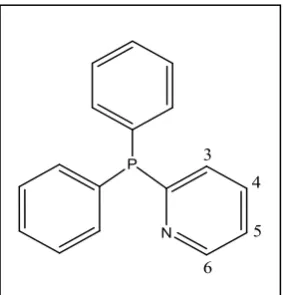
2-pyridyldiphenyl phosphine (Ph2Ppy) is an unsymmetrical bidentate ligand with
Chapter One
10
Figure 1.2. 2-pyridyldiphonylphosphine ligand.
[image:21.595.241.383.95.243.2]Consequently, a study was undertaken to further investigate the effect of the presence and position of pyridyl group in the ligand in the hydroesterification of propyne (Table 1.1).4, 12, 13
Table 1.1. Effect of position of pyridyl in the hydroesterificationa of propyne
Ligand Pd(OAc)2
(mmol) T (
o
C) Average Rate (mol of propyne/mol of Pd h)
MMA sel.
(%)
PPh3 0.100 115 Approximately 10 89.0
4-PyPPh2 0.100 90 Approximately 10 90.0
3-PyPPh2 0.100 70 1000 99.2
2-PyPPh2 0.100 45 40 000 98.9
2-PyPPh2 0.012 115 5 000 000
b
N/A
a
Conditions: 30 ml of propyne, 50 ml of methanol, 60 bar CO, 3.0 mmol of ligand, 0.2 mmol of
CH3SO3H; 2-Py = 2-pyridyl.
b
Note: Calculated by the author from the original data obtained at
45 oC by using an estimated 20 Kcal/mol activation energy.
Chapter One
11
1.2.3. Mechanistic studies
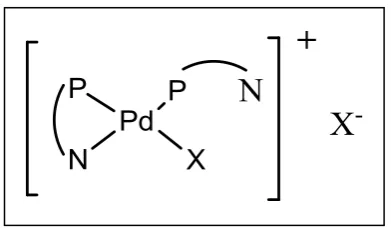
Both Drent4 and Scrivanti16, Dervisi and Tooze17-19 proposed mechanisms, based on the large differences observed in catalyst characteristics when changing the ligand from PPh3 to Ph2Ppy. The proposal is that the active site of the
palladium (II) catalyst contains two Ph2Ppy ligands (Figure 1.3). One of the
ligands is coordinated to the palladium (II) cationic centre through both phosphorus and nitrogen creating a four-membered ring structure, whilst the other Ph2Ppy is monodentate coordinated through phosphorus only, henceforth
[image:22.595.207.403.299.413.2]called Pd-‘chelate-monodentate’ complex.
Figure 1.3. Active species as proposed by Drent4.
It is suggested that in addition to stabilising the soluble palladium(II) catalyst complexes and adjustment of the electrophilicity of the palladium(II) centre, the Ph2Ppy ligand plays a crucial role in both the selectivity and rate determining
step.4 This enormous kinetic effect has been attributed to the nitrogen base that is closely associated with the metal, which in turn enables the ligand to assist the chemical transformation. This shows the ligand assisted nature of the catalytic process.
Also, Drent4 and Scrivanti16 both report that an excess of strong acid that has weakly coordinating anions (such as, methanesulfonic acid) is required to protonate the nitrogen of a pendant pyridylphosphine ligand to achieve high activities in the hydroesterification of alkyne catalyst by Pd/PPh2py. Drent4
Chapter One
12
Scheme 1.9. Mechanistic of as proposed by Drent.
Scrivanti16 suggest that a proton transfer from the pendant pyridyl nitrogen ligand (P-NH+) is the initiation step of the methoxycarbonylation of alkynes (Scheme 1.10).
Scheme 1.10. Mechanistic of as proposed by Scrivanti.
1.3.
Palladium catalysed carbonylation of alkenes
Interest in palladium catalyzed olefin carbonylation was re-awakened by the discovery of a class of highly efficient cationic palladium catalysts for CO/ethene carbonylation. Pd-catalysed carbonylation of olefins can be tuned to produce selectively esters by alkoxycarbonylation, or aldehydes (alcohols)15, or ketones depending on the polarity of the solvent.
Chapter One
13
Scheme 1.11. Methoxycarbonylation of ethylene to MeP
In 1992, Drent found that the palladium complex L2PdX2 ( L= 1,3-bis(di-tert
-butylphosphine)propane (dtbpp) a bulky bidentate ligand, X= CH3SO3-)
selectively catalysed the production of (MeP) when applied in ethene methoxycarbonylation.20
In 1996, Tooze reported that the (dtbpx) ligand combined with [Pd2(dba)3], gave
an exceptionally active and selective system for the methoxycarbonylation of ethene to (MeP). This work represented a landmark achievement in terms of the stability, activity and reaction rate of (MeP) catalysts compared to those on PPh321and (dtbpp)20.
1.3.1.
Mechanism of Methoxycarbonylation
Two mechanisms can be proposed for the methoxycarbonylation of alkenes (Scheme 1.12).
Chapter One
14
The hydride mechanism (A) starts with the formation of a palladium hydride complex formed by protonation of the palladium centre, ethene reacts immediately with the hydride complex, followed by insertion into the Pd-H bond, sequential coordination and insertion of CO leads to an acyl complex. Inter- or intra-molecular nucleophilic attack of methanol on the acyl carbonyl leads to the formation of methyl propanoate and reformation of the palladium hydride species, completing the catalytic cycle.22,23,24
The methoxy mechanism (B) involves initial formation of a methoxcarbonyl complex.25 Then, the migratory insertion of CO into a Pd-OMe bond is followed by coordination and insertion of ethene followed by methanolysis to give the product and regenerate the catalyst. 25
The catalytically active species is thought to be a d8 square-planar cationic complex L2Pd(H or OCH3)S, where L2 is the cis-coordination bidentate
diphosphine ligand and S is solvent. The fourth co-ordination site at palladium is filled by an anion, a solvent molecule or mono-dentate ligand. The competition among all these species is very important for the catalysis and explains the sensitivity of the system to the choice of solvent and counterion.26Cis-chelation by the neutral diphosphine ligand is considered essential for placing the palladium-hydride or palladium-carbon bond in the catalytic intermediates cis to the fourth coordination site that is available to substrate molecules. This is an ideal situation for migratory insertion of the substrate molecules to generate intermediate Pd-alkyl and Pd-acyl species.27 These steps will now be discussed in detail.
Initiation
Chapter One
15
Scheme 1.13. Palladium carbomethoxy formation.
A more general route to carbomethoxy-palladium complexes involves the oxidative addition reaction of halides, such as benzyl chloride, to zerovalent palladium complexes followed by nucleophilic attack on a coordinated carbon monoxide molecule.29 This latter method, although it cannot be relevant to the catalytic reaction, can provide access to putative catalytic intermediates.
Palladium hydrides can be generated both from zerovalent palladium complexes (oxidative addition) and from divalent palladium complexes (treatment with hydridic reagents).
Scheme 1.14. Formation of a Pd-H initiator from a Pd (II) complex.
Formation of Pd-hydrides from the reaction of Pd (II) complexes and MeOH has been widely claimed as one of the possible routes to hydride species during the catalytic alkoxycarbonylation of ethene.24 For example, the hydride initiator complex for the Lucite ALPHA process [Pd(dtbpx)H(MeOH)]+ can be obtained from the Pd(II) complex Pd(dtbpx)(η1-TfO)2 in the absence of acid probably via
Chapter One
16
C-C bond formation
C-C bond formation can be either by insertion of carbon monoxide into a Pd-alkyl bond (hydride cycle) and migratory insertion of ethene into the resulting Pd-acyl bond (scheme1.15) or olefin into a performed Pd-carbomethoxy bond (methoxy cycle scheme 1.16).28
Scheme 1.15. Insertion of CO into a Pd-alkyl bond
The formation of [Pd(L-L)(C(O)Et)(MeOH)]+ involves facile equilibria. The insertion of an olefin into a metal-carbon bond of a Pd- carbomethoxy intermediate was prospered to be the slowest (rate-determining) and irreversible step although subsequently Liu has shown this to be a facile reaction.30, 31
Scheme 1.16. Insertion of ethene into a Pd-carbon bond. The group R represents MeO
Chapter One
17
Termination
The termination step is very important and can be crucial in achieving the desired ester product. There are three possible termination modes (A) β-hydride elimination yielding an unsaturated end group and is only relevant in co-polymerization catalysis (scheme 1.17) this mechanism has only been observed in non-alcoholic solvent,34,35 (B) involves nucleophilic attack of methanol on an acyl intermediate, leading to an ester end group and Pd-H species (Scheme 1.18). Finally, (C) involves protonation of the metal center in a complex containing an alkyl intermediate followed by reductive elimination to form a keto end group and to initiate the carbomethoxy cycle (scheme1.19). Mechanism (A) and (B) are ending with new catalyst containing a metal hydride, whilst mechanism (C) is ending with a metal methoxy. Which of these possible pathways is dominant, depends on the nature the solvent, the anion (X-), the ligand (L2), and the presence of additional substrates such as (H2).36
Scheme 1.17. (A) β-elimination from the growing polymer chain giving a vinyl end group.
Scheme 1.18. (B) Methanolysis of an acyl gives an ester end group.
Chapter One
18
The termination mechanism (B) is (alkoxycarbonylation) which relates to my project. This step includes alcoholysis of the first Pd-acyl in protic solvents and presumably requires a fairly electron poor metal center which leads to nucleophilic attack of methanol to give product (methylpropionate (MeP)) and new catalyst is containing a metal hydride.3, 37 Curiously, electron rich metal centers tend to follow the hydride route, that means diphosphine ligand becomes unidentate at the first catalytic cycle, it is partly because of the tension between the high electron density on the metal complex afforded by the bidentate (ALPHA) ligand. Cole-Hamilton29 proposed that one arm of the phosphine ligand decoordinates from the metal centre to give a three coordinate intermediate, with the acyl group trans with dissociating P; acyl groups have a very high trans influence and hence also a high trans effect in dissociative processes , the metal then becomes much lower in electron density leading to (i) coordinate of methanol to the vacant site much faster which than attacks the acyl carbon directly or (ii) protonates the free phosphine centre to generate a methoxy ligand on Pd. Elimination of ester and reforming of the hydride results. Steric crowding around the metal will be reduced and the ligand will return to the bidentate coordination to reinitiate the first stage or transfer of the proton from phosphorus to metal center and recoordination of the phosphine completes the methanolysis process.23,37, 38
Van Leeuwen39 and Liu40 report that the coordination of CH3OH to the Pd centre
is an essential prerequisite to methanolysis of the Pd-acyl bond, and that
cis-coordination of alcohol and acetyl are needed to form an ester (methyl propanoate) by intra-molecular nucleophilic attack on the acyl carbon. In addition, the bulk of the bidentate ligand (dtbpx) inhibits ethene coordination which becomes unfavourable; only CO or CH3OHcan coordinate cis to the acyl
Chapter One
19
1.4
Chemoselectivity
Organometallic catalysts consist of a central metal surrounded by organic or inorganic ligand. The properties of the catalyst are determined by both the metal and the ligands, this means that the selectivity and activity of an organometallic catalyst can be relatively easily adjusted by varying the ligand environment. For example, variation of the ligand and anionic components can be used to control chemoselectivity in hydrocarbonylation of olefins by cationic palladium catalysts of the type under consideration in this thesis.
Ligands containing phosphorus as the donor element have found widespread application not only in organometallic chemistry but also in homogeneous catalysis in industrial applications. Phosphorus ligands like (ALPHA) have both (σ-basicity) electron donor and (π-acidity) electron acceptor electronic effects toward the metal, thus increasing the stability of complexes. In addition, the steric and bite angle effects of diphosphine can result in steric interactions that can change the energies of the transition states and catalyst resting states, therefore changing the activity or selectivity of the catalytic system.27
Increasing ligand basicity should lead to a decreasing electrophilicity of a metal center like palladium (II). Likewise, weaker acids (anion) are generally associated with increasing coordination strength of the anion to the palladium center.41 Furthermore, the anion should be easily displaced from the coordination sites around the metal centre (e.g. palladium) by incoming reactants, strongly coordinating anions like halide may thus lead to inactive catalysts (poison). As a result, basic ligand and strong acids with non-coordinating anions are favoured in hydroesterification.
1.4.1. The Effect of Counterion on the Activity and Stereoselectivity
of Palladium (II)
Chapter One
20
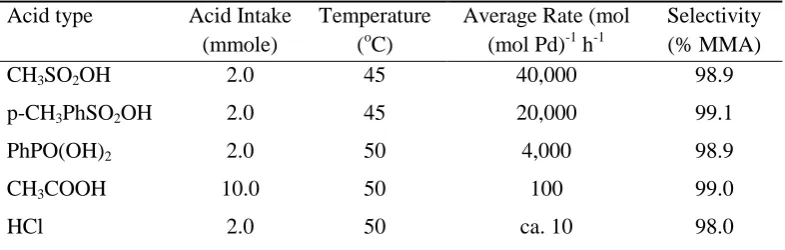
promoter; the nature of the counterion can considerably affect both the activity and selectivity. For example, Drent found that the rate of conversion of ethene to methyl propanoate is significantly influenced by the anion.15 Also, in the hydroesterification of propyne to methyl methacrylate (MMA),12,13 the large activity and relatively small selectivity differences of these reactions are dependent on the acid (Table 1.2)15
Table 1.2. Effect of acid type in the hydroesterificationa of propyne
Acid type Acid Intake (mmole)
Temperature (oC)
Average Rate (mol (mol Pd)-1 h-1
Selectivity (% MMA)
CH3SO2OH 2.0 45 40,000 98.9
p-CH3PhSO2OH 2.0 45 20,000 99.1
PhPO(OH)2 2.0 50 4,000 98.9
CH3COOH 10.0 50 100 99.0
HCl 2.0 50 ca. 10 98.0
a Conditions: 30ml propyne, 50ml MeOH, 60bar CO, 0.025 mmol Pd(OAc)
2, 1.0mmol Ph2Ppy
[image:31.595.110.503.251.376.2]Chapter One
21
PGSE (pulsed field gradient spin-echo) NMR experiments provide an estimate of the average magnitude of the ionic species present and, thus, the aggregation tendency.
Together the NOE and PGSE results provides a reasonable picture of how cations and anions interact in solution, the positive charge distribution together with ability of the anion to approach the positively charged positions (steric effects due to molecular shape), represent the determining factors in the extent of ion pairing. This helps to rationalize observed experimental anion effects in the case of transition-metal complexes when used in homogenous catalysis. In spite of the small size of such anions as (hydride or chloride ligand) compared with cation size that means the anion will not approach formally negatively charged donors.46,47,48 For example, in the methoxycarbonylation of ethene using the Lucite catalyst, Pregosin et al49 suggested that the stability of Pd(II)-hydride complex [Pd(dtbpx)H(MeOH)][OTf] (the active catalyst) might be dependent on coordination of the an ion pairing with the CF3SO3¯ anion H-bonding to the
complexed solvent molecule. To test this idea, diffusion data for Pd(II)-hydride in methanol were collected at 240 K using 31P (instead of 1H) as a diffusion probe for the cation and 19F for the anion. The results showed that the anion and cation diffuse independently i.e. there is no strong hydrogen bond between cation and anion in Pd(II)-hydride.
1.5
. Characterisation of the catalyst
Both NMR and IR spectroscopy play a very important role in the study of the variation of the ligand environment surrounding a metal centre of a catalytic complex in a controlled way.
Chapter One
22
However, the inherent low sensitivity of NMR requires relatively high concentrations of samples to be used, often much greater than catalytic concentrations, and some species observed may not be involved in the catalytic process. However, the NMR signal normally reflects quantitatively the species present; therefore we can determine the concentrations of intermediates along with total mass balance and also concentration of starting materials and products without the need for prior knowledge of IR extinction coefficients – which is usually not available.
IR spectroscopy has several advantages over NMR: IR has high sensitivity; no need for high field superconducting magnets, low noise rf electronics are not required, an IR-cell can be used as an online detector connected to a reaction vessel. However, in addition to the problems of gas dissolution IR has the disadvantages that the structural information that can be obtained is much less than that for NMR.
An additional challenge is that many homogenous catalytic systems operate under gas pressure (10 to > 100 bar).
Many designs of high pressure NMR experimental systems for in situ studies of reacting systems in which gas is consumed have been developed, however, only a few laboratories in the world have these systems.51, 52
Chapter One
23
The NMR phenomenon is based on the fact that nuclei of atoms have magnetic properties that can be utilized to yield chemical information. Quantum mechanically subatomic particles (protons, neutrons and electrons) have spin.
1.6. Dynamic processes and NMR
Dynamic NMR is one of the branches of NMR spectroscopy. NMR techniques can be used to determine e.g. whether molecular structure is rigid can rotation about the bonds in a molecule, or a change in conformation, occur? can ligands can migrate between different sites in a molecule.
Intramolecular processes that can be studied by NMR and are called fluxional
processes. Intermolecular processes such as the exchange of bound and free ligands can also be studied by NMR and are called exchange processes.
These changes in the NMR spectrum are due to exchange between sites with different chemical shift and /or different coupling constant. The most important kind of information obtained in this way concerns the rate constants for the processes studies; the rate associated with the dynamics of discrete equilibria occurring in catalytic cycles (such as a reversible transformation taking place within the coordination sphere of a transition metal complex, or ligand dissociation) can be determined. Evidence for this type of degenerate exchange is usually observed in the form of temperature dependent changes in the NMR lineshape analysis which is one of several strategies available to determine the thermodynamic and kinetic parameters of a dynamic process. Use of an extended temperature range in conventional lineshape analysis improves the quality of the estimated activation parameters. The effect of exchange on coupling differs between a fluxional process and an intermolecular exchange process. In a fluxional process the ligand/migrating group is bonded at all times to the molecule and hence couplings are retained, an averaging of the coupling constant is seen in an intramolecular process.
Chapter One
24
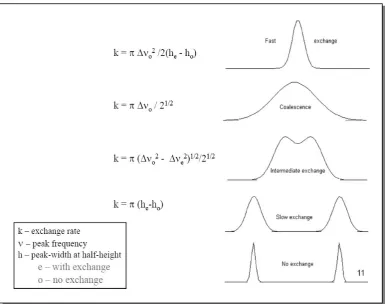
[image:35.595.118.504.338.642.2]In NMR we can distinguish two limiting exchange regimes: (A) slow exchange that is much slower than the difference in resonance frequencies, a separate resonance at the characteristic resonance position is observed. (B) Fast exchange that is much faster than the difference in resonance frequencies, a single line is observed at the weighted average resonance position. Between the fast and slow motion regimes is the coalescence point where the separate resonance of the exchanging sites have just merged into a single peak. All these regimes depend on the temperature, we can change the rate of a dynamic process by altering the temperature; at low temperature the process will be slow like (A), whilst at high temperature the process will be fast like (B) and at intermediate temperature the lines first broaden then coalesce (Figure 1.4). in the fast exchange regime the line width becomes narrower as the rate of exchange increases.53,54
Figure 1.4. Effect of temperature on the resonances and the Exchange Rate
Chapter One
25
1.7. Aims of the thesis
1.7.1. Phosphino-Pyridine (PN) ligand
One aspect of this reaction (hydroesterification of alkyne) is the role(s) played by the pyridylphosphine ligand employed. This is now generally accepted to act as a proton transfer agent but may also act as a hemilabile ligand, protecting the catalytic site from decomposition. The nature of this hemilabilty is the focus of the chapter two.
1.7.2. Effect of alkane sulfonate
Chapter One
26
1.8. References
1. K. Nagai, Appl Catal a-Gen, 2001, 221, 367-377.
2. k. Kida, (Mitsubishi Gas Chemical Co. Ltd), 1999, EP 941, 984
3. W. Clegg, G. R. Eastham, M. R. J. Elsegood, R. P. Tooze, X. L. Wang and K. Whiston, Chem Commun, 1999, 1877-1878.
4. E. Drent, P. Arnoldy and P. H. M. Budzelaar, J Organomet Chem, 1993,
455, 247-253.
5. J. happel, J. H. Blanck and Y. Sakakibara, (standard Oil Co.), US, 1970,
3,496, 221.
6. J. Happel, S. Umemura, Y. Sakakibara, H. Blanck and S. Kunichika, Ind. Eng. Chem., Process Desibn Develop., 1975, 14, 44.
7. Noborn Kawata, Kosaka Honna and Hirozo Sugahara, (Idemitsu Kasdan Co.), 1977, US 4055721.
8. E. Drent, (Shell), 1986, EP 0186228. 9. E. Drent, (Shell), 1990, EP 0386833. 10. E. Drent, (Shell), 1992, EP 0495547.
11. E. Drent and E. Kragtwijk, (Shell), 1992, EP 0495548.
12. E. Drent, P. Arnoldy and P. H. M. Budzelaar, J Organomet Chem, 1994,
475, 57-63.
13. J. Keijsper, P. Arnoldy, M. J. Doyle and E. Drent, Recl Trav Chim Pay B, 1996, 115, 248-255.
14. J. P. Farr, M. M. Olmstead, F. E. Wood and A. L. Balch, J Am Chem Soc, 1983, 105, 792-798.
15. G. Kiss, Chem Rev, 2001, 101, 3435-3456.
16. A. Scrivanti, V. Beghetto, E. Campagna, M. Zanato and U. Matteoli,
Organometallics, 1998, 17, 630-635.
17. A. Dervisi, P. G. Edwards, P. D. Newman and R. P. Tooze, J Chem Soc Dalton, 2000, 523-528.
Chapter One
27
19. A. Dervisi, P. G. Edwards, P. D. Newman, R. P. Tooze, S. J. Coles and M. B. Hursthouse, J Chem Soc Dalton, 1998, 3771-3776.
20. E. Drent and E. Kragtwijk, Eur. Pat. Appl, , 1992 EP 0495548.
21. W. G. Reman, G. B. Deboer, S. A. J. Van Langen and A. Nahuijsen, Eur. Pat. , 1989, EP 0411721.
22. W. Clegg, G. R. Eastham, M. R. J. Elsegood, B. T. Heaton, J. A. Iggo, R. P. Tooze, R. Whyman and S. Zacchini, J Chem Soc Dalton, 2002, 3300-3308.
23. W. Clegg, G. R. Eastham, M. R. J. Elsegood, B. T. Heaton, J. A. Iggo, R. P. Tooze, R. Whyman and S. Zacchini, Organometallics, 2002, 21, 1832-1840.
24. B. A. Markies, D. Kruis, M. H. P. Rietveld, K. A. N. Verkerk, J. Boersma, H. Kooijman, M. T. Lakin, A. L. Spek and G. Vankoten, J Am Chem Soc, 1995, 117, 5263-5274.
25. J. K. Liu, B. T. Heaton, J. A. Iggo and R. Whyman, Angew Chem Int Edit, 2004, 43, 90-94.
26. I. del Rio, C. Claver and P. W. N. M. van Leeuwen, Eur J Inorg Chem, 2001, 2719-2738.
27. E. Drent, J. A. M. Vanbroekhoven and M. J. Doyle, J Organomet Chem, 1991, 417, 235-251.
28. Z. Z. Jiang and A. Sen, J Am Chem Soc, 1995, 117, 4455-4467.
29. R. I. Pugh and E. Drent, Catalytic Synthesis of Alkene-Carbon Monoxide Copolymers and Cooligomers, Vol. 27 (ed,: A. Sen), Kluwer, Dordrecht, 2003.
30. T. W. Lai and A. Sen, Organometallics, 1984, 3, 866-870.
31. E. Drent, J. A. M. v. Broekhoven and P. H. M. Budzelaar, Applied Homogeneous Catalysis with Organometallics compounds,, ed. B. Cornils and W. A. Herrmann, VCH, 1996.
32. F. C. Rix and M. Brookhart, J Am Chem Soc, 1995, 117, 1137-1138. 33. A. Sen, J. T. Chen, W. M. Vetter and R. R. Whittle, J Am Chem Soc, 1987,
Chapter One
28
34. W. Keim, H. Mass and S. Mecking, Z Naturforsch B, 1995, 50, 430-438. 35. E. Drent, J. A. M. vanBroekhoven and P. H. M. Budzelaar, Recl Trav
Chim Pay B, 1996, 115, 263-270.
36. E. Drent and P. H. M. Budzelaar, Chem Rev, 1996, 96, 663-681.
37. G. R. Eastham, R. P. Tooze, M. Kilner, D. F. Foster and D. J. Cole-Hamilton, J Chem Soc Dalton, 2002, 1613-1617.
38. T. G. Appleton, H. C. Clark and L. E. Manzer, Coordin Chem Rev, 1973,
10, 335-422.
39. P. W. N. M. van Leeuwen, M. A. Zuideveld, B. H. G. Swennenhuis, Z. Freixa, P. C. J. Kamer, K. Goubitz, J. Fraanje, M. Lutz and A. L. Spek, J Am Chem Soc, 2003, 125, 5523-5539.
40. J. K. Liu, B. T. Heaton, J. A. Iggo and R. Whyman, Chem Commun, 2004, 1326-1327.
41. Y. Koide, S. G. Bott and A. R. Barron, Organometallics, 1996, 15, 2213-2226.
42. C. A. Reed, Accounts Chem Res, 1998, 31, 133-139. 43. S. H. Strauss, Chem Rev, 1993, 93, 927-942.
44. H. P. Mo and T. C. Pochapsky, Prog Nucl Mag Res Sp, 1997, 30, 1-38. 45. A. Macchioni, Eur J Inorg Chem, 2003, 195-205.
46. M. Alajarin, A. Pastor, R. A. Orenes, E. Martinez-Viviente and P. S. Pregosin, Chem-Eur J, 2006, 12, 877-886.
47. S. P. Smidt, N. Zimmermann, M. Studer and A. Pfaltz, Chem-Eur J, 2004,
10, 4685-4693.
48. E. Martinez-Viviente and P. S. Pregosin, Helv Chim Acta, 2003, 86, 2364-2378.
49. P. S. Pregosin, E. Martinez-Viviente and P. G. A. Kumar, Dalton T, 2003, 4007-4014.
50. D. C. Roe, P. M. Kating, P. J. Krusic and B. E. Smart, Top Catal, 1998, 5, 133-147.
Chapter One
29
52. S. C. van der Slot, P. C. J. Kamer, P. W. N. M. van Leeuwen, J. A. Iggo and B. T. Heaton, Organometallics, 2001, 20, 430-441.
53. F. A. Cotton and G. Wilkinson, Advenced Inorganic Chemistry, Wiley, Chichester, 1988.
Chapter Two
Coordination chemistry and
dynamic processes of Pd(II)
chelate complexes of
2-pyridyldiphenylphosphine in
hydroesterification of alkyne
This work has appeared in DALTON TRANSACTIONS Volume: 39
Issue: 34 Pages: 7921-7935 DOI: 10.1039/b918162h Published: 26th July 2010.
Title: The synthesis of, and characterization of the dynamic processes occur-
ring in Pd(II) chelate complexes of 2-pyridyldiphenylphosphine.
Chapter Two
31
Chapter Two
Coordination chemistry and dynamic processes of Pd(II) chelate
complexes of 2-pyridyldiphenylphos-phine in hydroesterification of
alkyne…...….... 30
Part 1: Coordination chemistry of Pd(II) chelate complexes of
2-pyridyldiphenylphosphine... 34 2.1. Introduction... 34
2.1.1. Electronic properties of phosphine ligand... 37 2.2. 2-Pyridyl diphenylphosphino (Ph2Ppy)... 38
2.3. Synthesis of Pd(II) complexes with both chelating and monodentate
(Ph2Ppy) ligands... 41
2.3.1. Formation of “Pd(ҡ1
-Ph2Ppy)2” precursors... 41
2.3.2. Solvent assisted synthesis of “chelate-monodentate” complexes. 42
Results and discussion... 44 2.4. Preparation of “chelate-monodentate” complexes by removal of halide... 44 2.5. Preparation of “chelate-monodentate” complexes from Pd(II)
precursors... 46 2.5.1. The role of acid... 46 2.5.2. Protonation of Ph2Ppy... 46
2.5.3. Protonation of palladium complexes of Ph2Ppy... 48
Part 2: Dynamic processes of Pd(II) chelate complexes of
Chapter Two
32
2.7. Derivation of thermodynamic parameters... 59
Results and discussion... 60 2.8. Dynamic processes in chelate-monodentate Pd(II) complexes of Ph2Ppy...
... 60 2.8.1. Dynamic processes in [Pd(κ2-Ph2Ppy)(κ1-Ph2Ppy)2][MeSO3]2 (6)....
... 65 2.8.2. Dynamic processes in [Pd(κ2-Ph2Ppy)(κ1-Ph2Ppy)Cl][X] (3[X])...
... 70 2.9. Conclusions... 75 2.10. Experimental... 78
2.10.1. General methods and procedures... 78 2.10.2. Experiments... 79 A- [Pd(κ2-Ph2Ppy)Cl2] (1)... 79
B- [Pd(κ2-Ph2Ppy)(κ1-Ph2Ppy)Cl][Cl] (3[Cl])... 79
C- TIX (X = BF4, MeSO3)... 79
D- [Pd(κ2-Ph2Ppy)(κ1-Ph2Ppy)Cl][BF4] (3[BF4])... 80
E- [Pd(κ2-Ph2Ppy)(κ1-Ph2Ppy)Cl][MeSO3] (3[MeSO3])... 80
F- [Pd(κ2-Ph2Ppy)(κ1-Ph2Ppy)Cl][OTf] (3[OTf])... 80
G- Pd(κ2-Ph2Ppy)(κ1-Ph2Ppy)X][X] (4[X])... 81
H- [Pd(κ2-Ph2Ppy)(κ1-Ph2PpyH)X][X]2 (4’[X]2)... 81
I- [Pd(κ2-Ph2Ppy)2][BF4]2 (5)... 82
Chapter Two
33
Chapter Two
34
Coordination chemistry and dynamic processes of Pd(II)
chelate complexes of 2-pyridyldiphenylphosphine in
hydroes-terification of alkyne
Part 1
:
Coordination chemistry of Pd(II) chelate complexes of
2- pyridyldiphenylphosphine
2.1.
Introduction
In recent years, the coordination chemistry of chelated ligands containing mixed functionalities on transition metal centres has been an extremely active area of research.1-7 In particular, a distinctive class of these ligands, which contain both substitutionally inert and substitutionally labile groups, has received considerable attention. These ligands, termed hemilabile ligands, have weakly chelating groups that are capable of temporarily coordinating to a transition metal centre in the absence of substrate. However, in the presence of substrate, the labile portion of the ligand can be displaced by in coming molecules to form a metal-substrate complex. In addition, the substitutionally inert portion of these ligands keeps them attached in close proximity to transition metal centres. Consequently, recoordination of the weakly chelating portion of the ligand can be achieved after a bound substrate molecule has been transformed into a more weakly bonding group or depleted from the reaction mixture such that the metal-substrate complex is no longer favoured. The bifunctional character of hemilabile ligands has been shown to be useful in a wide range of applications including homogeneous transition metal catalysis.
Jeffrey and Rauchfuss8 in 1979 first introduced the concept of “hemilabile
Chapter Two
35
Since then, a wide range of hemilabile ligands of differing reactivities have been synthesised and complexed to various metal centres. There are some basic characteristics which are present in all hemilabile ligands, illustrated in (Scheme 2.1).6, 13 Firstly, at least two donor atoms with different types of bonding groups (X & Y) are present in the ligand. Secondly, one group (X) bonds strongly to a metal centre while the other group (Y) is weakly bonding and can be easily displaced by incoming ligands or solvent (Z), that yet remains available for recoordination to the metal centre. Consequently, this displacement reaction can be a reversible process.
Scheme 2.1. Labile properties of hemilabile ligands.
A thermodynamically stable metal complex will have the substitutionally inert ligand group (X) binding to soft metals if (X) is a soft base, such as the case with phosphine base hemilabile ligands, or to hard metals if (X) is a hard base such as oxygen or nitrogen. In addition, the effect of changing the oxidation state of the metal in a complex must be taken into account when considering the binding properties of the labile donor atom (Y) in hemilabile ligands.
Chapter Two
36
process can occur that involves the dissociation and recoordination of the weakly bonding moieties via an intramolecular exchange process such as in the ether-phosphine Ru(II) complex shown in Scheme 2.2.14 and the dichlorobis(o -(diphenylphosphino)anisole) ruthenium(II) complex in the original paper of Rauchfuss and Jeffrey, Scheme 2.3.8
Scheme 2.2. Fluxional process of ether-phosphine ligand.
Reaction of the ruthenium (II) complex [RuCl2(P O)2] with CO at room
temperature, initially gives a fluxional monomeric complex [RuCl2(P~O)(P )
CO]. The fluxional process involves interchange of chelated and monodentate P,O ligands. Displacement of chelating P,O ligand by further CO results in the conversion of [RuCl2(P~O)(P )CO] to trans-[RuCl2(P~O)2 (CO)2], in which
both P,O ligands are monodentate (Scheme 2.3).
Scheme 2.3. Hemilabile of P, O ligand as observed by Jeffrey and Rauchfuss.
Chapter Two
37
hemilabile ligand and a coordinating counterion. For example, Chadwell et al15
reported an exchange between a polydentate ether-phosphine ligand and two triflate counterions of an Fe(II) complex (Scheme 2.4).
Scheme 2.4. Hemilability of ether-phosphine ligand
The complexation of substrates by organotransition metal compounds represents an important step in the course of catalytically operating process. Complexes which contain labile molecules have the ability to be transformed into reactive intermediates with an empty coordination site.16
2.1.1
. Electronic properties of phosphine ligand
The tight moiety of hemilabile ligands is often a phosphine. Phosphines, and in particular tertiary phosphines, are one of the most versatile ligands that can bind to late transition metals, due to the formation of stable metal-phosphorus bonds.17, 18
Tertiary phosphines PR3 (R=alkyl, aryl), are important because they constitute a
series of ligands in which the electronic and steric properties can be altered in a predictable way over a very wide range by changing R.19, 20 These ideas have found wide application not only in organometallic and inorganic chemistry but also in industrial applications of homogeneous catalysis. Alkyl phosphines are strong bases, and, as expected, are good σ-donors. Conversely, organophosphites
Chapter Two
38
metals. However, they are also good σ-donors forming stable complexes with high-valent metals.
The σ-basicity and π-acidity of phosphorus ligands has been studied by looking at the stretching frequencies of the co-ordinated CO ligands in complexes. For example, Strohmeier21 and Horrocks22 compared phosphorus ligand properties by measuring the CO stretching vibrations in ((CH3)6C6)Cr(CO)2L (L =
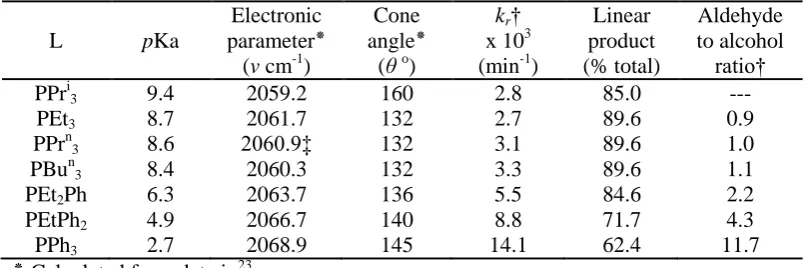
[image:49.595.107.513.395.529.2]phosphorus ligand). Tolman formulated the ideas of electronic parameter and ligand cone angle to explain the electronic and steric effects of phosphorus ligands in the nickel/phosphite catalysed hydrocyanation of butadiene to adiponitrile23 and Tucci has illustrated how changing the R group of the phosphine ligand can significantly alter the reaction result in cobalt hydroformylation (table 2.1).24, 25
Table 2.1. Hydroformylation of Hex-1-ene using Co2(CO)3/2L as catalyst precursor,
(T = 160oC;p ≈ 71 atm H2/CO = 1.2/1 24
)
L pKa
Electronic parameter٭
(v cm-1)
Cone angle٭
(θ o)
kr†
x 103 (min-1)
Linear product (% total) Aldehyde to alcohol ratio†
PPri3 9.4 2059.2 160 2.8 85.0 ---
PEt3 8.7 2061.7 132 2.7 89.6 0.9
PPrn3 8.6 2060.9‡ 132 3.1 89.6 1.0
PBun3 8.4 2060.3 132 3.3 89.6 1.1
PEt2Ph 6.3 2063.7 136 5.5 84.6 2.2
PEtPh2 4.9 2066.7 140 8.8 71.7 4.3
PPh3 2.7 2068.9 145 14.1 62.4 11.7
٭ Calculated from data in23
† calculated from data in 24
‡ estimated
2.2.
2-pyridyl diphenylphosphine (Ph
2Ppy)
Chapter Two
39
a low oxidation state, whereas the σ-donor of nitrogen has the ability to stabilize a higher oxidation state and makes the metal more susceptible to an oxidative addition reaction.2, 3 Selective binding to metal ions of different types (hard and soft), may result in hemilabile behaviour via reversible dissociation of the weaker metal-ligand bond, thus generating a vacant site for substrate binding. This also can help to stabilize an intermediate oxidation state or geometries during a catalytic cycle.
Ph2Ppy is an unsymmetrical potentially hemilabile bidentate ligand with a
nitrogen donor atom. Palladium complexes of which afford extraordinary activity and high selectivity towards the formation of MMA in the methoxy- carbonylation of propyne.
The explanation for the enhanced catalytic activity of (Ph2Ppy) vs (PPh3)
complexes is still not totally understood, and hence a general consensus regarding the catalytic reaction mechanism has, as yet, not been reached. Drent26,
27
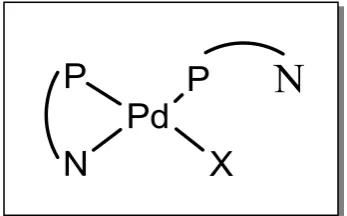
has proposed intermediates in which both phosphorus bound monodentate and chelating pyridylphosphines (henceforward called “chelate-monodentate” complexes) are present (Figure 2.1), and the ligand acts as a proton relay, to obtain high catalytic performance, while, Dervisi28-31 suggested that the pyridylphosphine ligands are monodentate only and are not actively involved in the catalysis when the concentration of Ph2Ppy is high in the reaction system.
But, when the concentration of Ph2Ppy is low, the pyridylphosphine ligands are
[image:50.595.218.392.565.673.2]coordinated as chelate, and it will be active in the catalysis reaction.
Chapter Two
40
One of the difficulties in establishing the mechanism of this catalysis is that the coordination chemistry of 2-pyridyldiphenylphosphine, Ph2Ppy with palladium
(II) has, surprisingly, been little explored.
The focus of this work was not ligand electronic and steric effects but the hemilability of 2-pyridyldiphenylphosphine (Ph2Ppy), which, as shown above,
has a dramatic effect on catalyst activity in palladium catalysed alkoxycarbonylation of alkynes.
Understanding the nature of the coordination mode of the ligand in the catalytic complex involved is fundamental to the understanding of the overall reaction mechanism.31-35
Balch and co-workers initiated work on the chemistry of (Ph2Ppy) in the early
1980s, studying the synthesis, structure and reactivity of Ph2Ppy-containing
complexes.
A small number of chelating 4-membered ring complexes containing (Ph2Ppy)
of metals other than Pd(II) has been reported. The X-ray crystal structures of these complexes, reveal a highly compressed P-M-N angle, which is nearly 70o, the other three angles consequently open up so that e.g. the P-M-L (L trans to N) is over 100o and the other two angles are near the ideal 90o.32, 36-38 Within the chelate ring, there is also significant angular compression. Both the C-N-M and the N-C-P angles are reduced from the ideal value of 120o and the C-P-M angle is reduced below the expected value of 109.5o. In addition, the chelate P-C distance is longer than the non-chelate P-C distances. The ring strain in these chelated complexes render them unstable, thus the nitrogen donor is readily displaced from a low valent metal giving phosphorus bound monodentate complexes.3
This strained hemilabile coordination mode may play a key role in catalysis. Furthermore, the substitutionally inert portion can be used to change the selectivity of the transition-metal centre and the presence of the labile donor group may allow this part of the ligand to play a dual role.39, 40
Protonation of the pendant pyridyl nitrogen is proposed to be an important step in catalytic hydroesterification of alkyne using Pd/pyridylphosphine catalysts.
31, 41-43
Chapter Two
41
cycle is due to the presence of a strong acid with weakly coordinating conjugate base which was a necessary co-catalyst in this transformation (Scheme 2.5).40
Scheme 2.5. One proposed role for bifunctional pyridylphosphine.
2.3. Synthesis of Pd(II) complexes with both chelating and
monodentate (Ph
2Ppy) ligands
2.3.1. Formation of “Pd(ҡ1-Ph2Ppy)2” precursors
Sheridan44 has previously reported that the direct addition of (Ph2Ppy) to
[Pd(PhCN)2Cl2] in dichloromethane solution, with varying (metal: ligand) ratios
[image:52.595.138.467.533.693.2]of 4:1 to 1:2, gives mixtures of complexes. For example, the 31P NMR spectrum (Figure 2.2) of the solution of a 1:1 mixture of (Ph2Ppy) and [Pd(PhCN)2Cl2] ,
shows three sharp singlets.
Figure 2.2. The 31P{1H} NMR spectrum recorded at 293 K of isolated product from the reaction of [Pd(PhCN)2Cl2] with 1 equivalent of Ph2Ppy in CH2Cl2.
(ppm)
Chapter Two
42
The two high frequency resonances, δ(P) 29.0 and 22.8 ppm, indicate (Ph2Ppy)
ligands bound through phosphorus only (cf. that of the free ligand δ(P) -4.5 ppm).2 The chemical shift of the third resonance is at extremely low frequency,
δ(P) -61.6 ppm and is characteristic of a strained, four-membered chelate ring.45 Normally coordination of a phosphine ligand produces a shift of the 31P resonance to high frequency relative to the free ligand, however, in the case of a four-membered chelate rings, there are large shielding effects which result in the
31
P resonance of the coordinated phosphorus atom occurring at low frequency relative to the free ligand,
The absence of coupling indicated only one type of phosphorus is present in each of the complexes and the three complexes were tentatively formulated as [Pd(ҡ2-Ph2Ppy)Cl2], 1, cis-[Pd(ҡ1-Ph2Ppy)2Cl2], 2a (δ(P) 29.0 (s) ppm), and trans-[Pd(ҡ1-Ph2Ppy)2Cl2], 2b (δ(P) 22.8 (s) ppm).46-49
2.3.2. Solvent assisted synthesis of “chelate-monodentate” complexes
Balch et al50 have previously reported the existence of an equilibrium between phosphorus-bound monodentate cis[Pt(Ph2Ppy)2X2] (X= I, Cl) and
“chelate-monodentate” [Pt(ҡ2
-Ph2Ppy)2(ҡ1-Ph2Ppy)X][X] (X= I, Cl)
complexes in chloroform solution. The position of the equilibrium shifts in favour of the cationic “chelate-monodentate” complex at low temperature, due, Balch suggested to the entropic contribution of two monodentate (Ph2Ppy) ligands vs one monodentate (Ph2Ppy) ligands becoming less
significant at low temperature, consequently, ionization of halide from the platinum centre in [Pt(Ph2Ppy)2X2] (assisted by intramolecular attack of a
Chapter Two
43
to result in complete dissolution of the solid and 31P{1H} NMR spectroscopy revealed the formation of the cationic Pd(II)- “chelate-monodentate” complex [Pd(ҡ2-Ph2Ppy)(ҡ1-Ph2Ppy)Cl][Cl], 3[Cl] (Scheme 2.6).
Scheme 2.6. Synthesis route to the ionic Pd(II) “chelate-monodentate”
The 31P{1H}NMR spectrum of 3(Cl) shows two broad sets of resonances at 293 K. Whereas, at 233 K the 31P{1H}NMR spectrum (Figure 2.3) becomes two sharp doublets at δ(P) 44.4 (d) and -44.0 (d) ppm indicating a fluxional process is occurring, 2J(P1-P2) = 33.0 Hz indicating the presence of two mutually cis, inequivalent phosphorus atoms.
Figure 2.3. 31P{1H}NMR spectrum, at 233 K, of [Pd(ҡ2-Ph2Ppy)(ҡ 1
-Ph2Ppy)Cl][Cl],
3[Cl] in CH2Cl2/MeOH
Chapter Two
44
resonance at high field (very low frequency) (δ(P) -44.0 ppm) can be assigned to the phosphorus of a chelating Ph2Ppy ligand45 with P trans to Cl, P2 (Scheme
2.6). We therefore decided to investigate further the possibility of using solvation of the anion for removing halide and substituting with other ligands.
Results and discussion
2.4.
Preparation of “chelate-monodentate” complexes by removal of
halide
The presence of a tightly bound halide ligand in the fourth coordination site at Pd(II) has been observed to suppress strongly the activity of the Pd centre in organometallic catalytic reactions. For example, Liu et al52-54 recently have shown that the presence of a strongly coordinating ligand such as chloride at the metal centre can have a profound effect on the individual reaction steps in the carbonylation of alkene catalysed by Pd(II) diphosphine cations, by completely inhibiting the reaction by preventing coordination of other molecules such as carbon monoxide, ethene and methanol. Therefore, the preference is to use less tightly bound ligands for example (OTf¯, CH3CN¯, MeSO3¯, CF3CO2¯) (OTf =
CF3SO3¯) over ligands such as chloride. Sheridan44 showed that addition of the
more polar solvent MeOH to CH2Cl2 solutions of 2a/b aids the removal of bound
chloride as a counterion resulting in the formation of the Pd(II)- “chelate-monodentate” complex, 3[Cl]. However, the dynamic exchange process observed in 3[Cl] indicates that Cl¯ might re-enter the coordination sphere displacing the chelating nitrogen. Therefore, we tried to remove the coordinated chloride from 3[X] and replace it with labile anions. The dynamic process in
3[Cl] has also been further investigated.
Other counterions of salt 3 can be prepared by the addition of one to four equivalents of TIX (X = BF4, OTf, MeSO3) to a dichloromethane solution of 2
or to a dichloromethane-methanol solution of 3[Cl], to give [Pd(ҡ2-Ph2Ppy)(ҡ1
-Ph2Ppy)Cl][X], 3[X], (X = BF4, OTf, MeSO3). The salts TIX (X = BF4, OTf
Chapter Two
45
CF3SO3H, MeSO3H). TI+ was used instead of Ag+ due to thallium being superior
to silver in at least two respects: (i) Tl+ is less oxidizing than Ag+; (ii) Tl+ lacks the affinity of Ag+ for neutral C, N, and P-donor bases, which prevents the decomposition of labile complexes via abstraction of ligands weakly coordinated to metallic centers. But, we should keep in mind that thallium compounds are very toxic and may cause alopecia.
The 31P{1H}NMR spectra of 3[X] in CH2Cl2 at 233 K reveals two sharp doublet
[image:56.595.120.500.313.586.2]at δ(P) 44.7 and –43.8 (+/–0.1) ppm with 2J(P1-P2) = 38.2 Hz with only small counterion dependent shifts of the resonances, Table 2.2 (Figure 2.4), indicative of a “chelate-monodentate” structure being formed.
Figure 2.4. 31P{1H} NMR spectrum of 3[X], (X = Cl, BF4, OTf, MeSO3) in CH2Cl2
/MeOH recorded at (top) 233 K.
Although, the position of the resonance and coupling constant is essentially the same in all four salts 3[X] as is expected when only the counter ion is changed,36, 37 the variable temperature behaviour exhibited in the 31P{1H} NMR spectra reveals a profound change in the rate of the exchange process which
3[OTf]¯
3[MeSO3]¯
Chapter Two
46
enables the mechanism of the exchange reaction to be elucidated, see section 2.6.
2.5. Preparation of “chelate-monodentate” complexes from
Pd(II) precursors
Although the procedure above allowed removal of one halide ion, the second remains coordinated to Pd.
It has been shown that halide salts interfere with palladium chemistry. Although we are able to exchange the counterion in salts such as 3[Cl], we cannot be certain that the resulting solution does not contain traces of chloride and the coordinated chloride remainsin the cation. Therefore, we investigated Pd(OAc)2
as a precursor to “chelate-monodentate” complexes.
2.5.1. The role of the acid
As previously mentioned in chapter one, Drent26 and Scrivanti55 observed that in order to achieve high activities for the carbonylation of alkynes, an excess of strong acid over the stoichiometric amount was required to remove acetate as acetic acid from the palladium coordination sphere. In addition, once an excess of acid is present, studies show that the reaction order with respect to acid concentration is close to zero. It is thought that the acid may not, therefore, be directly involved in the termination step, but rather is required to protonate the nitrogen of the pyridyl phosphine ligand; the idea of a proton messenger has been put forward by both Drent26 and Scrivanti55.
Before attempting the synthesis of Pd complexes, we first investigated the protonation of Ph2Ppy
2.5.2. Protonation of Ph2Ppy
For comparative purposes, the 1H and 31P{1H}NMR spectra of the free Ph2Ppy
in CH2Cl2 were recorded prior to reaction with acid and after addition of one
![Figure 2.2. The 31P{1H} NMR spectrum recorded at 293 K of isolated product from the reaction of [Pd(PhCN)2Cl2] with 1 equivalent of Ph2Ppy in CH2Cl2](https://thumb-us.123doks.com/thumbv2/123dok_us/8061806.226130/52.595.138.467.533.693/figure-spectrum-recorded-isolated-product-reaction-phcn-equivalent.webp)
![Figure 2.4. 31P{1H} NMR spectrum of 3[X], (X = Cl, BF4, OTf, MeSO3) in CH2Cl2 /MeOH recorded at (top) 233 K](https://thumb-us.123doks.com/thumbv2/123dok_us/8061806.226130/56.595.120.500.313.586/figure-nmr-spectrum-cl-otf-meso-meoh-recorded.webp)

![Figure 2.6. The 31P{1H} NMR spectrum of 4[X], and the protonated analogues 4’[X]2, (X = OTf, CF3CO2, MeSO3) in CH2Cl2 recorded at 193 K](https://thumb-us.123doks.com/thumbv2/123dok_us/8061806.226130/59.595.145.470.475.720/figure-nmr-spectrum-protonated-analogues-otf-meso-recorded.webp)
