Database Design for Smarties: Using UML for Data Modeling
by Robert J. Muller ISBN: 1558605150 Morgan Kaufmann Publishers © 1999, 442 pages
Learn UML techniques for object-oriented database design.
Table of Contents Colleague Comments
Back Cover
Synopsis by Dean Andrews
In Database Design for Smarties, author Robert Muller tells us that current database products -- like Oracle, Sybase, Informix and SQL Server -- can be adapted to the UML (Unified Modeling Language) object-oriented database design techniques even if the products weren't designed with UML in mind. The text guides the reader through the basics of entities and attributes through to the more sophisticated concepts of analysis patterns and reuse techniques. Most of the code samples in the book are based on Oracle, but some examples use Sybase, Informix, and SQL Server syntax.
Table of Contents
Database Design for Smarties - 3
Preface - 5
Chapter 1
- The Database Life Cycle - 6
Chapter 2
- System Architecture and Design - 11
Chapter 3
- Gathering Requirements - 38
Chapter 4
- Modeling Requirements with Use Cases - 50
Chapter 5
- Testing the System - 65
Chapter 6
- Building Entity-Relationship Models - 68
Chapter 7- Building Class Models in UML - 81
Chapter 8
- Patterns of Data Modeling - 116
Chapter 9
- Measures for Success - 134
Chapter 10
- Choosing Your Parents - 147
Chapter 11
- Designing a Relational Database Schema - 166
Chapter 12
- Designing an Object-Relational Database Schema - 212
Chapter 13
- Designing an Object-Oriented Database Schema - 236
Sherlock Holmes Story References - 259
Bibliography - 268
Index -
List of Figures - 266
Back Cover
Whether building a relational, Object-relational (OR), or Object-oriented (OO) database, database developers are incleasingly relying on an object-oriented design approach as the best way to meet user needs and performance criteria. This book teaches you how to use the Unified Modeling Language (UML) -- the approved standard of the Object management Group (OMG) -- to devop and implement the best possible design for your database.
Inside, the author leads you step-by-step through the design process, from requirements analysis to schema generation. You'll learn to express stakeholder needs in UML use cases and actor diagrams; to translate UML entities into database components; and to transform the resulting design into relational, object-relational, and object-oriented schemas for all major DBMS products.
Features
• Teahces you everything you need to know to design, build and test databasese using an OO model
• Shows you hoe to use UML, the accepted standards for database design according to OO principles
• Explains how to transform your design into a conceptual schema for relational, object-relational, and object-oriented DBMSs
• Offers proactical examples of design for Oracle, Microsoft, Sybase, Informix, Object Design, POET, and other database management systems
• Focuses heavily on reusing design patterns for maximum productivity and teaches you how to certify completed desings for reuse
About the Author
Robert J. Muller, Ph.D., has been desinging databases since 1980, in the process gaining extensive experience in relational, object-relational, and object-oriented systems. He is the author of books on object-oriented software testing, project management, and the Oracle DBMS, including The Oracle Developer/2000 Handbook, Second Edition (Oracle Press).
Database Design for Smarties
USING UML FOR DATA MODELING
Robert J. Muller
Copyright © 1999 by by Academic Press USING UML FOR DATA MODELING
MORGAN KAUFMANN PUBLISHERS AN IMPRINT OF ACADEMIC PRESS A Harcourt Science and Technology Company
SAN FRANCISCO SAN DIEGO NEW YORK BOSTON LONDON SYDNEY TOKYO Senior Editor Diane D. Cerra
Director of Production and Manufacturing Yonie Overton Production Editors Julie Pabst and Cheri Palmer
Editorial Assistant Belinda Breyer Copyeditor Ken DellaPenta Proofreader Christine Sabooni
Text Design Based on a design by Detta Penna, Penna Design & Production Composition and Technical Illustrations Technologies 'N Typography
Cover Image PhotoDisc (magnifying glass)
Archive Photos (Sherlock Holmes) Indexer Ty Koontz
Printer Courier Corporation
Designations used by companies to distinguish their products are often claimed as trademarks or registered trademarks. In all instances where Morgan Kaufmann Publishers is aware of a claim, the product names appear in initial capital or all capital letters. Readers, however, should contact the appropriate companies for more complete information regarding trademarks and registration.
ACADEMIC PRESS
A Harcourt Science and Technology Company
525 B Street, Suite 1900, San Diego, CA 92101-4495, USA http//www.academicpress.com
Academic Press
Harcourt Place, 32 Jamestown Road, London, NW1 7BY United Kingdom http://www.hbuk.co.uk/ap/
Morgan Kaufmann Publishers
340 Pine Street, Sixth Floor, San Francisco, CA 94104-3205, USA http://www.mkp.com
1999by Academic Press
All rights reserved
Printed in the United States of America
04 03 02 01 00 5 4 3 2
No part of this publication may be reproduced, stored in a retrieval system, or transmitted in any form or by any means—electronic, mechanical, photocopying, recording, or otherwise—without the prior written permission of the publisher.
Library of Congress Cataloging-in-Publication Data
Muller, Robert J.
Database design for smarties : using UML for data modeling /
Robert J. Muller.
p. cm.
Includes bibliographical references and index. ISBN 1-55860-515-0
Database design.UML (Computer science)Title.
QA76.9.D26 M85 1999
005.74—dc21 98-54436
CIP
Dedication To Theo,
This book presents a simple thesis: that you can design any kind of database with standard object-oriented design techniques. As with most things, the devil is in the details, and with database design, the details often wag the dog.
That's Not the Way We Do Things Here
The book discusses relational, object-relational (OR), and object-oriented (OO) databases. It does not, however, provide a comparative backdrop of all the database design and information modeling methods in existence. The thesis, again, is that you can pretty much dispose of most of these methods in favor of using standard 00 design— whatever that might be. If you're looking for information on the right way to do IDEF1X designs, or how to use SSADM diagramming, or how to develop good designs in Oracle's Designer/2000, check out the Bibliography for the competition to this book.
I've adopted the Unified Modeling Language (UML) and its modeling methods for two reasons. First, it's an approved standard of the Object Management Group (OMG). Second, it's the culmination of years of effort by three very smart object modelers, who have come together to unify their disparate methods into a single, very capable notation standard. See Chapter 7 for details on the UML. Nevertheless, you may want to use some other object modeling method. You owe it to yourself to become familiar with the UML concepts, not least because they are a union of virtually all object-oriented method concepts that I've seen in practice. By learning UML, you learn object-oriented design concepts systematically. You can then transform the UML notation and its application in this book into whatever object-oriented notation and method you want to use.
This book is not a database theory book; it's a database practice book. Unlike some authors [Codd 1990; Date and Darwen 1998], I am not engaged in presenting a completely new way to look at databases, nor am I presenting an academic thesis. This book is about using current technologies to build valuable software systems productively. I stress the adapting of current technologies to object-oriented design, not the replacement of them by object-oriented technologies.
Finally, you will notice this book tends to use examples from the Oracle database management system. I have spent virtually my entire working life with Oracle, though I've used other databases from Sybase to Informix to SQL Server, and I use examples from all of those DBMS products. The concepts in this book are quite general. You can translate any Oracle example into an equivalent from any other DBMS, at least as far as the relational schema goes. Once you move into the realm of the object-relational DBMS or the object-oriented DBMS, however, you will find that your specific product determines much of what you can do (see Chapters 12 and 13 for details). My point: Don't be fooled into thinking the techniques in this book are any different if you use Informix or MS Access. Design is the point of this book, not implementation. As with UML, if you understand the concepts, you can translate the details into your chosen technology with little trouble. If you have specific questions about applying the techniques in practice, please feel free to drop me a line at <[email protected]>, and I'll do my best to work out the issues with you.
Data Warehousing
Aficionados of database theory will soon realize there is a big topic missing from this book: data warehousing, data marts, and star schemas. One has to draw the line somewhere in an effort of this size, and my publisher and I decided not to include the issues with data warehousing to make the scope of the book manageable.
Briefly, a key concept in data warehousing is the dimension, a set of information attributes related to the basic objects in the warehouse. In classic data analysis, for example, you often structure your data into multidimensional tables, with the cells being the intersection of the various dimensions or categories. These tables become the basis for analysis of variance and other statistical modeling techniques. One important organization for dimensions is the star schema, in which the dimension tables surround a fact table (the object) in a star configuration of one-to-many relationships. This configuration lets a data analyst look at the facts in the database (the basic objects) from the different dimensional perspectives.
In a classic OO design, the star schema is a pattern of interrelated objects that come together in a central object of some kind. The central object does not own the other objects; rather, it relates them to one another in a
multidimensional framework. You implement a star schema in a relational database as a set of one-to-many tables, in an object-relational database as a set of object references, and in an object-oriented database as an object with dimensional accessors and attributes that refer to other objects.
Web Enhancement
If you're intersted in learning more about database management, here are some of the prominent relational, object-relational, and object-oreinted products. Go to the Web sites to find the status of the current product and any trial downloads they might have.
Tool Company Web Site
Rational Rose
98 Rational Software www.rational.com
Object Team Cayenne
Software www.cool.sterling.com
Oracle Designer Object Extension
Oracle Corp. www.oracle.com
ObjectStore PSE Pro for Jave
Object Design www.odi.com
POET Object Database System
POET Software www.poet.com
Jasmine Computer
Associates www.cai.com
Objectivity Objectivity,
Inc. www.objectivity.com
Versant ODBMS Versant Corp. www.versant.com
Personal
Oracle8 Oracle Corp. www.oracle.com
Personal
Oracle7 Oracle Corp. www.oracle.com
Informix Universal Data Option
Informix
Software, Inc. www.informix.com
Informix Dynamic Server, Personal Edition
Informix
Software, Inc. www.informix.com
Informix SE Imformix
Software, Inc. www.informix.com
Sybase Adaptive Server
Sybase, Inc. www.sybase.com
Sybase Adaptive Server Anywhere
Sybase, Inc. www.sybase.com
SQL Server 7 Microsoft
Corp. www.microsoft.com
DB2 Universal
Database IBM Corp. www.ibm.com
Chapter 1: The Database Life Cycle
For mine own part, I could be well contentTo entertain the lagend of my life
With quiet hours.
Shakespeare, Henry IV Part 1, V.i.23
Overview
definitely relevant to understanding the part. You will also find that, like honor and taxes, design pops up in the most unlikely places.
The life cycle of a database is really many smaller cycles, like most lives. Successful database design does not lumber along in a straight line, Godzilla-like, crushing everything in its path. Particularly when you start using OO techniques in design, database design is an iterative, incremental process. Each increment produces a working database; each iteration goes from modeling to design to construction and back again in whatever order makes sense. Database design, like all system design, uses a leveling process [Hohmann 1997]. Leveling is the cognitive equivalent of water finding its own level. When the situation changes, you move to the part of the life cycle that suits your needs at the moment. Sometimes that means you are building the physical structures; at other times, you are modeling and designing new structures.
Note
Beware of terminological confusion here. I've found it expedient to define my terms as I go, as there are so many different ways of describing the same thing. In particular, be aware of my use of the terms "logical" and "physical." Often, CASE vendors and others use the term "physical" design to distinguish the relational schema design from the entity-relationship data model. I call the latter process modeling and the former process logical or conceptual design, following the ANSI architectural standards that Chapter 2 discusses. Physical design is the process of setting up the physical schema, the collection of access paths and storage structures of the database. This is completely distinct from setting up the relational schema, though often you use similar data definition language statements in both processes. Focus on the actual purpose behind the work, not on arbitrary divisions of the work into these
categories. You should also realize that these terminological distinctions are purely cultural in nature; learning them is a part of your socialization into the particular design culture in which you will work. You will need to map the actual work into your particular culture's language to communicate effectively with the locals.
Information Requirements Analysis
Databases begin with people and their needs. As you design your database, your concern should be for the needs of database users. The end user is the ultimate consumer of the software, the person staring at the computer screen while your queries iterate through the thousands or millions of objects in your system. The system user is the direct consumer of your database, which he or she uses in building the system the end user uses. The system user is the programmer who uses SQL or OQL or any other language to access the database to deliver the goods to the end user.
Both the end user and the system user have specific needs that you must know about before you can design your database. Requirements are needs that you must translate into some kind of structure in your database design. Information requirements merge almost indistinguishably into the requirements for the larger system of which the database is a part.
In a database-centric system, the data requirements are critical. For example, if the whole point of your system is to provide a persistent collection of informational objects for searching and access, you must spend a good deal of time understanding information requirements. The more usual system is one where the database supports the ongoing use of the system rather than forming a key part of its purpose. With such a database, you spend more of your time on requirements that go beyond the simple needs of the database. Using standard OO use cases and the other accouterments of OO analysis, you develop the requirements that lead to your information needs. Chapters 3 and 4
go into detail on these techniques, which permit you to resolve the ambiguities in the end users' views of the
database. They also permit you to recognize the needs of the system users of your data as you recognize the things that the database will need to do. End users need objects that reflect their world; system users need structures that permit them to do their jobs effectively and productively.
One class of system user is more important than the rest: the reuser. The true benefit of OO system design is in the ability of the system user to change the use of your database. You should always design it as though there is someone looking over your shoulder who will be adding something new after you finish—maybe new database structures, connecting to other databases, or new systems that use your database. The key to understanding reuse is the combination of reuse potential and reuse certification.
Reuse potential is the degree to which a system user will be able to reuse the database in a given situation [Muller 1998]. Reuse potential measures the inherent reusability of the system, the reusability of the system in a specific domain, and the reusability of the system in an organization. As you design, you must look at each of these components of reuse potential to create an optimally reusable database.
Reuse certification, on the other hand, tells the system user what to expect from your database. Certifying the reusability of your database consists of telling system users what the level of risk is in reusing the database, what the functions of the database are, and who takes responsibility for the system.
Data Modeling
Given the users' needs, you now must formally model the problem. Data modeling serves several purposes. It helps you to organize your thinking about the data, clarifying its meaning and practical application. It helps you to
communicate both the needs and how you intend to meet them. It provides a platform from which you can proceed to design and construction with some assurance of success.
Data modeling is the first step in database design. It provides the link between the users' needs and the software solution that meets them. It is the initial abstraction that hides the complexity of the system. The data model reduces complexity to a level that the designer can grasp and manipulate. As databases and data structures grow ever more numerous and complex, data modeling takes on more and more importance. Its contribution comes from its ability to reveal the essence of the system out of the obscurity of the physical and conceptual structures on the one hand and the multiplicity of uses on the other.
Most database data modeling currently uses some variant of entity-relationship (ER) modeling [Teorey 1999]. Such models focus on the things and the links between things (entities and relationships). Most database design tools are ER modeling tools. You can't write a book about database design without talking about ER modeling; Chapter 6 does that in this book to provide a context for Chapter 7, which proposes a change in thinking.
The next chapter (Chapter 2) proposes the idea that system architecture and database design are one and the same. ER modeling is not particularly appropriate for modeling system architecture. How can you resolve the contradiction? You either use ER modeling as a piece of the puzzle under the assumption that database design is a puzzle, or you integrate your modeling into a unified structure that designs systems, not puzzles.
Chapter 7 introduces the basics of the UML, a modeling notation that provides tools for modeling every aspect of a software system from requirements to implementation. Object modeling with the UML takes the place of ER modeling in modern database design, or at least that's what this book proposes.
Object modeling uses standard OO concepts of data hiding and inheritance to model the system. Part of that model covers the data needs of the system. As you develop the structure of classes and objects, you model the data your system provides to its users to meet their needs.
But object modeling is about far more than modeling the static structure of a system. Object modeling covers the dynamic behavior of the system as well. Inheritance reflects the data structure of the system, but it also reflects the division of labor through behavioral inheritance and polymorphism. This dynamic character has at least two major effects on database design. First, the structure of the system reflects behavioral needs as well as data structure differences. This focus on behavior often yields a different understanding of the mapping of the design to the real world that would not be obvious from a more static data model. Second, with the increasing integration of behavior into the database through rules, triggers, stored procedures, and active objects, static methods often fail to capture a vital part of the database design. How does an ER model reflect a business rule that goes beyond the simple
referential integrity foreign key constraint, for example?
Chapters 8 to 10 step back from object modeling to integrate models into a useful whole from the perspective of the user. Relating the design to requirements is a critical aspect of database design because it clarifies the reasons behind your design decisions. It also highlights the places where different parts of the system conflict, perhaps because of conflicting user expectations for the system. A key part of data modeling is the resolution of such conflicts at the highest level of the model.
The modeling process is just the start of design. Once you have a model, the next step is to relate the model back to needs, then to move forward to adding the structures that support both reuse and system functions.
Database Design and Optimization
When does design start? Design starts at whatever point in the process that you begin thinking about how things relate to one another. You iterate from modeling to design seamlessly. Adding a new entity or class is modeling; deciding how that entity or class relates to other ones is design.
Where does design start? Usually, design starts somewhere else. That is, when you start designing, you are almost always taking structures from somebody else's work, whether it's requirements analysis, a legacy database, a prior system's architecture, or whatever. The quality, or value, of the genetic material that forms the basis of your design can often determine its success. As with anything else, however, how you proceed can have as much impact on the ultimate result of your project.
helps, where you wind up depends at least as much on how you get there as on where you start. Chapter 10 gives you some hints on how to proceed from different starting points and also discusses the cultural context in which your design happens. Organizational culture may impact design more than technology.
The nitty-gritty part of design comes when you transform your data model into a schema. Often, CASE tools provide a way to generate a relational schema directly from your data model. Until those tools catch up with current realities, however, they won't be of much help unless you are doing standard ER modeling and producing standard relational schemas. There are no tools of which I'm aware that produce OO or OR models from OO designs, for example.
Chapters 11, 12, and 13 show how to produce relational, OR, and OO designs, respectively, from the OO data model. While this transformation uses variations on the standard algorithm for generating schemas from models, it differs subtly in the three different cases. As well, there are some tricks of the trade that you can use to improve your schemas during the transformation process.
Build bridges before you, and don't let them burn down behind you after you've crossed. Because database design is iterative and incremental, you cannot afford to let your model lapse. If your data model gets out of synch with your schema, you will find it more and more difficult to return to the early part of design. Again, CASE tools can help if they contain reverse-engineering tools for generating models from schemas, but again those tools won't support much of the techniques in this book. Also, since the OO model supports more than just simple schema definition, lack of maintenance of the model will spill over into the general system design, not just database design.
At some point, your design crosses from logical design to physical design. This book covers only logical design, leaving physical design to a future book. Physical design is also an iterative process, not a rigid sequence of steps. As you develop your physical schema, you will realize that certain aspects of your logical design affect the physical design in negative ways and need revision. Changes to the logical design as you iterate through requirements and modeling also require Changes to physical design. For example, many database designers optimize performance by denormalizing their logical design. Denormalization is the process of combining tables or objects to promote faster access, usually through avoiding data joins. You trade off better performance for the need to do more work to maintain integrity, as data may appear in more than one place in the database. Because it has negative effects on your design, you need to consider denormalizing in an iterative process driven by requirements rather than as a standard operating procedure. Chapter 11 discusses denormalization in some detail.
Physical design mainly consists of building the access paths and storage structures in the physical model of the database. For example, in a relational database, you create indexes on sets of columns, you decide whether to use B*-trees, hash indexes, or bitmaps, or you decide whether to prejoin tables in clusters. In an OO database, you might decide to cluster certain objects together or index particular partitions of object extents. In an OR database, you might install optional storage management or access path modules for extended data types, configuring them for your particular situation, or you might partition a table across several disk drives. Going beyond this simple
configuration of the physical schema, you might distribute the database over several servers, implement replication strategies, or build security systems to control access.
As you move from logical to physical design, your emphasis changes from modeling the real world to improving the system's performance—database optimization and tuning. Most aspects of physical design have a direct impact on how your database performs. In particular, you must take into consideration at this point how end users will access the data. The need to know about end user access means that you must do some physical design while
incrementally designing and building the systems that use the database. It's not a bad idea to have some
brainstorming sessions to predict the future of the system as well. Particularly if you are designing mission-critical decision support data warehouses or instantresponse online transaction processing systems, you must have a clear idea of the performance requirements before finalizing your physical design. Also, if you are designing physical models using advanced software/hardware combinations such as symmetric multiprocessing (SMP), massively parallel processing (MPP), or clustered processors, physical design is critical to tuning your database.
Tip
You can benefit from the Internet in many ways as a database designer. There are many different Usenet newsgroups under the comp.databases interest group, such as
comp.databases .oracle.server. There are several Web sites that specialize in vendorspecific tips and tricks; use a Web search engine to search for such sites. There are also mailing lists (email that gets sent to you automatically with discussion threads about a specific topic) such as the data modeling mail list. These lists may be more or less useful depending on the level of activity on the list server, which can vary from nothing for months to hundreds of messages in a week. You can usually find out about lists through the Usenet newsgroups relating to your specific subject area. Finally, consider joining any user groups in your subject area such as the Oracle Developer Tools User Group (www.odtug.com); they usually have conferences,
maintain web sites, and have mailing lists for their members.
attacks on the data or server. To deal with risk, you first determine your tolerance for risk. You then manage risk to keep it within your tolerance. For example, if you can tolerate a few hours of downtime every so often, you don't need to take advantage of the many fault-tolerant features of modern DBMS products. If you don't care about minor data problems, you can avoid the huge programming effort to catch problems at every level of data entry and modification. Your risk management methods should reflect your tolerance for risk instead of being magical rituals you perform to keep your culture safe from the database gods (see Chapter 10 on some of the more shamanistic cultural influences on database design). Somewhere in this process, you need to start considering that most direct of risk management techniques, testing.
Database Quality, Reviews, and Testing
Database quality comes from three sources: requirements, design, and construction. Requirements and design quality use review techniques, while construction uses testing. Chapter 5 covers requirements and database testing, and the various design chapters cover the issues you should raise in design reviews. Testing the database comes in three forms: testing content, testing structure, and testing behavior. Database test plans use test models that reflect these components: the content model, the structural model, and the design model.
Content is what database people usually call "data quality." When building a database, you have many alternative ways to get data into the database. Many databases come with prepackaged content, such as databases of images and text for the Internet, search-oriented databases, or parts of databases populated with data to reflect options and/or choices in a software product. You must develop a model that describes what the assumptions and rules are for this data. Part of this model comes from your data model, but no current modeling technique is completely adequate to describe all the semantics and pragmatics of database content. Good content test plans cover the full range of content, not just the data model's limited view of it.
The data model provides part of the structure for the database, and the physical schema provides the rest. You need to verify that the database actually constructed contains the structures that the data model calls out. You must also verify that the database contains the physical structures (indexes, clusters, extended data types, object containers, character sets, security grants and roles, and so on) that your physical design specifies. Stress, performance, and configuration tests come into play here as well. There are several testing tools on the market that help you in testing the physical capabilities of the database, though most are for relational databases only.
The behavioral model comes from your design's specification of behavior related to persistent objects. You usually implement such behavior in stored procedures, triggers or rules, or server-based object methods. You use the usual procedural test modeling techniques, such as data flow modeling or state-transition modeling, to specify the test model. You then build test suites of test scripts to cover those models to your acceptable level of risk. To some extent, this overlaps with your standard object and integration testing, but often the testing techniques are different, involving exercise of program units outside your main code base.
Both structural and behavioral testing require a test bed of data in the database. Most developers seem to believe that "real" data is all the test bed you need. Unfortunately, just as with code testing, "real" data only covers a small portion of the possibilities, and it doesn't do so particularly systematically. Using your test models, you need to develop consistent, systematic collections of data that cover all the possibilities you need to test. This often requires several test beds, as the requirements result in conflicting data in the same structures. Creating a test bed is not a simple, straightforward loading of real-world data.
Your test development proceeds in parallel with your database design and construction, just as with all other types of software. You should think of your testing effort in the same way as your development effort. Use the same iterative and incremental design efforts, with reviews, that you use in development, and test your tests.
Testing results in a clear understanding of the risks of using your database. That in turn leads to the ability to communicate that risk to others who want to use it: certification.
Database Certification
It's very rare to find a certified database. That's a pity, because the need for such a thing is tremendous. I've
encountered time and again users of database-centric systems wanting to reuse the database or its design. They are usually not able to do so, either because they have no way to figure out how it works or because the vendor of the software refuses to permit access to it out of fear of "corruption."
This whole book is about design for reuse. All the techniques I present have an aspect of making software and databases more reusable. A previous section in this chapter, "Information Requirements Analysis," briefly discussed the nature of reuse potential, and Chapter 9 goes into detail on both reuse potential and certification.
Certification has three parts: risk, function, and responsibility. Your reviewing and testing efforts provide data you can use to assess the risk of reusing the database and its design. The absence of risk certification leads to the reflexive reaction of most developers that the product should allow no one other than them to use the database. On the other hand, the lack of risk analysis can mislead maintainers into thinking that changes are easy or that they will have little impact on existing systems. The functional part of the certification consists of clear documentation for the conceptual and physical schemas and a clear statement of the intended goals of the database. Without understanding how it functions, no one will be able to reuse the database. Finally, a clear statement of who owns and is responsible for the maintenance of the database permits others to reuse it with little or no worries about the future. Without it, users may find it difficult to justify reusing "as is" code and design—and data. This can seriously inhibit maintenance and enhancement of the database, where most reuse occurs.
Database Maintenance and Enhancement
This book spends little time on it, but maintenance and enhancement are the final stage of the database life cycle. Once you've built the database, you're done, right? Not quite.
You often begin the design process with a database in place, either as a legacy system or by inheriting the design from a previous version of the system. Often, database design is in thrall to the logic of maintenance and
enhancement. Over the years, I've heard more plaintive comments from designers on this subject than any other. The inertia of the existing system drives designers crazy. You are ready to do your best work on interesting problems, and someone has constrained your creativity by actually building a system that you must now modify.
Chapter 10 goes into detail on how to best adapt your design talents to these situations.
Again, database design is an iterative, incremental process. The incremental nature does not cease with delivery of the first live database, only when the database ceases to exist. In the course of things, a database goes through many changes, never really settling down into quiet hours at the lag-end of life. The next few chapters return to the first part of the life cycle, the birth of the database as a response to user needs.
Chapter 2: System Architecture and Design
Works of art, in my opinion, are the only objects in the material universe to possess internal order, and that is why, though I don't believe that only art matters, I do believe in Art for Art's Sake.
E. M Forster, Art for Art's Sake
Overview
Is there a difference between the verbs "to design" and "to architect"? Many people think that "to architect" is one of those bastard words that become verbs by way of misguided efforts to activate nouns. Not so, in this case: the verb "to architect" has a long and distinguished history reaching back to the sixteenth century. But is there a difference?
In the modern world of databases, often it seems there is little difference in theory but much difference in practice. Database administrators and data architects "design" databases and systems, and application developers "architect" the systems that use them. You can easily distinguish the tools of database design from the tools of system
architecture.
The main thesis of this book is that there is no difference. Designing a database using the methods in this book merges indistinguishably with architecting the overall system of which the database is a part. Architecture is multidimensional, but these dimensions interact as a complex system rather than being completely separate and distinct. Database design, like most architecture, is art, not science.
System architecture, the first dimension of database design, is the architectural abstraction you use to model your system as a whole: applications, servers, databases, and everything else that is part of the system. System
architecture for database systems has followed a tortuous path in the last three decades. Early hierarchical and flat-file databases have developed into networked collections of pointers to relations to objects—and mixtures of all of these together. These data models all fit within a more slowly evolving model of database system architecture. Architectures have moved from simple internal models to the CODASYL DBTG (Conference on Data Systems Languages Data Base Task Group) network model of the late 1960s [CODASYL DBTG 1971] through the three-schema ANSI/SPARC (American National Standards Institute/Standards Planning and Requirements Committee) architecture of the 1970s [ANSI 1975] to the multitier client/server and distributed-object models of the 1980s and 1990s. And we have by no means achieved the end of history in database architecture, though what lies beyond objects hides in the mists of the future.
The data architecture, the architectural abstraction you use to model your persistent data, provides the second dimension to database design. Although there are other kinds of database management systems, this book focuses on the three most popular types: relational (RDBMS), object-relational (ORDBMS), and object-oriented (OODBMS). The data architecture provides not only the structures (tables, classes, types, and so on) that you use to design the database but also the language for expressing both behavior and business rules or constraints.
Modern database design not only reflects the underlying system architecture you choose, it derives its essence from your architectural choices. Making architectural decisions is as much a part of a database designer's life as drawing entities and relationships or navigating the complexities of SQL, the standardized relational database language. Thus, this book begins with architecture before getting to the issue at hand—design.
System Architectures
A system architecture is an abstract structure of the objects and relationships that make up a system. Database system architectures reveal the objects that make up a data-centric software system. Such objects include
applications components and their views of data, the database layers (often called the server architecture), and the middleware (software that connects clients to servers, adding value as needed) that establishes connections between the application and the database. Each architecture contains such objects and the relationships between them. Architectural differences often center in such relationships.
Studying the history and theory of system architecture pays large rewards to the database designer. In the course of this book, I introduce the architectural features that have influenced my own design practice. By the end of this chapter, you will be able to recognize the basic architectural elements in your own design efforts. You can further hone your design sense by pursuing more detailed studies of system architecture in other sources.
The Three-Schema Architecture
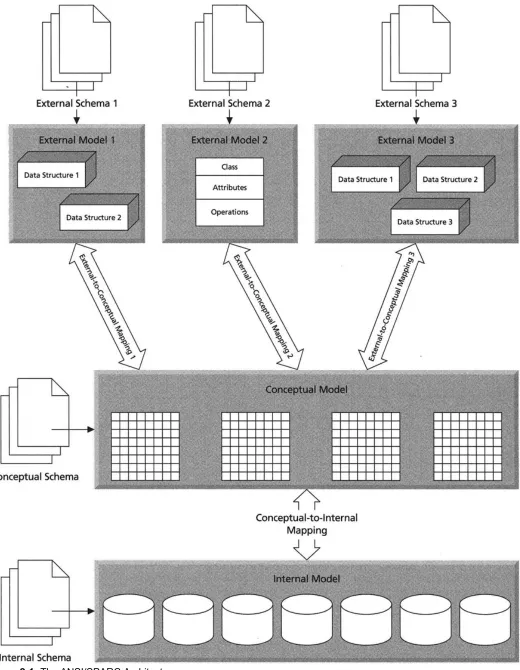
The most influential early effort to create a standard system architecture was the ANSI/SPARC architecture [ANSI 1975; Date 1977]. ANSI/SPARC divided database-centric systems into three models: the internal, conceptual, and external, as Figure 2-1 shows. A schema is a description of the model (a metamodel). Each schema has structures and relationships that reflect its role. The goal was to make the three schemas independent of one another. The architecture results in systems resistant to changes to physical or conceptual structures. Instead of having to rebuild your entire system for every change to a storage structure, you would just change the structure without affecting the systems that used it. This concept, data independence, was critical to the early years of database management and design, and it is still critical today. It underlies everything that database designers do.
For example, consider what an accounting system would be like without data independence. Every time an
application developer wanted to access the general ledger, he or she would need to program the code to access the data on disk, specifying the disk sectors and hardware storage formats, looking for and using indexes, adapting to "optimal" storage structures that are different for each kind of data element, coding the logic and navigational access to subset the data, and coding the sorting routines to order it (again using the indexes and intermediate storage facilities if the data could not fit entirely in memory. Now a database engineer comes along and redoes the whole mess. That leaves the application programmer the Herculean task of reworking the whole accounting system to handle the new structures. Without the layers of encapsulation and independence that a database management system provides, programming for large databases would be impossible.
Note
Lack of data independence is at least one reason for the existence of the Year 2000 problem. Programs would store dates in files using two-byte storage representation and would
propagate that throughout the code, then use tricky coding techniques based onthe storage representation to achieve wonders of optimized programming (and completely
Figure 2-1: The ANSI/SPARC Architecture
classes. In an objectrelational database, it contains the relational structures as well as the extended type or class definitions, including the class or type methods that represent object behavior. The database management system provides a query and data manipulation language, such as the SELECT, INSERT, UPDATE, and DELETE
statements of SQL.
The internal model has the structure of storage and retrieval. It represents the "real" structure of the database, including indexes, storage representations, field orders, character sets, and so on. The internal schema supports the conceptual schema by implementing the high-level conceptual structures in lower-level storage structures. It supplies additional structures such as indexes to manage access to the data. The mapping between the conceptual and internal models insulates the conceptual model from any changes in storage. New indexes, changed storage structures, or differing storage orders of fields do not affect the higherlevel models. This is the concept of physical data independence. Usually, database management systems extend the data definition language to enable database administrators to manage the internal model and schema.
The external model is really a series of views of the different applications or users that use the data. Each user maps its data to the data in the conceptual schema. The view might use only a portion of the total data model. This
mapping shows you how different applications will make use of the data. Programming languages generally provide the management tools for managing the external model and its schema. For example, the facilities in C++ for building class structures and allocating memory at runtime give you the basis for your C++ external models.
This three-level schema greatly influences database design. Dividing the conceptual from the internal schema separates machine and operating system dependencies from the abstract model of the data. This separation frees you from worrying about access paths, file structures, or physical optimization when you are designing your logical data model. Separating the conceptual schema from the external schemas establishes the many-to-one relationship between them. No application need access all of the data in the database. The conceptual schema, on the other hand, logically supports all the different applications and their datarelated needs.
For example, say Holmes PLC (Sherlock Holmes's investigative agency, a running example throughout this book) was designing its database back in 1965, probably with the intention of writing a COBOL system from scratch using standard access path technology such as ISAM (Indexed Sequential Access Method, a very old programming interface for indexed file lookup). The first pass would build an application that accessed hierarchically structured files, with each query procedure needing to decide which primary or secondary index to use to retrieve the file data. The next pass, adding another application, would need to decide whether the original files and their access methods were adequate or would need extension, and the original program would need modification to accommodate the changes. At some point, the changes might prove dramatically incompatible, requiring a complete rewrite of all the existing applications. Shall I drag in Year 2000 problems due to conflicting storage designs for dates?
In 1998, Holmes PLC would design a conceptual data model after doing a thorough analysis of the systems it will support. Data architects would build that conceptual model in a database management system using the appropriate data model. Eventually, the database administrator would take over and structure the internal model, adding indexes where appropriate, clustering and partitioning the data, and so on. That optimization would not end with the first system but would continue throughout the long process of adding systems to the business. Depending on the design quality of the conceptual schema, you would need no changes to the existing systems to add a new one. In no case would changes in the internal design require changes.
Data independence comes from the fundamental design concept of coupling, the degree of interdependence between modules in a system [Yourdon and Constantine 1979; Fenton and Pfleeger 1997]. By separating the three models and their schemas, the ANSI/SPARC architecture changes the degree of coupling from the highest level of coupling (content coupling) to a much lower level of coupling (data coupling through parameters). Thus, by using this architecture, you achieve a better system design by reducing the overall coupling in your system.
Despite its age and venerability, this way of looking at the world still has major value in today's design methods. As a consultant in the database world, I have seen over and over the tendency to throw away all the advantages of this architecture. An example is a company I worked with that made a highly sophisticated layout tool for manufacturing plants. A performance analysis seemed to indicate that the problem lay in inefficient database queries. The
(inexperienced) database programmer decided to store the data in flat files instead to speed up access. The result: a system that tied its fundamental data structures directly into physical file storage. Should the application change slightly, or should the data files grow beyond their current size, the company would have to completely redo their data access subroutines to accommodate new file data structures.
Note
The Multitier Architectures
The 1980s saw the availability of personal computers and ever-smaller server machines and the local-area networks that connected them. These technologies made it possible to distribute computing over several machines rather than doing it all on one big mainframe or minicomputer. Initially, this architecture took the form of client/server computing, where a database server supported several client machines. This evolved into the distributed client/server
architecture, where several servers taken together made up the distributed database.
In the early 1990s, this architecture evolved even further with the concept of application partitioning, a refinement of the basic client/server approach. Along with the database server, you could run part of the application on the client and another part on an application server that several clients could share. One popular form of this architecture is the transaction processing (TP) monitor architecture, in which a middleware server handles transaction management. The database server treats the TP monitor as its client, and the TP monitor in turn serves its clients. Other kinds of middleware emerged to provide various kinds of application support, and this architecture became known as the three-tier architecture.
In the later 1990s, this architecture again transformed itself through the availability of thin-client Internet browsers, distributed-object middleware, and other technology. This made it possible to move even more processing out of the client onto servers. It now became possible to distribute objects around multiple machines, leading to a multitier, distributed-object architecture.
These multitier system architectures have extensive ramifications for system and network hardware as well as software [Berson 1992]. Even so, this book focuses primarily on the softer aspects of the architectures. The critical impact of system architecture on design comes from the system software architecture, which is what the rest of this section discusses.
Database Servers: Client/Server Architectures
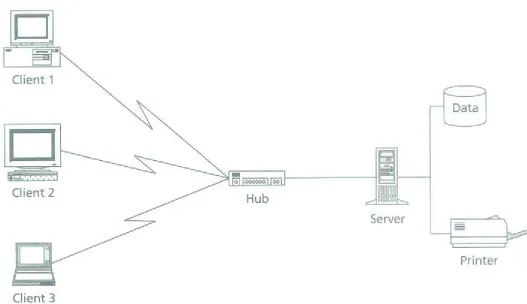
The client/server architecture [Berson 1992] structures your system into two parts: the software running on the server responds to requests from multiple clients running another part of the software. The primary goal of client/server architecture is to reduce the amount of data that travels across the network. With a standard file server, when you access a file, you copy the entire file over the network to the system that requested access to it. The client/server architecture lets you structure both the request and the response through the server software that lets the server respond with only the data you need. Figure 2-2 illustrates the classic client/server system, with the database management system as server and the database application as client.
In reality, you can break down the software architecture into layers and distribute the layers in different ways. One approach breaks the software into three parts, for example: presentation, business processing, and data
management [Berson 1992]. The X-Windows system, for example, is a pure presentation layer client/server system. The X terminal is a client-based software system that runs the presentation software and makes requests to the server that is running the business processing. This lets you run a program on a server and interact with it on a "smart terminal" running X. The X terminal software is what makes the terminal smart.
Figure 2-2: The Client/Server Architecture
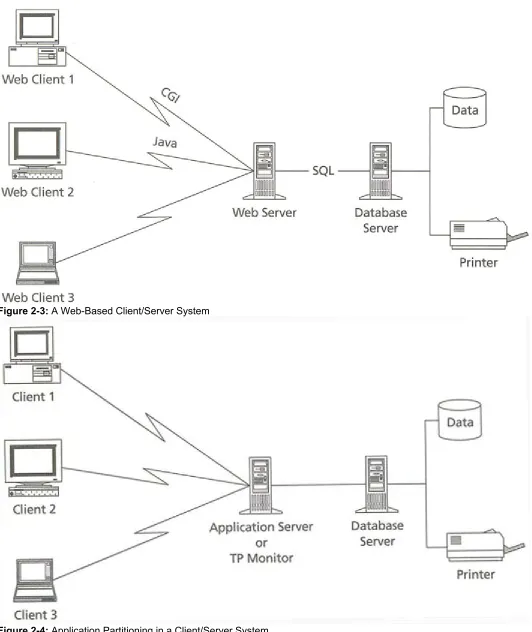
actions and/or data. The Web server then displays the results through the Web browser (Figure 2-3).
The Web architecture illustrates the distribution of the business processing between the client and server. Usually, you want to do this when you have certain elements of the business processing that are database intensive and other parts that are not. By placing the database-intensive parts on the database server, you reduce the network traffic and get the benefits of encapsulating the databaserelated code in one place. Such benefits might include greater database security, higher-level client interfaces that are easier to maintain, and cohesive subsystem designs on the server side. Although the Web represents one approach to such distribution of processing, it isn't the only way to do it. This approach leads inevitably to the transaction processing monitor architecture previously mentioned, in which the TP monitor software is in the middle between the database and the client. If the TP monitor and the database are running on the same server, you have a client/server architecture. If they are on separate servers, you have a multitier architecture, as Figure 2-4 illustrates. Application partitioning is the process of breaking up your application code into modules that run on different clients and servers.
The Distributed Database Architecture
Figure 2-3: A Web-Based Client/Server System
Figure 2-4: Application Partitioning in a Client/Server System
Note
Data warehouses often encapsulate a distributed database architecture, especially if you construct them by referring to, copying, and/or aggregating data from multiple databases into the warehouse. Snapshots, for example, let you take data from a table and copy it to another server for use there; the original table changes, but the snapshot doesn't. Although this book does not go into the design issues for data warehousing, the distributed database
There are three operational elements in a distributed database: transparency, transaction management, and optimization.
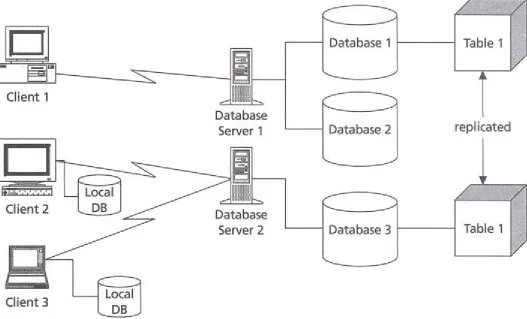
[image:18.595.38.565.225.544.2]Distributed database transparency is the degree to which a database operation appears to be running on a single, unified database from the perspective of the user of the database. In a fully transparent system, the application sees only the standard data model and interfaces, with no need to know where things are really happening. It never has to do anything special to access a table, commit a transaction, or connect. For example, if a query accesses data on several servers, the query manager must break the query apart into a query for each server, then combine the results (see the optimization discussion below).The application submits a single SQL statement, but multiple ones actually execute on the servers. Another aspect of transparency is fragmentation, the distribution of data in a table over multiple locations (another word for this is partitioning). Most distributed systems achieve a reasonable level of transparency down to the database administration level. Then they abandon transparency to make it easier on the poor DBA who needs to manage the underlying complexity of the distribution of data and behavior. One wrinkle in the transparency issue is the heterogeneous distributed database, a database comprising different database management system software running on the different servers.
Figure 2.5: A distributed Database Architecture
Note
Database fragmentation is unrelated to file fragmentation, the condition that occurs in file systems such as DOS or NTFS when the segments that comprise files become randomly distributed around the disk instead of clustered together. Defragmenting your disk drive on a weekly basis is a good idea for improving performance; defragmenting your database is not, just the reverse.
Distributed database transaction management differs from single-database transaction management because of the possibility that a part of the database will become unavailable during a commit process, leading to an incomplete transaction commit. Distributed databases thus require an extended transaction management process capable of guaranteeing the completion of the commit or a full rollback of the transaction. There are many strategies for doing this [Date 1983; Elmagarmid 1991; Gray and Reuter 1993; Papadimitriou 1986]. The two most popular strategies are the two-phase commit and distributed optimistic concurrency.
Optimistic concurrency takes the opposite approach [Ullman 1988; Kung and Robinson 1981]. Instead of trying to ensure that everything is correct as the transaction proceeds, either through locking or timestamp management, optimistic methods let you do anything to anything, then check for conflicts when you commit. Using some rule for conflict resolution, such as timestamp comparison or transaction priorities, the optimistic approach avoids deadlock situations and permits high concurrency, especially in read-only situations. Oracle7 and Oracle8 both have a version of optimistic concurrency called read consistency, which lets readers access a consistent database regardless of changes made since they read the data.
Distributed database optimization is the process of optimizing queries that are executing on separate servers. This requires extended cost-based optimization that understands where data is, where operations can take place, and what the true costs of distribution are [Ullman 1989]. In the case where the query manager breaks a query into parts, for example, to execute on separate servers, it must optimize the queries both for execution on their respective servers and for transmission and receipt over the network. Current technology isn't terrific here, and there is a good way to go in making automatic optimization effective. The result: your design must take optimization requirements into account, especially at the physical level.
The key impact of distributed transaction management on design is that you must take the capabilities of the language you are designing for into account when planning your transaction logic and data location. Transparency affects this a good deal; the less the application needs to know about what is happening on the server, the better. If the application transaction logic is transparent, your application need not concern itself with design issues relating to transaction management. Almost certainly, however, your logical and physical database design will need to take distributed transactions into account.
For example, you may know that network traffic over a certain link is going to be much slower than over other links. You can benchmark applications using a cost-benefit approach to decide whether local access to the data outweighs the remote access needs. A case in point is the table that contains a union of local data from several localities. Each locality benefits from having the table on the local site. Other localities benefit from having remotely generated data on their site. Especially if all links are not equal, you must decide which server is best for all. You can also take more sophisticated approaches to the problem. You can build separate tables, offloading the design problem to the application language that has to recombine them. You can replicate data, offloading the design problem to the database administrator and vendor developers. You can use table partitioning, offloading the design problem to Oracle8, the only database to support this feature, and hence making the solution not portable to other database managers. The impact of optimization on design is thus direct and immediate, and pretty hairy if your database is complex.
Holmes PLC, for example, is using Oracle7 and Oracle8 to manage certain distributed database transactions. Both systems fully implement the distributed two-phase commit protocol in a relatively transparent manner on both the client and the server. There are two impact points: where the physical design must accommodate transparency requirements and the administrative interface. Oracle implements distributed servers through a linking strategy, with the link object in one schema referring to a remote database connection string. The result is that when you refer to a table on a remote server, you must specify the link name to find the table. If you need to make the reference
transparent, you can take one of at least three approaches. You can set up a synonym that encapsulates the link name, making it either public or private to a particular user or Oracle role. Alternatively, you can replicate the table, enabling "local" transaction management with hidden costs on the back end because of the reconciliation of the replicas. Or, you can set up stored procedures and triggers that encapsulate the link references, with the costs migrating to procedure maintenance on the various servers.
As you can tell from the example, distributed database architectures have a major impact on design, particularly at the physical level. It is critical to understand that impact if you choose to distribute your databases.
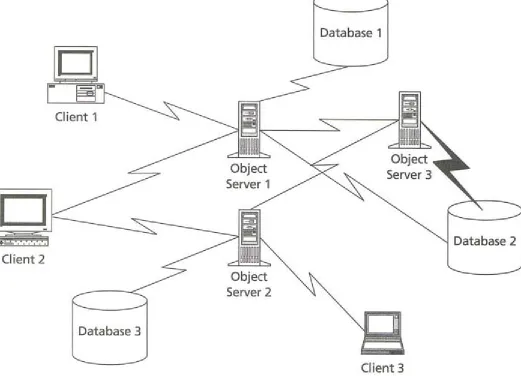
Objects Everywhere: The Multitier Distributed-Object Architecture
objects, then place those objects on servers rather than in the client application. That application then gets data from the objects on demand over the network. Figure 2-6 shows a typical distributed-object architecture using CORBA.
Warning
[image:20.595.38.559.207.583.2]
This area of software technology is definitely not for the dyslexic, as a casual scan over the last few pages will tell you. Microsoft in particular has contributed a tremendously confusing array of technologies and their acronyms to the mash in the last couple of years. Want to get into Microsoft data access? Choose between MFC, DAO, RDO, ADO, or good old ODBC, or use all of them at once. I'm forced to give my opinion: I think Microsoft is making it much more difficult than necessary to develop database applications with all this nonsense. Between the confusion caused by the variety of technologies and the way using those technologies locksyou into a single vendor's muddled thinking about the issues of database application development, you are caught between the devil and the deep blue sea.
Figure 2-6: A Simple Distributed-Object Architecture Using CORBA
In a very real sense, as Figure 2-6 illustrates by putting them at the same level, the distributed-object architecture makes the database and its contents a peer of the application objects. The database becomes just another object communicating through the distributed network. This object transparency has a subtle influence on database design. Often there is a tendency to drive system design either by letting the database lead or by letting the application lead. In a distributed-object system, no component leads all the time. When you think about the database as a cooperating component rather than as the fundamental basis for your system or as a persistent data store appendage, you begin to see different ways of using and getting to the data. Instead of using a single DBMS and its servers, you can combine multiple DBMS products, even combining an object-oriented database system with a relational one if that makes sense. Instead of seeing a series of application data models that map to the conceptual model, as in the ANSI/SPARC architecture, you see a series of object models mapping to a series of conceptual models through distributed networks.
Note
never disappears. I find it much more useful to regard the database as a peer object with which my code has to work rather than as an invisible slave robot toiling away under the covers
For example, in an application I worked on, I had a requirement for a tree structure (a series of parents and children, sort of like a genealogical tree). The original designers of the relational database I was using had represented this structure in the database as a table of parent-child pairs. One column of the table was the parent, the other column was one of the children of that parent, so each row represented a link between two tree elements. The client would specify a root or entry point into the tree, and the application then would build the tree based on navigating from that root based on the parent-child links.
If you designed using the application-leading approach, you would figure out a way to store the tree in the database. For example, this might mean special tables for each tree, or even binary large objects to hold the in-memory tree for quick retrieval. If you designed using a database-centric approach, you would simply retrieve the link table into memory and build the tree from it using a graph-building algorithm. Alternatively, you could use special database tools such as the Oracle CONNECT BY clause to retrieve the data in tree form.
Designing from the distributed-object viewpoint, I built a subsystem in the database that queried raw information from the database. This subsystem combined several queries into a comprehensive basis for further analysis. The object on the client then queried this data using an ORDER BY and a WHERE clause to get just the information it required in the format it needed. This approach represents a cooperative, distributed-object approach to designing the system rather than an approach that started with the database or the application as the primary force behind the design.
Another application I worked on had two databases, one a repository of images and the other a standard relational database describing them. The application used a standard three-tier client/server model with two separate database servers, one for the document management system and one for the relational database, and much code on the client and server for moving data around to get it into the right place. Using a distributed-object architecture would have allowed a much more flexible arrangement. The database servers could have presented themselves as object caches accessible from any authenticated client. This architectural style would have allowed the designers to build object servers for moving data between the two databases and their many clients.
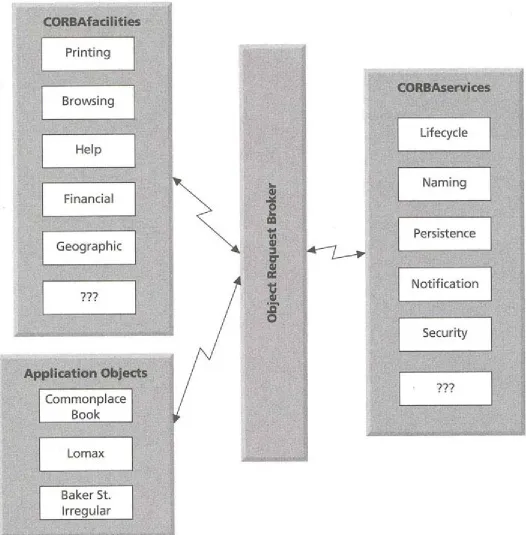
The OMG Object Management Architecture (OMA) [Soley 1992; Siegel 1996] serves as a standard example of the kind of software objects you will find in distributed-object architectures, as Figure 2-7 shows. The Open Group Architectural Framework [Open Group 1997] contains other examples in a framework for building such architectures. The CORBAservices layer provides the infrastructure for the building blocks of the architecture, giving you all the tools you need to create and manage objects. Lifecycle services handle creation, movement, copying, and garbage collection. Naming services handle the management of unique object names around the network (a key service that has been a bottleneck for network services for years under thenom de guerre of directory services). Persistence services provide permanent or transient storage for objects, including the objects that CORBA uses to manage application objects.
The Object Request Broker (ORB) layer provides the basic communication facilities for dispatching messages, marshaling data across heterogeneous machine architectures, object activation, exception handling, and security. It also integrates basic network communications through a TCP/IP protocol implementation or a Distributed Computing Environment (DCE) layer.
Figure 2-7: The Object Management Group's Object Management Architecture
The Application Objects layer consists of the collections of objects in individual applications that use the CORBA software bus to communicate with the CORBAfacilities and CORBAservices. This can be as minimal as providing a graphical user interface for a facility or as major as developing a whole range of interacting objects for a specific site.