Health Technology Assessment
NIHR HTA programme
November 2011
10.3310/hta15390The clinical effectiveness and
cost-effectiveness of management strategies
for sciatica: systematic review and
economic model
R Lewis, N Williams, HE Matar, N Din,
D Fitzsimmons, C Phillips, M Jones, A Sutton,
K Burton, S Nafees, M Hendry, I Rickard,
R Chakraverty and C Wilkinson
List of abbreviations
Executive summary Background Objectives Review methods Results of review Economic model
Results of economic evaluation Conclusions
Recommendations for future research Funding Chapter 1 Introduction Chapter 2 Research objectives Chapter 3 Background Definition of sciatica Epidemiology of sciatica Pathological mechanism Clinical diagnosis Treatments
Chapter 4
Evidence synthesis: methods
Methods for reviewing clinical effectiveness and cost-effectiveness Literature search
Management of references Inclusion and exclusion of studies Data extraction
Quality assessment Methods of analysis/synthesis Standard pair-wise meta-analyses Mixed treatment comparison meta-analyses Analysis of covariates
Publication bias Economic evaluations Economic model
Chapter 5
Results of searches
Chapter 6
Review of clinical effectiveness: results Disc surgery (including intraoperative interventions)
Summary of overall findings for disc surgery compared with alternative interventions Epidural/intradiscal injection
Summary of overall findings for epidural/intradiscal injections compared with alternative interventions Chemonucleolysis
Summary of overall findings for chemonucleolysis compared with alternative interventions Non-opioids
Summary of overall findings for non-opioids compared with alternative interventions Traction
Summary of overall findings for traction compared with alternative interventions Manipulation
Summary of overall findings for manipulation compared with alternative interventions Alternative therapies
Summary of overall findings for alternative interventions compared with comparator interventions Active physical therapy/exercise therapy
Summary of overall findings for active physical/exercise therapy compared with alternative interventions Passive physical therapy
Summary of overall findings for passive physical therapy compared with alternative interventions Biological agents
Summary of overall findings for biological agent compared with alternative interventions Activity restriction
Summary of overall findings for activity restriction compared with alternative interventions Opioids
Summary of overall findings for opioids compared with alternative interventions Education/advice
Summary of overall findings for education/advice compared with alternative interventions
Chapter 7
Mixed treatment comparisons: results Description of mixed treatment comparison models Review of existing economic evaluations: results Introduction
Summary of results
Review of full economic evaluations Summary
Chapter 9
Economic evaluation Introduction
Development of the economic model Telephone survey of service providers Model description
Dealing with uncertainty Data sources Cost-effectiveness results Sensitivity analysis Discussion Conclusion Chapter 10 Discussion
Summary of clinical effectiveness review Summary of cost-effectiveness review Summary of economic evaluation
Comparison with previous systematic reviews Assumptions, limitations and uncertainties Implications for further research
Chapter 11 Conclusions
Acknowledgements Contribution of authors
References
Health Technology Assessment programme
Appendix 1
Search strategies 441
MEDLINE (OVID) 1950 to week 1 June 2008 OLDMEDLINE (OVID) 1947–67
MEDLINE(R) In-Process & Other Non-Indexed Citations EMBASE 1980 to week 23 June 2008
EMBASE 1974–9 EMBASE 1947–73
Cumulative Index to Nursing and Allied Health Literature 1982 to week 2 June 2008 Allied and Complimentary Medicine Database 1985 to June 2008
British Nursing Index and Archive 1985 to June 2008 Health Management Information Consortium May 2008 PsycINFO 1806 to week 2 June 2008
Inspec 1969 to week 22 2008
The Cochrane Library (all databases) week 2 June 2008
System for Information on Grey Literature in Europe 1980 to March 2005
Web of Knowledge [all databases: Science Citation Index-Expanded and Social Sciences Citation Index, BIOSIS Previews (with Human Studies Restriction) and ISI Proceedings]. All time span to 16 June 2008
Appendix 2
Quality assessment checklist 463
Quality assessment for effectiveness studies External validity
Selection bias and confounders Detection bias
Performance bias Attrition bias
Quality assessment of economic evaluations
Appendix 3
Winbugs code used for the mixed treatment comparison analyses 471 Global effect
Pain CSOMs
Appendix 4
Ongoing or unpublished studies identified from search of trial registries 477
Appendix 5
Quality assessment of included clinical effectiveness studies 491
Quality assessment of included clinical effectiveness studies Disc surgery (including intraoperative interventions) Epidural/intradiscal injection Chemonucleolysis Non-opioids Traction Manipulation Alternative therapies
Active physical therapy/exercise therapy Passive physical therapy
Biological agents Activity restriction Opioids Education/advice
Appendix 6
Network diagrams 517
Global effect mixed treatment comparison network for randomised controlled trials and quasi-randomised controlled trials Pain mixed treatment comparison network for all study designs
Pain mixed treatment comparison network for randomised controlled trials and quasi-randomised controlled trials Condition-specific outcome measure mixed treatment comparison network for all study designs
Condition-specific outcome measure mixed treatment comparison network for randomised controlled trials and quasi-randomised controlled trials
Appendix 7
Winbugs plots for the Gelman–Rubin statistic 523
Appendix 8
Heterogeneity and model fit for the mixed treatment comparison analyses 527 Model fit
Assessment of heterogeneity
Appendix 9
Results of the mixed treatment comparison analyses 533
Appendix 10
Full summary of economic evaluations 549
Appendix 11
Study protocol 565
Introduction Research objectives Background
Systematic review method Cost-effectiveness modelling
Recommendations for practice and research Project management
How to obtain copies of this and other HTA programme reports
An electronic version of this title, in Adobe Acrobat format, is available for downloading free of charge for personal use from the HTA website (www.hta.ac.uk). A fully searchable DVD is also available (see below). Printed copies of HTA journal series issues cost £20 each (post and packing free in the UK) to both public and private sector purchasers from our despatch agents.
Non-UK purchasers will have to pay a small fee for post and packing. For European countries the cost is £2 per issue and for the rest of the world £3 per issue.
How to order:
– fax (with credit card details)
– post (with credit card details or cheque) – phone during office hours (credit card only).
Additionally the HTA website allows you to either print out your order or download a blank order form.
Contact details are as follows: Synergie UK (HTA Department) Digital House, The Loddon Centre Wade Road
Basingstoke Hants RG24 8QW
Email: [email protected]
Tel: 0845 812 4000 – ask for ‘HTA Payment Services’ (out-of-hours answer-phone service)
Fax: 0845 812 4001 – put ‘HTA Order’ on the fax header Payment methods
Paying by cheque
If you pay by cheque, the cheque must be in pounds sterling, made payable to University of
Southampton and drawn on a bank with a UK address. Paying by credit card
You can order using your credit card by phone, fax or post.
Subscriptions
NHS libraries can subscribe free of charge. Public libraries can subscribe at a reduced cost of £100 for each volume (normally comprising 40–50 titles). The commercial subscription rate is £400 per volume (addresses within the UK) and £600 per volume (addresses outside the UK). Please see our website for details. Subscriptions can be purchased only for the current or forthcoming volume.
How do I get a copy of HTA on DVD?
Please use the form on the HTA website (www.hta.ac.uk/htacd/index.shtml). HTA on DVD is currently free
of charge worldwide.
for sciatica: systematic review and
economic model
R Lewis,
1* N Williams,
1HE Matar,
1N Din,
1D Fitzsimmons,
2C Phillips,
2M Jones,
1A Sutton,
3K Burton,
4S Nafees,
1M Hendry,
1I Rickard,
5R Chakraverty
6and C Wilkinson
11
Department of Primary Care and Public Health, Cardiff University, School of
Medicine, North Wales Clinical School, Wrexham, UK
2
School of Human and Health Sciences, Swansea University, Swansea, UK
3
Department of Health Sciences, University of Leicester, Leicester, UK
4
Spinal Research Institute, University of Huddersfield, Huddersfield, UK
5
Patient representative, Betws-y-coed, UK
6
The Spinal Unit, Royal Orthopaedic Hospital NHS Trust, Birmingham, UK
*Corresponding author
Declared competing interests of authors: none
Published November 2011
DOI: 10.3310/hta15390This report should be referenced as follows:
Lewis R, Wiliams N, Matar HE, Din N, Fitzsimmons D, Philips C, et al. The clinical effectiveness and
cost-effectiveness of management strategies for sciatica: systematic review and economic model. Health Technol Assess 2011;15(39).
Health Technology Assessment is indexed and abstracted in Index Medicus/MEDLINE, Excerpta Medica/EMBASE, Science Citation Index Expanded (SciSearch) and Current Contents/
The Health Technology Assessment (HTA) programme, part of the National Institute for Health Research (NIHR), was set up in 1993. It produces high-quality research information on the effectiveness, costs and broader impact of health technologies for those who use, manage and provide care in the NHS. ‘Health technologies’ are broadly defined as all interventions used to promote health, prevent and treat disease, and improve rehabilitation and long-term care. The research findings from the HTA programme directly influence decision-making bodies such as the National Institute for Health and Clinical Excellence (NICE) and the National Screening Committee (NSC). HTA findings also help to improve the quality of clinical practice in the NHS indirectly in that they form a key component of the ‘National Knowledge Service’.
The HTA programme is needs led in that it fills gaps in the evidence needed by the NHS. There are three routes to the start of projects.
First is the commissioned route. Suggestions for research are actively sought from people working in the NHS, from the public and consumer groups and from professional bodies such as royal colleges and NHS trusts. These suggestions are carefully prioritised by panels of independent experts (including NHS service users). The HTA programme then commissions the research by competitive tender.
Second, the HTA programme provides grants for clinical trials for researchers who identify research questions. These are assessed for importance to patients and the NHS, and scientific rigour.
Third, through its Technology Assessment Report (TAR) call-off contract, the HTA programme commissions bespoke reports, principally for NICE, but also for other policy-makers. TARs bring together evidence on the value of specific technologies.
Some HTA research projects, including TARs, may take only months, others need several years. They can cost from as little as £40,000 to over £1 million, and may involve synthesising existing evidence, undertaking a trial, or other research collecting new data to answer a research problem.
The final reports from HTA projects are peer reviewed by a number of independent expert referees before publication in the widely read journal series Health Technology Assessment.
Criteria for inclusion in the HTA journal series
Reports are published in the HTA journal series if (1) they have resulted from work for the HTA programme, and (2) they are of a sufficiently high scientific quality as assessed by the referees and editors.
Reviews in Health Technology Assessment are termed ‘systematic’ when the account of the search, appraisal and synthesis methods (to minimise biases and random errors) would, in theory, permit the replication of the review by others.
The research reported in this issue of the journal was commissioned by the HTA programme as project number 06/79/01. The contractual start date was in March 2008. The draft report began editorial review in July 2010 and was accepted for publication in February 2011. As the funder, by devising a commissioning brief, the HTA programme specified the research question and study design. The authors have been wholly responsible for all data collection, analysis and interpretation, and for writing up their work. The HTA editors and publisher have tried to ensure the accuracy of the authors’ report and would like to thank the referees for their constructive comments on the draft document. However, they do not accept liability for damages or losses arising from material published in this report. The views expressed in this publication are those of the authors and not necessarily those of the HTA programme or the Department of Health.
Editor-in-Chief: Professor Tom Walley CBE
Series Editors: Dr Martin Ashton-Key, Professor Aileen Clarke, Dr Tom Marshall, Professor John Powell, Dr Rob Riemsma and Professor Ken Stein
Associate Editor: Dr Peter Davidson Editorial Contact: [email protected]
ISSN 1366-5278 (Print) ISSN 2046-4924 (Online) ISSN 2046-4932 (DVD)
© Queen’s Printer and Controller of HMSO 2011. This work was produced by Lewis et al. under the terms of a commissioning contract issued by the Secretary of State for Health.
This journal is a member of and subscribes to the principles of the Committee on Publication Ethics (COPE) (http://www. publicationethics.org/).
This journal may be freely reproduced for the purposes of private research and study and may be included in professional journals provided that suitable acknowledgement is made and the reproduction is not associated with any form of advertising. Applications for commercial reproduction should be addressed to: NETSCC, Health Technology Assessment, Alpha House, University of Southampton Science Park, Southampton SO16 7NS, UK.
Published by Prepress Projects Ltd, Perth, Scotland (www.prepress-projects.co.uk), on behalf of NETSCC, HTA.
Abstract
The clinical effectiveness and cost-effectiveness of
management strategies for sciatica: systematic review and
economic model
R Lewis,
1* N Williams,
1HE Matar,
1N Din,
1D Fitzsimmons,
2C Phillips,
2M Jones,
1A Sutton,
3K Burton,
4S Nafees,
1M Hendry,
1I Rickard,
5R Chakraverty
6and C Wilkinson
11Department of Primary Care and Public Health, Cardiff University, School of Medicine, North Wales
Clinical School, Wrexham, UK
2School of Human and Health Sciences, Swansea University, Swansea, UK
3Department of Health Sciences, University of Leicester, Leicester, UK
4Spinal Research Institute, University of Huddersfield, Huddersfield, UK
5Patient representative, Betws-y-coed, UK
6The Spinal Unit, Royal Orthopaedic Hospital NHS Trust, Birmingham, UK
*Corresponding author
Background: Sciatica is a symptom characterised by well-localised leg pain with a sharp, shooting or burning quality that radiates down the back of the leg and normally to the foot or ankle. It is often associated with numbness or altered sensation in the leg.
Objectives: To determine the clinical effectiveness and cost-effectiveness of different management strategies for sciatica.
Data sources: Major electronic databases (e.g. MEDLINE, EMBASE and NHS Economic Evaluation Database) and several internet sites including trial registries were searched up to December 2009.
Review methods: Systematic reviews were undertaken of the clinical effectiveness and cost-effectiveness of different treatment strategies for sciatica. Effectiveness data were synthesised using both conventional meta-analyses and mixed treatment comparison (MTC) methods. An economic model was then developed to estimate costs per quality-adjusted life-year gained for each treatment strategy.
some evidence for the effectiveness of biological agents and acupuncture. Opioid medication and activity restriction were found to be less effective than the comparator interventions and opioids were associated with more adverse effects than the inactive control. The full economic evaluations were of reasonable to good quality, but were not able to fully address our research question. Although individual studies raised a number of important issues, it was difficult to draw meaningful conclusions across studies because of their heterogeneity. The economic model demonstrated that stepped-care approaches to patient management were likely to be cost-effective, relative to strategies that involved direct referral to disc surgery.
Limitations: The limited number of studies for some comparisons, the high level of heterogeneity (within treatment comparisons) and the potential inconsistency (between treatment comparisons) weaken the interpretation of the MTC analyses.
Conclusions: These findings provide support for the effectiveness of currently used therapies for sciatica such as non-opioid medication, epidural corticosteroid injections and disc surgery, but also for chemonucleolysis, which is no longer used in the UK NHS. These findings do not provide support for the effectiveness of opioid analgesia, which is widely used in this patient group, or activity restriction. They also suggest that less frequently used treatments, such as acupuncture, and experimental treatments, such as anti-inflammatory biological agents, may be effective. Stepped-care approaches to treatment for patients with sciatica are cost-effective relative to direct referral for surgery. Future research should include randomised controlled trials with concurrent economic evaluation of biological agents and acupuncture compared with placebo or with currently used treatments. Development of alternative economic modelling approaches to assess relative cost-effectiveness of treatment regimes, based on the above trial data, would also be beneficial.
Contents
List of abbreviations ix
Executive summary xi
1. Introduction 1
2. Research objectives 3
3. Background 5
Definition of sciatica 5
Epidemiology of sciatica 5
Pathological mechanism 5
Clinical diagnosis 6
Treatments 6
4. Evidence synthesis: methods 9
Methods for reviewing clinical effectiveness and cost-effectiveness 9
Literature search 9
Management of references 10
Inclusion and exclusion of studies 10
Data extraction 13
Quality assessment 14
Methods of analysis/synthesis 14
Standard pair-wise meta-analyses 16
Mixed treatment comparison meta-analyses 16
Analysis of covariates 17
Publication bias 17
Economic evaluations 17
Economic model 17
5. Results of searches 19
6. Review of clinical effectiveness: results 21
Disc surgery (including intraoperative interventions) 21
Summary of overall findings for disc surgery compared with alternative
interventions 89
Epidural/intradiscal injection 96
Summary of overall findings for epidural/intradiscal injections compared with
alternative interventions 138
Chemonucleolysis 144
Summary of overall findings for chemonucleolysis compared with alternative
interventions 177
Non-opioids 182
Summary of overall findings for non-opioids compared with alternative
interventions 213
Summary of overall findings for traction compared with alternative interventions 233
Manipulation 237
Summary of overall findings for manipulation compared with alternative
interventions 246
Alternative therapies 248
Summary of overall findings for alternative interventions compared with
comparator interventions 250
Active physical therapy/exercise therapy 258
Summary of overall findings for active physical/exercise therapy compared with
alternative interventions 271
Passive physical therapy 280
Summary of overall findings for passive physical therapy compared with
alternative interventions 288
Biological agents 296
Summary of overall findings for biological agent compared with alternative
interventions 303
Activity restriction 310
Summary of overall findings for activity restriction compared with alternative
interventions 322
Opioids 325
Summary of overall findings for opioids compared with alternative interventions 331
Education/advice 338
Summary of overall findings for education/advice compared with alternative
interventions 343
7. Mixed treatment comparisons: results 353
Description of mixed treatment comparison models 353 The results of the mixed treatment comparison of each intervention category with
inactive control 355
Results of the mixed treatment comparison comparing all interventions that formed a
connected network 364
8. Review of existing economic evaluations: results 367
Introduction 367
Summary of results 367
Review of full economic evaluations 372
Summary 383
9. Economic evaluation 385
Introduction 385
Development of the economic model 385
Telephone survey of service providers 386
Model description 387
Dealing with uncertainty 388
Data sources 389
Cost-effectiveness results 392
Sensitivity analysis 393
Discussion 397
10. Discussion 399
Summary of clinical effectiveness review 399
Summary of cost-effectiveness review 407
Summary of economic evaluation 407
Comparison with previous systematic reviews 408
Assumptions, limitations and uncertainties 409
Implications for further research 411
11. Conclusions 413
Acknowledgements 415
References 417
Health Technology Assessment programme 435
Appendix 1 Search strategies 441
Appendix 2 Quality assessment checklist 463
Appendix 3 Winbugs code used for the mixed treatment comparison analyses 471
Appendix 4 Ongoing or unpublished studies identified from search of trial registries 477
Appendix 5 Quality assessment of included clinical effectiveness studies 491
Appendix 6 Network diagrams 517
Appendix 7 Winbugs plots for the Gelman–Rubin statistic 523
Appendix 8 Heterogeneity and model fit for the mixed treatment
comparison analyses 527
Appendix 9 Results of the mixed treatment comparison analyses 533
Appendix 10 Full summary of economic evaluations 549
List of abbreviations
ANCOVA analysis of covariance AUC area under the curve CCS concurrent cohort study CEA cost-effectiveness analysis CI confidence interval
CSOM condition-specific outcome measure CUA cost–utility analysis
DRG diagnostic-related group
EPHPP Effective Public Health Practice Project EQ-5D European Quality of Life-5 Dimensions ESI epidural steroid injection
GP general practitioner GPE global perceived effect HCS historical cohort study
HMO health maintenance organisation HRQoL health-related quality of life
ICER incremental cost-effectiveness ratio (e.g. incremental cost per QALY gained) IQR interquartile range
ITT intention to treat
LRS lumbar radicular syndrome MANOVA multivariate analysis of variance MRI magnetic resonance imaging MTC mixed treatment comparison
NICE National Institute for Health and Clinical Excellence NNT number needed to treat
NSAID non-steroidal anti-inflammatory drug ODI Oswestry Disability Index
OR odds ratio OTC over the counter
PENS percutaneous electrical nerve stimulation PT physical therapy
QALY quality-adjusted life-year
QDS Quebec Back Pain Disability Scale QoL quality of life
Q-RCT quasi-randomised controlled trial RCT randomised controlled trial
RMDQ Roland–Morris Disability Questionnaire SD standard deviation
SE standard error
SF-36 Short Form questionnaire-36 items SG standard gamble
SLR straight leg raise
SMD standardised mean difference
SPORT Spine Patient Outcomes Research Trial TENS transcutaneous electrical nerve stimulation TNF-α tumour necrosis factor-alpha
WHO World Health Organization WMD weighted mean difference
Executive summary
Background
Previous systematic reviews have found evidence for the clinical effectiveness of invasive treatments such as epidural steroid injection, chemonucleolysis and lumbar discectomy in the treatment of sciatica, but found insufficient evidence for less invasive treatments. None of the reviews has made indirect comparisons across separate trials or has examined cost-effectiveness.
Objectives
To determine the clinical effectiveness and cost-effectiveness of different management strategies for sciatica by undertaking a systematic review and an economic evaluation.
Review methods
Major electronic databases (for example MEDLINE, EMBASE and the NHS Economic Evaluation Database) and several internet sites including trial registries were searched up to December 2009. No language restrictions were used. Studies examining clinical effectiveness and cost-effectiveness were reviewed separately. Any comparative study or full economic evaluation was considered for inclusion. Studies involving adults who had sciatica or lumbar nerve root pain diagnosed clinically or confirmed by imaging were eligible. The essential clinical criterion was leg pain worse than back pain. Studies that included participants with lower back pain were included only if the findings for patients with sciatica were reported separately. Any intervention or comparator used to treat sciatica was included. Data were extracted by one reviewer and checked by a second reviewer. Quality assessment was conducted independently by two reviewers. Disagreements were resolved by discussion and, when necessary, a third reviewer was consulted.
For the review of clinical effectiveness, interventions were grouped into 18 treatment categories. The analyses were limited to three patient-centred outcome domains – global effect (or overall improvement), reduction in pain intensity (on a continuous scale of 0–100) and improvement in condition-specific functional status – and any reported adverse effects. The data were analysed according to three follow-up intervals: short (≤ 6 weeks), medium (> 6 weeks to 6 months) and long term (> 6 months). The global effect was synthesised as binary data using odds ratios (ORs) and pain intensity and a composite condition-specific outcome measure (CSOM) as continuous data using weighted mean difference and standardised mean difference, respectively. Missing study-level outcome data, where feasible, were dealt with by deriving/imputing
replacement values.
Mixed treatment comparison (MTC) meta-analyses were carried out to enable the simultaneous comparison of all treatment modalities for sciatica at a single follow-up interval (closest to 6 months). The analyses were conducted for the three main outcome domains, for all study designs and then after excluding observational studies and non-randomised trials.
Results of review
Searches
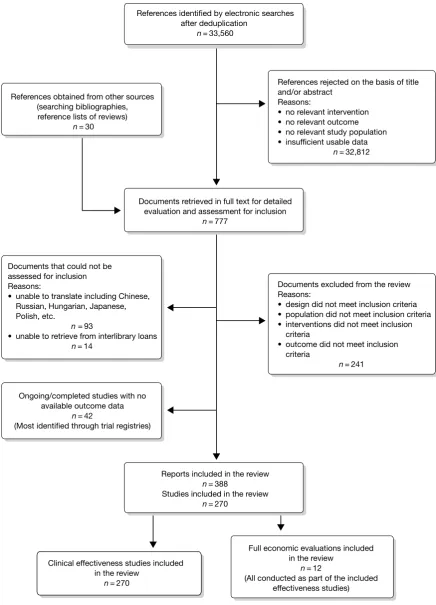
The searches identified 33,590 references, of which 270 studies that met the inclusion criteria were identified and 12 of these also included a full economic evaluation. A further 42 ongoing (or not yet reported) studies and 93 publications that could not be translated were identified.
Review of clinical effectiveness
The number of studies evaluating invasive interventions such as surgery, epidural and chemonucleolysis was greater than the number evaluating non-invasive interventions such as education/advice, alternative therapies, manipulation and opioid medication. The number of studies evaluating each treatment category ranged from two (manipulation and education/ advice) to 63 (disc surgery). The proportion of studies that were randomised control trials (RCTs) also varied, with the lowest being for disc surgery (51%), anti-inflammatory biological agents (50%) and chemonucleolysis (47%). The proportion that were deemed good quality ranged from 0% (chemonucleolysis, non-opioids, traction, alternative therapies, passive physical therapies, biological agents and education/advice) to 50% (manipulation, 1 out of 2); 14% of epidural studies and 3% of surgery studies were deemed to be good quality.
All but one study included patients with nerve root pain (or a combination of both nerve root and referred pain). The presence of disc herniation was confirmed by imaging in a greater proportion of studies evaluating invasive treatments than non-invasive interventions, as was the proportion of studies that did not limit inclusion to patients with acute sciatica (duration of symptoms being < 3 months), although this was not reported for many studies. Five treatment categories included a small number of studies that limited inclusion to patients experiencing their first episode (disc surgery, epidural injections, chemonucleolysis, non-opioid medication and biological agents). The proportion of studies that included patients who had received previous treatment were higher for invasive treatments compared with less invasive interventions, but the proportion was also fairly high for opioids and activity restriction and low for biological agents.
Results from the standard pair-wise meta-analyses were in broad agreement with those from the MTC analyses. The MTC provides an estimate of the relative treatment effects of the different management strategies at a single follow-up interval (closest to 6 months). We found a high level of between-study heterogeneity, so the results from the MTC analyses should be interpreted with caution.
Pair-wise meta-analyses were performed at short-, medium- and long-term follow-up and the statistically significant improvements were found for the following treatment groups. Disc surgery was superior to usual care (global effect, pain and CSOM at short-, medium- and long-term follow-up) and epidural injection (pain short-long-term follow-up), non-opioids (pain and CSOM at short-term follow-up), passive PT (global effect at medium- and long-term follow-up) and activity restriction (global effect at medium-term follow-up). Chemonucleolysis was superior to inactive control (pain at medium-term follow-up). Biological agents were superior to inactive control and non-opioid medication (global effect and pain at short-term follow-up). Non-opioid medication was superior to opioids (pain at short- and medium-term follow-up). Traction was superior to activity restriction (pain at short-term follow-up). Passive PT was superior to inactive therapy (pain at short-term follow-up). Spinal manipulation was superior to inactive control (global effect at medium-term follow-up).
Pair-wise analyses of adverse effects found that there was a statistically significant greater number of adverse effects in: disc surgery compared with usual care; epidural injection compared with education/advice, passive PT or usual care; non-opioids compared with inactive control; traction compared with activity restriction; manipulation compared with education/advice; and opioids compared with inactive control.
Review of economic evaluations
The full economic evaluations identified in the systematic review were of reasonable to good quality, but were not able to fully address our research question. Although individual studies raised a number of important issues, it was difficult to draw meaningful conclusions across these studies because of their heterogeneity. Although there was some indication of benefit, such as in the case of disc surgery, robust findings could not be reliably drawn. Although an evidence base is emerging, there remains a dearth of well-designed economic evaluations. In particular, there is a lack of published decision models. Furthermore, the relevance to the UK NHS setting of the studies that have been published is unclear.
Economic model
A decision-analytic model from the perspective of the UK NHS was constructed on the assumption that patients presenting with sciatica would be managed through one of three pathways, with alternative treatments within each of the pathways. The first pathway would involve management within primary care and revolve around what might be termed usual care, with the use of analgesics and other medications if considered appropriate, to attempt to secure symptom resolution. The second pathway would involve a stepped-care approach and include the use of intermediate treatments – offered in addition to the initial treatments provided within primary care – and provided in secondary care outpatients by multidisciplinary teams including physiotherapists, musculoskeletal physicians, etc.; the principle is one of ramping up the level of intervention if there is no timely symptom resolution following simpler, less invasive interventions. The third pathway would involve immediate referral for surgery to alleviate symptoms.
Each of the pathways and the treatment variations available were compared with ‘inactive control’ which, according to the findings from the MTC, has a non-zero probability of symptom resolution, but has been assumed to cost £0 in the baseline model.
relative incremental cost-effectiveness ratios and a series of sensitivity analyses were conducted on the baseline findings.
Results of economic evaluation
The treatment regimes that were shown to be the most cost-effective were inactive control; non-opioids followed by alternative/non-traditional treatments; non-opioids followed by alternative/non-traditional treatments followed by epidural; non-opioids followed by alternative/ non-traditional treatments followed by epidural followed by disc surgery; and non-opioids followed by biological therapies followed by epidural and followed by disc surgery. Although, this last regime would not be regarded as effective when measured in terms of current cost-effectiveness thresholds employed at national level in the UK NHS.
Conclusions
These findings provide support for the effectiveness of currently used therapies for sciatica, such as non-opioid medication, epidural corticosteroid injections and disc surgery, but also for chemonucleolysis, which is no longer used in the UK NHS. In addition, these findings do not provide support for the clinical effectiveness of opioid analgesia, which is widely used in this patient group. They also suggest that less frequently used treatments, such as acupuncture, and experimental treatments, such as anti-inflammatory biological agents, may be effective.
In terms of cost-effectiveness, the argument for stepped approaches based on an initial treatment with non-opioids, as opposed to direct referral for surgery, was apparent, although there are a number of limitations associated with the economic model.
Further research is needed to evaluate the use of biological agents and acupuncture compared with interventions that are currently being used such as non-opioids and epidural injections. Further research is also needed to compare the use of opioids with drugs used to treat neurogenic nerve pain or other treatments currently in use.
Recommendations for future research
The following areas are recommended for further investigation:
■ RCTs with concurrent economic evaluation of biological agents compared either with
placebo or with currently used treatments
■ RCTs with concurrent economic evaluation of acupuncture compared with other currently
used treatments
■ RCTs with concurrent economic evaluation of opioids compared with drugs used to treat
neurogenic nerve pain, such as tricyclic antidepressants and gabapentin (Neurontin, Pfizer)
■ development of alternative economic modelling approaches to assess relative
cost-effectiveness of treatment regimes, based on the above trial data.
Funding
Chapter 1
Introduction
Chapter 2
Research objectives
■ To undertake a systematic review of the clinical effectiveness and cost-effectiveness of
different management strategies for sciatica.
■ To synthesise the results using meta-analyses and a mixed treatment comparison (MTC)
method.
■ To construct an appropriate decision-analytic model to estimate costs per quality-adjusted
Chapter 3
Background
Definition of sciatica
Sciatica is a symptom defined as unilateral, well-localised leg pain with a sharp, shooting or burning quality that approximates to the dermatomal distribution of the sciatic nerve down the posterior lateral aspect of the leg, and normally radiates to the foot or ankle. It is often associated with numbness or paraesthesia in the same distribution.1,2 The symptom of sciatica is used by
clinicians in different ways. Some refer to any leg pain referred from the back as sciatica, others prefer to restrict its use to pain originating from the lumbar nerve root. Some authors prefer to use the term ‘lumbar nerve root pain’ to distinguish it from referred leg pain.3
Epidemiology of sciatica
The lack of clarity in the definition of sciatica persists in the epidemiological literature. In the UK, the prevalence of ‘sciatica suggesting a herniated lumbar disc’ has been reported as 3.1% in men and 1.3% in women.4 However, like most surveys, this study did not use strict criteria to diagnose
sciatica. A large population survey in Finland which did found a lifetime prevalence of 5.3% in men and 3.7% in women.5 Sciatica accounts for < 5% of the cases of lower back pain presenting to
primary care.3 Some cohort studies have found that most cases resolve spontaneously, with 30%
of patients experiencing persistent troublesome symptoms at 1 year, 20% out of work and 5–15% requiring surgery.6,7 However, another cohort found that 55% still had symptoms of sciatica
2 years later, and 53% after 4 years (which included 25% who had recovered after 2 years, but had relapsed again by 4 years).8 As the sciatica becomes more chronic (> 12 weeks), or with recurrent
episodes, it becomes less responsive to treatment.9 Effective treatment for patients with acute or
subacute sciatica is therefore important in order to prevent patients developing a more chronic condition that is resistant to treatment and likely to incur high health-care and socioeconomic costs. The cost of sciatica to society in the Netherlands in 1991 was estimated at US$128M for hospital care, US$730M for absenteeism and US$708M for disablement.10
Pathological mechanism
Sciatica caused by lumbar nerve root pain usually arises from a prolapsed intervertebral disc, but also from spinal stenosis, or surgical scarring as well as other aetiologies such as trauma and tumours.6 It was initially thought to occur predominantly as a result of compression of
the nerve root,11 leading to neural ischaemia, oedema (which would, in turn, lead to chronic
inflammation), scarring and perineural fibrosis. However, it is now known that symptoms can occur in the absence of direct nerve root compression, possibly as a result of release of proinflammatory factors from the damaged disc. Pain occurs because of chronic, repetitive firing of the inflamed nerve root.12,13 Referred leg pain occurs because pain fibres from paraspinal
Clinical diagnosis
It has been claimed that nerve root pain can be distinguished from referred leg pain because it is unilateral, radiates below the knee, results in leg pain that is worse than the back pain, can be aggravated by coughing or sneezing and has a segmental distribution. Important clinical signs include provocation tests for dural irritation, such as a limited straight leg raise (SLR) reproducing the leg pain, and compromised nerve root function leading to reduced power, sensation or reflexes in one nerve root.3 A systematic review of the diagnostic value of history and
physical examination in nerve root pain found that pain distribution was the only useful item in the history. The SLR test was the only sensitive sign in the physical examination, but had poor specificity; the crossed SLR test was the only specific sign, but had poor sensitivity.14 However,
another review found that there was no standard SLR procedure, no consensus on interpretation of results, no evidence of intra- and inter-observer reliability and its predictive value in lumbar intervertebral disc surgery was unknown.15
Treatments
A variety of surgical and non-surgical treatments have been used to treat sciatica and have been the subject of previous systematic reviews, the findings of which are summarised below. However, none of the reviews examined the cost-effectiveness of the various treatment modalities.
Bed rest and advice to stay active
Most cases resolve spontaneously and, traditionally, bed rest has been advised. A Cochrane systematic review of bed rest16 found that there was high-quality evidence of little or no
difference in pain or functional status between bed rest and staying active; moderate-quality evidence of little or no difference in pain intensity between bed rest and physiotherapy, but small improvements in functional status with physiotherapy; and moderate-quality evidence of little or no difference in pain intensity or functional status between 2–3 and 7 days’ bed rest. A Cochrane systematic review of advice to keep active reviewed the same trials comparing bed rest with activity and came to the same conclusions. Although there is no evidence to advise bed rest for sciatica, there is also very little evidence of any benefit of keeping active.16
Analgesia
Most patients will obtain analgesic medication either on prescription or purchased ‘over the counter’ from their pharmacist. A systematic review of the conservative treatment for sciatica identified three randomised controlled trials (RCTs) that compared non-steroidal anti-inflammatory drugs (NSAIDs) with a placebo tablet and found no evidence of efficacy.17
Intramuscular steroids
Part of the mechanism of production of nerve root pain is the release of proinflammatory factors from damaged discs, so administration of intramuscular corticosteroid steroid injections to reduce inflammation of the nerve root has a theoretical basis. The systematic review of conservative treatment for sciatica identified two RCTs comparing steroid injections with a placebo injection and found no evidence of efficacy.17
Traction
Traction is used relatively frequently to treat sciatica in North America, but less frequently in the UK, Ireland and the Netherlands.18,19 A Cochrane systematic review found strong evidence
Epidural steroids
Introduction of corticosteroids into the epidural space is a commonly used treatment for lumbar nerve root pain, with the rationale of reducing nerve root inflammation. It was performed on 47,665 occasions in the NHS in England in 2005–6.21 Systematic reviews of ESIs have
reached conflicting conclusions with regard to their efficacy compared with placebo and their effectiveness compared with other treatments.17,22–24
Spinal manipulation
The systematic review of conservative treatment for sciatica identified two RCTs of spinal manipulation. One found that manipulation was more effective than placebo, and another found no difference compared with manual traction, exercises or corset.17
Chemonucleolysis
Chemonucleolysis is a technique that is now rarely used. It attempts to decrease the volume of a disc herniation by reducing the amount of material contained within the nucleus pulposus by injecting the enzyme chymopapain. A systematic review of lumbar discectomy and percutaneous treatments identified three RCTs that compared chymopapain with placebo injection, and reported that symptom relief was greater in the group that received chymopapain.25
Lumbar discectomy
Between 5% and 15% of patients with lumbar nerve root pain are treated with surgery,6,7 usually
involving a lumbar discectomy. In 2005–6, 8683 lumbar discectomies were performed in the NHS in England.21 A Cochrane systematic review of surgery for lumbar disc prolapse26 found 40 RCTs
and two quasi-randomised controlled trials (Q-RCTs), but only four RCTs comparing discectomy with conservative management, which suggested a temporary benefit in clinical outcomes at 1 year, but no difference at longer-term follow-up. Meta-analyses showed that surgical discectomy produced better clinical outcomes than chemonucleolysis, which was better than placebo. The review concluded that there was considerable evidence of the clinical effectiveness of discectomy for carefully selected patients with sciatica caused by lumbar disc prolapse that fails to resolve with conservative management. Serious complications from lumbar disc surgery are uncommon, with one study25 reporting a mortality rate of 0.3% an infection rate of 3% and 4% requiring an
intraoperative transfusion. Surgery failed to relieve symptoms in 10–20% of the cases.25
Other treatments
A number of other treatments that have not been included in previous systematic reviews, for example complementary therapies such as acupuncture, will be included in this review.
Pattern of treatments
Chapter 4
Evidence synthesis: methods
Methods for reviewing clinical effectiveness and
cost-effectiveness
The review was undertaken according to the methodology reported in the Centre for Reviews and Dissemination (CRD) report Undertaking systematic reviews of research on effectiveness: CRD’s guidance for those carrying out or commissioning reviews27 and the Cochrane handbook for
systematic reviews of interventions.28 Studies examining clinical effectiveness and those evaluating
cost-effectiveness were reviewed separately. (The review protocol is presented in the appendices.)
Literature search
The following databases were searched for published, semi-published and grey literature. Full details of the search strategies are reported in Appendix 1. Initial searches took place in June 2008 and were then updated in December 2009, with databases searched from inception to the date of the search:
■ MEDLINE
■ MEDLINE In-Process & Other Non-Indexed Citations ■ OLDMEDLINE
■ EMBASE
■ Cumulative Index to Nursing and Allied Health Literature (CINAHL) ■ Allied and Complimentary Medicine Database (AMED)
■ British Nursing Index
■ Health Management Information Consortium (HMIC) ■ PsychINFO
■ Inspec
■ Cochrane Central Register of Controlled Trials (CENTRAL) ■ Database of Abstracts of Reviews of Effects (DARE)
■ Cochrane Database of Systematic Reviews (CDSR) ■ Health Technology Assessment (HTA) Database ■ NHS Economic Evaluation Database (NHS EED)
■ System for Information on Grey Literature In Europe (SIGLE) ■ Science Citation Index
■ Social Science Citation Index (SSCI)
■ Index to Scientific & Technical Proceedings (ISTP) ■ Physiotherapy Evidence Database (PEDro) ■ BIOSIS
■ National Research Register (NRR)
■ National Institute for Health’s ClinicalTrials.gov database ■ CenterWatch Clinical Trials Listing Service
■ Current Controlled Trials (CCT)
■ World Health Organization’s (WHO) International Clinical Trials Registry Platform (ICTRP)
– Australian New Zealand Clinical Trials Registry
– ClinicalTrials.gov
– International Standard Randomised Controlled Trial Number Register (ISRCTN) and monthly data from:
– Chinese Clinical Trial Registry
– Clinical Trials Registry – India
– German Clinical Trials Register
– Iranian Registry of Clinical Trials
– Japan Primary Registries Network
– Sri Lanka Clinical Trials Registry
– The Netherlands National Trial Register
■ Australian New Zealand Clinical Trials Registry ■ Clinical Trials Search.
The bibliographies of previous systematic reviews and included studies were screened to identify further relevant studies.
Management of references
The results of the searches were entered onto the reference management software Endnote (Thomson Reuters, CA, USA) and duplicate records removed. Articles written in a language other than English were translated whenever possible. Multiple publications arising from the same study were identified, grouped together and represented by a single reference.
Inclusion and exclusion of studies
Selection criteria Study design
Studies using any of the following study designs were considered for inclusion: RCTs, Q-RCTs, non-RCTs, cohort studies (with concurrent or historical controls), case–control studies, before and after studies and full economic evaluations as defined by Drummond et al.29 and The
Cochrane handbook.28
Patient population
Studies involving adults with sciatica or lumbar nerve root pain diagnosed clinically or confirmed by imaging were eligible. The essential clinical criterion was leg pain worse than back pain. Other clinical criteria which support the diagnosis include unilateral leg pain, pain radiation below the knee, pain aggravated by coughs/sneezes, segmental distribution of pain, pain induced by provocation tests (e.g. impaired SLR) and reduced power, sensation or reflexes in one nerve root. Studies that included participants with low back pain were included only if the findings for patients with sciatica were reported separately; studies in which the results were not reported separately for sciatica were excluded. Studies of sciatica caused by specific conditions such as spinal stenosis or discogenic pain were only included if it was documented that leg pain was worse than back pain. If imaging was used it had to demonstrate evidence of nerve root irritation. Studies of sciatica caused by a tumour were excluded.
Interventions
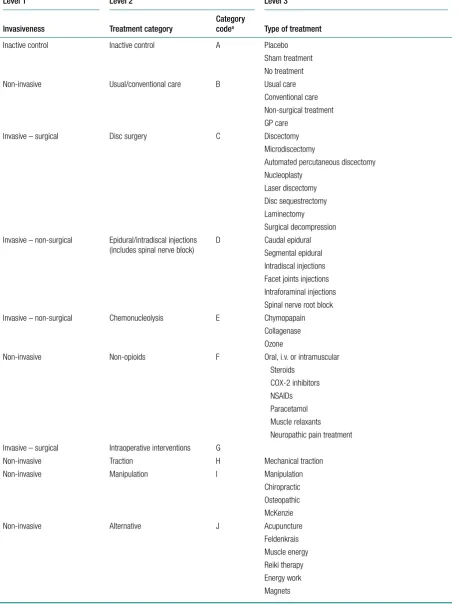
TABLE 1 Treatment categorisation
Level 1 Level 2 Level 3
Invasiveness Treatment category Category codea Type of treatment
Inactive control Inactive control A Placebo
Sham treatment No treatment
Non-invasive Usual/conventional care B Usual care
Conventional care Non-surgical treatment GP care
Invasive – surgical Disc surgery C Discectomy
Microdiscectomy
Automated percutaneous discectomy Nucleoplasty
Laser discectomy Disc sequestrectomy Laminectomy Surgical decompression Invasive – non-surgical Epidural/intradiscal injections
(includes spinal nerve block) D Caudal epiduralSegmental epidural Intradiscal injections Facet joints injections Intraforaminal injections Spinal nerve root block
Invasive – non-surgical Chemonucleolysis E Chymopapain
Collagenase Ozone
Non-invasive Non-opioids F Oral, i.v. or intramuscular
Steroids COX-2 inhibitors NSAIDs Paracetamol Muscle relaxants Neuropathic pain treatment Invasive – surgical Intraoperative interventions G
Non-invasive Traction H Mechanical traction
Non-invasive Manipulation I Manipulation
Chiropractic Osteopathic McKenzie
Non-invasive Alternative J Acupuncture
Feldenkrais Muscle energy Reiki therapy Energy work Magnets
Outcome measures
All relevant patient-based outcome measures such as pain, disability, functional status, adverse effects, health status, quality of life (QoL), analgesic use, operation rates, health utility, return to work, health-service use and costs were considered for inclusion in the review. Biochemical outcomes and biomechanical measurements (e.g. change in disc space) were excluded. Although all relevant outcome measures were extracted, because of the high volume of studies and time constraints, only those covered by the following important patient-centred outcome9 domains
were included in the analysis of clinical effectiveness: global effect, pain intensity, condition-specific outcome measures (CSOMs) (Table 2) and adverse event data. This means that the outcomes health status, QoL, analgesic use, operation rates, health utility, return to work, health-service use and costs have not been analysed in the clinical effectiveness section of the review.
Assessing relevancy of included studies
Two reviewers independently screened the titles and abstracts identified by the electronic searches for relevance. Potentially relevant studies were ordered and assessed for inclusion, using the criteria reported above, by two independent reviewers. Disagreements during both stages were resolved by discussion or if necessary taken to a third reviewer.
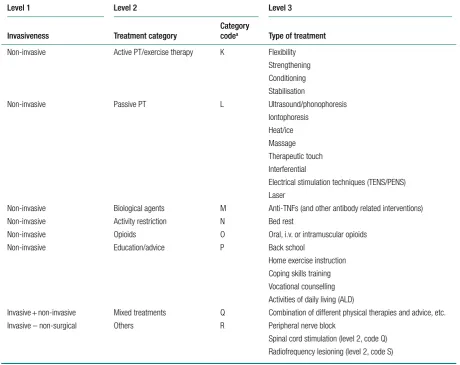
Level 1 Level 2 Level 3
Invasiveness Treatment category Category codea Type of treatment Non-invasive Active PT/exercise therapy K Flexibility
Strengthening Conditioning Stabilisation
Non-invasive Passive PT L Ultrasound/phonophoresis
Iontophoresis Heat/ice Massage Therapeutic touch Interferential
Electrical stimulation techniques (TENS/PENS) Laser
Non-invasive Biological agents M Anti-TNFs (and other antibody related interventions)
Non-invasive Activity restriction N Bed rest
Non-invasive Opioids O Oral, i.v. or intramuscular opioids
Non-invasive Education/advice P Back school
Home exercise instruction Coping skills training Vocational counselling Activities of daily living (ALD)
Invasive + non-invasive Mixed treatments Q Combination of different physical therapies and advice, etc.
Invasive – non-surgical Others R Peripheral nerve block
Spinal cord stimulation (level 2, code Q) Radiofrequency lesioning (level 2, code S)
COX-2, cyclo-oxygenase-2; GP, general practitioner; i.v., intravenous; PENS, percutaneous electrical nerve stimulation; PT, physical therapy; TENS, transcutaneous electrical nerve stimulation; TNF, tumour necrosis factor.
[image:28.595.78.539.113.478.2]Data extraction
Data were extracted using predefined forms developed on a Microsoft Access database
[image:29.595.57.516.113.649.2](Microsoft Corporation, Redmond, WA, USA). Separate forms were used for clinical effectiveness and cost-effectiveness studies. Data were extracted by one reviewer and checked for accuracy, against the original paper, by a second independent reviewer. Any disagreements were resolved by discussion or by a third reviewer if necessary.
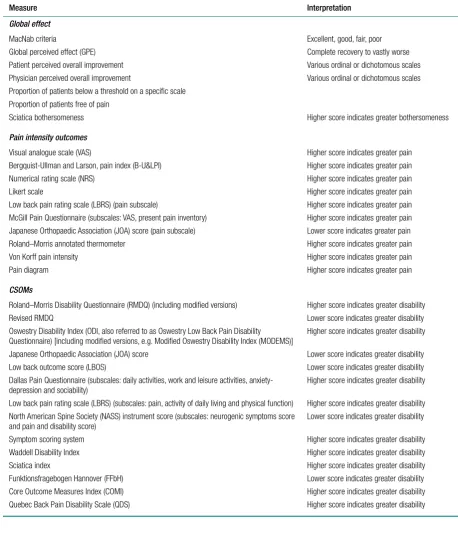
TABLE 2 Sciatica outcome measures
Measure Interpretation
Global effect
MacNab criteria Excellent, good, fair, poor
Global perceived effect (GPE) Complete recovery to vastly worse
Patient perceived overall improvement Various ordinal or dichotomous scales
Physician perceived overall improvement Various ordinal or dichotomous scales Proportion of patients below a threshold on a specific scale
Proportion of patients free of pain
Sciatica bothersomeness Higher score indicates greater bothersomeness
Pain intensity outcomes
Visual analogue scale (VAS) Higher score indicates greater pain
Bergquist-Ullman and Larson, pain index (B-U&LPI) Higher score indicates greater pain
Numerical rating scale (NRS) Higher score indicates greater pain
Likert scale Higher score indicates greater pain
Low back pain rating scale (LBRS) (pain subscale) Higher score indicates greater pain McGill Pain Questionnaire (subscales: VAS, present pain inventory) Higher score indicates greater pain Japanese Orthopaedic Association (JOA) score (pain subscale) Lower score indicates greater pain
Roland–Morris annotated thermometer Higher score indicates greater pain
Von Korff pain intensity Higher score indicates greater pain
Pain diagram Higher score indicates greater pain
CSOMs
Roland–Morris Disability Questionnaire (RMDQ) (including modified versions) Higher score indicates greater disability
Revised RMDQ Lower score indicates greater disability
Oswestry Disability Index (ODI, also referred to as Oswestry Low Back Pain Disability
Questionnaire) [including modified versions, e.g. Modified Oswestry Disability Index (MODEMS)] Higher score indicates greater disability Japanese Orthopaedic Association (JOA) score Lower score indicates greater disability
Low back outcome score (LBOS) Lower score indicates greater disability
Dallas Pain Questionnaire (subscales: daily activities, work and leisure activities,
anxiety-depression and sociability) Higher score indicates greater disability
Low back pain rating scale (LBRS) (subscales: pain, activity of daily living and physical function) Higher score indicates greater disability North American Spine Society (NASS) instrument score (subscales: neurogenic symptoms score
and pain and disability score) Lower score indicates greater disability
Symptom scoring system Higher score indicates greater disability
Waddell Disability Index Higher score indicates greater disability
Sciatica index Higher score indicates greater disability
Funktionsfragebogen Hannover (FFbH) Lower score indicates greater disability
Core Outcome Measures Index (COMI) Higher score indicates greater disability
Data extracted for clinical effectiveness studies included study location and setting, description of study population (including method of diagnosis and previous treatment), type of intervention and control used, how allocation was performed, outcome measures used and results (such as final means, change scores and proportions) with sufficient information, such as standard errors (SEs), significance levels and confidence intervals (CIs), in order to estimate missing standard deviations (SDs) wherever possible. When necessary, the results and the measures of dispersion were approximated from figures in the reports. Data for both continuous and binary outcomes were extracted based on the number of patients included in the analysis. Where possible, reported findings based on intention-to-treat (ITT) analysis were used. However, we did not recalculate findings based on the ITT principle, e.g. using worst- or best-case scenario for missing variables, as we believed we would be unlikely to have data on crossovers. For studies in which arm-level data were not available, but the mean difference between arms and associated SE had been reported, these were extracted and used in the synthesis instead. Additionally, if studies reported the mean difference between arms adjusted for baseline values, e.g. using analyses of covariates (ANCOVA), these were also extracted.
Data extraction for cost-effectiveness studies included the following: type of economic evaluation, specific details about the interventions being compared, study population, time period, measures of effectiveness, direct costs (medical and non-medical), productivity costs, resource use, currency, results and details of any decision modelling and sensitivity analysis.
Quality assessment
Quality assessment was undertaken by two independent reviewers with differences being
resolved by consensus or by a third reviewer if necessary. Data relating to quality assessment were recorded in an Access database.
For clinical effectiveness studies, the quality of both trials and observational studies was assessed using the same checklist based on the one used by the ‘Back Review Group’ of the Cochrane Collaboration for RCTs30 and the one developed by the Hamilton Effective Public Health Practice
Project (EPHPP) team for quantitative studies (which includes both comparative observational studies and RCTs).31 The checklist is presented in Appendix 2. The criteria cover selection bias
and confounding, detection bias, performance bias and attrition bias. Criteria relating to external validity have also been added.
The quality of the economic evaluations was assessed according to an updated version of the checklist developed by Drummond et al.29 (see Appendix 2). The checklist reflects the criteria for
economic evaluation detailed in the methodological guidance developed by the National Institute for Health and Clinical Excellence (NICE). For studies based on decision models, the critical appraisal was based on the checklist developed by Weinstein et al.32 (see Appendix 2).
Methods of analysis/synthesis
Missing study-level outcome data, where feasible, were dealt with by deriving/imputing replacement values. Where mean values were unavailable but the medians were reported, the latter were used instead (i.e. medians were assumed to be equal to means). Where possible, SDs were estimated from SEs, 95% CIs or p-values, using methods reported in The Cochrane handbook,33 and for median values,using the interquartile range (IQR). If SDs for baseline values
were available, then these were substituted for missing SDs. Finally, for studies that did not report sufficient data to derive the SDs, these were imputed using the weighted mean,34 which was
calculated separately for each intervention category.
Global effect (including the absence of pain)
When this outcome was reported in an ordinal format, this was converted into binary data (e.g. improved, not improved, absence of pain, presence of pain). For studies that used ordinal scales, where little improvement (or similar terms) was a central category or grouped with unchanged, the data for patients in this group were classified as not improved. Where both treatment success and failure were reported, treatment success was used. Where treatment failure was reported on its own, the data were converted to treatment success. Where studies reported both overall improvement (sometimes based on a number of scales) and improvement in pain (categorical data), the data on overall improvement were used. For studies that reported both physician- and patient-perceived global effect, the data for patients’ perceived effect were used, as this is considered to be the most useful; if the study reported only physician’s assessment, then this was used.
Pain intensity (based on a continuous scale)
Most of the studies reporting pain intensity used a visual analogue scale (VAS) to measure pain, with a mixture of both final mean and change scores reported. Studies were pooled using weighted mean difference (WMD). Studies that measured pain intensity on a similar continuous scale were also included, with the data converted to a scale of 0–100. Other types of pain measures were excluded as their inclusion would have necessitated using standardised mean differences (SMDs), where both final and change scores could not be used. Multiple and different locations of the pain were assessed across the studies. We included a pain assessment from only one site from each study using the following preference hierarchy: leg pain (preferred), then overall pain, and then back pain.
Condition-specific outcome measures
The included studies used a number of different scales to measure condition-specific functional status. The Roland–Morris Disability Questionnaire (RMDQ)35 and the Oswestry Disability
Index (ODI)36 are the most widely used CSOMs for sciatica studies,37 and an expert panel has
recommended the use of either in lower back pain research.35 The RMDQ was designed, and is
more widely used, in primary care settings; the ODI was designed, and is more widely used, in secondary care. Both show some evidence of criterion and construct validity. The RMDQ is the more frequently cited and is more responsive than the ODI, which in turn has better test–retest reliability.36 The RMDQ has undergone Rasch analysis to examine item separation, which found
that all but four of the items contributed to a single underlying construct, but several items in the middle of the disability hierarchy were too similar and there were insufficient items at the upper and lower extremes.38 The ODI has not undergone Rasch analysis, but like the RMDQ shows
evidence of ceiling and floor effects. There are also different versions of the ODI following its adaptation by different groups.39
studies in the synthesis that reported SDs for baseline, final and change from baseline.40 However,
when doing this we found the average correlation to be ≤ 0.5 for most treatment categories, which means that there is little advantage over using final means. Some studies report findings for more than one CSOM scale, but results from only one scale from each study were used in the analyses, based on the following preference hierarchy: RMDQ,41 ODI,42 Quebec Back Pain Disability Scale
(QDS), others.
Standard pair-wise meta-analyses
Data were analysed according to three follow-up periods: short (≤ 6 weeks), medium (6 weeks to 6 months) and long (> 6 months). Where studies reported findings for multiple follow-up intervals within a single follow-up period, the data relating to the duration closest to the upper limit were used.
Results are presented in structured tables and forest plots, grouped according to the treatment category being evaluated (see Table 1). Studies were pooled using the random effects model43 in
Stata (StataCorp LP, College Station, TX, USA), with between-study heterogeneity examined using I2 and chi-squared statistics. [There were insufficient studies to use individual treatments
(level 3) as separate meta-analyses.]
Although studies comparing different interventions that fell into the same category were included in the review, their findings are not reported here, e.g. studies comparing different types of surgery or different types of epidural injections.
Mixed treatment comparison meta-analyses
Prior to performing the MTC we checked whether or not the included studies formed a closed network using level 2 treatment categorisations (see Table 1) [there were insufficient data to use individual (level 3) treatments as nodes]. Studies evaluating mixed treatments (or combination therapy) were excluded, because of the uncertainty regarding the extent of interaction between the combined interventions. For the MTC, only one time point was considered, with the findings from individual studies closest to 6 months’ follow-up used in the analyses. Analyses were conducted for global effect, pain intensity and CSOMs, for all study designs and after excluding observational studies and non-RCTs.
The analyses were performed by the Multi-parameter Evidence Synthesis Research Group in the Bayesian framework and the modelling computed with Markov chain Monte Carlo stimulation methods using Winbugs (MRC Biostatistics Unit, Cambridge, UK). The codes that were used are presented in the Appendix 3 and are based on those used elsewhere.44 An inactive control
was used as the reference treatment. In all cases, an initial burn-in of at least 50,000 stimulations was discarded and all the results presented are based on a further sample of at least 50,000 stimulations. Convergence was assessed using the Brooks–Gelman–Rubin diagnostic tool in Winbugs and the inspection of the auto-correlation and history plots. The model fit was checked by the global goodness of fit statistic, residual deviance. If the model is an adequate fit, it is expected that the residual deviance would be roughly equal to the number of unconditional data points.
inactive control to be the most appropriate ‘baseline’ comparator. We also included treatment categories such as non-opioids, which could similarly be used as a baseline comparator if considering the use of usual care.
Analysis of covariates
Where 10 or more studies were included in the pair-wise meta-analyses described in Chapter 6, it had been our intention to evaluate the effect of study-level covariates (e.g. symptom duration used and study quality criteria such as adequate randomisation procedure, adequate allocation concealment, > 80% followed up and blind outcome assessment) on between-study heterogeneity using metaregression, but only one comparison (disc surgery vs chemonucleolysis for global effect at long-term follow-up) included sufficient studies. The possible effect of covariates such as study design, study quality and duration of symptoms on pooled results has been discussed when summarising the findings.
Publication bias
For all comparisons for which there were more than eight studies, funnel plots together with associated statistical tests were used to assess the potential publication bias.
Economic evaluations
Given the nature and lack of homogeneity between included economic evaluations, we performed a narrative review of the included studies and made overall conclusions. Details of each published economic evaluation, together with a critical appraisal of its quality, are presented in structured tables with a narrative summary. Where appropriate and where the data permitted, indications of the uncertainty underlying the estimation of the differential cost and effects of the alternative treatment options were summarised.