Rochester Institute of Technology
RIT Scholar Works
Theses Thesis/Dissertation Collections
12-2014
Gesture Recognition Using Hidden Markov
Models Augmented with Active Difference
Signatures
Himanshu Kumar
Follow this and additional works at:http://scholarworks.rit.edu/theses
This Thesis is brought to you for free and open access by the Thesis/Dissertation Collections at RIT Scholar Works. It has been accepted for inclusion in Theses by an authorized administrator of RIT Scholar Works. For more information, please [email protected].
Recommended Citation
Gesture Recognition Using Hidden Markov Models
Augmented with Active Difference Signatures
by
Himanshu Kumar
A Thesis Submitted in Partial Fulfillment of the Requirements for the Degree of Master of Science in Computer Engineering
Supervised by
Dr. Raymond Ptucha
Department of Computer Engineering Kate Gleason College of Engineering
Rochester Institute of Technology Rochester, NY
Dec 2014
Approved By:
_____________________________________________ ___________ ___
Dr. Raymond Ptucha
Primary Advisor – R.I.T. Dept. of Computer Engineering
_ __ ___________________________________ _________ _____
Dr. Andreas Savakis
Secondary Advisor – R.I.T. Dept. of Computer Engineering
_____________________________________________ ______________
Dr. Nathan D. Cahill
Dedication
I dedicate my thesis work to my family and friends. A special feeling of gratitude to my
loving parents, Ashok and Saroj Choudhary, whose words of encouragement
continuously pushed me towards my goal. I would also like to thank Ms. Kajal
Acknowledgements
First and foremost I offer my sincerest gratitude to my advisor, Dr. Raymond Ptucha,
who has supported me throughout my thesis with his patience and knowledge whilst
allowing me the room to work in my own way. I attribute the level of my Masters degree
to his encouragement and effort and without him this thesis, too, would not have been
completed or written. One simply could not wish for a better or friendlier advisor.
Besides my advisor, I would like to thank the rest of my thesis committee, Dr. Andreas
Savakis and Dr. Nathan Cahill for their encouragement, insightful comments and hard
Abstract
Table of Contents
1. Introduction ...1
2. Background ...3
2.1 Related Work ... 3
2.2 Gesture Recognition ... 10
2.3 Clustering ... 13
2.4 Hidden Markov Model ... 15
2.4.1 Definition of HMMs ... 21
2.4.2 Model of HMMs ... 22
2.4.3 The Three Basic Problems for HMM ... 23
2.5 Active Difference Signature ... 27
3. Methodology ...33
4. Experiments and Results ...47
4.1 Dataset and Experimental Methodologies ... 47
4.2 Experimental Results ... 50
4.3 Future Work ... 60
5. Conclusion ...62
Bibliography ...63
List of Figures
Figure 1: Block Diagram of Gesture Recognition Framework ... 12
Figure 2: Clustering of Data ... 15
Figure 3: Markov Model for Gesture Problem ... 17
Figure 4: Ergodic Model ... 22
Figure 5: Left-Right Model ... 23
Figure 6: Left-Right Banded Model ... 23
Figure 7: Overview of Active Difference Signature Framework ... 28
Figure 8: Difference Signature and Motion Signature Curve ... 29
Figure 9: Active Difference Signature vs. Difference Signature for Joints ... 32
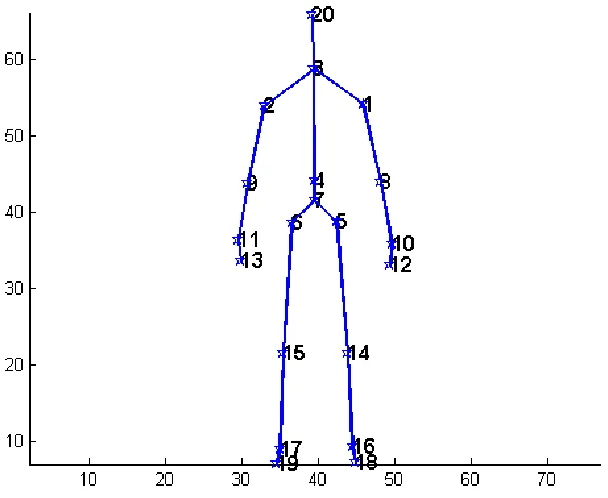
Figure 10: Skeleton Joints ... 33
Figure 11: Skeleton Joints ID for ChaLearn ... 34
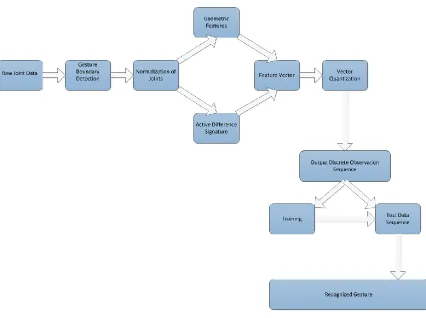
Figure 12: Gesture Recognition Framework ... 35
Figure 13: Hand Motion Signal ... 36
Figure 14: Gesture Detection Using Hand Motion ... 37
Figure 15: Joint Angles From Skeleton Data ... 40
Figure 16: Elbow Joint Angle ... 41
Figure 17: Relative Position of Hand With Respect to Head ... 42
Figure 18: Skeleton JointID for MSR3D ... 45
Figure 19: Italian Sign 1-10 ... 48
Figure 20: Italian Sign 11-20 ... 48
Figure 21: Confusion Matrix for MSR3D ... 52
Figure 22: Jaccard Index vs. Hidden States ... 54
Figure 23: Accuracy vs. Hidden States ... 55
Figure 24: Variable State vs. Fixed State for ChaLearn ... 59
Figure 25: Variable State vs. Fixed State for MSR3D ... 60
List of Tables
Table 1: Transition Probability Matrix for Gesture Problem ... 17
Table 2: Probability of Hand velocity for Gesture Problem... 18
Table 3: MSR3D Result ... 51
Table 4: ChaLearn Result ... 53
Table 5: Result on ChaLearn with and w/o Active Difference Signature ... 56
Table 6: Result on MSR3D with and w/o Active Difference signature ... 56
Table 7: Result on ChaLearn with Different Types of HMMs ... 56
Table 8: Result on MSR3D with Different Types of HMMs ... 57
Table 9: Active Body Parts Based Experiment Result for ChaLearn ... 57
Table 10: Active Body Parts Based Experiment Result for MSR3D ... 58
Table 11: Joint Angle Based Experiment Result for ChaLearn ... 58
Glossary
JOI Joint of interest
HMM Hidden Markov Model
LR Left - Right HMM
LRB Left - Right Banded HMM
MSR3D Microsoft Action 3D
DHMM Discrete Hidden Markov Model
VQ Vector Quantization
VC Vector Codebook
MHI Motion History Image
AU Action Units
SIFT Scale-Invariant Feature Transform SVM Support Vector Machine
ASL American Sign Language
HRI Human-Robot Interaction
Chapter 1
Introduction
Human gestures are non-verbal body actions used to express information and can
typically be instantly recognized by humans. Gestures are used in sign language, convey
messages in noisy environments, and to interact with machines [1]. Automatic gesture
recognition from continuous video streams has a variety of potential applications from
smart surveillance to human-machine interaction to biometrics [2, 3].
There are two categories of gesture recognition, isolated recognition and
continuous recognition [5]. Isolated gesture recognition is based on the assumption that
each gesture can be individually extracted in time, from the beginning to end of gesture
[6]. Continuous recognition has the additional challenge of spotting and recognizing a
gesture in continuous stream [6]. In the real world scenarios, gestures are continuous in
nature, without any explicit pause or break between individual gestures. Thus the
recognition of such gestures closely depends on the segmentation; i.e. determining start
and end frame of each gesture in a continuous stream of gestures [4]. Spatiotemporal
variability [7] refers to dynamic variations in movement and duration, even for same
gesture. The intermediate motion between two consecutive gestures is termed as
transitional motion.
Many researchers have used multi-modal gesture information to tackle the
problem of segmentation ambiguity [7], differentiating between meaningful gestures and
transitional motions, and recognition. The use of multi-modal information i.e. depth,
RGB, audio and skeleton joints, introduces high latency in real time applications. The
goal of this thesis is to introduce a system which uses only skeleton joint information to
real-time applications. The proposed method uses skeleton joints along with active difference
signatures [30] for gesture recognition. The method has shown good accuracy on
ChaLearn and MSR3D Action dataset. On the ChaLearn dataset, the proposed method
gives accuracy of 0.58 when Hidden Markov Model is augmented with active difference
signature against 0.51 when no active difference signatures are used. While on MSR3D
dataset, the proposed method got 80.70% accuracy using leave-one-subject out
cross-validation with active difference signature against 69.05% when no active difference
Chapter 2
Background
2.1. Related Work
A vast amount of research has been done on gesture recognition. Most of it has
been based on two-dimensional computer vision methods or some augmented input
devices such as colored or wired "data gloves". The performance of earlier methods such
as identifying gestures using one or more conventional cameras is highly dependent on
lighting conditions and camera angle. With the introduction of the Kinect camera,
virtually all state of art gesture recognition research has shifted to using RGB-D data,
where the D is a depth channel. The Kinect based approach has improved the user
interactivity, user comfort, system robustness, and ease of deployment.
Patsadu et al. [8] demonstrated the high potential of using Kinect for human
gesture recognition. They used twenty joint locations returned by Kinect to classify three
different human gestures of stand, sit down and lie down. They showed that using
different machine learning algorithms such as Support Vector Machines (SVM), decision
trees, and naive Bayes, they could achieve an average accuracy rate of 93.72%. A neural
network trained with backpropagation achieved 100% accuracy.
Starner et al. [9] used a view based approach with single camera to extract 2D
features as the input to a Hidden Markov Model (HMM) for continuous American Sign
Language (ASL) recognition. They achieved an accuracy of 92% with 40 different signs.
They used a single color camera to track hand shape, orientation and trajectory. The
downside is the user was required to wear inexpensive colored gloves to facilitate the
made gloves for tracking finger movement with similar performance. These systems have
mostly concentrated on finger signing, where the user spells each word with individual
hand signs, each corresponding to a letter of the alphabet [11]. These approaches
compromised user comfort and were shown to be accurate only in a controlled
environment.
Huang and Huang [12] used skeletal joints from the Microsoft Kinect sensor
along with SVM classification to achieve a recognition rate of 97% on signed gestures.
The dataset comprised of fifty samples from two users each. They implemented ten ASL
signs, all of which were based on arm movement. Their approach fails in case of gestures
that involve finger and facial movement as skeleton tracking does not provide finger and
facial movement information. Another limitation was that they used a fixed duration of
ten frames, restricting the speed of which a sign can be made.
Biswas and Basu [13] used depth images from the Kinect sensor for hand gesture
recognition. They showed that depth data along with the motion profile of the subject can
be used to recognize hand gestures like clapping and waving. They presented a lesser
compute intensive approach for hand gesture recognition, and shown the accuracy of the
system can be further improved by using skin color information from RGB data. Agarwal
et al. [14] used the depth and motion profile of the image to recognize Chinese number
sign language from the ChaLearn CGD 2011, [15] gesture dataset. They used low level
features such as depth and motion profiles of the each gesture to achieve an accuracy of
92.31%. The authors suggested the accuracy may be further improved if high level
features like optical flow information or motion gradient information were incorporated
Zafrulla et al. [16] investigated the use of Kinect for their currently existing
CopyCat system which is based on the use of a colored glove. They achieved accuracy
rate of 51.5% and 76.12% on ASL sentence verification in seated and standing mode
respectively which is comparable to the 74.82% verification rate when using the current
CopyCat system. They used a larger dataset of 1000 ASL phrases. They used the depth
information for ASL phrase verification, whereas the RGB image stream is used to
provide live feedback to the user. They used the skeleton tracking capability of the Kinect
along with depth information to accurately track the arm and hand shape respectively.
Vogler and Metaxas [17] designed a framework for recognizing isolated as well
as continuous ASL sentences from three dimensional data. They used multiple camera
views to facilitate three dimensional tracking of arm and hand motion. They partly
addressed the issue of co-articulation, whereby the interpretation of the sign is influenced
by the preceding and following signs, by training a context-dependent Hidden Markov
Model. They successfully showed that three dimensional features outperform
two-dimensional features in recognition performance. Furthermore, they demonstrated that
context-dependent modeling coupled with HMM vision models improve the accuracy of
continuous ASL recognition. With the 3D context-dependent model, they achieved
accuracy of 89.91% for continuous ASL signs with a test set of 456 signs.
Nianjun and Lovell [18] presented a paper in which they described a Hidden
Markov Model (HMM) based framework for hand gesture detection and recognition. The
observation sequence for the HMM model is formed by features extracted from the
segmented hand. They performed vector quantization on the extracted features by using
better than classic template based methods. They also compared two training algorithms
for the HMMs; 1) the traditional Baum-Welch and 2) the Viterbi path counting method.
By varying the model structure and number of states, they found that both methods have
reasonable performance.
Yang and Xu [19], proposed a method for developing a gesture based system
using a multi-dimensional HMM. They converted the gestures into sequential symbols
instead of using the geometric features. A multi-dimensional HMMs models each
gesture. Instead of using geometric features they used features like global transformation
and zones. They achieved an accuracy of 99.78% using 9 isolated gestures. Their method
did not work quite well in case of continuous gestures.
Nhan et al. [41] investigated the application of HMM in the field of Human-Robot
Interaction (HRI). This paper introduced a novel approach for HRI in which not only the
human can naturally control the robot by hand gesture, but also the robot can recognize
what kind of task it is executing. A 2-stage Hidden Markov Model is used, whereby the
1st stage HMM recognizes the prime command gestures, and the 2nd stage HMM utilizes
the sequence of prime gestures from the 1st stage to represent the whole action for task
recognition. Another contribution of this paper is the use of output Mixed Gaussian
distribution in HMM to improve the recognition rate.
Wilson et al. [42] presented a method for the representation, recognition, and
interpretation of parameterized gestures. Parameterized gestures are those gestures that
exhibit a systematic spatial variation; one example is a point gesture where the relevant
parameter is a two dimensional direction. In their approach, they extended the standard
variation in the output probabilities of the HMM states. The results demonstrate the
recognition superiority of the parametric HMM (PHMM) over standard HMM
techniques, as well as greater robustness in parameter estimation with respect to noise in
the input features.
Yang et al. [43] proposed an HMM-based method to recognize complex
single-hand gestures. The gestures samples were collected by using common web cameras. They
used the skin color of the hand to segment hand area from the image to form a hand
image sequence. To split continuous gestures they used a state-based spotting algorithm.
Additional features included hand position, velocity, size, and shape. 18 different hand
gestures were used, where each hand gesture was performed 10 times by 10 different
individuals to achieve an accuracy of 96.67%. The disadvantage of this method is that it
used skin color for segmentation which is very sensitive to the lighting conditions.
Yang and Sarkar [44] addressed the problem of computing the likelihood of a
gesture from regular, unaided video sequences, without relying on perfect segmentation
of the scene. They presented a method which is an extension of the HMM formalism,
which they called frag-HMM. This formulation, does not match the frag-HMM to one
observation sequence, but rather to a sequence of observation sets, where each
observation set is a collection of groups of fragmented observations. This method is able
to achieve recognition performance within 2% of that obtained with manually segmented
hands and about 10% better than that obtained with segmentations that use the prior
knowledge of the hand color on the publicly available dataset by Just and Marcel [45].
Eickeler et al. [46] presented the extension of an existing vision based gesture
position independent recognition, rejection of unknown gestures, and continuous online
recognition of spontaneous gestures. To facilitate the rejection of unknown gestures,
gestures of the baseline system were separated into a gesture vocabulary and gestures
used to train the filler models, which are defined to represent all other movements. This
system is able to recognize 24 different gestures with an accuracy of 92.9%.
Gaus et al. [48] found fixed state HMM gave the highest rate of recognition
achieving 83.1% over variable state HMM. The gestures were based on the movement of
each right hand (RH) and left hand (LH), which represented the words intended by
signer. Their HMM based system had features like gesture path, hand distance and hand
orientations which were obtained from RH and LH. While training HMM states, they
introduced fixed states and variable states. In the fixed states method, the number of
states are fixed for all gestures and for variable states, the number of states is determined
by the movement of the gesture.
Shrivastava [49] developed a system using OpenCV which is not only easy to
develop but also its recognition rate is so fast that it can be practically used for real-time
applications. The whole system is divided into the three stages of detection and tracking,
feature extraction, and training and recognition. The first stage uses an unconventional
approach of application of CIE L*a*b* color space for hand detection. The process of
feature extraction requires the detection of the hand in a manner which is invariant to
translation and rotation. For training, the Baum-Welch algorithm with Left-Right Banded
(LRB) topology is applied and recognition is achieved by forward algorithm with an
The method presented by Cholewa and Głomb [50], describes choosing the
number of states of a HMM based on the number of critical points in the motion capture
data. Critical points are determined as the points at the end of the sampling interval, local
maxima and local minima of a data sequence. This work used the publicly available
dataset, IITiS gesture database, which contains a recording of 22 hand gestures.
Compared to the standard approach, this method offers a significant performance gain,
where the score of HMMs using critical points as states is, on average, in the upper 2% of
the results.
Vieriu et al. [52] describes a background invariant Discrete Hidden Markov
Model based recognition system where hand gestures are modeled using Markovian
chains along with observation sequences extracted from the contours of the gestures.
They also demonstrated that Discrete HMM (DHMM) outperforms its counterpart when
working on challenging samples collected from Kinect. They used the same dataset as
[52] and achieved an accuracy of 93.38% on test data.
Several methods have been used for gesture recognition: template matching [20],
dictionary lookup [21], statistical matching [22], linguistic matching [23] and neural
networks [24]. Template matching systems are easy to train because the prototypes in the
system are exemplar frames. However, the use of a large number of templates makes it a
compute intensive method. Dictionary lookup techniques are efficient for recognition
when features are sequences of tokens from a small alphabet. The drawback for this
system is that it is not robust. Statistical matching methods employ statistics of example
feature vectors to derive classifiers. Some statistical matching methods make an
systems tends to be poor when the assumptions are violated. The linguistic approach tries
to apply automata and formal language theory to reformulate as a pattern recognition
problem. The major problem with this approach is the need of supplying a grammar for
each pattern class. Neural networks have been successfully applied to solve many pattern
recognition problems. Their major advantage is that they are built from a large number of
simple elements which learn and are able to collectively solve complicated and
ambiguous problems. Unfortunately the best performance neural networks have many
layers and nodes which require large training requirements.
2.2. Gesture Recognition
Gestures are expressive, important body motions involving physical movements
of the fingers, hands, arms, head, face, or body with the intent of: 1) conveying
meaningful information or 2) interacting with the environment [60]. Gestures can be
static (the user assumes a certain pose or con-figuration) or dynamic (with preparation,
stroke, and retraction phases). Some gestures also have both static and dynamic elements,
as in sign languages.
Static gestures can be described in terms of hand shapes. Posture is the
combination of hand position, orientation and flexion observed at some time instance.
Static gestures are not time varying signals and can be understood from still captures in
time such as a picture of a smile or angry face [62].
Dynamic Gesture is a sequence of postures connected by motions over a short
time span. In video sequences, the individual frames define the posture and the video
sequence define the gesture. Dynamic gestures have recently been used to interact with
The applications of gesture recognition are many, ranging from sign language
through medical rehabilitation to virtual reality. Gesture recognition has wide-ranging
applications [61] such as the following:
visual communication for the hearing impaired;
enabling very young children to interact with computers;
designing techniques for forensic identification;
recognizing sign language;
medically monitoring patients’ emotional states or stress levels;
lie detection;
navigating and/or manipulating in virtual environments;
communicating in video conferencing;
distance learning/tele-teaching assistance;
monitoring automobile drivers’ alertness/drowsiness levels, etc.
The various techniques used for static (pose) gesture recognition include [63]:
Template Matching
Neural Networks
Pattern Recognition Techniques
While, the techniques used in dynamic gesture recognition include [63]:
Time Compressing Templates
Dynamic Time Warping
Hidden Markov Models
Time-delay Neural Networks
Particle filtering and Condensation algorithm
Finite state machine
The automatic recognition of dynamic or continuous gestures requires temporal
segmentation. Often one needs to specify the onset and offset of a gesture in terms of
frames of movement, both in time and in space. This is the most complex part of the
entire gesture recognition framework. Most of the researchers classify gesture recognition
system into four main steps. These steps are: 1) Data acquisition; 2) Extraction method or
gesture modeling; 3) features estimation/extraction, and 4) classification or recognition as
[image:23.612.80.515.357.422.2]illustrated in Figure 1.
Figure 1: Block diagram of gesture recognition framework.
2.2.1 Data Acquisition
This step is responsible for collecting the input data which are the hand, face or
body imagery. This data is often collected from RGB camera, data gloves or depth
camera like Kinect. If a depth augmented camera is used, data is typically given as RGB
image, depth image and skeleton joint coordinates.
2.2.2 Gesture Modeling
Gesture modeling is concerned with the fitting and fusing the input gesture into
convergence to a unified set of gestures [63]. The pre-processing steps are typically
normalization, removal of noise, gesture segmentation etc. This stage makes the input
data invariant to subject's size, shape and location in the frame. The gesture segmentation
is a complex task and is very critical for the accuracy of the gesture recognition
framework.
2.2.3 Feature Extraction
After gesture modeling, the feature extraction should be robust to large input
variance as the fitting is considered the most difficult task in gesture recognition. Features
can be the location of hand/palm/fingertips, joint angles, or any emotional expression or
body movement. The extracted features might be stored in the system at training stage as
templates or may be fused with some recognition devices such as neural network, HMM,
or decision trees [63].
2.2.4 Recognition Stage
This stage is considered to be a final stage for gesture system and the
command/meaning of the gesture should be clearly identified. This stage usually has a
temporal classifier that can attach each input testing gesture to the closest matching class.
The input to this stage is an unseen test data sequence along with the model parameters
learned from training.
2.3. Clustering
Clustering algorithms partition data objects (patterns, entities, instances,
observances, units) into a certain number of clusters (groups, subsets, or categories) [53].
two points in the cluster is less than the distance between any point in the cluster and any
point not in it”. Clearly, a cluster in these definitions is described in terms of internal
homogeneity and external separation [54,55,56], i.e., data objects in the same cluster
should be similar to each other, while data objects in different clusters should be
dissimilar from one another. Usually similarity is defined as proximity of the points as
measured by a distance function, such as the Euclidean distance of feature vectors in the
feature space. However, measures of other properties, such as vector direction, can also
be used. The method of finding the clusters may have a heuristic basis or may be
dependent on minimization of a mathematical clustering criterion.
In the field of gesture recognition, vector quantization is clustering using the
Euclidean distance measure; however, many new terms are used. The clusters of a
classifier are now called the quantization levels of a vector quantization (VQ) code book.
Furthermore, the distance of each sample to the mean of its enclosing cluster is no longer
a measure of similarity but rather a measure of distortion. The goal of VQ is to find the
set of quantization levels that minimizes the average distortion over all samples.
However, finding the codebook with the minimal average distortion is intractable.
Nevertheless, given the number of clusters, convergence to a local minimum can be
achieved through the simple K-means algorithm [57]:
1. Randomly assign each sample of the data to one of K clusters. The number of
clusters is a predefined parameter which is varied during training.
2. Compute the sample mean of each cluster.
3. Reassign each sample to the cluster with the corresponding nearest mean.
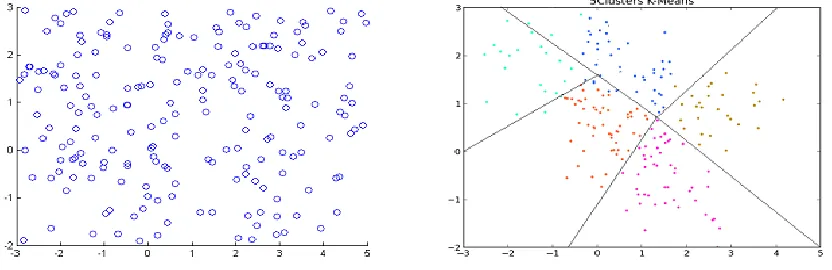
Figure 2: Clustering of data. (left) collection of data. (right) Vector quantization showing the
clusters.
Although it can be proved that the procedure will always terminate, the K-means
algorithm does not necessarily find the most optimal configuration, corresponding to the
global objective function minimum. The algorithm is also significantly sensitive to the
initial randomly selected cluster centers. The K-means algorithm can be run multiple
times to reduce this effect.
In this thesis, the clustering method is as follows. First, all the data are collected
into a single set of observation vectors. Next, vector quantization groups the data points
into clusters.
2.4. Hidden Markov Model
The HMM approach to gesture recognition is motivated by the successful
application of HMM to speech recognition problems. The similarities between speech
and gesture suggest that techniques effective for one problem may be effective for the
other as well. Inherently, HMMs can model temporal events in an elegant fashion. As
gestures are a continuous motion phenomenon on a sequential time series, HMMs are a
Before describing the Hidden Markov Model, it is necessary to describe its
foundation, the Markov Process. A Markov process consists of two parts: 1) a finite
number of states; and 2) transition probabilities for moving between those states. For
example, on a given day a person might be happy, sad or feel a sense of ennui. These
would be the states of the Markov Process. The transition probabilities represent the
likelihood of moving between those states - from a state of happiness on one day to state
of sadness the next.
The Markov process provides a powerful way to simulate real world processes,
provided a small number of assumptions are met. These assumptions, called Markov
Properties, are: a fixed set of states, fixed transition probabilities, and the possibility of
getting from any state to any other state through a series of transitions.
The Markov Model can be better explained by an example. Assume there is a
person who is performing three gestures, one after another. The three gestures are: 1)
Wave; 2) Stop; and 3) Come.
Through this example, Markov analysis can predict the probability of the next
gesture being come, given that previous gesture was wave and current gesture is stop. For
this problem, let's make a first order Markov assumption which states that, the probability
of a certain observation at time n only depends on the observation On-1 at time n-1.
). | ( ) ..., , , |
(On On1 On2 O1 P On On1
P (1)
The joint probability of a certain observation sequence{O1,O2,...,On}, using
Markov assumption is given by (2).
n
i
i i
n P O O
O O O P
1
1 2
1, ,..., ) ( | ).
(
The transition probability matrix for the given problem is shown in Table 1:
Table 1: Transition Probability Matrix.
Current Gesture Next Gesture
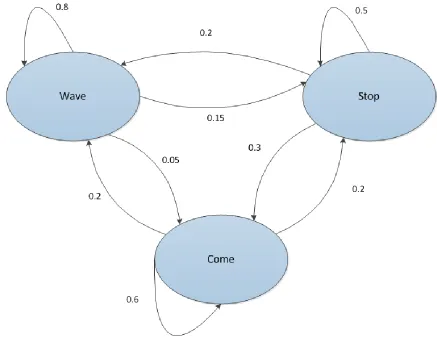
Wave Stop Come
Wave 0.8 0.15 0.05
Stop 0.2 0.5 0.3
Come 0.2 0.2 0.6
The Markov Model for the given problem based on the above probabilities is
shown in Figure 3:
Using the Markov assumption and the transition probabilities in Table 1, this
problem translates into:
) |
( ) ,
|
(O3 come O2 stop O1 wave PO3 come O2 stop
P
= 0.3
Thus the probability of next gesture being come is 0.3. This explains the Markov
assumption and Markov Models. So, what is Hidden Markov Model? Well, suppose
instead of direct knowledge of the gesture being performed, i.e. state of the Markov
Process, an observer makes some observations such as joint angle or joint velocity, and
based on a series of past observations, the observer can make a probabilistic guess of the
next gesture. The specific state, i.e. gesture in this case, is hidden from the observer, and
the observer can only make a guess based on past observations. The models which can
simulate these types of processes are called Hidden Markov Models. Once again, an
example is used to clarify the concept of Hidden Markov Model.
Assume the observer is locked inside the room and can't directly observe the
gesture being performed. However, the observer has information about hand velocity.
Let's suppose the probability of observation (hand velocity > threshold or hand
velocity < threshold) is shown in Table 2:
Table 2: Probability of hand velocity greater than threshold.
Gesture Probability of hand velocity greater than threshold (Y)
Stop 0.1
Wave 0.8
The equation for the gesture Markov process before the observer was locked
inside the room was (2). However, in this problem the actual gesture being performed is
hidden from the observer. Finding the probability of a certain gesture
) , ,
(wave stop come
si can only be based on the observation Oi with Oi = Y , if the hand
velocity is greater than threshold at observation i, and Oi = N if the hand velocity is
below threshold. This conditional probability P(si |Oi) can be written according to
Bayes' rule: ) ( ) ( ) | ( ) | ( i i i i i i O P s P O s P O s
P (3)
or for n gestures , and gesture sequence S = {S1,..., Sn}, as well as hand velocity
sequence O = {O1,..., On}
) ,..., ( ) ,..., ( ) ,..., | ,..., ( ) ,..., | ,..., ( 1 1 1 1 1 1 n n n n n
n P O O
s s P O O s s P O O s s
P (4)
Using the probability P(s1,...,sn)of a Markov weather sequence from above, and
the probability P(O1,...,On)of seeing a particular sequence of hand velocity events (e.g.
Y, N, Y), the probability P(s1,...,sn |O1,...,On)can be estimated as
n i i i O s P 1 ) |
( , if one
assumes that, for all i, the si, Oi are independent of all si and Oi , for all ji.
As the probability of the hand velocity being greater than the threshold is
independent of the gesture being performed, one can omit the probability of hand velocity
from (4). To measure the probability, a new term called likelihood, L, is introduced.
Using the first order Markov assumption, likelihood L is given by (5).
n i i i n i i i nn O O P s O P O O
s s L 1 1 1 1
1,..., | ,..., ) ( | ). ( | )
Now, suppose the observer cannot see the "wave" gesture being performed,
however, strategically placed accelerometers on each hand of the actor inform the
observer the hand velocity is greater than threshold, Y. Using this hand velocity
information, the observer has to predict what gesture is being performed. To predict the
gesture being performed, the likelihood of each gesture is calculated given the velocity
information. First calculate the likelihood of the gesture being wave using (5):
) | ( ) | ( ) , | ( 1 2 2 2 2 1 2 wave s wave s P wave s Y O P Y O wave s wave s L
= 0.8 * 0.8 = 0.64
then the likelihood of gesture being come is:
) | ( ) | ( ) , | ( 1 2 2 2 2 1 2 wave s come s P come s Y O P Y O wave s come s L
= 0.3 * 0.05 = 0.015
and finally for the likelihood of gesture being stop :
) | ( ). | ( ) , | ( 1 2 2 2 2 1 2 wave s stop s P stop s Y O P Y O wave s stop s L
= 0.1 * 0.15 = 0.015
The maximum likelihood among the three choices is 0.64 and so most probably
the gesture being performed is wave.
HMM's are statistical methods that model spatiotemporal information in a natural
way. They have elegant and efficient algorithms for learning and recognition, such as
2.4.1 Definition of HMMs
An HMM consists of N states S1, S2, ... , SN, together with transition probabilities
between states. The system is in one of the HMM's states at any given time. At regularly
spaced discrete time intervals, the system evaluates transitioning from its current state to
a new state [6]. Each transition has a pair of probabilities: A) a transition probability
(which provides the probability for taking the transition from one state to another state),
and B) an output probability or emission probability (which defines the conditional
probability of emitting an output symbol from a finite alphabet given a state) [7]. A
formal characterization of HMM is as follows:
{ S1, S2, S3,..., SN } - A set of N states. The state at time t is denoted by the
random variable qt .
{ V1, V2, V3, ..., VM } - A set of M distinct observation symbols, or a discrete
alphabet. The observation at time t is denoted by random variable Ot. The
observation symbol corresponds to the physical output of the system being
modeled.
A = { aij } - An N x N matrix for the state transition probability distribution
where aij, is the probability of making transition from state si to state sj :
aij = P(qt+1 = sj | qt = si), where q is state at a given time t
B = { b j (k) } - An N x M matrix for the observation symbol probability
distributions where bj(k) is the probability of emitting Vk at time t in state s j :
bj (k) = P( O t = V k | q t = s j) .
П = { Пi } - The initial state distribution where Пi is the probability that
Пi = P ( q1 = s i) .
Since A, B and П are probabilistic, they must satisfy the following constraints:
1 , ij 0. jaij i and a
b (k) 1 j,and bj(k) 0.j k
ii 1 and i 0.Following the convention, a compact notation λ = (A, B, П) is used which includes
probabilistic parameters.
2.4.2 Models of HMMs
Based on the nature of state transition, HMMs have 3 different types of models:
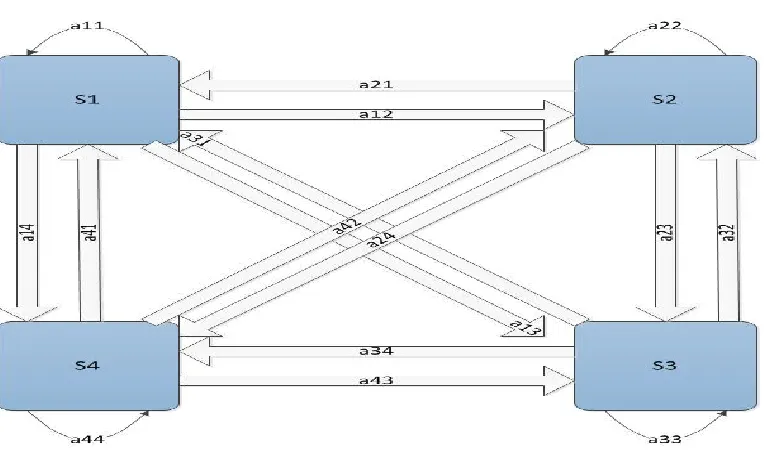
1. Ergodic Model - In this model, for a system with finite number of N states, any
state can be reached from any other state in single step. All the transition
probabilities are non-zero in a fully connected transition matrix. The model is
[image:33.612.117.500.464.692.2]depicted graphically in Figure 4.
2. Left - Right Model – A state can transition to itself or the state right to it. All the
transition probabilities in the transition matrix on the left of the state have zero
values and to the right of the states have non-zero values.
Figure 5: Left- Right Model
3. Left-Right Banded Model – A state can transition to itself or the state next to it on
the right side.
Figure 6: Left-Right Banded Model
The most common topology for gesture recognition is Left-Right Banded (LRB)
model. In this model, transition only flows forward from a lower state to the same state or
to the next higher state, but never backward. This topology is the most common for
modeling process over time.
2.4.3 The Three Basic Problems for HMM
For a HMM model to be useful in real world applications, it has to solve three
Problem 1: Given the observation sequence O = O1, O2, O3, ..., OM , and a model
λ = (A, B, П ), how to efficiently compute P(O|λ), the probability of the observation
sequence? This is referred to as an evaluation problem [26]. In simple terms, how to
compute the probability that the observed sequence is produced by the given model or
how well a given model matches a given observation sequence [26]. Problem 1 allows
system to choose the model which best matches the observation. In gesture recognition, it
is the predicted gesture for a given observation sequence when computed against all
training models.
Problem 2: Given the observation sequence O = O1, O2, O3, ..., OM, and the model
λ = (A, B, П ), how to choose a corresponding state sequence S = S1, S2, S3, ..., SN, which
best explains the observations [26]. In another term, it attempts to uncover the hidden part
of the model, i.e., to find the "correct" state sequence.
Problem 3: Adjust the model parameter of HMM λ = (A, B, П ), such that they
maximize P(O|λ) for some O [26]. In this, the system attempts to optimize the model
parameters so as to best describe how a given observation sequence comes about. The
observation sequence used to adjust the model parameters is called a training sequence
since it is used to train the HMM. This is the critical part of the gesture recognition
application as it is where model parameters adapt to create best models which is used in
problem 1 or the evaluation phase of the HMM.
The first problem corresponds to maximum likelihood recognition of an unknown
data sequence with a set of trained HMMs models. In this thesis this corresponds to the
probability of predicting a gesture. For each HMM, the probability P(O|λ) , is computed
is selected as the recognized gesture. For computing P(O|λ), let S = S1, S2, S3, ..., SNbe a
state sequence in λ:
N i S Q O O O P
i t t i
t() ( 1, 2,..., , |) 1
(6)
N i T i O P 1 ) ( ) |( (7)
) ( )
( 1
1 i ibi O
(8)
N j ji t t it i b O j a t T
1 1
1() ( ) ( ) 1 1
(9)
These equations assume that all observationsare independent, and they make the
Markov assumption that a transition depends only on the current and previous state, a
fundamental limitation of HMM. This method is called forward-backward algorithm and
can compute P(O|λ) in O(N2T) time [6].
The second problem corresponds to finding the most likely path Q through an
HMM λ, given an observation sequence O, and is equivalent to maximizing P(Q ,O|λ).
Let ) | , .... ( max )
( 1 2
... 1 2 1
i P QQ Qt Si O
Q Q Q t t (10) } ) ( { max ) ( ) ( 1 1
1 i t j N t ji
t i b O j a
(11)
)} ( { max ) | , ( max 1 i O Q P T N i
Q (12)
δt(i) corresponds to maximum probability of all state sequences that ends up in
state Si at time t. The Viterbi algorithm is a dynamic programming algorithm that, using
(7), computes both the maximum probability P(Q ,O|λ) and the state sequence Q in
The third problem corresponds to training the HMMs with data, such that they are
able to recognize unseen test data correctly in evaluation phase. It is by far the most
difficult and time consuming of the three HMM problems. Given some training
observation sequence O = O1, O2, O3,...., OM, and general structure of HMM, determine
HMM parameters (A, B, П ) that best fit training data. There is no analytical solution to
this problem, but an iterative procedure, called Baum-Welch, maximizes P(O|λ) locally.
The Baum–Welch algorithm is a particular case of a generalized
expectation-maximization (GEM) algorithm. It can compute maximum likelihood estimates and
posterior mode estimates for the parameters (transition and emission probabilities) of an
HMM, when given only emissions as training data.
The algorithm has two steps:
- Calculate the forward and backward probability for each HMM state;
- On the basis of this, determine the frequency of the transition-emission pair
values and normalizing by the probability of the entire string. This amounts to calculating
the expected count of the particular transition-emission pair. Each time a particular
transition is found, the value of the quotient of the transition divided by the probability of
the entire string goes up, and this value can then be made the new value of the transition.
Before expressing the Baum-Welch algorithm mathematically, it is good to
understand the meaning of few variables, ξ t (i,j) and ϒ t (i) . The first variable ξ t (i,j) is the
posterior probability of going from state i to state j at time t, given the observation
sequence and a set of model parameters. The second variable ϒt(i) is the posterior
probability of being in state i at time t, given the observation sequence and parameters
) , | ..., , ( )
( 1 2
t i POt Ot OT QtSi (13)
1 ) (i T (14) 1 1 , 1 , ) ( ) ( )
( 1 1
1
a b O j i N t Ti N t t
j j ij
t
(15)
Furthermore, define ξ and ϒ as:
) | ( ) ( ) ( ) ( ) ,
( 1 1
O P j O b a i j
i t ij j t t
t
(16)
N
i t
t i i j
1 ) , ( ) ( (17)
t
t(i,j) can be interpreted as the expected number of transitions from Si to Sj;likewise
t
t(i) can be interpreted as the expected number of transitions from Si . Withthese interpretations, the re-estimation formula for the transition and output probabilities
are
) (
1 i i
(18)
1 1 1 1 ) ( ) , ( T t t T t t ij i j i a (19)Repeated use of this procedure converges to a maximum probability, after several
iterations.
2.5. Active Difference Signatures
This thesis uses the concept of Active Difference Signatures [40] which select the
active temporal region of interest based on estimated kinematic joint positions [31]. The
difference between the normalized joints and a canonical representation of skeletal joints
forms an active difference signature, a salient feature descriptor across the video
sequence. This descriptor is dynamically time warped to a fixed temporal duration in
preparation for classification.
Figure 7 outlines the Active Difference Signatures extraction framework used in
this thesis.
Figure 7: Overview of Active Difference Signature Framework.
The input to the system is XYZ coordinates of the 20 kinematic joints of the
human body across a sequence of frames. The output of the system is a single active
difference signature for the input frame sequence. Gesture boundaries are detected, the
XYZ coordinates of the skeletal joints are normalized, and the normalized joints are
converted into an active difference signature attribute. The active difference signature is a
combination of joint differences of successive frames and joint differences between each
frame and a canonical skeletal joint frame. For pre-recorded datasets, the beginning and
end of the gesture is usually not the first and last frame. The active difference signatures
find the gesture onset and offset frames, then dynamic time warps all frames between
these boundaries to a fixed number of frames. The dynamic time warped frames create a
Gesture boundary detection finds frames which indicate the beginning and end of
a gesture. Inspired by the ChaLearn Gesture Challenge one-shot learning gesture dataset
[32], this detection scheme skips over frames for which there is no information content
worth analyzing. As soon as motion greater than a threshold is detected in the scene, the
gesture begins. If the gesture is separated by a user returning to resting position, motion
detection along with a measure of the difference between the current frame and the
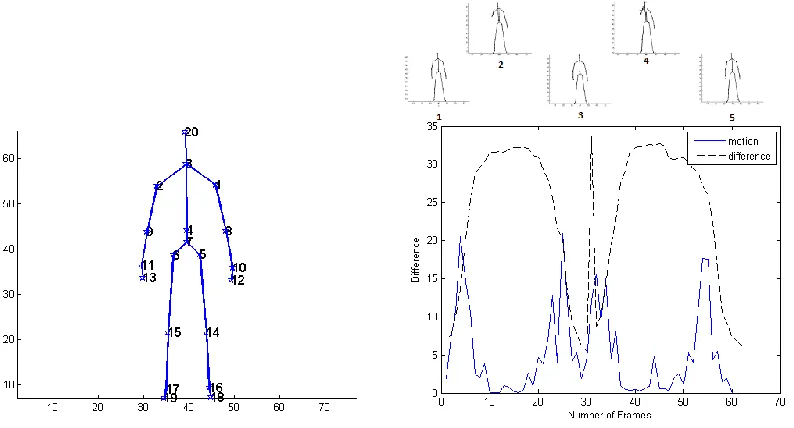
resting position are good markers for gesture boundaries. For example, Figure 8 shows a
time sequence of a user executing two gestures in a single video frame from ChaLearn
Gesture Challenge.
Figure 8: (left) The canonical skeleton used showing 20 joints, each having XYZ coordinates.
(right) Multi-gesture video sequence with 2 active gestures area (2 and 4) separated by three
non-gesture regions (1, 3 and 5). The solid blue curve is a frame to frame difference signature; the black
dotted line is frame-canonical signature. The image at the top shows the frame at the center of
non-gesture and non-gesture regions.
The solid blue line in Figure 8 is an indicator of frame to frame motion. The
[image:40.612.118.515.321.535.2]motion history image (MHI). Specifically, skeletal joints per frames are converted to a
difference frame using (20). This difference frame represents the frame to frame motion.
| ) 1 , , , ( ) , , , ( | ) , ,
(x y z g x y z f g x y z f
df (20)
where df = difference frame
f = 1,..,N-1 ; N = number of frames
g = skeleton data for a frame
The difference frame for current frame to a resting frame is given by (21).
| ) , , ( ) , , , ( | ) , ,
(x y z g x y z f r x y z
drf (21)
where drf = frame-canonical difference
r = skeleton data for canonical resting frame
For (21), canonical resting image, r(x,y,z), is formulated by averaging all resting
frames of a video sequence, and serves as a reference image for comparison.
The 20 XYZ skeletal joint coordinates in each active frame are normalized akin to
a Procrustes analysis in preparation for subsequent processing using (20) and (21).
Normalization makes this technique invariant to subject distance from the camera, subject
size, and subject location within the frame. Setting s equal to a vector of XYZ skeleton
joints and c equal to a vector of XYZ canonical skeleton joints:
20 ... 1 ; 3 ... 1 / ' 1
i j n s s s j n i jij (22)
) ' ( ) ( ' '' s size keleton canonicalS size s
s (23)
] 20 , 7 , 4 , 3 [ ; 3 ... 1 / '' / '' '' ' 1
i j n s n c ss ij j
n
i ij j
j
The skeleton joints are first shifted such that centroid is at (0,0,0). The size of a
skeleton is the joint to joint geodesic measure (i.e. the 3D length of the 20 blue lines in
Figure 8). After scaling, the skeleton is shifted back to the canonical skeleton location
using a centroid calculation of only the head and spine joints (joints numbered 3, 4, 7,
and 20). Omitting arm and leg joints enables the body mass to remain stationary even if a
subject's arm or leg is fully extended.
After joint normalization, the active difference signature attribute is formed by
differencing the 20 normalized skeleton joints of each frame with the 20 canonical
skeleton joint locations using (21) and with next frame using (20).
Figure 9 shows an active difference signature on the left and difference signature
on the right. Each of the 20 lines shows the temporal movement of each of the 20 skeletal
Figure 9: (left) Comparison of a displacement difference signature (left) vs. a motion
difference signature (right) for the gesture 17 from the ChaLearn dataset. Each of the line in two
figures shows the temporal displacement of one of the 20 skeletal joints from the canonical skeletal
frame (see Figure 6 for point annotation). The gesture being performed is the right hand gesture as
shown by the samples from thumbnail atop. Kinematic joints 11 and 13 showed the most
displacement from the canonical skeleton, which correspond to the right wrist and right hand
Chapter 3
Methodology
The proposed method uses only skeleton joint information from the world
coordinates (global position of tracked joints in three dimensions) as it is computationally
efficient and delivers high recognition accuracy. By incorporating ancillary information
such as RGB and depth, the training and testing time will increase significantly and thus
the system will not be useful for real time applications. Although this thesis does not
focus on making a system suitable for real time applications, it is one of the criterions
taken into account.
The dataset gives skeleton joint information of 20 human joints as shown below:
Figure 10: Skeleton Joints
The world coordinate is the three dimensional coordinate information of each
Figure 11 : Skelton Joint ID for ChaLearn.
For the ChaLearn dataset, the proposed method only considers movement of 13
joints out of 20 skeletal joints. This decision is based on the fact that all the gestures in
the dataset are hand based gestures, i.e. the gesture involves movement of hands only.
The joints of interest are: left hand (12), left wrist (10), left elbow (8), left shoulder (1),
right hand (13), right wrist (11), right elbow (9), right shoulder (2), head (20), shoulder
center (3), spine (4) , hip center (7), hip right (6) and hip left (5).
Figure 12 shows the block diagram of the gesture recognition framework. Later in
Figure 12: Gesture recognition framework.
3.1.1 Raw Joint Data
It is the raw input data from the dataset. The XYZ coordinates of all the 20
skeletal joints are input to the framework.
3.1.2 Gesture Boundary Detection
Raw skeleton joints are input to this step. Only hand joints (left hand joint - 12
and right hand joint - 13) are considered for gesture boundary detection. The rest of the
joints are discarded due to the fact that all gestures are hand based gestures. In particular,
the method considers only y-coordinates of the hand joint locations. As shown in Figure
gesture boundary, a motion filter [37] along with a space filter is used to detect these
[image:47.612.166.450.163.371.2]peaks and to determine the boundaries of each gesture.
Figure 13: Hand Motion Signal. Peaks in these signals indicate a gesture in progress.
The process of segmentation using hand motion signals consists of two steps. In
the first step, the start and end frame of the gesture is identified using only one hand
(either left or right, but not both) [37]. Let N be the total number of frames in an input
gesture sequence. Let yl(i) and yr(i) be the y-coordinates of the left and right hand joint. In
the ith frame, where i = 1,2,3...,N. The value of the filter (f) for the ith frame is defined as
follows: 1 ) ( 1 1 )) ( ( , 0 ) ) ( ) ( ( , 2 )) ( ) ( ( , 1 ) ( i y y if i y i y if i y i y if i f l i r l r r l (25)
where 1is a preset threshold that is greater than 0. A filter value of 1 indicates a
using right hand. If the filter value is zero, the corresponding frame is considered to be
such that the user is in neutral position or a gesture is performed by two hands.
The second step finds the start and end frame of the gesture performed by both
hands. This is done by computing a new adaptive threshold (2), from the signal for each
segment with a filter value of zero. To detect gestures performed using both hands, [37]
defines a combined envelope signal as shown in Figure 14, as yc(i) max(yl(i),yr(i)).
If the value of the combined signal yc(i)is greater than the computed threshold 2, it is
assumed that a gesture is performed using both hands. These frames are assigned a filter
value of 3.
Figure 14: Recognition of gesture using performed using both hands. (a) Motion signals
from individual hands, (b) combined envelope signal obtained by taking the maximum value of the
individual signal at each frame, (c) filter output (normalized to one) corresponding to gesture
[image:48.612.141.499.339.619.2]If a sequence of frames has a non-zero filter value, a gesture is detected, and the
start and end frames of the gestures are identified. In the post processing steps to remove
false gesture detection, a check on length of each detected gesture is performed. If the
length of the gesture is extremely short (for the ChaLearn dataset, a value of 12 is used)
then discard the detected gesture. This is done to filter away any impulse or spurious
signals (noise) that might be mistaken as a gesture. In the post processing step, another
check is also performed to check if a detected segment contains more than one gesture
(e.g. gestures that are done continuously without returning to the original or starting
position). This is done by tracking hand motion in the detected segment.
The advantage of this segmentation algorithm is that it efficiently identifies
segments containing gestures with minimal computation overhead.
3.1.3 Normalization of Joints
To prepare the data for the further processing, some basic pre-processing is
needed. Skeleton data is prone to noise and will vary with the size of the subject and
subject distance to the camera. To make joints invariant to the subject size and distance,
all frames are normalized with the canonical resting skeleton which serve as a reference
for comparison.
A canonical resting skeleton is formulated by averaging all frames of the video sequence
in which no motion is detected. The 20 XYZ skeletal joint coordinates in each active
frame are normalized akin to a Procrustes analysis. Setting s equal to a vector of XYZ
skeleton joints and c equal to a vector of XYZ canonical skeleton joints:
20 ... 1 ; 3 ... 1 /
'
1
i j
n s s
s
j
n
i
j
) ' ( ) ( ' '' s size keleton canonicalS size s
s (27)
] 20 , 7 , 4 , 3 [ ; 3 ... 1 / '' / '' '' ' 1
i j n s n c ss ij j
n
i ij j
j
(28)
The skeleton joints are first shifted such that centroid is at (0,0,0). The size of a
skeleton is the joint to joint geodesic measure (i.e. the 3D length of the 20 blue lines in
Figure 8). After scaling, the skeleton is shifted back to the canonical skeleton location
using a centroid calculation of only the head and spine joints (joints numbered 3, 4, 7,
and 20). Omitting arm and leg joints enables the body mass to remain stationary even if a
subject's arm or leg is fully extended.
3.1.4 Geometric Features
As the ChaLearn Dataset [28] consists of only hand based gestures, only joints in
the upper body are considered for feature extraction. Specifically, the joints of interest are
the: head (he), shoulder center (sc), spine (sp), hip center (hc), left shoulder (ls), left
elbow (le), left hand (lh), right shoulder (rs), right elbow (re), right hand (rh), hip right
(hr) and hip left (hl). Geometric features are calculated only for active parts of the body,
i.e. if the gesture is performed using only right hand, then features are calculated for the
right hand only. The active body part is detected in the gesture segmentation step. Using
these joints, the following geometric features are extracted:
a) Joint Distance: For each gesture, the Euclidean distance is calculated for each of the six arm joints (hand, elbow and shoulder) with respect to head, spine and hip center
.
2 2
2 ( ) ( )
)
( j i j i j i
ij x x y y z z
[image:50.612.140.520.75.161.2]where j ϵ [he, sp, hc]
i ϵ [lh, ls, le, rh, rs, re]
As features are calculated for only active parts, the joint distance is a 9 dimensional
vector for a single hand gesture and an 18 dimensional vector for a two hand gesture.
b) Joint Angles: Joint distance can only predict whether a hand is close to the body or far from the body but it cannot differentiate between different position of the
hand in gesture space. Joint angles on the other hand can better predict position of the
joints with respect to each other. Six joint angles are calculated for each gesture. These
[image:51.612.154.467.332.628.2]are shown in Figure 15 [38].
The method of calculating joint angle is illustrated in Figure 16 [38]. To calculate the
joint angle, the vector between joints must be computed. The shoulder-elbow vector
(se ) and elbow-hand vector (eh) is given by (30) and (31) respectively.
k z z j y y i x x e
s ( 2 1)ˆ ( 2 1)ˆ ( 2 1)ˆ (30)
k z z j y y i x x h
[image:52.612.76.530.63.545.2]e ( 3 2)ˆ ( 3 2)ˆ ( 3 2)ˆ (31)
Figure 16: Calculation of elbow angle [38].
The elbow angle is given by (32).
h e e s h e e s . arccos (32
where the numerator, se.eh is the scalar product of the two vectors and the
denominator is the product of the magnitudes of the two vectors.
The joint angle feature vector is a 3 dimensional feature vector when the subject is
performing a single hand gesture and a 6 dimensional vector when the subject is
performing a two hand gesture as follows:
L R L R L R