Jankov’s Theorems for Intermediate Logics in the
Setting of Universal Models
Dick de Jongh
Institute for Logic, Language and Computation, University of Amsterdam
Fan Yang
Department of Mathematics and Statistics, University of Helsinki
Abstract
In this article we prove the Jankov Theorem for extensions of IPC ([6]) and the Jankov Theorem for KC ([7]) in a uniform frame-theoretic way in the setting of n-universal models for IPC. In frame-theoretic terms, the first Jankov Theorem states that for each finite rooted frame there is a formulaψwith the property that any counter-model forψneeds this frame in the sense that each descriptive frame that falsifiesψwill have this frame as the p-morphic image of a generated subframe. The second one states that KC is the strongest logic that proves no negationless formulas beyond IPC. On the way we give a simple proof of the fact discussed and proved in [1] that the upper part of then-Henkin modelH(n)is isomorphic to the n-universal modelU(n)of IPC. All these results earlier occurred in a somewhat different form in [8].
1
Introduction
In this article we prove the Jankov Theorem for extensions of intuitionistic logic IPC ([6]) and the Jankov Theorem for Jankov’s logic KC ([7]) in a uniform frame-theoretic way in the setting ofn-universal models for IPC. In frame-theoretic terms, the first Jankov Theorem states that for each finite rooted frame there is a formulaψwith the property that any counter-model forψneeds this frame in the sense that each descrip-tive frame that falsifiesψwill have this frame as the p-morphic image of a generated subframe. The second one states that KC is the strongest logic that proves no nega-tionless formulas beyond IPC.
The first Jankov theorem is proved in Section 3, the second one in Section 4. Sec-tion 2 introducesn-universal models andn-Henkin models and develops their relation-ship sufficiently for the proofs in Sections 3 and 4. In section 5 we conclude our very straightforward proof that the upper part of then-Henkin modelH(n)is isomorphic to then-universal modelU(n)of IPC. This theorem was discussed extensively and proved in [1] in a more algebraic manner.
We will use the standard Kripke frames (F=hW, Ri), descriptive frames (F=
including the notationM, wϕ. We extend the notationV(p)to formulas:V(ϕ) =
{w∈W|w⊢ϕ}. Our models will usually ben-models, i.e. models with the valuation
V restricted to the atomsp1, . . . , pnand thereby ton-formulas, formulas formed from
p1, . . . , pn. IfX is a set of elements in the frameFwe will writeFXfor the subframe ofFgenerated byX, shortening this toFwifX is a single elementw; similarly for models. We call the upward closed subsets ofW (with respect to the relationR) upsets. The set of all upsets ofW is denoted byU p(W).
We have the usual notions of p-morphism for Kripke frames, descriptive frames and models.
Definition 1.1.
1. LetF=hW, RiandG=hW′, R′ibe two Kripke frames. A mapf fromW to V is called a (Kripke frame) p-morphism ofFtoGif it satisfies the following conditions:
• For anyw, u∈W,wRuimpliesf(w)R′f(u);
• f(w)R′v′implies∃v∈W(wRv∧f(v) =v′).
2. Let F=hW, R,Piand G=hW′, R′,P′ibe two descriptive frames. We call a Kripke frame p-morphismf ofhW, RitohW′, R′ia (descriptive frame) p-morphism ofFontoG, if it also satisfies the following condition:
• ∀X∈ P′,f−1(X)∈ P.
3. A Kripke frame p-morphismf ofFto Gis called a p-morphism of a model
M=hF, Vito a modelN=hG, V′iif
• w∈V(p)⇐⇒f(w)∈V′(p)for everyp∈PROP.
The canonicaln-model resulting from the usual completeness proof will be called then-Henkin model. It consists ofn-theories with the disjunction property. Our first business will be the development of then-universal models and their relationship to then-Henkin model.
2
n
-universal models and
n
-Henkin models of IPC
In this section we recall the definition of ann-universal model. Throughout this sec-tion, we will talk about the valuation of pointw in an-modelMby using the term color. In general, ann-color is a 0-1-sequencec1· · ·cn of lengthn. If the length is understandable from the context, we will use color instead ofn-color. The set of all
n-colors is denoted by Cn.
We define an ordering on the colors as follows:
c1· · ·cn≤c′1· · ·cn′ iffci≤c′ifor each 1≤i≤n.
A coloring on a nonempty setW is a functioncol:W→Cn. Colorings on frames
hW, Riwill have to satisfyuRv⇒col(u)≤col(v). Then colorings and valuations on frames are in one-one correspondence. Given aM=hW, R, Vi, we can describe the valuation of a point by the coloringcolV :W →Cn, defined bycolV(w) =c1· · ·cn, where for each 1≤i≤n,
ci=
1, w∈V(pi); 0, w6∈V(pi).
We callcolV(w)the color of wunderV.
In any frameF=hW, Ri, we say that a subsetX⊆Wtotally covers a pointw∈W, denoted byw≺X, ifXis the set of all immediate successors ofw. We will just write
w≺vin the case thatw≺ {v}. A subsetX⊆Wis called an anti-chain if|X|>1 and for everyw, v∈X,w6=vimplies that¬wRvand¬vRw.
We can now inductively define then-universal modelU(n)by its cumulative layers
U(n)kfork∈ω.
Definition 2.1.
• The first layerU(n)1consists of 2n nodes with the 2n differentn-colors under the discrete ordering.
• Under each elementwinU(n)k− U(n)k−1, for each colors < col(w), we put a new nodev in U(n)k+1 such that v≺w withcol(v) =s, and we take the reflexive transitive closure of the ordering.
• Under any finite anti-chainXwith at least one element inU(n)k− U(n)k−1and any colorswiths≤col(w)for allw∈X, we put a new elementvinU(n)k+1 such thatcol(v) =sandv≺Xand we take the reflexive transitive closure of the ordering.
The whole modelU(n)is the union of its layers. It is easy to see from the con-struction that everyU(n)kis finite. As a consequence, the generated submodelU(n)
w is finite for any nodewinU(n).
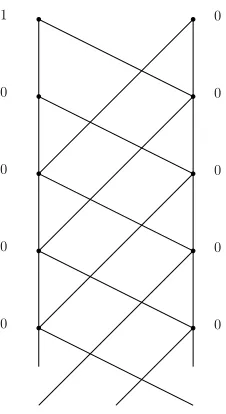
The 1-universal model is also called Rieger-Nishimura ladder, which is depicted in Figure 1.
LetU pper(M)denote the submodelM{w∈W|d(w)<ω}generated by all the points with finite depth. It is known that then-universal model is isomorphic to the finite part of then-Henkin modelU pper(H(n)). N. Bezhanishvili gave in [1] an algebraic proof of this fact. In the final section, we prove it directly on the basis of two important lemmas that we already need in the next section on the first Jankov theorem. These two lemmas respectively state that every finite model can be mapped p-morphically onto a generated submodel ofU(n)(Lemma 2.2), and thatU(n)wis isomorphic to the submodel ofH(n)generated by the theory of the de Jongh formula ofw(Lemma 2.9, see Definition 2.4).
Theorem 2.2. For any finite rooted Kripken-modelM, there exists a unique pointw
1
0
0
0
0
0
0
0
0
[image:4.612.250.363.70.277.2]0
Figure 1: Rieger-Nishimura ladder
For a proof of Theorem 2.2, see e.g. [8]. It implies immediately, by the finite model property of IPC, thatU(n)is a counter-model to every formula that is a non-theorem of IPC. This shows thatU(n)deserves being called a “universal model”.
Theorem 2.3.
1. For anyn-formulaϕ,U(n)|=ϕiff ⊢IPCϕ.
2. For anyn-formulasϕ, ψ, for allw∈ U(n)(w|=ϕ⇒w|=ψ)iffϕ⊢IPCψ.
Proof. (1)⇐: trivial.⇒: Suppose0IPCϕ. Then there exists a finiten-modelMand a pointw∈Msuch thatM, w6|=ϕ. By Theorem 2.2, there exists a p-morphismf of
MtoU(n). Hence,U(n), f(w)6|=ϕ. (2) follows easily from (1).
For any nodewin ann-modelM, if{w1, ..., wm}is the set of all immediate suc-cessors ofw, then we let
prop(w):={pi|w|=pi,1≤i≤n},
notprop(w):={qi,|w6|=qi,1≤i≤n},
newprop(w):={rj,|w6|=rjandwi|=rjfor each 1≤i≤m,for 1≤j≤n}1. Herenewprop(w)denotes the set of atoms which are about to be true inw, i.e. they are true in all ofw’s proper successors. Next, we define the formulasϕwandψw, which were first introduced in [4], and which were extensively discussed and named de Jongh formulas in [1].
Definition 2.4. Letwbe a point inU(n). We inductively define its de Jongh formulas
ϕwandψw.
Ifd(w) =1, then let
ϕw:=
^
prop(w)∧^{¬pk|pk∈notprop(w), 1≤k≤n},
ψw:=¬ϕw.
Ifd(w)>1, and{w1, ..., wm}is the set of all immediate successors ofw, then define
ϕw:=
^
prop(w)∧(_newprop(w)∨
m
_
i=1
ψwi→
m
_
i=1
ϕwi),
ψw:=ϕw→ m
_
i=1
ϕwi.
The most important properties of the de Jongh formulas are revealed in the next theorem. It was first proved in [4].
Theorem 2.5. For everyw∈ U(n) =hU(n), R, Vi, we have that
• V(ϕw) =R(w),
whereR(w) ={u∈ U(n)|wRu};
• V(ψw) =U(n)\R−1(w),
whereR−1(w) ={u∈ U(n)|uRw}.
An easy lemma that is needed in the proof of Jankov’s theorem in the next section is the following.
Lemma 2.6. Ifu, v∈ U(n)andvRu, then⊢IPCϕu→ϕv.
Proof. Immediate from Theorem 2.5 and Theorem 2.3.
Definition 2.7. We write
• Cn(ϕ) ={ψ| ⊢IPCϕ→ψ}.
We writeCnn(ϕ) ={n-formulaψ| ⊢IPCϕ→ψ}, but may leave thenout if it is clear from the context.
• T h(M, w) ={ϕ|M, w|=ϕ}.
We writeT h(w) ={ϕ|w|=ϕ}ifMis clear from the context, andT hn(M, w) for the restriction ofT h(M, w)to the set ofn-formulas. Again, we may delete then.
Corollary 2.8. For any pointwinU(n),T h(w) =Cnn(ϕw).
The next lemma expresses the essence of the fact that the upper part of then-Henkin model is isomorphic to then-universal model. We will pursue this in the last section. For the time being the lemma will come in very useful in the proof of the first Jankov Theorem, the main theorem of the next section.
Lemma 2.9. For anyw∈ U(n), letϕw be a de Jongh formula. Then we have that
H(n)Cn(ϕw)∼=U(n)w.
Proof. LetU(n) =hU(n), R, ViandH(n) =hH(n), R′, V′i. Define a mapf:U(n) w→
H(n)Cn(ϕw)by taking
f(v) =Cn(ϕv).
We show thatf is an isomorphism.
First for anyv∈U(n), by Corollary 2.8, we have thatv∈V(p)iffCn(ϕv)∈V′(p) and that
uRv⇐⇒ U(n), v|=ϕu(by Theorem 2.5)
⇐⇒ϕu∈Cn(ϕv)(by Corollary 2.8)
⇐⇒Cn(ϕu)⊆Cn(ϕv)
⇐⇒f(u)R′f(v).
This makesfinto a homomorphism.
Now, suppose u6=v; w.l.o.g. we may assume that ¬uRv, which by Theorem 2.5 means thatU(n), u6|=ϕv. Thus,ϕv6∈Cn(ϕu)by Corollary 2.8, and sof(u) =
Cn(ϕu)6=Cn(ϕv) =f(v). Hence,f is injective.
It remains to show thatfis surjective. That is, to show that for anyΓ∈ H(n)Cn(ϕu)
(i.e. anyn-theoryΓ⊇Cnn(ϕu)with the disjunction property) there existsvwithuRv such thatΓ=Cn(ϕv). We prove this by induction on the depth ofu.
d(u) =1. It suffices to show that ifCn(ϕu)⊆Γ, thenΓ=Cn(ϕu). This is clear from the fact thatθ∈Cn(ϕu)iff ⊢IPCϕu →θ iff (by Corollary 2.8), because this shows thatCn(ϕu)is maximal consistent.
d(u) =k+1. Let{u1, ..., um}be the set of all immediate successors ofu. Suppose
Cn(ϕu)⊆Γ. IfCn(ϕui)⊆Γ for some 1≤i≤m, then by induction hypothesis,
Γ=Cn(ϕv)for somev∈R(ui), i.e.v∈R(u). So, we can assumeCn(ϕui)*Γfor
all 1≤i≤m. ThusΓ0ϕui for each 1≤i≤m. Take anyθ∈Γ. We then have also
θ∧ϕu∈Γ. So,
θ∧ϕu0ϕu1∨ · · · ∨ϕum.
SinceU(n)is universal, there exists au′∈U(n)such that
U(n), u′|=θ∧ϕuandU(n), u′6|=ϕu1∨ · · · ∨ϕum.
By Theorem 2.5,u′=u, which implies thatU(n), u|=θ. By Corollary 2.8,θ∈
Cn(ϕu). ThereforeΓ=Cn(ϕu).
We end this section by a corollary which follows from the correspondence between
Corollary 2.10. LetMbe any model andwbe a point inU(n) =hW, R, Vi. For any pointxinM, ifM, x|=ϕw, then there exists a unique pointvsatisfying
M, x|=ϕv, M, x6|=ϕv1,· · ·,M, x6|=ϕvm,
wherev≺ {v1,· · ·, vm}, andwRv.
Proof. Note thatT hn(M, x)is a node inH(n) =hW′, R′, V′i.M, x|=ϕwimplies that
T hn(M, x)⊢IPCϕwandCnn(ϕw)R′T hn(M, x). Thus, by Lemma 2.9,T hn(M, x) =
Cnn(ϕv)for a unique pointv∈W. Moreover we havewRv. SoM, x|=ϕv. By Theorem 2.5, we have thatU(n)6|=ϕv→ϕvi for all 1≤i≤m. Thus0IPC
ϕv→ϕviandϕvi6∈Cnn(ϕv) =T hn(M, x), soM, x6|=ϕvi.
3
Jankov’s Theorem for extensions of IPC
The original theorem was proved by Jankov in [6] with respect to algebraically inspired formulas. De Jongh proved in [4] the same theorem with regard to the de Jongh formu-las defined above. Here we transform the latter proof, which made an algebraic detour, into a purely frame-theoretic one. We have set the stage in the previous section in such a manner that the analogies between the proof of the Jankov theorem and the proof of our central Lemma 4.7 for the Jankov Theorem on KC (Theorem 4.9) in the next section will come out as clearly as possible.
One of the things we will need in the proof of Jankov’s theorem is that under certain conditions a Kripke frame p-morphism from a descriptive frame to a finite descriptive frame is almost automatically also a descriptive frame p-morphism. The next lemma states the necessary conditions.
Lemma 3.1. LetF=hW, R,PiandG=hW′, R′,P′ibe two descriptive frames with
W′ finite. Let f be a (Kripke frame) p-morphism from the Kripke frame hW, Ri to the Kripke framehW′, R′isuch thatf−1(R(w))is an admissible set for anyw∈W′. Thenf is also a (descriptive frame) p-morphism from the descriptive frameFto the descriptive frameG.
Proof. It suffices to show that for anyX ∈ P′, f−1(X)∈ P. Observing thatX =
S
w∈X
R(w), we obtain that
f−1(X) =f−1( [
w∈X
R(w)) = [
w∈X
f−1(R(w)),
which impliesf−1(X)∈ Psincef−1(X)is a finite union of admissible sets.
The following useful lemma was introduced (as Theorem 3.2.16) and discussed in [1]. It says that any finite rooted frame can be isomorphically found as a generated submodel ofU(n)if only we takenlarge enough.
Lemma 3.2. For any finite rooted frameF=hW′, R′i, there exists a modelM=hF, Vi
Proof. We introduce a propositional variablepw for every pointwinW, and define a valuationV by lettingV(pw) =R(w). Putn=|W|. By Theorem 2.2, there exists a p-morphismf from the modelM=hF, Vionto a generated submodelU(n)w. By the construction, we know that different points ofMhave different colors, thusf is injective, i.e.Mis isomorphic toU(n)w.
Note that the underlying Kripke frame ofU(n)w=hW, R, Videscribed in the pre-vious lemma can be viewed as the general framehW, R, U p(W)i, which is a descriptive frame sinceW is finite.
Theorem 3.3 (Jankov). For every finite rooted frameF, letψwbe the de Jongh formula
ofwin the modelU(n)wdescribed in Lemma 3.2. Then for every descriptive frameG,
G6|=ψwiffFis a p-morphic image of a generated subframe ofG.
Proof. The direction from right to left is obvious, sinceF6|=ψwfollows immediately from Theorem 2.5.
For the other direction, supposeG6|=ψw. Then there exists a modelNonGsuch that
N6|=ϕw→ϕw1∨ · · · ∨ϕwm, (1)
wherew≺ {w1,· · ·, wm}. Consider the generated submodelN′=NV′(ϕw)=hW
′, R′,P′, V′i
ofN. Note that sinceV′(ϕw)is admissible,hW′, R′,P′iis a descriptive frame. Define a mapf :W′→W by takingf(x) =viff
N′, x|=ϕv,N′, x6|=ϕv1,· · ·,N
′, x6|=ϕ
vk, (2)
wherev≺ {v1,· · ·, vk}.
Note that for every x∈W′, N′, x|=ϕ
w, thus by Corollary 2.10, there exists a uniquev∈R(w)satisfying (2). Sofis well-defined.
We show thatfis a surjective (descriptive frame) p-morphism ofhW′, R′,P′ionto
hW, R,Pi. Supposex, y∈W′withxR′y,f(x) =vandf(y) =u. SinceN′, x|=ϕ v, we have thatN′, y|=ϕv. By Corollary 2.10, there exists a unique pointu′∈W such thatu′ andy satisfy (2), moreover,vRu′. So, sinceuandy also satisfy (2), by the uniqueness,u′=uandvRu.
Next, supposex∈W′andv, u∈W such thatf(x) =vandvRu. We now show that there existsy∈W′withxR′ysuch that
N′, y|=ϕu,N′, y6|=ϕu1,· · ·,N
′, y6|=ϕ
ul (3)
whereu≺ {u1,· · ·, ul}. This will give us the requiredf(y) =u. We will prove this directly ifuis an immediate successor ofv, i.e. one of thevi. Foruin general it follows then by tracing a chain fromvtou.
Sincexandvsatisfy (2), andϕvimplies by its definition that
m
_
i=1
ψvi→
k
_
i=1
ϕvi, (4)
we must have that
becauseuis one of thevi. From (5) the existence ofywithxR′ysatisfying (3) imme-diately follows. Hence, we have shown thatfis a (Kripke frame) p-morphism.
To show thatf is surjective it is sufficient to note that, by (1), there existsx∈W′
such that (2) holds forxandw, i.e.f(x) =w. Then, for every nodev∈W, we have thatwRv. Sincef is a (Kripke frame) p-morphism, there existsy∈R′(x)⊆W′such thatf(y) =v.
It remains to show that f is a (descriptive frame) p-morphism between the two descriptive frames. In view of Lemma 3.1, it is sufficient to show that for anyv∈X,
f−1(R(v)) =V′(ϕ
v)which is an admissible set.
Indeed, for everyx∈f−1(R(v)), there existsu∈R(v)such thatf(x) =uand so
N′, x|=ϕu. Applying Lemma 2.6 givesN′, x|=ϕv, and sox∈V′(ϕv). On the other hand, for everyx∈V′(ϕ
v), by Corollary 2.10, there exists a uniqueu∈R(v)such that
f(x) =u, thusx∈f−1(R(v)).
Hencefis a surjective (descriptive frame) p-morphism ofhW′, R′,P′iontohW, R,Pi. Then sinceF∼=hW, R,Pi,Fis a p-morphic image ofhW′, R′,P′i, which is a generated subframe ofG.
We conclude this section with a useful theorem of [4], [5]. We will not apply it directly in this paper, but we will use an adapted form of it in the special case of the next section.
Theorem 3.4. IfL is an intermediate logic strictly extending IPC, i.e. IPC⊂L⊆
CPC, then there existsn∈ωandwinU(n)such thatL⊢ψw.
Proof. Supposeχis a formula satisfying
L⊢χand IPC0χ.
Then there exists a finite rooted frameFsuch thatF6|=χ. By Lemma 3.2, there exists a modelhF, VionFsuch thathF, Vi ∼=U(n)wfor some generated submodelU(n)w ofU(n). Consider the de Jongh formulaψw. SupposeL0ψw. Then there exists a descriptive frameGofLsuch thatG6|=ψw. By Theorem 3.3,Fis a p-morphic image of a generated subframe ofG. Thus,Fis anLframe. SinceL⊢χ, we have thatF|=χ, which gives us a contradiction.
4
Jankov’s Theorem for KC
Jankov’s logic KC (also called the logic of weak decidability) is the intermediate logic axiomatized by¬ϕ∨ ¬¬ϕ. KC is complete with respect to finite rooted frames with unique top points. From that fact it is not difficult to show that KC proves exactly the same negation-free formulas as IPC. That is, for any negation-free formulaϕ, KC⊢ϕ
We start with defining formulasϕ′wandψ′w, which are negation-free modifications of de Jongh formulas. They function on KC-frames as de Jongh formulas do on all frames. First, we introduce some terminology.
For any finite setX of formulas with|X|>1, let
∆X=^
{ϕ↔ψ|ϕ, ψ∈X}.
For the case that|X|=1 or 0, we stipulate∆X=⊤.
LetU(n)w0=hW, R, Vibe a generated submodel with a largest elementtofU(n)
such that
• t|=p1∧ · · · ∧pn;
• col(w)6=col(v)for allw, v∈W such thatw6=v.
Letrbe a new propositional variable (to be identified withpn+1so that we can talk aboutp1, . . . , pn, r-models asn+1-models).
Definition 4.1. We inductively define the formulasϕ′
wandψw′ for everyw∈W.
Ifd(w) =1,
ϕ′w=p1∧ · · · ∧pn,
ψ′w=ϕ′w→r.
Ifd(w) =2, letqbe an arbitrary propositional letter innotprop(w). Define
ϕ′w=^
prop(w)∧∆notprop(w)∧((q→r)→q)2,
ψ′w=ϕ′w→q.
Ifd(w)>2 andw≺ {w1,· · ·, wm}, then let
ϕ′w:=
^
prop(w)∧(_newprop(w)∨
m
_
i=1
ψw′i→
m
_
i=1
ϕ′wi),
ψ′w:=ϕ′w→
m
_
i=1
ϕ′wi.
We will prove for theϕ′
wandψw′ formulas a lemma (Lemma 4.7) which is anal-ogous to Theorem 3.3 for theϕw andψw formulas. It is good to note already that theϕ′
wandψ′wformulas cannot be evaluated inU(n), since there is one propositional variable to many in them. Nevertheless, we will be able to follow the general line of the argument in the previous section.
It is worth remarking that, ford(w) =2,ψ′
wis a generalized form of Peirce’s Law (((q→r)→q)→q).
Lemma 4.2. ϕ′w[r/⊥]3andψw′ [r/⊥]are IPC-equivalent toϕwandψw, respectively.
2Note that in the definition, it does not matter which q∈notprop(w)is chosen. Note also that
notprop(w) =newprop(w).
Proof. We prove this by induction ond(w).
d(w) =1. Trivial.
d(w) =2.ϕ′w[r/⊥] =
V
prop(w)∧∆notprop(w)∧((q→ ⊥)→q). First note that(q→ ⊥)→q)is equivalent to¬¬q. On the other hand,
⊢ϕw↔
^
prop(w)∧(_
notprop(w)∨ ¬(p1∧ · · · ∧pn)→p1∧ · · · ∧pn)
⊢ϕw↔
^
prop(w)∧(_notprop(w)→p1∧ · · · ∧pn)∧(¬(p1∧ · · · ∧pn)→p1∧ · · · ∧pn)
Under the assumptionV
prop(w),W
notprop(w)→p1∧ · · · ∧pn is equivalent to ∆notprop(w). Furthermore,¬(p1∧ · · · ∧pn)→p1∧ · · · ∧pnis equivalent to¬¬(p1∧
· · · ∧pn)and hence to to¬¬p1∧ · · · ∧ ¬¬pn. This, in its turn is under the assumptions
Vprop(w)and∆notprop(w)equivalent to¬¬q. So, indeed,⊢ϕ
w↔ϕ′w[r/⊥]and
⊢ψw′ [r/⊥]↔(ϕ′w[r/⊥]→q)
⊢ψw′ [r/⊥]↔(ϕw′ [r/⊥]→p1∧ · · · ∧pn)
⊢ψw′ [r/⊥]↔(ϕw→p1∧ · · · ∧pn)
⊢ψw′ [r/⊥]↔(ϕw→ϕt)
⊢ψw′ [r/⊥]↔ψw.
d(w)>2. This is proved easily by applying the induction hypothesis.
Obviously, we could have definedϕ′wandψ′win such a way that this lemma would have been a complete triviality, but we preferred giving a more intuitive definition.
We will use the following corollary later in the proof of Theorem 4.9.
Corollary 4.3. For any generated submodelU(n)w0 ofU(n)as described above, any
pointwinU(n)w0,6⊢IPCψ
′ w.
Proof. By Theorem 2.5,U(n)w06|=ψw, thus, by the Lemma 4.2, the underlying frame
ofU(n)w0 falsifiesψ
′
w. Hence6⊢IPCψw′ .
The next lemma shows that theϕ′
wformulas have the same property that using The-orem 2.3 was easy to prove for theϕwformulas in Lemma 2.6. Note however that this theorem is not applicable to theϕ′wformulas. Here we prove the corresponding theo-rem directly from the construction of theϕ′wandψ′wformulas by a method that could have been applied to theϕwformulas, but would have been unnecessarily complicated in that case.
Lemma 4.4. LetU(n)w0 =hW, R, Vibe a model as described above and letw, vbe
two nodes inW withwRv. Then we have that⊢IPCϕ′v→ϕ′w.
Proof. We prove the lemma by induction ond(v). Ifd(v) =1, thenϕ′
v=p1∧· · ·∧pn. SincewRv, we have thatprop(w)⊆ {p1,· · ·, pn} and
⊢ϕ′v→^
prop(w). (6)
We show that⊢ϕ′
d(w) =d(v) +1=2. Then for anyp, q∈notprop(w)⊆ {p1,· · ·, pn}we have that
⊢p1∧ · · · ∧pn→(p↔q)and ⊢p1∧ · · · ∧pn→((q→r)→q).
It follows that
⊢ϕ′v→∆notprop(w)and ⊢ϕ′v→((q→r)→q).
Together with (6), we obtain
⊢ϕ′v→
^
prop(w)∧∆notprop(w)∧((q→r)→q)
i.e.⊢ϕ′v→ϕ′w.
d(w)>2. Let w≺ {w1,· · ·, wk}. Tthen for any immediate successor wi ofw, sinced(wi)< d(w)by induction hypothesis, we have that⊢ϕ′v→ϕ′wi, which implies
that⊢ϕ′ v→
k
W
i=1
ϕ′
wiand that
⊢ϕ′v→(_
newprop(w)∨
k
_
i=1
ψ′wi→
k
_
i=1
ϕ′wi). (7)
Together with (6), we obtain
⊢ϕ′v→
^
prop(w)∧(_newprop(w)∨
k
_
i=1
ψw′i→
k
_
i=1
ϕ′wi) (8)
i.e.⊢ϕ′ v→ϕ′w.
Ifd(v) =2, then sinceprop(w)⊆prop(v), clearly (6) holds. We show⊢ϕ′v→ϕ′w by induction ond(w).
d(w) =d(v) +1. Thenv=wi andϕ′v=ϕ′wi for some immediate successorwi
ofw, hence⊢ϕ′ v→
k
W
i=1
ϕ′
wi and (7) follows. Together with (6), we obtain (8) i.e.
⊢ϕ′v→ϕ′w.
d(w)> d(v) +1. For any immediate successorwi ofw, sinced(wi)< d(w), by
the induction hypothesis, we have that⊢ϕ′ v→
k
W
i=1
ϕ′
wi, which implies (7). Together
with (6), we obtain (8) i.e.⊢ϕ′ v→ϕ′w.
Ifd(v)>2, then clearlyprop(w)⊆prop(v)gives (6). By a similar argument as above, we can show that (7) holds, thus, (8) i.e.⊢ϕ′
v→ϕ′wis obtained.
Next, we want to prove for theϕ′
wformulas an analogue to Corollary 2.10. But we will have to do this in two steps. First, we show thatϕ′
wnodes have the right color.
Lemma 4.5. LetM=hW′, R′, V′ibe anyn+1-model andU(n)
w0 =hW, R, Vibe
a model as described above. PutVn=V′↾{p1,· · ·, pn}. For any pointwinU(n)w0
and any pointxinM, if
M, x|=ϕ′w, M, x6|=ϕ′w1,· · ·,M, x6|=ϕ
′
wm, (9)
Proof. We prove the lemma by induction ond(w). In the following discussion we re-strict attention ton-formulas andn-atoms all the time.
d(w) =1, i.e.w=t. Then (9) means thatM, x|=p1∧ · · · ∧pn. Also,U(n)w0, t|=
p1∧ · · · ∧pn. SocolVn(x) =colV(w).
d(w) =2. Then (9) implies that
M, x|=^
prop(w). (10)
This means that all atoms true inware true inx. From (9) we also have that
M, x|=∆notprop(w). (11) So, either all atoms false inware false inx, or all are true inx. But, in this case, in (9)m=1 andw1=t, so
M, x6|=p1∧ · · · ∧pn. (12) This implies that all atoms false inware false inx:colVn(x) =colV(w).
d(w)>2. This is the induction step. Again we have as in the previous case that all atoms true inware true inx. Now (9)
M, x6|=ψw′i, (13)
for all immediate successorwiofw, i.e. for each immediate successorwi ofw, there existsyi∈R′(x)such thatyiandwisatisfy (9). Sinced(wi)< d(w), by the induction hypothesis, we have thatcolVn(yi) =colV(wi). So, all atoms false in at least one of
thewiare false inx. On the other hand, (9) also implies
M, x6|=_newprop(w), (14) So, all atoms true in allwibut not inware also false inx. We havecolVn(x) =
colV(w).
This is the point where it becomes clear why at the start of this section we insisted on all the nodes ofU(n)w0 to have distinct colors. With this assumption the required
analogue of (Corollary 2.10) now readily follows.
Lemma 4.6. Let M and U(n)w0 be models described above. For any nodew in
U(n)w0 and any node xinM, ifM, x|=ϕ
′
w, then there exists a unique pointv∈
U(n)w0satisfying
M, x|=ϕ′v, M, x6|=ϕv′1,· · ·,M, x6|=ϕ′vm, (15)
Proof. SupposeM, x|=ϕ′w. We show that there existsv∈R(w)satisfying (15) by induction ond(w).
d(w) =1. Then triviallyv=wsatisfies (15).
d(w)>1. If for all immediate successorwi ofw,M, x6|=ϕ′wi, thenwsatisfies
(15). Now suppose that for some immediate successorwi0 ofw,M, x|=ϕ
′ wi
0. Since
M, x|=ϕ′ wi
0 andd(wi0)< d(w), by the induction hypothesis, there existsv∈W, such
thatwi0Rvandvsatisfies (15). And clearly,wRv.
Next, supposev′∈ U(n)
w0 also satisfies (15). By Lemma 4.5,
colV(v′) =colVn(x) =colV(v),
which by the property ofU(n)w0 means thatv
′=v.
LetFbe a finite rooted frame with a largest elementx0. By Lemma 3.2, there exists a modelhF, VionFsuch thathF, Vi ∼=U(n)wfor some generated submodelU(n)w ofU(n). Note thatU(n)w has a top pointt,t|=p1∧ · · · ∧pn, and distinct points of
U(n)whave distinct colors.
The next lemma is a modification of the Jankov-de Jongh Theorem (Theorem 3.3) proved in the previous section. Both the statement of the lemma and its proof are generalized from those of Theorem 3.3.
Lemma 4.7. For every finite rooted frameFwith a largest element, letU(n)wbe the
model described above. Then for every descriptive frameG,
G6|=ψ′
wiffFis a p-morphic image of a generated subframe ofG.
Proof. ⇐: LetU(n)w=hW, R,P, Vi. SupposeFis a p-morphic image of a generated subframe ofG. By Theorem 2.5,U(n)w6|=ψw, thus F6|=ψw. By Lemma 4.2, we know in that case thatF6|=ψw′ . ThenG6|=ψ′wfollows immediately.
⇒: SupposeG6|=ψ′
w. Then there exists a modelNonGsuch thatN6|=ψw′ . Con-sider the generated submodelN′=NV′(ϕ′w)=hW′, R′,P′, V′iofN. SinceV′(ϕ′w)is
admissible,N′is descriptive. Define a mapf :W′→W by takingf(x) =viff
N′, x|=ϕ′v,N′, x6|=ϕv′1,· · ·,N′, x6|=ϕ′vk, (16)
wherev≺ {v1,· · ·, vk}.
Note that for everyx∈N′,N′, x|=ϕ′w, thus by Lemma 4.6, there exists a unique
v∈R(w)satisfying (16). Sofis well-defined.
We show thatfis a surjective (descriptive frame) p-morphism ofhW′, R′,P′ionto
hW, R,Pi. Supposex, y∈N′withxR′y,f(x) =vandf(y) =u. SinceN′, x|=ϕ′v, we have thatN′, y|=ϕ′v. By Lemma 4.6, there exists a unique pointu′∈W such thatu′andy satisfy (16), moreovervRu′. So, sinceuandyalso satisfy (16), by the uniqueness,u′=uandvRu.
Next, supposex∈N′ andv, u∈W such thatf(x) =vandvRu. We show that there existsy∈N′such thatf(y) =uandxR′y.
The only interesting case to consider isd(v) =2 andu6=v. In this case u=t. Sincef(x) =v,vandxsatisfy (16), so
Note that
⊢IPC((q→r)→q)→ ¬¬q.
Thus,N′, x|=¬¬q, which means that there existsy∈W′such thatxR′yandN′, y|=q. Since
N′, y|=^prop(v)∧∆notprop(v),
we have thatN′, y|=p1∧ · · ·pn, i.e.f(y) =u.
The surjectivity off follows in the same way as in the proof of theorem 3.3. By applying Lemma 4.4, Lemma 4.6 and using the same argument as that in the proof of Theorem 3.3, we can show that for everyv∈X,f−1(R(v)) =V′(ϕ′
v), which is an admissible set. Therefore by Lemma 3.1, we obtainf−1(X)∈ P′.
Hence,fis a surjective (descriptive frame) p-morphism ofhW′, R′,P′iontohW, R,Pi. Then sinceF∼=hW, R,Pi,Fis a p-morphic image ofhW′, R′,P′i, which is a generated subframe ofG.
Remark 4.8. We have enough information to discuss the behavior of theϕ′
wi in the
n+1-Henkin model. Assumex|=randx|=ϕ′
wfor some pointwofU(n)withd(w)≥ 2 and some pointxof then+1-Henkin model. We will show that in that casex|=ϕ′
t. If that is not the case, then there exists ausuch thatx|=ϕ′
u with least depth≥2, i.e.x6|=ϕ′
ui for all immediate successorui ofu. This means thatf(x) =u. By the
surjectivity of the functionf constructed in the proof of Lemma 4.7, we know that there exists a pointv∈R(w)such thatd(v) =2 and ay∈R′(x)such thatf(y) =v. From this it follows thaty6|=ψv′. On the other hand, fromy|=r, it is easy to see thaty6|=ψv′, which is a contradiction. We have to conclude tox|=ϕ′t.
Of course,rcan be false as well ifϕ′tis true, and in the end it comes down to the following. The nodeϕ′win then+1-Henkin model generates a submodel consisting of an isomorphic copy of U(n)w (here r is false) with above its top a copy of the Rieger-Nishimura ladder for r withp1,· · ·, pn true everywhere. This also gives an indication how the p-morphism of the proof of Lemma 4.7 works in the case of the
n+1-Henkin model for the submodel generated byϕ′
w. On the bottom part it works as an isomorphism, the top part, i.e. the Rieger-Nishimura ladder is mapped onto a single point.
Now we are ready to prove Jankov’s theorem on KC.
Theorem 4.9 (Jankov). IfLis an intermediate logic such thatL*KC, thenL⊢θ
and IPC0θfor some negation-free formulaθ.
Proof. We follow the idea of the proof of Theorem 3.4. Supposeχis a formula satis-fying
L⊢χand KC0χ.
Then there exists a finite rooted KC-frameFwith a largest element such thatF6|=χ. By Lemma 3.2, there exists a modelhF, VionFsuch thathF, Vi ∼=U(n)wfor some generated submodelU(n)w ofU(n). Note thatU(n)w has a largest element t,t|=
p1∧ · · · ∧pnandcolV(v)6=colV(u)for allv, uinU(n)w.
Consider the formulaψ′w. SupposeL0ψw′ . Then there exists a descriptive frame
subframe ofG. Thus,Fis anL-frame. SinceL⊢χ, we have thatF|=χ, which leads to a contradiction.
Hence,L⊢ψ′w. We have that IPC0ψw′ by Corollary 4.3 andψ′wis negation-free, thusθ=ψ′wis the required formula.
5
Some properties of
U
(
n
)
and
H(
n
)
In this section we conclude in Theorem 5.1 the almost finished proof of section 2 that
U(n)is isomorphic to the upper part ofH(n). After that, we sharpen this result by giving a quick proof that these two models are even more “connected”: every infinite upset ofH(n)has an infinite intersection inU(n), or in other words, if an upsetX
generated by a point in then-Henkin model has a finite intersection with its upper part, then-universal model, thenXlies completely inU(n). Both results were proved before in [1].
Theorem 5.1. U pper(H(n))is isomorphic toU(n).
Proof. Let U(n) =hU(n), R, Vi. Define a function f :U(n)→U pper(H(n))by taking
f(w) =Cn(ϕw).
We show thatf is an isomorphism. From the proof of Lemma 2.9 we know that
U(n)w∼=U pper(H(n))f(w).
It then suffices to show thatf is a bijection.
Letw, vbe two distinct points ofU(n). W.l.o.g. we may assume that¬wRv, thus by Theorem 2.5,U(n), w|=ϕwbutU(n), v6|=ϕw. We know from the proof of Lemma 2.9 that
U(n)w∼=U pper(H(n))f(w)andU(n)v∼=U pper(H(n))f(v),
thusU pper(H(n))f(w)≇U pper(H(n))f(v), sof(w)6=f(v).
For any pointxinU pper(H(n)), by Theorem 2.2, there exists a uniquewxsuch thatU(n)wx is a p-morphic image ofU pper(H(n))x, which by Corollary 2.8 implies
that
T h(x) =T h(wx) =Cn(ϕwx),
thereforef(wx) =x.
We callw∈X a border point of an upsetX ofU(n), ifw6∈X and all successors
vofwwithv6=ware inX. Denote the set of all border points ofX byB(X). An upsetX is uniquely characterized by its set of border points. Note that all endpoints
U(n)which are not inXare inB(X). The concept of border point was developed in studied in [2].
Fact 5.2. IfXis finite, thenB(X)is also finite.
Proof. SinceXis finite, there existsk∈ωsuch thatX⊆U(n)k. Observe thatB(X)⊆
The next lemma shows the syntactic side of the connection of upsets and their border points.
Lemma 5.3. IfX ={v1,· · ·, vk} is a finite anti-chain in U(n) and B(U(n)X) =
{w1,· · ·, wm}, then⊢IPC(ϕv1∨ · · · ∨ϕvk)↔(ψw1∧ · · · ∧ψwm).
Proof. In view of Theorem 2.3, it is sufficient to show thatU(n)|= (ϕv1∨ · · · ∨ϕvk)↔
(ψw1∧ · · · ∧ψwm). By Theorem 2.5, it is then sufficient to show that
x∈R(v1)∪ · · · ∪R(vk)iffx6∈R−1(w1)∪ · · · ∪R−1(wm).
For⇒: Supposex∈R(v1)∪ · · · ∪R(vk) =U(n)X. If x∈R−1(wi) for some 1≤i≤m, then sinceU(n)X is upward closed, we have that wi ∈U(n)X, which contradicts the definition ofB(U(n)X).
For⇐: Supposex6∈R(v1)∪ · · · ∪R(vk) =U(n)X. We show by induction ond(x) thatx∈R−1(w
i)for some 1≤i≤m.
d(x) =1. Thenxis an endpoint which is a border point. Thus,x=wi for some 1≤i≤mand sox∈R−1(w
i).
d(x)>1. The result holds trivially ifxis a border point. Now suppose there exists
y∈R(x)such thaty6∈U(n)X. Sinced(y)< d(x), by the induction hypothesis, there exists 1≤i≤msuch thaty∈R−1(w
i). Thus,x∈R−1(wi).
Theorem 5.4. Let Γbe a point in H(n), i.e. Γis an n-theory with the disjunction
property. IfR(Γ)∩ U(n)is finite, thenR(Γ) =R(Γ)∩ U(n).
Proof. SupposeX=R(Γ)∩ U(n)is finite. Then the setB(X)of border points ofX
is finite. LetB(X) ={w1,· · ·, wm}. SupposeΓ0ψwi for some 1≤i≤m. Then
there exists a descriptive frameGsuch thatG|=ΓandG6|=ψwi. Since the underlying
frameF ofU(n)wi is finite rooted, by Theorem 3.3, the latter implies thatFis a
p-morphic image of a generated submodel ofG. Thus,F|=Γand soU(n)wi|=Γ, which
is impossible sincewi∈B(X)andwi6∈R(Γ)∩ U(n).
Hence, we conclude thatΓ⊢ψwi for all 1≤i≤m. LetY be the anti-chain
con-sisting of all least points ofX. Then by Lemma 5.3,Γ⊢ϕwfor somew∈Y, which by Theorem 2.5 means thatΓ∈R(w), soΓ∈ U(n), thereforeR(Γ) =R(Γ)∩ U(n).
References
[1] BEZHANISHVILI, N. Lattices of Intermediate and Cylindric Modal Logics. PhD thesis, University of Amsterdam, Netherlands, 2006.
[2] BEZHANISHVILI, N., AND DEJONGH, D. Projective formulas in two variables in intuitionistic propositional logic, manuscript, 2008.
[3] CHAGROV, A., AND ZAKHARYASCHEV, M. Modal Logic. Oxford University Press, 1997.
[5] DEJONGH, D. A characterization of the intuitionistic propositional calculus. In Intuitionism in Proof Theory, M. Kino, Ed. North-Holland, 1970, pp. 211–217.
[6] JANKOV, V. The relationship between deducibility in the intuitionistic proposi-tional calculus and finite implicaproposi-tional structures. Soviet Mathematics Doklady (1963).
[7] JANKOV, V. A. Ob ischislenii slabogo zakona iskluchennogo tret’jego. Izvestija AN. SSSR, ser. matem. 32, 5 (1968), 1044–1051.