The contribution of intangible resources to the post strategic
co-operation success of container lines:
Perspectives of senior managers in agencies and regional
offices
Liyanage Chaminda Indika Sigera
M.Sc (Sweden), B.Sc (Sri Lanka), Dip. Shipping (Norway), MICS (UK)
Submitted in fulfilment of the requirements for the Degree of
Doctor of Philosophy
Australian Maritime College
University of Tasmania (July, 2012)
DECLARATION OF ORIGINALITY
That the thesis contains no material which has been accepted for a degree or diploma by
the University of any other institution, except by way of background information and
duly acknowledged in the thesis, and to the best of the candidate‟s knowledge and belief
no material previously published or written by another person except where due
acknowledgement is made in the text of the thesis, nor does the thesis contain any
material that infringes copyright.
Signed
STATEMENT OF AUTHORITY OF ACCESS
This thesis may be made available for loan and limited copying in accordance with the
Copyright Act 1968.
Signed
STATEMENT OF ETHICAL CONDUCT
The research associated with this thesis abides by the international and Australian codes
on human and animal experimentation, the guidelines by the Australian Government's
Office of the Gene Technology Regulator and the rulings of the Safety, Ethics and
Institutional Bio-safety Committees of the University.
Signed
ABSTRACT
Container lines have been the main transport mode linking most markets engaged in
global trade. To cater for the growing customer demands, container lines have adopted
various approaches such as forming strategic co-operations to achieve rapid growth and
providing efficient services through the integration of resources. The spectrum of
strategic co-operations among container lines varies from loose-knitted slot charters,
liner conferences, shipping alliances, joint services and consortia, through to mergers
and acquisitions (M&As). However, these forms of strategic co-operations have not
always been able to achieve the intended synergetic growth resulting from the
integration of resources.
The Resource Based View (RBV) suggests that integrating intangible resources, which
are valuable, rare, inimitable and non-substitutable (VRIN), can make a significant
contribution to the performance of post strategic co-operations. The objective of this
thesis is to investigate the contribution of intangible resources to the post strategic
co-operation success of container lines. Therefore, the thesis focuses on the following
primary research question (PRQ):
PRQ: Does the integration of intangible resources contribute to the
post strategic co-operation success of container lines?
SRQ1: Which intangible resources provide the greatest contribution to the market success of container lines?
SRQ2: Do container lines adopt processes to ensure the successful integration of intangible resources when strategic co-operations are being developed?
The design used for this study is a two stage methodology enabling both quantative and
qualitative research approaches. The two stage approach helps to identify firstly the
senior managers‟ view of the importance of intangible resources and secondly how
intangible resources are integrated during strategic co-operations among container lines.
The sample consists of 84 senior managers (with a response rate of 51 per cent and thus
47 usable questionnaires) attached to regional offices of leading global container lines
and their agents in Colombo, the capital of Sri Lanka. The first stage was conducted via
an exploratory mail survey with the objective of investigating senior managers‟
understanding of intangible resources, importantly, the findings of stage one enabled
more probing questions to be developed and identified suitable respondents for the
second stage of the research. Due to the need for more qualitative responses, stage two
was conducted as in-person interviews, with a greater, focus on (i) the extent that
intangible resources were being integrated, (ii) the processes adopted to integrate
intangible resources, and (iii) the organisation and economic performance of container
lines during post-strategic co-operation. The in-depth in-person interviews achieved 100
per cent response rate with participation of 36 senior managers.
The findings of stage one, which addressed SRQ1, revealed that respondents attach a
and organisational processes and capabilities. These intangible resources provide major
benefits to container lines such as attracting customers and enabling internal functions
of container lines including the closely related functions of marketing the services of the
container lines.
During the stage two in-person interviews, differences were found in how intangible
resources were integrated among Limited integrated strategic co-operations (LISCs)
(shipping alliances, joint services and consortia) and acquisitions. In LISCs, due to their
loosely integrated structure and antitrust laws, sailing schedules have become the only
closely integrated intangible resource. Other intangible resources such as organisational
processes, capabilities and organisational culture are kept away from the strategic
co-operations to gain competitive edge for the individual container lines. The integration of
sailing schedules in LISCs has helped the container lines to increase the frequency of
services, enter into new trade routes by reducing cost.
In acquisitions, apart from sailingschedules intangible resources such as the capabilities
and organisational processes of the acquirer container line are adopted by the new
entity. The container lines adopted different processes such as organising staff meetings,
mixed project teams, joint training sessions, and appointing task teams to integrate these
intangible resources in acquisitions. However, colonising of the acquired container line
with intangible resources of the acquirer container line and neglecting the important
intangible resources of the acquired line has hindered the integration of acquired
container line staff to the new entity. Hence, high staff turnover among senior managers
management turnover, especially in the marketing functions has adversely affected the
intended synergetic growth of market share of these acquisitions.
Thus, the two stage study helped address both PRQ and SRQ2 by revealing that
intangible resources are important to the market success of container lines, and
container lines are advised to identify these intangible resources and adopt processes to
ACKNOWLEDGEMENTS
I have come to the end of my academic journey. It has been a long journey for me in a
dark tunnel and finally, it is very pleasing to see light at the end. During my journey
there were number of people who showed interest, care and support to persist while
facing many challenges of this journey. My thanks to all of you and I hope you will join
me in celebrating this moment. However, there are some people who deserve special
mention for their support in completing this study.
Dr. Stephen Cahoon, my supervisor and mentor, your insights, comments and
constructive criticism have helped me to think conceptually and laterally that need to
become a better researcher. Your encouragement and support have been immeasurable
for me to get to this point. Above all, the understanding, humanity and care you showed
me during down times of this journey enabled me to persist towards my goal. Thank
you Stephen, for that you have my deepest gratitude.
Dr. Jiangang Fei, as my co-supervisor, I am thankful to you for your valued advice and
guidance during this study.
Dr. Ben Brooks, your support especially during my upgrade from MPhil to PhD has
Dianne Hazelwood, your support and kind advice is much appreciated during this journey. Thank you Dianne.
Special thanks to Bron Fein, for prompt support going through the early drafts.
Many thanks to AusAID, for providing me with necessary financial assistance to pursue
my dream of PhD.
To all staff members of Department of Maritime & Logistics Management and the
research colleagues, thank you all for your kindness and assistance.
To my parents, Shyamalie and Kirthi Sigera, you have always been there for me
whenever I needed you most. Your unending love, support and constant encouragement
motivated me to choose this path to become an academic. You gave me strength to take
challenges and conquer the heights of knowledge. Thank you Mum and Dad, I am so
lucky to have you as my parents.
To my wife Subhashini and two children Anuda and Siluni, words cannot express my
love and appreciation for you. Anuda and Siluni, Thank you for understanding how
important this study was to me. I look forward to spend more time with you.
Subhashini, you were a great motivating force behind me, sharing all ups and downs of
this journey with great patience. Your rock solid nature could withstand the pressure we
had during this study. If not for your love and unending support this journey would not
have been possible. You are a special woman in my life whom I want to dedicate this
LIST OF ACRONYMS
ANZDL Australia New Zealand Direct Lines
APL American Presidents Line
CEO Chief executive officer
CKYH COSCO Line, K-LINE, Yangmin Line, Hyundai Line
CMA-CGM Compagnie Maritime d'Affrètement- Compagnie Générale Maritime
EC European Commission
EDI Electronic data interchange
EU European Union
GDP Gross domestic product
HR Human resources
IMF International Monitory Fund
IT Information technology
KMO Keiser Meyer Olkin (test)
LISC Limited integrated strategic co-operation
M&As Mergers and acquisitions
MOL
Mitsui OSK Lines
NOL Neptune Orient Lines NYK Nippon Yusen Kaisha Line
OECD The Organisation for Economic Cooperation and Development
OOCL Orient Overseas Container Line
PRQ Primary research question
RBV Resource based view
SRQ1 Subsidiary research question 1
SRQ2 Subsidiary research question 2
TAA The Trans-Atlantic Agreement
TEU Twenty foot Equivalent Unit
UNCTAD United Nations Conference on Trade and Development USA United State of America
VRIN Valuable rare inimitable and non-substitutable
VRS Voluntary redundancy scheme
WTO World Trade Organization
TABLE OF CONTENTS
DECLARATION OF ORIGINALITY...ii
STATEMENT OF AUTHORITY OF ACCESS... iii
STATEMENT OF ETHICAL CONDUCT………... iv
ABSTRACT... v
ACKNOWLEDGEMENTS ... ix
LIST OF ACRONYMS ... xi
Chapter 1:
Introduction ... 2
1.1 Introduction ... 2
1.2 Purpose of this research ... 5
1.3 Proposed contribution of the research ... 7
1.4 Overview of the thesis ... 7
Chapter 2:
Strategic co-operations among container lines ... 11
2.1 Introduction ... 11
2.2 Development of container services ... 11
2.3 Strategies of container lines to meet global demand ... 17
2.4 Strategic co-operations... 18
2.4.1 Types of strategic co-operations among container lines ... 19
2.4.1.1 Slot charters ... 20
2.4.1.2 Liner conferences ... 21
2.4.1.4 Pool agreements (joint services) ... 27
2.4.1.5 Consortia ... 29
2.4.1.6 Mergers and acquisitions ... 32
2.5 The changing container line industry due to strategic co-operations ... 36
2.6 Factors that affect the performance of strategic co-operation ... 39
2.7 Summary ... 43
Chapter 3:
Integrating intangible resources in strategic
co-operations ... 45
3.1 Introduction ... 45
3.2 Development of the Resource Based View ... 45
3.2.1 Resources in an organisation context ... 48
3.3 Tangible resources ... 48
3.3.1 Tangible resources in container lines ... 50
3.4 Intangible resources ... 52
3.4.1 Intangible resources that are assets ... 55
3.4.1.1 Intellectual property resources ... 55
3.4.1.2 Organisational resources ... 56
3.4.1.3 Reputational resources ... 57
3.4.2 Capabilities ... 58
3.4.3 Intangible resources in container lines ... 61
3.5 Rationale for strategic co-operation formation and resources ... 69
3.6 Processes of integration of intangible resources ... 71
3.7 Performance of post strategic co-operations performance ... 76
3.8 Summary ... 79
Chapter 4:
Research methodology ... 82
4.2 Research design ... 82
4.2.1 Methods for data gathering ... 84
4.2.2 Secondary data ... 86
4.3 Stage one: Mail survey... 87
4.3.1 Population design ... 87
4.3.2 Selection of respondents ... 90
4.3.3 Development of mail survey questionnaire ... 91
4.3.3.1 Question type and measurement scale ... 93
4.3.3.2 Layout of the mail survey questionnaire ... 95
4.3.4 Pre-testing of mail survey questionnaire ... 96
4.4 Process of administering mail survey ... 98
4.4.1 Design of cover letter ... 99
4.4.2 Administering the mail survey ... 100
4.5 Stage two: In-person interview ... 101
4.5.1 Population and sample design ... 101
4.5.2 Selection of respondents ... 103
4.5.3 Development of in-person interview questionnaire ... 103
4.5.3.1 Question type and measurement scale ... 106
4.5.3.2 Layout of the in-person interview questionnaires ... 108
4.5.4 Pre-testing ... 110
4.5.4.1 The polishing pre-test ... 111
4.5.5 The Process of administering in-person interviews ... 111
4.5.5.1 Design of advance letter for in-person interview ... 112
4.5.5.2 Process of conducting interviews ... 113
4.6 Error control process ... 116
Chapter 5:
Resources in container lines... 121
5.1 Introduction ... 121
5.2 General characteristics of respondents... 121
5.3 Respondents‟ profiles... 122
5.3.1 Work experience ... 123
5.3.2 Educational and professional background ... 123
5.4 Profile of the firms ... 124
5.4.1 Number of employees ... 125
5.4.2 Market performance ... 126
5.4.2.1 Increase in market share ... 126
5.5 Relative contribution of resources ... 127
5.5.1 Reliability of the survey questionnaire ... 127
5.5.2 Intangible resources ... 130
5.5.2.1 Reputational resources ... 130
5.5.2.2 Organisational resources ... 131
5.5.2.3 Organisational culture ... 132
5.5.3 Capabilities ... 133
5.5.4 Application of factor analysis ... 135
5.5.5 Findings of the factor analysis ... 138
5.5.5.1 Intellectual property resources ... 141
5.6 Differences in perceptions between demographic groups ... 142
5.6.1 Work experiences ... 142
5.7 Tangible resources ... 144
5.7.1 The demographic variations in tangible resources ... 145
5.8 The overall comparison... 146
5.10 Summary ... 150
Chapter 6:
Integration of intangible resources ... 152
6.1 Introduction ... 152
6.2 Interview response rate ... 153
6.3 Profile of the respondents ... 154
6.4 Limited integrated strategic co-operations ... 156
6.4.1 Main features of limited integrated strategic co-operations ... 156
6.5 Motives for forming LISCs ... 156
6.6 Integration of intangible resources in LISCs ... 158
6.7 The processes adopted to identify intangible resources ... 165
6.8 Processes used to integrate intangible resources ... 166
6.8.1 Staff meetings ... 166
6.8.2 Task teams ... 167
6.8.3 Mixed project teams and joint training sessions ... 169
6.9 The post strategic co-operation performance ... 169
6.9.1 Organisational performance ... 169
6.9.2 Economic performance ... 170
6.10 Main features and motives of acquisitions ... 172
6.10.1 Motives for forming acquisitions ... 173
6.11 Integration of intangible resources in acquisitions ... 174
6.12 Processes of integrating of intangible resources in acquisitions ... 178
6.12.1 Processes adopted to identify intangible resources in acquisitions .. 179
6.13 Processes used to integrate intangible resources in acquisitions ... 182
6.13.1 Staff meetings ... 182
6.13.2 Task team to facilitate the integration ... 184
6.13.4 Mixed project teams ... 186
6.14 The post strategic co-operation performance acquisitions ... 187
6.14.1 Organisational performance of acquisitions ... 187
6.14.2 Economic performance of acquisitions ... 192
6.15 Summary ... 194
Chapter 7:
Summary and conclusions ... 197
7.1 Introduction ... 197
7.2 Purpose of the research ... 197
7.3 Summary of the findings ... 199
7.3.1 Resources that contribute to the market performance ... 199
7.4 Integration of intangible resources in LISCs ... 201
7.4.1.1 Processes of integration of intangible resources ... 202
7.4.1.2 Post integration performance of LISCs ... 203
7.4.2 Integration of intangible resources in acquisitions ... 204
7.4.2.1 Processes of integration of intangible resources ... 205
7.4.2.2 Post-acquisition performance ... 206
7.4.3 Limitations of the study ... 208
7.5 Suggestions and recommendations for future research ... 209
7.6 List of References ... 211
Appendix A: Stage One Mail Survey Questionnaire ... 231
Appendix B: Cover Letter ... 238
Appendix C: Participant Information Sheet... 240
Appendix D: Pre-Testing Letter ... 244
Appendix E: Pre-Testing Questions: Stage One ... . 247
Appendix G: Response Cards A-B ... 262
Appendix H: Advance Letter ... 265
Appendix I: Participant Information Sheet ...267
Appendix J: Consent Form...271
Appendix K: Confirmatory Telephone Call Document ...273
Appendix L: Meeting Schedule ...275
Appendix M: Explanatory Pre-Test Letter: Stage Two ...277
Appendix N: Pre-Testing Questions: Stage Two...280
LIST OF FIGURES
Figure 2.1: Global containerised trade growth TEU 1985–2011 ... 14
Figure 2.2: Hapag-Lloyd Line‟s agency and regional offices network ... 16
Figure 2.3: Categorisation of strategic co-operations ... 19
Figure 2.4: Strategic co-operations among container lines ... 19
Figure 3.1: Evolution of Resource Based View ... 46
Figure 3.2: The classification of resources in firms ... 48
Figure 3.3: Tangible resources in container lines ... 50
Figure 3.4: Intangible resources: ... 54
LIST OF TABLES
Table 2.1: The growth of TEU capacity of main global alliances ... 27
Table 2.2: Details of some important M&As ... 34
Table 2.3: The changes in container industry due to these strategic co-operations ... 38
Table 3.1: Intellectual property resources ... 55
Table 3.2: Organisational resources ... 56
Table 3.3: Reputational resources ... 57
Table 3.4: Capabilities ... 59
Table 3.5: Summary of empirical studies ... 62
Table 4.1: Question dimensions ... 92
Table 4.2: Frequency of occurring strategic co-operations in the last ten years ... 101
Table 4.3: Question dimensions and type of questions ... 104
Table 4.4: Types of questions ... 106
Table 5.1: Job profile ... 123
Table 5.2: Profile of organisations ... 125
Table 5.3: Reliability of scale ... 129
Table 5.4: Reputational resources ... 131
Table 5.5: Organisational resources ... 132
Table 5.6: Organisational culture ... 133
Table 5.7: Capabilities ... 134
Table 5.8: KMO and Bartlett‟s test ... 136
Table 5.9: Total variance explained ... 137
Table 5.11: Cronbach Alpha value for capability dimension ... 141
Table 5.12: Intellectual property resources ... 141
Table 5.13: Comparison of two groups ... 143
Table 5.14: Mann-Witney U Wilcoxon test ... 143
Table 5.15: Tangible resources ... 144
Table 5.16: Mean comparison of tangible resources ... 146
Table 5.17: Overall comparison ... 147
Table 5.18: Acquiring resources ... 149
Table 6.1: Profile of respondents ... 155
Table 6.2: Motives for forming limited integrated strategic co-operations ... 157
Table 6.3: Integration of intangible resources in LISCs ... 159
Table 6.7: Motives for forming acquisitions ... 173
Table 6.8: Integration of intangible resources ... 176
Table 6.9: Processes adopted to identify intangible resources ... 180
Table 6.11: The composition of the task teams... 185
Table 6.12: Organisation performance of acquisitions ... 188
Table 6.13: Staff turnover after acquisitions ... 189
CHAPTER ONE
INTRODUCTION
.
Chapter 1: Introductionn
1.1
Introduction
The growth in global trade during past two decade has exerted pressure on container
lines to grow rapidly. The growth in container lines has occurred in the form of, more
routes, increased number of port calls, and a higher frequency of services (Das 2011).
However, the organic growth through the purchase of ships and entering into new routes
is considered too slow by most container lines. Thus, container lines have adopted
strategic co-operations to expand service coverage and increase freight revenue. The
spectrum of strategic co-operations among container lines varies from loose knitted slot
charters, liner conferences, shipping alliances, joint services, consortia and mergers and
acquisitions (M&As). Conferences, shipping alliances and M&As among global
container lines have increased during the last two decades as an alternative to internally
generated corporate growth.
However, success of the strategic co-operations among container lines is a factor to be
concerned, as most strategic co-operations such as consortia, conferences, shipping
alliances and M&As did not survive the intended period or achieve the synergetic
growth by integrating the resources of partnering container lines (Midoro and Pitto
2000). Thus, several researches have focused their studies on identifying factors, which
contribute to the success and motives for forming strategic co-operations among
container lines (Ryoo and Thanopoulou 1999). The study by Lu, Cheng and Lee (2006),
for example focused on identifying factors, which contributed to the formation of the
The Resource Based View (RBV) identifies strategic co-operations as a window of
opportunity to access the partners‟ key capabilities and resources (Hamel, Doz and
Prahalad 1989). In contrast to the transaction cost logic (Hennart 1988; Williamson
1985), which emphasizes cost minimisation, the RBV emphasises value maximisation
of a firm through integrating valuable resources of partnering firms (Das and Teng
2000). Therefore, the integration of resources through strategic co-operations improves
the strategic position of a firm by enabling them to be competitive by providing
resources from other firms to share costs and risks. Further such resources give firms a
cushion to weather business down times and other setbacks and ensure predictable
resource flows. Hence, the RBV theory suggests that the competitive advantage of
strategic co-operation is based on the effective integration of the firms‟ valuable
resources. The critical feature in terms of RBV is whether there is a resource alignment
among firms (Seabright, Levinthal and Fichman 1992).
Research studies in other industries have revealed that decisions and negotiations of
strategic co-operations still centre on financial and legal issues, and rarely involve the
personnel function. Further, according to Cartwright and Cooper (1995, p. 32)
In a survey carried out by London Business School on 40 British acquisitions, all 40 companies conducted a detailed financial and legal audit of the company they intended to acquire. Although 30% of the companies considered the financial implications of employee pension arrangements, not one made any attempt to carry out any audit of the company‟s human resources to assess the indigenous of they were acquiring.
With the growth of the service industry the importance of intangible resources and their
contribution to competitive advantage of firms have grown (Buono and Bowditch 1989;
Chatterjee et al.1992) According to Fahy (2002), in terms of major contributors to
gross domestic product (GDP) (Hufbauer and Warrant 1999). Thus fundamental
resources or factors of production and source of competitive advantage in many service
industries are intangible resources, rather than the more traditional financial and
physical resources of manufacturing industries (OECD 2001), because valuable, rare,
inimitable and non-substitutable (VRIN) intangible resources are the basis of service
differentiation among competing firms (Fahy 2002). As these VRIN resources are
mainly people-dependent and are closly attached to firms, although acquiring firms may
be confident that they have acquired some of acquirers‟ intangible resources (such as
patents), they cannot be confident as to the retention these resources (such as
know-how, culture or networks) as staff may walk away from the new entity (Dieriks and
Collis 1989).
As a strategy of effective integration of these intangible resources, the process
perspective of the integration of intangible resources in strategic co-operations proposes
a five stage process model that includes selecting the mode of operation, locating
partners, negotiating, and setting up the alliance, operations, evaluation and
modification in a process. More specifically in M&As where there is close interaction
of the human element, the processes to integrate intangible resources can be broadly
categorised into two sub processes (Birkinshaw et al. 2000), them being task integration
and human integration. Task integration focuses on the value creation of M&As by
integrating intangible resources such as capabilities, intellectual property, reputational
and organisation processes. Human integration is concerned primarily with generating
employee satisfaction, and ultimately a shared identity, among the employees from both
firms mainly by integrating the cultures of the partnering firms (Birkinshaw et al. 2000).
integration sub-processes are conceptually distinct, they are not independent of one
another. This is because aspects of human integration, such as enhanced employee
satisfaction, are likely to make capability transfer and other intangible resources sharing
easier; and task integration, in turn, is likely to enhance the employee satisfaction and
shared identity (Blake and Moutan 1985).
Task integration and human integration require predominantly different management
actions (combining and eliminating operations versus building an atmosphere of mutual
respect and trust), and focus on different objectives (operational synergies versus
employee satisfaction) (Jemison and Sitkin 1986). However it is identified that one sub
process cannot be executed with relatively little concern for the other (Birkinshaw, et al.
2000). Therefore, the individuals responsible for the management of the entire merger
or acquisition are expected to reconcile the management of the two sub processes
(Birkinshaw et al. 2000).
However, among container line research not many studies have been conducted on
identifying resources that contribute to the market success of container lines and more
specifically, on the contribution of integration of intangible resources to success of
strategic co-operation performance.
1.2
Purpose of this research
This thesis argues that in the present competitive global context, the effective
management of intangible resources is an essential factor for container lines to
successfully provide a reliable, punctual, safe, customised service with increasing
resources is an important consideration for the performance and growth of container
lines involved in strategic co-operations.
Accordingly the purpose of the current research study is to explore firstly, the
recognition of intangible resources by senior managers and their perceived importance
to the success of a container line‟s business. Further, the survey explores how intangible
resources are being valued by container lines and their agents and the potential benefits
of managing these resources successfully.
Thus, the primary research question (PRQ) for this study is
PRQ: Does the integration of intangible resources contribute to the
post strategic co-operation success of container lines?
To further examine PRQ, two subsidiary research questions (SRQ1 and SRQ2) are
explored. In order for the container lines to manage their resources during strategic
co-operations the container lines need to identify the intangible resources that contribute to
their market success Therefore, the first subsidiary research question (SRQ1) explores
whether container lines have an understanding of their intangible resources with
relevance to which intangible resources contribute to their market success.
Thus, the first subsidiary research question (SRQ1) is
SRQ1: Which intangible resources provide the greatest contribution to
the market success of container lines?
For the container lines to be successful in strategic co-operations, they have to adopt
intangible resources can result in the loss of intangible resources from them. This would
result in the deterioration of service performance. Accordingly, the second subsidiary
research question explores the processes that container lines adopt to integrate these
intangible resources when strategic co-operations are being developed.
SRQ2: Do container lines adopt processes to ensure the successful integration of intangible resources when strategic co-operations are being developed?
1.3
Proposed contribution of the research
The primary contribution of this research is to identify the contribution of integration of
intangible resources to the success of strategic co-operations. In addition the current
study will identify valuable intangible resources which contribute to market success of
container lines. Another significant contribution of the study will be to gain an
understanding of senior managers extent of knowledge about intangible resources.
Furthermore, the processes the container lines have to adopt to integrate these intangible
resources will be identified. A suitability of a two stage methodology to investigate
integration of intangible resources will be focused. Application of RBV perspective on
strategic co-operation to analyse the resource integration in strategic co-operation
among container lines will be another contribution.
1.4
Overview of the thesis
Chapter One is the introduction to this thesis. It begins with the general background
related to this research and explains the research questions, the structure of this thesis,
and the potential contribution of this research to the management literature and
Chapter Two begins with examining the development of containerisation and its
contribution towards global trade growth. The chapter then explains the range of
strategic co-operations among container lines and concludes by identifying factors that
affect the success of strategic co-operations.
Chapter Three begins by studying in-depth the development of RBV. An analysis of the
resources is then presented by classifying them according to their characteristics. The
chapter then discusses the relationship between the formation of strategic co-operation
and resources in firms.
Chapter Four provides the rationale for the development and implementation of a two
stage data gathering process. The chapter continues by identifying the sample selection
of the respondents and design and administering of the questionnaires for both methods
of data gathering.
Chapter Five discusses the findings of the stage one mail survey. The chapter begins by
identifying the profiles of respondents and the regional offices and the agencies which
represent the global container lines. The major part of this chapter focuses on the
perceptions of respondents on the contribution of intangible and tangible resources to
the market success of the container lines.
Chapter Six focuses on the findings of the second stage of the research, which was
conducted as in-person interviews. The interviews were focused on the integration of
intangible resources in strategic operations among container lines. Strategic
co-operations among container lines are categorised into two groups based on the level of
strategic co-operations (acquisitions). Accordingly the chapter begins by discussing the
integration of intangible resources in LISCs (shipping alliances, joint services and
consortia) and then on the closely integrated acquisitions.
Chapter Seven highlights the most important findings of the research within the study‟s
limitations and provides an evaluation of its achievement in relation to answering the
CHAPTER TWO
STRATEGIC CO-OPERATIONS
AMONG CONTAINER LINES
Chapter 2: Strategic co-operations a mong co ntai ner li nes
2.1
Introduction
This chapter examines the development of containerisation and its contribution towards
global trade growth in order to identify the changing role of container lines in the global
supply chain. The chapter then introduces how strategic co-operations among container
lines have been formed with the objective of meeting the challenges of the global
environment. The main features of strategic co-operations are then explained along with
the motives for their formation. The chapter concludes by identifying the importance of
integrating intangible resources to post strategic co-operation success.
2.2
Development of container services
The origin of containers can be traced back to World War I. During the war, containers
were used by the United States to transport ammunition to Europe (Fossey 2007). Since
1928, the European railways have increased the efficiency of exchanges between train
and road transport by using containers (Fossey 2007). For example, Van Gend and
Loos, a Dutch door-to-door forwarding company, used wooden and then metal
containers to transport goods from the train with the intention of minimising delays
between interfaces (Fossey 2007).
In the mid 20th century Malcolm McLean, the American road transporter, encountered
problems in transporting goods due to the many incompatibilities that existed within the
transportation industry in the US (Fossey 2007; Midoro, Musso and Parola 2005; Slack
and Fremont 2009). This prompted him to develop a method to minimise delays
between the differing modes of transport. As a result, in 1956 he introduced containers
(Fossey 2007), which became the world‟s first known containerised transportation of
cargo by sea. This movement of cargo between different modes of transport (land and
sea) has become one of the main technical features that revolutionized the liner industry.
Previously the liner industry transported cargo as break bulk (Stopford 2008). With this
innovation more types of cargo were attracted to be transported using container lines
(Stopford 2008). McLean then went on to establish Sea-Land Container Lines, (Fossey
2007) the first Trans-Atlantic container service to open up long-distance containerised
trade (Slack and Fremont 2009). The maiden voyage of Sea-Land Container Lines
occurred in 1966.
In 1968 the Orient Overseas Container Line (OOCL) was established in Hong Kong. By
1970 the OOCL line started operating the first fixed-day container service in the
Trans-Pacific (Slack and Fremont 2009), which was another landmark in the container liner
service development. A fixed-day service provided continuation for the service, thereby
enabling customers to plan their product movement accurately. Although regular
services had been provided by liner services previously, these services were not able to
operate with punctuality due to problems in cargo handling. The year 1968 also saw the
commencement of operation of a few other container lines such as Evergreen and
Neptune Orient Lines that later became global leaders (Rimmer 1998). These container
lines, along with Korea‟s Cho Yang, Hanjin Shipping and Korean Shipping Company
were all leading players in container shipping by the mid-1970s. A few years later in
1973, the present market leader, Denmark‟s Maersk Line, commenced container
The containerisation that took place in the liner industry, along with other
macroeconomic policy changes such as the liberalisation and deregulation of markets
and the removal of trade barriers by international trade organisations (such as WTO and
UNCTAD) further facilitated the growth of containerised cargo volumes globally
(Midoro, Musso and Parola 2005; Midoro and Pitto 2005; Notteboom 2004; Notteboom
and Rodrigue 2009). These changes allowed industrialised nations around the world to
source the semi-finished industrial products or raw material needed for their industries
from other regions of the world (Notteboom 2004). This view is further strengthened by
Rodrigue and Notteboom (2009, p.1) by their comment that
Low transport costs help make it economically sensible for a factory in China to produce Barbie dolls with Japanese hair, Taiwanese plastics and American colorants, and ship them off to eager girls all over the world.
Therefore, today‟s containerised transport is much more than a container; it is a system
of production and distribution (Rodrigue and Notteboom 2009). Without the important
role played by container lines, it is unlikely that Japan would have risen to take its place
among the ranks of the world‟s wealthiest nations, and the speed with which China
grew in the 21st century is also attributable to containerisation (McLellan 2006). While
initial container trade mostly involved finished goods and semi finished goods, today
containerisation also concerns commodities. Apart from the high-value time-sensitive
cargoes, seasonalconsumer goods such as garments and perishable goods such as fruits
and other food commodities are now exported to Europe and US markets from Asia,
Africa and South America using container lines (International Monetary Fund
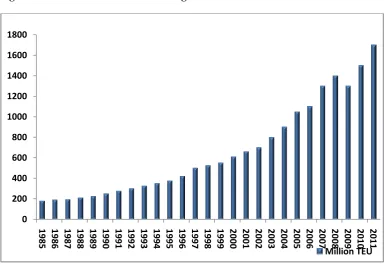
Secretariat 2007). As Figure 2.1 indicates, during the last two decades, global trade has
grown by one billion tons (UNCTAD Secretariat 2011). Further the growth in container
on global trade development, for example in 2010 the Pacific trade route, which links
the Far East to the USA, reached 18.5 million TEUs (UNCTAD Secretariat 2011). In
the same period other major trade routes such as the Asia-Europe trade route reached
18.3 million TEUs. The Trans-Atlantic route linking Europe with North America also
has increased (but at a lesser pace compared to Asian sectors) to reach 6.2 million TEUs
by the year 2010 (UNCTAD Secretariat 2011). It is evident that container lines have
been the main transport mode linking most global markets (UNCTAD Secretariat
[image:35.595.114.501.329.599.2]2007).
Figure 2.1: Global containerised trade growth TEU 1985–2011
Source: developed from Review of Maritime Transport (2011, p. 20)
To cater to this global demand for maritime transport, all the container lines operating
globally have set up their own network of agents and regional offices (McCalla, Slack
and Comtois 2004). These agencies and regional offices are the life lines of these
container lines (Frémont 2009). They are responsible for the marketing of container
0 200 400 600 800 1000 1200 1400 1600 1800
1985 1986 1987 1988 1989 1990 1991 1992 1993 1994 1995 1996 1997 1998 1999 2000 2001 2002 2003 2004 2005 2006 2007 2008 2009 2010 2011
services, handling shipping documents and vessel operations (when vessels reach the
ports) (McCalla, Slack and Comtois 2004). Furthermore, some of these container lines
provide logistical services and freight forwarding to attract more customers to their
container line (Frémont 2009). Thus offices are directly engaged with the customers and
their conduct has an impact on the services offered by container lines (Frémont 2009).
Maersk Line for example, has established more than 250 offices and has close to 10,000
employees in over 70 countries to serve more than 80,000 customers across the globe.
Similarly American President Line (APL) has in excess of 200 offices worldwide, and
their motto is “always ready to move the business forward and help you expand” (APL
2011).
With over 650 shipping agencies all over the world, Compagnie Maritime
d'Affrètement-Compagnie Générale Maritime Line (CMA-CGM) Line promotes their
services to customers by declaring “There will always be a CMA-CGM agency or office
to make it easy for you, and a vessel to take your containers to your
destination”(CMA-CGM 2011). Evergreen Line serves over 240 locations around the world in Asia,
America, Europe, the Middle East, Australia and Africa (Evergreen 2011). Further as a
multi-national, multi-lingual, service-driven container line Mitsui Osaka Line (MOL)
offers customer focused professionals with the experience to evaluate and develop
strategic service packages (MOL 2011). Hapag-Lloyd Line states that their global sales
network has 300 offices in 114 countries. The Hapag Lloyd agency network is shown as
an example to indicate the widespread of agency and regional office network of the
container line (see Figure 2.2) (Hapag-Lloyd 2011). These offices play an important
role in generating business in different parts of the world by representing the container
The examples cited above demonstrate that, along with the growth of container lines,
global agency and regional office networks have also undergone rapid expansion. These
networks are focused on providing customised services to their clients. No longer are
the container lines merely transporting a container from point to point, they are
providing a transport solution (Slack and Fremont 2009). Therefore, the contribution of
these regional offices and agencies has been crucial to the market growth of container
[image:37.595.117.475.309.634.2]lines.
Figure 2.2: Hapag-Lloyd Line’s agency and regional offices network
2.3
Strategies of container lines to meet global demand
To cater to the growing customer demand, container lines have enhanced the quality of
services by increasing service frequency, punctuality, reliability and safety, while
ensuring wider geographical coverage (Evangelista and Morvillo 2000; Rodrigue and
Notteboom 2009; Notteboom and Winkelmans 2009). For example, a weekly service
requires as many as seven or eight ships on the Asia-Europe routes (Sato 2002) and five
or six such ships for the North America routes. In addition, these services have to be
supported by a wide spread of branch networks and office staff (Das 2011; McCalla,
Slack and Comtois 2004; Rimmer 1998). Further, to support the service the container
lines have had to develop their own customer base, thereby generating cargo volumes to
sustain these services (Das 2011).
However, the high fixed costs involved in the container liner industry, difficulty in
accessing valuable resources from the market and low freight rates takes a long time to
achieve the target growth organically (Das 2011; Heaver 2002; Song and Panayides
2002). Thus, container lines have adopted horizontal co-operations such as alliances,
partnerships and M&As to access the resources needed to expand their services
(Brooks, Bluden and Bigood 1993; Brooks and Ritchie 2006; Merikas, Polemis and
Gounopoulos 2010; Notteboom 2004; Pierre 2000). In the literature, horizontal
co-operations among container lines are identified with different labels such as strategic
alliances (Das 2011; Ryoo and Thanopoulou 1999), strategic co-operations (Ryoo and
Thanopoulou 1999) and horizontal co-operations and partnerships (Cruijssen et al.
strategic co-operations. The next section explains the types of strategic co-operations
that prevail among firms generally and, more specifically, among container lines.
2.4
Strategic co-operations
Simatupang and Sridharan (2001) define horizontal operations (strategic
operations in the current study) as a combination of vertical and horizontal
co-operations. This combination, through merging and sharing capabilities in both
horizontal and vertical contexts increases flexibility Lamber et al. (1999) and Cruijssen
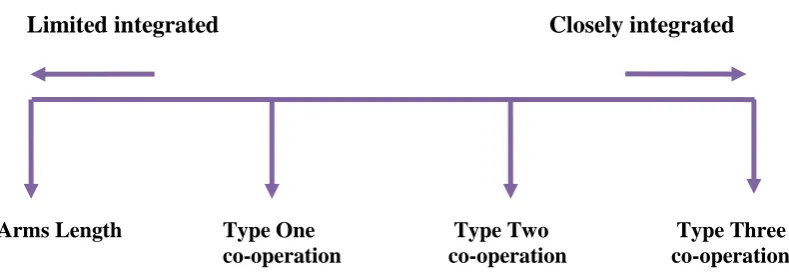
et al. (2007) identify four types of strategic co-operations among firms which differ
depending on the level of integration (see Figure 2.3). In an arm‟s length strategic
co-operation, communication is limited and, although firms may co-operate over a
prolonged period, usually interactions are also limited in number, because there is no
strong sense of commitment or joint operations (Cruijssen et al. 2007; Lambert,
Emmelhainz and Gardner 1999). Firms in a Type One strategic co-operation (as per
Figure 2.3) differ in that there is co-ordination of activities and planning, although they
tend to be limited in terms of time-span, extent, strength and closeness. The
co-operation usually involves a single activity of the firm (Lambert, Emmelhainz and
Gardner 1999). The Type Two strategic co-operation is more than just on co-ordination
of activities, but involves a longer-term integration of each firm‟s business planning
involving multiple divisions or functions. With regard to the most closely integrated
strategic co-operations, Type Three firms have integrated their operations to a level
where they regard each other as an extension of itself (Cruijssen et al. 2007). This type
level of integration as shown in Figure 2.3 can also be observed within the strategic
[image:40.595.115.510.186.323.2]co-operations of container lines.
Figure 2.3: Categorisation of strategic co-operations
1
Limited integrated Closely integrated
Arms Length Type One
co-operation
Type Two co-operation
Type Three co-operation
Source: Adapted from Cruijssen et al. (2007, p. 25)
1
2.4.1 Types of strategic co-operations among container lines
The spectrum of strategic co-operations among container lines varies from loose-knitted
slot charters, liner conferences and shipping alliances through to M&As (see Figure
2.4).
Figure 2.4: Strategic co-operations among container lines
1
Limited integration Closely integration
Slot Charter
Liner Conferences
Shipping Alliances
Pool agreements
(Joint service)
Consortia M&As
Source: Adapted from Sigera, Cahoon and Fei (2010)1
[image:40.595.105.531.550.680.2]According to Notteboom (2004) and (Koay 1994), strategic co-operations among
container lines can be categorised into three groups depending on their scope and level
of integration - (i) trade agreements (liner conferences), (ii) operating agreements (for
example slot chartering agreements, pooling agreements (joint service), shipping
alliances and consortia) and, (iii) M&As. The level of integration of intangible
resources and the scope of activities of container liner strategic co-operations vary
depending on the motives for forming the strategic co-operations, the regulations, and
the nature of the strategic co-operation. The main objectives for container lines forming
strategic co-operations were identified by Song and Panayides (2002), Notteboom
(2004) and Lu et al. (2006) as reduced costs, increased freight revenue, expanding
service coverage, achieving economies of scale, gaining instant access to new markets,
and increased freight revenue. To gain further understanding of the range and diversity
of strategic co operations in container lines, each of the categories shown in Figure 2.4
are discussed in the following sections.
2.4.1.1 Slot charters
A slot charter is a contractual agreement among partners that allows for the exchange of
available space on board vessels that they operate (Ryoo and Thanopoulou 1999). Slot
charters represent the simplest form of strategic co-operation, where two groups of
container lines rely on minimal operational integration (Brooks, Bluden and Bigood
1
Three reseach papers were published based on the findings of the current study:
1) Sigera, I., Cahoon, S. and Fei, J. 2010, 'The Contribution of intangible resources to the competitive performance of container lines: Perspectives of senior managers in Sri Lanka ',Proceedings of the International Association of Maritime Economists Conference, Lisbon, Portugal, 17-19 July.
2) Sigera, I., Cahoon, S. and Fei, J. 2010, 'Integrating intangible resources in strategic co-operations of container lines: Ship agents' perspective ',Proceedings of the Asian Logistics Round Table, 2-3 December 2010, Antwerp, Belgium.
1993; Koay 1994). The first group comprises the container lines not represented in a
trade route, but have the need to serve a trade route without investing in any
infrastructure. In order to achieve this, the container lines purchase slots from container
lines currently operating in the trade route. The second group comprises container lines
that are already operating liner services in a particular trade route and have the need to
increase their service frequency and space capacity (Koay 1994). Such container lines
will choose to enter into a slot charter agreement with another or a few other container
lines. However, the container line which sells space in the vessel continues to retain full
marketing and operational independence, while the slot purchaser retains its marketing
independence but forfeits any influence on the design and operations of the liner service
(Koay 1994). It enables carriers to retain their individual marketing identities and
compete vigorously in the market place while they gain the advantage of sharing costs
(Brooks, Bluden and Bigood 1993). As this form of partnership involves minimal
integration between the partners, termination conditions for such agreements are usually
more flexible compared to other forms of strategic co-operations (Ryoo and
Thanopoulou 1999). Therefore, there only tends to be an operational integration
between the members.
2.4.1.2 Liner conferences
Conferences are the earliest form of strategic co-operation among container lines, the
origins of which dates back to the Calcutta Conference of 1875. This was initiated
among break bulk liner service partners. That came to an agreement regarding a uniform
As defined by Tupper (2008, p. 5), a liner conference is :
A group of two or more vessel-operating carriers, which provide international liner services for the carriage of cargo on a particular route or routes that operate under uniform or common freight rates.
From the perspective of the integration of resources, liner conferences also depict a
limited integration. The integration is specific to price integration (freight integration).
Brooks (1993) explains that the aim of a liner conference is to limit rate-based, and in
some cases capacity-based competition (Heaver et al. 2000). Therefore, the main
objective of setting up conferences was to minimise destructive competition among
container lines by integrating pricing. According to Sjostrom (2004), a conference can
be either open or closed. The concept of open conferences was introduced to the
maritime industry by the USA Shipping Act 1916 (Koay 1994). Unlike closed
conferences, open conferences differ from closed conferences in that they are, in
principle, obliged to accept new members (Sjostrom 2004). However, the rules about
open conferences can be vague, for example some open conferences deter new members
by imposing an entry fee and by questioning the entrant‟s ability to provide common
carrier services (Acciaro 2010).
Conferences impose integrated pricing mechanisms in various manners (Acciaro 2010;
Sjostrom 2004). The most common complaint regarding conferences is predatory
pricing, involving the use of a „fighting ship‟ approach (Yamey 1972). The conference
would, in response to an entrant, lower the rates on one of its vessels to compete with
the entrant until the entrant lost revenue and left the trade route (Sjostrom 2004). Yamey
(1972) cites the operation of Mogul Steamship Co. as the best known example of
integrated price mechanisms are loyalty contracts such as the dual rate contract
(sometimes called contract rates) and the deferred rebates (Sjostrom 2004). The dual
rate system involves the shipper signing an agreement to deal exclusively with the
conference. In exchange the shipper receives a discount on the freight rate. Should the
shipper use a non-conference carrier, the conference imposes a fine. Thus, a number of
studies (for example, Bennathan and Walters 1969; Fox 1992; Podolony and Morton
1999) argue that conferences could act as cartels due to the substantial scale of
economies they possess. The Trans-Atlantic Agreement (TAA) which became active in
1993 was a typical price cartel (Heaver et al. 2000). However, in the initial stages of the
liner industry, this integration of pricing among the members of the conference was
accepted by the market regulators because it provided stability and protection for the
container lines from unnecessary price undercutting (Acciaro 2010; Heaver 1973;
Jansson and Shneerson 1987).
A liner industry with very high fixed costs will not survive in the market (Jansson and
Shneerson 1987). Therefore, legislation was introduced only to minimise the damaging
effects of conference systems, but the main concept of price or freight integration (price
integration) among the members was retained (Koay 1994). The Shipping Act of 1916
in the United States was the first such legislation brought forward to minimise the
monopolistic behaviour of conferences (Koay 1994). The 1916 Act specifically forbade
the use of „fighting ships‟ and differed rebates (Koay 1994). It also disallowed ocean
carriers from making unfair or unjustly discriminatory contract with any shipper based
on the volume of freight offered (Koay 1994). Even in 1963, the European Commission
adopted a ministers‟ resolution that recognised the liner conference system as being
2004). This recognises that undue price undercutting between container lines will affect
the stability of high fixed cost involved in the container liner industry. The resolution
also recognised the concerns of shippers over a possible abuse of conference powers,
and requested conferences to provide the means for ensuring fair practices and an
avenue for shippers to discuss any grievance against the conference system (Koay
1994). The European Commission Regulation No: 4056/861, which was established in
1983, restricts the application of critical 81(1) EC antitrust regulations on liner
conferences (Tupper 2008) and allows price integration, the co-ordination of shipping
timetables, sailing dates, or dates of calls. The European Commission legislators justify
the exemption of price integration and supply regulations between competing container
lines on the assumption that it would lead to the stability of rates.
However, on 25 September 2006, Regulation 1419/2006 was published in Europe. It
implemented the changes recommended by the review process and it was enforced on
18 October 2006 (Tupper 2008). The key changes introduced by this regulation were
cancellation of block exemption, price integration and regulating of capacity with
immunity (Tupper 2008). The European Commission anticipates that repealing the liner
conference block exemption will bring about considerable benefits to the European
Union industry and consumers by reduced transport prices for liner shipping services
and improved service reliability on deep sea and short sea trades. The Commission
recognises the container liner industry has developed with sufficient market power to
operate without price integrations (Tupper 2008). As a result of these changes in the
past decade, there has been a significant decline in the number of conferences registered
with the US Federal Maritime Commission (restricted to those in US trades). The
2001 (Sjostrom 2004). This was mainly due to regulations and growth of antitrust laws
enforced by the US, European Union and other countries. Therefore at present no any
conferences operating globally.
2.4.1.3 Shipping alliances
A shipping alliance is a general term used to describe operational integration between
two or more container lines in a global context, including for example schedule/sailing
arrangements (these are arrangements under which schedules are integrated with a view
to limiting transit time) (Slack, Comtois and McCalla 2002). This is an arrangement
whereby container lines agree to use each other‟s vessels on certain routes to enable
increased efficiency and cost savings (Midoro, Musso and Parola 2005). Consequently,
operational synergies are the main attraction for container lines to join shipping
alliances (Ryoo and Thanopoulou 1999).
The shipping alliances have facilitated expansion of services without needing to
increase the number of vessels for each container line (Slack, Comtois and McCalla
2002). It is worth noting that such integration of services has also enabled container
lines to utilise large-capacity ships for the alliance services. The Grand, New World and
United Alliances services are provided by ships that are larger than average size of the
fleets of the individual carriers (Slack and Fremont 2009). Alliance members have made
their largest vessels available to alliance services (Slack, Comtois and McCalla 2002).
Membership of the alliance has provided carriers with the opportunity to add more ports
of call and has also helped the lines to increase frequency (Slack, Comtois and McCalla
2002). According to Lu, Cheng and Lee (2006) the motives for forming shipping
entry to new trade routes, share the risk of providing new liner services and maximise
operational synergy.
Initially, when global alliances were formed in late 1995 and 1996, they focused only
on the Trans-Pacific and Asia-Europe trades (Damas 2001). The first global strategic
alliance was set up in 1996 by the container lines of APL, OOCL, MOL and Nedlloyd
and its objective was to establish an integrated Europe-Far East service (Alix, Slack and
Comtois 1999; Damas 2001 Heaver et al. 2000). In the same period, the Grand Alliance
was formed by Hapag-Lloyd, P&O, NYK and NOL. However, during 1996–1998, two
separate mergers occurred between APL and NOL, and P&O and Nedlloyd. After the
merger, the new container line P&O Nedlloyd joined the Grand Alliance, resulting in
the disintegration of the Global Alliance due to a lack of partners (Damas 2001). The
remaining partners of Global Alliance, APL and MOL invited Hyundai to form a new
global alliance, the New World Alliance (Damas 2001). The Grand Alliance also
became larger with the integration of MISC Line (Rimmer 1998). With P&O
Nedlloyd‟s acquisition by Maersk in 2005, the market share of the Grand Alliance
reduced. Meanwhile the three Asia-based container lines Yang Ming Line, K-Line and
COSCO Line formed CKY Alliance, which in 2003 became the CKYH Alliance with
the joining of Hanjin (Lu Cheng and Lee 2006). As indicated in Table 2.1, CKYH
Alliance currently has the largest market share and it is also the latest alliance to be
formed. Members of the CKYH Alliance are all Asian based with similar backgrounds
in managing culture. The members of CKYH Alliance have not changed over time.
Thus, it indicates that this alliance is more stable (Lu, Cheng and Lee 2006). However,
market share of these alliances over the period apart from that there have been many
changes in the membership (see Table 2.1) (Lu, Cheng and Lee 2006).
Table 2.1: The growth of TEU capacity of main global alliances
Year Shipping alliance TEU %
1997 Grand Alliance 547,000 12.45
CKY Alliance 382,000 11.50
New World Alliance 294,000 9.50
2000 Grand Alliance 692,551 13.45
CKY Alliance 649,709 12.62
New World Alliance 446,381 8.67
2005 CKYH Alliance 1,067,198 11.68
Grand Alliance 989,241 10.83
New World Alliance 720,708 7.89
2010 CKYH Alliance 1,264,640 11.93
Grand Alliance 1,251,016 11.80
New World Alliance 791,453 7.46
Source: Adapted from Notteboom (2004)
2.4.1.4 Pool agreements (joint services)
In pool agreements, the partnering container lines pool their vessels and operate a joint
service (Ducruet et al. 2010). In a situation where the joint service consists of more than
one service (multiple subservice-service alliance), vessels are utilised in the respective
subservices based on the characteristics of the vessels (Koay 1994). Therefore, vessel
pooling allows ships of similar sizes and speed capabilities to be joined together by
require no equity involvement and each container line markets the service separately
(Ryoo and Thanopoulou 1999). However, there are closer integrated vessel pools, as
indicated by Pierre (2000), where income and expenditure are shared between the
members in proportion to their contribution and pool accounts are produced on an
annual basis.
According to Tupper (2008, p. 39):
A pool is a collection of similar type of vessels; under various ownerships; placed under the care of an administration, which; markets the vessel as a single cohesive unit; and collects the earning; which are distributed to individual owners under a pre-arranged weighting system by which each entered vessel receives its fair share.
At present the integration of revenue and marketing pool agreements have to adhere to
the EU anti-competitive clause 81, which explains the limitation of market share for
cases where a common marketing strategy and revenue pooling is occurring (Tupper
2008). In 1965, OOCL line was established as a tonnage pool and joint marketing entity
by British Commonwealth Shipping, Furness-Withy, Ocean Transport and Trading and
the P&O group to cover their operations linking the United Kingdom (UK) and Europe
with the Far East, Australia and South Africa (Fossey 2007). The present pool
agreements are mostly integrated through sailing schedules (Brooks, Bluden and Bigood
1993). This enables each container line to retain its own marketing identity. Slack,
Comtois and McCalla (2002) observe the growth in joint services since the late 1980s.
For example, in the North Atlantic trades, Sea-Land Line had a joint service with
Nedlloyd and P&O Lines whereby efficiency is enhanced through vessel sharing
(Brooks, Bluden and Bigood 1993). In 1990, Sea-Land and P&O expanded their