Finite narrative modelling, contextual dynamic semantics
and Elusive Knowledge
MSc Thesis (Afstudeerscriptie)
written by Peter van Ormondt
(born 30 December 1976 in Delft, the Netherlands)
under the supervision of Prof. dr. B. L¨owe, and submitted to the Board of Examiners in partial fulfillment of the requirements for the degree of
MSc in Logic
at theUniversiteit van Amsterdam.
Date of the public defense: Members of the Thesis Committee: 30 November 2012 Prof. dr. J.F.A.K. van Benthem
Prof. dr. D.H.J. de Jongh Prof. dr. B. L¨owe
Dr. S.J.L. Smets
Abstract
The central point of this thesis is the semi-formal approach to con-texualist semantics of knowledge by David Lewis. Lewis introduces a set of rules that allow us to ignore certain parts of the space of all possi-bilities when we evaluate a knowledge claim. These rules are dependent on the context of utterance of the knowledge claim and therefore give rise to a contextualist notion of knowledge. We focus in particular on the Rule of Attention. The open nature of this rule poses problems for a formalisation in the usual framework ofdynamic epistemic logic.
We make a distinction between two modelling approaches: open modelling and closed modellling. The latter approach, called finite narrative modelling, is a methodology that relieves us from the duty of using a language that can represent arbitrary facts, since we as modellers know which facts will become relevant when we start with the modelling.
Contents
1 Introduction 4
2 Epistemic Contextualism 6
2.1 Introduction . . . 6
2.2 The scepticist claim . . . 10
2.3 Frameworks for contextualism . . . 11
2.4 Conclusions . . . 19
3 Some concrete issues in contextualism 19 3.1 Introduction . . . 19
3.2 David Lewis’ Elusive knowledge . . . 20
3.3 Elusive knowledge: the rules . . . 22
3.4 Conclusions . . . 25
4 Finite narrative modelling 26 4.1 Introduction and motivation . . . 26
4.2 Open and closed modelling . . . 26
4.3 Finite narrative modelling as a modelling technique . . . 28
4.4 An example . . . 30
4.5 Structure of the formalisation process . . . 34
4.6 Finite narrative modelling and dynamic epistemic logic . . . . 36
4.7 A case study . . . 36
5 Dynamic Epistemic Logic 39 5.1 Epistemic logic with common knowledge . . . 40
5.2 Epistemic events and action models . . . 43
5.3 Conclusions . . . 47
6 Contextual models 47 6.1 Introduction and notation . . . 47
6.2 Context function models . . . 48
6.3 Assumption context models . . . 53
6.4 Contextual models . . . 55
7 The destruction of knowledge – the case of Lewis 58 7.1 The Rule of Actuality . . . 58
7.2 The Rule of Conservatism . . . 59
7.3 The Rule of Resemblance . . . 59
8 Future work 61
1
Introduction
This thesis consists of three parts: a philosophical part (sections 2 and 3) in which we discuss the position of contextualism in epistemology, a method-ological part (sections 4 and 5) in which we discuss a modelling approach that we will use in the formalisation, and a formal part (sections 6 and 7) in which we apply the techniques of dynamic epistemic logic to the problems outlined in the first part.
The central point of this thesis is the semi-formal approach to contex-ualist semantics of knowledge by David Lewis [Lewis, 1996]. In this paper Lewis introduces a set of rules that allow us to ignore certain parts of the space of all possibilities when we evaluate a knowledge claim. These rules are dependent on the context of utterance of the knowledge claim and therefore give rise to a contextualist notion of knowledge. Although Lewis discusses these rules only informally, he claims that his approach could be adequately formalised.
I could have said my say fair and square, bending no rules. It would have been tiresome, but it could have been done. The secret would have been to resort to ‘semantic ascent’. I could have taken great care to distinguish between (1) the language I use when I talk about knowledge, or whatever, and (2) the second language that I use to talk about the semantic and pragmatic workings of the first language. If you want to hear my story told that way, you probably know enough to do the job for yourself. If you can, then my informal presentation has been good enough. [Lewis, 1996, p. 566–567]
In this thesis we accept this challenge.
There is one of Lewis’ rules that receives particular focus and that is the Rule of Attention. This rule says that if we are not ignoring a certain possibility then it is part of the contextually determined domain. Moreover:
If it is an uneliminated possibility in which not-P, then it will do as a counter-example to the claim that P holds in every possibility left uneliminated by S’s evidence. That is, it will do as a counter-example to the claim that S knows that P. [Lewis, 1996, p. 559]
This means that our conversation partner can potentially destroy knowledge by raising an issue that was previously ignored.
consider our attempt to formalise Lewis in a system of dynamic epistemic logic (cf. section 5 for definitions).
The open nature of Lewis’Rule of Attention does pose problems for the usual framework of dynamic epistemic logic. This framework is a proposi-tional modal logic whose main applications (and explanatory power) come from easily surveyable finite models: complex facts about the real world are encoded in single propositional variables to simplify the formalism. How-ever, the Rule of Attention seems to require a language that allows us to represent virtually arbitrary connections and situations as they might be brought up in conversation and therefore must be attended to.
In order to deal with this discrepancy, in the second part of this thesis, we will introduce a distinction between two fundamentally different modelling approaches: an open modelling approach that leaves all formal possibilities undecided in order to deal with changes of situation flexibly, and a more restrictive approach that makes decisions at the beginning of the modelling what the scope of the model should be and fixes the vocabulary accordingly. The latter approach is calledfinite narrative modelling. We think of this as a method where the modeller gets the entire (finite) narrative of the de-veloping situation up front, then makes the modelling decisions, and finally reestablishes the dynamics via a sequence of models that represent the nar-rative. In fact, the method offinite narrative modelling is the main method-ology used in most theoretical applications of logics of actions (whereas the open modelling approach is used by people who implement AI and build robots).
The methodology offinite narrative modelling relieves us from the duty of using a language that can represent arbitrary facts, since we as modellers know which facts will become relevant when we start with the modelling. This will allow us to use the language ofdynamic epistemic logic to formalise Lewis’ rules. This we shall undertake in the final part of this thesis. We explain the basics ofdynamic epistemic logic (section 5), we then introduce two extensions ofdynamic epistemic logic (section 6) and finally we will use these frameworks to give a formalisation of several of Lewis’ rules.
By restricting our methodology to finite narrative modelling, some of Lewis’ rules seem to lose their force. We will discuss what this means for the interplay between formal ontology of the modelling framework and the philosophical theory.
it (cf. [van Eijck and Visser, 2010]), to AI, introduced by John McCarthy in his [McCarthy, 1993] and found further development in context logics such as [Buvaˇc et al., 1995]. Dynamic context logics have been studied in [Aucher et al., 2009]. The idea of specifically formalising contextual notions of knowledge has recently attracted interest witnessed by publica-tions [Holliday, 2012a, Holliday, 2012b, Holliday, 2010]. Similar to attending and unattending to possibilities is awareness and unawareness of possibil-ities. [Fagin and Halpern, 1988] make a distinction between implicit and explicit knowledge in order to deal with the problem oflogical omniscience. A dynamic variant of the latter system can be found in [van Benthem and Vel´azques-Quesada, 2009]. We finally point to [de Jager, 2009] that concen-trates on unawareness as an epistemic attitude.
2
Epistemic Contextualism
2.1 Introduction
Epistemic contextualism is the position that the truth of knowledge state-ments, or the propositions that are expressed by them, are in some way dependent on the context in which they are uttered. It is a position that is rooted in the analytical tradition and has been developed in the second half of the 20th century.1 Arguably, epistemic contextualism is a position also to be found in other traditions dating back further but those will not concern us here.2
On the face of it, the claim that the truth of the proposition expressed by the utterance of a sentence like ‘aknows thatp’ depends on context, seems hardly controversial. Surely, the truth of ‘I know thatBeatrix is the Queen of the Netherlands’ depends onwhen this sentence is uttered and bywhom. But it is not in this respect that knowledge claims are said to be context-sensitive. What is meant is that knowledge claims are context-sensitive with respect to changing epistemic settings. Different contexts have, or determine, different epistemic settings and therefore impose different truth conditions on propositions expressed by claims of knowledge. Alternatively, the content of the word “know” is a function from epistemic settings in contexts to relations between individuals and propositions.3 What these
1
Cf.[DeRose, 1998, section 5].
2See [Norman, 1999] who traces contextualist claims in other philosophical traditions.
Also see [Bianchi and Vassallo, 2005, p. 42] for a claim that contextualism is already to be found with Descartes, Hume and Locke.
3
epistemic settings are, or what it is that changes with context is a matter of debate and different frameworks have been developed in this respect. For instance, some people claim that the truth conditions of a knowledge claim will be more easily met in some contexts and more difficult in others. A claim which is denied by so-called “invariantists” who will not agree that the truth conditions of the knowledge claims vary according to these changing settings.
Although most people working in the field of epistemic contextualism would agree with the general claim of the contextual dependence of knowl-edge statements, positions start to curdle when you ask whose contexts we are talking about? Well, the ascriber’s, say some.4 Not so, it is the subject’s context, say others.5 Positions change more when you ask what these epistemic settings are, and when they are met. And when we talk about knowledge, do we talk about propositions that are expressed when knowledge claims are uttered or are we talking about knowledge per se? Following [Rysiew, 2011], there are two general distinctions we can make in the field of epistemic contextualism. One distinction is between a semantic and a substantive view of contexts. The other between subjective and at-tributive contexts, or whose contexts we should consider. We will look at these distinctions in turn.
Semantic and Substantive contextualism
A central concern for epistemology has always been what the structure of knowledge and justification is. Traditional theories include foundational-ism and coherentfoundational-ism and are about knowledgeper se. By this we mean that these theories try to give an account of what knowledge is, rather than when we can adequately utter knowledge statements.6 By the term substantive contextualismwe refer to the position that tries to give an account of knowl-edge and justification in this respect but argues for the contextual depedency of knowledge and justification, respectively. For instance, David Annis for-mulates an alternative to the view of foundationalism by pointing out the
and that propositions are the semantic contents or meanings of sentences. This is not the place to go into this century-old philosophical history. Instead we refer to [Stalnaker, 1984], [Stalnaker, 1999] for a contemporary view and to [Nuchelmans, 1973] for an overview of the historical development.
4
Most notably, Stewart Cohen [Cohen, 1999], Keith DeRose [DeRose, 1998], David Lewis [Lewis, 1996].
5
For instance, Fred Dretske in [Dretske, 1981].
6We could have also phrased the opposition as a distinction between understanding
contextual parameters that have been overlooked in these theories [Annis, 1978]. In particular, he stresses thesocial nature of justification by arguing that the question whether an agent S is justified in believing h is always relative to a so-calledissue-context:
The issue-context is what specific issue involving h is being raised. It determines the level of understanding and knowledge that S must exhibit, and it determines an appropriate objector-group. [Annis, 1978, p. 215]
The point being that given a set of basic statements in a foundationalist framework, the foundationalist should recognize that it is only in specific contexts that these basic statements do not stand in need of further jus-tification, but they might require justification in others. But it is not the particular structure of knowledge the contextualist is objecting to, for in-stance, coherentism is also frequently attacked, it is the idea that there is a perspective that can reveal the correct structure of a justified true belief. It is this assumption of a structural unity of the object of investigation in epistemology that is also argued against by Michael Williams in [Williams, 1991]. This “epistemological realism”, as he calls it, assumes that knowledge has a context-independent structure.
In contrast to these investigations that concentrate on the structural properties of knowledge, the semantic position is looking at the proposo-sitions that are expressed when knowledge claims are made and tries to provide adequate truth conditions for them. Such investigations are carried out within particular (semi-)formal frameworks, of which we will see a few examples in section 2.3, and it is within these frameworks that the seman-tics of the propositions are analysed. Semantic contextualism can therefore be said to only be epistemelogical because it concerns itself with epistemic terms.7 This is a clear difference from the substantive position we described above, where knowledge, and the structure and justification of knowledge, are concerned.
In recent years people have investigated the linguistic implications of the claims made by semantic contextualists, for instance by looking how the verb “to know” as a linguistic itemactually functions in natural language.8 To give an example, one of the claims made by contextualists is that the verb “to know” like the adjective “flat” isgradable, in the sense that what counts as flat in one context (the claim that the surface of my desk behind
7
Cf.[Rysiew, 2011, section 2].
8
which I am sitting is flat) does not so in another (when one is building an advanced space telescope). In [Stanley, 2004], the author investigates if there is linguistic evidence for such a claim. The linguistic underpinnings of epistemic contectualism is a different and large field of research altogether and will not be explored in this thesis.
Rather, in what follows, we will be concerned with the semantic position of contextualism and not with substantive contextualism9 nor the linguistic underpinnings of these claims. In this thesis we will introduce a methodol-ogy for modelling knowledge claims in narratives and build on the concepts introduced in semantic contextualism and has therefore no bearing on ques-tions about knowledge of a substantive nature nor does it explore a linguistic analysis of narratives.
Attributive and Subjective contextualism
A second distinction we can make in the field of epistemic contextualism is a distinction between subjective and attributive contextualism. When we talk about contexts we can ask, whose context? When we say that the truth conditions of the proposition that an agent a knows that p are dependent on context we might mean the context of the subject of knowledge,i.e., the knower. We might also mean the person attributing the knowledge that p
toa,i.e., the knowledgeascriber. As Keith DeRose puts it:
The basic issue here is whether the varying standards a subject must live up to to count as knowing are relative to the context of that subject or rather to the context of the attributor – the person describing the subject as a knower or a non-knower. [DeRose, 1998, section 4]
Between the theories of epistemic contextualism that are around there exist many subtle differences. In order to interpret these correctly, the above distinctions provide a good guiding principle. In this text we will focus on the distinction between what we have called subjective contextualism and attributive contextualism. Both are a semantic thesis in the way pointed out above, but as the naming suggests some find the contextually relevant factors in facts about the subject of knowledge, others also in that of the attributor of knowledge.
9
2.2 The scepticist claim
Much of the motivation to develop contextualist theories comes from try-ing to neutralize sceptical arguments and because it is such an important motivation for contextualism we consider the argument and its responses.10 In some of the literature of epistemic contextualism the scepticist claim is presented as a paradox. The argument can be rendered as follows:
(1) I know that I have hands.
(2) I don’t know that I am not a brain-in-a-vat.
(3) I don’t know that I have hands if I don’t know that I am not a brain-in-a-vat.
Individually, all propositions seem plausible up to some extent yet they cannot all be true. (1) seems true because if we are to know anything then surely these are the mundane things in life we usually take for granted we know. (2) is true, we could say, by design. The brain-in-a-vat argument is manufactured in such a way that we cannot differentiate between being a in-a-vat and not. Therefore, we cannot know that we are not a brain-in-a-vat. (3) In order to know that I have hands I must of course be able to know that I am not a brain-in-a-vat.
The sceptic will reason on the basis of (2) and (3) that
(4) I don’t know that I have hands.
which would be contradicting (1). The disagreement is the following: be-cause this reasoning works the same way if we substitute “I have hands” with some other proposition which we normally assume we know and sub-stitute “being a brain-in-a-vat” with some other exotic mind construct, like continuously deceiving demons, nefarious scientists on Alpha Centauri,etc., the sceptic seems to have his victory: we really don’t know the things we ordinarily suppose we know.
Those people who do not wish to accept this result should point out where the reasoning above goes wrong. Because (2) is true by design, many have considered (3) to be the faulty premiss in the sceptic’s reasoning. But behind it is a principle that few would care to give up and is known as the closure principle of knowledge. This principle can be stated as follows:
10
(K) If agentaknowsp and aknows that p→q, then agent aknows that
q.
Let p be the proposition that I am a brain-in-a-vat and let q be the proposition that I have hands. As agreed to above, I don’t know that I am not a brain-in-a-vat,¬K¬p. Also, it’s reasonable to assume that I know that
¬pis a consequence ofq,i.e., if I have hands, then I am not a brain-in-a-vat,
K(q → ¬p). We must then conclude that I do not know that I have hands,
¬Kq, or (4) above. Because, were we to conclude that Ido know that I have hands, Kq, then by virtue of (K) above we have Kq &K(q → ¬p), hence
K¬p, which contradicts our first assumption, or (2) above. Here we see clearly where the sceptic gets his strength from. By the mere mentioning of “You don’t know that not —”, where we can insert any sceptical hypothesis for —, the sceptic can cast a doubt over all that seems certain.
It seems we have three choices. We could of course just be content with believing that we do not know the things we normally think we know, i.e., throw out (1) above, a position sometimes called ‘fallibilism’. We can deny (3),i.e., deny the closure principle for knowledge, an option which is argued for by Fred Dretske, which we will discuss in the next section. We could also deny (2) and insist that we do know that we are not brains-in-a-vat. Something which is known as the Moorean response after the philospher G.E. Moore.
Contextualists, however, particularly contextualists of the attributive kind, believe that the truth conditions depend on context and they will try to show that in the argument we have presented above, there is a shift in context taking place which is the reason why the argument leads to apparent contradiction. As we shall see in the next section, they will use this strategy to dodge these three choices altogether.
A lot of the epistemological contextualist theories are developed with the precise intent to neutralize the sceptical argument. This plays an important role in the background and for this reason we have brought it to our atten-tion. In the next section we will have a look at two contextualist solutions to this scepticist paradox.
2.3 Frameworks for contextualism
section 3.2 how David Lewis further develops these ideas.
1. Relevant alternatives theory
2. Theory of changing epistemic standards
We will look at these theories in turn.
Relevant alternatives theory
We will first considerrelevant alternatives theory as a response to the scep-tical paradox mentioned in the previous section. On the one hand relevant alternatives theory is a contextual theory in it’s own right which has been primarily developed by Fred Dretske11 but it can also be seen as a (tech-nical) framework and as such has been adopted by others, as we shall see, to express their views which might not be in agreement with the theory. The reason for this popularity might be thatrelevant alternatives theory is easily expressed in modal logical terms because the central idea of eliminat-ing possibilities is the same in epistemic logic, with the difference that basic epistemic languages do not normally distinguish between relevant and irrel-evant possibilities.12 However, the framework and the theory are two issues that need to be kept separate. The strategy of Dretske to counter the scep-tical argument is to argue that “knowledge” is an absolute concept which can be analysed in terms of relevant alternatives and to deny the closure principle of knowledge, as seen in the previous section, a claim backed-up with a device called truth-tracking.
Factual knowledge is an absolute concept and does not admit of degree. It makes no sense to say that one person knows that Amsterdam is the capital of The Netherlands better than another person. “Knowledge is an all or nothing affair, like being pregnant”, Fred Dretske claims in [Dretske, 1981]. Dretske agrees with Peter Unger13on this point, but unlike him does not draw sceptical conclusions from this idea. Dretske, with his approach of relevant alternatives theory, promises a way to keep sceptical claims at bay. Indeed, as we have said before, many contextualist theories were developed with the aim to do just that, andrelevant alternatives theory is no different.
11
See [Dretske, 1981, Dretske, 1970]. Other people who developedrelevant alternatives theoryinclude Alvin Goldman [Goldman, 1976] and Gail Stine [Stine, 1976].
12This last remark will be made more clear when we present formal epistemic languages
in section 5.2.
We therefore first recall the discussion of absolute concepts put forward by Peter Unger.
Unger makes his point by comparing the concept offlat to that of knowl-edge. Flat like knowledge is an absolute term. Unger contends that when we say that a surface is flat we mean that there are no bumps or dents on it whatsoever. In case there would be irregularities on the surface, however minute these might be, we have to conclude that the surface is not flat. Perhaps we would say that it is almost flat but not flattout court. Were we to put the surface in question underneath a (strong enough) microscope we would find all sorts of irregularities and the sad conclusion is that almost nothing is really flat. So too, Peter Unger concludes, it is the case with knowledge (cf., [Unger, 1975, chapter II]).
Dretske does not share the sceptical conclusions Unger draws from the charateristics of absolute concept but agrees that knowledge, like flat, is an absolute concept which does not admit of degree. He does not agree, however, that nothing is really flat, or that we cannot be said to ever really know anything. The argument is as follows. Given an absolute concept like flatness, for an object to be flat, it must not have any bumps. This is an absolute matter. What is not an absolute matter is what counts as a bump. Similarly for knowledge, if I say that I know thatp, it means that I know this on the basis of my evidence or justification being sufficient or adequate. Once the threshold of justification has been passed, only then knowledge, the one kind there is, is established. My evidence eliminates all possibilities that conflict with the knowledge statement, therefore I can truthfully be said to know and this does not admit of degree. What actually counts as a possibility that conflicts with the knowledge statement and has to be eliminated by my evidence is another matter. Dretske says:
‘Such concepts, we might say, arerelationally absolute; absolute, yes, but only relative to a certain standard. We might put the point this way: to be empty is to bedevoid of all relevant things, thereyby exhibit-ing, simultaneously, the absolute (in the word ‘all’) and relative (in the word ‘relevant’) character of this concept.’ [Dretske, 1981, p.366–367]
that Lewis, who also chooses Unger’s infallibility of knowledge as a starting point, wisely avoids this terminology altogether.
According torelevant alternatives theory for a knowledge claim to be true one has to be able to rule out therelevant alternatives that are incompatible with it. Given the knowledge claim thatp there are those possibilities that are necessarily excluded by p. Those possibilities form what Dretske calls thecontrasting set. Then there is the relevancy set which consists of those possibilities that the person who knows must be able to exclude. Or as Dretske says:
In saying that [a person] must be in a position to exclude these pos-sibilities I mean that his evidence or justification for thinking these alternatives are not the case must be good enough to say he knows they are not the case.14 [Dretske, 1981]
The intuitions of relevant alternatives theory are captured formally as follows. Define acontrasting set,S, of epistemic possibilities and a subset of
S, the relevancy set,R. The elements ofS represent those epistemic poss-bilities that, given a knowledge claim, the knower should be able to exclude, by justification or evidence, in order for it to be true to say he knows. The elements which are inS but not inR,S\R, contain those possibilities that are irrelevant and need no justification for exclusion. Amongst othersS\R
contains the malicious demons, and evil scientists manipulating our brain and perception. In this formalism a sceptic would be represented by iden-tifying R and C, in which case one would need to exclude all possibilities which is a tremendous or even impossible burden on evidence.
This does not mean that R is always the same given a knowledge claim that p. In different situations, or contexts, what is a relevant alternative top can differ. But this does not change what we know, although it might change the evidence that is required.
How is this theory intended to prevent the sceptical paradoxes outlined in section 2.2? According to Dretske, knowledge is only transmitted if the entailment is relevant.15 If we again consider principle (K), knowing that the animal in front of me is a dog may transmit by entailment to knowing that it is not a sheep, but not to knowing that it is not a hologram generated by a martian in order to fool epistemologists, because this is not in the
14
Cf., Lewis in [Lewis, 1996, p. 553] defines the excluding of possibilities as a conflict a possbility has with the propositional information that exists in the subject’s entire perceptual experience and memory, denying that justification plays any role. We will return to this issue in section 3.2.
relevancy set for the knowledge claim. (K) then fails in the sceptic paradox and knowledge is saved.
What remains to be explained, and what of course is essential for this theory to go through, is an answer to the questionwhat makes a possibility relevant. What are the (relevant) possibilities that need to be excluded given a knowledge claim that p? For instance, why is the possibility that I am standing next to my desk a relevant alternative to the claim that I am sitting behind it and why is the possibility that I am a brain-in-a-vat not? In order to determine this, Dretkse introduces a counterfactual account of knowledge: an agent knows some propositionpiff hadpbeen false then the agent would not have believed it.16 This works as follows. Let us consider that I know I have two hands, then according to the definition I would not believe this if I, as a result of a tragic accident, would only have one, whereas I would still believe it if I was a brain-in-a-vat.
Usually, this account is given a modal logical interpretation in such a way that knowledge requires in addition to a true belief in the actual world a belief which issensitive to the truth of the proposition in question. This means that in the nearest possible world where this proposition is not true, I no longer believe it.17 This requirement for knowledge to be sensitive to the truth of the proposition in question is sometimes calledtruth-tracking.
To make this more clear, suppose John is at the zoo and is looking at a striped animal in a cage in front of him. In normal circumstances, Dretske will say, John can claim he knows that the animal in front of him is a zebra. Let’s call this fact p. The relevant alternatives to p, the possibilities that John wil need to rule out, are for instance that the animal is not some kind
16Initially this idea was presented in [Dretske, 1971] and later revived by Nozick. See
[Nozick, 1981], especially part 3 on epistemology.
17
Truth-tracking depends on the analysis of counterfactuals. The general form of a counterfactual statement is:
(1) If it had been the case thatϕ, then it would have been the case thatψ.
which we write as
(2) ϕ ψ
Analysis of conterfactual statements as a material implication fails because utterence of (2) is done usually when the antecedentϕis false, so if we would analyse counterfactual statements as a material implication all counterfactual statements would be true.
of horse, gazelle or cow. The possibility that the animal is a cleverly painted mule to fool the zoo-going public is a possibility which is not relevant because we would still not believe it even if it were true.
Relevant alternatives theory advanced by Dretske has been criticised. Especially, the rejection of the closure principle of knowledge has been the focus of the attack.18 First noticed by Gail Stine [Stine, 1976], the account by Dretske and Nozick depends on sensitivity of beliefin the nearest worlds. This means that knowledge of p depends solely on being able to rule out relevant alternatives top. As a result, this means that one cannot know the denial of a sceptical hypotheses, because one cannot rule out that it actually obtains, but as long as it is not a relevant alternative, Dretske would say, this does not harm us. So, where we can be said to know in a normal situation that the animal in the zoo is not a gazelle, horse etc. One does not know, however, that it is not a cleverly painted mule, even though it being a zebra implies this. It is here where the K-axiom fails. The problem with this approach is that, as we can see, it allows for the conjunction “I know that that is a zebra but I do not know it is not a cleverly painted mule”, and this is hard to stomach. The following section will focus on a position that tries to circumvent these difficulties.
Theory of changing epistemic strength
The most notable proponents of attributive contextualism are Keith DeRose, David Lewis and Stewart Cohen, cf., footnote 4. A central observation of attributive contextualism is that it seems perfectly legitimate to ascribe knowledge in ordinary (non-sceptical) contexts whereas it does not seem legitimate to do so in contexts where sceptical possibilities have been raised. Furthermore, it is claimed that the change from an ordinary context to
18
A concern in epistemic logic is what is sometimes calledlogical omniscience. Together with the rule of necessitation, the K axiom allows agents to know all the logical conse-quences of what they know. The authors of [Fagin and Halpern, 1988] acknowledge that human reasoning is limited to some extent making a distinction betweenimplicitand ex-plicitknowledge. However Dretske would deny K to hold in general even if humans would not have limits to their reasoning capabilities:
a context where sceptical possibilities have been raised is determined by conversational factors. This is why in ordinary contexts it is alright to say somebody knows this or that mundane fact and knows the denial of some sceptical hypothesis, whereas in a sceptical context this knowledge is lost.
A subjective contextualist will argue that if an ascription sentence is true, then it is true in every conversational context, because somebody’s knowledge depends entirely on the subject’s information status. For this reason a subjective contextualist will deny at least one of the above obser-vations. An attributive contextualist will argue against this and say that an ascriber responds to changing “epistemic standards” due to a changing conversational context and that whether or not a knowledge ascription is true depends on the conversational context of the ascriber. In what follows we will mostly focus on the explanation given by DeRose in [DeRose, 1995]. With regard to explaining why it does not seem right to ascribe knowl-edge to a subject in a conversational context where sceptical possibilities have been raised, DeRose relies on thecounterfactual insensitivity of beliefs we have explained in the previous section:
[W]e have a very strong general, though not exceptionless, inclination to think that we don’t know that P when we think that our belief that P is a belief we would hold even if P were false. Let’s say that S’s belief that P is insensitive if S would believe P even if P were false. [...] We tend to judge that S doesn’t know that P when we think S’s belief that P is insensitive. [DeRose, 1995, p. 18]
DeRose cannot leave things like this because this would involve a denial of closure, in the way pointed out in the previous section, and this is exactly what he is trying to prevent. DeRose too expresses the oddness of maintain-ing that in normal contexts I can know some ordinary fact expressed byp
and not know the denial of a sceptical hypothesisqeven if I might know that
p implies ¬q. So, the notion of sensitivity needs to somehow be limited in the explanation. In order to do this DeRose points out that the reason why this situation is odd is because my “epistemic postion” with regard to p is no stronger than with regard to¬q, where epistemic strengh is understood as follows:
Note that for Dretske and Nozick counterfactual sensitivity required the agent tolack the belief thatp in nearby worlds where¬p holds, or tracking the truth innot-pworlds. For DeRose, epistemic position simply means that ifp is the case the belief that p should match it. As a result I can be in a strong epistemic position with regard to the denial of a sceptical hypothesis
q even though my belief that ¬q is not sensitive in the sense outlined by Dretske and Nozick.
With the notion of epistemic strength in hand we are in a position to look at what mechanism DeRose proposes to explain how epistemic stan-dards vary across conversational contexts. It comes down to determining how strong the epistemic position of an agent a must be with respect to a propositionpin order for an ascriberA’s claim that ‘aknows thatp’ is true. This will involve both sensitivity and epistemic strength:
When it is asserted that some subject S knows (or does not know) some proposition P, the standards for knowledge (the standards of how good an epistemic position one must be in to count as knowing) tend to be raised, if need be, to such a level as to require S’s belief in that particular P to be sensitive for it to count as knowledge. [DeRose, 1995, p. 36]
According to DeRose, in order for a knowledge claim thatppertaining to a subjectSto be true,Shas to believep,phas to be the case andS’s epistemic position must be strong enough in order forS’s believe to be sensitive. What the scepticist does, according to DeRose, is to set high standards according to which the requirement for knowledge is that my beliefs must be sensitive if they are to count as knowledge. In these sceptical contexts, I fail to know that I am not a brain-in-a-vat because this is not a sensitive belief. But it is only in these contexts that the statement that I do not know this enjoys any plausibility. In other, more relaxed contexts, the requirement that our beliefs must be sensitive is not required and therefor we can reject that I do not know that I am a brain-in-a-vat. And it is only with respect to an agent’s belief which are part of the ascriber’s conversational context that need to be sensitive in order for the ascription sentence to be true.
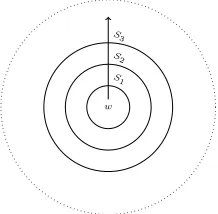
w n
= 1
n
= 2
n
= 3
We can now think of the notions of sensitivity and epistemic strength as follows. We say an agent is sensitive top if in all vi, where i < k, ifp does not hold in vi, then neither does Bap. Similarly, we can put a measure on epistemic strength by saying that the epistemic strength of an agent with repsect to a proposition p is i if for all j < i, if in vj p holds then so does
Bap.
2.4 Conclusions
In this section we have discussed two frameworks in which semantics for contextual knowledge statements are developed. The important difference between the two positions are in whose context to look for the contextual rel-evant parameters. We have seen that subjective contextualism as advanced by Dretske has a flaw called “abominal conjunctions” by DeRose who has adopted an attributive contextual view to overcome these problems. This does not mean that the latter view, which we shall further explore in the next section, is without critics. Cf.[Rysiew, 2011,§4] for an overview of the arguments against the attributive thesis. This article also makes clear that the debate is far from over.
3
Some concrete issues in contextualism
3.1 Introduction
sense,i.e., we considerallpossibilities imaginable, which has the unfavorable consequence that we are rid of all everyday knowledge that we normally suppose we have.19 Or, we relax the interpretation and admit that we are mere fallibilists, allowing that we cannot possibly eliminate all possibilites where not-p, ridding the word ‘knowledge’ of its content.
As we will show in the next session, in order to sidestep these problems David Lewis adds a “proviso” to the above definition, making knowledge a context-dependent notion. By introducing a set of rules he aims to deter-mine exactly which possibilities are relevant and which ones we can properly ignore. In the next section we will have a a look at Lewis’ paper in more detail. We will then take up some issues which were left in section 2 and see how his views relate to other positions in epistemic contextualism. Do Lewis’ suggestions indeed solve the problems he addresses,i.e., does he suc-ceed in defining a notion of knowledge that saves the big bulk of everyday knowledge, which we normally assume we have, from the arguments of the sceptic, without admitting to the fallibilistic position?
3.2 David Lewis’ Elusive knowledge
“We know a lot”, Lewis starts out in [Lewis, 1996]. Though he also admits that all the things that we think we know are endangered by the infallibilis-tic character of the definition of knowledge, mentioned in the introduction above. Because as soon as we start doing epistemology we find that there are a lot of possibilities not eliminated (“let your paranoid fantasies rip”20) and we know next to nothing. A solution to this could be that we only have fallibilistic knowledge. But, Lewis implores us, doesn’t knowledge despite uneliminated possibilities just sound wrong? Fallibilism is not an option and he seeks to “dodge the choice” altogether.21
Assuming that knowledge ascriptions are context-dependent, Lewis claims that it is only in the context of epistemology, or other demanding contexts, that we are robbed of our everyday knowledge we normally as-sume we have. If we are in an informal setting we normally asas-sume that we know a lot, however as soon as we engage in the systematic philosophical ex-amination of knowledge, thereby raising the standards of evaluation, things go bad. What this makes clear is that Lewis is considering the context of
19
Recall the discussion on page 11 where we showed that the strategy of the sceptic consists in letting us agree that we do not know that the sceptical hypothesis is false. It’s this unrestricted quantification over all possibilities imaginable that causes trouble.
20[Lewis, 1996, p. 549] 21
the knowledge ascribers and the propositions uttered by them.
Lewis further disagrees that justification is necessary. We rely on per-ception, memory and testimony and often don’t know how we know. So he insists that justification should not be part of the definition of knowledge. Dretske in fact says that the way we come to know is always the locus of irrelevant possibilities. If you claim to know the car manufacturers went on strike because you read this in the newspaper you are not claiming to know that this is a reliable source even though this is assumed.22
Like Fred Dretske, Lewis follows Peter Unger and makes the infallibility of knowledge his starting point:23
Subject S knows that P iff P holds in every possibility left unelimi-nated by S’s evidence; equivalently, iff S’s evidence eliminates every possibility in which not-P. [Lewis, 1996, p. 551]
What does it mean to say that every possibility in which not-P is elimi-nated, Lewis asks. Normally, a quantifier is restricted to a specific domain. When I say in a bar that I will buy everybody a drink, I do not mean ev-erybody on the face of the planet. It is restricted to the people I am having a drink with, the people relevant to that specific situation. So too, it is the case with the restriction of the quantifier in the definition above. ‘Every possibility’ does not mean every possibility in logical space, but only those that are relevant for the truth of the knowledge statement.24 But we cannot just ignore any possibility we choose. We can properly ignore some unelimi-nated possibilities, we may not properly ignore others. The definition Lewis started out with needs revision. He adds a ‘sotto voce proviso’:
S knows that P iff S’s evidence eliminates every possibility in which not-P –Psst!– except for those possibilities that we are properly ignoring. [Lewis, 1996, p. 554]
Lewis restricts the universal quantifier to domains determined by con-text,i.e., in specific situations we may ignore some possibilities. This gives the verb “to know” a contextualist reading. Of course, we cannot just ig-nore any possibility we want, otherwise true ascriptions of knowledge would be very easy to come by. In order to distinguish between possibilities that cannot be ignored, the ‘relevant alternatives’ as Dretske would call them, and the irrelevant ones, Lewis formulates a set of rules that determine just that. In the next session we will explore what these rules are.
22
[Dretske, 1981, p. 374]
23
See section 2.3 for a discussion on Unger’s claims.
3.3 Elusive knowledge: the rules
The rules that Lewis introduces are a modal treatment of the sotto voce proviso we mentioned above. They can be seen as rules for the modeller or acriber of knowledge given a certain epistemic setting. In the following we will briefly introduce and discuss the rules. There are seven rules in total of which there are three rules, or prohibitions, which tell us which possi-bilities cannot be properly ignored and four which can be properly ignored. However, Lewis mentions that some rules could possibly be subsumed under others.
We begin with the rules that include possibilities.
Rule of Actuality
The possibility that actually obtains is never properly ignored; ac-tuality is always a relevant alternative; nothing false may properly be presupposed. [Lewis, 1996, p. 554]
But Lewis asks,whose actuality cannot be ignored? This might seem like a silly thing to ask, he says, there is but one actual world and the ascribers and the subjects of knowledge share this world, hence actuality is the same for all. However, in other situations it is not so easy.
Contrary to the standard view, Lewis insists that the objects of be-lief are not propositions, i.e., sets of possible worlds, but properties, i.e., sets of possible objects.25 Lewis claims that every de dicto (or propositional) belief can be explained in terms of the self-ascription of a property. Believing thatp is the self-ascription of the property that one inhabits a world wherep. Some of our beliefs are about specific individuals and their location and thesede se beliefs determinewhere one is in the world rather than in which world one thinks one is. Lewis claims that de se beliefs subsume de dicto ones.
Going back to The Rule of Actuality. When Lewis askswhose actual-ity, he means that there are some situations where information about who and where one is can be relevant.
Rule of Belief
A possibility that the subject believes to obtain is not properly ig-nored, whether or not he is right to so believe. Neither is one that
he ought to believe to obtain – one that evidence and arguments justify him in believing – whether or not he does so believe. [Lewis, 1996, p. 555]
Lewis mentions here that the rule as it stands needs some refinement in terms of degrees of belief, where the degree depends on the situation. Situations where the stakes are very high and error would be especially disastrous would result in properly ignoring fewer possibilities. But even when the stakes are very high, let’s say a court of law, some possibilities may still be properly ignored. For instance “that it was the dog, marvellously well-trained, that fired the fatal shot.” But if the world’s greatest dog-trainer was the victim’s mortal enemy, the dog hypothesis would get a higer degree of belief and be relevant after all.26
Rule of Resemblance
Suppose one possibility saliently resembles the another. Then if one of them may not be properly ignored neither may the other. [Lewis, 1996, p. 556]
A famous riddle in epistemology is that of the Land of Fake Barns.27 This is a fictitious country side teeming with fake barn fa¸cades made out of paper mˆache that cannot be distinguished from a real barn and we happen to gaze upon one of the few real barns. Do we know that that is a barn? According to Lewis, what is at play here is the Rule of Resemblance, and we do not know that it is a barn because I cannot ignore the possibility that I am seeing another fake one. “This possibility saliently resembles actuality in respect of the abundance of bogus barns, and the scarcity of real ones, hereabouts.”28
However, this rule should be applied with care, Lewis warns us. The resembling should be in virtue of the rules other than this one. Oth-erwise, “enough little steps of resemblance can take us from anywhere to anywhere”.29 Lewis also warns that the actual world wwhich may not be properly ignored and any other world v not yet eliminated by the subject resembles actuality at least with respect to the subject’s
26
[Lewis, 1996, p. 556]
27Normally Alvin Goldman is cited in [Goldman, 1976, p. 22] who says it is originally
due to Carl Ginet.
28[Lewis, 1996, p. 557] 29
evidence. This can be the case even if v is very dissimilar to w, for instance in the case of a deceiving demon or evil scientists on Mars. The Rule of Actuality combined with the application of the current rule would have us consider those possibilities we tried to (properly) ignore. We therefore need to apply this rule with care.
The next rules are presumptive, they tell you which possibilities you may properly ignore.
Rule of Reliability
Processes that deliver information to us, perception, memory and tes-timony, may be expected to work without fault: “Defeasibly – very defeasibly! – a possibility in which they fail may properly be ignored”. This of course does not mean that knowledge that we arrive at through one of these processes is always right, we could be hallucinating, or somebody might be intentionally lying to us:
We do not, of course, presuppose that nowhere ever is there a failure of, say vision. The general presupposition that vision is reliable consists, rather, of a standing disposition to presuppose, concerning whatever particular case may be under consideration, that we have no failure in that case. [Lewis, 1996, p. 558]
Rules of Method
Similar to the Rule of Reliability, this rule tells us that
We are entitled to presuppose –again, very defeasibly – that a sample is representative; and that the best explanation of our evidence is the true explanation. [Lewis, 1996, p. 558]
Rule of Conservatism
Suppose that those around us normally do ignore certain possi-bilities, and it is common knowledge that they do. [...] We are permitted, defeasibly, to adopt the usual and mutually expected presuppositions of those around us. [Lewis, 1996, p. 559]
Rule of Attention
feature of the particular conversational context. No matter how far-fetched a certain possibility may be, no matter how properly we might have ignored it in some other context, if in this context we are not in fact ignoring it but attending to it, then for us now it is a relevant alternative. [Lewis, 1996, p. 559]
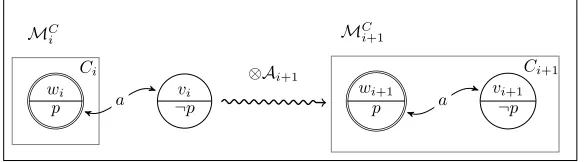
This rule can be read as the driving force behind the sceptical argu-ment: the making salient of possibilities we may properly ignore by introducing them in the conversational context, with the result that they are no longer properly ignored. Because of this context-change potential, it makes sense to consider the perspective of dynamic se-mantics to describe this rule: what is the result of adding a previously ignored possibility to the context?
The generality of this rule is rather large. The rule of course applies to “the mere mentioning” of possibilities, but even goes beyond that. Consider for instance the following sentence:
(4) The mere mentioning of the name of her friend John made her wonder about his whereabouts.
or even
(5) All of a sudden she considered the possibility that he might be in America.
This underlines not only the open nature of the Rule of Attention, but also its fluidity. There need not be definite reasons for possibilities to enter the context. We will see in the formal part of this thesis that as a result of this, it is not always possible to encode in our language the result of announcements or actions.
After introducing these rules, Lewis invites us, to “[d]o some epistemol-ogy. Let your fantasies rip.”30 And you will find yourself in a context where there are uneliminated possibilities everywhere and by attending to them you are no longer ignoring them and very quickly almost no ascription of knowledge, either to yourself or to others, is true anymore.
3.4 Conclusions
In this section we have seen a semi-formal framework of attributive con-textualism. What makes this framework special is the systematic modal
treatment of a set of rules that govern given a knowledge claim which pos-sibilities are relevant and need to be considered and which pospos-sibilities can be (properly) ignored. The driving force behind the rules is the Rule of At-tention. This rule because of its context-change potential makes it a good candidate to find a representation by dynamic logics. However, because of the very open nature of the rule – anything mentioned gets put in the context and therefore no longer is ignored – this demands a decision on a methodological level in order to decrease the overhead a representation of the Rule of Attention would place on the formal system.
4
Finite narrative modelling
4.1 Introduction and motivation
In the previous section we have seen that the Rule of Attention allows us to bring anything to the foreground and make it part of the conversational do-main. When attempting to formalise this rule one is faced with the problem of representing that which is ignored and that which we attend to. Because of the open nature of the Rule of Attention, this means that a language should be able to represent any possibility.
In this section we will discuss two approaches to this problem. We can distinguish two general modelling methodologies calledopen modelling and closed modelling. It is a distinction between models that continuously in-teract with that which it models,i.e., the target, and models which targets are complete, in a sense to be determined, when the modelling starts. We will discuss the differences between the two approaches in section 4.2.
In this thesis we will follow the approach ofclosed modelling by use of a specific meta-technique we will callfinite narrative modelling. We will give a description of this semi-formal framework in section 4.3.
After considering an example (section 4.4) we will discuss some structural properties offinite narrative modelling in section 4.5.
4.2 Open and closed modelling
We can distinguish between two general modelling methodologies we denote by open modelling and closed modelling.31 These modelling methodologies
31
are providing the meta-level of the modelling.
Let’s call that which needs to be modelled the target or target system and the result amodel orformal representation. The target can be any part of reality, but, without defining this explicitly, we will roughly assume this to be a scenario, situation or story consisting of events and actions. The key difference between the two approaches is not so much the target but rather when the modelling is done with respect to the target. Open modelling is typically done whilst the target unfolds or progresses, whereas closed modelling is typically done when the target is complete in some relevant sense. For instance, when our target is a narrative open modelling will model a narrativeas the narrative progresses,closed modelling will have the possibility to go offline, and construct a respresentation of the narrative when the narrative has reached its conclusion.
The choice of methodology has important consequences for what we might call overhead of the (formal) system doing the modelling. Suppose we want to model a narrative and we are confronted with an initial fact, for instance, that the story is set “in fair Verona, where we lay our scene”. Whether or not the location of the story will become relevant cannot be known by the system in advance. This fact might become negligible, but it also might not. As a result this fact needs to be represented in the formal language employed by the system, together with representations of other locations, where the story might have been set. In contrast, closed modelling will consciously leave some of the modelling to the modelling practice, in the sense that the modeller will decide in advance, if the location is relevant or not. We stress again that the closed modeller only has this opportunity if the target is given to him or her in a complete form up front. If the modeller would for instance decide it is not an important fact (the story works just as well in the back alleys of Manhattan) he or she could leave out location entirely in the representation. Languages employed by open modellers tend to be much richer than those of closed modellers since they need to be able to deal with new and unforeseen situations.
Admittedly, this is a distinction between idealized approaches: hardly any system in practice is using a completely open modelling methodology. In the area of AI that studies formal representation of narratives an example that comes close can perhaps be found in [Dyer, 1983], but the model pre-sented there can only deal with narratives that are similar to each other.32
32
It is also clear that even Curiosity, the mars rover, does not have a module installed that allows it to interact with traffic lights, and this is a decision made on the level of the modelling practice. Typically, one will find the open modelling approach used by people who implement AI software or build robots. The method of closed modelling, in fact, is the main method-ology used in most theoretical applications of logics of action, which we shall argue for at more lenght below.
Because of the open nature of the Rule of Attention, by which anything can be introduced in the conversational discourse by mere mentioning, a de-cision with respect to the methodological approaches described above needs to be taken. In what follows we imagine that the dialogues, storiesetc., to which we can apply Lewis’ rules, are given to us in a finite narrated form that the modeller can read from beginning to end before having to decide on the modelling tools.
4.3 Finite narrative modelling as a modelling technique
The general methodology of finite narrative modelling can be described as follows. A human modeller is given a (finite) narrative in some form (natural language text, movie, libretto, a play etc.) and the aim is to develop a framework in which a formal respresentation can be given of the narrative. Narratives are in a general sense a description of the world, where ‘world’ is not restricted to the actual, every-day world. Narratives can be as diverse as a movie about a ficticious heroine in a fictitious part of the universe and the minutes of last Thursday’s board meeting.
A common definition ofnarrative isa description of a sequence of events. Also in linguistics the termnarrative seems to refer to texts in which events occur in a temporal order. We shall not define precisely what we mean by narrative here33 but we will roughly assume that it means a coherent sequence of events featuring one or more agents in some narrated context, whereevent is taken to mean a change in the state of affairs.
Even before a narrative is selected to be formalised, we may assume the modeller wants to focus on something particular. For instance, he or she could be interested in the belief structure or the deontic structure or other structure of the narrative. We call thiscontextual focus and simply is the particular concepts a modeller tries to formally capture and determines, up to a point, which components of the narrative become relevant for the
See also [McCarthy, 1976] for an early programmatic memo.
33
modeller. We believe that all research is embedded in the customs and traditions of a particular research community, and that this will influence the contextual focus, although of course, not in a strict, necessary way. We note that even though this is perhaps somewhat obvious it is an important feature offinite narrative modelling, because it will limit the range of frameworks.
We imagine that next the modeller transforms the narrative into list form, creating a finite list of descriptions of the relevant stages of the nar-rative. LetN be a narrative, then we will denote the narrative list byLN. It could be that not all the sentences are relevant for the representation of the narrative and the modeller could decide to leave out certain sentences. Sentences could also be added to make explicit certain implicatures that could be hidden in the text. This process of transformation should probably be more likened to a soft massage rather than the execution of a computer script.
Once the modeller is satisfied with the list LN, the modeller will go through the list to look for the building blocks of his language. For instance, if the decision was made the language is based on propositional logic, then a propositional variable has to be added for each of the facts listed inLN. The gathering of the building blocks of the language, for instance, selecting propositional variables to represent facts, or constants to represent objects, is an iterative process, which is characteristic of the structure offinite narrative modelling as a whole, something we will point out in more detail below, and is done with one eye focussed on the framework to be developed.
At this point we have a formal framework F to our disposal, which is given by a syntax and corresponding semantics. The syntax determines a formal language, consisting of elements we have gathered in the previous step, and will also determine a class of mathematical models for the language and a satisfaction relation, in the usual sense of mathematical logic.
The penultimate step of the process is to construct models M of the frameworkF for each stage iof a narrativeN given in LN, thereby giving a sequence of models Mi, which is intended to represent the narrative N. What exactly the procedure is a modeller follows when he or she constructs a modelMat a particular stageiis a difficult question and is more of an art than of a science, according to some. In [van Benthem, 2009], the author, considering the construction of a model for an epistemic situation, remarks the following:
is a cognitive abstraction skill that many people have, a serious fact in itself. [van Benthem, 2009, p. 3]
This art or skill depends on the experience and creativity of the modeller and the more complex the situations become the more experience and creativity is required to construct an adequate representation.34
Finally, the modeller needs to confront the representation of the narrative with the narrative itself and check if the representation is faithful.35 If the modeller is satisfied he or she stops, if not he or she can go back to the beginning and rework his steps and make changes anywhere in the process.
4.4 An example
Example 4.1(A small narrative). John’s mother complained over the phone that she hasn’t been feeling well lately, so John decides to visit her. He takes the train and walks over to his mother’s house which is quite near to the train station. He notices along the way that a new bakery has opened shop and suddenly is reminded that his mother asked him to bring some cookies to go with the coffee. He quickly buys some and arrives at his mother’s house to find here in much better shape than she made seem over the telephone.
Although we use the above as an example of a narrative we note that narratives normally tend to be much longer and are not always in a ready form to serve as an object for modelling. For instance, in a literary story, there could be flashbacks or flashforwards, stories within stories, and so on.36 In the case of this simple example, we can easily create a list of single statements in chronological order, but this might not always be so easy and in those cases the modeller needs to do some ordering, perhaps leave out sentences and do some interpretation.
Example 4.2 (An example of the narrative in list form).
34
Commenting on this point, the authors of [van Eijck et al., 2011] try to show that some of the art is actually a science.
35
What exactly afaithful representation is, is a difficult matter. It is something that cannot be defined context-independently and depends on what you aim for. We will discuss this in some more detail in the next section.
36
1. John’s mother complains over the phone to him that she has not been feeling well.
2. John decides to visit his mother.
3. Luckily, on the way over to her house, John notices a new bakery and is reminded by this to bring cookies, which he would have otherwise forgotten.
4. John brings the cookies to the visit of his mother who is in fact quite well.
Considering the example above, there are several formal frameworks we could think of, depending on what it is exactly we are trying to represent, i.e., the contextual focus. We could be interested in the beliefs of John and his mother. For example, how John’s mother believes John will bring cookies but that it is only after he sees the bakery he is reminded. Similarly, we could be interested in a simple temporal representation of the events that take place, or the various relations between the two characters that are in the story, and so on.
Suppose we would proceed naively and we wish to formally represent the basic properties and relations of the narrativeN in example 4.1. We would then go through the listLN to gather the elements for our language. Example 4.3 (“Formal representation” of example 4.1 just to make a point). LetLbe a language consisting of the following components. We have a set of variables A = {a1, a2, . . . , am} denoting agents, a set of variables
O={o1, o2, . . . , on}for objects and the following sets of predicate lettersP =
{Son of,Not feeling well,Small distance}andQ={Remembers,Visits,Brings}. If a1, a2 are agents and o1, o2 objects, then
Son of(a1, a2)
Not feeling well(a1)
Small distance(o1, o2)
are states. Ifa1, a2 are agents and o1 is an object, then
Remembers(a1, o1)
Visits(a1, a2)
are events. A basic semantics for this language, based on elementary set the-ory, now seems straightforward. Given this toy language we could represent the story of example 4.1 as follows:
Son of(j, m)
Not feeling well(m)
Visits(j, m)
(1)
Of course, this is at best an abbreviated summary of example 4.1, how-ever for the moment this will be enough to discuss some important issues.
Here are some things we can remark about our examples:
1. There are elements of the narrative that cannot be represented by the language, but the framework still captures the right structure of the narrative, so enriching the language is a minor revision. For instance, if we look at (1), we see that the fact that John almost forgot to bring cookies but remembered because he saw the new bakery, is not represented. One could argue that this is an essential part of the narrative and any representation of it should represent this fact (see below).
2. There are elements of the narrative that the language is fundamentally not able to express,i.e., a revision would require a change of the whole framework. For instance, if we look at our “framework”, we see that we cannot express the motivation of why John is visiting his mother. The story strongly suggest that John is visiting his mother because he is concerned about her wellbeing. Adding “motivations” to the framework would require an extension of the ontology.
3. There are elements of the narrative that are intentionally left out by the modeller because they are deemed irrelevant for the representation of the narrative. In (1), the fact that the house of John’s mother is near to the train station is not represented. On the face of it this does not really seem to matter for the story and although it could be represented this fact is deemed irrelevant.
have access to an objective structural core on the basis of which we could decide these matters? This notion of granularity, i.e., how finely-grained our representation is, and hence how much of the detail of the narrative is included in the representation, hardly ever seems to be a real issue when we are considering examples like the one we have, but things change rapidly when the narratives become longer. Determining the relevant aspects for longer narratives is not a given and needs empirical grounding (cf. [L¨owe, 2011,§4.3, §6], [Block et al., 2012]).
When we say that faithfulness of the representation also applies to the information that is contained in the narrative we mean the following. Our example narrative seems to imply that John’s mother gave a somewhat negative report of her wellbeing in order to persuade her son to come and visit. This information is not really explicit so one can argue if it should be represented (we don’t in our example). What the intuitions are and if they are shared by everyone who reads the narrative is also something which would need to be investigated.
If we compare (1) and (3), we see that in both cases a particular compo-nent of the narrative could be represented but is not. The difference, how-ever, is that in case (1) this renders an incomplete representation whereas in case (3) not representing it probably does not matter.
If we compare (1) and (2), we see that in both cases it could be argued that the particular facts should be represented, but looking at our language we could probably only (easily) accommodate (1) and not (2).
In order to incorporate point (1) we would need to expand the language of example 4.3, for instance by adding a one place predicate Forget. After this a new representation would look as follows:
Son of(j, m)
Not feeling well(m)
Forget(j, c)
Remembers(j, c)
Visits(j, m)
Brings(j, c)
(2)
this should be represented he or she would again look for adjusments of the framework although in this case this would require a more fundamental revision: we need a way of representing that it is not the case that the mother is not feeling well, but she makes it seem that that is the case.
This iterative procedure, where we check the representation against the narrative, or target, is an example ofconceptual modelling, and we will have a closer look at it in the following section when we discuss in more detail the structural aspects of the modelling process.
In a recent paperfinite narrative modelling has been applied when find-ing formalizations for episodes of a TV crime series and can be seen as a more “real-life” example of narratives and how the technique offinite narra-tive modelling can be applied. In [L¨owe et al., 2009,§3] there is a discussion on how to make modelling decisions and there examples are given showing that these decisions can be hard to make.
4.5 Structure of the formalisation process
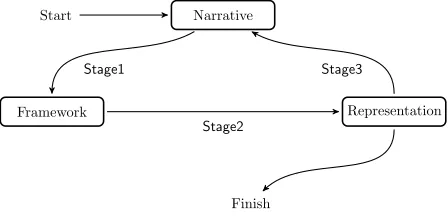
Having looked at a description and an example offinite narrative modelling we now take a step back and look at the structural properties of the pro-cess. The process offinite narrative modellingcan roughly be divided in the following three stages:
Stage 1
• Transform the narrative into list form, creating a finite list of sentences, representing the stages of the narrative.
• From these sentences “read off” building blocks for the object lan-guage: for instance propositional variables, predicate letters,etc.
• Define a formal framework given by a syntax and corresponding se-mantics.
Stage 2
• Devise an initial model and models for each stage of the narrative, thereby creating a sequence of models representing the narrative.
Stage 3
Central to the methodology of finite narrative modelling is the possibility of reading the narrative in entirety up front, and the iterative nature of the process. If the formalisation (stage 3) does not give a faithful representation, the modeller can rework the steps of the modelling procedure by starting again with first stage. Figure 1 is a picure of this structure.
Narrative
Framework Representation
Stage1
Stage2
Stage3 Start
[image:36.612.196.420.209.320.2]Finish
Figure 1: Structure offinite narrative modelling
In the papers [L¨owe and M¨uller, 2011, L¨owe et al., 2010] the authors discuss the widespread methodology ofconceptual modelling. This method-ology can be seen as a generalisation ofmathematical modelling, but is also applied to non-quantitative research areas, for instance in philosophy.
Conceptual modelling is an iterative process through which a stable equilibrium is reached between a concept or a collection of concepts as explanandum and a (somewhat) formal representation of it. [L¨owe and M¨uller, 2011, p. 133]
This idea of using iteration towards an equilibrium involves three natural steps:37
1. Formal representation 2. Phenomenology 3. Assessment
The last step is where the model is confronted with the phenomena. In our setting of finding “the right” representation for a narrative this is the step where we test the model against our intuitions. For instance, suppose we model the epistemic setting of tossing a coin, whereHis heads and T is