Definitional Question-Answering Using
Trainable Text Classifiers
Oren Tsur
M.S.c Thesis
Institute of Logic Language and Computation (ILLC)
University of Amsterdam
Abstract
Automatic question answering (QA) has gained increasing interest in the last few years. Question-Answering systems return an answer rather than a document. Definitional questions are questions such as Who is Alexander Hamilton? or what are fractals? Looking at logs of web search engines definitional questions occur quite frequently, suggesting it is an important type of questions. Analysis of previous work promotes the hypothesis that the use of a text classifier component improves performance of definitional-QA systems. This thesis serves as a proof of concept that using trainable text classifier improves definitional question answering. I present a naïve heuristic-based QA system, investigate two text classifiers and demonstrate how integrating the text classifiers into definitional-QA system can improve the baseline system.
Table Of Contents
ABSTRACT ...2
ACKNOWLEDGMENTS ...6
1. INTRODUCTION ...7
1.1 Question Answering...7
1.2 Question Answering at TREC – Text REtrieval Conference. ...9
1.3 Objectives and Structure of the Thesis ...10
2. DEFINITIONAL QA – BACKGROUND AND CHALLENGES ...13
2.1 Characteristics of the Definition QA...13
2.2 State of the Art ...16
2.2.1 Google Glossary ...16
2.2.2 DefScriber...17
2.3 Official TREC Guidelines and the Evaluation Problem ...18
2.4 The Corpus ...21
2.4.1 Which Corpus to use?...21
2.4.2 Web Retrieval – The Truth is Somewhere Out There...22
3. THE BASELINE QA SYSTEM – TREC VERSION...24
3.1 Hypothesis...24
3.2 System Overview and System Architecture ...25
3.2.1 Question Analyzer...26
3.2.2 Conceptual Component ...26
3.2.3 Biographical Component ...26
3.2.5 Default Component...28
3.2.6 Snippets Filtering Component ...29
3.3 Evaluation Metric ...31
3.4 Results and Analysis ...33
3.5 Discussion...36
4. TEXT CATEGORIZATION AND MACHINE LEARNING ...39
4.1 Introduction...39
4.2 Text Categorization – Definition and General Introduction ...40
4.3 Machine Learning and Text Categorization ...41
4.4 Is This TC Problem Linearly Separable?...43
4.5 Data Representation, Document Indexing and Dimensionality Reduction ....44
4.5.1 Document Abstraction Using Meta Tags...45
4.6 Naïve Classifier...46
4.7 Support Vector Machines Classifier ...49
5. NAÏVE BIOGRAPHY-LEARNER – TRAINING AND RESULTS. ...50
5.1 Training Set ...50
5.2 Training – Stage 1: Term Selection and Dimensionality Reduction ...51
5.2.1 Validation Set ...52
5.3 Training – Stage 2: Optimization and Threshold. ...52
5.4 Test Collection...54
5.5 Results ...54
6. SVM BIOGRAPHY-LEARNER – TRAINING AND RESULTS ...58
6.1 Training Set ...58
6.1.1 Validation Set ...59
6.2 Training ...59
6.4 Results – Classifier Evaluation ...60
6.4.1 General Run ...60
6.4.2 Specific-Name Runs ...60
6.5 Naïve Classifier Performance vs. SVM Performance...61
7. INTEGRATION OF A BIOGRAPHY CLASSIFIER WITH THE DEFINITIONAL QA SYSTEM...63
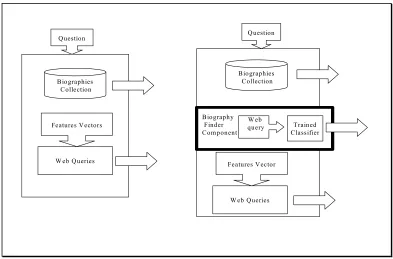
7.1 Integrated Architecture...63
7.2 Test Set...64
7.3 Results ...64
7.3.1 Definitional QA System Integrated With Naïve Classifier ...66
7.3.2 Definitional QA System Integrated with SVM Classifier ...68
7.3.3 Naïve classifier vs. SVM classifier – Results Analysis ...69
8. CONCLUSIONS ...71
8.1 Summary...71
8.2 Conclusions...72
8.3 Future Work...73
APPENDIX A – GLOSSARY ...74
APPENDIX B – THE FO SCORE: A UNIFIED METRIC FOR PRECISION, RECALL AND ORGANIZATION ...75
APPENDIX C - EXAMPLES OF TREC SUBMITTED ANSWERS VS. BASELINE TUNED VERSION ANSWERS ...77
Summary...77
Question 1905 (What is the golden parachute?) ...77
Question 2274 (Who is Alice Rivlin?): ...78
Question 1907 (Who is Alberto Tomba) ...78
Question 2322 (Who is Ben Hur?)...83
Acknowledgments
Thanks to my thesis advisors Dr. Maarten de Rijke and Dr. Khalil Sima’an for their help, support and inspiration.
I also wish to thank my supervisor Dr. Henk Zeevat for his guidance and many wise advices.
1. Introduction
1.1 Question Answering
The field of Automatic Question-Answering (automatic QA or QA, here after) can be viewed from many different perspectives. This introductory chapter briefly reviews the short history of the field, the contexts in which the research exists and the current research agenda. Next, I zoom-in to the more challenging task of definition QA in which answers are harder to retrieve and evaluate. I shall express the motivation and objectives of this work and close the introduction with a short review of the structure of the thesis.
Several disciplines are involved in QA, some of them interact whilst some are independent, some are of theoretical nature whereas others are very practical. The main disciplines involved are philosophy, psychology and computer science.
The roots of QA found in philosophical discussions are millennia old. Although, at first glance, it seems the issue of questions and answers is clear, the nature of ‘a question’ and the ‘expected’ answer occupied the mind of many philosophers during hundreds of years. Starting from the Socratic dialogue, knowledge, understanding, paradox, world - all define nature of “a question”. Ontology, epistemology, mind, truth, ideals, and proof - all define the nature of a good “answer”. Later on, as part of the discussion about the evaluation problems, we mention those philosophical issues.
new directions in the cognitive research [Dix et al. 2002; Pazzani 2001; Norgard et al. 1993 and more].
In recent decades information access has become a major issue. As processors became faster, memory and, especially, storage space became cheaper, and most of all, due to the vast growth of the Internet, we are faced with an urgent need to provide access to the available information resources in an efficient way. Document retrieval systems aim to do this by taking a number of keywords and returning a ranked list of relevant documents. Question answering systems go beyond this. In response to a question phrased in natural language, QA systems aim to return an answer to the user. In other words – a QA system should supply the user with only the relevant information instead of a pointer to a document that might contain this information. The user is interested in an answer, not in a document. The users want all of their work to be done by the machine and do not wish to do the filtering themselves. Sometimes the user is interested in an opinion and the question involves some degree of inference. The answers to this type of questions could not be obtained from a collection as is since the answer “as is” is not present in the collection. An understanding of the question and an inference technology should be used to process the information coded in the collection and generate an appropriate answer. The main sub fields of coputer science involved in this field of research are Information Retrieval (IR), Information Extraction (IE) and Text Mining.
1.2 Question Answering at TREC – Text REtrieval Conference.
Back in the 60’s [Green et al. 1963] a domain-dependant QA system was built, claiming to answer simple English baseball questions about scores, teams, dates of games etc. A decade later the Lunar system was built [Woods 1977], answering questions regarding data collected by the Apollo lunar mission such as chemical data about lunar rocks and soil. The domain-dependant systems are usually based on structured databases. Those sporadic experiments didn’t cause the expected research “boom” and no large-scale experiments or evaluation took place for several decades, until the first Text Retrieval Conference was held in the beginning of the 90’s.
The Text REtrieval Conference (TREC), co-sponsored by the National Institute of Standards and Technology (NIST) and the Defense Advanced Research Projects Agency (DARPA), was started in 1992 as part of the TIPSTER Text program. Its purpose was to support research within the information retrieval community by providing the infrastructure necessary for large-scale evaluation of text retrieval methodologies. [NIST home page1; 23;24;25;26;27]. Each year’s TREC cycle ends with a workshop that is a forum for participants to share their experiences. After the workshop, NIST publishes a series of overview papers and proceedings written by the participants and the TREC organizers.
Factoid Questions Definitional Question
• How many calories are there in a Big Mac?
• Who was the first American in space?
• Where is the Taj Mahal?
• How many Grand Slam titles did Bjorn Borg win?
• What are fractals?
• What is Ph in biology?
• Who is Niels Bohr?
[image:9.595.88.514.506.587.2]• What is Bausch & Lomb?
Table 1.1 Examples of Factiod and definitional questions
At 1999, TREC-8, Question Answering track was the first large-scale evaluation of domain-independent QA systems. At TREC-11 (2002) many of the questions in the test set (taken from search engine logs) turned out to be definition questions, even though the main focus of the track was still on factoids. This showed that:
“Definition questions occur relatively frequently in logs of search engines, suggesting they are an important type of questions” (TREC 2003, definition QA pilot; [25])
At TREC 2003 definition questions became an official part of the evaluation exercise, with their own answer format and evaluation metrics (see chapters 2 and 3 for details). To stress the importance of definition questions, they accounted for 25% of the overall QA score, although they only made up about 10% of the whole question test set.
One of the main challenges of TREC 2003 QA track was the problem of evaluation of answers. The problem of evaluation is also of great importance and I address it in more detail in chapters 2 and 3. Evaluation of QA systems means a clear idea of what a good answer is. As mentioned above, this problem is not only a computational problem (as hard as the answer retrieval itself), but it is also an old philosophical and psychological problem. My interest in building a QA system is motivated not only by achieving another step for a novel solution to the QA problem, but it is motivated also by those philosophical and cognitive questions. Note that the TREC evaluation is still done by human assessors while the main effort was defining metrics and guidelines for the assessors as a starting point before building an automated evaluation system.
1.3 Objectives and Structure of the Thesis
The previous sections presented the TREC research agenda and the different research possibilities. In this section I present my interests and my research agenda, entwined with the TREC agenda in some aspects and differs in other aspects.
In this work I‘m concerned with open domain Definition QA. My interest
lies in open corpus source, namely the WWW. The WWW presents the
can be found to almost any possible question. The web is changing constantly and new emerging events have their reflection on the web. On the other hand, it is unstructured, constantly changing, not supervised and contains much noise and low quality information. My challenge is to cope with this wild field of data in order to mine the gold-lines of information that lies beneath the messy surface.
Next, in chapter 2, I present the state of the art and some of the core challenges we face when we come to deal with definitional QA systems. Amongst those challenges I
discuss the evaluation problem, the “good answer” definition problem, the recent TREC guidelines for answers and assessment and I state my own objectives. I also mention some problems regarding web retrieval.
In chapter 3 I present my baseline definition-QA system. This system is based on a heuristic selection of feature-sets and keywords for a good retrieval. This system was submitted to the TREC 2003 QA track and was ranked the seventh out of 54 submissions by leading corporations and institutes. I’ll present a differently tuned version of the baseline that performed even better. I’ll analyze the results, the points of strength and the weakness of this baseline system. I conclude that we can improve performance using machine learning techniques for text categorization.
Chapter 4 is an introduction to text categorization. I describe the classification problem from general perspective, discuss some crucial aspects of text classification algorithms and explain why this problem is not linearly-separable. I also briefly review the two classification algorithms I use –a naïve classifier - mutation of RIPPER and Support Vector Machines (SVM). These two algorithms were chosen for they represent two different approaches toward text classification, each has its unique advantages and disadvantages.
Chapter 6 repeats the categorization with another algorithm – SVM. It is assumed that SVM is currently the best text classifier. I present and discuss some of the surprising results.
Chapter 7 goes back to the over-all picture presenting the unified system, tested on a real definitional QA task, and analyzes the results.
2. Definitional QA – Background and Challenges
This chapter presents the main challenges and problems of definitional QA, the state of the art of definitional QA and the guidelines of the last TREC QA Track, which define the current research agenda in the field. I review a few problems regarding QA and web retrieval and mention some of my goals and objectives beyond the TREC guidelines.
Fact -Q: Where is the Taj Mahal? A: In the city of Agra.
Def –Q: What is a battery?
A: Batteries are made in cell packs and button-size disks, and last from days to months and even years. All modern batteries generate electricity by use of an electrochemical reaction. Generally two electrodes are inserted--one positive (a cathode) and one negative (an anode)--into a material called an electrolyte, which helps the flow of energy between electrodes. The electrodes can be liquid or solid. When a battery runs down the anode and cathode reach a state where they can no longer pass electrons between them. Batteries store energy not electricity. Batteries date back to 1790. Zinc carbon batteries have given away to Alkaline batteries. Over the years batteries have used manganese dioxide, zinc, nickel, lithium salts, hydrogen-absorbing alloys and potassium hydroxide.
Table 2.1 Example of answers for factoid and definition questions (TREC documents).
2.1 Characteristics of the Definition QA
Definition questions, as they are used at TREC and by most of the researchers, opposed to factoid questions, has two main features (see table 2.1)[27]:
1. The answer is longer and consists of at least one full sentence and can be of a paragraph length or even longer.
2. The correctness of the answer is not binary. The answer A for a factoid-question Q is either correct or incorrect2, while the answer A’ for a
2 Actually there also is “inexact answer” – “the string contains more than the answer or missing bits of
question Q’ can be partially correct, partially wrong, not a full answer, inexact answer etc. Using terms of IR, we have to define some metric of precision and recall in order to rank answers for definition-questions.
Looking at table 2.1, the answer to the factoid question is correct or incorrect, although it can be incorrect for number of reasons. ‘Agra’ is the right answer while in case the system returns “Jerusalem” or “Amsterdam” it would clearly be a wrong answer, which no one can argue about. The full answer is a string of 5 words and the answer could also be a single word “Agra” or two words “Agra, India”3. The Answer for the definition-question is much longer, based on many facts from different areas, requires more sophisticated language model and text generation mechanism. Moreover, is it a full answer or maybe it is too long and detailed? Maybe the question was about an artillery battery and not about the electricity power source?
The vague nature of an answer to a definition-question also results in a major difficulty to evaluate the answer. Automatic evaluation of a definitional-QA system is as hard and problematic as the answer retrieval itself or even harder. In order to automatically evaluate an answer, there should be a clear notion of what a good answer is. Furthermore, the evaluation system needs to occupy a good comparison method in order to compare the information the system expects, and the information retrieved, since even though good answers deliver close information, the language used is probably different. In other words, the system should be capable to match two semantically-close answers although they differ very much in style. In addition, we totally ignore the fact that different users expect different answers and one user can find an answer sufficient while another finds it insufficient. In an ideal world we would like the evaluation system to be flexible to users need.
All of those problems were addressed in TREC 2003 [27;28] but no sufficient solution yet found, therefore the current TREC policy is to evaluate definition-QA systems by human assessors. Human assessors have the cognitive ability to evaluate
3 Actually it is not that trivial. Should we accept an answer like “India”? Should we accept an answer
like “Asia”? what about the given answer “The city of Agra” – shouldn’t we require the state as well? What about the answer “On the banks of Yamuna river”?
the answers but the core problem still remains – what is a good answer. For a specific question Q, one will take A1 as a sufficient answer while another will take A2 as a sufficient answer. A1 and A2 can have almost no intersection at all4. Different assessors, just like different users, have different expectations for answers. In the battery example (table 2.1) one will be much more interested in the chemical reaction while another is interested in the different sizes and uses.
Not only that those differences of “expectation” exist among assessors, each assessor might change his point of view and way of judging in different circles of evaluation. In the last TREC 2003 it was shown that even the same assessor could evaluate a specific answer in more than one way in different rounds of assessment [10;27]5.
Another characteristic of the nature of the answer of a definition question is its eclecticism. The answer consists of many pieces of information, sometimes from different sources and different fields. Looking back on the battery example, we can find historic facts, chemical facts, electronic facts and something about the way batteries are used. Although not yet required by TREC, ideally, all those facts should be presented in a coherent and readable way, and not only as separate nuggets. In case the information was extracted from different sources, it should loose the signs of the different origin (anaphora etc.) and be a part of the newly generated text – the final answer (see appendix B) [27;28].
Automatic text summarization is another interesting and very challenging task sharing some important characteristics with definition-QA. Text summarization is the process of distilling the most important information from a source (or sources, in the case of multi-document summarization) to produce an abridged version for a particular user and task [16;18;19]. Identifying the key points in a document or documents extracting them and organizing/rewriting the extracted snippets in a coherent way. Automatic text summarization research is still an emerging field, but the current definitional QA research can borrow some of the insights, methods and metrics used for text
4 The notion of “intersection” of answers in not well defined yet. I define it later.
5 Each group participating in the TREC could send 3 different runs of their system. Even though some
summarization. Indeed, some of those metrics were used by the TREC 2003 assessors as reviewed later in this chapter.
2.2 State of the Art
As mentioned above, TREC 2003 was the first large-scale effort to evaluate definitional QA systems. Not much research on definitional QA took place before this last TREC. AskJeeves6, probably the most known QA system is incapable of answering definitional QA due to the simple fact that it retrieves a list of documents, just like a standard search engine. Other systems like AnswerBus7 [Zhiping Zheng] retrieve a series of snippets, most of them irrelevant or insufficient. TREC committee implemented and tested few systems as a pilot to the real track. These systems were tested in order to set the goals for the coming TREC (2003). This section briefly reviews two of the very few definitional QA systems were built before TREC 2003.
2.2.1 Google Glossary
Google Glossary is not a real QA system but it shares some important aspects with QA systems, therefore I find it worth mentioning. Last summer (July), just before the TREC deadline, Google released a beta version titled Google Glossary8. Google released no official reports about the system performance or about the algorithm. Google declares the system “Finds definitions for words, phrases and acronyms” [Google Glossary]. It seems Google Glossary exploits few online glossaries and encyclopedias and retrieves a list of the definitions taken from those glossaries. It seems that Google Glossary is searching for the definition target in external knowledge source sources. As for its domain, it retrieves definitions for words and phrases but not organizations or figures, unless they are very well known and won an entry in one of the encyclopedias accessed by Google9.
6 http://www.ask.com/
7 http://misshoover.si.umich.edu/~zzheng/qa-new/ 8 http://labs.google.com/glossary
9 An “exception” for a definition question of an organization answered by Google Glossary is for the
Opposed to a real QA systems, Google Glossary lacks the ability to process a natural language question. All wh questions cannot be answered since Google Glossary fails to process it. Google Glossary requires the bare term (definition target), while the main idea of QA systems is to process a natural language style question and return a good answer in natural language. “Search engines do not speak your language, they make you speak their language” [AskJeeves]. QA systems attempt to let the users ask the question in a way they would normally ask it. In those terms, Google Glossary is still a standard search engine.
2.2.2 DefScriber
DefScriber is a system developed in Columbia University. It combines knowledge-based and statistical methods in forming a multi-sentence answers to definitional questions of the form “What is X”. It is based on definitional predicates by which it identifies the “right” definition sentences from a selection of possible answers. The candidate sentences are selected from longer documents by summarization and generation techniques. The main idea of the system is that “answering a ‘What is X?’ definitional question and creating a summary result for the search term ‘X’ are strongly related” [6]. The predicates mean to screen definitional material from a large volume of non-definitional material returned from search and identifying types of information typically found in definitions. Detailed description of the system architecture can be found in [6].
way but analysis of the results shows that better results can be achieved by using ML techniques instead of heuristics and manual feature-selection.
2.3 Official TREC Guidelines and the Evaluation Problem
Evaluation of definitional QA systems is much more difficult than evaluation of factoid QA systems since it is no more useful to judge system response simply as right or wrong [see section 2.1; 27; 28]. Evaluation of definitional QA system is actually abstraction of the real system’s task of providing an answer to the definition question. This is just like the chicken-and-egg proposition, since the whole point of evaluation is to set the standards that constitute a “good system”.
The last TREC set the requirements from definition-QA systems, as currently expected in this relatively new field of research. Traditionally, the TREC committee sets standards and milestones for improvement before and after analyzing the conference results. In the pilot of the last definition-QA track, “systems were to return a list of text snippets per question such that each item in the list was a facet of the definition target. There were no limits placed on either the length of an individual nugget or on the number of nuggets in the list, though systems knew they would be penalized for retrieving extraneous information” [27]. Yet, assigning partial credit to a QA system response requires some mechanism for matching concepts is the desired response to the concepts in the system’s response, similarly to issues arise in evaluation of automatic summarization and machine translation systems, where the concepts should be semantically identical and not syntactically identical. Moreover, without some expectations and “familiarity” with the user (questioner) it is impossible for the system to decide what level of detail is required and considered a “good” answer. School-aged child and a nuclear scientist expect two different answers for the same question. To provide guidelines to systems developers, the following scenario was assumed:
They are not experts in the domain of the target, and therefore not seeking esoteric details [27].
Taking the above into account, precision and recall are non-trivial notions when scoring definition questions (or text summarization). The TREC committee solved the problem as follows: “For each definition question the assessor will create a list of all acceptable information nuggets about the target from the union of the returned responses and the information discovered during development. Some of the nuggets will be deemed essential, i.e. piece of information that must be in the definition of the target for the definition to be considered good. The remaining nuggets on the list are acceptable: a good definition of the target may include these items but it doesn’t need to” [27; 28].
The definition of precision and recall is derived from the assessor’s lists, although an answer could achieve a perfect recall by matching only a subset of the list – all the essentials. On the other hand, there are many other facts related to the target that, while true, detract from a good definition and thus an answer containing those facts is penalized. These facts shouldn’t appear in the assessor’s list10. The scoring metric for definition answers is based on nuggets recall (NR) and an approximation of the
nuggets precision (NP) based on length, assuming that of two strings that deliver the same information but vary in length – the shorter the better. The NP and NR are combined by calculating the F-score with β = 5 to give recall an importance-factor of 5 comparing to the precision.
The F-score measure is computed as follows: 2
2
( 1)
( i )
Q NP NR F L NP NR β β β + ⋅ = + ,
where is a list of snippets (pieces of information) retrieved by system i for a question Q. NP and NR are standard precision and recall computed against - the assessor’s target list (for more details on the evaluation metric see section 3.3).
i Q L * Q L
10 In a question about Alger Hiss, we don’t care about the fact that he brushes his teeth every morning,
Note that although this is a formal and strict metric, it only addresses some of the aspects mentioned above. An assessor still has the some freedom to create his own list and to decide which facts are essential and which are not – this way the assessor affects the recall and the F-score of an answer. A good question-set is of a diverse nature and as the assessor is not an expert in the fields of the entire collection, he learns the answer just like the user and it is possible that his lists are not complete. Moreover, different assessors, just like different users, can legitimately have different views on what a relevant or essential snippet is.
Another issue the TREC F-score metric completely ignores is the coherence and organization of the answer. This problem was tackled in the TREC pilot “Holistic” evaluation. In this evaluation the was score computed as follows:
1 ( ) 5
2
i Q
score L = ⋅content+ content organization⋅
This is very loosely defined. The assessors were to judge intuitively given the definitions (TREC 2003 definition QA Pilot):
Content: The system response includes easily identifiable information that answers the question adequately; penalty for misleading information.
Organization: Information is well structured, with important information up front and no or little irrelevant material11.
assessors. In appendix B there is an alternative metric, little different from the one proposed in the TREC pilot.
2.4 The Corpus
2.4.1 Which Corpus to use?
TREC QA track is based on a closed corpus. Each system submitted to the TREC can get its answers using all sources available but the answers should be justified by pointers to the documents in TREC collection from whom the answer could be retrieved. My definition QA system is based on web retrieval and not on the closed corpus domain used for the TREC QA track. Basing the system on web retrieval forced me to add another component to my system – the justification component. This component was used next to the web retrieval in order to find “justification” to my web retrieved answers in the TREC collection. This component is irrelevant for this research and was used only in order to meet the TREC guidelines. Yet, using web retrieval involves few other issues I find important to mention.
The most important feature of the web is its size. The web is huge and dynamic. Information can be found on almost every desired topic. For instance, on November 24, Google has indexed 3,307,998,701 pages, which is only a portion of the actual web.
On doing web retrieval, this wealth of information means that recall is not an issue and only precision counts since full recall cannot be obtained and/or computed. One can hardly tell whether he has the full picture due to the size and the constant change of the web content represented (in this research) by the Google indexes12. On the
other hand, doing definitional QA, recall is an important measure to the extensiveness of the answer. Definitional QA based on web retrieval is, therefore, problematic.
This problem was artificially solved by adopting the F-score or any similar metric basing precision and recall on finite, relatively short lists. The assessor decides on a list of facts that are acceptable as part of an answer. A subset of those facts is defined
12 All the systems implemented this thesis make use of Google search engine as a preliminary retrieval
as mandatory essential fact that no answer could be considered complete without. Precision and recall are then computed in respect to those lists and not in respect to the information “available” on the web. Note that this solution is only technical and not inherent. Those lists enable to measure precision and recall (and thus F score) in respect to those lists only and give a numeric evaluation, but one can argue that the lists are not complete unless built by a universally-accepted expert in the field of the definition target.
2.4.2 Web Retrieval – The Truth is Somewhere Out There
Another issue regarding web retrieval is the quality of the pages. One of the things that characterize the web is its lack of regulations. The web is in a constant change; there is no control on the contents – subject wise and quality wise. It is not guaranteed that a document or a nugget retrieved from the web is not noisy or misleading. One can assume that Google page ranking system overcomes this problem. This assumption is only partially true. While it is reasonable to assume that high-ranked Google pages are more important hubs and authorities, contain less junk and are better structured, these pages can still be biased and contain misleading information. For example, Microsoft PR page is the first to be retrieved for some queries regarding Microsoft Corporation, Microsoft products or Microsoft personnel but one has to remember that Microsoft Corporation dominates the Microsoft domain with all the information bias derives from the interests of the “page master”. This is not some Microsoft conspiracy – it holds true for governmental domains as well as many other firms and corporations. It is even legitimate or at least a common PR tactic. Yet, we/the users have to be aware of those biases. Google ranking helps a lot to filter the real junky or poorly structured stuff out but it cannot secure objectivism of important pages. This objectivism is most important in definition questions for a definition can, sometimes, depend on the definer authority [12].
In this work I didn’t try to tackle this problem of the quality of webpages, I simply rely on the Google ranking system as the best free filtering system available.
3. The Baseline QA System – TREC Version
The previous chapter drew the challenges of definitional QA and the current research agenda. This chapter describes the baseline system designed according this agenda. The baseline system was submitted to TREC 2003 and scored very nicly, ranked 7th out of 54 submissions. In this chapter I present my hypothesis, describe the system architecture, present, discuss and analyze the results the baseline system achieved in the TREC.
Along with the TREC submission results I present results of the same baseline system, a bit differently tuned. It is shown that tuning results in great improvement and I believe that the tuned run could score even better if it had been submitted to the TREC.
I close this chapter with some conclusions suggesting that using ML techniques for text categorization could result in further improvement.
3.1 Hypothesis
I expect that identifying the “right” documents on the web will not only improve the precision and recall obtained by a QA system, but will also result in major improvement in the coherence and organization of the answer. The right document means retrieving glossary-entry-like or encyclopedic-entry-like pages from the web instead of using an external knowledge source, and using Google snippets representing this page as the answer nuggets.
3.2 System Overview and System Architecture
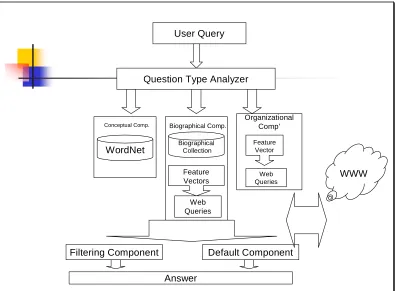
User Query
Question Type Analyzer
WordNet BiographicalCollection
Feature Vectors
Web Queries
Filtering Component Default Component
Answer
Feature Vector
Web Queries Conceptual Comp. Biographical Comp.
WWW
[image:25.595.92.489.261.552.2]Organizational Comp’
Table 3.1 Baseline System Architecture
The flow of the baseline system consists of four steps: 1. Question Analysis.
3.2.1 Question Analyzer
In the first step the system uses the Question Analyzer component in order to determine the question type (biographical, concept, organization) and key words like the question word, the definition target (DT) etc. The analysis is rather naïve and based on the question key words, like “Who/what”, on articles and determiners identification, on capitalization and name recognition.
In the next step each question type is treated in a different way by a different component. In case no answer was returned by any task-specific component, the default component returns a naïve answer.
3.2.2 Conceptual Component
Concept questions are treated by the Conceptual component. Previous work [7; 17], shows that using dictionary sources is very effective approach for answering “what is” questions. Given a question the system first consults WordNet in order to get the answer for “free”. This approach was recently adapted by Google, releasing its beta version of Google Glossary (see section 2.2.1).
3.2.3 Biographical Component
Designing the baseline system, the main effort was focused on the “Who is/was” questions. I chose to focus on “who is” questions for three reasons:
1. Analysis of search engines logs show that most of the definitional questions are of the “who is” type – about sixty (60%) percents [26; 28].
3. Previous work already addressed “what is” questions. Although this work suggests a new approach that wasn’t tried for “what is” questions either, the baseline, presented in this chapter, starts up with almost the same approach of exploiting existing glossaries and ordered collections, more specific, by making use of biography collections.
Focusing on “who is” questions doesn’t mean other types of definitional questions left aside. It only means I put more effort in answering “who is” questions and that the hypothesis will be checked mainly according to the system performance on this type of questions.
Biographical “Who is” questions are passed to the Biographical component. Following the same rationale of using WordNet for conceptual questions, we first try to get a ‘ready made’ authorized biography of the definition target (the person in question). We do this by consulting the big collection of biography.com. The challenge lies in the case where no biography could be found in the biography.com domain. Actually this happens in most of the cases and the system has to collect small biographical nuggets from various sources. The system uses a predefined-hand crafted set of human features: the FV (features vector). The FV contains words or predicates like “born”, “died”, “graduated”, “suffered” etc. then searches Google for different combinations of the definition target and various subsets of FV.
1 He wrote many short stories, including "The Man Without a Country" 1863, "The Brick
Moon" 1869 (1st story describing an ...Hale, John Rigby, Sir (1923-1999 ...
2 Editorial Reviews Synopsis Sir John Hale is one of the worlds foremost Renaissance
historians whose book "The Civilization of Europe in the Renaissance" (1993 ...
3 ... he died there on Christmas Day, 1909 SIR JOHN RIGBY HALE... on the founding of
Virginia,and wrote short stories. The grand-nephew of Nathan Hale, in 1903 he was ...
4 ... Am looking for possibly James HALE who was a coachman ... for a complete list of the
music WH wrote. ... du nouveau manuel complet d'astronomie de sirJohn fW Herschel ...
5 A love unspoken Sheila Hale never thought she was worthy of her husband, the brilliant historian, Sir John Hale. But when he suffered
6 On 29 July 1992, Professor SirJohnHale woke up, had ... For her birthday in 1996, he wrote
on the ...JohnHaledied in his sleep - possibly following another stroke ...
7 Observer On 29 July 1992, Professor SirJohnHale woke up ... her birthday in 1996, he wrote
on the ...JohnHaledied in his sleep - possibly following another stroke ...
8 ... Sir Malcolm Bradbury (writer/teacher) -- Dead. Heart trouble. ... Heywood Hale Broun
(commentator, writer) -- Dead. ... John Brunner (author) -- Dead. Stroke. ... Description:
Table 3.2 Example of Google Snippets retrieved for subsets of a toy FV and the pilot question “Who is Sir John Hale?”
The FV subsets are predefined by humans according to thumb-rules, common sense heuristics and as a result of try-and-error runs (ideally, those features would be selected by a domain expert). An example of a toy FV is be “born, position, wrote, book, work, prize, known, graduated, school, suffered, died”. Taking two subsets of this vector, say, “born wrote graduated” and “wrote suffered died” with the definition target, say, “Sir John Hale”13, creating two Google queries returns various snippets some of them contain usful information and other snippets are irrelevant (see table 3.2).
The features subset selection can be much improved with experience gained over time. The features-subsets-selection is part of the parameter tuning to be described later (along with tuning of the filtering component).
3.2.4 Organizational Component
“What is <an organization>” questions are processed by the Organizational component. The organizational component is based on rather naïve method. It looks for information about the organization by performing a web search combining the definition target and a small subset of “organization features” that might happen to be unique to organizations manifesto or declaration. Opposed to the Biographical Component, the Organizational Component has no smart feature selection and the answer is not chosen to be the combination of different features subsets queries.
3.2.5 Default Component
In case the task-specific components yield no satisfactory results, the question is processed by the Default Component. The default component basically gets the Google snippets corresponding to the fixed string “DT is a”. This naïve method
13 This was one of the most difficult questions in the definitional QA pilot. Not much information can
proved to be very good for questions like “2385. what is the Kama Sutra?”. The problem with this component is that there is no control on the results and no corrupted snippet will is filtered out. The use of this component depends on the penalty the system gets for wrong answers.
3.2.6 Snippets Filtering Component
When the system processes a question using other component than the default component it monitors the quality of the snippets. There is more than one way the retrieved snippets may be corrupted. Snippets can be noisy (see snippets 1, 3, 5 in table 3.2) or totally irrelevant (see snippets 4,8 in table 3.2). In order to overcome the problem of the lack of integrity of the snippets, we use the Snippets-Filtering Component to be described below.
Snippets Filtering component – the final step is to filter the retrieved snippets. The retrieval components might return hundreds of snippets, some are identical, some are different but contain almost identical information (see snippets 6,7 in table 3.2), some are completely irrelevant (see snippets 4,8 in table 3.2), some are relevant but dirty (see snippets 1, 3, 5 in table 3.2) while some other snippets are just perfect (snippet 2 in table 3.2 is almost perfect). Filtering the valuable snippets from the junk and identifying snippets that contains semantically close information are important tasks. These two tasks are processed separately. First we remove irrelevant snippets. An irrelevant snippet is identified by the syntactic structure of the snippet, meaning the distances between the tokens of the definition target and between the definition target and other entities and features in the snippet. In the example of table 3.2, snippets 4 and 8 are being removed for the words “Sir”, “John”, “Hale” and “wrote” are too far from each other, suggesting the snippet’s subject is not “Sir John Hale” but represents a document regarding at least three different people: “Sir X” “John Y” and “Z Hale”.
Formally, LD is a measure of the similarity between two strings, which we will refer to as the source string s and the target string t. The distance is the number of deletions, insertions, or substitutions required to transform s into t.
The system performs a partial stop-words removal and stemming, then sorts the tokens of the each snippet in order to overcome structure variations like passive/active forms. Going back to the example presented in table 3.2, snippet number 7 is removed because its semantic similarity with snippet number 6.
1 He wrote many short stories, including "The Man Without a Country" 1863, "The Brick
Moon" 1869 (1st story describing an ...Hale, John Rigby, Sir (1923-1999 ...
2 Editorial Reviews Synopsis Sir John Hale is one of the worlds foremost Renaissance
historians whose book "The Civilization of Europe in the Renaissance" (1993 ...
3 .. he died there on Christmas Day, 1909 SIR JOHN RIGBY HALE... on the founding of
Virginia,and wrote short stories. The grand-nephew of Nathan Hale, in 1903 he was ...
5 A love unspoken Sheila Hale never thought she was worthy of her husband, the brilliant historian, Sir John Hale. But when he suffered
6 On 29 July 1992, Professor SirJohnHale woke up, had ... For her birthday in 1996, he wrote
on the ...JohnHaledied in his sleep – possibly following another stroke ...
Table 3.3. The snippets actually returned by the baseline system
The delicate task is choosing threshold of similarity, meaning the maximal distance in which we still treat two strings as semantically identical14. This threshold has a significant impact on the filtering task, and tuning the threshold after the track submission resulted in great improvement of precision and recall, not to mention the improvement in length of the returned answer, for many snippets were filtered out. The threshold was determined manually after several runs on a test collection and on the TREC pilot collection. Back to the example of table 3.2, setting the threshold too low might leave both strings (6, 7) in the final answer. Setting the threshold extremely high might filter all snippets but the shortest one.
In the TREC submission the system used another component – the Justification Component. The TREC guidelines demand an answer justification pointing to the relevant documents in the TREC collection. Since this research concerns an open corpus, namely the web, pointers to the relevant TREC documents had to be found as
14 By the term semantically identical I don’t mean pure semantically identical. Two strings differ from
a last step. The Justification Component finds the justification in the TREC collection and adjusts the output to the TREC guidelines, meaning that sometimes we had to break a perfect answer to shorter nuggets. Since this work addresses the problem of definitional QA using an open corpus, I’m not going into the details of this component.
3.3 Evaluation Metric
Chapter 2 section 2.3 presented the evaluation problem and briefly described TREC 2003 metric used in the evaluation of definitional questions. This section goes into the details of the evaluation metric and assessors guidelines.
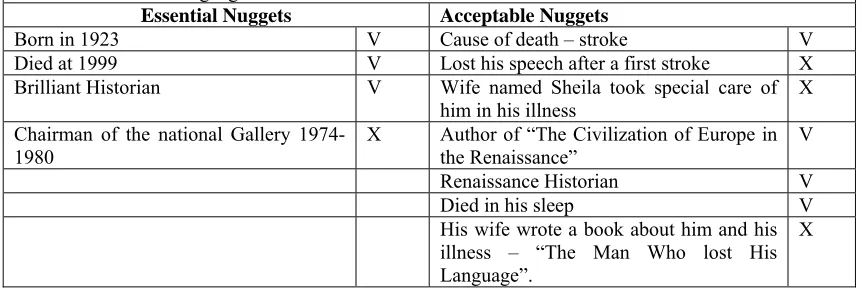
Hale, John Rigby, Sir (1923-1999) British historian; chairman of National Gallery 1974-1980; wrote
"The Civilization of Europe in the Renaissance" (1993). Sir Hale is known as one of the foremost renaissance historians and his book considered the best book ever written about those times. At the age of 69 he suffered first stroke loosing his speech ability. Nine years later he suffered another stroke and died in his sleep at the age of 76. His devoted wife, Sheila, took special care of him in his years of illness, describing their lives, especially Sir John’s struggle after loosing his speech in the book “The Man who Lost His Language”.
Essential Nuggets Acceptable Nuggets
Born in 1923 V Cause of death – stroke V Died at 1999 V Lost his speech after a first stroke X Brilliant Historian V Wife named Sheila took special care of
him in his illness
X Chairman of the national Gallery
1974-1980 X Author of “The Civilization of Europe in the Renaissance” V
Renaissance Historian V
Died in his sleep V His wife wrote a book about him and his illness – “The Man Who lost His Language”.
[image:31.595.83.514.383.527.2]X
Table 3.4 – “Who is Sir John Hale?” Answer and assessors lists. Check marks mark what nuggets were returned by the system.
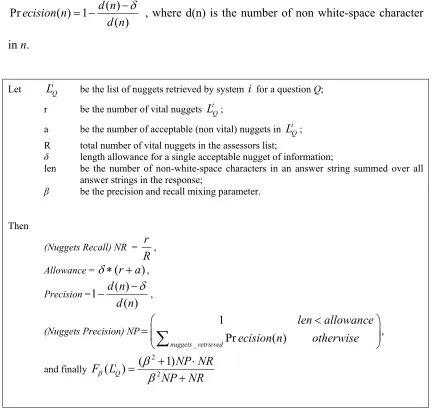
answer nuggets) the precision is computed in respect to the general list of acceptable nuggets (including the list of essentials). Borrowing from evaluation of summarization systems [16;18;19], the length of the nuggets is a base to a crude approximation of the precision. The length based measure captures the intuition that users prefer the shorter of two definitions that contain the same concepts. Defining a length allowance δ to be the number of non white space characters for each correct nugget allowed, precision score is set to be 1 if a retrieved nugget is no longer than δ, otherwise the precision on a nugget n is is:
( )
Pr ( ) 1
( ) d n ecision n d n δ −
= − , where d(n) is the number of non white-space character in n.
Let LiQ be the list of nuggets retrieved by system for a question i Q; r be the number of vital nuggets LiQ;
a be the number of acceptable (non vital) nuggets in LiQ; R total number of vital nuggets in the assessors list;
δ length allowance for a single acceptable nugget of information;
len be the number of non-white-space characters in an answer string summed over all answer strings in the response;
β be the precision and recall mixing parameter. Then
(Nuggets Recall) NR = r
R,
Allowance = δ∗ +(r a),
Precision =1 ( )
( ) d n d n δ − − ,
(Nuggets Precision) NP ,
_ 1
Pr ( )
nuggets retrieved
len allowance ecision n otherwise
< ⎛ ⎞ = ⎜⎜ ⎟⎟ ⎝
∑
⎠ and finally 2 2 ( 1)( i )
[image:32.595.82.515.240.648.2]Q NP NR F L NP NR β β β + ⋅ = +
Table 3.5 Computation of F-score for definitional questions
100), NR= 3
4 , NP = 1 (since the allowance is 100*(4+7)=1100 much longer than len). The F score for this toy example is 0.7572. Note that even though snippet #1 contains misleading data (John Hale didn’t write short stories, the stories are attributed to another Hale), the system was not punished for it because of the big allowance and the big β stating precision is not very important in this parameter setting.
This metric ignores the aspect of coherence and organization and combines only precision and recall. Section 2.4 described my goals in this work; one of them was building a QA system trying to achieve coherence of the retrieved answer. This chapter presents a baseline implementation of such a system; yet, this system requires a different metric in order to evaluate an answer with respect to its coherence along with its precision and recall. An alternative metric I developed – the FO (F score and Organization), taking coherence and organization into account is presented in appendix B15.
In the next section I present the official TREC results followed by results of a tuned version of the baseline.
3.4 Results and Analysis
This section presents and analyses the TREC submitted results followed by the results of a differently tuned version of the baseline. The following section discusses the results, pointing on problems revealed in the baseline and suggesting a noble method to solve some of the problems. Remember that although the baseline is far from perfection, even the first, not-tuned, version did score very well and was ranked rather high by TREC assessors.
15 The F score for definitional QA is problematic enough and not always stable. The alternative metric
The average F-score of our TREC submission was 0.315, much better than the median (0.192) but still a bit behind the best system with the score of 0.55. These results place the system as the seventh out of 54 submissions. This average F score was computed over all the 50 questions in the TREC set but the system was scored null for 20 questions. The average F score over the 30 answered questions is 0.527.
Since the system was more focused on “who is” questions, I would also like to mention the distribution of our system F score over the different question types:
Who is questions: average F score: 0.392, improvement of 25 % of the overall score.
The F score for “what is <an organization>” and for “what is <a concept> are: 0.268 and 0.15 in respect.
After a tuning session (independent of the TREC questions) I managed to improve the precision and the recall, boosting the overall system’s F score. The tuning session included tuning of two parameters 1) resizing the features subsets and 2) filtering threshold tuning.
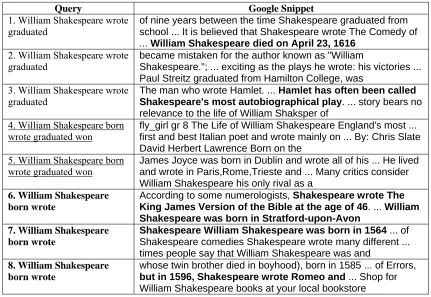
Query Google Snippet
1. William Shakespeare wrote
graduated of nine years between the time Shakespeare graduated from school ... It is believed that Shakespeare wrote The Comedy of
... William Shakespeare died on April 23, 1616
2. William Shakespeare wrote graduated
became mistaken for the author known as "William
Shakespeare."; ... exciting as the plays he wrote: his victories ... Paul Streitz graduated from Hamilton College, was
3. William Shakespeare wrote
graduated The man who wrote Hamlet. ... Shakespeare's most autobiographical playHamlet has often been called . ... story bears no relevance to the life of William Shaksper of
4. William Shakespeare born wrote graduated won
fly_girl gr 8 The Life of William Shakespeare England's most ... first and best Italian poet and wrote mainly on ... By: Chris Slate David Herbert Lawrence Born on the
5. William Shakespeare born
wrote graduated won James Joyce was born in Dublin and wrote all of his ... He lived and wrote in Paris,Rome,Trieste and ... Many critics consider William Shakespeare his only rival as a
6. William Shakespeare born wrote
According to some numerologists, Shakespeare wrote The
King James Version of the Bible at the age of 46. ... William
Shakespeare was born in Stratford-upon-Avon
7. William Shakespeare born wrote
Shakespeare William Shakespeare was born in 1564 ... of
Shakespeare comedies Shakespeare wrote many different ... times people say that William Shakespeare was and
8. William Shakespeare born wrote
whose twin brother died in boyhood), born in 1585 ... of Errors,
but in 1596, Shakespeare wrote Romeo and ... Shop for
[image:34.595.82.513.422.719.2]The effect of the resizing was a better quality of the retrieved snippets (see table 3.6 and appendix C).
The big subsets sometimes return irrelevant documents or corrupted snippets since Google tried to match the whole query. The longer the query is the bigger the chance to get corrupted snippets. Long documents containing many of the required features will be represented by shattered snippets, sometime mixing sentences regarding other people (see rows 4 and 5 in table 3.6). Since the system is based on Google snippets and not on retrieved documents as a whole, the noise in the snippet is a function of the feature subset size, the length of the document and the distance between the terms of the query as they appear in the document. Resizing the FV subsets improves recall since the returned snippets are more accurate containing more focused details (see rows 6-8 in table 3.6).
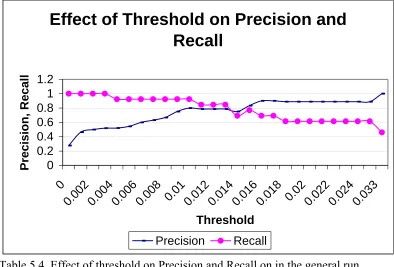
The other tuned parameter is the filtering threshold. A bigger filtering parameter filters more documents, removes redundancies and improves precision. In the tuned run the filtering parameter was set to 85 instead of 70 in the submitted run.
The average length of an answer in the TREC submission was 2815.02. The average length of an answer in the tuned version was a bit more than half of the basic run – only 1481.62, causing a major improvement in the precision score. The improvement of the precision score is not necessarily linear to the change in the average length of an answer since the precision function is not linear (see precision function at table 3.5). In case the length of an answer drops under the allowance the precision is set to 1 as noticed in the “John Hale” example (section 3.3 and tables 3.4 and 3.5).
After tuning the system achieved an F-score of 0.688 on the very same question set used in TREC. Further more, instead of 20 unanswered questions in the TREC submission16, only 6 unanswered questions remained after the tuning (what helped in boosting the F score of the tuned version).
Since the runs sent to the TREC scored 0 for twenty (!) questions out of 5017 (meaning that the overall F score is quite impressive), it might be interesting to look at the performance of the system in respect to the answered questions only. Calculating our TREC average for the non-zero F score questions shows an average F-score of 0.527. However, after further tuning we managed to reduce the number of unanswered questions to six only, obtaining an average F-score of 0.688.
3.5 Discussion
According the official TREC results the hypothesis drawn in the beginning of the chapter is proven correct. This simple and rather naïve baseline achieved quite high ranking - 7th out of 54 submissions, though it is still far from perfection. Furthermore, the system was not evaluated in terms of organization and coherence at all. Looking on the system output (see appendix C) it is clear that the system would have scored badly on coherence if measured. In this section I discuss the results, analyze the weak points, and suggest more improvements following the rationale of the hypothesis (see section 3.1).
Since the main focus of our work was “who is” questions, I would like to discuss some issues noticeable in the results of the “who is” questions in a more specific way.
Past experience of using a dictionary such as WordNet shows quite good results [7; 17]. I decided to try and adopt this approach for “who is” questions and get as much information as possible from online encyclopedia such as biography.com. However, only less than half of the “who is” questions had entries in biography.com, the rest of the questions were answered using the Google snippets that were returned by searching predefined subsets of the features vector.
16 The TREC assessors scored 20 questions with 0, some of them since no answer was retrieved while
Using the combination of a biographies-collection and the features-vector, we face some notable problems, mainly of two kinds.
The first problem of our system was coping with literature/fiction figures like “2130. Who is Ben Hur?” or “2322. Who is Absalom?” (see appendix C). Those figures have no entry in the external knowledge source since they do not have a real biography. When no biography could be found in the external source, the system is programmed to look for combinations of features that are connected to the lives of the people, thus the system will not find too much info related to fictional figures. We note however, that our tuning helped in improving the precision of this kind of questions, but had no real effect on the recall.
The other problem is of the opposite nature. For some figures, our system returned too much of irrelevant data, without the ability to filter the junk. Two questions of this type are “2082. Who is Anthony Blunt?” and “2125. Who is Charles Lindberg?”. There are too many people named Charles Lindberg and many institutes, schools and programs named after him. Most of the results seemed relevant but a second look reveals that not only it is not vital information; some of it is totally irrelevant.
4. Text Categorization and Machine learning
4.1 Introduction
The previous chapter presented the baseline system submitted to TREC 2003. Although the system was highly ranked by TREC the system is far from perfection. The definitional QA system sent to TREC 2003 was based on special external knowledge source and on web retrieval. The system exploits Google search engine, sending various queries then filters the returned snippets to form an answer from the remaining snippets (see section 3.2). Analysis of the results shows that Google snippets are not always sufficient. The baseline method is heuristic-dependent and since the system (just like the user) doesn’t “know” the individual key terms related to each definition target, some important information nuggets may not be retrieved while some junk snicks in through the nuggets-filtering component, resulting in low precision and recall. Moreover, even when Google snippets contain all the relevant information and only the relevant information, the answer is poorly structured since combining many nuggets from different sources to form a coherent answer is a hard task, let alone the fact that each individual nugget, being a Google snippet, is not always well structured (see Appendix C for examples of answers).
Source of Answer Average F-score
[image:39.595.130.454.500.551.2]Web (Google) 0.304 Glossary (WordNet) 0.504 Biography Collection (Biography.com) 0.586
Table 4.1. TREC submission average F score according to answer source. The hypothesis lying behind the baseline was that using external knowledge source or identification of external knowledge source-like documents, improves definitional QA systems. Performance analysis of the baseline reveals the hypothesis holds true. The analysis proposed is that retrieving the answer from a single source or very few good and reliable sources improves performance greatly (see table 4.1).
external knowledge source, promotes the idea of filtering the noise and retrieving external knowledge source-like documents. Filtering of documents by genre can be done by text categorization methods. In the rest of the work I test the use of Machine Learning techniques for text categorization in order to achieve a better filtering.
For the remainder of the thesis we zoom in on biography-like documents categorization, used to improve answer for “who is” questions. The decision to concentrate on “who is” questions is explained in detail in section 3.2.3, however, a brief reminder of the main motivation is appropriate:
1. Search engines logs show that “who is” questions are more frequent than the two other types of definitional questions [26].
2. Biographies are easily treated as lists of facts; therefore categorization of biographies is very intuitive, therefore easier to model than a definition of organization or a concept.
In this chapter I review text categorization from a ML perspective, including some formal notations. I present the features of the two algorithms I use (Naïve classifier and SVM) and explain a number of decisions made, regarding text representation. In the next two chapters the performances of algorithms are analyzed and discussed. Chapter 7 analyzes the integrated QA system and the contribution of the learning biography-filter component to the QA system.
question classification, documents retrieval and named entity recognition do use it to some extent.
The goal of TC is to classify the topic or theme of a document, for example categorization of the Reuters text collection into categories like “mergers and acquisitions”, “earning reports” etc [Hayes et al. 1990]. Text Categorization is the task of assigning a Boolean value to each pair d cj, i ∈ ×D C, where D is a domain of documents and C={ ,...,c1 cC}is a predefined set of categories18. A value of T
assigned to each pair d cj, i indicates the decision to file under , while value of F indicates a decision not to file under .
j
d ci
j
d ci
More formally:
The categorization task is to approximate the unknown target function by means of a function
*:D C {T F
Φ × → , } Φ:D C× →{ , }T F called the
classifier, such that Φand Φ* coincide as much as possible.
The binary classification function is the standard way to look at TC. This is called hard categorization. For the purpose of this work a different kind of classification could be more appropriate. The QA system receives a stream of candidate documents and should filter/choose the best documents to get the answers from. For this purpose the classifier output should be a rank of a document according to its estimated appropriateness to a desired category. This process is called ranking categorization.
4.3 Machine Learning and Text Categorization
The baseline implementation of the QA system, presented in chapter 3, used a very simple and naïve categorization method somewhat close to the old TC technique known as Knowledge Engineering (KE). KE was popular in the 1980s. An example of this approach is the Construe system [Hayes et al. 1990] built by a Carnegie Mellon
18 Note that is is also possible to do text categorization without knowing the categories in advance. This
group for the Reuter agency. Construe was based on a set of manually defined logic rules in the form of
If (DNF formula) then (category)
The drawback of this approach is known as the knowledge acquisition bottleneck. In order to build such a system a knowledge engineer must be employed along with a domain expert. When dealing with many categories or once the set of categories is updated, new rules should be written, with cooperation of the knowledge engineer and the domain expert. Applying ML techniques could solve this problem of knowledge acquisition bottleneck. Using ML we build a learner that will be able to make the categorization decision after some training without the help of a domain expert. In case the set of categories is updated, the learner should be trained again only on a training set including the new category.
In order to train and test a learner/classifier, one needs a training set and a test set, which are taken from an initial corpus of documents Ω ={ ,...,d1 dΩ}⊂D. A document di is a positive example of the category if ci *( , )
j i
d c T
Φ = and is a
negative example of if ci *( , ) .
j i
d c F
Φ =
4.4 Is This TC Problem Linearly Separable?
Classification problems can be divided into linearly separable and non-linearly separable problems. A dichotomy is linearly separable if the space of documents can be distinguished via a linear surface (line or hyper-plane). Some learners can learn only linearly separable problems, some learners can learn non-linearly separable problems but without reaching optimal solution while some other learners (SVM) can learn non-linearly separable problems by pumping the dimension of the problem and finding a linear separator in the higher dimension.
In the scope of this work it doesn’t really matter if the biography categorization is linearly separable or not, since absolute separability is not as important as relative classification. Humans can tell whether a document is not a biography, humans can identify pure biography when they read one, however, there are documents that even humans will hesitate whether they should be classified as biographies even though the documents are noisy and contain many biographical details. For this specific definitional QA task, we can make use of noisy biographies, although they would be ranked lower than clean biographies. A clean biography is a document that was written as a biography. A noisy biography is a document that wasn’t written as a biography but as an article or review about the figure in question (i.e. NYT article presenting someone). I assume that a clean biography can be extracted from a noisy biography.