Rochester Institute of Technology
RIT Scholar Works
Theses
Thesis/Dissertation Collections
2004
The role of advertising agencies on the demand for
personalized communications
Kathryn C. Moore
Follow this and additional works at:
http://scholarworks.rit.edu/theses
This Thesis is brought to you for free and open access by the Thesis/Dissertation Collections at RIT Scholar Works. It has been accepted for inclusion in Theses by an authorized administrator of RIT Scholar Works. For more information, please [email protected].
Recommended Citation
School of Print Media Rochester Institute of Technology
Rochester, New York
Certificate of Approval
Master's Thesis
The Role of Advertising Agencies on the Demand
for Personalized Communications
This is to certify that the Master's Thesis of
Kathryn Moore
has been approved by the Thesis Committee as satisfactory for the thesis requirement for the Master of Science degree
at the convocation of
May 23, 2003
Thesis Committee:
Patricia Sorce
. Patricia Sorce, Primary Thesis Advisor
Franziska Frey
Franziska Frey, Secondary Thesis Advisor
Frank Cost
Frank Cost, Graduate Thesis Coordinator
Twyla
J. Cummings
The Role ofAdvertisingAgencies on the Demand
for Personalized Communications
By
Kathryn C. Moore
A thesis submitted inpartialfulfillmentofthe
requirementsforthe degreeofMasterofScience inthe
SchoolofPrint MediaintheCollege
ofImagingArts& Sciencesofthe
Rochester Institute ofTechnology
October 2004
Thesis/Dissertation Author Permission Statement
Title of thesis or dissertation: The Role of Advertising Agencies on the Demand for Personalized Communications
Name of author: Kathryn Moore
----~~---Degree: Masters of Science
Program: Print Media
College: College ofImaging Arts & Sciences
I understand that I must submit a print copy of my thesis or dissertation to the RIT Archives, per current RIT guidelines for the completion of my degree. I hereby grant to the Rochester Institute of Technology and its agents the non-exclusive license to archive and make accessible my thesis or dissertation in whole or in part in all forms of media in perpetuity. I retain all other ownership rights to the copyright of the thesis or dissertation. I also retain the right to use in future works (such as articles or books) all or part of this thesis or dissertation.
Print Reproduction Permission Granted:
I, Kathryn Moore , hereby grant permission to the Rochester Institute Technology to reproduce my print thesis or dissertation in whole or in part. Any reproduction will not be for commercial use or profit
Signature of Author:
Ka
t
h
ryn C. Moo re
Date: 1-03-05Print Reproduction Permission Denied:
I, , hereby deny permission to the RIT Library of the
Rochester Institute of Technology to reproduce my print thesis or dissertation in whole or in part.
Signature of Author: ___________________________________ Date: ________ _
Inclusion in the RIT Digital Media Library Electronic Thesis &
Dissertation (ETD) Archive
I, , additionally grant to the Rochester Institute of Technology Digital Media Library (RIT DML) the non-exclusive license to archive and provide electronic access to my thesis or dissertation in whole or in part in all forms of media in perpetuity.
I understand that my work, in addition to its bibliographic record and abstract, will be available to the world-wide community of scholars and researchers through the RIT DML. I retain all other ownership rights to the copyright of the thesis or dissertation. I also retain the right to use in future works (such as articles or books) all or part of this thesis or dissertation. I am aware that the Rochester Institute of Technology does not require registration of copyright for ETDs.
I hereby certify that, if appropriate, I have obtained and attached written permission statements from the owners of each third party copyrighted matter to be included in my thesis or dissertation. I certify that the version I submitted is the same as that approved by my committee.
The RoleofAdvertisingAgencies ontheDemand forPersonalizedCommunications
I, Kathryn Moore, herebygrant permissionto the
Wallace MemorialLibraryofR.I. Ttoreproducemy thesisin whole orinpart.
Anyreproductionwill not beforcommercial use orprofit.
TableofContents
ListofTables v
ListofFigures vi
Abstract vii
Chapter 1: Introduction 1
Chapter 2: A ReviewoftheLiteratureintheField 3
PersonalizedPrinting 3
PersonalizedCommunications: ChallengesandBarriers 4
AdvertisingAgencies Role inRecommendingNew Media 7
Innovative BehaviorofAgenciesofDifferent Sizes 10
MarketingStrategiesofClient Types 10
Chapter 3: The Hypotheses 13
Agency Type 13
Agency Size 14
Client Type 15
Chapter 4:Methodology 17
Chapter5: TheResults 19
Hypothesis 1 23
Hypothesis 2 26
Hypothesis3 28
Chapter 6:
Summary
and Conclusions 31Agendafor FurtherResearch 33
Bibliography
35Appendices 37
Appendix A
-Advertising Agency Survey 38
AppendixB - Case
Study on aDirect Marketing Agency 42
ListofTables
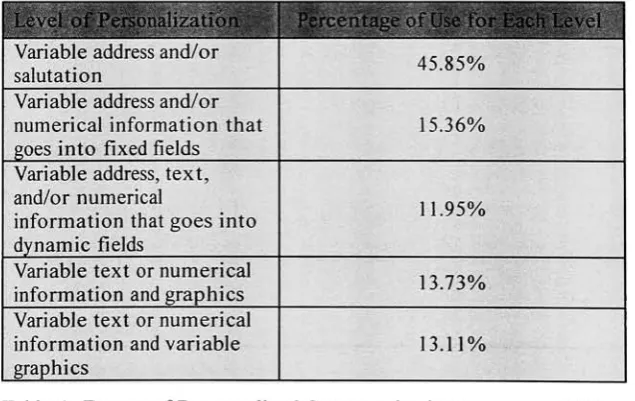
Table 1.DegreeofPersonalized Communications 21
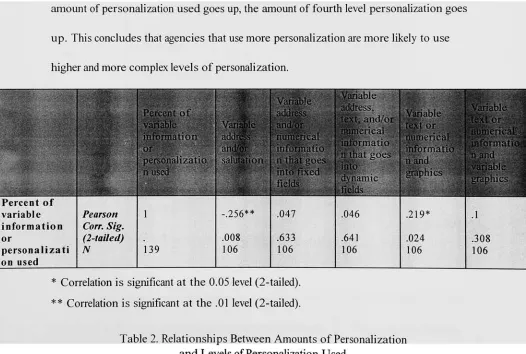
Table 2. Relationships Between AmountofPersonalizationandLevels
ofPersonalization Used 22
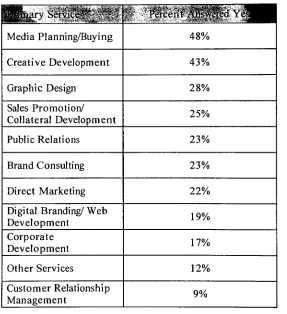
Table 3. Primary Services Provided byAgencies 23
Table4. NumberofAgencies in Each Cluster 24
Table 5. Means Comparison(Agency Type) 25
Table 6. NumberofAgencies Located in EachAgencySize 26
Table 7. Means Comparison(Agency Size) 27
Table 8. Relationships Between HighandLow Annual Billings
andLevelsofPersonalization Used 28
Table 9. Means Comparison (Client Type) 30
Table 1 0. Background Information Resultsfrom theAgencySurvey 38
ListofFigures
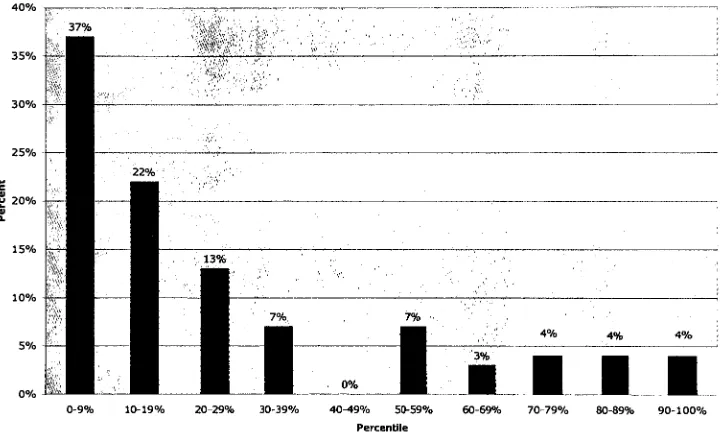
Figure 1. PercentageofAgency WorkInvolvingPersonalizationorVariable Data 20
Figure 2. Exampleof aPersonalized Brochure 46
Abstract
Apersonalizedcampaignallows anagency toutilizeits
clients'
recordstoreach
itsaudienceby sendingtargetedmessages andpromotions, whichoftenresults in
improved businessresults. Thispullisachievedby using detailed databaseswith alarge
quantityofinformationaboutexistingand potential customers. This information, inthe
formoftext, dataand sometimesimages, isthenplacedintoadocument inaway that is
easy forcustomerstolocateand actupon.Variabledatatechnology shouldbeembraced
by advertisingagenciesas adefinite wayto improveresponse rates and generate more
business. Butwhatdo advertisingagenciesactuallythinkof personalized campaigns?Is
thetechnologybeingembracedby agenciestoimprovebusinessresults?Doesthe type
and size oftheagencymake adifference inwhether or not personalizedcampaignsare
used?Does theagency'sclientbasealtertheuse of personalization?
To findsolutionsto thesequestions,asurveywas givento a randomgroup of
advertisingagenciesdrawnfromThe Red Books list of agencies. Atotalof250agencies
completedthe telephonesurvey. Also,anin depth questionnaire was completed by a
direct marketing agency usingpersonalizedcommunications,tocomplementthe survey
results.
Whatwasfoundwasthatan average ofonly 23% ofthework theagenciesdo
actuallyinvolves usingaformof personalizedcommunications. Seventy-ninepercent of
clientsrequestingpersonalization are smallbusinesses ($100millionorless inannual
revenue), 15%are medium sizebusinesses ($101 millionto$1 billioninannualrevenue),
and almost6%oftheclients arelarge businesseswith morethan $1 billion inannual
revenue. Forty-eight percent of clientsrequestingpersonalized communications were
business-to-business clients.Almost 42%werebusiness-to-consumer
clients, andthe
other 11%wereboth.
Todetermineifthereisadifferenceintheuseof personalizationaccordingto the
agency type,agencies were groupedintothreecategories: 1) direct marketingandweb
agencies,2)traditional full serviceagencies,and3)boutiqueagencies.Results indicatethat
thereisno significantdifference intheuse of personalization amongthese threeagency
types. Direct marketingandweb agenciesusethemostamountofpersonalization at25%,
followed closelyby traditionalfullservice agencies at24%. Boutiqueagenciesusethe
least amount ofpersonalization at20%.
Todetermine ifthereisadifferenceintheuse of personalizationinrelationto
agency size, theagencies were classifiedintothreegroupsaccordingtotheirannual
billings: 1)smallagencies with$5 millionorlessinannualrevenue,2)medium agencies
withannualrevenuebetween$5,000,001 and$50million,and3) largeagencieswith
annualrevenue of$50,000,0001 or more.Results determinedthat thereis no significant
difference intheuse of personalizationamongthesedifferent agency sizes. Largeagencies
usethemost amount of personalizationat27.6%, followedbymedium sized agencies at
26.7%andsmall agencies at20.7%.
Finally,todetermineifthereis adifference intheuse of personalizationinrelation
toclient type, agencies were asked onaverage,whatpercentagesoftheiraccounts are
primarilybusiness-to-business (B2B), business-to-consumer(B2C),and a mixture of
both. Results indicatethat again, thereisno significantdifference intheuseof
personalization amongtheseclienttypes.Agenciesthatserved a mixedarray of clients
use thehighest percentageof personalizationat29.5%,whileB2BandB2Cclients use
almostthesame percentage ofpersonalizationat21.5%and22.1%,respectively.
Chapter 1
Introduction
One oftheemergingtechnologies and applications usedby advertisingagenciesto
reachtheirclientsmarketis personalizedcommunications. Clientscreatetheirmarketing
programs, includingmediachoices, andthen turntoanadvertising agency tohelpthem
executetheircampaigns. Adagencies are thecriticaldecidingfactor fortheseclients asto
whether ornot apersonalized campaign willbeusedfortheirproducts or services. Itis
uptoad agenciestobeable toeducatetheirclients onthismarketingtrendandits linkto
improved businessresults. Forthisto take place,agenciesthemselvesmustbeeducated
ontheadvantages ofthis technologyin marketingcampaigns.To determinewhatagencies
aremorelikely tofacilitate theadoption ofthistechnology, it is importanttodiscoverthe
characteristicsoftheagencies andtheirclients thatarecurrently implementing
personalized campaigns.
Theyearsfollowingthe introductionof personalizedprinting indicatedthat there
was a slowadoption ofthetechnology by companies,ad agenciesand print providers
(On-Demand
Printing, 1998). Sincethen, technicalsolutionstosome oftheseproblems
havebeenmet, such asthe introduction ofPPML(PersonalizedPrint MarkupLanguage),
print withdigital devices. However, practicalissuesare stillpresent today, such asthe
cost of
implementing
apersonalized campaign and databaseintegrity. Still,aspersonalizationbecomes moreknownthroughout the advertisingandprintingindustries,
it is importanttofind out whetheradagenciesarefacilitatingor are abarrierto the
adoption of personalization.
This thesisfocuses specifically ontheadvertising agencyanditsuse of
personalizationtechnology. Theobjectives ofthis thesisareto:
1. Determine how
many ad campaigns areusingpersonalizedcommunications
2. Determinewhattypesofagencies areusingthistechnology
3. Determinewhetherthe agency sizeimpactstheuse ofpersonalization
4. Determinethetypes ofclients thatuse personalized communications.
These objectiveswill bemetthroughdescriptive surveys sent to adiverse groupof
advertisingagenciesfromall overtheUnited States. Itishopedthatoncethe thesis is
complete, therewillbe abetter understandingasto thecharacteristicsof adagenciesthat
Chapter 2
AReview oftheLiterature inthe Field
PersonalizedPrinting
Accordingto the"Third EditionoftheBest Practices in DigitalPrint,"
personalizationis"personalizingorcustomizingadocumentby varyingthetext,
graphics, andlayoutofpersonally relevantinformationtherebyachievingthemarketing
goal of effective andefficient
communications."
Itisn't just movingelementsaround, but
instead, "Thefundamentalvalue proposition ofpersonalized printis it increasesthevalue
oftheprinted page asa purposeful communicationtool."("Personalized Print: a new
modelfor
success,"
2000).
Manyad agencies areusingthesimplest formof1:1 marketingwhen names and/or
addressesareplacedonthedocument.Itisused somuch todayhowever,thatit doesn't
seemlikeaformof personalization.Personalized marketing iswhenaseparate and unique
documentis createdforeach person dependingonhisorher individual interestsor
specifications. Any typeof publication canbe personalized,anditcan oftenbe found in
direct mail,promotionalbrochures,and sales collateralor event-related pieces. There
are different levelsof personalization aswell, startingwith asimple mail mergetoa
willfindanincrease inresponserate, thelastlevelbeingthemost targetedandhavingthe
most promise forresponsefrom thecustomer.
PersonalizedCommunications: Challenges andBarriers
Thereare several reasonswhy personalized campaigns aren'talwaysthe first
choiceforan adagencywhen itcomestodecidingonamarketingcampaignfor itsclients.
The firstareaofconcernwhendecidingon a personalizedcampaigniswhethertheclient
hasastrong database.The higherthepersonalizationlevel inthecampaign,thehigherthe
demand isfora clean and up-to-datedatabase. Thiscouldpossiblybe thehardest but
mostimportant part ofputtingtogethera personalized campaign.Ifa clientdoesnothave
a currentdatabase,oradatabaseformatted correctlytomergeintoavariabledata
application, therecouldbereal problems.Databasesstartasrentedmailinglistsand when
acompanyreceivestherespondinginformation fromamailingsuch as apromotion, itcan
thenusethat informationto startformatting databases(Broudyand Romano, 1999). The
databasesthatare used are notjust fullof namesandaddresses;they havedemographics,
psychographics,jobfunctions, purchasingpatternsandevenimagesthat correspondto
individualinterests (Broudy andRomano, 1999). Dataabout customers canbe found in
manydifferentplacesincludingsalesrecords,customersurveys, censusfilesand other
publicsurveys (Jones, 1999). Databasesrequiretheirown software and sometimes their
ownhardware alongwithfront-endsystemsto store and accessdata. Theyalso needto
havea persontomanagethem,andforlargerdatabases, thisrequires advanced database
managementskills, whicharen'tfoundinmost advertisingagencies. Asaresult, many
agencies
doing
personalizationneedtooutsource orhire someonetomanagetheirdatabases. The lastissuewithdatabases is security.Therearemany clients who arevery
reluctanttogivetheirdatabasesoverto agencies,sotherehasto betrustanda
partnershipbetweenboth sides(On-DemandPrinting, 1998).
One continuingtrend thatisimprovingthequality ofdatabases is Customer
Relationship Management (CRM). This isakeycomponentinimplementing
personalized campaigns and canhelp adatabasebecomeinstrumentaltoan adagency's
success. Accordingtothe"Third EditionoftheBest Practicesin DigitalPrint", CRMis
"technology thatinteractswithpotentially every area of anorganization's operationsthat
touches the customer, suchasmarketing, sales,and customerservice. Thistechnology
actsasthe centralrepositoryforallinformationcollectedand shared aboutthecustomer.
Ideally, all customertouchpointsuse thiscommondatabase,allowingInternet, call
center,directmail,andotherinteractionsto shareinformation."Whenthesedatabasesare
incorporatedintoapersonalizedcampaign, theresult isa campaignthatishighly targeted,
building 1:1 customerloyalty thatwill helpmaintainexistingcustomersalongwith
establishingnewrelationships withpotential customers.
Thesecondmajor challengeiscost. Printproviders must provide personalization
expensive,theworkflowismorecomplicated,andtheoperators are even scarcer.Itis
necessarytounderstandthegeneral workflowof avariable or personalized campaignfrom
thecollection ofdatato theprintinganddistributiontorealizewhichadditional costs are
associated withthe technology. Followingarethe 12majorstepsaccordingtoBroudy
andRomano:
1. DataAcquisition/Analysis
-collectdatafromone/severaldatabasesand
organizeinto one
2. MarketingConcept
-definetheprojectintermsofmarketinggoals and results
3. Creative Concept/Production
-designthematerial andplanforpersonalization
4. Data Finalization
-cleanupand organizedata for consistency
5. Data Stream
-Organizedataintoidentifiableunits and standardizedcoding
6. Data Construction &Linking
-linkvariabledatatothelayoutand prepare for
output
7. Print Stream
-OrganizeintoaPostScript datastream
8. Preview/Preprint/Proof/Correct
9. Print Production
-runjobthroughRIP and print
10. Post PrintProcessing binderyandfinishing
1 1. Verify/Audit
-doublecheckforcorrectness
12. Conversion/Archive
-convertforother applications and saveforfutureuse.
Withcostinmind, it ishardtosella client onpersonalized printing.Instead, theagency
needstoselltheclient on personalizationas atool forbuildingamarketingprogram
(Broudy andRomano, 1999). John SissonofBantastates, "Ifcustomersdon't see
anothervaluebeyond theunitcost, they'renotgoingtobeinterested"
(On-Demand
Printing, 1998). Thisattitudeisvery
disheartening
foragenciespromotingpersonalizationbecause inorderfora clienttomakealargeprofitfrompersonalizedcampaigns,agencies
Thethirdmajor challengeistheadditionalwork neededtocreatepersonalized
documents. Designsneedtobecarefullyshapedtomeetall possiblescenariosthatmay
befound inthe database,whetherit'stextlengthortheplacement ofimages. Thesethree
concerns are possible reasonswhy usingpersonalizationisn'talwaysthefirstchoice
whendecidingonamarketingcampaignforan adagencyanditsclients.
AdvertisingAgencies Role in RecommendingNew Media
Historically,advertisingagenciesingeneralhavebeenmediainnovatorswhenit
comestomarketingstrategies. The 4 As (American AssociationofAdvertisingAgencies)
describeanadvertising agency as "anindependentorganizationofcreativepeople and
businesspeoplewho specializeindevelopingandpreparing advertisingplans,
advertisements, and other promotionaltools. The agency purchasesadvertisingtimein
various media onbehalfofits clients
-various advertisers or sellers to findcustomers
forthe
clients'
goodsand
services"
(Leeand Johnson, 1999).
Tobeadoptersofpersonalizedtechnology,ad agencies needtohaveaninnovative
outlookontheirmedia strategiesfortheirad campaigns. Themoreleadingedgethey are
andtheearlierthey educatethemselveson newtypesoftechnology,thefasterthey and
theircampaignswillbenefit from it. Forthis study,itis importanttounderstand the
typesof agenciesthathaveahistory ofbeingmoreinnovative because itcouldplay a role
First, it is importanttonotethe differences in agency types. Agenciescanbe
classified by the servicestheyoffer andby thetypesofbusiness theyhandle. Thereare
twomain typesofadvertisingagencies, full-serviceagenciesandspecialized service
agencies. Fullservice agencies arelargeragenciesthatperform atleast fourofthesebasic
functions fortheirclient: researchservices,creative services,mediaservices,
advertising-relatedlegalcounsel, marketing planningandmanagement and accountmanagement.
Beyond thesebasic segments,afullserviceagency could also offerdirectmarketing,
publicrelations and sales promotionservices(LeeandJohnson, 1 999). Many fullservice
agencies are publiclyownedconglomeratesandmany ofthemareinternational. The single
agencies withintheconglomerates areseparatelymanaged andforthemost part arein
competition with one another(Jones, 1 999).
Themajority ofadvertisingagenciesinthemarket are smalleragencies,which
typically have upto adozenemployees andhandleaccountsupto $10,000(Leeand
Johnson, 1999). Some smallfirmscanbeclassified as full serviceagencies,butthe
majority ofthemare specialized.There are severaltypesofspecialized service agencies
includingcreativeboutiques,health/medicalagencies, direct marketingagencies and ethnic
agencies. Creative boutiquespreparethecreative execution oftheirclient's product and/or
serviceandtheirsolefocusis ontheideaand creative product.Health/medicalagencies
carry outmanyofthe functionsof afull serviceagency, thedifferencebeingthatthey
marketingagencies primarily specializeinstrategicplanning,creative solutions and
execution,anddatabasemanagementfor direct responseadvertising. Direct marketing
agencies also offer serviceslikee-commerce, Internetmarketing, data miningand modeling.
They specializein relationship marketingandinteractivecommunicationstoreachtheir
clients consumers on a personallevel.Ethnicagenciesspecializein advertisingtoethnic
populationsby concentratingon customizedmarketingprogramsgearedspecificallyat
thegroup's values andlifestyles (LeeandJohnson, 1999).
When comparingtraditionalfull service agenciestoboutiqueagencies, studies
have determinedthatboutiqueagencies aremorelikely todemonstrate innovative
behaviors.Accordingtoa report onthepost-adoptionattitudesto advertisingonthe
Internetby Shelly RodgersandQimei Chen,traditionaladvertisingagencieslagbehind
other specializedagencytypes whenitcomestoadvertisingontheInternet (Rodgersand
Chen, 2002). Traditionalad agencieshavea"legacy
system"
mindset where notonlyare
they slowto change,butalso resistanttochange.One reasonforthisisthat "Agencies
withthegreatestmonetary investmentsintraditionalmedia willprobably be lesslikely
than otheragency typestoperceivetherelativeadvantage oftheInternet" (Rodgersand
Chen,2002). Other agencytypes such as new-mediafirmsandInternetboutiquesdon't
havethatmindset, one reasonbeingthat theiragencies were createdtospecialize in
traditionaladagencies,boutiqueagencies needtohaveaninnovativeoutlookand market themselvesas agenciesthatare abletobringtheirclients somethingnew.
InnovativeBehaviorofAgenciesofDifferent Sizes
When comparingagenciesofdifferent sizes,thereisnotevidenceofdifferencein innovative behavior betweensmallagenciesandlargeagencies.Largeragencieshave many raw resourcesandhaveanetworkofpeopleworkingtogether. They havethecredibility toattract more clientswith moremoney toinvest inthe technology.Largeragenciesare alsousuallyassociated withthe traditionalfullservice agenciesmeaningthatthey may havethesame mindset as suggestedinthe previous paragraph.Smalleragencies offer a morepersonalizedtouch intheirservices(Fadden, 1994). Lowoverhead,diversified services,and willingnessto accommodate change are someexplanations forthesuccessof
smaller,boutiqueagencies("AdvertisingAgencies", 2004).
MarketingStrategies ofClientTypes
Theonemaindifference betweenbusiness-to-businessandbusiness-to-consumer
customersisthatbusiness-to-businessclients arelookingtofillaspacefortheir
customers'
needs andbusiness-to-consumerclients are lookingforoneitemtofilla personalspace orneed("B2BvsB2CSelling,"2002). When comparingad agencies
whose clientsarebusiness-to-businessorbusiness-to-consumer, ithas beenshownthat
thereisa cleardifference intheamountofadvertising ineach group. Accordingto an
articlein InternetWire, B2Bs lack marketingcomparedtoB2Cs, especiallyon the
Internet. As statedbefore,decidingto use theInternetaspart ofamarketingplanisasign
ofadoptingtheinnovationprocess. "Accordingto the study,less thanhalfofB2B
customers say theyarevery satisfiedwith theironlinepurchasingexperiencecomparedto
52percent ofB2Cbuyers" ("Internet Wire",2001). Assaidinthearticle,B2Bsare not
adheringto the "fundamentalprinciples ofMarketing 101 whichisto deliverasuperior
online experiencethatisrelevant andtargeted("B2B's LackofMarketingDwarfs B2C's
Mismarketing,"2001).
InrelationtoInternetmarketing, accordingto "The DMA'sStateofPostaland
E-Mail Marketing: New Trendsand Results,"over 51%of alltypesof companies
including B2B, B2C,andcompanieswho areboth, sentunder 100,000e-mailsin 2001.
However, 23%ofB2C companies are morelikely to send over 1 million promotional
e-mails.Whenitcameto sendingpromotional pieces via postal servicesin2001, 80%of
B2B companieswerelikelytosend under3millionpieces,whileonly28.5% ofB2C
companieswerelikely to dothesame. When sendingover30million promotionalpieces,
consumercompanies werethemost likelytodothisat22%. Thisshowsthat B2C
companies are morelikelyto be marketingthroughdirectmail,by wayof e-mail and
postalmail.
When itcameto themost frequentlyusedmarketing strategiesinthese mailings,
The Direct
Marketing
Associationfoundthat 66.7%ofB2Bcompaniessometimes usepersonalizedinformationabout acustomer(beyondname andaddress) intheiroffer,
followedbycompaniesthatare bothat65.3% and B2Cat56.3%. However overall, the
marketing strategy alltypesof companiesuse most oftenis customizingmailaccordingto
customer profile at76%, followedbypersonalization at61.5%. Inconclusion, while
B2Ccompanies aremailingoutmorepromotional piecesthanB2B, B2Bcompaniesare morelikely tobepersonalizingandcustomizing theirpromotional mail pieces. B2C
companies arebecomingmoreinnovative inthe Internetand e-mailmarket, whileB2B
companies arebecomingmoreinnovative inthe directmail market.
Chapter3
The Hypotheses
Thisthesiscontains threehypotheses, all ofwhichstemfromthequestion of
what percentage ofadvertisingcampaignsis usingpersonalized communications. Ofthe
agenciesthatareusingpersonalizationintheircampaigns, it isimportantto pinpoint their
characteristics.
AgencyType
Advertisingagencieshave beenseparatedintothreedistinctgroupsforthis study
basedontheservicesthey saidtheyofferedinthesurvey andfromthe preliminary
researchconducted earlier. Thesegroupsinclude direct marketingand webagencies,
traditionalfullserviceagencies,andboutiqueagencies.Direct marketingagenciesalready
havetheexpertisetobuildcompetentdatabasesand arebasedondirectresponse
advertising,makingthemaqualifiedagency type touse personalization. Traditional full
service agencieshaveallthe resourcesnecessary to besuccessfulin usingpersonalized
communications includingmonetary resources,diverse personnel,and connectionsto
outsidevendors. Howeverthey have beensetintheirways whenutilizingnew media.
Boutiqueagencieshavehadamoreinnovative historyand are uniqueinthat theyare able
tofocus solelyon personalizedcommunicationsand utilizeitas a valuablemarketingtool.
Hence, it is expectedthat,
Hypothesis 1: There isnodifference intheamount ofpersonalized
communications used inrelation toagency type.
Agency Size
Advertisingagencieshave beenseparatedinto threedistinctgroupsforthis study
basedontheirsize.Their sizewasdeterminedbytheiramount ofannual revenue.
Agencies with$5million orless inannual revenue werecategorized assmallagencies.
Agencieswith$5,000,001 to $50millioninannual revenue were categorizedas medium
sized agencies.Annualrevenuesover$50million werecategorized aslargeagencies.
Althoughit has been determinedthatpersonalizedcampaigns canbean expensive
undertaking, theuse of personalizedcommunicationsmaynotbe impactedby thesize of
theagency in termsofits annual revenuebecause itisuncertainwhat kindofadvertising
theirclientsarerequesting.It may bepossiblethatasmallagency isworkingwith afew
clientswhoonly use personalizedcampaigns;alarge agency mayhave hundredsof clients
requestingseveraltelevisionad campaignsthroughout theyear oritmaybethe otherway
around.
Hence,itisexpectedthat,
Hypothesis2: There isnodifferenceintheamount of personalized
communications usedinrelationto agency size.
Client Type
Forthis study, the typesof clients that the agencyworkswith were divided into
threecategories. These includedbusiness-to-businessclients,business-to-consumer
clients, and clients who wereboth B2B andB2C. Targetedcommunications are abetterfit
forsmaller audiences and an example ofthisis selling Cokeversus sellingi-Gen3s. Cokeis
apopularconsumer productknownaroundtheworld andis soldto thegeneral public and
to otherbusinesses forresale.Itwouldmorethanlikely survive withlittleadvertising,but
wouldbenefitfrommass market campaignsbecause itserves somany demographics.
Sinceit servesmany populations, targetingcampaignstoeachdemographic wouldalsobe
an obvious method of marketing.Advertisingfor Xerox'si-Gen3 printer,aB2B product,
needsto betargeted
-notonlyto printproviders,buttoprint providers who would
benefit from its servicesbecauseit serves avery specific servicenotneededby all print
providers. Thebuyer behavior for B2B andB2C firmsdeterminesthatB2B firms have
smaller amountsofcustomers measuredinthethousands,whileB2Cfirms havelarger
amountsofcustomers measuredin themillions. Howeverthedollarvalue of eachB2B
customerissignificantly largerthan thatof aB2C customer.Withthat,the
buying
andsellingprocesstakes longer for B2B sales andultimatelythecost oftheB2B saleismuch
higher ("7 KeyDifferences Between B2BandB2C DatabaseDirect Marketing,"
2004).
Hence,it isexpectedthat,
Hypothesis 3: There isnodifference intheamountofpersonalized
communications used in relation to clienttype.
Chapter4
Methodology
Inordertodeterminethepreviously stated hypotheses,researchwasconducted
andpreliminary interviewswere setupwith local advertisingagenciestobetter
understand theirrelationshipswith clientsand printersandhow theiragency operates.
Fromthese interviewsandtheresearchobjectives, asurveywas assembled.
The survey (AppendixA)containsboth agency-relatedbackgroundquestionsand
variabledata/personalizationquestions. Tomeasure thedependent variablesforeach
hypothesis, theparticipants wereasked: 1)thepercentageoftheiragency'sworkthat
involvesvariableinformationor personalization and 2)thedistributionof100points
among thefive levels of personalizationtoindicate howoften personalized
communicationsisproduced andtowhatdegreethey are personalized. Thesefive levels
include: 1)variable address and/or salutation,2)variableaddress and/or numerical
informationthatgoesinto fixedfields
-thefields donotchangeinsize, shape, orlocation
fromrecordto record, 3)variableaddress,text, and/ornumericalinformationthatgoes
into dynamic fields
-thefieldscanchangeinsize, shape,orlocationfromrecord torecord
basedontheamountofinformationordatabaseconditions andprogramming, 4)variable
textor numericalinformationandgraphics
-thegraphics are static imagesinsertedintoa
fixed field based ondatabaseconditionsand5) variabletext or numericalinformationand
variable graphics
-thegraphics arecreateddynamicallybased ondatabaseconditions and
inserted into fieldsthatcan changeinsize, shape,orlocation.
Tomeasure theagency typeindependentvariable,participants wereaskedtogive
up to threeprimary servicestheiragencyprovidesthatwerethenclustered intothree
agency types. These primary servicesincluded 1)graphicdesign,2)brandconsulting,
3) corporateidentity, 4)creativedevelopment, 5)customerrelationshipmanagement,
6) digitalbranding/web development, 7)directmarketing, 8)mediaplanning/buying,
9) publicrelations, 10) salespromotion/collateraldevelopment, and 11) other services. To
measuretheagency size(independentvariable), participants were asked togivetheir
annualbillingsto determinethesizeoftheiragency. Finally, tomeasurethe clienttype
independentvariable,theparticipants were askedtheaveragepercentageoftheiraccounts
that arebusiness-to-business, business-to-consumer,orboth.
Thesampleforthissurvey wastakenfrom The Red Bookslist, which contains
nearly 13,500 U.S. and international advertisingagencies. A sample of5,325 recordswas
selectedfromthis listand a worldwidemarketresearch and consulting firm contacted a
total of731 agencies.Atotal of250agencies completed thesurveyand 150thatwere
classified as
"production-focused"
and are usedforthis thesis. The remaining 481
agencieseither refusedtocompletethesurveyordid notqualify. Afterall thesurvey data
Chapter 5
TheResults
Eachrepresentative participating inthesurvey wasasked somebasic
characteristic questions abouthisorheragency. Theaveragenumber ofemployeesforthe
agenciesparticipating inthe surveyis56 (n=223). Theaverageannualbillingsare $26
million(n=198). Therespondentshaveworkedan average of19yearsintheadvertising
industry (n=249)andthey haveworked anaverage of1 0yearsfortheircurrentagency
employer(n=248).
Totest eachhypothesis,eachdependentvariablefromitshypothesiswill be
testedagainst the independentvariables inthesurvey. Thedependentvariablesinclude
thepercentage ofagencyworkinvolvingpersonalization andthedegreeofpersonalization
theyare using. Inregardsto thepercentage ofagencywork involvingpersonalization, itis
importanttounderstandthatonly therespondents classifiedas"production-focused"
(n=150)completedthissection ofthesurvey. Respondentswere classified as
"production-focused"
whentheyreportedthattheyeither: 1)areinvolvedinthe
production ofadvertisingmaterials,but donot advise clientsregardingmedia strategies
andselectionor2)bothadvise clients on mediastrategy ANDareinvolved inthe
productionofadvertisingmaterials.
It was 139respondents out ofthat 150thatansweredthepersonalization
question statinganaverage of23%oftheworkthey doactually involves using somelevel
of personalization(with astandarddeviationof27.4.)Figure 1 showsthedistributionof
theresponsesforpercentage oftheworkthat theagenciesdothat involves
personalizationorvariabledata.
[image:32.534.86.447.222.442.2]0-9% 10-19% 20-29% 30-39% 40-49% 50-59% 60-69% 70-79% 80-89% 90-100% Percentile
Figure 1. PercentageofAgencyWorkInvolvingPersonalizationorVariable Data n=139
As showninFigure 1,37%oftheagencies surveyed use lessthan 10%
personalizationand22% oftheagencies usebetween 10-19%personalizationintheir
campaigns. Only22%oftheagencies surveyed use morethan 50%personalization.
Theseconddependentvariable wasthedegreetowhichthecommunications were
personalized. Thelevelsofpersonalizationarelisted in Table 1 below,alongwiththe
instructionofdistributing100points amongthelevelstoindicate howoften
personalizationisusedintheiragency andtowhat degreethey are personalized.These
levelsof personalizationrangefromasimplemailmergeto themost complexlevelof
personalizationwherethewholecontentofthepieceisdynamic. Almost halfofthe
respondentstothisquestion(45.85%)usevariableaddressingand/or salutationsinthe
personalized campaignswhichis lowestandeasiestlevelofpersonalization.Variable
addressingand/ornumericalinformationthatgointo fixed fieldsisthenextlevelused
most oftenbytheseagencies, althoughdifferences intheseotherfour levels arevery
minimal withlessthan 4% betweenthem.
Level ofPersonalization
!
Percentage ofUsefor Each Level[
Variableaddressand/or
salutation
45.85%
Variableaddressand/or
numerical information that
goesinto fixed fields
15.36%
Variableaddress,text,
and/or numerical
information thatgoesinto
dynamic fields
11.95%
Variabletextornumerical
information and graphics 13.73%
Variabletextor numerical
informationand variable
graphics
13.11%
Table 1. DegreeofPersonalizedCommunications n=106
[image:33.534.115.433.410.610.2]Correlationtestswereconductedaswelltodeterminewhetherstrong
relationships occurredbetweentheamountofpersonalizationused andthelevelof
personalization used.Table2 showstheresults ofthecorrelationtests. Twoofstrong
relationshipswerefoundwithin thesetwofactors. A strongnegative correlationbetween
thepercent of personalization usedandtheuse ofthefirstlevelofpersonalizationreveals
thatastheamount ofpersonalization used goesup, theamountoffirst level
personalizationusedgoesdown. A strongpositive correlationbetweenthepercentof
personalizationused andtheuse ofthefourthlevelof personalization revealsthat asthe
amount of personalization used goesup, the amount offourth level personalizationgoes
up. Thisconcludesthatagencies thatuse more personalization are morelikelytouse
higherand more complexlevels of personalization.
Percentof variable information or personalizatio nused address and/or salutation Variable address and/or numerical informatio
n thatgoes
into fixed fields Variable address, text, and/or numerical informatio
nthat goes
into dynamic fields Variable textor numerical informatio n and graphics Percent of variable information or personalizati on used Pearson Con. Sig. (2-tailed) N 139 -.256** .008 106 .047 .633 106 .046 .641 106 .024 106
* Correlation is
significantatthe 0.05level (2-tailed).
** Correlationis
[image:34.548.10.536.294.648.2]significant at the .01 level (2-tailed).
Table 2. Relationships Between Amounts ofPersonalization
andLevelsofPersonalizationUsed
Hypothesis 1
Therespondents to thesurvey were askedto namethetop threeservicestheir
agencies provided.Table 3 provides asummaryofthe responses withtheirfirst three
responsesaccepted.
Primary Service Percent AnsweredYes
Media Planning/Buying 48%
Creative Development 43%
Graphic Design 28%
Sales Promotion/
Collateral Development 25%
PublicRelations 23%
BrandConsulting 23%
Direct Marketing 22%
Digital Branding/ Web
Development 19%
Corporate
Development 17%
Other Services 12%
CustomerRelationship
Management 9%
Table 3.PrimaryServices Provided byAgencies n=247
ForHi,eachagency thatansweredthe survey was classifiedinto distinctgroups
inorderto understand whatagency typesused personalization. Basedontheservices
they offered,aHierarchical ClusterAnalysis(HCA) was performed. Thisdetermined
[image:35.534.133.420.201.515.2]threenatural groupingsbasedonresponsestoquestionsofthe top servicestheyoffered.
The threeagency types were: 1) directmarketingandwebagencies,
2)traditionalfull serviceagencies,and 3)boutiqueagencies. Table 4breaks downthe
numberof agencieslocated ineachclusterequaling247;threeagencies couldn'tbe
clustered.
Agency Type NumberofAgenciesin Cluster
Direct Marketing& Web 91
Traditional Full Service 96
[image:36.534.126.410.204.319.2]Boutique 60
Table 4. Number ofAgencies in Each Cluster n=247
Totest ourfirst hypothesis,Hi: There isnodifference in theamount of
personalized communications used inrelation toagencytype,theseagencyclusters
becameourindependentvariables. Thesevariablesweretestedagainstthedependent
variablesdiscussed todetermine ifthereisany differenceintheuseof personalizationin
relationtoour agency types.Thistestwas performedbycomparingthemeansofthe
dependentvariablesandcreatinganANOVA Tabletodeterminewhetherthereareany
smallsignificancevaluesbetween thevariables (p<.05). Table 5 presents theresults ofthe
ANOVA test.
H) was notrejected,thereforeit is determinedthatthereisnodifference in the
amount of personalizedcommunications usedinrelationto agency type. Agencies that
areinvolvedin direct marketingandweb services usethemost amountof personalization
at25%,followedcloselyby traditionalfull service agenciesat24%. Boutiqueagenciesuse
theleastamountof personalization(20%). Direct marketingandfull service agenciesuse
themajorityofthelower levelsofpersonalization,whiletheboutiqueagencies use more
ofthehigher levelsofpersonalization. However,therewere no significant differences
betweentheselevelsofpersonalization andtheagency types.
Agency ;; Percent of variable information or personalization used Variable address and/or salutation Variable address and/or numerical information thatgoes into fixed fields .Variable address, text, and/or numerical information tfiatgoes into dynamic fields Variable textor numerical information and graphics Variable textor numerical information
andvariable,
graphics Direct Marketing & Web Services Mean N Std. Deviation 25.1860 43 28.20694 47.0313 32 30.71354 14.4687 32 13.92372 15.0625 32 17.26816 13.3750 32 20.68153 10.0625 32 14.66164 Traditional Full Service Agency Mean N Std. Deviation 24.1569 51 28.15129 46.5000 40 34.42197 16.000 40 18.68086 12.1250 40 18.63576 12.6250 40 21.27318 12.7500 40 20.53608 Boutique Agencies Mean N Std. Deviation 20.4000 45 26.15287 43.9706 34 26.79268 15.4412 34 17.72550 8.8235 34 12.25109 15.3529 34 16.27395 16.4118 34 25.22399 Total Mean N Std. Deviation 23.2590 139 27.41319 45.8491 106 30.75612 15.3585 106 16.91164 11.9528 106 16.44175 13.7264 106 19.46696 13.1132 106 20.65145
Pvalue .688 .910 .930 .307 .831
.458
Table 5. Means Comparison(Agency Type)
Hypothesis 2
To test our secondhypothesis, H2: There is nodifference in the amountof
personalized communicationsused in relation to agency size,therespondentsto the
survey neededtobeclassifiedintothreegroupsintermsoftheirannualbillingsto
determinethesize oftheiragency. Agencieswith$5 millionorlessinannual revenue were
categorized as smallagencies. Agencieswith$5,000,001 to$50millioninannual revenue
were categorized asmediumsized agencies. Annualrevenues over$50millionwere
categorizedas largeagencies. Table6 breakstheagenciesintothe threegroups. Small
agencies makeupalmosthalfthepopulation with96 agencies.
Agency Size NumberofAgencies
Small Agencies-Upto $5 million
96
Medium Sized
Agencies-$5,000,001 to $50million
77
Large
Agencies-$50,000,001 or more
25
Table6. NumberofAgencies Located in EachAgency Size n=l98
Thesame procedureinH] wouldbeperformed for H2in ordertodetermine ifthe
size ofthe agencywouldinfluencetheuse of personalization. The agency sizebecamethe
independentvariableandagain,thepercentage of agencieswork
involving
personalizationandthedegreesofpersonalizationusedisthedependentmeasure. Table 7presents the
resultsofthecompare meanstest.
[image:38.534.131.412.348.451.2]H2was not rejected, thereforeitisdeterminedthatthereisnodifference inthe
amount of personalized communicationsusedinrelationto agencysize. It's determined
that largeagencies use themost amountofpersonalizationat 27.6%,while smallagencies
use theleastamount of personalization at20.7%. Smallandmedium sized agencies usea
higherpercentage ofthelowerlevels ofpersonalizationwhilelargeagenciesuse the
highest percentage of variabletextandgraphics at33%,whichisthehighest levelof
personalization. Agency Size." " Percent of variable information or personalization used Variable address and/or salutation Variable address and/or numerical information thatgoes into fixed fields address, text,and/or numerical information that goes into dynamic fields Variable text or numerical information and graphics Variable text of numerical information and variable graphics Small Agencies Mean N Std. Deviation 20.7612 67 23.48377 45.0943 53 31.41672 15.3774 53 20.02040 9.3396 53 12.86161 14.0943 53 20.89375 16.0943 53 22.85007 Medium Sized Agencies Mean N Std. Deviation 26.7750 40 28.55717 48.2813 32 30.04323 15.0000 32 12.76335 17.5000 32 22.96561 11.8750 32 13.60443 7.3438 32 18.22726 Large Agencies Mean N Std. Deviation 27.6667 3 36.82843 40.0000 3 43.58899 13.3333 3 5.77350 6.6667 3 5.77350 6.6667 3 11.54701 33.3333 3 28.86751 Total Mean N Std. Deviation 23.1364 110 25.68063 46.0795 88 30.96577 15.1705 88 17.27813 12.2159 88 17.43391 13.0341 88 18.23502 13.5000 88 21.93669
Pvalue .484 .850 .978 .095 .718 .056
Table 7. MeansComparison(Agency Size)
However,thereisamarginallysignificantdifferenceinlevel fiveat .056,butwith
alowsample, afirmconclusion can'tbemade. Acorrelationanalysis was conductedto
determineany strongrelationshipsbetween theagencysize andthelevelsof
personalization. Table 8 below showsthe results ofthiscorrelation analysis.Results
determinethat therearen'tany strongcorrelationsbetween agencysize and
thelevelsof personalization.
Variable address and/or salutation Variable address and/or numerical information thatgoes into fixed Variable address, text, and/or. numerical information thatgoes into dynamic fields Variable text or numerical informatior, and Variablej text or-numerical information and variable graphics High and LowAnnual Billings Pearson Correlation Sig. (2-tailed) N .022 .836 88 -.019 .857 88 .159 .139 88 -.084 .435 88 -.073 .502
* Correlationis significant atthe0.05 level (2-tailed).
** Correlation is significant atthe
[image:40.534.33.505.268.439.2].01 level (2-tailed).
Table 8. Relationships Between HighandLow Annual Billings
andLevelsofPersonalization Used
Hypothesis 3
Totest the thirdhypothesis,H3: There is nodifference in theamount of
personalized communications used in relation toclienttype,the respondents needed
tobegrouped accordingtothe typeof clientsthey served.They wereaskedtheaverage
percentage oftheiraccountsthatareprimarilybusiness-to-business,
business-to-consumer,and a mixture ofboth.Based ontheirresponses,agenciesthathadahigh
percentage oftheiraccountsbelongingto B2Bclientswere categorizedashigh B2B
(n=91). The samethinghappenedforthemajority ofaccountsbelongingtoB2C clients
(n=67). Agenciesthathada mixture of eachwere categorizedamixed(n=91).
Todetermineifthe clienttype made adifferenceintheuse ofpersonalization and
thelevelofpersonalizationused, clienttypewould nowbecometheindependentvariable,
measured againstthedependentvariable
-thepercentageof
agencies'
workinvolving
personalizationandthedegreesof personalization used. Table 9onthenext page
illustrates theresultsofthe comparemeanstest.
H3 wasnotrejected, thereforeit is determinedthat thereisnodifferenceinthe
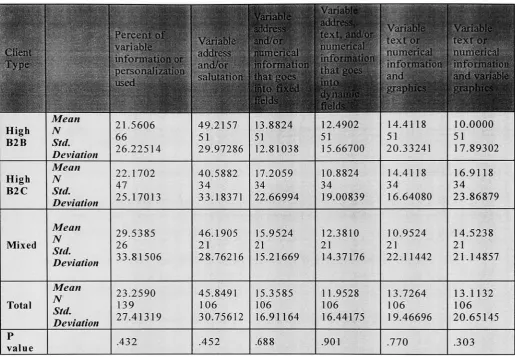
amountof personalized communicationsusedinrelationtoclienttype. Agenciesthat
serve a mixedarrayof clientsusethehighestpercentage ofpersonalization(29.5%),while
B2BandB2Cclients use almostthe same percentage ofpersonalization at21.5%and
22.1%,respectively. B2B clients use thehighestpercentage ofthelowestlevelof
personalization(49%)alongwiththelowest percentage ofthehighest levelof
personalization(10%).B2Cclientsuse thelowestpercentageoflowest level of
personalization (40%)alongwiththehighestpercentage ofthehighest levelof
personalization(16.9%).
Client Type High B2B Percentof variable informationor personalization used Variable address and/or salutation Mean N Std. Deviation 21.5606 66 26.22514 49.2157 51 29.97286 Variable address and/or numerical information thai goes into fixed !elds 13.8824 51 12.81038 Variabilis address, text,and/or numerical information thatgoes into dynam c fields
|
12.4902 51 15.66700 Variable textor numerical information and graphics 14.4118 51 20.33241 Varic text or numerical information and v grapf 10.0000 51 17.89302 High B2C Mean N Std. Deviation 22.1702 47 25.17013 40.5882 34 33.18371 17.2059 34 22.66994 10.8824 34 19.00839 14.4118 34 16.64080 16.9118 34 23.86879 Mixed Mean N Std. Deviation 29.5385 26 33.81506 46.1905 21 28.76216 15.9524 21 15.21669 12.3810 21 14.37176 10.9524 21 22.11442 14.5238 21 21.14857 Total Mean N Std. Deviation 23.2590 139 27.41319 45.8491 106 30.75612 15.3585 106 16.91164 11.9528 106 16.44175 13.7264 106 19.46696 13.1132 106 20.65145 P value [image:42.534.10.526.54.411.2].432 .452 .688 .901 .770 .303
Table 9. Means Comparison (ClientType)
Chapter 6
Summary andConclusions
The underlyingmotivationforusingpersonalized communicationsistoformthe
ultimatedirect marketingcampaigninwhich eachperson wouldreceiveanindividualized
advertisementbasedon demographicsor past purchasing information. "Theobject of
direct marketingistoget messages todefinedaudiencesinamanner thatinvitesattention
and engenders actions-thatultimately leadtobuyingaproductor
service"
(Broudy and
Romano, 1999). Personalizationand variabledatatechnologyisthetool thatcouldmake
thistype ofadvertisinggrowtremendously. AccordingtoPrecisionMarketing, during
2003,direct-response advertising spendinggrew5% to$203 million anddirect marketing
salesintheU.S. amountedto$1.7trillion. Amediumthatplaysamajorrolein direct
marketingandpersonalized communications is directmail,wherein2002,marketers
spentapproximately $49.1 billionand generated salesofover$636billion,up 9.4% from
2001 ("Direct MailAdvertisingServices,"2004).
Withtheseindustries growingandafterexaminingeachhypothesis,personalized
communications stillhas incredibleroomforgrowth. Currentlyon average,agencies use
personalizationon23% oftheircampaigns. Eventhen, almost46% ofthatisa simple
mailmergeand 1 5%iscombined address andnumericaldatainto fixed fields. This
establishesthat thevariabledatatechnologyisnotbeingusedto itsutmost capabilities.
Theresultsfrom testingthehypothesesconcludedthat there'sno differenceinagency
type, size orclient type inrelation to theamount of personalizationused.Whetherthe
agency isaboutiqueagency orafull serviceagency oradirect marketingfirm;anagency
with annual billingsof$1 million or$500million; or anagency withB2BorB2Cclientele
-personalizationisjust anothertool usedby alltypes of agenciestohelp improve
businessresults.Every agency,nomatterwhat typeit isorwho itsclientsare,hasthe
same general objectives
-to promoteits
clients'
products, services,and/orideasthrough a
variety of media outlets("AdvertisingAgencies,"2003). Innovativead agenciesuse
personalizedtechnology toachievethisobjectiveonly whenit'sneededforthe success of
thecampaign, whenthetimeisright,whentheresources aretheretoinvest in that type
ofcampaignandwhen theagency'sclientiscomfortablewithtakingits marketing
campaigninthatdirection. Ifpersonalized communications yieldsthekindofresultsit's
beensaidtoproduce,agenciesof all types shouldbe pushingtheirclientstouseit intheir
campaigns andtakingtheirtimeandresourcesto invest inthetechnology. On thesame
note, clients ofalltypes shouldbe askingabout thetechnology andlearningif itwillwork
fortheircompanies.Likeallnewtechnologies, personalizationwill needtime to "ironout
thekinks"inall aspects ofitsuse, and as ofnow,that involvesa competent database,
designskills, and additional costs.
Agendafor Further Research
Now thatit is determinedthatagency typesand sizes aswell asclienttypes, even
withtheirinnovativehistory, don't play a significantroleintheuse of personalized
communications, further investigation intotheuse ofpersonalizationin differentmarket
segmentsmay beuseful.Are theresomeindustriesthat aremoreinnovativeand use
personalization morethanothers?Andifso, what isthereasonforthis?Learningabout
industriesthathave hadsuccesswithpersonalized campaignsmay beusefulin educating
otherindustries, agencies,and clients about overcomingtheobstacles thatareintheir
way. Is itpossiblethat themorethey learn andthemore personalizationtheseagencies
use, themoresophisticated theirpersonalized campaigns will get?Also, further
investigationinto data miningandfindingthebest wayto havea stable database isalso
crucialto thesuccessofpersonalized campaigns.
Intheend, it isimportant tounderstandthatthebest way tomake
personalizationaconventional and productivemarketingtool withinagenciesistokeep
educatingcompanies, agencies and print providers aboutthetechnology andits
capabilitiesalongwiththeobstaclesstandinginitsway. Asexplainedby adirect
marketing agency (AppendixB), thereisalargelearningcurve whendesigninga campaign
usingvariabledataincludingcreativeelements, production, anddatamanagement. "The
ultimateexample of'onetoone'
marketing wouldbeapicture ofyouwearingorusingthe
potential product. Imagineaday when personaldigital photographsfindtheirway into
databasesalongwith otherinformationabout each of
us"
(Broudy and Romano, 1999).
Variabledatatechnology placesawholenew world of onetoone marketingat our
fingertips. It isup tousto findawayto utilizethe technology to thebestof our ability.
Bibliography
(2000, Oct.) "Personalized Print: anewmodel for
success."
[PDF slideshow].
PrintonDemand Initiative. Available FTP: Hostname: podi.org File:
/pdf/resources/presentations/XPLOR_BP_Oct_2000_presentation.pdf
(2004). "7 Key DifferencesBetween B2B andB2C Database Direct Marketing."
[PDFslideshow]. The Sales & MarketingInstitute. Available FTP:
Hostname:b2bmarketing.com File:/resource.asp
"AdvertisingAgencies."Encyclopedia ofGlobalIndustries, 3rded.GaleGroup, 2003. ReproducedinBusinessandCompany Resource Center. FarmingtonHills,
Mich.: Gale Group. 2004.http://galenet.galegroup.com/servlet/BCRC
"AdvertisingAgencies."Encyclopedia ofAmerican Industries. Online Edition. Gale, 2004. Reproducedin BusinessandCompany Resource Center. Farmington
Hills, Mich.: Gale Group. 2004. http://galenet.galegroup.com/servlet/BCRC
Broudy,D. andRomano,F. (1999). Personalized &DatabasePrinting, Salem, NH: GAMA.
deBronkart, D. (2001,April). PersonalizingPrint: Howpersonalizedprinting
works,why it works,andhowtouseit properly [14paragraphs].AvailableFTP:
Hostname: digitaloutput.net File: back%20edit/edittopic5ul.html
"Direct Mail AdvertisingServices." Encyclopedia ofAmerican Industries. Online
Edition. Gale,2004. ReproducedinBusiness andCompany ResourceCenter.
FarmingtonHills, Mich.:Gale Group. 2004.
http://galenet.galegroup.com/servlet/BCRC
Direct MarketingAssociation. (2002, October). TheStateofPostal & E-Mail
Marketing: New TrendsandResults. New York: The Direct Marketing
Association, Inc.
Fadden, J. (1994,September 23). AttackingGoliath. SHOOT. 35. 37-34.
Fenton, H. andRomano, F. (1998),On-DemandPrinting: The Revolutionin
DigitalandCustomizedPrinting(2nded.),Upper SaddleRiver,NJ: Prentice Hall
PTR
Ganger, P. (2002,Jan/Feb). PersonalizationthroughVariable-Data Printing. Digital PublishingSolutions,45-50.
Jones, JohnP- (1999). TheAdvertisingBusiness. Thousand Oaks: Sage
Publications, Inc.
Lee,M. andJohnson, C. (1999). PrinciplesofAdvertising:A Global Perspective.
New York: The HaworthPress,Inc.
Newaccenture studyreportsthatB2B's lackofmarketing dwarfs B2C's
mismarketing,companies canimprovetheirperformancebyapplyingold
economy marketing disciplinesto theweb. (2001,May 20). InternetWire, 1008130u5749.
PrintonDemand Initiative. (2003,January). Best Practices in Digital Print
(3rd ed.)
Rodgers, S. andChen, Q. (2002).Post-adoptionattitudes toadvertisingonthe
Internet. JournalofAdvertisingResearch, 42,95-104.
Zell,A. (2002). Is ThereaDifference BetweenSellingtoBusiness-to-Business
andBusiness-to-ConsumerCustomers? [9 paragraphs].AvailableFTP:
Hostname:sellingselling.comDirectory: articlesFile: btbb.html
Appendix A
Appendix A
Advertising Agency Survey
HarrisInteractiveconducted asurvey performedby250 advertisingexecutivesin
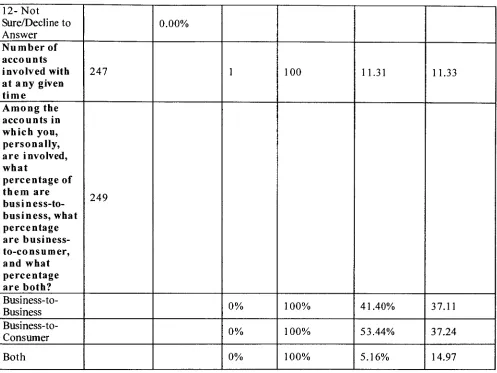
Spring2003. Table 10 belowreportsthebackgroundinformation fortheserespondents.
General Agency Questions
: -v...
"/' '-"'
Respondents (outof150)
%
Respondents Answered Yes
Minimum Maximum Average Standard Deviation
Number of
employees at
this location
223 1 5000 55.98 341.19
Annual
billings 198 $200,000 $820,000,000 $26,000,000 $73,218,713
Number of
years worked
in advertising
industry
249 60 19.14 11.26
Number of
years worked
forcurrent
employer
50 10.45 9.35
What isthe highest level of education you have completed or the highest degreeyou havereceived? 249
1- Lessthan
highschool
0.40%
2-Highschool
orequivalent
(e.g., GED)
1.60%
3- Somecollege,
but nodegree 7.20%
4-College(e.g.,
B.A., B.S.) 63.50%
5-Some
graduate school,
but no degree
4.80% 6-Graduate school (e.g., M.S., M.D., Ph.D) 19.70% Respondent Classification 250
1-Strategic 40.40%
2-Production 9.20%
3-Both 50.40%
What are the
primary
services your
agency
provides?
247
1- Graphic
12-Not
Sure/Decline to
Answer
0.00%
Numberof
accounts involved with
at any given
time
247 1 100 11.31 11.33
Amongthe
accounts in which you,
personally,
are involved, what
percentage of
them are
business-to-business, what
percentage
are
business-to-consumer,
and what
percentage
are both?
249
Business-to-Business 0% 100% 41.40% 37.11
Business-to-Consumer 0% 100% 53.44% 37.24
[image:52.534.21.518.48.421.2]Both 0% 100% 5.16% 14.97
Table 1 0. Background Information Results fromtheAgency Survey
Fromthe250advertising executives, 150ofthoserespondentswere classifiedas
"production-focused"
andcompletedthepersonalized communications portion ofthe
survey. Respondentswere classifiedas
"production-focused"
whentheyreportedthat
theyeither: 1)areinvolvedintheproductionofadvertising materials, but donot advise
clientsregardingmedia strategiesandselection or2)both adviseclients on mediastrategy
AND areinvolved in theproduction ofadvertisingmaterials. Table 1 1 belowreportsthe
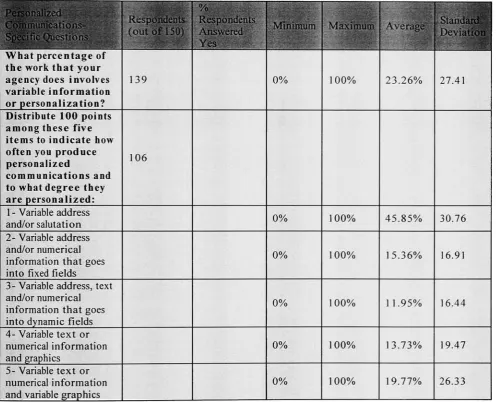
summary fortheserespondents.
Personalized
Communications-SpecificQuestions
Respondents
(outof150)
%
Respondents
Answered
Yes
[image:53.534.21.518.143.545.2]Minimum Maximum Average
8&|
Whatpercentage ofthework that your
agency does involves
variableinformation
or personalization?
139 0% 100% 23.26% 27.41
Distribute 100 points
amongthese five items toindicate how
often you produce
personalized
communications and
towhatdegreethey
are personalized:
106
1- Variable
address
and/or salutation
0% 100% 45.85% 30.76
2-Variableaddress
and/ornumerical
information thatgoes
into fixed fields
0% 100% 15.36% 16.91
3-Variable
address, text
and/ornumerical
information thatgoes
into dynamicfields
0% 100% 11.95% 16.44
4-Variabletext or
numericalinformation
and graphics
0% 1 00% 13.73% 19.47
5-Variable textor
numericalinformation
and variable graphics
0% 1 00% 19.77% 26.33
Table 1 1. Personalized Communications Results fromtheAgency Survey
Appendix B
Appendix B
Case Studyon a DirectMarketingAgency
The followingisan example of onedirectmarketing firmanditsthoughtsabout
implementing
personalized campaigns anditsthoughtsontheseobstaclesholdingagenciesbackfromutilizingvariabledatatechnology.
Thisfull service,direct marketing agencywith acapitalized billingof
$22.5millionhaveclients suchasBausch& Lomb,Sony, CitigroupandNexPress
Solutions. Itsmissionisto "measurably increaseour
clients'
bottom lineby addingvalue
in everythingwe
do."
Itbelievesthatitseffectiveadvertisingisbased simply on
knowledge,knowledgeofits client andknowledge-basedsolutions. The primary services
that itprovidesto itsclients arestrategy development,marketresearch,creative services,
productionmanagement, databasemanagement, reporting,analysis andteleservices. On
average,ithandlesapproximately 1 5 accountsthatare inmotion on anongoing basis.
Approximately45%ofits media allocationisspentondirectmail, 42%onmediasuch as
telemarketing,point of sale andinserts. Internet-basedactivities suchasdirectemailisat
10%>andthefinal 3%isspent on directprintadvertisingsuch as calltoaction pieces. In
termsofthenatureofthe accounts,40%ofitsclientsare business-to-businessand60%
ofitsclients arebusiness-to-consumer.