Research in Mathematical Education <數學敎育硏究> Vol. 12, No. 3, September 2008, 179–191 제12권제3호 2008년 9월, 179–191
179
Notes on “Perpetual Question” of Problem Solving: How
Can Learners Best Be Taught Problem-Solving Skills?
Yevdokimov, Oleksiy∗
Department of Mathematics & Computing, University of Southern Queensland, West Street, Toowoomba, QLD 4350, Australia; e-mail: [email protected]
Taylor, Peter
Australian Mathematics Trust, University of Canberra, ACT 2601, Australia; e-mail: [email protected]
(Received August 17, 2008. Accepted September 9, 2008)
Although problem solving was a major focus of mathematics education research in many countries throughout the 1990s, not enough is known about how people best acquire problem-solving skills. This paper is an attempt to advance further development of problem-solving skills of talented school students through combination of some methods accessible from curriculum knowledge and more special techniques that are beyond curriculum. Analysis of various problems is provided in detail. Educational aspects of challenging problems in mathematical contests up to IMO level are, also, taken into account and discussed in the paper.
Keywords: Problem solving, thinking strategies, non-routine tasks, conceptual understanding, mathematical contests
ZDM Classification: D53, D54
MSC2000 Classification: 97D50
1. INTRODUCTION
Problem solving activities are as old as mathematics. Ancient Greece, Egypt, China and Mesopotamia and many other places on the globe were the centres of mathematical thought and produced the first research results in mathematics, mostly mathematical models in agriculture, sailing, architecture and other needs of mankind. Since that time problem solving activities related to the teaching and learning of mathematics as well as doing mathematics, and mathematics itself, have received tremendous development. Nowadays the diversity of problem solving can be demonstrated from the child’s first
∗
attempts in counting, or recognising different shapes, to the best mathematicians’ practice in different directions, e.g. the proof of the Last Fermat Theorem by Wiles (1995) or Green and Tao’s result on arbitrarily long progressions of primes (in press). The importance of problem solving is emphasised in the mathematics curriculum all over the world. The Australian Education Council (1991)1 and the National Council of Teachers of Mathematics (1980, 1989, 2000) have recommended that the mathematics curriculum should be organised around problem solving.
Singapore has possessed a problem-solving curriculum since 1992 (Singapore Ministry of Education, 1990). This has developed in various stages. These include in 1997 the initiative Thinking Schools, Learning Nation (Goh, 1997), a revision in 2001 (Singapore Ministry of Education, 2000), in 2003 the initiative Innovation and Enterprise (Tharman, 2003) and a revision (Singapore Ministry of Education, 2007) with a further de-emphasis on computational skills and further emphasis on problem solving. These initiatives are further described in Chapter 8 of the Study Volume of ICMI Study 16 (Barbeau & Taylor, due to be published late 2008).
Although problem solving was a major focus of mathematics education research in many countries throughout the 1990s, in particular in Australia (Anderson & White, 2004; Nisbet & Putt, 2000), this area is still not being developed to its maximum potential. Not enough is known about how people best acquire problem-solving skills or how they can best be taught them. Taplin (1998) emphasised that “a great deal has been written and debated about problem solving but it is still clear that there are difficulties associated with teaching people how to succeed at it” (p.146). We are not in a position to provide an answer to the question in the paper’s title. Nor can anyone else do this. This paper is an attempt to advance further development of problem-solving skills of talented school students through combination of some methods accessible from curriculum knowledge (Barbeau & Taylor, due to be published late 2008) and more special techniques that are beyond curriculum. In particular, we discuss the different problems taking into account that: solution method or main idea can be identified from the statement of the problem with no difficulties (Tasks 4, 5, 6); such identification requires efforts (Tasks 1, 2, 7); solution method or main idea is hidden in the statement and difficulties can happen in identifying them (Tasks 3, 8).
1
In Barbeau and Taylor (ibid.), Section 1.4, which is attributed in the Preface to Taylor, elaborates on approaches of how some methods accessible to talented school students with no more than curriculum knowledge can help them advance their mathematical thinking. In this paper we continue to investigate the benefits of this approach focussing on particular mathematical topics, solution methods and some didactical issues of problem solving. Educational aspects of challenging problems in mathematical contests up to IMO level are, also, taken into account and discussed in the paper.
2. BEING INVOLVED IN PROBLEM SOLVING: WHAT DOES IT MEAN FOR A LEARNER?
We consider a non-routine problem as a learning material which has two values:
• Mathematical value, i.e. content of the problem, a certain feature valid under the given conditions, and
• Didactical value, i.e. thinking strategies related to the problem and knowledge of a particular result, which give an opportunity for students to advance understanding of the broader material of the topic and acquire problem solving skills.
If a non-routine problem can be further challenged or modified, then its mathematical value can change, while didactical value can be different within the same problem. On the different examples we observe relationship between the two values, what influence they have on each other, to what extent this does depend on the topic.
2.1. Analysing solution methods and topics
2.1.1 On benefit of the tasks on manipulations
Manipulations as an approach to algebra and number theory problems are one of the simplest methods to use by students. In many cases manipulations are underestimated and neglected in favour of other methods, e.g. using congruencies. Sometimes this happens even with experienced problem solvers. Indeed, manipulations themselves, without a clear elaborated plan what they are needed for, do not make any sense. However, using an approach, where manipulations are a means to reach a certain aim, they can be seen as a powerful tool for a number of problems. The following task (Andreescu & Gelca, 2000, p. 63) is a good illustration of the case.
Task 1. Let a and b be integers such that there exist consecutive integers c and d for which a−b=a2c−b2d. Prove that |a−b|is a perfect square.
(
) (
[
)
1]
2
− + −
= a b c a b
b .
Are these manipulations from the “guess and check” category? Definitely not, though there are no difficulties to obtain this expression. The idea that leads towards solution and uses the equality above is the following:
If a perfect square can be factorised on pairwise relatively prime factors, then each of the factors must be a perfect square2.
The idea seems to be routine, rather than bright and new for most talented school students, who have some successful experience in problem solving. However, its didactical value can vary in different learning conditions. While the mathematical value remains unchangeable, the other one depends on the way a learner is taught problem-solving skills. Not all high school students are able to identify and use such a simple idea in time constraint conditions, i.e., in mathematical contests. Some of them, who did it in one contest, could miss doing the same in another contest with the similar problem. The same tendency retains without time constraints. In this problem the crucial point is learner’s understanding of the fact that proof of |a−b| as a perfect square can be achieved by different ways possibly, but, in any of them through establishing a clear picture of relationships between |a - b| and other expressions. This means analysing the structure of the problem and its components through the appropriate approaches and ideas, most of which are based on prior knowledge. The ablest students can invent (discover) this (or similar) idea many times, while solving different problems. However, without development of their conceptual understanding on the structure of any problem and using prior knowledge, there is still a possibility that students can fail in problem solving at any moment.
We will return to this task discussion from another point of view in section 2.2.1. The other example demonstrates a combination of using manipulations and special technique to be used for some inequality problems.
Task 2 (Mathlinks Contests). Let a,b,cbe positive real numbers. Prove that
) ( ) ( ) ( ) ( ) ( )
(a c a b b c b a c a c b
a c c b b
a + + ≥ + + + + + + + + .
This inequality can be proved by rewriting the desired inequality as the sum of two non-negative numbers in the standard SOS-Schur form (Ngoc Thanh Cong, et al., 2007):
0 ) )( ( ) ( ) , ,
(a b c =M a−b 2 +N a−c b−c ≥
f .
Also, we need to show that M andNare non-negative, if
) , , min(a b c
c= or c=max(a,b,c).
2
Mamona-Downs & Downs (2005) describe such a situation as one of the levels of the efficiency of knowledge as a source for problem solving – “the formatting of the knowledge base in special ways that are especially suitable for applications” (p.394). Many students start problem solving with attempts to use knowledge of techniques which are the most familiar for them. The development of conceptual understanding on the structure of the problem can contribute to the student’s choice of appropriate technique. We will continue discussion of special techniques in Section 3.
2.2 Didactical issues of problem solving
2.2.1 On the role of particular ideas that can have a wider spectre of application
This didactical issue was particularly discussed in section 2.1.1 with respect to the idea of a perfect square factorisation on relatively prime factors. This idea like many others can be applied to different problems. The Task 1 in section 2.1.1 is just one of many examples, where that idea plays the key moment of solution. Another task on the slightly modified idea from 2.1.1 follows (Andreescu, 2008, p.18).
Task 3. Find the least odd positive integer
n
such that for each prime, p8 4 2
4 ) 1
(n − +np + p
is divisible by at least four primes.
The other benefit of this didactical issue is the student’s growth of understanding that links between different problems can be identified through particular idea(s) used in those problems.
We claim that the student’s awareness of the possibility to apply a certain idea from one problem to other situations, with respect to other problems, can advance their conceptual understanding of problem solving principles. We would like to emphasise that the skill of recognising similarities amongst problems and links between them is one of the most influential factors in problem solving.
2.2.2 On the importance of a graphical insight
The following task can arise in or outside a class. It can be solved with different ways. Essentially this is those where students can get a really nice insight into graphically.
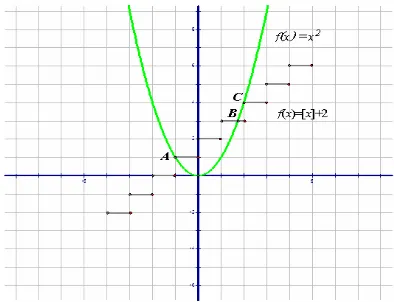
Task 4. How many solutions are there to the equation x2 −[x]−2=0?
Task analysis. The graphical method of solving this task gives a good insight, but if trying to draw the left hand side function in stages many students miss the one involving 3 . On the other hand, if they drawf(x)=[x]and then f(x)=[x]+2, and overlay this on f(x)=x2, it is safer (Figure 1).
discouraging them.
It is also possible to solve this equation symbolically, say having x≥0 and x<0 as separate cases and treating them carefully. However, it is a good example for discussing graphical methods.
2.2.3 On the role of particular information in the task
Quite often particular information in the statement of the problem provides all necessary conditions to be used for solution, though, some efforts are mostly required to interpret such information in the correct way. Many students find this transition difficult to do, though in some cases it relates more to psychological aspects than to the educational ones. The following example (Fukugawa, 2007, p.177) highlights the situation.
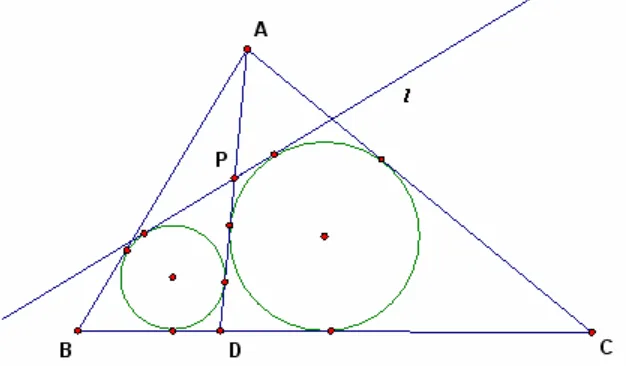
[image:6.595.108.502.196.498.2]Task 5. Let D be any point on the side BC of triangle ABC. Let
Γ
1 andΓ
2 be the incircles of triangles ABD and ACD, respectively. Let l be the common external tangentto
Γ
1 andΓ
2 which is different from BC. If P is the point of intersection of AD and l, show that 2AP = AB + AC – BC. (Figure 2.)Figure 2. Red points on the two incircles are tangent points
Task analysis. Particular information in the statement relates to the point D, two incircles and common external tangent to them. Furthermore, if the final result gives the double length of AP in terms of the triangle’s sides, then transition of that particular information into the main idea should be about some properties of tangents, especially such properties, where tangents are drawn from the same point. From this moment transition is no longer hidden in the problem. The idea that leads towards solution is the following:
Tangents’ segments drawn from the same point are equal.
After that, easy manipulations with the corresponding tangents’ segments provide the required result. Could such a problem be potentially difficult for some students? Possibly. However, after getting some practice in development of conceptual understanding on the problem structure, similar problems wouldn’t be difficult for most students. We note that Task 5 has different solutions; we have just described one of the didactical issues, and won’t discuss the others. This didactical issue, though important, is not universal, and some problems are better approached from a general point, using particular information afterwards.
2.2.4 Educational potential of multiple solutions
increase the perspective of problem solving to the student and help develop further techniques.
In this section we discuss two different solutions given by two different students. The emphasis is on cognitive benefits of their work. Describing cognitive benefits of multiple solutions, Silver et al (2005) suggest that “getting aware of at least another approach helps students become more flexible when solving similar problems” and “offers them additional strategies for their mathematical ‘tool bag’” (p.297). We note that some solutions (e.g. the second solution below) may lead to the formation of conceptual understanding of much broader questions, even theoretical ones that lie far beyond the scope of the given problem. Therefore, didactical values of multiple solutions are different. This means that cognitive benefits of multiple solutions are different. Thus, thinking strategies that correspond to multiple solutions are responsible for higher or lower level cognitive benefits of each solution through their didactical values.
Task 6. A teacher wrote the polynomial x2 +10x+20 on the board. After that each student, one after another, either increased by 1 or decreased by 1 either the coefficient of x or the constant term, but not both. Finally x2 +20x+10 appeared on the board. One student is sure that a polynomial with both integer roots necessarily appeared in the process. Is she right or not? (Sapir, 1984)
First solution. Since we are increasing or decreasing the coefficient of x or the constant by 1 at a time, there must be a point where the coefficient of x exceeds the constant by
1, i.e. where the coefficient is n+1 and the constant
n
, for somen
:9≤n≤19. Then the corresponding polynomial can be factorised as(
x+1)(
x+n)
, and this has two integer roots.Second solution. If we consider f1
( )
x =x2 +10x+20, we can see that its value at1 − =
x will be changed by 1 every time either the coefficient of xor the constant is increased or decreased by 1. Letf2
( )
x =x2 +20x+10, then f1( )
−1 =11and f2( )
−1 =−9. Therefore, in the process at some point a polynomial, g( )
x =x2 + px+q must appear on the board for which g( )
−1 =0. In other words, 1− is a root of g( )
x , and the other root must be −q, by Vieta’s formula.constructed on the base of one mathematical object only. It is easy to follow, but difficult to modify and apply in other problems, whereas, the second strategy refers to several mathematical objects, based on relationships between those objects rather then on objects themselves, and, due to this flexibility can be modified to other applications.
3. CHALLENGING STUDENTS IN MATHEMATICAL COMPETITIONS
Competitions are very important in developing problem solving ability among students. They are important because they can help identify talent which is not so obvious in normal classroom mathematics firstly. Secondly, participation in competitions provides an avenue for students to develop their ability well beyond what they can do in a classroom environment.
On the subject of identification of talent it is quite common in mathematical circles (mathematics clubs of students from different schools) and competitions that the students who have a near perfect reputation on classroom assessment cannot solve presented problems, whereas some other student might. This is due to classroom and syllabus examinations test either immediate recall, or ability to answer certain types of questions for which there are many similar practice examples.
Because competition questions are usually set slightly outside a strict syllabus framework and are written in many schools, they are not so likely to be set in a familiar framework. Competition questions can test a student’s ability to solve a problem in which they have the mathematical skills but are asked to apply them in a less familiar environment. As a result sometimes quite different students with these different skills might excel and be given an opportunity to display this talent.
Whatever the background of the students, participation in competitions enable a student to get practice in using their skills in different environments, and as long as they treat the problems in this way they can only mature their skills as they gain more and more exposure to this. Exposing students to this experience can better equip them for further study and their careers, where life continually presents the challenge of having to adapt to new situations.
Task 7. Natural numbers from 1 to 99 (not necessarily distinct) are written on 99 cards. It is given that the sum of the numbers on any subset of cards (including the set of all cards) is not divisible by 100. Show that all the cards contain the same number. (p.83)
Task analysis. The first step is easy to follow – to assume the opposite, which means that at least two cards contain distinct numbers, e.g. n98 ≠n99 using standard notation, where
i
n is a number written on the card i. The next step is to identify and apply a method (technique) that leads to a contradiction. The main idea is to investigate different remainders xi of n1+n2 +...+ni upon division by 100, which guarantees the result that
all xi must be distinct for i=1,2,K,99.
After that, making comparison of the sum n1+n2 +L+n97 +n99 (just one of the two distinct numbers needs to be omitted) with another sum having the same remainder gives three possible results, each of which leads to a contradiction.
This solution method is rather a general approach based on consideration of different remainders than a special technique. Although a certain class of problems can be solved with no difficulties, by those who are familiar with this approach, thinking strategy for Task 7 can be built up on the same ideas without prior knowledge. In terms of the two values of a problem, it witnesses that this task is an example of a certain balance between mathematical and didactical values despite its solution requiring some efforts to be found. Another task, Problem 5 IMO 2007, is an example of a special technique (the Vieta jumping method) for solving number theory problems on divisibility of positive integers. This technique has been used extensively in different competitions. For a number of problems it provides the shortest, but still not easy, solution method, though other solutions can be available too.
Task 8. Let
a
and b be positive integers. Show that if 4ab−1divides(4a2 −1)2, then a=b.Task analysis. The Vieta jumping method begins with an assumption that there is such a solution for which the statement of the problem is incorrect. Analysis of the assumption is based on using Vieta’s formula and leads to a contradiction. The structure of this method is hard to follow for many students, even if they can identify correctly which solution method should be used. In this task we could assume that distinct positive integers
a
andbexist such that 4ab−1|(4a2 −1)2. However, this technique doesn’t work for(4a2 −1)2, which appears to be another difficulty for students – either the Vieta jumping method shouldn’t be used on this problem or it must be applied to something else.
Nevertheless, it turns out that 4ab−1|(a−b)2since
2 2 2 2 3 2 2 2 ) ( 2 ) 2 4 )( 1 4 ( ) 1 4
( a ab a b ab a a ab b a b
The benefit of manipulations was discussed in section 2.1.1. This is just one more example of their importance. Hence, the Vieta jumping method can be applied to a newly found(a−b)2instead (4a2 −1)2. Was it easy for students to find this place properly? There is no certain answer to this question. For some students that could seem to be easy, while other talented students could struggle with this.
Thus, thinking strategy for this task consists of two main components: method identification, i.e. that method which should be used for solution, and place identification, i.e. where that method should be applied. Similar problems in mathematical competitions, together with time constraints, provide a real challenge for talented students.
4. SUMMING UP
Any mathematics topic has a great potential for problem solving activities. Most non-routine problems can help students to learn something new or to back up and activate knowledge they already have. Analysing the benefits of manipulations in different tasks, we have shown the ways and provided examples of how curriculum knowledge of standard manipulations can be combined with special techniques, like SOS – Schur method and Vieta jumping method, and be extended beyond curriculum. We have made an attempt to review and highlight some didactical issues that mathematics teachers and trainers need to be aware of in working with talented students. The impact on the development of learners’ mathematical thinking has been analysed focussing on particular issues. A number of didactical issues – in some ways opposite each other, like the role of particular ideas that can have a wider spectre of application and the role of particular information in the task – have been discussed in detail. An issue on the importance of a graphical insight has illustrated some warnings about graphical methods without discouraging them. Another issue on the educational potential of multiple solutions has been presented through the comparative review of its didactical values.
achieved. While the list of didactical issues is far from exhaustive, such consideration helps to form a conceptual framework required for further research.
Finally, we would like to emphasise the importance of creating an opportunity for learners to experience the excitement of mathematical constructions and the power of mathematical knowledge. Mathematics, in both teaching and curriculum, must be made more enticing (Watson, 2008), rather than being further simplified. Problem solving is a vehicle for promoting and developing this excitement and power.
REFERENCES
Anderson, J. & White, P. (2004). Problem solving in learning, teaching mathematics. In: B. Perry, G. Anthony & C. Diezmann (Eds.), Research in mathematics education in Australasia 2000-2003 (pp. 127–150), Flaxton, QLD: PostPressed. MATHDI 2004e.03816
Andreescu, T. (2008). Senior problems. Mathematical Reflections1, 18.
Andreescu, T. & Gelca, R. (2000). Mathematical Olympiad Challenges. Birkhauser, Boston. MATHDI 2003a.00743
Australian Education Council (1991). A National statement on mathematics for Australian schools.
Melbourne: Curriculum Corporation.
Barbeau E. J. & Taylor, P. J. (Eds.) (due to be published late 2008). ICMI Study 16 “Challenging Mathematics in and beyond the Classroom”, Springer, Massachusetts.
Djukic, D.; Jankovic, V. Z.; Matic, I. & Petrovic, N. (2005). The IMO Compendium. A collection of problems suggested for the International Mathematical Olympiads: 1959 – 2004, Springer, New York.
Fukugawa, H. (2007). Problem 3126, Crux Mathematicorum33(3), 177.
Goh, C. T. (1997). Shaping our future: Thinking schools, learning nation. Accessed 14 April 2008 www.moe.gov.sg/media/speeches/1997/020697.htm
Green, B. J. & Tao, T. C. (in press). The primes contain arbitrarily long arithmetic progressions,
Annals of Mathematics.
Mamona-Downs, J. & Downs, M. (2005). The identity of problem solving. J. Math.. Behav. 24(3), 385–401. MATHDI 2007c.00103
National Council of Teachers of Mathematics (1980). An agenda for action: Recommendations for school mathematics of the 1980s. Reston, VA: NCTM.
National Council of Teachers of Mathematics (1989). Curriculum and evaluation standards for school mathematics. Reston, VA: NCTM.
National Council of Teachers of Mathematics (2000). Principles and standards for school mathematics. Reston, VA: NCTM.
Mathematical Reflections5, 1–3. Available at
http://www.awesomemath.org/reflections/2007_5/sos_schur.pdf
Nisbet, S. & Putt, I. (2000). Research in problem solving in mathematics. In: K. Owens & J. Mousley (Eds.), Research in mathematics education in Australasia 1996–1999 (pp.97–121). Sydney: MERGA. MATHDI 2000d.02435
Sapir, M. (1984). Problem 830. Kvant (Quantum)1, p. 36.
SingaporeMinistry of Education (1990). Mathematics Syllabus: Primary. Singapore: Curriculum Planning Division.
_____(2000). Mathematics Syllabus: Primary. Singapore: Curriculum Planning Division.
_____ (2007). Mathematics Syllabus: Primary. Singapore: Curriculum Planning and Development Division.
Silver, E. A. ; Ghousseini, H. ; Gosen, D. ; Charalambous, C. & Font Strawhun, B. T. (2005). Moving from rhetoric to praxis: Issues faced by teachers in having students consider multiple solutions for problems in the mathematics classroom. J. Math.. Behav. 24(3),287–301.
Stephens, M & Reeves, H. (1993). A national statement on mathematics for Australian schools: the involvement of a national professional association. Curric. Perspect. 13(1), 52–57. MATHDI
1994c.00994
Taplin, M. (1998). Management of problem-solving strategies. In: A. McIntosh & N. Ellerton (Eds.) Research in Mathematics Education: A Contemporary Perspective, 145-163. Perth, Western Australia: MASTEC, Edith Cowan University.
Tharman, S. (2003). The next phase in education: Innovation and enterprise.
www.moe.gov.sg/media/speeches/2003/sp20031002.html . Accessed 14 April 2008
Watson, J. (2008). Excitement part of the equation. The Australian, The Higher Education Supplement, Wednesday April 16, www.theaustralian.com.au