WHAT ARE THE EDUCATIONAL AND TRAINING REQUIREMENTS FOR
A COMPETENT PROFESSION?
Barrie Todhunter
University of Southern Queensland
Toowoomba Australia 4350 Tel. +61 7 3853 3237 email [email protected]
ABSTRACT
This paper looks at the educational and training requirements for competent professionals, albeit in the context of project management, for which the author provides postgraduate studies in a Master of Business Administration program.
With increasing expectations of excellence in the delivery and implementation of services in management sectors such as occupational safety, health and environmental risk, the community today demands a level of education and training appropriate for such professions. From a time when on-the-job training was deemed more than adequate for many service industries, and through a subsequent period that focussed on vocational competencies, we have now reached an era where educational and training programs are expected to be of the highest standards so that service industries can take their place among the ‘recognised’ professions.
Tertiary institutions are now looking at what defines the attributes of a member of a ‘profession’, and how those attributes can best be achieved. Going far beyond delivery of simple knowledge and skills, professional education demands that students undergo a personal and professional transformation to deal with the range of qualitative issues that require higher levels of judgement and compliance with ethical standards.
The author is a senior lecturer with the University of Southern Queensland in Australia specialising in professional education in project management as part of a Master of Business Administration program offered in multiple modes including face-to-face, print-based, online and in a new hybrid model utilising the multimedia capabilities offered through the use of CD-ROM digital technologies. He is currently engaged in doctoral studies and research into professional education, distance education and adult education, and this paper presents the findings of the early stages of that research, offering insights into the important issues and suggesting guidelines for the development of effective professional education programs that will also have implications for the occupational safety, health and environmental risk sector.
KEY WORDS:
Education, Profession, Competencies, Project Management, Occupational Safety, Health and Environmental Risk
INTRODUCTION
This paper looks at the issues associated with training and education for professions such as project management and occupational safety, health and environmental risk, for which there are a number of parallels, and alternative modes of delivery that are suitable for distance education. The theme of this conference is ‘compliance to excellence to sustainability’. This suggests that there is an agreed framework with which everyone can comply, then strive to reach a standard of excellence, and which leads to a system that is sustainable in a changeable environment. This theme can be applied to the topic of this paper – professional education
profession’ because of the way that practitioners enter the field, project management is struggling to create an identity and a theoretical framework that can be used for professional practice, development and education. As one of the major stakeholders, the Australian Institute of Project Management (AIPM) has had a strong influence since its inception over the development of a professional identity, professional development, and accreditation. The Project Management South Africa professional body has a similar role in professional project management development in South Africa, and NOSA has a similar role in the field of Occupational Safety, Health and Environmental Risk.
However, the competency-based focus adopted for accreditation has led to a conflict between the processes and objectives of occupational training and those of higher education. This paper considers how a conceptual and theoretical framework could be developed that is sustainable for ‘competency-based learning’ at all levels, and how respective modes of delivery can be evaluated for distance education.
RESEARCH CONTEXT
This paper suggests that:
the vocational competency standards developed by professional bodies lack consideration of attributes associated with recognised professions,
valid competency standards and a conceptual framework must consider a broad range of higher-level outcomes, and
project management education lacks an adequate conceptual framework that is aligned with the objectives of valid professional development.
EFFECTIVE PROJECT MANAGEMENT EDUCATION
The first section of this paper looks at what constitutes effective project management education. Turner et al. (2000) observe that most project personnel hold a qualification or first degree in an area other than project management (thus project management education is commonly approached as postgraduate study), fewer than fifteen percent of project personnel hold any form of project management certification or registration, and that the majority of project personnel have gained their knowledge through experiential learning. It would not be unreasonable to suggest that a parallel exists with occupational safety, health and environmental risk.
Formal project management education is relatively new to the higher education sector and Master’s level programs are still uncommon throughout most of the world. They are generally post-experience and aimed at professionals who are advanced in their chosen careers (Turner & Huemann 2000). Despite project management having its roots in the engineering and defence industries, Jaafari (1998, p. 514) suggests that it ‘has tended to evolve into an independent discipline, even to the point of defining competency levels for project managers…’, but there is still ‘no coherent and systematic programmes for the preparation of project managers from an early age through to full professional status’.
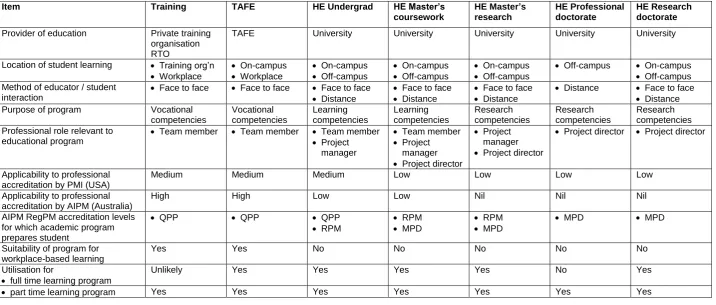
Table 1: General Characteristics of Project Management Training and Educational Programs in Australia
Item Training TAFE HE Undergrad HE Master’s coursework HE Master’s research HE Professional doctorate HE Research doctorate
Provider of education Private training organisation RTO
TAFE University University University University University
Location of student learning Training org’n
Workplace On-campus Workplace On-campus Off-campus On-campus Off-campus On-campus Off-campus Off-campus On-campus Off-campus Method of educator / student
interaction
Face to face Face to face Face to face Distance
Face to face Distance
Face to face Distance
Distance Face to face Distance Purpose of program Vocational
competencies Vocational competencies Learning competencies Learning competencies Research competencies Research competencies Research competencies Professional role relevant to
educational program
Team member Team member Team member Project
manager
Team member Project
manager Project director
Project manager Project director
Project director Project director
Applicability to professional accreditation by PMI (USA)
Medium Medium Medium Low Low Low Low
Applicability to professional accreditation by AIPM (Australia)
High High Low Low Nil Nil Nil
AIPM RegPM accreditation levels for which academic program prepares student
QPP QPP QPP
RPM RPM MPD RPM MPD MPD MPD
Suitability of program for workplace-based learning
Yes Yes No No No No No
Utilisation for
full time learning program Unlikely Yes Yes Yes Yes No Yes
part time learning program Yes Yes Yes Yes Yes Yes Yes
Legend
TAFE Technical and Further Education HE Higher Education
The Project Management Institute (PMI) in the United States of America offers global professional accreditation through their Project Management Professional (PMP) program, based on academic qualifications and a knowledge-based multiple-choice questionnaire. The Australian Institute of Project Management (AIPM) offers their Registered Project Manager (RegPM) professional accreditation program using competency-based assessment rather than academic qualifications. There are three levels of the RegPM program reflecting increasing levels of responsibilities—Qualified Project Practitioner (QPP), Registered Project Manager (RPM), and Master Project Director (MPD). The AIPM RPM program has been taken up by many project managers in South Africa.
From Table 1 and a review of the current literature, the following conclusions may be drawn about project management education in Australia:
Private registered training organisations (RTOs) and TAFE colleges provide the bulk of project management education, and this is provided as vocational competency-based programs aimed at practitioners at team member level
There are few, if any, undergraduate degree programs, and formal education is undertaken predominantly at postgraduate level
Postgraduate programs are targeted at practitioners at a higher level of the professional community such as project managers and program directors
Coursework Master’s programs focus on a mix of knowledge, cognitive and functional competencies, whereas other postgraduate programs have an emphasis on personal, behavioural, values, ethical and research competencies (see the elements of professional competence in table 3).
Higher education programs that are not competency-based provide little value for practitioners in achieving professional accreditation under current models.
THE NATURE OF PROFESSIONAL EDUCATION
Project management and similar occupations such as Occupational Safety, Health and Environmental Risk are often represented as ‘professions’ although it is arguable whether they have reached that level of acceptance in the community (Turner 1999). Research indicates that professional practitioners should have a sound theoretical knowledge of the subject and that the provision of formal educational programs is an essential part of the development of a new profession (Turner & Huemann 2000). Based on the views of Schon (1987), Benson (2001, p. 92) suggests ‘that the most important areas of professional practice lie beyond the instrumental boundaries based on technical expertise and go into the more indeterminate areas of practice that deal with uncertainty, uniqueness and value conflict’ and that the ‘outstanding professionals in all areas, including those with high levels of formal rationality, reflect wisdom, intuition and artistry beyond the instrumental’.
They raise valid questions about determining the effectiveness of professional education (p. 964) as indicated below:
Are there student attributes that will result in better prepared professionals?
What aspects of professional education must students master before entering the practical environment?
Have the characteristics of effective practical instruction been fully identified?
What are the most efficient and the most effective methods for evaluating a learner’s practical performance?
Of importance to project management and similar professions is their suggestion that professional education suffers from two versions of insufficient theory:
Many professions are themselves loosely defined, and that their practice is based on models such as habit, the ‘artist as hero’, or craftsmanship—there is no ‘theory of action’; and
Professional education, resting on an already tenuous theory base, suffers further because there is little education theory of action for instruction – particularly practical instruction.
OBJECTIVES OF LEARNING AND EDUCATION
Jones & Paolucci (1999, p. 9) suggest that ‘assessment of learning outcomes provides the major feedback mechanism’ and that it ‘is critical in evaluating the instructional system and its effectiveness. The information that is collected as evidence of learning achievement will depend on the nature of competency being measured’. These consist of ‘cognitive tests (measurement of intellectual skills), performance tests (measurement of capability) and attitudinal tests (measurement of disposition and perspective)’.
Bloom’s (1956) taxonomy of learning in the cognitive domain provides part of an essential framework for understanding desirable educational objectives and skills and the processes necessary to achieve them. The hierarchy of learning outcomes for this domain is:
lower order learning objectives of knowledge, comprehension and application; and
higher order learning objectives of analysis, synthesis, and evaluation.
Jones & Paolucci (1999) suggest that ‘learning is achieved when a permanent change in thinking, attitude, or behaviour is experienced’ (p. 3) and that instructional objectives can and should be based on one or more of the following factors:
learning domain - cognitive, affective or psychomotor
learner profile - objectives should be appropriate for the learner’s level of ability
task characteristics - instructional objectives should be appropriate for the tasks associated with the subject matter that is to be learned, and
grouping - instructional objectives should be appropriate for the grouping arrangement and learning situation.
Farivarsadri (2001) has researched the pedagogy of architectural education and asserts that ‘education’s purpose goes much beyond the mere transformation of knowledge; it aims at implementing changes in the patterns of behaviour of a social group in the desired direction’ (p. 2). He also indicates that apart from preparing students for a profession, a university architectural education ‘is different from training that is only giving knowledge and skills necessary to serve a profession’ and that:
knowledge, to communicate, to be aware of his own values, and those of the other’s as well. So does a holistic architectural education. This education in one end should prepare student (sic) for the profession with necessary abilities and skills and on the other end should educate them as people aware of social realities, being able to see the problems, to find solutions, have critical thinking, have their own values, etc’ (p . 2).
This is consistent with the views of tertiary educators from interviews carried out by the author, but appears to be in conflict with the limited range of competencies considered for professional development and accreditation by professional bodies.
Conner et al (1996, p. 33) remind us that ‘what might be effective when we’re novice learners, meeting complex bodies of information for the first time, may not be effective, efficient, or stimulating for learners who are more familiar with the content’. Consideration of competencies in the affective domain becomes increasingly significant as higher levels of education are reached, such as those in postgraduate studies. The importance of competencies in the psychomotor domain varies from discipline to discipline. They may be of considerable importance to professional activities in medicine (surgery) and architecture (design and drawing), but may be of marginal importance to project management and many other business disciplines.
LEARNING EFFECTIVENESS
Research into the effectiveness of educational programs recommends consideration of the learning outcomes over the entire program, rather than perceptions of the effectiveness of a single component of the program, or of the learning processes themselves. Kretovics and McCambridge (2002) have indicated that the research focus ‘has now shifted to value-added measures that assess what students have actually learned as a result of their participation’ and that ‘one systematic way to measure student learning would be to compare measures of student competencies at the beginning and end of their educational experience’ but concede that ‘few schools of business have conducted outcome studies that compare their graduates to their newly admitted students’. They conclude that ‘there are no significant differences in the learning outcomes of students enrolled in distance courses as compared to traditional face-to-face classroom settings’. Their framework involved measurement of twelve learning skills grouped into four major skill areas:
interpersonal skills—helping, leadership, and relationship skills
information gathering skills—sense-making, information gathering, information analysis
behavioural skills—goal setting, action, initiative, and
analytical skills—theory, quantitative, technology. (Kretovics & McCambridge 2002)
EXPLORATORY RESEARCH INTO PROJECT MANAGEMENT EDUCATION
body in Australia, a senior project manager providing consulting and contractual services to the Department of Defence, and a postgraduate project management student.
Data reduction and analysis of the interview material has identified the following themes and categories relating to postgraduate education in project management:
The need for incorporation of autonomous learning processes including:
reflective and self-referential learning skills
deep learning
the academic role to be one of facilitation
mapping to an overall competency framework
incorporating a range of assessment techniques including self-assessment and peer-assessment
high levels of communication among educators and students
the need for personal transformation outcomes to include:
changing mindset and perspective
generating new visions
changing the platform of thinking
development of personal competencies and soft competencies
becoming a lifelong learner
challenging and addressing prejudices
qualifications, recognition and status
the need for professional transformation outcomes to include:
development of professional competencies
becoming self reflective with regard to ongoing professional development
involvement in the definition and development of the profession
providing a positive influence on changing the professional culture
establishment of professional standards and best practice
These conclusions are consistent with the views of Jarvis (1998, p. 77) who suggests a focus on such concepts as ‘self-determination, self-actualisation or self-transformation as the underlying concepts of all education for adults’.
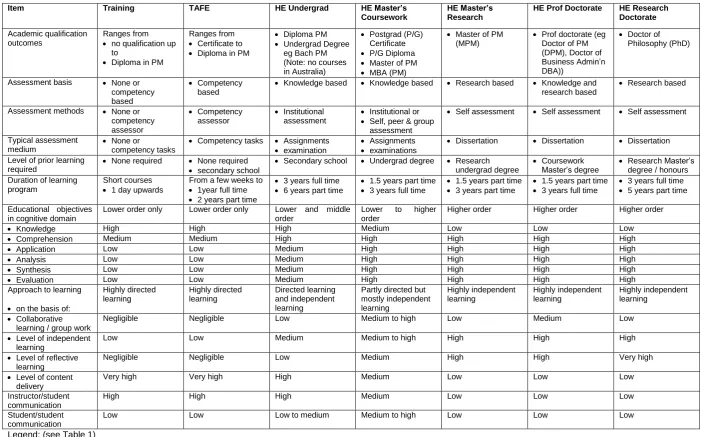
Table 2 provides a comparison of the pedagogical issues associated with the project management programs identified in table 1. From the comparison in table 2, the following conclusions may be drawn with regard to postgraduate programs:
The ‘approach to learning’ changes significantly for postgraduate programs from one of directed learning to one of independent learning
Although the assessment media for postgraduate coursework programs are similar to those of undergraduate programs (assignments and examinations), the recommended assessment methods change significantly to incorporate self-assessment, peer-assessment and group-peer-assessment.
The emphasis for learning objectives changes from lower order to higher order, and
Table 2: Pedagogical Dimensions of Project Management Training and Educational Programs in Australia
Item Training TAFE HE Undergrad HE Master’s
Coursework
HE Master’s Research
HE Prof Doctorate HE Research Doctorate
Academic qualification outcomes
Ranges from
no qualification up to
Diploma in PM
Ranges from
Certificate to
Diploma in PM
Diploma PM
Undergrad Degree eg Bach PM (Note: no courses in Australia)
Postgrad (P/G) Certificate
P/G Diploma
Master of PM
MBA (PM)
Master of PM (MPM)
Prof doctorate (eg Doctor of PM (DPM), Doctor of Business Admin’n DBA))
Doctor of Philosophy (PhD)
Assessment basis None or competency based
Competency based
Knowledge based Knowledge based Research based Knowledge and research based
Research based
Assessment methods None or competency assessor
Competency assessor
Institutional assessment
Institutional or
Self, peer & group assessment
Self assessment Self assessment Self assessment
Typical assessment medium
None or
competency tasks
Competency tasks Assignments
examination
Assignments
examinations
Dissertation Dissertation Dissertation
Level of prior learning required
None required None required
secondary school
Secondary school Undergrad degree Research undergrad degree
Coursework
Master’s degree Research Master’s degree / honours Duration of learning
program
Short courses
1 day upwards
From a few weeks to
1year full time
2 years part time
3 years full time
6 years part time
1.5 years part time
3 years full time
1.5 years part time
3 years part time
1.5 years part time
3 years full time
3 years full time
5 years part time
Educational objectives in cognitive domain
Lower order only Lower order only Lower and middle order
Lower to higher order
Higher order Higher order Higher order
Knowledge High High High Medium Low Low Low
Comprehension Medium Medium High High High High High
Application Low Low Medium High High High High
Analysis Low Low Medium High High High High
Synthesis Low Low Medium High High High High
Evaluation Low Low Medium High High High High Approach to learning
on the basis of:
Highly directed learning Highly directed learning Directed learning and independent learning
Partly directed but mostly independent learning Highly independent learning Highly independent learning Highly independent learning
Collaborative learning / group work
Negligible Negligible Low Medium to high Low Medium Low
Level of independent learning
Low Low Medium Medium to high High High High
Level of reflective learning
Negligible Negligible Low Medium High High Very high
Level of content delivery
Very high Very high High Medium Low Low Low
Instructor/student communication
High High High Medium Low Low Low
Student/student communication
Low Low Low to medium Medium to high Low Low Low
FRAMEWORK FOR EVALUATION OF PROFESSIONAL EDUCATION
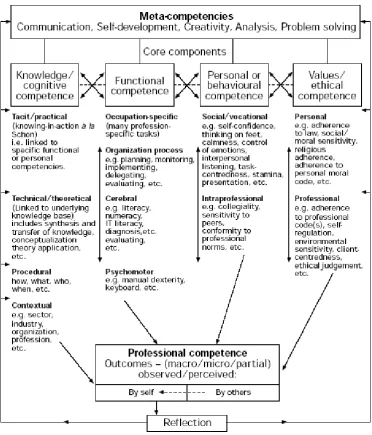
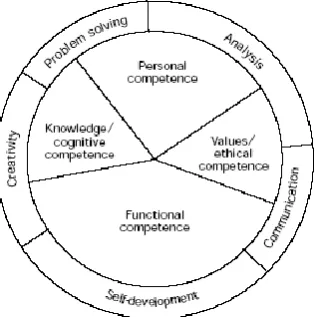
[image:10.595.114.487.214.650.2]In the mid 1990s, Cheetham & Chivers (1996) developed a framework for evaluation of professional competencies. They indicate that competence can be a difficult concept to pin down when it relates to professional occupations, where roles can be complex and the knowledge and skills involved are many and varied. They suggest that the components of professional competence are those indicated in figure 1, comprising functional competence, personal or behavioural competence, knowledge/cognitive competence and values/ethical competence (p. 24).
Figure 2: Typical example of occupational competence mix (including meta-competencies) Source: (Cheetham & Chivers 1996, p. 28)
Figure 3: Typical example of individual competence mix (excluding meta-competencies) Source: (Cheetham & Chivers 1996, p. 29)
Although this framework might not have universal endorsement, it does highlight the argument that competencies associated with ‘professions’ incorporate many attributes that are not considered in the development of most competency-based frameworks, such as those of the National Competency Standards for Project Management in Australia.
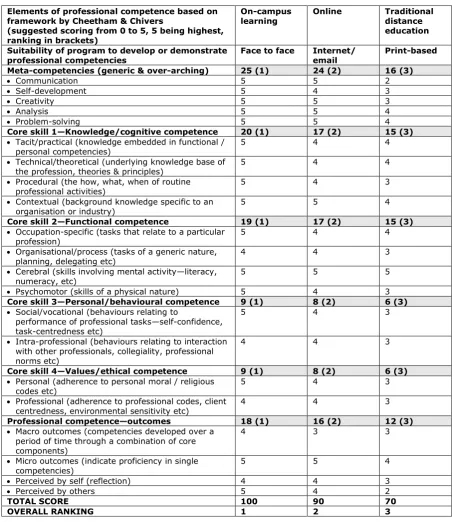
[image:11.595.176.422.281.407.2]Table 3: Comparison of learning environments for project management education (based on the Cheetham/Chivers Competence Model)
Elements of professional competence based on framework by Cheetham & Chivers
(suggested scoring from 0 to 5, 5 being highest, ranking in brackets)
On-campus
learning Online Traditional distance education
Suitability of program to develop or demonstrate
professional competencies Face to face Internet/ email Print-based Meta-competencies (generic & over-arching) 25 (1) 24 (2) 16 (3)
Communication 5 5 2
Self-development 5 4 3
Creativity 5 5 3
Analysis 5 5 4
Problem-solving 5 5 4
Core skill 1—Knowledge/cognitive competence 20 (1) 17 (2) 15 (3) Tacit/practical (knowledge embedded in functional /
personal competencies) 5 4 4
Technical/theoretical (underlying knowledge base of
the profession, theories & principles) 5 4 4
Procedural (the how, what, when of routine
professional activities) 5 4 3
Contextual (background knowledge specific to an
organisation or industry) 5 5 4
Core skill 2—Functional competence 19 (1) 17 (2) 15 (3)
Occupation-specific (tasks that relate to a particular
profession) 5 4 4
Organisational/process (tasks of a generic nature,
planning, delegating etc) 4 4 3
Cerebral (skills involving mental activity—literacy,
numeracy, etc) 5 5 5
Psychomotor (skills of a physical nature) 5 4 3
Core skill 3—Personal/behavioural competence 9 (1) 8 (2) 6 (3) Social/vocational (behaviours relating to
performance of professional tasks—self-confidence, task-centredness etc)
5 4 3
Intra-professional (behaviours relating to interaction with other professionals, collegiality, professional norms etc)
4 4 3
Core skill 4—Values/ethical competence 9 (1) 8 (2) 6 (3)
Personal (adherence to personal moral / religious
codes etc) 5 4 3
Professional (adherence to professional codes, client
centredness, environmental sensitivity etc) 4 4 3
Professional competence—outcomes 18 (1) 16 (2) 12 (3)
Macro outcomes (competencies developed over a period of time through a combination of core components)
4 3 3
Micro outcomes (indicate proficiency in single
competencies) 5 5 4
Perceived by self (reflection) 4 4 3
Perceived by others 5 4 2
TOTAL SCORE 100 90 70
OVERALL RANKING 1 2 3
Source: Adapted from Cheetham & Chivers (1996)
Note: there is no empirical basis for the allocation of numerical values to the respective elements, and no weighting has been allocated to the various elements.
ANALYSIS
Based on the evaluation framework, the comparative analysis above suggests the following possible conclusions with regard to the development of competencies in professional education:
Face-to-face education may be measurably superior to other educational environments
may provide a better learning environment than print-based distance education (which ranks last of the three environments considered)
Print-based distance education may be particularly poor in developing the meta-competencies defined in the framework
There may be little difference between the various modes in the development of the knowledge/cognitive competencies
There may be marginal differences between the modes in the development of the functional competencies
There may be noticeable differences between the modes in the development of personal/behavioural competencies and values/ethical competencies
There may be significant differences between the modes in the overall development of the professional competencies insofar as they relate to the concept of the ‘reflective’ practitioner.
CONCLUSION
This paper has looked at the effectiveness of professional education based on a review of recent literature, interviews with major stakeholders, and review of the framework for development of professional competence suggested by Cheetham & Chivers (1996). Comparison of various modes of delivery of professional education suggests that face-to-face education may be measurably superior to online delivery and print-based distance education, however, empirical research is required to confirm or refute the values attributed to the respective elements of competence in the analysis above, and this will form part of further research to be carried out by the author. Of particular interest will be how the deficiencies suggested in the learning environments associated with distance education and the Internet can be overcome or minimised.
REFERENCES
Australian Institute of Project Management 2002, 'Project Management Courses', Australian Project Manager, vol. 22, no. 3, pp. 19-31.
Benson, R, Hardy, L & Maxfield, J 2001, 'The international classroom: Using reflective practice to improve teaching and learning', paper presented to ASCILITE 2002 The 18th Annual conference of the Australian Society for Computers in Learning in Tertiary Education, Melbourne, 9-12 December.
Bloom, BS 1956, Taxonomy of educational objectives: The classification of educational goals: Book I, cognitive domain, Longmans, New York.
Cheetham, G & Chivers, G 1996, 'Towards a holistic model of professional competence', Journal of European Industrial Training, vol. 20, no. 5, pp. 20-30.
Conner, M, Wright, E, Curry, K, de Vries, L, Zeider, C, Wilmsmeyer, D & Forman, D 1996, Learning: The Critical Technology: A whitepaper on adult education in the information age, Wave Technologies, St Louis USA.
Dinham, SM & Stritter, FT 1986, 'Research on Professional Education', in M Wittrock (ed.), Handbook of Research on Teaching, 3rd edn edn, The American Educational Research Association, Simon & Schuster Macmillan, USA.
Farivarsadri, G 2001, 'A critical view on pedagogical dimension of introductory design in architectural education', paper presented to Architectural Education Exchange AEE2001, Cardiff, 11-12 September.
Jarvis, P, Holford, J & Griffin, C 1998, The Theory and Practice of Learning, Kogan Page, London, UK.
Jones, T & Paolucci, R 1999, 'Evaluating the Effectiveness of Educational Technology on Learning Outcomes: A Research Framework', Journal of Research on Computing in Education, no. Winter.
Kretovics, M & McCambridge, J 2002, 'Measuring MBA Student Learning: Does Distance Make a Difference?' The International Review of Research into Open and Distance Learning, vol. October.
Perraton, H 2000, 'Rethinking the research agenda', International Review of Research in Open and Distance Learning, vol. 1, no. 1.
Phipps, R & Merisotis, J 1999, What's the difference? A review of contemporary research on the effectiveness of distance learning in higher education, The Institute for Higher Education Policy, Washington, USA.
Saba, F 2000, 'Research in Distance Education: A Status Report', International Review of Research in Open and Distance Learning, vol. 1, no. 1.
Schon, DA 1987, Educating the Reflective Practitioner, Jossey-Bass, San Francisco, USA.
Turner, JR 1999, Is Project Management a Profession?, viewed 10 August 2003, <http://www.pmforum.org/docs/pmprof.htm>.
Turner, JR & Huemann, M 2000, 'Formal education in project management: current and future trends', paper presented to PMI Annual Seminars & Symposium, Houston, USA, 7-16 September 2000.
Turner, JR, Keegan, A & Crawford, L 2000, 'Learning by experience in the project-based organisation', paper presented to Project Management Research at the Turn of the Millennium: Proceedings of PMI Research Conference, Paris, 21-24 June.