
The discursive construction of literacy in a disadvantaged school
69
0
0
Full text
(2) The discursive construction of literacy in a disadvantaged school Volume 2. Barbara Comber.
(3) Chapter 7 Making time for literacy lessons. Chapter 7 Making time for literacy lessons: On task and socially responsible. People know what they do; they frequently know why they do whal they do; but what they don't know is what they do does. (Foucault, quoted in Dreyfus & Rabinow 1983, p.187) I can think of no more important project for teachers and researchers than studying classroom discursive practices in relation to the part they play in alienating students from literacy by fai ling to articulate their students' representations of themselves as subjects different from theirteachers. (Brodkey 1992, p.315). What needs to be realized is that, in every case students are caught up in a particular relationship with a teacher, one which is always intimate. interacti ve, transactive and negotiated, and characterized by a certain form of the expression of pedagogic authority. (Green forthcomillg). 7.1 in1roduction Literacy was a high priority at Banfield. The entire two hour morning period was usually devoted to language and literacy lessons. What did it mean to make literacy central at this school at this time? What were literacy lessons like? My initial question concerns the literate cul ture constructed at this disadvantaged school. What did students read and write? What did teachers make important? What came to count as literacy? Previous research I had conducted with colleagues presented us with two worryi ng findings. In one study teachers in disadvantaged schools suggested that they found it difficuh to make enough time for literacy (Comber et a1. 1991). In the other study teachers estimated that. approximately a third of students failed to meet their teachers' expectations for literacy achievement (Badger et al 1993). These surveys made me curious to witness first hand the complexity of teachers' and students' work in literacy lessons. In this chapter and the next I consider the literacy lessons in which I participated over an eighteen month period in four different classrooms. From all that I observed and audio taped, it is difficult to se lect lessons which might be considered typical. I do not wish to suggest uniformity where none existed. I see literacy lessons as discursive sites and as suc h as sites of contestation. My task then is to portray the complexity of teachers' and students' work in literacy lessons and the struggles to fulfil multiple and at ti mes contradictory purposes that were often at stake. Here I explore the discourses and. Page 224.
(4) Chapter 7 Making time for literacy lessons. practices which produced a multiplicity of literacies and student subjectivities in literacy lesso ns. I exami ne the classroom discourse through which schoollireracies are constructed. Recent discourse analyses of literacy pedagogy focusses on the busi ness of literacy, often singling out common school 'literacy events'. For example researchers have explored shared book experience (Baker & Freebody 1989; Baker 1991; Luke 1992),joint construction of narrative (Luke 1993c), hearing reading (Spreadbury 1992), morning talks (Christie 1990; Kamler et al. 1994), and sharing times (Michaels 198 1; Dyson 1993). However in this study my intention is to consider literacy lessons as pan of everyday school life, as something teachers do along with other institutional practices. Rather than editing out all that goes on around the literacy curriculum in order to better focus on 'literacy', I deliberately put the literacy lesson in the context of schools as workplaces, and the classroom as a 'work environment' as one of the teachers put it. My decision manifests itself in the use of extended transcripts which situate literacy events within other mundane discourses and practices of school life. In this way I want to consider 'the other sides' of the literacy event - what takes place before, during and after. Because literacy theorists look at literacy events, that which appears to be. non ~ literacy. business is often edited out, leading to somewhat san itised. transcripts of literacy lessons - two to five minute segments which foregro und the literacies bei ng constlucted. This has been important in building an analysis of how literacy is shaped in the classroom. In this study my object is to consider literacy pedagogy from the teachers' position hence I give the non-literacy business that goes on during literacy workshops a greater prominence. I cons ider teacher talk, suc h as 'pep talks' and. 'voice~over',. which at firs t sight may appear to have little to do with literacy. lessons per se. The chapter proceeds in four sections. First, I review one lesson where the complexity of teachers' work is foregrounded. I begi n by considering the ways in which literacy teaching is embedded in teachers' institutional work as a prelude to my analysis of literacy lessons as normalising practices. Second, I identify and examine normative teacher talk during literacy lessons: pep talks, voice-over and on patrol. I consider these classroom discourse technologies as instances of institutional disciplinary practice where students w·e examined, classified, monitored and managed. Third. I examine occasions where teachers and students contest normalising and disciplinary practices. Last, I discuss the discursive construction of teacher and student subjectivity produced in literacy lessons .. Page 225.
(5) Chapter 7 Making time for literacy lessons. 7.2 Teachers' work in literacy lessons: the complexity of making space In my own work I have promoted literacy pedagogical techniques and philosophies with the assumption that a space for literacy teaching already exists, that it does not have to be negotiated or that best practices in literacy teaching solve other problems of teaching. The unstated logic of this approach was that if the curriculum offerings were interesti ng e noug h, students wou ld be won over, wou ld want to read and write, would see it as pleasurable and would behave themselves; there would be stories that children would sit still for and literacy clubs that students could not resist joining. Res istant and troublesome studen ts would be transformed by a meaningful and liberating curriculum they could see was in their best interests. At the same time because the literacy curriculum promoted self direction, self awareness, self monitoring and self assessment, students would manage themselves. When academics and policy makers write about literacy pedagogy often the assumption is that if only we could arrive at the right formula we could make it simple for teachers to produce students with high levels of literacy performance, however iiteracy might be defined. By this account there are two independent variab les: teachers' methods and approaches and students' internal capacities. whether construed as skil ls. competences, abilities. stages or IQs. These assu mptions are the legacies of meritocratic definitions of education. The mundane routine work that teachers do in classrooms is distanced from our discourses of empowerment and liberation or even from discourses of quality and productivity. For example student misbehaviour is an absent category for many whole language. genre or critical literacy theorists. The assumption is that if the language curriculum is authentic and interesting problems of behaviour would diminish or disappear. Our student teachers learn about behaviour management separately from the Language, Maths, Environmental Studies curricula. In the classroom however teachers must bring these different know ledges and discourses into play at the same time as they orchestrate even ts and manage students. This may seem obvious. Teachers have to be able to 'control the class', whatever methods they employ - whether teachers train students to control themselves or whether teachers maintain control through thei r ow n force and explicit exercise of power. I argue that theories of literacy pedagogy, and curri cu lum more widely, have for the most part ignored the mundane realities of teachers' work (exceptions include Edelsky et ai. 1983; Luke 1993a; McNeil 1986).. 7.2.1. Caring, managing and teaching in the early literacy classroom In this section, I take my fieldnotes from one lesson to foreground the complexity of teachers' work at Banfield. On the day in question in this first week in November, Ngan, who is five years old and having arrived in Australia from a refugee camp in Vietnam just. Page 226.
(6) Chapter 7 Making time for literacy lessons. weeks earlier, has just begun her school life. Before the school bell sounds she is already quite distressed. She speaks no English and her teacher speaks no Vietnamese. She knows no-one from the school community. These notes represent what I recorded during the lesson. The extended transcript is considerably longer. Still, the fieldnotes indicate what I was able to take in and get down at the time and are interesting in that regard. 1 made notes about the time as teachers had expressed concern that it took them so long to get things done and that they never finished what they had planned. [Before school chat. Il'S S.55am. One of the children Slarts lO cry Ngan - new child who doesn't speak any English. She cries and coughs and the teacher picks her up.]. Teacher. Who was away yesterday?[Teacher records attendance in roll. Leona comes in late. Sean shows teacher his watch.] Who's got something to show and tell the whole class this morning? I think Daniel has. Come here Daniel. [Daniel brings an encyclopaedia from home to the front of the class and begins to turn pages and show them to the group gathering on the mat on the floor.] Any book clubs? OK. Tomorrow's the last day Sunshine Room.[Teacher collects forms, writes lunch orders and fills in the roll book while Daniel continues to show the encyclopaedia.]. Teacher. In a big big voice people cannot hear you.[To Daniel] [A parent walks in with Tabalha who is late. Tabalha looks worried. Larry (from another class) brings in a note to the teacher, which teacher opens and reads and gives him a return message.]. Teacher. It's going to be one of those days today. It's one interruption after another.[To researcher]. Teacher. What shall we do lhis moming? ReadingjoumaJs,[Children agree enthusiastically.] Daniel's been showing his excellent book. Do you want me to read it later?. Students. Yes. Teacher. Everyone eyes on Rebecca. Look at her beautiful dress.. Rebecca. It's my party dress. I gOl illoday.. Teacher. It's your birthday today isn't it. Everyone it's Rebecca's birthday. [They sing Happy Birthday lO Rebecca.]. Page 227.
(7) Chapter 7 Making time for literacy lessons. Teacher. So how many claps do you want us to give you today? Six. What else did you get for your birthday. Rebecca explains what she got for her birthday. Ah Robin listen in please. Who's that coughing like that? Is that you Amy? You're sick. [It's 9.10 am. Many children start to cough. Child reads the print at the bottom of the bobcat poster.]. The teacher comments thm it's going to be 'one of those days' when in the first few minutes she deals with latecomers, parents and children with messages from other teachers. In her view the scene is set for interruptions. Ten minutes into the language alts lesson the teacher has already provided pastoral and physical care of children as well managing clerical matters such as marking the roll and collecting fOlms and money for lunch orders and book club. While she does these things Ngan is either on her lap or at her side. The literacy lesson becomes ancillary to these other institutional demands that go with managing and caring for thirty five and six year old children, some of whom are sick or fearful and some of whom have birthdays or show and tell. The negotiation and management of lifeworlds is primary and the literacy agenda struggles for space. In continuing to turn the pages of his encyclopaedia, Daniel and the patient child onlookers provide an illusion of literate activity, supporting the teacher to get the morning underway. Teacher. Yes Melinda. I'm not listening to you Jasmine, not if you call out like that. [Ngao starts to cry and coughs.] It's a bit scary for her. Let's see how quietly we can get started this morning and do our work. [Sophie from grade six comes in and says her teacher sent her in because the others are going 00 an excursion and she wasn't allowed to go. Teacher smiles and says she can help out or do her own work. Teacher hands out the reading journals, cuddles Ngan and does Ryan's lunch order. Leona shows teacher some new clothing.]. Teacher. Oh they're groovy aren't they? [Teacher finds the pages in the reading journals for some Children.] Look at that class a bit off today .[To researcher. Children are talking loudly. Ngan starts to cry again.} A. Teacher. Alright Sunshine Room you should be on task. [Ngan cries and cries and coughs and comes back to sit on teacher's lap.] Right Kirby if you used it yesterday.[He has lost his reading journa1.} Come on Shelly. Right, good to see everyone is settled down now. The people on this table have almost finished - very good; excellent. I think these can be the best workers this morning. Or is it this table. Page 228.
(8) Chapter 7 Making time for literacy lessons. or this. Maybe everyone. Perfect beautiful. [The children are doing their reading journals. They copy the title of the book they took home to read the previous night and draw a picture.] Teacher. OK Sunshine Room, five more minutes and then we're going lO have some big books lOgether. [It's 9.26 am. Ngan cries very loudly again. The children al the table where I'm sitting chat abom TV programs and draw their pictures. Then they talk about the ghost train at the show. As the children finish they go to sit on the mat. The teacher is over that side of the room already with Ngan, hearing individual children read. Sophie wanders around and chats with the chi ldren.]. Teacher. OK. Two more minutes Sunshine Room. [It's 9.31 am. Teacher checks reading journals and reads any writing they have done aloud and hears children read.]. Teacher. At least they've settled down a bit now. See what it's like. [To researcher] How are we going over here? You've got one minute to go. [It's 9.34 am. Teacher goes with Ngan to check out what the others are doing] Pack up now please. OK. Let's pack up now. Oh reading books are we? [To group of children gathered on the floor reading big books togetheL] We'll have some together. [Ngan starts to cry very loudly agai n. Several child ren start to fight as they put back their books.]. In this next phase of the lesson the teacher sends chil dren off to do their reading journals, whi lst she listens to individual children read. Doing reading journals in this class means that the children write the title and author of the book they read at home the previous. evening; they draw a picture about the story and, if they are ab le, write something about the story. Some children copy parts of the story. This was a daily activity in this. classroom. The teacher's prediction that it was going to be one of those days appears to be coming true. In this twenty five minute period, the teacher deals with a child sent to. her from another class, Ngan who appears to be sick as well as unhappy, and the continued chores of forgotten lunch orders and lost books. As well she hears individual chi ldren read and provides words for those children trying to write their own texts in their reading journals. Conscious of my presence she also apologises for the class - 'a bit off today'. In all of this she makes time for comments to individuals about clothing and to the class and groups about being on task. She and the ch ildren keep the lesson moving along as they engage in their everyday routines. With promises of having some bi g books. Page 229.
(9) Chapter 7 Making time for literacy lessons. together she brings the children together on the mat and moves into the next phase of the lesson. Teacher. OK. Hands on heads, shoulders, in the air. On your bottoms. 'With my hands on my head'. [Sings song. Teacher does the actions with Ngan on her lap. Jasmine starts to cry and cough too. Teacher looks at me. Checking my reaction to the song and how involved the kids get.]. Teacher. What's wrong Jasmine? Change your home book. [They sing another song.]. Teacher. I was going to say ... Stop that Cymhia and turn this way Leona. See what happens. I cannot concentrate on two things at once. [They go back to their rhyme. It's a clapping, clicking rhyme. Benjamith from grade seven comes in to borrow the staple gu n. Ngan starts to cry very loudly and teac her stops what she's doing and talks about how she might be feeling.]. Studem. I saw her crying when I was coming home with my mum.. Teacher. I think she's sick and yesterday I didn't think she was too bad but.. Student. [ thought she'd hurt herself.. Teacher. No I think she's really sick. You know when you did n't fee l well and you felt really sad and you said, 'I don't know what's wrong with me'.. First the teacher, with the distressed Ngan on her lap begins to chant poems, and songs which many of the children know by heart. She begins with one intended to get all the children attending to her, a variation of the Simple Simon game. Here the child body is trained to respond to the teacher demands through the game· like forma t. The teacher loses direction when she is distracted by the behaviour of two students. When another child from the senior class comes in with a request for the staple gun, Ngan begins to cry very loud ly and the teacher cannot proceed. Cuddling Ngan on her lap she talks wi th the children about how she might be feeling, reminding them of times when they have been ill. The reru issue of health care becomes most urgent in the lesson. The difficulty of not being able to communicate with Ngan is foregrounded in this episode. Ngan is unable to tell her teacher what is wrong and the teacher finds no way to ask. Given these circumstances and her need to manage all the children she continues with the familiar morning activities whilst trying to comfort Ngan physically as best she can. When Ngan. Page 230.
(10) Chapter 7 Making time for literacy lessons. is quiet again the teacher begins to lead the children in reading a big book 'Bubble gum' emphasising some words loudly as she reads. Teacher. Why do we say it louder Rebecca? Remember,. Rebecca. Cos it's gOl a question.. Teacher. Is that a question mark?. Rebecca. An exclamation mark. [Teac her points and reads aloud. Kids join in.]. Teacher. 'No bubble gum at school- cos it's troub le gum.' [Teacher reads aloud. Child starts talking.] Charlie I can only hear one person at a time. [Teacher starts to read 'Dear Zoo' a teacher made big book version. Ngan starts to cry again. One of the students complains about how loud she is.]. Teacher. Don't listen to anyone who calls out. Choose someone with lovely manners, who's Sitting on their bottom. [To Sophie from grade six who's helping and allowed to choose students for special jobs like pointing to the text.) On your bOHom, and she might choose you. Ah. don't call out. [Ngan starts to cry again very loudly. Jasmine starts to cry.]. Student. Jasmine's crying.. Teacher. I don't think there's any reason fo r Jasmine to cry. [They continue to read the story.]. Teacher. Can we read this together? Dzung. Dzung. Dzung tu m around, sit down , good girl. Who can read this sign? [S ophie starts to read the zoo anima ls book.. Sophie. 'Aa all igator eating apples a a a'. [They sing to time of 'Skip to my lou'.]. Teacher. 'Cc camel eating carrots c c c.' Who thinks they can remember the next one?. Teacher. Next one Daniel. Cannot remember. Doesn't matter. Bruno.. Bruno. Elephant eating eggs e e e.. Page 231.
(11) Chapter 7 Making time for literacy lessons. Teacher. The next one's a tricky one. Melinda.. Melinda. Ibis eating ice cream i i i.[They sing this.]. Teacher. Jaguar eating jellybeans j j j [They continue singing until Leona puts up her hand.] Leona.. Leona. Jasmine went like that to me. [Indicating what Jasmine did.]. Teacher. You need to decide if you can sit nicely with us or go to time out.[To Jasmine]. Student. Some of the animals are eating junk food and I don't think they should be.. Teacher. No I agree with you one hundred percent. Next one. Qh. Now what's that next one do you think. Dzung, Tabatha. Give you a clue it's a 'm'. 'Monkey's eating muesli bars.' [They continue to si ng their way through the book. Ngan cries again.). Teacher. I don't really know what to do with her.[to researcher re Ngan]. Be. Is there is anyone who speaks her language in the schoo l, so you can find out if she's homesick or s ick or.. ?. Teacher. Yes Tran - I might have to get Tran. [They go back to their book. It's 1O.00am.) 'Zebra eating zucchinis z z z.'. It has taken a long time to get to the lesson itself. The teacher's literacy agenda here is to have the children notice the initial sounds and letters of words by reciting together a class made text using alliteration and based upon a published book. As they work their way through the entries for each lelter of the alphabet, Ngan continues to be upset and her crying intenupts the academic agenda. As the lesson proceeds the difficulty for the child and the teacher in this situation is highlighted. The troublesome Jasmine begins to cry as well. The teacher proceeds and the visiting child from the senior class helps out. As they consider the text on each page one child is invited to read it before the class sings it together. Just as things seem to be running smoothly Leona complains about Jasmine and the teacher invites her to decide between sitting nicely or time out. Here the teacher employs the behaviour management policy, aimed at training the children in self-control and making choices about their behaviour and its consequences. When Ngan begins to cry again the teacher says to me anxiously that she doesn't know what to do with her. She decides to see jf a chi ld from another class can translate for Ngan. tn order to get this organised she first sets the rest of the class to work on another task.. Page 232.
(12) Chapter 7 Making time for literacy lessons. Teacher. Right now we're doing 'flamingo eati ng ... and giraffe eating'. I got two pictures from this excellent animal dictionary. OK. Rebecca. Hands up if you can tell everyone what we're going to do. Start colouring in when you go to your table if you can and I'll give out your zoo books. Ngan cries. [Teacher tries Dzung and Mi nh as translators. They say that Ngan wants to go home.]. Teacher. Ask her: 'Is mummy horneT [Ngan cries. The children are noisy as they sit down.] Excuse me - that's not how we normally work Su nshine Room. Excuse me Sunshine Room. I also think that Ngan is scared because of the noise level and I don' t blame her. Now you know what you're meant to be doing and [ want you to do it quietly. I don't need to tell anyone. [Tran comes in to translate for Ngan.]. Teacher. I think we might need to practice at recess time. That's not how we do ou r work. [Teacher is going to take Ngan to pri ncipal's office. She gives them an instruction about working quietly or otherwise time out and leaves them with me for just a few minutes. Teacher returns. She has been unable to see the principal because she is down doing an enrolment.]. Teacher. Shelly you're wonderful you've finished your work, packed it away, pushed your chair in.. Student. Excuse me [teacher's name]. Everyone on my table is teasing me. [Teacher goes to this table and begins to check what the children are doing. Tran and Sophie are still in the room. Teacher bobs down at a table and starts to read one of the books. Ngan watches. The children chat as they stick their pictures in and copy from the board. Ngan starts to cry again. It's 10.28 am. Sophie po ints ou t the words on the blackboard.]. Teacher. OK. Sunshine Room. Hands on heads please and listen. Put your work on your desk. Push your chair in. Let me see which table is ready. You can be my leaders Ryan and Jasmine because you were ready so quickly. It's so noisy in here I cannot believe it! [As they get ready to go off for a singing lesson the principal arrives and introduces a prospective new parent to teac her.]. In the final part of the lesson the teacher organises the children to illustrate the next part of. their shared text abollt zoo animals and enlists the aid of other students as translators for Ngan. She moves between directing questions for the translators to ask Ngan and keeping the rest of the class on task. She suggests that Ngan's crying may be partly. Page 233.
(13) Chapter 7 Making time for literacy lessons. because she is scared of the children's noise. Here she uses Ngan's crying as part of her plea for quiet working. As things become quieter she begins to check what children are producing. When Ngan is still not calmed after having talked with the other children she leaves me with the class and takes her to the office in order to get some assistance from the principal. However the principal is busy enrolling a new student. When she returns she recalls that the children are due for a singing lesson and she interrupts them to prepare them for that.. 7.2.2. What do teachers do in literacy lessons and what are the effects of what they do? What can be said about this literacy lesson? Many different critiques could be made of this lesson from different educational posi tions. Educators may point out the problem with interruptions to the time spent on the academic tasks at hand. Others may question the effectiveness of a shared book approach for instructing children about letter-sound relationships. Still others may question the challenge of the content. My standpoint warns against any hasty critiques of the teacher. She is an experienced and highly respected teacher. Parents were eager to have tbeir children placed in her class. Children demonstrated considerable affection and respect for her and she towards them. Worried or distressed children regula.rly spent time on her lap as she went about her work. Other teachers spoke of the 'warmth' of the classroom atmosphere. I witnessed chi ldren's growing competence with interpretation and production of texts in her classroom. My concern here is not with what the teacher didn't do, nor with her effectiveness. My concern here is with all that she had to do - the work required from her in order to make a space fo r a literacy lesson of any kind or substance. Much of this has little to do with the key variables of pedagogical method or student capacity - it is about establishing an institutional and moral order in the classroom. It is about survival in the complex ecology of a classroom community. Teachers' classroom work involves caring for the bodies of children, inculcating children in classroom routines, managing institutional business, connecting with the absent family and dealing with the academic coment. In this ninety minute period this teacher deals with a multiplicity of demands: including legal, organisational, personal, physical, emotional, disciplinary, collegial and academic. As well as the competing pressures of her classroom work, there are other interruptions from outside as well: children corning late, a child to mi nd from another class, requests from other teachers for equipment, a visit from the principal and prospective parent. She juggles her competing roles without losing good humour. She lets me know that this is 'what it's like'.. Page 234.
(14) Chapter 7 Making time for literacy lessons. Readers might respond that a day like this is unusual. New children who are sick, who don't speak English don't begi n school each day. However days like these were not unusual. In comparison with other days this lesson was relatively straight forward. I observed other more stressful and difficult occasions - circumstances involvi ng family trauma, severe child injury and so on. The ci rcumstances vary continuously; this constant variation being a problem fo r teachers in its own right. Teachers develop, as one teacher put it, a kind of 'crisis mentality'. They begin to expect family trauma to impact on school; they begin to expect interruptions; they begin to expect high absenteeism. Teachers frequently made statements to this effect - the continual feeling of not getting enough done, of being interrupted, of sick child ren at school, of the academic agenda being short circuited by more immediate needs. How teachers deal with a classroom commu nity of children from many different cu ltures and speaking many different languages is sometimes ignored in considerations of teachers' work and formulatio ns of literacy pedagogies. The effects of language and cultural differences allied with the effects of commu nity poverty on everyday school li fe are rarely considered. In this lesson we see the teacher working hard to construct the classroom space as a place of work and selfdiscipline whilst at the same time a place of comfort, fun and academic learning. My purpose here is not to prove that teachers' work is complex, This requires no proof to those who have taught in schools such as Banfield. My purpose is to understand the circumstances of teachers' work at Banfield in order that the excerpted transcripts of classroom discourse which follow may be read with these echoes and images in mind. I document these local circumstances so that the discourses and practices of literacy lessons can be read against this broader, though brief, pon rayal of teachers' classroo m work. In consideri ng why certain discourses and practices are employed at this time in this school I foreground the everyday classroom lives of these women teachers. Why some discourses and literacy practices become dominant at Banfield at this time is contingent on these wider institutional and community real ities. To conclude my brief comments on the above field notes, I make reference to the literacy work wh ich was achieved in the above lesson. The teacher heard a number of ch ildren read, read a big book and checked a number of readi ng journal entries; children wrote and illustrated their reading journals, wrote and coloured in two entries for their zoo animal alphabet books and sung or reci ted a number of poems and songs. It is not that nothing happened, far from it. Even on those days, where it was 'one of those days' the teacher and children did read and write; however on this particu lar day the literacy business was not the most urgent; it struggled to stay on the agenda.. Page 235.
(15) Chapter 7 Making time for literacy lessons. As a palticipant observer of this lesson r felt keenly the teacher's concern for the distressed child and yet her frustrat ion at a lesson somehow wasted. I we lcomed the lime when the class went to singing and she would have the space to organise for Ngan to be 'looked after'. How then do teachers make space to do more than survive, to make time for the academic agenda as they see it? In the next section I pursue these questions by looki ng at repeated discursive practices across each of the four classrooms.. 7.3 The other side of the literacy event: Normalising practices Because lite racy is a social practice it cannot be separated from and constitutes the forms of social organisation and institutional practices and beliefs within which it is exercised. My aim here is to look not only at what goes on duri ng specific literacy events but to consider what goes on duri ng the en ti re 'language workshop', usually from 9.00am11.00al11. Thus my interest is not only in which texts are read and which genres are written, though these are important, but more broadly in what gets spoken about, how students are addressed, what gets made important, what is teachers' and students' work like during literacy lessons. My intention here is to recontextualise literacy pedagogy as a form of teacher labour which in turn produces specific student labour and behaviour. I identify particular kinds of teacher talk during li teracy lessons and consider how students are constituted in th is classroom discourse. Over the past decade researchers and academics have encouraged teachers to move to a workshop approach where for a significant segment of the school day students focus on reading, writing, listening, speaking, handwriting, spelling - whatever is counted as part of the literacy and language curriculum. At Banfield the entire morni ng period was usually set aside for the language and literacy workshop. The idea was to get this work done while the children were freshest and engaged. Discourse analytic research typically focusses on specific literacy events within this workshop time, for example listening to a child read, morning talks, sharing time, a shared book experience segment or ajointly constructed text being produced. Insights from this work has incl uded analyses of the ways these events work ideologically - telling students what literacy is and how they should practise it and shaping student identity. In the next section of this chapter I examine how schoolliteracies are constructed at Banfield through institutionalised pedagogic practice. I am interested here in particular in instances of normative discursive practices where teachers exercise power in managing the class to be made li terate (Fairclough 1992a). During my observat ions of the language workshops I noted that teac hers employed a. Page 236.
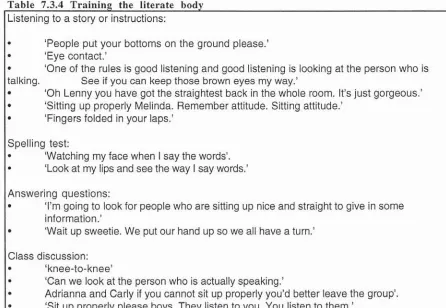
(16) Chapter 7 Making time for literacy lessons. repertoire of discursive techniques designed to keep students on task and to produce the ideal student. I have named these: voice-over, pep talks and on patrol. These techniques were onen used as a cumulative strategy, hence I consider them together. Voice-over is what teachers say while students work. Pep talks are what teachers say to students about how students should be. Teacher on patrol is the individualised checking teachers do during literacy lessons. Table 7.3 provides a summary and examples of these techniques. ' T a bl e 73 D'Iscu rSlve tec h moues to Dro d uce t h e l'd ea I stu d e nt Techn i au e Oe f in i tion Exa mpl e s. Voice-over. What teachers say while students work. Pep lalks. What teachers say about students to students. 'That's not how we normally work' 'You're on task straight away' 'I'm find ing your noise level too high' 'Focus on journal please' 'Some lovely Quiet workers' 'Some people have cleaned up beautifully' 'So you know deep down inside what your responsibilities are' 'When I saw you were a bit sloppy at the end of the day you were forgiven' 'Because we are looking at working. 10Qelher' On patrol. Individualised checking of students. 'This shouldn't be in your journal' 'Adam have you started work?' 'U's not drawing time Daniel, it's writing tim e.' 'Adrianna are vou on task?'. I see these discursive techniques as nonnalising practices because they make explicit the teachers' norms for classroom behaviours, where they should be, where their bodies should be, when and how Ihey can speak, whallhey should be doing, how Ihey should. be doing it and how they should be using their time. I move now to illustrate and discuss in turn voice-over, pep talks and on patrol. I use extended examples from across the classrooms as 1 make the case that these practices are not part of teachers' unique styles, bu t available resources within the insti tutionalised repertoires of schooling.. 7,3,1 Voice-over: A reminder of what you should be (doing) Voice-over refers to the running commentary produced by teachers after students begin the set task. To illustrate: the teacher has given the instruction about what students are to do, how they are to do it, and how long they have to do it. The students return to their seats and engage in all manner of acti vities from doing exactly as they are told, chatting, organising books and so on. At this point, and in fact any time whilst students are supposedly engaged in independent work, teachers make statements to the class. These statements may include reminders, additions, clarifications, comments on student behaviour, comments on student products. Students are usually free to stay at their seats. Page 237.
(17) Chapter 7 Making time for literacy lessons. and to keep going about their set tasks, unlike other kinds of teacher talk, which does not proceed without eye-contact, silence and pens down; in fact its Object is to keep students in their seats and keep them on task. I call this fonn of teacher talk voice-over because it runs over the top, as it were, of the other activity that has already been put in place, and provides a meta-conunentary upon it. Here the teacher, a little like the spotting commentator, tells the audience what it is they can see. In this instance however the audience are also the panicipants; hence the analogy fa lls short. However it is suggestive of the kind of talk which occurs. If the voice-over does not produce the required result it can eas il y be transformed into other forms of discipline. I discuss voice-over as occasions of specific kinds of discursive practice constitutive of student subjectivity. Examp les of voice-over from each of the fou r teachers foll ows, beginning with the junior class, the children at the begi nning of their sc hooling. Teacher. Look at this wonderful table here - organised straight away excellent.. Several minutes later same lesson Teacher. You're on task aren't you this morning. Excelle nt. Come on Kirsty and Leona.. Several minutes later same lesson Teacher. We've got about five more minutes left before we need to be organ ised.. Several minutes later same lesson Teacher. Right Jasmine and Scott how are you going the re? I'm going to come and see what you're do ing in a minute. Great workers on this table. Cou ld you qu ieten down please. How are you going here boys. Excellent. Wow. Well done. Some people dec ided to do their look-cover-write-check straight away.. Towards the end of the same lesson Teacher. Oh let's see what's happening over here. How are you going Bruno? Right nearly recess. I don' t think you've got it done - you might not be allowed to go. Right Allan let's see how you're going. [Chi ld complai ns of noise and a headache,] It's very no isy in here. Obviously people are not really working. If I have seen you really. Page 238.
(18) Chapter 7 Making time for literacy lessons. concenrrating this morni ng then you might be able to go out, but if I haven't seen you concentrating then when the bell goes you can stay in and do your work. The teacher's voice-over did a number of things. It named groups of children, 'tables', who were on task and organised. Individual children who were not 'on task' were encouraged with 'Come on Kirsty and Leona', reminiscent of a spOl1S coach enthusing team members to play harder, run faster. The. voice~over. also reminded chi ldren of time. limits. It reminded children that the teacher would be there to check what they were doing. It reminded children of the teacher'S desire for them aU to be 'great workers'. It reminded children to be quieter. It remi nded them of task options for early finishers (look, cover, write, check). It reminded them of the consequences of not getting things done, such as losing their recess time. It reminded them of the need to concentrate. In this classroom then the voice-over lets the children know where their teacher is and what they should be like: quiet, organised, conce ntrating, on task, self-directed, great workers. Such people would be rewarded with recess time. Non-conformers would 'stay in and do you r wo rk'. Punitive consequences are spelt out. S urveil lance is mai ntained. The proper student subject is identified, described and promised reward. As a cumu lative strategy. voice~over. has different effects at different stages in the lesson.. In the emergent phase children are encouraged to be on task and organised. As the lesson proceeds it signals surveillance, examination and time limits. The teacher often begins by naming individuals and moves out to include the whole class. Starting with positive naming of specific chi ldren has the effect of having each child listen in the hope of being identified also. When the children are all listening then the generic message can be delivered to the whole class. I move now briefl y to voice~over from each of the other classrooms and make brief conunents indicating how this discursive practice is deployed in each context. Firstly I consider teacher talk fro m the other junior primary class, comprised mainly of six and seven year old children, wi th a small number of five year olds. These children have been at school on average longer than the class discussed above. Teacher. Sofia, you're getting yourself organised in a very adult way. Martin I really like the way you're on task.. several minutes later same lesson Teacher. I really like the way Liam's table is working so quietly and they're getti ng so much done.. Page 239.
(19) Chapter 7 Making time for literacy lessons. In a lesson a day later Teacher. Oh Luke - you're on you're task straight away. Do you know what Adam, I have forgotten to give out the books. Stop. Shoot me. Billy are you ready to strut love? Bruce - would you like to start straight away dear. Mark I' ve got to talk to you about your voice darl ing. It cannot be that loud.. Same lesson several minUles later Teacher. I' m finding your noise level too high and Zlata is finding it too hard. So I want you to check that you have all three things in your illustrations and I can tell you that we've only got ten more minUles left so noses down bottoms up.. In this classroom the teacher voice-over again identifies students who are on task, who are getting organised 'in a very adult way'. Once again groups of childre n, 'tables' are named as doing the right thing, 'working qU'ietly' and its implied desired consequence, 'getti ng so much done' . Teacher voice-over publicly names and describes the good students. Children are reminded to be 'on task straight away' through the public naming of model students. These criteria 'starting straight away' and 'working quietly' can then be used to name and encourage those who have not automatically produced the required be haviours. Would-be recalcitrant individuals are addressed with terms of endearment love, darling - to coerce them gently into the right behaviours. A fina l reminder repeats the message about noise, reminds students of the task, gives students a time limit and metaphorically insists that they work harder: 'noses down and bottoms up'. Praise is associated with be ing adul t, organised, on task, 'working hard', 'working so quietly'. Thus the formatio n of the ideal student subject once again is as quiet worker meeting deadlines. I move now to grade three/four class. Here the teacher voice-over is more extended in length and frequency. Teacher. Focus on journal please. Are you on task?. Several minutes later same lesson Teacher. OK. Can you fin ish up what you're writing now and spend a little bit of time checking your writing . No don't come to me. I want you to do it. For example I sent one person to check the ti tle. Make some changes to your wri ti ng that needed to be made. J want you to add the 'ses' and 'eds',. Page 240.
(20) Chapter 7 Making time for literacy lessons. Towards the end of the same lesson Teacher. Right there are two people out in the garden at the moment because they achieved their goaL. A day later Teacher. OK. You can refer back on yesterday 's notes to fix the word goal and sentence begi nnings.. Teacher. My learning goal, my goal for today. So that's a start for everyone.. Several minutes later same lesson Teacher. OK. You've got a couple of minutes left to get your two goals down. If you've got spare time you can do a recording of something you want to remember from last night or last day . Please make sure you have a dare on the top. Are you finished Adam?. Adam. No. [Stalts writing.]. Teacher. Can you try to keep the noise level down. Clara have you finished your goals? OK one minute left. I would really prefe r that I don't have to give people extra time to finish their goals. Tthink with some people it's staying on task that's the prob lem.. In this voice-over simi lar discourses dominare. The student subject in literacy lessons is 'on task' ac hieves their 'goals' and works quietly wi th in time limits. However in this class, detail about how the literacy task should be done is provided. Students are re minded to make c hanges to thei r writing themselves, not to come to the teacher. Here is a case of forced independence, where the indiv idual is pushed to be proactive and autonomous. A little later in the same lesson the students are info rmed that two students who have already achieved their goals are out in (he garde n. The discourse of work is more sophi sticated here in that students are working not only towards fi nishing tasks by the deadlines. Now they are working towards completing their self-set learning goals. Those who complete goals early are rewarded with free time in the garden . [n the language lesson the following day students are reminded that they can find con'ect spellings for the word 'goal' in their previous e ntries a nd that possible sentence beginning for their journal entries are on the board. In 'spare time' they are given permission 'to record something they want to re me mber. Potential non-finishers are questioned about their progress for all to hear. Finally students are reminded of the noi se level, the need to finish within the set time limits and the need to be on task.. Page 241.
(21) Chapter 7 Making time for literacy lessons [n the grade three/ four class the same discourses are repeated. The student subject still sou nds very much the same. [n addition the teacher makes it clear that the literate student checks their writing themselves and refers to previous entries and the blackboard. Students should not come to the teacher for these things. The ideal student is able to set their own goals and complete them ahead of time in order to have free time in the garden. The teacher prefers 'not to give people extra time'. The teacher ultimately controls the organisation of time, whilst students are apprent iced into discourses of management of the self. I move now to the teacher voice·over in the sen ior class, the five/six/seven class. Teacher. Perhaps you could be more specific about your goal. If you llsually read two pages in silent reading you could read four.. Same lesson several minutes later Teacher. I think we might need a silent time. It doesn't look to me like too many people have finished.. Same lesson several minutes later Teacher. As soon as you're organised show me that you've organised by siuing quietly. [Teacher names kids as they sit still..] It's interesting to see the people that can get their act together.. Same lesson several minutes later Teacher. I'm pleased to see people checking the spelling of "adjectives" as they write it.. Same lesson several minutes later Teacher. Can we stop. There's a lot of giggling and SlUff. Everyone has the right to work in a quiet environment. You know the rules so can you use it please.. Same lesson several minutes later Teacher. Remember you people [ have the right to move you if working in friendship groups does not work.. Towards the end of the same lesson. Page 242.
(22) Chapter 7 Making time for literacy lessons. Teacher. Thankyou to those people who came down quickly, It's time to fin ish now please Julia. Mark we have a rule. Could YOll use it please.. In the grade five/six/seve n class the ideal student subject is again consistent wi th each of. the other classrooms: quiet, organised, worki ng and finishing on time -'people who can get their act together'. Students need to 'be spec ific' about their goals. This is exemplified in terms of the amount that they might read during silent reading time. Lack of finishi ng is once again explai ned by noise level and 'a silent time' is suggested. Students are asked to demonstrate their organisation by 'sitti ng quietly', Students are reminded to check spellings. Students are remi nded that 'giggling and stuff does not fit with thei r class ru le and that 'everyone has the ri ght to work in a qu iet environment'. They are reminded that failure to abide by the rules may have consequences. The teacher has 'the right to move' them away from their frie ndship groups if si tting in their groups doesn't work, In the senior class the ideal literate studen t is able to get 'organised', set 'specific' goals and 'use the fuies·. The class has agreed to rules of behaviour to protect their rights as learners. Siuing with friends is a privilege. Ultimately the classroom is a work environment. The teacher reminds them of her authority in dec idi ng whether they are keeping the ru les and can maintai n their privileges.. 7.3.2 Voice-over: The construction of student workers Banfield teachers prided themselves on their own individualistic approaches to teaching. Indeed there were differences. However, the uniformi ty of thei r statements in voice 0ver 8. was striking. The construction of the literate student subject - from five year olds to thirteen year olds - was remarkably consistent across teachers and classrooms. The fonnalion of the sensibilities of self-regu lating workers was put in place from the earliest days of primary school and evident across the grade levels. Students are constituted as 'great workers' and their organisation complemented as 'very adult'. The voice-over reminds them of the need to be 'on task' to ensure productivity within the time limits. The school day begins with setting goals and reviewing yesterday's achievements. Students are reminded that they are in a 'work environment' where their relations and rights as colearners must be prioritised over their relations as friends. These teacher comments occur over the top of other classroom activities. Students are not usually expected to respond verbally to these statements, but they are expected to hear them and perhaps alter their behaviour. Tn summary, teacher voice·over congratulates the hard-working, quiet, on task students and simultaneously reminds all students of these nonns. Voice-over also reminds students about reducing noise, In addition specific. Page 243.
(23) Chapter 7 Making time for literacy lessons. literacy behaviours are reinforced, such as the need to check spellings and refer to prev ious materiaL The teachers' voice can be seen as a oral reminder of the teachers' presence. It lets students know that the teacher is there - ever watchful and aware of student misdemeanours and transgressions, conformity and achievements. Teacher voiceover then is a remi nder of the continual surveillance to which eac h student is subjected and for which each teacher is responsible. What were the objec ts of teacher voice-over in these classrooms? In other words what did teachers talk about while studems worked? Across the four classrooms the most common themes of teachers' voice-over talk were what stu dents should be doing ('working', 'o n task'); how students shou ld use time (meet 'dead li nes'); students' responsibilities ('tidy up', 'not to disturb ot hers'); what different studen ts shou ld be doing ('people writing in roller pen', 'people who are doing spelling tests') and preferred li teracy behaviours for the task at hand ('be indepe ndent', 'w ithout aski ng me'). As a disciplinary practice, voice-over defines and articulates, through repetition, the classroom nonns. It overrides all other classroom activity to tell students once again who they are, who they can be and how they should be. These were not isolated or rare instances. Below I reproduce a selecrion of voice-over from one classroom across a school term to illustrate its frequency and consistency. My aim is to show how this technique was put to work in the classroom of children newest to schooL My interest here is how the 'new students'. the five and six year aids are inducted into school discourses in li teracy lessons. In th is classroom the student as worker construction was rei nforced regularly, as the fie ld notes be low ill ustrate. 20110/92. Some lovely quiet workers. See this table's nice and quiet. Goodness me, busy beavers.. 29/10/92. Very good lable here. On lask lable. I reckon lhe girls lalk the rna'" [said teasingly] This is the chatterbox table. (Leona interjecting, ' I' m not a chatterbox.'] Jasmine. Remember quieter voice. I'm going to come and see how much you've done.. 29110/92. OK. Su nshine Room you should be almost fi nish ing that off now. So you can do your 'Dear Zoo' books. A few peop le al ready have. That's excellent. Right Stephen and Robin that table is very noisy at the moment. Apart fro m Bruno. You' re obvious ly not on task. Are you on task?. Page 244.
(24) Chapter 7 Making time for literacy lessons. 29/10/92. Some people are complaining that they cannot do their work properly. There's too much noise.. 29/10/92. That's a much better noise level now. You can work much better.. 29110/92. Beautiful and fantastic. I know you're just working so hard.. 3111/92. Right, good to see everyone is settled down now. The peop le on this table are excellent. I think these can be the best workers this morning. Or is it this table? Or this? Maybe everyone? Perfect, beautiful. OK Sunshine Room, 5 minutes more and then we're going to have some big books together.. 12111/92. Remember no cheating. Does that help you to learn? If I hear people talking does that mean that people are concentrating and on task? No. All I want to hear is those brains ticking and your pencils clicking. Let's see who's going to start straight away today. Because I'm going to choose someone who's working hard.. 12111192. She's a lovely worker Sharon isn't she - nice and quiet.. 12111/92. I think Melinda's almost finished her work as usual - always the first to finish.. 12111192. I think Mrs K [principal] is going to say to me at recess time. Your class was working so well apart from Robin who was playing with his chatterbox. Robin I'm talking to Bruno. I cannot listen to you at the same time. I'm not Wonder Woman even though I wish I was. You don't need any help - smarty pants. Five more minutes then we're going to pack up and if you haven't finished your work you'll do it at lunch time. Gee I'm mean aren't I? [children interject 'No, no.'] If they weren't working in worktime then they have to finish it at play time.. 16111/92. You don't seem to have worked too well at that table. Two minutes more before we pack up. Two more minutes.. 21111192. Look at these people working down here - very good.. 22/11192. There are some very hard workers here. Researchers is what your called. Researching is what you're doing. Finding information that you need. You are working very well. Kylie and Sarah and Kirby are working extremely well. I am very, very proud of you people. Yes Rather excellent ( ... ) do you think. Robin that looks beautiful. There are some great workers in this class like Matthew and Sean, Rebecca and Daina.[Some students call out 'and me'.] OK what,. Page 245.
(25) Chapter 7 Making time for literacy lessons. why are we all doing here? Laura what are you doing here again? Hey, always clinging around, always, always, always. No do something without me asking every second of the day.. 22111192. The quiet workers are going to be ... (pause) ... organise it.. 22111192. Rachel are you doing your work? No you're not. You're jumping around like a kangaroo. We're going around the Sunshine Room please. We've got excellent work in this room today. Isn't that right Sammy? [Sammy answering, 'Yes'.] Hard working people in the Sunshine Room not kangaroos.. 2/ 12/92. This table here is usually is always organised first. This is the noisy table, this is the chatterbox table, This could be the [Child interjects, 'Good table',] This is 'both' table. Sometimes it's quiet sometimes it's noisy.. 7/12/92. Sit down and start your work straight away please. I can see Allan is really on task. I'm watching this [able's here. So nice and quiet. Goodness me l ady well done. Melinda finishes again - Speedy Gonzales. [Chi ld inteljects, 'But he's a boy'.] This time she's a girl.. In the reception/one classroom the teacher voice-over establishes what a good student is. The students themselves must shape their behaviours in line with the hypothetical ideal student. How is the ideal student subject talked about in this classroom?. •. 'some lovely quiet workers'. • •. 'busy beavers'. •. 'on task table'. • • •. 'girls talk the most' 'chatterbox table'. •. 'a lovely worker'. •. 'nice and quiet'. •. 'some very hard workers here'. • • •. 'researchers is what you're called'. 'great workers'. 'best workers'. 'the quiet workers' 'hard working people in the Sunshine Room not kangaroos'. • •. 'the no isy table'. •. 'Melinda finishes again - Speedy Gonzales'. 'the chatterbox table'. Page 246.
(26) Chapter 7 Making time for literacy lessons. For the most part, with the exception of students as 'researchers', they are constructed as workers. An essential characteristic of workers is being quiet. An implied characteristic is sitt ing still , 'not jumping around like kangaroos'. Also suggested in the voice-over is the judgement and compari son of workers or groups of workers - girls talk the most. these can be the best workers, the noisy rabie, always (hefirs( to finish, Speedy Gonzales. In these state ments the teacher's monitoring, categorising and differential naming of students is publicly announced. Students are also singled out as exceptions for negative evaluation 'apalt from Robin who was play ing with hi s chatterbox'. making them targets for peer criticism for not working in the collective interest of the group. Again the genres of sports broadcasters, such as a race caller. is called to mind. The present tense narration of the classroom li feworld constructs the school student. It provides the collective student body with scripts for how we work, how we listen, how we read , how we sit and so on. It could be assumed that students ignore the teacher's ongoing patter as just the same old thing - that this kind of talk does not have effects. In some ways students are a most captive audience at thi s point, in their ow n places at their desks with their own 'work' in front of them, rather than a student body grouped together on the mat. Here their individualised placement in the classroom space positions them as vulnerable. as open to individualised checki ng. Indeed students did respond to these messages overlaying their work, bodies were rearranged, pencils were picked up, work was re-commenced, voices were lowered, students whispered 'quiet' to noisy peers at their table who had prevented them being named as best, in response to the reachers' vo ice-over: 'S h Sh I cannot concentrate'. Sitting at the tables with children I was also privy to whispered conversations between peers that resuhed and sometimes children commented directly to me. Teacher. I think Melinda's almost finished her work as usual - always the first to finish.. Charles. I' ve nearly fini shed.. Teacher. But Melinda's also finished her words in her word study book - all eight of them.. Leona. Isn't that good Mrs Comber? She must be really concentrating.. Charles wants to be recognised in the same way as Melinda and puts the case that he's almost fini shed as well. His teacher points out that Melinda has already gone ahead and done the next task as well. Leona does not attempt to compete on this occasion but. Page 247.
(27) Chapter 7 Making time for literacy lessons. displays to me that she remembers the logic of 'early finishers' as spelt out by her teacher on many occasions. To be a great worker you must 'really concentrate'. In these ways the ideal school subject (which Leona was not at thi s point) is constructed. Meli nda comes to embody the goals of all would be ideal students. The voice·over works almost subliminally, tell ing students over and over the criteri a for success, telling them who they can be, who they shou ld be. The teachers' voice·over constructs a hegemonic. 'tec hnology of the self (Foucault 1988) for internalisation by the student. The differential j udgements which are made of students have inunediate effects when the identified best students are chosen to do special jobs, such as si t on the seat by the teacher and be the helper who gets to choose people to answer questions, read aloud and so on. I am interested in the conditions under which it becomes possib le to talk about children in this way· to make the literacy classroom a work environment and students as workers. This way of talking differs from literacy education discourses which name students as reade rs and writers. as language users making meaning. In the exceptional instance where the teacher names students as 'researchers' it contrasts sharply with the dominant discourse of work. However I would not argue thar these students in a disadvantaged sc hool are being trained for worki ng class jobs, for 'learning to labour' in Willis' ( 1977). sense (see also Anyon 1980; Jones 1989). Rather the discourse of work employed here const itutes the worker of 'New Times' of 'fast capi talist societies'- the self-regulating, productive information user meeting deadli nes (Gee & Lankshear 1995; Fairclough 1993 ; Harvey 1988 ; Miller & Rose 1993). I continue this exp loration of the constitution of the di sadvantaged school child as an ethical subject by examining another common discursive practice of the literacy lesson - 'pep talks'. 7.3.3 Pep talks: A reminder of who you should be. During my time at Banfield 1 observed each of the teachers conducting what I describe as 'pep talks'. UsuaUy the pep talk began as a teacher monologue, but student participants were sometimes asked to contribute on the teacher's theme. On some occasions the 'pep talk' seems to have been brought on by student transgressions from classroom rules or teacher expectations. On other occasions, however, such talks seem to have been a response to students' fo llowi ng the rules and displaying the kinds of standards and behaviour {he teacher is looking for. Sometimes it is simply the beginning of the day and the teacher begins with a 'moti vational' speech. Pep talks may last a minute or up to ten minutes. On these occasions the teacher lays out expectations for behav iour, standards, ways of being a student and responsibilities.. Page 248.
(28) Chapter 7 Making time for literacy lessons. Teachers may relum to the same theme later in the lesson or follow up a pep talk with voice-over and patrol. In this teacher talk the student is publicly constructed as an ethical subject. The 'pep talk' should not be seen simply as a punitive lecture for naughty students. It has positive and productive effects. An analysis of the pep talks across the fou r classrooms indicates dominant themes in tems of how teachers constitute the ideal student: • Responsibility ('Just ask yourself; 'Deep down inside you know what your responsibilities are'; 'Right you have a responsibility on your own work and a responsibility on Olher people's work'; 'Whose responsibility is it?') • Use of time (,How am I using my time?'; 'How much can I get done in a certain time?'; 'We haven't got time to waste'; 'Some people are going to ask [teacher's name]. for more time to achieve this goal because they aren't using their time well') • Rules for behaviour ('a quiet level of working'; 'One thing we are going to practise today is using a ten centimetre voice; 'You know how I feel about comi ng in to our work environment') • Language and literacy behaviours ('take a risk'; 'a good stable fonn of handwriting') The ideal student takes responsibility for their work, uses their time productively, follows the rules and displays particular language and literate behaviours which match those valued by their teacher. In this section of the chapter I examine how such a student is constructed in specific classroom literacy lessons. I begin with a pep talk made by one of the junior primary teachers in a lesson near the middle of the school year. Teacher. OK. Can I just have stillness and eye contact. Some people bave cleaned lip beautifully. Adam I asked you for stilJness and eye contact and that's what I expect. There's not one rule for you and one rule for everybody else. Do you understand thal? OK. Urn, we haven't done reading journals for about a week. Urn I'll talk, I'll just talk about the expectations about reading journals. I'm going to give you your words. Urn I want you (Q do the title, an illustration and if you would like somet hing about that book, whatever you want to do about that book. Now I'm going to be seeing, watching today to see if you can actually make a comment about that book on your ow n wishes, not what I've asked. Whether you choose to write about the story. I'm waiting for stillness from some people, whether you choose to write some of the new words, whether you choose to write something out of the book, like the artist. Listen carefully, whether you choose to write about what you think about the book. It's up La you and that's what we're going (Q be looking for when V (parent) and I come around for hearing reading. I hope to hear lhis table and this table read today. Tomorrow that table and V(parent) we can probably get through those tables. OK Now I also. Page 249.
(29) Chapter 7 Making time for literacy lessons. expect a quiet level of working. That's out of consideration fo r Olhers and out of being on task and I'm go ing to c rack down very very very [sai d loudly] hard on people who choose to step olltside that expectation. Is that unders{Qod? Children. Yes Mrs. [teacher's name].. Teacher. What do I mean by that expectation abou t quiet working Larry?. Larry. Urn .. Teacher. Adam I asked you to be, to do what we asked. Fold your fi ngers and have eye contact. Do it.. Larry. ... (inaudible) ... and sitti ng in Qur seats.. Teacher. Right, because whe n we're natteri ng away and wanderi ng around like Brown's cows we don't get our work done. OK. We've only got half an hour to complete this task. It is now tcn past nine, by twenty (0 ten we wi ll be wi nding up and comi ng down ready to look at one of our Olher fascinat ing facts.. In this pep talk the teacher states her expectations for listen ing behaviour, readi ng journal entries and how students must work. Initiall y her approach could be seen as simi lar to that of the teacher described by Edelsky et al. (1983) in that the teacher explicitly reminds students of the groundrules which have been negotiated and lays out her expectations for the tasks at hand. First off the teacher tells students how they must listen - 'sti Uness and eye contact'. A student who does not immediately comply is singled out and the teacher repeats her expectation. this time referring to it as a rule. The teacher conti nues her theme of expectations this time in reference to the reading journal. She outlines what must be done: the title, the illustratio n and 'something about the book'. She goes on to explain what that might be. Here her discourse shifts from rules, expectations and requ irements, to the progress ive discourse allowing for student choice. Students must make a comment, but what ki nd of comment they make is up to them. However, she warns that she will be checki ng what the students decide. Choice is framed as selection between task options that the teacher can and wi ll check. In her introductory statements behaviour and academic work are addressed together wit hin a regime of rules and expectations. Anticipating different proficiencies, the teacher ensures there is an option for the range of stude nt development, from commenting on the text, to copy ing out new words, to writing something out of the book, to writi ng what you think about the book. The student listeners are expected to hear and select the option that fi ts them. After directing the parent. Page 250.
(30) Chapter 7 Making time for literacy lessons. helper, she returns 1O her expectations for studem behaviour. She warns that she wilJ 'crack down very very very hard' on people who step outside her expectation 'for a quiet level of working'. She calls on a child collaborator to translate for his peers what she has just said. Before Larry can answer, Adam transgresses again and is corrected instanlly, thus demonstrating for his peers how failure to meet the teacher's expectations will be dealt with summarily. Larry finishes his answer, on which the teacher elaborates. Nattering and wandering around will not help them get their work done in time. The pep talk prov ides an official reminder of how a student should be - responsible - both for academic work and for fe llow students. The student's behaviour becomes a moral issue. The teacher begins her second scolding of Adam with the statement, 'I asked you 1O be', then SlOpS and continues with the reframed demand 'to do what we asked. Fold your fingers and have eye contact. Do it.' While the teacher cannot di rectly ask Adam 'to be' anything, she can work on his actions. his observable behaviours, where he puts his hands and how and where he directs his vision. These are reasonable demands within an ensemble of behaviour management discourses which exhort teachers to be explicit about the behaviou rs they require. Such imperatives also exemplify how action upon the action of others, what Foucault (1983) describes as 'governmen t', happens in the moment by moment practices of institutions. [n pep talks such as this, the school literacy lesson becomes the site of nonnalising practices, even as the teacher simultaneously deploys a progressive discourse of choice. Another instance of pep talk from the same teacher two months later in the year (and Adam having transferred to another local primary school) makes it clear how the teacher's professional authority and diverse school roles allow her to work on the child across a range of fronts. Teacher. Anyway what I thought yesterday was when I came in at clean up time there was Mrs ... uh. what's her name? McG. saying, 'Do this do that'. Not one person in my class was listening. I thought, this isn' t my class. They know they can pack up chairs and do ordinary things. I thought, What is happeni ng here?' Because you don't do that for me. Who are the best cleaners up in the school? [Students point to themselves.] Yes the very best. Who are the most ... (inaudible) ... Yes, that's right. So [thi nk we need to get those whole listening things organised. I'm not cross. I'm not say ing to you I'm cross and I'm not saying I'm disappoi nted because you're not like that for me. I'm really impressed, but I guess I was surprised that what you are for me you're not for somebody else. So urn just think about that and just reflect on that; it's not up (Q somebody else outside to say 'do this, do this, do this'. You know. Page 251.
(31) Chapter 7 Making time for literacy lessons. deep down inside what you need to do. So you know deep down inside what your responsibilities are, what your responsibilities are towards each other, how you treal each other, how you listen, how you stop. How you avoid ... (inaudible) ... [Baby in the classroom calls out several times.] How you tidy up. It's not up to me. I think all I need to say ... (inaudible) ... And it's done isn't it? And I say to a couple of people ... (inaudible) .. . Rosa, Zlata ... (inaudible) ... maki ng table. Edward w ill you be responsible for this corner and you just do it. And I come back at the end of the day when you've gone and I think, 'Gee Mark L was very responsible with tidying that c upboard', and I look over at the making table and I think, 'Gee they worked really hard on that making table'. I don't even tell you. I just kind of expect it. And I know you will do it. And I'm very proud of you and I'm very proud of you sitting here listening to what I'm saying. We' re going to begin our day with Sister C who's going to take you for a prayer and a story from our special book, because it's urn one of the most famous stories in this book. This is the book that changed the lives of lots of people because it's Jesus name for sorts of ways we are and sorts of things that we do and so let's have one of my favourite stories today that. Have you had 'The shepherd and the sheep'? No Urn and ah, and Sister C can read you 'The shepherd and the sheep'. And while she's coming and maybe Judy you can go and get her darling, I'd just like to say that I thought the sorts of costumes were for everyone of you without exception, were very very authentic. And I was so impressed was that five year olds six year olds and seven year a ids could get up on that mike and be so articulate and say the sorts of thi ngs you say. You know your characters inside out and that was just wonderful and your parents gave you lots of support with that. Say, 'Good Morning' to Sister C. Same lesson several minutes later Teacher. And I'd also like the say that you as a group really showed how much you valued Jenny and Jack yesterday by the kind of food that you brought. It was just beautiful. By the way you ate your party. By the way you sang for her and Jack, by the lovely farewell cake Anna made and you ate beauti fu lly. T he way you sat and you kept all your food on your plate. Nobody was greedy and it was just wonderful and I again felt so proud of you and I felt so proud of they way you listen to me when I talked about how much you meant to Jenny and Jack and L So I guess I went away yesterday feeling very proud of those times that I was lucky enough to spend with you yesterday, so then when I saw that you were a bit sloppy at the end of the day you were forgiven, but I know that I don't want YOll. Page 252.
(32) Chapter 7 Making time for literacy lessons. to do that son of thing and 1 really want you to do, how you treat me. and rise to those expectations. I want you to do that for other people as well, that's really important. Can you think about those things today? In this pep talk the teacher focusses on two recent events where she has observed her students. On the first occasion she had returned early to see her class at pack up time with a relief teacher and on the second she had watched them during a farewell party for two children leaving the school. The teacher does a number of things in this pep talk. My interest here is her statements that relate to what students 'are' and to student responsibilities. She begins by telling her class what she observed. She characterises the other teacher as saying, 'Do this and do that' and claims that not one of her students was listening to the teacher's instructions to pack up chairs and other 'ordinary things'. In these opening sentences the teacher dismisses the other teacher in that she doesn't remember her name and implies that the other teacher's instructions were not thc kind she would give hersel f. She describes the children as 'my class' thereby connecting herself quite directly with the children. In these moves she foregrounds her ownership of the class and positions the other unmemorab le autocratic teacher as an outsider. The teacher then recalls her response to seeing her class with this other teacher. She states that she is not saying that she is 'cross' or 'disappointed', though in naming those possibilities she reminds them that she might have been and might be in (he future. She signals that they are part of her repertoire as a teac her subject. She reassures students that she is 'impressed' with them, but that she is 'surprised that what you are for me you're not for someone else'. What students 'are' is her business; however, her comments signal that what students 'are' is not in itself unproblematic or unchanging. Thi s is a particularly interesting point in terms of teachers' work and student subjectivity . The teacher's commentary foregrounds the central role teachers have in constituting students as ethical subj ects. However whether students take this subjectivity on board or simply display it as required poses a theoretical and practical problem. While she may put in place rules and expectations that construct particular kinds of disciplined subjects there is no guarantee that this repertoire will be employed by students with other teachers. Given this problem, this teacher begins to work on the students as people who can govern themselves, who do not need othe r people to tell them what to do. In her words, 'It's not up to so mebody else outs ide to say 'do this, do this'. You know deep down inside what you need to do'.. Page 253.
Figure
Related documents
Background: Low back pain commonly affects work ability, but little is known about the work-related help and advice that patients receive from GPs and other clinicians.. The purpose
The peak values for the vertical and posterior ground reaction force, altered knee flexion angle and knee flexion moment from the RRA, quadri- ceps force and anterior tibial
moderate to advanced OA, a lower proportion of knees showed progression of cartilage damage on a knee level as well as less progression of MRI-based inflammatory markers for
Conclusion: Our results suggest that both low HDL-C and high LDL-C have a tendency to result in the occurrence of AVNFH in elderly patients with low-energy femoral neck
In this report we describe the case of a patient with an ANCA associated systemic vasculitis who presented with aortic regurgitation of unusual mechanism requiring
national past .4 Moreover, whf le such celeb ratio,^ of Btnationaln traditions 6bviously lerd themselves to conservative political exploitation, the Left has also been
International Classification of Functioning, Disability and Health (ICF) constructs of Impairment, Activity Limitation and Participation Restriction in people with osteoarthritis
The present analysis extended the use of this Bayesian framework to fit the model against hypoxic volume data and examined how parameter estimation and predictive uncertainty can
