A STUDY TO ASSESS THE EFFECTIVENESS OF VIDEO
TEACHING PROGRAMME ON KNOWLEDGE
REGARDING DYSLEXIA AMONG TEACHER TRAINEE IN
SELECTED TEACHER TRAINING INSTITUTION AT
ERODE
A
DISSERTATION SUBMITTED TO THE
TAMILNADU Dr. M.G.R MEDICAL UNIVERSITY,
CHENNAI, IN PARTIAL FULFILLMENT OF THE
REQUIREMENT FOR THE DEGREE OF AWARD OF
MASTER OF SCIENCE IN
NURSING
MENTAL HEALTH NURSING
BY
301232303
SRESAKTHIMAYEIL INSTIUTE OF NURSING & RESEARCH
(J.K.K. Nattaraja Educational Institutions)
A STUDY TO ASSESS THE EFFECTIVENESS OF VIDEO
TEACHING PROGRAMME ON KNOWLEDGE
REGARDING DYSLEXIA AMONG TEACHER TRAINEE IN
SELECTED TEACHER TRAINING INSTITUTION AT
ERODE
BY
301232303
Research Advisor: ……….
Professor.Mrs. Jamunarani. R, M. Sc (N). Ph. D (N),
Principal,
Sresakthimayeil Institute of Nursing &Research,
Kumarapalayam, Namakkal (District).
Clinical specialty advisor: ……….
Mrs. Kiruthika.L, M. Sc Nursing,
Reader,
HOD, Mental Health Nursing,
Sresakthimayeil Institute of Nursing &Research Kumarapalayam, , Namakkal (Dt).
A dissertation submitted in partial fulfillment of the requirement for the Degree of Master of Science in Nursing To The Tamil Nadu Dr. M.G.R Medical University, Chennai.
CERTIFIED THAT THIS IS THE BONAFIED WORK OF
301232303
AT SRESAKTHIMAYEIL INSTIUTE OF NURSING &RESEARCH (J.K.K.Nattaraja Educational Institutions)
A DISSERTATION SUBMITTED IN PARTIAL FULFILLMENT OF THE REQUIREMENT FOR THE DEGREE OF MASTER OF SCIENCE IN NURSING TO THE TAMIL NADU Dr. M.G.R MEDICAL UNIVERSITY, CHENNAI.
EXAMINERS,
1. ………..
DECLARATION
Registered number: 301232303, hereby declare that this dissertation entitled “A Study to Assess the Effectiveness of video teaching programme on Knowledge regarding Dyslexia among teacher trainee in a Selected teacher training institution at Erode” has been prepared by me under the guidance and direct supervision of Prof.R.Jamunarani, M.Phil(N)., Ph.D., Professor cum Principal, and Mrs.KIRUTHIKA.L, M.Sc(N)., Reader, Department of Mental Health Nursing, sre sakthimayeil institute of nursing and research, komarapalayam as the requirement for partial fulfilment of MASTER OF SCIENCE IN NURSING degree under The TamilNadu Dr. M.G.R. Medical University, Chennai-32. This dissertation had not been previously formed and this will not be used in further for award of any other degree/diploma. This dissertation represents independent work on the part of the candidate.
Place: Erode Mrs.UMA.K
Date : II –Year, M.Sc (N) Student,
Sri sakthimayeil institute of nursing and research,
ACKNOWLEDGEMENT
God comforts us…that we may be able to comfort those who are in my trouble
Gratitude can never be expressed in words but this is only the deep appreciation, which makes words to flow from one’s in heart. I am grateful to almighty god for his grace and blessing, which has been the guiding force behind al l my effort s that has enabled me to complete this study successful.
I expressed my heartful thanks to the honorable to our chairman
Tmt.SENTHAMARAI and managing director of sre sakthimyeil institute of nursing
and research,MR.OMM SARAVANAN for giving mean opportunity to study and also utilizes the facilities in the reputed institution.
I proudly and honestly express my sincere gratitude to Mrs.Jamuna rani Msc(N), M.phil, Principal, sre sakthimyeil institute of Nursing and Research,
Komarapalayam for her valuable caring spirit, enduring support and giving me good inspiration in completing this study.
My heartfelt thanks to extend to, Dr.Mr. J.Anand kumar, M.D., my
psychiatrist expert for her able guidance and scholastic suggestions towards this study.
I wish to convey my special thanks to Mrs.vanaji I, M.sc., psychology,
I would like to express my deepest thanks to Mrs.Sampoornam, M.Sc. (N) professor, department of mental health Nursing, Dhanvantri college of nursing,
Kumparalayam, for validating the tool and support during my study
I owe a depth of gratitude to Mrs.Kiruthika.L Msc (N), HOD in
psychiatric department sre Sakthimyeil Institute of Nursing and Research, komarapalayam, who at times when I was under tremendous strain ,never failed to provide the vital support and encouragement which made me complete this study.
It gives me great pleasure to record my deep sense of gratitude and in datedness to my class co-ordinator Mrs.Arockiya Mary, Msc(N),HOD in community
Health Nursing ,sre Sakthimyeil institute of Nursing and Research ,komarapalayam for her entiring help ,guidance and support.
I express my sincere thanks to Mrs.Geetha, M.Sc. (N). Associate professor,
department of Mental Health Nursing, Sresakthimyeil Institute of Nursing and Research, komarapalayam , for validating the tool and valuable guidance.
I wish to express grateful thanks to Mrs. UMA, ph.D., professor, department
of English, J.K.K.N. college of arts and science, komarapalayam, for their valuable editorial support.
I owe a deep gratitude and heartfelt thanks to Mrs.Dhanpal Msc (statistics), PGDCA, Lecturer in bio-stastictics sre sakthimyeil Institute of Nursing and Research komarapalayam for his expert statistical assistance in my study.
I take this opportunity to extend my earnest and profound sense of gratitude to teaching and non-teaching staffs, classmates.
I would like to express my sincere gratitude to Husband Mr. SAM LAWRENC, BA, for his help and support to complete this study.
I am greatly indebted to my Beloved and Ever loving parents,Mr. M.KRISHNAMOORTHY, Mrs. K. LAKSHMI, and My brother ABEL, GODWIN, and other family members, for their never ending love, faith, support and
encouragement throughout the study.
I extend my warmest gratitude to my Beloved son MASTER S. SHIMON HELLER, who missed me and my care during the course of this study.
My sincere thanks to principal, C.S.I.TEACHER TRAINING INSTITUTION granted permission to conduct this study.
I would like to express my deepest thanks to all TEACHER TRAINEE, who
had participated in the study without them it would have been impossible to complete this study.
I also thank team members of Easy Solution computer center, for their laborious effort in getting this research computerized.
ABSTRACT
Background
Improving the health of children is one responsibility for teacher. Today’s children are tomorrow citizens. All children who can succeed life with the right support of schools and teacher. one of the 1st place where children’s behavior and future
education. The reason is that all students depend on her/him everything the teacher says and helping the childern to learn.The reason why the first years of school are so critical is because kids learn the base of their educational life. In a world where reading and writing skills are in increasing demand, the impact of dyslexia on individual and on society can be devasting.About 80% of learning disabled children eligible for special education services has significant reading difficulties including dyslexia. According to the National Centre for Education statistics, the high school dropout rate for students with learning disabilities is more than twice what it is for other students (36 percent compared with 14 percent)
The aim of this study is to assess the effectiveness of video teaching programme on dyslexia it identifies and create awareness among teacher trainee regarding knowledge on dyslexia at an earlier stage.
Objectives of Study
¾ To deliver video teaching programe regarding dyslexia among teacher trainee
¾ To evaluate the effectiveness of video teaching programme regarding dyslexia
¾ To find out the association between the knowledge regarding dyslexia among teacher trainee with various demographic variables.
Methods
The study involved one group pre-test and post-test research design selected for the present study was pre-experimental with simple random sampling technique was used to draw the sample. 50 teacher trainee who fulfilled the inclusion and exclusion criteria were made to mark the structured questionnaire. The pre-test was followed by implementation of video teaching programme and post test conducted after 8 days using the same structured questionnaire to find out the effectiveness of video teaching programme. The results were described by using descriptive and inferential statistical analysis.
Results
LIST OF CONTENTS
CHAPTERNO CONTENT
PAGE NO
I INTRODUCTION 1-17
• Need for the study 7
• Statement of the problem 11
• Objectives 11
• Hypothesis 11
• Operational Definitions 12
• Assumptions 12
• Conceptual framework based on Widenbach’s Helping art of Clinical Nursing theory (1964)
14
II REVIEW OF LITERATURE 18-36
Review related to prevalence of dyslexia 19 Review related to identification and management of dyslexia 21 Review related to knowledge regarding dyslexia among teacher
trainee and teacher
30 Review related to video teaching programme on dyslexia 33
III METHODOLOGY 37-46
• Research Approach
37
• Research Design
38
• Setting of the Study
39 • Variables 40 • Population 41 • Sample 41
• Sample Size
42
• Sampling technique
42
• Criteria for Sample Selection
42
• Description of the Tool
42
• Validity
43
• Reliability
44
• Plan for data analysis 45
Chapter No
CONTENT
Page No
IV DATA ANALYSIS AND INTERPRETATION 47-67
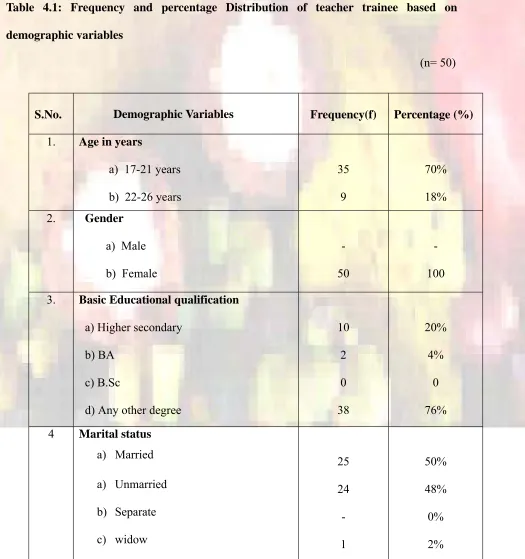
• Description of Demographic variables of teacher trainee 48
• (a) Analysis of pretest and post test knowledge regarding dyslexia among teacher trainee
61
• (b) Comparison between pretest and post test knowledge regarding dyslexia among teacher trainee
63
• Association between post test level of knowledge regarding dyslexia among teacher trainee with they all demographic variable
65
V RESULTS AND DISCUSSION 68-71
VI SUMMARY, CONCLUSION, IMPLICATION AND
RECOMMENDATION
72-78
REFERENCE 79-86
LIST OF TABLES
TABLE NO.
TITLE PAGE NO
3.1 Representation of research design 39 4.1 Frequency and percentage distribution of demographic
variables among teacher trainee
48
4.2 (a) Frequency and percentage distribution of pre & post test knowledge scores on dyslexia among teacher trainee
61
4.2(b) Paired “t” test values, Mean, Variable and SD values for knowledge
63
4.3 Association of demographic variables with post test knowledge regarding dyslexia among teacher trainee
65
LIST OF FIGURES
FIGURE
NO. TITLE PAGE NO
1.1
Conceptual Frame work based on Ludwing Van Bertalanffy General system theory(1968)
17
3.1 Schematic representation of research methodology 46 4.1 Bar diagram showing the percentage distribution of
demographic variables according to the age of the teacher trainee
52
4.2 Bar diagram showing the percentage distribution of demographic variables according to the gender of the teacher trainee
53
4.3 Bar diagram showing the percentage distribution of demographic variables according to the marital status the teacher trainee
54
4.4 Bar diagram showing the percentage distribution of demographic variables according to the number of children at home
55
4.5 Bar diagram showing the percentage distribution of demographic variables according to the family type
56
4.6 Bar diagram showing the percentage distribution of demographic variables according to the religion status the teacher trainee
57
4.7 Bar diagram showing the percentage distribution of demographic variables according to the number of student handle in classroom
58
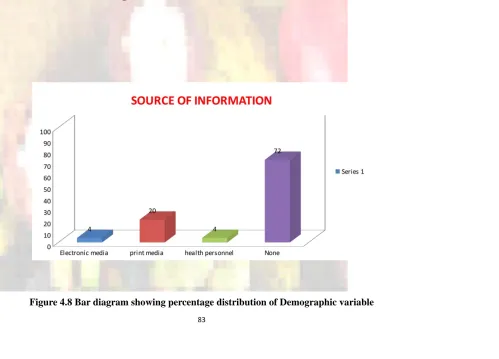
4.8 Bar diagram showing the percentage distribution of demographic variables according to source of information
FIGURE
NO. TITLE PAGE NO
4.9 Bar diagram showing the percentage distribution of demographic variables according to basic educational qualification
60
4.10 Bar diagram showing pretest and posttest level of knowledge score on dyslexia among teacher trainee
62
4.11 Bar diagram showing mean percentage distribution of teacher trainee students pre and post test level score on knowledge
LIST OF APPENDICES
LIST OF APPENDICES
No. Title Page No
I Letter seeking permission to conduct the research study
II Letter seeking expert’s opinion for content validation of the tool.
ii
III Content validity certificate iii
IV Certificate for English validation iv
V List of experts v
VI Tool for research
¾ Demographic data
¾ Structured questions
¾ Answer Key
vii
VII ¾ Lesson plan xxi
VIII Photographs lv
IX Video teaching Programme on dyslexia CD Material
INTRODUCTION
CHAPTER I
INTRODUCTION
Once children learn how to learn, nothing is going to narrow their
mind. The essence of teaching is to make learning contagious, to
have one idea spark another.
Learning is the process of growth and development whereby the learner acquires a body of knowledge, develops ideals which he makes a part of himself and develops the ability to use his knowledge in the pursuit of his ideals. Learning is a part of education; learning brings modification of behavior.
Mayananda et al (2009) Learning disability sometimes called as learning
disorder or learning difficulty in which a person has a difficulty in learning in a typical manner.
Alan M. Hultquist (2006) Dyslexia is a major educational problem, but the
studies on genetics of dyslexia are very limited in India, because the inheritance pattern of dyslexia is not well established in our population. About 5% of the population will have enduring, severe reading disabilities that are very difficult to treat. In India around 13-14 % of all school children suffer from learning disorder, unfortunately most schools fail to lend a sympathetic ear to their problems. As a result these children are branded as failures. Dyslexia is not a disease but it’s a lifelong problem and presents a challenge that needs to be overcome every day.
According to Wagner (2006) Dyslexia is a language based disability.
Dyslexia refers to a cluster of symptoms, which results in people having difficulties with specific language skills, particularly reading students with dyslexia usually experience difficulties with other language skills such as reading, writing and pronouncing words
According to Sreevani.R (2005) explained terms of dyslexia In 1887 Berlin
coined the term “Dyslexia” a Greek Word meaning “Reading Disorder”.
meaning “Twisted Symbols”. Some authors called it “Specific Learning Disability” to differentiate it from mild Mental Retardation.
The word dyslexia comes from the Greek which means ‘difficulty with words’, and encompasses a wide variety of features. This disorder is one type of specific learning disability. It commonly affects the person to have difficulty in verbal skills, abstract reasoning, hand-eye coordination, concentration, perception, memory and social adjustment.
` According to Dr.Harry chaste (2013) the prevalence of dyslexia estimated to
be between 5% and 15% of the population, depending on the criteria used to define dyslexia. Some 5% show dyslexia in its more severe forms ,If we take the average of 10% this means that 700 million people worldwide display traits of dyslexia.
According to Gupta, et. Al (2008) Motor difficulties are commonly
observed in age group of 3 to 5 years. It is most commonly seen among 10% of girls and 15% of boys. Math difficulties are most commonly seen among 40% of girls and 35% of boys based on their strengths and weaknesses. Language difficulties are commonly seen among 10% of girls and 15% of boys. Reading difficulties are commonly observed in primary school of age group (5-10 years). Writing difficulties are commonly seen among 5% of girls and 8% of boys. Auditory and visual processing problems; in a class of 30-40 students, 2:4 children may have problem in
vision and hearing.
Jigjig zhang(2013) says that prevalence of dyslexia was 3.9% in qianjiang
SEKI A.K (2008) Described the exact causes of dyslexia are still not
completely clear, but anatomical and brain imaginary studies show differences in the way the brain of a dyslexic person develops and functions. But it has been well established that it is a language based disorder, often caused by deficit in phonological processing. Although Dyslexia is a genetic disorder with reported linkage to chromosomes 6and 15 it’s phenotypic expression depends on the environment as well as heredity.
According to Yadav Manoj says in early childhood life behavior disorders
are common. In children behavioral disorders are any deviations from the normal behavior. In children, mostly behavioral disorders are developed from the home environment, school environment and by the social group environment by which the child belongs or passes the most time. Among the behavioral disorders learning disabilities are common. These disorders are more reliable than the adjustment reactions, these are difficult to treat
According to “National Joint Committee on Learning Disabilities” (2006)
defines the term has heterogeneous group of disorders manifested by significant difficulties in the acquisition and the use of listening, speaking, reading, writing, reasoning or mathematical disabilities. This condition broadly affects the academic and functional skills of the children. Learning disorder is not a single disorder but it is a group of disorders such as dyslexia, dysgraphia, dyscalculia, dyspraxia, attention deficit hyperactivity disorders, expressive language disorder, central auditory processing disorder etc.
Ramus F (2003) the impact that dyslexia has is different for each person and
remediation. The core difficulty is with word recognition and reading fluency, spelling and writing. Some dyslexics manage to learn early reading and spelling tasks, especially with excellent instruction, but later experience their most debilitating problems when more complex language skills are required, such as grammar, understanding textbook material and writing essays.
Indian Pediatriests Karande.S,et.al (2011) Learning Disability Clinic,
Department of Pediatrics, Seth GS Medical College and KEM Hospital, Mumbai, India. Specific learning disability (dyslexia, dysgraphia, and dyscalculia) affect 5-15% of school going children. Over the last decade; awareness about this invisible handicap has grown in India. However, much needs to be done to ensure that each affected child gets an opportunity to achieve his or her full academic potential in regular mainstream schools. In order to achieve this ideal scenario, all regular classroom teachers should be sensitized to suspect, and trained to screen for this disability when the child is in primary school. School managements should become proactive to set up resource rooms and employ special educators to ensure that these children receive regular and affordable remedial education; and be diligent in ensuring that these children get the mandatory provisions both during school and board examinations. Once specific learning disability is recognized as a disability by the Government of India, these children with the backing of the Right to Education Act would be able to benefit significantly.
JAROME MATHEW (2008) says that fact that a child may have dyslexic
doesn’t mean that they will be unsuccessfully. Some examples of people who have to live(d) with dyslexia are people like Whoopi Goldberg who is famous for her many roles in the movie, industry, another person is Albert Einstein who is famous for the theory of relatively, and Winston Churchill the former prime minister of England.
Johnson (2007) says that Dyslexia is a lifelong condition. With proper help,
many people with dyslexia can learn to read and write well. Early identification and treatment is the key to help dyslexics achieve in schools and in life. Most people with dyslexia need help from the teacher, tutor or therapist specially trained in nursing a multisensory, structured language approach. It is important for these individuals to be taught by a systematic and explicit method that involves several senses (hearing, seeing, touching) at same time. Many individuals with dyslexia need one-on-one help. So that they can move forward at their own space.
S.karande (2010) says that Education is the process by which society
deliberately transmits its accumulated knowledge, skills and values from one generation to another. Teacher in educational institution directs education of students and might draw on many subjects, including reading, writing, and mathematics. This process sometimes called schooling when referring to the education of teaching. Most of the teachers should act friendly to the students. They should act as a guide, a father, a mother, a friend, a companion.
Huffington (2014) says that video games may improve their reading and
order to understand the brain mechanisms underlying dyslexia, but they don't put us in a position to recommend playing video games without any control or supervision.
Disability Discrimination Act (2005) gives people the right to ask for
‘reasonable adjustments’ to take account of a disability. They can complete high school classes and have read all the class assignments. College programs can be mastered by these students so they can become statisticians, lawyers, biologists, teachers, journalists, etc. All this is possible because of the new technologies that allow people to "read" what they cannot read and to "write" when they cannot spell. All the print that we need to read can be read using alternative methods for reading. And the writing that we need to do can be done using alternative methods for writing.
For those with dyslexia, the prognosis is mixed. The disability affects such a wide range of people, producing different symptoms and varying degrees of severity that predictions are hard to make. The prognosis is generally good, however, for individuals whose dyslexia is identified early, who have supportive family and friends and a strong self-image, and who are involved in a proper remediation program. The teacher is a dynamic force in the school. A teacher’s role is importance to bring a child’s up. Teachers strive with heart and soul to raise children up to highest perfections of mankind to such a degree so that every one of them will be trained in the use of mind in acquiring knowledge. Teacher trainee also must have knowledge about dyslexia because without proper knowledge and perception cannot motivate the future the student.
NEED FOR THE STUDY
-Aristle
Dyslexia is most common problem among children. Many teachers unaware of dyslexia. So I have planned to give video teaching programme regarding dyslexia.
Lanser (2007) “Reading and Learning are the two things that determine the success of a child during his school career. First he learns to read, and then he reads to learn. Reading is therefore a paramount importance in the educational process.”Learning disability constitutes one of the major health problems which affect the educational processes.
Journal of Global Pharma Technology (2005) says that Researchers have been
studying about learning disability (LD) in children for a long time. Many teachers today are unaware of the legal ramifications for negligence. The Statistical reports indicate that 2.7 million children nationwide have been identified as learning disabled, and that 50% of all high school drop-outs are learning disabled.
According to Nightingale Nursing times (2009) The healthy survival of the
children is threatened in every moment. Child health problems are shocking and alarming throughout the world especially in developing countries. The children under 15 years of age constitute 40% of total population.
According to National Knowledge Commission (2007) School Education
economic development. It is also essential if India is to transform the current demographic asset of a mostly young population into a dynamic national force for all-round progress. This makes it imperative to increase public resource allocation for education, as the recently approved Eleventh Five Year Plan of the Government of India has recognized.
The National Joint Committee on Learning Disabilities (1998) believes that
comprehensive interdisciplinary education programs are necessary for the preparation of all education professionals. To serve the needs of students with learning disabilities most effectively, all teacher trainees should have preparation that includes the competencies in the area of learning disability. By doing a thorough review of teacher education, the researcher felt that after the thorough analysis of the curricula and also the question papers of the teacher education in India showed that there is only one unit on the childhood psychological problems. Early detection of the dyslexia is very much important to prevent psychological problems and other complications in children.
Nair MRC(2003) conducted study on incidence of Specific Developmental
Disorders of Scholastic skills had co-morbid psychological disorder at child and adolescent unit at National Institute of Mental Health and Neurosciences, Bangalore. In this study 79% of children with Specific Developmental Disorders of Scholastic skills had co-morbid psychological disorders in which 32% had internalizing disorders, 28% had externalizing disorders and 19% had other
disorders.
Jenkins R (2004) says that knowledge regarding dyslexia among trainees is
Hence the researcher selected this study to find the knowledge of trainees regarding dyslexia and its types and also to provide additional information to them which will be helpful in detecting early manifestations of dyslexia among school children. The teacher trainees hardly remember the utterance of the word learning disability during their course period. Hence, learning disabilities is one such area where adequate knowledge in handling these children in class room situation.
The World Health Organization had declared that as 1 in 5 children in the
world have handicap which is a serious obstacle to a child’s development. The learning disabilities constitute 1 in 10 children. In 2004, 10% boys and 6% girls aged 3- 17 had a learning disability. Nearly 4 million school children have learning disability, 7.7% of children ever have been told that they have learning disability. Prevalence of reading disabilities is conservatively estimated to range between 4% and 10% in general school aged population in US. In India prevalence estimate of learning disability ranges from 9- 39% and incidence of dyslexia in school children in India has been reported to be 2-18%, of dysgraphia 14% and of dyscalculia 5.5%.
According to India’s Population (2011) The Current Population of India in
2011 is 1.21 billion. Out of this 40% Of India's population is below the age of 18 years which at 400 million is the world's largest child population. The Statistical
reports indicate that 2.7 million children nationwide have been identified as learning disabled child , and that 50% of all high school drop-outs are learning disabled children.
Learning disability constitutes one of the major health problems which affect the educational processes. Its prevalence is about 10-15% of the school age children
(Robinson & Roberton, 2003). Currently, prevalence of learning disabilities was
a study done by Ahmed et al. (2003) showed that the prevalence of learning
disabilities (LD) among primary school children at Abbassia district was 15.7%, which increased among boys than girls. More over inheritance pattern of dyslexia is not well established in our population. About 5% of the population will have enduring, severe reading disabilities that are very difficult to treat .In India about 13-14% of all school children suffer from learning disability, unfortunately most school fail to lend a sympathetic ear to their problem. Prevalence of dyslexia is estimated to be around 10% across nations. In Hong Kong, the prevalence of dyslexia is estimated to be 9.7-12% and the male to female ratio is around 1.6:1.Dyslexia is a Neurodevelopment disorder that affects 5 to 10% of school-age children. Impaired motor development is a common feature that affects nearly 50% of dyslexics and dyslexia is frequent among dyspraxia patients.A recent study by National Institute of health shows that children under 15 years of age have been found with dyslexia in which nearly 1 in 100 school age children are found to have dyslexia with poor attention and concentration.
Early recognition and adequate remediation is important and can make a big difference to the child’s future. Teachers are in an ideal position to help families in early identification of problem and to provide appropriate guidance. The researcher found that teacher trainee should have adequate knowledge. It was found that teacher trainees are having lack of knowledge. This study motivated researcher about knowledge aspect of dyslexia among teacher trainee
A study to assess the effectiveness of video teaching program on knowledge regarding dyslexia among teacher trainee in selected teacher training institute at Erode.
OBJECTIVES
¾ To assess the level of knowledge regarding dyslexia among teacher trainee.
¾ To deliver video teaching programe regarding dyslexia among teacher trainee.
¾ To evaluate the effectiveness of video teaching programme regarding dyslexia.
¾ To find out the association between the knowledge regarding dyslexia among teacher trainee with various demographic variable
HYPOTHESIS
H1: There will be statistically significant difference between the scores
obtained by the teacher trainees (study subjects) on the level of knowledge about dyslexia prior to and after the video teaching programme.
H2: There will be a statistically significant association between the scores
obtained by the teacher trainees on knowledge with selected socio demographic variables towards dyslexia.
OPERATIONAL DEFINITIONS
Assess
Effectiveness
In this study it refers to find out a desired or intended result of video teaching programme regarding dyslexia among teacher trainee.
Video teaching programme
It is a series of visual information given through slides show and video’s regarding dyslexia
Dyslexia
In this study dyslexia means Dyslexia is a learning disability that impairs a person's fluency or comprehension accuracy in being able to read.
Teacher trainee
Refers to individuals who are studying in I and II Year diploma in teaching
education in C.S.I.Teacher Training Institution, Panniselvam park, Erode.
Assumptions
• The primary school children may experience of dyslexia.
• Dyslexia among primary school children is measurable.
• Teacher trainee’s knowledge can be accessed through video teaching programme.
• Teacher trainees can realize the importance of knowledge regarding dyslexia.
• A video teaching programme will help to improve knowledge about dyslexia
CONCEPTUAL FRAMEWORK
The conceptual framework for research study presents foundation on which the purpose of proposed studies based.
developing the conceptual framework. This perspective theory directs action towards an explicit goal.
Widenbech proposes a prescriptive theory for nursing which is described as a conceiving of a desired situation and the ways to attain it. Prescriptive theory directs action toward an explicit goal. It consists of three factors.
Central purpose Prescription Realities
A nurse develops a prescription based on a central purpose and implement it according to the realities of the situation. The conceptualizing of nursing practice according to this dissertation consists of 3 steps as follow.
Step 1: Identifying the need for help Step 2: Ministering the needed help Step 3: Validating the need for help
The factors included are central purpose, prescription and realities.
Identification:
Identification determines a whom ever need for help based on the existence of a need. Whether the teacher trainee realizes the need, meeting the need and cannot meet the need alone.
dyslexia by structured questions. Based on this, researchers explore the teacher trainee need for help.
Ministration:
It refers to provision of needed help to full fill the identified needs. It specifies the nature of the action that full fill the nurse’s central purpose and rationale for behind the action. it has 2 components
Prescription:
It refers to the plan of care to achieve the purpose which includes development and validation, followed by administration video teaching programme on dyslexia.
Realities:
It refers to the factors that influences the nursing action, in the particular situation .
Validating the need for help was met:
It refers to the collection of evidence that show needed help have been met as a direct results of action .this explored by evaluate post test knowledge on dyslexia as adequate knowledge, moderate knowledge, inadequate knowledge .Based on widenbach’s helping art of clinical nursing theory, the researcher may need to reconstruct experience.
DEMOGRAPHIC VARIABLES Age, gender, marital status ,
No of children at home ,Family type ,Religion , No. of students handle in the classroom , ,source of informa on, basic Educa onal
qualifica on.
PRE TEST
Assessment of knowledge
regarding behavioural
problems among primary
school teachers
Video teaching programme on
Dyslexia
Post test Evaluate the pre‐test
and post test
knowledge regarding
Dyslexia among teacher
training
Adequate Knowledge
Moderately adequate knowledge
Inadequate knowledge
IDENTIFICATIONN MINISTRATION VALIDATION
Moderately Inadequate knowledge
[image:38.595.83.785.66.502.2]Reassessment
CHAPTER - II
CHAPTER II
REVIEW OF LITERATURE
Review of literature is a broad, comprehensive, systematic and critical view of scholarly publication, unpublished print materials, audio and visual materials and personnel communication.
The researcher presents the review of related literature which helps the studying of problems in depth. It also serves as a valuable guide to understand what has been done, what is still unknown and untested.
According to Polit and Hungler, literature review refers to an extensive, exhaustive
and systematic examination of publications relevant to the research project .An extensive review of the research and the non research literature was done to gain the maximum information.
Literature related to
¾ Review related to prevalence of dyslexia
¾ Review related to identification and management dyslexia
¾ Review related to knowledge regarding dyslexia among teacher trainee and teacher
¾ Review related to video teaching programme on knowledge regarding dyslexia
Wheldall K, et.al (2010), conducted study on to assess the prevalence of reading
problems among boys and girls. In Australia, Basic Skills Test for reading was administered annually to third and fifth grade students in New South Wales schools, were analyzed from 1997 to 2006. Poor readers were defined as students who scored in the lowest BST bands i,e., Bands 1 and 2. Average boy/girl ratios for third-grade students were 1.66:1 and 1.44:1 (combined Bands 1 and 2) and for fifth grade students were 2.26:1 and 1.99:1 (combined Bands 1 and 2). The findings of this study confirm that more boys than girls experience reading problems.
Benjasuwantep ,et.al (2002), conducted study on prevalence and clinical
characteristics of attention deficit hyperactivity disorder among primary school students in Bangkok. Attention deficit hyperactivity disorder is an important disorder because it is the most prevalent chronic health condition affecting school aged children. Children with Attention deficit hyperactivity disorder are at risk for academic and behavior problems. Attention deficit hyperactivity disorder making a prevalence of 6.5 per cent. There were 11 boys and 12 girls. The ratio of male to female was 1:1.09. The Attention deficit hyperactivity disorder students had lower scores in mathematics.
John Bradford (2010), A comparative study was conducted to investigate the
Kuwait derived from a nationwide study. This study concluded that there is a previous evidence for an increased frequency of dyslexia among young offenders.
Benjasuwantep ,et.al (2002), conducted study on prevalence and clinical
characteristics of Dyslexia among primary school students India. A total of 486 first to sixth grade students were administered "Raven's progressive matrices test" for estimation of intellectual functioning. Those who scored below the fifth percentile were labeled as mental retardation and excluded from the study. The prevalence of dyslexia and probable dyslexia were found to be 6.3 per cent and 12.6 per cent, respectively. The male to female ratio of dyslexia was 3.4:1.
Mogasale VV, et al. (2011) A cross sectional study was conducted on the prevalence
of specific learning disabilities (SpLD) among primary school children in a south Indian city, India in 2011. A cross-sectional multi-staged stratified randomized cluster sampling study was conducted among children aged 8-11 years from third and fourth standard. A six level screening approach that commenced with identification of scholastic backwardness followed by stepwise exclusion of impaired vision and hearing, chronic medical conditions and subnormal intelligence was carried out among these children. In the final step, the remaining children were subjected to specific tests for reading, comprehension, writing and mathematical calculation. The prevalence of specific learning disabilities was 15.17% in sampled children, whereas 12.5%, 11.2% and 10.5% had dysgraphia, dyslexia and dyscalculia respectively. This study suggests that the prevalence of specific learning disabilities is at the higher side of previous estimations in India.
Pushpa Saviour, et al. (2009) A study was conducted to determine the prevalence of Inheritance Consanguinity Fatty Acid Deficiency in India. Here we report prevalence,
India. Among school children, prevalence of dyslexia is found to be 9.87% and in the
selected families the prevalence is 28.32%. Based on the affectedness, dyslexia phenotypes
were classified as severe and mild deficits. Mild deficits were better compensated than the
severe deficits. Among the selected families autosomal dominant mode of inheritance was
found to be more prevalent. Consanguinity plays a major role in familial aggregation of
dyslexia.
Review related to identification and management dyslexia
Ho CS1, et al. (2011) A longitudinal study was conducted on early difficulties of
Chinese preschoolers at familial risk for dyslexia in Hong Kong. Seventy-six high-risk (40 good and 36 poor readers) and 25 low-risk Chinese children were tested on oral language, reading-related cognitive skills and Chinese word reading and spelling over a 3-year period. The parents were also given a behaviour checklist for identifying child at-risk behaviours. Results showed that the High Risk (Poor Reading) group performed significantly worse than the Low Risk .More children in the High Risk (Poor Reading) group displayed at-risk behaviours than in the other two groups. These results suggest that Chinese at-risk children with early difficulties in reading and spelling do show a wide range of language-, phonology-, and print-related deficits, similar to their alphabetic counterparts. An understanding of these early difficulties may help prevent dyslexia from developing in at-risk children.
Antoniazzi D, et al. (2009) A Descriptive study was conducted on teacher
children whose oral language skills require further investigation. Results are discussed in the light of recommendations for teacher pre-service education, SLP advocacy for oral language competence as a life-long determinant of health, issues in screening during the early years of school, and implications for further research.
MadhuriKulkarni, et al. (2006) a comparative study was conducted on educational
provisions and learning disability in Mumbai, India. The academic performance of 60 children (45 boys, 15 girls) at the secondary schools board examination with benefit of chosen provisions was compared with their performance at their last annual school examination before diagnosis of specific learning disability. There was a significant improvement in their mean percentage (%) total marks scored at the SSC board examination as compared with the mean % total marks scored by them at their last annual school examination before the diagnosis (63.48 ± 7.86 vs. 40.95 ± 7.23 ) [mean ±SD, mean % difference = 22.53, 95% CI = 19.8 - 25.26, P < 0.0001, using student’s t test]
Souroulla AV, et al. (2009) A study was conducted on the role of the teacher in
Flax JF, et al. (2009) A study was conducted on using early standardized language
measures to predict later language and early reading outcomes in children at high risk for language-learning impairments in U K. Participants included 99 children (40 FH+ and 59 FH-) who received a standardized neuropsychological battery at 2, 3, 5, and 7 years of age. As a group, the FH+ children had significantly lower scores on all language measures at 2 and 3 years, on selected language and phonological awareness measures at 5 years, and on phonological awareness and nonword reading at 7 years. Language comprehension at 3 years was the best predictor of later language and early reading for both groups. These results support past work suggesting that children with a positive family history of language-learning impairments are at greater risk for future language and reading problems through their preschool and early school-age year.
P. Saviour, et al. (2006) An experimental study was conducted to establish the
inheritance pattern of dyslexia in 23 selected families from the state of Karnataka. Individual with above 8 years of age, normal performance Intelligence Quotient (>85) and remarkable deviation in reading and writing skills compared for the study. Based on the genetic registry, pedigrees of the families were constructed. Dyslexia phenotypes were classified into 4 types on the basis of affect. It was concluded that family history of dyslexia is a consistent risk factors. Therefore this knowledge can be applied to the prevention and management of dyslexia.
Torppa, et al. (2010) A retrospectively study was conducted to assess the
1.5 years to school age. The RD group was outperformed by typical readers on numerous language and literacy measures. (expressive and receptive language, morphology, phonological).
Limbos MM, et al. (2001) A longitudinal study was conducted identification of
reading disability for EAL(early language assessment) children is often delayed. Providing descriptions of how children grow in their literacy skills and what predicts successful acquisition of these skills. Sampling is 773 L1(first language) and 182 EAL (early language assessment) children from grades 2 through 7. Multi-group latent growth analyses provided compelling evidence for common developmental models for L1 (first language) and EAL(early language assessment) in word recognition, word reading fluency, and decoding, decoding fluency, reading comprehension, and spelling. Phonological processing, syntactic awareness, and verbal working memory were important predictors of growth for children from both language groups. Growth models also show that poor readers from both language groups continued to be behind normally achieving peers. For poor readers, growth in word recognition, word reading fluency, decoding, decoding fluency, and reading comprehension was characterized by a persistent deficit model. In contrast, there was a cumulative deficit for spelling. Results of this study highlight the importance of early services and assessment for all children at risk for reading disability, regardless of first language status.
Melissa D. Malani et al. (2011) A Meta-Analysis Study was conducted to Improve
one intervention, including the improving phonemic awareness program, for students with language/learning disabilities. Cautious recommendation for implementation is offered.
Rachel G. Klein, PhD, et al. (2012) A Prospective study was conducted childhood
attention-deficit/hyperactivity disorder masked clinical assessments. A total of 135 white men with attention-deficit/hyperactivity disorder in childhood, free of conduct disorder, and 136 men without childhood attention-deficit/hyperactivity disorder (65.2% and 76.4% of original cohort, respectively). Which had significantly worse educational, occupational, economic, and social outcomes; more divorces; and higher rates of ongoing attention-deficit/hyperactivity disorder (22.2% vs 5.1%,P < .001), anti social personality disorder (ASPD) (16.3% vs 0%, P < .001), and substance use disorder (SUDs) (14.1% vs 5.1%, P = .01) but not more mood or anxiety disorders (P = .36 and .33) than did comparison participants. Ongoing attention-deficit/hyperactivity disorder (ADHD) was weakly related to ongoing substance use disorder (SUDs) (mean = 0.19, P = .04), as well as anti social personality disorder (ASPD) with substance use disorder (mean = 0.20, P = .04). During their lifetime, this had significantly more anti social personality disorder (ASPD) and substance use disorder (SUDs) but not mood or anxiety disorders and more psychiatric hospitalizations and incarcerations than comparison participants. Findings highlight the importance of extended monitoring and treatment of children with attention-deficit/hyperactivity disorder( ADHD).
Roongpraiwan R, et al. (2009) A prospective cohort study to investigate the
and early language delay( ELD). The incidence of early language delay (ELD) at age 2 years was 11.68%. Risk factors for early language delay( ELD) were birth weight (Odds Ratio: OR = 2.38, 95% Confidence interval: CI 1.65-3.42), male gender (OR = 2.12, 95% Confidence interval: CI 1.67-2.69), 3rd-4th and 5th child born or more (OR = 1.42, 95% CI = 1.02-1.96; OR = 1.88, 95% CI = 1.08-3.27, respectively), birth weight <2500 grams (OR = 2.38, 95% CI = 1.65-3.42), no first word within 1 year (OR = 2.25, 95% CI = 1.79-2.84), no talking within 1 year (OR = 1.34, 95% CI = 1.05-1.72), and maternal occupation (laborer or none) (OR = 1.36, 95% CI = 1.01-1.82). District living was a protective factor for early language delay (OR = 0.42, 95% CI = 0.32- 0.54). There was no clear evidence for a link between breastfeeding and early language delay (ELD). Significant factors identified here raise strong concerns that should be addressed clinically when counseling families and planning treatment.
Chuthapisith J, et al. (2007) conducted study on Language development among the
retardation' (MR) in Thailand) had significantly lower verbal Intelligent Quotient scores than siblings of children with autistic spectrum disorder but without mental retardation.
Vanstenbrngger H, et al. (2006) conducted study on examine the mathematics
learning disabilities in primary education in 2006. The aim of the present study is to investigate Turkish primary school teachers’ opinions about problem posing applications for students, the mathematics curriculum and textbooks. A 30-item questionnaire was developed by the researcher and administered to 18 primary schools. Altogether, 277 primary school teachers participated in the study. The results showed that Turkish primary school teachers have positive views about problem posing applications related to students but negative opinions about the mathematics curriculum and mathematics.
Dr.Ramjee Prasad Pandit, et al. (2004) conducted study on Factors affecting
learning disabilities in Mathematics in central region of Nepal. Sample for this study consist of 58 boys and 46 girls having learning disabilities, from the 29 rural and 15 urban schools in different parts of the central region of Nepal. The analysis of those 104 learning disability students’ bio data revealed that the factors related to the learning disability in mathematics were poor instruction, parent’s adverse behaviour to children, and teacher’s negliance in the class. The instrument use for this study was student’s bio data Performa and the tool for the study was administered individually. The major findings of the study was self study habits of the students about 44% of learning disability studied less than 2 hours and 56% used to study more than 2 hours,socio-economic status adversely affected learning disabilities with 46.87% from very low income groups and 43.8% students were from the average income group.
Amany Sobhy Sorour, et al. (2014) A Comparative Study was conducted to assess
primary school children with and without learning disabilities were selected from two governmental primary schools using case –control research design. Data were collected by the teachers using the Strengths and Difficulties Questionnaire for children and adolescents aged 4-16 years. The results conducted that the prevalence of total difficulties scores among primary school children with learning disabilities was 98.1% abnormal difficulties compared to 79.7% of normal children. Results also found that statistical significant differences were found between children with and without learning disability in all sub domains of emotional and behavioral disorders.
Lalitha .k (2009) a comparative study was conducted to compare the awareness and
teaching programme among teachers of students with learning disabilities at different board levels. 312 teachers from different board of education were selected using convenient sampling technique and their awareness on dyslexia was assessed by structured knowledge questionnaire. Results of the study showed that after the teaching programme Indian certificate secondary examination board teachers are more aware about learning disabilities as compared to the SSE and central board secondary examination board(CBSE). About 70% of the Indian Certificate Secondary Examination (ICSE) board teachers had adequate knowledge compared to 28% in SSE and Central Board Secondary Examination (CBSE) board teachers.
Kale, et al. (1999) A study was conducted in Russia to determine the effectiveness of
group parents. There was no significant difference between the experimental and control groups' posttest mean scores on the total behavior problems.
Brook,et.al (2009) conducted study to investigate the knowledge on learning
disabilities among the primary school teachers at University of Jordan with 46 teachers. The study revealed that 71% of teachers had knowledge towards learning disabilities where as 29% of teachers experience low level of knowledge and difficulties of children with learning disabilities.
Harlaar N (2008) a twin study was conducted on correlation in between the
pre-schooler’s language abilities with later reading in England, 2008. A sample of 7,179 twin pairs was selected by simple random sampling method and assessed on parent-report measures of syntax and vocabulary at ages 2, 3, and 4 years and on teacher assessments of reading achievement at ages 7, 9, and 10 years. The phenotypic correlation between language ability and reading achievement (r =0.40) was primarily due to shared environmental influences that contribute to familial resemblance. These environmental influences on reading achievement and reading achievement overlapped substantially (rC =0 . 62).Genetic influences made a significant but smaller contribution to the phenotypic correlation between reading achievement and reading achievement, and showed moderate overlap (rA =0 .36). The association between early language and later reading is underpinned by common environmental and genetic influences.
Padmavathi (2009) A quasi experimental study was conducted by NIMHANS
Bangalore, to assess the effectiveness of structured teaching programme on the level of knowledge of teacher trainees towards learning disabilities. The samples were 32 teacher trainees from second year D. Ed. programme at Shree Vijayendra D. Ed. College, Kolar Gold Fields. The tools used for the study comprised of socio demographic data, knowledge about learning disability questionnaire and opinion about learning disability questionnaire. The pre-test knowledge mean score was 17.75, standard deviation was 4.19 and the post-pre-test knowledge mean score was 28.78, standard deviation was 5.41. The paired difference between the pre-test knowledge and post-test knowledge showed the knowledge gain and the value was 11.3 and ‘p’ value was significant at 0.001. This indicated that study was effective in improving knowledge of teachers on learning disabilities.
Saravanabhavan S (2010) The study was conducted to determine the knowledge
level of learning disabilities (LD) among teacher.144 teachers in two regular high schools, 38 teachers in two special schools, and 165 pre-service teachers in a teacher education college in a metropolitan city in a southern state in India. One-way analysis of variance (ANOVA) showed that the knowledge level of learning disabilities among teachers working in regular schools was statistically different. Among the three groups, the pre-service teacher group scored the lowest (Mean = 60.76, SD = 13.36, N = 165) which was below the mean score for the entire group (Mean = 66.32, SD =13.37, N=347).The study concluded that teaching experience and familiarity with persons with learning disabilities did not affect the knowledge level of the three groups of participants.
Ms. Anjana Williams, et al. (2013) A Quasi experimental Study was conducted to
was taken by structured knowledge questionnaire, attitude scale and knowledge of skill checklist followed by Learning Package and post -test was taken after 7 days which showed that mean posttest knowledge score (13.7 ±3.2) was higher than the mean pre -test knowledge score (5.4±2.6). Mean post test Attitude score (31.9±4.7) was higher than the mean pretest Attitude score (26.6±5.4). Mean post test knowledge of skill scores (23.1±4.2) was higher than the mean pretest knowledge of skill scores (17.2±6.6). After post test the knowledge, attitude and skills of primary school teachers had increased significantly. Hence it is proved that the Learning Package improves the competency of primary school teachers regarding Learning disability.
John Kessell, et al. (2009) a descriptive study conducted on Student teacher’s
knowledge of the individuals with disabilities. The purpose of this study was to describe students’ teachers’ knowledge of the individual with disabilities, disabling condition and special education laws. The population of this study was student teachers (N=335).Overall, 74.5% felt prepared to teach special needs in classrooms and laboratories. Mean score for this study for the total correct response to knowledge assessment was 57% .The results shows ample evidence that future teachers have limited or no knowledge of the disabling conditions impacting special needs of students.
Charlene Flexner, et al. (2008) a study was conducted on primary teacher knowledge
awareness, phonemic awareness, phonetic principles and specific terminology. The findings of this study showed that 48% of the participants felt that phonics was the most important skill required for effective reading.
Anand Lingeswaran (2013) conducted study on assess the knowledge of learning
disability among primary school teachers in India 2013. An observational study was carried out 34 primary school teachers from 2 different schools in Puducherry town agreed to participate in this study with informed consent. . Here used a multiple choice questionnaire format with a total of 50 questions, 5 choices for each question and a total score of 50. 29% of the questions were correctly answered by all 34 teachers. The mean total score for this sample was 14.50 ± 9 and total item score for the 50 items was 9.90 ± 4. Cronbach's (α) reliability was 0.89. Overall discrimination index was + 0.2 and facility factor analysis score was 0.26. Validation of this new screening questionnaire was successful in Indian setting. It has to be used in other settings to our finding.
Edwin david k, et al. (2012) A Quasi experimental Study was conducted to evaluate
JOY PRICILLA, (2013) A Quasi experimental Study was conducted to evaluate the
effectiveness of structured teaching programme on Dyslexia and its identification among primary school teachers in selected primary schools of Bengaluru . The target population was composed of teachers. A total of 40 school teachers were recruited as samples. The total difference in the mean of overall pre- test and post- test knowledge score was 19.38 and 39.53 respectively with the obtained t’ value of 25.779 was found to be highly significant at the level of p<0.001. It means there is significant difference between pre- test and post- test level of knowledge of school teachers regarding Dyslexia and its identification. Teachers play a very important role in helping children with dyslexia. All teachers should be encouraged to study up to date information on how to spot dyslexia and to help affected pupils. Schools should use proper teaching methods of teaching children to help combat dyslexia.
Review related to video teaching programme regarding dyslexia
Sanghavi Reepa, et al. (2005) An experimental study conducted on Visual Motor
children aged 10 to 14 years attain mean raw score in Visual Motor Integration (DVMI) at younger age than normal American Children. It was showed Visual Motor Integration (DVMI) raw scores that improvement in experimental group was more as compare to control group (P< 0.001). Thus occupational therapy has wide scope in treating learning-disabled children with the help of Occupational Therapy program.
Thomas Oakland (1998) conducted study on Multisensory Method for Promoting
Reading in Students with Reading Disabilities. Three qualities are thought to facilitate reading development in these children: the provision of a highly structured phonetic-instruction training program with heavy emphasis on the alphabetic system, drill and repetition to compensate for short-term verbal memory deficits, and multisensory methods to promote no language mental representations. The Dyslexia Training Program, a remedial reading program derived from Orton-Gillingham methods, embodies these qualities. Following their 2-year program, students displaying dyslexia demonstrated significantly higher reading recognition and comprehension compared with a control group. The main effect for group, F(1, 20) = .41, p > .05, and interaction between group and year, F(2, 20) = . 16, p > .05, did not differ significantly. The main effect for year approached significance, F(2, 20) = 2.73, p < .08, indicating that the two groups performed comparably, but their spelling skills did not improve significantly over the 2-year period The two groups did not differ in spelling.
Michael J. Kennedy, et.al.(2013)conducted study on Multimedia Approach
skill-based items related to PA and PA instruction. Results demonstrate a significant main effect and large effect size for the CAP group on the posttest and, several weeks later, a maintenance probe. There was a significant main effect for group F(1, 868) ¼ 19.89, p < . 001, u2 ¼ .08; time F(2, 1529) ¼ 189.6, p < .001, u2 ¼ .29, and the interaction between group and time F(2, 143) ¼ 17.74, p < .001, u2 ¼ .05. Therefore, 42% of the variance in this model is explained by the sum of effects from the predictor variable (Content Acquisition Podcasts (CAP) vs. text-only) in our experiment .Findings indicate that multimedia instructional tools, such as Content Acquisition Podcasts (CAPs), may benefit undergraduates as they acquire necessary knowledge and skills that underwrite advanced practices for teaching students in general and special education settings.
Harrar et.al.(2014) A study suggest Video Games Might Help People With Dyslexia
Seyedmorteza Nourbakhsh1 (2013) conducted study on The Effects of Multisensory
CHAPTER - III
METHODOLOGY
METHODOLOGY
Research methodology is a way to systematically solve the research problem. It consists of various steps that are generally adopted by the researcher in studying the problem along with the logic behind them. The methodology of research indicates the general pattern of organizing the procedure for gathering valid and reliable data for the study.
This chapter deals with the methodology that was selected by the investigation in order to determine the knowledge of teacher trainee regarding dyslexia in selected institution at Erode. Methodology of the study includes research approach ,research design variable , research setting ,population , sample , sampling criteria , sampling technique , development and description of tool , reliability of the tool ,pilot study , data collection process and plan for data analysis .
RESEARCH APPROACH:
Research approach implicates the basic process for conducting a research .The qualitative Research approach is chosen according to the purpose of the study. The aim of the present study is to develop and implement video assisted teaching programme on knowledge regarding dyslexia among teacher trainee in selected institution of teacher training at Erode. Hence the selected research approach was considered on appropriate to determine the effectiveness of video teaching programme.
The term research design refers to the plan of a scientific investigation. Research design helps the researcher in the selection of subjects, identification of variables, their manipulation and control observations to be made and types of statistical analysis to interpret the data. The overall plan for addressing research question, including specification for enhancing the integrity of the study.( Polit and Hungler) (1999) The research design is the
architectural backbone of the study. The research design is the overall plan for obtaining answers to the question being studied and for handling some of the difficulties encountered during the research process.
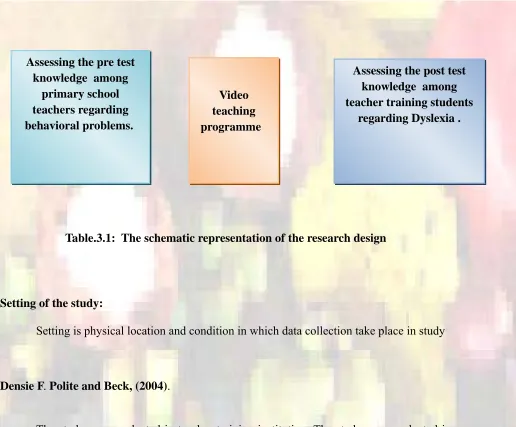
The research design adopted for the study was quasi experimental one group pre test and post test design. This design was used to evaluate the effectiveness of video assisted teaching programme on knowledge regarding dyslexia among teacher trainee in selected institution of teacher training at Erode.
One group pre test post test research design was adapted for this study. It involves the randomization, manipulation of independent variables that is by implementing of an intervention.
‘Q1 pre test assessment,
‘X ‘ Intervention
Table.3.1: The schematic representation of the research design
Setting of the study:
Setting is physical location and condition in which data collection take place in study
Densie F. Polite and Beck, (2004).
The study was conducted in teacher training institution. The study was conducted in CSI Teacher training Institute .CSI Teacher training Institute located at Pannir selvam park , Erode ,which is situated 20 km away from Sre Sakthimayeil Institute of nursing and research. Samples of the study belong to CSI teacher training institution. In this institution 50 teacher training student are selected for this present study.
DESCRIPTION OF VARIABLES:
Assessing the post test knowledge among teacher training students
regarding Dyslexia . Video
teaching programme Assessing the pre test
A concept which can take on different qualitative value is called variable Kothari C.R, (2002).
The variables under the study are the following,
Independent variable:
According to Polit and Hungler (2011), the variable that is believed to care or
influence the behaviour and ideas.
Independent variables were Video teaching programme on Dyslexia among teacher training.
Dependent variable:
The dependent variable is the variable the researcher is interested in understanding, explaining and preceding.( Polit and Hungler 2011).
In this study, the dependent variable is refer to the knowledge on dyslexia. The dependent variables is knowledge among teacher training regarding Dyslexia and the influencing variable are demographic variables.
Dependent Variable
POPULATION:
The entire set of individuals or objects having the same common characteristics Polit and Hungler, (2011).
In the present study population were teacher training student selected population. The accessible population includes the teacher training students at selected schools in Erode.
SAMPLE:
According to Polit and Hungler, (2011) the sample is a subset of a population and
selected to participate in a research study. It is a portion of population, which represents the entire population.
In this present study, it refers to the members of the teacher trainee, who fulfilled the inclusion criteria as selected as sample.
Criteria for Sample Selection:
Video teaching programme regarding dyslexia Knowledge of
teacher trainee regarding dyslexia Age, gender, marital
status, No of children at home, Family type, Religion, No.of students handle in the classroom, source of information,
Inclusion criteria:
¾ Those who are undergoing teacher training programme to teach in primary schools
¾ Those who are studying in I Year teacher trainee.
¾ Those who can understand English.
¾ Those who were interested to participatein thestudy
Exclusion criteria:
¾ Those teacher trainee who were on leave during the data collection period
¾ Those teacher trainees who have attended refresher or orientation courses on Dyslexia.
Sampling Technique and Sample Size:
Sampling refers to the process of selecting a portion of the population to represent the entire population Polit and Hungler, (2011). Non-probability Convenient Sampling
Technique was used to select the sample for the study. The total sample for this study is 50.
DESCRIPTION AND INTERPRETATION OF TOOL:
The instrument se