www.socialsciences-journal.com
The International
Journal
inTeRDiSciPLinARy
SOciAL ScienceS
Volume 2
Autoethnography and Teacher Development
THE INTERNATIONAL JOURNAL OF INTERDISCIPLINARY SOCIAL SCIENCES http://www.SocialSciences-Journal.com
First published in 2007 in Melbourne, Australia by Common Ground Publishing Pty Ltd www.CommonGroundPublishing.com.
© 2007 (individual papers), the author(s)
© 2007 (selection and editorial matter) Common Ground
Authors are responsible for the accuracy of citations, quotations, diagrams, tables and maps.
All rights reserved. Apart from fair use for the purposes of study, research, criticism or review as permitted under the Copyright Act (Australia), no part of this work may be reproduced without written permission from the publisher. For permissions and other inquiries, please contact
ISSN: 1833-1882
Publisher Site: http://www.SocialSciences-Journal.com
THE INTERNATIONAL JOURNAL OF INTERDISCIPLINARY SOCIAL SCIENCES is a peer refereed journal. Full papers submitted for publication are refereed by Associate Editors through anonymous referee processes.
Autoethnography and Teacher Development
Jon Austin, University of Southern Queensland, Queensland, Australia
Andrew Hickey, University of Southern Queensland, Queensland, Australia
Abstract: Autoethnography has largely been deployed in formal therapeutic situations, with its potential for application in general personal and professional development only now emerging. Autoethnography presents valuable opportunities for application in situations requiring a connection between self-understanding and broader socialization processes. This paper explores the nature of autoethnographic approaches to research, including various methodological issues pertaining to Self as data-source, and describes initial outcomes of a research project aimed at illuminating procedural and epistemolo-gical issues attached to the use of autoethnography in teacher education and professional development situations. The im-portance of excavating Self and identity through the autoethnographic process is highlighted with the paper drawing upon examples from practice to illustrate possibilities for the deployment of agency through critical analyses of Self.
Keywords: Autoethnography, Teacher Education, Memory work, Conscientisation, Critical Pedagogy
Introduction
A
S SOCIAL RESEARCHERS position themselves to meet the epistemic challenges presented by the on-coming Eighth and Ninth Moments in qualitative research (Lincoln & Denzin, 2005), ethnography, a previously standard(ised) methodological approach to studying the social, has been subjected to calls to account for and reconsider the desirability of its ‘truth claims’ and Western-centric underpinnings. One outcome of this has been the emergence of “new ethnograph-ies” (Goodall 2000) with their concern to “heal the artificial separation of subject and object, modulate the ‘authorial voice’ and acknowledge our subjective involvement in the creation of social knowledge” (Bochner & Ellis 1996, p 301). Autoethnography is one of these “experimental postmodern ethnograph-ies” (Foley & Valenzuela, 2005), one that we see as nestled amongst the methodologies of the oppressed (Sandoval, 2000).With the narrowing of the focus of ethnographic studies over the past half-century - from large-scale studies of whole cultures to smaller sub-groups – the last remaining frontier for rigorous, sustained and powerful anthropological work is that of the research-er’s Self. The focus of the researcher has shifted from looking on to looking in, with the anthropological canon now admitting of the importance of the inward turn to our understanding of the individual-societal dialectic. Prominent here is work dealing with reflex-ivity, narrative inquiry and self analysis, as presented through methodologies including testimonio (Yudice 1991, Menchu 1984), life history (Plummer 1983) and, as discussed in this paper, autoethnography.
Moments in Qualitative Social Science Research
Denzin and Lincoln’s ‘Moments’ have been widely utilized as a means of charting the conceptual and epistemological development of forms of qualitative research (Denzin & Lincoln, 2005b; 2005a). For the purposes of this paper, most salient are the Seventh and Eighth Moments. The Seventh moment, the “methodologically contested present”(Denzin & Lincoln, 2005b, p 20), is characterized by an appear-ance of chaos and multiplicity that has led to the discarding of older, simplistic means of classifying and categorizing research approaches and paradigms in the shadow of the rise of “conjugated and complex new perspectives” (Denzin & Lincoln, 2005a, p 1115) that are very much of their time:
The important thing to note about many practi-cing interpretivists today is that they have been shaped by and influenced toward postmodern perspectives, the critical turn (as powerful an influence as the interpretive turn and the post-modern turn were in their own times), the nar-rative or rhetorical turn, and the turn toward a rising tide of voices (Denzin & Lincoln, 2005a, p 1115 emphasis in the original)
The emergence of new ways of both experiencing and writing/telling the world in the Seventh moment has contributed to an increasingly untidy, non-standardised, chaotic appearance of social scientific work. However, Denzin and Lincoln argue that such messiness is, in effect, the result of “the intense de-sire of a growing number of people to explore the
THE INTERNATIONAL JOURNAL OF INTERDISCIPLINARY SOCIAL SCIENCES, VOLUME 2, 2007
http://www.SocialSciences-Journal.com, ISSN 1833-1882
multiple unexplored places of a global society in transition” (Denzin & Lincoln, 2005a, p 1116). It is in such a turbulent time of new searches for under-standing that autoethnography comes into its own.
From this accounting for the situatedness of knowledge (Harraway 1988) and recognition that “academic and other knowledges are alwayssituated , always produced by positioned actors working in/between all kinds of locations, working up/on/through all kinds of research” (Cook 2005), the eighth moment emerges. Attached to this meth-odological whirlpool are the features of the seventh moment which evolve with increasing methodologic-al sophistication, but where such developments will result from accommodating four “new improvisations on old issues”.For Denzin and Lincoln, these impro-visations focus on: a reconnection of social science to social purposes; the rise of indigenous social sci-ence(s); the decolonization of the academy; and the homecoming of Western social sciences(Denzin & Lincoln, 2005a, p 1117).
The first and fourth of these “new improvisations” are particularly important for the purposes of our work and for the focus of this paper. The ways in which we see autoethnography being deployed to provide a significant provocation to the reconceptu-alisation of the links between education and social transformation resonate clearly with the movement of social science into its eighth moment. A hallmark of this moment is research that works towards the reconnection of social betterment ends, emancipatory practices and accounts from multiple perspectives. As Denzin and Lincoln argue, “qualitative research-ers’ concerns for social justice, moral purpose and ‘liberation methodology’ will mark this next moment with passion, purpose and verve”(Denzin & Lincoln, 2005a, p 1123). Additionally, Western social scient-ists will continue to question their complicity – past, present and future - in the maintenance of exploitat-ive and dehumanizing relationships of power:
Questioning whether, when and under what conditions our knowledge has served to enhance democratic ends and extend social justice as well as when and under what conditions it has served to reify historical power and resource distributions. (Denzin & Lincoln, 2005a, p 1122)
We would hope that our developing understanding of new forms of inquiry through autoethnography, with their associated reformulations of what counts as truth, have allowed us to begin re-invigorating notions of teaching as a broadly transformative activity. Due to this, we suggest that autoethnography offers significant opportunities for building on the concerns of the seventh moment as well as actively engaging key themes of the eighth moment via its reconnection to social purposes through the interrog-ation of Self and the attendant connections this yields to agency, power and voice as a ‘liberation method-ology’. We also suggest that Education forms a key location for the presentation and application of the critical, emancipatory and transformative social practices that autoethnographic work provokes.
Autoethnography: What’s so
Ethnographic about Autoethnography?
Autoethnography as a formal, structured, recognized approach to the study of the self has a relatively short history. The earliest acknowledged use of the term was in 1975 when Karl Heider coined the term to describe the ethnographic-type explanations of cul-tural constructs given by members of that culcul-tural group (Heider, 1975). Whilst growing out of con-cerns with the difficulty of maintaining the pseudo-scientific objectivist façade of “classic” anthropo-logy, it has really been with the unfolding of the postmodern era and the ascendancy of the tenets of poststructuralist theory that the power of the individu-al, the significance of the “new” evidentiary sources and forms of representation and the settling in of identity as the lynchpin of socio-cultural research that accompanied these that has brought the new ethnographies into prominence and relevance.
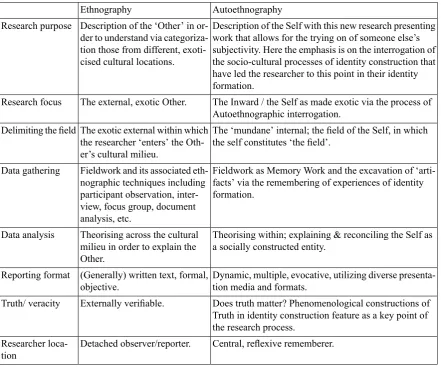
While it is not the purpose of this paper to enter into detailed discussion of essential features of auto-ethnography – this paper is not meant to provide an
Table 1: Features of Ethnography and Autoethnography
Autoethnography Ethnography
Description of the Self with this new research presenting work that allows for the trying on of someone else’s Description of the ‘Other’ in
or-der to unor-derstand via categoriza-Research purpose
subjectivity. Here the emphasis is on the interrogation of tion those from different,
exoti-cised cultural locations. the socio-cultural processes of identity construction that have led the researcher to this point in their identity formation.
The Inward / the Self as made exotic via the process of Autoethnographic interrogation.
The external, exotic Other. Research focus
The ‘mundane’ internal; the field of the Self, in which the self constitutes ‘the field’.
The exotic external within which the researcher ‘enters’ the Oth-er’s cultural milieu.
Delimiting the field
Fieldwork as Memory Work and the excavation of ‘arti-facts’ via the remembering of experiences of identity formation.
Fieldwork and its associated eth-nographic techniques including participant observation, inter-Data gathering
view, focus group, document analysis, etc.
Theorising within; explaining & reconciling the Self as a socially constructed entity.
Theorising across the cultural milieu in order to explain the Other.
Data analysis
Dynamic, multiple, evocative, utilizing diverse presenta-tion media and formats.
(Generally) written text, formal, objective.
Reporting format
Does truth matter? Phenomenological constructions of Truth in identity construction feature as a key point of the research process.
Externally verifiable. Truth/ veracity
Central, reflexive rememberer. Detached observer/reporter.
Researcher loca-tion
Central to the concerns of autoethnography as method is the shift inward of the field of study and the implications this shift generates. While the ethno-graphic field constitutes that of the Other - that loca-tion to which the ethnographer ‘goes’ to undertake the research - the autoethnographic field is that of the Self, in which techniques of data collection and recording are reconfigured to account for this inward investigation of the Self. A key element of this pro-cess is the charting of identity and those propro-cesses of sense-making that individuals engage in as part of the socio-cultural dynamic, with this potentially occurring across entire life-spans, multiple locations and diverse social contexts.
While key differences between the two exist due to this inward investigation, ultimately autoethno-graphy follows many of the paradigmatic concerns of ethnography. The investigation of the exotic via entry into the ‘field’ (whether this be the milieu of the Other in ethnography or the Self in autoethno-graphy) of investigation remains, with many of the techniques of enquiry sharing similar epistemological roots (the excavation of artifacts of evidence- arti-facts of cultural productionin ethnography as op-posed toartifacts of memoryin autoethnography- as
one example). However it is this shift of the ethno-graphic gaze from something outside and exotically ‘over there’ to that which is Self that is the funda-mental point of delineation between the two methods. This shifting of the gaze from the external subject of ethnographic study to the ordinary and seemingly mundane Self as the central location for inquiry in autoethnographic work presents a point of conceptual and methodological implication for each of these methods.
The Personal-Political-Professional Project
professional and personal practices and activities, attempt to bring the social transformative potential of teachers to actuality. At present, autoethnography seems to us to be a very powerful ‘method’ of pro-voking the type of conscientisation necessary for authentic community engagement and commitment espoused by critical pedagogues (Freire, 2000 pp 39ff).
One of the crucial underlying beliefs of those who see teaching as something more than the reproduction of existing social relations is that a socially-transform-ative education requires authentic knowledge of and connection to the experiences, histories and hopes of those who inhabit the margins. This means that educators must enact a pedagogy of enablement, re-straint and solidarity. By this, we mean that educators must give voice to those whose stories are typically unheard while at the same time restraining the dom-inant hegemonic narratives that would continue the silencing process. The end point of this is to contrib-ute to the building of lines of connectivity between disparate groups within the classroom (and, by obvi-ous extension, the community) with the goal of raising to visibility the imperative of emancipatory social solidarity.
Attendant upon this particular philosophical ori-entation is a view of professional educational practice that aims to disrupt the taken-for-granted assump-tions about the teaching-learning relaassump-tionship, to, in effect, “practice what it preaches”. The tension between domesticating and transformative pedago-gies is perhaps best captured in Freire’s description of what he terms the “banking model” of education where the privileging of hegemonic knowledge and sources of cultural authority leads to the maintenance of a culture of silence (Freire, 1974 p 58 ff). Educat-ors enacting a critical approach to their pedagogy work to unsettle such a culture.
From our perspective, a socially-transformative teacher education program is one that draws intend-ing teachers into a consideration of their own silence and/or privilege in the face of injustice, one that provokes the conscientization necessary to under-stand the power of contemporary socialization pro-cesses that support structures of inequality, oppres-sion and exploitation as achieved largely through the colonizing of mass or popular culture by the dictates and imperatives of global capital. To us, a critical practice of autoethnography is one way of opening up such an orientation. Via the interrogation of Self as a socially constructed entity, autoethnography encourages the critical appraisal of Identity and the operations of those locations in which formations of Identity are constructed.
Autoethnography as a Critical Political Methodology
Of the many purposes to which autoethnographic approaches have and might be put, the view of auto-ethnography promoted by Holman Jones is one that seems to offer the greatest possibility of developing a social-betterment orientation in those who would teach. Jones views autoethnography, the personal text, as “a critical intervention in social, political and cultural life” (Jones, 2005, p 763), one that can “move writers and readers, subjects and objects, tellers and listeners into this space of dialogue, debate and change” (p.764). Similarly, Ellis sees autoethno-graphy as “research, writing, story and method that connect the autobiographical and personal to the cultural, social, and political (Ellis, 2004, p xix), a view shared by Spry (Spry, 2001, p 710) (“a self-narrative that critiques the situatedness of self with others in social contexts”), Neumann (Neumann, 1996, p 189) (“texts[that] democratize the represent-ational sphere of culture by locating the particular experiences of individuals in a tension with dominant expressions of discursive power”) and Reinelt (Reinelt, 1998, p 285) (autoethnography as “a radical democratic politics - a politics committed to creating space for dialogue and debate that instigates and shapes social change”). As such, autoethnography holds significant potential as a point of interrogation for critical, reflexive practice in Education. It is from this perspective that the authors have applied auto-ethnography specifically with pre-service teachers in undergraduate university Education programs.
The Research Project
We move now to address a number of possibilities that have become exposed through the conduct of a large, complex research project that utilizes autoeth-nography as a method for the critical exploration of professional identities. This project has been conduc-ted over three years to date, and has involved several hundred undergraduate teacher education students and a smaller number of postgraduate and doctoral candidates. The essential purpose of the project has been to explore the impact of self-focused, profes-sional identity research on people intending to teach. In more standard ethnographic language, the authors are the principal researchers in this project, but both acknowledge the significant role performed by those with whom we have worked here.
of evidence. Verbal data (interviews and learning conversations) have been digitally recorded and professionally transcribed. Poland’s transcription protocols and accuracy checks (Poland, 1995)have been applied to all transcriptions and have provided evidence of high levels of accuracy. Data analysis conducted to date has been organized around Dey’s five stages of qualitative data analysis (Dey, 1993) and coding and associated categorization of data have been conducted using NVivo 7 software (QSR International, 2006)
The project has involved two distinct groups of participants. The first, three successive annual intakes of first semester, first-year students to a four-year initial teacher education program at the University of Southern Queensland, Australia. The second group is comprised of a small number (N=6) of postgradu-ate students, primarily masters level students but also including two Ph.D candidates. The former group, from which the major part of the data underpinning this paper is derived, undertake a compulsory course,
Identity and Culturein the first year of their degree programs, where they are introduced to contemporary notions of identity and to autoethnography as a means of excavating aspects of personal identity along racial, class and gender dimensions. Over the course of the project, well over three hundred stu-dents have engaged in this type of work, and from this group, volunteers have been solicited for the purposes of assisting the authors in trying to determ-ine the challenges, benefits, impact and contribution to participants’ view of themselves as intending teachers that derive from a focus on the Self and processes of Identity formation.
The second group of participants, all of whom are practicing teachers undertaking post-graduate further studies in education that connect to life history, nar-rative or autoethnography specifically, have been invited to participate in a companion study that, while still in its early stages, looks to explore the effect of autoethnographic work. The focus here is specifically on inquiry of Self using autoethnography as a basis for professional development, on senses of social / community connection and senses of agency amongst these experienced teachers (the data from this study form the basis of a further paper currently under preparation, but are utilized in this paper where ap-propriate).
Working Autoethnographically with Pre-Service Teachers
While eschewing any thought of formularizing auto-ethnographic work, our work with undergraduate students has led us to conclude that a very large percentage of participants follow a particular
se-quence of steps in engaging explorations of the Self. This process seems to involve three major stages: Memory Work, Analysis and Metaphor-Selection and Representational Activity.
Memory has been described as the fundamental medium of ethnography (Marcus, 1992, p. 316). It is the essential core material for the reflexive pro-cesses involved in considering identity and identity formation:
[Memory] relates history to identity and vice versa. This means that questions of how and what we remember are important…memory is not a collective construction as it was in tradi-tional society, when it was communicated and handed down in oral traditions and storytelling; now it is expressed in individual memories and autobiographies. (Svensson, 1997, p. 93)
For many of the participants, the most challenging part of the autoethnographic process was the dredging up of memories – recollections of events that, in the broader scheme of things are not neces-sarily significant but evocative – from which to re-view and reconsider influences on their lives and identities. In the research project involving under-graduate students investigating their emerging pro-fessional identities, this seems to be particularly dif-ficult when considering racialised aspects of identity, with the identity axes of class and gender generally less problematic for most students. The large major-ity of participants (in excess of 95%) identify as white, and, as explored in much of the literature on whiteness studies (Austin, 2001; McIntyre, 1997b), many of these students experience initial frustration at what they see as not having lived a raced life. A common comment from white students when attempt-ing to generate initial memories of raced experience is that, as whites, they haven’t ever really experi-enced race in their lives.
This is a crucial point for opening up the vistas of lived lives to the autoethnographic experience. It is only when participants come to understand that it is largely what passes as the mundane (and thereby, the generally unnoticed) that is in fact thesignificant
that the evocative memories flow. For our white students, the proclaimed lack of experience of a ra-cialised past (and present) is in itself the remarkable. One participant, Maryanne1found that her presumed unexceptional racialised existence was in fact full of formative experiences that she had overlooked or forgotten, but that, when exposed to the rigors of the autoethnographic gaze, yielded illuminative moments of insight. By way of illustrative example, the follow-ing is an extract from a further publication in
prepar-1
All names, other than those of the authors, have been pseudonymised
ation2. It provides an insight into how Maryanne’s autoethnographic work as a pre-service teacher opened up her understanding of the way in which seemingly everyday experiences contain and carry messages of identity, difference and Otherness. Ini-tially, Maryanne identified as white (which, by virtue of her actually naming her ‘whiteness’ as a racial category, was in itself sufficiently novel amongst the student body) but couldn’t see what there was to excavate about the social processes that have led to forming this part of her identity. The extract here is based on a series of autoethnographically-oriented learning conversations between Maryanne and one of the authors:
There was a small shopping centre close to where Maryanne’s family lived in Gaywa. This became a place of racialised space, another location of danger-ous territory for Maryanne as she grew up. For (white) children in this neighbourhood, the cake shop in this shopping centre was an attractive place. Not only did the cake shop operators sell cakes, bread, buns and other types of bakery goods typical of the time, it was also the nearest source of lollies. It was here that the constructions of Self and Other already put in place from the conceptions of Home as raced space were further reinforced:
We had a cake shop where you bought lollies, you'd have all the Aboriginals sitting in the middle of the shopping centre drunk because the pub was part of the shopping centre. (con-versation T1, text unit 37).
It is interesting to note that it is only by reference to violations of White cultural mores that the presence of Indigenous Australians is noticed and registered. The only reference to Indigenous Australians in this part of Maryanne’s childhood memories relates to (White) socially-shocking behaviour: in her construc-tion of the past, being drunk in public was the only use these people made of the shopping centre. These people did nothing other than violate. There are no stories of other uses to which these people put the space, and yet, presumably in a small country town like Gaywa at that time, a shopping centre would have housed a range of everyday activities, not the least being that of shopping. Where did the Indigen-ous Australians shop? Is this feature of Maryanne’s recounting of her early experiences with racial differ-ence indicative of the selective remembering and erasure that accompanies the formation of acceptable, justifiable and thereby comfortable images of the Other?
Not only was this racialised space in the making, the engagement with that space also led to a racial-ised time:
Maryanne: We weren't allowed down to the shops after 2 o'clock in the afternoon. We had a cake shop which sold lollies and things like that and we weren't allowed down there because after 2 o'clock they'd all come out of the pub and sit in the outside area and our families weren't allowed down there.
Jon: Because of the possibility of danger for you?
Maryanne:Yep
Jon:Physical danger or cultural danger?
Maryanne:I think a bit of both. (conversation T3, text units33-40)
In an interesting parallel to other White-Aboriginal struggles over land and place, the use of the shopping centre and cake shop space was a contested one. Maryanne was allowed by her parents to use the space until a certain time of the day after which it was assumed it would no longer be a safe space for her and others like her - Whites. Her removal from the shopping centre during danger times was simple and effected without fuss and bother:
I think I was so little that usually with mum, she'd just grab my hand and take me home. We'd all go down to the cake shop, but if I was there too long, they'd come down and get me. (conversation T1, text unit. 43-45)
Later in the series of conversations, Maryanne again returned to this story, but with a different spin to it. In speaking of her present racial positioning and level of understanding of the ways in which she had been socialised, she further developed the point of the telling of the cake shop story:
Once I left home and started doing my own things and started noticing what was going on I think well, I could really have gone to the cake shop at any time and I could have come home at any time, it didn't have to be that time and I suppose that's what I do now. I don't have to go home at 2 o'clock, I can hang out at Kumbari
3
or I can go home and it's not a two o'clock curfew.(conversation T4, text units 120-121).
At this point in her life, Maryanne has not only summoned up the courage to transgress the racialised borders that had operated with decreasing strength
2This article is a co-constructed account of Maryanne’s becoming racially aware. See Austin & HickeyWriting the White Racialised
Ex-istence(forthcoming)
to contain her within safe white space, she is now actively dwelling within the space of the Other.
Via her recalling of her childhood memories of an everyday, mundane activity such as going to the shops, it was through the autoethnographic process that Maryanne began to take stock of her racialised self, and the processes of socialization that manifes-ted in those experiences of dealing with Aboriginal Australians. She noted later that these experiences began to make sense in terms of some of the reac-tions to events and dealings with Aboriginal Australi-ans she had more recently in life.
In one episode from her memory work, Maryanne recalled an experience from a teaching practicum in which she witnessed her supervising teacher physic-ally relocate an Aboriginal student to the back of the room and comment negatively about the student’s work in terms of the student’s racial characteristics. Maryanne noted:
One of the things I, more than anything else, [want to] stop in schools- I’ve seen teachers do- is the racial, ‘this child’s no good, will never learn it’, … stereotyping. (conversation T4, text units 16-36).
This short extract from Maryanne’s autoethnographic exploration of race and teacher identity provides a good example of the potential for self-analysis to lead to consciousness raising of the type envisaged by Freire (1974) when he wrote of the importance of education to generateconscientisation.By actively engaging her memories of race as a child, locating herself within a racial- social dynamic and then re-flexively engaging more recent memories, Maryanne has moved from the recall and telling of a tale, a story from her life, to actively and critically engaging issues of race in her professional practice. It is this connection between reflection, memory work and the mobilization of critical and emancipatory prac-tice, in this case a critical pedagogy, that is of signi-ficance and demonstrative of the potential for auto-ethnography to function as the underlying methodo-logy for this to occur.
Conscientisation, Action Research and Social Betterment through
Autoethnography
This paper opened with a survey of autoethnography as one of the ‘new ethnographies’ that have emerged in line with Lincoln and Denzin’s (2005) seventh and eighth moments in qualitative research. From applications as a reflexive methodology that works
to take stock of the processes of identity formation engaged by individuals, autoethnography emerges as a key method for critical interrogation and eman-cipatory practices.
It is the underlying consciousness-raising intent that autoethnography presents that raises significant opportunity as a point of application for critical pedagogical concerns. We suggest that this in many ways is similar to the Action Research Cycle, in which, after identifying an initial ‘problem’ for in-vestigation and social change, critical engagement with the problem opens opportunities and solutions which can be applied to the social system, from which further reflection, action and application re-peats. The cyclical nature of action research is echoed in autoethnographic work, whereby the initial pro-vocation to inquiry (in the case of the students repor-ted in this paper, this is performed by virtue of their enrollment in the courseIdentity and Culture) is en-gaged and interrogated so that formative understand-ings of Self are generated and located back onto the social dynamic as elements of individual Identity formation. From this, the students are asked to reflect and continually build on their understanding of Self, but more particularly, to also actively engage these understandings for the purposes of emancipatory practice. As pre-service educators, our students velop, within the ‘safety’ of their undergraduate de-gree programs, strong understandings of their Identity formation and the social processes that work to pos-ition these Identities. Again, mirroring elements of the Action Research Cycle, it is from here that the actionable stage of this autoethnographic process moves to having these students apply their own no-tions of Self and understandings of Identity and Identity formation in a critical pedagogical way in their own professional practice post graduation.
What we are finding is that students who have applied this autoethnographic methodology are able to critically interrogate their Identities and those processes of socialisation that worked to form these Identities. While further work is currently is forth-coming by the authors on this topic, work into the application of autoethnography as a key location of critical pedagogy is required. As presented in this paper, autoethnography holds significant potential as a method for the engagement of socially emancip-atory professional practices that identify difference and open opportunities for understanding the ‘Other’. As a methodology that is primarily interested in ex-cavating the formation of Identity, autoethnography holds significant potential for the development of critically reflexive and genuinely emancipatory pro-fessional practice, particularly, in Education.
References
Austin, J. (2001).Becoming racially aware: Explorations of identity and whiteness with pre-service teachers.Unpublished unpublished Ph.D thesis, University of Southern Queensland, Toowoomba.
Cook, I. (2005). Positionality, Situated Knowledge in D. Sibleyet al(eds)Critical Concepts in Cultural GeographyLondon: IB Tauris.
Counts, G. S. (1932).Dare the school build a new social order?New York: John Day.
Denzin, N. K., & Lincoln, Y. S. (2005a). Epilogue: The eighth and ninth moments - Qualitative research in /and the fractured future. In N. K. Denzin & Y. S. Lincoln (Eds.),The Sage Handbook of Qualitative Research(3rd ed., pp. 1115-1126). Thousand Oaks CA: Sage.
Denzin, N. K., & Lincoln, Y. S. (2005b). Introduction. The discipline and practice of qualitative research. In N. K. Denzin & Y. S. Lincoln (Eds.),The Sage Handbook of Qualitative Research(3rd ed., pp. 1-32). Thousand Oaks: Sage. Denzin, N. K., & Lincoln, Y. S. (Eds.). (2005c).The Sage Handbook of Qualitative Research(3rd ed.). Thousand Oaks:
Sage
Dey, I. (1993). Qualitative data analysis: a user-friendly guide for social scientists. London: Routledge.
Ellis, C. (2004). The ethnographic I: A methodological novel about teaching and doing autoethnography. Walnut Creek, CA: Alta Mira.
Freire, P. (1974).Pedagogy of the Oppressed(M. B. Ramos, Trans.). New York: Seabury.
Freire, P. (1998).Pedagogy of Freedom: Ethics, Democracy and Civic Freedom(P. clarke, Trans.). Lanham, MA: Rowman & Littlefield.
Freire, P. (2000).Cultural Action for Freedom. Cambridge: Harvard Education Review.
Giroux, H. A. (1988). Teachers as Intellectuals: Toward a Critical Pedagogy of Learning. New York: Bergin & Garvey. Harraway, D. (1988). Situated knowledges: the science question in feminism and the privilege of partial perspective.
Fem-inist studies14:.575-99.
Heider, K. (1975). What Do People Do? Dani Auto-Ethnography.Journal of Anthropological Research, 31, 3-17. International, Q. S. i. R. (2006). NVivo7. Melbourne: Qualitative Solutions in Research International.
Jones, S. H. (2005). Autoethnography: Making the personal political. In N. K. Denzin & Y. S. Lincoln (Eds.),The Sage Handbook of Qualitative research(pp. 763-791). Thousand Oaks: Sage.
Kincheloe, J. (2005).Critical Pedagogy Primer. New York: Peter Lang.
Marcus, G. (1992). Past, Present and Emergent Identities. In S. Lash & J. Friedman (Eds.),Modernity and Identity. Cambridge: Blackwell.
Menchu, R. (1984). I, Rigoberta Menchu: an Indian woman in Guatemala. London: Verso.
McIntyre, A. (1997b). Making Meaning of Whiteness: Exploring Racial Identity with White Student Teachers. Albany: State University of New York.
McLaren, P. (1995). Critical pedagogy and predatory culture: Oppositional politics in a postmodern era. London: Routledge. Neumann, M. (1996). Collecting ourselves at the end of the century. In C.Ellis & A. Bochner (Eds.),Composing ethnography:
Alternative forms of ethnographic writing(pp. 172-198). Walnut Creek CA: Alta Mira.
Plummer, K. (1983). Documents of Life: An Introduction to the problems and literature of a Humanistic Method. London: Allen and Unwin.
Poland, B. D. (1995). Transcription quality as an aspect of rigor in qualitative research.Qualitative Inquiry, 1(3), 290-311. Reinelt, J. (1998). Notes for a radical democratic theatre: Productive crisis and the challenge of indeterminancy. In J.
Colleran & J. S. Spencer (Eds.),Staging resistance: Essays on political theatre(pp. 283-300). Ann Arbor: Uni-versity of Michigan Press.
Sandoval, C. (2000).Methodology of the Oppressed. Minneapolis: University of Minnesota Press. Shor, I. (1987).Critical Teaching and Everyday Life. Chicago: University of Chicago Press.
Spry, T. (2001). Performing autoethnography: An embodied methodological practice.Qualitative Inquiry, 7, 706-732. Svensson, B. (1997). The Power of Biography: Criminal policy, prison life, and the formation of criminal identities in the
Swedish welfare State. In D. Reed-Danahay (Ed.),Auto/Ethnography: Rewriting the Self and the social(pp. 71-104). Oxford: Berg.
Thomas, L. F., & Hari-Augstein, S. (1985). Self-organised learning: Foundations of a conversational science in psychology. London: Routledge & Kegan Paul.
Weiler, K., & Mitchell, C. (Eds.). (1992).What schools can do: Critical pedagogy and practice. Albany, New Youk: State University of New York Press.
Yudice, G. (1991). Testimonio and Postmodernism,Latin American Perspectives,18 (3): 15-31.
About the Authors
Dr. Jon Austin
Mr Andrew Hickey
Andrew is Lecturer in Cultural Studies and Social Theory with the Faculty of Education at the University of Southern Queensland. He has a background in Sociology, Cultural Studies and Information Management and is currently writing in areas of ‘representation politics’ and notions of community identities. His doctoral work is currently examining relationships between the individual and the community and the function of community in contemporary urban spaces.
THE INTERNATIONAL JOURNAL OF INTERDISCIPLINARY
SOCIAL SCIENCES
E
DITORSMary Kalantzis,
University of Illinois, Urbana-Champaign, USA.
Bill Cope,
University of Illinois, Urbana-Champaign, USA.
E
DITORIALA
DVISORYB
OARDPatrick Baert
, Cambridge University, Cambridge, UK.
Norma Burgess
, Syracuse University, Syracuse NY, USA.
Vangelis Intzidis
, University of the Aegean, Rhodes.
Paul James
, RMIT University, Melbourne, Australia.
José Luis Ortega Martín
, University of Granada, Spain.
Francisco Fernandez Palomares
, University of Granada, Spain.
Miguel A. Pereyra
, University of Granada, Spain.
Chryssi Vitsilakis-Soroniatis
, University of the Aegean, Rhodes, Greece.
Please visit the Journal website at
http://www.SocialSciences-Journal.com
for
further information:
-
ABOUTthe Journal including Scope and Concerns, Editors,
Advisory Board, Associate Editors and Journal Profile
-
F
OR AUTHORSincluding Publishing Policy, Submission Guidelines,
Peer Review Process and Publishing Agreement
S
UBSCRIPTIONSThe Journal offers individual and institutional subscriptions. For further
information please visit
http://iji.cgpublisher.com/subscriptions.html
Inquiries
can be directed to
I
NQUIRIES