
Mentoring dyad to learning community: a narrative case study of the evolution of a workplace peer learning support system
331
0
0
Full text
(2) Mentoring Dyad to Learning Community: A Narrative Case Study of the Evolution of a Workplace Peer Learning Support System. Thesis submitted by. Josephine Margaret Balatti B.A., B.Ed.St., M.Ed.(Hons) in March 2001. for the degree of. Doctor of Philosophy in the School of Education James Cook University.
(3) For learners of all communities. 11.
(4) Statement on Access to Thesis. I, Josephine Margaret Balatti, the author of this work, understand that James Cook University will make it available for use within the University Library and, by microfilm or other photographic or electronic means, will allow access to users in approved libraries. All users consulting this work will have to sign the following statement:. In consulting this work I agree not to paraphrase it in whole or in part without the written consent of the author and to make proper written acknowledgement for any assistance which I have obtained from it. Beyond this, I do not wish to place any restriction on access to this work.. Signature. Date.
(5) First Declaration. I, Josephine Margaret Balatti, declare that this is my own work and has not been submitted in any form for another degree or other award at any university or other institution of tertiary education. Information derived from the published or unpublished work of others has been acknowledged in the text and a list of references is given.. 1//Signature. Date. lV. 0/.
(6) Second Declaration. The research was conducted within the guidelines of "The National Health and Medical Research Council Statement on Human Experimentation and Supplementary Notes." The research received ethical clearance from the James Cook University Experimentation Ethics Review Committee (Approval Number H491).. v.
(7) Acknowledgements This study has gone on for a long time. Along the journey I have travelled with many companions who, in different ways, have contributed to my arriving at this point. Some such as my family have been with me the whole time. Others, including fellow postgraduate students have been companions for one or two years or a mere few months. With others still, our time together has been a fleeting couple of hours or even minutes while we waited for a cab in a hotel foyer. I thank all these people for the formal talks, informal chats, and passing comments about how we adults learn and mentor one another. These conversations helped me make progress with my own learning journey. To these people, I add the administration and technical staff at James Cook University who helped me negotiate the University system and the vagaries of computers and software packages. The experience of being an on-site researcher for almost eighteen months in a company is priceless. For this I need to thank Dr John Edwards who invited me to join his existing team of John O'Brien, Dr Jim Butler, Dr Donna Rigano, and Bronwyn Houldsworth to work on the major collaborative project of which this study was a part. Working with a research team proved a very rich and rewarding experience that made that part of the journey less lonely. When the project ended and we relocated to different parts of the country, John and I maintained contact. Four years after the fieldwork ended John willingly read my thesis and I thank him for his insights which have proved invaluable. To the men and women involved in the research project at Copper Refineries Limited in Townsville, North Queensland lowe an enormous debt. Almost all now have gone on to other places, but their vision and willingness to share their ideas and experiences made this study possible. I would like to especially thank Peter Andrew who was the H R Development Officer at the time. Four years later I have again called on the generosity of Peter and Ross Wotherspoon, the then Acting General Manager, to comment on this thesis. Associate Professor Dawn Francis, my supervisor, has been a source of constant inspiration. I have valued her strong and non-intrusive academic. VI.
(8) and emotional support. During our time together she, too, has experienced a learning journey, forced upon her by a major stroke. I would like to thank Dr Merle Iles who graciously agreed to be my supervisor for a year when Dawn was unwell. Finally, I wish to acknowledge the contribution to this study made by my six month sojourn as Research Fellow with the Centre for Research and Learning in Regional Australia at the University of Tasmania. My time at the Centre caused me to re-imagine my study. I would like to thank the Director, Associate Professor Ian Falk; Margaret Falk; and the staff of the Centre for the abundance of ideas and learning opportunities made available. The project that this study draws on was funded from 1995-1996 by an Australian Research Council Collaborative Research Grant. From 1998 to halfway through 2000 I was supported by an Australian Postgraduate Research Award.. Vll.
(9) Abstract In organisations, the mentoring program has become a common intervention. used to promote workplace learning. Formal mentoring is a systematic attempt to reproduce, manage, and improve on those informal relationships in everyday life where one person fosters the learning of another in a supportive yet challenging way. The application of mentoring programs in diverse contexts and for diverse purposes has produced multiple interpretations of mentoring practice. This ethnographic, narrative case study documents and analyses the evolution of an eighteen-month long mentoring program involving approximately fifty staff members in an industrial worksite. The program belongs to the category of workplace mentoring programs designed to provide peer support for learners undertaking professional development courses. In its initial form this program failed to meet the needs of its participants. The thesis reveals how the tension produced by different and sometimes conflicting notions of what it means to mentor led participants to explore new ways of helping one another learn. The aim of the study is to provide explanations for the difficulties experienced in the program and for the ways in which the program evolved. In so doing, it considers the capacity of the conventional mentor-mentee dyad arrangement to help professionals learn. Secondly, it identifies alternative models of peer learning support systems. Lastly, it shows that the concept of social capital is useful in helping explain the dynamics of peer learning support systems and in identifying the contribution that such systems make to the organisations in which they are located. The primary source of data used for the study is transcriptions of mentor meetings. Transcripts of a series of interviews conducted with all the participants during the program are used to check events, issues, and themes that were evident or emerging at the mentor meetings. Written data are also used and include summaries, agendas and minutes of meetings, and journal entries written by the participants and by the researcher.. Vll1.
(10) In the thesis two modes of explanation are used to explain how and why the. program evolved. The first is narrative and in the thesis the evolution of the mentoring program is reconstructed as a stage play. The second involves reinterpretations of the narrative using the literature on formal mentoring and adult learning theories that view learning as a social practice. This thesis raises concerns about the limitations of the formal mentoring relationship as the cornerstone of peer learning support structures in the workplace. The mentor-mentee dyad with its associated differentials of expertise and position was found to be unacceptable to this group of participants. While the formal mentor-mentee relationship was, in most cases, rejected, a mentoring style to interactions was welcomed and developed. In this case a mentoring style came to mean one characterised by effective listening and facilitative questioning in an environment where there was sufficient trust for the learner to risk voicing assumptions and making errors. This study suggests that more egalitarian and less structured learning partnerships between multiple learners have more potential for fostering workplace learning than the men to ring dyad. It found that a community of practice comprising interconnected learning groups which are ongoing, have flexible membership, and are facilitated by peers skilled in a men to ring style of interaction can be more valuable than conventional mentoring programs. The study also identifies social capital as a resource that is used and generated in peer learning support systems and which should be accounted for in their design and evaluation.. IX.
(11) Table of Contents. ~CKNOWLEDGEMENTS. VI. ~BSTRACT. VIII. x. rABLE OF CONTENTS LIST OF TABLES. XIV. LIST OF FIGURES. XV. 1. SUBJECT OF THE RESEARCH. 1. 1.1 Introduction. 1. 1.2 Learning to mentor. 3. 1.3 What is facilitated mentoring?. 4. 1.4 Purpose of the case study. 8. 1.5 Positioning facilitated mentoring in the mentor motif. 14. 1.6 Significance of the study. 19. 1.7 Organisation of the thesis. 23. 1.8 By way of summary. 25. 26. 2. RESEARCH AS NARRATIVE 2.1 Introduction. 26. 2.2 What is metaphor?. 26. 2.3 What is narrative?. 30. 2.4 Research and narrative. 33. 2.5 Why narrative? 2.5.1 Narrative as ordering of experience. 35 36. 2.5.2 Narrative as retrospective explanation. 39. 2.5.3 Narrative as vicarious experience. 42 44. 2.6 Narrative production 2.6.1 The narrated event: The field experience. 45 50. 2.6.2 The narrative text: The thesis. x.
(12) 2.6.3 The narrative event: The reading. 56. 2.7 Conclusion. 60. 3. LITERATURE REVIEW. 62. 3.1 Introduction. 62. 3.2 Mentoring in the workplace 3.2.1 Mentoring as an ideal. 64 64. 67 68. 3.2.2 Mentoring for career advancement 3.2.3 Mentoring for learning 3.3 Value of mentoring programs to organisations 3.3.1 Mentoring as human capital building 3.3.2 Mentoring as social capital building. 73. 76 78. 3.4 Factors influencing the success of a mentoring program 3.4.1 Mentoring program of best fit 3.4.2 Mentoring relationships of best fit 3.4.2.1 The mentor's willingness to mentor 3.4.2.2 The mentee's willingness to be mentored 3.5 Learning to help co-workers learn 3.5.1 Mentor as learner. 89. 90 93 95. 96 101 101. 3.5.2 Participant group as learning community 3.5.2.1 Communities of practice 3.5.2.2 When is a community of practice a learning community? 3.5.2.3 Learning community as practice field 3.6 Conclusion. 104. 108 III 115 117. 4. CONTEXTS OF THE NARRATED EVENT. 119. 4.1 Introduction. 119. 4.2 The company context 4.2.1 The setting. 119 119. 4.2.2 Mise-en-scene. 121. 4.2.3 Background of change. 124. 4.3 The project context 4.3.1 A shared history. 131 131. 133. 4.3.2 The project design 4.4 The mentoring program context. 136. 4.5 Existing workplace culture. 140. 4.6 Conclusion. 145. Xl.
(13) 5. EVOLUTION: A STAGE PLAY. 146. Act I: Resistance and resolve. 147. Act II: Change and chaos. 172. Act III: Diversity and direction. 192. Coda: Dissolution. 208. 6. READINGS OF THE NARRATIVE. 211. 6.1 Introduction. 211. 6.2 How did the peer learning support structure evolve?. 214. 6.3 Why did the support system have so many problems?. 217. 6.3.1 All learners are unique. 218. 6.3.2 The organisation is host. 221. 6.3.3 The formal mentoring dyad has limits. 225. 6.4 Why did the mentoring program evolve in the way it did? 6.4.1 Preconditions permitting the possibility of learning. 236 237. 604.2 Building a community of practice. 239. 604.3 Becoming a learning community 604.3.1 Building social capital. 243. 244. 6.4.3.2 Interfacing with external communities 604.3.3 Continuity of experience. 248. 6.5 Was the peer learning support program worth it?. 253. 251. 6.5.1 Factors confounding assessment of value. 254. 6.5.2 Ascertaining the value of a peer learning support system. 256. 258. 6.6 Why did my participation change? 6.6.1 Two interconnected communities of practice. 260. 6.6.2 On being a member of the research team. 263. 6.6.3 On being a member of the participant group. 264. 6.6.4 On reconciling dual membership. 265. 270. 6.7 Conclusion. 272. 7. THE POINT TO THE STORY 7.1 Introduction. 272. 7.2 The case in summary. 274. 7.3 Limitations of the study. 275. 7.4 Contribution to our understanding of facilitated mentoring 704.1 Multiple constructions of the mentoring relationship. 277 277. 704.2 Suitability of facilitated mentoring in the modern workplace. 281. XlI.
(14) 7.5 Contribution to our understanding of formal peer learning support systems 7.5.1 Peer support system as a learning community of practice 7.5.2 Formal peer learning support systems build social capital. 283 284 286. 7.6 Contribution to collaborative research practice. 288. 7.7 Implications for workplace professional development 7.7.1 Mentoring programs - proceed with caution. 289 290. 7.7.2 Learning communities - a possible alternative 7.7.3 Value of peer learning support systems. 291 291. 7.8 Directions for further research. 293. 7.9 Conclusion. 294. 297. REFERENCE LIST. Xlll.
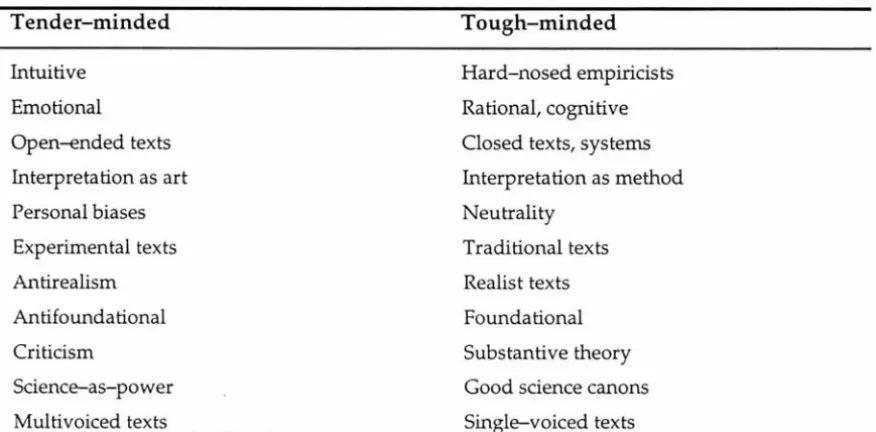
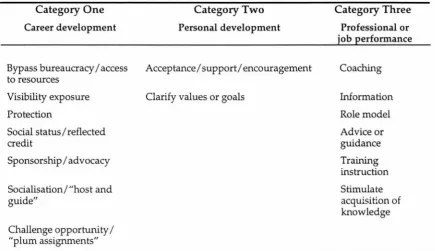
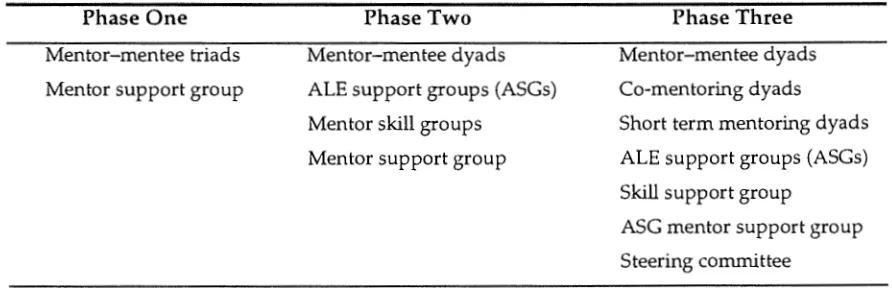
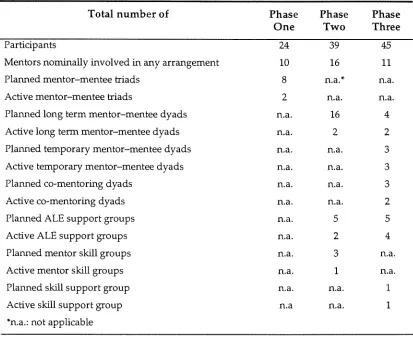
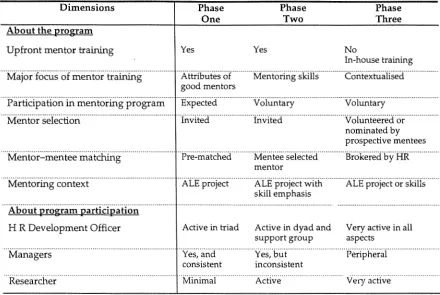
(15) List of Tables. Table 2.1. Characteristics of two interpretive communities. 59. Table 3.1. Categories of mentoring functions. 68. Table 6.1. Peer support arrangements in each phase. 214. Table 6.2. Numerical snapshot of participation in the peer learning support system. 215. Table 6.3. Dimensions of the peer learning support system in each phase. 216. Table 6.4. Comparison of expertise expectations in mentoring programs. 229. Table 6.5. Dimensions of a community of practice evident in the support system. 241. XlV.
(16) List of Figures. Figure 1.1. Evolution of the peer learning support system. 10. Figure 3.1. Social capital in the creation of intellectual capital. 83. Figure 3.2. Simultaneous building and using social capital. 85. Figure 3.3. Components of Butler's model of human action. 102. Figure 3.4. Benner model applied to mentoring. 105. Figure 4.1. Layout of the copper refinery. 122. Figure 6.1. Support arrangements at the beginning of Phase One. 245. Figure 6.2. Support arrangements at the end of Phase Three. 245. Figure 7.1. Contexts and constructions of mentoring. 278. xv.
(17) Chapter One Subject of the research 1.1 Introduction For many, the term "mentoring" evokes a positive image of a respectful, trusting, and mutually satisfying relationship between a wise and experienced person, the mentor, and a less experienced other, the mentee or learner. Until recent times, such relationships would have emerged, evolved, and dissolved only in the private realm of people's lives. In the last two decades of the twentieth century the dynamic of mentoring. was transformed as organisations began attempting to harness the capacity of this naturally occurring phenomenon. Programs matching mentors with mentees are now being designed to simulate natural mentoring for the purposes of achieving particular kinds of workplace learning. As a result, the mentoring relationship has been taken from the private realm to the public arena. When mentoring is in a program context it is variously described as organised, facilitated, structured, or formal. Outside this context, it is described as natural or informal mentoring. Despite the endorsements of its many advocates and research reports that identify positive outcomes (Caldwell & Carter, 1993b; Clutterbuck, 1991; Lewis, 1996; Matters, 1998; Merriam, 1983), research has also shown that as a social intervention in organisational life, facilitated mentoring has produced mixed results. The difficulties encountered in implementing mentoring programs and the sometimes less than expected outcomes have been documented (Gibb, 1999; Long, 1997). Notwithstanding the problems, interest from organisations in men to ring programs does not seem to have abated. In this thesis I tell of a mentoring program that encountered its own set of difficulties. In this case the participants themselves identified the problems and explored different solutions. This thesis is an ethnographic, narrative case study of a workplace mentoring program in which the participants and especially the mentors worked together to search for ways of mentoring that were effective in their workplace. It reveals how the tension produced by different and sometimes.
(18) conflicting notions of what it means to mentor led to new ways of helping one another learn. The alternatives developed bear little resemblance to the mentoring relationships that sometimes occur informally between two people in everyday life. In this case, interconnected learning support groups in which a mentoring style of interaction was promoted proved more appropriate peer support arrangements than the conventional mentor-mentee dyads. Amongst the participants in this study, a mentoring style came to mean one characterised by effective listening and facilitative questioning in an environment where there was sufficient trust for the learner to risk voicing assumptions and making errors. The alternatives developed in this workplace arguably stretch the notion of mentoring beyond what is generally regarded as facilitated or formal mentoring as described in the literature. A term that better describes the peer learning support system that developed is that of a "community of practice" (Wenger, 1998). This chapter tells of the purpose of this case study and how I came to that purpose. It helps establish a sense of the ways in which this case study is unique and yet similar to other studies of organised mentoring in terms of both the case itself and how it was researched. With Chapter One, I am also placing this narrative within the broader narrative of how mentoring moved from the private domain to the public arena. It is in light of this migration of the mentoring relationship into the formal workplace mentoring program that I discuss the significance of this study. In this chapter I also introduce a second narrative, my account of the collaborative research experience I shared with the program's participants. Although secondary its inclusion assists understanding the main narrative. In addition, it makes a contribution to the body of knowledge on doing collaborative research. The chapter concludes with a description of how the thesis unfolds in the subsequent chapters. I now begin with a brief overview of the mentoring program to establish why this case study predominantly concerns itself with how a group of people went about learning to mentor in an organised mentoring context.. 2.
(19) 1.2 Learning to mentor In this thesis I tell of the experiences of a group of professional men and women who volunteered to participate in a mentoring program at a copper refinery in Australia in the mid 1990s. Over an eighteen-month period, managers, engineers, metallurgists, scientists, programmers, accountants, and administrators entered formal mentoring relationships in which they were mentors or mentees. From a total workforce of about 460 employees, some fifty staff members participated in the peer learning support program. Of the fifty, eighteen were mentors at some time during the project and the rest were mentees. The mentoring program was part of a large three-year joint government and industry funded research project (hereafter commonly referred to as the Project) involving Copper Refineries Pty Ltd (CRL), James Cook University (JCU), and the University of Queensland (UQ). The Project was designed to look at improving professional performance through an Action Thinking Change model (Butler, 1994, 1996). Participants in the research project undertook individual action learning projects that had reflection on practice as the key component. Because the participants referred to these projects as ALEs (Action Learning Explorations), I shall also call them ALEs. The main purpose of the ALEs was to provide a focus for participants to better understand how they learned in their everyday work and how to improve that learning. The primary purpose of the mentoring program was to assist participants with their ALEs. For eighteen months, the participants in the Project struggled individually and collectively to construct notions and practices of mentoring that they could personally live with, that were compatible with their other workplace practices, and that met the aims of the program. Although some abandoned the struggle, most did not. From the very beginning, the mentoring arrangements implemented and even the term "mentor" met with resistance. For most participants, the formal mentor-mentee arrangements experienced in the program seemed to have very little in common with their personal experiences of mentoring. Although some participants managed to develop mutually satisfying mentoring relationships, traditional mentor-mentee relationships, for the most part, did not take root.. 3.
(20) Despite this resistance and lack of success, the mentors as a group developed other ways of helping one another learn. The new multiple forms of peer learning support arrangements trialled-and outlined later in this chapter-did prove to be more successful than those that had been initially implemented. From my position as the on-site researcher I not only heard about their experiences in interviews, but I was also able to witness and share in some of them as well. From the inception of the program to its premature demise, I was able to document the group's struggles and achievements. What soon became evident in this case was that learning to mentor was going to become the major focus for the participants and of my research. This thesis therefore is primarily a narrative reconstruction of individual and collective experiences-especially those of the mentors-that led to learnings about mentoring and to the evolution of the peer learning support system.. 1.3 What is facilitated mentoring? Organised or facilitated mentoring, of which this program is an example, is a late twentieth century phenomenon. In a time span of twenty to twenty-five years, mentoring has become a strategy in the personal and professional development initiatives of companies, universities, schools, hospitals, and organisations. It is being embraced by organisations, agencies, and community groups to improve work performance and to redress imbalances of gender, race, and class. At the time of writing, a mentoring program complete with a "mentor nook" in the library is available to undergraduates at my university. Students are walking the corridors with the word "MENTOR" emblazoned in block letters across the backs of their shirts. Another mentoring program was recently funded for women academics at the same university. At a nearby major hospital a men to ring program is being established for its nurses. The Federal government funds mentoring programs in the community. For example, in my city of Cairns in Queensland a program funded by the Department of Family and Community Services is currently running to support youth at risk. These examples are illustrative of the diverse range of purposes for which mentoring programs are designed.. 4.
(21) The facilitated workplace mentoring relationship attempts to replicate the dynamics of the naturally occurring mentoring relationship for the purposes of achieving particular organisational goals. Many definitions of mentoring have been used in programs. Within this diversity, Jacobi (1991, p. 513) identifies five elements about which there is strong agreement. In summary, they are: •. The mentoring relationship is a helping relationship focused on. achievement. •. Mentoring serves at least one of three functions: emotional and. psychological support; direct assistance with career and professional development; and role modelling. •. Both mentor and men tee derive benefits from the relationship that are. benefits other than fee for service. •. Mentoring relationships are personal relationships between a mentor. and mentee involving an exchange of information. •. Relative to the mentee, the mentor possesses greater experience,. influence, and achievement within the organisation. Workplace mentoring programs are implemented to foster vocational learning, leadership and management expertise, and career path development. They are used as a strategy either to help enculturate new employees into an existing organisational culture or to help employees adapt to cultural change. Mentoring programs are also used as a developmental tool to support personal and professional growth of employees in professional development initiatives that include workshops and courses. This was the intent of the program in this study. There is no universally accepted definition of what constitutes mentoring in organisations and particularly in formal mentoring programs. Dalton, Thompson, and Price (1977, cited in Zagumny, 1993) claim that the complex nature of mentoring relationships precludes a definitive description. A mentoring program is subject to even further complexities because the idiosyncrasies of the organisation intersect with those of the individual mentor and mentee (Gladstone, 1988 cited in Garvey, 1994b). Constructed by managers, staff development consultants, and academics for different purposes to describe different processes in different contexts, the concept of. 5.
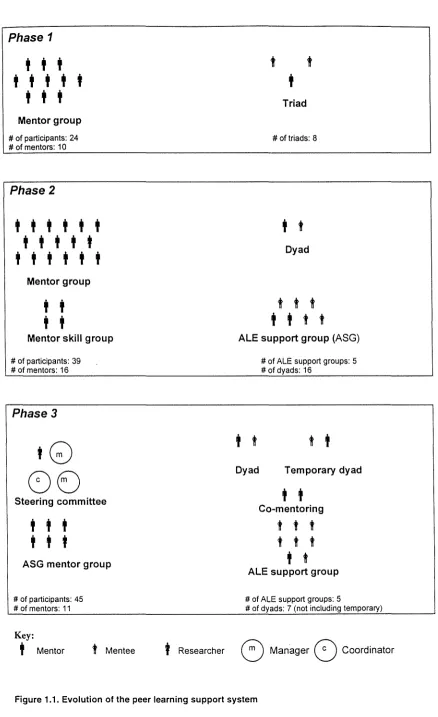
(22) mentoring has developed what Gibb (1999, online) calls an "elasticity" that hinders rather than helps understanding and theorising. Even the traditional arrangement of two people comprising the mentor-mentee dyad can no longer be assumed. For example, Burney (1998) describes the Mentor-Protege Program operated by the Department of Defense in the United States of America that fosters successful partnerships between big defence contractors and smalt disadvantaged businesses. In this case, the dyad is two organisations. In some of the cases where the mentoring relationship is still between two people, the differentials that traditionally used to exist between the mentor and the mentee seem no longer a prerequisite. These include differentials in levels of expertise, in positions within the organisational hierarchy, and in age as well. In peer mentoring relationships for example, these differentials can be obliterated without the mentoring function supposedly being compromised (Kram & Isabella, 1985). Peer mentoring actually describes two kinds of dyad arrangements. One arrangement is a learning relationship in which both partners assume the role of mentor and men tee (Fine & Pullins, 1998). These relationships, which are also called co-mentoring relationships, are founded on the belief that each partner is able to help the other in his or her professional development even if they do have comparable levels of expertise. The second kind of peer mentoring arrangement is one where there is a mentor and mentee, but the mentor is not a superior in the organisation to the mentee. For example, the mentor may be a colleague whom the mentee has asked to be a sounding board and coach for a particular purpose (Peters, 1996). Another example of this kind of configuration is co-workers who are temporarily allocated as mentors to new recruits to assist with their transition to a new role or workplace (Allen, Russell, & Maetzke, 1997). The notion of mentoring can also extend beyond the dyad to group mentoring. As with peer mentoring, this, too, may refer to two very different kinds of configura tion. In the first, an experienced member of the workforce collectively mentors a group of employees. In this mentoring arrangement, Kaye and Jacobson (1996) describe the mentor as the "learning leader" and the group of men tees as a "learning group." In the second, it is the group. 6.
(23) rather than any single individual that is the mentor. Dansky (1996, online) defines the mentoring role that a group can have for its members as "a group influence that emerges from the social norms and roles that are characteristic of a specific group and results in the career enhancement of an individual member." One interesting feature of this second definition is confining the notion of mentoring to those social processes that have a career advancement outcome. Another unusual feature is defining the mentoring role in terms of a group influence rather than that of an individual. Despite these new applications of mentoring, the mentor-mentee dyad continues to be the main arrangement in mentoring programs. In general, then, formal mentoring refers to "a deliberate pairing of a more skilled or experienced person with a lesser skilled or experienced one, with the agreed-upon goal of having the lesser skilled person grow and develop specific competencies" (Murray, 1991, p. xiv). In contrast, Daloz (1986) proposes a definition of mentoring that has more to do with its spirit than with its structure. He describes the mentor as a guide who supports and challenges the men tee on a learning journey along which he or she experiences transformative change. In fact, it was Daloz's interpretation that informed the training workshops for the mentoring program in this study. The training consultants had asked the mentors to "help people grow" and this was to become the mentor group's own motto. Organised mentor-mentee pairings, and the less common kinds of mentoring arrangements such as mentoring groups, usually occur within a structured program. The literature contains many models that identify the components of a mentoring program and their interrelationships (Clutterbuck, 1991; Murray, 1991; Lewis, 1996). The common elements of a mentoring program comprise a set of management goals for the program; a definition of the mentoring role; protocols for matching mentors to men tees; an agreed upon period of time and context in which the mentoring takes place; and a process for evaluating the program. Although by no means universal, most programs also have some initial training for mentors and less commonly for mentees. The program in this study had all these elements including a two-day training workshop for mentors and a short training session of two to three. 7.
(24) hours for mentees. It also had an additional element in its design. The design of the entire professional development project, of which the mentoring program was a part, consisted of a series of phases each approximately six months long. The phase structure permitted new intakes of participants as well as the opportunity for others to withdraw. Each phase began with training workshops for new and existing participants at which the experience of the previous phase was reviewed. Participants' recommendations for change were discussed with the training consultants and, if agreed upon by the group, were implemented in the next phase. This mechanism facilitated the evolution of the mentoring program.. 1.4 Purpose of the case study The proliferation of men to ring programs in the last two decades has produced an extensive mentoring literature, especially of case studies. To different degrees, most case studies have either an evaluative or prescriptive purpose and tend to follow a common format. The case study usually describes a program in terms of the various components or elements I outlined earlier. It then lists the outcomes for the different stakeholders-the company, the mentor, the mentee, and sometimes the manager of the mentee. It identifies the strengths and weaknesses of the program and also makes recommendations for future changes. The most common sources of data for these studies are written questionnaires or sets of interviews with a sample of the participant group. In most cases these data are collected toward the end of the program. This thesis, too, is a case study of a mentoring program, but it differs from most others in two major respects. First, in this case data collection was ongoing. I observed or participated in mentoring-related activities on a weekly basis and I formally interviewed participants twice every six months. Second, in contrast with most of the case studies found in the mentoring literature, the principal focus of this case study is neither evaluative nor prescriptive. My purpose is primarily explanatory. My purpose comes from the fact that the most notable feature of this case is that the program changed. Although research has been done on how individual mentoring relationships develop over time (Kram, 1985), to my knowledge no studies document the evolution of a mentoring program. In. 8.
(25) this case, as the participants learnt from experience what formal mentoring meant in the context of their workplace and the research project, they went about changing the mentoring arrangements. The new social arrangements trialled in each of the three phases (see Figure 1.1) are indicative of the learning that took place during the eighteen months. Figure 1.1 illustrates the general trend toward multiple peer learning support arrangements. These ranged from the traditional mentor-mentee dyad to support groups led by a group mentor. Each of the components in the diagram will be described in detail in subsequent chapters, but the figure is included here to provide an overview of how the program changed. As the narrative I write will reveal, these changes were only some amongst many others impacting on, or brought about by, the participants' experience.. In addition to the changes experienced by the project members, my own participation in the project changed. The initial research design positioned the researcher outside the participant group as observer only. Over time this became increasingly untenable for two reasons. First, individual relationships developed between the project participants and myself. Second, the participants and I developed an understanding of what it meant to collaborate in this project and what our mutual obligations were to the enterprise. Consequently my role as researcher changed from that of the detached observer to, at different times, being a participant in the program, an observer, and a critical friend. The question that all these changes constantly raised for me was why? Why was it that so many participants-both mentors and mentees alike-felt ill at ease with the term mentor? Why did the term itself persist? Why was it that, in the main, the initial mentoring structures that had been designed by the consultants in collaboration with management did not prove to be workable? Why did the mentors throughout the life of the program continue to regularly meet to reflect on existing mentoring arrangements and create new ones? Why did they persevere? Why was it that some of these new structures that placed the mentor in a far less traditional role prove more successful? And lastly, why did my participation change and what affect did this have on the program?. 9.
(26) Phase 1. t. t t t t t t t t t t t. t t Triad. Mentor group # of participants: 24 # of mentors: 10. # of triads: 8. Phase 2. t t t t t t t t t t t t t t t t t. t t Dyad. Mentor group. t t t t t t t. t t. t t. ALE support group (ASG). Mentor skill group # of participants: 39 # of mentors: 16. # of ALE support groups: 5 # of dyads: 16. Phase 3. t t Dyad. Co-mentoring. t t t t t t t t. t t t t t t ASG mentor group. ALE support group. # of participants: 45 # of mentors: 11. # of ALE support groups: 5 # of dyads: 7 (not including temporary). Key: Mentor. Temporary dyad. t t. Steering committee. t. t. t. t. Mentee. t. Researcher. 0. Figure 1.1. Evolution of the peer learning support system. 10. Manager. 8. Coordinator.
(27) These are some of the questions that led me to write this thesis. In this thesis I have tried to distil the multitude of questions and impressions that the field experience produced into the exploration of four questions, namely: Why did the peer learning support system have so many problems? Why did it evolve in the way it did? Was the peer learning support system worth it? Why did my participation as researcher change in the program? My interest in this case therefore lies primarily in how and why this particular program changed in the ways it did. Evaluating its outcomes and recommending possible modifications are secondary in importance. Furthermore, my intent is not to hypothesise about the general pattern of development that mentoring programs might follow if placed in the hands of participants. In contrast to Kram (1985) who sought to find a developmental pattern discernible across many mentoring relationships, this study comprises one case only. Nevertheless, as Stake (1995) argues, much that is general can be learned from the individual case. To use Stake's (1995) distinction between an intrinsic case study and an instrumental case study, my primary objective is to understand this particular mentoring program because of its intrinsic interest. This is due to its difference from other programs. However, the case study also has instrumental value. Despite the reasons for its uniqueness, this case still has enough similarities with other mentoring programs to permit its classification as one. Hence this case study adds to the body of knowledge on facilitated mentoring in organisational settings and to that of peer learning support systems more generally. It also contributes to our knowledge on doing long term collaborative research between universities and organisations that involves social interventions. Because my purpose is explanatory, I use several modes of explanation to give different and, of necessity, partial accounts of what happened. Here I describe them briefly and in the next two chapters they are discussed in detail. First and foremost, I appeal to the explanatory power of narrative. Narrative does more than chronicle a series of events or changes. From a psychological. 11.
(28) perspective, Polkinghorne (1988, p. 6) explains that narrative makes meaning "by noting the contributions that actions and events make to a particular outcome and then configures these parts into a whole episode." It shows how the unique connections between those events that unfolded in a particular space and span of time produced an overall effect. Narrative interpretation is not about establishing proof. Bruner (1986, 1991) explains that narrative is concerned more with possible reasons for why things happened in a particular way. This means that there is no one "true" story and all that I can do in this thesis is provide a critically reconstructed narrative in which I try to make space for other interpretations of what happened besides my own. To help understand what happened in this case I also compare it with others. From case reports, Stake argues that "we learn both propositional and experiential knowledge" (1994, p. 240). Propositional knowledge is explicated knowledge and according to Stake, experiential knowledge can be more than what we produce from direct experience. It also includes knowledge produced from vicarious experiences that occur when we read case reports. Although reviewers of the mentoring literature (Gibb, 1999; Jacobi, 1991) have critiqued much of it for its lack of a theoretical base, it is useful to me because it tells stories, albeit sometimes perfunctory, of mentoring programs that have worked and not worked successfully in other organisations. In comparing this case with others across particular dimensions, I am able to consider differences and similarities that provide insights into why this program developed in the ways it did. In contributing to a better understanding of this particular case, comparison also provides new insights into the nature of facilitated mentoring in general. In addition to narrative as a mode of explanation, I also appeal to what Bruner (1991) calls the logico-scientific cognitive mode. I use models and theories' that explain how adults learn to explore why the mentoring program evolved in the way it did. In particular, I use theories that view learning as a social practice (Falk & Kilpatrick, 2000; Wenger, 1998). So through narrative, I try to understand the case in terms of its specificity and interconnectedness of contexts and events. Through models and theories, I try to understand other aspects of the case in terms of abstract. 12.
(29) :l.temporal patterns. Both kinds 6f explanation are useful to better understand why and how this program evolved. In the next chapter I explain how I came to this selection of interpretive frameworks that gives the thesis its particular form and content. The explanation constitutes a narrative in itself. The ways I finally chose to interpret this research experience were very different from my original intent. My choice was heavily influenced by what actually happened over the eighteen months. As Stake (1995) affirms, the ways in which data are interpreted in qualitative research, especially in qualitative case study research, are subject to what the researcher finds in the field. Even research questions may need to be modified or, indeed, be replaced. This happened in this study. How I interpreted what had occurred in the field was also influenced by research experiences I was involved in two years after this project actually terminated. Robinson and Hawpe (1986, p. 123) use the term "narrative repair" to describe the way we revise narratives in the light of new information or new perspectives. In this case, narrative repair continued well after the men to ring program finished and, in some ways, is still continuing as I write. The contribution that this study makes to the field of facilitated mentoring comes from the intrinsic nature of the case itself and from the methods I use to interpret what happened. Before discussing the significance of this study, I will outline a bigger narrative in which the story of this particular mentoring program is embedded. The bigger narrative concerns the evolution of the notion of mentoring up to this particular moment in time where it has encountered and been transformed by strong academic and management interest in how adults learn and how workplaces can maximise learning potential. In fact, the set of aims of this particular program is one example that reflects the connections that researchers, practitioners, and organisations are making between developing a company's learning capacity and mentoring. Placing the narrative of this specific program in the larger storyline of the evolution of mentoring also provides the context for understanding why many of the participants in this project were holding. 13.
(30) multiple and sometimes conflicting beliefs of what a mentoring relationship is about.. 1.5 Positioning facilitated mentoring in the mentor motif Through the imagination and lived experience the motif of mentor has woven itself into the consciousness of the western world. Fictional and nonfictional narratives have provided and continue to provide countless incarnations of the mentor as the trusted guide, wise counsellor, and critical friend. The mentor is commonly portrayed as male, as more experienced than the protege or mentee in both life and work, and generally older. In the numerous representations in literary works, the mentor is generally depicted as acting out of selfless interest to foster the personal and professional growth of another (Seigneuret, 1988). Mentor-like figures populate both our imaginations and everyday lives. Stories of mentoring relationships are plentiful in classical literature and in the popular culture of today. They are found in religious literature including the Bible and endure in classics such as Homer's The Odyssey (n.d./1967) and Dante's (Alighieri) The Divine Comedy (c. 1310-1314/1995). These works continue to provide sources of reflection and analysis for researchers of mentoring in the vastly different contexts of today (see for example, Garvey's (1994a) analysis of the relationship between Telemachus and Mentor in Homer's The Odyssey and Daloz's (1986) discussion of the mentoring relationship between Dante and Virgil in Dante's The Divine Comedy). Representations of the mentor also proliferate in the modern day literature of comics, novels, and drama. Not all are equally laudable. One paternalistic and well known interpretation of the men to ring relationship is found in Lerner's (1959) musical comedy My Fair Lady adapted from British dramatist George Bernard Shaw's play Pygmalion produced in 1916. Here the mentor strives to remould the men tee into a persona of his own imagination. In these works the relationship between Henry Higgins and Eliza Doolittle displays what many today would consider a dysfunctional element that in fact harks back to a Greek myth told by Ovid about two thousand years ago in his work. Metamorphoses. According to the story, Pygmalion, king of Cyprus, falls in love with the statue of a woman he sculpted. He believes that the statue. 14.
(31) reciprocates his love and, as myth has it, the statue, through Aphrodite's intervention, does eventually come to life. Films, too, are a rich source of mentoring relationships. The Karate Kid trilogy (1984, 1986, 1989, directed by John Avildsen) for instance, tracks the developmental stages of a mentoring relationship. In film, the mentor has been variously portrayed as other worldly such as in Star Wars (1977, directed by George Lucas) and in Field of Dreams (1989, directed by Phil Alden Robinson), mortal, and even flawed as in The Firm (1993, directed by Sydney Pollack). In the 1980s and 1990s, it has been the American actor Robin Williams perhaps more than any other who has played very mortal but notable mentors in films such as Dead Poets Society (1989, directed by Peter Weir) and Good Will Hunting (1997, directed by Gus Van Sant). The Dictionary of Literary Themes and Motifs (Seigneuret, 1988) identifies the theme of divine tutor, which is one manifestation of the mentor, as one of the fifty most significant themes in the evolution of cultural history. Although context, character, and plot make each mentor unique, the many representations found in literary works tend to share common characteristics. Seigneuret's analysis (1988) of the various literary manifestations concludes that the mentor, who in many cases is divine but not always, may act in a number of capacities. As a preceptor, the mentor presents "instruction through arguments and precepts to be learned"; as a coach of physical, emotional, and spiritual potential, the mentor "makes possible experiences that serve to prove and shape the character of the young person"; and as a wise person, the mentor is there to provide reflection on significant experiences (p. 396). When necessary, mentors are even there in a literal or figurative sense to rescue their proteges. The artistic device often used to provide the context and plot that enables the mentor to teach, advise, and nurture the learner is the journey. The journey or voyage can be physical or spiritual, allegorical or symbolic. Its function is to provide the opportunities through which the men tee experiences change. That mentoring relationships exist in real life as well as in the imagination appears unquestioned. Biographies and autobiographies often refer to mentors who have had a strong influence during periods of the protagonists'. l5.
(32) lives (Garvey, 1994a). Like many of us, the participants in this study were able to recall experiences in their own lives in which either they had been mentored by people such as fathers, managers, or even scout leaders, or they themselves had mentored others such as students, co-workers, or young sportsmen and women. Interestingly, they often noted that at the time they would not have referred to the relationship as a mentoring relationship. It was only in retrospect that they would have described themselves as having been mentored or having mentored. One notable and often cited study of naturally occurring mentoring relationships was an all male study that took place in the 1970s. In that study Levinson (1978) found that successful men had experienced special relationships that positively influenced their professional lives. These relationships displayed many of the mentoring qualities idealised in myth and other cultural forms. Levinson (1978, pp. 97-98) with his colleagues described this kind of relationship as one of the most complex, and developmentally important, a man can have in early adulthood .... No word currently in use is adequate to convey the nature of the relationship we have in mind here. Words such as "counsellor" or "guru" suggest the more subtle meanings, but they have other connotations that would be misleading. The term "mentor" is generally used in a much narrower sense, to mean teacher, adviser, or sponsor. As we use the term, it means all these things, and more.. In the late twentieth century, at least in societies where western cultures are strong, the mentor figure materialised in the public arena of the organisation. The springboard wasn't Greek mythology, biblical stories, or the epics; rather, it was the literature of psychology and management. Writers (Gay, 1994; Jacobi, 1991; Daloz, 1986) concur that it was, in fact, Levinson's longitudinal developmental study in the 1970s that drew attention to the significance of the mentor in people's lives. Kanter's (1977) and Roche's (1979) publications also identified the relationship between attaining professional success and having a sponsor or mentor in one's professional life. Organisations recognised that informal mentoring was already occurring amongst some of their staff and that even the old trade model of "apprentice,. 16.
(33) journeyman, and master" demonstrated mentoring principles. However, the ad hoc nature of such informal men to ring meant that results were uneven and sometimes even negative. By sponsoring planned mentoring programs that targeted specific groups within the organisation for specific purposes, management hoped that better results and more leverage could be gained from managed mentoring relationships than from informal or naturally occurring mentoring. The advent of the "learning organisation" (Garvin, 1993; Pedler, Burgoyne & Boydell, 1991; Senge, 1992; Watkins & Marsick, 1993) stimulated even more interest in mentoring especially as a strategy to help people learn on a one-to-one basis in the workplace. Watkins and Marsick (1993, p. 8) define a learning organisation as follows: The learning organization is one that learns continuously and transforms itself. Learning takes place in individuals, teams, the organization, and even the communities with which the organization interacts. Learning is a continuous, strategically used process-integrated with, and running parallel to, work. ... The learning organization has embedded systems to capture and share learning.. To varying degrees, workplaces have embraced the ideology and practices of the learning organisation to better respond to a changing environment that is often called the knowledge society (Drucker, 1993). The need for employees to be effective learners has become critical in a marketplace where knowledge and its applications have replaced labour and capital as the major source of economic growth (Drucker, 1993). In the 1980s, and especially in the 1990s, attention turned to new management styles that fostered learning environments. Included amongst these is a mentoring style approach to management that has managers and supervisors change from "monitors and controllers to coaches and mentors" (London, 1992, p. 53) or more succinctly, that has them change "from cop to coach" (McMahon, 1993, p. 113). With the need to increase its capacity to learn, industry has taken a stronger interest in a theoretical understanding of adult learning. Trainers and management now conceptualise the workplace-whether it be the factory floor, the boardrooms, or the R&D laboratories-as learning spaces. Revans' (1982) action learning, Kolb's (1984) learning cycle, and Schon's (1983). 17.
(34) reflective practitioner have become part of the literature that informs deliberately designed learning practices in the workplace. It is not that surprising then that this thesis derives from a research project conducted in an industrial worksite by a team of six researchers from Faculties of Education rather than, say, Faculties of Business or Management. It is also not surprising that this mentoring program was not about helping people learn a specific work related task. Rather, it was about helping people learn how to learn more effectively. In the last two decades, the literature on facilitated men to ring has in quantitative terms outstripped by far any literature on naturally occurring mentoring relationships. Despite attempts at the scientification of the mentoring process, the meaning of mentoring in facilitated programs continues to defy packaging. As a result, customised definitions of mentoring begin almost all papers or books on the topic. Jacobi (1991) for example, laments the lack of a generally recognised operational definition of mentoring and lists fifteen definitions as an indication of the diversity that exists. Furthermore, the practical reasonableness of some of the definitions has become doubtful. In reviewing mentoring programs for teachers, Roberts and Chernopiskaya (1999, p. 83) question the "daunting repertoire of skills and attributes" that mentors should supposedly possess and ask themselves how such a role description came about. From the perspective of the participants in a facilitated mentoring program, this study will show that the number of definitions and the expectations imposed on mentors and mentees alike have made the mentoring arrangement potentially confusing and in some cases inoperable. In this brief outline I have attempted to portray chronologically the development of facilitated mentoring. In shifting the mentoring relationship from the natural to the programmed, the essence of the mentor relationship is conceptualised very differently. Where in the private mentoring dyad of literature, film, or private life the rewards of the experience are enjoyed by the two people involved, mentoring in the organisational format hopes to reap rewards for the individuals and for the organisation. Not only that, it is. 18.
(35) anticipated that those rewards can in great measure be programmed to materialise. At this point. In. history, expressions of both informal men to ring and. facilitated mentoring co-exist, albeit sometimes uncomfortably. Consequently, participants in a program may find that they're being asked to conceptualise mentoring in ways that are inconsistent with their own understandings of what mentoring should be. The mentoring program in this study became a ground for such contested meanings. The understandings participants brought with them based on their own personal mentoring experiences, direct, or indirect, often appeared incompatible with how mentoring was supposed to be conducted in this program. This disequilibrium ultimately produced new interpretations of mentoring that permitted some participants to engage in more meaningful learning relationships.. 1.6 Significance of the study For a story to be worth telling, Bruner (1991, p. 11) explains that it needs to breach the expected or the norm: "A tale must be about how an implicit canonical script has been breached, violated, or deviated from in a manner to do violence to what Hayden White [1987] calls the 'legitimacy' of the canonical script." With this study there was indeed a story to be told; in fact, there were a number of stories. If the mentoring literature is the "canonical script," the breaches concern both the subject of the story and how the story is told. As I continue to read studies about organisational men to ring programs, I am becoming more certain that this particular program was significantly different from most others in terms of its aims and how it was operationalised. Also different to most other studies is the perspective I have taken in its investigation. In these differences lies the significance of this research as well as many of its limitations which I reflect upon in the final chapter. The first major difference between this study and others is that the subject is a mentoring program that is unlike most others. For example, in most workplace programs, the mentor selection process and the learning area that. 19.
(36) the mentoring program targets are both closely tied into the existing structures and practices of the workplace. Mentors are usually selected for their recognised expertise in a specific and identifiable knowledge area that mentees need to develop to better do their work. This program made such a match difficult because the learning that this mentoring program aimed to foster was less tangible and more diverse than, say, learning the skills and know-how associated with a job or position. The program aimed to provide the support and challenge needed to help people learn whatever and however they had planned in the ALEs. The focus of the ALEs was learning to reflect on one's practice. As a result the mentor selection process challenged the traditional differences between mentor and mentee in terms of expertise, and in some cases, age and status. For the participants, this was to mean attempting to reconcile their prior understandings of mentoring with what was possible in the context of the ALEs. For management, it meant ongoing frustrations in determining the value of the program. For the researchers, the program meant the opportunity to gain further insights into how workplace mentoring may be used to help people learn how to learn. Also unusual was that the ongoing running of the program was in the hands of the participants. In consultation with management, the training consultants-who were also the Chief Investigators in the research project-did introduce the program into the workplace, but they encouraged the mentors to assume responsibility for it-which they did. By virtue of its design, company commitment, and participant commitment, the program had the space and time to evolve-and it did. Over time, new experience-based understandings and possibilities for helping one another learn developed that would otherwise not have had the opportunity to arise. It is these new understandings and the factors that permitted their. development that make an important contribution to the field of facilitated mentoring and to the field of peer learning support systems more generally. As well as the case being unusual, so was its investigation. A research method using ethnographic techniques is not a common approach to the study of men to ring programs. Lareau and Shultz (1996) describe ethnography. In. its. broadest. sense. as. a. study. that. uses. participant-observation and in-depth interviewing over an extended period of time. This study employed those techniques to help understand the. 20.
(37) meanings that this community-the participants of the professional development program and, in particular, the group of mentors-made of new practices called mentoring. The open-ended approach in the research design made it possible to develop a research methodology that harmonised with the evolving lived experience of the men and women involved in the program. Preconceived criteria for determining the program's success or otherwise were absent; the program itself was open to change; the nature and extent of my engagement in the program were open to change, as were the methods for data generation. Participants told of their mentoring experiences in different settings including interviews with me, meetings with their colleagues, discussions at workshops and at meetings with the training consultants. Some wrote in their journals. The fact that I was based at the refinery for two or three days a week gave me access to data that pre- and post- tests supplemented with one or two interviews could not. The nature of the mentoring program together with an ethnographic narrative approach to the inquiry has led to new understandings of what mentoring and other forms of peer learning support may mean in an industrial workplace. Hence this program, different in many respects but similar enough in others to allow it to be located in the field of formal workplace mentoring, has sensitised me to what Gusfield (1992) describes as the rhetoric of the field. Rhetoric, Gusfield explains, is "the study of argument and persuasion as a facet of human interaction, of reason as well as emotion" (p. 120). Gusfield argues that when the books, chapters of books, conference proceedings, and papers in a field are considered as a whole, one can discern a total framework of assumptions and interests [that] persuades the audience by the way in which the object of study is delineated and described .... No one study will yield the way in which a set of assumptions constitutes a dominant paradigm for constructing phenomena. It will provide an understanding of the rhetoric of a single study but, by ignoring the total effect of a field, tells us little about what is not studied. It gives us the voices but not the silences .... This kind of rhetoric is part of what Gramsci referred to as cultural hegemony. It restricts and channels what is thinkable and unthinkable.. 21.
(38) In the field defined by the literature on facilitated mentoring, Gusfield would argue that dominant frames operate to construct men to ring, the personae of mentor and mentee, the writer, and even the audience in particular ways. In studying a mentoring program that was allowed to "breathe" and evolve, this inquiry helps reveal some of these frames and in addition, makes some of the "silences" audible. It shows that when the private and personal act of mentoring is transplanted into the public domain and the men to ring relationship is made an object of social engineering, what it means to mentor and to be mentored are transformed. The main objective of this thesis is to contribute to the existing literature on men to ring and other peer learning support systems for the practical use of those considering implementing workplace support programs. However, this thesis also contributes to the practical knowledge available on collaborative research. Woven into the main plot of how the mentoring program developed is also the narrative of my changing experience as an onsite researcher. I had had no previous experience in this kind of research and my coming to understand the research experience in the field as a collaboration took time. Levin (1993, p. 331) describes collaborative research as that which is "conducted with the active participation of people in an organizational setting, with the goal of producing knowledge which is meaningful and useful both for academic purposes and to the people in the setting being studied." Couched in product rather than process-oriented terms, this definition provides no understanding of what the verb "to collaborate" means. Yet this definition essentially encapsulated the sum total of my understanding of how to do collaborative research when I first began the project. In contrast, eighteen months later, it was Ulichny and Schoener's (1996) definition of collaborative research between teacher and researcher that was resonating far more powerfully with my experience. They explain that collaboration for them came to mean determining mutual goals for the II. research, sharing responsibility for the research product, and building a trusting relationship that permitted interdependence and mutuality between teacher and researcher" (p. 496).. 22.
(39) This thesis tells of how I came to an experiential understanding of what Ulichny and Schoener mean. I tell of the empowering capacity that such an understanding brings to the researcher, but I also tell of the emotional and intellectual discomfort that it often caused me. Well after the field experience ended, I made meaning of the collaborative research experience through using Wenger's (1998) notion of communities of practice to explain my changing identity both in the research team and in the participant group. Finally, this thesis also has a personal significance. It is a story of my journey towards furthering my understanding of what the endeavour of research, especially collaborative research is about; of what mentoring, especially in a structured form is about; and of what I, as a learner and a facilitator of learning am about. Daloz (1986) describes the education experience for adult learners as a transformational journey along which the traveller, through trial and tribulation, losing direction, regaining it and then losing it again, changes profoundly. This thesis is evidence of my own personal transformational journey.. 1.7 Organisation of the thesis The metaphorical concept I have chosen to interpret my research experience is that of narrative. Richardson (1994, p. 520) explains that "metaphors organize sociological work and affect the interpretations of the 'facts'; indeed, facts are interpretable ('make sense') only in terms of their place within a metaphoric structure." In the next chapter, I explain how I came to choose narrative as the main metaphor for interpreting this experience. I describe the significance of this choice of metaphor to the study and the choices it led me to make in the various stages of the research project. Chapter Three reviews the literature on mentoring programs for the purpose of placing the program that is the subject of this study in the field of organised mentoring. Because the narrative is mainly about how the mentors themselves learned, the second half of the chapter presents theories on adult learning with which to interpret their experience. My discussion of the literature on facilitated mentoring and adult learning in this chapter is the result of a dialectic relationship between what I have been reading and what I experienced first hand. While the literature has contributed to how I. 23.
(40) interpreted what was happening in this particular case, the reverse is also true. The experience of the case also led me to reinterpret the literature from fresh perspectives. This has included a reconsideration of the value of mentoring programs to an organisation in terms of their capacity to add to the organisation's social capital (Coleman, 1988). Chapter Four details the backgrounds required to make sense of the narrative. Clandinin and Connelly (1994, p. 413) explain that the status of a passage as representing experience depends on what we choose to convey II. contextually." The company, the professional development training, and the mentoring program are described. I also outline the pre-story and post-story of the project and the company including the events that led to the research project taking place in the copper refinery. The pre-stories are important because they influenced both the research and the mentoring processes. The post-stories describe what happened, after the project terminated, to the company, to the employees involved in the project, and to the research team. These, too, are important because what eventuated was foreshadowed during the project and influenced people's experiences. Chapter Five tells the story of the mentoring program and of the mentors' learning journeys over the three phases of the program. Through narrative, this chapter answers the how and why questions posed earlier in this chapter. The chapter is written as a stage play in three acts with each act corresponding to one of the three phases. The point of this chapter is to convey a holistic interpretation of the case in the form of a reconstructed narrative using multiple voices. Chapter Six answers these same questions but in a different way. I use the mentoring literature reviewed in Chapter Three to inform a discussion of the difficulties experienced in the mentoring program. To help explain how and why the program evolved in the way it did, I then use the adult learning theories from Chapter Three to reinterpret the narrative from what Bruner (1991) calls a logico-scientific point of view. In Chapter Six, I also reflect on my learnings in doing on-site research with a group of people over a prolonged period of time. In the final chapter, Chapter Seven, I reflect on what this case study, despite its limitations, contributes to our understanding of traditional formal. 24.
(41) mentoring programs and of alternate formal peer support learning structures. I also consider the contribution it has made to our understanding of collaborative research. I conclude with the implications that this study may have for workplace professional development and the directions for further research that it suggests.. 1.8 By way of summary In the late twentieth century, the archetypal figure of the mentor leapt from. the private domain of the individual to the public arena of the organisation. The platform has been the structured, planned, or facilitated mentoring program. As this thesis shows, the leap has not gone without mishap. What it also shows is that the notion of mentoring has opened up other ways in which colleagues can help one another learn professionally and personally in the workplace. Through ethnographic narrative I tell of the journey of a group of colleagues who discovered ways "to help people grow." In the next chapter I explain why and how I used the metaphor of narrative to make sense of the circumstances, events, and experiences that constituted this case.. 25.
(42) Chapter Two Research as narrative "Nature and the world do not tell stories, individuals do." Riessman, 1993, p. 2. 2.1 Introduction In this chapter I tell of how I wrote this particular story about the ways the. mentoring program evolved. The title of the chapter signals that narrative is the main metaphor that shaped the inquiry from its beginnings in the field to the final product which is this text. To more precisely highlight the metaphorical nature of the title, it could have been written as "Research as. if. it were narrative." Narrative refers to the subject of the inquiry; to the method of interpretation I used; to the text I wrote; to how I conceptualised the research experience overall. The title identifies the set of interrelated assumptions and beliefs about human experience and knowledge that underpin the theoretical framework and methodology of this inquiry. The purpose of this chapter is three-fold. First, I explain what the metaphor of narrative means when applied to the activity of research. I then explain why I chose the metaphor of narrative to shape this particular research experience. Finally, I describe the specific methods used. Because I am starting from the belief that it is through metaphor that we make meaning of experience, I begin with a discussion of metaphor itself.. 2.2 What is metaphor? Lakoff and Johnson (1980, p. 5) explain that metaphor is "understanding and experiencing one kind of thing in terms of another." They argue that metaphor is at work both in the experiential and the cognitive domains-it structures experience as it is lived and as it is thought about. Sarbin (1986, p. 4), too, points to the meaning-making capacity of metaphor: When a person confronts a novel occurrence for which no ready-made category or class is available, the occurrence remains uninstantiated, unclassified, or unassimilated until a class or category is located or invented. The recognition of partial similarity on some dimension or construct provides the basis for analogy, and if linguistic translation is necessary, the partial. 26.
(43) similarity is expressed as metaphor. The novel occurrence is named with the metaphor.. By its very nature, the research enterprise is a particularly fertile ground for metaphor making. Indeed, whilst we may describe research as an investigation, an exploration, or a systematic inquiry aimed at furthering knowledge, we resort to metaphor to explain how it is done. A long list of research concepts and procedures compiled by Richardson (1990, pp. 19-20) provides explicit and implicit examples of the use of metaphor in research practice. Just one set of metaphors commonly used to understand research derives from the imagery associated with light and sight. For example, research has been described "as a 'window' through which we might 'see' and comment" (Miller, 1997, p. 2). The light/ sight analogy is also taken up in the title of the book, The enlightened eye: Qualitative inquiry and the enhancement. of educational practice (Eisner, 1991). As these examples illustrate, metaphors affect how we conceive the research project, how we position ourselves as researchers, and how we perform the research act. For this thesis I use narrative or story as the main metaphor to help structure and interpret the research experience. In foregrounding the notion of metaphor in this study, I may be inviting criticism on at least three counts. Some may argue that metaphor is merely a literary device and nothing more; some may argue that using a particular metaphor to shape a piece of research results in certain aspects of the subject of study being ignored; others may argue that the very ambiguity of metaphor inhibits the pursuit of new knowledge. My response to these potential sources of criticism is based on the argument that yes, metaphors do have limitations and ambiguities but we make meaning through metaphor whether we acknowledge the particular metaphors or not (Lakoff & Johnson, 1980; Sarbin, 1986) .. Implicit in the first possible criticism-that metaphor is a literary device-is the assumption that rhetoric has no place in the research enterprise. This argument ignores the power of language in the making of meaning. Responses to positivist research paradigms in the social sciences (Atkinson, 1990; Brown, 1992; Clifford & Marcus, 1984; Nelson, Megill, & McCloskey, 1987; Van Maanen, 1988, 1995) have revealed how "the conventions of text. 27.
(44) and rhetoric are among the ways in which reality is constructed" (Atkinson, 1990, p. 2). Writing, especially research writing, is not about "writing up". findings. Rather, it is a continuation of the process that constructs the findings, a point which Richardson highlights when she describes "writing as inquiry" (1994, pp. 516-529). Even if metaphor were "only" rhetoric, it fundamentally shapes the research text. The second criticism-that metaphor can only provide a partial understanding- is valid. When one subject is described in terms of another, it results in some aspects being revealed and others remaining hidden. Lakoff and Johnson (1980, p. 13) explain that metaphorical structuring can only be partial because "if it were total, one concept would actually be the other, not merely be understood in terms of it." Sarbin's (1986, p. 4) analysis of Pepper's (1942) notion of root metaphor also identifies the constraints a particular metaphor imposes on the making of meaning: The root metaphor provides the framework for the construing of occurrences in the natural and man-made worlds. The root metaphor constrains the kinds of philosophical or scientific models to be applied either to the task of observing and classifying or to the task of interpreting or explaining. The categories of analysis and the sorts of questions asked are similarly constrained by the choice of root metaphor.. Conceptualising inquiry as if it were narrative then, may be criticised for producing inappropriate analogies and even blind spots. This is a valid concern. Metaphors do delimit but they do this whether we articulate them or not. My purpose in this chapter is to identify the root metaphor I am using and thus to make more explicit the "situational limitations of the knower" (Richardson, 1994, p. 518) that make all research partial. While metaphors restrict interpretation in one sense, they also do the opposite. They offer breadth and depth by providing insight into characteristics that were not previously discernible. The main issue here is the choice of metaphor. What makes a metaphor a good metaphor? Metaphor works because it "exploits simultaneous similarity and difference" (Fiske, 1990, p. 92). But its power to structure experience and the talk about experience lies in what Lakoff and Johnson (1980) call the "systematicity" of the metaphorical concept. They use the term "systematicity" to refer to the. 28.
Figure

+7



Related documents
Finally, the key financial information disclosed to the market is approved by the highest- ranking governing bodies (the Board of Directors and the Audit and Control Committee)
The deceased’s cousin testified she sent an instant message to that particular screen name and received a reply that would have made no sense unless the reply had been sent
Robertsonian rearrangements, especially the fissions, reveal the inadequacy of Muller's rules, especially his concept of centromeres and telomeres as immutable structures (1), and
Xaivia will be graduating from Cumberland High School later this month with a GPA of 3.66.She plans to attend Old Dominion University to major in nursing on a pre-law advising
66% of debugging time can be saved with software of high quality. *Source: Andy Kyte, “Measure and manage your IT debt,” Gartner, Inc., August 9, 2010 (last reviewed June 19, 2013)
The PA is an economic alliance that revives the open regionalist model of the early 1990s in Latin America in that it seeks to increase intratrade and extraregional trade
This component also improved the specialized occupational training for adults to better meet retraining needs, during and after the transition period, through the
Topics include information security risk management, security policies, security in the systems-engineering process, laws related to information security and the management of
