This is a repository copy of
Portable haptic device for lower limb amputee gait feedback:
Assessing static and dynamic perceptibility
.
White Rose Research Online URL for this paper:
http://eprints.whiterose.ac.uk/126533/
Version: Accepted Version
Proceedings Paper:
Husman, MAB, Maqbool, HF, Awad, MI orcid.org/0000-0002-0367-0187 et al. (1 more
author) (2017) Portable haptic device for lower limb amputee gait feedback: Assessing
static and dynamic perceptibility. In: IEEE International Conference on Rehabilitation
Robotics. 2017 International Conference on Rehabilitation Robotics (ICORR), 17-20 Jul
2017, London, UK. IEEE , pp. 1562-1566. ISBN 9781538622964
https://doi.org/10.1109/ICORR.2017.8009470
© 2017, IEEE. This is an author produced version of a paper published in 2017
International Conference on Rehabilitation Robotics (ICORR). Uploaded in accordance
with the publisher's self-archiving policy.
[email protected] https://eprints.whiterose.ac.uk/
Reuse
Unless indicated otherwise, fulltext items are protected by copyright with all rights reserved. The copyright exception in section 29 of the Copyright, Designs and Patents Act 1988 allows the making of a single copy solely for the purpose of non-commercial research or private study within the limits of fair dealing. The publisher or other rights-holder may allow further reproduction and re-use of this version - refer to the White Rose Research Online record for this item. Where records identify the publisher as the copyright holder, users can verify any specific terms of use on the publisher’s website.
Takedown
If you consider content in White Rose Research Online to be in breach of UK law, please notify us by
Abstract— Loss of joints and severed sensory pathway cause reduced mobility capabilities in lower limb amputees. Although prosthetic devices attempt to restore normal mobility functions, lack of awareness and control of limb placement increase the risk of falling and causing amputee to have high level of visual dependency. Haptic feedback can serve as a cue for gait events during ambulation thus providing sense of awareness of the limb position. This paper presents a wireless wearable skin stretch haptic device to be fitted around the thigh region. The movement profile of the device was characterized and a preliminary work with able-bodied participants and an above-knee amputee to assess the ability of users to perceive the delivered stimuli during static and dynamic mode is reported. Perceptibility was found to be increasing with stretch magnitude. It was observed that a higher magnitude of stretch was needed for the stimuli to be accurately perceived during walking in comparison to static standing, most likely due to the intense movement of the muscle and increased motor skills demand during walking activity.
I. INTRODUCTION
Lower limb amputation (LLA) has significant effects on
a person’s quality of life and ability to perform activities of daily living. Caused mostly by vascular disease such as diabetes, LLA are becoming a major concern in the healthcare community. In England alone for example, hospital inpatient data showed that 5489 episodes of LLA’s were carried out in 2009/10 [1]. Prescription of prosthetic device post amputation is intended to help restore some degrees of mobility function, however studies have shown evidence of low balance confidence and higher risk of falling among amputee community, especially those suffering from above knee amputation [2] - [3]. The lack of response to external perturbation can be attributed to loss of sensorimotor post amputation [4], which reduces limb control during mobility. While powered prosthesis offers better control of prosthetic device, they often lack a form of feedback which creates awareness of the limb position to the user while walking. Haptic feedback has been suggested
as a measure to recreate the ‘sensory pathway’ which was
severed due to amputation. The use of haptic feedback in
upper limb powered prostheses, which have been studied earlier and more extensively, has showed possibility of improving its functional capability, while carrying out task such as holding and grasping [5] - [6]. While lower limb functionalities such as weight bearing and locomotion are biologically different compared to upper limb, equivalent effect from haptic feedback in improving locomotion can be expected. Prior studies of haptic feedback intended for lower limb amputees include use of pneumatic balloon [7] and vibration [8] - [9] to exert feedback on the skin in response to gait events identified using force sensors worn at foot. Although vibrotactile stimuli find its way in many haptic applications, skin stretch modality has been suggested as having advantages to vibration as it activates multiple types of mechanoreceptors and does not show the adaptation effect demonstrated by vibrotactile actuators [10].
To the author’s knowledge, skin stretch as a haptic modality for lower limb has not been extensively explored, specifically studying its perceptibility in dynamic mode. Chen et al. [11] investigated the sensitivity of lower limb to skin stretch stimuli for conveying directional information, however, only while seating. One possible reason is that evaluating skin stretch stimuli while walking requires portability. This work describes the development of a wireless wearable haptic device capable of delivering lateral stretch haptic stimuli to the skin. The haptic feedback is intended to be used as a cue for gait events delivered to lower limb amputees, to enhance their awareness on the limb placement while ambulating. The characterization of the device is described first and results of experimental work carried out with healthy participants and one amputee to evaluate the perceptibility of the stimuli during static and walking condition are then presented.
II. DEVICEDESCRIPTION
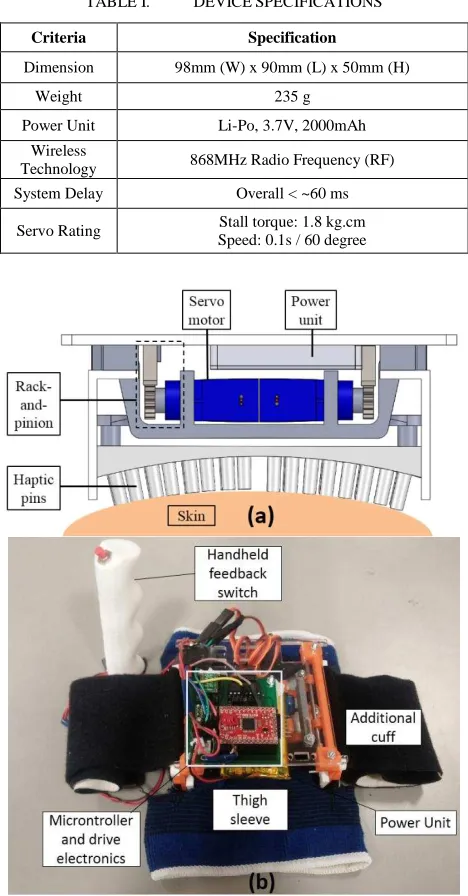
The proposed haptic device is a standalone, wireless device consisting of a haptic plate, power supply, drive actuators, handheld user feedback switch, and on-board electronics. The haptic plate that makes contact with the skin consists of a 3D printed array of 24 stimuli pins arranged in grid formation. An array of stimuli pins was chosen rather than a single stimulus point to maximize the area covered by the stimuli on the skin, adapting to our previous work [12]. To create the lateral movement to the skin, the haptic plate was attached to a frame driven by two miniature servo motors arranged in a rack-and-pinion mechanism as shown in Figure 1(a). The haptic plate is removable and can be replaced with different types of stimuli size, patterns or formations. When subjected to a
Portable Haptic Device for Lower Limb Amputee Gait Feedback:
Assessing Static and Dynamic Perceptibility
M. A. B. Husman, Member, IEEE, H. F. Maqbool, Member, IEEE, M. I. Awad, Member, IEEE, and
A. A. Dehghani-Sanij
This work is linked to a large project supported by EPSRC (EP/K020462/1).
M. A. B. Husman (e-mail: [email protected]) is with University of Leeds, UK.
H. F. Maqbool is with University of Engineering & Technology Lahore, Pakistan and University of Leeds, UK. e-mail:
M. I. Awad is with Ain Shams University, Egypt and University of Leeds, UK. e-mail: [email protected]),
drive signal, both servo motors will rotate to a determined angle which is translated into a linear movement of the haptic plate (Figure 2). The wireless communication and control of the haptic device is handled by a tiny (33mm x 23mm) wireless microcontroller (Moteino R4, LowPowerLab LLC, Michigan, USA). A rechargeable Lithium-Polymer battery was used as a power supply. A handheld switch was interfaced to the device to allow participants to actively record perceived stretch stimuli in real-time while conducting the experiments, especially during walking. The device was fitted with a flexible thigh sleeve and a fabric based cuff to allow secured and firm attachment to the leg. Table I shows the specifications of the haptic system. Figure 1(b) shows the overall assembled components of the device.
TABLE I. DEVICESPECIFICATIONS
Criteria Specification
Dimension 98mm (W) x 90mm (L) x 50mm (H)
Weight 235 g
Power Unit Li-Po, 3.7V, 2000mAh Wireless
Technology 868MHz Radio Frequency (RF) System Delay Overall < ~60 ms
Servo Rating Stall torque: 1.8 kg.cm Speed: 0.1s / 60 degree
Figure 1. (a) Front view (b) top view of the assembled haptic device.
III. EXPERIMENTALWORK A. Device Characterization
Since the haptic pins will move along the skin and cause skin displacement, it was necessary to find the relationship between the servo rotation and the distance of plate movement, and experimentally validate it.
With a pinion pitch diameter, pd = 9.6 mm,
The linear travel dt, per revolution can be calculated as:
dt= (pd)
= 30.2 mm/rev
The relationship between servo rotation angle and linear displacement can then be defined as:
360 / dt = 11.9 or ~12 degree per mm.
[image:3.612.326.549.401.495.2]To validate this movement profile, an optical laser distance sensor (Leuze Electronics, Germany) was positioned opposite to the body of the haptic frame, along the axis of the movement as shown in Figure 2. Initial distance reading was recorded as the baseline position. Subsequently, the haptic plate was programmed to move 1mm (12-degree servo rotation) towards the distance sensor, and then return to the baseline position. The step is repeated with 2mm, 3mm, 4mm travel, with the output from the sensor recorded throughout each movement. The task was repeated 5 times to obtain the average actual travel distance.
Figure 2. Setup for validating displacement created by the device (haptic plate, elctronics and power units are not shown).
B. Haptic Perception
1) Static Perceptibility
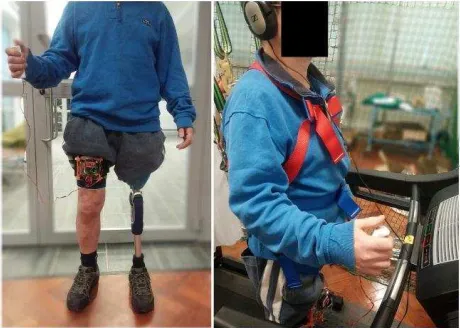
The device was strapped on the anterior mid-thigh on the right leg while the participant is standing. The haptic plate was adjusted such that it was rested firmly on the skin. For the above knee amputee, the device was fitted on the intact leg for this assessment. Participants held the handheld switch with one hand to indicate perceived stimuli. Participants also wore an earphone playing white noise to mask the sound coming from the haptic device, thus eliminating the chance of guessing the stimuli via auditory means. Series of stretch stimuli were delivered to the skin with 1, 2, 3, and 4mm stretch displacement. A single stimulus is completed when the actuator moved from baseline position to the intended displacement value and return. Participants were instructed to push the handheld switch upon perceiving the stretch stimuli. A pause of 2s was given in between each stimulus to allow sufficient time for the participants to respond. The trials were repeated two times for each participant.
2) Dynamic Perceptibility
To assess perceptibility of the device in dynamic mode, the participants performed the walking activity on a treadmill. As a safety measure, participants were required to wear safety harness attached to a rigid frame to prevent tripping or falling. The treadmill was started at an arbitrary low speed to allow the participants to do a 2-minute warming up session. Subsequently, the participants were asked to adjust the treadmill speed in 0.1 km/h increment until it reached the speed which they thought bears the closest resemblance to their normal walking speed over ground. When the participants indicated comfortable walking pattern, similar task as described in static experiment were carried out.
[image:4.612.324.556.161.318.2]The response received from the participants were sent wirelessly to a computer which stored the data into a spreadsheet. The percentage of correctly identified stimuli were used as a measure of perceptibility i.e. the ability to perceive the stimuli. Participant’s responses were also analyzed for any false perceptions (participants indicating stimuli when there was not one).
Figure 3. Haptic device fitted on the amputee participant, in standing mode (left) and on the treadmill (right).
IV. RESULTS A. Movement profile
Figure 4 shows the movement profile of the haptic plate, for travel distance of 1-4mm. The time taken to complete single movement cycle (baseline-target-baseline) was less than 0.5ms. The data obtained from the optical sensor showed an average positioning error of +0.3mm.
Figure 4. Distance travelled by haptic device as measured by the optical sensor.
B. Static and Dynamic Perceptibility
Table II shows the summary of perception accuracy in both static and walking mode. A total of 96 stretch stimuli in the range 1 – 4mm were delivered to each participant in each activity mode. The perception of the stimuli varies according to the level of the stretch applied. The 3mm and 4mm stretch remained highly perceived throughout both standing and walking mode with 100% accuracy. The perceptibility for 2mm stretch was high during standing, however, reduces to just over 90% during walking (87.5% for amputee). The 1mm stretch was perceived with at least 80% accuracy in standing mode but was poorly perceived during walking (< 25%) for both able-bodied and amputee participants. There were a total 6 instances (~0.4%) of false perception recorded in the entire dataset, where participants indicated feeling stimuli when it was not actually given. However, this can be observed only during walking mode as shown in table III. The average self-selected walking speed was 3.2 km/h for all the participants.
TABLE II. SUMMARYOFPERCEPTIONACCURACY(%). DARKERSHADESINDICATESGREATERACCURACY.
Stretch level
Able-bodied Amputee
Standing Walking Standing Walking
1mm 91.7 20.8 83.3 8.3
2mm 100 91.7 91.7 87.5
3mm 100 100 100 100
4mm 100 100 100 100
TABLE III. INSTANCESOFFALSEPERCEPTIONS 0
1 2 3 4 5
0 0.1 0.2 0.3 0.4 0.5
D
is
ta
n
ce
(
m
m
)
Time (s)
Distance travelled over time
Distance (1mm) Distance (2mm)
[image:4.612.57.287.533.697.2]Stretch level
Able-bodied Amputee
Standing Walking Standing Walking
1mm 0 1 0 0
2mm 0 1 0 1
3mm 0 0 0 1
4mm 0 1 0 1
V. DISCUSSION
Skin stretch on non-glabrous skin has been studied previously as a feasible feedback method for conveying motion information and directional cues [11], 13]. In addition, skin displaced in lateral direction has been suggested as a preferable choice for developing tactile displays on hairy skin (which dominates the lower limb) [14]. This study showed that apart from directional and motion cues, skin stretch stimuli has the potential of delivering a one-off or event based cue as well.
Chen et al. [11] studied the skin sensitivity to stretch stimuli in lower extremity, although focusing on several locations below the knee only. It was anticipated that targeting the upper part of the leg will have more advantages in the amputee application, as most amputees (especially above knee) will have lost a significant portion of the limb due to amputation. While the remaining stump for above knee amputee will most likely be covered with the prosthesis socket, a miniaturized version of the wearable device will allow possible integration into or around the prosthetic socket, allowing placement of the haptic device on the amputated leg itself.
The reason for walking on the treadmill rather than walking overground while carrying out this study was to allow smooth and uninterrupted motion over several minutes of walking time, which is not possible in our indoor laboratory space. Previous study has shown that walking on the treadmill is comparable to walking overground [15], making it preferable choice for our application.
It can be observed that while 1mm stretch stimuli can be perceived relatively accurately (over 80% of the time) by the participants during static standing, the same stimuli went virtually unnoticed during walking exercise. This could be explained by the fact that walking requires higher motor skills demand and more intense muscle activity (continuous extension and contraction of the muscle), which can mask low intensity external stimuli. Authors in [16] noted in an experiment with low frequency vibrotactile feedback given at the quadriceps tendons, the stimuli were effectively ignored, attributed to down weighting by the sensory motor system. In addition, certain gait events such as heel strike induces higher reaction force from the ground, which might as well mask lower magnitude stimuli coming from the device. Although the above knee amputee had lower accuracy in identifying lower level stretch magnitude, the accuracy of the perceiving 3mm and 4mm stretch remained superior throughout the experiments for both groups. This confirms to the pattern shown in [11] where stretch perceptibility was found to be proportional to the stretch magnitude. The instances of false perception
occurred randomly, albeit rarely, throughout the walking experiments. This might be attributed to the participants mistaking the general vibration caused by walking as a form of stimuli or due to losing concentration.
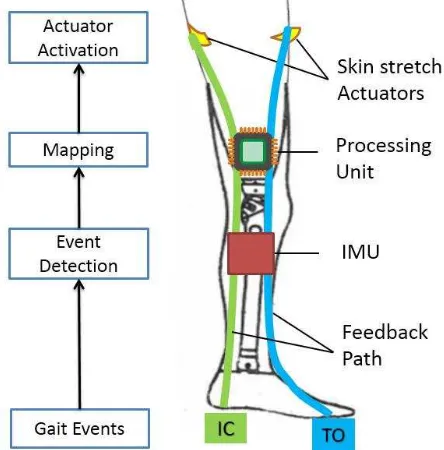
[image:5.612.327.549.264.489.2]This proposed haptic feedback system is intended to be used in lower limb prostheses feedback scheme, coupled with an Inertial Measurement Unit (IMU) placed at prosthetic shank/pylon developed in our previous study [17] which was capable of identifying gait events in real-time with high accuracy in both level ground and inclined walking surface. Figure 5 shows the intended overall feedback scheme. Upon detection of Initial Contact (IC) and Toe-off (TO) by the IMU sensor, stretch stimuli can be mapped onto different locations of the actuators on the skin to notify the amputee about the respective gait events. For example, an IC event will activate a stretch stimuli on the anterior part of the limb while a TO event will activate a stimuli on the posterior region of the limb.
Figure 5. Overall haptic feedback scheme. IC: Initial contact; TO; Toe-off
VI. CONCLUSION
A wearable stretch haptic device capable of delivering perceptible stimuli during static and dynamic activities was presented in this paper. A stretch magnitude of at least 3mm was found to be adequate for high perception during waking. Combined with gait event detection system, the device could potentially provide information to the prosthesis user about the position of the prosthetic limb on the ground, especially on critical gait events such as heel strike and toe off. Manipulating the stimuli parameters, varying walking speed and terrain will be the future focus of this study, as well as investigating the real-time effect of
such intervention on amputees’ gait awareness.
REFERENCES
[1] HQIP, “Lower limb amputation report,” HQIP - Healthcare Quality Improvement Partnership, Nov. 14 2014. [Online]. Available: http://www.hqip.org.uk/resources/lower-limb-amputation-report [Jan. 13 2017].
[2] W. C. Miller, M. Speechley, and A. B. Deathe, "Balance Confidence Among People With Lower-Limb Amputations," Physical Therapy, vol. 82, pp. 856-865, 2002.
[3] W. C. Miller, M. Speechley, and B. Deathe, "The prevalence and risk factors of falling and fear of falling among lower extremity amputees," Archives of Physical Medicine and Rehabilitation, vol. 82, pp. 1031-1037, 8// 2001.
[4] D. Rusaw, K. Hagberg, L. Nolan, and N. Ramstrand, "Bilateral electromyogram response latency following platform perturbation in unilateral transtibial prosthesis users: Influence of weight distribution and limb position," J. Rehabil. Res. Dev, vol. 50, pp. 531-544, 2013.
[5] K. Kim and J. Colgate, "Haptic feedback enhances grip force control of sEMG-controlled prosthetic hands in targeted reinnervation amputees," Neural Systems and Rehabilitation Engineering, IEEE Transactions on, vol. 20, pp. 798-805, 2012.
[6] J. M. Walker, A. A. Blank, P. A. Shewokis, and M. K. O'Malley, "Tactile feedback of object slip improves performance in a grasp and hold task," in Haptics Symposium (HAPTICS), 2014 IEEE, 2014, pp. 461-466.
[7] Fan, Richard E., Christopher Wottawa, Amit Mulgaonkar, Richard J. Boryk, Todd C. Sander, Marilynn P. Wyatt, Erik Dutson, Warren S. Grundfest, and Martin O. Culjat. "Pilot testing of a haptic feedback rehabilitation system on a lower-limb amputee." In Complex Medical Engineering.
[8] P. Marayong, I.-H. Khoo, K. Nguyen, N. Bharti, B. Ruhe, D. Craig, et al., "Vibrotactile device for rehabilitative training of persons with lower-limb amputation," in Healthcare Innovation Conference (HIC), 2014 IEEE, 2014, pp. 157-160.
[9] Plauché, A., Villarreal, D., & Gregg, R. D. (2016). A Haptic Feedback System for Phase-Based Sensory Restoration in Above-Knee Prosthetic Leg Users.IEEE Transactions on Haptics,9(3), 421-426.
[10] K. Bark, J. W. Wheeler, S. Premakumar, and M. R. Cutkosky, “Comparison of Skin Stretch and Vibrotactile Stimulation for Feedback of Proprioceptive Information,” in 2008 Symposium on Haptic Interfaces for Virtual Environment and Teleoperator Systems, 2008, pp. 71–78.
[11] Chen, Daniel KY, Iain A. Anderson, Cameron G. Walker, and Thor F. Besier. "Lower extremity lateral skin stretch perception for haptic feedback." IEEE transactions on haptics 9, no. 1 (2016): 62-68. [12] Husman, M. A. B., H. F. Maqbool, M. I. Awad, A. Abouhossein,
and A. A. Dehghani-Sanij. "A wearable skin stretch haptic feedback device: Towards improving balance control in lower limb amputees." In Engineering in Medicine and Biology Society (EMBC), 2016 IEEE 38th Annual International Conference of the, pp. 2120-2123. IEEE, 2016.
[13] Bark, Karlin, Jason Wheeler, Pete Shull, Joan Savall, and Mark Cutkosky. "Rotational skin stretch feedback: A wearable haptic display for motion." IEEE Transactions on Haptics 3, no. 3 (2010): 166-176.
[14] J. Biggs and M. A. Srinivasan, "Tangential versus normal displacements of skin: Relative effectiveness for producing tactile sensations," in Haptic Interfaces for Virtual Environment and Teleoperator Systems, 2002. HAPTICS 2002. Proceedings. 10th Symposium on, 2002, pp. 121-128.
[15] Riley, Patrick O., Gabriele Paolini, Ugo Della Croce, Kate W. Paylo, and D. Casey Kerrigan. "A kinematic and kinetic comparison of overground and treadmill walking in healthy subjects." Gait & posture 26, no. 1 (2007): 17-24.
[16] Chelette, Amber M., and Charles S. Layne. "Effects of low frequency continuous muscle vibration on learning and transfer of a knee joint positioning task." In Haptics Symposium (HAPTICS), 2014 IEEE, pp. 427-430. IEEE, 2014.
[17] Maqbool, H.F., Husman, M.A.B., Awad, M.I., Abouhossein, A., Iqbal, N. and Dehghani-Sanij, A.A., 2016. A real-time gait event detection for lower limb prosthesis control and evaluation. IEEE transactions on neural systems and rehabilitation engineering. [18] Jiang, Iris, and Blake Hannaford. "Comparison of reaction times