This is a repository copy of
Local termination criteria for Stochastic Diffusion Search : a
comparison with the behaviour of ant nest-site selection
.
White Rose Research Online URL for this paper:
http://eprints.whiterose.ac.uk/103126/
Version: Accepted Version
Proceedings Paper:
Bishop, J. M., Martin, Andrew O. and Robinson, Elva Joan Hilda
orcid.org/0000-0003-4914-9327 (2016) Local termination criteria for Stochastic Diffusion
Search : a comparison with the behaviour of ant nest-site selection. In: Nguyen,
Ngoc-Thanh, Manolopoulos, Yannis, Iliadis, Lazaros and Trawiński, Bogdan, (eds.) Lecture
Notes in Artificial Intelligence:Proceedings of the 8th International Conference on
Computational Collective Intelligence (ICCCI 2016), Halkidiki, Greece. Lecture Notes in
Artificial Intelligence . Springer-Verlag .
https://doi.org/10.1007/978-3-319-45243-2
[email protected] https://eprints.whiterose.ac.uk/
Reuse
Items deposited in White Rose Research Online are protected by copyright, with all rights reserved unless indicated otherwise. They may be downloaded and/or printed for private study, or other acts as permitted by national copyright laws. The publisher or other rights holders may allow further reproduction and re-use of the full text version. This is indicated by the licence information on the White Rose Research Online record for the item.
Takedown
If you consider content in White Rose Research Online to be in breach of UK law, please notify us by
Diffusion Search: a comparison with the
behaviour of ant nest-site selection
J. Mark Bishop1
, Andrew O. Martin1
, and Elva J. H. Robinson2
1
TCIDA, Goldsmiths, University of London New Cross, London, UK.
{mark.bishop,andrew.martin}@tungsten-network.com http://www.tungsten-network.com/tcida/ 2
York Centre for Complex Systems Analysis and Department of Biology University of York, York, UK.
https://www.york.ac.uk/biology/research/ecology-evolution/elva-robinson/
Abstract. Population based decision mechanisms employed by many Swarm Intelligence methods can suffer poor convergence resulting in ill-defined halting criteria and loss of the best solution. Conversely, as a result of its resource allocation mechanism, the solutions found by Stochastic Diffusion Search enjoy excellent stability. Previous implemen-tations of SDS have deployed complex stopping criteria derived from global properties of the agent population; this paper examines two new
localSDS halting criteria and compares their performance with ‘quorum sensing’ - a natural termination criterion deployed in nature by some species of tandem-running ants. We empirically demonstrate that local termination criteria are almost as robust as the classical SDS termina-tion criteria, whilst the average time taken to reach a decision is around three times faster.
Keywords: Collective Decision Making; Ant Nest Selection; Stochastic Diffusion Search; Swarm Intelligence; Global Search.
1
Introduction
Independently of these algorithms, Stochastic Diffusion Search (SDS), was first described in 1989 as a population-based, pattern-matching algorithm [7]. Unlike stigmergic communication employed in Ant Algorithms, which is based on modification of the physical properties of a simulated environment, SDS uses a form of direct communication between the agents similar to the tandem running mechanism employed by some species of ants (e.g.Temnothorax species, [14]).
SDS is an efficient probabilistic multi-agent global search, optimisation and decision making technique [23] that has been applied to diverse problems such as site selection for wireless networks [41], mobile robot self-localisation [6], object recognition [8] and text search [7]. Additionally, a hybrid SDS and n-tuple RAM [1] technique has been used to track facial features in video sequences [8] [19]. Previous analysis of SDS has investigated its global convergence [26], linear time complexity [27] and resource allocation [25] under a variety of search conditions. For a recent review of the theoretical foundations, and applications of SDS see Al-Rifaie and Bishop [2].
In arriving at a ‘decision’ - halting - standard implementations of SDS ex-amine thestability of the agent population as a whole; in this manner halting is defined as a global property of the agent population. However such global mechanisms are both less biologically/naturally plausible and more complex to implement on parallel computational systems, than local decision making mech-anisms. This paper examines the local quorum sensing behaviour observed in some natural (ant) systems and uses this as the inspiration for two new local termination mechanisms - one mechanism, ‘independent termination’, seeks to implement an asynchronous protocol in SDS that in many ways is quite close to the quorum sensing method used by real ants; a second method - confirmation termination - aims to implement a synchronous local termination protocol with more similarity to the conventional SDS architecture.
2
Stochastic Diffusion Search
SDS is based on distributed computation, in which the operations of simple computational units, or agents, are inherently probabilistic. Agents collectively construct the solution by performing independent searches followed by diffu-sion/communication of information through the population [28]. Positive feed-back promotes better solutions by allocating to them more agents for their ex-ploration. Limited resources induce strong competition from which the largest population of agents corresponding to the best-fit solution rapidly emerges.
by the presence of agent clusters with the same hypothesis can be interpreted as good candidate solutions. A global solution is thus constructed from the in-teraction of many simple, locally operating agents forming thelargest cluster of agents with the same hypothesis. Such acluster is dynamic in nature, yet stable, analogous to, “a forest whose contours do not change but whose individual trees do”, [4] [9] [29].
Algorithm 1Classical - inactive recruitment - SDS
1: procedure step(swarm,search space)
2: foreachagentinswarmdo ⊲Diffuse Phase
3: if notagent.activethen
4: polled agent=swarm.random agent() 5: if polled agent.activethen
6: agent.hypothesis=polled agent.hypothesis
7: else
8: agent.hypothesis=search space.random hypothesis()
9: foreachagentinswarmdo ⊲Test Phase
10: test result=perf orm random test(hypothesis) 11: agent.active=test result
Central to the power of SDS (seeAlgorithm 1) is its ability to escape local minima. This is achieved by the probabilistic outcome of the partial hypothesis evaluation in combination with reallocation of resources (agents) via stochastic recruitment mechanisms. Partial hypothesis evaluation allows an agent to quickly form its opinion on the quality of the investigated solution without exhaustive testing [23].
The termination of SDS has historically been defined as a function of the stability of the population size of a group of active agents. Such methods are termedglobalhalting criteria as they are a function of the number of active agents within the total population of agents. Two well documented global methods for determining when SDS should halt are the Weak Halting Criterion andStrong Halting Criterion [26] [25]; the former is simply a function of the total number of active agents and the latter thetotal number of active agents maintaining the same hypothesis.
3
Collective decision-making in house hunting ants
The ant emigration process can be summarised thus: If the home nest cavity is damaged or degraded, scouts search for new nest sites. Scouts assess available nests across a number of metrics using a weighted additive strategy [16]. If a nest is judged as unsuitable, a scout continues searching; if a nest is assessed as suitable by a scouting ant (Scout A), this scout will return towards the home nest and recruit a second scout (Scout B) [37]. Scout A will lead Scout B to the new nest by tandem-running. Scout B will then make an independent assessment of the nest, and will either reject it and keep searching, or accept the nest and spend some time in it, before returning home and recruiting a further scout. By this positive feedback process, a good quality nest will accumulate ants [34], [36]. Different ants appear to have differing thresholds for starting recruitment to a nest; this means that even low quality nests can attract some ants, but scouts will accumulate more quickly and to a higher level at higher quality nests [39] [35]. This assessment and recruitment process is terminated when scouts sense that a nest site has reached quorum. Scouts then move into a ‘post-quorum’ behavioural state [32]: they stop leading other scouts by tandem-running, and are no longer willing to be recruited by tandem-running themselves. Instead, they transport brood, queen, other workers to the chosen site. Transported workers do not learn the route between the home nest and the new nest, so are unable to return home, and thus cannot challenge the decision that has been implemented [32]. Transported ants therefore contribute strongly to the quorum by staying in the new nest, so once a few scouts have entered a ‘post-quorum’ state and started transporting, others quickly follow suit.
4
Quorum sensing in house-hunting ants
Quorum sensing is a separate process from quality assessment and recruit-ment. This means that the quorum sensing process in effect detects an average quality assessment across many scouts, and has the potential to smooth out dif-ferences in individual nest acceptance thresholds [17]. Once quorum is reached, scouts do not re-assess quorum on subsequent visits - they will continue to bring brood even if the nest is artificially emptied of ants [31]. The quorum threshold itself is not modulated depending on the quality of the new nest [30]. If nest quality is artificially manipulated during the assessment phase of an emigration, the ants are able to respond flexibly to the new nest qualities; if quality is manip-ulated after quorum is reach and implementation has begun, then colonies often become ‘trapped’ in an inferior nest [15], [?]. This indicates that quality is not re-assessed after quorum has been reached in these cavity-dwellingTemnothorax species. In contrast, a different ant species,Diacamma indicum recruits only by tandem-running with no clear quorum point and no adult transport [3]. Colonies of Diacamma indicum are able to respond flexibly to manipulated qualities at any stage of the emigration - but overall colony cohesion is lower, supporting the idea that using a quorum threshold increases cohesion, but at a cost to flexibility. Although quorum sensing behaviour is not modulated by the quality of the options available, it is influenced by the experience and context. Naive scouts use different quorum thresholds to those used by more experienced scouts, but the direction of this difference differs between species, indicating a learning compo-nent to quorum sensing behaviour [30]. Emigrations often occur in an emergency context, but cavity-nesting ants do also sometimes emigrate even when their home nest is undamaged, if a better nest is available in the neighbouring area. This is not due to direct comparison of the quality of the two nests, but due to quality-dependent nest acceptance [36], [39]. In these non-emergency migrations, scouts appear to use a quorum threshold around twice as high as in emergency migrations [12], suggesting that colonies prioritise speed over accuracy when conditions are harsher.
5
SDS Local Halting criteria
Drawing inspiration from the behaviour ofTemnothorax ants in their nest selec-tion behaviour, the halting behaviour of SDS was modified such that it would emerge from purely local interactions of SDS agents. By analogy with the be-haviour of tandem running Temnothorax ants (as outlined in Section (3) and Section (4) herein), in the following we propose two new variants of the process for determining when an agent should switch from the classical SDS explore-exploit behaviour to a new, so called, ‘terminating’ behaviour which we term theindependent andconfirmation halting criteria.
swarm3
and give them their own (now fixed) termination hypothesis (analogous to the ‘post-quorum’ behavioural state in ants of the genusTemnothorax, wherein post-quorum ants literally carry other ants they encounter to the new nest site). As this decision making process successively removes agents from the popula-tion we name this form of SDSReducing SDS; in this vein a collective ‘decision’ is made (and the local halting condition met) when all agents are either active and/or have been removed from the population.
5.1 ‘Independent’ termination behaviour
Inindependent reducing SDS we relax the assumption that all SDS agents update synchronously in iterative ‘cycles’ (wherein one such cycle corresponds to all agents being updated).
Algorithm 2Independent SDS
1: procedure step(swarm,search space) 2: swarm=shuf f le(swarm)
3: foreachagentinswarmdo
4: polled agent=swarm.random agent() ⊲Diffusion behaviour
5: if Both agents are inactivethen 6: Both agents randomise hypothesis
7: else if One agent is inactive and other is active but not terminatingthen 8: Inactive agent assumes active agent’s hypothesis
9: else if One agent is terminatingthen 10: Other agent is removed from the swarm 11: else if Agents share a hypothesisthen 12: Both agents become terminating
13: if notagent.terminating then ⊲Testing behaviour
14: test result=perf orm random test(hypothesis) 15: agent.active=test result
In independent SDS agents update independently and probabilistically4 -which is more analogous to the behaviour of a collection of real ants - and recruitment becomes bidirectional. Considering two such interacting agents:
– if neither agent is active both reselect new random hypotheses;
3
Standard SDS has previously been shown to be a global search algorithm [26] -it will eventually converge to the global best solution in a given search space; by removing agents form the swarm, relative to standard SDS the number of potential agents remaining available for explore-exploit behaviour is reduced; precisely how this reduction impacts the robustness of the algorithm [with respect to erroneous convergence to sub-optimal solutions] has yet to be fully established.
4
– one agent is inactive and other is active but not terminating then the inactive agent assumes active agent’s hypothesis; inTemnothorax nest selection this is analogous to a ‘scout’ ant being recruited to a new nest hypothesis by tandem running.
– one of the agents is in terminating mode then the other is assigned the solution hypothesis and ‘removed’ from the population (playing no further part in the search); in Temnothorax nest selection this is analogous to an ant in post-quorum (terminating) mode carrying an ant to the new nest site. – if the two agents meet that both have the same hypothesis then both switch to terminating mode; in Temnothorax nest selection this recruitment be-haviour would serve to reinforce an ant’s initial nest-judgement5
.
The above process is algorithmically outlined inAlgorithm 2.
5.2 ‘Confirmation’ termination behaviour
Since its inception in 1989 [7] a substantial body of algorithmic analysis (describ-ing the theoretical behaviour of SDS), empirical studies and practical applica-tions have been published (for a recent review see [2]). To more readily facilitate the future use of these results in both local termination variants and poten-tially to extend the reach of this analysis to some aspects of real ant behaviour, we suggest a further simplification of Independent SDS to a second reducing behaviour that more closely aligns with standard SDS diffusion; we term this modeconfirmation reducing termination.
In ‘confirmation reduction’ SDS agents are once again assumed to update synchronously and the diffusion of information is changed to more closely re-semble that of classical dual mode (passive and active) recruitment SDS [24]. In confirmation SDS an active agent polls random agents in the diffusion phase. Active agents become terminating if their polled agent is also active and both agents share a hypothesis. The agent is then locked into being active, maintain-ing that hypothesis. If an inactive agent polls a terminatmaintain-ing agent, the inactive agent is removed from the population (seeAlgorithm 3for details).
6
Experiments
A series of experiments was performed to investigate the diffusion behaviour of the two new halting criteria over a variety of search parameters to establish (a) if the algorithms’ gross behaviour remains characteristic of SDS and (b) to
5
Algorithm 3Confirmation SDS
1: procedure step(swarm,search space)
2: foreachagentinswarmdo ⊲Diffuse Phase
3: polled agent=swarm.random agent() 4: if agent.activethen
5: hyp1 =agent.hypothesis 6: hyp2 =polled agent.hypothesis
7: if polled agent.activeandhyp1 ==hyp2then 8: agent.terminating== True
9: else
10: if polled agent.activethen
11: if polled agent.terminatingthen 12: swarm.remove(agent)
13: else
14: agent.hypothesis=polled agent.hypothesis 15: else
16: agent.hypothesis=search space.random hypothesis()
17: foreach agentinswarmdo ⊲Test Phase
18: test result=perf orm random test(hypothesis) 19: agent.active=test result
evaluate their robustness over a variety of search parameters (which effectively characterise the quality of the putative best solution, α(0≤α <1), relative to β, (0 ≤β < 1), the quality of the distractor solution6
); in the ‘ant migration’ problem, α is analogous to a measure of the quality of the potential new nest site andβ effectively a measure of the quality of the original nest.
In all experiments the population is initialised with one agent maintaining the hypothesis representing the potential best solution and the probability of an agent randomly selecting the hypothesis of the potential best solution is set to zero; this ensures that only thediffusionbehaviour of the algorithm is explored7
. In the first experiment each of the three termination functions (strong, in-dependent and confirmation) was modelled in a population of 10000 agents, one of which was active and at the solution hypothesis at time zero, with all other agents set inactive pointing to the ‘noise’ hypothesis. The algorithm was then evaluated 25 times from these conditions against a range of possible values ofα andβ(from 0 to 0.875 with a step of 0.125). The number of times the algorithm successfully halted within 250 iterations was recorded as was the mean average number of iterations before halting in these cases.
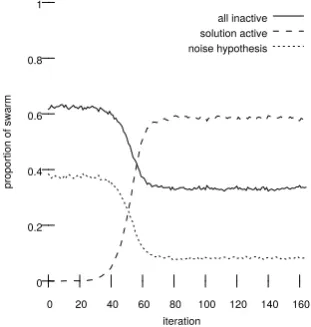
In the case of strong halting SDS, halting was considered successful if the halting criterion was satisfied; figure 1 shows the characteristic S-shape
con-6
β defines a “uniform random noise” hypothesis; an aggregate of all the possible hypotheses an agent could have other than the putative solution hypothesis.
7
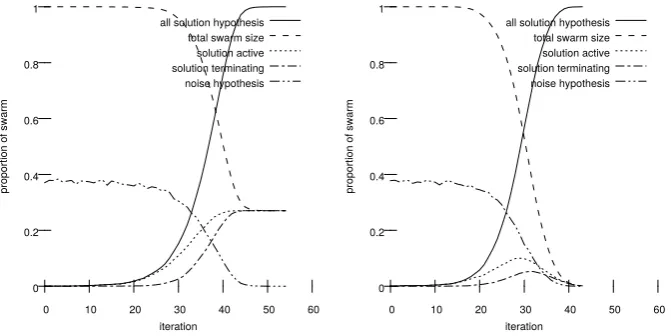
vergence curve obtained deploying SDS using the Strong Halting criterion. All algorithms would also halt if all agents were active at the solution hypothesis, as this is analogous to a successful migration of agents to an optimal state; in addition the process was also halted if the algorithm had run for more than a specified number of iterations or if all the agents held the noise hypothesis. Any experiment that halted for the latter two reasons was consideredunsuccessful. In a second experiment the three algorithms were run against fixed values of α and β which the first experiment had shown would be likely to successfully halt. The state of all agents was recorded at every iteration and number of agents (as a proportion of the total population) in various states was graphed over time to visualise the characteristic behaviour of the halting criteria (see figure 2).
Table 1 lists i the average number of iterations before halting and c the number of times that the algorithm successfully halted for a SDS experiment for all three algorithms using a population of 10,000 agents across a variety of parameter values of the noise hypothesis (β) and solution hypothesis (α).
NB. Pairs of values for α and β for which all three algorithms failed to converge 25 times out of 25 are not listed. Examining the results presented in Table 1, the following comparative observations can be made:
strong halting versus independent reduction on average the convergence time is 3.3 times faster for independent whilst its robustness is similar (strong halting is more robust in 11 cases, less robust in 6);
strong halting versus confirmation reduction on average the convergence time is around 2.8 times faster for confirmation whilst its robustness is similar (strong halting is more robust in 8 cases, less robust in 6);
7
Conclusion
This paper has looked at cooperative decision making in the Stochastic Diffusion Search algorithm and house-hunting ants. Typically, decision making in standard SDS is based on the use of a global halting function which entailsglobal access to the activity of the SDS agent population as a whole. Conversely in this paper, inspired by the quorum sensing mechanism deployed by some species of ants in nest selection, we have successfully demonstrated two newlocal termination criteria for SDS which, in terms of their robustness to noise, have been demon-strated to have broadly similar behaviour to the standard SDS meta-heuristic. Furthermore, it is observed that the use of a local halting mechanism results in an approximately three-fold speed-up in the collective decision making time.
Table 1.Mean average iterations before termination for three different halting criteria (strong, independent and confirmation) over varying quality of solutions
strong independent confirmation
β α i c i c i c
0.000 0.625 151.2 17 42.0 6 46.2 14 0.000 0.750 126.8 20 25.8 16 27.8 18 0.000 0.875 118.2 21 20.0 22 21.1 21 0.125 0.625 195.0 7 52.2 12 58.4 7 0.125 0.750 130.4 11 29.6 15 34.1 16 0.125 0.875 122.0 23 22.9 21 25.8 20 0.250 0.625 216.0 1 77.1 7 88.6 5 0.250 0.750 138.7 17 35.5 16 42.2 15 0.250 0.875 125.5 22 26.0 21 31.4 22 0.375 0.625 100.0 1 232.0 1 244.0 1 0.375 0.750 165.6 14 48.5 12 56.7 16 0.375 0.875 131.5 21 30.0 19 38.5 20 0.500 0.750 212.0 5 74.2 12 87.9 7 0.500 0.875 140.5 18 38.5 13 51.5 16 0.625 0.750 100.0 4 150.0 3 238.0 1 0.625 0.875 161.9 18 50.6 14 73.5 20 0.750 0.875 211.0 7 92.4 14 142.5 13
0.875 0.875 100.0 1 − 0 − 0
0 0.2 0.4 0.6 0.8 1
0 20 40 60 80 100 120 140 160
proportion
of swa
rm
[image:11.595.226.382.430.594.2]iteration all inactive solution active noise hypothesis
0 0.2 0.4 0.6 0.8 1
0 10 20 30 40 50 60
proportion
of swa
rm
iteration all solution hypothesis
total swarm size solution active solution terminating noise hypothesis
0 0.2 0.4 0.6 0.8 1
0 10 20 30 40 50 60
proportion
of swa
rm
iteration
[image:12.595.140.476.120.288.2]all solution hypothesis total swarm size solution active solution terminating noise hypothesis
Fig. 2. Cluster size evolution over time for SDS using confirmation SDS (left) and
independent SDS (right). The x-axis counts iterations, the y-axis shows cluster size as a proportion of the entire population. Both show an accelerating growth in the number of agents at the solution hypothesis followed by a similar growth of terminating agents at the solution hypothesis until the entire swarm is either active (in the case of confirmation SDS) or removed from the swarm (in the case of independent SDS).
scouting ants can judge quorum to have been reached (through encounter rate) without having followed a tandem run, so clearlyTemnothorax ants do not solely rely onindependent-SDS like termination rules. In this context, future research will investigate the degree to which appropriately modified SDS characterisations can be used to describe the behaviour ofTemnothorax ants.
References
1. Aleksander, I. & Stonham, T.J.: Guide to pattern recognition using random access memories. Computers & Digital Techniques 2(1), pp. 29-40 (1979)
2. al-Rifaie, M.M. & Bishop, J.M.: Stochastic Diffusion Search Review, Journal of Behavioral Robotics 4(3), pp. 155-173 (2013)
3. Anoop, K. & Sumana, A.: Response to a change in the target nest during ant relocation.The Journal of Experimental Biology 218(6), pp. 887-92 (2015)
4. Arthur, W.B.: Inductive reasoning and bounded rationality, (The El Farol Problem). Amer. Econ. Rev. 84, pp. 406-411 (1994)
5. Back, T.: Evolutionary Algorithms in Theory and Practice. Oxford University Press, Oxford (1996)
6. Beattie, P.D. & Bishop, J.M.: Self-localisation in the ‘SENARIO’ Autonomous Wheelchair. Journal of Intelligent and Robotic Systems 22, pp. 255-267 (1998) 7. Bishop, J.M.: Stochastic Searching Networks. In: Proc 1st IEE Int. Conf.
8. Bishop, J.M. & Torr, P.H.S.: The Stochastic Search Network. In: Linggard R., My-ers, D.J. & Nightingale, C. (eds) Neural Networks for Images, Speech and Natural Language. Chapman Hall, New York (1992)
9. Bishop, J.M., Nasuto, S.J. & De Meyer, K.: Dynamic Knowledge Representation in Connectionist Systems. In: Dorronsoro, J.R. (ed) Artificial Neural Networks ICANN, Madrid, 2002. Lecture Notes in Computer Science, vol 2415, pp. 308-313. Springer, Heidelberg New York (2002)
10. Bonabeau, E., Dorigo, M. & Theraulaz, G.: Swarm Intelligence: from Natural to Artificial Systems. Oxford University Press, Oxford (1999)
11. Cao, T.T.: High social density increases foraging and scouting rates and induces polydomy in Temnothorax ants. Behavioral Ecology and Sociobiology 67(11), pp. 1799-1807 (2013)
12. Dornhaus, A., Franks, N.R., Hawkins, R.M. & Shere, H.N.S.: Ants move to im-prove: colonies of Leptothorax albipennis emigrate whenever they find a superior nest site. Animal Behaviour 67(5), pp. 959-963 (2004)
13. Dornhaus, A., Holley, J.A., Pook, V. G., Worswick, G. & Franks, N.R.: Why do not all workers work? Colony size and workload during emigrations in the ant Tem-nothorax albipennis. Behavioral Ecology and Sociobiology 63(1), pp. 43-51 (2008) 14. Franklin, E. L.: The journey of tandem running: the twists, turns and what we
have learned. Insectes Sociaux 61, pp. 1-8 (2014)
15. Franks, N.R., Hooper, J.W., Gumn, M., Bridger, T.H., Marshall, J.A.R., Gro, R. & Dornhaus, A.: Moving targets: collective decisions and flexible choices in house-hunting ants. Swarm Intelligence 1(2), pp. 81-94 (2007).
16. Franks, N.R., Mallon, E.B., Bray, H.E., Hamilton, M.J. & Mischler, T.C.: Strategies for choosing between alternatives with different attributes: exemplified by house-hunting ants. Animal Behaviour 65, pp. 215-223 (2003)
17. Franks, N.R., Stuttard, J.P., Doran, C., Esposito, J.C., Master, M.C., Sendova-Franks, A.B., Masuda, N. & Britton, N.F.: How ants use quorum sensing to estimate the average quality of a fluctuating resource. Scientific Reports 5: 11890 (2015) 18. Goldberg, D.: Genetic Algorithms in search, optimization and machine learning.
Addison Wesley, Reading MA (1989)
19. Grech-Cini, E.: Locating facial features. PhD Dissertation, University of Reading, Reading UK (1995)
20. Holland, J.H.: Adaptation in natural and artificial systems. The University of Michigan Press, Ann Arbor (1975)
21. Kennedy J, Eberhart R.C. & Shi, Y.: Swarm Intelligence. Morgan Kauffman, San Francisco (2001)
22. Kramer, B.H., Scharf, I. & Foitzik, S.: The role of per-capita productivity in the evolution of small colony sizes in ants. Behavioral Ecology and Sociobiology 68(1), pp. 41-53 (2013)
23. De Meyer, K., Nasuto, S.J. & Bishop, J.M.: Stochastic Diffusion Optimisation: the application of partial function evaluation and stochastic recruitment. In: Abraham A, Grosam C, Ramos V (eds) Stigmergic Optimization, Studies in Computational Intelligence 31, pp. 185-207, Springer, Berlin Heidelberg New York (2006)
24. Myatt, D, M., Nasuto, S.J., Bishop J.M.: Alternative recruitment strategies for SDS. In Proc. AISB06: Symposium on Exploration vs. Exploitation in Naturally Inspired Search, pp. 181-187, Bristol UK (2006)
25. Nasuto, S.J.: Analysis of Resource Allocation of Stochastic Diffusion Search. PhD Dissertation, University of Reading, Reading UK (1999)
27. Nasuto, S.J., Bishop, J.M. & Lauria, S.: Time Complexity of Stochastic Diffusion Search. In: Heiss, M. (ed) Proc. Int. ICSC / IFAC Symposium on Neural Compu-tation. Vienna (1998)
28. Nasuto, S.J., Dautenhahn, K. & Bishop, J.M.: Communication as an Emer-gent Methaphor for Neuronal Operation. In: Nehaniv, C. (ed) Computation for Metaphors, Analogy, and Agents, Lecture Notes in Artificial Intelligence1562, pp. 365-379, Springer, Berlin Heidelberg New York (1999)
29. Nasuto, S.J., Bishop, J.M. &. De Meyer, K.: Communicating neurons: a connection-ist spiking neuron implementation of stochastic diffusion search, Neurocomputing 72(4-6), pp. 704-712, Elsevier, Orlando (2008)
30. Pratt, S.C.: Behavioral mechanisms of collective nest-site choice by the ant Tem-nothorax curvispinosus. Insectes Sociaux 52, pp. 383-392 (2005)
31. Pratt, S.C.: Quorum sensing by encounter rates in the ant Temnothorax albipennis. Behavioral Ecology 16, pp. 488-496 (2005)
32. Pratt, S.C., Mallon, E.B. , Sumpter, D.J.T. & Franks, N.R.: Quorum sensing, recruitment, and collective decision-making during colony emigration by the ant Leptothorax albipennis. Behavioral Ecology and Sociobiology 52(2), pp. 117-127 (2002)
33. Pratt, S.C. & Pierce,N.E.: The cavity-dwelling ant Leptothorax curvispinosus uses nest geometry to discriminate among potential homes. Animal Behaviour 62: 281-287 (2001)
34. Pratt, S.C., Sumpter, D.J.T., Mallon, E.B. & Franks, N.R.: An agent-based model of collective nest site choice by the ant Temnothorax albipennis. Animal Behaviour 70, pp. 1023-1036 (2005)
35. Robinson, E.J.H., Feinerman, O. & Franks, N.R.: How collective comparisons emerge without individual comparisons of the options. Proc. Royal Soc. B 2014 281 20140737; DOI: 10.1098/rspb.2014.0737. (2014)
36. Robinson, E.J.H., Franks, N.R., Ellis, S., Okuda, S. & Marshall, J.A.R.: A simple threshold rule is sufficient to explain sophisticated collective decision-making. PLoS One 6: e19981. (2011)
37. Robinson, E.J.H., Smith, F.D. Sullivan, K.M.E & Franks, N.R.: Do ants make direct comparisons? Proc. Royal Soc. B 276: 2635-2641. (2009)
38. Seeley, T.D., Visscher, P.K. Schlegel, T. Hogan, P.M. Franks, N.R. & Marshall J.A.R.: Stop signals provide cross inhibition in collective decision-making by honey bee swarms. Science 335, pp. 108-111 (2012)
39. Stroeymeyt, N., Robinson, E.J.H., Hogan, P.M., Marshall, J.A.R., Giurfa, M. & Franks, N.R.: Experience-dependent flexibility in collective decision-making by house-hunting ants. Behavioral Ecology 22(3), pp. 535-542 (2011)
40. Sumpter, D.J.T. & Pratt, S.C.: Quorum responses and consensus decision making. Proc. Royal Society B 364(1518), pp. 743-753 (2009)