This is a repository copy of Biodiesel production from used cooking oil using a novel surface functionalised TiO2 nano-catalyst.
White Rose Research Online URL for this paper: http://eprints.whiterose.ac.uk/111901/
Version: Accepted Version
Article:
Gardy, J, Hassanpour, A orcid.org/0000-0002-7756-1506, Lai, X et al. (2 more authors) (2017) Biodiesel production from used cooking oil using a novel surface functionalised TiO2 nano-catalyst. Applied Catalysis B: Environmental, 207. pp. 297-310. ISSN 0926-3373
https://doi.org/10.1016/j.apcatb.2017.01.080
© 2017 Elsevier B.V. This manuscript version is made available under the CC-BY-NC-ND 4.0 license http://creativecommons.org/licenses/by-nc-nd/4.0/
[email protected] https://eprints.whiterose.ac.uk/ Reuse
Unless indicated otherwise, fulltext items are protected by copyright with all rights reserved. The copyright exception in section 29 of the Copyright, Designs and Patents Act 1988 allows the making of a single copy solely for the purpose of non-commercial research or private study within the limits of fair dealing. The publisher or other rights-holder may allow further reproduction and re-use of this version - refer to the White Rose Research Online record for this item. Where records identify the publisher as the copyright holder, users can verify any specific terms of use on the publisher’s website.
Takedown
If you consider content in White Rose Research Online to be in breach of UK law, please notify us by
Accepted Manuscript
Title: Biodiesel production from used cooking oil using a novel surface functionalised TiO2 nano-catalyst
Author: Jabbar Gardy Ali Hassanpour Xiaojun Lai Mukhtar H. Ahmed Mohammad Rehan
PII: S0926-3373(17)30097-8
DOI: http://dx.doi.org/doi:10.1016/j.apcatb.2017.01.080 Reference: APCATB 15393
To appear in: Applied Catalysis B: Environmental
Received date: 29-11-2016 Revised date: 11-1-2017 Accepted date: 28-1-2017
Please cite this article as: J. Gardy, A. Hassanpour, X. Lai, M.H. Ahmed, M. Rehan, Biodiesel production from used cooking oil using a novel surface functionalised TiO2 nano-catalyst, Applied Catalysis B, Environmental (2017),
http://dx.doi.org/10.1016/j.apcatb.2017.01.080
Accepted Manuscript
Biodiesel production from used cooking oil using a novel surface functionalised TiO2nano-catalyst
Jabbar Gardy1, Ali Hassanpour1, , Xiaojun Lai1, Mukhtar H. Ahmed2, Mohammad Rehan1, 3
1
School of Chemical and Process Engineering, University of Leeds, LS2 9JT Leeds, UK.
2
Nanotechnology Integrated Bioengineering Centre, University of Ulster, Jordanstown, BT37 0QB Belfast, UK.
3
Centre of Excellence in Environmental Studies (CEES), King Abdulaziz University, Jeddah, Saudi Arabia.
Corresponding author: Tel.: +441133432405; E-mail: [email protected]
Highlights
• A novel, efficient and recyclable mesoporous TiO2/PrSO3H solid acid nano-catalyst was synthesised.
• We examined the catalytic activity, stability and reusability of synthesised mesoporous TiO2/PrSO3H.
• The FAME yield from UCO was 98.3% under optimum process conditions.
• Synthesised biodiesel from UCO satisfied ASTM D6751 and EN 14214 standards.
ABSTRACT
A novel, efficient and recyclable mesoporous TiO2/PrSO3H solid acid nano-catalyst
was synthesised by the post-synthetic grafting of propyl sulfonic acid groups onto a
mixed phase of a TiO2 support. The synthesised nano-catalyst was characterised using
FTIR, SEM, TEM, XPS, N2 adsorption–desorption isotherms, XRD, DSC, TGA, and
CHNS analysis. The percentage of loading for propyl sulfonic acid on the TiO2
support was calculated using CHNS analysis and TGA. The catalytic performance of
TiO2/PrSO3H on the production of the fatty acid methyl esters (FAME) via
simultaneous esterification and transesterification reactions from used cooking oil
(UCO) has been studied. The effects of different process parameters showed that
98.3% of FAME can be obtained after 9 hrs of reaction time with 1:15 molar ratio of
oil to methanol, 60°C reaction temperature and 4.5 wt% catalyst loading. It was also
found that the one-pot post-surface functionalisation strategy with hydrophilic
functional groups (-SO3H) enhanced the acid strengths of the nano-catalyst providing
Accepted Manuscript
triglycerides (TG)/free fatty acids (FFAs) by increasing the pore volumes/sizes of thenano-catalyst. The solid acid nano-catalyst was re-used in four consecutive runs
without significant loss of catalytic efficiency. Finally, the synthesised biodiesel fuel
satisfied ASTM and EN standards.
KEY WORDS
TiO2/propyl sulfonic acid; solid acid nano-catalyst; esterification & transesterification;
Accepted Manuscript
1. INTRODUCTIONNanomaterials have fascinating and unique properties for the usage in various industrial
fields. Titanium dioxide nanoparticles (TiO2 NPs) are among the most widely studied for
their use in photocatalysis, gas sensors, medicine, catalyst support, pigments, cosmetics and
solar cells [1-3]. This is due mainly to their favourable properties, acidity, wide band gap,
high surface area, low cost and highly availability, better redox selectivity, good mechanical
and chemical stability, high reactivity, low toxicity, and high reusability [4-6]. TiO2-NPs
naturally occur in three main crystallographic phases, these being anatase, rutile, and brookite
[2], but the most commonly used, because of its highly photocatalytic activity properties, is a
mixture of anatase and rutile phases of TiO2 [7].
Because of their multiple potential applications, straightforward recoverability and excellent
properties, a wide range of recent studies on synthetic routes have been undertaken to
fabricate surface modified nanoparticles in order to increase their surface acidity/basicity
[8-13]. This is of particular significance in relation to nano-catalysts for biodiesel production
involving the use of cheap raw materials containing free fatty acids (FFAs) as the acid
catalysts can facilitate simultaneous esterification of FFAs and transesterification of
triglycerides without soap formation [14, 15]. In the context of green chemistry, recycled
vegetable oils could be used as inexpensive feedstocks for biodiesel fuel production [16-18].
Such use helps to reduce environmental pollution and utilises economies for cheap biodiesel
production [19-21]. The yield and quality of biodiesel can be highly affected by the surface
area, surface acidity/basicity, and particle size of the catalysts used in the esterification and/or
transesterification processes [22]. This has encouraged the development of novel recyclable
solid acid nano-catalysts to replace conventional corrosive homogeneous acid catalysts [21,
23], which can corrode reactors and requires further washing with neutralisation steps for
Accepted Manuscript
According to the literature, the surface modification of nanoparticles could create solid acidnano-catalysts [25]. The surface modification could be carried out through different strategies
such as chemical treatments, ozonolysis, polymer grafting, encapsulation in a silica shell
(silanization), ligand exchange technique, or capping agents (surfactants)/encapsulation in a
surfactant corona [26, 27]. Modification of the surface of nanoparticles by integration of
acidic functional groups (e.g. -SO3H) to produce solid acid catalysts for different applications
has been highlighted in the literature over the recent years [8, 11, 21, 24, 28-38]. This is
because sulfonic acid functional groups on the surface of nanoparticles lead to the formation
of porous materials with high accessibility to the active sites [39].
There are several recent works describing the performance of such promising materials for
the biodiesel production [10, 19, 31, 40-42]. The surface modification of mesoporous
materials, such as SBA-15, with organosilane sulfonic groups increases the hydrophobic
character of the solid acid catalyst surface resulting in high catalytic activity and selectivity
toward glycerol in the esterification of FFAs [43]. However, these types of catalysts are quite
sensitive to the presence of impurities in raw materials such as recycled oil feedstocks [44];
also, low sulfonic acid sites loading on the surface of nanoparticles are hampered in practical
application of such catalysts [37]. Furthermore, fast deactivation is another practical problem
for such catalyst. Therefore, there is a need to synthetize stronger and more tolerant
nano-catalysts with higher re-usability for cheap feedstocks such as used cooking oil.
There are, so far, no reports on the surface functionalisation of titania with 1,3-propyl sultone
for a direct-preparation of propyl-sulfonic acid grafting the surface of TiO2 NPs and/or on the
use of such material as a solid acid nano-catalyst for biodiesel production. Therefore, the
present work describes the fabrication, characterisation and application of a novel TiO2
-propylsulfonic acid nano-catalyst in order to understand the impact of catalytic activity and
Accepted Manuscript
cheap feedstock. Finally, the synthesised biodiesel from the catalyticesterification/transesterification processes was analysed in accordance to ASTM and EN
standard methods.
2. EXPERIMENTAL
2.1 Materials and methods
2.1.1 Synthesis of solid acid nano-catalysts
The surface charge of titania NPs is pH dependent. Therefore, we pre-treated the titania NPs
with aqueous solution of ammonium hydroxide to reduce the agglomeration and increase the
receptor sites (TiO2 + nOH- TiO2(OH)nn-) on the surface of titania support [45]. 6g of
TiO2 NPs (Sigma-Aldrich) was added slowly into a 50ml of 0.5M ammonium hydroxide
solution (Sigma-Aldrich) at room temperature. The suspension was then sonicated for 30mins.
The resultant was transferred into a centrifuge tube for washing with double deionised water
and dried at 80°C for 4 hrs in an oven. Typically, 1g of the dried powder was charged into a
three necked glass flask at ambient temperature then 20ml suspension solutions of 0.1 molar
1,3-propane sulfone (Sigma-Aldrich) in dry toluene (Sigma-Aldrich) was added dropwise. The
resultant suspension was slowly stirred under reflux for 72 hrs at 120°C. The synthesized
TiO2-propyl sulfonic acid powders were cooled to room temperature. Thereafter the
synthesised nano-catalyst was separated from the solution using a centrifuge and washed off
several times with fresh toluene to remove the remained unreacted 1,3-propane sulfone. The
resulting precipitate sample was dried overnight at 80°Cthen denoted sample as TiO2/PrSO3H.
2.1.2 Synthesis of biodiesel fuel
The simultaneous esterification and transesterification of UCO was performed in a
glass batch reactor connected with an automatic temperature controller loop system
under constant agitation rate at 600 RPM using a digital mechanical stirrer and a reflux
pre-Accepted Manuscript
treated by filtration process to remove solid impurities and heated to 100°C for a fewhours to remove the moistures. Specified amounts of pre-treated UCO, TiO2/PrSO3H
nano-catalyst and methanol (Sigma-Aldrich) were charged into the batch reactor. The
three-phase (solid-liquid-liquid) mixture was mixed at 600 RPM and heated to
specified temperatures and times. The final reaction mixture was transferred into a
separating funnel and allowed to cool to room temperature. A few millilitres of aliquot
was withdrawn from the upper layer, biodiesel phase, and separated from the remaining
impurities using a centrifuge at 9000 RPM for 10 mins to quantify the fatty acid methyl
ester (FAME) content of the samples by off-line gas chromatography (GC) [4].
2.2 Characterization methods
2.2.1 Catalyst characterization
Physicochemical properties of the prepared TiO2/PrSO3H and TiO2 nano-catalysts were
fully characterised as follows: Fourier transform infrared (FT-IR) spectroscopy was
measured at room temperature using a Nicolet iS10 FT-IR spectrometer fitted with a
DTGS-KBr detector. A minimum of 36 scans were performed at the average signal of
infrared with a resolution 4 cm-1 in the ranges of 500 cm-1 to 4000 cm-1. Particle size
and surface morphologies were observed with a high performance cold field emission
scanning electron microscopy (CFE-SEM, SU8230 Hitachi) and transmission electron
microscopy (TEM, FEI Titan Themis Cubed 300). The location of the elements and
elemental compositions of the prepared nano-catalyst sample were identified using the
TEM fitted with high-angle annular dark field (HAADF) detector operated at an
accelerating voltage of 300kV equipped with an energy dispersive X-ray spectroscopy
(EDS, Oxford INCA 350). Nitrogen porosimetry was obtained at -196°C on a
Micromeritics TriStar 3000 surface analyser. Prior to the measurements, the
Accepted Manuscript
photoelectron spectroscopy (XPS) was performed using a KRATOS XSAM 800equipped with an energy analyser and monochromated Al-K X-ray source (hv1486
eV) generated from aluminium anode. The film of the nano-catalyst sample was
prepared by dissolving a few milligrams of catalyst sample in chloroform and methanol
(3:1) then coating on the silicon wafer surface. CasaXPS version 2.3.17 was used for
spectral fitting and binding energies corrected to the C 1s peak at 285 eV to compensate
for residual charging effects. The bulk and surface sulfonic acid loadings on the surface
of the nano-catalysts were determined via elemental analysis (Thermo Scientific™
FLASH 2000 CHNS Analyzer) and XPS, respectively. The thermal stability was
carried out on a Mettler Toledo (TGA/DSC-1) stare system. The system was
programmed to heat up from 25°C to 900°C at 10°C/min under nitrogen gas at 50
ml/min with a constant flow rate. Total propyl sulfonic acid loadings were calculated
from the TGA weight loss between 200oC and 600oC. XRD patterns were recorded on
a Bruker D8 X-ray diffraction, fitted with a CuK radiation (1.54Å, 40kV, 40mA).
Data was collected from 2 angle ranging of 10° to 70° with step size 0.0495° at 35
seconds per step.
2.2.2 Biodiesel characterization
The flash point of prepared biodiesel sample was measured by an auto ramp closed cup flash
point tester (Setaflash series 3, England) equipped with a coolant block unit. The temperature
ramped at 1°C-2°C/min until the flash was captured. Moreover, the pycnometeric method was
used to determine the density of obtained biodiesel at 15°C. Furthermore, viscosity of
prepared biodiesel was measured on a Bohlin-Gemini 150 rotary rheometer (Malvern, UK).
Additionally, trace moisture content in biodiesel was analysed by volumetric Karl Fischer
titration (Mettler Toledo-V20, Germany). The acid values and percentage of FFA were
Accepted Manuscript
examined by a differential scanning calorimetry (DSC 1, Mettler Toledo, UK) equipped withan intracooler system (Huber TC45). (5±2.5) mg of biodiesel sample was accurately weighted
in a 40 l sealed standard aluminium pan and placed in the DSC sample chamber. The
experiment was initiated by keeping the sealed sample pan at 50°C for 5 mins to homogenise
the sample should it contain any wax materials. The system was then cooled to -30°C at
1°C/min and held at that temperature for 5 mins. The sealed sample pan was then heated to
50°C at 1°C/min and held at that temperature for 5 mins. Nitrogen gas, at a constant flow rate
of 50ml/min, was used as a purge gas during all steps in this experiment and analysed using
Mettler Stare software. The cloud point was the onset temperature of the initial exothermic
peak on the cooling curve. Finally, the thermal stability of prepared biodiesel was assessed on
the Stanton Redcroft thermogravimetric analysis (TGA-TGH 1000) on 20-25 mg of biodiesel
sample at 10°C/min during heating from 25°C to 700°C under air gas at 50ml/min with a
constant flow rate.
3. RESULTS AND DISCUSSION
3.1 Catalyst characterisation
TiO2/PrSO3H nano-catalyst was prepared by the reaction of TiO2-NPs support with an
extremely reactive sulfoalkylating agent to increase the surface acidity of TiO2-NPs.
The concentration of propyl sulfonic acid groups attached on the surface of TiO2-NPs
mainly depends on the amount of available –O-H terminated adsorption sites. Such
surface modification was formed through a ring opening reaction of 1,3-propane
sultone with nucleophile cleaving the carbon-oxygen bond as shown in proposed
scheme 1.
Figure 1 illustrates the FT-IR spectra over the range 500–4000 cm-1, corresponding to
the TiO2 (in red) and TiO2/PrSO3H (in black) nano-catalysts. The FT-IR spectrum for
Accepted Manuscript
spectrum. The broad band in the range of 500-626.4 cm-1 assigned to Ti-O stretchingvibrations can be clearly observed in both spectra [46]. The appearance of a new strong
peak at 1031 cm-1 assigned to the stretching vibration of S-O bond, whereas the band
occurring at 1130 cm-1 corresponded to C-O stretching vibration [47]. Moreover, the
existed band at 1198 cm-1 attributed to the C-C stretching vibration. The new extra two
peaks appeared on the black spectrum at around 1275 cm-1 and 1362.5 cm-1 are
considered to be a fingerprint of the S=O symmetric and asymmetric stretching
vibrations, respectively, for sulfonic acid groups attachment on the surface of TiO2
-NPs [47]. Similarly, the new peaks located at 1416 cm-1 and 1447 cm-1 are attributed to
the methylene groups [–CH2–] bending in PrSO3H functional groups [47]. The region
below 3000 cm-1 clearly showed two distinct peaks at 2886 cm1 and 2946 cm1 that are
likely to represent the C-H stretching vibrations, representing symmetric and
asymmetric modes respectively, for the –CH2– groups in PrSO3H functional groups
[47, 48].
Furthermore, the weak absorption bands at 1640 cm-1 in TiO2-NPs and 1712 cm-1 in
TiO2/PrSO3H belong to H-O-H symmetric vibration of the physisorbed water
molecules on the surface. Whilst the region between 1975 cm-1 and 2160 cm-1 clearly
showed few peaks related to the asymmetric stretching of CO2 molecules adsorbed on
the surface of the both TiO2/PrSO3H and TiO2 nano-catalysts [4, 49]. Additionally, the
broad band at 3200-3500 cm-1 in TiO2/PrSO3H nano-catalyst assigned to O-H
stretching vibration of sulfonic acid functional groups on the surface of TiO2-NPs [47].
Surface morphological and structure features of the TiO2-NPs and TiO2/PrSO3H
nano-catalysts were examined by using Hitachi CFE-SEM. It is clear from Figure 2a that
TiO2-NPs have relatively uniform sized particles with some agglomerates. Moreover,
Accepted Manuscript
nano-catalyst (see Fig. 2b), however, showed non-uniform particle size distributionswith well-defined hexagonal, tetragonal and cubic shaped structures (inset SEM image
@ 250K magnification). This may suggest that the surface modification caused slight
enlargement of the particle sizes of TiO2 support as can be seen clearly in Figure 2b
(inset).
The particle size enlargements and different morphologies for TiO2/PrSO3H
nano-catalyst are also clearly seen in TEM images (Figure 3). TiO2/PrSO3H agglomerated
resulting in larger clusters owing to interaction between the head groups of PrSO3H on
the surface of TiO2-NPs. It is also important to mention that the enlarged particle sizes
(red arrow) of as-synthesised TiO2/PrSO3H, observed in different TEM images, were
due to the effects of surface grafting. The TEM images also show mixture of
tetragonal/cubic/hexagonal morphologies of TiO2/PrSO3H nano-catalyst with good
crystallinity. The uniform and narrow particle size distributions of prepared
nano-catalyst mainly depend on the initial TiO2-NPs support with the grafting of 1,3-propane
sultone into the surface of TiO2 around the particle. A similar case has been reported for
surface modification of different particles using silanization method [50]. The number
based particle size distributions of TiO2/PrSO3H were estimated from different TEM
images and presented as histograms in Figure 4. These particles were found to have
size range of 8.2-42 nm with an average particle size of 23.1 nm; whereas, the average
particle size of initial TiO2-NP was 22.34 nm [4].
HRTEM and SAED were conducted to investigate the particle morphologies as
depicted in Figure 5a and b. As shown from the HRTEM images (Figure 5a), two
different kinds of lattice fringes were observed, which were attributed to [101]
interplanar spacing of anatase phase and [200] interplanar spacing of rutile phase with a
Accepted Manuscript
and [200] facets have more preferable planes in anatase and rutile crystal phases,respectively. Noticeably, the d-spacing of the surface grafting nano-catalyst has
expanded (inset in Figure 5a) with good core crystallinity regardless of the presence of
PrSO3H groups on the surface. Furthermore, several obtained SAED patterns confirm
the mixed phases of rutile and anatase with poly-crystallinities, in the TiO2/PrSO3H
nano-catalyst as shown in Figure 5b. In addition, the clear poly-crystallinity rings/spots
correspond to the [101], [116], [004], [200], [220], [213], [216] and [204] lattice planes
of anatase TiO2 crystal phase in TiO2/PrSO3H nano-catalyst. The other
poly-crystallinity rings/spots, on the other hand, attributed to the [101], [210], [220], [310],
[110], [200], [111], [202], [410], [221] and [202] lattice spacing of rutile TiO2 crystal
phase in TiO2/PrSO3H nano-catalyst.
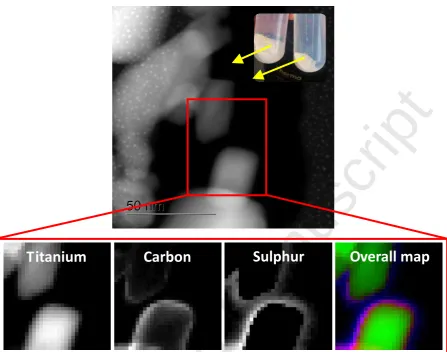
STEM electron energy loss spectroscopy (EELs)-maps for TiO2/PrSO3H nano-catalyst
was performed to obtain more information about the loading of carbon and sulphur
layers on the surface of TiO2-NPs. Titanium, carbon and sulphur maps were extracted
from the spectrum imaging high loss region. Figure 6 demonstrates the high resolution
elemental mapping of titanium, carbon and oxygen layer-by-layer distributions onto the
TiO2/PrSO3H particles. It can be observed that the surfaces of TiO2-NPs are uniformly
covered by carbon and sulphur layers. These homogenous distributions of carbon and
sulphur clearly confirms the surface of TiO2-NPs have been functionalised by PrSO3H
groups. This also explains the reason for surface area reduction (Figure 7b) and some
surface roughness of particles (Figure 5a). The STEM image further shows clear
porous structures between TiO2/PrSO3H particles.
Nitrogen adsorption–desorption isotherms and pore volume/size distributions of TiO2
and TiO2/PrSO3H samples are presented in Figure 7. The surface area was calculated
Accepted Manuscript
method, but the mean pore size and total pore volume were calculated from thedesorption branch of the isotherm using the Barrett-Joyner-Halenda (BJH) methods.
The adsorption isotherms for both catalysts were determined in the range P/Po
=0.06-0.2, wherein a liner relationship was maintained, which revealed that both materials are
typical type IV isotherms within mesoporous structure. The differences in condensation
and evaporation were attributed to the monolayer-multilayer adsorption according to
the IUPAC - behaviour, associated with mesoporous materials. The hysteresis loop
shape for as-synthesised TiO2/PrSO3H at relative pressure in the range of 0.75-0.985
was classified as H1-type, indicating a capillary condensation in mesoporous structure
[51]. It should be noted from Figure 7 (inset) that the pore volume distributions in
TiO2/PrSO3H nano-catalyst has much larger mesopores with an increase of pore
diameter compared with the initial TiO2-NPs. The large pore size is much more
preferable for minimizing diffusion limitations for long alkyl chain hydrocarbons in
FFA/triglyceride (TG) in esterification and transesterification reactions [4, 14, 52].
The detailed analyses for texture properties using N2 adsorption-desorption isotherms,
percentage of carbon and sulphur contents using CHNS analysis, as well as the
percentage of sulphur using TEM-EDS for prepared TiO2/PrSO3H nano-catalyst, are
summarized in Table 1. It was found that the loading of 1.41% of carbon and 0.28% of
sulphur from PrSO3H groups on the surface of TiO2-NPs was accompanied by a small
decrease of the BET surface area with an increase of the pore volumes and sizes.
The surface chemistry of the TiO2 and TiO2/PrSO3H nano-catalysts was investigated by
X-ray photoelectron spectroscopy (XPS) as shown in Figure 8. The XPS analysis
provides valuable insight into the surface compositions and bonding environments for
both nano-catalysts. The detailed high resolution XPS of the O 1s, S 2p, C 1s, and Ti
Accepted Manuscript
(Figure 9a) was de-convoluted into three Gaussian peaks centred at 530.4 eV, 31.75 eVand 533 eV indicating the presence of Ti=O, S=O and S-O/C-O, respectively.
However, it was very difficult to distinguish between the contribution of the binding
energy (BE) of the O 1s core-level for O-C and O-S bonds because both of species fell
in the same energy regions [53]. The S 2p spectra (Figure 9b) were fitted with three
Gaussian peaks centred at 164.4 eV, 166.3 eV and 167.4 eV assigned to the S-C, S=O
and S-O, respectively, supporting the presence of PrSO3H groups on the surface [53].
Moreover, the high resolution C 1s XPS spectra (Figure 9c) included two Gaussian
peaks centred at 285.1 eV and 286.4 eV which can reasonably be assigned to the C-C
and C-S/C-O, respectively, in the PrSO3H groups [54]. The above findings indicate the
surface of TiO2-NPs is functionalised with PrSO3H groups. Figure 9d depicts the Ti
2p1/2-Ti 2p3/2 spin-orbit splitting at 464.4 eV and 458.7 eV, respectively, with a BE=
5.74 eV confirming the oxidation state of Ti in the as-prepared TiO2/PrSO3H is IV
[55-57]. The surface atomic ratios of Ti:O and S:C were determined from the XPS data and
found to be 1:6.64 and 1:4.63, respectively. In fact, these ratios theoretically supposed
to be 1:6 and 1:3 for Ti:O and S:C, respectively. Therefore, there was an overall
increase in both ratios presumably due to surface contamination of the nano-catalyst
with COx and/or H2O in the atmosphere during sample preparation for analysis. This
result confirms an earlier investigation with the FTIR spectrum for TiO2/PrSO3H
nano-catalyst. In addition, the percentage of sulphur to carbon atomic ratios using XPS
quantitative analysis in TiO2/PrSO3H nano-catalyst was 0.22. This is in agreements
with the results obtained by CHNS analysis. In the case of TiO2-NPs, the detailed high
resolution XPS analysis demonstrated in our previous work [4].
Thermal stability analysis gave insights on the species evolved upon heating of the
Accepted Manuscript
weight loss of TiO2/PrSO3H and initial TiO2-NPs as determined by thermogravimetricanalysis (TGA) under N2 purge gas. There was a negligible weight loss from 25°C to
120°C for both samples assigned to desorption of H2O/COx molecules from the surface
of TiO2. In the case of initial TiO2-NPs, there was no further mass loss up to 900°C. In
contrast, there was a gradual weight loss of about 2% from TiO2/PrSO3H at 210°C to
500°C; afterwards there was no further weight loss up to 900°C. This is due to the
thermal decomposition of PrSO3H species on the surface of TiO2-NPs. This result
agrees with results of the CHNS elemental analysis and is in accordance with the FTIR
results. It must be noted also from the DSC results (see Figure 10b) that there is only
one sharp distinct endothermic peak observed at 210°C with enthalpy of -60 mJ
corresponding to the decomposition of PrSO3H groups on the surface of TiO2-NPs.
This is further evidence that the surface of TiO2-NPs was successfully functionalised
with PrO3H groups.
Figure 11 illustrates that the surface grafting of TiO2 with PrSO3H groups resulted in
the position shift of all diffraction peaks to a bit higher 2 angles by 0.2° indicating the
decrease of the unit-cell sizes. Moreover, a reduction of intensity in all reflections is
observed for TiO2/PrSO3H as compared with the initial TiO2-NPs precursor.
Furthermore, the position of the main diffraction peaks with 100% intensity of initial
TiO2-NPs were observed at 2 value of 25.3° corresponding to the [101] for 81.6% of
tetragonal anatase phase structure (JCPDS-ICDD: 04-014-5762) whilst the peak at 2
value of 27.43° assigned to the [110] for 18.4% of tetragonal rutile phase structure
(JCPDS-ICDD: 01-072-41815). In the case of TiO2/PrSO3H nano-catalyst, the XRD
patterns matched all the diffraction peaks with tetragonal anatase phase (JCPDS-ICDD:
Accepted Manuscript
However, no characteristic extra peak was observed for the PrSO3H groups, which
suggested that these groups were only grafted on the surface of TiO2-NPs, rather than
impregnating the main crystallographic structure as expected. The detailed interlayer
spacing values and calculated crystallite sizes of the [101] peak for anatase and [110]
peak for rutile from the initial TiO2-NPs and PrSO3H surface functionalized TiO2-NPs
are summarised in Table 2.
3.2 Catalytic performance
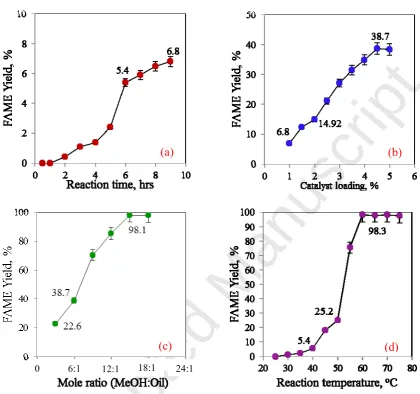
The catalytic activity of TiO2/PrSO3H nano-catalyst for simultinous esterification and
transesterification of UCO to produce biodiesel fuel was investigated. The effect of different
reaction times, catalyst loadings, mole ratios of methanol to oil, and reaction temperatures on
the percentage of FAME yields were studied and the results are presented in Figure 12. The
reaction time of esterification/transesterification was varied between ½ hr and 9 hrs whilst
other process parameters were kept constant at 1wt% of TiO2/PrSO3H nano-catalyst to UCO
feedstock, 6:1 methanol to oil mole ratio, 65°C reaction temperature, 600 RPM agitation rate,
0.14% moisture, and <2.0% of FFA content in raw material (UCO). It was found that the
initial (trans)esterification reaction rate was very low, as shown in Figure 12 (a). This could
possibly be due to the immiscibility of reactants (solid-liquid-liquid phases)/ the initial mass
transfer limitations. The FAME yield further increased but was still lower than 10% FAME
yield when the experiment was run for a longer time (9 hrs). This is because of the better
micibility of reactants (solid acid nano-catalyst, methanol and UCO) with the time and
increasing of mass transfer. The results of different catalyst to oil loadings on the FAME
yield, however, shows the yield of FAME was almost doubled (see Figure 12(B)) when the
(trans)esterification process was set at 9hrs of reaction time, 2wt% of nanocatalyst to UCO,
6:1 methanol to oil mole ratio, 65°C reaction temperature, 600 RPM of agitation rate, 0.14%
Accepted Manuscript
active sites were increasing with an increase the catalyst concentration in the reaction systemrequiring a shorter time to reach the equalibrium [58]. Furthermore, the yield of FAME
further increased from 14.92% to 38.7% with an increase in the nano-catalyst loading from
2wt% to 4.5wt% of UCO. Increasing the catalyst concentrations will lead to an increase in
the number of active sites (proton, -SO3H, concentration in the interface), which enhanced
selectivity towards the FAME product [59].
A maximum conversion of FFA/triglycerides (TG) into FAME is required in simultinous
esterification and transesterification reactions to obtain the highest yield of FAME in order to
satisfy the EU and ASTM standards for obatined biodiesel fuel. In theory, the stoichiometric
ratio for transesterification reaction requires three moles of methanol per mole of TG to
obtain three moles of FAME and one mole of glycerol whilst this ratio is one to one for
esterification reaction [60]. However, transesterification reaction practically needs an excess
amount of methanol in order to get a complete conversion. In order to drive the reaction
towards the highest FAME yield [61], various mole ratios of methanol to UCO were used
[see Figure 12 (c)] under the aforementioned reaction conditions. It can be noted that the
highest FAME yield of 98.1% was obtained when the mole ratio of methanol to UCO was
steadily increased to 15:1 whilst the other parameters were fixed as most probably to a higher
molar ratio of methanol to UCO leads to an increase of miscibility of reactants which shift the
equalibrium to the product side and increase the probability of a methanol nucleophilic attack
on the carbonyl/carboxylic acid functional groups in the FFA/TG. However, a further mole
ratio of methanol to oil increase leads to a slight reduction in the FAME yield [58, 62],
presumably as glycerol and FAME solubility in excess methanol can help to derive the
reverse side of transesterification reaction [10].
The rate of esterification/transesterification reactions are strongly dependent on the process
Accepted Manuscript
at 9hrs reaction time, 4.5wt% of TiO2/PrSO3H to UCO, 15:1 molar ratio of methanol to UCO,600RPM agitation rate, 0.14% moisture content, and <2% of FFA content in UCO raw
material, is shown in Figure 12 (D). It can be noted that the increase of reaction temperature
from 25°C to 60°C led to smooth increase in the rate of the (trans)esterification process to
reach 98.3% FAME yield. The reason for obtaining a high FAME yield at a higher
temperature can be explained by the fact that the higher reaction temperature accelerates (1)
the movement of molecules in reactants, (2) solubility of TG in methanol, (3) diffusion of TG
molecules, as well as (4) generating more neucleophilic sites in the reaction system which
results in an increase in reaction rate. This could help to initiate the activation of
carboxylic/carbonyl function groups in FFA/TG by nucleophile [14]. Further studies on the
reaction kinetic of the esterification/transesterification reaction using TiO2/PrSO3H
nano-catalyst should be reported in the future publications.
3.3 Catalytic activity and its reusability
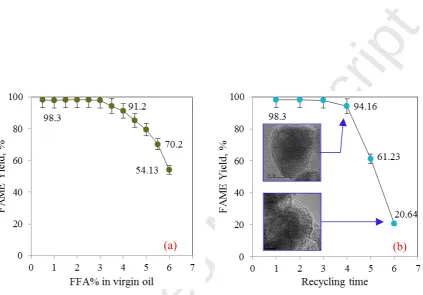
The catalytic activity of TiO2/PrSO3H nano-catalyst was assessed by the addition of different
percentages of oleic acid in virgin oil because the presence of FFA in the feedstock has a
great influence on the deactivation of catalysts. The addition of oleic acid in virgin oil was
varied from 0.5% to 6% under determined optimium reaction conditions as reported in
previous section. It can be observed from Figure 13(a), that the FAME yield was greatly
reduced with an increase in the percentage of oleic acids in the virgin oil as raw material.
This can be explained by the rate of esterification which was much faster than the
transesterification [61] producing more water (by-product) in the reaction medium in a
shorter time. The produced excess water in the reaction medium would probably deactivate
the active sites of the catalyst. Likewise, the presence of a high concentration of oleic acid in
Accepted Manuscript
water from the reaction as a by-product may drive the reverse reaction to re-form FFA andmethanol [63, 64].
The spent TiO2/PrSO3H nano-catalyst was recovered from the reaction products and
by-products at the end of each run by using centrifuge (Megafuge 16R, UK) and then
properly washed several times with 1:1 ratio of methanol to n-hexane in order to
remove any remaining impurities (polar and non-polar components) on its surface. The
recycled catalyst was later dried in an oven for 3hrs at 110°C to remove any moisture
on the surface prior to being re-used under optimised process conditions to investigate
its remaining activity.
It was found that TiO2/PrSO3H can be re-used up to four times under optimized reaction
conditions, i.e. reaction temperature of 60°C, 4.5 wt% of TiO2/PrSO3H nano-catalyst to
UCO, molar ratios of methanol to UCO of 15:1, 600 RPM agitation rate, 0.14% moisture,
<2.0% FFA, and 9hrs reaction time. However, thereafter, the yield of FAME was sharply
reduced to 20.64%, as shown in Figure 13 (b). This obvious change in the production of
FAME yield is due to the organic or carbonaceous materials on the surface of recycled
nano-catalyst causing blockage of the active sites and/or detachment (leaching) of the PrSO3H
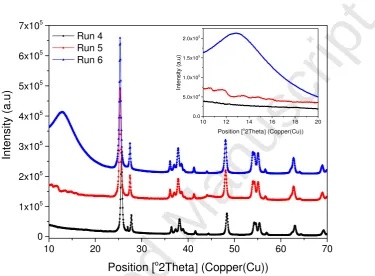
species on the surface of TiO2-NPs [65-68]. According to the XRD results shown in Figure
14, there was an accumulation of organic or carbonaceous materials from the surface of the
prepared mesoporous solid acid nano-catalyst after four runs. This possibly inhibited the
contact between the reactants and the active sites of the nano-catalyst [10, 40, 44, 66]. In
order to fully understand the catalytic poisoning of the spent TiO2/PrSO3H nano-catalyst,
further studies should be carried out in detail, using the XPS, temperature programmed
desorption (TPD)-MS, Hammett indicator titration, TEM-EDS, and CHNS techniques.
Accepted Manuscript
The properties of obtained biodiesel are mainly dependent on the FAME compositions[17]. Therefore, off-line GC-MS was used to analyse the final product in order to
quantify FAME content of synthesised biodiesel using TiO2/PrSO3H solid acid
nano-catalyst. The FAME compositions for obtained biodiesel are listed in Table 3.
It was found from Table 3 that the major FAMEs are palmitic acid methyl ester, stearic
acid methyl ester, oleic acid methyl ester, linoleic acid methyl ester, linolenic acid
methyl ester, and gadoleic acid methyl ester. The quality of final biodiesel fuel
obtained under optimum reaction conditions are summarised in Table 4. The fuel
properties of obtained biodiesel fuel were evaluated and the results revealed that the
quality of produced biodiesel from the current study fulfilled ASTM and EU standards
for biodiesel fuel quality control.
The cloud point is the temperature at which a cloud or few crystals form in a biodiesel
fuel caused by the first stage of crystallisation on cooling of the fuel. It is one of the
most important properties of biodiesel, which influences its use in a cold environment
due to the possibility of causing fuel injector problems, poor fuel atomization,
incomplete combustion, and deposit formation [17]. The DSC thermogram for
as-synthesised biodiesel is shown in Figure 15. It can be seen from the cooling DSC curve
that there is only one sharp endothermic peak centred at -11°C with enthalpy of
67.14mJ corresponding to the formation of crystals in biodiesel fuel. The onset
temperature of crystallisation on the cooling curve at -10.57°C represents the cloud
point temperature of prepared biodiesel. In heating DSC thermogram, a board
exothermic peak was observed between -28°C and 0°C assigned to the melting of the
formed crystals.
Thermal oxidative behaviour plays a key role in the industrial application of the
Accepted Manuscript
temperatures are shown in Figure 16. The onset temperature (174°C) represent thebiodiesel sample starting to decompose whilst the endset temperature (252°C)
corresponds to the completely burnt off biodiesel sample. These results indicate that the
synthesised biodiesel was thermally stable in atmosphere.
3.5 Discussion
A novel TiO2/PrSO3H nano-catalyst was prepared through grafting of TiO2-NPs with
1,3-propane sultone in dry toluene under reflux at 120°C for 72hrs. The application of
such material as solid acid nano-catalyst is reported for the first time for biodiesel
production from UCO. The synthesised solid acid nano-catalyst shows a remarkable
catalytic activity for simultaneous esterification and transesterification of cheap
feedstocks, probably due to the catalytic activity of such material according to its
surface property (-SO3H). It is important to mention that loading of higher density
hydrophilic functional groups (-SO3H) onto the surface of TiO2-NPs may lead to an
improvement in the hydrophilicity of TiO2-NPs support and increase the accessibility
of raw material (FFAs, triglycerides and methanol) in the simultaneous esterification
and transesterification processes to the –SO3H groups. Therefore, more investigations
could to be carried out in future on the effect of different TiO2 phases (anatase, rutile and
brookite) with different loadings of PrSO3H species and the surface acidity/strength of
TiO2/PrSO3H for the catalytic performance. Such future studies could fully utilize the
potential of such nano-catalyst on the FAME yield produced from simultaneous esterification
and transesterification of UCO. The prepared solid acid nano-catalyst was found to
esterify FFA in cheap raw materials to FAME in parallel with transesterification of TG
without formation of soaps. The nano-catalyst was also found to be a non-hazardous
material compared to conventional homogenous acids and it can be used in four
Accepted Manuscript
which may satisfy the principle of green chemistry. Table 5 summarizes thecomparison of the optimised process condition results for biodiesel production from
UCO/oleic acid using solid acid catalyst in the present study with other reported solid
acid catalysts in the literature.
4. CONCLUSIONS
Mesoporous TiO2/PrSO3H solid acid nano-catalyst with an average particle size of around
23.1nm has been successfully synthesized as a novel inorganic–organic hybrid
heterogeneous nano-catalyst from TiO2-NPs and 1,3-propyl sulfonic acid for simultaneous
esterification and transesterification of UCO containing FFA. STEM EELs-maps shows
that the PrSO3H groups decorate the surface of TiO2-NPs layer-by-layer. N2
adsorption-desorption isotherms result demonstrated that surface modification reduced
the surface area of TiO2-NPs by 5% with an increase in the mean pore size and total
pore volume. The XPS confirmed that the PrSO3H functional groups attached to the
surface of TiO2-NPs. TiO2/PrSO3H nano-catalyst performance showed promising
results for catalytic simultaneous esterification and transesterification of cheap raw
materials for biodiesel production. The enhanced catalytic performance mainly relates
to the loading of propyl sulfonic acid groups on the surface of TiO2-NPs.
ACKNOWLEDGEMENT
This study was funding by the Human Capacity Development Program (HCPD) of the
Kurdistan Regional Government (KRG) for one of our authors (JG). Discussions with
Professor Karen Wilson at the European Bioenergy Research Institute (EBRI) was
highly valuable for this study. We are thankful to Dr Adrian Cunliffe, Dr Mike Ward
Accepted Manuscript
REFERENCES1. Shen, J., Y. Zhu, X. Yang, and C. Li, Magnetic composite microspheres with exposed {001} faceted TiO2 shells: a highly active and selective visible-light photocatalyst. Journal of
Materials Chemistry, 2012. 22(26): p. 13341-13347.
2. Rehan, M., X. Lai, and G.M. Kale, Hydrothermal synthesis of titanium dioxide
nanoparticles studied employing in situ energy dispersive X-ray diffraction.
CrystEngComm, 2011. 13(11): p. 3725-3732.
3. Patsoura, A., D.I. Kondarides, and X.E. Verykios, Enhancement of photoinduced hydrogen production from irradiated Pt/TiO2 suspensions with simultaneous degradation of
azo-dyes. Applied Catalysis B: Environmental, 2006. 64(3): p. 171-179.
4. Gardy, J., A. Hassanpour, X. Lai, and M.H. Ahmed, Synthesis of Ti(SO4)O solid acid
nano-catalyst and its application for biodiesel production from used cooking oil. Applied Catalysis A: General, 2016. 527: p. 81–95.
5. Ahmed, M.H., J.A. Byrne, and T.E. Keyes, Investigation of the inhibitory effects of TiO2 on
the -amyloid peptide aggregation. Materials Science and Engineering: C, 2014. 39: p. 227-234.
6. Bourikas, K., M. Stylidi, D.I. Kondarides, and X.E. Verykios, Adsorption of acid orange 7 on the surface of titanium dioxide. Langmuir, 2005. 21(20): p. 9222-9230.
7. Hanaor, D.A. and C.C. Sorrell, Review of the anatase to rutile phase transformation.
Journal of Materials science, 2011. 46(4): p. 855-874.
8. Kang, S., J. Ye, and J. Chang, Recent advances in carbon-based sulfonated catalyst: preparation and application. International Review of Chemical Engineering (IRECHE), 2013. 5(2): p. 133-144.
9. Patel, A. and V. Brahmkhatri, Kinetic study of oleic acid esterification over 12-tungstophosphoric acid catalyst anchored to different mesoporous silica supports. Fuel processing technology, 2013. 113: p. 141-149.
10. Melero, J.A., L.F. Bautista, G. Morales, J. Iglesias, and R. Sánchez-Vázquez, Biodiesel production from crude palm oil using sulfonic acid-modified mesostructured catalysts.
Chemical Engineering Journal, 2010. 161(3): p. 323-331.
11. Toh-Ae, P., B. Junhasavasdikul, N. Lopattananon, and K. Sahakaro. Surface modification of TiO2 nanoparticles by grafting with silane coupling agent. in Advanced Materials
Research. 2014. Trans Tech Publ.
12. Zhao, J., M. Milanova, M.M. Warmoeskerken, and V. Dutschk, Surface modification of TiO2 nanoparticles with silane coupling agents. Colloids and surfaces A:
Physicochemical and engineering aspects, 2012. 413: p. 273-279.
13. Radoman, T., J. Džunuzović, K. Trifković, T. Palija, A. Marinković, B. Bugarski, and E. D unuzović, Effect of surface modified TiO2 nanoparticles on thermal, barrier and
mechanical properties of long oil alkyd resin-based coatings. Express Polymer Letters,
2015. 9(10).
14. Shu, Q., J. Gao, Z. Nawaz, Y. Liao, D. Wang, and J. Wang, Synthesis of biodiesel from waste vegetable oil with large amounts of free fatty acids using a carbon-based solid acid catalyst. Applied Energy, 2010. 87(8): p. 2589-2596.
15. Lee, A.F. and K. Wilson, Recent developments in heterogeneous catalysis for the sustainable production of biodiesel. Catalysis Today, 2015. 242: p. 3-18.
16. Alhassan, F.H., U. Rashid, and Y. Taufiq-Yap, Synthesis of waste cooking oil-based biodiesel via effectual recyclable bi-functional Fe2O3-MnO-SO42−/ZrO2 nanoparticle
Accepted Manuscript
17. Gardy, J., A. Hassanpourm, X. Lai, A. Cunliffe, and M. Rehan, The influence of blendingprocess on the quality of rapeseed oil-used cooking oil biodiesels. Int. Sci. J. Environ. Sci, 2014. 3: p. 233-240.
18. Nizami, A., O. Ouda, M. Rehan, A. El-Maghraby, J. Gardy, A. Hassanpour, S. Kumar, and I. Ismail, The potential of Saudi Arabian natural zeolites in energy recovery technologies. Energy, 2015.
19. Wang, H., J. Covarrubias, H. Prock, X. Wu, D. Wang, and S.H. Bossmann,
Acid-functionalized magnetic nanoparticle as heterogeneous catalysts for biodiesel synthesis. The Journal of Physical Chemistry C, 2015. 119(46): p. 26020-26028.
20. Atabani, A.E., A.S. Silitonga, I.A. Badruddin, T. Mahlia, H. Masjuki, and S. Mekhilef, A comprehensive review on biodiesel as an alternative energy resource and its characteristics. Renewable and sustainable energy reviews, 2012. 16(4): p. 2070-2093. 21. Sani, Y.M., W.M.A.W. Daud, and A.A. Aziz, Activity of solid acid catalysts for biodiesel
production: a critical review. Applied Catalysis A: General, 2014. 470: p. 140-161. 22. Refaat, A., Biodiesel production using solid metal oxide catalysts. International Journal of
Environmental Science & Technology, 2011. 8(1): p. 203-221.
23. Gong, S.-w., J. Lu, H.-h. Wang, L.-j. Liu, and Q. Zhang, Biodiesel production via esterification of oleic acid catalyzed by picolinic acid modified 12-tungstophosphoric acid. Applied Energy, 2014. 134: p. 283-289.
24. Lee, A.F., Catalysing sustainable fuel and chemical synthesis. Applied Petrochemical Research, 2014. 4(1): p. 11-31.
25. Melero, J.A., J. Iglesias, and G. Morales, Heterogeneous acid catalysts for biodiesel production: current status and future challenges. Green Chemistry, 2009. 11(9): p. 1285-1308.
26. Kango, S., S. Kalia, A. Celli, J. Njuguna, Y. Habibi, and R. Kumar, Surface modification of inorganic nanoparticles for development of organic–inorganic nanocomposites—a review. Progress in Polymer Science, 2013. 38(8): p. 1232-1261.
27. Laurent, S., D. Forge, M. Port, A. Roch, C. Robic, L. Vander Elst, and R.N. Muller,
Magnetic iron oxide nanoparticles: synthesis, stabilization, vectorization, physicochemical characterizations, and biological applications. Chemical reviews,
2008. 108(6): p. 2064-2110.
28. Atghia, S. and S.S. Beigbaghlou, Nanocrystalline titania-based sulfonic acid (TiO2
-Pr-SO3H) as a new, highly efficient and recyclable solid acid catalyst for the N-Boc
protection of amines at room temperature. Journal of Organometallic Chemistry, 2013. 745: p. 42-49.
29. Mo, X., D.E. López, K. Suwannakarn, Y. Liu, E. Lotero, J.G. Goodwin, and C. Lu,
Activation and deactivation characteristics of sulfonated carbon catalysts. Journal of Catalysis, 2008. 254(2): p. 332-338.
30. Ahn, B.K., H. Wang, S. Robinson, T.B. Shrestha, D.L. Troyer, S.H. Bossmann, and X.S. Sun, Ring opening of epoxidized methyl oleate using a novel acid-functionalized iron nanoparticle catalyst. Green chemistry, 2012. 14(1): p. 136-142.
31. Melero, J.A., L.F. Bautista, J. Iglesias, G. Morales, R. Sánchez-Vázquez, and I.
Suárez-Marcos, Biodiesel production over arenesulfonic acid-modified mesostructured
catalysts: optimization of reaction parameters using response surface methodology.
Topics in Catalysis, 2010. 53(11-12): p. 795-804.
32. Li, W.L., S.B. Tian, and F. Zhu, Sulfonic acid functionalized nano- -Al2O3: A new,
efficient, and reusable catalyst for synthesis of 3-substituted-2h-1, 4-benzothiazines.
Accepted Manuscript
33. Yang, L., Y. Wang, G. Luo, and Y. Dai, Functionalization of SBA-15 mesoporous silicawith thiol or sulfonic acid groups under the crystallization conditions. Microporous and mesoporous materials, 2005. 84(1): p. 275-282.
34. Dõaz, I., C. Márquez-Alvarez, F. Mohino, J.n. Pérez-Pariente, and E. Sastre, Combined alkyl and sulfonic acid functionalization of MCM-41-type silica: Part 2. Esterification of glycerol with fatty acids. Journal of Catalysis, 2000. 193(2): p. 295-302.
35. Melero, J.A., R. van Grieken, and G. Morales, Advances in the synthesis and catalytic applications of organosulfonic-functionalized mesostructured materials. Chemical reviews, 2006. 106(9): p. 3790-3812.
36. Alvaro, M., A. Corma, D. Das, V. Fornés, and H. García, “Nafion”-functionalized mesoporous MCM-41 silica shows high activity and selectivity for carboxylic acid esterification and Friedel–Crafts acylation reactions. journal of Catalysis, 2005. 231(1): p. 48-55.
37. Pirez, C., M.T. Reche, A. Lee, J. Manayil, V. dos-Santos, and K. Wilson, Hydrothermal saline promoted grafting of periodic mesoporous organic sulfonic acid silicas for sustainable FAME production. Catalysis Letters, 2015. 145(7): p. 1483-1490.
38. Sobhani, S., Z.P. Parizi, and N. Razavi, Nano n-propylsulfonated -Fe2O3 as magnetically
recyclable heterogeneous catalyst for the efficient synthesis of -phosphonomalonates.
Applied Catalysis A: General, 2011. 409: p. 162-166.
39. Margolese, D., J. Melero, S. Christiansen, B. Chmelka, and G. Stucky, Direct syntheses of ordered SBA-15 mesoporous silica containing sulfonic acid groups. Chemistry of Materials, 2000. 12(8): p. 2448-2459.
40. Zuo, D., J. Lane, D. Culy, M. Schultz, A. Pullar, and M. Waxman, Sulfonic acid
functionalized mesoporous SBA-15 catalysts for biodiesel production. Applied Catalysis B: Environmental, 2013. 129: p. 342-350.
41. Mbaraka, I.K., K.J. McGuire, and B.H. Shanks, Acidic mesoporous silica for the catalytic conversion of fatty acids in beef tallow. Industrial & engineering chemistry research,
2006. 45(9): p. 3022-3028.
42. Basaldella, E.I., M.S. Legnoverde, I. Jiménez-Morales, E. Rodríguez-Castellón, B.O. Dalla Costa, and C.A. Querini, Preparation, characterization and catalytic activity towards green reactions of sulfonic functionalized SBA-15. Adsorption, 2011. 17(3): p. 631-641.
43. Lotero, E., J.G. Goodwin Jr, D.A. Bruce, K. Suwannakarn, Y. Liu, and D.E. Lopez, The catalysis of biodiesel synthesis. catalysis, 2006. 19(1): p. 41-83.
44. Melero, J.A., L.F. Bautista, J. Iglesias, G. Morales, R. Sánchez-Vázquez, K. Wilson, and A.F. Lee, New insights in the deactivation of sulfonic modified SBA-15 catalysts for biodiesel production from low-grade oleaginous feedstock. Applied Catalysis A: General, 2014. 488: p. 111-118.
45. Bahnemann, D., A. Henglein, and L. Spanhel, Detection of the intermediates of colloidal TiO2-catalysed photoreactions. Faraday Discussions of the Chemical Society, 1984.
78: p. 151-163.
46. Soler-Illia, G.d.A., A. Louis, and C. Sanchez, Synthesis and characterization of mesostructured titania-based materials through evaporation-induced self-assembly.
Chemistry of Materials, 2002. 14(2): p. 750-759.
47. Pavia, D.L., G.M. Lampman, G.S. Kriz, and J.A. Vyvyan, Introduction to spectroscopy.
2008: Cengage Learning.
48. Sirsam, R. and G. Usmani, Preparation and characterization of sulfonic acid
Accepted Manuscript
49. Muthirulan, P., C.N. Devi, and M.M. Sundaram, TiO2 wrapped graphene as a highperformance photocatalyst for acid orange 7 dye degradation under solar/UV light irradiations. Ceramics International, 2014. 40(4): p. 5945-5957.
50. Lu, A.H., E.e.L. Salabas, and F. Schüth, Magnetic nanoparticles: synthesis, protection, functionalization, and application. Angewandte Chemie International Edition, 2007. 46(8): p. 1222-1244.
51. Klobes, P., K. Meyer, and R.G. Munro, Porosity and specific surface area measurements for solid materials.2006.
52. Lam, M.K., K.T. Lee, and A.R. Mohamed, Sulfated tin oxide as solid superacid catalyst for transesterification of waste cooking oil: an optimization study. Applied Catalysis B: Environmental, 2009. 93(1): p. 134-139.
53. Barroso-Bujans, F., J. Fierro, S. Rojas, S. Sánchez-Cortes, M. Arroyo, and M. López-Manchado, Degree of functionalization of carbon nanofibers with benzenesulfonic groups in an acid medium. Carbon, 2007. 45(8): p. 1669-1678.
54. Hueso, J., J. Espinós, A. Caballero, J. Cotrino, and A. González-Elipe, XPS investigation of the reaction of carbon with NO, O2, N2 and H2O plasmas. Carbon, 2007. 45(1): p.
89-96.
55. Chastain, J., R.C. King, and J. Moulder, Handbook of X-ray photoelectron spectroscopy: a reference book of standard spectra for identification and interpretation of XPS data.
1995: Physical Electronics Eden Prairie, MN.
56. Wu, L., Y. Zhou, W. Nie, L. Song, and P. Chen, Synthesis of highly monodispersed teardrop-shaped core–shell SiO2/TiO2 nanoparticles and their photocatalytic
activities. Applied Surface Science, 2015. 351: p. 320-326.
57. Yadav, H.M., S.V. Otari, V.B. Koli, S.S. Mali, C.K. Hong, S.H. Pawar, and S.D. Delekar,
Preparation and characterization of copper-doped anatase TiO2 nanoparticles with
visible light photocatalytic antibacterial activity. Journal of Photochemistry and Photobiology A: Chemistry, 2014. 280: p. 32-38.
58. Li, Y., S. Lian, D. Tong, R. Song, W. Yang, Y. Fan, R. Qing, and C. Hu, One-step production of biodiesel from Nannochloropsis sp. on solid base Mg–Zr catalyst.
Applied energy, 2011. 88(10): p. 3313-3317.
59. Shu, Q., Q. Zhang, G. Xu, Z. Nawaz, D. Wang, and J. Wang, Synthesis of biodiesel from cottonseed oil and methanol using a carbon-based solid acid catalyst. Fuel Processing Technology, 2009. 90(7): p. 1002-1008.
60. Li, J., X. Wang, W. Zhu, and F. Cao, Zn1.2H0.6PW12O40 nanotubes with double acid sites as
heterogeneous catalysts for the production of biodiesel from waste cooking oil.
ChemSusChem, 2009. 2(2): p. 177-183.
61. Kulkarni, M.G., R. Gopinath, L.C. Meher, and A.K. Dalai, Solid acid catalyzed biodiesel production by simultaneous esterification and transesterification. Green Chemistry,
2006. 8(12): p. 1056-1062.
62. Teng, G., L. Gao, G. Xiao, and H. Liu, Transesterification of soybean oil to biodiesel over heterogeneous solid base catalyst. Energy & Fuels, 2009. 23(9): p. 4630-4634.
63. Rattanaphra, D., A. Harvey, and P. Srinophakun, Simultaneous conversion of
triglyceride/free fatty acid mixtures into biodiesel using sulfated zirconia. Topics in Catalysis, 2010. 53(11-12): p. 773-782.
64. Morales, G., L.F. Bautista, J.A. Melero, J. Iglesias, and R. Sánchez-Vázquez, Low-grade oils and fats: effect of several impurities on biodiesel production over sulfonic acid heterogeneous catalysts. Bioresource technology, 2011. 102(20): p. 9571-9578.
Accepted Manuscript
66. Lopez, D.E., J.G. Goodwin, D.A. Bruce, and E. Lotero, Transesterification of triacetinwith methanol on solid acid and base catalysts. Applied Catalysis A: General, 2005. 295(2): p. 97-105.
67. Jitputti, J., B. Kitiyanan, P. Rangsunvigit, K. Bunyakiat, L. Attanatho, and P. Jenvanitpanjakul, Transesterification of crude palm kernel oil and crude coconut oil by different solid catalysts. Chemical Engineering Journal, 2006. 116(1): p. 61-66.
68. Mo, X., E. Lotero, C. Lu, Y. Liu, and J.G. Goodwin, A novel sulfonated carbon composite solid acid catalyst for biodiesel synthesis. Catalysis Letters, 2008. 123(1-2): p. 1-6. 69. Xu, Y. and M.A. Hanna, Synthesis and characterization of hazelnut oil-based biodiesel.
Industrial crops and products, 2009. 29(2): p. 473-479.
70. Fu, X.-b., J. Chen, X.-l. Song, Y.-m. Zhang, Y. Zhu, J. Yang, and C.-w. Zhang, Biodiesel production using a carbon solid acid catalyst derived from -cyclodextrin. Journal of the American Oil Chemists' Society, 2015. 92(4): p. 495-502.
71. Feyzi, M., L. Nourozi, and M. Zakarianezhad, Preparation and characterization of magnetic CsH 2PW12O40/Fe–SiO2 nanocatalysts for biodiesel production. Materials
Research Bulletin, 2014. 60: p. 412-420.
S O O
O
+ O
S O
O OH
1,3-propanesultone
(H2C)3
TiO2
Dry toluene Reflux at 120oC for 72hrs
TiO2
OH
Titania TiO2/PrSO3H nano-catalyst
Accepted Manuscript
4000 3500 3000 2500 2000 1500 1000 500 0 10 20 30 40 50 60 70 80 90 100 O -H S tr . O
=C=O H-O
-H T i-O S tr. S =O S tr .( S y m ) TiO2
TiO2/PrSO3H
Wavenumbers (cm-1)
% Transmittance C-H S tr . (S ym .) -CH 2
- be
ndi ng S -O S tr. C-H S tr. (A sy m .) S = O S tr .( A sy m ) C-O S tr. C-C S tr .
Figure (1): FT-IR spectra of TiO2/PrSO3H (in black) and TiO2 (in red) nano-catalysts
Figure (2): SEM images showing particle size and morphology distributions of (a) TiO2
and (b) synthesised TiO2/PrSO3H nano-catalyst
(a) (b)
[image:29.595.112.505.101.380.2] [image:29.595.74.522.420.614.2]Accepted Manuscript
Figure (3): TEM images at different magnifications of synthesised TiO2/PrSO3H
nano-catalyst
Figure (4): Particle size distributions for (a) TiO2 and (b) TiO2/PrSO3H nano-catalysts
[101]A
[001]A
[image:30.595.77.528.111.253.2] [image:30.595.83.519.282.595.2]Accepted Manuscript
Figure (5): (a) High resolution TEM (HRTEM) micrograph images and (b) selectedarea electron diffraction (SAED) patterns for TiO2/PrSO3H nano-catalyst
(a)
(b)
[101] A
d=3.35Å
[101] A
d=3.57Å
[101] A
d=3.6Å
[200] R
d=2.29Å
[101] A
d=3.45Å
[200] R
d=2.308Å
[310]R [220]R [200]A
[210]R
[004]A
[101]R
[101]A
[202]R [116]A [213]A
[220]A [200]A [200]R [101]A [110]R [410]R
[204]A [202]R
[220]A [221]R
[220]R [200]A [200]R [110]R [101]A [111]R
[116]A
[101] A
Accepted Manuscript
Figure (6): STEM image with EELs-mapping of synthesised TiO2/PrSO3Hnano-catalyst obtained from Titan at 300kV illustrating the 2D elemental mapping with high
quality overall map of TiO2/PrSO3H particles with the distribution of individual
elements (Titanium in green, Carbon in violet, and Sulphur in blue).
[image:32.595.74.522.92.444.2]Accepted Manuscript
0.0 0.2 0.4 0.6 0.8 1.0
0 1 2 3 4 5
0 200 400 600 800 1000 1200
0.00 0.02 0.04 0.06 0.08 0.10 0.12 0.14 0.16 0.18 0.20 Pore volume Pore size
Pore width (Å)
dV /d lo g( w ) po re vo lu m e ( cm ³/ g) 0 20 40 60 80 100 dA /d lo g( w ) p or e a rea (m 2/g ) Adsorption Desorption
Relative pressure (P/Po)
Q u an ti ty a d so rb ed ( cm 3 /g m S T P )
0.0 0.2 0.4 0.6 0.8 1.0
0 1 2 3 4 5 6
0 200 400 600 800 1000 1200
0.0 0.1 0.2 0.3
0.4 Pore volume
Pore size
Pore width (Å)
dv/ dl og( w ) po re v ol um e ( cm 3/g ) 0 5 10 15 20 25 30 35 40 45 dA /d lo g( w ) po re ar ea ( m 2/g ) Q uant ity A ds or bed ( m m ol /g)
Relative pressure (P/Po)
Adsorption Desorption
Figure (7): N2 adsorption-desorption isotherms and total pore volumes with mean pore
sizes (inset) for (a) TiO2-NPs and (b) synthesised TiO2/PrSO3H nano-catalysts.
[image:33.595.78.517.183.375.2]Accepted Manuscript
0 200 400 600 800 1000 1200 Binding Energy (eV)
Ti 2p
C 1s
S 2p
Si
2p
O 1s
TiO2/Pr-SO3H
TiO2
[image:34.595.153.511.183.481.2]
Accepted Manuscript
528 529 530 531 532 533 534 535
0 1x10³ 2x10³ 3x10³ 4x10³ 5x10³ 6x10³ In te ns ity (a .u )
Binding energy (eV)
Ti=O
S=O
S-O C-O
158 160 162 164 166 168 170 172 4.0x10² 6.0x10² 8.0x10² 1.0x10³ 1.2x10³ Intens ity (a.u)
Binding Energy (eV)
S-O S=O
S-C
280 282 284 286 288 290 292
0.0 2.0x10² 4.0x10² 6.0x10² 8.0x10² In te ns ity (a .u )
Binding Energy (eV)
C-C
C-O C-S
456 458 460 462 464 466 468
0.0 5.0x10³ 1.0x10⁴ 1.5x10⁴ 2.0x10⁴ In te ns ity (a .u )
Binding energy (eV)
Ti 2p3/2
Ti 2p1/2
5.74 eV
Figure (9): XPS spectra showing the chemical environments of (a) O 1s, (b) S 2p, (c) C
1s, and (d) the de-convolution of Ti 2p peaks in TiO2/PrSO3H nano-catalyst
(a) (b)
Accepted Manuscript
0 100 200 300 400 500 600 700 800 900
0 20 40 60 80 100
0 100 200 300 400 500 600 75
80 85 90 95 100
% Mass
Temperature, oC
Loss of PrSO3H groups
0 100 200 300 400 500
-1.0 -0.5 0.0 0.5 1.0 1.5 2.0
H
eat
fl
ow
(
m
W
)
Temperature,
oC
% Ma
ss
Temperature, oC
TiO2
TiO2/PrSO3H
TiO2
TiO2/PrSO3H
Integral= -60.60 mJ
Onset= 207.02oC
Endset= 216.30oC
Figure (10): TGA (a) and DSC (b) profiles for TiO2.and TiO2/PrSO3H nano-catalysts
[image:36.595.76.515.183.406.2]Accepted Manuscript
10 20 30 40 50 60 70
0 1x10⁵ 2x10⁵ 3x10⁵ 4x10⁵
24 25 26 27 28 Position [o2 Theta] (Cupper (Cu))
[010] [100]
[001]
Titanium
Oxygen [010]
[100] [001]
Titanium
Oxygen
TiO2
Intens
ity %
Position [o2 Theta] (Copper (Cu))
TiO2/PrSO3H
Rutile Anatase
[image:37.595.112.508.182.486.2]Accepted Manuscript
Figure (12): The effects of (a) reaction time, (b) TiO2/PrSO3H nano-catalyst loading to
UCO, (c) mole ratio of methanol to UCO, and (d) reaction temperature on the
percentage of FAME yield.
0 6:1 12:1 18:1 24:1
(a) (b)
[image:38.595.86.507.117.511.2]Accepted Manuscript
Figure (13): The effect of different concentration oleic acid addition in virgin oil (a)
and reusability of TiO2/PrSO3H nano-catalyst (b) on the percentage of FAME yield.
[image:39.595.87.511.175.470.2]Accepted Manuscript
10 20 30 40 50 60 70
0 1x10⁵
2x10⁵
3x10⁵
4x10⁵
5x10⁵
6x10⁵
7x10⁵
10 12 14 16 18 20
0.0 5.0x10⁴
1.0x10⁵
1.5x10⁵
2.0x10⁵
In
te
ns
ity
(
a.u
)
Position [o2Theta] (Copper(Cu))
Intensity (a.u)
Position [o2Theta] (Copper(Cu)) Run 4
Run 5 Run 6
[image:40.595.130.506.180.456.2]
Accepted Manuscript
30 20 10 0 -10 -20 -30
-0.26 -0.24 -0.22 -0.20 -0.18 -0.16
30 20 10 0 -10 -20 -30
0.40 0.45 0.50 0.55 0.60 0.65 0.70 0.75
Hea
ting fl
ow (mW
)
T (oC)
H
ea
ting flow
(mW)
T (oC)
Fig
ure (15): The DSC (a) cooling and (b) heating curves for obtained biodiesel
100 200 300 400 500 600
0 20 40 60 80 100
Mas
s (%)
T (oC)
Onset = 174oC
Endset = 252oC
[image:41.595.76.520.133.379.2]
Accepted Manuscript
Table 1: Physicochemical parameters of TiO2/PrSO3H nano-catalystTexture properties a CHNS analysis b TEM-EDS c
SBET Vp Dp C% S% S%
TiO2/PrSO3H 38.59 0.192 24.55 1.41 0.28 0.26
a
SBET: BET surface area (m2.g-1) calculated over the relative pressure range 0.05–0.2, Dp: Mean pore size
(nm) calculated by applying the BJH model from N2 desorption isotherm; Vp: Total pore volume (cm3.g -1
) was determined at P/Po =0.98. b C%: Carbon%, and S%: Sulphur% determined by using elemental
(CHNS) analysis. The overall of sulphur loading on the surface of TiO2-NPs was quantified using
TEM-EDS analysis at different TEM spots.
Table 2: Comparison of d-spacing and crystallite sizes of TiO2 and TiO2/PrSO3H
Sample XRD peak °2 FWHM d-spacing, Å D *, nm
[101] Anatase 25.30 0.39 3.52 20.87
TiO2
[110] Rutile 27.43 3.26 3.25 2.51
[101] Anatase 25.47 0.41 3.49 19.86
TiO2/PrSO3H
[110] Rutile 27.52 3.26 3.24 2.51
*
[image:42.595.79.512.414.517.2]Accepted Manuscript
Table 3: FAME profiles for as-prepared biodiesel from UCOName % FAME
Myristic acid methyl ester C14:0 0.07
Palmitic acid methyl ester C16:0 7.86
Palmitoleic acid methyl ester C16:1 0.01
Stearic acid methyl ester C18:0 3.08
Oleic acid methyl ester C18:1 56.19
Linoleic acid methyl ester C18:2 26.74
Linolenic acid methyl ester C18:3 3.30
Arachidic acid methyl ester C20:0 0.00
Gadoleic acid methyl ester C20:1 1.32
Eicosadienoic acid methyl ester C21:0 0.10
Behenic acid methyl ester C22:0 0.43
Erucic acid methyl ester C22:1 0.64
Lignoceric acid methyl ester C24:0 0.12
Nervonic acid methyl ester C24:1 0.14
Table (4): Properties of UCO and obtained biodiesel over TiO2/PrSO3H nano-catalyst
Limits Property Unit
ASTM D6751 EN14214 UCO
Synthesised
biodiesel
Flash point °C 93 min 101 min 289 171
Kinematic viscosity mm2/s 1.9-6.0 3.5-5.0 32. 91 4.8
Acid number mgKOH/g 0.8 max 0.5 max 4.04 0.41
FFA mass% --- --- 2.034 0.21
Density at 15°C Kg/m3 --- 860-900 921 898.1
[image:43.595.71.533.519.686.2]