UNIVERSITI TEKNIKAL MALAYSIA MELAKA
DESIGN ON RAINFALL’S VIBRATION BASED POWER
GENERATION MODULE FOR RURAL AREA IN MELAKA
This report submitted in accordance with requirement of the Univerisiti Teknikal Malaysia, Melaka (UTeM) for the Bachelor Degree of Engineering Technology
Industrial Power with Honours
by
HANIS ZAFIRAH BINTI KAMARUDIN
B071310791
941214-14-5518
UNIVERSITI TEKNIKAL MALAYSIA MELAKA
BORANG PENGESAHAN STATUS LAPORAN PROJEK SARJANA MUDA
TAJUK: DESIGN ON RAINFALL’S VIBRATION BASED POWER GENERATION MODULE FOR RURAL AREA IN MELAKA
SESI PENGAJIAN: 2016/17Semester 1
Saya HANIS ZAFIRAH BINTI KAMARUDIN
Mengaku membenarkan Laporan PSM ini disimpan di Perpustakaan Universiti Teknikal Malaysia Melaka (UTeM) dengan syarat-syarat kegunaan seperti berikut:
1. Laporan PSM adalah hak milik Universiti Teknikal Malaysia Melaka dan penulis. 2. Perpustakaan Universiti Teknikal Malaysia Melaka dibenarkan membuat salinan untuk
tujuan pengajian sahaja dengan izin penulis.
3. Perpustakaan dibenarkan membuat salinan laporan PSM ini sebagai bahan pertukaran antara institusi pengajian tinggi.
4. **Sila tandakan )
(Mengandungi maklumat TERHAD yang telah ditentukan oleh SULIT organisasi/badan di mana penyelidikan dijalankan)
(Mengandungi maklumat yang berdarjah keselamatan atau TERHAD kepentingan Malaysia sebagaimana yang termaktub dalam
AKTA RAHSIA RASMI 1972)
TIDAK TERHAD
Disahkan oleh:
Alamat Tetap:
NO. 5, Jalan Vista Kirana 3D,
Cop Rasmi:
Vista Kirana, Hang Tuah Jaya,
75450 Ayer Keroh, Melaka.
Tarikh:
DECLARATION
I hereby, declared this report entitled “Design on rainfall’s vibration based power generation module for rural area in Melaka” is the results of my own
research except as cited in references.
Signature : ………
Name : HANIS ZAFIRAH BINTI KAMARUDIN
v
APPROVAL
This report is submitted to the Faculty of Engineering Technology of UTeM as a partial fulfillment of the requirements for the degree of Bachelor Degree of Engineering Technology Industrial Power with Honours. The member of the supervisory is as follow:
vi
ABSTRACT
vii
ABSTRAK
Projek ini direkabentuk untuk kegunaan tenaga semula jadi daripada getaran air hujan yang boleh menghasilkan elektrik untuk kegunaan pengguna elektrik di Melaka. Melaka mempunyai cuaca yang sesuai untuk projek ini iaitu cuaca panas di permulaan tahun dan cuaca hujan di bulan yang seterusnya. Mengikut sumber daripada laman web Tenaga Nasional Berhad, elektrik tariffs di Malaysia mula meningkat sejak tahun 2014. Objektif untuk menjalankan projek ini adalah untuk mereka bentuk projek modul dengan menggunakan tenaga semula jadi dalam penghasilan elektrik, meneliti effek tenaga kinetik kepada projek modul dan untuk mengenalpasti kualti projek modul ini. Latar belakang projek modul akan dilakukan serta simulasi daripada software Multisim akan dijalankan. Tujuan untuk merekabentuk projek modul ini supaya dapat diaplikasikan kepada pengguna di Melaka. Data eksperimentasi akan
viii
DEDICATION
To my beloved parents
Kamarudin Bin Abu Hassan
Kamisah Binti Ali
To my supervisor:
ix
ACKNOWLEDGMENT
By the name of Allah, the Most Compassionate Most Merciful. I would wish to show my gratitude to Allah for providing me the blessings to complete this report. I represent my gratitude to Universiti Teknikal Malaysia Melaka (UTeM) for yielding me the opportunities to make this final year project report. I am grateful to my supportive and helpful supervisor, Encik Muhamad Faizal bin Yaakub for assisting and guiding me in the completion of this research. In all truthfulness, without him, the project would not have been a complete one. Encik Muhamad Faizal bin Yaakub has always been my source of motivation and direction. I am truly grateful for his continual support and cooperation in assisting me all the way through the semester
x
TABLE OF CONTENTS
DECLARATION ... iv
APPROVAL ... v
ABSTRACT ... vi
ABSTRAK ...vii
DEDICATION... viii
ACKNOWLEDGMENT ... ix
TABLE OF CONTENTS ... x
CHAPTER 1 ... 1
1.0 Introduction ... 1
1.1 Background ... 2
1.2 Problem Statement ... 5
1.3 Project Objective ... 6
1.4 Scope of Project ... 7
CHAPTER 2 ... 8
2.0 Introduction ... 8
2.1 Power generation from rain source... 12
xi
CHAPTER 3 ... 22
3.0 Introduction ... 22
3.1 Literature Review and Preliminary Works ... 22
3.2 Simulation of the module ... 25
3.3 Design and development of the module ... 29
3.4 Module testing and data collection ... 29
3.5 Flow chart of the module ... 30
CHAPTER 4 ... 31
4.1 Introduction ... 31
4.2 Simulation and circuit designs ... 32
4.3 Module hardware development ... 33
4.3.1 Module Circuit ... 35
4.3.2 Module housing structure... 41
4.3.3 Lab scale testing ... 44
4.3.4 Field testing ... 47
4.4 Troubleshooting and improvement ... 48
4.5 Data experiment ... 50
4.5.1 Lab scale testing ... 59
4.6 Discussion ... 63
CHAPTER 5 ... 65
xii
1
CHAPTER 1
INTRODUCTION
The project’s introduction, background, problem statement, objectives and project scope will be focused in this chapter. The process and development of the module will be explained more in details throughout the following chapters.
1.0 Introduction
Malaysia is a country that located in the Southeast Asia and has two regions that made up of Peninsular Malaysia and East Malaysia (the Malaysian Borneo). Malaysia is widely known as one the country with tropical climate because of the country is located near the equator of the world. It has equatorial climate with being hot and humid throughout the years. The average amount of rainfall in Peninsular Malaysia is around 2500mm while in East Malaysia is around 5080mm of the rain. The average temperature in Malaysia has range from 20 C to 30 C. In the early months of the year, the amount of rainfall is below average. When the rainy season appeared at the end of the year, it caused the amount of the rainfall to increase beyond the average.
2
Figure 1.0.1: Peninsular Malaysia and East Malaysia
The energy sector in Malaysia is handled by the Tenaga Nasional Berhad (TNB) which is the largest electric utility company in the Southeast Asia. Recently, the demands in electricity are increasing especially in 2014 and broke a record with the highest electricity demand of history in 2016. The power generation module will be designed and developed. This project will generate electricity to help and support the community that lives in the rural area of Melaka by decreasing their electric bills.
1.1 Background
3
Figure 1.1.1: PVDF piezoelectric transducer
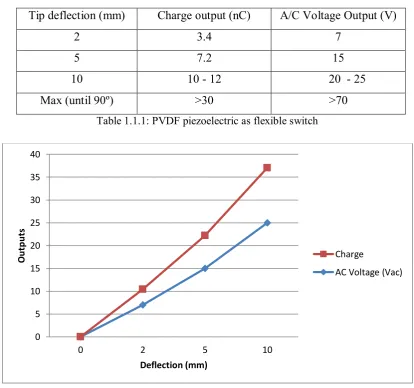
Besides that, the PVDF sensor can act as accelerometer or vibration sensor. The PVDF sensor has been used widely in the several applications such as vibration sensing in washing machine, low power wakeup switch, low cost vibration sensing, car alarms, body movement of machine or robot, and security systems. The PVDF sensor is tested as flexible switch and the results are written in a datasheet as below.
Tip deflection (mm) Charge output (nC) A/C Voltage Output (V)
2 3.4 7
5 7.2 15
10 10 - 12 20 - 25
[image:14.595.111.526.323.711.2]Max (until ) >30 >70
Table 1.1.1: PVDF piezoelectric as flexible switch
Figure 1.1.2: Graph of Voltage output vs Tip deflection
0 5 10 15 20 25 30 35 40
0 2 5 10
O u tp u ts Deflection (mm) Charge
4
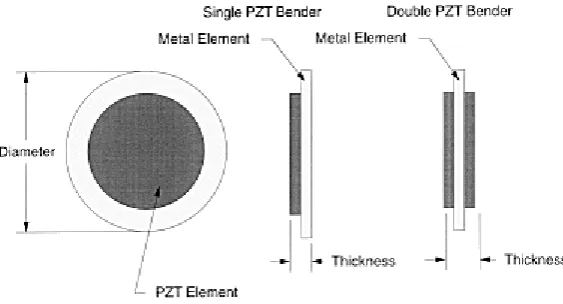
[image:15.595.179.461.280.432.2]The second type of piezoelectric transducer chosen is the Lead Zirconate Titanate (PZT). This type of piezoelectric transducer is made from ceramic materials called ceramic perovskite hence when the compound changes its shape when an electrical field is applied. Besides, the PZT has constant sensitivity and inexpensive transducers compared to PVDF. This PZT is one of the piezo ceramics that can withstand any mass or vibration that applied but the PZT’s high sensitivity will degrades over time. Most likely the degradation is related with increased temperature.
Figure 1.1.3: PZT piezoelectric transducer
5
1.2 Problem Statement
Recently, the interest in renewable energy sources and its reliable working is rapidly growing and giving much attention without using conventional thermal power or nuclear plants according to the demand for energy in developing countries by MET (2015a). Energy in the surrounding area can be capture and the latest energy that can be harvest is by converting mechanical energy from raindrop’s vibration into electricity that can be used to power sensors or other device by Zyga (2008). Malaysia has equatorial and tropical climate with being hot and humid throughout the years. It will be high temperatures in earlier months and rainy season in the following months. The method of harvesting energy from rainfall is a good alternative as sustainable power system where it is installed in the tropical region with rain season by Wong et al. (2016a) especially in the rural area of Melaka.
The energy demands arise as the years pass on by Warude et al. (2015a). According to Tenaga Nasional Berhad (TNB), the electrical tariffs in Malaysia start increasing in 2014 due to the high demands. The TNB record stated that the demand in electricity start to increase on 28 May 2014 with 16,583MW. In the following years, the latest electrical tariff showed that the electrical bills are also increasing in 2016. According to TNB, the highest electricity demand in Malaysia’s history with 17,175MW on 9 March 2016. This record had broken the previous record of 16,901MW in 6 June 2014. This means that the renewable energy sources are focused to avoid environmental and energy crisis by Warude et al. (2015b). The type of piezoelectric plates that will be use is the Polyvinylidene Fluoride (PVDF). Energy generations are done by binding the plates to make the structures vibrate and gain physical strain for generation of electricity by Dakua and Afzulpurkar (2015). When a single raindrop hitting the piezoelectric plates, it generates voltages less than a dozen of volts but no evaluation on power is proposed by Miceli et al. (2014).
6
permanent and ubiquitous energy sources by Park (2010). To solve the problems this module is require to build and to apply in the rural area of Melaka for community usage. Based on the problems, there is a need to design, to configure and to verify this module that will harvest the energy from the rainfall. The most suitable solutions for the low power supply are by using the piezoelectric materials to be use in this project module.
1.3 Project Objectives
This project is the design of rainfall’s vibration based power generation module for rural area in Melaka was developed to give more convenience to the user. There are several objectives as follows:
1. To design a module for alternative power generation which generates electricity by harvesting the natural energy that produce from the raindrops. The designated module has to be suitable to use and apply in the rural area.
2. To analyze the output parameters that relates with kinetic energy conversion method and its efficiency that affects towards the module. The effect from the kinetic energy of the raindrops is the impact of the raindrops on the module surface which produce vibration energy.
7
1.4 Project Scope
According to the Malaysian Meteorological Department, there will be rainy season which means the quantity of the rain in this season is above the average of the amount of rain for every end of the year in Malaysia. This project will focus on the alternative power generation which can harvest the natural energy from the raindrops to produce electricity. The project will be applied in the rural area of Melaka. In 7th
June 2015, Melaka was one of the states in Malaysia that experienced flood due to the heavy rain. The simulation that will be used is Multisim software to present the signal output. The hardware of the module will be design using the PVDF (Polyvinylidene Fluoride) piezoelectric.
8
CHAPTER 2
LITERATURE REVIEW
2.0 Conditions and weather changes in Malaysia
9
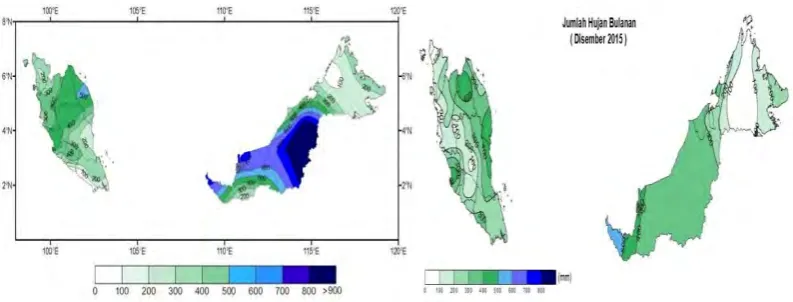
[image:20.595.119.522.308.429.2]Figure 2.0.1: Northeast Monsoon (NEM) on January 2015 and February 2015
Figure 2.0.2: Two Inter-Monsoon (MA) on March 2015 and April 2015
[image:20.595.136.508.535.655.2]10
[image:21.595.121.519.299.400.2]Figure 2.0.4: Southwestern Monsoon on July 2015 and August 2015
Figure 2.0.5: September 2015 and October 2015 (SO)
[image:21.595.120.517.511.662.2]11
Figure 2.0.7: Northeast Monsoon on January 2016 and February 2016
Melaka is one of the states that achieved status as a developing country in 2010 and starting to achieve the country’s vision towards 2020. According to the Melaka Green Technology policies, the state government has set three objectives such as to increase the process of developing in the state, to strengthen the state status of the city, and to improve the state status through the use of sustainable technologies and practically apply the Green Technology. Melaka has goals to achieve the title of “State Urban Green Technology” and 7 major sectors of UN-UAE framework focusses are in power, time reduction, urban design, urban environment, transportation, environmental health and air. In order to achieve one of these goals the study will be focused and conducted in Melaka.
12
[image:23.595.122.522.287.434.2]According to the bar chart 1 below which is taken from World Weather and Climate Information website (2015), the amount of rainfall in Melaka when the NEM occurred between November until February 2015 shows a decreasing trend. However, it shows that the amount of rainfalls in Melaka has the highest value in November 2015 because it is the earlier of NEM season. During two inter-monsoon seasons (MA), the western region of Peninsular Malaysia represents the higher indices of the amount of rainfall by Syafrina et al. (2014f). These affect the Melaka area and it is proven by the bar chart figure 2.0.8 below that shows an increasing trend from March to April. The average amount of rainfall in Melaka is maintained from May to August when the SWM season happened by Syafrina et al. (2014g).
Figure 2.0.8: Average precipitation (rain/snow) in Melaka, Malaysia by by Syafrina et al.
(2014h).
2.1 Power generation from the rain source
13
which are turbine test, open circuit test and system test to determine the how much power can be generated. The prototype of Micro Hydro Generator has been built which consists of turbine and generator. This project is able to generate approximate 7 V and 17 mA. With the help of circuitry part, this generated power is able to charge up hand phone by Yan et al. (2011c).